Less Preaching, More Praying

Psalm 119.33-40

Teach me, O Lord, the way of your statutes, and I will observe it to the end. Give me understanding, that I may keep your law and observe it with my whole heart. Lead me in the path of your commandments, for I delight in it. Turn my heart to your decrees, and not to selfish gain. Turn my eyes from looking at vanities; give me life in your ways. Confirm to your servant your promise, which is for those who fear you. Turn away the disgrace that I dread, for your ordinances are good. See, I have longed for your precepts; in your righteousness give me life.


I’ve mentioned The Circle in a number of recent sermons, and for good reason. Every week, our youth gather together as a witness to the loving nature of God made manifest in their lives. While others their age are consumed by that which they consume: the Internet, social media, attention from co-eds, false identities, and even politics, our kids are consumed by another thing they consume: the body and the blood of Jesus Christ.

But I don’t want to lay it on too thick. I love our youth, but they can be miserable at the same time. I have never been more self-conscious about my balding head than when one of our boys insists on bringing the subject up every single week. (Honestly, I think he does it not because he cares about my lack of follicles, but because he enjoys watching my reaction to his provocation.)

Another one of our youth will miss a meeting (too much homework, play practice, or some other obligation) only to have her brother tell me that she’s not at The Circle because a recent sermon I preached made her lose her faith.

Another one of our youth will purposely pretend like he can’t find a particular book in the bible, forcing one of us to flip through and declare the page number only to have him smile diabolically in return.

Like I said, we’ve got wonderful and miserable youth at this church.

Anyway, as I’ve mentioned on a number of occasions, we follow the same formula every week – we gather around the table for communion, fellowship, and bible study. Communion looks a lot like it does in this room whereby we pray together for God to pour out the Holy Spirit on us, and on the gifts of bread and the cup. And after we feast we go to the box.

The box contains a random assortment of questions designed to get all of us to share and reflect on what it means to be faithful. An example: “Who do you trust the most and why?” The question propels us to think about the value of our friendships, and implores us to be thankful for the people we trust.

One of the more frustrating questions is: “When was the last time you shared your faith with someone?” Everyone always sighs deeply when that one is pulled, but one by one they’ll each struggle to share a moment from the last week or so when they talked with someone about their faith.

But recently we read a new question: “If you could change one thing about the church what would it be and why?” Without hesitation, my follicle-conscious friend said, “I’d get rid of the preacher!” Another youth however, took the question seriously and said she would make the youth group larger so we could share the stories of Jesus with more people.

One by one each youth got a chance to reflect about a particular change to the church, and we ended with our adult volunteer for the evening. You see, everyone has to answer the question from the box whether you’re in the sixth grade of you’re sixty.

After giving the question some deep thought she said, “I’d get rid of the preaching… I’ve always thought that preaching in worship was okay, but it’s not the most important part of what we do. Sometimes you go on a little too long. But I would definitely increase our prayer time. In fact, what if all we did was pray?”

I got burned.

The preaching on Sunday is a little long? Seriously? You all should be grateful! I get you out of here before the Baptist churches in town every week, and we want to talk about the length of the sermon?!

I’m only teasing. But maybe she’s on to something. What if we prayed more, and I preached less?

less-is-more-blog-image

The psalmist, at least the author of Psalm 119, was a praying poet pleading with God. No preaching, no pontificating; only praying.

Teach me Lord, give me understanding, lead me in the path of your commandments, turn my heart to your decrees, turn my eyes from looking at vanities, give me life.

Where does this life of prayer come from? Praying like the psalmist requires an awareness of God’s presence. We can pray like the psalmist when we poetically plead with God, not to show that we are above anyone else, not out of arrogance, but with remarkable humility and hope – we ask God to give us what only God can give us.

And we can dispense with polite trivialities. No more do we need to start our prayers with a listing of God’s divine attributes, no more do we need a long list of adjectives before we begin to converse with the Lord. We need only pause, breathe, and then declare our faith in the Lord who hears and responds to our prayers.

Teach us, O Lord, your ways and we will follow on the path to the end. Give us understanding God, so that we can observe your will here on earth with our whole hearts. Lead us on your paths and we will delight in traveling the way that leads to life. Turn our hearts to your commandments, and not to our own selfish and arrogant ambitions. Turn our eyes from looking at vanities, the things that fade away, the things that do not give life, and instead give us life in you. Confirm to us your promises God because we are worthy when we fear you. Turn away the disgrace that we are ashamed of, for you are forgiving. O God, we have longed for your will; nothing more, nothing less, nothing else. In your righteousness, give us life.

When those words become our words, when we can utter them with true faith and humility, when we can ask for God’s will to be done and mean it, then our prayers will always mean more than my preaching. As Karl Barth said, when we clasp our hands together in prayer, it is the beginning of an uprising against the disorder of the world.

Because this is what we need God to do for us. We need God’s help to empower our uprising against the disorder of the world. We need God to teach us, to lead us, and to turn us. We cannot do this stuff on our own.

God, thank you for gathering us together in this place, at this time, with these people to call on you to make us into your people. Come to us now! Awaken us! Give us your light! Be our Teacher and our Comforter! Speak to us through the scriptures, through the prayers, through the hymns, through the sermon, so that we may hear just what we need and what will help. Preserve us by your Word; protect us from hypocrisy, error, boredom, and distraction. Give us knowledge and hope and joy.

We can pray like that. We can pray like the psalmist. We can do it from the comfort of our bedrooms when we wake up and right before we fall asleep. We can pray from the depths of our souls in this holy place whenever we gather together. Our prayers can be as long and as profound as the entirety of Psalm 119, or they can be as short and as simple as: Lord have mercy on me, a sinner.

Praying to God is a good and right thing because it actively makes us participate with the divine. Praying calls us to question the status quo, and to wonder about what could be. Praying challenges us to see ourselves for who we really are and to ask for God’s help to be better. Prayer changes things, and more often than not the thing that prayer changes is us.

prayer-changes-me

But sometimes we need to be prayed for, more than we need to pray for ourselves. Do you hear the difference? It is good and right for us to pray to the Lord like the psalmist, but at the heart of being a disciple of Jesus Christ is a willingness to share our burdens and needs with others, and to receive their prayers for us when we cannot pray on our own.

Years ago, I helped lead a mission trip to Costa Rica. We went for a week, and I was responsible for keeping track of the youth at our different work sites, and led devotions each night. A large focus of the trip was partnering with the local community in order to empower them, rather than helping with something only to disappear a few days later.

Every day, whether we were working on construction for a new school building, or we were helping young children in a day care program, the whole trip was about creating relationships with people.

Of course, for some of us, myself included, this was quite a difficult task since there was a language barrier. We quickly learned to speak with our hands and with the few words we knew of each other’s languages, and we did the best we could.

At the end of the trip I asked the youth to each pair up with someone they connected with during the week, but not someone from our own team. The kids quickly dispersed to find the friends they made over the week and I watched my sister Haley walk over to Jose. Haley and Jose were the same age; both had wonderful and loving personalities; but they couldn’t have been more different.

One grew up with all the advantages and privileges of an American who grew up outside of Washington D.C. The other lived day to day without a clear understanding of what the future held.

And yet, even though they spoke different languages, and had different hopes, and different dreams, they sat down together and prayed for each other. Haley went first, she prayed for Jose and lifted him up to the Lord. I only later realized it was the first time that Haley had ever prayed for another person out loud. And after Haley said “amen” Jose grabbed her by the hands and prayed for her.

Haley could not understand a word he uttered, but she wept as Jose prayed for her.

I know this is going to drive some of you crazy, but I am here not just to comfort the afflicted, but also to afflict the comfortable. So, in just a moment, we are going to pray for one another. You will feel tempted to find one of your friends in the congregation, someone you are comfortable with, but we all need to resist that temptation. We are going to stand up, and move about the sanctuary until we find someone we are not as familiar with, and they will be our prayer partners. And we’re going to talk to them. We’re going to listen to them. We’re going to pray for them. And they are going to do the same for us.

Remember, God does not need ornate and complicated prayers; God only needs our hearts. Pray for one another as you feel led, and then I will lead us in a congregational prayer. So, let us pray.

We are afraid, God, and we believe we can and should hide ourselves from you. We did it in the Garden, we did it in the wilderness, and we still do it today. We even think we can hide from ourselves. For better or worse, usually for worse, our desire to hide scatters and shatters our identity in you. As a result, we begin to hate ourselves, our families, our neighbors, and even You. We hate ourselves, and one another, because You refuse to believe that we are the masks we wear. God, help us learn to trust your love. Help us to learn we do not need to pretend to be something we are not. Help us accept that we are who we are because of You. Forgive us God. And as forgiven people, help us follow your Son in this world shaped by lies and deception. As your forgiven people, make us your salvation, that the world might see how good and great it is to be who we are, your children. Amen.

The Mission Of The Church

1 Corinthians 3.1-9

And so, brothers and sisters, I could not speak to you as spiritual people, but rather as people of the flesh, as infants in Christ. I fed you with milk, not solid food, for you were not ready for solid food. Even now, you are still not ready, for you are still of the flesh. For as long as there is jealousy and quarreling among you, are you not of the flesh, and behaving according to human inclinations? For when one says, “I belong to Paul,” and another, “I belong to Apollos,” are you not merely human? What then is Apollos? What is Paul? Servants through whom you came to believe, as the Lord assigned to each. I planted, Apollos watered, but God gave the growth. So neither the one who plants nor the one who waters is anything, but only God who gives the growth. The one who plants and the one who waters have a common purpose, and each will receive wages according to the labor of each. For we are God’s servants, working together; you are God’s field, God’s building.


When I lived in Harrisonburg, I played drums for a worship service that met every Sunday evening. On Sunday mornings the sanctuary would be packed with individuals and families from the community who would listen to the organ, sing from the hymnal, pray from the pews, and worship together. On Sunday evenings however, we would set up for a very different type of worship service: we had two electric guitars, a bass, a drum set, and a couple singers. Instead of suits and dresses most people came as they were, and instead of the sanctuary being packed, we were lucky if there were more people in the pews than in the band.

The basic worship formula included playing four or so songs, reading scripture, hearing a sermon, celebrating communion, and then playing one more song. Which meant that I spent most of the evenings sitting behind a drum kit looking out at everyone else. From this vantage point I quickly learned who always came late, who refused to sing certain songs, who let themselves go and put their hands in the air to praise, and who pretended to pray while they were actually texting someone on their phone.

I had been playing with the band for a while when I started to notice a young man, probably about my age, who walked in during the first song, and left during the last song every week. We had other people show up for one Sunday a month, or would be there for a couple weeks in a row only to disappear for a months at a time, but this guy was there EVERY WEEK.

Week after week I watched him arrive only to depart before I had a chance to talk to him. But, even though we didn’t talk, his faithfulness was palpable. As a college student, he came to worship week after week while others were choosing to put their allegiances in other places.

When the academic year was coming to a close, the leadership team for the service met to discuss changes for the future. It was abundantly clear that we were not growing and we wanted to make more disciples of Jesus Christ so we started discussing ways we could get more people to join us.

I suggested that we speak to the young man who snuck in and snuck out; after all, he showed up more than anyone else, and I thought he would have some ideas for us.

So the next Sunday, we purposefully ended with a song that did not use the drums so that I could talk to him before he jettisoned out of the sanctuary. We met by the doorway and I introduced myself. I explained that I saw him come in every week, and apologized for not doing more to make a connection. I then launched into a dense theological reflection about why we need more people to come to the service and that all of us thought he would be a great person to speak with. He listened as I went on and on until he raised his hand and said, “That sounds nice and all, but I’m not a Christian.”

            “Not a Christian? What do you mean you’re not a Christian? Why have you been here every week if you’re not a Christian?”

            “I don’t feel like I belong anywhere else, and I don’t have any friends.”

eternal-mission-church_620

We, as human beings, want to belong. We want to belong in the worst ways whether we’re in preschool, high school, or it’s been a long time since we’ve been in school. Out of this desire for belonging we join communities: neighborhood associations, sport teams, civic organizations, and even scout troops.

But they tend to disappoint us. We hope for a sense of identity and purpose and community to magically erupt soon after we begin participating, but because people are so focused on themselves, or someone forgets our name, or someone else argues with us over a matter of opinion, we become disappointed and disillusioned. And before long, we fall back into that pit of loneliness.

The same human desire for belonging was apparently true of the folk in Corinth. The church that Paul helped to inaugurate was struggling. The people wanted desperately to belong, to be part of something. And they joined the church, but then (like we always do) they broke up into factions: I belong to Paul, I belong to Apollos, or some other leader.

One need not stretch the imagination to hear the same sorts of declarations in the church today: I’m a Republican, I’m a Democrat. Zig Volskis was the best pastor we ever had. Steve Greer was the best pastor we ever had.

Paul caught word of these divisions and wrote to the church: Who do you belong to? Why are you dividing over issues of leadership? I came to you with the message of Jesus Christ and him crucified, but clearly it did not take root deep enough. So long as you continue to quarrel you will not be ready to be Christ’s church.

Who do we belong to?

We have a book in the United Methodist Church called The Book of Discipline. In it, its paragraph 120 if you’re interested, we have the mission of the church written out plainly for all to read and understand.

mission_umc_logo

The mission of the United Methodist Church is to make disciples of Jesus Christ for the transformation of the world.

Making disciples is at the heart of what it means to be a United Methodist. I mean, its what Jesus calls the disciples to do at the end of Matthew’s gospel: Go therefore and make disciples of all nations baptizing them in the name of the Father, Son, and Holy Spirit.

But making disciples is often confused with filling the pews.

It results in having conversations about how to get more people in the building while neglecting to interact and connect with the people already in the building. It results in infantile discipleship. It results in working for the numbers, and not the kingdom.

And then we’ve got this bit about transforming the world. Is that really our mission? Do we have the church to change the people and the community around us? Should that be our soul purpose? Does the church exist to make the world a better place?

The church is defined by the sacraments of communion and baptism in order to be a community of difference and peace. The church, therefore, is called not to make the world a better place, but to be the better place God has already made in the world.

Of course, the problem is whether or not our experience of the church matches its definition of being the better place.

I suspect that many of you have experienced the church as Paul experienced it: Disagreements, petty arguments, and at times suffocating silence between bickering factions. For some, the pews of the sanctuary are more like walls of division and less like avenues of connection.

If church is the better place that God has already made in the world, then it should, like it was for that young man in Harrisonburg, be the place to cure loneliness. Because loneliness is something all of us have experienced in some way, shape, or form, and is a wound not easily healed.

I spend an hour every week with the youth of our church at our gathering called The Circle. We always have communion and answer questions and study the bible. But we often just talk about what’s going on in each other’s lives. And, without breaking their trust, I’ll tell you: their lives are not easy. There is such a tremendous amount of pressure placed on them by outside forces. They feel compelled and pushed to change their image, the way they talk, the way they think, and even what they believe in order to be accepted.

Some weeks I leave our Circle meeting feeling broken by what they have to endure on a regular basis, only to have a conversation the next day with an adult who is going through basically the same things in a different context.

The world would have us change. Change your image, hide your faults, be someone else.

As Christians, however, we walk with our wounds and our cracks and our brokenness instead of running away from them. We cannot accept who we are until we discover that we are loved by God because of who we are.

The church can be the better place that God has made in the world because the church is the place where we walk with our wounds and loneliness because of Christ and him crucified. The broken and lonely Christ on the cross knows our brokenness and our loneliness. But he also carries our wounds so that we might see the One who truly loves us.

God is transforming the world. God is the one who makes the first last and the last first. God does, and should, get all the good verbs. Our God is a God of action, of change, of transformation. We are the church, we are the vineyard of God’s garden, we plant the seeds, we water the seeds, but God is the one who makes them grow.

You and I, with our sins and our disappointments, with our fears and loneliness, we have a place here. God invites us to the better place where we are welcomed not because we fit the mold, but because we do not fit the mold. We have a place in this better place because we are caught up in God’s great story.

Just look at the cross, consider the waters of baptism. God is made manifest in the world not through the powerful, not through the expectations of the mighty, but through the weak and through the shamed; through babies and wandering Israelites; through tax collectors and fishermen; through a poor rabbi murdered by the state.

This is the better place God has made in the world. And in this place we remember our baptisms, we remember our death to self and our resurrection in Jesus Christ. We remember our baptism and through that water we remember the story of creation, of the flood, of the exodus. We remember that in our baptism we became part of the body of Christ, the church, where we should never be lonely. Where we should never be made to feel as if we are not enough.

In baptism we joined the better place God has made in this world.

Who then do we belong to?

Do we belong to political rhetoric and partisan ideology? Do we belong to church growth programs co-opted by a desire to see more people in the pews? Do we belong to isolationism or interventionism? Do we belong to a world that pressures us to become that which we are not? Do we belong to Paul or to Apollos? Do we belong to the flesh and are consumed by jealousy and quarreling?

No.

            In this better place, we belong to God. Amen.


(With thanks to Jason Micheli, Stanley Hauerwas, and Will Willimon)

God Said It, I Believe It, That Settles It

Deuteronomy 23.12-14

You shall have a designated area outside the camp to which you shall go. With your utensils you shall have a trowel; when you relieve yourself outside, you shall dig a hole with it and then cover up your excrement. Because the Lord your God travels along with your camp, to save you and to hand over your enemies to you, therefore your camp must be holy, so that he may not see anything indecent among you and turn away from you.

1 Corinthians 14.32-35

And the spirits of prophets are subject to the prophets, for God is a God not of disorder but of peace. As in all the churches of the saints, women should be silent in churches. For they are not permitted to speak, but should be subordinate, as the law also says. If there is anything they desire to know, let them ask their husbands at home. For it is shameful for a woman to speak in church.


We have a problem. I’m sorry that I have to use the pulpit to bring it up, but this is the best way to reach the highest number of people. We, as a church, have fundamentally broken one of God’s laws and we need to do something about it. We need to pray for forgiveness. We need to seek God’s mercy. And, we should get moving on this issue quickly in order to establish our faithfulness before the Lord.

We need to stop using the church bathrooms.

Now, some of you might be thinking: What in the world? Stop using the bathrooms? We’ve heard him say some strange stuff from the pulpit, but this has to be the strangest!

But scripture is pretty clear. We are supposed to have a designated area, outside the church, where we shall go when nature calls. We are supposed to keep a trowel with us at all times so that when we relieve ourselves outside, we can dig a hole and then cover up our excrement. We need to do this because the Lord is with us when we are in church, therefore this church must be holy and we can’t let the Lord see anything indecent among us.

So, after prayerful consideration, the trustees have voted to permanently close all the bathrooms in the church building, and we will construct some outhouses on the edge of the property for excrement disposal.

Just kidding.

lexica

Have you ever heard someone preach on Deuteronomy 23.12-14? I haven’t, nor have I even encountered it during a bible study. But in the 1880’s, churches and bathrooms were quite the topic of sermonic conversation. The advent of indoor plumbing had arrived and the question about whether or not to have bathrooms in churches started to pop up.

By the logic of the Old Testament, churches were seen just like the Israelite encampments and because of this the same rules about where people could relieve themselves were applied. Many preachers used this argument from their pulpit more than a century ago to fight the growing trend to build bathrooms in churches!

Today, when designing a new church, one of the first questions isn’t what the sanctuary should look like, or what kind of design will enhance the altar, or even how many people can fit in it, but how many bathrooms should there be, and where should they be put.

How do we understand the Word of God? Do we believe that all scriptures have been inspired by God and are useful for teaching? What does it even mean that God inspired the writing of scripture?

Years ago I was invited to participate in a bible study that met once a week. At the time we were going through the gospel of Matthew when one of the women in attendance interrupted with a dilemma for the group. Her son told her that he was thinking about getting a tattoo and she knew that God forbids this kind of behavior in the Old Testament. It was clear that she was looking for approval from the rest of us, but I opened my big mouth and said something like, “Well, I don’t think its that big of a deal” To which she replied, “If God says it in the bible, then the issue has been settled!”

I should have stopped right there, but I couldn’t help myself. “So, you don’t eat pork or shrimp? And you are going to rally the community together to stone your son to death for rebelling against you? And you didn’t mean to wear earrings today because you know the bible forbids them as well?”

This sort of extreme biblical literalism is problematic, and basically impossible. If we try to live by the Word with extreme rigidity, we would not be allowed to wear clothing with blended fabrics, we’d have to completely rethink our diets, working on the Sabbath would get us killed, and men would not be allowed to trim their beards. Ever.

            God said it, I believe it, that settles it.

This is another one of the trite and cliché Christianisms that float around in conversation. When Christians get into an argument about a particular biblical precept, like prohibitions against tattoos or homosexuality, they will take a verse and use it like a weapon against the person they disagree with. God said it, I believe it, that settles it.

But, whether we admit it or not, rarely do we read the bible and think, “Okay, that settles it then.”

Today, no one worries about whether to build a church without a bathroom, we don’t hear preachers belabor biblical dietary restrictions, and we neglect a great number of scriptures while at the same time we use scripture to attack others.

There are all sorts of rules and regulations in scripture that, if we’re honest, we pick and choose to emphasize.

bible-and-its-interpretation

As we read earlier, Paul is clear in more than one letter that women should not speak in church. And yet, this church had a female pastor for a number of years, and our liturgist this morning just read out loud from the bible! Heaven forbid! A woman speaking in church! Can you believe it?

Of course, some churches still believe that the words about the subordination of women are the gospel truth. In those church, women are not allowed to serve in leadership positions, they are not allowed to teach Bible Studies where men are present, and they are not allowed to serve in any capacity that would require them to speak in front of the congregation.

I’ll tell you right now, this church would not be here if women kept their mouths shut. We are as faithful as we are because the women in our midst have been brave enough to speak what God has placed on their hearts, and because we have listened.

So what are we to do? We can’t just throw out the bible, but at the same time we can’t live by every single word within it.

Like the apostles and disciples before us, we read scripture and we hear God speaking through it. But we also ask questions of it. We consider context. We wonder if God really intended women to remain silent in church. We recognize that things like slavery are counter to God’s will, despite more than 200 verses that support it in the Bible. We don’t preach and teach that having bathrooms inside churches are offensive to God.

We follow Jesus’ example.

Jesus, Son of Man and Son of God, did not adhere to strict biblical literalism. He had different interpretations of the Sabbath restrictions, he had stronger opinions about divorce and adultery, and he regularly disobeyed the Law by eating with those deemed unclean.

Living as a Christian, reading the bible, it’s all about interpretation. And, to be clear, interpretation does not mean to change the text, or to ignore it, but to proclaim it for this time and for this place.

Even the Bibles in our pews are themselves a work of interpretation. Someone, and more often than not some people, made particular choices about how to translate particular words from Hebrew and Greek into English. This might not seem like a big deal, but if you take something like one of the most beloved of all scriptures: For God so loved the world that he gave his only begotten son that whosoever believe in him may not perish but have everlasting life. The word for “perish” in Greek is apollumi which can mean perish, but it can also mean to die, to be destroyed, to be lost, killed, or ruined. Each of these translations can change the meaning of the text slightly, and are therefore a product of interpretation.

So whenever we take up a bible, whenever we flip to a specific passage, the work of interpretation started long before our eyes flow over the English translation. But nevertheless, even the best translations leave us to continue the task of interpretation.

How do we do it? Well, we don’t do it in isolation. We don’t read our bibles in our living rooms never to speak about the words again, we don’t listen to a sermon only to have that be the only time we encounter the words.

We interpret God’s Word in community. We go to bible studies, we send emails to our friends and to our pastor, and we do what we need to do in order to comprehend that which is often incomprehensible.

And we let Jesus help us interpret. In the beginning was the Word and the Word was with God, and the Word was God. As the definitive Word, Jesus helps us to understand the words of scripture. We read from the Old and New Testament alike through the lens of Jesus and we begin to wrestle with how these words continue to live and breathe in our lives today.

But that requires a lot more work than “God said it, I believe it, that settles it.” It compels us to actually take up our bibles, read them, and talk about them. It challenges us to ask hard questions and produce new ideas. It requires us to believe that this book is in fact the living Word of God and that it continues to speak truth in new and exciting ways, perhaps in ways we cannot even imagine.

This last week has been filled with controversy from the Oval Office. In their first week, the new administration put forth a number of executive orders including a call to begin construction on a wall at our southern border, a gag order for the EPA, and the halting of refugee migration from a number of countries.

c3nffwbxaae5lbr

On the same day we celebrate the liberation of the concentration camps in Europe, our country said, “we don’t want them” to people fleeing persecution and destruction.

Now, no one has said that this has been done because of scripture, but the bible should have played a role in the decision if our politicians are going to keep claiming their Christian allegiance.

Moses was a refugee after fleeing from Egypt.

            Ruth was a refugee after her husband died and she followed her mother-in-law to a strange new land.

            The entire Israelite people were refugees in Babylon.

            Jesus, the one we worship here in church, was a refugee. Jesus, like people in the Middle East today, had to flee his home out of fear of violence, persecution, and even death.

And yet, we tout these certain stories from scripture and hold them over people’s heads about behavior and identity. But when we start actively preventing the oppressed from entering the country, we forget all about the story of our Lord and Savior.

People have used this book, with understandings like “God said it, I believe it, that settles it,” to attack and belittle people for far too long. It has been used to justify the horrific practice of slavery. It has been used to subjugate and relegate women’s rights. It has been used to rationalize physical violence and aggression toward people of different religions. It has been used to incite fear and terror in those who do not believe. It has been used as a weapon again and again and again.

And now we, the people of God, join together to say “no more!”

“No more!” to the use of scripture like a weapon to oppress the weak and the marginalized. “No more!” to the complacent Christianity that stands idly by as people are attacked for whom they are. “No more!” to the backwards ways of the past that lose sight of God’s grace here and now.

“No more!” to God said it, I believe it, that settles it.

God Won’t Give You More Than You Can Handle

Mark 2.1-5

When he returned to Capernaum after some days, it was reported that he was at home. So many gathered around that there was no longer room for them, not even in front of the door; and he was speaking the word to them. Then some people came, bringing to him a paralyzed man, carried by four of them. And when they could not bring him to Jesus because of the crowd, they removed the roof above him; and after having dug through it, they let down the mat on which the paralytic lay. When Jesus saw their faith, he said to the paralytic, “Son, your sins are forgiven.”


On the day of the funeral, everything felt too familiar. The pews were filling up with the same people who were here the week before, the same family was waiting in the narthex, and our organist was even playing some of the same music as people were walking in.

I stood right here in front of the gathered congregation and asked everyone to stand for the family. Leading the profession were two daughters who were about to bury their father after burying their mother the week before. Their grief and pain and anger were palpable as they slowly walking down the center aisle, and everyone watched them as they passed.

And we did what we do for a service of death and resurrection. We prayed. We opened up the hymnals and proclaimed God’s faithfulness through song. We listened. We grieved. We cried.

As we finished, I watched the pallbearers stand up and surround the coffin. With hands shaking in nervousness and fear they carried their friend’s body out of the church and put him in the hearse.

And we did what we do when travel to a cemetery. We got in our cars and turned on our hazard lights. We followed one another through the streets of Staunton. We watched cars slow down and pull over out of respect for what we were doing. We drove. We listened. We grieved. We cried.

After arriving at the cemetery, I watched the same pallbearers carry the coffin to the grave over uncertain soil. With sweat perspiring on their foreheads they lowered their friend to the ground and stood beside the family.

And we did what we do by the graveside. We prayed. We listened. We placed dirt on the coffin. We said what we needed to say. We listened. We grieved. We cried.

After the final “Amen” I waited by the grave with a few others, making sure the family was comforted. I overheard familiar and charming anecdotes about the man we just gathered to bury. I witnessed family members reach out to one another for the first time in many years. I saw a lot of tissues filled with tears wadded up in clenched fists.

And then I saw something I’ll never forget. A man, unknown to me, walked right over to one of the daughters devastated by the loss of both her parents. He placed his hand on her shoulder and said, “Don’t worry, God won’t give you more than you can handle.” And with that he turned around and walked away.

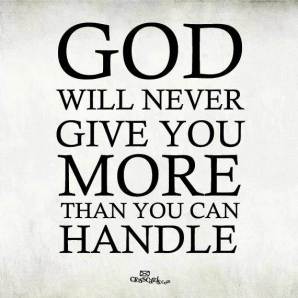
God won’t give you more than you can handle.

635787512482303409305489483_29f1979c65db2aa1627169bad37391df-imgopt1000x70

I’m sure that all of us here have heard this statement, or some form of it, in our lives. It is part of that trite and cliché Christian-lingo that we use to fill uncomfortable silences when we don’t know what else to say. And it’s not true.

Let’s start with the beginning: God won’t give you… We’ve talked about it with every sermon of this series so far; God doesn’t give us our sufferings. God is not some sadist who delights in our trials and tribulations. God is not some architect of divine destruction. God is not sitting up in heaven plotting away about what terrible things to send for us to handle.

Can you imagine going to a devastated neighborhood in Chicago to families whose sons have been killed by gunfire and saying, “Don’t worry God won’t give you more than you can handle”?

Can you imagine going to a young mother recently diagnosed with breast cancer and saying, “Don’t worry, God won’t give you more than you can handle”?

Can you imagine going to the millions of people in this country who are terrified of losing their healthcare coverage in the next few months and saying, “Don’t worry, God won’t give you more than you can handle?”

God did not kill those families’ sons, God did not give that woman breast cancer, and God is not responsible for the arguments about whether or not to eradicate the Affordable Care Act.

Sometimes, we say things like “God won’t give you more than you can handle” because we don’t know what else to say. We encounter the shadow of suffering that is so suffocating we don’t know how to respond. So instead, we will that awful void with awful words. And we make God into a monster.

The problem is that when we use trite and cliché words like the ones we are confronting this morning, we imply that God chooses to make people suffer.

Jesus, God incarnate, had been on the road for a while, going from town to town, synagogue to synagogue, proclaiming the Good News, teaching about the kingdom of God, and healing those on the margins of society. Word about his ministry spread pretty vast, and he returned to Capernaum for a few days, perhaps to rest. But so many people knew where he was that they surrounded his house and Jesus spoke the Word to them.

Some friends heard about what was happening, so they went to their paralyzed friend and carried him on a mat to Jesus. When they could not bring him to the Messiah because of the crowd, they carried him to the roof, dug through the ceiling, and lowered their friend to Jesus. And when Jesus saw the faith of the friends, he looked at the paralytic and said, “Son, your sins are forgiven.”

What a strange and beautiful story. Friends with such profound faith were willing to carry their friend, and dig through a roof, just so he could encounter the living God.

I often wonder about the tradition of pallbearers at funerals. Did it start of out a practical necessity? Is there strong theological purpose behind it? Is it a unique Christian behavior?

But on the day I buried a husband after burying his wife the week before, the day I saw a man dismissively respond to the daughter’s suffering, I saw the connection between pallbearers, and the friends who carried the paralytic to Jesus.

When we cannot handle what’s happening in our lives, we need people who can carry us, and the ones we love, to Jesus.

We will face adversity in our lives. We will experience hardships. We, or someone we love, may struggle with debilitating depression or suicidal thoughts or grief so heavy it feels like someone is sitting on our chest. We might give in to the temptation of an addiction and lose contact with the people we need most. We may fall into a pit of financial debt that feels impossible to climb out of.

If we are like most human beings, at some point we will absolutely face things that are more than we can handle.

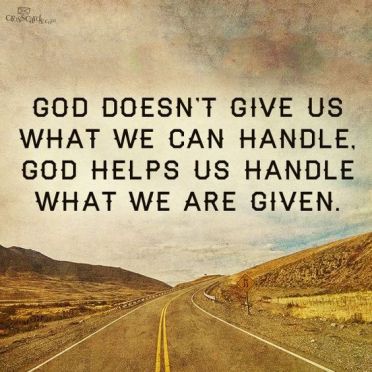
So here’s a corrective. It’s not that God won’t give you more than you can handle, but that God will help you handle all that you’ve been given.

6fa0c8a00d809d23761dfaa71b6b542a

This acknowledges that trials and tribulation will occur in our lives, and it promises that when we go through the muck and grime of life, God will be present.

When we’re walking through hard times, whether they were given to us by the random chance of life, or they’re a result of our own brokenness, or they’re signs of our captivity to the powers and principalities, it’s okay and good to admit, “I can’t handle this by myself, and I need help.” There are times when we need a doctor, or a therapist to carry us. More often, we need family, friends, pastors, neighbors, and brothers and sisters in our church family to come alongside us to carry us through.

God does not give us more than we can handle. God gives us Jesus Christ so that we can handle what life gives us.

For a lot of people, what happened on Friday in Washington DC was more than they could handle. Whether it was the pent up frustration with the political rhetoric that overflowed over the last 18 months, or witnessing a billionaire place his hands on Abraham Lincoln’s bible, or experiencing the great swing of the pendulum from one political ideology to another, it felt overwhelming. Some responded with violent protests and destroyed shop windows and attacked the police. Others responded with peaceful demonstrations making sure their voices were not stomped out among all the shouting debauchery. There were the political talking heads offering their opinions about who was right and who was wrong. There were smug smiles and there were frightening frowns. The inauguration, for some, was more than they could handle.

For others, the last eight years has been more than they could handle. Whether it was the constant feeling like the country was slipping out of their fingers, or the realization that the American dream is not what it once was, or the rise of oppositional and divisive voices, it felt overwhelming. Some responded with protests and boycotts of particular institutions, others responded by focusing inwardly and praying for change, and still yet others waited patiently for a new direction. For eight years there were plenty of talking heads offering their unsolicited opinions about who was right and who was wrong. The last eight years, for some, was more than they could handle.

Some say the time has come for all of us to just get along. A couple weeks ago I even told you that we, as a church, should have a collective New Year’s resolution to be more kind.

Kindness and getting along are good and nice. But there are people around us, people in our lives, who need more than kindness and getting along. There are people desperately clinging to the hope of their healthcare coverage completely unsure of what it about to happen. There are people who are hopeless when confronting their joblessness and economic futures. There are people shaking and quaking about their faith and whether or not they are going to be forced to register themselves because they wear a particular piece of cloth on their heads. There are people who see police officers as enemies and not community protectors.

There are people in our community; there are people in our church, who have more than they can handle right now.

We need people, like the friends who carried the paralytic to Jesus, to carry others who have more than they can handle. We need people who can look us in the eye and tell us we have a problem. We need people who will call their friends every night just to get them through a profound period of loss. We need people like all the women who marched in solidarity all across the world yesterday. We need people with eyes wide open to the horrible suffering of the people around us so that it does not go on unnoticed. We need people who are unafraid of the consequences for questioning the status quo. Right now, we need people who are brave enough to carry us to Jesus. Amen.


dumb-things-christians-say-sermon-series-idea

God Helps Those Who Help Themselves

Psalm 121

I lift up my eyes to the hills – from where will my help come? My help comes from the Lord who made heaven and earth. He will not let your foot be moved; he who keeps you will not slumber. He who keeps Israel will neither slumber nor sleep. The Lord is your keeper; the Lord is your shade at your right hand. The sun shall not strike you by day, nor the moon by night. The Lord will keep you from all evil; he will keep your life. The Lord will keep your going out and your coming in from this time on and forevermore.

A guy was walking down a street when all of the sudden he fell into a deep hole. The walls were so steep that he couldn’t climb out and he began crying out for help. A doctor was passing by and looked down into the pit when the man yelled up, “Hey! Can you help me out?” The doctor thought about it for a moment, wrote a prescription, threw it down into the hole and kept walking.

Then a preacher came walking along and the guy shouted up, “Reverend, I’m stuck down here in this hole, can you help me up?” The pastor slowly put his hands together, said a prayer for the man, and kept walking.

Next, a sweet older woman from the local church came up and the man yelled, “Please help me. I’m stuck down here and I can’t get out.” The woman stared right into the man’s eyes and said, “Don’t you know that God helps those who help themselves?” And with that she went on her way.

Finally, a friend walked up and the man shouted, “Hey! It’s me down here! Can you help me out?” And the friend jumped right into the hole. The first guy said, “Are you stupid? Now we’re both stuck down here!” The friend said, “Yeah, but I’ve been down here before and I know the way out.”

A relatively recent poll found that better than eight in ten Americans think, “God helps those who help themselves” is in the Bible. In fact, more than half the people who responded to the poll were strongly convinced that it is one of the major messages of scripture.

Quote Typographical Background - vector design

Guess what? It’s not in the bible!

Do you know where it actually comes from? There are hints of the phrase in ancient Greek mythology, but it became popularized by Benjamin Franklin in Poor Richard’s Almanac published in 1736.

And yet, a majority of people in this country believe it is a major aspect of Christianity straight from the lips of Jesus.

Of course, there is some, very small, truth to the statement. After all, if we sit around our dinner tables praying for God to miraculously provide us with food, we’re going to be disappointed. We can eat because God has blessed creation with abundance and through things like employment we can afford to provide food for our tables. God helps us because we work to help ourselves.

Likewise, focusing in school, listening to our spouses, nurturing our children, these things result in our lives being better because we have worked for them to be better.

But that pales in comparison to how “God helps those who help themselves” has been used by Christians to avoid our obligation to help others.

Like the woman walking passed the man in the hole, it blinds us from our responsibility toward others and frees us from feeling guilty for how broken the world is outside of our respective bubbles.

The truth is: some people cannot help themselves. Societal discrimination, generational poverty, institutional racism, and a host of other problems prevent people from helping themselves. Some people, in fact many people, are in holes so deep, with walls so steep, that they can’t climb out without help.

About a year ago, some of the pastors in Staunton got together to talk about ways we could minister to the homeless population in our community. We asked ourselves how our respective churches could work together to help the people that cannot help themselves.

At first we debated the pros and cons of establishing something like a computer lab to help individuals apply for jobs. The thought being that if they found work, they could have an income, and no longer be homeless. We discussed offering weekly classes in reading, mathematics, and financial management at the Valley Mission to teach important skills necessary for breaking free from the cycle of homelessness. But in the end, only after we finally connected with homeless community members in Staunton, we discovered what they really needed were showers and a place to do their laundry.

What we failed to realize was that all the best training and teaching would be meaningless if the individuals arrived to a job interview wearing the same clothes they had been sleeping in for months.

We, the pastors, had walked passed the hole many times and decided how to fix the problem from our vantage point, rather than jumping into the hole in the first place.

The Church, and I mean big “C” Church, cannot shrug off the responsibility to help others with the use of another trite and cliché sentence because God, over and over again, commands his people to take special care of the poor, the widow, the orphan, and the needy.

A cursory scan through the prominent stories of the Old and New testaments leads us to the biblical truth that God helps those who cannot help themselves.

maxresdefault-1

In Leviticus, God commands the farmers to not harvest all the way to the edge of the fields. Certain amounts of the produce were supposed to be left for the poor and the immigrant. Instead of consuming it themselves, or selling it for a profit, a portion was to be left for those who were not able to make ends meet or for the strangers in the land.

In another part of the Old Testament, God says that compassion for others is itself a form of worship. There are times when the priest and the religious leaders heaped up sacrifice after sacrifice, they had the perfect worship services with all the right prayers and all the right songs, and God tells them their worship has become lifeless.

            What difference does it make if we show up at a place like this for an hour a week if we ignore the people God tells us to care about the rest of the week?

In the New Testament, Jesus is forever going from town to town and seeks out the last, the least, and the lost. And when he finds them, the sick and the needy, does he say, “God will help you if you help yourself?” When the crowds gathered to hear Jesus speak, did he command the disciples to tell the hungry 5,000 that God will give them food if they go collect it for themselves?

No. Jesus helps them. He connects with their brokenness and brings healing. He sends the abandoned back to the villages that disowned them, he feeds the hungry out of the abundant grace of God, and he helps people precisely because they cannot help themselves.

Have you ever felt like you’ve been the one down in the pit? Have you ever encountered a moment in your life that felt so suffocating and oppressive that you knew you couldn’t get out of it on your own? Have you lost a job, or a spouse, or a child? Have you received a frightening medical diagnosis, or a horrible tip for the stock market, or a habit that you couldn’t kick?

We can claw all we want, we can plead on our knees with our hands clasped in the air, but sometimes the only way out of the pit is if someone jumps in to help us find the way out.

From where will out help come? We lift our eyes to the edge of the pit and we see that our help comes from the Lord. The Lord who sends us a friend willing to jump down into the depths of our despair, the Lord who never abandons us even when we feel alone, the Lord who was willing to jump down into the pit of humanity and be born into this fractured world of ours.

That, my friends, is the whole point. We help others who cannot help themselves because God helps us when we cannot help ourselves. God came into the world as a baby in the deep pit of fear and suffering of a couple all alone in the world. God went to the margins of society in Jesus Christ to sink low into the stink of the world and offer hope. God went to the broken families and the battered spouses and the abandoned children and showed the way out. God went to the very depth of death just so that all of us could find the way to salvation.

Tomorrow, some of us who work will not have to because of Martin Luther King Jr. Day. It is a day set apart to remember the man who led this country through a particularly horrible period of racial injustice. His life, his teachings, his marches, and his protests all bear witness to his willingness to jump into the pit of his people’s suffering, in order to find a way out.

A father was with his four year old daughter last Christmas, and it was the first time she ever asked what the holiday meant. He explained that Christmas is all about the birth of Jesus, and the more they talked the more she wanted to know about Jesus so he bought a kid’s bible and read to her every night. She loved it.

They read the stories of his birth and his teachings, and the daughter would ask her father to explain some of the sayings from Jesus, like “Do unto others as you would have them do unto you.” And they would talk about how Jesus teaches us to treat people the way we want to be treated. They read and they read and at some point the daughter said, “Dad, I really like this Jesus.”

Right after Christmas they were driving around town and they passed by a Catholic Church with an enormous crucifix out on the front lawn. The giant cross was impossible to miss, as was the figure that was nailed to it. The daughter quickly pointed out the window and said, “Dad! Who’s that?”

He realized in that moment that he never told her the end of the story. So he began explaining how it was Jesus, and how he ran afoul of the Roman government because his message was so radical and unnerving that they thought the only way to stop his message was to kill him, and they did.

The daughter was silent.

A few weeks later, after going through the whole story of what Christmas meant, the Preschool his daughter attended had the day off in celebration of Martin Luther King Jr. The father decided to take the day off as well and treat his daughter to a day of play and they went out to lunch together. And while they were sitting at the table for lunch, they saw the local newspaper’s front-page story with a picture of Martin Luther King Jr. on it. The daughter pointed at the picture and said, “Dad! Who’s that?”

“Well,” he began, “that’s Martin Luther King Jr. and he’s the reason you’re not in school today. We’re celebrating his life. He was a preacher.”

And she said, “for Jesus?!”

The father said, “Yeah, for Jesus. But there was another thing he was famous for; he had his own message and said you should treat everyone the same no matter what they look like.”

She thought about it for a minute and said, “Dad, that sounds a lot like do unto others as you would have them do unto you.”

The dad said, “Yeah, I never thought about it like that but it’s just like what Jesus said.”

The young girl was silent again for a brief moment, and they she looked up at her dad and said, “Did they kill him too?”

If we are serious about following Jesus, it’s going to cost us. It might cause embarrassment, or ridicule, or shame. It might cost us money, or time, or status. But jumping into the pit comes with a cost. Thanks be to God.


dumb-things-christians-say-sermon-series-idea

Everything Happens For A Reason

Deuteronomy 30.19-20

I call heaven and earth to witness against you today that I have set before you life and death, blessings and curses. Choose life so that you and your descendants may live, loving the Lord your God, obeying him, and holding fast to him; for that means life to you and length of days, so that you may live in the land that the Lord swore to give to your ancestors, to Abraham, to Isaac, and to Jacob.


Since Thanksgiving, I have been at a lot of tables with a lot of people and talked about a lot of things. That’s what the holidays are often about, and frankly what we remember the most; we might forget the first present we opened, or who was the first person to arrive, but we can almost always recall those table side discussions.

A lot of things happened in 2016 that warranted conversation at those particular tables. The deaths of celebrities, cultural icons, and transformative leaders; the rise in popularity of strange things like Pokemon Go, the Netflix hit Stranger Things, and Bruno Mars’ 24K Magic; the never-ending saga of suffering in Syria, the increase in terrorist related events throughout the world, and the ever thinning ice like situation in the middle east; the incredible Rogue One, the magical Fantastic Beasts and Where To Find Them, and vibrant color palette of Trolls.

But do you know what was talked about more than anything else?

Politics.

Politics. Politics. Politics.

And then when you throw a pastor into the fray at the tables, you start mixing together the real forbidden topics of conversations.

So I have learned, over the years, to keep my mouth shut. Whether I agree with a political policy or not, I nod my head along with the speaker regardless of their position and then reign myself to sit in silence.

In the last few months I have been at tables where people bashed the political rhetoric of the Republican Party, I listened to people re-imagine a new Democratic platform with notes hastily written on cocktail napkins, I watched people force index fingers at others while berating the likes of Bashar al-Assad and Vladimir Putin, I’ve heard people place bets over how long it will take Donald Trump to build a fence at the border with Mexico, and I’ve seen people cry with tears of pain, and people cry with tears of joy, while talking about the political future of the United States of America.

But I heard something the other day that I can’t get out of my head, one theologically politicized statement that has rattled through my brain ever since.

It went like this:

“Did you hear what Franklin Graham said?”

            “You mean the son of Billy Graham?”

            “Yes, him.”

            “No, what did he say?”

            “He said that it wasn’t the Russians who intervened in the presidential election, it was God.”

Now, before we really get into this, I want to be clear. Donald Trump is going to be the president of the United States. That’s a fact. Even though we now live in the so-called time of “post-truth,” the truth is that Donald Trump will be president.

But how Donald Trump became the president elect is something we should talk about. Particularly when one of the leading Christian evangelists in this country can say something like “God made Donald Trump president.”

dumb-things-christians-say-sermon-series-idea

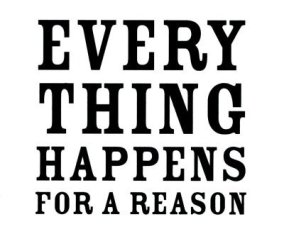
Everything happens for a reason. This is true, of course, in the sense that actions have consequences. If I step down from this pulpit and walk to the back and flip the switch in the breaker box, all of the lights in the sanctuary will turn off. If plants do not receive enough moisture and sunlight they will not grow. If I give my wife a mop for Christmas, I’m going to get in trouble.

In our scripture from Deuteronomy, Moses offers the Israelites a similar reflection: if you choose life and love the Lord you may live in the land the Lord promised. Actions have consequences. However, the problem with “everything happens for a reason” is that we almost always imply that God is the reason that everything happens.

So, to take the recent election as our example, if it was God who intervened to make sure that Donald Trump became president, why wasn’t the victory more lopsided? Or, does it mean that everyone who voted for Clinton is a sinner for doing so because they went against God’s will? Did God choose not to “show up” for the Obama elections in 2008 or 2012? If everything happens for a reason, then why did God choose to have Donald Trump elected as president while all sorts of other things (like the situation in Syria, Police shootings, etc.) are still happening?

And this logic can also be applied to a number of things: If everything happens for a reason, then why did one of my best friends die in a car accident when she was a teenager? What is the reason for men who beat their wives, or women who abuse their children, or children who assault their parents?

When we throw out a trite and cliché sentence like “everything happens for a reason” it removes all responsibility from us and puts it all on God. And yet, we do believe that God is in control, that God is the author of our salvation, and that God continues to move and act in this world of ours.

everything-happens-for-a-reason

This is fundamentally at the heart of the strange mystery of what it means to be a disciple. On one side we affirm that God rules, and on the other side we affirm that God has given us perfect freedom to live and act in this place that God rules.

God has given us the freedom to make choices, for better or worse. From the Garden of Eden to the sanctuary of St. John’s on this first day of 2017 we are free. When we do something right or wrong, we can’t blame it on God. It is our freedom to choose who we are to be, that allows this world to be as strangely beautiful as it is, but it makes it strangely broken and flawed as well.

We are not marionettes being strung along by a divine puppeteer. God gives each of us, his creatures, a brain, a heart, a soul, to make choices and act in this world. We use things like prayer and the reading of scripture to help us determine how our choices can coincide with God’s will, but the choices are fundamentally ours to make.

All of us know that terrible things happen that cannot be explained. They are a part of life. But we also know that those terrible things do not have the final word. We know that God is working through us, helping us to see and to know who we are to be in order to transform this world into his kingdom. And we know that God is the one who has the final Word, thats what Jesus’s birth and resurrection changed. God came into the world in order to free us from the last vestige that had a hold on us, death. God broke the chains of death’s dark shadow in order to guide us into the light of resurrection. We know that even though terrible things happen, and will continue to happen, God’s love in Jesus Christ is the final Word.

Living in this tension of God’s perfect sovereignty and our perfect freedom is one of the things that makes being a Christian so challenging. For when we encounter those terrible things that happen in the world we often vacillate between “everything happens for a reason” or “life is meaningless.” Whereas Christians, people like us, are called to live somewhere in the middle.

In the early hours of April 15th 1912, more than a hundred years ago, the infamous ship named the Titanic sank in the Northern Atlantic Ocean. 1,500 people were lost at sea when the ship ran into an iceberg and it is still one of the worst maritime disasters to have ever happened.

Much like other events that grab the attention of the world, many pastors felt called to speak about the disaster the following Sunday in order to make sense of the tragedy. In a small sleepy Swiss village was a young pastor named Karl Barth who regularly bored his congregation with long theologically dense sermons, but the Sunday after the sinking of the Titanic called for something a little more meaningful.

He used the beginning part of the sermon to outline the power of the almighty from creating the cosmos to bringing life to all creatures. He referenced heavily from the book of Genesis and went on and on. But at the end he said something that grabbed their attention.

It went like this: God most certainly put the iceberg in the water, but God did not make the captain feel pressured to beat the record time across the Atlantic and thereby neglect to pass slowly and safely through a region filled with large icebergs.

1101620420_400

Barth’s simple reflection is by no means perfect, but it points toward a better way of thinking about, “Everything happens for a reason.” Sometimes there are reasons things happen, people feel tempted to go faster than they should and it means they run through red lights, they neglect to check their blind spots, or they run into icebergs. Sometimes people feel disaffected and forgotten by their government and they come out in droves and subvert the majority of polls and elect a political outsider to the most powerful position in our earthly world.

But that doesn’t mean that God made a car accident happen, or that God willed the sinking of the Titanic, or that God had a reason for making Donald Trump the next president of the United States.

And sometimes things happen for no reason at all. Fathers in perfect health and in the prime of their lives die of sudden heart attacks. Natural disasters like tsunamis and hurricanes come out of nowhere and devastate entire communities. Marriages fall apart for no particular reason other than the build up of tiny disagreements that never get settled.

And still there is hope. There is hope because God can work through people like you and me to bring about the kingdom on earth. God still speaks through the ancient scriptures to remind us of the importance of ministering to the last, the least, and the lost. God places opportunities in our lives that we can choose to respond to, and in so doing, we can become the reason good things happen.

God has set before us life and death, blessings and curses. We have the choice to choose life so that our families and friends may live to love the Lord and obey what he has taught. If we choose the good we may all live in the peace that God promised to God’s people from Abraham, to Isaac, to Jacob, to David, to Isaiah, to Jesus, to Peter, to Paul.

So it is good and right for us to start this New Year in this place, where God makes all things new. At this table we receive the spiritual food necessary for the journey of life. We break bread knowing that strange things are afoot in this world, but that God moves in and through people like us to shine as a light in the darkness. We surround the cup together knowing that Jesus’ sacrifice opens up the glory of the resurrection and gives us the strength to do incredible things here and now.

Not everything happens for a reason. But sometimes God calls us to be the reason something good happens to someone else. Amen.


The Humanity of God – Christmas Eve Sermon on Luke 2.1-7

Luke 2.1-7

In those days a decree went out from Emperor Augustus that all the world should be registered. This was the first registration and was taken while Quirinius was governor of Syria. All went to their own towns to be registered. Joseph also went from the town of Nazareth in Galilee to Judea, to the city of David called Bethlehem, because he was descended from the house and family of David. He went to be registered with Mary, to whom he was engaged and who was expecting a child. While they were there, the time came for her to deliver her child. And she gave birth to her firstborn son and wrapped him in bands of cloth, and laid him in a manger, because there was no place for them in the inn.

Colorful holiday lights background, defocused

Christmas Eve! No matter how old or jaded we may be, no matter what kind of year precedes this night, Christmas Eve never fails to brighten our spirits. I look forward to Christmas Eve with a kind of painful excitement: I know there are people here tonight who will not be here the rest of the year, I know this holiday carries with it more meaning than can be contained in a 15 minute sermon, and yet to share the story of salvation is one of my greatest privileges.

But then the question must be asked: Why are you here tonight? Some of you were raised in this church and can’t imagine being anywhere else. Some of you have come alone; others are with large families taking up an entire pew. Some of you have been planning to come here for weeks and some of you decided on a last-minute impulse. Some of you have been dragged here against your will, out of loyalty and guilt. And some of you are here for the first time in a very long time.

Some of you are young and are full of hope and anticipation; most of your Christmases are still in front of you. Some of you who are older are filled with memories of Christmases past that will never come again. Some of you are looking forward to getting back home to the fireplace and the presents and the tree; others dread going home. Whoever you are, and whatever you’re feeling, I’m glad you’re here tonight.


On April 26th, I woke up to the sounds of my excited wife declaring, “I think it’s happening.” The due date for our son had come and gone and each day we waited with anticipation of his coming arrival. So, being the incredible husband that I am, I started offering Lindsey all kinds of things: “Do you want me to make you breakfast? Can I massage your feet? Would you want me to call the doctor?”

She, however, was distracted from my offers by the pain she was starting to experience.

As the day progressed I must’ve checked our hospital bag no less than 42 times, I made sure we had enough clothes and snacks, I went through the 3 birthing playlists (one for calm, one for happy, one for pushing), and I asked Lindsey how she was feeling every fifteen minutes. While I was frantically going through my list over and over, Lindsey was on the couch trying to find a comfortable position to sit in until things really got going.

Mary and Joseph spent the day before their son’s birth traveling over harsh terrain while Joseph led the donkey that was carrying his pregnant fiancé. With every bump and slip, the pain Mary experienced increased and she hoped against hope they would find a place to stay in Bethlehem.

When my wife’s contractions started coming at a regular interval we called the doctor’s office and they told us to come in. Under the caring gaze of the nurses and medical staff Lindsey went through a number of tests before they told her, as kindly as they could, that it was still too early to go to the hospital, so we went home instead.

Mary’s contractions must’ve started to really ramp up as they arrived in the sleepy little town of Bethlehem. All the people they encountered were busily talking about the census that the emperor had required, how they all had to be there in Bethlehem without a choice. To the degree that no one even noticed the man escorting the pregnant woman on a donkey as they passed through the outskirts of the town.

We waited all day and finally at 9pm, the contractions we regularly occurring at such intensity that we knew the time had come. Being the good husband that I am, the car had been packed with our hospital bags for hours and all I had to do was gingerly walk Lindsey to the car and drive to the hospital with care and focus. When we were given a room time seemed to increase in speed dramatically. With every passing minute the contractions were intensifying and the nurses came in at a higher frequency to check on Lindsey and the baby.

Mary and Joseph wandered through the town at a snail’s pace hoping to find somewhere to stay, or a relative to encroach upon. But the farther they walked, the less hope they had of finding a place for the night.

At some point, my beloved wife was breathing strongly through a particularly rough contraction when the nurse said, “Honey, I think it’s time to talk about pain management.” I, watching her go through this thought to myself, “Gee, I think its time for me to have some pain management.” But, being the good husband that I am, I knew not to speak that thought out loud.

Joseph guided the donkey to their last hope, the inn, while his wife was breathing heavily through a particularly rough contraction. The innkeeper saw them walking up and went to the door to announce: “We’re full.” Being the good man that he was, Joseph then led the donkey and Mary to a stable, the only place left and helped her down into some crinkly hay.

At 7am on April 27th, Lindsey started to push. She was surrounded by a team of medical staff, machines monitoring every heartbeat and contraction, and by me trying to figure out what I could to do help.

When Mary could tell that the time had arrived, she started to push. She was surrounded by dirty animals huddled together for warmth, hay that was covered in dirt and hair from the animals, and a man who was trying to figure out what he could do to help.

And with a final push, a son was born into the world. The baby was quickly placed into his mother’s arms and for a fleeting moment nothing happened. In our hospital room the medical team waited with blankets and devices, in the stable the animals watched as the miracle of life came to fruition.

And then, with what sounded like a rush of wind, the baby sucked and breathed in air for the very first time.

From a dirty barn house to an immaculately clean hospital delivery room, the first breath of Jesus and my son Elijah highlights the fragility of this thing we call life. And don’t we take it for granted? All of us have been breathing throughout this sermon without even thinking about it, but we can only live because we can breathe.

In the beginning God’s breathed the breath of life into Adam, God breathed life into Jesus, God breathed life into my son Elijah, God breathed life into every one of you.

It is something worth celebrating because it is a miracle.

But this service, what we’re doing here tonight, is not a mere celebration of a mother and her newborn child’s arrival into the world. It is about more than the miracle of life. This is the unique story of God in the flesh. The baby placed in the manger is not us and we are not Him. He is totally other.

And yet – and this is the real mystery of Christmas – Jesus is the incarnation of the living God, but at the same time, though he is entirely other than us, he has become one of us. Nothing less than God himself has become Emmanuel, God with us.

In Jesus’ birth, God entered history in a new and strange way with the promise that in the kingdom that has no end, sadness will be turned into joy, sin will be destroyed by righteousness, and death will be defeated by resurrection.

But it all started in a tiny little stable with a couple all-alone in the world. That is the true miracle of Christmas – the fragility and humanity of God in a breath. For it is in our breathing that we constantly encounter the one thing we have to do to survive and the one thing we have from the beginning to the end of our days. And that is where God is; with every single breath we inhale the Spirit of the Lord who first breathed life into us. And in our breathing we connect with the one who breathed for the first time in the manger long ago…

And through that first breath, God emptied himself of all power and reign and might and majesty, leaving it all behind to enter our corrupted, polluted, and tragic world. Gone were the days of abandonment, gone were the times of uncertainty, and gone was the power of death. For God came into the world through a baby in a manger to save us from ourselves; to be with us in every single breath; to offer us the true gift of Christmas: God with us.

Merry Christmas. Amen.

christmascandle

Too Busy To Welcome – Advent Homily on Romans 15.7

Romans 15.7

Welcome one another, therefore, just as Christ has welcomed you, for the glory of God.

too-busy-for-christmas-1

When Bob Sharp was sent to Marquis Memorial, I know that he was welcomed because it didn’t take long for the church to paint his office burgundy and gold in honor of his dedicated devotion to the Washington Redskins.

When Courtney Joyner started at St. Paul’s, I know she was welcomed because she is a triple-threat: She can sing, she can jam, and she can preach.

When John Benson first preached at Augusta Street, I know he was welcomed because his people haven’t stopped shouting “Amen!” since his first sermon.

When Won Un showed up at Central, I know he was welcomed because their entire church community has developed an affinity for Kimchi and they know that if they can’t find Won on a nice day, it’s because he’s out riding his bike.

When Janet Knott arrived at Jollivue, I know she was welcomed because she preaches with gifts, and who doesn’t love presents?

When Clayton Payne began at Cherryvale, I know he was welcomed because people keep showing up week after week even though he keeps preaching the same sermon over and over again.

When Bryson Smith was appointed to St. Paul’s, I know he was welcomed because they know if the sermon falls flat, he can always sing a solo and get the people to shout “Praise the Lord!” and “Mercy!”

When Sarah Locke was sent to Christ, I know she was welcomed because people started showing up in her kitchen while she was still unpacking boxes. I know that because I was there!

I know the United Methodist churches of Staunton are a welcoming bunch because you have so warmly welcomed your pastors. But I wonder, do we welcome everyone to our churches in the same way we welcome the pastor when he or she first arrives? Do you really welcome one another just as Christ welcomed us?

When I arrived in Staunton, Won and I got together and thought it seemed about time to resurrect the Lenten and Advent luncheons. We were not here when they used to happen and so we were able to tweak the schedule and the organization a little bit. Important for us was the shifting of host churches and guest speakers so that everyone got a chance to welcome, and every preacher got a chance to preach.

Fun fact: As of Christmas day, I will have preached in every single United Methodist Church in Staunton. And it only took me three and a half years!

Anyway, we got the Lenten luncheons started again, and the first time I was invited to preach we were gathering at Central UMC. At the time, I was young and naive, and I thought it would be a good idea to wear my Carharrt Overalls when I preached from the pulpit in order to really drive home the message. Maybe you were there. Maybe you even remember some of the things I said.

I poured out my heart and soul from the pulpit at Central UMC and I did my best to make the people of St. John’s as proud as possible. Afterwards, during lunch, after the tenth or so person made a comment about my attire, an older woman came up to me and asked if we could talk (I won’t say which church she was from).

So we moved to the corner of the social hall, and she gingerly placed her hand on my shoulder and said, “I understand that you’re new to town you might be looking for a church home, so we’d love to have you join us for worship on Sunday.”

I remember just standing there stunned. I mean, it was a kind gesture for her to invite me to church (particular when the average person in a United Methodist Church invites someone to worship once every 33 years). But going to another church on Sunday is impossible.

She welcomed me, but she didn’t listen to me. I suspect that she was more concerned with having people in the pews, than with knowing who the people are in the pews.

Welcome one another, therefore, just as Christ welcomed you, for the glory of God.

How did Jesus welcome? Well, he certainly didn’t wait for people to just show up because he was having a service on a Wednesday afternoon, or a Sunday morning, or even on Christmas Eve. Jesus welcomed others by showing up in their lives, he met them where they were and ministered to them in terms and in ways they could understand. He told stories that connected with their daily living, stories about the soil and the birds of the air. He welcomed them in the midst of their suffering and isolation. He welcomed the very people who would abandon him to a table without cost.

At St. John’s we have a Preschool and I spend time every week leading the kids in what we call chapel time. I’ll take a lesson from scripture and try to rework it in ways that can understand and apply to their life.

Last week, after practicing the Christmas pageant for what felt like the thousandth time, I set up a small table near the altar and I invited the kids to come sit and listen. The thirty minutes prior to chapel time were filled with pushing and tripping and laughter and debauchery, but when they sat down around the table I started speaking in a soft voice, and they all started to listen.

I said, “My friends, I have something I want to share with you. This is bread and grape juice, but it is about to me much more than that. For this is a gift that Jesus gives to us. Some of you might do this in your church on Sundays, and whenever we sit at the table we are remembering Christ’s love for us. At this table, all of us are welcome no matter what. So let’s pray… God thank you for loving us so much that you welcome us no matter what we’ve done and no matter who we are. I pray that you would pour out your Spirit on us and make us more like Jesus so we can love others. Amen.”

And then one by one I called them by name, I gave each of them a piece of the bread, they dipped it into the cup, and the received communion.

Unlike us, the preschoolers have the benefit of not rushing around through this season of Advent endlessly crossing items off our to-do lists. Unlike us, the preschoolers don’t feel burdened by the tyranny of things and can sit quietly for a moment to receive a gift better than anything under the tree.

It often happens around this time of year that we feel too busy to welcome. We become more concerned with the wrapping paper and the ornaments and appearance of things than with the welcoming love of the Lord who was born into an unwelcoming town. When our sanctuaries fill up with more people than usual on Christmas Eve we are more often burdened by making sure everything is in the right place, than we are by making sure we are in the right place to welcome and be welcomed by the Lord.

And it is at the meal, the Lord’s Supper, the thing that most of us do on the first Sunday of the month, where we learn what it really means to welcome like Jesus. For Jesus is the one inviting you to the table, not merely hoping that you will show up to fill an empty place in a pew, but earnestly and truly yearning for your presence. You are invited because you are unique, you are wonderful, and you are a child of God. There is a place for you at the table no matter what.

Can you imagine what our churches would really look like if we welcomed others as Christ welcomed us?

Amen.

Let’s Talk About Doubt – Sermon on Isaiah 7.10-16

Isaiah 7.10-16

Again the Lord spoke to Ahaz, saying, Ask a sign of the Lord your God; let it be deep as Sheol or high as heaven. But Ahaz said, I will not ask, and I will not put the Lord to the test. Then Isaiah said: “Hear then, O house of David! Is it too little for you to weary mortals, that you weary my God also? Therefore the Lord himself will give you a sign. Look, the young woman is with child and shall bear a son, and shall name him Immanuel. He shall eat curds and honey by the time he knows how to refuse the evil and choose the good. For before the child knows how to refuse the evil and choose the good, the land before whose two kings you are in dread will be deserted.”


What a strange promise. The Lord will give you a sign. Look, the young woman is with child and shall bear a son, and shall name him Immanuel. The promise sounds nice and sweet, after all its part of a lot of the hymns we sign during this time of year. We read these verses and our minds immediately jump to the manger scene with Mary and Joseph carefully cradling the baby Jesus with the animals remaining perfectly quiet and still. But this promise is made to a particular person in a particular moment, and that’s what makes it strange.

At the time of Isaiah’s proclamation, forces were gathering and attempting to attack and invade Jerusalem. The King, Ahaz, is deeply afraid. And it is in the midst of his fear that God offers the King a sign, any sign that he wants, let it deep as hell or high as heaven. God offers Ahaz any sign he wants so that the king will remember to trust the Lord. Ahaz, appearing quite faithful, says he will not put the Lord to the test (the same thing Jesus says during the temptations in the wilderness), but the Lord ignores Ahaz and proclaims the coming sign nonetheless.

So it is while King Ahaz is shaking in his boots, while troops are gathering at the gates, that he receives a sign of God’s promised presence: A young woman will bear a son named Emmanuel.

Now, let’s be real for a moment: God’s promise of a baby is weird. And it’s rather ambiguous. God does not say, “I will destroy the invading forces with terrible violence” nor does the Lord promise that Ahaz will survive. Instead, God says that a baby is coming to save the world.

I don’t know about you, but Christmas, to me, always seems full of happy go lucky faith without any doubt or questions. Lights are hung up on all the houses, people tune their radios to the Christmas stations, and parents want their children to behave themselves in the Christmas pageants.

But doubts and questions are there, perhaps just barely below the surface of the façade we wear around during these weeks we call Advent.

doubt

Do we doubt? Are we allowed to? What happens to us if we do? More than a few of us will be sitting in the pews on Christmas Eve singing Joy to World and celebrating the Christ-child while we’re really wondering what it means to believe.

King Ahaz doubted. While surrounded by enemies, and offered a miracle by God, he insists on not putting God to the test. This might sound really faithful, but God offers something incredible and Ahaz turns it down. His pious response is more a dismissal of the Lord being able to actually help.

Moses doubted. When the Lord asked him to go and deliver the people from the tyranny of Egypt, Moses quickly listed off the excuses for why he shouldn’t be the one to go.

Jeremiah doubted. When the Lord called him to be a prophet to God’s people his response was quick, “I am only a boy! Surely I can’t speak on your behalf”

Jonah doubted. When the Lord commanded him to travel to Nineveh he traveled in the opposite direction in order to avoid what he had been asked to do.

Zechariah doubted. When the Lord spoke to him and told him that his wife was going to become pregnant he did not believe the Lord could perform such a miracle.

John Wesley doubted. You know, the guy in the stained glass window right there. He was asked to go travel to a strange place called Georgia and preach the Good News but he did not have faith. And when he told his superiors about it, they said, “Preach faith until you have it; and then, because you have it, you will preach faith.”

Even Jesus doubted, though only for a moment. When he found himself all alone and nailed to the hard wood of the cross, he cried out, “My God, my God, why have you forsaken me?”

Sometimes we feel like if we have doubts it is the complete opposite of having faith. In fact, many leave the church whenever that first doubt starts to creep in and they begin to wonder about the truth and promises of God’s Word.

I know more people than I can count who, at some point, were devout and faithful followers of Jesus Christ. And all it took was a little dose of the dirty word for their faithfulness to crumble. Was there really a virgin birth? Did Jesus really walk on water and feed the 5,000 and bring sight to the blind? Does God really care about our individual lives? Did God really raise Jesus from the dead?

Their entire discipleship hinged on the answer to one of those questions, and when they could not find an answer that was satisfying, they left.

I have friends from seminary who felt called to the ministry but have since left the church because a professor told them something like, “Moses didn’t write the first five books of the bible.” Or “Paul did not write the epistle to the Hebrews.” Or “Some of the psalms attributed to David were not written by David.”

            Doubt is such a dirty word. For a long time it has been shunned from the church and treated like a mortal sin. It has been seen as a weakness. But doubting is often a sign that our faith has a pulse, that it is alive and well and exploring and searching.

            Doubt and faith are not opposites.

            You can’t really have one without the other.

We’re now going to try something a little different, something a little strange, and frankly it might not work. But I’m going to leave this pulpit and come down to you and we’re going to talk about our doubts. Now the point of this is not for you to say something like, “I have trouble believing the virgin birth” and then have me completely remove your doubts with some sort of speech. No, the point of this is for us to be vulnerable and intentional with one another, for us to connect as a community of faith around the fact that we have doubts, but that God is big enough to handle our doubts.

So, what are your doubts?

This week, as I was scrolling through the seemingly endless cycle of news from around the world, I read about Russia’s apparent involvement in the democratic election cycle of the United States, and I read about Apple’s struggle to provide Bluetooth compatible headphones in time for Christmas consumers, and I read and read and read.

But then I saw a picture that still haunts me. In the image, a man and a woman are walking through the city Aleppo, Syria. The woman’s face is covered and her husband is cradling their baby in his arms, while holding up an IV bag that’s running down into the bundle of swaddling clothes.

            I’ll admit that what I should have been struck by most was the violence in the background and the terror in their posture, but what struck me the most was how much it reminded me of Mary, Joseph, and the baby Jesus.

A man carries a child with an IV drip as he flees deeper into the remaining rebel-held areas of Aleppo, Syria December 12, 2016. REUTERS/Abdalrhman Ismail

Over 250,000 people have died in Syria as a result of their civil war, most of them innocent civilians. And while we fret over the incoming president-elect and whether or not consumer goods will arrive on time, modern Marys and jaded Josephs are doing everything they can to protect their babies.

And it makes me doubt. I read the statistics, I see the photos, and I want to know where God is in the midst of all this. How can the God who knows us by name and has counted the hairs on our heads rest easy while innocent men, women, and children are dying at a rate we can barely fathom?

And while this is happening across the world, Christians in our country are worried about Muslims and are seriously considering instituting a registration of all Muslims. And do you know what’s happening in Aleppo? Christians and Muslims are serving shoulder to shoulder pulling children from rubble, consolidating food and resources to share with as many as possible, and are the remaining sources of light in a city under the shadow of death.

I doubt God’s presence in the midst of something as terrible as what’s happening in Aleppo, but then I have hope when I read about Christians and Muslims working together to bring joy to people who feel no joy.

And so I live in this tension between faith and doubt. We all do. We vacillate between the two like a frenetic sphere in a pinball machine. We doubt and we trust. We break down under the tyranny of violence and are built back up by the very nature of love. We weep for the world and its destructive desires, and are comforted by the God who came down to take on our flesh. We lift up our clenched fists in frustration to the sky, and we hear God speak in the still small voice: “Lo, I am with you always.”

Faith and doubt; you can’t have one without the over. Amen.


doubt

Ridiculous Renewal – Sermon on Isaiah 35.1-10

Isaiah 35.1-10

The wilderness and the dry land shall be glad. The desert shall rejoice and blossom; like the crocus it shall blossom abundantly, and rejoice with joy and singing. The glory of Lebanon shall be given to it, the majesty of Carmel and Sharon. They shall see the glory of the Lord, the majesty of our God. Strengthen the weak hands, and make firm the feeble knees. Say to those who are of a fearful heart, “Be strong, do not fear! Here is your God. He will come with vengeance, with terrible recompense. He will come and save you.” Then the eyes of the blind shall be opened, and the ears of the deaf unstopped; then the lame shall leap like a dear, and the tongue of the speechless sing for joy. For waters shall break forth in the wilderness, and streams in the desert; the burning sand shall become a pool, and the thirsty ground springs of water; the haunts of jackals shall become a swamp, the grass shall become reeds and rushes. A highway shall be there, and it shall be called the Holy Way; the unclean shall not travel on it, but it shall be for God’s people; no traveler, not even fools, shall go astray. No lion shall be there, nor shall any ravenous beast come up on it; they shall not be found there, but the redeemed shall walk there. And the ransomed of the Lord shall return, and come to Zion with singing; everlasting joy shall be upon their heads; they shall obtain joy and gladness, and sorrow and sighing shall flee away.

advent_2015_screen


On Christ the King Sunday, the sermon was titled “Not My President.” And before we even started worshipping, more than a few of you made sure I knew your concerns about the impending proclamation. After all, Donald Trump had just procured the necessary electoral college votes to be labeled as president-elect, and people across the country were (and still are) protesting his election with signs saying, “Not My President.” If you were here on Christ the King Sunday, you know that the sermon had very little to do with Mr. Trump, and in fact was all about how grateful we should be that Jesus is not our President.

However, like the good Methodists we are, the sermon was not the pinnacle of our worship that Sunday. You might remember a few lines that I proclaimed from the pulpit, you might even remember one of the hymns we used, but if you sat in the front half of the congregation, I bet the thing you remember most from that service happened during communion.

As always I stood behind the table and I prepared to pray over the bread and the cup. Together we confessed our sins and asked for God to forgive us. We stood up from our pews and shared signs of Christ’s peace with one another. And then I asked God to pour out the Spirit on us gathered together and on the gifts of bread and the cup.

One by one each of you came forward to the front of this sanctuary with hands outstretched to receive the body and the blood of Jesus Christ. One by one I looked each of you in the eye as I tore off a piece of the bread and placed it into your hands. Some of you came up with tears in your eyes. Some of you came up with your eyes focused on the ground, perhaps out of reverence for the precious thing you were about to receive. And some of you came forward with eyebrows askew as if to say, “Who thinks of preaching a sermon about Jesus not being our president?”

The last family to come up for communion sat in the very last pew during worship, and they are connected to the church through our Preschool. Their son is here in the building every week learning about what it means to grow in knowledge, in wisdom, and in love of God. So when his father came up with his hands outstretched I asked if I could offer the bread to his son. The father smiled and said, “Of course.” With his blessing, I knelt down onto the floor and looked at my young friend in the eye and I said, “Owen, this is Jesus.”

To which he smiled, titled his head back slightly, opened his mouth, and waited for me to drop the bread right in.

Without really thinking about it, I took the piece and put it in his mouth, and in response he started chewing while smiling and trying to say, “Thank You Pastor Taylor.”

And I lost it. For whatever reason, I could not contain the laughter that was brewing inside me and I started cracking up. I laughed so hard that I actually snorted. Perhaps it was the seriousness of our service getting flipped upside down by a two year old receiving communion like a little bird from his mother, or maybe it was the smile he offered me while pieces of barely chewed bread were falling out onto the floor, or perhaps it was the little skip in his step while his cheeks were filled like a chipmunk preparing for winter, but I couldn’t stop laughing.

            In that simple and yet profound moment, the desert of our ritualistic liturgy was transformed with blossoms of laughter as other people laughed in response to my snort. In that brief and beautiful moment, God brought this church some much-needed joy.

You see, after spending the better part of two months confronting controversies facing the church and addressing the deep seeded political anger felt in this congregation and across the country, we needed to laugh.

man-jumps-for-joy

Isaiah says the wilderness and the dry land shall be glad. The desert shall rejoice and blossom. The prophet looks to the future and shares the ridiculousness of the renewal that is waiting for God’s people. Like a desert blooming in the middle of a drought, like old and worn out people finding strength in their knees, like tongues of the speechless being filled with words, so will the glory of the Lord transform the world.

In this vision everything is made new from the farthest reaches of creation, to the deepest aspects of our souls. The deserts shall rejoice and blossom, flowers will grow abundantly in the forgotten places, the blind will see, the deaf will hear, and waters will break forth in the wilderness.

God promises transformation and joy. Though not necessarily the transformations and joys we pray for, but ridiculous and redemptive reversals nonetheless. Isaiah sings of liberation, joyful homecomings, and the end of all sorrow and sighing.

Signs of this future of joy will be made manifest in the weak being strengthened, those with feeble knees will stand firm, the fearful will be strong. Those who have long been isolated to the powers of loneliness will be grafted in and never forgotten.

Isaiah sings about the Holy Highway cutting through the wilderness, a way for God’s travelers to move without threat or fear, a place where the people of God’s can sing on their way home.

It sounds a lot like the Garden of Eden, and it sounds a lot like heaven.

But just like last week, Isaiah’s song about the promises of God are not just things that will happen in the distant future; they are part of God’s wonderful and creative reality here and now.

Yet, there are things in this world that hold us back, accidents on the highway of God’s grace, that prevent us from traveling the way to God’s promised salvation. There are chains and bumps that derail us from the pathway to glory: economic fears, political disappointments, spiritual droughts, emotional baggage, relational frustration, and seasonal depression, to name a few. And yet over and over again, whether it’s through a child walking back to his pew with bits of saliva soaked bread falling out of his mouth, or a host of other means, God transforms this world and fills us with joy.

I love to tell stories. From the time we are young children we learn important lessons more through stories and less through object lessons. That’s why scripture is so powerful, and it’s why Jesus used parables to relate the immensity of God to his disciples. This week, in anticipation of this sermon, I emailed a number of you to ask for stories of how God has transformed your life. I wanted to hear about the times that God’s living water broke forth in the midst of an otherwise desert-like existence.

And you did not disappoint.

One of you came to church for years without it really meaning much. It was just the thing you were supposed to do. And on one particular occasion, you were sitting in these pews listening to the choir sing an anthem. There wasn’t anything particularly moving about the words or even the melody, but you found yourself watching the individuals as they were singing and you could tell they meant it. Though you had seen and heard the choir many times, God spoke to you through their faithfulness that fateful day, and since then you have known and experienced the power of God through the music of our church, and through those who provide it.

One of you expressed how narrow-minded and intolerant you used to be. Whether it had to do with politics, or religion, or social status, you judged others unfairly. And then a pastor came to this church named Zig Volskis and he changed everything for you. His spiritual presence and demeanor taught you the importance of asking the right questions, and the importance of being content with answers that pushed you into a new direction. Instead of treating you like a student who needed to be lectured, Zig encouraged you with amazing insights and discernment. And through God working in him, you began to see the Bible not as a book to be consumed, but a life-giving witness to the reality of God.

One of you wrote about recent event whereby you attended a funeral for a man out of guilt because you were afraid that very few people would be in attendance. And yet, when you arrived, there was a line out the door and across the street full of people trying to get into the chapel. You described the experience as a moment through which God made you aware of one of your many sins, your judgment of others based on accomplishments you deemed as worthy, and through it you were transformed to know and believe that everyone has worth, and everyone is sacred.

God transformed the world through the advent of Jesus Christ, and God continues to transform our lives in ways we cannot even anticipate or imagine. The devastated deserts of our souls will once again blossom through a crowded funeral, a faithful pastor, a passionate choir, or a child-receiving communion. God uses people in our lives to change our lives so that we might change other lives.

Isaiah’s song is all about the ridiculous renewal awaiting us, God’s people. That through God’s transformative work, joy will rain down from the skies, and all the scattered promises of the bible will be fulfilled like a dance – the earth will spring forth new life, bodies will be remade, freedoms will be conferred, the city will be reclaimed, joys will erupt from unexpected places, and sorrow and sighing will be banished from the earth.

Isaiah’s song ends with the happy and joyful homecoming of those who have been liberated from the bondage that keeps them from traveling on the Holy Highway. For there is a new way that cuts through desolate deserts and turns them into beautifully blooming fields. God’s people will travel on this path without threat or fear, they will sing with joyful hearts, because the Lord is doing a new thing.

God is not done.

            God is not done with creation and God is not done with us.

            God breaks the chains of our slavery to sin and death.

            God delivers us to places yet unknown.

            God transforms our hopes and dreams into real and tangible experiences.

            God fills the deserts of our souls with living water.

            God blossoms and brings forth new life and opportunities in ways we cannot even imagine.

            God offers unending joy to the redeemed.

            God makes a way where there is no way. Amen.