The Grammar of Faith

Genesis 12.1-4a

Now the Lord said to Abram, “Go from your country and your kindred and your father’s house to the land that I will show you. I will make of you a great nation, and I will bless you, and make your name great, so that you will be a blessing. I will bless those who bless you, and the one who curses you I will curse, and in you all the families of the earth shall be blessed.” So Abram went, as the Lord had told him; and Lot went with him.

The people who seem to have it all just drive me crazy. 

Now, you’re good and faithful and kind people so you don’t know what’s its like to feel the way I do, but when people go about parading all of their successes and all of their perfections I just get all sorts of frustrated.

It’s even worse when the people in question are Christians.

These people are the type who get on social media and brag about all the blessings God has showered down on top of them, all the while giving you a tour of their 3.5 million dollar house. 

They are the type of people who, after experiencing some apparently divine miracle, start raking in the dough from the righteous investments and then brag about their vacation home on the other side of the world. 

They are the type of people who make it seem as if being a Christian simply means there are no problems, no fights with spouses, no disagreements with kids, no bills to be paid, no medicine to take, so long as you invite Jesus into your heart.

But what about the other Christians? 

What about the disciple who’s coping with poverty and hunger? What about the family that shows up in church only to get in the car and continue the fight they paused when they pulled into the parking lot? What about the person sitting in the pews week after week feeling less and less sure about this thing called faith?

To be clear: Miracles happen, and the less fortunate can become the most fortunate. After all, Jesus did say that the first will be last and the last will be first. It just seems like sometimes those who go from last to first want to remind everyone that they got there on their own.

Which, of course, is absurd. 

But that doesn’t stop us from consuming it with reckless abandon.

We are suckers for the supposedly self-made fortunes, and the get rich quick schemes, and the take this pill to lose all your fat babble. 

And, frankly, if we want to pour ourselves into those narratives, we are more than welcome to do so, they just don’t have much to do with the Lord.

Back-to-the-Start_LowRes-WebSlide

Every verse in the Bible is important.

That’s why, every week, we read the Word aloud in this space and we affirm the importance of that Word by responding with: The Word of God for the People of God… Thanks be to God. There are, of course, verses in the scripture for which it becomes a little harder to affirm our gratitude for something that appears confounding. But, as Christians, we believe that this book continues to speak new and fresh and good words into our lives, even today.

Every verse is important but (dare I say it?) there are some which are more important than others. What we’ve read today, the call of Abram, though short and to the point, it contains some of the most important words of all: Now the Lord said to Abram…

That might not seem like much, but it is not too strong of a statement to say that the entire structure of our faith hangs upon this foundation that we, at other times, call revelation. Now the Lord said to Abram… If this is something we believe to be true, then everything else falls into place accordingly.

Like most books, we learn to read the Bible in particular ways. Some of us learned this explicitly from a pastor or a Sunday school teacher, and others among us just picked it up along the way. There are a great many ways to read the Word and how we do it can make all the difference.

The two primary ways of coming to the text, of reading it and hearing it, are to do so anthropologically or theologically.

Now, before I lose all of you to the midmorning nap session that can come from using words like the ones I just did, bear with me. All they mean is that we can encounter the Bible as if its all about humanity (and largely only about humanity) or as if its all about God (and largely only about God).

How we read the Bible, and in particular this story near the beginning, is a big deal.

And it comes down to grammar. 

Again, I recognize that I am tempting fate by dragging out such ideas this early on a Sunday morning, on Daylight Savings no less, but the grammar we use in the life of faith communicates more about who we are and whose we are than we recognize

God is the subject of the verb right here at the beginning of Genesis 12. That means we’re not the main characters of the story – God is.

The story of the Bible is, of course, the great tale of God with God’s people’s, but (more often than not) we read it as the story of who we are, and what we’re supposed to do, or not to, and the more we focus on ourselves the less we realize that God is the subject of the verb.

But we don’t like this. 

Not one bit. 

So time and time again we change the grammar. We do it whether we’re lay or clergy, we do it in the pulpit and in the classroom, and the results can be devastating.

hands

I can vividly remember attending a college campus meeting of Christians shortly after moving away from home in which all of the faithful freshman were encouraged to gather together for a worship service in an auditorium. There was a band that played familiar songs, and we said familiar prayers, and this scripture from Genesis 12 was used by the speaker that night. 

She went on and on about how Abram was faithful in traveling to where God sent him. She talked about how Abram is an example to all of us whenever we encounter something new and strange and different. She kept returning to this singular idea that no matter how difficult college life might feel like, all of us had to keep the faith, to stay the course, and to be like Abram as strangers in a strange land.

I know she meant well, and I know that she truly believed in what she was saying, the only problem is most of us were already nervous as it was, and now it felt ten times worse. She left us with this idea that our faith was being put to the test, and that only if we held fast to our moral convictions would we remain, as she put it, sheep of His flock.

It was all about us, and it had almost nothing to do with God.

We, whether we’re college freshman or not, are all functioning narcissists. We think the world revolves around us and we want to know how everything will affect us and we act as if the entirety of the cosmos is resting on our shoulders.

And that is exhausting.

For some reason, bad theology mostly, we think this whole story from Genesis 12 is going to be about Abram as if Abram has special powers or holy characteristics that make him worthy of God’s affections. There had to be something special about Abram that led to God choosing to bless the world through him. 

But, the truth is, we don’t know anything about Abram at this point in the story. At least Noah was a good man when God told him to build the ark, but Abram’s got nothing. All we know from Genesis is that he is the son of Terrah, and his wife Sarai is barren. 

That’s it.

And yet, those skim details are everything! They are everything because these two people carry nothing significant about them or within them. What happens from this point forward is about what God does in the lives of two people who had no potential for anything on their own.

God chooses nobodies to bless the world.

god-god-is-love-lord-love-the-greatest-love-of-all-favim

I don’t know how that makes you feel, but it brings me great comfort. For, if God could bless the world through two people who had no hope in the world, then maybe God can do something even through someone like me.

Or someone like you. 

And, again, notice the grammar. God is the one who blesses the world through Abram and Sarai, not the other way around. God is the one who makes a way out of no way which, incidentally, is the entire story of the Bible.

God promises to do what is impossible for humankind, God calls into existence things that do not exist, God is the subject of the verb.

If it were all on us, if it were all up to us, we would fail. We can’t bless the world because we are far too concerned with blessing ourselves. We can’t fix the world because we are so fixated on our own problems. We can’t redeem the world because we are the ones who need redemption.

We can’t even keep our promises.

But God does. 

Always.

That’s a pretty crazy thing to think about when you hear it for the first time or the thousandth time, it just also happens to be true.

Lenny Duncan is a pastor in Brooklyn, NY at a church that has rapidly grown under his leadership. He is a gifted speaker and is sought after across the country as someone who can speak the truth of the role of church in the 21st century. He wrote a book that I’m reading right now called Dear Church.

But the fact that Lenny became a pastor is a miracle.

It’s a miracle because he had a far greater chance of ending up in prison than behind a pulpit.

He’s a former drug dealer, sex worker, homeless queer teen, and a felon.

He tried church again and again and again when he was younger, and every time he did he left feeling worse than when he arrived. He was told, explicitly and implicitly that he was not enough, that he needed to correct his ways before coming to the Lord, and that he needed to take a good hard look in the mirror to find out if he was really worthy of Jesus’ love.

That only led to more of the same in his life.

Until one day, miraculously, he entered a church just like any other church, sitting in the first pew with a backward cap on, listening to people whisper about him under their breath, but this time he heard something different. Not a different sermon or a different prayer or a different hymn, but a different invitation.

An invitation that felt like an invasion. 

“This is Jesus’ table; he made no restrictions, so come.”

There was no membership meeting, no checking of theology, no “friendly” talk with the pastor before he was invited to the table of grace. He was welcomed simply as he was, and that was revolutionary. 

He describes the moment that he heard those words and walked up the center aisle like this: 

Tears welled up in my eyes as I walked forward… this welcome to the table was something I had never experienced before. I didn’t even know what it was. It awakened the shadow side of my relationship with God that I hadn’t had the courage to look under. It was like a knife that cut instantly through years of shame and brokenness and released me from those bonds. Grace is like a knife sometimes.

That invasion of an invitation changed him forever. It changed him because instead of being invited to change or transform or get his life together, he was invited by a mighty God who works the changes that we couldn’t on our own. 

Right then and there God called him to a new and strange and different life. Not because he had any of the prerequisites or the right schooling or the right amount of faith, but simply because God loves to make something of our nothing. Amen.

The Condition Of Our Condition

Genesis 2.15-17; 3.1-7

The Lord God took the man and put him in the garden of Eden to till and keep it. And the Lord God commanded the man, “You may freely eat of every tree of the garden; but of the tree of knowledge of good and evil you shall not eat, for in the day that you eat of it you shall die.” Now the serpent was more crafty than any other wild animal that the Lord God had made. He said to the woman, “Did God say, ‘You shall not eat from any tree in the garden’?” The woman said to the serpent, “We may eat of the fruit of the trees in the garden; but God said, ‘You shall not eat of the fruit of the tree that it in the middle of the garden, nor shall you touch it, or you shall die.’” But the serpent said to the woman, “You will not die; for God knows that when you eat of it your eyes will be opened, and you will be like God, knowing good and evil.” So when the woman saw that the tree was good for food, and that it was a delight to the eyes, and that the tree was to be desired to make one wise, she took of its fruit and ate; and she also gave some to her husband, who was with her, and he ate. Then the eyes of both were opened, and they knew that they were naked; and they sewed fig leaves together and made loincloths for themselves. 

This is where it all really starts, here back at the beginning. Sure, we’ve got the creation of the whole cosmos in the first seven days in Genesis 1, but this is where the story gets good.

It gets juicy.

The story of Adam and Eve is perhaps the greatest of stories, up until the advent of Jesus Christ. What we discover and find here in the garden is inexhaustible, it can never be fully mined, and it cannot be explained away. So much, if not all, of who we are is founded upon what happens to these two with their mid-afternoon fruit snack. 

Today we re-enter the strange new world of the Bible and learn how the created order became utterly disordered.

The garden is called paradise and in these few verses paradise is lost. Of course, when we hear the word “paradise” we conjure up in our minds all sorts of images and ideas that don’t really have much to do with Eden. It’s not all crystal clear beaches and palm trees and drinks with ice that never fully melt away. It is paradise simply because it was a perfect communion between God and God’s creation.

Which, if we’re honest, doesn’t sound too much like paradise to us.

Back-to-the-Start_LowRes-WebSlide

We can’t even fathom how communal the communion is because it just sounds wrong. And if it sounds wrong it does so because we don’t like the idea of being too intimately connected with anything, let alone God. 

We know what we’re really like behind closed doors and in our internet search histories and in our knee-jerk reactions. We know how quick we are to judge and how untrusting we can be, and frankly we’d like to keep God out of all that, thank you very much.

Whatever paradise might have been for Adam and Eve, whatever the community called communion looked like, it definitely wasn’t like the world today.

Nations reeling from the threats of the Corona-virus and what it means for the so-called global community.

Children relying on free lunches at schools during the weeks because they don’t have any food to eat at home over the weekend.

Individuals seeking solace and comfort in the digital community because meeting people in the real world has become too difficult or too frightening.

But here we find our first parents in the paradise of God and there is only one rule. Can you imagine? You can do whatever you want! You are never in need of anything at all! There’s just one teeny tiny restriction. Think of the generosity of God here before the fall. God has opened up the entirely of everything for them with one little exception, and it’s not enough.

Imagine it like this: You’re a child, and you’re spending the afternoon at your grandmother’s house. The weather is perfect outside and she’s got this incredible playground for you to enjoy, there’s a pitcher of cold lemonade waiting for you on the porch and you can do anything you want! Except, your grandmother tell you, you can’t leave the yard.

Fair enough right?

Until the next door neighbor comes to the slats in the fence and calls out your name. “Hey look, I’ve got a few toys over here on my side, why don’t you come over here and play with me?”

There’s one rule – don’t eat from the tree of knowledge of good and evil – Don’t leave the yard.

Enter the snake, the next door neighbor. 

Did God really tell you not to eat from that one tree?

Did your grandmother really tell you not to come and play over here?

God wants you to be able to eat – just take a bite.

Your grandmother wants you to enjoy yourself, come and join me.

The seeds of doubt are planted.

You can’t help herself, and before you know it you’re playing in the sandbox on the other side of the fence, the fruit is dripping out of the corners of your mouth.

And Adam, your best friend, he doesn’t even put up a fight and just jumps right in with the fun.

And your eyes are opened. That’s the way scripture puts it. The effect of our first parents’ choice was instantaneous. They now know what they didn’t know. There’s no going back to what life was like before. They’ve had a taste of the other side of the fence.

What do they fell with all of this new knowledge? Are they puffed up and feeling invincible? Are they ready to take over the world?

No.

end_beginning-670x676

They are afraid, they are ashamed, they are embarrassed. They see themselves as they had never seen themselves before, and they can’t stand the sight. They fashion some fig leaves together to make clothes, and they go hide in the bushes.

This is the root of all sin. It was then and still is now. We want to be God. We want to determine out own limits. We want to be in control of ourselves and others. 

And whenever we catch a glimpse of our true selves in the mirror, when we recognize all that we want and can not and should not have, then we hide ourselves away in shame.

And that’s the end of the story. Or, at least, that’s where the scripture reading stops for today. But, of course, that’s not the end – it’s only the beginning. Everything is uphill from here on out – uphill because it never gets easier.

But perhaps never is too strong of word.

But lets not skip to the end too quickly.

In the garden they make their choice, they begin to see, and they decide the best course of action is to hide, from each other, from themselves, and from God.

Prior to their decision this fear and shame was inconceivable, but now they find themselves in the bushes.

And this, for better and much worse, is exactly who we are. We are stuck in the bushes for good, hiding in our own self-knowledge, hoping that God won’t find us and see us as we know ourselves to be.

This is truly where everything went wrong. 

It is the division between all that is good, namely God, and all that is bad, namely us. 

We are, whether we like to admit it or not, rebellious, disobedient, idolatrous, and selfish.

And it is precisely at this moment in the story, as we see Adam and Eve hiding, that we often let the story run off in the wrong direction. For, I hope you have noticed so far, that almost everything I have said in this sermon has been entirely about us – our choices, our mistakes, our futility. 

It hasn’t really been about God.

what-is-sin

This text, usually for the worse, has been used as a call to arms for those who would call themselves Christians in one of two ways. 

One, we are told about how bad we are and how badly we need to feel about how bad we are. We leave church wallowing in self-pity and feeling even more exhausted than we did on the way in for all of our sins, past, present, and future.

Or, Two, we’re told all about how people outside the walls of the church are bad and how it is our job to go out there and fix them in all of their badness by bringing them in here so they too can start feeling bad about how bad they are.

And, sure, sometimes we do need to feel bad about our badness. Should we continue in sin in order that grace may abound? Of course not. 

But, that’s not the whole story. 

For as much as we might want to believe that its all up to us, or that the church exists to help broken people fix themselves, or that we have to go searching for God, or whatever else – that’s not the story of the Bible.

The story of the Bible is that God is the one who comes to be and dwell and find his lost, and broken, and even dead creation.

Notice, this is the first thing God does after the fateful choice of Adam and Eve. God doesn’t hurl down lightning bolts from the sky or send in a billowing tornado out of anger. No, God goes into the garden, and like a loving parent (or grandparent), kindly intones, “Adam, where are you?”

Adam, Even, and all the rest of us are lost. And for some strange reason, we keep willing ourselves to believe that we are the ones who have to find ourselves. We keep trying to get back to Eden as if we are capable of doing so.

We’ve done all sorts of crazy things all in the attempts at making this life more like whatever we think paradise should be. 

We got rid of slavery only to instead have the highest rate of incarceration of any developed nation.

We tried to protect the freedom of the individual and instead we got greater wealth inequality than just about any other place on the planet.

We tried to produce advancements in medicine, and I just read that American life spans have shorten for the first time in decades due to the rise in the opioid epidemic.

Think about that for a moment – scores of people in this country would rather commit slow suicide than have to keep living with people like us. 

Whenever we read this story from the beginning we forget that it is exactly that, a beginning. The rest of the Bible will be about how God refuses to abandon us even after we fail to listen again and again and again. God does not give up on his children even though they keep hopping the fence to go play with the forbidden toys. God keeps waiting on the porch with the lemonade.

And for a lot of scripture, that’s kind of the whole story. God on one side of the fence, and we his creatures hanging out on the other side. At times, God will toss over a little bit of manna, or a little bit of wisdom, to help make sense out of the chaos of our own making. 

But then Jesus, God in the flesh, breaks down the whole fence, brings a new creation into existence. God, in Christ, rectifies the wrongs of Eden and opens up a new paradise for us, one even greater than what we had in that first garden. 

And we, believe it or not, get a taste of the goodness of that promised garden right here and right now. This thing we call communion is both a foretaste of what is to come, and is also a call back to what we once had in the garden. This is what God offers us, even though we broke and break the rules, even though we chose to leave the paradise God gave to us. 

For we, despite our attempts at self-righteousness and best intentions, are the kind of people who, one Friday afternoon when the sky went dark, as church and state were finally working together, democracy in action, happened to torture the Son of God to death on a cross. 

And yet, with some of his final breaths he pronounces not damnation but instead invitation. The Son of man calls us by name, with open arms on the cross, and destroys the fence of our own making forever and ever. Amen.

Sinners In The Hands Of A Loving God – Ash Wednesday

Psalm 51.1-3

Have mercy on me, O God, according to your steadfast love; according to your abundant mercy blot out my transgressions. Wash me thoroughly from my iniquity, and cleanse me from my sin. For I know my transgressions, and my sin is ever before me. 

“I know all about that.”

I looked up from my book toward in the man sitting next to me. He had bandages all over his face and he was pointing at the cover of my book.

When God Is Silent by Barbara Brown Taylor.

I was trying to mind my own business at the dermatologist, just preparing for a routine exam of my pale and mole-y body, I didn’t even wear a clergy collar because I just wanted to be like everybody else, but I didn’t think about the book I was reading.

So I looked into the eyes of the man and I said, “What do you mean?”

“I know all about God being silent.”

And, knowing that listening is often better than speaking, I just kept looking into his eyes and waited for him to continue.

And then he did.

I learned about the man. About his life, about his family, about his struggles, about his skin cancer that just keeps coming back. About how many times he’s pleaded with God to just give him a sign, to just say anything at all. He kept talking and talking until they called his name and he left me sitting there in the waiting room, waiting for my own appointment, in silence.

I hear this a lot, considering what I do for a living. I hear about God’s silence, about the absence of God from one’s life. I hear about suffering and loneliness and fear and, in particular, the silence of death. People want to know what their loved ones long dead are now doing. They want reassurance that, even though they hear nothing, God is somewhere still speaking.

In other words, they want to hear about life without having to think about death.

And they, whoever they are, are us.

We all do it. 

Consciously and unconsciously.

tumblr_static_flashlight_beam

Whether we’re lying awake at night frantically willing ourselves not to think about the end, or we’re watching yet another commercial desperately attempting to convince us that we can make it out of this life alive.

I was sitting with a family one time preparing a funeral and the daughter of the woman now dead said, “We really want this to be a celebration of life.”

“Sure,” I muttered, thinking we could move on to selecting hymns or particular scriptures, but she continued.

“In fact, we would prefer it if you didn’t mention how she died, or even that she’s really dead at all. Come to think of it, we’d really like it if you could talk about her as if she were still alive with us right now.”

There is a time to live and there is a time to die, as the scripture goes. And we’d prefer to have to the first bit without the latter.

I wonder if the reason we feel so afraid of death, the reason we pretend the dead aren’t dead, is because the silence of death is so overwhelming. We go from having someone with whom we can converse and then suddenly that conversation is cut off forever. We don’t know what to do with something we can’t control, and we therefore fear it with every fiber of our being.

We fear death.

We used to fear God.

I’ve been preaching and gathering together with Christians on Ash Wednesday for the better part of a decade, and I find it to be one of the most incredible and strange things we do. Ash Wednesday, though hyper focused on our identity as sinners in the hands of God, is a time when we are actually encouraged to do some navel gazing.

Every other day of the church year feels different. As the oft quoted line goes, “The church is the only institution in the world that exists for the sake of outsiders.” That’s probably true, but today is different. Today, it really is about us.

It’s about how we know we’re going to die, and how God is going to make something out of the nothing of our deaths, and how God will still speak even in the silence of our ends.

But that’s not an easy thing to handle, and its why fewer and fewer people attend services like this one, whether its at 7 in the morning or 7 in the evening. We don’t want to look at sin and death any more than we have to, but we have to do it. Otherwise we run the risk of perpetual self-deception, in which our ears become so stopped up that we can’t hear the voice of the Lord that still speaks in spite of us.

Like the psalmist, today we come before the throne of the Lord and confess that God has a case against us and we throw ourselves upon the mercy of the Lord. 

As Christians this rests at the heart of who we are and whose we are – we cannot ignore the condition of our condition, we cannot fool ourselves into believing that we are better than anyone else, we are sinners resting in the hands of a loving God.

That we can call God a loving God is what makes all the difference. For, it is in the same moment that we can truly acknowledge our brokenness that we also begin to see God as the One who offers mercy to us even though we don’t deserve it.

god-god-is-love-lord-love-the-greatest-love-of-all-favim

While we were sinners, Christ died for us. Not before we were sinners, or after we were sinners, but in the midst of our sin. 

Even the psalmist gets it: “Have mercy on me, O God, according to your steadfast love; according to your abundant mercy blot out my transgressions. Wash me thoroughly from my iniquity, and cleanse me from my sin. For I know my transgressions, and my sin is ever before me.”

That is the prayer of someone who knows that there is hope in spite of feeling hopeless, who knows that God’s compassion far exceeds our own, and who knows that grace is always greater than our sin. Always.

I waited my turn, all the while thinking of the man and what he said. I pondered over what I would’ve said had his name not been called, and I kept mulling over the different scriptures that speak about God’s silence in the Bible. I even pulled out my phone to look up a passage about Elijah and the still small voice, when I realized that the man was finished and was walking back into the waiting room. But instead of walking toward the door and leaving us all behind, he walked back over to me, sat down and said, “Thanks for listening earlier. I feel a lot better.” Then he shook my hand and left.

His gratitude for my silent listening was a reminder for me that whenever God might feel silent, perhaps God’s silence is due to God’s listening. That, rather than interrupting and knocking us down a peg or two (something we all deserve) God is content to listen to whatever we might hurl at God. God can handle our anger and our fear and our frustration and even our sin because God is holy.

63872-ash-wednesday-thinkstockphotos-902323194-azer.1200w.tn

In a few moments we are going to pray together. As we pray and reflect on the overwhelming love of God we are going to confess our lack of love. While we remember Jesus’ willingness to come and take away our sins, we are going to confess those sins for which Jesus came. As we acknowledge the unconditional grace of God, we are going to confess the conditions we place on one another all the time. 

And while we do all of that, lifting up contradictory elements of who we are and who God is, it will become our worship. God has done a remarkable thing for us. We don’t need to lie to ourselves or to others, we don’t have to compete with unattainable moral expectations, we don’t have to pretend we are something that we are not.

We are Christians, we can be who we are and can be seen as the sinners we are, because God will not remain silent.

God speaks his Son into the world who comes to be the judged Judge in our place. He takes each and every one of our sins, nails them to the cross, and refuses to evaluate us by our mistakes. God reminds us today, and every day, that we are dust and to dust we shall return. 

But God is in the business of raising the dead, which means that dust isn’t the end. Prayer.

You Can’t Handle The Truth

Exodus 24.12-18

The Lord said to Moses, “Come up to me on the mountain, and wait there; and I will give you tablets of stone, with the law and the commandment, which I have written for their instruction.” So Moses set out with his assistant Joshua, and Moses went up into the mountain of God. To the elder he had said, “Wait here for us, until we come to you again; for Aaron and Hur are with you; whoever has a dispute may go to them.” Then Moses went up on the mountain, and the cloud covered the mountain. The glory of the Lord settled on Mount Sinai, and the cloud covered it for six days; on the seventh day he called to Moses out of the cloud. Now the appearance of the glory of the Lord was like a devouring fire on the top of the mountain in the sight of the people of Israel. Moses entered the cloud, and went up on the mountain. Moses was on the mountain for forty days and forty nights. 

Matthew 17.1-9

Six days later, Jesus took with him Peter and James and his brother John and led them up a high mountain, by themselves. And he was transfigured before them, and his face shone like the sun, and his clothes became dazzling white. Suddenly there appeared to them Moses and Elijah, talking with him. Then Peter said to Jesus, “Lord, it is good for us to be here; if you wish, I will make three dwellings here, one for you, one for Moses, and one for Elijah.” While he was still speaking, suddenly a bright cloud overshadowed them, and from the cloud a voice said, “This is my Son, the Beloved; with him I am well pleased; listen to him!” When the disciples heard this, they fell to the ground and were overcome by fear. But Jesus came and touched them, saying, “Get up and do not be afraid.” And when they looked up, they saw no one except Jesus himself alone. As they were coming down the mountain, Jesus ordered them, “Tell no one about the vision until after the Son of Man has been raised from the dead.”

Everything is politics.

Politics are everything.

I don’t know if it’s completely true, but I can remember a time when my family and I were able to watch the news at night and nothing about politics would come up. There were no brief shots of the Capitol building with soundbites of senators arguing with one another. There were no cutaway shots of political campaign rallies. And if there was a debate on television, it certainly wasn’t attended to in such a way as if people talked about it the next day like the Superbowl.

Whatever that time was, it’s long gone.

Now we can’t do anything, or watch anything, or read anything without the allure of politics taking center stage within the midst of our reality.

Politics are even seeping into the church!

So here I was in the middle of the week, racking my brain for something worth addressing in the sermon. I knew that it was Transfiguration Sunday, and that we’d be looking at Moses on the mountain in Exodus, and Jesus on the mountain in Matthew, and I was about to offer up a prayer to the Lord for a little bit of homiletical manna from heaven, when someone emailed me a YouTube clip in which two news reels had been edited together.

In the first, Rush Limbaugh, having just received the Presidential Medal of Freedom from Donald Trump, said that America isn’t ready for a man to be president who kisses his husband so willingly on stage. He continues with some other homophobic remarks before moving on to address the other Democratic presidential candidates.

In the second clip, Mayor Pete Buttigieg, the person Limbaugh was talking about, responds to the controversial comments by saying, “The idea of the likes of Rush Limbaugh or Donald Trump lecturing anybody on family values – I mean, sorry but, one thing about my marriage is it’s never involved me having to send hush money to a porn star after cheating on my spouse. Let’s debate family values – I’m ready.”

Moses goes up on the mountain to receive a word from the Lord, to get the Law, and politicians debating the intricacies of moral law falls into my inbox.

God surely has a sense of humor.

Now, I’m not going to make this into whose righter or whose wronger, as if to comparing systems of morality would be at all helpful or even faithful. And yet, in both cases there is a clear understanding on the part of the speaker about rightness and wrongness, as if all of us should know the rules we are meant to follow and then we must follow them.

rules

The only problem with that, is that none of us follow of the rules.

And that’s a truth far too inconvenient to handle.

Whenever we talk about right and wrong, which is just another way of talking about the Law, we do so at the expense of how Jesus and Paul actually talk about the Law. For, when we talk about the Law, we do so as if it is a bludgeon that we are privileged to use against those we deem unworthy. We hold over the heads of the transgressors and we tell them to get better or get out. The Law becomes our litmus test about who is good enough and who isn’t even close.

But according to Jesus and Paul, the most important part of the Law, in fact the purpose of the Law, isn’t to regulate our behavior… It’s to accuse us.

The Law shows us again and again and again that none of us, not even the best of us, have the kind of lives and moral histories that are enough to meet the righteousness of God. 

Moses goes up on the mountain, gets a sunburn from getting too close to the divine, and comes back down with the stones tablets of what to do and what not to do.

The rest of the Old Testament is a story of the people called Israel who struggle to adhere to those very laws and, more often than not, they do the things they know they shouldn’t, and they avoid doing the things they know they should.

And if that were the end of the story, then our politicking and our moralizing and our finger-pointing would be fine. We could parade out the ledger books whenever someone took a step too far and we could hang them out to dry. We could saunter over to Fox News or NPR and give testimonies about who has done what such that some are torn down while others are built up.

But then Jesus shows up and ruins all of our fun.

The story from Matthew is eerily similar to the one in Exodus. A man is called to a mountain, he brings only a few companions, and it’s clear that whatever happens on the mountain changes everything. 

For Moses it’s the giving of the Law, but for Jesus, it’s different.

Peter was there and Peter was like us. He loved the Lord, he volunteered for the Lord, he showed up when he was asked, and he found himself on the mountain path listening to the voice of the One who had called him out of whatever his life could’ve been. And as the light shines around and through and in Jesus, as Peter takes in the sight of Moses on his left and Elijah on his right, he must’ve been thinking about the Exodus story, he must’ve viewed his present through the past. 

It’s no wonder he offers to build dwelling places on the mountaintop – that’s what the people called Israel were supposed to do. 

a3115801455_10

But the mountaintop miracle is different this time. There will be no stone tablets, there will be no Law by which the people will discern who is right and who is wrong. Instead, there is only a voice, “This is my Son, the Beloved; with him I am well pleased; listen to him!” 

And how does Peter respond to this remarkable Transfiguration? He is afraid.

Today we use the Law as a set of principles by which people like us can live good and perfect lives. Do this and don’t do that and in the end you’ll be good enough.

But none of us are good enough.

Jesus says before all of this mountaintop madness, “Unless your righteousness exceeds that of the Pharisees you will not enter heaven.” No one’s righteousness exceeds the Pharisees!

Contrary to how we’ve been talking about it for so long, the Law isn’t about living the right way. 

The purpose of the Law is what the Law does to us.

The Law is the means by which God brings us down to our knees.

The Law is the recognition that God is God and we are not.

The Law is what made Peter tremble on that mountain.

For, at its best, the Law compels us to see ourselves as we really are (no easy task); to see all of our wickedness and imperfection, and to wonder, “How could God love someone like me?”

That’s how Peter responded the first time he met the Lord on the boat, “Go away from me Lord, for I am a sinner.” Peter’s proximity to Jesus forced him to see things about himself he never would have seen otherwise, and it made him afraid.

He was afraid because he knew, just as some of us do, that the truth of who we are is no good. As St. Paul puts it in Romans, “None is righteous, no, not one.”

Jean Vanier was a Canadian Catholic theologian who founded what is called the L’Arche community in 1964. He was moved by the experiences of those with developmental disabilities who were often ostracized and sent away to live in institutions far away from everyone else. At first he invited two men with disabilities to come live with him in France. He believed that, as a Christian, he had a duty and responsibility to make these particular individuals feel loved and a part of a community. Their time together led to the establishment of a communal way of living where people with disabilities began living with the people who care for them, rather than being marginalized and put away.

Since then a network of over 150 intentional L’Arche communities have been founded in 38 different countries around the world. 

Vanier wrote numerous books on his experiences, about the theology beyond the practices, and calls to others to learn how to live as intentionally.

Throughout his life, Vanier was regarded over and over again as a living saint. His patience with those who had experienced no patience at all was heralded as the paragon of virtue. Without his work, there is a serious chance that our understanding of those with developmental disabilities would be horrendous and not at all faithful, let alone kind.

Jean Vanier, at the age of 90, died last year in May. 

Yesterday, the L’Arche organization published the results of an inquiry which investigated the claims about the early history of the community and Vanier’s role within it. The investigation was carried out by an independent agency and they determined that Vanier abused at least 6 non-disabled women during those early years under the auspices of spiritual guidance through which he manipulated them and they experienced long emotional and physical abuse.

Imagine your abuser being regarded by the rest of the world as a living saint.

transfiguration-abstract-e1360464424741

None is righteous, no, not one.

That’s the point of the Law – on our own we can’t even fulfill a fraction of it. All that stuff that Moses brought down from the mountain, it is good only insofar as it shows us that we, all of us, are bad.

We’re all bad no matter how good we think we are and no matter how good we think other people are.

Because behind closed doors, when we think we’re alone, or that no one will ever find out – in the secrets thoughts of our hearts and minds – each and every one of us are more like Donald Trump and Pete Buttigieg and Rush Limbaugh and Jean Vanier than we are like Jesus Christ.

The Law exists to drive us to Jesus not as a teacher or as an example, but as someone who did something for us that we could not and would not do for ourselves.

Jesus is the only one who is fully obedient to the Law, the only one who can fulfill its demands, the only one whose righteousness exceeds that of the Pharisees. 

Jesus’s love and grace and mercy has overflown on to us so that we, not because we’ve earned it or deserve it, can stand before God justified by Jesus Christ. 

When we come close to that grace, to the Gospel we call Good News, it brings us to our knees like it did Peter because we can’t make sense of it. If we are strong enough to look into the mirror of our souls we know that we’re no better than anyone else. And yet the cloud surrounds us anyway, the voice speaks to us anyway, and we are changed forever anyway.

The truth is we should be afraid. If our moral laundry were to hang out to dry for everyone to see it wouldn’t be good. If we were compelled to share our inner thoughts and regrettable choices, none of the people here would ever look at us the same.

And for some strange reason Jesus looks upon all of that and comes to find us on our knees and says, “I’m going to do what you cannot. Get up and don’t be afraid.” Amen. 

We Are (Not) Together

We tried something different in church yesterday… Instead of the typical ~15 sermon, I broke the congregation up into groups and sent them to different rooms throughout the building. Below I have included the directions for the group leaders in addition to the questions used for discussion. After the groups had spent a significant amount of time together, I invited them back into the sanctuary for a brief homily to connect the scripture with our activity.

get_to_know_your_audience

We Are (Not) Together – Group Leader Instructions

Directions:

Below you will find step-by-step instructions to guide each group through their time together. In light of your leadership during the activity I will share with you the reason for our activity, but I ask that you do not share it with the group – Many of us attend church on a regular basis, we see the same familiar faces, and yet we don’t have an intimate knowledge about those whom we call our brothers and sisters in Christ. Over the last few weeks I have been particularly struck by our lack of knowledge in regard to the people in the pews on Sunday, and when the text for worship came up with a focus on “working together” I had the idea that we might try to work together on working together. 

Each group will be asking and answering questions in order to learn more about our community. My hope is that we will begin to know more about one another than just where each person sits in the sanctuary on Sunday morning. The quality of the answers should be emphasized over the quantity. I would rather you only get to one of the questions and really learn about each other than get to all of the questions without really soaking up the answers.

  1. Reread the following portion from our text for the day:
    1. 1 Corinthians 3.9
    2. For we are God’s servants, working together: you are God’s field, God’s building.
  2. Ask everyone to share their names.
  3. Say: “For the next 15-20 minutes, we will be speaking casually with one another about our respective interests. This is not going to be a densely theological conversation about “When was the last time you felt God’s presence?” Or “What sins are you currently struggling with?” Instead, our time we be focused on what makes you, you. By no means is this mandatory, and if there is a question that you do not want to answer, all you have to say is “pass” and we can move one to the next person. However, if you can answer the questions, it will allow for greater growth and fruitfulness in this church and in our community.
  4. Below are a list of questions that you may use for the group. The idea is to read one of the questions aloud and then ask everyone to respond in a circle, or at random, or any other way you’d like. I have prepared more questions than you will be able to answer in the time allowed but that’s okay. I trust you to know and judge the situation such that you can choose the right questions to get conversation flowing. A primary emphasis should be placed on giving every person ample time to respond so that everyone will learn a little bit about everyone else. If a natural conversation begins in response please allow it to continue so long as it fits with the general nature of the activity. However, if someone begins to monopolize the time, or become too long-winded, please ask them to conclude so that the group can move on to the next person.
  5. Questions:
    1. What was the last good movie you watched and what made it good?
    2. What is your “go-to” restaurant in Woodbridge and what do you usually order?
    3. What is one of your most memorable birthday presents and how did you feel when you opened it?
    4. If you could have one superpower what would it be and why?
    5. If you could recommend one book for all of your friends to read, what book would it be and why?
    6. When was the last time you felt truly joyful and what were the circumstances behind it?
    7. When you were a child, what did you want to be when you grew up?
    8. What is your favorite thing to do in the winter and why?
    9. If they made a movie about your life, which actor would you want to play you and why?
    10. If you could only eat one type of food for the rest of your life, what would it be and why?
    11. Who is your hero and why?
    12. What is one thing that you’re extremely proud of from your life and why?
    13. If you had a time machine, to what time would you travel and why?
    14. If you could have a conversation with one person from the entire history of the world, who would it be and why?
    15. If you had an entire vacation paid for, where would you travel and why?
    16. What do you think is the greatest invention from your own lifetime and why?
  6. Wrapping Up
    1. Depending on the service, we need everyone back in the sanctuary by 9:15am or 10:45am. When your group comes to a time that naturally allows for a conclusion I ask that you pray the following words out loud, and then lead your group back to the sanctuary.
    2. Prays: “Lord, you know each of us and have called us by name. In the midst of our community together, we give you thanks for each person in the group and for everything they have shared today. We praise you for the many ways in which you have revealed yourself to us through one another. We pray, Lord, that you might instill in each of us the beauty of our community. Give us the strength to live in harmony and work together for your kingdom. Amen.

1-cor-web-sermon

Homily:

For we are God’s servants, working together; you are God’s field, God’s building.

What are churches for? One on hand, churches are physical spaces for God’s people to get together. And that makes sense – we are a people who recognize what comes from communing with community. The church is also a symbol. It stands as a beacon of a different way of being in which we know and believe we cannot make it through this thing called life by ourselves. And still yet, the church is practical – we need somewhere we can gather and sing and pray and listen and eat and baptize. We need a place for study and for contemplation.

But mostly, church is a place for us to come to grips with the strange new world of the Bible and recognize how that strange new world has become our world.

A few years back I got a knock on the door of my office and a man asked if he could speak with me. He introduced himself and told me that he was married in the church forty years ago and that his wife had died the day before. He said that he woke up that morning and realized he had no one to tell about his loss – no family, no friends, no church community. So he got into the car and drove to the place where their marriage began and told a stranger about how he was feeling.

The church is a lot of things, more things that we often realize, but if it is anything it is a place where loneliness is combatted with every fiber of our beings. Part of what we read in scripture is the witness that there is no such thing as a solitary Christian because Christ has gathered all of us together.

We are God’s servants working together. But how can we work together if we’re not together?

Pay Attention

Screen Shot 2020-02-17 at 8.18.27 AM

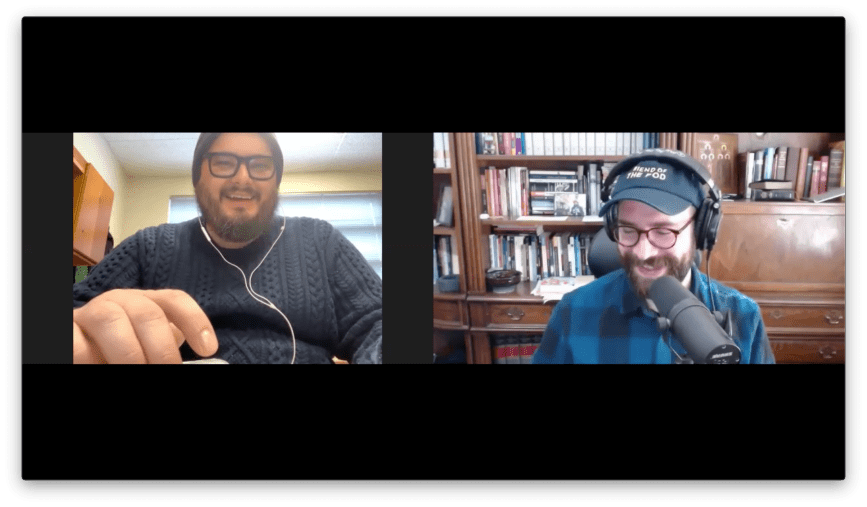
This week on the Strangely Warmed podcast I speak with Drew Colby about the readings for Transfiguration Sunday [A] (Exodus 24.12-18, Psalm 2, 2 Peter 1.16-21, Matthew 17.1-9). Drew is a United Methodist Pastor serving Grace UMC in Manassas, VA. Our conversation covers a range of topics including a face like the sun, locating the Transfiguration, apocalyptic language, refining fires, upending expectations, witnesses, the power of a pinhole, the strange new world of the Bible, and Sufjan Stevens. If you would like to listen to the episode or subscribe to the podcast you can do so here: Pay Attention

The Gospel of Ren & Stimpy

Screen Shot 2020-02-10 at 2.59.50 PM

This week on the Strangely Warmed podcast I speak with Drew Colby about the readings for the 6th Sunday After Epiphany [A] (Deuteronomy 30.15-20, Psalm 119.1-8, 1 Corinthians 3.1-9, Matthew 5.21-37). Drew is a United Methodist Pastor serving Grace UMC in Manassas, VA. Our conversation covers a range of topics including the deletion of hymns, typology work, low anthropology, guilt management systems, disruptive distractions, the glory of the gospels, DBH, the passivity of plants, throwing out the ledger book, and the new Moses. If you would like to listen to the episode or subscribe to the podcast you can do so here: The Gospel of Ren & Stimpy

We Are (Not) Crucified

1 Corinthians 2.1-12

When I came to you, brothers and sisters, I did not come proclaiming the mystery of God to you in lofty words or wisdom. For I decided to know nothing among you except Jesus Christ, and him crucified. And I came to you in weakness and in fear and in much trembling. My speech and my proclamation were not with plausible words of wisdom, but with a demonstration of the Spirit and of power, so that your faith might rest not on human wisdom but on the power of God. Yet among the mature we do not speak wisdom, though it is not a wisdom of this age or of the rulers of this age, who are doomed to perish. But we speak God’s wisdom, secret and hidden, which God decreed before the ages for our glory. None of the rulers of this age understood this; for if they had, they would not have crucified the Lord of glory. But, as it is written, “What no eye has seen, nor ear heard, nor the human heart conceived, what God has prepared for those who love him” these things God has revealed to us through the Spirit; for the Spirit searches everything, even the depths of God. For what human being knows what is truly human except the human spirit that is within? So also no one comprehends what is truly God’s except the Spirit of God. Now we have received not the spirit of the world, but the Spirit that is from God, so that we may understand the gifts bestowed on us by God. 

I was standing in line, along with everyone else, waiting for my chance to pass through customs. We were on our way to Guatemala to spend a week working in the remote highland area with an organization called HSP. The group had packed accordingly, we had read all the right scriptures that compelled us to go and love on our neighbors to the south, and honestly we were just really excited. We were college and high school students, and for some of us this would be our first time going out of the country.

It was the 4th of July, and you could tell from the sheer amount of red, white, and blue adorning just about everyone leaving the US. We joked in line and the buzz of anticipation was palpable in the air. I, just like most everyone else, was wearing a shirt with an American Flag prominently displayed on the front when I was my turn to step forward and hand over my passport.

I patiently smiled as the TSA worker looked at my picture, looked at me, looked at my ticket, and then looked at my shirt. Her gaze promptly returned to the desk in front of her, and without even looking up she said, “Just a piece of advice – I’d change my shirt if I were you.”

I stood in confused silence – I mean, why would I need to change my shirt?

And, as if reading my mind, the TSA agent said, “You’re traveling to a place where that flag doesn’t mean what you think it does.”

Bible-and-Flag

Reading from the Apostle Paul in worship can be a difficult endeavor. His sentences tend to drag along and he is quite the fan of repeating himself. And taking the time to look at his argument, if we want to call it that, week after week after week is, possibly, an ill-advised proposition.

And yet, here we are.

Today, many of us, if not most of us, face the unenviable task of coming to grips with the fact that Paul’s letters were written before any of the gospel stories were recorded. That is, the earliest churches that sprung out around the Mediterranean had a better than good chance of meeting or reading from Paul long before they got a chance to hear or read from the evangelists.

Therefore, for those of us who think we can get closer to Jesus through Matthew, Mark, Luke, that’s all good and fine. But to elevate the gospels as much as we do does a disservice to the work of Paul.

And, it’s not easy. I mean, Paul’s letters contain almost no references to the teachings of Jesus. He doesn’t recount the beauty of the Prodigal Son, or hammer home the words from the Sermon on the Mount, or even talk about the miracle of feeding 5,000 by the sea. Instead, it is the word of the cross that coveys the everything Paul wishes to share. “Jesus Christ and him crucified” was the message that reshaped reality and turned the world upside down.

That’s not to say that the stories of Jesus, those he told and those he lived out, are of non-importance. They are absolutely pivotal. And yet, we often read Paul today as if he took the simple messages of Jesus and complicated them into these opaque and intellectual arguments. When, in fact, the truth is quite the opposite: Paul distilled the gospel in a way that we would not have known without him.

A small, but potent example: Jesus tells the disciples that it will be easier for a camel to go through the eye of a needle than for a rich person to enter heaven. If that’s all we’ve got then woe to the rich, because this is as good as its going to get. But Paul is adamant, throughout the letters, the Christ dies for us while we are sinners, that every single one of our sins are nailed to the cross whether we’re rich or poor, and the justification of the ungodly (that’s all of us) is the whole thing.

The work of Christ on the cross then becomes the lens by which the gospels come into focus, and not necessarily the other way around.

scandal

Knowing nothing but Jesus Christ and him crucified is no easy thing to do. It wasn’t for Paul and it’s not easy for us. We are constantly in search of signs of demonstrated power so as to know where our allegiances should reside. We look up to the healthy and the wealthy as if they are more important and holier than the sick and the poor. We are so persuaded by, to use Paul’s words, the rulers of this age rather than the one who came to overthrow the powers and the principalities that compete for our attention.

I stood in the airport, displaying my red, white, and blue, and right before I boarded the flight, I took it off and put something else on. I spent the following week working with and among people whom I otherwise never would have seen, and I learned more than I could have dreamed.

Sure, I learned a lot about what it means to be a faithful disciple, and what it means to put faith into action, but the thing I learned the most about was what it meant to be an American. At least, what it meant to be an American to those who are not. 

That week in the Guatemala opened up my eyes to the long and sordid history of the United States with the government and civil war in Guatemala. I discovered how our country, in the name of freedom, instituted a new government in their country, assuming it would make for a more favorable relationship between the countries. But I also discovered how ravaged families and communities were by those actions, how many young men were indiscriminately murdered in a short period of time leaving behind a country that is still suffering the consequences of ours.

For me, it was a painful moment of transformation. For, in those conversation and interactions, in the tears and in the stories, I realized that, by the world’s standards, I am a citizen of empire. The country of my home and the country of my birth has bullied the rest of the world into recognizing our supposed superiority such that I was encouraged to remove my patriotic teeshirt before leaving the country.

In other words, I am exactly who Paul is addressing in 1 Corinthians 2. And so is every average American Christian.

We might enjoy spending our time bickering among ourselves about what President Trump said during the State of the Union, or Nancy Pelosi ripping up his speech, or who really won the Iowa Caucus, or any other number of things, all the while people across the world are living entirely different lives. 

How we carry ourselves in the world, whether at home or abroad, makes a tremendous difference because, whether we realize it or not, the Red, White, and Blue says a lot more about us than we think.

Even a sentence like that is troubling and confounding these days because the “us” in the “says more about us” is almost undefinable. As soon as we feel lumped into something we feel like we shouldn’t, we throw up our arms as if to say, “That’s not me!” And we very quickly and rapidly move into a posture of rigid defense and we stop up our ears from having to hear anything contrary to what we might think or even believe.

There’s nothing inherently wrong with the symbols of patriotism in the United States. Proudly displaying flags and colors and even documents like the Declaration of Independence are all fine. Except, for Christians, those patriotic symbols seem to mean more to us than the symbol of our faith: the cross. 

And it makes total sense. The cross is an ugly and deadly thing. We don’t want to be bombarded with thoughts of death and suffering and so we prefer to worship and idolize other symbols – symbols that appear more simple.

The cross is anything but simple.

1*0I0TcQ7w-DcMEg2v6c1ixA

We are forever trying to reduce the complex questions of life into these manageable and simple solutions as if there really is a solution to every single problem in the world. And whoever comes up with the easy formulas for success are the people we worship the most. We do it with politicians we do it with preachers we do it with just about anybody.

If the solution can fit nicely into a tweet or a soundbite on the news then its good enough for the rest of us. It gives us the illusion that we are in control, that we are the masters of fate, and we therefore have nothing to be afraid of.

Except, it’s not true.

We are not in control. Fate is fickle. And there is plenty to be afraid of. 

The cross always hangs on the horizon, an ever present reminder that when things get tough, when things get too complicated, we all too often resort to violence and power and control in order to put things back the way we think they should go.

We did it with Jesus on the cross.

We did it with Guatemala.

We’re still doing it as a nation, and we’re all, in some way, shape, or form doing it in our own lives.

We think that it’s all up to us, and we’ve forgotten that the cross also stands to show us how Christ is already in the business of putting us back together, in ways we’d rather not if it were up to us.

But thanks be to God that’s its not up to us, because if it were all we’d achieve is more of the same instead of the in-breaking of the Kingdom of God on earth. If it were up to us we’d only associate ourselves with the people who already think like us, and talk like us, and even look likes us instead of being surrounded by the great cloud of witnesses that only have one thing in common: Jesus Christ and him crucified.

Paul wrote to the Corinthian Christians because he was devastated by how quickly they had fallen away from the complicated message of the cross. They had factionalized around different leaders that only told them what they already wanted to hear, instead of hearing the good news that sounds too good to be true: Christ died for us while we were sinners, which means we cannot remain as we were.

The church was not and is not meant to be like the world – It is a counter-cultural endeavor in which the powers and principalities and empires of this world are called into question. Knowing nothing but Jesus and him crucified is but another way of articulating a different way of being in the world.

Or to put it another way, Jesus is crucified so that we don’t have to be. We don’t have to mount the hard wood of the cross because Christ has already done it for us. We don’t have to suffer the indifference of the world because Christ has come to conquer the world. 

Paul implored those first Christians to open their eyes and ears, to recognize how their beliefs and patterns and habits communicate what they valued and what they worshipped.

Today, how we live and move in the world with others makes all the difference as we, like Paul, strive to know nothing but Jesus Christ and him crucified. 

Everything else is secondary. Amen.

We Are (Not) Scandalized

1 Corinthians 1.18-31

For the message about the cross is foolishness to those who are perishing, but to us who are being saved it is the power of God. For it is written, “I will destroy the wisdom of the wise, and the discernment of the discerning I will thwart.” Where is the one who is wise? Where is the scribe? Where is the debater of this age? Has not God made foolish the wisdom of the world? For since, in the wisdom of God, the world did not know God through wisdom, God decided, through the foolishness of our proclamation, to save those who believe. For Jews demanded signs, and Greeks desire wisdom, but we proclaim Christ crucified, a stumbling block to Jews and foolishness to Gentiles, but to those who are the called, both Jews and Greeks, Christ the power of God and the wisdom of God. For God’s foolishness is wiser than human wisdom, and God’s weakness is stronger than human strength. Consider your own call, brothers and sister: not many of you were wise by human standards, not many were powerful, not many were of noble birth. But God chose what is foolish in the world to shame the wise; God chose what is weak in the world to shame the strong; God chose what is low and despised in the world, things that are not, to reduce to nothing things that are, so that no one might boast in the presence of God. He is the source of your life in Christ Jesus, who became for us the wisdom from God, and righteousness and sanctification and redemption, in order that, as it is written, “Let the one who boasts, boast in the Lord.” 

I worked hard on the sermon.

I mean, I worked really hard on the sermon. 

At one point I had, on my desk, three different commentaries, a collection of Christian poetry, two Biblical atlases, and my Greek New Testament. I must’ve written three versions of the sermon before I finally felt like it was complete before and I saved the document and patiently waited for Sunday.

And Sunday came.

I walked down the center aisle tightly gripping the sermon in my hand while the congregation sang around me. I sat dutifully throughout the service, listening to the different lay people playing their parts, and when the time came to preach I ascended into the pulpit, took a deep breath, and preached my heart out.

I used my hand emphatically, lowered my voice when I wanted everyone to hang on the words, and I ended with as large and as booming of a voice as I could muster.

When I sat down I had to wipe my sleeve across my forehead because I worked up a sweat.

After the service, I stood in the narthex waiting to shake hands with those in attendance that morning and was feel rather proud of my effort. 

A tall gray-haired gentleman was the first to walk over that morning, and I’ll never forget what he said, “Son, that sounded nice and all, but you used too many of them big seminary words and not a one of us understood not one thing you said.”

1-cor-web-sermon

There’s something interesting going on in the budding Corinthian Christian community. Sure, Paul’s already proclaimed grace upon all who receive his letter, and he’s warned them about breaking off into different factions, but here, before we even get to the second chapter of the letter he addresses what we might call, status consciousness. And notice, I’m still falling prey to the temptation to use bigger words than necessary!

It’s not just about who each of the early disciples follow, but to which class each person belongs. (As if people belong to certain classes)

In our minds when we think of class divisions today we rightly consider economic disparities, or even geographical placements, but one that we often ignore (to our detriment) is the division of education. There were some who proudly proclaimed their educational prowess while putting others down and it was starting to create major rifts in the community. 

“I know more than you do,” or “I’m smarter than you,” become more than childish attacks and take on a whole new version of the in crowd and the out crowd. 

Whereas Jesus comes to show us how we were once all in the out crowd, and we are all now in the in crowd.

Paul puts it this way: “Where is the one who is wise? Where is the scribe? Where is the debtor of this age? Has not God made foolish the wisdom of the world? For since, in the wisdom of God, the world did not know God through wisdom, God decided, through the foolishness of our proclamation, to save those who believe. For Jews demanded signs, and Greeks desire wisdom, but we proclaim Christ crucified, a stumbling block to Jews and foolishness to Gentiles, but to those who are the called, both Jews and Greeks, Christ the power of God and the wisdom of God.”

In other words, “What makes you think you’re so smart? None of this is smart! God has made the wisdom of the world into foolishness! The religious elite call for signs and the secular folk want wisdom, but we proclaim a crucified man, dead on the cross. This will always be a stumbling block to the religious and foolishness to those outside the faith.

scandal

Now the challenge before us, regarding this text, is nearly impossible – imagine, if you can, having never heard of Jesus or his cross. Imagine, challenging as this might seem, that you encounter someone in your life, perhaps a friend or a neighbor or even someone in your family and they tell you, “The most powerful being in all of the creation, chose to become like us, to dwell among us, and then when the right time came he was executed for all to see, and then three days later he rose from the dead.”

It’s difficult to take a step back from all of this, from a sanctuary adorned with cross, and hymns with language about the cross, and to consider how confounding the cross is. 

Or, to put it in a Corinthian context, it is scandalous.

That’s the word for us today, that’s the thing we cannot ignore, how scandalous it all is. Our English Bibles, of course, render it as foolishness a la the foolishness of the Gentiles, but in Greek the word is SKANDALON. 

Even in their boasting, those that had reason to boast, Paul reminds them that all of their bragging is for nothing because the word of the cross, the truth of Christ’s work, has nothing to do with our own intelligence, or our own wisdom, or our own work.

That scandal is difficult to approach – it is challenging because everything about the crucifixion from the details about the responsible parties to the words offered by those who witnessed the event carry little to no redeeming religious features. 

It is not an uplifting moment even though Jesus is lifted up. Which is strange when we consider just how much of our faith and all that we do as Christians is tied up with inspirational uplift and attempts at making us feel better whether we want to or not. 

So much of what I learned in school, the schooling that was required for me to become a pastor, was all about speaking the right words to make things right in your lives. It was about pushing lay people, you people, to be more faithful. It was about helping each of you to see all that you needed to do in order to find Jesus.

And yet, the scandal of the cross is scandalous precisely because it stands as a stark reminder that we are messed up, and Christ come to us anyway.

It is a reminder that no matter how smart we are or how dumb we are, no matter how healthy or sick, no matter how virtuous or sinful, Christ comes to us anyway.

A few years back one of my dearest friends and a fellow United Methodist pastor (and godfather to my son), made it through 8 rounds of chemotherapy to treat his incurable cancer. The suffering involved was such that when he was told that they could no longer see any signs of his tumor he didn’t believe them. That is, until they reminded him that the cancer was still in his bone marrow and would never full be gone. 

He would, and still does, rely on what they call maintenance chemo in hopes that the cancer will be kept at bay.

In the wake of receiving the good news that sounded like bad news but was actually good news Jason, that’s his name, articulated something strange about the whole experience.

He said that even though learning he had cancer meant mourning the loss of the life that he had and the loss of the future he envisioned, so too, paradoxically, finding out that he wasn’t going to die quite yet meant mourning the loss of the life he’d found while living with cancer.

Basically, he kind of enjoyed having the cancer.

As crazy as that sounds, there was a reason for feeling that way. You see, while undergoing those months of chemotherapy and the constant fear about losing his life before he expected to, he discovered that he had his theology backwards. For far too long he had believed, and to some degree articulated, a faith that required people to grow closer to God, a faith in which Jesus suffers for our sins and that’s it.

But what Jason discovered in his cancer was that Jesus joins us in our suffering, that its not up to us to grow closer to God because God is already closer to us than we are to ourselves, and that no matter what we’re going through, no matter how bleak or frightening or terrifying, God is there in it.

In church terms we call it A Theology of the Cross.

Paul would call it the scandal of the cross. 

1*0I0TcQ7w-DcMEg2v6c1ixA

Today we might talk about how the cross is a sign of how Jesus saves us from our sins, but what Paul, and Jason, would have us consider is that the cross is where the God who has saved us in Jesus Christ meets us.

The cross is where God meets us in our own lives. In all of our suffering, in all of our sins, in our shames and pains. 

And that is downright scandalous because it rubs against so much of what we’ve been taught to think and speak. If we’ve left church feeling guilty for all the things we should have done, for all the things we left undone, then we’ve missed the scandal of the cross. The scandal is that we don’t have to do anything. Because Christ does the everything we could not and would not do for ourselves.

And even more scandalous is the fact that God in Christ continues to meet us not in the mountaintops of our achievements, not in our theology degrees or perfectly performed prayers, not in our miraculous morality, but in the moments that frighten us and scare us the most.

Paul writes to the Corinthians in hopes of knocking them down a peg or two, he points to the scandal of the cross and reminds those who call themselves Christians that we really have nothing to boast about. We all do things we know we shouldn’t and we all avoid doing things we know we should. No amount of education or status or health can fix that fundamental problem within us. Therefore, confronting the scandal of the cross compels us to reorient ourselves into the shadow of the cross. 

All the things we lift up, right education, economic success, perfect health and perfect bodies, have nothing to do with the scandal of the cross. It simply is what it is.

The cross has always been the focus of Christianity. The cross embodies all of what makes the Good News good. And for as long as it has been the object of our worship, it has also caused offense and has been scandalous. Here within the context of our own country, we tend to push the cross out to the margins, away from view, because we prefer a more upbeat and earned and triumphalist version of faith. 

This is, perhaps, because we are so obsessed with ourselves and what we deserve and how hard we’ve worked. We are moved by consumption and instant gratification. We lift up the healthy and the wealthy as the paragons of virtue and idealism. And, the more we do this, the more the rich get richer and the poor get poorer, the celebrities of our culture become that which we idolize, and we ignore the plight of the sick, weak, lonely, and poor.

The word of the cross, that which confuses the religious and the irreligious alike, calls we who follow Jesus to embrace the struggle of life, to never turn a blind eye to those around us, and to remember that Christ meets us in the midst of our sins.

It’s scandalous. Amen.

Meek Mill and The Beatitudes

4d46bf1bb0394b294fab8d3ea3c7ea0b-1024x1024

This week on the Strangely Warmed podcast I speak with Thomas Irby about the readings for the 4th Sunday After Epiphany [A] (Micah 6.1-8, Psalm 15, 1 Corinthians 1.18-31, Matthew 5.1-12). Thomas is a United Methodist Pastor serving in Tacoma, Washington. Our conversation covers a range of topics including cliche Christian tattoos, social activism, divine controversies, usury, moral ambiguity, the cross as everything #blessed, peace-making vs. peace-keeping, and being poor in the kingdom. If you would like to listen to the episode or subscribe to the podcast you can do so here: Meek Mill and The Beatitudes

Screen Shot 2020-01-27 at 9.27.19 AM