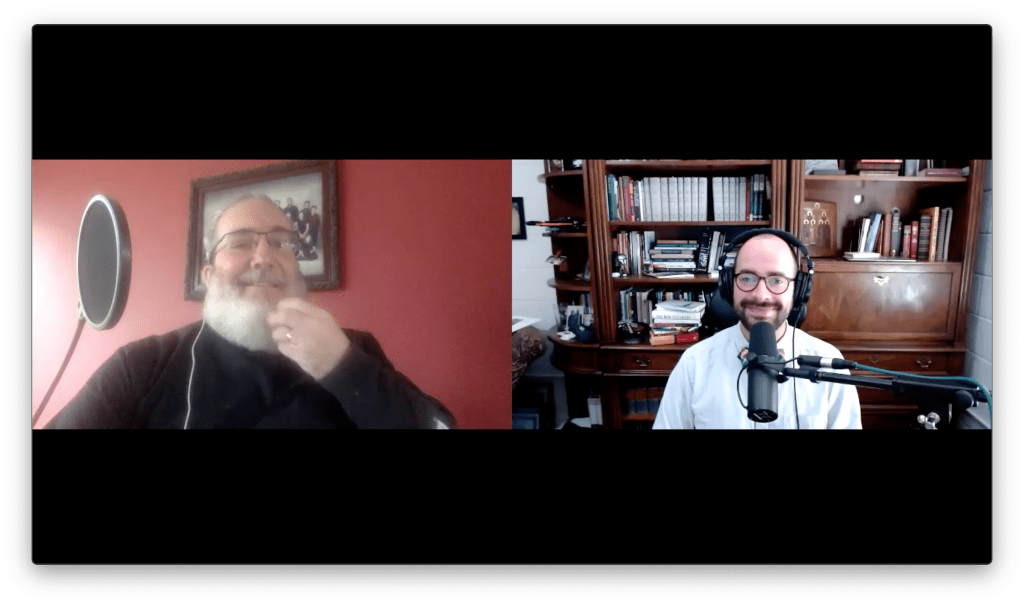
This week on the Strangely Warmed podcast I speak with Matt Benton about the readings for the 10th Sunday After Pentecost [A] (Genesis 37.1-4, 12-28, Psalm 105.1-6, 16-22, 45b, Romans 10.5-15, Matthew 14.22-33). Matt is the pastor of Bethel UMC in Woodbridge, VA. Our conversation covers a range of topics including Coronatide, NOVA, the case for Karl Barth, narrative theology, dreamers of dreams, church leadership as evangelism, different righteousnesses, exegetical grammar, and God’s oddness. If you would like to listen to the episode or subscribe to the podcast you can do so here: The Hardest Part Of Being A Christian
We know that all things work together for good for those who love God, who are called according to his purpose. What then are we to say about these things? If God is for us, who is against us? He who did not withhold his own Son, but gave him for all of us, will he not with him also give us everything else? Who will bring any charge against God’s elect? It is God who justifies. Who is to condemn? It is Christ Jesus who died, yes, who was raised, who is at the right hand of God, who indeed intercedes for us. Who will separate us from the love of Christ? Will hardship, or distress, or persecution, or famine, or nakedness, or peril, or sword? As it is written, “For your sake we are being killed all day long; we are accounted as sheep to be slaughtered.” No, in all these things we are more than conquerors through him who loved us. For I am convinced that neither death, nor life, nor angels, nor rulers, nor things present, nor things to come, nor powers, nor height, nor depth, nor anything else in all creation, will be able to separate us from the love of God in Christ Jesus our Lord.
Everything happens for a reason. We say something like that to bring comfort to people in the midst of uncertainty, or tragedy, or difficult circumstances mostly because we don’t know what else to say. It is a remarkably common expression among Christian-types and it’s not in the Bible.
Years ago I received a phone call that a woman in my church was in her final moments. She had been suffering from a great number of chronic problems for the better part of two decades and most of her family had not expected for her to live as long as she did. We all stood around her bed together praying and sharing those final moments before she died.
A few days later, on the eve of her funeral, her now widower husband fell down the steps in front of their house after returning from the wake and was rushed to the hospital. He needed a few days to recover and we delayed his wife’s funeral until he was better. Eventually he sat in the pews with surrounded by his family and worshipped with the rest of us as we gave thanks to God for his wife.
After the burial and reception he returned to his now empty house complaining of our tired he was and after he went to bed, he never woke up again.
A husband a wife dead less than a week apart.
When I got the call about his death, having only seen him the day before, I rushed to the house to meet with the family who were still in town from the wife’s funeral. And one by one I watched and listened as every single family member exchanged a version of “everything happens for a reason.”
“God just needed another angel in heaven.”
“God wanted them to be married in heaven just like they were married on earth.”
“This was all part of God’s plan.”
And the more I heard it the more my blood boiled. But before I had a chance to blurt out something pastors aren’t supposed to say, one of the couple’s daughters beat me to it.
“That’s BS” she stammered.
Though she didn’t use the acronym.
“If this was all part of God’s plan, then why did God take away my Mommy and Daddy so quickly? Why would God do that to me?”
And that’s when the whole room turned to me, the pastor, the so-called expert on God.
So I said, “If there is a reason for everything, if God killed both of them on purpose, then God isn’t worthy of our worship.”
When we throw out trite and cliche sentences like, “everything happens for a reason” it puts all of the responsibility of every single little thing entirely upon God.
It makes God into a monster.
The author of car crashes, incurable childhood cancers, and unending wars.
And yet, more often than not, it is our go-to expression when we don’t know what else to say.
If there are two things that we, as human beings, just can’t stand they are mystery and silence. It’s no wonder therefore that when we face a situation that has no explanation we get as far away from mysterious silence as we possibly can by saying something we think is helpful. We both want to have an answer for every question and we want to be able to get out of uncomfortable moments when we don’t know what to say.
The problem with all of that is we think we’re helping someone when we’re actually making things worse.
Anyone who claims that everything happens for a reason are those who believe God wills every single horrific death, every incurable diagnosis, and even something like the Coronavirus. They see and imagine God as some great puppeteer in the sky instituting every possible contingency such that it must be this way at all times no matter what.
And if that’s true, then every rape, every murder, every act of child abuse or neglect, every war, every storm or earthquake, are all part of God’s plan.
To those who believe that is the case, the response from the daughter whose parents died should suffice.
In his book The Doors of the Sea, David Bentley Hart recalls reading an article in the New York Times shortly after the unimaginable tsunami that wrecked South Asia back in 2015. The article was focused on a Sri Lankan father, who, in spite of all his efforts, which included swimming in the rolling sea with his wife and mother-in-law on his back, was unable to save his wife or any of his four children from drowning in the waters. The father recounted the names of his children and then, overwhelmed by his grief, sobbed to the reporter, “my wife and children must have thought, ‘Father is here… he will save us” but I couldn’t do it.”
David Hart wonders, in his book, If you had the chance to speak to the father in the moment of his deepest pain, what would you say? Hart then argues that only idiots would have approached the father with trite and empty theological expressions like: “Sir, your children’s deaths are part of God’s cosmic plan” or “It’s okay this was God’s design” or “Everything happens for a reason.”
Most of us, Hart believes, would have the good sense not to talk like that to the father. And then he takes it one step forward. “And this should tell us something. For if we think is shamefully foolish and cruel to say things in the moment when another’s sorrow is most real and irresistibly painful, then we ought never to say them.”
And to take it one step even further, if we mustn’t say things like that to such a father, then we ought never to say them about God.
St Paul wrote to the early church in Rome: “We know that all things work together for good for those who love God, who are called according to his purpose.” Which, for many, justifies the desire to say “everything happens for a reason.”
And yet we so often forget that this verse is the beginning of Paul’s big crescendo to one of the texts we use most often at funeral – nothing can separate us from the love of God in Christ Jesus.
What we miss in that profound and powerful declaration is that there are powers and principalities contending against God in this life.
That is, death is something that is trying to separate us from God, but God wins in the end.
The Good News of Jesus Christ is that death is God’s ancient enemy, whom God has defeated in Christ Jesus, and will ultimately destroy forever in the New Jerusalem.
That is, to put a fine note on it, the whole point of the Gospel in the first place.
It would then be nothing but ridiculous for God to delight or even ordain the deaths of those whom he loves for it would run counter to the life, death, and resurrection of Jesus Christ.
“We know that all things work together for good for those who love God and are called according to his purpose.”
God does not want bad things to happen to us. But bad things do happen in this fallen and fallible world we find ourselves in. We, all of us, make choices we know we shouldn’t and we avoid doing things we know we should. We contribute in ways both big and small to the tremendous suffering in the world. From delighting in being able to purchase a banana whenever we want from the grocery store (a banana that requires low waged work, an absurd amount of fossils fuel, and harmful chemicals to make it to our plate) to texting while we drive (which distracts us from the kid running into the street to grab his wayward basketball) to a great number of other scenarios.
Some of the suffering of the world is willed, but not by God. It is willed by us in our relentless pursuit of whatever we think we deserve.
And yet a fair amount of suffering in the world exists not because of us or God, things just happen without explanation.
And when those things occurs, whether willed by human beings or random events in creation, we do well to close our mouths and rest in the knowledge that God has defeated death.
Does that erase death’s sting here and now? Of course not, death always hurts.
But as Christians, we know how the story ends, we know that those we lose in life will be waiting for us at the Supper of the Lamb surrounded by the great cloud of witnesses that have gone on before us.
The “for good” that God works to achieve is the proclamation that nothing can ever separate us from the love of God in Christ Jesus. That even in our suffering, even in our deaths, God is with us.
Look, I hear it a lot in my line of work, people showing up at the church or calling me on the phone to ask, “Why is God doing this to me?”
The loss of a child. The loss of a job. The loss of health.
And for as many times as I have heard questions about God’s purposes behind the purposeless moments in life, I’ve heard from just as many people wondering, “What can I possibly say to someone in their suffering, in their loss?”
Sometimes the best thing to say is absolutely nothing. As hard as it might be to sit with someone else in their pain and in their suffering, just listening to them is far better than trying to fill the time with trite and meaningless aphorisms. At the very least, it’s the most faithful thing we can do.
Life is hard and all sorts of things happen without explanation. I know that might not sound very pastoral, but it’s true. Can you imagine how you would feel if you came to the church one morning in your grief or suffering or pain, and you got down on your knees to pray to God when all of the sudden you heard a voice booming from the heavens declaring, “I”M DOING THIS TO YOU ON PURPOSE! THIS IS PART OF MY PLAN!”
If that’s who God is, then God isn’t worthy of our worship.
Thankfully, that’s not who God is. God is whoever raised Jesus from the dead having first raised Israel out of Egypt. God is the author of salvation and not the dictator of death. God is the one who would do everything, and already did, to make sure that nothing, truly nothing, could ever separate us from the his divine love.
Our hope is not contingent on finding reasons to explain everything that happens – instead our hope is built on Christ who shows us in his life, death, and resurrection that God is with us, always.
And there’s nothing we can do about it.
For I am convinced, like Paul, that neither death, nor life, nor angels, nor rulers, nor things present, nor things to come, nor powers, nor height, nor depth, nor anything else in all creation, will be able to separate us from the love of God in Christ Jesus our Lord.
That’s the gospel.
Jesus is the reason that even when things happen, we are not abandoned.
This week on the Strangely Warmed podcast I speak with Kenneth Tanner about the readings for the 8th Sunday After Pentecost [A] (Genesis 29.15-28, Psalm 105.1-11, 45b, Romans 8.26-39, Matthew 13.31-33, 44-52). Ken is the pastor of Holy Redeemer in Rochester, Michigan. Our conversation covers a range of topics including Athanasius’ On The Incarnation, keeping the Cross in Christmas, weddings beds, the canon, family trees, the importance of liturgy, the Romans Argument, buying the whole field, and baking bread. If you would like to listen to the episode or subscribe to the podcast you can do so here: Remember Who(se) You Are!
So then, brothers and sisters, we are debtors, not to the flesh, to live according to the flesh — for if you live according to the flesh, you will die; but if by the Spirit you put to death the deeds of the body, you will live.
I did a funeral a while back for an older woman, and during the service people stood up to talk about how amazing she was how she always cared for everyone in her midst and how she was the paragon of virtue. We heard from grandchildren, co-workers, neighbors, it went on and on.
When the funeral was over, I mingled among the gathered people, offering condolences and so on until I met the recently dead woman’s caretaker. She was wearing scrubs, having already moved on to a new client and was only able to get away for the funeral. We chatted briefly exchanging pleasantries until she said, “You know what’s strange Preacher? Having to sit there and to listen to all these people talk about how perfect she was. Because she was the meanest woman I’ve ever met in my life. She treated me worse than dirt.”
I stood there silently stunned unsure of how to respond.
And then she said, “It’s a good thing we worship a God of forgiveness, right Preacher?”
I have a great sign in my office that says, “Live your life so that the Preacher won’t have to lie at your funeral.”
I used to love how it would hang over the heads of those who came to confess yet another one of their sins. I hoped that it would convince them to shape up and start behaving accordingly without me having to say it.
But the longer I’ve been a pastor, the more I’ve realized how strange of a theology the sign portrays. For, it implies that there are some people who have lived such good, and true, and virtuous lives that preachers don’t have to lie at their funerals.
But, that denies the real truth: Not a one of us is righteous, no, not one. We all fail to love God and neighbor with our hearts, souls, minds, and strengths. We avoid doing things we know we should, and we do plenty of things we know we shouldn’t.
And yet, how often have we gone to a funeral to listen to someone like me, a preacher, wax lyrical about the now dead’s holy life when we all know that all of our lives are more complicated than that?
For, the real truth is that all of us are the ungodly, we are the ones for whom Christ died. And that’s good news, because it means not a one of us is outside the realm of God’s forgiveness.
Which is just another way of saying that the only way any of us make it to the Kingdom of Heaven is because we worship a King of forgiveness.
This week on the Strangely Warmed podcast I speak with Teer Hardy about the readings for the 7th Sunday After Pentecost [A] (Genesis 28.10-19a, Psalm 139.1-12, 23-24, Romans 8.12-25, Matthew 13.24-30, 36-43). Teer serves at Mt. Olivet UMC in Arlington, VA. Our conversation covers a range of topics including Zoom meetings on the Peloton, dreaming dreams, timelessness, (un)holy spaces, God’s choices, birth pangs, losing control, doom-scrolling, parable preaching, and making the world a better place. If you would like to listen to the episode or subscribe to the podcast you can do so here: God Knows Your Internet Search History
There is therefore now no condemnation for those who are in Christ Jesus.
Inclusion is all the rage in the church these days (and just about everywhere else). We have such a desire to appear appealing to as many people as possible, that we put out signs on the church property promising our inclusiveness, we develop slogans for websites assuring visitors that they are already part of the church family, and we cultivate sermon series about how to be more tolerant of our neighbors.
But nothing is more inclusive than the Gospel of justification for the ungodly.
It insists (demands) a Church exists where there is not a single distinction between us.
Because not a one of us is righteous (Romans 3).
We’re all the ungodly for whom Christ died.
Depending on the kind of church you grew up in, or saw embodied on television, talk of sin varies. In some traditions, sin is wagged at the congregation week after week in order to (hopefully?) scare people into faith. In other traditions, talk of sin is avoided at all costs unless it has to do with who should be allowed to get married or who should be allowed to become a pastor.
And yet, when Paul wrote his letter to the burgeoning church in the first century, the only sins he mentions are the sins for which Christ has already died.
That is, all of them.
Robert Farrar Capon, taking a cue from Paul, drops this into the laps of we religious types: “Both heaven and hell are populated entirely and only by forgiven sinners. Hell is just a courtesy for those who insist they want no part of forgiveness.”
Thats a tough truth to handle for those of us addicted to right-ness and wrong-ness. For, the Gospel (according to Paul) reminds us that since Christ has been raised from the dead we, who are in Christ by baptism, are not in our sins. But, at the same time, sinners we shall remain!
No matter how good we want to think we are, none of us is righteous. We all, at some point or another, do something we shouldn’t or we avoid doing something we should do.
At the very least, we can’t even get along on Facebook or Twitter! We’re constantly doom-scrolling through the posts and tweets that set us off and even if we have the power to not respond, in our heart of hearts we know what we wish we could say.
We’re all the ungodly for whom Christ died.
It doesn’t matter whether we’re liberal or conservative, it doesn’t matter if we study the Bible every day or we’ve never even picked one up, it doesn’t matter with whom we share a bed or what we do in it – none of it changes the fact that we’ve been baptized (deadened) into Christ.
And that work, the work done to us, is not our own.
Our baptism, our being in Christ, is not our own pious achievement or the height of our own perfect morality. It is, what we call in the church, grace.
And here’s the bad news turned Good News – the Gospel according to Paul, no condemnation, means we’re forever stuck at the party called salvation, the Supper of the Lamb, with people who think that certain people shouldn’t be at the party!
Whether its a denomination in-fighting about who can get married or ordained, or a country going to fisticuffs over differing political ideologies, or communities wrestling with police brutality and racial injustice, or any other thing we can imagine – Christians are stuck with each other, whether we like it or not.
Jesus has bound us together forever in the waters of baptism that destroy whatever divisions we want to create between us. Jesus, like the Father with his arm around his eldest son peaking in on the prodigal cutting up the rug inside the party, desires for us to celebrate together with the people we can’t stand. Jesus, abandoned, beaten, and betrayed, looks out from the Cross into our sins even today and says, “Father, forgive them – they don’t know what they’re doing.”
The Gospel according to Paul, the verse upon which the epistle to the Romans is set on fire, is that we are all the sinners for whom Christ died.
Look, I’m not a big fan of the church insisting on its existence being predicated on making the world a better place. I happen to believe that the church already is the better place that God has made in the world. But whenever I read this verse from Paul, and all my inclusivity buttons get pushed, I can’t help but wonder how much better things would be if we acted as if we believed it.
There is therefore now no condemnation for those who are in Christ Jesus.
This week on the Strangely Warmed podcast I speak with Teer Hardy about the readings for the 6th Sunday After Pentecost [A] (Genesis 25.19-34, Psalm 119.105-112, Romans 8.1-11, Matthew 13.1-9, 18-23). Teer serves at Mt. Olivet UMC in Arlington, VA. Our conversation covers a range of topics including self-care, ordinary people, church pro-tips, low hanging fruit, family problems, lamps in parenting, other gods, the Gospel in Romans, peaceful living, sowing stories, and fertilizing with the Word. If you would like to listen to the episode or subscribe to the podcast you can do so here: God Works With Manure
That was the tweet I sent out into the twitterverse, not thinking too much about what I had done. I have, for a long time, felt the dissonance between the American Flag and the Cross of Christ hanging as if equals in places of worship. I have written about it at length and preached about it on a number of occasions. That I feel so strongly is a result of the Gospel’s insistence that Christians’ truest citizenship can be found in heaven and that our truest freedom comes from Jesus and not from a nation.
But, writing one sentence about the subject for Twitter doesn’t amount to much.
Or, at least, I didn’t think it did…
As of the moment of writing this, the tweet has been seen over 550,000 times and over 70,000 people have interacted with it.
In a matter of two days, my one sentence about the flag in church has become more “popular” than anything I have ever done.
And, the responses have been fairly predictable.
On one side people have been deeply offended by the thought of the flag being removed from a sanctuary. They have implored me to realize that the flag symbolizes sacrifice, the nation it represents was founded on religious freedom, and that to take it away is unpatriotic (if not treasonous).
On the other side, Christians have expressed their concern with the proximity of the flag to the worship of God. They have remarked that we cannot serve two masters (America and God), that God doesn’t belong to a particular nation-state, and a great number of Christians from other parts of the globe have remarked that they’ve never seen their own nation’s flag in church (demonstrating how this is a uniquely American phenomenon).
I’ve received more private messages than I can count both thanking me for the tweet and damning me for it. I’ve been labeled a prophet and a traitor. I’ve searched through so many of the responses that it started to feel like “doom-scrolling” where it left me feeling hollow.
Today is the 4th of July – a day for Americans to celebrate the nation’s independence. And yet, for Christians (who happen to be American) it’s important to remember that our independence came long before George Washington and the Continental Congress and the Declaration of Independence.
Our truest freedom comes from and through Jesus.
Can we still fly American Flags on our homes? Sure – though we should remember and recognize that there is a slippery slope between patriotism and nationalism that often leads to xenophobia and violence.
Can we support our military? Of course – though we cannot forget or ignore how America is an imperial power that often uses violence indiscriminately and disproportionately throughout the world.
Can we celebrate and enjoy fireworks today? Definitely – though we cannot let them blind us to the injustices that our taking place within, and right on, our nation’s borders.
Which leads me back to the American Flag in church…
America is not synonymous with the Kingdom of God and when we put the American Flag in the sanctuary we equate the two together. Our obsession with patriotism, such that we fly a nation’s flag in places of worship, is a sign of what Jesus calls idolatry.
The 4th of July is not independence day for Christians. It certainly marks the beginning of a new kind of freedom for a nationstate and a particular people in a particular way – but our realest independence came through the cross and the empty tomb 2,000 years ago.
The 4th of July, therefore, doesn’t really belong to Christians. We can participate and enjoy the day as much as anyone else, but we do so knowing that our hopes and dreams have been formed by the Lord, not by a document declaring our freedom from monarchy.
The 4th of July is not our independence day. In fact, if it is anything it is our dependence day. It is our dependence day because it shows how much faith and hope we put in things made by human hands which come and go like the wind. We depend on the Lord to do for us what we cannot do for ourselves.
Americans might bleed red, white, and blue, but Jesus bled for us so that we wouldn’t have to.
We can absolutely enjoy the 4th of July and rejoice in our celebrations, but if what we do today is more compelling and life-giving than the Word of God revealed in Jesus Christ then we have a problem.
Jesus Christ is, and forever will be, the end of all sacrifices.
Jesus Christ is the One in whom we live and move and have our being so much so that we can rejoice in the presence of others without hatred, fear, or bitterness.
Jesus Christ is the incarnate Lord whose resurrection from the dead has set us free from the truest tyrannies of all – sin and death.
This week on the Strangely Warmed podcast I speak with Drew Colby about the readings for the 5th Sunday After Pentecost [A] (Genesis 24.34-38, 42-29, 58-67, Psalm 45.10-17, Romans 7.15-25a, Matthew 11.16-19, 25-30). Drew is the lead pastor of Grace UMC in Manassas, VA. Our conversation covers a range of topics including the paradox of doing nothing, an arranged marriage, the scandal of particularity, allegory, Pauline honesty, the goodness of our badness, having fun with Jesus, and the strange burden of Christianity. If you would like to listen to the episode or subscribe to the podcast you can do so here: Yokes Over Easy
This week on the Strangely Warmed podcast I speak with Matthew Husband about the readings for the 4th Sunday After Pentecost [A] (Genesis 22.1-14, Psalm 13, Romans 6.12-23, Matthew 10.40-42). Matthew is an occupational therapist in Westerville, Ohio. Our conversation covers a range of topics including canonical preaching, the Bible on a bumper sticker, sacrifices, foolish prayers, obedience to grace, singing the faith, baptismal protests, and memorable zingers. If you would like to listen to the episode or subscribe to the podcast you can do so here: The Church Isn’t Full Of Hypocrites (There’s Always Room For More)









 think and let think