Devotional – Mark 9.47

Devotional:

Mark 9.47

And if your eye cause you to stumble, tear it out; it is better for you to enter the kingdom of God with one eye than to have two eyes and be thrown into hell.
Weekly Devotional Image

I was sitting in a classroom at James Madison University when one of my peers raised her hand to ask a question. The lecture had been focused on the reliability of the New Testament writers/witnesses and a debate had erupted over whether or not to take the bible literally. I sat patiently near the front of the class watching the comments fling back and forth like a ping pong match between the students and our professor when the girl finally raised her hand.

She said, “I just want everyone to know that I take the bible literally because Jesus is my savior.” The rest of us stared at her and then slowly turned to watch our professor’s rebuttal. “Really? You take the entire bible literally all the time?” he asked rhetorically. The silence was palpable. He continued, “Well then, let me ask you this: Are you a sinner?”

With an obvious look on her face, she said, “Of course I am, but Jesus died on the cross to save me from my sins.” The professor responded, “Yes yes, but do you sin, even though Jesus died for the world?” “Duh,” she said, “everyone sins, and that why we need to let Jesus into our hearts.”

The professor then sighed and brought the point home, “So you say you’re a sinner, but I notice that you have two hands, two legs, and two eyes… Jesus told his disciples that if their hands or feet cause them to sin, they should cut one of them off, and if their eyes cause them to sin they should pluck one out. So you see, I’m having a hard time understanding how you take the bible literally, affirm that you’re a sinner, and still have both your hands, both your feet, and both your eyes all at the same time.”

I don’t remember the girl’s name, but I will never forget the way she looked as she slumped back down into her chair thinking about what our professor had said.

Image processed by CodeCarvings Piczard ### FREE Community Edition ### on 2015-05-18 22:39:16Z | http://piczard.com | http://codecarvings.com &

The bible is full of different literary forms that give it life. There are epic poems that retell the great story of the past in order to teach a lesson to the present. There are long genealogies that connect different characters throughout the centuries. There are parables of everyday situations that are meant to leave us scratching our heads in wonder. There are metaphors used (just like we do) to convey meaning in a way that is memorable and effective. There are proverbs, psalms, and poems that contain wisdom beyond their literal words.

The bible is not a historical narrative to be analyzed and redacted like a modern textbook. It is not a perfect collection of rules to live life. The bible is not a text to be read literally all the time in every situation; otherwise we would all be stumbling around with missing appendages.

The great beauty of scripture is that it opens up the strange new world of what it means to be in relationship with God and with our fellow human beings. The greatest moments in our lives cannot be conveyed in simple words to be taken literally, but are in fact so profound that we must use differing literary forms to even begin conveying what our experience was like. The bible is full of wonder and that’s why we keep coming back to it every day and every week to learn more about who we are, and whose we are.

This week, let us open up our bibles to discover the strange new world of God’s kingdom, and start letting it become incarnate in the way we live.

O To Be Wise – Sermon on Proverbs 1.20-33

Proverbs 1.20-33

Wisdom cries out in the street; in the squares she raises her voice. At the busiest corner she cries out; at the entrance of the city gates she speaks: “How long, O simple ones, will you love being simple? How long will scoffers delight in their scoffing and fools hate knowledge? Give heed to my reproof; I will pour out my thoughts to you; I will make my words known to you. Because I have called and you refused, have stretched out my hand and no one heeded, and because you have ignored all my counsel and would have none of my reproof, I also will laugh at your calamity; I will mock when panic strikes you, when panic strikes you like a storm, and your calamity come like a whirlwind, when distress and anger come upon you. Then they will call upon me, but I will not answer; they will seek me diligently, but will not find me. Because they hated knowledge and did not choose the fear of the Lord, would have none of my counsel, and despised all my reproof, there they shall eat the fruit of their way and be sated with their own devices. For waywardness kills the simple, and the complacency of fools destroys them; but those who listen to me will be secure and will live at ease, without dread of disaster.”

seek-wisdom

Wisdom is standing on the street corner shouting at anyone within distance. In all the town squares she is that preacher standing on a box yelling at the crowds to repent from their ways. At the entrance of the largest cities she is the one holding up the signs about our idiocy and the power of God’s wrath. She is all the preachers, prophets, and teachers that weep in sadness that their words are no longer heeded. Wisdom is frightening and demanding.

How long, all you simple minded people in this congregation, how long will you love to remain being so simple in your thoughts and reflections? How long will you enjoy scoffing at the events in your life and hate the knowledge that is given to you in scripture and in church?

Listen to Wisdom right now, because she is pouring out all her thoughts to you and making all of her words known in this place.

Yet, she has called and called, she has screamed and screamed, and none of us have listened. We ignored her words and demands, and now she laughs at our suffering and at us. She will relish in the calamities that come like a whirlwind, she will delight in our frustration and anger. She knows that when we are at the end of our ropes, when we have nowhere else to turn, that we will turn back to her, but it will be too late.

Because we have so consistently hated knowledge and did not fear the Lord, we will eat the fruit of our way, and be sated with our own devices.

Wisdom cries out from the streets, yells at us in our cars and in our pews: “Waywardness kills the simple, and our complacency as fools will be our undoing. But whoever listens to Wisdom will be secure and will live at ease, without dread of disaster.”

Are you feeling uncomfortable yet? When you heard me rambling up here about Wisdom’s disposition, did you squirm in your pews? This is one tough scripture precisely because Wisdom does not mince her words and comes with a clear and stern warning. We can continue in our stupidity that leads to suffering, or we can listen to Wisdom and live in peace.

For a long time, the book of Proverbs has been marginalized and forgotten in contemporary American Christianity. Similarly the church might confess that our wisdom has suffered a similar fate in culture. Many of us no longer read our bibles, we no longer know what it means to pray, and we live in fear rather than in hope.

But are we really at fault? The church has not done the best job of equipping Christians for the work of discipleship, and the world is full of other options for Wisdom. We are constantly overwhelmed with choices and advice. For instance: The front of our church right now is filled with most of the books that I was assigned to read in seminary. You can read about what it means to do church, you can read books about preaching and teaching, you can read about suffering and temptation, but none of those books taught me the true wisdom of what it means to be a pastor.

Any of us can read about the importance of praying for our enemies in scripture, but the words cannot possibly prepare us for the moment when someone grabs us by the hands and actually asks us to pray for them.

Any of us can turn on the news, or search online to hear about the refugee/migrant crisis happening in Europe right now, but all we hear and learn means very little unless we ourselves are forced to flee our home in hopes that someone else will welcome us in.

So it’s not so much that we have not been given the chance to learn and become wise, but because there are so many options out there, we run the risk of feeling like we just walked into at an all-you-can-eat-buffet prepared for people who ate before they arrived.
wisdom-large-3

Books and television shows and lecture halls can point us in the right direction, but lady Wisdom will more often show up in the places where we live our lives. She shows up in the busy streets, in the public squares, and at the bustling intersections. Wisdom appears in our simple experiences, in the blink-and-you’ll-miss-it advice from an acquaintance, and in the quick responses of our children.

On Wednesday night St. John’s hosted the first meeting of “The Circle.” It was designed as a space where the youth of the church can feel comfortable sharing reflections on their own discipleship and partake in communion with one another. Our first meeting went pretty well, the conversation flowed naturally, and I was incredibly impressed by the youth’s ability to convey how Jesus is real for them.

But toward the end of the meeting, I saw the youth really come alive. We were sitting around the table with our bibles opened to Proverbs 1.20-33. We read together about Wisdom yelling out from the streets and then I asked them to share pieces of advice they wished they could tell their parents without fear of getting in trouble.

Up to that point I thought all the youth were really enjoying The Circle, but with one question about advice for their parents, they all became animated and had more advice than I could possibly write down. We went back and forth for at least fifteen minutes before we were able to agree on a solid list that everyone agreed on and, in the true spirit of Wisdom, I am now going to share the list with all of you.

Disclaimer: Parents, your children were vulnerably honest about their responses and they knew I would be sharing them in church. I will not tell you who said what, but listen carefully, because the advice might be for you…

I wish my parents knew that nobody is perfect.

            I wish my parents knew that is not worth it to takes things so seriously all the time.

            I wish my parents knew that they could trust me; after all, I trust them.

           I wish my parents knew how much it hurts when they interrupt me.

            I wish my parents knew that patience is still a virtue, even when you’re old.

            I wish my parents knew that I am smarter than they think I am.

            I wish my parents knew that if they tell me “not to have an attitude,” I am DEFINITELY going to have an attitude.

            I wish my parents knew that I love them, but sometimes I don’t love their cooking.

Wisdom is a tough pill to swallow. But even as difficult as it is to hear Wisdom speak to us this way, whether it be the dreadful warnings in scripture or the advice from our children, it is difficult to argue with her warnings. The advice the youth offered was so profound that it not only applies to parents but to all people. We could read about how we are supposed to behave as rational human beings, but having a youth tells us that patience is a virtue, and to remember that nobody is perfect actually affects us in all the right ways.

It shocks us to hear something so right from someone we least expect. It bewilders us to hear Wisdom crying out in the streets when we would otherwise like to ignore her.

To walk in the way of Wisdom is incredibly demanding. We cannot claim to be wise by reading a lot of books and watching a lot of television, true wisdom requires us to act and move in the world.

gods-wisdom-02

When Wisdom cries out, when we hear about what our children wish they could say to us, it hurts (or at least cuts deep), but it makes sense. When we forget about who we are and whose we are, when we forget about the ways of God built on love, we often get ourselves in terrible predicaments. We say things without thinking, we act without conscience, and we believe we are smarter than the people around us.

I regularly discover wisdom in the people from this church who listen for the still small voice of God while the world is screaming and spinning. I will be in my office after a difficult phone call, or standing outside shaking hands following worship, or walking through the grocery store, when one of you will come up to me and say something that just reorients my entire being. Something like: “Remember God loves you too

Wisdom is all around us, particularly in the people in the pews next to us, calling to us to start behaving like God wants us to. Because Wisdom is finally approachable and possible as we participate in the practices of God, who is Wisdom. We start to see and hear the Wisdom around us as we search for ways to love like God, listen like God, and even laugh like God, in the complicated and ordinary places of life.

I experienced the depth of Wisdom this week when our youth spoke far beyond their ages and dropped some important knowledge on me. In them I experienced a power greater than my own, and realized that if I gave up my false assumption that I was greater than, or wiser than, those youth, I would start to recognize the true wisdom around me and actually listen.

Where do you hear Wisdom? Do you hear her in the scriptures you read? Do you find her in the worship services at St. John’s? Have you seen her shouting through a parent or a spouse or a child? Does she make you uncomfortable when she shows up?

Wisdom speaks to us all the time; we only need the patience to hear her, and the strength to respond. Amen.

Devotional – Ephesians 3.16

Ephesians 3.16

I pray that, according to the riches of his glory, he may grant that you may be strengthened in your inner being with power through his Spirit.

Weekly Devotional Image

Pre-marital counseling is the best. It is one of the few places where I am actually allowed to ask the questions I have racing in my head: What was your last fight about? How do you feel about your soon-to-be in-laws? Why do you deserve to marry each other? Similarly, it is one of the few places I feel comfortable being completely candid about the church’s role in marriage and how the covenant is not just between the couple, but it also incorporates the gathered body and the Lord.

At some point during the pre-marital counseling, I challenge each couple to go back to scripture and pick a passage that reflects their relationship for the wedding ceremony. My one caveat is that (unless they can demonstrate how necessarily important it is to them) they are not allowed to pick the part in 1st Corinthians about love being patient and kind, nor are they allowed to pick the part from Ephesians about wives being subject to their husbands. So it is with those few directions that couple have been forced to go back to their bibles and find something indicative of their relationship.

A few months ago I had the privilege of bringing together Chris and Chelsea Frumkin into the joy of marriage. I challenged them to pick their scripture and they quickly replied with Ephesians 3.16: “I pray that, according to the riches of his glory, he may grant that you may be strengthened in your inner being with power through his Spirit.” This verse had a particularly special meaning to the couple, because Chris has Ephesians 3.16 etched into the inside of Chelsea’s engagement ring.

11221675_10204258142484714_1762300626060138752_o

What a dynamic and perfect scripture for a wedding ceremony! When we stood together before their family, friends, and the Lord I made mention of the fact that their relationship had led to such a beautiful wedding precisely because they had prayed for one another. As a couple they were not content with the status quo. Instead, they consistently went to the Lord to discover renewed strength in their relationship.

The longer I spend time in ministry, the more I realize that scripture no longer holds the great value that it once did. Instead of a people defined by the Word of the Lord, many of us are content with knowing a handful of verses that make us smile, or would be worthy of a print that we could hang on our wall or Facebook page.

As we prepare to take steps into a new week, let us reflect on the great gift that scripture is for us: What stories from the bible have shaped who we are? Is reading the bible a priority in our lives, or a last resort? If we had to pick a verse that defined our character, what would it be and why?

monkimage

Devotional – Luke 24.45

Devotional:

Luke 24.45

Then he opened their minds to understand the scriptures.

Weekly Devotional Image

Seminary required a lot of reading and writing. Every week our professors would assign readings from book and articles that we would never complete in time in addition to reflective papers on a variety of subjects. At the beginning of each semester you could almost hear the collective groan from the student body with every new syllabus that detailed the amount of work that would be taking place over the coming months.

During my second year I took a class entitled “Greek Exegesis of Mark.” Throughout the semester we would be translating Mark from it’s original language into English and explore the nuances of the grammar. I remember reading the syllabus on the first day and thinking that I was in way over my head. Yet there was one particular requirement on the syllabus that I was really excited about; every week we would be required to read through the gospel of Mark in English.

At the time I realized that I was spending so much time studying God’s Word that I was no longer enjoying and absorbing God’s Word. So each week two of my fellow students and I sat on the steps of Duke Chapel and read the gospel of Mark aloud. Depending on the week we would trade off chapters and until each of us had the chance to read every chapter multiple times.

2014-10-30-10.51.11

I read more grammar and theological works on the gospel according to Mark that semester than I care to remember, but none of them compared to the importance of just reading Mark over and over again. There were insights from theologians that I never would have discovered on my own, but spending time in scripture alone every week truly opened up God’s Word in a way I had yet to experience.

After Jesus’ resurrection from the dead he appeared to the disciples and opened their minds to understand the scriptures. For the first time they were able to begin seeing faithful discipleship through the lens of the resurrection (which makes all the difference). Today we can purchase commentaries and books about the bible to help us understand what’s going on in the verses but nothing can compare to spending faithful time with God’s Word alone. It is important to remember that every time we read a book about the bible we are actually reading someone’s opinion and interpretation; we can only create our own understanding and interpretation from the source itself.

This week let us challenge ourselves to read one of the gospels out loud. Mark is the shortest so it can be finished quickly, but they are all worth exploring on their own. The point is this: the more time we spend in the Word the more we will begin to understand.

Devotional – Psalm 118.22

Devotional:

Psalm 118.22

The stone that the builders rejected has become the chief cornerstone. 

Weekly Devotional Image

We were in the middle of the woods during a Boy Scout camping trip. Our leaders were known for coming up with activities that would help us to grow our wilderness skills, but this particular challenge was driving me crazy. Scattered throughout the clearing were areas with dry wood, tinder, and two stakes connected by a string holding up a water balloon. The challenge was to create a fire under the dangling water balloon using the natural elements until the balloon would pop and put out the fire.

The leaders separated us into groups of four and sent us to our different areas. I don’t remember everyone from my group but there was one boy who was known more for his love of books than his love of the great outdoors. Without intending to I basically ignored his presence while trying to organize the other two boys to begin working on our fire. We collected the tinder in a pile and tried rubbing sticks together. We went searching for some rocks that would hopefully create a spark when we slammed them together. Throughout the wooded area audible frustrations could be heard from each group as they struggled in vain to pop their balloon.

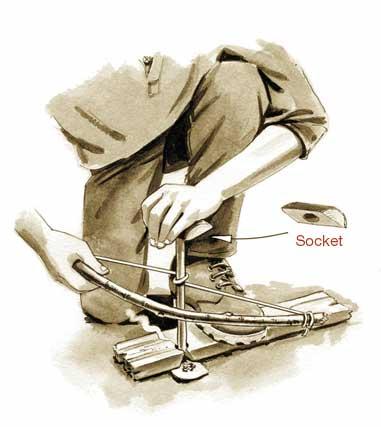
We must have worked for thirty minutes before I noticed the book-boy offering me a piece of advice. He was remarkably shy and I could barely make our what he was trying to say, though I could tell that he was serious. He quickly took off one of his hiking boots, removed a shoe-lace, curved a long stick, and created a make-shift bow. He then demonstrated that if we wrapped another stick around the string, we could move the bow like a saw and it would spin the stick for us with an incredible amount of friction. We quickly went to work and within 10 minutes we were the only group with a fire at all, and a few moments later the balloon popped and put out the fire that we had struggled to ignite. After congratulating ourselves I made a point to thank the boy for his idea and asked where it came from. He said, “I read about it in the Wilderness book that we were all supposed to read before this weekend.”

startafirewithabowdrill

The palmist writes about a stone that builders rejected becoming the chief cornerstone. Those who are familiar with the New Testament will quickly identify Jesus as someone rejected by the elders who then became the foundation for the church. Yet, this is not something that can be applied to Jesus alone. I quickly rejected the help from a boy in the woods because I made a ridiculous assumption about his inability to help. In him I saw little value worth assessing. However, without his help we would probably still be in the woods trying to pop our balloon. God can, and does, use some of the least likely people to change the world. Everyone has value and worth, we need only a new perspective to realize it.

In the remaining days of Lent let us open our eyes to value in people around us. Instead of making quick and unjustified assumptions, let us take a moment to reflect and remember that those who we reject are often the ones who are here to save us.

Listen to Him! – Sermon on Mark 9.2-9

Mark 9.2-9

Six days later, Jesus took with him Peter and James and John, and led them up a high mountain apart, by themselves. And he was transfigured before them, and his clothes became dazzling white. such as no one on earth could bleach them. And there appeared to them Elijah with Moses, who were talking with Jesus. Then Peter said to Jesus, “Rabbi, it is good for us to be here; let us make three dwellings, one for you, one for Moses, and one for Elijah.” He did not know what to say, for they were terrified. Then a cloud overshadowed them, and from the cloud there came a voice, “This is my Son, the Beloved; listen to him!” Suddenly when they looked around, they saw no one with them any more, but only Jesus.

20cuaresmaB2

Two years ago, today, I woke up like every other Sunday and got ready for church. Though I was enriched with theological education Monday – Friday in seminary, I looked forward to spending time in worship with people who were not from school on Sundays. Duke Memorial UMC is a beautiful church located right on the corner of downtown Durham and serves the needs of a wide variety of people. The sanctuary is wider than it is long, with a balcony, and a raised area above the altar for the choir and the organ. The church prides itself on its ability to worship faithfully, and engage deeply in the community.

Two years ago, today, I woke up like every Sunday morning, but this one would be different. While my roommates got ready to attend their respective churches, my phone began to ring and my pastor’s name appeared on the phone. Now, many of you might not know this, but if you receive a phone call from me on Sunday morning, it usually means there’s an emergency. I nervously answered the phone and through her scratchy voice I learned that both pastors of Duke Memorial were sick, and neither one of them would be able to preach. I had a feeling that I knew were the conversation was headed and I quickly glanced over at my clock; worship would begin in one hour. She continually apologized for their sickness and then finally asked if I would be willing to preach in a very short amount of time. “Of course” I said with a chipper voice, knowing full and well that I had not the faintest idea regarding what I would preach about.

The next hour was a blur.

I obviously did not have the time to write out a manuscript, I was not able to consult numerous commentaries about the text, and I had not spent an appropriate amount of time in prayer over the passage. All I knew was that the passage was the same as today’s (Mark 9.2-9) and that it was Transfiguration Sunday.

Duke Memorial UMC

Duke Memorial UMC

I barely made it in time for the service to began with a 3×5 index card in my pocket with three key points that I wanted to make. Upon arrival I searched for a bulletin to discover what else would be going on during the service and I quickly said a prayer before entering the sanctuary. My eyes were still closed when organ began and an acolyte walked up to me and asked, “Where’s the preacher?” To which I responded, “You’re looking at him.

The next hour was also a blur.

I led us through the usual motions of worship after explaining the lack of two ordained pastors. We prayed together; we sang together; we read together; I preached; and before I knew it, the service came to a conclusion ten minutes earlier than usual.

While people departed from the sanctuary, I did as all pastors do and stood at the door to shake hands with everyone. Many made comments thanking me for my service and willingness to preach on such short notice, but most of the compliments came in the form of, “Hey thanks for getting us out early!

However, there was one older woman waiting around at the back of the line for her turn to come forward. Another thing you might not know is that if someone waits a long time to speak after a service, they usually have a critique or a criticism that they don’t want to share in front of everyone else. I waited and waited until nearly everyone was gone when she finally stepped forward and grabbed my hand; “Son,” she said, “I’ve been coming to this church my whole life to worship the Lord and hear people preach. I want you to know that you said more in 10 minutes than many could say in 45. Thank you.” And with that she left the sanctuary.

Two years ago, today, I woke up and got tapped to preach a sermon at a moment’s notice. Now, of course, I am the pastor here at St. John’s and I have plenty of time each week to work on preparing for Sunday worship. I have the time to be in prayer over the words of scripture, I have the time to consult commentaries about what’s happening in the deeper sense of the text, I have the time to write out a full manuscript of everything I will say from this pulpit. But this week, I kept thinking about what happened two years ago on Transfiguration Sunday, and I wanted to do something similar…

00027841_h

Instead of combing through numerous books highlighting the ins and outs of Mark 9, instead of doing all the things I normally do to prepare a sermon, I began by reading one verse: “Then a cloud overshadowed them, and from the cloud there came a voice, “This is my Son, the Beloved; listen to him!”” and then I felt propelled to do something radical, something that I have not done in a long time, something that I want to share with all of you right now:

I listened to Jesus.

I spend so much time talking about Jesus, that I don’t spend enough time listening to him. Now, I have had some remarkably beautiful and religious experiences in my life, but I have never literally heard the Lord speak like on the mountain during the Transfiguration. I felt called to the ministry but it did not come in the form of a voice booming down from on high saying, “Taylor you need to be a pastor!” So, this week, I put away all the books, and tried to listen to Jesus speaking in my life.

I heard Jesus during my interactions with other people: 

One of my best friends in the world found out he has cancer this week. As a young pastor, husband, and father of two young boys, he is more often on the other side of the hospital bed praying for people in the midst of suffering. I immediately wanted to shout with my clenched fists in the sky, I wanted to know why this was happening, but when he wrote to me about his diagnosis I heard Jesus telling me that I need to keep the faith. I remembered that even pastors need prayers and that all of us are called to be faithful and loving people toward those who are suffering around us.

A few days ago I visited one of our long time church members who is nearing the end of her life. Upon arrival I learned, from one of her helpers, that she had tried to get herself ready for the visit, but discovered that she did not have enough energy to get out of bed. As I made my way into her bedroom, and knelt beside her bed, I saw her smile for the first time in a long time; “It’s not everyday that I invite a young man into my bedroom” she said with a laugh. We talked together about her struggles, we reflected on the many blessings from her life, and we prayed for God’s peace to reign abundantly in the days ahead. While kneeling beside her bed I heard Jesus telling me to be thankful for my blessings. I felt convicted by her faithfulness to not wallow in my own self-pity, and strive to live my life as fully as she has.

I heard Jesus during my reading of scripture.

This might come as a shock but I am ashamed at how rarely I read my bible. Sure, I read scripture every morning as a devotional practice; Sure, I read the bible every day in preparation for sermons on Sundays. But it has been a long time since I just picked up the good book and started reading for the simple pleasure of reading. More often than not my reading of scripture is based on a requirement or using the text as a resource. Even when I tell myself that I am reading for the right reasons I find myself writing down notes about using this bit in an epistle article or weekly devotional.

So, one day this week, I carved out some time and sat down with my bible. It took a while to rid myself of the vocational tendencies I have when reading scripture, but eventually the words and pages started to flow through my mind. I read about the great acts of God during the life of Moses, I flipped ahead to the story of Samson when he toppled the pillars and destroyed the Philistines, I soaked up some of the psalms and let their words become poetry for my soul, I walked the streets of Jerusalem with Jesus as he prepared to overturn the tables in the temples, I entered the strange new world of the bible and felt it come alive. Through reading the scriptures I heard Jesus telling me to that all people are part of God’s cosmic plan. From the patriarchs in Genesis, to the crowds in Mark, to the disciples at St. John’s, God can use anyone to bring about his will on earth.

I heard Jesus in the silence. 

silent-listen

I am not a quiet person. I am as extroverted as can be. I usually have music playing in my office, or I am tapping my fingers away in some sort of percussive rhythm, or I am humming a hymn or song out loud. But this week I tried to be quiet and listen. I turned off the radio in the car, I let my turntable collect some dust, and I left my headphones at home. Silence is uncomfortable. Even a few moments of silence can drive us to fidget in our seats. Allow me to demonstrate: (1 minute of silence from the pulpit)

How did that feel? Yet, even though it makes some of us uncomfortable, silence can be beautiful. Turning off the noise this week allowed me to hear things that I normally miss: the sound of children laughing in the preschool, the crisp sound of pages turning in my bible, I even heard my heartbeat. What did you hear during our minute of silence? Maybe you heard the wind blowing against the roof of our church, perhaps you heard people breathing beside you in the pews, or maybe you heard heard the faint murmurings of your heart beating. During my time in silence this week I heard Jesus telling me that life is precious and beautiful. Only God could have imagined something like a heart to give us life, constantly thriving and pumping to bring existence to our bodies, a constant reminder of the fragility and beauty of what it means to be alive.

The disciples thought they knew everything they needed to know about Jesus. They believed they had him completely figured out. But when they made it to the top of the mountain God made it very clear that their assumptions and expectations were wrong; whenever we think we know what God is up to, its usually more about us than God. Its like looking for something at the bottom of a well, when all we really see is a faint reflection of ourselves. The Transfiguration shines brilliantly as a reminder that we are called to listen to Jesus. We need to hear him through the people in our lives, through our prayers, through our bibles, and through the silence.

Listen to Him through the words of Thanksgiving at the Lord’s table. Hear what God has done in the world for people like you and me. Listen to the Messiah that speaks to us through the bread and the cup. Hear the Lord speaking to you as you come to gather at the altar. Listen closely, and you just might hear God speak. Amen.

Why Do We Pray? – Sermon on Psalm 19.7-14

Psalm 19.7-14

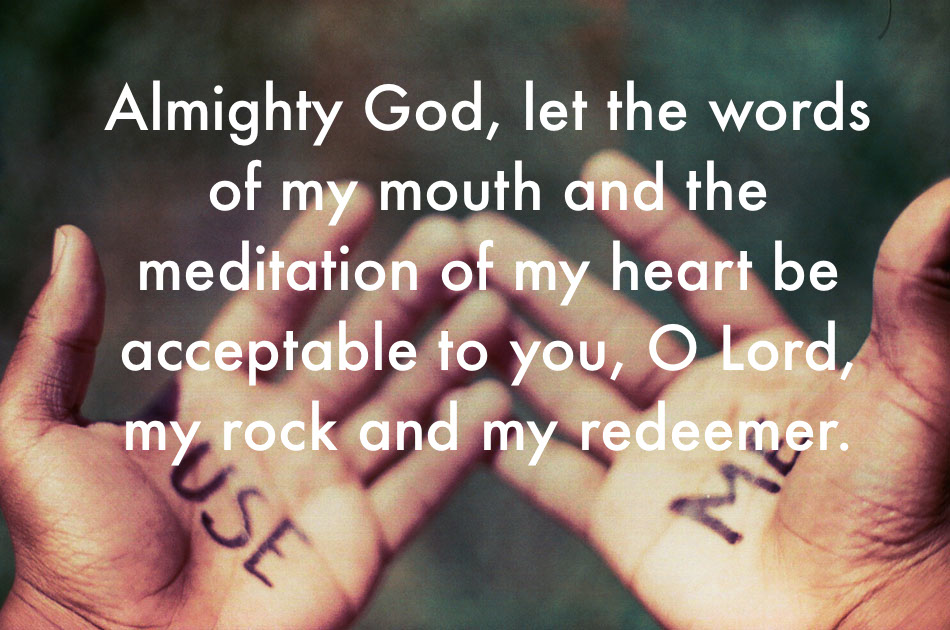
The law of the Lord is perfect, reviving the soul; the decrees of the Lord are sure, making wise the simple; the precepts of the Lord are right, rejoicing the heart; the commandment of the Lord is clear, enlightening the eyes; the fear of the Lord is pure, enduring forever; the ordinances of the Lord are true and righteous altogether. More to be desired are they than gold, even much fine gold; sweeter also than honey, and drippings of the honeycomb. Moreover by them is your servant warned; in keeping them there is great reward. But who can detect their errors? Clear me from hidden faults. Keep back your servant also from the insolent; do not let them have dominion over me. Then I shall be blameless, and innocent of great transgressions. Let the words of my mouth and the meditation of my heart be acceptable to you, O Lord, my rock and my redeemer.

use-me

There were two men. The first lived his life perfectly and blamelessly; everything was coordinated and examined. He never wasted a moment and did his utmost to plan for every contingency and minor catastrophe. If he could live his life in consistent repetition, he believed he could achieve perfection. Every morning he awoke to eat the same breakfast and spend precisely 15 minutes reading from his bible, offering up the same lifeless prayer. He wasn’t sure that he actually believed in God, but he wanted to be safe. He took the same roads to work, ordered the same lunch, used the same pencil brand. Everything was accounted for. He made his money, invested in the right companies, provided for his family. On the surface he had everything you could want. Except he did not have life.

The second man lived a life of apparent chaos as he tried desperately to cling to something solid as the world continued to spin around him. Every morning was a new and exciting, though sometimes terrifying, adventure. He would often oversleep leading him to rush off to work without his breakfast or morning coffee. He was a faithful Christian, he somehow was able to make it to church every week, his bible was often found in different places throughout his house with ear marks and underlined passages in the Old and New Testament. He believed deeply that God was a living and loving presence in his life and looked forward to his moments of silence during the day when he felt he could best commune with the divine. Speaking with God was not about rhythm or repetition, but a life-giving and humbling experience. He made his money, tried to invest, but believed that spending time with his family would be more rewarding than a large portfolio. On the surface he was missing some of the things that make up the American dream. But he had life.

It has taken me a long time to learn how to pray; and I’m still not satisfied with my prayer life. I go through waves of devoting time everyday to sitting in silence and talking with God, and then there are days when I have realized that I felt too busy to pray. I have spent weeks praying prayers that have been written in books, and I have spent months praying extemporaneous prayers from my heart and soul. I have experimented with numerous spiritual disciplines, and I’m not sure that I have found the one that is just for me, perhaps I never will.

Prayer is one of those things in the life of Christian discipleship that we expect, but rarely talk about. Whenever we get together as a church, before an activity begins, all eyes fall on me to lead us in prayer so that we can start. Sometimes those prayers feel life-giving, but oftentimes they feel like an expectation. When I am asked to pray before a meal, there are times that I feel truly genuine in expressing my thankfulness to the Lord, but there are also times when I feel that I am just going through the motions.

prayer

There was a long period in my life where I felt like the first man. I would wake up early and ride my bike to Duke Divinity School just so that I could be there for Morning Prayer with the Anglicans and Episcopalians. I even started to lead the daily worship service. But there was a time when in meant very little to me. It became so routine that I stopped listening to the words, and felt that it was more important for me to be there in body, than it was for me to be there in heart and soul.

Last week I asked us to examine a simple, yet profound, question: What is the point of Church? Why do we spend time each week gathering in this place? I attempted to proclaim God’s Word in such a way that we could begin to move away from a maintenance model of Church, to a missional model where we live as Christ’s body for the world.

Today I would like to ask an equally simple, yet profound, question: Why do we pray and read scripture? Why do we take the time to halt the busyness of our lives to read God’s Word and commune with him?

The psalmist writes that the law of the Lord is perfect, it revives the soul, it makes us wise, it allows us to rejoice in our hearts. The commandments are clear, they open our eyes. The fear of the Lord is pure and endures forever. The ordinances of the Almighty are true and righteous. The psalmist even goes on to claim that the Word of the Lord is to be desired more than gold and sweeter than honey.

You could give me a biscuit with honey on it right now, and I would tell you that is the sweetest thing in the world. Yet, as I have grown older, as I have spent more time deep in God’s Word, its sweetness has been revealed to me. In a conversation with someone during bible study, or deep in prayer about someone’s life and suffering, a new vision and understanding is presented to me out of God’s Word. It truly is a sweet gift, one that speaks to us, even today, from God.

The difference between the two men, is that the first saw his responsibility to prayer and scripture as simply that – a responsibility. He sets aside the time to read and pray, but the words on paper and the words on his lips are lifeless. He believes the first part of the psalm but expects that so long as he maintains his regular practice it will be enough. The second man, however, recognizes that he can do more, that speaking with God can be different and casual and faithful.

Psalm 19 begins to answer our question: Why do we pray and read scripture? It refreshes our souls.

When we spend time reflecting on God’s Word and going to him with our thoughts, desires, hopes, and fears we honor the living Lord who refreshes our souls for a new day. It simplifies the way we envision the world, and reminds us who we are following and why. It humbles us and rewards us.

However, even with the benefits and warnings in scripture, we cannot completely avoid hidden sins and mistakes nor can we control others around us and prevent them from doing the same.

God’s Word operates as a warning about the transgressions of life. It has not only the green light of “allowed”, and the red light of “forbidden,” but also the yellow light of “caution.” Ordinary and humble people do not normally go plowing through the red lights of life. Deliberate and precise sins come with practice and committed degeneracy. But we are all constantly taking chances with the yellow lights of behavior.

That is why the end of the psalm is so important: Who can detect all of their own errors? Who can look at their life and faithfully say I was wrong? Great God, cleanse me from my hidden faults, keep me from those who would do harm to my soul.

The greatest test of our faith is found in our willingness to seek forgiveness from our sins, particularly those no one knows about except us. When we have committed a wrong against someone, and everyone else knows about it, I believe we are more inclined to seek forgiveness. But when we do something wrong in secret, when we sin while no one is watching, I believe we are less inclined to ask for forgiveness, because it is entirely on us. God’s word and a life of prayer are therefore the ways by which we might have the strength to admit our faults, as we read about so many who have sinned before us, and seek forgiveness as we commune with the Lord in prayer. Reading and praying are as essential for us as are eating and breathing – they all give us life.

If you want to become a United Methodist Pastor, there are a number of requirements you have to meet. One of the most stressful is planning a full worship service, leading it, preaching, and having the entire thing videotaped. I was still in seminary when I asked my home church if I could “take over” for one Sunday in order to film the service and send it off to the people who would determine whether I should become a pastor or not.

I fretted about the service, overanalyzed the bulletin, worried about the hymns I selected, stressed about the scripture, and never felt the sermon was good enough. After all the weeks of planning and communication I showed up at my home church Sunday morning, and prepared to put it all on the line. I remember standing in the back, and giving my father the “thumbs up” to start recording when Jason, my friend and pastor, walked ahead of me to address the congregation.

“For those of you that don’t know,” he began “we have one of our very own here this morning to lead us through worship. Taylor is applying to be considered for an appointment in the United Methodist Church and everything we do this morning is being filmed. You and I all know that he is not really that funny, but if you could try to laugh at his jokes, I’m sure that it will help him out with the Board of Ordained Ministry.

The service was oriented around a reading from the end of James about sharing our sufferings with one another. The role of disciples in the church is to rejoice with one another at times of happiness, and weep together during times of sorrow. We are called to love one another through the good times and the bad, but we can only begin to find healing and reconciliation if we share our struggles.

When I was finally able to offer the benediction at the end of the service I breathed out a huge sigh of relief, a sigh that was so loud that you can hear it in the recording! I had made it through the whole thing without tripping and embarrassing myself, without stuttering through the scripture reading, and I even got a few laughs during the sermon though I could never tell whether they were genuine or not…

I made my way out of the sanctuary proud of the service and hopeful that it was good enough for the Board that would be viewing it. But while my mind was caught up in my own selfish reflections about the service, I saw a member of the church, someone I knew very well, crying in her pew.

She shared with me that her daughter had been suffering with bulimia through the last six months and she had refused to share it with anyone. She was embarrassed that she had failed as a mother and she felt as if she was carrying the whole world on her shoulders. She said that after hearing the scripture read, and the words of the sermon, she prayed in her pew, and she realized (for the first time) that the church was the place that she could share her burden. And while others were preparing to leave she reached out to the stranger in her pew and asked if she could share with him her struggles and pray together. With tears flowing down her face she said that this was the best she had felt in months.

prayer-bible

The Word of the Lord is greater than gold and sweeter than honey. In the moments of our reading and praying we are opened up to the strange new world of the bible and of faithful living that can change everything.

We pray and read to cleanse our souls and to give us life. It is not something that has to be strictly observed with militaristic expression, but instead something that we believe can change our lives.

The final line of the Psalm 19 is a beloved and permanent aspect of worship; they are the words I pray before preaching every single Sunday. If our words and thoughts are acceptable in the Lord’s sight we are on the path toward renewed spirits and discipled living. When those words become our truest prayer and hope then we are speaking and thinking as if Jesus was at our elbow which, after all, is the whole point of prayer.

Amen.

Devotional – Romans 12.2

Devotional:

Romans 12.2

Do not be conformed to this world, but be transformed by the renewing of your minds, so that you may discern what is the will of God – what is good and acceptable and perfect.

Weekly Devotional Image

“Taylor,” he began, “I have been attending worship at United Methodists churches nearly every Sunday since I was a child and I have never heard anyone preach on the texts you chose this month.” We were sitting in the church social hall after worship yesterday afternoon when a member of our church made it known that he was still learning something new and church and growing in his discipleship. Georgeanna Driver, one of our members who passed away last week, made a similar comment two weeks ago about not knowing that story (Elisha and the she-bears) was even in the bible. It has been exciting and thrilling over the last three weeks to challenge peoples’ perspective on what the Word of the Lord can still speak into our lives today, even stories we might otherwise choose to ignore.

tumblr_mdhatd0Ybh1qhmhdfo1_500

When I was at Duke for seminary our Dean, Dr. Richard Hays, reminded us that the responsibility of the Christian is to be constantly transformed by the renewing of our minds. Etched in the marble archway leading into the chapel, Romans 12.2 is a relevant reminder for students of God’s Word but even more so for the people who have been called to follow Christ. In today’s world/society it is too easy to remain complacent with our understanding of faith and overreact when a new person/idea challenges our faith. In stark contrast Jesus was regularly pushing his disciples into new territory with understandings about the kingdom of God.

What we do as Christians is primarily about God, and only secondarily about us. We gather on Sunday’s to hear the Word of the Lord and then live it out in the world. Worship is that time that helps in the transformation and renewal of our minds so that we may discern God’s will for our lives, rather than be conformed to the ways of the world.

Outside of worship we can be transformed through the reading of scripture. Try opening your Bible to a book or a chapter you’ve never read (or haven’t read in a long time), read a set number of verses, and then pray over them. Ask yourself: what might God be saying to me through these words today?

The Word of God is alive and speaking anew everyday, we need only the faith to hear it and live it out.