Devotional – Psalm 25.5

Devotional:

Psalm 25.5

Lead me in your truth, and teach me, for you are the God of my salvation; for you I wait all day long.

Weekly Devotional Image

On Friday, at a campaign rally in Alabama, President Trump suggested that any “son of a b!@#$” who kneels during the national anthem should be fired. His comment was made in reference to the growing controversy initiated by the (former) NFL player Colin Kaepernick who last year knelt during the national anthem to protest police shootings of black people. And as more and more players began to join Kaepernick in demonstrating, responses from political figures have garnered a lot of attention including the recent comments from the president.

At both a wedding reception on Saturday evening and in church yesterday I overheard a number of conversations between people about the controversy and battle lines were quickly drawn. On one side there are people who believe those who kneel represent anti-patriotic sentiments and that they are ungrateful for the military. On another side there are people who believe that kneeling in protest is part of the 1st Amendment and therefore is absolutely an American thing to do and that it should be protected.

Witnessing conversations about the American Flag and the responses of professional football players to it reminded me of Stanley Hauerwas concern that most Christians today are moved more by the American Flag than by the cross of Jesus Christ. This is not to say that there is anything wrong with the flag (though it is certainly a more complicated symbol than we often think it is), but the fact that the flag itself generates more response and appears to be more powerful than the cross is something that should give Christians pause.

Bible-and-Flag

It’s one thing for talking heads to ramble about the pros and cons of kneeling during the anthem but it’s another thing entirely when it comes to the realm of the church. These days the church seems to revolve around tweets from the White House more than the revealed Word of God. These days the church appears to spend more of it’s time debating the values of our country’s democracy than our Savior’s teachings and ethics. These days the church seems to believe that our salvation will come from Congress more than from Jesus Christ.

The psalmist wrote, “Lead me in your truth, and teach me, for you are the God of my salvation; for you I wait all day long.” As Christians, our God is the God of salvation, God is the first and the last, and God is the one for whom we wait all day long. Our creeds and our prayers, our hymns and our scriptures, all point to the definitive claim that God is the source of our being and that the cross of Christ is, and forever shall be, the most determinative symbol in our lives.

But sometimes, it doesn’t feel like it.

Instead, in the realm of the church we label one another as liberal or conservative when we’re supposed to see one another as brothers and sisters in Christ. When we have culture wars over things like NFL players kneeling during the national anthem we classify entire groups of people as pro or anti American, we neglect to remember that all of us are children of God. When we are more concerned about how someone responds to the flag than we are about how someone responds to the grace of God, we neglect to be a church that can faithfully say: “Lead me in your truth, and teach me, for you are the God of my salvation.”

What’s Right With The Church?

Psalm 145.1-8

I will extol you, my God and King, and bless your name forever and ever. Every day I will bless you, and praise your name forever and ever. Great is the Lord, and greatly to be praised; his greatness is unsearchable. One generation shall laud your works to another, and shall declare your mighty acts. On the glorious splendor of your majesty, and on your wondrous works, I will meditate. The might of your awesome deeds shall be proclaimed, and I will declare your greatness. They shall celebrate the fame of your abundant goodness, and shall sing aloud of your righteousness. The Lord is gracious and merciful, slow to anger and abounding in steadfast love.


People outside the church love to talk about its faults and failures. For instance: Church organizations were able to mobilize and respond to the recent devastation in Texas and Florida before FEMA or the Red Cross, but whenever the Church is in the news it has to do with a failure to keep track on money properly, a scandal involving clergy, or a denomination’s vote on something like homosexuality.

Last week I shared some stories about a recent wedding I presided over, and I told you about how effusive some of the people in attendance were with their praise. There is something strange and mysterious about a wedding that leads people to speak in deeply honest ways. Perhaps it’s the fact that love is in the air, or that reunions are bringing people together, or the free alcohol. However, what I didn’t share with you last week were the negative comments from other people.

“I don’t think you’re gonna have a job much longer preacher. You know the church is dying right?”

            “How can you support a system that is so archaic and out of touch with reality?”

            “You seem like a nice guy but I think the church is more responsible for evil in the world than good.”

It’s easy to pick on people outside of the church who are so harsh and judgmental with their language. It’s easy to pick on them because they’re not here, they don’t know what God is up to, they don’t know what the church is really like.

And for as much as people outside of the church love to talk about its faults and failures, people inside the church might be even worse.

I went to my first clergy meeting for the Alexandria District this week and I was struck by how somber so many of us were. Throughout the time of our gathering there was far more negativity than positivity, and at some point it felt like the whole point of the meeting was to get preachers together to complain about people like you.

            What’s right with the church?

Fotolia_137876364_Subscription_Monthly_M-1080x675

A few years ago I was given a copy of sermon preached by a man named Zig Volskis in 1987, the year before I was born. In it he attempts to answer that very question, “What’s right with the church?” Zig, like me, was frustrated with all of the negativity surrounding the church and instead he wanted to focus on the life-giving elements of the body of Christ that is the church.

Zig preached that as a child he would have responded to the question with: the church bells and music. They both represent the energy and depth of the worshipping community through sounds and communal response. The music of the church reassures the people that God is the one in control, even is the world claims the contrary.

As an adult, Zig claimed that his answer had changed over a career of serving the church for thirty years. He believed the best thing about the church is that it endures. Empires come and go, even church buildings are destroyed by war and exodus, yet the body of Christ always endures. With all its blindness and plundering, for all its inability to faithfully use its enormous resources properly, the church has sought to minister to human needs in thousands of different ways. And, for untold numbers of persons, the helping hand of the church has been a lifesaver.

Zig ended the sermon with a call to those who love the church: make more room for church, bring to the church your best and highest devotion. And to those who are not sure about the church: you will not find perfection here, but come in anyway, and help us make the church better.

And with that he said: Amen.

Over the years I’ve thought a lot about Zig’s sermon, and in particular our willingness to overemphasize the negative rather than addressing the positive. And, I’ll be the first to admit – The church does have problems. From this Cokesbury here in Woodbridge to the great universal church, we have problems because, at its heart, the church is filled with people like us: broken, flawed, sinners.

I could take time to bring up poor management, or fiscal irresponsibility, or personal judgments. We could spend weeks talking about how we’ve failed as a church, we could spend weeks talking about how we need to get better, but in so doing we would fail to recognize all the things that are right with the church.

But the psalmist, and the witness of scripture, chooses to focus on the things that are right. I will extoll the Lord, I will meditate on the goodness of God, I will declare the greatness of God. Every generation will share with those who follow all the splendor and majesty of God.

The psalm we have today is like a hymn, something to be declared by the entire congregation. And if you look at it, and really read through each line, it is so over the top with declarations of God’s glory that it sounds like the kind of love letters middle school students used to leave in each other’s lockers.

The love and praise the psalmist has for God is not something that can remain bottled up and hidden away. There is a quality of God’s grandeur that evokes a response, it pushes us to bring forth our gladdest praise and declare from the rooftops about the mighty works of God.

However, most of us are uncomfortable with wearing our faith on our sleeves. We don’t know quite what to make of religious displays of affection. We can’t even imagine standing up in church to talk about what God has done for us.

This psalm, these words about God, they are an invitation to remember what God has done for us, and shout it out.

I love asking people to tell me about sermons they remember from the past. Such as: Have you ever heard a sermon on Psalm 145? Can you remember the preaching from when you were a kid? Can you even remember what I preached about last week? The truth is that most of us remember very little, myself included!

I think back on what it was like to be raised in the church and I can’t remember any sermon I heard. There are a couple phrases that continue to bounce around the grey matter between my ears, but I don’t remember anything more than that. But you know what I do remember? I remember the people who got up and talked about how the church had changed their lives.

I remember sitting as a child at the altar and listening to a man in a hospital gown talk to us about how the church visited him when he was in the hospital after finding out he had cancer. I remember the woman who wept from the pulpit as she was thanking people for attending her husband’s funeral. I remember the older man who was baptized in front of the whole church who then shared his story about how he lost everything in his life, and then found everything when he started coming to church.

There is a profound power in being reminded, again and again, of what God is doing in the world and in the church. There is something good and right and true about sharing stories of what is right with the church. So that’s exactly what we’re going to do.

Founders-Day-2017-672x330

I’m going to go first, as an example, but then I want to open up this space and this time for you to share what you think is right with the church.

Shortly after I arrived here at Cokesbury, I was working on a sermon in my office when a bunch of people came in through the door and kept walking past without saying a word. I mean I was the new guy and they didn’t even both to check on me. And they call themselves Christians! I found out later they were the Prayer Shawl team, and that they had work to do in the conference room.

I sat in my office for a while, pretending to work, but what I was actually doing was eavesdropping. I wanted to know what they were really up to, I wanted to know what these ladies were really like, I wanted some gossip.

But I was disappointed. Instead their conversation was filled with affirmation for one another, and they worked and worked and worked.

You want to know what I think is right with the church? Our prayer shawl team. They gather together and have created a beautiful community designed to make the community more beautiful. They work to give away everything they’ve created to be a blessing to others. And they do so with abundant joy. Each of their shawls, and all of the squares in our bulletins today are seeds they are casting into the world, and because of their work and God’s grace, those seeds will grow to bear beautiful fruit for God’s kingdom.

So, now its your turn: What’s right with the church?


There are few things in this life more joyful than discovering how our lives are caught up with the great and enduring story of God’s wondrous works. As we share what’s right with the church we discover how connected we are with one another. As we listen to what’s right with the church we rediscover the faith and the fervor of the psalmist within each and every one of us.

So to those who love the church: make more room for it, bring to it your best and highest devotion. And to those who are not sure about the church: you will not find perfection here, but come anyway, and help us make the church better. Amen.

Devotional – Psalm 103.8

Devotional:

Psalm 103.8

The Lord is merciful and gracious, slow to anger and abounding in steadfast love.

Weekly Devotional Image

16 years ago I was sitting in my 8th grade band class when an announcement came over the PA system that I was needed at the main office. I walked down the hallway wondering why in the world they needed me in the main office of my middle school when I saw my father standing outside the doors beckoning me to hurry up. We quickly dashed toward the car where my sisters were already waiting and all I remember my dad saying was, “So many people have already died.”

It was September 11, 2001 and my father somehow got us out of school before they went under lockdown. I spent the entire day sitting on the living room floor at my parents’ house watching the World Trade Centers fall to the ground over and over again. And I was angry.

sept-11-Brigitte

Thinking back on that day 16 years ago, I can remember the anger I felt, but I can’t tell you who or what that anger was directed toward. The television contained images of violence I never thought possible in the world and it created in me a frustration and an anger that remained for a long time.

It was only years later that I came across a prayer written by one of my professors 30 minutes after the destruction of the World Trade Center. Dr. Hauerwas’ words articulate a feeling that I believe most Americans felt 16 years ago, but he was also bold enough to speak the truth in a time of fear, anger, and violence. This is the prayer he wrote 16 years ago today:

“Vulnerable – we feel vulnerable, God, and we are not used to feeling vulnerable. We are Americans. Nor are we used to anyone hating us this much. Such terrible acts. Killing civilians. We are dumbfounded. Lost. We are good people. We are a nation of peace. We do not seek war. We do not seek violence. Try to help us remember that how we feel may be how the people of Iraq have felt while we have been bombing them. It is hard for us to acknowledge the “we” in “We bombed them.” What are we to do? We not only feel vulnerable, but we also feel helpless. We are not sure what to feel except shock, which will quickly turn to anger and even more suddenly to vengeance. We are Christians. What are we to do as Christians? We know that anger will come to us. It does us not good for us to tell ourselves not to be angry. To try not to be angry just makes us all the more furious. You, however, have given us something to do. We can pray, but we wonder for what we can pray. To pray for peace, to pray for the end of hate, to pray for the end of war seem platitudinous in this time. Yet, of course, when we pray you make us your prayer to the world. So, Lord of peace, makes us what you will. This may be one of the first times we have prayed that prayer with an inkling of how frightening prayer is. Help us.” (Dr. Stanley Hauerwas – Disrupting Time)

So today, 16 years later, we still pray for God’s will to be done. We pray that we might become God’s prayer for the world. And, perhaps most boldly, we remember that while the world is consumed by fear and terror, we worship the God who is merciful and gracious, slow to anger, and abounding in steadfast love.

Devotional – Psalm 133.1

Devotional:

Psalm 133.1

How very good and pleasant it is when kindred live together in unity!

Weekly Devotional Image

It is very good and pleasant when kindred live together in unity, but it rarely happens. Instead, in-laws fight over table decorations for wedding receptions, children argue over who received the most Christmas presents, and spouses argue about the strangest things until they lose their voices. Even beyond the nuclear family, kindred (in the larger sense) are divided over a great number of topics including politics, economics, and ethics.

I am convinced that for as much good as social networking and the 24-hours news cycle have brought into the world there is also just as much evil. In the wake of the recent tragedy in Charlottesville, VA people on every spot of the spectrum have come out to voice their particular opinion as if shouting into the void without a care as to who might hear it. I have friends, good friends, who posted on their Facebook pages some truly hateful language regarding the protestors and anti-protestors. One person said that the young woman who was murdered by the driver who drove into the crowd of people would still be alive if she wasn’t a fat-good-for-nothing trying to interrupt a “peaceful protest.” Another person wrote about how we should jail and/or physically punish all white republicans because they’re all “racists on the inside.” And still yet another person wrote about the need to reassert the values of “white America” over and against all other types of Americas.

And all of this was posted publicly for the world to see.

body-of-Christ-featured-image-600x400

The psalmist declares, “How very good and pleasant it is when kindred live together in unity!” Unity is a rare thing in the world today, let alone in our individual communities. Rather than seeking unity we almost always just spend our time with those who already have our opinion and instead of seeking to find common ground we stake our claim and dig deeper into our own ground.

As Christians we believe that the church is the better place that God has made in the world. For us, the church is the place where even though we do not think alike we can love alike. We sit down in pews with people who are of different opinions, we gather with them at the altar, and we are sent forth with them to be Christ’s hands and feet for the world. If we cannot have unity in the church, unity in a common purpose to love, then the world will continue to be a place of walls and divisions and disunity.

This week, as we continue to take steps in faith and seek God’s kingdom here on earth, let us join our voices together in a common prayer:

“Almighty God, help us to remember that before Jesus marched to the cross he prayed for his disciples that they might be one. In the same fellowship that is between you and your Son and your Spirit, in the same hope of the prayer that Jesus offered in the garden, we pray for unity in your Church, being bound together in love and obedience to you. Help us so to love you and one another that your kingdom might reign here on earth now and forever. Amen.”

Devotional – Psalm 85.8

Devotional:

Psalm 85.8

Let me hear what God the Lord will speak, for he will speak peace to his people, to his faithful, to those who turn to him in their hearts.

Weekly Devotional Image

In 1968 there was a man whose job was to record nature sounds for films and television. He would pack up his recording equipment, hike out into the wilderness, drop his gear, and then return later for the undisturbed natural sound. In order to achieve 1 hour of unaffected sound, no planes or sirens or human presence, it would take 15 hours of recording time.

Today, the same man continues to record and when he wants to get 1 hour of unaffected nature sounds, it takes 2000 hours of recording time.

We live in loud world.

noise

Most cars now come with separate audio systems for the front and back so that passengers can listen to different music. You can buy clothing with wires stitched into the fabric so that you can have music in your ears wherever you go. I even saw a commercial last week of a couple out in the wilderness camping and they were unable to sleep because it was too quiet and they then started playing “soothing city noises” of traffic and horns honking on their phones in order to fall asleep.

What does it say about us when we now have apps to help us sleep with the sounds of pedestrians and road rage?

What does it say about us when we need to have sound and music playing whenever we’re in the car, whenever we’re sitting in the backyard, or whenever we’re walking down the street?

What does it say about us when most of squirm and uncomfortably cough when we’re asked to pray silently in church on Sunday for all of 15 seconds?

Loud-Noises

Many of us want the same things as the psalmist; we want to hear what God the Lord will speak, for he will speak peace to his people. But how can we ever expect to hear God speak when our ears are filled with the sounds of life that bang and clash and hum over and over?

When was the last time you were intentionally quiet for ten minutes? What is it about silence that makes it so difficult? Why is it so much easier to be surrounded by noise than to stop and listen?

There are times when God will speak to us through loud and cacophonous means, but there are other times when God shows up in the silence, if we are willing to listen.

Devotional – Psalm 145.9

Devotional:

Psalm 145.9

The Lord is good to all, and his compassion is over all that he has made.

 Weekly Devotional Image

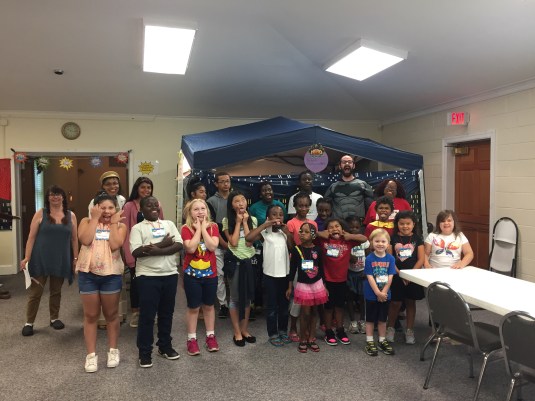
I arrived at church this morning mentally prepared for Vacation Bible School. I had read over the “Bible Story Teller” section, I knew where I needed to be and at what time, and I even had the perfect costume picked out: Batman.

However, I had assumed, foolishly, that the other adults would also arrive in some form of superhero costume. So, instead of blending in among a crowd of heroes, I stuck out like a sore thumb. However, when the children arrived (some from the church and some from the community) they were all shocked that the Caped Crusader was making his way around the building.

After our initial assembly time we broke out into age groups and then began making the rounds through the different centers. I made my way to the storyteller room and started teaching all of the children and youth about Samuel anointing a young David. The groups listened to my rendition and appropriately laughed at my silly jokes, they left with a sense that to be a hero in God’s kingdom one needs to have a compassionate heart, and they learned about how God is our true hero.

IMG_2824

Toward the end of the day, in my last bible story session, one of the youth was not as engaged in the others. I tried to include her as much as possible, but there was clearly something distracting her. When we finished, the rest of the youth walked out of the room, but she stayed behind as if to ask a question. Without prompting she lifted up her head and said, “Did you really mean that?” I said, “What do you mean?” She replied, “That God really loves everyone? Even me? You said that God’s love for David is the same as God’s love for eveyrone, and I want to know if that’s true.” And I said the only thing I could say, “Of course it’s true.”

I don’t know what’s going in her life to warrant her isolated behavior, or even her stark wonder at the fact that God could love her, but I am grateful for the opportunity to tell her the truth. As the psalmist says, “The Lord is good to all, and his compassion is over all that he has made.” God’s love and grace and mercy know no bounds. They are for ALL. And all means all!

From the youth who arrived for Vacation Bible School while wrestling with something beyond herself, to the man panhandling on the street corner, to the family sitting in the pews on Sunday morning, God’s love is for ALL.

Sometimes we lose sight of the tremendous extent of God’s love when we encounter people that we cannot love. When we disagree with them, or are angry with them, they feel outside the realm of God’s grace.

And sometimes we lose sight of the tremendous extent of God’s love when we feel like we know longer deserve it. When we really think about how we have sinned, or how we could be better, we feel outside the realm of God’s grace.

Then let us all hear the good news, the best news: The Lord is good to ALL, and his compassion is over ALL that he has made.

Devotional – Psalm 105.1

Devotional:

Psalm 105.1

O give thanks to the Lord, call on his name, make known his deeds among the peoples.

Weekly Devotional Image

I love Star Wars. When I was a boy I watched our VHS copies of A New Hope, The Empire Strikes Back, and Return of the Jedi so many times that they became unwatchable and we had to purchase new copies. I would read and reread the VHS cover so frequently that I began memorizing all of the inconsequential details. I still know almost every line in all three movies all from the time of my childhood.

I still love Star Wars as an adult. I’ve dressed up as characters from the universe for far too many Halloween celebrations, I definitely have too many Lego sets from the movies (that stay prominently displayed out of my son Elijah’s reach), and I even have a replica of Luke Skywalker’s green light saber from Episode VI.

Untitled

When new details about the upcoming films come out I become an evangelist for the films. I will turn just about any conversation in such a way that I can mention rumors about casting, or new hopes for screen writing, or even connections within the expanded universe. I become my nerdiest when I’m talking about Star Wars.

And I rarely talk about church the same way.

Don’t get me wrong: I love the church. I love the church’s liturgy, I love the call to preach, I love offering the sacraments, I love being with people in some of the most holy moments we can ever experience. But I rarely recommend the church to others in the same way that I recommend watching a Star Wars movie. And even with how much of my life has been blessed by Star Wars, God has done, and will continue to do, more than any film ever can.

The psalmist calls for the people of God to “make known [God’s] deeds among the peoples.” We tend to recommend things to people all the time like restaurants to try, books to read, and movies to watch, but when it comes to the church we often remain silent. Or, perhaps more importantly, when it comes to what God has done for us, we remain silent.

Part of this tendency is due to our belief that faith is a “personal and private” matter, which leads us to leave our faith to ourselves. Part of it also stems from the fact that we so often take our blessings for granted, or we don’t recognize where the blessings came from in the first place.

But God is the author of our salvation. God is the one working in and through our lives to bring about the kingdom on earth. God is the one who has transformed us.

How much better would it be then, to share with others what God has done for us?

Devotional – Psalm 139.4

Devotional:

Psalm 139.4

Even before a word is on my tongue, O Lord, you know it completely.

Weekly Devotional Image

I was shaking hands with people on their way out of worship when a young man, about my age, walked up. We exchanged the pleasantries due to one another in a place like church and then he asked if I would be willing to pray for him. I said something like, “Sure I’ll be happy to add you to my prayer list” and then prepared to shake the next person’s hand. But the young man kept standing there and said, “No. I need you to pray for me right now.”

He told me about the struggles in his life all while people standing in line waited patiently. He shared about his inability to find work, his complicated relationship with his father, and his general feeling of despair. And then he grabbed me by the hands, closed his eyes, and waited for me to pray. So I did.

I had casually known the young man for a couple years but I had no idea about his struggles. Week after week we were in the same church, singing the same songs, offering the same prayers, but I knew nothing about what was happening under the surface.

The psalmist proclaims, “Even before a word is on my tongue, O Lord, you know it completely.” And this is good and right and true. The Lord knows what we need and what we want even before we can articulate what we need and what we want. But just because God knows our words before we do, that doesn’t mean that everyone else does as well.

shutterstock_153536591

In today’s world many of us are uncomfortable with the thought of asking someone to pray for us, let alone having him or her do it right in the moment of our asking. Instead we fill the time of prayer concerns with the needs of other with whom we are familiar. And even then, the expectation is usually that a general prayer will be offered for individuals and groups removed from the immediate situation so that we can move on to something else.

The Lord knows what we need, but the people closest to us (our friends, family, church members) usually don’t. Instead, they are habituated by the masks we wear. They grow comfortable with what they experience and then assume that so long as everything on the surface appears normative then everything deeper must be the same.

What would it look like for you to ask someone in your life to pray for you this week? And not the “can you pray for me sometime” casual request we are used to hearing but the “I need you to pray for me right now.” It might be uncomfortable and even frightening, but it is at the heart of what it means to be in relationship with others in a way that is true, deep, and faithful.

Devotional – Psalm 86.10

Devotional:

Psalm 86.10

For you are great and do wondrous things; you alone are God.

Weekly Devotional Image

Yesterday, while the United Methodist Churches in the Virginia Conference gathered for worship, clergy and lay representatives were at the Hampton Convention Center to hear Bishop Sharma Lewis lead worship. In her sermon she brought together many of the ideas from the weekend of Annual Conference particularly regarding the fact that God is in the business of doing new things. And she concluded with our new ministry focus: “to be disciples of Jesus Christ who are lifelong learners, who influence others to serve.”

But there was another line from her sermon that has been playing over and over in my mind more than any other: “Laity, do not say to your Clergy who bring fresh ideas, ‘But we’ve never done it that way before.’”

I count myself blessed that over the last four years St. John’s has largely responded positively to new ideas. Working together with the leadership of the church has resulted in new ministries and ways to serve the community that have allowed us to accomplish God’s will. But just as we embarked into new territory during my time as the pastor, you (and I really mean you) need to continue to have open eyes and open hearts to the new ideas from your new pastor.

editors-rant

Just because we did something a certain way while I was here does not mean that’s the way you have to do it forever. Frankly, you should probably change almost everything because that would be a better way of allowing the Spirit to move in new and bold ways. And that is what is at the heart of what Bishop Lewis said and at the heart of churches that are currently fruitful; a recognition that new ideas should be embraced because they ultimately come from God.

The psalmist boldly proclaims that God is the one who is great and does wondrous things. Pastors can do good things for their churches, they can help to point to what God is doing in the world, but God is the one doing the things in the world! God is God alone and a church can only be fruitful when it knows and believes that God is the one from whom all blessings flow.

So when you hear about a new idea, whether it comes from your new pastor or even from yourself, know and believe that God is the source of the idea, and prepare yourselves to be surprised by the wondrous majesty of our God who is in the business of doing new things.

I will miss all of you and all of the remarkable things we’ve done together over the last four years, but I am grateful that God will continue to do even more for you in this new chapter of the church’s life.

A Reminder For Those Attending Annual Conference

Psalm 100.3

Know that the Lord is God. It is he that made us, and we are his; we are his people, and the sheep of his pasture.

2017AClogo_color_600

In a few days United Methodists from all over the state of Virginia will gather in Hampton for Annual Conference. It is the conference wide meeting for clergy and lay representatives so that we might have worship and parliamentary deliberations in order to discern the will of God. Highlights will include the Service of Ordering Ministry when new candidates will be blessed for ministry, our new(ish) Bishop will address the conference as a whole for the first time, and we will hear from all of the vibrant ministries taking place across the conference. However, there will come a time when we descend into the depths of Roberts Rules of Order, individuals will speak into the PA system just to hear the sound of their own voice, and it will feel a whole lot more like a shareholders meeting than the gathering of God’s people.

And as I have been preparing for Annual Conference this year by reading through the Book of Reports and praying for our denomination, I felt compelled to write the following reminder for anyone attending conference this year (and frankly for any Christian):

On one of my first Sundays at St. John’s 4 years ago, I sat with the Church Council in the Social Hall for the very first time. We gathered that afternoon in hopes of communing with one another such that we could discern what God was calling us to do together. And I started the meeting with this story…

On my first day of seminary the dean stood up in front of the entire incoming class and gave a 45-minute lecture on the ethics of the New Testament. It was interesting for the first ten minutes and then most of us lost track of where he was going. We struggled to listen but everything was so brand new that most of us were more captivated by the architecture in the sanctuary than what was being said from the pulpit. But he ended with these words, words I will never forget, and words I hope you will never forget.

He said, “Why are you here? Some of you think you’re here because you want to teach in college one day, some of you are here because you believe you can save the church, and some of you are here simply because you love the bible. But why are you here? Now, I want you all to pull out a small piece of paper. You might, and probably will, forget most of what I’ve said today, but this is the most important lesson you will ever learn as Christians. I want you to take your piece of paper and tape it somewhere you will see every single day. You can put in on the mirror in your bathroom, or on your computer, or even on your bible, I don’t care where it is just make sure you see it every single day. And on your piece of paper I want you to write the following words: ‘It’s about God, stupid.’”

Wherever you are when you read this reminder, I encourage you to find a piece of paper and write down those same words: It’s about God, stupid. Tape it up in your hotel room, fasten it to the front of your book of reports, put it on your name tag, just do whatever it takes to encounter those words while attending Annual Conference. The UMC does not exist to serve the needs of those already in it, it does not exist to further perpetuate the bureaucracy in which it finds too much meaning, it does not exist to do whatever it takes to keep doors open on Sunday mornings; The UMC exists because it’s all about God!

God is the one who first breathed life into John Wesley and sent him on a course that would forever reorient the fabric of the church. God is the one who breathed life into all of the churches of the Virginia Conference, who empowers the pastors to proclaim the Word from their respective pulpits, who shows up in the bread and in the cup at the table. God is the one who gathers us together for a time of holiness, who moves in the words we sing, who rests in the spaces between us when we worship, who calls us to serve the kingdom instead of serving ourselves.

And so, no matter what you’re thinking or how you’re feeling this year for Annual Conference, remember it’s all about God.

inom8GpY