Stuck In The Middle

strangely-warmed-spreaker-header

This week on the Strangely Warmed podcast I speak with Rev. Matt Hambrick about the readings for the 24th Sunday after Pentecost (Judges 4.1-7, Zephaniah 1.7, 12-18, 1 Thessalonians 5.1-11, Matthew 25.14-30). Matt is the pastor of Trinity UMC in San Diego, California . The conversation covers a range of topics including the joy of collecting vinyl records (and why OK Computer is so good), the importance of place-names, the myth of originality, being stuck between joy and sorrow, militaristic language, and using our God given talents. If you would like to listen to the episode or subscribe to the podcast you can do so here: Stuck In The Middle


MH

The Strange New World

Psalm 78.1-7

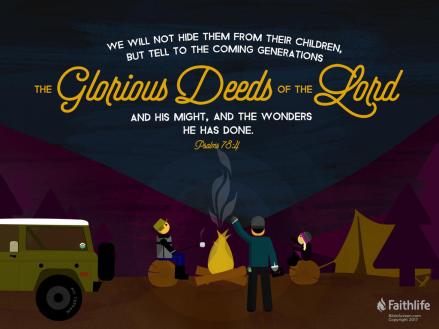
Give ear, O my people, to my teaching; incline your ears to the words of my mouth. I will open my mouth in a parable; I will utter dark saying from of old, things that we have heard and known, that our ancestors have told us. We will not hide them from their children; we will tell to the coming generation the glorious deeds of the Lord, and his might, and the wonders that he has done. He established a decree in Jacob, and appointed a law in Israel, which he commanded our ancestors to teach their children; that the next generation might know them, the children yet unborn, and rise up and tell them to their children, so that they should set their hope in God, and not forget the works of God, but keep his commandments.

A father was with his five year old daughter last Christmas, and it was the first time she ever asked what the holiday meant. He explained that Christmas is all about the birth of Jesus, and the more they talked the more she wanted to know about this “Jesus” so the father bought a kid’s bible and began reading to her every night.

She loved it.

They read the stories about Jesus’ birth, the miracles he produced, and teachings he offered. And the daughter would ask her father to explain some of the sayings from Jesus, like “love your neighbor as you love yourself” and “blessed are those who mourn” and “the kingdom of God is like a mustard seed.” They read and the read and at some point the daughter said, “Daddy, I really like Jesus.”

Right after Christmas they were driving around town and they passed by a huge Catholic Church with an enormous crucifix out on the front lawn. The cross was impossible to miss, as was the figure nailed to it. The daughter quickly pointed out the window and said, “Dad! Who’s that?

The father realized in that moment that he never told his daughter the end of the story. So he began telling her how it was Jesus on the cross, that he ran afoul of the Roman government because his message was so radical and unnerving that they thought the only way to stop him was to kill him, and they did.

And the daughter was silent the rest of the ride.

A few weeks later, after going through the whole story of what Christmas meant, the father took his daughter out to lunch on Martin Luther King Jr. day because her school was closed for the holiday. While they were sitting at the table waiting for their food, the daughter saw the local newspaper’s front-page story with a picture of Martin Luther King Jr. on it. She quickly point to toward the picture and said, “Dad! Who’s that?

“Well,” he began, “that’s Martin Luther King Jr. and he’s the reason you’re not in school today. We’re celebrating his life. He was a preacher.” And she said, “For Jesus?!”

“Yeah,” he said, “For Jesus. But there was another thing he was famous for; he had his own message and said you should treat everyone the same no matter what they look like.”

She thought about it for a minute and said, “Dad, that sounds a lot like love you neighbor as yourself.”

The dad said, “Yeah, I never thought about it like that, but it’s just like what Jesus said.”

And the young girl was silent for a minute or two, starring down at the table, but when she looked up at her dad she had tears in her eyes and she said, “Dad, did they kill him too?”

books-1245690_1920

It doesn’t happen often, but I love when a passage from scripture is straightforward. With the daunting amount of passages in both the Old and New Testaments that remain frustratingly ambiguous, it is refreshing to encounter a text that is so simple with its claims and expectations.

Listen up! Open your ears to what I am about to say regarding the mighty acts of God! I will declare the stories from the past, and we will not hide them from the children. They must hear about all the wonders of God. The Lord commanded our ancestors to teach their children, so they would teach their children, so that none of us would forget what God has done. Listen! We cannot fall back into the problematic rhythms of those who came before us, a stubborn and rebellious generation. We have to tell the story.

What follows in the psalm for today is a record of Israel’s history in song. The psalmist sets up a challenge: to remember the mighty acts of God for future generations, and then the psalmist declares the story of God with God’s creation. The narrative is so strong that the psalmist will not depart from it. The old old story has become so important to the psalmist that sharing it with others is the most important thing in the cosmos.

We have a member here at our church named Glenn who has dedicated himself over the last few years to rebooting our Children’s ministry. But he never really wanted to do it. It’s not a passion he’s had his entire life.

It actually all started when he volunteered to be the bible storyteller at Vacation Bible School a few years ago. Every morning he got the right costumes and ushered the kids into the strange new world of the bible through his stories. And one day, without really thinking about it, he simply asked, “Who is Jesus?”

The room was silent except for one girl who was brave enough to raise her hand with any semblance of an answer.

That was enough for Glenn to be jolted toward the importance of telling the story. That was enough for Glenn to commit himself to sharing Jesus with as many children as possible. That was enough for Glenn to hear the words of the psalmist echo through the sands of time: we will tell the coming generation the glorious deeds of the Lord.

There was a time when asking children about Jesus would’ve been unnecessary. There was a time when most families in a community went to church on a Sunday morning simply out of habit. There was a time when preachers could preach on a text without providing context.

But that time is gone.

Instead of embracing God’s story as our story, we’ve embraced other narratives. We don’t tell our children about Jesus, we expect the church to take care of that for us, much like we assume that schools will make them into perfect little citizens.

On Tuesday morning Lindsey and I brought Elijah to our local polling location to vote for Virginia’s next governor. I held him in my arms while Lindsey went to sit down and scan over her ballot, and while I was standing off to the side one of the poll workers gave me a little wave and said, “It’s so precious that you’re teaching your son about the value of voting!”

Is that what I want to instill in the coming generation represented by my son? Am I pleased to know that he will inherit a political structure that celebrates divisiveness while degrading cooperation? Am I more inclined to teach him about a political race than about God’s grace?

Ps78

The psalmist, long ago, believed in retelling the story to help shape the people of God. The psalmist believed that in going back to their origins, remembering who they are and whose they are, the people would always find the living God. When we tell the story that is our story, we become shaped by the Word to be Christ body in the world today.

But what is the story?

When we open the scriptures we are with Adam and Eve in the Garden. We hear the Lord warn them about the tree of knowledge of good and evil. We hear the slithering serpent calling them (and us) to rebel against the One who is love. And then Adam and Eve reach for that forbidden fruit inevitably driving them away from the Lord and into the unknown. We can feel that there is something of ourselves in these two standing on the edge of Eden looking back to what they once were and unsure of what will come in the days ahead.

We are with Noah kissing the earthy ground after the flood. We see the rainbow cast across the sky and we feel the colors reflecting off the pools of water still being sucked into the ground. We hear the promise of God to never abandon creation again. We believe in Noah there is a new creation, another chance for humanity to get things right. But then we see him tilling the ground, preparing the vines, and eventually getting drunk from the wine. In him we see the failures of the past reaching forward into the present and we hope for something better in the days ahead.

We are with Abraham in a strange land. We hear a call from the Lord commanding him to go to a land that has been prepared. We hear the promise, “I will make of you’re a great nation and your descendants will be more numerous than the stars.” We feel the Spirit moving through the space as the story continues lurching forward.

We are with Moses on a rocky hillside. We feel the warmth of a burning bush. We heard the voice of the Lord speak to the wandering shepherd: “Tell them I AM sent you.” We participate in the beginning of a call that will forever define an entire nation of people, a delivery from slavery to Egypt, and freedom in the Promised Land. We hear these strange words and promises and we know they are unlike anything else we have ever read. We know the story, and we think it might be about us, but it’s about God.

We are with David when he puts the rock into the sling and takes down the mighty Goliath.

We are with Solomon when he prays for the Lord to give him wisdom.

We are with Isaiah when the coal is placed on his lips.

And then we are there when everything changes; that strange and bewildering moment in a manger in Bethlehem when the Word becomes flesh. When a man and a woman flee to save a child’s life. When that baby grows to be a man who was like no other man. When His words are cause for pause and alarm and delight and fear. With unending power and resonating grace he calls out: “Follow me!

And they do.

Through him the blind see, the lame walk, the deaf hear, the hungry eat, the powerful are humbled, the poor are made rich.

And then we are there when the sky turns black. We hear His final words and we feel a faint echo of those first words from so long ago. But that echo continues for three days until it reaches a triumphant crescendo in an empty tomb, in resurrection.

We are there with the disciples in the upper room. We witness the Spirit fill their mouths with words to proclaim. We go with them across the sea and over the dry land. We feel the water of baptism and new birth. We smell the bread being broken and we taste the wine at the table.

And we know it is for us.

We tell this story because it is our story. And, of course, this isn’t just about teaching children the story. It’s about all of us, whether we’re eight or eighty. We come together in this place, all of us, to remember over and over the great acts of God in the world. We vacillate between creation and redemption, back and forth, to remind one another what God has done for us, and what God continues to do through us.

Telling the story pushes us further through the narrative that has no end. In it we find people and places that boggle our minds. We read decrees that shatter our understanding of what is real. We experience moments of profound joy and profound sorrow. And we find ourselves in the story when we did not know we had a story.

So, tell the story. Tell the story when you are up and when you are down, when all is well and when all is hell, tell the story when you are received and when you are nowhere believed. Tell the story until sinners are justified, until the devil is terrified, until Jesus is magnified, and until God is satisfied! Tell the story. Amen.

It’s About God, Stupid.

strangely-warmed-spreaker-header

This week on the Strangely Warmed podcast I speak with Rev. Sarah Locke about the readings for the 23rd Sunday after Pentecost (Joshua 24.1-3a, 14-25, Amos 5.18-24, 1 Thessalonians 4.13-18, Matthew 25.1-13). Sarah is the pastor of Christ United Methodist Church in Staunton, Virginia. The conversation covers a range of topics including the idol of being perfect, short term memory loss, being “for” God, and the possibility of God growing tired with all our words. If you would like to listen to the episode or subscribe to the podcast you can do so here: It’s About God, Stupid. 

15356757_10154146502701297_8666134507242876920_n

Donkeys, Elephants, and The Lamb

Revelation 7.9-17

After this I looked, and there was a great multitude that no one could count, from every nation, from all tribes and peoples and languages, standing before the throne and before the Lamb, robed in white, with palm branches in their hands. They cried out in a loud voice, saying, “Salvation belongs to our God who is seated on the throne, and to the Lamb!” And all the angels stood around the throne and around the elders and the four living creatures, and they fell on their faces before the throne and worshiped God, singing, “Amen! Blessing and glory and wisdom and thanksgiving and honor and power and might be to our God forever and ever! Amen.” Then one of the elders addressed me, saying, “Who are these, robed in white, and where have they come from?” I said to him, “Sir, you are the one that knows.” Then he said to me, “These are they who have come out of the great ordeal; they have washed their robes and made them white in the blood of the Lamb. For this reason they are before the throne of God, and worship him day and night within his temple, and the one who is seated on the throne will shelter them. They will hunger no more, and thirst no more; the sun will not strike them, nor any scorching heat; for the Lamb at the center of the throne will be their shepherd, and he will guide them to springs of the water of life, and God will wipe away every tear from their eyes.”

What is the most important thing in America? As in, if you could take a step back from it all, what do you think has the greatest priority in this country?

Some might say, after a week like the one we just had, that the World Series is the most important thing in America. Baseball is, after all, the great American pastime. Or at least, drinking a beer while eating a hot dog at the World Series is what being an American is all about.

Or maybe the greatest thing in America is the willingness to fight against tyranny and terrorism. This week there was yet another attack against innocent civilians in New York City and the response in condemning the attack was universally accepted.

What’s the most important thing in America? I would make a case, that for Americans freedom is the most important thing in America. Think about it for just a moment: freedom to chose, freedom to speak, freedom to worship, freedom to vote. Nothing is more important to Americans on the political left and right than maintaining the freedom of the individual. We hear about our freedom all the time.

As such, we’ve created a culture where privacy is sought more than community, where no one should be asked to suffer for anyone else, and where we get to say whatever we want, and others can say whatever they want, so long as it doesn’t offend us too much.

In a strange and weird way, our bondage to political realities and political choices has resulted in our bondage to freedom.

When we moved here a handful of months ago, after we finally unpacked most of the house, we set up our TV and signed up for cable. It took a long time to get used to watching commercials again after not seeing them for the majority of the last seven years while I was at my first appointment and while I was in seminary.

I liked watching a narrative from start to finish without interruption, and because the commercials were now interrupting my viewing I started paying more attention to them. During the first two months of cable television, just about every single advertisement had to do with bodies. If you take this pill your body will feel stronger, if you use this cream you will look ten years younger, if you use this shampoo you will get the man of your dreams, if you use this deodorant you will get the woman of your dreams.

And whenever I saw two middle age individuals holding hands while sitting in separate bathtubs, or just being overly affectionate with one another, I didn’t even need to listen to the voiceover to know what they were selling.

But then something changed.

Almost without warning, there was a not a single commercial break without an ad for the gubernatorial race that comes to its fruition this Tuesday. And the more I witnessed the ads the more I realized something bizarre: I never saw an ad describing what either candidate stood for. Instead every ad was dedicated to attacking the other.

At this point, I’m sad to say, I can tell you far more about what’s wrong with both candidates than I can tell you something constructive about what each of them are hoping to accomplish.

Freedom.

img_mouseover3 (1)

Today we celebrate the saints of God. Since nearly the beginning, the church has set aside a day to remember the great cloud of witnesses who have gone on before us in the faith, stretching across the centuries and all around the world. We take time to read their names and pause for a moment of praise to the Lord for the many ways those saints shaped our faith even here and now.

And we don’t get to choose our saints, much like we don’t get to choose our politicians. I mean we do in the sense that we get to vote on them, but more often that not we just get the politicians we deserve.

Today, our culture has been separated into two divided categories: Donkeys and Elephants. Just about every fabric of our lives can be whittled down to one of the two dominant political ideologies such that we can’t watch TV, or read a newspaper, or get online, or even drive down the road without being bombarded by one of the two political animals. The suffocating political atmosphere of today is oppressive and often forces us to identify what camp we’re in.

And, sadly, because we have total and ultimate freedom, the thing we hold dear, we can surround ourselves with people who look like us, think like us, and perhaps most importantly, vote like us.

But saints are the people who gave their lives not to a donkey, and not to an elephant, but to the Lamb.

Revelation is one of the weirder books in the bible, and one not often read in church. In it you can find the kind of stuff that some people shout from the street corners of life. In it we can read about beasts and dragons and lambs. And, often times, it is used by those of a more fundamentalist leaning to detail the coming wrath and destruction of God in such a way that it scares faith into people.

But for as much as Revelation is about a time yet to come, it is also about what the faithful life is like here and now.

The vision contains a great multitude that no one could count, people from every nation, every tribe, every people, and every language standing before the throne and before the Lamb, robed in white, with palm branches in their hands. And they’re singing!

This group that is beyond all groups is gathered around the one Lamb at the throne. They are the ones who have come out of the great ordeal and have washed their robes and made them white in the blood of the Lamb.

            In God’s time, all people will be washed by the blood of the Lamb; through the death of Christ on the cross salvation has entered existence.

Here and now, we are washed through the waters of baptism, something that gives us more identity than any donkey or elephant ever can, something that frees us more than any declaration of independence ever can, and something that saves us better than any politician ever can.

Baptism is the beginning of the journey that leads to sainthood. Because in baptism we enter into the revolution of God where the Lamb at the throne determines our lives more than anything else. Where we can find a unity through the waters that is almost completely absent in every other part of existence.
saints_5236c

Church, thanks be to God, is one of the last remaining places where we willingly gather with people who don’t think, look, act, and vote like us. Church is the place where we believe our baptismal identities are more important and more determinative than the political sign in our front yard and the person whose name we choose in the voting booth.

Whenever we gather in this space, we are brought before the throne with the Lamb at the center. This thing we call worship is our best chance to be reminded that God is the One guiding us to springs of water, and that God is the One invested in the work of wiping every tear from our eyes. Church is where we come to meet the saints with hope that someone might call us saints when we’re gone.

We live between the Alpha and the Omega, the first and the last. We rest in the time between when we hear the beautiful tones of God’s final Word that stretches into eternity and reaches back into the farthest moments of time itself.

            And, like the saints of Revelation, we sing.

The music of the saints, the very music of salvation, gives a different sound and understanding to what we prioritize in this life. When we sing with the great cloud of witnesses from the past, present, and future, we boldly proclaim that it is always the Lord and not the empire that liberates. When we lift our voices to the sky we do so in declaration that the Lamb is more important than a donkey and an elephant.

It is through the music of God, the sounds of the saints, that we receive the endurance necessary to make it through whatever trouble springs up in our lives.

That heavenly choir of revelation, a choir that we harmonize with here on earth, invites the revolution of God that will not let division have the final word.

Almost a year ago I woke up and drove down the road from the parsonage to the local Seventh Day Adventist church, which was my polling station for the presidential election. For the better part of two years, with billions of dollars raised and spent by both campaigns, the time had come for the country to decide who would be our next president.

I pulled into the parking lot before the Sun had peaked over the horizon, and with a coffee mug in my hand and my clergy collar around my neck, I walked into the fellowship hall to cast my vote.

I remember the polling operators looking dreadful and depressed, as if the previous months had sucked the very life out of them, and I walked passed to my booth.

There before me on the table was a piece of paper that countless individuals have fought to protect. There, with big fonts and circles to fill in, was the very freedom our country was founded on. I filled in my circle and walked over to the machine, which ate my decision, and rang a little bell for completion.

And then I looked up. On the wall above the voting machine was a giant painting of Jesus. Not Jesus dying on the cross, nor was it Jesus praying in the garden, nor was it any of the miracles Jesus performed through his ministry. No, it was a giant painting of Jesus laughing his butt off.

            And it was perfect.

Salvation belongs to God alone. Even though all nations, and races, and creeds, and languages are pictured in the divine vision of revelation, salvation does not belong to any of them. All of them are guilty of promising something to a particular group while damning another.

The donkeys and the elephants can’t and won’t save us. They exist to instill a sense of freedom that isolates us from one another rather than binding us to one another. They attempt to rid us of our baptismal identities to tell us that our political identities are more important. They promise salvation that only brings division.

But the Lamb of God is at the center of the throne. The saints of God, those who came before, those who are with us now, and those who are yet to come sing with one voice, “Salvation belongs to our God who is seated on the throne, and to the Lamb!” Amen.

Urging & Encouraging

strangely-warmed-spreaker-header

This week on the Strangely Warmed podcast I speak with Rev. Sarah Locke about the readings for the 22nd Sunday after Pentecost (Joshua 3.7-17, Micah 3.5-12, 1 Thessalonians 2.9-13, Matthew 23.1-12). Sarah is the pastor of Christ United Methodist Church in Staunton, Virginia. The conversation covers a range of topics including Old Testament references to baptism, what its like to be “hangry”, the power of telling the truth, and why everyone likes being thanked. If you would like to listen to the episode or subscribe to the podcast you can do so here: Urging & Encouraging

SL

Why Do We Serve?

Matthew 22.34-40

When the Pharisees heard that he had silenced the Sadducees, they gathered together, and one of them, a lawyer, asked him a question to test him. “Teacher, which commandment in the law is the greatest?” He said to him, “You shall love the Lord your God with all your heart, and with all your soul, and with all your mind. This is the greatest and the first commandment. And a second is like it: ‘You shall love your neighbor as yourself.’ On these two commandments hang all the law and the prophets.

Love loves to love love. Love, in my opinion, is one of the most over-used and (therefore) underwhelming words that we use on a regular basis. We teach our children to be careful with their hearts and affections unless they are in love. We wait to value a romantic relationship as something with a future only when we love and feel loved by the other. We spend way too much money in February every year in attempts to declare our love through chocolate, cards, and other frivolous items.

Love.

In the church, sadly, the call to love God and neighbor has become so routined that we have become numb to it, or we view it superficially. When we hear something like how we are called to love God and neighbor, we worry more about who are neighbors are, than we actually spend time thinking about loving God in such a way that it spills out to our neighbors.

In a time when the word “love” is greatly abused, it is important to remember that the fundamental component of biblical love is not affection or hallmark cars, but service.

To love is to serve.

servesearch

When I was 14 years old I was sitting in church on a typical Sunday morning and I was flipping through the bulletin rather than listening to whatever was coming from the pulpit. We were an almost every Sunday family and I don’t have many memories of my life without church in it, but that doesn’t mean that I always loved the church.

I used to get so bored that I would doodle all over the bulletin with images of planes, robots, and destruction. I even got to the point where I was so bored that I would pick up the bible out of the pew rack and would flip to a random passage and start reading.

            But that Sunday, when I was 14, I read something in the bulletin that truly changed my life forever: “Soundboard operator needed. Training begins next Sunday.”

The next Sunday I showed up early for worship and stood awkwardly by the sound system until Bud Walker arrived. For the next month he stood behind me every Sunday, looking over my shoulder, and whispered directions into my ear about what to do… this knob controls this… you have to press both buttons to record the service… make sure to hit mute before the hymn begins.

And after my month of training, the responsibility was mine.

My faithfulness today is largely a result of learning to serve the church as the soundboard operator as a teenager. Up until then my understanding of church was limited to the place we went to for an hour a week, but serving the church opened my eyes to so much more.

And, of course, it wasn’t without its strange moments… There were plenty of Sundays when I forgot to mute the microphones in time and everyone got to hear one of our preachers sing something that I would hesitate to even call a melody. There were the many Saturdays that I was needed to run the board for a wedding service and I got to witness the stumbling and hung-over groomsmen struggling to keep up with the perfectly coordinated bridesmaids. And there were the dozens of funerals for both young and old Christians, funerals for people I knew and for people I never met, funerals that taught me what being a Christian is really about.

Running the soundboard was one of the most important decisions of my life because it taught me to listen to worship carefully. Instead of doodling in the bulletin I had to focus on the sermons and the hymns and they took on a whole new meaning for me.

My service to God through the church resulted in my loving the church.

But why do we serve? We could just say something like the Son of Man came not to be served but to serve and end the sermon right there. But service, at least Christian service, is about more than simply copying Jesus.

Or we could talk about how Jesus says to the crowds, “Just as you have done unto the least of these so you have done unto me.” But even then, service is about more than serving the hidden Jesus in our midst.

We serve, because in serving we learn what it means to love.

f0e651fd6aac05640a4daa2d474fe3e3--ministry-leadership-leadership-is

The Pharisees wanted to test Jesus, but what they really wanted was to trap him. A lawyer came forward and said, “Teacher, which commandment is the greatest?” Jesus answers by first quoting the Shema, the centerpiece of morning and evening Jewish prayer services, “You shall love the Lord your God with all your heart, with all your soul, and with all your mind.” But he doesn’t stop there. Jesus reinterprets the greatest commandment in scripture to include, from Leviticus, “You shall love your neighbor as yourself.” These two commandments, according to Jesus, are what the entirety of the law and the prophets hang on.

            Or, to put it another way, the greatest commandment is to love God and neighbor.

            Or, still yet another way to put it, you can’t love God without loving your neighbor, and you can’t love your neighbor without loving God.

This little bit of wisdom from Jesus came on the Monday of Holy Week. Between the tension of the palms waving frantically on Sunday and the hardwood of the cross waiting on Friday, this is what Jesus chose to share with the people of God.

            The greatest thing we can do in this life is love.

And there can be no love without service.

For some reason, in the church, we read this passage and all we ever really emphasize is the call to love our neighbors. We produce programs designed to break down the walls between us and them, we host events and gatherings designed to bridge the gaps between us and them, and then whenever we feel like we “love” our neighbors we check off the box and move on to the next item.

And for sure, we would do well to have some more love for our neighbors. I asked our Sunday School class last week about what sounds annoy them the most, and just about every person in the room complained about a noise that comes from their literal neighbors. Whether it’s the loud music shaking the windows, or the backyard dogs that won’t stop barking, or the cars that rev their engines as the peel out of the neighborhood.

And I wonder if our neighbors would annoy us if we ever offered to serve them dinner. Imagine, if you can, walking up to the neighbor you know the least, the one who frustrates you the most, and asking if they’d like to come over for dinner some time.

Serving someone in that intimate of a setting is the equivalent of the scales falling from Paul’s eyes so that he could see clearly again. Serving a neighbor something as simple as a meal is the beginning of a journey that leads them away from being a neighbor, into the realm of being a friend.

But we’ve all heard sermons like that before. We’ve all left church at some point with the challenge to be a little more friendly or kind to the people around us. For some reason we whittle this passage down in such a way that all we think about is loving our neighbor, and we’ve almost done so at the expense of loving God.

            Do we love God?

I mean, we talk a lot about how much God loves us, but do we feel love for God? There was a Christian many centuries ago who said that he wanted to love God in such a way that he would be so completely seized by that love that all the desires of his heart and all the actions, affections, thoughts, and decisions which flow from them would be directed toward God. Is that what we feel?

Instead of thinking about and exploring ways that we might love God, we’re stuck in realm of thinking and exploring ways on how to handle the person who lives next door.

But, at the core of what it means to follow Jesus, loving God and loving neighbor cannot be separated from one another.

Loving God results in loving our neighbors, and loving our neighbors results in loving God. Or, maybe, serving God allows us to serve our neighbors, and serving our neighbors allows us to serve God.

So instead of asking, “Do we love God?” perhaps the real question is, “How are we serving God?”

In each of your bulletin you will find an insert with details about ways to serve God here at Cokesbury. By no means is this list totally comprehensive, but it presents a sampling of any number of ways we can love God by serving God in this place (and frankly, outside of this place).

My life changed because I read about a need in a bulletin 15 years ago. It was through the work of serving the church at the soundboard that I fell in love with the God who was revealed to me in worship. The soundboard became a launch pad toward other areas of the church where I spent even more time in service of God and neighbor. I spent nights sleeping at Rising Hope in their hypothermia shelter, I joined a praise band that led worship, I went on mission trips all over Virginia and all over the world. And I can honestly say that all of it happened because I saw the request in the bulletin.

111d27e1caf4453c066b9ab44b4b0977

So here’s your list. From joining our missions committee, to reading scripture in worship on Sunday, to helping with our monthly food distribution, there is a place for everyone in this room to plug in and serve God. And maybe as you skim over the list you feel like there isn’t something for you, perhaps you have a new idea about how we can serve God together as a church. If so, tell somebody about it, tell me, and let’s make it a reality.

For friends, it is in the service of God that we learn what it means to love God. And when we learn what it means to love God we begin the work of loving our neighbors. And then we live into the greatest commandment made manifest in Jesus.

Because, after all, that’s really why we serve. We serve because we have been served.

In all of God’s majesty and mystery, God chose to descend into the world of our brokenness and shame to take on our flesh as a baby born in a manger. God served us in Christ through words, and acts, and miracles. God served us by mounting the hard wood of the cross to die and rise again three days later.

We worship a God of service and action, One who does not remain high and far away, One who is not absent from the perils of this world, but One who believes in moving in and through our being as we take steps in this life.

We worship a God who serves, and that’s why we serve.

Or, better yet, we worship a God who loves, and that’s why we love. Amen.

The End of Questions

strangely-warmed-spreaker-header

This week on the Strangely Warmed podcast I speak with Kenneth Tanner about the readings for the 21st Sunday after Pentecost (Deuteronomy 34.1-12, Leviticus 19.1-2, 15-18, 1 Thessalonians 2.1-8, Matthew 22.34-46). Ken pastors the Church of the Holy Redeemer in Rochester Hills, Michigan and is a good friend of the podcast. The conversation covers a range of topics including the role of the theologian-pastor, why we should think about Moses when we think about MLK Jr., thoughts on the awesomeness of the BCP, and why we should spend less time trying to please people. If you would like to listen to the episode or subscribe to the podcast you can do so here: The End of Questions

books-of-common-prayer

Why Do We Give?

Matthew 22.15-22

Then the Pharisees went and plotted to entrap him in what he said. So they sent their disciples to him, along with the Herodians, saying, “Teacher, we know that you are sincere, and teach the way of God in accordance with truth, and show deference to no one; for you do not regard people with partiality. Tell us, then, what you think. Is it lawful to pay taxes to the emperor, or not?” But Jesus, aware of their malice, said, “Why are you putting me to the test, you hypocrites? Show me the coin used for the tax.” And they brought him a denarius. Then he said to them, “Whose head is this, and whose title?” They answered, “The emperor’s.” Then he said to them, “Give therefore to the emperor the things that are the emperor’s, and to God the things that are God’s.” When they heard this, they were amazed; and they left him and went away.

When I was in my final year of seminary, I had a friend who asked me to fill in and preach at his church one Sunday morning. He had labored for the previous years as a full time student and a full time pastor and needed a little break. Also – he was given tickets to a Carolina Panthers football game, though I was forbidden from telling his church that where he was instead of with them on a Sunday morning for worship.

The tiny United Methodist Church was in the middle on nowhere North Carolina, and I was nervous about leading worship for a congregation that I had never met. However, I figured God is good and that God would show up even if my sermon fell flat.

The sanctuary was simple and charming with white walls and florescent lights hanging from the ceiling, there was a cross above the altar that was draped with an American flag, and it was so quiet I actually thought that maybe I had showed up at the wrong church.

However, within a couple minutes, the lay leader of the church arrived and greeted me enthusiastically as if I was a first time visitor of the church, only to later realize that I was the stand-in pastor for the day. He quickly guided me through the sanctuary, gave me the grand tour (he even showed off the recently renovated bathroom) and then informed me that he was the head usher, the liturgist, the organist, and the treasurer.

From what I can remember the service went fairly well, through most of the congregation was utterly bewildered by academic deconstruction of an apocalyptic prophecy from the book of Daniel (something I thank gave up doing that day), and there was an infant who wailed throughout the entirety of the sermon. I like to think that she liked my preaching so much that it drove her to tears.

When the service ended, I finally had a better chance to look around the sanctuary and I noticed a list on the wall behind the pulpit for the hymns of the day, the offering brought in from the week before, and the deficit regarding the annual budget. There in big numbers for everyone to see was how far away they were from keeping up with their plan, and it was a staggering amount of money.

On my way out I thanked the lay-leader/usher/organist/treasurer for the opportunity to preach and asked why the church felt the need to display the deficit for everyone to see every Sunday.

I’ll never forget how casually he shrugged his shoulders and said, “Guilt is the only way to get them to give.”

Offering

Why do we give? Taking time to talk about financial giving in the church is about as awkward and uncomfortable as it gets. Money, in general, is one of the taboo topics of normal conversations. We don’t ask how much someone makes in a year, even if we’re curious. We avoid asking for financial assistance or help because it requires too much vulnerability. But then we take the taboo subject of money, and put it together with religion (another taboo) and we get the double whammy of things we don’t like talking about.

It seems some things never change.

The Pharisees and the Herodians wanted to trap Jesus in his words. “Tell us,” they said, “should we pay our taxes to the emperor, or not?” There’s no good answer to the question. If Jesus said, “Yes, you must pay your taxes” it would cause a rift among those who suffered under the weight of dictatorial Roman rule. And if Jesus said, “No, you don’t owe the government anything,” his critics could have charged him with insurrection and he would have been executed.

And it was all about money.

Jesus however, answered in a way that has captured the hearts and minds of Christians for millennia: “Bring me a coin… whose head is this and whose title?” The people responded, “The emperor’s.” And Jesus said, “Give therefore to the emperor the things that are the emperor’s, and to God the things that are God’s.” And when the crowds heard his response they were amazed and they went away.

2000 years later and taxes and money and giving still drive us crazy. It’s a hard subject to talk about. I certainly don’t enjoy it. We, and by we I really mean you and we, we would rather have a service about grace and mercy than one about sin and sacrifice. Which is strange when we consider the fact that Jesus talked about money more than just about anything else during his earthly ministry. For Jesus, money was a subject worth confronting because it had taken over the lives of his peers and it was leading them on a path of disappointment, regret, and fear.

We don’t like talking about money because what we do with our money is personal and private right?

collection-plate-money-hands

A UMNS photo illustration by Mike DuBose. Accompanies UMNS story #099. 3/20/12.

To talk about giving in the church, to address the subject of why we give, we have to get personal. It would be shameful for me to stand here each and every week calling for the gathered body to give your gifts to God if I, myself, was afraid to talk about my own giving. If we want to be a church of gifts, then we must first be a church of vulnerability and honesty.

Before I became a pastor, I rarely gave to the church. I have vivid memories of sitting in church throughout my adolescence, and feeling waves of guilt as I passed the offering plate over my lap to whomever else was in the pew. It helped that I was a kid and had no money to give in the first place but the guilt was still there.

It is a powerful thing here at Cokesbury when the children come up for their message and they place their offering in the plate. They are creating a habit of generosity that was largely absent from my childhood.

By the time I made it to college and seminary, I still attended church but rarely gave to the church. I certainly volunteered my time, led mission trips, and taught bible studies, but giving money to the church was not on my radar.

Then I was appointed to my first church. I had a steady income, and Lindsey and I started to tithe. And honestly it was really hard. We were a young married couple with seminary debt, and then we had a baby. Yet, we covenanted with God and one another to give 10%. In the first months it was harder that I thought it would be. I would find myself thinking about those thousands of dollars that I could have spent on other things, but we got into the habit and we kept giving. And after a while it became pretty easy because I just withheld the 10% from my paycheck and after time I stopped thinking about it at all.

But then we came here. We had to move and buy a house. It was easy when the money was taken out automatically, but now we needed to write a check and place it in the plate. There is a place of power and privilege that comes with being a pastor of the church, particularly when it comes to money. I get to sit up here while the offering plates make their way throughout the sanctuary. But the covenant to give is not one for pastors alone, nor is it for laypeople alone. The covenant to give is one made by all Christians, one that is challenging, but one that is ultimately what faith is all about.

My conversion toward tithing did not happen in a big shiny moment, but was a gradual transformation. The more I give, the longer the habit continues, the better it becomes, and things start to change.

            Instead of imagining what I could do with the money I’ve given to church, I’ve started tangibly witnessing what the money I give is doing for the church and for the kingdom.

Give, Donate, Charity

Giving to the church requires a conversion; it is built on a vision where we recognize how our blessings can be used to bless others. It is built on the knowledge that we give because so much has been given to us. It is built on the call to give not out of guilt, but out of generosity.

We are called to give because we have a shared vision and are invited into the mission of God through the church. Even a seemingly small act of generosity can grow into something far beyond what we could ever imagine – The creation of a community of love in this world.

Our generosity helps God build the kingdom here on earth.

But, we should not be expected to give, nor feel inclined to give without knowing why or to what we are giving. To just stand before you and say, “give give give” or to have a sign on the wall about out finances prevents us from developing strong relationships with the people and programs we serve. So, here are just three aspects of what our church does with our gifts.

At Cokesbury we believe in providing meaningful, fruitful, and life changing worship every week of the year. We plan months in advance, connect messages with the music, and look for imaginative ways to respond to God’s Word in the world. This means that we keep our sanctuary in the best shape possible for the worship of God, and use the great gifts of all involved in the church to make it happen. As a church we regularly welcome first-time visitors to discover God’s love in this place and help to develop professions of faith in Jesus Christ.

At Cokesbury, we believe in nurturing those in the midst of their faith journeys. We spend a significant amount of time and resources to help disciples grow in their faith and love of God and neighbor. We have numerous classes and opportunities to study God’s Word, whether its through Sunday School, Thursday Night Bible Studies, or Vacation Bible School. Everyone that participates in any of our groups is able to take what they learn and apply it to their daily lives whether they’re eight or eighty.

And at Cokesbury, we believe in witnessing to our faith in service beyond ourselves. We strive to serve those in need through a mosaic of opportunities in order to be Christ’s body for the world. Every year we have apportioned giving that directly impacts people in our local community and across the world. We provide support to agencies in our area like Hilda Barg and ACTS, and others. We help people with acute needs through discretionary accounts. And we have a great number of other missional activities that are all focused on helping other experiences God’s love through the work of the church.

We give from our abundance to bless others. Whether it’s the people in the pews next to us who gather for worship, kids from the community who show up for church events, or the countless people around the world who need help. We give out of generosity because so much has been given to us.

Sometimes when we read the story about Jesus’ response to the question of taxes, we liable to water it down to something like: Jesus leaves the choice up to us. Rather than falling into the trap of the Pharisees or the Herodians, rather than siding with the empire or inciting insurrection, Jesus breaks down the question and put the ball in our court.

But that leaves the passage without saying much of anything and prevents it from ringing out the stinging truth: We can put all of our trust in our money, we can use it to do all sorts of things in the world, but if we think that it all belongs to us, or has come to us simply because we deserve it, then we’ve failed to recognize the One from whom all blessings flow.

This passage about money isn’t so much about whether or not we should pay our taxes. Instead, it calls into question what we are doing with our money, and why we are doing what we are doing. It forces us to confront whether or not we believe God is the source of our being, or if we believe material objects can bring us satisfaction in this life. It begs us to reconsider what we’ve spent our money on, and if it helped the kingdom at all.

Give therefore to the emperor the things that are the emperor’s, and to God the things that are God’s. Yet, as Christians, we believe that we, and everything we hold dear, belong to God. Amen.

God’s Backside

strangely-warmed-spreaker-header

This week on the Strangely Warmed podcast I speak with Kenneth Tanner about the readings for the 20th Sunday after Pentecost (Exodus 33.12-23, Isaiah 45.1-7, 1 Thessalonians 1.1-10, Matthew 22.15-22). Ken pastors the Church of the Holy Redeemer in Rochester Hills, Michigan and is a good friend of the podcast. The conversation covers a range of topics including how God responds to prayer, reflections on people worshipping the nation more than the living God, why the old hymns are the good hymns, and thoughts about David Bentley Hart’s new translation of the New Testament. If you would like to listen to the episode or subscribe to the podcast you can do so here: God’s Backside 

KT

Many Are Called But Few Are Chosen


strangely-warmed-spreaker-header

This week on the Strangely Warmed podcast I speak with Teer Hardy about the readings for the 19th Sunday after Pentecost (Exodus 32.1-14, Isaiah 25.1-9, Philippians 4.1-9, Matthew 22.1-14). Teer currently serves as an associate pastor at Mt. Olivet UMC in Arlington, VA. The conversation covers a range of topics including what it means to be a “grass” church, how Christians are supposed to read the bible; wedding invitations, and consuming our golden calves. If you would like to listen to the episode or subscribe to the podcast you can do so here: Many Are Called But Few Are Chosen

many-are-called-few-are-chosen