Devotional – Deuteronomy 8.10

Devotional:

Deuteronomy 8.10

You shall eat your fill and bless the Lord your God for the good land that he has given you.

Weekly Devotional Image

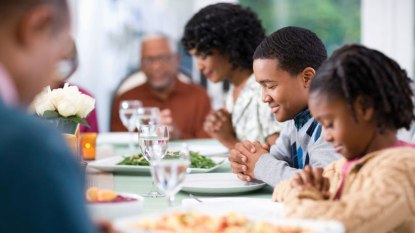
When I was in college I lived in a house with a handful of other young men, though I was the only one who went to church. We had all, at some point, been involved with a church, but my roommates no longer felt the need to attend. However, as I was the one who usually made dinner for all of us, I insisted that we pray together before feasting together.

For the first few months of living together they begrudgingly participated and politely bowed their heads as I thanked God for all of our blessings. After time they started holding hands with one another while I prayed and even asked for me to included particular things in my prayers. And on one particular night, when I inexplicably forgot to pray, they were the ones who reminded me to pray on behalf of the table before we ate.

For years it was expected in many a Christian home that there would at least be a prayer before the common meal of dinner. Today, however, Thanksgiving has become one of the last refuges of prayer at a meal for many who follow Jesus.

We should pray before every meal recognizing that, as we read in Deuteronomy, the Lord has provided so much for us. But prayer is a habit that has to be cultivated; it is not something we can just institute overnight. However, we all have to start somewhere.

16549TCA150101_p19

There is a wonderful resource for developing a life of prayer titled Common Prayer: A Liturgy For Ordinary Radicals. And in it you can find the following prayer for before or after a meal:

“Lord God, Creator of all, in your wisdom, you have bound us together so that we must depend on others for the food we eat, the resources we use, the gifts of your creation that bring life, health, and joy. Creator God, we give thanks. Holy be the hands that sew our clothes so that we do not have to go naked; sacred be the hands that build our homes so that we do not have to be cold; blessed be the hands that work the land so that we do not have to go hungry. Creator God, we give thanks. Holy be the feet of all who labor so that we might have rest; sacred be the feet of all who run swiftly to stand with the oppressed; blessed be the feet of all whose bodies are too broken or weary to stand. Creator God, we give thanks. Holy be the sound of children laughing to take away our sorrow; sacred be the sound of water falling to take away our thirst; blessed be the sound of your people singing to heal our troubled hearts. Creator God, we give thanks. Holy be the bodies of those who know hunger; sacred be the bodies of those who are broken; blessed be the bodies of those who suffer. In your mercy and grace, soften our callous hearts and fill us with gratitude for all the gifts you have given us. In your love, break down the walls that separate us and guide us along your path of peace, that we might humbly worship you in Spirit and in truth. Amen.”

What would it look like to use this prayer before our Thanksgiving tables on Thursday? Or, perhaps more importantly, what would it look like to use this prayer every time we gather at the table to eat?

Devotional – Psalm 90.12

Devotional:

Psalm 90.12

So teach us to count our days that we may gain a wise heart.

Weekly Devotional Image

These are frightening words. We can read through the Psalms and discover just about every human emotion under the sun; we can dance with joy and weep with sorrow, we can raise our fists and anger and fall to our knees in gratitude. But confronting our mortality? That’s a challenge.

When I was in seminary one of my professors told me that the hardest thing about being a pastor is that I have to remind people that they are dying when everything and everyone else tries to claim the contrary. I have been given the unenviable tasks of proclaiming the deep truth of our mortality in hospital rooms, in church offices, and always at the grave.

Most of us are tempted to believe that we are invincible and that life will never catch up with us. We are tempted to believe that death isn’t real. Countless commercials and products are advertised with the sole purpose of prolonging our inevitable end. Even in church, we spend so much time talking about the joy and hope of God in the resurrection from the dead, that we fail to spend adequate time reminding ourselves of our own earthly finality.

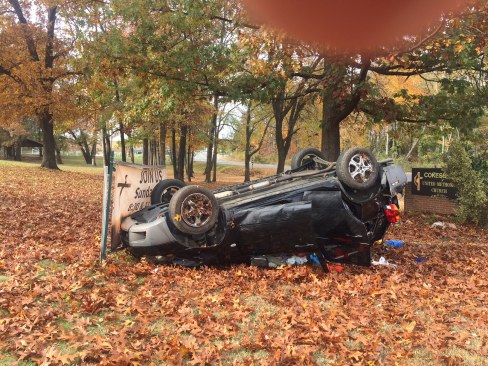
I received a phone call yesterday afternoon from our church secretary informing me that there had been an accident on the church property. A man was driving under the influence and lost control of his vehicle, smashed into our church sign, and eventually flipped over until it came to a stop. The man was quickly rushed to the hospital where he was treated for relatively minor injuries. And when I spoke with the police officers on the scene they kept saying the same thing over and over again, “He’s so lucky it wasn’t worse.”

IMG_1123

Death is a frightening thing. Contemplating our finitude is by far one of the strangest things we do as Christians. But in the end, we do it so that we may gain wiser hearts, so that God might sustain us in the midst of our sinful lives, and above all so that we can appreciate the sacrifice of Christ on the cross and take solace in the glory of the resurrection.

It is my prayer that the man who crashed his car into our church sign yesterday will count his days and gain a wiser heart. Through God’s grace I hope he see’s his life for the tremendous gift that it is, and he gives thanks for all that has been given to him; including one more day.

Faith and Politics From The West Wing

Crackers-Banner-1

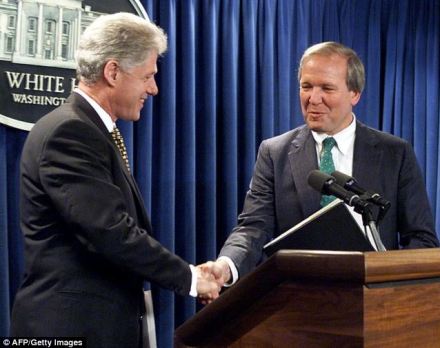
A few months ago my friend Jason Micheli recorded a conversation for our podcast Crackers & Grape Juice with the former White House Press Secretary Mike McCurry about what it was (and is) like to balance faith and politics while working in the West Wing. McCurry served as the Press Secretary during the Clinton years and enrolled at Wesley Theological Seminary following his time working in the administration. The conversation offers a lens into the inner workings of the most powerful office in the land while also addressing the deep challenge of being a political Christian. If you would like to listen to the episode or subscribe to the podcast you can do so here: From West Wing To Wesley 

article-2628189-1DD62C3400000578-874_638x506

Devotional – Amos 5.23-24

Devotional:

Amos 5.23-24

Take away from me the noise of your songs; I will not listen to the melody of your harps. But let justice roll down like waters, and righteousness like an ever-flowing stream.

Weekly Devotional Image

Yesterday morning, while countless Christians were passing the peace, or humming the hymns, or celebrating communion all over the country, a man carried a Ruger assault-style rifle into a small Baptist church in southern Texas and murdered 26 people. Officials have reported that the associate pastor was walking up to the pulpit to preach when the gunfire began and that the victims ranged in age from 5 to 72.

Within a short period of time people all across the country flocked to social media and news outlets to share reflections, condolences, and prayers. Politicians tweeted their thoughts, parents held onto their children a little tighter, and pastors started thinking about how in the world they could address what happened in their own churches.

It was about a month ago that we were all reeling from the news that a gunman opened fire on a crowd of concertgoers in Las Vegas leaving 58 dead and 546 injured.

And within a short period of time people all across the country flocked to social media and news outlets to share reflections, condolences, and prayers. Politicians tweeted their thoughts, parents held onto their children a little tighter, and pastors started thinking about how in the world they could address what happened.

maxresdefault (6)

Is God tired of all our talking (and tweeting)? Are the prayers that we offer in the midst of a crisis, and then forget about until the next thing comes, being heard? Is God listening to all of this noise?

What would it look like to let justice roll down like waters in a world that lives in the shadow of the cross? When did we let the words we offer become more important than living lives of righteousness? Is the noise we produce so deafening that we can no longer hear what God has to say?

There’s no easy solution to the recent horrific shooting tragedies. We are clearly a people divided on just about everything these days, and in particular when in comes to gun rights and gun control. But when it comes to the realm of the church, when we think about what this all means for the kingdom of God, we have to ask ourselves if God has grown tired of all our talking.

This is not to say that we should cease to pray. In fact, we should pray without ceasing. But our prayers that we offer to God cannot be limited to words we toss around while our hands are clenched together. Sometimes the most faithful prayers are the ones we make with our actions.

Devotional – Psalm 106.1

Devotional:

Psalm 106.1

Praise the Lord! O give thanks to the Lord, for he is good; for his steadfast love endures forever.

Weekly Devotional Image

On Sunday morning we will spend most of our worship service confronting the question “Why Do We Pray?” Prayer has been part of what it means to be a disciple of Jesus Christ from the very beginning of the church. Prayer, fundamentally, is about taking time to be with the Lord as well as a desire to change our circumstances. And for as important as it is to talk about why we pray, the question of how we pray is equally worth our time.

When I was a kid I was taught how to pray using the acronym PRAY: Praise – Repent – Ask – Yield. We begin praying by praising God for the marvelous works God has made real in our lives, then we repent and apologize for how we have failed to be the people God has called us to be, then we ask for how we need God to change our present circumstances, and then we conclude by yielding to God’s will. The PRAY way to pray is helpful for setting up a rhythm of what it means to commune with God, but it can also be limiting.

If our prayers follow the same pattern over and over again, we run the risk of no longer meaning what we say, or worse: we say things without realizing what we’re saying. Additionally, the PRAY model can result in us being tempted to ask God to change trite and insignificant things in our lives, instead of the deep reflection on what it means to yield to God’s will being done in our lives.

prayer_2014_02_07-13

Praying through PRAY can be helpful when we no longer know what to say, but some of the best prayers I’ve ever heard (or read) do not follow the model at all. Because, after all, prayer is not about checking off the box; prayer is about learning how to listen to God in the midst of loud and chaotic world.

Sometimes faithful prayer looks less like getting on your knees and clasping your hands together, and more like sitting in a quiet space for five minutes. Sometimes faithful prayer sounds less like all the big adjectives we use in church on Sunday and more like a conversation we have with a friend over the phone. Sometimes faithful prayer is less about following any model or rhythm and more about finding a way that works for us in order to hear what God has to say.

I have friends for whom using crayons in a coloring book is the best way to pray. For others, prayer is at its best when it is the complete absence of any distraction. And still yet for other, the PRAY model is the best way to pray.

The point of prayer is not so much that we have to pray a certain way, but that we do it in the first place.

Devotional – Psalm 103.8

Devotional:

Psalm 103.8

The Lord is merciful and gracious, slow to anger and abounding in steadfast love.

Weekly Devotional Image

16 years ago I was sitting in my 8th grade band class when an announcement came over the PA system that I was needed at the main office. I walked down the hallway wondering why in the world they needed me in the main office of my middle school when I saw my father standing outside the doors beckoning me to hurry up. We quickly dashed toward the car where my sisters were already waiting and all I remember my dad saying was, “So many people have already died.”

It was September 11, 2001 and my father somehow got us out of school before they went under lockdown. I spent the entire day sitting on the living room floor at my parents’ house watching the World Trade Centers fall to the ground over and over again. And I was angry.

sept-11-Brigitte

Thinking back on that day 16 years ago, I can remember the anger I felt, but I can’t tell you who or what that anger was directed toward. The television contained images of violence I never thought possible in the world and it created in me a frustration and an anger that remained for a long time.

It was only years later that I came across a prayer written by one of my professors 30 minutes after the destruction of the World Trade Center. Dr. Hauerwas’ words articulate a feeling that I believe most Americans felt 16 years ago, but he was also bold enough to speak the truth in a time of fear, anger, and violence. This is the prayer he wrote 16 years ago today:

“Vulnerable – we feel vulnerable, God, and we are not used to feeling vulnerable. We are Americans. Nor are we used to anyone hating us this much. Such terrible acts. Killing civilians. We are dumbfounded. Lost. We are good people. We are a nation of peace. We do not seek war. We do not seek violence. Try to help us remember that how we feel may be how the people of Iraq have felt while we have been bombing them. It is hard for us to acknowledge the “we” in “We bombed them.” What are we to do? We not only feel vulnerable, but we also feel helpless. We are not sure what to feel except shock, which will quickly turn to anger and even more suddenly to vengeance. We are Christians. What are we to do as Christians? We know that anger will come to us. It does us not good for us to tell ourselves not to be angry. To try not to be angry just makes us all the more furious. You, however, have given us something to do. We can pray, but we wonder for what we can pray. To pray for peace, to pray for the end of hate, to pray for the end of war seem platitudinous in this time. Yet, of course, when we pray you make us your prayer to the world. So, Lord of peace, makes us what you will. This may be one of the first times we have prayed that prayer with an inkling of how frightening prayer is. Help us.” (Dr. Stanley Hauerwas – Disrupting Time)

So today, 16 years later, we still pray for God’s will to be done. We pray that we might become God’s prayer for the world. And, perhaps most boldly, we remember that while the world is consumed by fear and terror, we worship the God who is merciful and gracious, slow to anger, and abounding in steadfast love.

Devotional – Psalm 133.1

Devotional:

Psalm 133.1

How very good and pleasant it is when kindred live together in unity!

Weekly Devotional Image

It is very good and pleasant when kindred live together in unity, but it rarely happens. Instead, in-laws fight over table decorations for wedding receptions, children argue over who received the most Christmas presents, and spouses argue about the strangest things until they lose their voices. Even beyond the nuclear family, kindred (in the larger sense) are divided over a great number of topics including politics, economics, and ethics.

I am convinced that for as much good as social networking and the 24-hours news cycle have brought into the world there is also just as much evil. In the wake of the recent tragedy in Charlottesville, VA people on every spot of the spectrum have come out to voice their particular opinion as if shouting into the void without a care as to who might hear it. I have friends, good friends, who posted on their Facebook pages some truly hateful language regarding the protestors and anti-protestors. One person said that the young woman who was murdered by the driver who drove into the crowd of people would still be alive if she wasn’t a fat-good-for-nothing trying to interrupt a “peaceful protest.” Another person wrote about how we should jail and/or physically punish all white republicans because they’re all “racists on the inside.” And still yet another person wrote about the need to reassert the values of “white America” over and against all other types of Americas.

And all of this was posted publicly for the world to see.

body-of-Christ-featured-image-600x400

The psalmist declares, “How very good and pleasant it is when kindred live together in unity!” Unity is a rare thing in the world today, let alone in our individual communities. Rather than seeking unity we almost always just spend our time with those who already have our opinion and instead of seeking to find common ground we stake our claim and dig deeper into our own ground.

As Christians we believe that the church is the better place that God has made in the world. For us, the church is the place where even though we do not think alike we can love alike. We sit down in pews with people who are of different opinions, we gather with them at the altar, and we are sent forth with them to be Christ’s hands and feet for the world. If we cannot have unity in the church, unity in a common purpose to love, then the world will continue to be a place of walls and divisions and disunity.

This week, as we continue to take steps in faith and seek God’s kingdom here on earth, let us join our voices together in a common prayer:

“Almighty God, help us to remember that before Jesus marched to the cross he prayed for his disciples that they might be one. In the same fellowship that is between you and your Son and your Spirit, in the same hope of the prayer that Jesus offered in the garden, we pray for unity in your Church, being bound together in love and obedience to you. Help us so to love you and one another that your kingdom might reign here on earth now and forever. Amen.”

Devotional – Psalm 139.4

Devotional:

Psalm 139.4

Even before a word is on my tongue, O Lord, you know it completely.

Weekly Devotional Image

I was shaking hands with people on their way out of worship when a young man, about my age, walked up. We exchanged the pleasantries due to one another in a place like church and then he asked if I would be willing to pray for him. I said something like, “Sure I’ll be happy to add you to my prayer list” and then prepared to shake the next person’s hand. But the young man kept standing there and said, “No. I need you to pray for me right now.”

He told me about the struggles in his life all while people standing in line waited patiently. He shared about his inability to find work, his complicated relationship with his father, and his general feeling of despair. And then he grabbed me by the hands, closed his eyes, and waited for me to pray. So I did.

I had casually known the young man for a couple years but I had no idea about his struggles. Week after week we were in the same church, singing the same songs, offering the same prayers, but I knew nothing about what was happening under the surface.

The psalmist proclaims, “Even before a word is on my tongue, O Lord, you know it completely.” And this is good and right and true. The Lord knows what we need and what we want even before we can articulate what we need and what we want. But just because God knows our words before we do, that doesn’t mean that everyone else does as well.

shutterstock_153536591

In today’s world many of us are uncomfortable with the thought of asking someone to pray for us, let alone having him or her do it right in the moment of our asking. Instead we fill the time of prayer concerns with the needs of other with whom we are familiar. And even then, the expectation is usually that a general prayer will be offered for individuals and groups removed from the immediate situation so that we can move on to something else.

The Lord knows what we need, but the people closest to us (our friends, family, church members) usually don’t. Instead, they are habituated by the masks we wear. They grow comfortable with what they experience and then assume that so long as everything on the surface appears normative then everything deeper must be the same.

What would it look like for you to ask someone in your life to pray for you this week? And not the “can you pray for me sometime” casual request we are used to hearing but the “I need you to pray for me right now.” It might be uncomfortable and even frightening, but it is at the heart of what it means to be in relationship with others in a way that is true, deep, and faithful.

Devotional – Acts 2.42

Devotional:

Acts 2.42

They devoted themselves to the apostles’ teaching and fellowship, to the breaking of bread and the prayers.

Weekly Devotional Image

“Why don’t you offer the prayer?” This is one of my favorite questions to ask in order to make someone uncomfortable when they least suspect it. I’ll be out at dinner, or some sort of communal function, and the moment right before the host inevitably asks me (as the pastor) to pray, I’ll lean over to someone and say, “Why don’t you offer the prayer?”

The question is often met with a blank expression that quickly morphs into terror. Some people feel like they can’t say no when a pastor asks them to do something so they start to pray; others begin to quake under the anxiety of publically praying though they muster something together; and others just sit there silently waiting (and perhaps praying) for me to start saying something instead.

But the more I’ve done this, the more I’ve realized how harmful it can be. And not just on an interpersonal level regarding the manipulation of the pastor over and against a lay person, but also because it leaves people feeling like they have to be able to make up a prayer and offer it on the spot in order to be a Christian.

Spontaneous and extemporaneous prayers can be difficult and problematic things. Instead of sitting silently and listening for the Spirit we often fill the void with our own words that may have nothing to do with what it means to pray in the first place. We assume that praying has to be original and new every time it happens, but it was not so for the first Christians.

lightstock_4192_small_diana_hapsari

In the wake of Pentecost, the new coverts “devoted themselves to the apostles’ teaching and fellowship, to the breaking of bread and the prayers.” Notice the definite article: the prayers. They were given prayers to pray and this is entirely different than assuming that everyone can and should be able to make up their own prayers on the spot.

It is a great gift in the church to have prayers from the saints, to be able to look back and use the words that have been used so many times (and will continue to be used long after we’re gone) because sometimes we don’t have the right words to pray. Rather than struggling to come up with something on our own we can use the words from the Psalms, or reach for the Book of Common Prayer, or even read the words from a beloved hymn. Those words are our prayers, they are the prayers, and they have been given to us. Thanks be to God for providing the words of prayer when we cannot find them on our own.

On Working The Crowd

Matthew 21.8-9

A very large crowd spread their cloaks on the road, and other cut branches from the trees and spread them on the road. The crowds that went ahead of him and that followed were shouting, “Hosanna to the Son of David! Blessed is the one who comes in the name of the Lord! Hosanna in the highest heaven!”

Romans 8.31-39

What then are we to say about these things? If God is for us, who is against us? He who did not withhold his own Son, but gave him up for all of us, will he not with him also give us everything else? Who will bring any charge against God’s elect? It is God who justifies. Who is to condemn? It is Christ Jesus, who died, yes, who was raised, who is at the right hand of God, who indeed intercedes for us. Who will separate us from the love of Christ? Will hardship, or distress, or persecution, or famine, or nakedness, or peril, or sword? As it is written, ‘For your sake we are being killed all day long; we are accounted as sheep to be slaughtered.’ No, in all these things we are more than conquerors through him who loved us. For I am convinced that neither death, nor life, nor angels, nor rulers, nor things present, nor things to come, nor powers, nor height, nor depth, nor anything else in all creation, will be able to separate us from the love of God in Christ Jesus our Lord.


Working a crowd can be an art form. Comedians walk back and forth casually across a stage making the crowds feel relaxed and ready to laugh. Martin Luther King Jr. repeatedly punctuated and staccato’d his refrains like the rhythm of a song to get the people connected to the message. Even our President, Donald Trump, knew how to work the crowds at his rallies leading up to the election. You don’t win elections by laying out the step-by-step plans to make economic, ethical, political, and militaristic changes. You don’t win elections by calmly reflecting on the days of the past and a desire for simpler times. You don’t win elections with PowerPoint projections of pie-graphs and political policies.

We all know you win elections by firing up the people with a litany of complaints about what has gone wrong. You win elections by throwing gasoline onto the fire. You win elections by working the crowd.

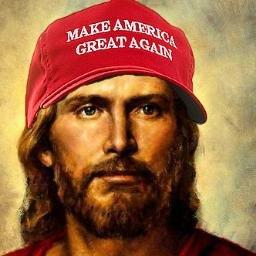
And Jesus, like Donald Trump, knew how to work a crowd.

Jesus-and-Donald-800x430

You spread the word and get thousands of people outside to hear the message, you keep them on the edge of their, you know, ground area, and then wait for them to salivate with under the sun and then transform a loaf of bread and a couple of fish into a buffet the likes of which had never been seen.

You get the crowds riled up about working on the Sabbath, even quote some of the prophets from the past, and then heal a cripple man and leave everyone with a rhetorical question: Is it better to heal someone on the Sabbath or let them continue to suffer?

Walk into the middle of an angry mob about to stone a woman to death and quietly write a couple choice words in the sand to let them peer deeply into their own sinful souls and then empower the woman to live a new life.

Jesus knew how to work the crowd.

And Palm Sunday, this strange occasion where we pass out palm branches at the beginning of the service, is perhaps the best example of Jesus’ perfect political ability to work the crowd. We read that many people spread their cloaks; they literally take the clothes off their backs, and placed them on the road. And still yet others even cut down palm branches to prepare the way for the king who entered Jerusalem on the back of a donkey.

We know the story. We can imagine ourselves there on the side of the road with the dust hanging in the air. We can feel the buzz of expectation around the one who will come to change it all. We can feel within ourselves that same desire to scream out “Hosanna!” “Save us!”

Christ's Entry into Jerusalem by Hippolyte Flandrin c. 1842

But, unlike the crowd, we know how the story ends.

We know what awaits us this so-called Holy Week. We know what will happen in the temple when Jesus flips the tables. We know what kind of strange sermon Jesus will offer from the mountain. We know that Jesus will get down on the floor and wash the feet of his disciples. We know that Jesus will gather his friends around a table to share bread and wine. We know that Jesus will be betrayed, arrested, beaten, mocked, and nailed to a cross. We know that before the end of the week, Jesus will die.

And because we know how the story ends, it becomes clear to us that may not have known what we were doing by joining the crowds along the road, or by joining the crowds in a place like this one that we call church.

The crowds who gathered to sing their “hosannas” wanted a king, but the only people who continue to admire him as a king at the end of the week are the sadistic soldiers who made him a crown of thorns and drove it into his skin.

Jesus, it seems, was not the right kind of king. He was not the one they, or even we, were hoping for.

Maybe Jesus wasn’t all that gifted at working the crowd. After all, it took less than a week for the shouts to go from “Hosanna” to “crucify.”

Jesus is a King unlike any other king. Other kings, who are also at times called presidents, know they have to work and manipulate the crowd to bend them according to the desires of the powerful. Kings and Presidents may even rely on the power of the sword to control and handle the crowd to bring forth their hopes and dreams.

Such is the reality of worldly power.

But Jesus, our King, does not take advantage of the crowd’s enthusiasm. Rather than a call to arms to storm the city gates or to murder the ruling elite, Jesus suffers humiliation, abandonment, and death.

Do you still want to be part of the crowd by the side of the road? Do you want a place in Jesus’ kingdom? Do you want to follow the suffering King?
9cc

Don’t be mistaken; Jesus is as political as they come. But he rules not at the head of an army, but from an old wooden cross. He rules not by filibustering particular Supreme Court nominees or demanding democratic political policies, but by laying it all down for the ungodly. He rules not by ordering his troops to use chemical weapons against innocent civilians or even sending tomahawk missiles to destroy a military base, but mounting the cross and saying, “Forgive them Father, for they do not know what they are doing.”

In America, we pride ourselves on being the ones who can defy the whims of the crowds. Freedom! We think for ourselves! Or at least, we think we can think for ourselves. But here’s the irony: The moment we are so sure that we have thought something up for ourselves, the moment we believe we are most free, is really when we’ve been co-opted by the powerful.

I know that we like to think that if we had been there, we would’ve been good disciples and that we would’ve stayed with Jesus to the very end. I know we like to think that if we had been there in Germany all those years ago, that we would’ve protected the Jews and rallied against Hitler. I know we like to think that if we had been involved in politics at the time, we would’ve voted against going to war in Iraq and Afghanistan.

But the truth is a whole lot harder to swallow: We are easily manipulated.

Which is precisely why we sing awful songs like “Ah Holy Jesus.” God will not allow us to get away with perennial self-deception and arrogance. We killed Jesus.

Who was the guilty? Who brought this upon thee? Alas, my treason, Jesus, hath undone thee! ‘Twas I, Lord Jesus, I it was denied thee; I crucified thee.

smaller-crowd-rdc-color-hi.png

We know who we want Jesus to be. We want Jesus on our side in our petty arguments with friends and neighbors. We want Jesus on our side when it comes to disagreements in the community. We want Jesus on our side when it comes to the trajectory of our country. We want Jesus on our side when it comes to politics, and Syria, and Healthcare, and Immigration. We see ourselves as Jesus in the story of his entry into Jerusalem, when in reality we are far more like the fickle crowds on the side of the road than anyone else.

And that brings us to Romans 8.

Romans 8 is an unsettling text. Sure, we’ve heard it and used it at funerals; it offers us comfort and hope in the midst of sorrow and loss. It is important for us to declare over and over again that death will not separate us from the love of God in Christ Jesus.

We know this passage. We know it just like we know the story of Palm Sunday. In fact, if you can remember, months ago I asked the congregation to imagine what scripture you would use to comfort someone on death row, and this was the overwhelming favorite.

But these words from Paul can tempt us to forget that it is not just death that threatens to separate us from the love of God. Instead, we imagine the other things in the list to be good: life, angels, rulers, powers, things present, things to come. But all of them can threaten to come between Christ and his church; between God and us.

When we are comfortable, when we can’t imagine our faith requiring us to suffer, the list remains easily ignorable. However, we become true disciples of Jesus when we are willing to take risks, when we are prepared to go against the flow, when we resist the manipulation of those in power. And risks are called risks for a reason: following Jesus is a risky thing to do because it always involves the possibility of rejection.

Many of us know that this week marked the anniversary of the death of Martin Luther King Jr. Dr. King stood firm while the waves of the status quo crashed around him. Dr. King called out the principalities and powers for being wrong. Dr. King worked the crowds to a belief in non-violent resistance. And it got him killed.

Here in Staunton, like I said last week, we don’t feel very revolutionary, we don’t equate our faith with taking risks, and we can’t even imagine having to lay down our lives for the sake of the gospel. We can’t imagine ourselves being like Dr. King or questioning what our country is doing in Syria. But if we are serious about following Jesus, we will suffer; it’s just a less glamorous and more mundane form of suffering.

You know, like being mindful of other people; not getting stuck in our own unending bubble; asking hard questions that other people would rather ignore; acting like Jesus; sacrificing our wants and needs; calling someone in the midst of grief; showing up for a funeral when we might have other things to do.

Following Jesus in this place these days might not get us killed. But it might mean reaching out to someone who is totally unlike us. It might mean having a conversation with someone who voted for the other candidate. It might mean asking our spouses to forgive us for what we did. It might mean repenting for the way we spoke to our children or our parents. It might mean confronting our friends about their addictions. It might mean asking for help regarding our addictions.

And in so doing, we will suffer.

But nevertheless (!) nothing can separate us from the love of God in Jesus Christ! Not a bitter parent who refuses our apology; not an angry child who resents us for a past decision; not a nation who indiscriminately persecutes the poor and the marginalized; not a king or a president or a politician; not standing against the powers that be; not going against the current for a strange and more loving way of life; not anything now; not anything in the future.

We will surely suffer for the sake of the kingdom, but we will never be divided from the Lord. Amen