Calming the (Political) Storm

Mark 4.35-41

On that day, when evening had come, he said to them, “Let us go across to the other side.” And leaving the crowd behind, they took him with them in the boat, just as he was. Other boats were with him. A great windstorm arose, and the waves beat into the boat, so that the boat was already being swamped. But he was in the stern, asleep on the cushion; and they woke him up and said to him, “Teacher, do you not care that we are perishing?” He woke up and rebuked the wind, and said to the sea, “Peace! Be still!” Then the wind ceased, and there was a dead calm. He said to them, “Why are you afraid? Have you still no faith?” And they were filled with great awe and said to one another, “Who then is this, that even the wind and the sea obey him?”

160221104601-donald-trump-hillary-clinton-ted-cruz-marco-rubio-bernie-sanders-composite-exlarge-tease1


On Tuesday morning, Lindsey and I woke up early to hit the polls before work. We were expecting long lines so we made sure to plan for enough time and double check our voting location. When we arrived, we were both a little shocked to discover the limited number of participants but we walked into the building with excitement.

I went over to the table to receive instructions and eventually went over to the machine to cast my vote. Lindsey, however, was forced to reregister because of a filing error, so I stood off to the side and waited patiently.

I really try not to eavesdrop, but sometimes it feels impossible. When people walk into to a building and start shouting things, it’s hard not to notice.

The first man came in wearing bib overalls, dirt all over his boots, with his hair going every direction. When he arrived at the table the volunteer asked, “What party will you be voting for?” The man stared blankly back and then declared, “Well, I ain’t no socialist so I’ll be voting Republican.

The second man came in wearing a perfectly pressed suit, with a tie clip, and an expensive looking watch on his wrist. When he arrived at the table the volunteer asked, “What party will you be voting for?” Without taking time to think about his answer he said, “I can’t trust Hillary but I’m still voting Democrat.

The first woman came in wearing a completely coordinated outfit, her hair and makeup looked perfect, and her heels were so high they started giving me vertigo. When she arrived at the table the volunteer asked, “What party will you be voting for?” I don’t think the woman was really paying attention because she filled the next few minutes trying to convince the volunteer that our country is in a mess and the only good option we have left is the Christian Ted Cruz.

The next woman came in wearing a sweat suit, with spit-up on her shoulder, while making a comment about her baby waiting in the car. She was clearly in a rush so when the volunteer asked, “What party will you be voting…” She interrupted and yelled, “Anyone but Trump!

It didn’t take long for me to notice that all of the people coming in to vote were doing so out of fear. None of them were particularly satisfied with any of the candidates, they represented different walks of life, and the one thing that united them was fear.

On that day, when the evening had come, Jesus said, “Let us go across to the other side.” As the sun was setting in the distance, darkness was hovering over the waters, and Jesus suggested that it was time to go across the Sea of Galilee. And this was no simple journey; Jesus had been ministering to the Jews in the Jewish territory, but now he wanted his disciples to go across to the other side, to the gentiles.

This is probably Jesus’ first foray into dangerous territory, his first opportunity to proclaim a sense of inclusion that still mystifies most of us today.

And while they were out on the water, making the journey from their side to the other side, a great windstorm arose, smashing waves against the boat so hard that it was being swamped with water. But Jesus was asleep! So the disciples woke him up and asked, “Teacher, do you not care that we are going to die?

Jesus woke up, rebuked the wind, and said to the sea, “Peace! Be still!” and there was a dead calm. He turned to his disciples and said, “Why are you afraid? Have you no faith?

They were definitely afraid; afraid of the wind and the waves crashing against the boat, afraid about the journey to the other side, afraid for their very lives.

And notice that Jesus does not say, “There’s nothing to be afraid of.” There are plenty of things for Jesus’ disciples then, and now, to be afraid of: isolation, pain, illness, losing one’s job, money problems, failure, death. Instead, he asks, “Why are you afraid?”

            Why are you afraid for your lives when I’m here on the boat with you?

            Why are you afraid of rejection and failure when I’m here with you in life?

            Why are you afraid of death when you know that I rose from the grave?

What a fitting text for this political season in our lives. While many of us grow tired of the countless fights and arguments that break out on the news, while the chain of endless debates rattle with sound bite after sound bite, while people go to the polls to vote against someone rather than for someone, Jesus asks, “Why are you afraid?”

029-james-ensor-theredlist

We are afraid. We are afraid of the wind and the waves that assail our fragile ships. We are afraid for our lives, our church, our cities, our politics, our country, our world. We fear disapproval, rejection, failure, meaninglessness, illness, death… We are held captive by the power of fear.

And perhaps our greatest fear is of anything that differs from us. We are so contented in life that we fear death. We are so rooted in our Republicanism that we fear Democrats, or we are so Liberal that we fear Conservatism. We are so constantly surrounded by white middle-class Christian America, that we fear anyone who is black, or Hispanic, or Muslim, or Atheist. We are so used to seeing the traditional family unit of a husband and wife with 2.5 children that we are afraid of anyone who is lesbian or gay.

And Jesus is the one telling us its time to go to the other side. Jesus is the one who knows, even better than us, that there is plenty to be afraid of, but those things do not have the final word.

What we fail to remember and realize, is that we were once the outsiders that Jesus welcomed in. We were the gentiles waiting on the other shore for an incredible Messiah to show up and graft us in. If it were not for the incredible inclusiveness of Jesus’ ministry, none of us would be here in this place, none of us would have been blessed with grace, and none of us would have received the gift of the cross.

And now we face a time with other outsiders, people for whom many of us are afraid of, people who will rock our boats. And as we get closer, as the scales begin to fall from our eyes, as we begin to see others as brothers and sisters instead of enemies, that’s precisely when the storms start billowing in, playing toward our fears.

“If we start working with the Republicans, we will lose everything we once deemed sacred…”

“If we let another Democrat into the White House, God only knows what kind of terrible things will happen to us…”

“If we start changing what we do on Sunday mornings, the church will die…”

“If we start affirming their relationships, the traditional family will die…”

“If we start opening our borders, our country will die…”

Jesus knows best of all, that we cannot have resurrection without crucifixion.

The call to not be afraid bookends the gospel. It is there at the beginning when the angel Gabriel shares the news of the coming Messiah with Mary, and it is there at the end when the disciples encountered the angels on the first Easter. Not because there are no fearsome things on the seas of our days, not because there are no storms, but rather, because God is with us.

That night on the Sea of Galilee, Jesus brought peace in the midst of the storm. This kind of thing happens all the time when people are willing to look past their fear and remember that Jesus is in the boat with us.

Painting184B

It may be at the polls while people are arguing about the fate of our country, it may be at General Conference when people are arguing about homosexual relationships, it may be in our own families when people are arguing about anything under the sun.

We will face strong winds and huge waves in the middle of a storm. Jesus wants us to remember that he will always be in the boat with us; that we can rely on his strength and mercy when ours runs out; that the prince of peace will always calm the waters.

On Wednesday night I had the youth of our church read the story of Jesus’ calming the storm. We discussed the types of storms that we have witnessed in our lives and then we started to talk about fear. I gave each of them a permanent marker and a plate with the instructions to write down their deepest and truest fears. I promised them that whatever they wrote was between them and God, but they also talked about fears they felt comfortable sharing…

“I’m afraid of death.”

“I’m afraid of our government.”

“I’m afraid of being alone.”

Then we went out into the back parking lot and we smashed the plates into tiny pieces. After we collected all of our broken fears, we started to glue them back together in the shape of the cross (you can see it right here).

Christ’s cross shatters our fears, it breaks down the moments that haunt us, and remind us over and over again that we are not alone. To wear a cross around our necks, to see one in the sanctuary, is a witness to the fact that the cross shatters our fears. The cross is a reminder that God is with us; with us in on the seas of life, with us in our most frightened moments, with us when we need him.

This part of the sanctuary is called the nave. The word comes from the Latin navis, which means “ship.” If you look up at the ceiling, it looks like the inside of a boat. In this place we are bombarded with images of the cross and the ship on the sea as a reminder of how God is with us.

Every week we gather here into this boat, with Christ as the captain, calming the wind and the waves of our fears.

Every week we hear scriptures, and hymns, and prayers that help to remind us who is our real hope and salvation while the world feels like it’s falling apart.

Every week we gather in the boat to remember that Jesus promised to be with us always, even to the end of the age.

Don’t be afraid. Amen.

The Gifts of God – Peace

Micah 5.2-5a

But you, O Bethlehem of Ephrathah, who are the one of the little clans of Judah, from you shall come forth for me one who is to rule in Israel, whose origin is from of old, from ancient days. Therefore he shall give them up until the time when she who is in labor has brought forth; then the rest of his kindred shall return to the people of Israel. And he shall stand and feed his flock in the strength of the Lord, in the majesty of the name of the Lord his God. And they shall live secure, for now he shall be great to the ends of the earth; and he shall be the one of peace.


IMG_8605-5843

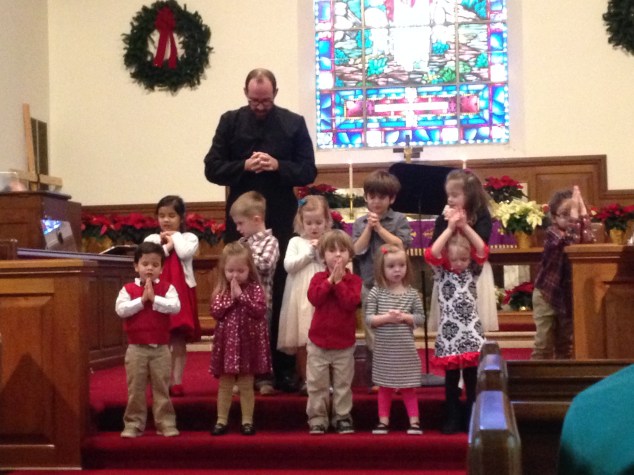
The children looked perfect in their Christmas pageant costumes. One by one they entered the chancel area in preparation for proclaiming their individual lines. The shepherds came first, watching over their sheep. Then the animals of the manger came forth, including a cow, a bird, and a mouse. They all made it to their spots and sat perfectly still as a donkey, Mary, and Joseph walked up to the microphone and exclaimed that a baby would soon be born, but they would need to find a place to stay.

Then the angelic cherubs boldly walked down the center aisle in the dark each holding an electric candle. The lead angel walked up to the microphone and frightening declared: “Do not be afraid! I bring joy to everyone!” The wise men and a camel followed the star to the manger where they presented the baby Jesus with their gifts of gold, frankincense, and myrrh.

I had the best vantage point of the entire production from up here in the pulpit. I could see all of the children with their costumes and I could also look out at the faces of all the parents, families, and friends that had gathered for this spectacular performance. I was honestly beaming while I stood up here on Tuesday evening because the kids had all done such a great job, they all nailed their lines, and were standing perfectly still in their spots.

Except for one of our shepherds.

Throughout the weeks of practice we had purposely withheld the shepherd staffs from the children knowing full and well that they would play with them too much. And during the actual performance most of them were being wonderful, but one of the shepherds could not overcome the desire to do something.

At first he just twirled the staff around in his hands like trying to start a fire on the carpet. Later, he swung it from side to side like a microphone at a rock and roll concert. I tried my best to whisper powerfully for him to stop, and though he would for a moment or two, he would then start up with something new.

As we were nearing the end of the performance, nearly all of the characters and animals from the manger scene were in place; the little shepherd grabbed his staff and started lifting it into the air. I, of course, immediately thought of Moses lifting up his staff in the wilderness to strike the rock for water. I, of course, immediately thought of how theological our young shepherd was being as he lifted the staff into the air, but then I realized he was about to bash somebody on the top of the head!

Breaking character from the pulpit, I quickly reached down and stopped the staff in mid arch. My eyes went down the shaft of the staff to the little hand, to the arm, to the face of the young shepherd, and instead of seeing a repentant and apologetic look; he had the biggest and proudest grin on his face.

IMG_0610

We lean toward violence. From Preschoolers picking up shepherd staffs, to fights in high school, to international and political disagreements, we lean toward violence. There is a power that comes with violence and demonstrates our importance and opinion. Violence has been at the forefront of some of the most important historical moments in the entirety of human existence and still captivates our attention. The movies that make the most money, the stories that garner the most attention, the moments we can’t tear our eyes away from usually contain violence.

As I have found myself saying too often from this pulpit: just turn on the TV or get online and you will be immediately bombarded with the violence in the world and the local community. Even this season of Advent and preparation for the holidays tends to bring out the worst in us. We have short tempers with the people ahead of us in line while we are buying gifts. We mutter inappropriate comments about drivers that are just driving too slowly. And we secretly expect to receive as many good gifts as we give.

Our lives and the world are filled with aggression, anger, and violence.

Yet, the prophet tells us about the one who will come with peace.

Micah spoke during a time of considerable unrest. The situation was grim with corrupt political leaders. There were fearful enemies on the horizon. Internal disputes were pinning people against one another. (Sound familiar?) And while the people saw no hope, Micah saw the promise of peace. Micah looked beyond the present circumstances, he looked beyond the news headlines and the talking heads, he looked beyond the broken and tarnished community to what God was promising to do.

From the little town of Bethlehem will come one who will rule the world. From a back road town of insignificance will come the one who will lead his flock in the way that leads to life and peace.

Many of us have a hard time imaging that an impressive hero can come from such a small town and such a fragile beginning. We, instead, look to politicians and presidents, magistrates and ministers, to fix all of our problems. But from the words of scripture this morning, Micah is jumping up and down and waving his arms to move us in an entirely different direction. He is pointing not at the towering leaders of the world on CNN. He is not drawing us to the political buildings in Washington DC. Instead he is pushing us to a small, out of the way, little place called Bethlehem.

55f81b353eaa23507d83b12e70adb998

Jesus is the one of peace, the one who comes as a light in the darkness, the one who will stand and lead like a shepherd. Jesus came from humble beginnings and changed the world.

One of the things that the bible loves to show us is that true power and peace often comes from unexpected people in unexpected places. Many of us have heard the Christmas story so many times that we are desensitized to the insignificance of Bethlehem in the most significant story ever told.

Yet, important babies that change the world can be born just about anywhere. Bethlehem is proof of that. Every baby has the potential to help remind us of the way that leads to peace. Jesus is proof of that.

This week, our little neck of the woods made national news. A local geography teacher landed in the hot seat for an assignment where her students were required to copy a text in Arabic from the Quran. The purpose was to demonstrate the beauty and power of calligraphy and, in a sense, teach students to appreciate people who have differing beliefs and opinions. However, when a particular parent found out that the text in Arabic said, “There is no god but Allah. Muhammad is the messenger of Allah” everything came to a head.

In the days that followed, a community meeting was held at a local church for concerned parents who were outraged by the assignment. Augusta County rightly started to step up security measures in order to maintain the peace, but the longer the situation percolated the more frightening it became. On Thursday morning there were armed guards at Riverheads elementary school. And on Thursday afternoon, every student in Augusta County was ordered to leave their respective school and the buildings were to go on lockdown. Lastly, Friday’s classes were completely canceled.

Augusta County received so many threats by phone and mail that they believed they could not guarantee the safety of their students and decided to cancel an entire day of school.

There are so many facets to the story that we don’t have enough time to address all of them, but suffice it to say, it is sad. It is a sad that a teacher did not take the time to re-evaluate what text she was having the students copy. It is sad that an entire community responded immediately out of fear and hatred. It is sad that such a tremendous amount of people were filled with rage to the point that Augusta County had to cancel school. It is sad.

While Fox News picked up the story for the nation to learn about what was going on here, I felt God’s Word calling me to listen to the Bethlehem-like voices. Instead of reading news article after news article from talking heads, I went to the local youth of our community and listened.

This is what one of them said: “Religion is not the problem. Religion does not breed terrorism. Ignorance breeds terrorism. Lack of education breeds terrorism. Failure to see the world around you breeds terrorism. Incompetence breeds terrorism. The inability to accept one’s wrongs breeds terrorism. The inability to connect and empathize and understand your fellow human beings is what breeds terrorism.”

I don’t know how to fix or change what happened in Augusta County this week, but if we continue to treat everyone who is different from us with nothing but suspicion and fear, then we have lost our connection to the one who comes in peace. If we make the self-righteous assumption that everyone should look like us, think like us, and talk likes us, then we have stopped following Jesus.

For too long we have lived with a culture that teaches us to defeat our enemies so that only our friends will be left. But that’s not what Jesus calls us to do! Jesus, the one born in a manger in Bethlehem, Jesus the one who shall be our peace, Jesus the one who we worship on Christmas Eve and every Sunday of our lives, tells us to love our enemies! Jesus calls us to pray for those who persecute us. Jesus tells us to live our lives in the way that leads to peace.

God’s peace in Christ is a gift; a gift with strings attached. God gives us peace, but we are to be instruments of God’s peace on earth. We know that peace is not easy. It requires a willingness to sacrifice and be vulnerable with people who differ from us. Peace is uncomfortable. Peace is strange. Peace is difficult because it is so contrary to the ways of the world.

Peace is hard, but so is following Jesus. Amen.

The Gifts of God – Hope

Isaiah 12.2-6

Surely God is my salvation; I will trust, and will not be afraid, for the Lord God is my strength and my might; he has become my salvation. With joy you will draw water from the wells of salvation. And you will say in that day: Give thanks to the Lord, call on his name; make known his deeds among the nations; proclaim that his name is exalted. Sing praises to the Lord, for he has done gloriously; let this be known in all the earth. Shout aloud and sing for joy, O royal Zion, for great in your midst is the Holy One of Israel.

hope-hero

Over the last few weeks we have been going through a sermon series on The Gifts of God. This has been particularly fitting considering the fact that Advent is usually a time when we fret about what we will be purchasing for everyone else. However, this Advent, we have been reflecting on what God has given us. Today we continue the sermon series with God’s gift of Hope.

When I was a kid, even when I was as young as some of our preschoolers, I loved Star Wars. We had the old VHS versions of “A New Hope” “The Empire Strikes Back” and “Return of the Jedi.” The covers were so worn from use that you could barely read the writing, and the film inside the VHS tapes was starting to crackle from excessive usage. But I loved them nonetheless.

Some of the themes were lost on me as a child but I loved the light saber fights, the fundamental battle of Good vs. Evil (The Darkside vs. The Light), and that a kid from a Tatooine moisture farm could go from bulls-eyeing womp rats in T-16 to saving the entire galaxy.

Star Wars taught me that, with the right cause, even the weak could triumph. Star Wars taught me that we are not defined by our past and are given opportunities to change. And Star Wars taught me about hope.

In the beginning of Episode IV, aptly titled “A New Hope”, the galaxy is in disarray and the evil Empire continues to exert its power over the powerless. For a generation, people of all shapes and sizes cowered under the rule of the emperor and started to forget the way things used to be. However, a group of people held onto the hope of a new future, they called themselves The Rebel Alliance, and they believed that things could change.

Isaiah 12 is about hope for the future. Like the rebels from the Star Wars universe, Isaiah fundamentally believed that a day would come when everything would be turned upside down and salvation would be delivered.

With confidence, Isaiah declared a profound trust in the Lord, a trust without fear. With hope, Isaiah envisioned that future day when all of God’s people would give thanks to the Lord and make God’s deeds known among the nations. With joy, Isaiah could hear the songs of the future praising the mighty works of the Lord, for he would have done gloriously.

And on that day, God’s people will draw water from the wells of salvation.

IMG_4568

The man felt empty; like something was missing from his life. He had parents who loved him, he had gone to the right school, he had a good job, but things didn’t feel right. Whenever the holiday seasons came around he did not have the energy the call his parents, he resented the happy families at department stores purchasing gifts, and he abstained from the holiday radio channels.

He couldn’t explain it but one day he lost his patience with his family when they kept asking him about whether or not he was happy. One day at work he screamed at a customer after losing his patience. And one night, while he sat in his apartment, he realized how empty and lonely he felt.

He continued like this for some time. Living a dry and empty life, until he met her. She was everything he could have hoped for; smart, pretty, funny. They immediately hit it off, and in her he believed he found the solution for his emptiness, in her he thought he found the one thing that could fill him again.

The beginning of their marriage was wonderful; they saw the world with hope and expectation. They both were not filled, but they had more than they had in a long time. But it started to fade. Arguments with the in-laws, shouting matches in the living room, and nights spent sleeping in other rooms emptied them of the joy and hope they once felt.

They were at a crossroads in their relationship and were unsure of how to move forward. Both of them were too proud to try counseling, and definitely too proud to apologize, so they just continued with the thinly veiled frustration with one another. But then they had an idea: “Maybe if we have a child, it will fix all our problems, it will bring us closer together.”

They had some stability after the first, but when things reverted back to the pre-baby days, they decided to have a second child, and then a third. What they didn’t know, but what many of should know, is that even the perfect child cannot fill the emptiness within us. No child should be expected to make up for our baggage, and no child should be expected to heal our brokenness.

But this habit and rhythm in the family didn’t stop. After the kids, the parents tried to fill themselves with experiences and material possessions. They went on vacations they couldn’t afford, they took out a loan on a house they could never pay back, and every Christmas had to be better (and filled with more gifts) than the last. But all of these things failed to fill the emptiness they felt.

And on that day, God’s people will draw water from the wells of salvation.

IMG_4571

Jesus once met a woman at a well and confronted her emptiness. She had attempted to fill her life with man after man and yet there was something missing. Jesus said to her, “Everyone who drinks of this water will be thirsty again, but those who drink of the water that I give them will never be thirsty. The water that I will give will become in them a spring of water gushing up to eternal life.

Many of us are broken. Actually, the truth is, we are all broken. Most of us just don’t want to admit it. We have good days, but there are times that we feel dry and empty inside. We seek out the wrong objects to validate our lives: a spouse, a career, a child. And none of those things are strong enough to hold our identity together.

Yet, God offers us this living water, water from a well that never runs dry. When we start to see the hope that God has given us, when we rest our identity on the fact that we are first a child of God, when we drop our buckets into God’s well of salvation things starts to change.

God knows our thoughts and minds. God witnesses our brokenness and sinfulness. And God still loves us anyway. God’s love is truly unconditional. God’s love is unmerited. God’s love is filled with hope for our futures.

I’ve only been doing this whole pastor thing for two and a half years, but two and a half years is long enough to know that most of us, if not all of us, are looking for love and validation in all the wrong places. We expect our children to makes our lives better, we expect the presents under the tree to make our lives fuller, and we expect our spouses to fix all of our problems.

Jesus offers us something totally and wonderfully different. Jesus offers us hope from the well of salvation. A hope in a future not defined by our past. A future not limited by the mistakes we make here and now. A future not corrupted by the powers of death.

Jesus offers us hope, a hope unlike any other, a hope that can truly fill us.

An-so-Lord-where-do-it-put-my-hope

When we find our hope in the Lord, we can stand up to the intolerance and injustice in our midst because we know God’s sees the world differently.

When we find our hope in the Lord, the presents under the tree will not leave us looking for the next fix because we will know that the greatest gift we’ve ever received is Jesus.

When we find our hope in the Lord, we can confront the brokenness in the world and know that life here on earth is not the end.

Isaiah had hope, hope for a day when God would show up, hope for a time when God would make all things new. Isaiah prayed for a future where people would sing praises for the glorious power of the Lord. Isaiah dreamed about a day when God would offer the wells of salvation to the world.

That hope became real on the first Christmas, and that hope is still real and available to you and to me.

Jesus calls to each of us today and says, “I can fill you. I can fill you with the living water that never runs dry. I can bring you to the well of salvation. I can fill you with hope, and love, and validation. I can fill you with joy, and peace, and purpose. I can fill you and turn your life around.

Amen.


(With thanks to the Tamed Cynic, Jason Micheli, for inspiring parts of this sermon)

Devotional – Philippians 4.4

Devotional:

Philippians 4.4

Rejoice in the Lord always, again I will say, Rejoice.

Weekly Devotional Image

Advent is a strange time for Christians. While we patiently wait through the weeks leading up to Christmas, people around us are moving at remarkable speeds to get anything and everything they need for the holiday. I was at Target yesterday and I saw a couple arguing about how many gifts they should be purchasing for their respective in-laws. In the parking lot I witnessed a man struggling to fit his bags of presents into the back of his car. And while I was leaving the shopping center I saw someone blow through a red light and the immediate response of one driver screaming obscenities from her car.

Advent is a strange time for Christians. While we strive for patience, the world rushes on. And while we strive to remember the reason for the season, we get caught up with the anger and impatience the holiday brings with it.

Children, on the other hand, are somehow able to maintain the sense of joy that comes this time of year.

This morning, shortly after the preschoolers arrived, we gathered in the sanctuary to practice for the upcoming Christmas pageant. For weeks the students have worked on memorizing their lines and delivering them clearly into a microphone, their costumes have been altered and cleaned, and they have learned to keep from fidgeting while standing in place.

After we went through the theatrical side of the production, we then reorganized the kids to practice singing six songs about the real meaning of Christmas. Our Preschool director quieting counted “1-2-3” in order to start the song and then they started to belt out the words to “We Wish You A Merry Christmas.” It was loud and powerful. They took in as much air as possible to sing with full gusto, they had accompanying hand motions to mirror the words, and every one of them had a huge smile on their face. In fact, they were so loud that our secretary left her office just to make sure that everything was okay in the sanctuary.

IMG_0566

Near the end of his letter to the Philippians, Paul commands the disciples of Jesus to “Rejoice in the Lord always, against I will say, Rejoice.” There are plenty of Sundays in worship when it really feels like we are rejoicing in the Lord, but many of them pale in comparison to the joy I heard echoing from our Preschoolers this morning. They believe in rejoicing in the Lord always.

This week, let us strive to rejoice in this season rather than resent it. Let us pray for God to give us patience while we prepare for the holiday. And let us recapture the joy of this time in the same spirit as preschool-age children.


The Gifts of God – Grace

Philippians 1.3-11

I thank my God every time I remember you, constantly praying with joy in every one of my prayers for all of you, because of your sharing in the gospel from the first day until now. I am confident of this, that the one who began a good work among you will bring it to completion by the day of Jesus Christ. It is right for me to think this way about all of you, because you hold me in your heart, for all of you share in God’s grace with me, both in my imprisonment and in the defense and confirmation of the gospel. For God is my witness, how I long for all of you with the compassion of Christ Jesus. And this is my prayer, that your love may overflow more and more with knowledge and full insight to help you to determine what is best, so that in the day of Christ you may be pure and blameless, having produced the harvest of righteousness that comes through Jesus Christ for the glory and praise of God.

Christmas 1

From now until Christmas Eve, we will have a sermon series on the gifts of God. This is particularly fitting considering the fact that Advent is usually a time when we fret about what we will be purchasing for everyone else. However, this Advent, we will be reflecting on what God has given us. Today we continue the sermon series with God’s gift of Grace.

PowerPoint presentations were all the rage when I was in seminary. Professors would carefully craft their lectures around being able to display particular words on the screen while they talked. Some failed to use PowerPoint effectively and would just randomly throw words up on the screen without much context. But others used PowerPoint in a powerful way by displaying a piece of art and then describing how it conveys a deeper sense of faith than words alone.

In the spring semester of my first year I was in the middle of a New Testament lecture about the crucifixion when my professor began showing image after image of Jesus’ death. At the time, I was so academically invested in the words of scripture that I was treating it more like a text to be mastered rather than letting in sink into my soul.

I would go to church on Sundays but instead of listening to a sermon for my own discipleship I would think about how to change the sermon to make it more effective. I would receive communion but I would lose myself to thoughts of Eucharistic practices throughout the centuries while I chewed on the bread and juice. And I would read scripture everyday but I thought about how it applied to other people more than myself.

So there I was in the New Testament lecture and the images of Jesus’ death kept flowing across the large screen. I lost count of how many versions were displayed and at some point I stopped listening to my professor and stopped taking notes. Instead I watched my savior dying over and over again.

Some were abstract with shapes and colors conveying the cross and Christ’s body whereas others were remarkably vivid in detail with blood, cuts, and bruises. My professor continued to run through the images on the screen and let the art speak for itself. Like a merry-go-round of emotional impact, I sat in my chair observing the death of Christ until my professor stopped and said, “This is what Christ did for you.”

Overcome by the totality of the moment I jumped up from my chair and covered my tears as I walked out into the hallway. I remember breathing heavily as I tried to compose myself when my friend Wil came out of the lecture hall to check on me.

“What’s going on? Are you alright?” He asked.

I said, “I just don’t deserve it. I don’t deserve what Christ did.”

Then he looked me in the face and started to laugh. “Taylor,” he said, “That’s the whole point!”

Paul wrote his letter to the Philippians from prison. In the shackles for the crime of his faithfulness, Paul continued to embody that same discipleship in a letter to a church that he loved. The community of faith had learned about Jesus Christ, they had heard about his ways and stories, they shared bread, wine, and goods together and were living a radically different life. Their faith in the Lord God was bearing fruit in the community and Paul wrote to encourage their commitment.

This wasn’t just a “keep up the good work” note, but was a profound theological reminder of what the point of the church is supposed to be.

I thank the God of heaven and earth whenever I remember you and I pray for you constantly. I am confident that God will bring your work to completion in Jesus Christ because of your commitment to the kingdom. It is right and good for me to think this way about you, because you hold me in your heart, for all of you share in God’s grace with me.

What is God’s grace?

gracechangeseverything4-w855h425

I asked this question recently of our youth and some of our more seasoned Christians and I got a wide variety of answers: love, hope, peace, forgiveness, salvation, joy, knowledge, wisdom, food, blessing, etc. “Grace” is a buzzword in the church, one of those terms that we fling around all the time without really thinking about what it is. We say grace before we eat, we sing hymns like “Amazing Grace” and we even use it in common expressions like “there by the grace of God go I.” But what is grace?

Like my friend Wil reminding me in the hallway, Grace is love that we don’t deserve.

A few days ago I was standing on the front lawn of the church with all of our preschoolers. We were walking through the rows and rows of Christmas tree to select a few for the classrooms downstairs. Wilford Kirby generously volunteered his time to teach the children about how Christmas trees grow and how the real reason for the season isn’t the gifts under the tree but the gift of Jesus Christ for you and me. All of the kids loved it except for one, who was having a complete meltdown.

Why? I couldn’t begin to explain what was going through his mind. But for whatever reason, the moment we asked him to pick out a tree he started wailing and crying. “I don’t want a Christmas tree! NO! NO! NO!”

I tried to distract the other kids from his tears by guiding them along the trees and I could tell that the boy’s teacher was growing very tired of his outburst. Yet, while I kept an eye on her class, she went over to the boy wrapped her arms around him, and started to comfort him.

Grace is love that we don’t deserve.

Yesterday afternoon many of us gathered to remember the life of Dave Fitzgerald, a long time member of this church. We sat in our grief regarding the life that was lost, but we also faithfully proclaimed the promise of the resurrection. We got out the hymnal with our tissues and we praised God for sharing Dave’s life with us.

During the funeral I told a story about Dave that completely reshaped my understanding of the church. When I arrived at this church, Dave and his wife Pat were some of the first people I had a chance to visit outside of these walls. I hadn’t been here more than a month before I was sitting in their living room and learning about this church and all of you. They shared about why the church was important to their lives and how they had, hopefully, passed that feeling to their sons. I learned about how Dave used to butcher meat and stuff sausages in the back parking lot much to the chagrin of some older church members. And then I started to hear about all the drama from the past.

Every church has drama, arguments, and fights. After all, churches are filled with broken people like you and me. So Dave described this seemingly epic event from the past and how it made him so angry with the church and with the people in it. One man in particular. Who and why are not important. Frankly it could have been anyone about anything. But after he had finally got all of the frustration out, he said, “But just because I didn’t agree with him, it doesn’t mean that I couldn’t love him.”

Grace is love that we don’t deserve.

Gods-grace

I am fortunate to know most of you and your stories. I have been invited into your homes and precious moments. I have learned your stories, and what makes you smile. You all are good people. But if you’re anything like me, you don’t deserve God’s love. You make the wrong choice when you know what you’re really supposed to do. You turn your head away from the public arguments and bullying that you know you could stop. You hear about the problems going on in the world and though you feel bad about it, you don’t have enough energy to do anything about it.

We are so broken people, us Christians. Frankly, that’s what church is all about. This place is not supposed to be a museum of saints. It is a hospital for sinners. We fail to be obedient to the words we hear in church and read in scripture. We love the tunes of the hymns but we forget to live according to them from Monday to Saturday. And we are content to leave our discipleship in this room.

And guess what? God still loves us even through we don’t deserve it!

Can you think of anything more radical that our God could possibly do? I believe in the profound power of the resurrection from the dead, but I am still astonished by the fact that God loves me even though I don’t deserve it.

Like a prodigal son who squandered his inheritance, God will always welcome us home.

Like a crying preschooler on the front lawn, God will always surround us with love.

Like a frustrated parishioner, God will always love us even if God doesn’t agree with us.

Grace is love that we don’t deserve. Grace is a gift.

This table embodies God’s overwhelming grace. There are plenty of people in our lives that, if we did something bad enough, they would never welcome us back. Walls will be built up between us and few bridges would ever get us back. Yet God, no matter who we are or what we’ve done, always invites us to the table and to the kingdom. God’s love is so profound that even when we are at our worst, God will be here with open arms.

God’s grace is a gift. Grace is the love of God made manifest in the life of Jesus Christ who gave his life for the world. Grace is the love of God made real in a baby born in a manger to a young woman in the middle of Bethlehem. Grace is the bread and cup at this table offered to you no matter what.

Grace is love that we don’t deserve. Amen.

This Is Not The End

Mark 13.1-8

As he came out of the temple, one of his disciples said to him, “Look, Teacher, what large stones and what large buildings!” Then Jesus asked him, “Do you see these great buildings? Not one stone will be left here upon another; all will be thrown down.” When he was sitting on the Mount of Olives opposite the temple, Peter, James, John, and Andrew asked him privately, “Tell us, when will this be, and what will be the sign that all these things are about to be accomplished?” Then Jesus began to say to them, “Beware that no one leads you astray. Many will come in my name and say, ‘I am he!’ and they will lead many astray. When you hear of wars and rumors of wars, do not be alarmed; this must take place, but the end is still to come. For nation will rise against nation, and kingdom against kingdom; there will be earthquakes in various places; there will be famines. This is but the beginning of the birth pangs.

511238384_640


The temple in Jerusalem was something to behold. It captivated the hearts and imaginations of countless Israelites throughout the centuries and was the pivotal focus of their faith. During times of strife and warfare the Hebrews would pray for the foundation of the temple. When uncertainties remained in the air, the temple was the place to offer sacrifices. It stood as a beacon to all with eyes to see regarding the power and the glory of the Lord.

It is no wonder therefore why the disciples couldn’t help but marvel at the giant stones when they were walking with Jesus. After spending a considerable amount of time ministering to the last, least, and lost in Galilee, Jesus triumphantly entered Jerusalem on the back of a donkey and brought his friends to the temple.

“Look Lord! Look at the large stones and large buildings!” Like the dwarfing power of a modern skyscraper the temple kept the disciples’ eyes in the sky. But then Jesus said, “See these buildings? Not one stone will be left here upon another; all will be thrown down.

I can almost imagine the disciples rubbing their hands together in anticipation; “Finally Jesus is getting ready for the revolution! He keeps talking about the first being last and the last being first, now is the time to strike!”

Later, when Jesus was sitting on the Mount of Olives opposite the temple, the inner circle of disciples gathered close and asked Jesus privately, “Tell us, when is it going to happen? What will be the sign that all these things are about to be accomplished?”

Then Jesus began to teach them, “Beware that no one leads you astray with empty promises about the end. Many will come in my name declaring change and messianic power, and they will lead people astray. When you hear about wars and destruction, do not be alarmed; this must take place, the end is still to come. There will be earthquakes. There will be famines. This is just the first part of the birth pangs, the beginning of the end.

this-is-not-the-end

We call this an apocalypse. Commonly understood to mean the destruction of the world, it conveys much more than that. An apocalypse is a revelation from God; it is a vision of a timeless reality. It is the past, the present, and the future. Jesus’ friends saw the temple as the end-all-be-all of faithful living, and he quickly brushed it aside to say that even bricks and mortar will fall away. Don’t put your faith in the buildings and in the structure but in the Lord who reigns forever.

But then Jesus takes the time to warn his friends about the coming days, things that we are still experiencing even now. Watch out for the deceivers who claim to know when the end of the world is coming, beware of the preacher who proclaims words in Jesus name that don’t match what Jesus said, keep guard when you encounter the Christian as sales-rep and instead look for the Christian as servant.

Jesus’ words are tough to swallow in our comfortable contemporary condition. We would rather hear about the miracles or the ethical teachings of Jesus. But today we hear about the devastation, the destruction, and the death that will come before the end. When you look out at the world and it looks like the very fabric of life is unraveling, the end is still to come. When you feel lost and alone deep in your soul, unsure of your future and welfare, the end is still to come. When you lose a loved one to death, and you feel like you can’t go on, the end is still to come.

Only a Messiah like ours would dare to proclaim the end as the beginning, the fear as the new birth.

Francine Christophe is an 83-year-old French writer and poet who survived the Holocaust. She was recently interviewed for a documentary about what it means to be human and this is what she said:

“My name is Francine Christophe. I was born on August 18th, 1933. 1933 was the year when Hitler took power… When I was 11 years old in the Bergen-Belsen camp, an amazing thing happened. Let me remind you, as the children of prisoners of war, we were privileged. We were permitted to bring something from France. A little bag, with two or three small items. One woman brought chocolate, another some sugar, a third, a handful of rice. My mom had packed two little pieces of chocolate. She said to me, “We’ll keep this for a day when I see you’ve collapsed completely, and really need help. I’ll give you this chocolate, and you’ll feel better.

“One of the women imprisoned with us was pregnant. You couldn’t tell, she was so skinny… But the day came, and she went into labor. She went to the camp hospital with my mom, the barracks chief. Before they left, my mom said, “Remember that chocolate I was saving for you?” “Yes, Mama.” “How do you feel?” “Fine, Mama. I’ll be okay.” “Well, then, if it’s alright with you, I’d like to bring your chocolate to this lady, our friend Helene. Giving birth here will be hard. She may die. If I give her the chocolate, it may help her.” “Yes, Mama. Go ahead.”

“Helene gave birth to the baby. A tiny, little, feeble thing. She ate the chocolate. She did not die. She came back to the barracks. The baby never cried. Never! She didn’t even wail. 6 months later, the camp was liberated. They unwrapped the baby’s rags, and the baby screamed. That was when she was born. We took her back to France. A puny little thing, for 6 months.

“A few years ago, my daughter asked me, “Mama, if you deportees had had psychologists or psychiatrists when you returned, maybe if would have been easier for you.” I replied, “Undoubtedly, but we didn’t have them. No one thought of mental illness. But you gave me a good idea. We’ll have a lecture on that topic.” I organized a lecture on the theme: “If the survivors of concentration camps had had counseling in 1945, what would have happened?”

“The lecture drew a crowd. Elderly survivors, historians, and many psychologists, psychiatrists, psychotherapists… Very interesting. Many ideas emerged. It was excellent. Then, a woman took the podium and said, “I live in Marseille, where I am a psychiatrist. Before I deliver my talk, I have something for Francine Christophe.” In other words, me. She reached into her pocket, and pulled out a piece of chocolate. She gave it to me and she said, “I am the baby.”

I can’t imagine the fear of being pregnant while in one of the concentration camps. New birth and new life is supposed to be filled with such hope and promise, but to be pregnant in one of the camps was basically a death sentence.

Francine Christophe’s story is a powerful reminder of the power of new life in the midst of chaos and calamity. We see the truth and depth of Jesus’ words, “the end is not yet.

Today, faithfulness and religious observance is either a fanatical or apathetic endeavor. Turn on the news and you will quickly hear about the destructive powers of ISIS, the greed of the Church, or the failure of Christian politicians. The world quickly identifies the people who claim to speak on behalf of Jesus who then rapidly lead disciples away from the truth. They care more about the color of Starbucks coffee cups than they do about children going hungry. They preach intolerance instead of love, they emphasize death over resurrection, and they support destruction above new life.

On the other side, countless churches contain only the blandness of discipleship. Week after week the pews are filled with less and less people as the sermons are filled with more and more trite clichés about living a better life. Cultural Christians might take the time to attend worship and offer up a few dollars and change when the plate comes around but their once deeply rooted faithfulness has been replaced with apathy for all things religious. They have a bible displayed at their homes but it is covered in dust, they go to church simply because that’s what you’re supposed to do, and they only pray when they don’t know what else to do.

Against the fanatical religious leaders of today, Jesus warns us to “beware that no one leads us astray.” Hold fast to the love that has been revealed to you in scripture and in the church, remember who you are and whose you are.

            And against the apathetic churches of today, Jesus announces an electrifying message: the end is not yet!

This kind of scripture might terrify us to the core; we might see the world falling apart and immediately identify what we witness with what Jesus warned his disciples about. From our comfortable vantage point, these verses are more horrifying than hopeful. But for those for whom the present is a terrifying reality, it is a truly hopeful word.

For a pregnant woman in the middle of a concentration camp, “this is not the end” rings true in a young woman with a gift of chocolate.

For a grieving family preparing to gather for a funeral, “this is not the end” takes on a whole new meaning when they hear about the glory of the promised resurrection.

For a city in France that is still mourning the loss of so many innocent lives, “this is not the end” becomes powerful through the global community responding in love and prayer.

For a church that sees fewer and fewer people in the pews each week, “this is not the end” resonates in the commitment to spread the Good News of Jesus Christ.

No matter what you are going through in your life right now, hear Jesus’ hopeful words and know that they are meant for you, “this is not the end.” Amen.


151114-paris-peace-sign.jpg.CROP.promovar-mediumlarge

Devotional – Job 38.4

Devotional:

Job 38.4

“Where were you when I laid the foundation of the earth? Tell me, if you have understanding.”
Weekly Devotional Image

The grains of sand fell through my hand while I was sitting on the beach. My Boy Scout troop had set up camp the night before and a few of us had woken up to catch the sunrise. We could hear our fellow scouts still rustling in the warmth of their sleeping bags, but we were content to sit in the sand and listen to the water.

The boy next to me was absent-mindedly running his fingers through the sand when he looked up and said to no one in particular: “How many grains of sand are in my hand? And in this little spot where I’m sitting, how many grains of sand could there possibly be? Do we even have a number to count that high? And what about all the beaches in the world… and all the sand under the oceans… all those grains of sand… And yet, there are more stars in the sky at night than there are grains of sand on the whole earth…”

4e5e532e25bc1DSC01828_large_medium (1)

The rest of us sat there in amazement at such a simple and profound reflection and immediately felt tiny and insignificant in the grand scheme of the cosmos. If we felt like the world revolved around us, we were all changed by our friends’ comment, and I have never forgotten the way it made me feel.

After Job has been through all his trials and tribulations, after Job challenges the Lord, God finally answers Job by saying: “Where were you when I laid the foundation of the earth? Tell me, if you have understanding.” As if Job had heard our discussion about the grains of sand, he was immediately put in his place in relation to God. Instead of believing that he was the center of the universe, Job was humbled by God’s declaration.

Sometimes it is good for us to be humbled. After a particular season of life where we believe that people should worship the ground we walk on, we do well to be knocked down a peg or two. It can be incredibly life giving to realize that we are no greater than anyone else. And it can do wonders to remember what we are in the grand scheme of things: a grain of sand. Because when we remember our place, our eyes can be opened to the people around us instead of only focusing on ourselves.

This week let us remember to not think too highly of ourselves. If we catch ourselves deep in the clutches of vanity and vainglory let us remember the story of the grains of sand, let us remember God’s declaration to Job, and let us remember to be humble.


Devotional – John 2.16

Devotional:

John 2.16

He told those who were selling the doves, “Take these things out of here! Stop making my Father’s house a marketplace!” 

Weekly Devotional Image

“Now let us exchange signs of Christ’s peace,” the pastor bellowed from the pulpit. In quick and succinct fashion people rotated 360 degrees and shook hands with those closest and muttered, “peace of Christ.” Though it was something we did one a month, the passing of the peace was finished within 20 seconds, and people were ready to get on with the rest of the communion liturgy. For months I attended worship in that church, sitting in the same pew, but I never learned anyone’s name nor did I know anything about what was going on in their lives. I felt invisible even while I was surrounded by people.

That summer I was appointed to help a small church in the shadow of the Great Smokey mountains in western North Carolina. Passing the peace was something they did every week and it took forever. The pastor would casually invite us to greet one another with the love of Christ and before I knew it I was getting hugs from people I had never seen before and others wanted to know my life story. I overheard men making plans to go golfing in the afternoon, women sharing the latest bits of gossip from the community, and kids making fart jokes.

To go from one extreme to the other while passing the peace was difficult. Each week, when we hit the 10 minute mark during the peace, all I could think about was Jesus turning over the tables and rebuking the money-lenders and dove-sellers. Had we turned God’s house into a space no better than a marketplace? Where was the solemn respect for the divine, where was the recognition of God’s holiness?

The weeks passed throughout the summer and I continued to walk throughout the entire sanctuary during the passing of the peace and I began to learn about the people who called that church “home.” I got invited to dinner parties, people prayed for me and my calling while others moved around us, I even had a woman begin to confess her most recent sinful behaviors. I felt confused about what we were doing and how it fit into the worship of God in a church until an older gentlemen spied my discomfort and whispered in my ear: “this is how we build community; we don’t get many chances to check in on one another and this time, for us, is sacred.”

Jesus threw out the money-lenders because they were making a mockery of the temple. In that tiny rural church we shared our lives with each other during the passing of the peace, and it felt like what the church was really all about. Instead of just sitting down and facing the front without interacting with our brothers and sisters, that church made a point to pass the peace by building their community.

What is church like for you? Do you gather each week with the expectation of hearing a few prayers, listening to a sermon, singing a couple hymns, and going back to your regular life? Or do you see church as an opportunity to build your community by getting to love on, and communicate with, your brothers and sisters in Christ?

peace-dove-web2

Devotional – 1 Thessalonians 5.9-11

Devotional:

1 Thessalonians 5.9-11

For God has destined us not for wrath but for obtaining salvation through our Lord Jesus Christ, who died for us, so that whether we are awake or asleep we may live with him. Therefore encourage one another and build up each other, as indeed you are doing. 

Weekly Devotional Image

When I arrived at church yesterday morning I had a lot on my mind. We had a rough and busy week here at St. John’s and the events from the previous days were weighing heavily upon my heart. After having the funeral service and burial for Chris Harris on Monday afternoon, I was surprised to hear on Wednesday that her husband and now widower, George, was rushed to the hospital and passed away shortly thereafter. Moreover on Thursday I received a phone call informing me that Howard Cassidy had been placed on Hospice care, and by the time I got to his room next door, he too had passed away. Our church quickly became the location for a tremendous amount of heartache and grief, and I was tasked with entering into that suffering and proclaiming the hope of the resurrection.

While I stood in the pulpit yesterday morning, talking with the gathered people about the importance of telling the great story, Marshall Kirby stood up from his pew and walked to the front. The sanctuary became silent as all eyes were on Marshall as he made his way up into the pulpit and wrapped his big arms around me in a hug. In the midst of our embrace Marshall said, “You do a great job telling the story for those who have died, and we are praying for you.” Up until that moment I had neglected to realize how much the recent funerals had taken a toll on me, and how badly I needed to be encouraged by the church through Marshall’s hug and words.

1Th5.11

Therefore, readers of this devotional, I task you with the same responsibility that Marshall exemplified yesterday in worship. The gathered body of Christ is tasked with encouraging one another and building up each other for the betterment of the community. Whether you know it or not there are people in your lives who are suffering and need some encouragement. It can be as simple as a phone call, an email, or even a letter. All it takes is that extra effort to ask how someone is doing, and then truly listen to their response.

I needed Marshall’s embrace and kind words yesterday. I needed to be reminded of my calling and feel the support of the people I serve during this difficult time. Moreover we are now called to encourage and build up the families who have lost their loved ones in the midst of death. We gather to support them at the funerals, but our support cannot end there; it must transcend the walls of our church into the great bounds of our community so that we can be Christ’s hands and feet for the world.

Who needs encouragement and building up in your life? How can you show them a glimpse of God’s love through your actions this week?

Think of the Children! – Sermon on Psalm 78.1-8

Psalm 78.1-8

Give ear, O my people, to my teaching; incline your ears to the words of my mouth. I will open in my mouth a parable; I will utter dark sayings from of old, things that we have heard and known, that our ancestors have told us. We will not hide them from their children; we will tell to the coming generation the glorious deeds of the Lord, and his might, and the wonders that he has done. He established a decree in Jacob, and appointed a law in Israel, which he commanded our ancestors to teach their children; that the next generation might know them, the children yet unborn, and rise up and tell them to their children, so that they should se this hope in God and not forget the works of God, but keep his commandments; and that they should not be like their ancestors, a stubborn and rebellious generation, a generation whose heart was not steadfast, whose spirit was not faithful to God.

kids-in-church

I love when scripture is straight-forward. With the amount of passages in both the Old and New Testaments that remain ambiguous, it is remarkably refreshing to encounter a text that is so simple with its claims and expectations.

Listen up! Open your ears to what I’m about to say regarding the mighty acts of God. I will remember for us the forgotten sayings from the past, we will not hide them from the children, we will share with them all the wonders of God. The Lord commanded our ancestors to teach our children, so that they would indeed teach their children, so that none of us would forget what God has done. Above all, let us not fall back into the rhythms of our distant ancestors, a stubborn and rebellious generation, a generation whose heart was not steadfast, nor was their spirit faithful to God.

What follows our reading from this morning is a record of history in song. The psalmist sets up his challenge: to remember the mighty acts of God for the future generations; and then declares the history of God with God’s creation. The tradition, the narrative, is so strong that the psalmist will not depart from it, since his purpose is to instruct rather than to entertain. That old old story has become so important to him, that he will tell it to the best of his ability for the sake of God’s people.

As I read the words to Psalm 78 this week, I couldn’t help but wonder about what we are teaching our children. If our desire to instruct the future generations regarding the mighty deeds of God is as strong as this Psalm claims, then how are we living that out today in our faith and in our church?

3rnvk6

On Tuesday morning, with the words from scripture percolating in my heart and soul, I made my way down to the Preschool to welcome our children into the building. I’ll admit that opening the door for our students is one of the things that I look forward to most during the week. The children are always so excited about entering the classrooms for the activities and learning that will enrich them. Whereas many parents have to drag their high-school students out of bed, banging pots and pans, even dumping water on them to wake them up, the Preschool students see school as something worth celebrating and waking up for!

It brings me so much joy to see their smiling faces every morning, to hear them shout “Pastor Taylor!” and run over to give me a hug as if they thought that they had lost me forever, to see them walking with their parents or guardians hand in hand hopeful for the day ahead. When I look at them in the morning I can’t help but think about the future generations of the church, and our community. In the basement of our building, we have the privilege of shaping, molding, and nurturing those who will one day take care of us.

Anyway, when the children arrived on Tuesday morning they came in with their normal excitement and made their way to their respective classes. I usually try to sneak back down around snack time for the selfish purpose of receiving some carrots with ranch dressing, or pretzel sticks, and I often ask each of the children what they had been learning about that morning.

“Pastor Taylor, I learned about the letter “G.” Goofy, Girl, Grass, and Grapes!”

“Pastor Taylor, I learned that spiders have eight legs and make a web to catch their food!”

“Pastor Taylor, I learned that we stole the land away from the Indians and forced them to move across the country!”

On Tuesday morning, every one of those children looked at me when I walked in, and shouted, “Pastor Taylor, we learned how to vote!” The teachers had set up a voting booth in the yellow room, and each child had the opportunity to vote on their snack for the day: Pringles Chips, or Oreo Cookies (obviously Oreos were victorious). Every child had the opportunity to go behind the curtain, place their vote in secrecy, and then received an “I Voted!” sticker.

10629408_721542274588756_4548535686040301173_o

Downstairs in the basement we work on educating the future generation on the important things: Letters, Shapes, and Numbers; Animals, Plants, and Weather; Hygiene, Responsibility, and even Civic Duty. However, sometimes we get so caught up in the education of our youth, that we lose sight of what God has called us to do. Because right now I know that every child from our Preschool can tell you why we vote, and how we vote, but I know that only a few of them can tell you who Jesus is, and what he came to do. What does it say about our culture when more people now recognize the McDonald’s Golden Arches than they recognize the cross of Jesus Christ? What does it say that we train our children regarding voting procedures, but we do not teach them how to pray?

I have very fond memories of growing up in church. I loved the change in the liturgical seasons, and the different colors around the altar. I loved getting invited up to the front of the church once a month to receive communion. I loved getting to hear the choir sing with passion on a regular basis. I loved church because it was fun.

Yet, I can’t really remember what I learned. I know that when I was much younger, we, the kids, were only allowed to stay in the sanctuary until the “children’s sermon” and then we were escorted out of the sanctuary to the classrooms to work on arts and crafts as if whatever was happening in worship was for adult audiences only; Aldersgate UMC Rated PG-13

I remember learning about the big stories, the ones that everyone knows: Noah and the Ark, David and Goliath, Jesus and his disciples. But there are so many things about church that I never learned. 

My grandmother remembers her mother placing a coin in her hand every Sunday so that she would place it in the offering plate. From a young age she was habituated into the practice of giving back to God out of the abundance that she had. But by the time my mother came around this was not something that was instilled in her, and therefore it was not instilled in me. I have no idea whether or not my parents ever gave money to the church because it was not something we ever talked about.

What I do remember is a story that one of my pastors told about receiving a letter from a young boy in the congregation. The boy had been mowing lawns in the community and his parents had talked to him about the importance of tithing so that boy collected 10% of his lawn-mowing earnings, and placed them in the offering plate inside of a ziplock bag. The way my pastor told the story was so powerful that it got many of the adults crying. Look at the faith of this young boy and his willingness to give back to God!

Photo of a Collection Plate

But when I think about that now, I don’t see it as something special, in fact I see it as something rather ordinary. The fact that it was something so deeply celebrated as a rarity is another testament to the fact that we have neglected to tell the story of God’s mighty acts to the coming generation. They recently did a study at my home church and they discovered that only 25% of the people who attend worship give money to the church. That means that 3/4 people in the pews let the offering plate pass right over them. What are we instilling in the future generations that allows them to witness the incredible acts of God in the world today? How are we sharing the story with others so that we remember who we are and whose we are?

Instead, we hope and expect that others will just figure it out on their own and that they will know to give 10%, that they will know how and when to pray for their enemies, that they will place their hope in the resurrection in the midst of death. We so desperately want to privatize everything in our lives that we don’t want to talk about our prayers, we don’t want to talk about how much we give to church, and we don’t walk to talk about when and how we doubt.

When I was in seminary we were required to take a class on preaching. For weeks we gathered in the basement of the Divinity School listening to our professor lecture on the importance of proclaiming the Word, and then we were asked to preach in front of our peers on assigned texts so that they could critique our style and form. One day however, our preaching class went on a field trip to one of the local funeral homes in Durham, NC. The point of the visit was to help prepare us for the sermons that we would be preaching at funerals, offer advice on how to interact with funeral home directors, and talk about the theology behind death.

We walked through the facility from the basement where they did the embalming to the chapel where they held smaller services. And when we passed through one of the rooms, I noticed that a coffin had been prepared and opened for a viewing that would happen that afternoon. I stopped to pay my respect and offer up a brief prayer when I saw one of my friends frozen in place with her gaze locked on the casket. At 27 years old, she had never seen a dead body. Even with all the training and reading, the practice and focus, she was completely shocked by the sight, and I had to physically help her out of the room to continue the tour. I can remember her muttering under her breath as if she was unaware that she was actually speaking “death is so real.” I learned later that she had never been to a funeral and seeing that embodiment of death for the first time came as a frightening and almost overwhelming dose of reality.

What does it say when we keep our young people from experiencing death through funerals? Are we so afraid of death that it blinds us from the hope of the resurrection? Are we so concerned about how it might affect the coming generation that we neglect to instill in them the story about how God conquered death through Christ on the cross?

Of course, this isn’t just about teaching children the stories. It’s about all of us, whether we’re nine or ninety. We gather here in this space to remember, over and over, the great acts of God in the world. We move from creation, to redemption, back and forth, to remind one another what God did for us, and what God continues to do through us.

The psalmist, so long ago, believed in retelling the story to help shape the people of God. The psalmist believed that in going back to their origins, by remembering who they are and whose they are, they would always find the living God. When we retell the story we become a people of habit and pattern, we become shaped by the Word to be Christ’s body in the world today. 

We tell the story to open our eyes to how God has provided us with so many blessings that we respond by giving back to God our tithes and offerings. We tell the story so that we can open our hearts to the ways that we can love God and love our neighbors as ourselves. We tell the story so that we can open our souls to the great cosmic victory over death and remember that we have the hope of the resurrection.

If we want the coming generations to be steeped in the Word of the Lord, if we want them to remember the glorious deeds of God, and his might, and the wonders that he has done, if we want them to be a people of hope, then its up to us to share the story with them.

Amen.