Devotional – Isaiah 43.18-19

Devotional:

Isaiah 43.18-19

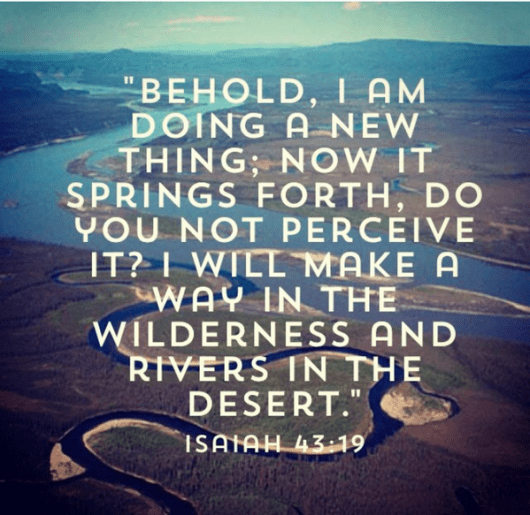
Do not remember the former things, or consider the things of old. I am about to do a new thing; now it springs forth, do you not perceive it? I will make a way in the wilderness and rivers in the desert.

Weekly Devotional Image

On Saturday morning I gathered with a few hundred United Methodists from all over the Virginia Conference for the Bishop’s Convocation on prayer. I was asked to teach a class on spiritual disciplines, but before we broke off into small classes we all met in the sanctuary to hear from our plenary speaker Dr. Fred Schmidt (Reuben P. Job Associate Professor of Spiritual Formation at Garrett-Evangelical Theological Seminary in Evanston, Illinois.)

Dr. Schmidt’s lecture was focused on the need to reclaim a sense of prayerful discernment. He admitted that countless churches will often use prayer in worship, or at the beginning of committee meetings, but rarely do churches actually strive to discern the will of God through their prayers. He set up this distinction by comparing the church of the 50s and 60s to the contemporary church; a half-century ago the church was comfortable with its role in society but as the church has diminished over the decades we have tried to reclaim that popularity. He mentioned that we now have things like “Ashes-to-go” on Ash Wednesday, we hand out coffee in our narthexes, and we fill worship with things like “how to be a better you.” Year after year we initiate new programs in the hope that they will bring us back to the heyday of the church. Then Dr. Schmidt brought the whole point home: “Part of our problem is that we’ve been seeking to rebuild our attendance and influence instead of rebuilding the body of Christ.”

Bc8l84xCAAA2R7Y

The Lord once spoke through the prophet Isaiah and said, “Do not remember the former things, or consider the things of old. I am about to do a new thing;” Many of us fall prey to the temptation to make things “just like they once were” and we want the church to be as popular as it once was. However, God does not call us to be popular. God calls us to be faithful.

This week, let us consider how we can discern God’s will in our lives and in our churches. Instead of just assuming that if we water down our ministries more people will show up in the pews on Sundays, let us earnestly pray and wait for God’s will to be revealed. Instead of limiting our faith to “how to be a better person,” let us earnestly live out our faith and pray for God to make us more like Jesus.

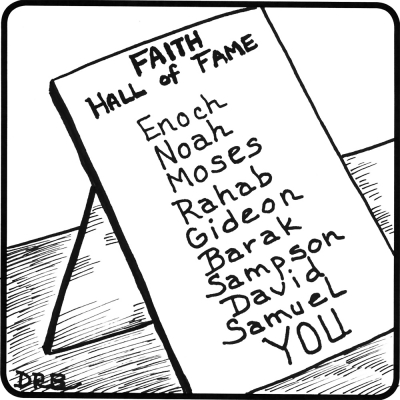
Faith Hall of Fame – Hebrews 11.32-40

Hebrews 11.32-40

And what more should I say? For time would fail me to tell of Gideon, Barak, Samson, Jephthah, of David and Samuel and the prophets — who through faith conquered kingdoms, administered justice, obtained promises, shut the mouths of lions, quenched raging fire, escaped the edge of the sword, won strength out of weakness, became mighty in war, put foreign armies to flight. Women received their dead by resurrection. Others were tortured, refusing to accept release, in order to obtain a better resurrection. Others suffered mocking and flogging, and even chains and imprisonment. They were stoned to death, they were sawn in two, they were killed by the sword; they went about in skins of sheep and goats, destitute, persecuted, tormented — of whom the world was not worthy. They wandered in deserts and mountains, and in caves and holes in the ground. Yet all these, though they were commended for their faith, did not receive what was promised, since God had provided something better so they would not, apart from us, be made perfect.

1357372800

Today we conclude our Advent Sermon Series on “New Beginnings.” This is the final Sunday leading up to Christmas day, and over the last few weeks we have prepared our hearts and minds for the coming of God in Christ. We began with Abram being called into a strange land. Next we looked at Samuel being called by name in the temple. Last week we explored Paul’s conversion on the road to Damascus. This morning we conclude by looking at the Faith Hall of Fame from Hebrews 11.

_

And what more should I say? For time would fail me to tell of Fletcher Swink, Sam Stanley, Zig Volskis, Patricia Meadows, and the other pastors — who through faith endured frustrating congregations, proclaimed God’s presence, fought for justice, became mighty in honor, and brought people to the Lord.

Hebrews 11 contains what I call the “Faith Hall of Fame.” The entire chapter is devoted to the great leaders and prophets from the Old Testament and their willingness to stand up for God even when it meant certain doom. They so fervently believed that God was with them, that they were willing to embark on new beginnings when others refused to obey.

The closest thing we have to a Faith Hall of Fame here at St. John’s can be found in our parlor next to the narthex. Inside you will discover a picture of every pastor that has had the good fortune to serve this church since 1954. From Fletcher Swink to yours truly, every pastor has been framed and dated, hung with care, and honored with a spot on the wall.

Have you ever taken the time to look through the pictures? It was one of the first things I did when I was newly appointed, and frankly the room terrifies me. Whenever I sit in the parlor with a group of people, I feel the heavy gaze of the pastors, they look down from their Faith Hall of Fame, and I can’t help but wonder what they think of me.

Marshall Kirby begged me my first week to give him a picture so that he could put me up with everyone else. I hesitated. For weeks he bugged me about getting the picture, about having it be just the right size and tint to blend in with the others. But I continued to put it off. I kept making excuses about how busy I was, or about the priorities I needed to focus on, but the truth is, I didn’t feel worthy of going on the wall. I had been here for such a short amount of time and felt that I hadn’t done anything that earned me a spot in the Hall of Fame.

When I’m in the parlor, when I experience the St. John’s Hall of Fame, I think about all the things they must have gone through to bring this church to where it is. I think about Fletcher Swink starting the church down the road at the Auto Parts store. I imagine that it required a tremendous amount of faith to believe that God had call him from Durham, NC to Staunton, VA to start a new church; to make something of nothing. How many nights did he pray for God to send him people, how many afternoons did he spend worrying about the new building project, how often did he confront frustrated parishioners about his sermons?

When I’m in the parlor, when I experience the St. John’s Hall of Fame, I think about Patricia Meadows being appointed as the first female pastor. I wonder about how hard she had to work to gain the trust of the people, what lengths she had to go to to reignite the flame of faith. I imagine the deep prayers she offered to God about sending new sheep to her flock, the lonely days of sermon preparation, and the terrifying moments of standing by the graveside with friends and family from the church. How often did she wrestle with her call when she felt persecuted, how many days did she spend praying for the people of our community when they were no longer able to offer their own prayers, how did she feel standing up against the injustices around her?

I wonder about all the pastors of this church, and what they went through for God’s kingdom. What was it that set them apart? What did they do that helped to grow and nurture faith in this community?

Last week I was standing in the parlor, admiring the past, when I realized how similar our Faith Hall of Fame is to the one listed in Hebrews 11.

faith

The people of Israel’s past were not of special value. Gideon was hesitant and timid when he was called by God; Barak had to be shamed by Deborah into fighting for the Lord; Jephthah is remembered mostly for his rash oath; Samson was weak of mind and conscience.

Similarly, there is nothing particularly special about those who have served our church. Though undoubtedly unique, they contained no special powers that set them apart from other clergy. Each of them had strengths and weaknesses that became manifest while they served the church.

Our pastors, and the heroes from Israel’s past, were set apart because they did all things “through faith.” They worked knowing that the real significance of what they had done would never be seen in their own time, but something that would come much later. They suffered through persecution and injustice because they believed in God’s goodness even when the world claimed the contrary.

We remember the ways our pastors have suffered: Angry emails/letters about inappropriate sermons, knowing glances and whispers from the committee members in the parking lot (where the real meetings happen). Shouts and finger pointing during counseling sessions. Years of loneliness serving a church full of people who cannot see the pastor as anything other than pastor. Doubts when preparing funerals for people in the community.

We read about all the ways the faithful of Israel suffered: torture, mocking, flogging, chains and imprisonment. Stoned to death, sawn in two, killed by the sword, wandered about in the skins of sheep and goats, destitute, persecuted, and tormented.

This is what evil does to the good. It attacks at the core of our being, shakes our faith, and  encourages us to doubt. Yet, reading these words and remembering our church’s past should bring us courage and hope. We see in them the willingness of people to go and risk it all for God. Pastors who remained brave and faithful when others tried to break them down. Prophets who spoke the truth when others sought to kill them. We see in them the true courage that faith can develop. 

It only takes a moment to see this tremendous faith in the world today, people standing up against injustice when the world argues the contrary. Consider the droves of people standing with their hands up and holding signs that say “Black Lives Matter” in response to Ferguson. Consider the droves of people standing shoulder to shoulder with the LGBTQ community during Pride marches in response to fanatical attacks against sexuality.

pic_related_120114_SM_Black-Lives-Matter-G_1

We remember and read and see the ways people suffer for God’s kingdom and we commend them for their willingness to go and be grace for the world. God sends into our confused and cruel humanity his messengers and prophets. God sends them into the midst of the wolves so that we might not be left to our evil ways, that we may see in them hope for tomorrow, and in response turn back to the God of mercy.

Yet all these, though they are commended for their faith, did not receive what was promised, since God had provided something better so they would not, apart from us, be made perfect. Whether Gideon, Barak, Fletcher Swink, or Zig Volskis, their completion depends on us. Their faith rested in God who would fulfill his promises. They served the Lord as an anchor cast into the days ahead; faith is built on hope for the future.

Abraham’s faith would have been in vain if his descendants never made it to the Land of Promise. Samuel’s faith would have been in vain if he had not responded to God calling him by name in the temple. Paul’s faith would have been in vain if the resurrected Christ had not appeared to him on the road to Damascus.

Apart from us they cannot be made perfect. The completion of those from the Faith Hall of Fame depends on us. We can fulfill their faith even today by going out and being Christ’s body for the world.

We remember the past of scripture, and the past of our church, but we are not to idealize it. We cannot be blind to the mistakes of those who came before us, or allow the past to fasten its dead hand upon us, binding us down to fruitless ideas, ancient prejudices, and old failures. We look back so that we can look forward. Just because “thats the way we’ve always done it” does not mean “thats the way we must do it now.”

Yet too often we forget how indebted we are to the past. We neglect to remember how faithful Abram, Samuel, and Paul were. We brush aside all the pastors who worked with every fiber of their being to bring about God’s kingdom here on earth. Every good thing that we have and enjoy was consecrated by the sacrifices of the past. We have faith because the people of the past passed it along to us. So today, we in our turn cast our anchors into the future. Without those who are to come after us, without the youth of our church and without the children of our preschool, we shall not be made perfect.

We are who we are because of the past. We will become what God intends for us because of the legacy we pass on to the future. Our new beginning comes when we cast our hope into the future of God’s kingdom, when we stand up for something new and different that breaks from the past, when we take steps in faith knowing that God is with us.

God is with us. In a few days we will gather again to celebrate Christ being born into the world to be God with us. We will look to that lowly manger and remember that God came to dwell among us and encourage us to be brave people of faith who remember the past and cast our hope into the future. Our purpose does not depend on our own power, but on the strength of love that comes from the Lord and in community with one another.

I still feel uncomfortable whenever I’m in the parlor. Sets of eyes follow me from the past, and I see in them everything they went through to bring our church to where it is. I believe in their hope cast into the future. In all of you I see the seeds that they planted long ago that are blossoming into true discipleship today.

I see my picture on the wall and feel unworthy. But that’s when I remember that it’s not about me and it’s not about what I do. It’s about what God does through me. It’s about what God does through you. Amen.

Apocalypse When? – Sermon on Luke 21.5-19

Luke 21.5-19

When some were speaking about the temple, how it was adorned with beautiful stones and gifts dedicated to God, he said, “As for these things that you see, the days will come when not one stone will be left upon another; all will be thrown down.” They asked him, “Teacher, when will this be, and what will be the sign that this is about to take place?” And he said, “Beware that you are not led astray; for many will come in my name and say, ‘I am he!’ and, ‘The time is near!’ Do not go after them. When you hear of wars and insurrections, do not be terrified; for these things must take place first, but the end will not follow immediately.” Then he said to them, “Nation will rise against nation, and kingdom against kingdom; there will be great earthquakes, and in various places famines and plagues; and there will be dreadful portents and great signs from heaven. But before all this occurs, they will arrest you and persecute you; they will hand you over to synagogues and prisons; and you will be brought before kings and governors because of my name. This will give you an opportunity to testify. So make up your minds not to prepare your defense in advance, for I will give you words and a wisdom that none of your opponents will be able to withstand or contradict. You will be betrayed even by parents and brothers, by relatives and friends; and they will put some of you to death. You will be hated by all because of my name. But not a hair on your head will perish. By your endurance you will gain your souls.


            The disciples have gathered together with Jesus. They’ve probably shared some bread, fish, and wine while sitting around and talking about the latest news from Galilee and the recent happenings in Jerusalem. Peter, ever extraverted, decides to change the conversation to the majesty of the temple: “Oh how lovely it was, adorned with remarkable stones and the gifts dedicated to God. Have you ever seen such gold in your lives?” The other disciples nod in approval, while Jesus remained silent. Bartholomew furthers Peter’s claim: “The temple of God is indeed a witness to God’s majesty in the world. Only the God of Abraham, Isaac, and Jacob could have such a place!” They all begin to agree with one another, affirming the glory and might of their God, the God of Israel, worthy of such a temple.

            But then, in sharp contrast to their excited exclamations, Jesus speaks up, “All of these things that you see, the temple in all its glory, the days will come when not one of these stones will be left upon another; all of them will be thrown down.

            The disciples have been around Jesus long enough to know that when he says something like this, its important to pay attention. “But how could this be?” they wondered; the temple was a sign of God’s glory. So then one of the disciples, perhaps Peter, asked on behalf of the whole group, “Teacher, when will this be, and what will be the sign that this is about to take place?”
apocalypse-when

            What a question. Its stories like this one that help to remind me how similar we all are to the disciples. Because that question is the same one I would’ve asked. Okay Jesus, things are going to get rough, when? What will happen to let us know that this is about to take place?

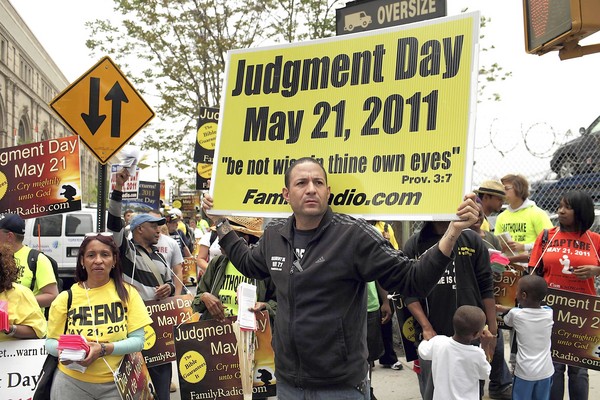
            How appropriate and funny is it that Jesus’ first warning about the apocalypse is directed toward the would-be-prophets who predict the end of the world? Just within my lifetime I can think of a number of examples of the self-affirmed prophets who claim to know the exact date of the approaching end of the world. And even though Jesus has clearly warned us against them, when they come forth with their predictions, they never fail to get a hearing, media presence, and air time.

61786025


And people listen to them! Droves of people go to the bank and withdraw their life savings, bunkers are dug and filled with emergency supplies, and some even take their own lives rather than accept the coming doom and gloom predicted by these would-be prophets. Jesus looks out at his disciples, and therefore every one of us, and declares, “Beware that you are not led astray; for many will come in my name and say, ‘I am he,’ and, ‘The time is near!’ Do not go after them.

            There always seems to be some other form of allegiance in the world that appears better than what we learn to live into from God’s Word. Some affiliation more fruitful, some path through the trials of life that seems more certain and secure. We would rather rely on reason than faith. We would prefer to deal with material possessions than with spiritual growth. The tragedy of the history of God and God’s people is that we have continually been a people running off like that, generation after generation, in pursuit of other, perhaps easier, gods.

            After this first warning, Jesus continues his diatribe regarding the eschaton: “When you hear of wars and insurrections, do not be terrified; for these things must take place first, but the end will not follow immediately. Nation will rise against nation, and kingdom against kingdom; there will be great earthquakes, and in various places famine and plagues; and there will be dreadful portents and great signs from heaven. But before all this occurs, they will arrest you and persecute you; they will hand you over to synagogues and prisons; and you will be brought before kings and governors because of my name.”

tumblr_lxqyysSSQ61qlvp8so1_500

            I have often heard non-Christians remark about how easy it is to be Christian. Those with a limited knowledge of what it means to be a faithful people often charge the church as being a means of escape from the harsh realities of the world. “It must be so easy to be Christian, you don’t have to worry about what really goes on in the world, just waiting for your heavenly reward.” However, in sharp contradiction to these claims Jesus very bluntly puts forth how very difficult it is, and will be, to be Christian. In a way, being Christian, is in some sense, an escape, not our of life, but right into the depth of it; from meaningless into meaning, from futility into purpose, from bondage into freedom.

            The Good News of Jesus Christ has always been paradoxical in its ability to disturb the ways of the world. Those with privilege look on it with suspicion, those with power look at it with disappointment. The Jewish leaders were shaken by it and fearful. Rome outlawed it. The first disciples all suffered persecution and condemnation. Jesus did not get killed for loving too much, but for turning the world upside down; for changing the perspective of what it means to be first and last, for defeating death, and removing power from the powerful.

            “This will give you an opportunity to testify. So make up your minds not to prepare your defense in advance, for I will give you words and a wisdom that none of your opponents will be able to withstand or contradict.”

            When Jesus addresses the disciples, describing for them the very trials and tribulations that they were to face he makes it clear that these are the hours of opportunity. When the world shouts No, the church responds with a resounding Yes!

            Our faith is not a creed, not a way of thinking about life, not 5 steps to make a better you; it is the I and Thou of a God who calls us by name, addresses us, seeks us, a moment of meeting, the time for hearing and becoming. Our faith is about confronting the problems of the world, living into them, and transforming the world for God’s kingdom. The Bible, God, and our faith is never on pause. The time is now!

            What Jesus describes in this passage is what we often call the apocalypse. What kinds of images come to your mind when you think about the apocalypse? Death? Destruction? Zombies? Though these are the popular images often associated the apocalypse, apocalypse deals with a revelation, which discloses the realm of God behind the world of historical and interpretable events.

            Timing is important when we talk about revelation from God. What Jesus describes, the events surrounding the suffering of his followers will happen in the future. There will come a time when Christians are called to testify to their faith when everything around them will argue the contrary. The apocalypse is coming in the future.

            However, most of the events that Jesus described took place within the 1st century of the church. The temple was destroyed in 70 AD, the disciples were called before synagogues and governors to witness to their faith. They were rejected by the world and suffered because of their association with Jesus Christ. Nations rose against nations and wars took place. The apocalypse happened in the past.

            What becomes real for us today, though, is that God’s revelation, the apocalypse, is happening right now! What Jesus described in his apocalyptic descriptions helps to show how what is going on is mixed with what is really going on. Events set in the larger context of God’s purposes in the world. We have been caught up in God’s great cosmic victory and therefore we are surrounded by symbols, signs, and mysterious elements regarding what is really taking place. As strange as this may seem to us as enlightened, modern, and rational people, it is a dramatic witness to the tenacity of faith and hope among the people of God.

            “You will be betrayed even by parents and brothers, by relatives and friends; and they will put some of you to death. You will be hated by all because of my name. But not a hair on your head will perish. By your endurance you will gain your souls.”

            How easy is it to be Christian? Apparently, its not. What is at stake for us in this passage is the commitment and call to be faithful witnesses under unusual stress and frustration. For us, here in Staunton, it might be hard to imagine suffering for our Christian identities. But faithfulness and endurance under threat and disapproval (and even penalty of death) are the qualities of discipleship during the time of witnessing. Disciples, and that means all of us here, are not exempt from suffering. If there is any doubt of this period of testing and testimony is still present, you need only look to what recently happened in the Philippines, or the dozens of Christians who were recently executed in North Korea for having Bibles, or the suffering of members within this church right now. Some of you might know of the suffering within the church, perhaps its even happening to you, just look around.

            Jesus’ address to the disciples regarding the apocalypse, the revelation of God, calls us to reflect on our own discipleship. I have been told again and again that if people are not complaining about me in the church I serve, than I am not doing my job. Being Christian implies a willingness to be pushed into the discomfort of discipleship in order to live into the new reality that Christ initiated with his death on the cross.

            Are we almost Christians? Are we content to arrive on Sunday mornings in order to go back to work on Monday without any change in our lives? Are we comfortable with seeing all of the suffering around us and letting it pass by our vision without stopping to question why? Are we ready to witness God’s kingdom transform the world without our participation?

            Or are we fully Christian? Have we felt the love of God in our hearts and we are ready to respond to that love with our commitment to faithfulness? Do we sit in the shadow of the cross while awaiting the glory of the resurrection? Are we ready to witness to the goodness of God even amidst our own suffering?

            I love the question the disciples ask: “When is this going to happen?” But there’s another question I feel compelled to ask: “Why is it going to happen?” If our Christian lives are comfortable and easy, perhaps we’re not doing enough. If the amount of suffering the first disciples went through was part of God’s revelation, then maybe we should be going far enough to disrupt the powers of the world. What would it take for us to believe so fervently, that we would live such faithful lives worthy of persecution from those around us?

            We have to know that what Christ is talking about is the end. And we have to know with equal knowledge that it is also the beginning. That the God of grace and glory is bent on rescuing his own from the misery that finds us in life, and continually working toward that salvation. That God is committed to saving us with the Good News according to Christ, and eagerly doing it by means of every life that will give itself away to him and his kingdom.

            Teacher, when will this be, and what will be the sign that this is about to take place? The apocalypse, the revelation of God, is now.

            Amen.