Weekly Devotional – 12/16/13

Devotional:

Psalm 80.19:

Restore us, O Lord God of hosts; let your face shine, that we may be saved. 


I used to love making fun of my pastors who complained about how much busier they became during advent. It’s not as if they had more on their plates than any other month during the year, but they nevertheless felt overwhelmed by this particular liturgical season.

I now regret making jokes at their expense.

I’m not sure how its possible, because we are not doing more than the ordinary during this time, but I am busier than I have been since I started working at St. John’s in June. I like to think that my newfound busyness stems from the different holiday concerts and Christmas pageants or the shifts for selling Christmas trees or the added time spent decorating the house… but I think it really comes from somewhere else.

country-church-christmas

This season carries with it tremendous joy but also remarkable sadness. Advent helps to prepare us for the coming of the Lord, but often times we fail to prepare ourselves for the onslaught of emotions and old memories that are triggered by this time of anticipation. In the last few weeks I have noticed more tears and tissues in the pews that are the result of the welling up of suppressed emotions that this season breaks forth. For as much as we can be excited about opening gifts together under the tree with a fire roaring in the fire place, for many of us Christmas embodies tremendous pain that is often difficult to ignore.

At the end of the 80th psalm, the psalmist writes, “Restore us, O Lord God of hosts; let your face shine, that we may be saved.” I believe that this psalm is one that we need during this season, perhaps more than any other. We need to feel restored in our lives during this time when old and difficult memories flood our perspective. We need to be reminded of God’s glory that outshines all of the darkness in our lives. We need to sing those familiar hymns, let the tears flow, and remember that God came in the form of our brokenness to dwell and walk with us.

So, as we all make it through this last week of advent, preparing for the great coming of our Lord on Christmas, let us all take the time to live into the brokenness in our lives. Do not ignore the pain that this season often brings. Let it be. But remember that it does not have the final word. God has triumphantly declared that He will make all things new, that we are not defined by our pasts, but instead by the love that God has for each and every single one of us.

Weekly Devotional – 12/9/13

Devotional:

Psalm 146.5-10

Happy are those whose help is the God of Jacob, whose hope is in the Lord their God, who made heaven and earth, the sea, and all that is in them; who keeps faith forever; who executes justice for the oppressed; who gives food to the hungry. The Lord sets the prisoners free; the Lord opens the eyes of the blind. The Lord lifts up those who are bowed down; the Lord loves the righteous. The Lord watches over the strangers; he upholds the orphan and the widow, but the way of the wicked he brings to ruin. The Lord will reign forever, your God, O Zion, for all generations. Praise the Lord!


I love to ask questions. For years I have always been “that guy” at dinner or at a party who can orchestrate the direction of the conversation just by asking a few well placed questions. Depending on the season, or company present, some of my favorite questions include: How did you two meet? What was your favorite halloween costume as a child? What was the last best book you read? All of these questions are geared toward opening up a conversation for all people to respond accordingly. It allows for everyone present to reflect on something and then share it with everyone present. My favorite question to ask during Advent has always been: What was the best Christmas present you ever received?

stxmco001christmas_tree_and_presents1

Its a perfect question. Everyone loves to take a few moments to go through the catalogue in their memory banks of all the presents they received as children, you can detect a positive change in the atmosphere because the memories elicit such joy, and the discussion will continue from that first question toward a full and fruitful conversation.

What was the best Christmas present you ever received? What memories do you have of gathering around the Christmas tree with your family preparing to rip apart the wrapping paper?

I love to ask that question, but recently I’ve begun to wonder whether I should be asking it at all. The celebration of Christmas (according to the ways of the world) has so trumped the theological convictions of Advent that Santa Claus has become frighteningly synonymous with Jesus Christ. Moreover, practices like “The Elf on the Shelf” have led children (and some adults) to grossly misunderstand the depth and breadth of God’s prevenient grace in the world.

When I read from the 146th Psalm I wonder if instead of asking everyone about their favorite present, I should instead ask: “When was the last time you gave food to the hungry?” Or “How are you keeping your faith?”

I know those questions are tougher to swallow, even for me, but I believe they really get at the heart of the Christmas message. How are we living out our faith, particularly during this season of giving? How are we reaching out to those in our community who need to feel the love of Christmas more than anyone else?

So, as we all gather in the shops to find the perfect present, and even as we sit around our perfectly lit and decorated Christmas trees, let us remember the true depth of Christmas. Let us recall that Christ came not to be served but to serve. Let us ask ourselves the difficult and life-changing questions in order that we might live fruitful lives in God’s kingdom.

Weekly Devotional – 11/18/13

Devotional:

Psalm 46.1-3

God is our refuge and strength, a very present help in trouble. Therefore we will not fear, though the earth should change, though the mountains shake in the heart of the sea; though its waters roar and foam, though the mountains tremble with its tumult.


John_Wesley-3

In 1735 John Wesley, the founder of the Methodist renewal movement of the Church of England, made his way from England to the New World having been called to be a minister for the new colony of Georgia. Wesley prayed over this invitation for some time and eventually came to the conclusion: “My chief motive, to which all the rest are subordinate, is the hope of saving my own soul.” Though he had lived a devout life, and was ordained as a deacon in the Anglican Church, he felt that his own soul had yet to be saved.

During the voyage across the Atlantic, Wesley experienced a new kind of faith, one that he had yet to find in his own life. He recorded it as such in his journal: “There was now an opportunity of trying whether they (The German Moravians) were delivered from the spirit of fear, as well as that of pride, anger, and revenge. In the midst of the psalm wherewith their service began, the sea broke over, split the mainsail in pieces, covered the ship, and poured in between the decks, as if the great deep had already swallowed us up. A terrible screaming began among the English. The Germans calmly sung on. I asked one of them afterwards, ‘Was you not afraid?’ He answered, ‘I thank God, no.’ I asked, ‘But were not your women and children afraid?’ He replied mildly, ‘No; our women and children are not afraid to die.’”

This profound experience would follow Wesley throughout the rest of his life, inevitably leading to the discovery of his own profound faith in the God who had faith in him, despite his sinfulness.

The psalmist sings out, “God is our refuge and strength… therefore we will not fear, though the earth should change, though the mountains shake in the heart of the sea; though its waters roar and foam…” That kind of faith is remarkable, one that takes years to cultivate and nurture. Just as Wesley was surprised by the faith of the Moravians on the ship, so too, it is often difficult for us to maintain our faith in the midst of tragedy and fear. Yet, every Sunday the church gathers together to remember our God, to remember that God came in the form of flesh and mounted the hard wood of the cross for us.

So, the next time you’re confronted with the seas and mountains in your life shaking and spilling over remember the faith that God has in you. That time and time again God went after you, to find you, to call you by name, and to embrace you. How would your life change if you had the faith to look at death and suffering in the face and simply remark, “I am not afraid”?

The Magnificent Defeat – Sermon on Genesis 32.22-31

Genesis 32.22-31

The same night he got up and took his two wives, his two maids, and his eleven children, and crossed the ford of the Jabbok. He took them and sent them across the stream, and likewise everything that he had. Jacob was left alone; and a man wrestled with him until daybreak. When the man saw that he did not prevail against Jacob, he struck him on the hip socket; and Jacob’s hip was put out of joint as he wrestled with him. Then he said, “Let me go, for the day is breaking.” But Jacob said, “I will not let you go, unless you bless me.” So he said to him, “What is your name?” And he said, “Jacob.” Then the man said, “You shall no longer be called Jacob, but Israel, for you have striven with God and with humans, and have prevailed.” Then Jacob asked him, “Please tell me your name.” But he said, “Why is it that you ask my name?” And there he blessed him. So Jacob called the place Peniel, saying, “For I have seen God face to face, and yet my life is preserved.” The Sun rose upon him as he passed Penuel, limping because of his hip.

1383606_169741249886845_1520756210_n

Jacob was left alone. He had sent his entire family, all of his possessions, and his future across the Jabbok river. There he was all alone basking in the glow of the sunset, terrified but hopeful for the morning. Jacob had lived a strange life, but nothing would compare to what was about to happen.

Out of nowhere, a strange unnamed man arrived and began to wrestle with Jacob till daybreak. Scripture is rather lacking in details about this epic match, but we can imagine the blood, sweat, and tears that went into this fight. Two men grappling with each other in the bleak conditions of the ancient near east. When it seemed as if one man was finally getting an advantage, the other would return with a defensive move pinning the other one to the ground. This was probably not some glorified hollywood-esque battle, but rather like the ones you used to have with your brother or sister, where no one would relent.

PCH5808

The fight went on throughout the evening, and when the stranger knew that he could not prevail against Jacob, he struck him precisely on the hip socket, knocking it out of joint as they continued to wrestle. Then the stranger in the night said, “Let me go, for the day is breaking.” But Jacob said, “I will not let you go unless you bless me!” So he said to him, “What is your name?” And he said, “Jacob.” Then the man said, “You shall no longer be called Jacob, but Israel, for you have striven with God and with humans, and have prevailed.”

Though already having received a remarkable blessing, a new name, a new identity, Jacob further pushes the man, “Tell me your name!” But the man replied, “Why is it that you ask my name?” And there he blessed him. Jacob would later name the place Peniel (which means face-to-face) saying, “For I have seen God face to face, and yet my life is preserved.” And for the rest of his life, Jacob walked with a limp because of his battle with the man.

What a story! 

Some theologians are convinced that this narrative has received more scholarship than almost any other story from the Old Testament. Yet, last Sunday, when I casually mentioned this narrative to a few people before church, they remarked that they had never heard about it. In our current culture, we can no longer take for granted the amount of scriptural knowledge everyone has in the church. A lot of people will be quick to blame the laity for not reading enough scripture outside of church, but I believe the fault doubly lays with the clergy who are afraid or unwilling to preach on particular texts.

So, if you’ve never heard this story before, or even if its the 100th time you’ve heard a sermon on it, what do you make of it?

It is one heck of a story, but like many passages in scripture, we have read this section in isolation and we are missing the rest of the narrative. If we really want to know what is going on here on the sandy banks of the Jabbok river, we have to go back to the beginning…


Jacob was the son of Isaac and Rebekah (son of Abraham and Sarah). When Rebekah became pregnant with twins she felt a struggling within her womb, and after praying to God, “If it is to be this way, why do I live?” The Lord said to her, “Two nations are in your womb, and two people born of you shall be divided; the one shall be stronger than the other, the elder shall serve the younger.”

The first born was Esau, red and covered in hair, and later Jacob who came out gripping the heal of his brother; each of them were named after elements regarding their birth (Esau – red // Jacob – one who grabs the heel). When the boys grew up, Esau was a skillful hunter, a man of the field, while Jacob was a quiet man, living in tents. Isaac loved Esau; but Rebekah loved Jacob. 

Esau

Esau

Like most sibling rivalries, Jacob and Esau were combative throughout their lives. You can imagine them as children fighting over simplest little things while the father would side with one, the mother the other.

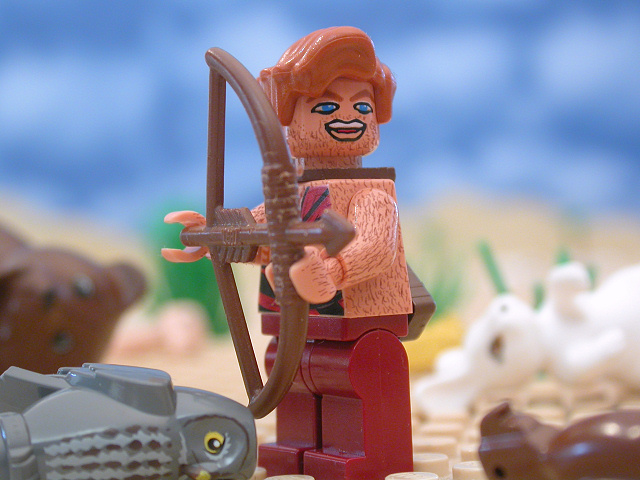
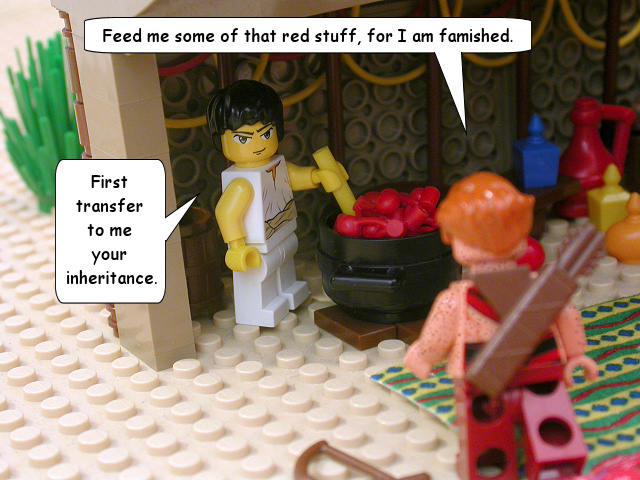
Once, when they were older, Jacob was cooking a stew while Esau came in from the field famished. Esau said to to Jacob, “Let me eat some of that red stuff, for I am famished!” Jacob, the cunning heal-grabber that he was, agreed to give his brother food, in exchange for his birthright, and thus Esau gave up his birth right to his younger brother.

07_gn25_30-31

And then later, when their father Isaac was approaching death, with weakened eyesight, he beckoned for Esau to bring him some wild game in order to bless him before his death. However, when the cunning little heal-grabber found out about this from his mother, he covered himself in fur and deceived his father by pretending to be his brother. Before Jacob had had enough time to even make it away from his father’s tent, Esau returned from the field shocked to discover that Jacob had stolen his blessing.

The heal-grabber had gone too far this time and Esau was furious. He vowed to kill his brother after the death of his father. But Rebekah discover Esau’s plot and sent Jacob away to flee from the inevitable wrath of his twin.

24_gn27_41

Years pass. Esau and Jacob continue to live out their lives apart from one another. When it seemed like Jacob might finally be able to forget his past and his brother, he had a vision which made him realize that he needed to return to the land of his father.

And so, with all his possessions and children and wives Jacob prepared to encounter his brother, unsure of what would happen. However, the little heel-grabber had one trick left up his sleeve; knowing that his brother would surely kill him, Jacob sent ahead of him all his possessions and family in order to appease Esau before their reunion, while thinking to himself, “I may appease him with presents that go ahead of me, and afterwards I shall see his face; perhaps he will accept me.” Therefore his gifts passed on ahead of him, and he stayed behind alone for the night before meeting his brother in the morning.

At this critical moment in his life, at the matrix of what would determine everything forward, spending the night on the border of the Promised land, Jacob struggled with God.

So you see, the story of Jacob wrestling with God is placed perfectly within the greater story of Jacob’s life; while anticipating a frightful reunion with his brother Esau, Jacob must first meet with the dreaded stranger of the night and these two meetings are intimately related to one another.

The story, as we find it in scripture is not explicit about who Jacob actually wrestles with. Is he wrestling with his metaphorical brother? Himself? A stranger of the night? Though arguments abound for many interpretations, it makes most sense to understand the story in such a way that Jacob is wrestling with God

During the night, the cool evening when precision and detail are lacking, the divine antagonist arrives and takes on features of others with whom we all struggle during the day.

What a man this heal-grabber was! He may have been frightened of the coming repercussions of the reconciliation between he and his brother, and he may have been afraid of the almighty Lord, but in the fray he held his own with either one.

This is no ordinary story.

In a way, what Jacob experienced was a magnificent defeat. A defeat because Jacob is left with a limp for the rest of his life, and magnificent in his ability to prevail. From that day forward Jacob limped every day to show others (and remind himself) that there are no untroubled victories with the Holy One. Yet his limp was also a reminder that he had prevailed in this skirmish between humanity and the divine.

It is important to note that this meeting with God, this nighttime wrestling match, did not lead, as we are wont to imagine, to reconciliation, forgiveness, and healing. It resulted in a crippling. There is a dangerous consequence of meeting the divine, resulting in a marking that we will carry throughout the rest of our lives.

And so, when the day broke the stranger left a crippled Jacob, now Israel, limping toward his powerful and vengeful brother.

Can you imagine how he must have felt? Weak after wrestling all night long, afraid of the coming consequences, isolated from all his family and possessions, sand caught in his eyes, clothing ripped, walking across the deserted landscape toward his brother?

When Jacob made his way forward, lessening the space between himself and inevitably, he bowed seven times until he came to his brother.

Like the stranger from the night before Esau rushed forward and grappled his brother to the ground, falling upon his neck. However, instead of punches and scrapes, Esau covered his brother with kisses and tears.

The juxtaposition of the wrestling in the night with Jacob’s reunion with Esau offers us a warning; God will not be taken lightly or easily. There will be no cheap reconciliations. On the way to the affronted brother, Jacob must deal with the crippling and blessing of God.

It is easy to take the story in isolation and make it into a simple lesson: “being a Christian is about wrestling with God. There will be times when we cannot understand what it happening and though we are grappling with the divine in a negative, God will positively hold onto us while refusing to let go.” And though that message is true, there is so much more going on with the greater story.

Don’t we all have a little Jacob in us? At times we’ve all acted like the little heel-grabber, willing to do less to receive more, willing to focus on ourselves alone rather than those around us. And at the same time, don’t we all have a little Esau in us too? At times we’ve felt betrayed, unloved, and hurt, our trust broken from broken relationships. Being Christian is about wrestling with God, but its also so much more. This story in scripture reveals to us how the love of God and the love of brother belong together. We were never meant to be alone, scavenging for ourselves, removed from others. We were all created in the abundant image of the triune God, made out of unified plurality to be in plurality with others.

Like Adam and Eve, like Jacob, like the disciples, and so many other figures from scripture, we want to know the answer to the ultimate question. We want to bridge the gap between us and God. In this passage Jacob wanted to know God’s name, the mystery of heaven and earth, to overcome all the distance. When wrestling, the stranger did not win, but he did not lose either. Jacob gained a great deal, but the depth of God’s being had not been given. The stranger stopped short of giving the ultimate gift – that would have to wait until a cramped night in the crib of a manger in Bethlehem.

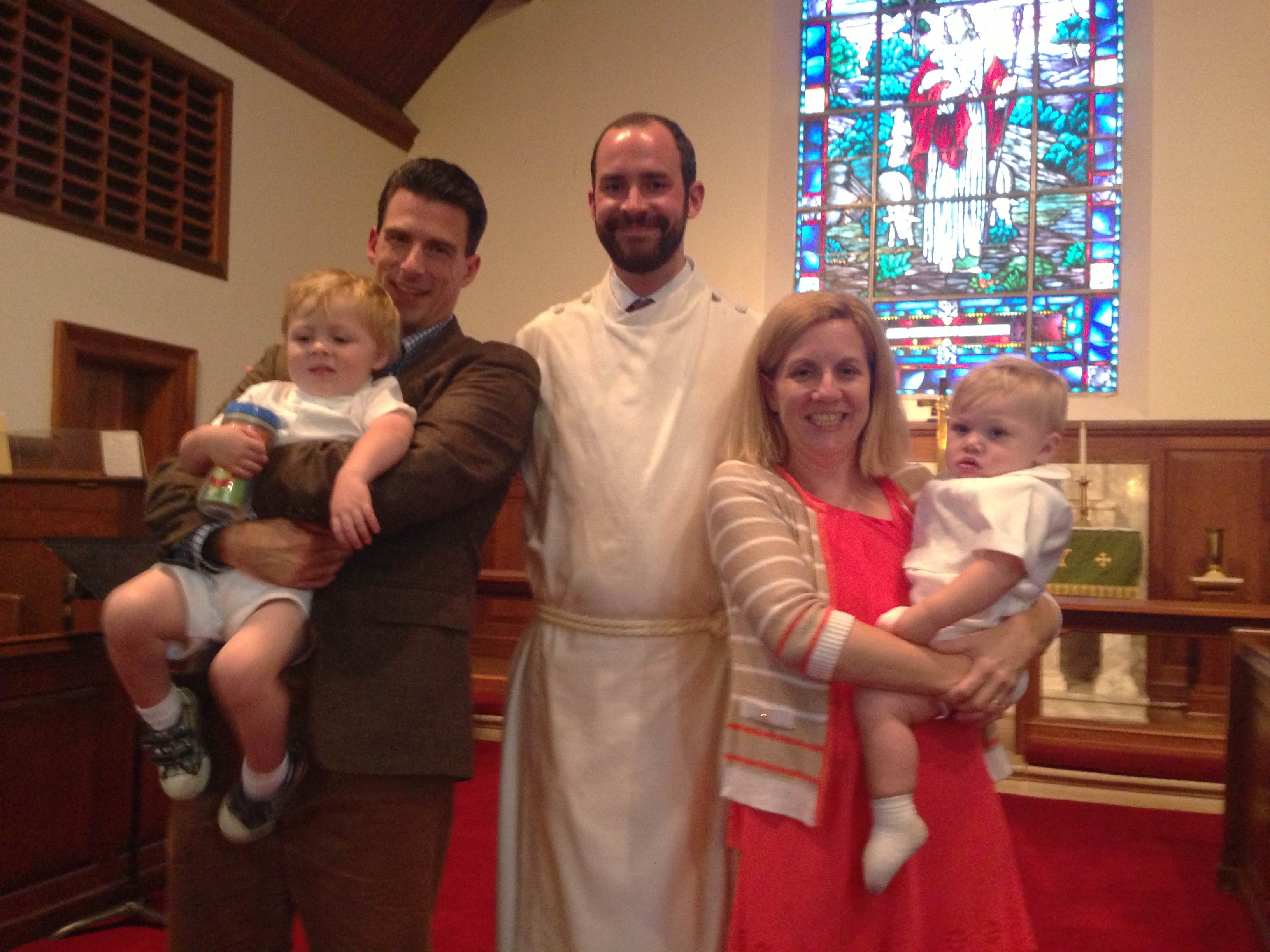
In a few moments I will be inviting Isabella Bailey-May Sullivan and her family to come forward and gather around the baptismal font. In Isabella’s baptism she will be incorporated into this body here, to learn about these kinds of stories from scripture, to begin a life of wrestling and reconciling with God. Like Isabella, all of us gathered here have been grafted into the story of Israel through Christ’s death on the cross. We will encounter our brokenness through God’s Word but we will also rejoice in the grace that God gives us in spite of our brokenness.

And so what are we left to make of this heel-grabber and his wrestling match on the banks of the Jabbok? Like Jacob’s wrestling and Isabella’s baptism, when we enter the church we are marking ourselves for the rest of our lives. It is in this place through the worship of the people and the proclamation of the Word that all the Jacobs of the world become reconciled with the Esaus. Its where we can meet one another and God face-to-face and prevail. We might be brought down in a way that we are truly wrestling and we will walk away marked by God. Though we may not walk with a physical limp, we have been struck by the almighty God in a way that we will never be the same again.

And that, is good news.

Amen.


Weekly Devotional – 10/14/2013

Devotional:

Psalm 119.103-105

How sweet are your words to my taste, sweeter than honey to my mouth! Through your precepts I get understanding; therefore I hate every false way. Your word is a lamp to my feet and a light to my path.

Adjusting to life in Staunton has been incredible! The pace of life is a welcome relief from the hustle and bustle that I have experienced in other places. I look forward to my regular trips to Food Lion because I know I will inevitably run into someone from church and we will be able to catch up between the ketchup. Additionally, Lindsey and I have fallen in love with the culture here in town. There are so many great restaurants, used bookstores, and a movie theater that always has an open seat!

Recently, I have found myself engaging in conversations with people about the latest book I read (Hard-boiled Wonderland and the End of the World by Haruki Murakami), the latest meal I had at a local restaurant (Pepperoni Pizza from Shenandoah Pizza), and the latest movie I saw (Gravity). It amazes me how so much of our conversations are about the wonderful things we experience and how we want to share them with others; we hope that they can derive as much pleasure from the activities as we did.

Haruki Murakami

Haruki Murakami

Gravity

Gravity


Now, think of something you did recently that was great, perhaps a delectable meal, or an incredible movie, or an exciting novel. Did you tell anyone about it? Did you share your experiences?


If those things were good for our lives, why are we so afraid to talk about the Good News?

I’ll be the first to admit that talking about a book or a meal is a lot easier than sharing the gospel, particularly with a stranger. But, when I really think about it, God has done far more for my life than any movie or meal ever has.

The psalmist writes, “How sweet are your words to my taste, sweeter than honey to my mouth!” (Psalm 119.103) Part of what it means to live out are faith in the world, is to soak up the delectable qualities of God’s word, and then be ready to share the good news with those around us. This doesn’t mean that we need to be bible-carrying evangelists ready to knock on every door on our street. But if God’s Word has been sweeter than honey in your life, isn’t it worth sharing with those around us?

So, the next time that you start sharing an experience with someone, remember that God’s Word has been a light for our feet and a lamp for our paths, that it has sustained us through the valleys and celebrated with us on the mountaintops, that it is our story.

Prepare To Be Surprised – Sermon on 2 Kings 5.1-15

2 Kings 5.1-15

Naaman, commander of the army of the king of Aram, was a great man and in high favor with his master, because by him the Lord had given victory to Aram. The man, though a mighty warrior, suffered from leprosy. Now the Arameans on one of their raids had taken a young girl captive from the land of Israel, and she served Naaman’s wife. She said to her mistress, “If only my lord were with the prophet who is in Samaria! He would cure him of his leprosy.” So Naaman went in and told his lord just what the girl from the land of Israel had said. And the king of Aram said, “Go then, and I will send along a letter to the king of Israel.” He went, taking with him ten talents of silver, six thousand shekels of gold, and ten sets of garments. He brought the letter to the king of Israel, which read, ‘When this letter reaches you, know that I have sent you my servant Naaman, that you may cure him of his leprosy.” When the king of Israel read the letter, he tore his clothes and said, “Am I God, to give death or life, that this man sends word to me to cure a man of his leprosy? Just look and see how he is trying to pick a quarrel with me.” But when Elisha the man of God heard that the king of Israel had torn his clothes, he sent a message to the king, “Why have you torn your clothes? Let him come to me, that he may learn that there is a prophet in Israel.” So Naaman came with his horses and chariots, and halted at the entrance of Elisha’s house. Elisha sent a messenger to him, saying, “Go, wash in the Jordan seven times, and your flesh shall be restored and you shall be clean.” But Naaman became angry and went away, saying, “I thought that for me he would surely come out, and stand and call on the name of the Lord his God, and would wave his hand over the spot, and cure the leprosy! Are not Abana and Pharpar, the rivers of Damascus, better than the waters of Israel? Could I not wash in them, and be clean?” He turned and went away in a rage. But his servants approached and said to him, “Father, if the prophet has commanded you to do something difficult, would you not have done it? How much more, when all he said to you was, ‘Wash, and be clean’?” So he went down and immersed himself seven times in the Jordan, according to the word of the man of God; his flesh was restored like the flesh of a young boy, and he was clean. Then he returned to the man of God, he and all his company; he came and stood before him and said, “Now I know that there is no God in all the earth except in Israel; please accept a present from your servant.”

Prayer

Have you ever gone looking for God? Maybe your church or your prayer life was no longer cutting it, and you thought about actively seeking out the God who you used to meet in the sanctuary.

For a long time, I made it my duty to help other people find God.

I would help organize trips to domestic or foreign locations, often leading youth and adults into uncomfortable situations so that they could live out the calling of the gospel by serving their neighbors.

Whether you lead a group to Winchester, Virginia or Xela, Guatemala the paradigm remains basically the same: Take a group of people out of their comfort zone, encourage them to serve others through physical means, participate in theological reflection and fellowship, and return home a changed individual.

I have been blessed to see wealthy American men weep in the arms of poor Guatemalan women after working for a week in a remote village, I have seen privileged teenagers play in the destroyed and desolate streets of New Orleans with other children who had lost everything. I have seen college-age Christians sing and chant hymns fervently with their eyes closed after having not stepped foot in a church in years.

Desktop

All of these trips were fantastic and were remarkably important for the people who participated. The only problem was, after returning home, it only took a few weeks to fall back into the same routine as if nothing had actually happened. In fact I’ve seen nearly the same thing occur after a group does a Bible study for months: as soon as they finish, they are on fire for Christ, but within a few weeks, that fervor has disappeared. The thought usually goes something like, “I did what I could but I can only do so much” “I tried to keep the fire alive, but I have other responsibilities” “I know this is what Christ wants me to do, but it’s too hard.”

We often engage in these activities expecting to experience God on our terms, only to return back to life the same as before…

Many, many years ago, a foreign warrior named Naaman had it all. He had the favor of his king, he was consistently victorious on the battlefield, and he had power. He was the kind of guy that you hated in high school. The proverbial quarterback of the football team, straight-A student, the guy who had everything just fall into his lap easily. But Naaman had a big problem: he was a leper. Covered in this invasive skin condition, there was nothing he could do to rid himself of the suffering.

The CEO of the huge multinational corporation can get the best table at any restaurant in town without even calling for a reservation, but his son is in rehab for an addiction to heroin. The famous and celebrated writer travels the world to give lectures and presentations – but he’s an alcoholic. The beautiful actress can turn every man’s head, but she dreads the lights and cameras in case they show an unflattering angle. The envied mother in the community has perfect children that never get in trouble but she weeps every night out of her loneliness and depression.

In every life there is a “but.” What’s yours?  Naaman was a successful military man in great favor with the king, but he was a leper.

However, one day, an unnamed completely insignificant Israelite, the quiet girl who always sat in the shadows, the one whose name no one could remember said the obvious: “Naaman, all you have to do is visit the prophet in Samaria, he can cure your leprosy.”

Why Naaman listened to this woman, we will never know, but he gathered his treasures and traveled to visit the king of Israel. After an embarrassing episode, where it is clearly apparent that Naaman does not know the way God works because he seeks healing from the king rather than the prophet, Elisha invites Naaman to his home so that he will learn there is a prophet in Israel.

The scene that follows is remarkably comical. Naaman comes in full regalia, with an impressive entourage, and gifts galore: ten talents of silver, six thousand shekels of gold, and ten sets of garments. He stands proudly before the house of the prophet but he does not even get invited inside. Instead, Elisha sends out a messenger to instruct the officer to wash seven times in the Jordan River.

Naaman is incensed! “This so called ‘prophet’ doesn’t even have the decency to come greet me? And then he is so bold as to claim that his river is mightier than ours?” So Naaman went away in a rage.

But, just as before with the unnamed woman, some unnamed servants approach Naaman, “If the prophet had commanded something difficult, would you not have done it? How much more, when all he said to you was, ‘Wash, and be made clean’?” And so Naaman went down to the Jordan and immersed himself seven times and his flesh was restored.

de-saussure-elisee-et-naaman

Before returning to his homeland, Naaman went to Elisha and proclaimed, “Now I know that there is no God in all the earth except in Israel!”

Like many people who go out seeking to find God, Naaman knew how it was supposed to work. However, the scripture today confirms Naaman’s lack of understanding when interacting with the divine. First, he brings all of his treasures to the king of Israel assuming that he would have the power to cleanse him. Second, he arrives at Elisha’s home expecting to be regarded as the dignified warrior he is, only to be slighted by Elisha’s lack of welcome.

Like Naaman, so many of us go out expecting to find God on our terms and in the ways we want.

If we travel to an impoverished part of the country, or if we go visit a remote village on the other side of the planet we will surely find God. If we sweat in the mud all day long for our brothers and sister we will be blessed by God almighty for our actions. Yet, like Naaman, we cannot meet God on our own terms, but it is God who meets us.

What takes place here with Naaman is the way the Bible often deals with God. The extraordinary arises within the ordinary. The heavenly breaks out amid the earthly. What we tend to view as ordinary and plain, the Bible wants to depict as the realm of God’s amazing work among us.

Elisha, and all the other prophets from the Old Testament have something that we have lost in the church these days. They have freedom from the society around them. They are not blown about by the winds of doctrine or expectation, they are not captive to special interest groups, they do not follow all the latest fads, they do not unquestionably serve the latest liberal or conservative agenda. They serve, rather, their living God – that God who is on the move toward the establishment of the kingdom on earth.  – They hear God and follow him accordingly; this gives them the freedom from all the voices of this world and from every ideology that would capture them for its own selfish purposes. They meet God in the ordinary ways of life, respond to the call, and are transformed.

The healing of Naaman is one remarkable story. God takes an enemy of his chosen people and restores him to good health. In spite of the antagonism between two seemingly opposed people, God interrupts Naaman’s life in order to bring about a revelation.

Naaman was healed, but in what way? Yes, there is the physical healing, by washing himself seven times in the Jordan Naaman loses the leprosy that had so plagued him, but there was something else more powerful going on here in the story.

In this narrative Naaman learns about humility and encounters the living and active God. It is not the kings, nor the warrior, in the story who understand the ways of God, but it is through the unnamed servants that Naaman comes to experience the divine. It was through humbly following the commands of his servants that Naaman found cleansing in the muddy waters of the Jordan, but more importantly he found new life in a God that meets us in the ordinary.

What is your “but”? What is your excuse for not letting God meet you where you are? When we meet the triune God it would seem that it happens without regard for being rich or poor. Perhaps even more dramatically God extends his mercy, and works out his plans through the unnamed people in our lives, the ones we so often overlook in our day-to-day living.

Somewhere in your life, God is calling you away from the distraction that you are so rooted in. Perhaps God has been using someone to bear a word of hope for your leprosy, for your “but”. Maybe its your mother who you have neglected to call for the last few months that just wants to tell you that God loves you. Maybe it’s the homeless man on Beverly Street who muttered “Thank God” under his breath when you gave him a dollar. Maybe it’s the co-worker who doesn’t treat you with enough respect or your own child who drives you mad when they neglect to clean their room or do their homework. It might be someone who you are jealous of, or threatened by.

Our scripture today boldly declares that God is the one looking for you. If you want to meet God, then you don’t have to go off on some mountaintop, or move to some sort of spiritual summit. You just have to let yourself go, like Naaman, and be willing to let God take over and ready for the changes in your life.

Be prepared to be surprised. When you meet the unnamed person that God is using to address your leprosy, it will almost inevitably offend you in some way, just as Naaman was furious over Elisha’s lack of decorum. The message will cut deep into your life by way of its simplicity, or its unexpectedness, and it will occur in a way that only you will be able to comprehend.

When God comes to meet us where we are, it does not occur through overwhelming theatrics, flashing lights and great booming sounds. God does not meet us where we expect him to, but rather through simple things:

Yesterday morning I stood here right in front of the altar with my cousin Devin. Devin is currently part of a confirmation class in Alexandria, VA at Aldersgate UMC regularly learning more about faith, God, and the Bible. At the end of this confirmation period, Devin will kneel before his home congregation and will be welcomed as a member into the church. But, Devin has not been baptized, and baptism is a requirement for confirmation.

Devin and I talked and he made it clear to me that he wanted me to be the one to baptize him. So after a conversation regarding the importance of the sacrament of baptism, about what it will mean for him and his life, I welcomed Devin to come here for the weekend and be baptized.

So there we stood yesterday, with the muted overcast light coming through the “I am the good shepherd” stained glass window lighting up the altar. I ran my fingers through the cold water talking to Devin about the glorious ways that God has interacted with his people through water over the centuries. And as I held the water in one hand, and Devin in my other, I said, “Devin, many years ago Jesus gathered at the Jordan River and was baptized by his cousin John. In the same way Jesus calls all of us to be baptized in order to be brought into his body, the church.”
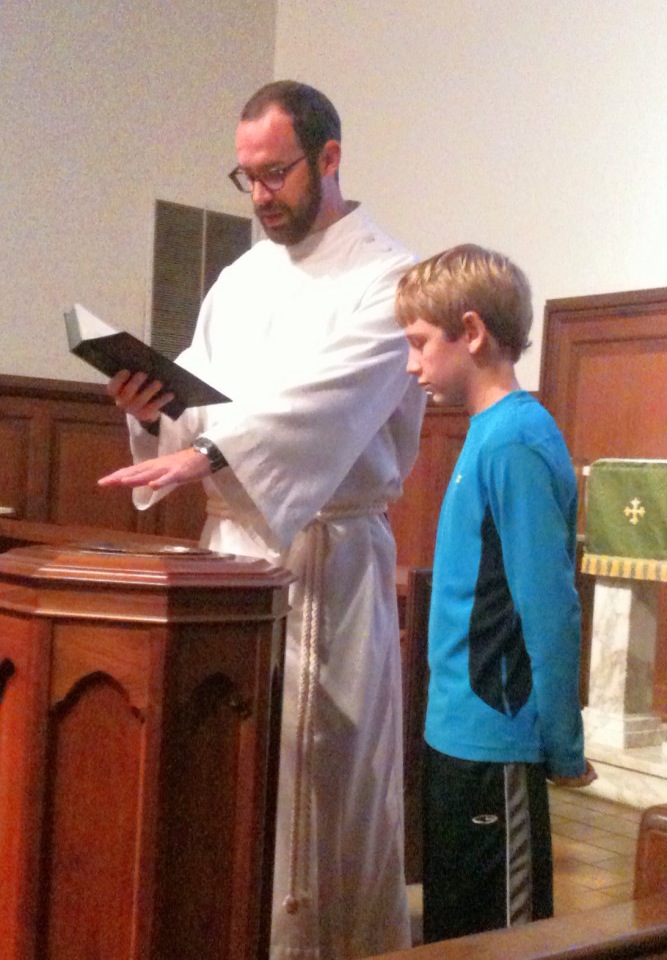
1373497_10151926400772840_183143865_n

I stood there for perhaps just a moment frozen in my own words. As I looked down at his blonde head I realized that just as John baptized his cousin, here I was, blessed to be doing the same thing to my cousin.

God confronted me in that moment. In a solitary blink of time I was flooded with the knowledge that the Jordan River where Jesus was baptized is the same river where Naaman was cleansed of his leprosy. That I was standing before almighty God baptizing my cousin in the same way that John baptized his. It was not grand: the sky did not open up with the Sun beating down on us, no trumpets were heard blaring from heaven, and the wind did not blow through the building. But it was perfect, because in that moment God met us in the ordinary: through the simple water and words of baptism.

water2

God does not meet us where we expect him to, but through the ordinary rather than the extraordinary. God meets us in the proclamation of his Word, in the remembrance of a man named Naaman who walked down to the Jordan River, and through a young man’s baptism on a rainy Saturday morning.

What is God calling you to? Where has God been trying to meet you?

Prepare to be surprised.

Amen.

(preached at St. John’s UMC on 10/13/13)

Dear Archer and Abram… – Sermon on Jeremiah 29.1, 4-14

(Preached at St. John’s UMC on 9/29/13)

Jeremiah 29.1, 4-14

“These are the words of the letter that the prophet Jeremiah sent from Jerusalem to the remaining elders among the exiles, and to the priests, the prophets, and all the people, whom Nebuchadnezzar had taken into exile from Jerusalem to Babylon.

It said: Thus says the Lord of hosts, the God of Israel, to all the exiles whom I have sent into exile from Jerusalem to Babylon: Build houses and live in them; plants gardens and eat what they produce. Take wives and have sons and daughters; take wives for your sons, and give your daughters in marriage, that they may bear sons and daughters; multiply there, and do not decrease. But seek the welfare of the city where I have sent you into exile, and pray to the Lord on its behalf, for in its welfare you will find your welfare. For thus says the Lord of hosts, the God of Israel: Do not let the prophets and the diviners who are among you deceive you, and do not listen to the dreams that they dream, for it is a lie that they are prophesying in my name; I did not send them, says the Lord. For thus says the Lord: Only when Babylon’s seventy years are completed will I visit you, and I will fulfill to you my promise and bring you back to this place. For surely I know the plans I have for you, says the Lord, plans for your welfare and not for harm, to give you a future with hope. Then when you call upon me and come and pray to me, I will hear you. When you search for me, you will find me; if you seek me with all your heart, I will let you find me, says the Lord, and I will restore your fortunes and gather you from all the nations and all the places where I have driven you, says the Lord, and I will bring you back to the place from which I sent you in exile.”

photo (4)

The year was 594 BC, and everything was falling apart.

The prophet Jeremiah had seen it all. Coming from a village from the small tribe of Benjamin, he had been called by God and given the unenviable task of being appointed over nations and kingdoms, to pluck and pull down, to destroy and overthrow, to build and to plant (Jer. 1.10).

Babylon was growing stronger and stronger, while Judah was growing weak from internal turmoil. By the time the year 594 had come around, most of the Israelites had been exiled to Babylon, removed from their precious promised land.

In the midst of particular unrest in Jerusalem, Jeremiah learned of similar frustrations among the exiles in the foreign land. More specifically, Jeremiah learned that false prophets were claiming that the exiles would soon be going home had provoked the unrest. However, God’s plan for the exiled Israelites would have to take place on God’s time.

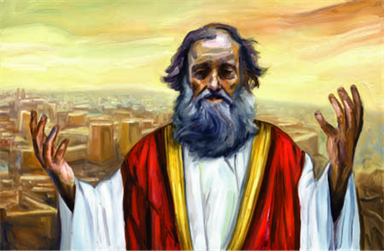
prophet-jeremiah

In the year 594, with unrest brewing in Babylon, Jeremiah sent a letter to the exiles against their false hope for an early return.

For our sermon today I have decided to try something different. In many ways, the letter Jeremiah wrote to his fellow Jews living in a foreign land, speaks to the no longer dominant Christians today living in our culture.

This sermon has been prepared as a letter, using Jeremiah’s epistle as a template, written for both Archer and Abram Pattie, the two young boys who will be baptized later in the service. I hope however, that you will notice that this letter is not just for them, but also for all of us…

Dear Archer and Abram,

Build houses and live in them; plant gardens and eat what they produce… But seek the welfare of the city where I have sent you into exile, and pray to the Lord on its behalf, for in its welfare you will find your welfare.

Today is the day that you are welcomed into God’s church through baptism. All of us have gathered together to witness this incredible event, prayerfully waiting and watching for the water to be poured over your heads. We are all here because we love you, because we are committing ourselves to you, and because we have been down your path before.

But, it won’t be easy.

The world today is an entirely differently place than it used to be. 50 years ago, this church was packed with people filling up nearly every single pew. Most of the restaurants, businesses, movie theaters, were all closed on Sunday because it was expected that we maintained Sabbath and reverence for holy worship. When you went out in public you could expect to see families together in prayer, the bible and its wonderful scriptures were a part of daily living often being read from the dining room table, and churches were growing and growing.

Today, you two are being baptized into a church that no longer fits that mold. Instead of the glory days of Jerusalem, you are entering into a time where the church feels like it is in Babylonian captivity.

The church and the world have changed but that’s a good thing! You are privileged to grow up in a church that no longer has to fit the expectations of the world, but gets to instead meet the expectations of almighty God.

Grow up in this community. Dig deep roots. Make friends. Play sports. Study Hard. Take advantage of the opportunities around you. Spend time with people who do not look like you, do not talk like you, and do not act like you; learn about yourself from them. But remember one thing: God’s kingdom is not of this world. You are being welcomed into a new family that is defined by its love of God and neighbor and therefore you are part of something so much bigger and so much greater than yourselves. Rejoice in what you have here, and hold fast to the love of God that will shower down on you every single day.

Do no let prophets and the diviners who are among you deceive you, and do not listen to the dreams that they dream, for it is a lie that they are prophesying in my name; I did not send them.

Archer and Abram, growing up will be tough. There are going to be people, and corporations, and television shows, and politicians, and advertisements, and all sorts of other false prophets that will try to tell you about the world. Every time you turn around you will be force-fed new information about how you are supposed to see, feel, believe, and understand everything. You will be told about the importance of maintaining your individuality and allegiances to the powers around you: Truly I tell you Caesar can come in all shapes and sizes.

They will try to fill holes and spots and negativity in your lives with all sorts of garbage.

False prophets will always tell you exactly what you want to hear: If you take this weight loss pill you will have the body of your dreams, if you drive this car your neighbors will respect and admire you, if you invest enough money in our company you will never have to worry about finances again…

The only one who can ever make you whole, the only one who will every truly love you, no matter what, is the triune God.

False prophets and diviners will try to label you and help you create your own identity on their terms. But today they can never compare to your new identity in Jesus Christ. Today you are being baptized in the name of the Father, Son, and Holy Spirit. Today you are becoming God’s children and nothing, nothing, can ever compare to that. We, the church, are here to help nurture you in your discipleship, we will take vows of love and commitment to help mold you in the faith, so that you will always remember that nothing, nothing, will ever separate you from the love of God in Jesus Christ.

For surely I know the plans I have for you, says the Lord, plans for your welfare and not for harm, to give you a future with hope.

Archer and Abram, God has a plan for both of you. From the very beginning it was God who breathed the breath of life into both of you, you were each uniquely created in the image of God. Many have claimed over the centuries that being made in the image of God means we have rational thought, or an imagination, but today I am telling you that being made in the image of God means that you were both created to be in community.

God’s plans for you include growing up in a place like this, feeling the love of God through your brothers, sisters, mothers, and fathers in Christ. God wants us to be here for you, and you to be here for us.

Things will get tough in your lives. There will be moments when it feels like God does not have a plan for you, that all you see and feel and hear is anything but your welfare. But God will always be there. This church will always be there. Because of our baptismal commitments to you we will always wait with open arms ready to help you, nurture you, believe in you, and support you in everything you go through.

Many years after Jeremiah sent his letter, after Israel had fallen captive to foreign nations, after Rome had laid siege to great Jerusalem, there was little hope. But one remarkable night, God came and dwelt among us in the flesh and became hope incarnate. God walked through the streets in Jesus Christ teaching about the kingdom, healing the sick, feeding the hungry, and bringing people into fellowship with one another. When our love failed, when we crucified Jesus on the cross, God’s love remained steadfast and the hope that we have always waited for became real and tangible in the resurrection.

In the beginning of our faith, when Christianity was still a budding movement there was pain and fear and frustration. Many people died for the faith that is now being passed on to you, but you will probably never be required to die for your faith. More likely, you will be given the dilemma, or opportunity, to summon up the courage to react against an injustice at the grocery store, or speak up for the voiceless in an argument, or love someone who is so unlovable. It will not be large and it will not be grand, but it will be good enough. Remember who you are, and whose you are.

20130929_114851        20130929_114826

God has a plan for you, a plan for your welfare, to give you a future with hope. There is something greater than this world; there is something more powerful than we can imagine, something brighter than the sun, and lovelier than the moon. It is your future, your future with hope because God loved you enough to die on the cross.

Then when you call upon me and come and pray to me, I will hear you. When you search for me, you will find me; if you seek me with all your heart, I will let you find me.

Archer and Abram, God is the one who lets us come to him with our requests and he hears and answers them. God’s gracious will to hear us, to know us, and to love us in prayer is the basis of the covenant that will take place in the waters of your baptism. God’s love is so superior, so majestic, and so clear that it makes our prayers immediately necessary.

God is ready for us to call on him. By living into a new reality, one that is shaped by prayer and scripture, by seeking God with our whole hearts, by practicing justice and loving-kindness we will find God with you.

We do not keep God locked up in this church, you do not have to be sitting in the pews or singing in the choir loft to find God. All you have to do is call upon him. When you search for God, you will find him. You will find God in the wonderment of creation, in the perfectly pitched harmonic notes of a song, in the warmth of the fire in the winter, in the hug of your mother when you make it home, in all sorts of places because God is always there.

Today you are being wrapped up into God’s great cosmic story. When you open the Bible you will now discover that it is not just some story about some people from the past but it is the very story of your lives. We are all here to rejoice with you today.

Sincerely,

Rev. Taylor Mertins


Nearly 2,500 years ago Jeremiah wrote a letter of truth to his friends in exile. He warned that things would not turn around immediately, that they would have to persevere through tough times before God would bring them home. This letter continues to live on for all of us today. The false diviners will continue try to make sense of the world for us, we will continue to feel like a strange people in a strange land, but God has plans for us.

God wants us to love each other in the same way that he first loved us. God wants us to wrap Archer and Abram up in love to teach them the stories of scriptures and how to be in communion with the divine. And above all, God wants us to know that no matter what we are loved.

Amen.

photo (5)

Dietrich Bonhoeffer On Canonical Reading

As a devotional practice I have been reading through Dietrich Bonhoeffer’s Letters & Papers From Prison. It has been my experience that preachers today, and for some time, have tended to preach almost entirely from the New Testament leaving the Old Testament to collect dust. In a letter to his friend Eberhard Bethge, which had to be smuggled out of the prison, Bonhoeffer speaks toward a more canonical reading of scripture [both Old and New Testaments]:

dietrich-bonhoeffer-2

To Eberhard Bethge (Advent 2) December 5th 1943 from Tegel

My thoughts and feelings seem to be getting more and more like those of the Old Testament, and in recent months I have been reading the Old Testament much more than the New.

It is only when one knows the unutterability of the name of God that one can utter the name of Jesus Christ;

it is only when on loves life and the earth so much that without them everything seems to be over that one may believe in the resurrection and a new world;

it is only when one submits to God’s law that one may speak of grace;

and it is only when God’s wrath and vengeance are hanging as grim realities over the heads of one’s enemies that something of what it means to love and forgive them can touch our hearts.

In my opinion it is not Christian to want to take out thoughts and feelings too quickly and too directly from the New Testament.


Bonhoeffer, Dietrich. Letters & Papers From Prison (New York: Macmillan Publishing, 1972), 156-157.

The Power of Words – Sermon on Jeremiah 1.4-10

Jeremiah 1.4-10

“Now the word of the Lord came to me saying, “Before I formed you in the womb I knew you, and before you were born I consecrated you; I appointed you a prophet to the nations.” Then I said, “Ah, Lord God! Truly I do not know how to speak, for I am only a boy.” But the Lord said to me, “Do not say, ‘I am only a boy’; for you shall go to all to whom I send you, and you shall speak whatever I command you. Do not be afraid of them, for I am with you to deliver you, says the Lord.” Then the Lord put out his hand and touched my mouth; and the Lord said to me, “Now I have put my words in your mouth. See, today I appoint you over nations and over kingdoms, to pluck up and to pull down, to destroy and to overthrow, to build and to plant.”

prophet-jeremiah

The Power of Words 

Words are powerful. The perfectly timed phrase or expression can carry more meaning and accomplish more than just about anything else. From the pulpit they carry even greater value because they are so connected with the Word of the Lord. At their best words can be used in a fruitful way, demonstrating the kind of building-up that the bible often refers to, in order than we can affirm one another in love. At their worst, words can be used in a destructive way, hurting those around us, and ignoring the truth of God’s role in the world.

On January 30th, 1933, Adolf Hitler became the democratically elected chancellor of Germany. This was the beginning of the Third Reich. Germany, the land that had produced the likes of Bach, Goethe, Durer was now being led by a man who consorted with criminals and was often seen carrying around a dog whip in public. Hitler was known for using his words in public propaganda for destructive purposes. Some of you here this morning can remember how the world shuddered when this began to take place.

Two days after Hitler was elected, a twenty-six year old theologian name Dietrich Bonhoeffer gave a radio address throughout the German nation. The speech was titled “The Younger Generation’s Altered Concept of Leadership.” Though the talk was itself highly philosophical, it constructively argued against the type of leadership that Hitler would use for the next twelve years, inevitably leading a nation and half the world into a nightmare of violence and misery.

Dietrich Bonhoeffer

Dietrich Bonhoeffer

Bonhoeffer spent a significant portion of his speech discussing the differences between a true leader, and the Fuhrer. He used his words in a calm and collected way, appreciating the power they held: A true leader must know the limitations of his/her authority. The good leader serves others and leads others to maturity. He puts them above himself, as a good parent does with a child, wishing to lead that child to someday be a worthy parent. Another word for this type of leadership is discipleship. “Only when we see that leadership is a penultimate authority in the face of an ultimate, indescribable authority, in the face of the authority of God, has the real situation been reached. The individual is responsible before God.”

Before Bonhoeffer could finish, the speech was cut off. Only two days after Hitler’s election, the Nazis were suppressing this young man who spoke out against the type of leadership that would come to define Germany over the coming decade.

What we find in the first chapter of Jeremiah is an encounter between the human and the divine. We discover how powerful words can be through God’s call. As the divine Word, God is a genuine and invisible otherness when compared to Jeremiah. During this particular encounter the word of the Lord came to Jeremiah and the prophet meets in faith the God who meets him through the Word.

“Jeremiah! Before I formed you in your mother’s womb, I knew you, and before you were born I consecrated you; I appointed you a prophet to the nations.” Then Jeremiah said, “Ah, Lord God! You cannot expect me to speak! I am only a boy.” But the Lord responded, “Do not say ‘I am only a boy’; for you shall go to all whom I send you, and you shall speak whatever I command you. Do not be afraid of them, for I am with you to deliver you.”

In his Word, God does not deliver a course of lectures on dogmatic theology, He does not submit the content of a creed of a confession of faith, and he does not even produce a perfectly prepared three-point sermon. Instead He makes himself accessible to us. An exchange takes place here in scripture that is beyond any analogy in the sphere of rational thinking. Instead, we have here a simple encounter, just like one between any two people, where God makes Himself available and known through relationship.

Jeremiah’s experience guides him into boundary, toward his own finitude, being reminded of his humanity, as over and against God. Jeremiah’s encounter is a reminder for us that we are not God. God is wholly other when compared with his creation. When Jeremiah meets God, his personality sinks away into the background; he feels his words being replaced by the Word of God. When we truly encounter the depth and beauty of the triune God, everything about us begins to sink away as well.

It is no wonder therefore why Jeremiah evades the commission of God. “Surely you can’t use me God, for I am only a boy.” Jeremiah protests because he is overwhelmed and intimidated by the call to set aside priests, princes, and people to become a prophet to the nations. He was afraid to proclaim the Word of God, which would go beyond the comprehension of his time.

This isn’t in scripture, but I can imagine God’s full response to Jeremiah’s evasion: “have you not seen and have you not heard what I have done with mere people? Have you forgotten the stories of Abraham, Isaac, and Jacob? What about Moses and Joshua? David was but a boy when I had him defeat the Philistines. Solomon became the wisest king to rule the nation All of the prophets, the judges, the priests? This isn’t about you Jeremiah, this is about what I am going to do through you.”

Recoiling from a divine appointment is common throughout scripture. It only takes a moment to remember Moses standing in the heat of the burning bush and then turning his face away because he was afraid to look at God.

The theologian Paul Tillich once said: “we always desire to escape God… People of all kinds, prophets and reformers, saints and atheists, believers and unbelievers, have the same experience.” It is safe to say that a person who has never tried to flee God has never experienced the truth of who God is.

God dismisses Jeremiah’s excuse; Young or old, learned or uninformed, handsome or ugly, none of things matter to God because they all pertain to our own self-centeredness: my powers, my status, my desire to have reality on my terms. Because of the power in God’s Word Jeremiah does not react in silence, nor does he step aside to let someone else take his place, instead he steps into the situation, which has in a way stepped into him. He responds to the encounter of God, feels the Word of the Lord placed on his lips, and is prepared to do God’s work.

From this point forward Jeremiah will not go forth on his own terms; God will send him, and he will move according to God’s will. It is because of God working in and through Jeremiah that he will be able to speak and act in the specific situations as they arise. The encounter has changed Jeremiah so that he will be able to narrate God’s plucking up and planting again. Jeremiah will speak the truth of the Word of God regardless of whether or not they are agreeable to his youth, ambitions, moods, or self-examination.

            It is only when it is made plainly clear to Jeremiah that the point at issue has nothing to do with his own abilities or the extent of his talents that the truth of God’s reign is made abundant and it becomes possible for Jeremiah to become a messenger.

            Like Jeremiah, the young German theologian Dietrich Bonhoeffer felt the call of God to proclaim the Word. Things became very difficult for Bonhoeffer after he made that first radio address. As the German nation descended into Fuhrer worship with the German church emphasizing politics more than theology, he struggled with how to be authentic to the Word of God as a pastor and a theologian. He trained young pastors through an underground seminary at Finkenwalde and preached about remaining faithful and obedient to God before anything else. As it became harder and harder for him to proclaim the good news in Germany, Bonhoeffer learned that war imminent and was frightened about being conscripted into the army.

dBonhoeffer

Bonhoeffer was a committed pacifist and was adamantly opposed to the Nazi regime, therefore he would never swear an oath to Hitler nor fight in his army. However, to refuse this would be a capital offense. It was at this time that Bonhoeffer accepted a position at Union Theological Seminary in New York. While in the United States Bonhoeffer had somewhat of a Jeremiah experience, because even though he had the freedom to run away from his calling in Germany, Bonhoeffer realized that his responsibility was to God with the German people. Just as God would pluck up and replant the Israelites in Jeremiah’s time, Bonhoeffer knew that the German nation would have to be destroyed in order for it to be fruitful once again. And so Bonhoeffer returned to Germany on the last scheduled steamer to cross the Atlantic before the war.

Upon arriving back in Germany, Bonhoeffer’s desire to speak powerful words against the Third Reich resulted in him being forbidden to speak publically starting in 1940 and he had to regularly report his activities to the police. Within a year he was forbidden to print or publish. And on April 5th, 1943, ten years after making his radio address, Bonhoeffer was arrested by the Gestapo for his continual Anti-Nazi remarks and involvement with the Abwehr’s plot to undermine Hitler’s regime.

            He remained in prison for two years, able to write letters and theology that were smuggled out by sympathetic guards.

0800697030h


Though he remained hopeful for the end of the war and his eventual release, he was condemned to death in April of 1945. He was killed by hanging just two weeks before the United States liberated the camp where he was being held. Before his execution, Bonhoeffer was led away as he was concluding his final Sunday service and said to one of his fellow prisoners: “This is the end – for me the beginning of life.”[1]

            I fear that whenever we hear stories of people like Jeremiah or Bonhoeffer we regard them as a special kind of people, set apart for the work God ordained for them. And to be quite honest, it is very unlikely that anyone of us in this room will ever be imprisoned, or suffer, for our Christian identity. But we are all called to be Jeremiahs and Bonhoeffers in our commitment to following Jesus Christ. Just like those two prophets God has formed us, consecrated us, and placed the Word on our lips.

            There is a power in words that we regularly underestimate. The way that we often talk about other behind their backs carries with it a great destructive energy. When we ignore the truth of our interconnected as the body of Christ in this place by speaking poorly of one another does a disservice to the God who formed you from the womb. Our words are powerful, use them wisely.

            So too, there is a power in the words that we use to affirm and address one another in love; By caring for and reaching out to those around us we continue to live out the kind of fruitful lives that God has always envisioned for us. This church is called to be a place where we understand the power of our Words and use them appropriately.

            Do not be afraid of this power that God has given to you. Jeremiah and Bonhoeffer did not go in their own strength and neither do you. They did not speak on their own authority and neither do you. God is our strength and our authority. “I am with you to deliver you, says the Lord.” The thoughts of our selfish lives can be cast away to the side so that we can assume the proper posture as messengers of God. As Paul wrote to the Galatians “Yet not I, but Christ working in me” (Gal. 2.20).

            Throughout their lives both Jeremiah and Bonhoeffer saw the collision of powers in the world. What defined them was their ability to see God’s decisive acts in history, remembering that God is the true authority over all things in spite of the powers that dominated their cultures. Jeremiah and Bonhoeffer were ordinary people. They were just like us. They were living their lives, expecting everything to be fine when God put something on their lips to say. Hearing and responding to the Word of God is a difficult thing, but God is always speaking and our response to that Word will define us as a people of faith, hope, and love.

            Do not be afraid to speak the truth, for the Lord is with you.

Amen.


[1] Bethge, Eberhard. Dietrich Bonhoeffer: A Biography (Fortress Press, 2000), 927.

Worship in God’s Church – Sermon on Isaiah 1.10-20

Isaiah 1.10-20

Hear the word of the Lord, you rulers of Sodom! Listen to the teaching of our God, you people of Gomorrah! What to me is the multitude of your sacrifices? says the Lord; I have had enough of burnt offerings of rams and the fat of fed beasts; I do not delight in the blood of bulls, or of lambs, or of goats. When you come to appear before me, who asked this from your hand? Trample my courts no more; bringing offerings is futile; incense is an abomination to me. New moon and Sabbath calling of convocation – I cannot endure solemn assemblies with iniquity. Your new moons and your appointed festivals my soul hates; they have become a burden to me, I am weary of bearing them. When you stretch out your hands, I will hide my eyes from you; even though you make many prayers, I will not listen; your hands are full of blood. Wash yourselves make yourselves clean; remove the evil of your doings from before my eyes; cease to do evil, learn to do good; seek justice, rescue the oppressed, defend the orphan, plead for the widow. Come now, let us argue it out, says the Lord: though your sins are like scarlet, they shall be like snow; though they are red like crimson, they shall become like wool. If you are willing and obedient, you shall eat the good of the land; but if you refuse and rebel, you shall be devoured by the sword; for the mouth of the Lord has spoken.

isaiah-1

When I was in college I tried to attend as many different worship experiences as I could. At times I gathered with high church Presbyterians, Free Church Pentecostals, non-denominational evangelicals, and southern Baptists. After having already begun to wrestle with a call to ministry, and knowing that I was a Methodist through and through, I thought it would be helpful to experience many forms of Christian liturgical worship, and discover the individual strengths and weaknesses.

There was one campus Christian organization that met every a week in one of the lecture halls at JMU in order to have their worship service. Now this group was one of the most talked about throughout the university and people always raved about the spirit, vigor, and excitement of the services. A few of my friends from the Religion department regularly attended, so one week I decided to give it a shot.

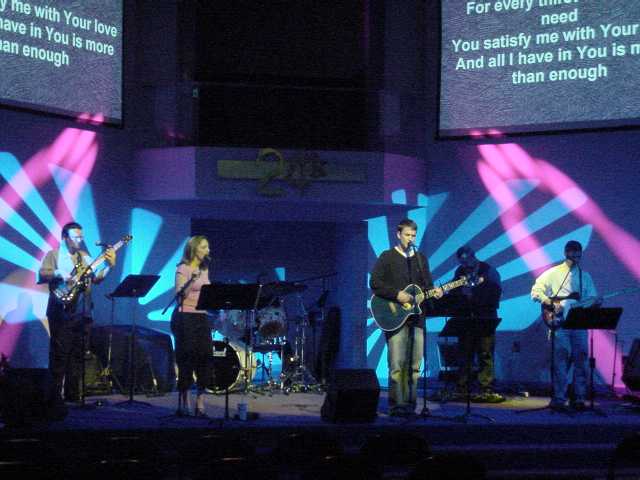
Let me tell you: those people knew how to worship. If you can imagine a full band: drum kit, 3 guitarists, bass, keyboard, and multiple singers. They had stage lighting set up that would change dramatically during the songs, and even during the sermon. They had giant projectors that displayed lyrics, prayers, and even sermonic notes. When the band was playing, everyone had their hands in the air praising. When the preacher was praying, everyone had their heads bowed in submission. It was an experience. The energy in the room was so palpable that I felt on fire for Jesus when I left.

CrossTalk_PCBC_050403

About a week later, after spending way too many hours in the library, I found myself walking back across the quad late at night toward my locked up bicycle. Across the perfectly mowed grass I saw a young man stumbling and trying desperately to maintain his balance. As our paths inevitably drove us closer and closer I recognized him from the worship service I had been in the week before, this young inebriated college student was the bass player for the worship band. It was obvious that he needed help, and remembering that I was a Christian and thinking that this would be a Christian thing to do, I offered him my arm and began to walk him back to his dorm.

“I loved your service the other night,” I said, “The music was particularly moving.” He met my statements with a suspicious eyebrow, so I awkwardly continued “It was really powerful for me.” “Look man,” he slurred, “I don’t believe in God. I just play in the band because they pay me to.”

Worship is important. As Christians we have gathered together for the last 20 centuries first in synagogues, then basements and homes, eventually we started to build churches, and then cathedrals. Worship is at the heart of what it means to be Christian because we participate in the kind of life that Jesus led with his disciples in the 1st century. You might not realize it, but the basic pattern of our worship service has its roots in the ancient practices of the Israelites, and have been handed down to Christians ever since.

First we gather together: we are brought into this place as a community, the body of Christ. We assemble together from the outside world preparing ourselves to be launched into the realm and praise of God almighty.

Second we proclaim the Word of God. We read from the scriptures of the Old and New Testaments. We remember the mighty acts of God in the world as recorded in the Bible and then a sermon is given in order to let the Word become incarnate in our hearing and living.

Third we respond to the proclaimed Word. After hearing about and remembering God’s actions in our lives and the lives of others we return to God with our own participation. Sometimes this response takes place in the form of Communion where we recommit ourselves and are welcomed to God’s table. Other weeks we respond with affirmations of our beliefs such as the Apostles’ Creed.

Finally, we conclude by being sent forth. We re-enter the world bringing with us the light of Christ. As a gathered community we recommit ourselves to life outside of the church being the body of Christ for the world.

Here’s the frightening part: All of that is meaningless unless our lives are transformed.

One of the things that we definitively learn from scripture, particularly the Old Testament is this: the children of God, the objects of divine grace, are not in any way worthy of it. Time and time again in the scriptures we learn about the people of Israel who, by way of their faithlessness, were transgressors of the commandments given to them by almighty God. Just think of some of the so-called “heroes” of the Old Testament: Noah – saved his family and all the animals in his ark and then got drunk and cursed one of his sons for all eternity. Abraham – entered into the holy covenant with God and then pretended to be his wife’s brother and nearly murdered his son. David– delivered the Israelites from the Philistines by killing Goliath, and then stole Bathsheba from her husband and tried to have him murdered. I could go on and on.

The normal sermonic response to these stories of failure and sin is that the children of God are corrupted children. However, in time, God came to dwell among his people and came in the form of a baby named Jesus, the one Israelite who took the place of the disobedient children, the faithless people, and their faithless priests and kings. The Word made flesh. It is only in the light of who Jesus is and was that we see how far humanity had fallen from the grace of God.  What we miss though is the fact that this type of behavior, this faithlessness, does not only apply to the Israelites and the people of Isaiah’s critique, but in fact acts as a mirror for all of us.[1]

Its very easy to read this passage from Isaiah and assume that the Israelites were the one’s who got it wrong, but us enlightened folk in the 21st century, we United Methodists, we’ve got our worship lives together, we are appropriately liturgical. But the Word of God has a most perturbing way of disregarding dates and making truth contemporary.

Isaiah begins, “Hear the word of the Lord, you rulers of Sodom! Listen to the teaching of our God, you people of Gomorrah!” He continues by pointing out all of the failures of their worship: “What to me is the multitude of your sacrifices? I have had enough burnt offerings!” It’s as if God were looking at us today and saying: “I don’t care about your opening Hymn, I have heard enough of the scriptures read aloud.” All these elements of worship, the types of things we take for granted every week are relatively meaningless to God unless what we do in this place translates into the way we live our lives.

“Wash yourselves, make yourselves clean, remove the evil of your doings from before my eyes; cease to do evil, learn to do good, seek justice, rescue the oppressed, defend the orphan, plead for the widow.” These are the things that are important to God. The Hebrew prophets Isaiah, Amos, Micah, Hosea, and Jeremiah each denounce worship practices that have no influence on the way we handle our lives. The prophets try again and again to demonstrate that God is far more concerned with the relationships between people than with the details of public worship.

“Wash yourselves, make yourselves clean.” It is precisely at this moment that the voice of God, through the prophet Isaiah reaches us across the centuries and bids us to look into our own hearts before we come to God. Sometimes we don’t like to admit it, but there is a relationship between corporate worship and individual character. What we believe shapes how we behave.

When I ran into the young man on campus, the bass player for the worship service, I got a glimpse into what Isaiah is getting at in this passage. You can have the “perfect” worship service, we could get the lights going with the projectors and the band and the PowerPoint and the over the ear microphones. We could get people to wave their hands in the air and sing at the top of their lungs. But, worship ceases to be true worship unless our lives are changed when we re-enter the world. Worship becomes just a routine for us if we treat it like that bass player did: just a gig.

We here, good Christian United Methodists, we might not be guilty of the same hypocrisy in our worship, but we need to face the truth that to raise no voice against the evils and injustices of the world, to remain silent in the shadow of corruption and sin, is to leave a fatal gap between the type of Worship we offer to a righteous God, and the attitudes we have toward the wrongs of the world. Throughout history there has been a deep inconsistency between the faith we proclaim on Sunday mornings in the fatherhood, justice, and holiness of God and the type of ethics and moral decisions to which we consent in our lives and particularly in our dealings with other people.

book_of_isaiah

We should ask ourselves: Is our worship changing the way we live our lives? Are we heeding the call to love the oppressed? Are we content to remain almost Christians, or are we fully embodying what it means to be disciples of Jesus Christ? Why do we gather together once a week?

All of this, gathering, proclaiming, responding, being sent forth, remains empty until we are transformed. They will continue to act only as a routine for us unless we enter the strange new world of the Bible and realize that our world has been turned upside down. We gather weekly to turn ourselves back toward God so that we can live lives that follow the teachings and practices of God in Jesus Christ. What we do in this place can function to help transform our lives if we continue to learn the grammar of discipleship and speak that new language when we go back into the world.

The only true worship worthy of God, the worship that God seeks from his people, is the time and space that reveals God’s character through justice, righteousness, unselfishness, and purity. What we are must ratify what we say. Or as one of my professors used to say: We can only live in a world we can see, and we can only see in a world we have been taught to speak. When we learn the stories of scripture, let the tunes and words of the hymns resonate deeply in our lives, we can then learn to be a new people for the world.

It is the responsibility of this church to make the love of God known and to comfort all people with the Good News of our Lord Jesus Christ. This cannot be done through worship alone, through singing hymns alone, through preaching alone, or by any other institutional method we can come up with, but only through living lives which reflect God’s loving spirit. When you walk out of church this morning I encourage you to remember that God has already transformed you through the life and death of Jesus Christ. As you interact with others remember that we have been called to love the oppressed, and seek justice in the world. I challenge you to do something this week that is truly worthy of God’s worship.

Worship in God’s church takes place right here in this space, but the results of our worship should be manifest in the way we live our lives here and in the world. Amen.


[1] Barth, Karl. Church Dogmatics V.1. (Peabody, Mass.: Hendrickson Publishing, 2004), 523.