Confronting Conflict – Sermon on Isaiah 6.1-8

Isaiah 6.1-8

In the year that King Uzziah died, I saw the Lord sitting on a throne, high and lofty; and the hem of his robe filled the temple. Seraphs were in attendance above him; each had six wings: with two they covered their faces, and with two they covered their feet, and with two they flew. And one called to another and said: “Holy, holy, holy is the Lord of hosts; the whole earth is full of his glory.” The pivots on the thresholds shook at the voices of those who called, and the house filled with smoke. And I said: “Woe is me! I am lost, for I am a man of unclean lips, and I live among a people of unclean lips; yet my eyes have seen the King, the Lord of hosts!” Then one of the seraphs flew to me, holding a live coal that had been taken from the altar with a pair of tongs. Then seraph touched my mouth with it and said: “Now that this has touched your lips, your guilt has departed and your sin is blotted out.” Then I heard the voice of the Lord saying, “Whom shall I send, and who will go for us?” And I said, “Here am I; send me!”

6292687510_a9b81d37f4_z

Tell me about your last fight.” So began one of my recent premarital counseling sessions. The couple danced around the question for a few moments, claiming they couldn’t remember the last time they had a fight, but when I started to ask more specific questions the answers started pouring out. Their conflict could be boiled down to a lack of communication, and when I sat there with them I saw them begin to share things with one another for the very first time. Before we went on, I couldn’t help myself from asking, “Why haven’t you talked about this stuff before?”

The woman sat in my office with her head hung low. It took her a few minutes to muster the courage to begin telling her story, and when she started it came out like the floodgates were opening. She felt invisible to her husband, no matter what she did, he would brush it off and continue to focus on the task before him. She was afraid that she had done something wrong and didn’t know where else to turn so she came to me. We talked together about her situation, but I couldn’t help myself from wondering, “Why hasn’t she told her husband how he makes her feel?

We were sitting on the edge of a property in West Virginia after nearly a week on our mission trip. The young boy was from a different church, but I could tell something had sent him over the edge. His tears fell slowly and deliberately as he confided in me about his struggles. He could not longer stand being treated like an infant or a child. He had important ideas and things to share but everyone brushed him aside instead of treating him with worth. Rather than being supported in his discipled journey, he felt like he was all alone and he was worried. I listened, but I also knew that when the end of the trip arrived he would be going home to a different community and a different church so I asked, “Is there someone from home that you can share all of this with?” And he said, “I don’t know, I’m afraid.

In each of your bulletins you will find a piece of paper about the size of an index card and I would like you to hold it in your hand. We’re going to have some time for silence, and during that time I want everyone to write down the name of one person that you are currently in conflict with.

Maybe your mother-in-law has been driving you crazy with her relentless need to tell you how to raise your family. Perhaps your boss continues to heed your advice, but then takes all the credit when things go right. Maybe your son has made some poor choices and you can’t remember the last time you had a decent conversation about anything. Perhaps one of your best friends is letting their backwards political opinions isolate them from what it means to be a decent human being. Maybe your pastor has been preaching all sorts of sermons that you definitely do not agree with.

So take a moment, and write down a name. No one will see it but you. When you’ve finished, I want you to hold the card in your hand for the rest of the sermon.

In the year King Uzziah died, Isaiah saw the Lord sitting on a throne. God encountered the soon-to-be prophet in the midst of something important. Uzziah was an arrogant ruler, and his arrogance led to his death. Even though his reign brought economic prosperity, he neglected to respect the temple and the worship of God. It was at this particular time, in the wake of Uzziah’s death that Isaiah was called to speak.

The call is frightening. The Lord is high and lofty with the hem of his robe filling up the entirety of the temple. Seraphs, winged creatures, were flying above the Lord, each with six wings. One of them called out to another and declared, “Holy, holy, holy, is the Lord of hosts; the whole earth is full of his glory!

Everything around Isaiah began to shake and tremble and the room filled with smoke. Only then does Isaiah muster up the courage to say anything at all, “Woe is me! I am lost, for I am a man of unclean lips, and I live among a people of unclean lips; yet my eyes have seen the King, the Lord of hosts!

Isaiah was confronted with the utter and radical holiness of the Lord. With wind spinning, floors shaking, and voices trembling, Isaiah is struck with the realization of his own unworthiness and the unworthiness of his people. Have you ever felt unworthy when confronted by something greater than yourself?

When I saw my wife Lindsey walking down the aisle at my home church to meet me at the altar for the covenant of marriage, I felt completely unworthy. When I held Archer and Abram Pattie in my arms above the baptismal font and brought them into the fold of God’s kingdom, I felt completely unworthy. Every month when I serve communion here at the front of the church, I am met with eyes of Christians who have lived far more faithfully than I ever will, and I feel completely unworthy.

God’s majesty, whether through the beauty of creation, a call vision, or the people in our lives often leaves us feeling pretty feeble. When we discover the divine we can only feel that much more mortal. When we encounter the infinite, we are reminded of our finitude. When we meet the living God, we can’t help but wonder about the lives that he gave to us.

God’s call is frightening. God calls the young and old, men and women, to abandon their former and sinful ways to live fully in Christ. God called a young prophet to speak harsh truths to a community that had grown far too complacent. God continues to call all of his children to be prophetic with our words and our actions.

The call is frightening and scary enough. But when we respond, when we answer the call, the real trouble begins.

hereami2

Then one of the seraphs flying high above the Lord came down to Isaiah with a live coal that had been taken from the altar with a pair of tongs. The seraph touched his mouth with the burning coal and said, “Now that this has touched your lips, your guilt has departed and your sin is blotted out.” Then Isaiah heard the voice of the Lord saying, “Whom shall I send, and who will go for us?” and Isaiah said, “Here am I; send me!

Isaiah was dramatically changed through his encounter. The flaming coal not only cleansed him, but it also gave the him the power to speak on behalf of the Lord. In a matter of moments he went from crying out, “Woe is me! I am lost” to “Here am I; send me!

This whole story about Isaiah’s call is a lot like what we do in worship. We come together to praise the almighty God, we pray and confess our unworthiness, and then seek forgiveness. We pray for God to give us the grace and strength to hear the Word with faith so that we can respond accordingly.

How we worship matters because it shapes us into the disciples we are called to be. Every Sunday is like Isaiah’s call. We meet the Lord in the words from scriptures, prayers, hymns, and our brothers and sisters. Through that encounter we are called to live out our faith as soon as we depart in a way that will make God’s kingdom reign. All of these things that we do on a weekly basis, they are done to attune us to the voice of God who speaks into our lives.

Isaiah’s call, this dramatic and overpowering moment in the temple, reminds us that when we encounter the living God, there is not way to know God without being changed. Like a coal coming from the altar to our lips, we are tasked with speaking words like fire. Like a frightened prophet we are given the power to cry out “Here am I; send me!

The prophet was called to speak during a particular time, to sinners in the midst of sin. If we hear something from God’s Word today it should be a similar call. We should not be afraid to names the sins of our time, just as Isaiah did when he confronted the people’s political arrogance, spiritual pride, and economic injustice.

Abraham had to confront the Lord who promised to make his descendants more numerous than the stars. Jacob had to confront his twin brother Esau who sought to kill him for stealing his blessing. David had to confront King Saul who was jealous of the Lord’s favor. Isaiah had to confront a people who neglected to thank God for being the source of all their blessings. Jesus had to confront a religious elite who no longer practiced what they preached. Peter had to confront the gentiles and welcome them into the fold of the church. Paul had to confront his own sinfulness and call others to do the same.

Christians, for centuries, have been called by God to confront the conflict in their lives. To be faithful is to meet the outcasts where they are and show them love. To be a disciple means a willingness to forgive people when they have done something wrong. To follow Jesus means having the courage to ask for forgiveness when we have done something wrong.

What situation are you in right now that God is calling you to confront? I believe the holy Lord of hosts is personally addressing each and every one of us in the scripture today. Who do we need to call out? Where are the conflicts in our lives?

In each of our hands we have a name that represents a conflict in our life. Some of them can be confronted with a phone call or a conversation. Some of them can be confronted with our willingness to forgive a wrong that was done toward us. Some of them can be confronted with the simplest of gestures.

It might not go well. If we take the first step to confront one of our conflicts, it might blow up in our faces. But the longer we let these names stay on paper, the longer the conflict will keep us from fully living out our identities as disciples. The longer we let the conflict simmer, the longer we will be people of unclean lips living amidst unclean lips. The longer the conflicts remain, the harder it will be to hear the living God speaking into our lives.

The voice of the Lord is saying to all of us, “Whom shall we send, who will go for us to confront the conflict?” Our answer should be the same as Isaiah’s, “Here am I, send me!” Amen.
00021958_h

Devotional – Psalm 29.2

Devotional:

Psalm 29.2

Ascribe to the Lord the glory of his name; worship the Lord in holy splendor. 

Weekly Devotional Image

Every church is unique. Even if you had the same architect and the same builders and the same property size, churches are what they are because of people, and people are always different. Some churches value high liturgy and spend their Sunday services standing up, sitting down, kneeling, praying, singing, and listening. Others believe in the importance of contemporary music with big bands, projections screens, and coffee at the front door. Every church is unique.

Before I arrived at my current appointment I wondered about the uniqueness of this place. I pondered about their comfort with the hymnal, what expectations they had out of worship, and where they would be heading. Did they use the Lord’s Prayer? Did they affirm their faith with the Apostles’ Creed? etc. And I spent a good amount of time wondering how they dressed for church on Sundays.

hangars

I grew up in a church where ushers were required to wear ties on Sunday mornings. I have helped a church that expected men to wear full suits, and women to wear dresses for worship. And I have spent time at a church that if you weren’t wearing blue jeans, you were the odd one out. What people wear to church says a lot about what they expect from worship, and the kind of people they are hoping to attract.

I was therefore pleasantly surprised to discover that the people at St. John’s arrive on Sundays in a great plethora of fashion. We have suits, dresses, khakis, jeans, flip-flops, yoga pants, and everything in between. No one is judged for what they wear (so long as they are wearing something).

Yet, a few weeks ago, a child from our congregation asked why I wear my “black dress” (clergy robe) on Sunday mornings. I shared that, for me, it is important for Sundays to be different than the rest of the week. I expect to discover something I can’t normally find on my own Monday-Saturday, and when I dress differently, it allows me to act like the Christian I really am in the first place. The little boy thought about my answer for a few moments and then said, “Well then, I think I should wear my Iron Man costume next week.”

The psalmist call us to “worship the Lord in holy splendor.” Whether we wear our suits and dresses or our clergy robes and comic-book costumes, we do so in hopes that we can live into the reality of what it means to be a disciple in the world today.

This week, let us reflect on how we worship the Lord in holy splendor. Would changing our outfits for Sundays change the ways we worship? How can we better reflect what it means to follow Christ through our clothing, our words, and our actions?

Devotional – Psalm 104.33

Devotional:

Psalm 104.33

I will sing to the Lord as long as I live; I will sing praise to my God while I have being.

Weekly Devotional Image

Our service yesterday was filled with music: We began with the wonderful hymn “For the Beauty of the Earth” as we praised God for the many blessings of life. Our Preschoolers offered wonderful renditions of “This Is My Commandment” and “He’s Got The Whole World In His Hands” all with corresponding hand gestures. Our Youth Choir faithfully proclaimed the words to “You Are My All In All.” And as a congregation we all joined together for “Savior, Like a Shepherd Lead Us” and “Leaning on the Everlasting Arms.”

Out of the numerous responsibilities that come with being a pastor, selecting the hymns for Sunday morning is one of my favorite privileges. I love spending time deep in God’s Word to begin crafting a sermon, but spending time in the hymnal and choosing songs to complement the thrust of worship is incredible. I grew up learning to sing my faith out of the hymnal and I believe hymns are vitally important for us to continually learn what it means to be faithful today.

After worship, while we were celebrating our preschoolers with a reception, I had a couple come up to me to thank me for worship. We talked about how cute the children were and how wonderful it was to see them in church. We exchanged stories about what we remember from our days in Preschool (not a lot). But before I was going to thank them for their words and pick up some more food from the table they had one more thing to say: “We heard God in the songs today.”

Boston_Avenue_Methodist_Episcopal_Church,_Tulsa,_OK,_Interior,_Hymnal

Have you ever been in the middle of a hymn during worship when you started to really understand it for the first time? You might’ve known all the words to something like “Leaning on the Everlasting Arms” but one Sunday it finally clicked? Or you’ve heard children sing “He’s Got The Whole World In His Hands” but when you saw them pointing at you during the service you realized, for the first time, that God has you in his hands?

“I will sing to the Lord as long as I live; I will sing praise to my God while I have being.” Singing our faith is at the heart of what it means to be faithful because our words, and the music, help us to grasp who we are and whose we are.

This week, let us all reflect on the meaning of the hymns we sing.

What is your favorite hymn? What has it taught you about faith and discipleship?

Devotional – Psalm 1.1

Devotional:

Psalm 1.1

Happy are those who do not follow the advice of the wicked, or take the path that sinners tread, or sit in the seat of scoffers. 

Weekly Devotional Image

“Tell me something good.” This is one of my favorite ways to begin a conversation precisely because we tend to focus on the negative. As a pastor, it only takes a few minutes before people begin to open up about what is really going on in their lives and they share things that they have kept bottled up for a long time. As Christians, we are called to the ministry of presence with our fellow disciples to provide ears to hear. However, sometimes the negativity can be so overpowering that we neglect to focus on the good things in our lives.

I spent part of last week with other United Methodist pastors from the Virginia Conference. We met together in Blackstone, VA and shared reflections about our ministries and how we are continuing to respond to God’s call in our lives. For as much as people are ready to vent with their pastors about negativity, pastors are far worse when venting to other pastors. After spending so much time being present for others, we tend to neglect the importance of reflection and seeking out others to help us with our baggage. Within the first moments that we gathered together the conversation quickly turned to challenges and disappointments in the ministry.

When we broke away from our sessions to share meals together I tried to reorient the conversation toward the good, but my efforts were largely fruitless. It was as if we were trying to make the most out of our time together before heading back to our churches and we just kept dumping all of our worries and anxieties on one another. But then something amazing happened…

We were sitting in a circle when our leader told us to break off into small groups and share the names of people for whom we knew we had been fruitful. We were told to focus on the good and the positive as we shared our stories. Then when we regathered as a group we went around the circle praying for the names we had raised, gave thanks to God for putting them in our lives, and then we thanked God for putting us in their lives.

256407_CA

Why is it so hard to focus on the good? Psalm 1 affirms that happiness can be found in  those who do not follow the advice of the wicked, or follow the path that sinners tread, or sit in the seat of scoffers, but we forget how important it is to celebrate the goodness of God in our lives. Instead we listen to the wicked, follow the sinners, and scoff from our chairs. How much happier could we be if we followed the advice of Psalm 1.1?

This week, let us strive to focus on the good in our lives. Instead of dwelling in the negative, let us give thanks to God for the people we have shaped and the people who have shaped us.

The Methodists – Sermon on Psalm 22.25-31

Psalm 22.25-31

From you comes my praise in the great congregation; my vows I will pray before those who fear him. The poor shall eat and be satisfied; those who seek him shall praise the Lord. May your hearts live forever! All the ends of the earth shall remember and turn to the Lord; and all the families of the nations shall worship before him. For dominion belongs to the Lord, and he rules over the nations. To him, indeed, shall all who sleep in the earth bow down; before him shall bow all who go down to the dust, and I shall live for him. Posterity will serve him; future generations will be told about the Lord, and proclaim his deliverance to a people yet unborn, saying that he has done it.

3-abstract-stained-glass-textures

How can we get young people to worship?” I get asked this question all the time. Because I am young and involved the church, many assume that I have the secret to unlocking the riddle of putting younger people in pews. The truth is, I have no answer to the question. For me, it is as simple as discovering God in a place and time such as this, and therefore I return week after week because it provides the strength for my own discipleship. I don’t know what to do to get younger people to worship other than doing what we do well. 

However, some believe the key to growing the church can be found in contemporary worship. The belief goes that traditional worship styles with stained glass sanctuaries, organs, and hymnals, no longer connect with people and give life.

So, contemporary services strive for the opposite, instead of traditional church architecture they meet in auditoriums or gymnasiums, instead of stained glass they use projectors and screens, instead of an organ and hymnals they use a rock band and display lyrics on the screen. Many church planters believe this is the future of worship, that if we want the church to grow we have to be willing to let go of the past and embrace the future.

I’m not so sure.

Interestingly, many young people are finding themselves drawn to traditional worship, while contemporary services are regularly filled by the boomer generation. Why? What we discover in traditional worship is unlike anything we encounter during the week. Worship is supposed to be different than our daily lives and fill us with God’s grace. I could go on an on about the importance of listening to the organ and singing our faith from the hymnal, but I’ll save that for another sermon series. This month we will take time each week looking at the Stained Glass of our sanctuary and wrestle with how they convey the Good News to us today.

We begin with what I call “The Methodists.

IMG_0062

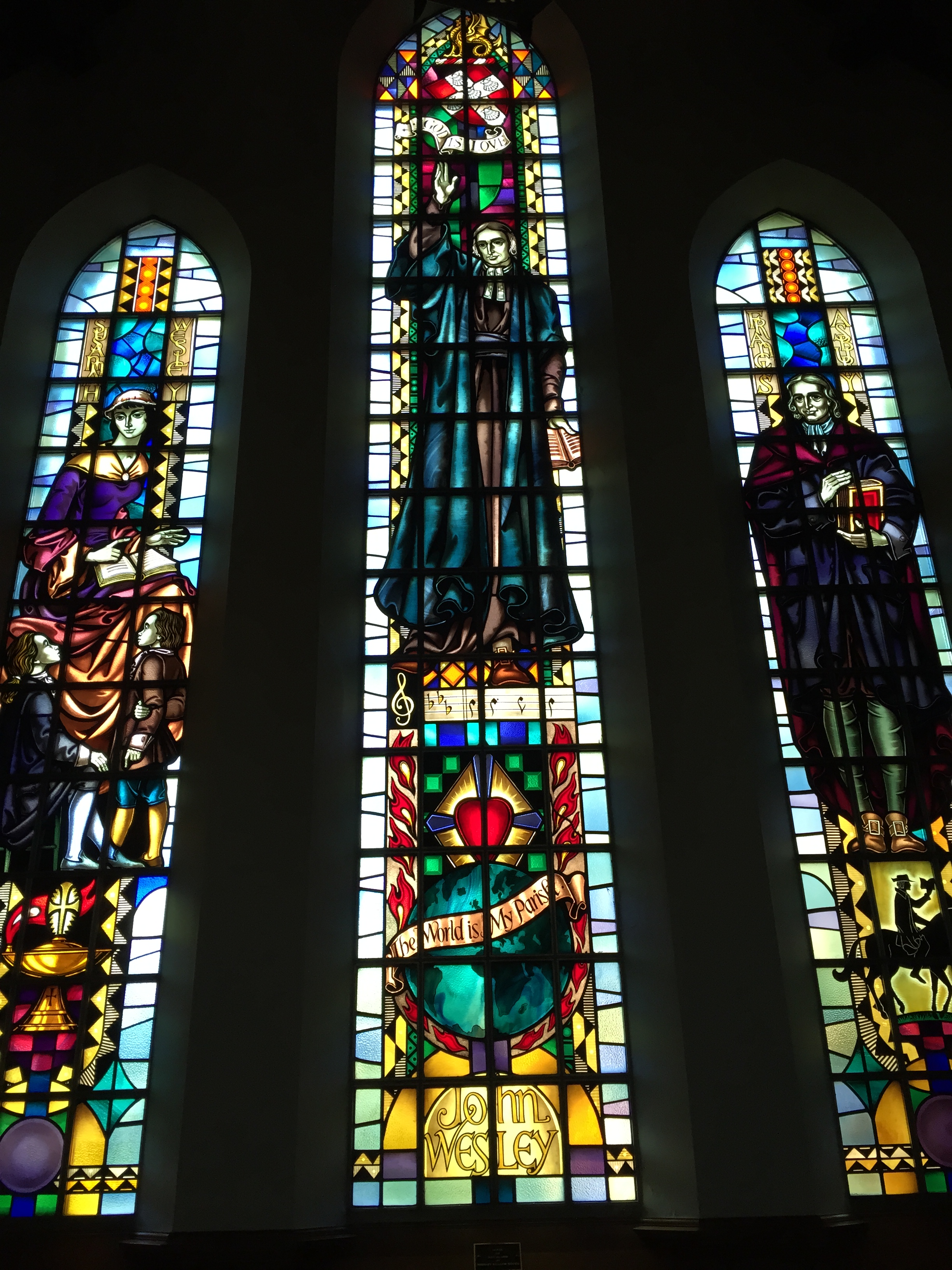
The first window contains the mother of Methodism Susanna Wesley. Born in 1669, Susanna was the twenty-fifth of twenty-five children. Her father, was a preacher of sorts who rebelled against the status quo of the Church on England and he consistently encouraged his daughter to study books from his library (against the conventional wisdom). Susanna eventually married Samuel Wesley, a clergyman from the Church of England and gave birth to 19 children, of which only 10 lived to adulthood.

Because her husband was often busy with the responsibilities of the parish, Susanna was left to raise and educate the children on her own. They all learned Latin and Greek and were well informed in classical studies.

The image in our window shows Susanna teaching two of her sons, John and Charles Wesley. She took seriously the need for her children to be raised with a proper education and also put a tremendous emphasis on raising them in the faith. I don’t know for sure why the artist chose this particular representation, but I imagine it has something to do with an episode during her life when her willingness to engage her children sent them on a path that led to a renewal within the church, and eventually a new church.

The story goes that her husband was gone in London for a period of time, and a guest preacher was brought into the local parish. After a few weeks of particularly sub-par sermons, Susanna decided to assemble her children on Sunday afternoon for her own services. It would begin with the singing of a psalm, then Susanna read a sermon written by her father or husband, and concluded the worship with another psalm. Word about the services began to spread and people started to ask if they could attend. At the height of her Sunday afternoon services, over two hundred people were attending regularly, while the Sunday morning service at the local church dwindled to nearly nothing. 

Susanna, like the psalmist, believed in the importance of remembering and returning to the Lord. She took time each week to educate her children, and the local community, about God’s dominion so that future generations would be told about the Lord.

Whenever our eyes fall upon this window we remember that we, like Susanna, are called to nurture and teach and love those around us. John and Charles Wesley would eventually grow into the men who sparked a theological revolution. Charles will always be remembered for his hymn writing (all of the hymns we are using this morning were written by him) and John would become the founder of Methodism.

This window helps us to remember that we can serve the Lord by sharing the Lord with others. Our words are powerful and they can be the spark that ignites a revolution of the heart.

The second window portrays a grown John Wesley during the height of the Methodist renewal movement. Born in 1703, he was raised and taught by his mother and followed a call to ministry within the Church of England. However, John grew disenfranchised with the way the church was being run, he saw pastors who were following a career path rather than giving their lives to Christ. He saw people fighting for positions within the church rather than submitting to the will of God. He saw hypocritical preachers rather than people seeking holiness of heart and life.

After a particular string of episodes that left him filled with doubt, John Wesley had his heart strangely warmed during a small service on Aldersgate Street in London. He wrote in his journal: “I felt my heart strangely warmed. I felt I did trust in Christ, Christ alone for salvation: And an assurance was given me, that he had taken away my sins, even mine, and saved me from the law of sin and death.” (The Journal of John Wesley, 35).

The glowing heart in our window is a reminder of his conversion experience. From that point forward he felt called to spread scriptural holiness of heart and life throughout the lands and helped to form small groups through the country to help disciples grow in love of God and one another. The moment of heart warming encouraged him to see the world as his parish. Rather than being limited to a particular time and place, John Wesley listened to the Spirit’s call and moved according to God’s will.

IMG_0065

John, like the psalmist, believed in the importance of remembering the Lord’s works even to the ends of the earth. He understood Jesus as Lord and did whatever he could to share the love he experienced in his heart with other people.

Whenever we take in the beauty of this window we remember that we, like John, are called to feel and experience God’s pardoning and loving nature. Having our hearts strangely warmed is at the heart of what it means to follow Christ and give our lives to discipleship. Yet, once we feel this assurance like Wesley did, we cannot just keep it to ourselves. If it really is something that transforms our very lives then we should be willing to go even to the ends of the earth to help others remember the Lord.

The gift of God’s love is something worth sharing with others just like John did. Our words are powerful and they can be the spark that ignites a revolution of the heart.

Our third window displays Francis Asbury, the symbol of American Methodism. John Wesley discovered Asbury while a young man in England and encouraged him to become a circuit riding lay-preacher for the renewal movement. He was remarkably successful as a preacher even at a young age.

In 1771 Wesley sent lay preachers to continue the movement in the colonies including the young and talented Francis Asbury. However, by 1777, at the height of the American Revolution, all but one, Asbury, would return back to England. For Asbury the kingdom of God was more important than any human nation, and nothing would stop him from following his call.

Asbury became the de facto leader of the movement and spent the rest of his life traveling on horse back to spread scriptural holiness. When he arrived in the colonies there were 600 people participating in Methodist ministries. By the year of his death (1816) there were more than 200,000 members (2.3% of the population) making it the single largest Christian tradition in America at the time. 

Why was he so successful? In our stained glass we see Asbury holding a bible and riding on a horse. He had a strong and fundamental belief that the Lord was calling him to reform the continent, and to spread scriptural holiness over the land. Asbury was willing to go wherever whenever with only the Word of God to guide his words and actions. He traveled so widely across the landscape that at one time he was the most well known man in America simply because of how much he traveled.

Asbury, like the psalmist, believed the people were hungry and yearning for something greater than themselves. He understood that if he was willing to bring the Word to the people, that they would feast and be satisfied. He gave his life to the mission of spreading holiness so that people would praise the Lord.

Whenever we gaze upon this particular window we remember that we, like Asbury, have a responsibility to help people feast on the Word. Going out and meeting people where they are is fundamental to the kingdom of God. If we are content to just wait for people to show up with their questions and hopes, then we will be disappointed. This window gives us the encouragement to give of ourselves for other people just like Francis Asbury was willing to do.

The gift of God’s grace and mercy is something worth sharing so that others might feast and be satisfied. Our words are powerful and they can be the spark that ignites a revolution of the heart. 

What we do in worship, how we understand discipleship, and even why we gather for communion was largely determined by the three Methodists in our stained glass. From Susanna’s Sunday afternoon lessons, to John’s heart-warming experience, to Asbury’s commitment to mission of God, we are who we are because of what they did. However, if we call ourselves Wesleyans or Methodists, it is fundamentally important to remember that we are first disciples of Jesus Christ.

These three Methodists followed Christ and their lives were results of their discipleship. It was through their reading of scripture and persistent prayers that they started a revolution within the greater church and brought the Word to people to tell them about the Lord.

When we come to gather at the Lord’s table in a few moments, let us remember that Susanna, John, and Asbury all gathered at a table such as this to feast on the Lord and receive the strength for their discipleship. Wesley in particular believed in constant communion, doing whatever he could to experience the Lord’s grace at all times. If you want to know God’s grace and love, look no further than this table.

But after we feast, what shall we do? Shall we return to the busyness of our lives and forget the importance and value of finding holiness? Will we limit the power of the Lord to Sunday mornings at 11am?

Or will we take the bread and cup and let it nourish our souls for the work of discipleship? Will we pray fervently for the Lord’s will to be done? Will we go out into the world to tell future generations about the power of God?

Now is the time for a revolution of the heart. Amen.

5484428341_c71e6c50c4_z

Reality Check – Sermon on Psalm 4

Psalm 4

Answer me when I call, O God of my right! You gave me room when I was in distress. Be gracious to me, and hear my prayer. How long, you people, shall my honor suffer shame? How long will you love vain words, and seek after lies? But know that the Lord has set apart the faithful for himself; the Lord hears when I call to him. When you are disturbed, do not sin; ponder it on your beds, and be silent. Offer right sacrifices, and put your trust in the Lord. There are many who say, “O that we might see some good! Let the light of your face shine on us, O Lord!” You have put gladness in my heart more than when their grain and wine abound. I will both lie down and sleep in peace; for you alone, O Lord, make me lie down in safety.

sleep_in_peace_lg

He was resting in the bed when I entered the room. Like many people suffering from a terminal illness, the living room had been reimagined as a bedroom with medical equipment spread throughout the space. The older man’s son stood next to me, trying not to cry while he watched his dad sleeping in the bed. The son gently nudged his father to wake up and introduced me as the young seminary intern. He then left us alone.

After his son left the room, the older man sat up from his bed with a smile that left me feeling disoriented. I could see his physical discomfort, but there was a sense of joy and peace that emanated from his whole person to anyone around. Unsure how to begin our conversation, I just sat there trying to come up with something, when he interrupted my thoughts by saying, “Taylor, this cancer has been the best thing that ever happened to me.

Rev. Willie Mac Tribble was dying of a brain tumor. He had spent the majority of his life serving as a United Methodist Pastor in the North Georgia Conference. He had pastored 10 different churches during his 40-year career, but now he was stuck in his living room talking to a young seminarian about his life and ministry. Though simple movements sent lightning bolts of pain throughout his body, and he was nearing the end of his life, he claimed that his suffering had been a blessing.

Psalm 4 is often overlooked in the life of faithfulness, but it conveys the depth of what it means to rely on the Lord and have the right perspective. Upon first inspection we might label it as an evening psalm, something to be prayed before our heads hit the pillows: I will both lie down and sleep in peace; for you alone, O Lord, make me lie down in safety. It sounds like a prayer that we hope the leaders of our community would utter up to God recognizing they have endured shame for the betterment of the people. It is selfless, hopeful, and faithful. 

Yet, this psalm is not just for a particular set of people with a specific set of problems, but it is a psalm for all of us, worthy to be prayed throughout our lives.

prayer-slide

Psalm 4 begins by addressing the Lord:

God, when I start praying, please listen and answer me. I know that you are the Lord of my life, and you are with me in all things, but I need you presence now.

In the past you provided for me when I was in need. You placed words on my tongue when I was speaking, you sent the right people into my life when I was lonely, and you provided food from the earth when I was hungry. So Lord, be gracious yet again and listen to me as I pray.

The psalmist then moves to address the people who no longer trust God:

How long will all you people fall short of you potential? Why do you continue to love words that puff up, that make you sound better than you are, that inflate your ego and self-perception? How long will you believe all the lies that surround you? Why are you so transfixed by the rumors and drama? Remember this: the Lord has set us apart to be a holy people who pursue holiness. The Lord listens when we call to him. 

When life is full of disappointment and regret, when you feel like nothing is going your way and the floor is crumbling underneath, when you experience loneliness and fear, do not sin. Instead of venting and taking out your frustrations on other people, ponder your circumstances and be silent. Give up the things that are tearing you down, and put your trust in the Lord. 

Too many people only believe and keep faith when everything is going right in their lives. They only praise the Lord when they are successful, and the minute something becomes derailed they blame the Lord first before looking at themselves. Too many prayers are based upon: “Lord, if you do this for me, I will turn my life around, or I’ll start going to church.”

We are at the peak of our faithfulness when we recognize the gladness the Lord has placed in our hearts more than when all the material things of life abounded. We do well to recognize the Lord’s blessing in all things and trust that God is with us. Because it is only with a deep trust and confidence in the Lord that we can sleep in peace, for the Lord is the one who brings us comfort in our rest.

Why are all of us here this morning? I count it as nothing short of a miracle that God continues to gather people together every week for worship. But the fact that people choose to spend their time doing something like this will always surprise me. With all the competing narratives in our world, we decided to come here to participate in an ancient practice of letting the Lord reorient our lives.

Why are we here? Perhaps the best answer to that question is this: we want to hear something true. All of us are constantly bombarded by the facts of the life, and the subsequent denial of those facts. We wake up feeling sore and then we watch a commercial about a cream that can make all of our pain go away. We struggle through relationship after relationship and then we get invited to an online dating service that promises to find us a companion for life. We wrestle with children who neglect to pay attention at home and school, and a friend tells us about the magic pill that will calm our children, and make them into who they are supposed to be.

And then we come to church and we hear the truth. We learn about our sinfulness and how we need to be better. But through the church there are no cheap fixes, there’s no pill or simple prayer that can turn everything around. Discovering our sinfulness and seeking holiness requires a lifetime of work.

Yet, here we are. I have to believe that even though the life of discipleship is remarkably difficult, we are here because we believe it is worth it. We are here because we hear the words of Psalm 4 and we know that it is speaking something new and truthful into our very lives on this very day.

Church, at its best, is the arena of reality checks. Whether we want to admit it or not, this is the time when we face the truth: The unrighteous often flourish, and the faithful are usually ridiculed and ignored. In fact, godliness tends to make suffering inevitable. Psalm 4 speaks to the deep truth of what it means to follow Christ: if we really act like the Christians we claim to be, we will be persecuted for our discipleship.

So here is the deep reality check of Psalm 4: True happiness and faithfulness is often found in the least likely of places. We imagine that the wealthy and powerful are joyful but what they have cannot make them happy and sleep in peace. It never ceases to amaze me, but I regularly discover happiness in places I would never imagine: hospitals and funerals. The people who are in the midst of pain and suffering are somehow renewing their own lives. They are the ones who are proving that they can face life’s harshness and still stand fast. There is an inner glow in the heart of a disciple who can show such faith in the midst of something so tragic.

Taylor” he said, “this cancer has been the best thing that ever happened to me. For the first time in years people have been anxious to come visit with me. For decades I served as a pastor and was surrounded by people, but since I retired I have never been so lonely in my life. Yet now, my sons and daughter, who used to just call once in awhile, have been driving to see me on a regular basis. I’ve had old confirmands and church members from past seek me out since my diagnosis. Friends from long ago have reached out through letters, phone calls, and even visits. I am ashamed that, for the first time in my life, I am thankful for living at all.

Mac’s faith was not grounded in simple and straightforward theological claims, but was instead rekindled by the recognition of how blessed his life really was. It is so sad that it often takes a profound loss or an unwavering diagnosis to make us appreciate what we have, but for Mac it made all the difference. He recognized the true gladness in his heart, even in the midst of suffering, because God’s love was being poured down upon him during the final days of his life. He could only claim his cancer as the best thing to happen, because he understood that death is not the end, and that God will take care of us when we die.

This room is full of sinners and maybe that’s exactly why we are here. While the world tells us to forget our mistakes and press forward, the church calls us to look upon our short-comings and repent. While we seek to find fulfillment in relationships and passions, the church challenges us to remember that only the Lord can provide wholeness. While we strive to ignore that annoying co-worker, and push off our children’s problems onto someone else, the church tells us to love one another and take responsibility.

This is one of the only places left that actually challenges us with the truth. 

I stand at the front door every Sunday and I see all the sinners gather for worship. I see the broken relationships, the arguments between friends, the bad blood that continues to boil over, the resentments and frustrations, the prejudices and failures. And we stand and sit, we praise and pray, and then the chief sinner of us all gets to stand at the front and talk about what God is still doing in our lives.

My friends, we can’t wait for something bad to happen before we begin to appreciate what we have. If we base our happiness around material success, then we will never feel truly fulfilled. If Psalm 4 is speaking something to us today, it’s to start giving thanks for what we have, and seeking out those whom God has placed in our lives.

But if we’re not at that point, then we can at least begin with prayer. Maybe like the psalmist we can commune with the Lord before we go to sleep, or perhaps we can go to God the moment we awake in the morning. It does not matter how we pray, but that we pray in the first place because prayer leads to trust, a trust in the Lord that even when we die, it will not be the end. Amen.

tumblr_mr2oiqKjz01r1c0cto1_500

Devotional – Psalm 118.22

Devotional:

Psalm 118.22

The stone that the builders rejected has become the chief cornerstone. 

Weekly Devotional Image

We were in the middle of the woods during a Boy Scout camping trip. Our leaders were known for coming up with activities that would help us to grow our wilderness skills, but this particular challenge was driving me crazy. Scattered throughout the clearing were areas with dry wood, tinder, and two stakes connected by a string holding up a water balloon. The challenge was to create a fire under the dangling water balloon using the natural elements until the balloon would pop and put out the fire.

The leaders separated us into groups of four and sent us to our different areas. I don’t remember everyone from my group but there was one boy who was known more for his love of books than his love of the great outdoors. Without intending to I basically ignored his presence while trying to organize the other two boys to begin working on our fire. We collected the tinder in a pile and tried rubbing sticks together. We went searching for some rocks that would hopefully create a spark when we slammed them together. Throughout the wooded area audible frustrations could be heard from each group as they struggled in vain to pop their balloon.

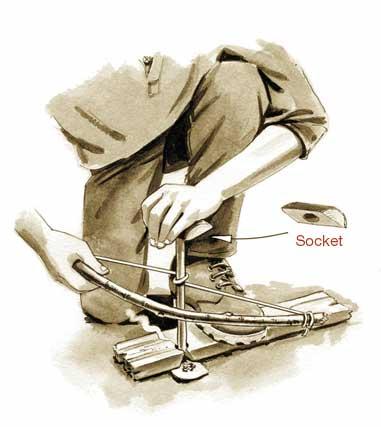
We must have worked for thirty minutes before I noticed the book-boy offering me a piece of advice. He was remarkably shy and I could barely make our what he was trying to say, though I could tell that he was serious. He quickly took off one of his hiking boots, removed a shoe-lace, curved a long stick, and created a make-shift bow. He then demonstrated that if we wrapped another stick around the string, we could move the bow like a saw and it would spin the stick for us with an incredible amount of friction. We quickly went to work and within 10 minutes we were the only group with a fire at all, and a few moments later the balloon popped and put out the fire that we had struggled to ignite. After congratulating ourselves I made a point to thank the boy for his idea and asked where it came from. He said, “I read about it in the Wilderness book that we were all supposed to read before this weekend.”

startafirewithabowdrill

The palmist writes about a stone that builders rejected becoming the chief cornerstone. Those who are familiar with the New Testament will quickly identify Jesus as someone rejected by the elders who then became the foundation for the church. Yet, this is not something that can be applied to Jesus alone. I quickly rejected the help from a boy in the woods because I made a ridiculous assumption about his inability to help. In him I saw little value worth assessing. However, without his help we would probably still be in the woods trying to pop our balloon. God can, and does, use some of the least likely people to change the world. Everyone has value and worth, we need only a new perspective to realize it.

In the remaining days of Lent let us open our eyes to value in people around us. Instead of making quick and unjustified assumptions, let us take a moment to reflect and remember that those who we reject are often the ones who are here to save us.

Devotional – Psalm 107.1

Devotional:

Psalm 107.1

O give thanks to the Lord, for he is good; his steadfast love endures forever. 

Weekly Devotional Image

“I’m post-racial” he said. “I am color blind to racial differences and I have no prejudices.” At the time we were discussing racial inequality in Durham, North Carolina (a still very pertinent topic) and the man claimed that if more people could see the world the way he did, everything would be fixed. He proudly claimed his lack of prejudice for anyone with ears to hear but I had a hard time taking him seriously. I did not know him well enough to begin arguing against his so called “prejudice free lifestyle” so I decided to let him him wax lyrical about himself. However, while he continued to go on and on, a friend muttered next to me under his breath, “Show me someone without prejudice, and I’ll show you a liar.”

One of the hardest tasks of following Jesus Christ is to try to live without prejudices precisely because many of us aren’t aware of how deeply rooted our prejudices are. We may think that we are “color blind” or that we relate to people who are different from us in religion, sexual orientation, or political persuasions, but in many circumstances our involuntary thoughts, uncensored words, and knee-jerk reactions often demonstrate that our prejudices are still there.

If we’re driving in our cars and we see two women holding hands walking down the side-walk, what are our first thoughts? If we are at a restaurant and we witness a black woman and a white man kissing one another across the table, how do we immediately respond? If we’re flipping through news channels and come across a political campaign of a different perspective, how do we initially react?

diversity-hands1-400x266-copy

Strangers, anyone who is unlike us, stir up fear and discomfort. They break down our sense of security and well being by simply being “different.” We can puff ourselves up all we want with claims of living with a post-whatever lifestyle, but most of us, if we’re honest, are prejudice in ways big and small, seen and unseen.

As Christians, we give thanks to the Lord for he is good. Only when we learn to fully believe that God loves each of us unconditionally and see others as equally loved can we begin to behave according to God’s goodness. The great variety in the world is a sign of God’s immense wonder and beauty. Living with a non-judgmental frame of mind is exceptionally difficult, but it is worth working toward.

This week, while we continue to journey through the season of Lent, let us admit our own prejudices. When we have those knee-jerk reactions toward those who are different from us, let us immediately go to the Lord in prayer and ask for Him to create in us clean hearts so that we might become people of love rather than prejudice.

God’s Top 10 – Sermon on Exodus 20.1-17

Exodus 20.1-17

Then God spoke all these words: I am the Lord your God, who brought you out of the land of Egypt, out of the house of slavery; you shall have no other gods before me. You shall not make for yourself an idol, whether in the form of anything that is in heaven above, or what is on the earth  beneath, or that is in the water under the earth. You shall not bow down to them or worship them; for I the Lord your God am a jealous God, punishing children for the iniquity of parents, to the third and the fourth generation of those who reject me, but showing steadfast love to the thousandth generation of those who love me and keep my commandments. You shall not make wrongful use of the name of the Lord your God, for the Lord will not acquit anyone who misuses his name. Remember the sabbath day, and keep it holy. Six says shall you labor and do all your work. But the seventh day is a sabbath to the Lord your God; you shall not do any work – you, your son or your daughter, your male of female slave, your livestock, or the alien residents in your towns. For in six days the Lord made heaven and earth, the sea, and all that is in them, but rested the seventh day; therefore the Lord blessed the sabbath and consecrated it. Honor your father and your mother, so that your days may be long in the land that the Lord your God is giving you. You shall not murder. You shall not commit adultery. You shall not steal. You shall not bear false witness against your neighbor. You shall not covet your neighbor’s house; you shall not covet your neighbor’s wife, or male or female slave, or ox, or donkey, or anything that belongs to your neighbor.

ten-commandments-set-free-to-live-free_27594_banner_img

As a kid, I always preferred worship to Sunday School. Sunday School meant we had to wake up earlier in order to make it on time, it rushed us as a family to get things ready, and the classrooms were filled with all of those strangely adult renditions of biblical stories. The lesson might’ve been on David fighting Goliath, but all I could ever remember was how buff and old David appeared in the pictures rather than the young and innocent version from the story. The lesson might have been focused on the importance of sacrifice, but the imagery of Abraham preparing to kill his son left most of us utterly terrified of God, rather than ready to give our lives to him. The lesson might have been about Jesus and Mary Magdalene, but the story fell a little flat when our teacher kept calling Mary a “lady of the night” which made her sound more like a vampire than a prostitute.

On the other side, worship was awesome. I loved sitting near the front and watching all sorts of different people come together for this one thing. It amazed me that old men and women would take the time to talk to me and ask me questions about my life. Oh the joy that I remember experiencing when I was invited to the front for the children’s message; we were the special ones, all the adults had to sit in their pews but we, the kids, got to go all the way to the front and get closer to God.

My adolescent faith and love for church was like a roller-coaster. I looked forward to the hymns, the bread and cup, the communal act of praying together, but I dreaded the Sunday School classroom, the 25 year old cut-out flannel-graphs, and the seemingly endless amount of Old Testament arts and crafts.

But, if I’m honest, the thing that really drove me crazy about Sunday School was the fact that it felt way too much like regular school. We had a teacher who took attendance, put us in assigned seats, gave out homework, and even proctored pop-quizzes. Now, don’t get me wrong, there is an importance to the education that comes in Sunday School, but the way that it was done for me resulted in my desire to read the bible not for its knowledge, but for the promise of receiving a piece of candy if, for instance, I was the first person who could turn to the book of Isaiah.

Sunday-School_t

I could go on and on about the things I experienced in those Sunday School classrooms, but the one that stands out the most was the day we were quizzed on the 10 Commandments. At the time I knew they were a thing, but I certainly had no idea what they were. Up to that point in my life I could not remember ever hearing them preached about in church, I had no idea where they were in the bible, but I knew you could find them in framed cross-stitch patterns at older people’s homes.

My sheet of paper remained blank for a long time. However, the teacher took pity on me and tried to help encourage some answers: “What are the ten things God wants us to do?” My mind raced through different sermons and scriptures; I tried to remember what the pastor always said about God… I think God wants us to love Him, I’m pretty sure we are supposed to do unto others as we would have them do unto us… What else? God calls us to lift up our crosses. Oh, and God wants us to give Him our money!

I don’t remember what I eventually wrote down for the quiz, but I do remember that I failed, and I did not receive a piece of candy.

Can you recite the Ten Commandments from memory? What do you imagine when you hear about the Ten Commandments? Do you think about how the law was established to protect and bind us together? Or do you just picture Charlton Heston from the movie version of the Ten Commandments?

ten_commandments

Sadly, in our modern world we are more likely to hear about the Ten Commandments as they relate to controversies surrounding public displays than how they were written to help shape, guide, and mold our lives. Even as a child I was implicitly taught that it was more important to memorize God’s Top 10, than it was to understand them, and live accordingly.

The beginning of the commandments sets up an individual address, but the concern is not just about our private lives and welfare. The focus and thrust of the list is on protecting the health of the community in which the individual plays a pivotal role.

God graciously provided these guidelines as a way to open up our lives rather than limit them. It might not appear that way at first, but upon closer inspection they describe the outer limits of conduct rather than focusing on countless specific behaviors for every situation. At the foundation of the Ten Commandments is God’s desire for us to be protected from behaviors that have the potential to destroy.

In addition, the Ten Commandments are not a once-and-for-all declaration about the limitations of the Law. Throughout the history of Israel and the New Testament, faithful people struggled with these guidelines and amended them to be as fruitful as possible. This gives the people of God, in every age, the right and warrant to expand upon the laws.

If we can begin to see and imagine the commands as opportunities for fruitful living and malleable for our time, then they will no longer remain the stagnant list from our Sunday School memories.

I am the Lord your God, and you shall have other gods before me. You shall not create idols, nor shall your worship them

In our lives there are countless other gods fighting for our allegiances. From political parties to celebrities to businesses, it is next to impossible to be in the world without outside influences calling for us to worship them. When we find ourselves bowing to the powers in life, we neglect to honor the first two commandments. Honoring them encourages us to keep perspective about who is really in charge and the kinds of things that should be important in our lives. If we continue to worship what the media tells us, we will forget our call to love our enemies. If we spend more time catching up on all our favorite television programs, we will no longer catch up on what God is doing in our lives.

You shall not take the Lord’s name in vain

This is less about using curse words than it is about not claiming that we are doing something in the “name of the Lord” when we are really doing it in the name of ourselves. Perhaps some of us give time to serve the poor and homeless in Staunton, but if we do it to feel good about ourselves than we are taking the Lord’s name in vain. This command pushes us to commend and praise God for all the blessing of our lives, particularly when we can bless others.

Remember the Sabbath and keep it holy

Honoring the sabbath allows us to be our fullest. God rested on the sabbath, and we need rest in our lives. If we spend our days rushing through the familiar patterns of life, if we work without rest, then we will no longer be living. Or, as Ferris Bueller puts it, “Life moves pretty fast. If you don’t stop and look around once in a while, you could miss it.” Enjoying life and resting was not some external thing handed down for us to abide by, but a way in which we can be the truest form that God hopes for.

Honor your mother and father

Having parents is a gift. More and more children grow up without the vitally important guidance of parents and have to learn to live according to the tests and trials that are thrown at them. Our parents, whether biological or situational, made the choice to love us in spite of us. They gave and provided when we could not do so for ourselves. Loving our parents encourages us to be people of gratitude, instead of imagining that we are the source of all good things in our lives.

You shall not murder

Instead we should protect the innocence of life. We are called to value every single life whether belonging to someone famous, or someone nearly invisible in Staunton living on the streets. Every life has value, and God wants us to cherish the beauty in all people.

You shall not commit adultery

Instead we should love and embrace our commitments. When we covenant to be in relationship with those whom we love, we are asking for God (and others) to hold us accountable to that promise. Fighting against the temptations of adultery results in us valuing the needs and wants of the other, more than ourselves.

You shall not steal

No one should have to steal to live in our world. Instead of stealing we are called to give with glad and generous hearts. Whether through the offering in church, or to any charitable organizations, when we give we help to prevent the need for people to steal to survive. God will provide, it just might not be the way we are anticipating.

You shall not bear false witness

Instead we should speak well of our brothers and sisters. Gossip and deception only serve to destroy our community. Just imagine how we might start loving and treating and trusting each other if we believed that no one would speak falsely about anyone else. Think about how beautiful a town and a church such as ours could be if people took this commandment seriously and worked hard for it to become manifest. When we begin to speak well of others at all times, we start seeing the world through God’s perspective and not just our own.

You shall not covet

Instead we should be grateful. It is too easy to look around at all the sources of blessings in other people’s lives and begin desiring to take them for ourselves. How quickly do we begin to resent our coworkers when they are given a raise, how quickly do we begin to ignore our classmates when they receive a better grade, how quickly do we avoid our fellow church folk when everything starts going well in their lives as ours fall apart? God has given all of us gifts, large and small, seen and unseen, they are there we only need a change in perspective to realize them in our midst. God will provide in ways that are miraculous and beautiful. We need not covet what our neighbors have when we remember that God has chosen to be with all of us.

The Ten Commandments are a gift, they open up life for us rather than restrict, they call us to do more rather than simply obey, and they help to build and foster our community rather than destroy it. God’s Top 10 are part of the basics of faith, from them we learn how to grow as disciples and serve others. If we can move them from a memorized list to a practiced way of life, everything will begin to change for the better.

Amen.

Marked and Cleansed – Ash Wednesday Homily on Psalm 51.1-12

Psalm 51.1-12

Have mercy on me, O God, according to your steadfast love; according to your abundant mercy blot out my transgressions. Wash me thoroughly from my iniquity, and cleanse me from my sin. For I know my transgressions, and my sin is ever before me. Against you, you alone, have I sinned, and done what is evil in your sight, so that you are justified in your sentence and blameless when you pass judgment. Indeed, I was born guilty, a sinner when my mother conceived me. You desire truth in the inward being; therefore teach me wisdom in my secret heart. Purge me with hyssop, and I shall be clean; wash me, and I shall be whiter than snow. Let me hear joy and gladness; let the bones that you have crushed rejoice. Hide your face from my sins, and blot out my iniquities. Create in me a clean heart, O God, and put a new and right spirit within me. Do not cast me away from your presence, and do not take your holy spirit from me. Restore me to the joy or your salvation, and sustain in me a willing spirit.

ash-wed-sq-300x300

How would someone know that you’re a Christian? I think this is a very important question for us to ask ourselves on a regular basis. During a normal day, how would anyone know that we affirm Jesus as Lord, that we pray to God the Father, that we believe the Spirit is with us in all things? Maybe you wear a cross around your neck, though even that symbol has become so innocuous to the general culture around us. Maybe you bring your bible with you to work or public places and you are not afraid to spend some time reading from the good book in front of other people. I personally like to wear my clerical collar when I’m out in town because it helps to show others who I am, and frankly it forces me to act like a Christian in public.

When I became a pastor I was so excited to wear my collar for the first time, to walk around Staunton, and let it speak for itself. I imagined the conversations that would begin at one of our local coffee shops: “Sir, would you please pray for my wife, she just received some tough medical news.” … “Do you mind if I pull up a chair and ask some questions? I’ve always wanted to ask a pastor about the miracles from the gospels.” … “I’m new in town, would you be able to help me find a church community?” However, after being here for some time, I can share that most of the time no one notices. I’ve gone to a local bar with the expectation that people would hide their beer bottles behind their backs, but they just keep talking like normal. I’ve been shopping at the grocery store and prepared myself for random questions, but people just keep scanning the aisles on their own. I’ve sat down at a coffee shop with my collar on, and bible open, and almost no one has made mention of my vocation.

That was the case until last week.

I was sitting at a table alone working on a sermon when two women came in, ordered coffee, and sat at the table next to me. I’m not ashamed to admit that I often eavesdrop on the conversations around me. It’s not that I intend to, or have a problem with it, but most of the time the place is quiet enough that its impossible not to hear what people are talking about. I went to grab my headphones, in order to drown out their conversation, but I heard something that peeked my interest: “Being a pastor must be the easiest job in the world

I decided then that the sermon could wait, this conversation was too good to miss.

One of them continued, “Seriously! They get paid to act like the rest of us. I mean, how hard is it to write a sermon every week and visit old people? Being a Christian is so much harder than being a pastor. It must be the easiest job in the world.

Without thinking about what I was doing, I stood up, walked over to their table, and said, “You’re absolutely right. Being a Christian is harder than being a pastor. The church has expectations about the way you are supposed to behave, and I get paid to behave appropriately, I am a professional Christian. The only difference is this, everyone knows I’m a Christian, what about you?” I then packed up my things and left.

Today, above all days, is an opportunity for us to be marked and cleansed. In a short while, each of us will be invited forward to have a cross of ashes placed on our foreheads, a sign for us to carry around for the rest of the day. Today, wherever you go, people will know who you really are. 

IMG_1957

Do you know where the ashes come from? We save some of the palm branches from Palm Sunday, and we burn them down into ashes. The same palms that some of us waved last spring to welcome Jesus in Jerusalem have been placed in the fire, and will now adorn our heads. This is done as a reminder that our shouts of “hosanna!” can quickly turn to “crucify!” I can go from being a well behaved Christian, minding my own business at a coffee shop, to walking over to strangers and letting my passive aggressive side get the better of me. We use these ashes to mark and cleanse ourselves for the coming season of lent.

All of us are sinners, the young and the old, the weak and the strong, we all fall short of God’s glory. This season of lent is an opportunity to turn back to God and reorient our perspectives about the way the world truly works. For the coming weeks our prayers should be for wisdom, for God to purge from us all wrong desires and failures. This is the time for us to be bold in our faithfulness as we enter the community around us. Lent is the time for God to create in us clean hearts, to put new and right spirits within us. We begin here with the ashes, remembering our finitude, so that God might restore us to the joy of salvation, and sustain us with a willing spirit to be faithful in the world.

How would someone know you’re a Christian? Today, everyone will know just by looking at your foreheads. But, the ashes will eventually fade away; the cross will disappear. The challenge for us is to act like it’s still there, to live full lives of discipleship so that everyone might know who we are, and whose we are. Amen.