Devotional – Psalm 30.4

Devotional:

Psalm 30.4

Sing praises to the Lord, O you his faithful ones, and give thanks to his holy name.

Weekly Devotional Image

How often are we really thankful for the people God has placed in our lives? Sadly, it usually takes a profound moment of loss or grief before we are able to recognize how fortunate we were to spend time with them. I can’t tell you the number of times I’ve sat with a family while planning a funeral when someone breaks down in tears as they begin to wrestle with how shaped they were by the person now dead. It is a frightening moment when we recognize how blessed we were to have them, and their loss leaves a gaping hole.

On Saturday night I received an email from my home church containing the news that a man by the name of Bud Walker had passed away. As my eyes read over the lines in the email it was impossible to not let my emotions get the better of me as I realized that one of the greatest men I’ve ever been privileged to call my friend is now gone.

I met Bud Walker on a Sunday morning when I was 13 years old. I was responding to a volunteer opportunity from the church bulletin about learning how to run the sound system for Sunday services and Bud was going to teach me how it worked. For a month he stood behind me and looked over my shoulder as I twisted nobs and raised levels so that the whole congregation could hear the choir and the pastors, and for that whole month I was terrified of messing up. And yet, even after I passed my training month, Bud continued to stand with me at the back of the church before and after worship just to talk. I learned about his life and his family, I heard stories from his youth, and I saw what it meant to be faithful. During those incredibly formative years of my youth, I learned about God from the sermons, but I learned what it meant to follow Jesus from Bud Walker.

20120730-f0002-D8

At the time, my experience of church was that the adults got to do their thing and the youth got to do their thing. We might all sit in the same sanctuary on Sunday mornings, but there was a clear divide between our activities. Bud never saw that divide. He was one of the first people who pushed me to pursue a calling to the ministry, and he always made me feel like I mattered. And now he’s gone.

Today I sing praises to our Lord for having placed Bud Walker in my life; I am a better person for having spent time with him. As we continue to take steps on the path that leads to following Jesus, let us not take for granted the people God has given to us. Let us find the time this week to reach out to the people who helped to shape us and, if they are no longer living on earth, let us sing praises for the time we had with them.

Devotional – Psalm 118.24

Devotional:

Psalm 118.24

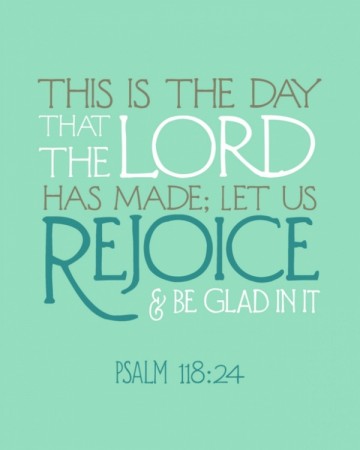
This is the day that the Lord has made; let us rejoice and be glad in it.
Weekly Devotional Image

The topic of “blessings” occurs regularly in our Bible studies at St. John’s. We can be reading from the Old or the New Testament, we can be reading a Psalm or an Epistle, we can be reading a genealogy or one of the miracles of Jesus, and the conversation almost always turns to how we take out blessings for granted. There is something inherent in scripture that works like a mirror, forcing us to confront ourselves in the text.

Yesterday morning, while we were reading about the episode of Jesus with the woman at the well, we started off by praying over the text, and before long one of our group members started to reflect on her blessings: “I am so blessed. I’ve got a great family and home. I have a church that cares about me. But I am even more blessed than that. I wish I could realize that every single day, every single breath, is a gift. And I wish I could stop taking these gifts for granted.”

this-is-the-day-360x450

For many of us, life feels like a train that keeps moving in one direction and we barely have time to admire the scenery passing out windows. Time rolls like a blur and we neglect to be thankful for the present because we are always looking toward the future. The psalmist’s words then confront us in our fast-paced lifestyles: “This is the day that the Lord has made; let us rejoice and be glad in it.”

I use these words to mark the beginning of worship at St. John’s because gathering in our sanctuary is a gift that God has given. It is not something we should take for granted. But can you imagine how differently we would live if we started every morning with these words? Can you picture how wonderful it would be to contemplate the blessing of your life every morning rather than just once in a while?

This week, let us use the words of Psalm 118 to mark our mornings. Instead of waking up and rushing to catch up with the train of life, let us take a slow breath and say: “This is the day that the Lord has made; I will rejoice and be glad in it.” If we do this, we will begin to stop taking our lives for granted, and we can give God thanks for all of our many blessings.

Devotional – Isaiah 43.18-19

Devotional:

Isaiah 43.18-19

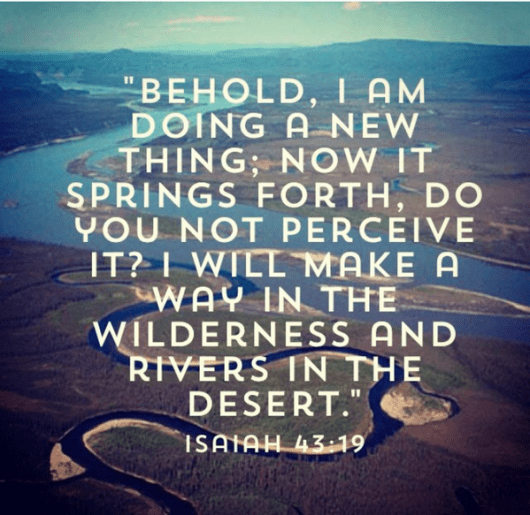
Do not remember the former things, or consider the things of old. I am about to do a new thing; now it springs forth, do you not perceive it? I will make a way in the wilderness and rivers in the desert.

Weekly Devotional Image

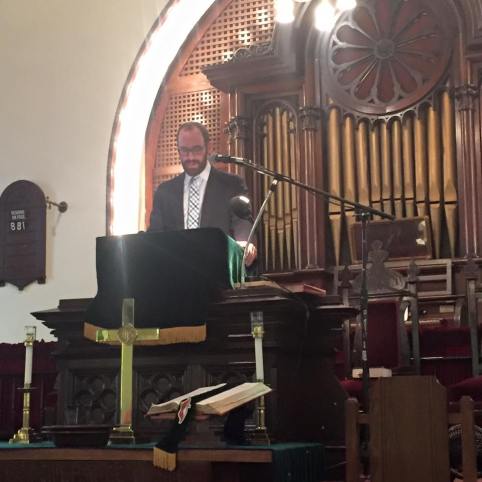
On Saturday morning I gathered with a few hundred United Methodists from all over the Virginia Conference for the Bishop’s Convocation on prayer. I was asked to teach a class on spiritual disciplines, but before we broke off into small classes we all met in the sanctuary to hear from our plenary speaker Dr. Fred Schmidt (Reuben P. Job Associate Professor of Spiritual Formation at Garrett-Evangelical Theological Seminary in Evanston, Illinois.)

Dr. Schmidt’s lecture was focused on the need to reclaim a sense of prayerful discernment. He admitted that countless churches will often use prayer in worship, or at the beginning of committee meetings, but rarely do churches actually strive to discern the will of God through their prayers. He set up this distinction by comparing the church of the 50s and 60s to the contemporary church; a half-century ago the church was comfortable with its role in society but as the church has diminished over the decades we have tried to reclaim that popularity. He mentioned that we now have things like “Ashes-to-go” on Ash Wednesday, we hand out coffee in our narthexes, and we fill worship with things like “how to be a better you.” Year after year we initiate new programs in the hope that they will bring us back to the heyday of the church. Then Dr. Schmidt brought the whole point home: “Part of our problem is that we’ve been seeking to rebuild our attendance and influence instead of rebuilding the body of Christ.”

Bc8l84xCAAA2R7Y

The Lord once spoke through the prophet Isaiah and said, “Do not remember the former things, or consider the things of old. I am about to do a new thing;” Many of us fall prey to the temptation to make things “just like they once were” and we want the church to be as popular as it once was. However, God does not call us to be popular. God calls us to be faithful.

This week, let us consider how we can discern God’s will in our lives and in our churches. Instead of just assuming that if we water down our ministries more people will show up in the pews on Sundays, let us earnestly pray and wait for God’s will to be revealed. Instead of limiting our faith to “how to be a better person,” let us earnestly live out our faith and pray for God to make us more like Jesus.

Devotional – Psalm 32.5

Devotional:

Psalm 32.5

Then I acknowledged my sin to you, and I did not hide my iniquity; I said, “I will confess my transgressions to the Lord,” and you forgave the guilt of my sin.

Weekly Devotional Image

There is a shop in Alexandria, VA called “The Variety Store” that truly contains a variety of items. Some of my earliest memories are of walking up and down all the aisles with my mother struggling to take in all the strange things I was seeing. There was an aisle full of ribbons, an aisle of ceramic dinnerware, an aisle of candy, and much more. It was a treat to witness the enormity of “The Variety Store” as a child, though it feels a lot smaller now than it did then.

Once, when my mother brought me into the store for some light shopping, I made my way to the toy aisle and just stood in awe of everything. And, as was my custom, I picked up a yellow smiley-face bouncy ball and bounced it all around the store with my her while she collected her items for purchase. We went through all the necessary aisles, my mother waited in line to pay for everything she found, and then we got in the car to go home. All in all, it was a relatively uneventful journey to the store until I put my hand into my pocket and discovered the bouncy ball. I can remember my entire disposition changing in an instant when I realized that I (accidentally) stole the yellow smiley-face bouncy ball.

ar120274857936808

For the next few minutes, which felt like hours, it burned a whole in my pocket as I walked around my house. Were the police on their way to arrest me for shoplifting? How severely was my Mother going to punish me for stealing a plastic ball that cost a quarter? The fear I experienced was palpable and when I finally mustered up the courage to confess my transgressions to my mother I’m sure that I was in tears.

But the strangest thing happened: As I explained my predicament, and I confessed my wrongdoing, the fear and terror faded away. My mother’s calm demeanor and response comforted me as she forgave me for what happened. Even when we returned to the store and I handed the smiley-face bouncy ball back over to the cashier I experienced forgiveness in a way that I would never forget.

When we can muster up the courage to confront and acknowledge our sins, it relieves us from the burden that comes with the weight of sin. When we have those opportunities to express our shortcomings to one another and to God it allows us to start moving in the right direction in discipleship. This week, let us take time to properly and faithfully acknowledge our sins to God, let us repent our transgressions, and let us rejoice in the forgiveness of our sins.

Unity in the UMC

Psalm 133

How very good and pleasant it is when kindred live together in unity! It is like the precious oil on the head, running down upon the beard, on the beard of Aaron, running down over the collar of his robes. It is like the dew of Hermon, which falls on the mountains of Zion. For there the Lord ordained his blessing, life forevermore.

12495241_10153458160651297_8700736706336599235_n

I love meeting people in our community and introducing myself as a pastor for the United Methodist Church. I love doing this because I never know what people will say in return.

“Oh, you must be that pastor who encouraged his church to start wearing hardhats to worship because God has a knack for tearing down walls…”

“No, you’re thinking of Clayton Payne at Cherryvale UMC.”

“Oh, you must be the pastor who loves shouting things like ‘Mercy!’ and ‘Praise the Lord!’ in the pulpit”

“No, you’re thinking of Bryson Smith at St. Paul’s UMC

“Oh, you must be the pastor who is forever mentioning apple butter and its many uses and applications.”

“No, you’re thinking of Sarah Locke at Christ UMC.”

“Oh, you must be the pastor who is absolutely obsessed with the Washington Redskins and even had the office painted burgundy and gold.”

“No, you’re thinking of Bob Sharp from Marquis Memorial UMC. Though I wish my office looked like his.”

“Oh, you must be the pastor who loves using objects in sermons, like handing out mirrors for people to remember the need to shine Jesus’ light.”

“No, you’re thinking of Janet Knott at Jollivue UMC.”

“Oh, well you don’t look Korean…”

“No, you’re thinking of Won Un at Central UMC.”

“Oh, you must be the pastor everyone raves about with a particular gift for preaching, handsome features, and can get congregations to shout ‘Amen!’ with feeling.”

(Sigh) “No, you’re thinking of John Benson at Augusta Street UMC.

“Oh, well then who are you?”

All of us pastors, and all of our churches are known for a variety of things. We’re known for our community engagement: Fish Fries, Apple Days, and Christmas Tree Sales. We’re known for the ways that our pastors like to preach and pray. We are known for a variety of things. We are known for how different we are from one another.

But the one thing I wish all people in Staunton knew about the United Methodist Church is that we love and worship the living God.


How very good and pleasant it is when kindred live together in unity!

The psalmist is right. We all know, on some level, the beauty of a community in unity. When we are working in one accord, when we harmonize with one another, it is very good and pleasant. But then we grimace at the way the psalmist talks about the beauty of unity. Can you imagine what would happen if I pulled John Benson up to the front of the sanctuary and poured extra virgin olive oil all over his head? And what is it about heavy dew that it supposed to elevate the blessing of unity?

Well, in the world of the psalmist, oil and dew were signs of God’s blessing. Like manna in the wilderness and the anointing of the prophets, these images speak to something greater at work than mere mortals. Yet, we are so removed from the time of the psalmist that these images no longer carry the weight they once did. Perhaps we need a new way of imagining the beauty of unity in community.

About a year ago, we started putting plans together for a community wide Trunk-or-Treat. Many of our churches had participated in some sort of Halloween celebration over the last few years, but we began imagining how much of an impact we could have if we worked together.

By the time October came around, all of the pieces were set and we were ready to host the Trunk-or-Treat at Gypsy Hill Park. On the day of the event I arrived super-early with hopes of setting the area up and organizing volunteers. We really had no idea how many people would show up but we were prepared for whatever would happen.

We handed out extra candy to all of the trunks, we set up safe areas for children to wander around, and we passed out orange vests to volunteers. The whole afternoon honestly felt like a whirlwind as we were trying to get everything together.

At the height of our preparations I noticed a small family off to the side of the parking lot watching us run around. They must’ve been standing there for ten minutes when I finally walked over to introduce myself.

What are you all doing?” the mother asked while keeping her three young boys close.

I said, “We’re calling it a Trunk-or-Treat, it’s a safe way to celebrate Halloween. We’ll be finished setting up in about an hour and we’d love it if you’d come through.” And with that she smiled shyly smiled and left the park.

Hours later, after 3,500 people came through the Trunk-or-Treat I was exhausted. Some of the last families were making their way through the few trunks that still had candy when I noticed the small family from earlier standing by the edge of the lot. The boys were not wearing costumes, but each of them held a bag full of candy with huge grins across their faces. I started walking over to find out if they had enjoyed themselves, but as I got closer I realized that even though the children were smiling, the mother was crying.

Is everything okay?” I asked.

With a wipe of her sleeve she tried to cover her tears and then said, “My boys have never had a Halloween before. All these people gave them candy and talked to us and asked us questions and they don’t even know us. You invited us to come earlier and you don’t even know us.

I replied, “You’re right. I don’t know you. But God does. And God loves you.

12182395_10204873871677559_710633466728393275_o (1)

How very good and pleasant it is when kindred live together in unity. It is like a mother all on her own, trying to raise her boys, who is treated with love and dignity by a strange community called the church. It is like the tears of a young mother rolling down her cheeks in recognition that she is not alone, and that she is loved no matter what.

How very good and pleasant it is when kindred live together in unity. It is like a group of people striving to be Christ’s body for the world through acts of grace and mercy. It is like volunteers giving out candy to countless children for no other reason than the fact that they too are children of God.

How very good and pleasant it is when kindred live together in unity. It is like a church that no longer treats other churches as competition, but instead sees them as brothers and sisters in Christ. It is like a group of people who believe that need trumps greed, that there can be unity in community, and that by the power of God’s grace the world can be transformed.

How very good and pleasant it is when kindred live together in unity. Amen.

Devotional – Psalm 63.3

Devotional:

Psalm 63.3

Because your steadfast love is better than life, my lips will praise you.
Weekly Devotional Image

When we saw the article in the newspaper we knew we had to do something; the local Valley Mission was in desperate need of items for young children and babies. They were thankful for all of the food and adult clothing they had received over the years, but what they really needed were diapers, toys for toddlers, and an assortment of other items.

Two couples at St. John’s are currently pregnant and we decided to harness the excited energy the church is feeling about new life and channel it into blessing the children at the mission. For weeks we have talked about the items needed during worship, we have sent out email reminders, and it has been an integral part of our prayers. Yesterday was the conclusion of the “baby shower” drive and we encouraged everyone to bring their items into the social hall and enjoy some food and fellowship as we prayed over the items before dropping them off.

Honestly, when we make pleas like this from the pulpit, they can often fall flat. It’s not that the congregation is unwilling to bless others; it just falls in among the many needs the community faces. When we hear about how much someone needs something on a weekly basis, it is very easy to just assume that someone else will take care of it.

Therefore, when I entered the social hall after worship yesterday and saw the tremendous amount of items donated I was shocked: Diapers were falling off the tables, crayons and coloring books were stacked on the floor, baby clothes were neatly arranged, in addition to all the other things that were brought in. It was a holy moment seeing all of the material that had been generously donated to bless others.

IMG_0783

When we can connect a need with something tangible, (when we see pregnant women in the sanctuary and imagine how badly other people might need baby supplies) it encourages a profound generosity within us. When we can remember how badly we needed those types of items for our children, it encourages us to do more than usual. When we can truly proclaim that God’s steadfast love has changed our lives, it encourages us to use our lips and our lives to change others.

God’s steadfast love is revealed in the people around us. Whenever we need something and a friend steps up to help out, that is God’s love in action. But God’s steadfast love is also revealed in scripture through the life, death, and resurrection of his Son Jesus Christ. This week, as we continue on the way that leads to life, let us look for ways to act like Jesus so that others may experience God’s steadfast love through us.

Return to the Lord – Ash Wednesday Homily

Joel 2.12-17

Yet even now, says the Lord, return to me with all your heart, with fasting, with weeping, and with mourning; rend your hearts and not your clothing. Return to the Lord, your God, for he is gracious and merciful, slow to anger, and abounding in steadfast love, and relents from punishing. Who knows whether he will not turn and relent, and leave a blessing behind him, a grain offering and a drink offering for the Lord, your God? Blow the trumpet in Zion; sanctify a fast; call a solemn assembly; gather the people. Sanctify the congregation; assemble the aged; gather the children, even infants at the breast. Let the bridegroom leave his room, and the bride her canopy. Between the vestibule and the altar let the priests, the ministers of the Lord, weep. Let them say, “Spare your people, O Lord, and do not make your heritage a mockery, a byword among the nations. Why should it be said among the people, ‘Where is their God?’”

Ash_Wednesday (1)


While I was growing up, I remember being jealous off all the Christians with ashes on their foreheads every year. I grew up in a church that did not celebrate Ash Wednesday and so it always came as sort of a shock when I would get to school on a Wednesday morning and a whole bunch of people were walking around with smudges on their skin. Part of my jealously stemmed from the fact that they were excused from being on time in the morning and got to miss part of a class. But the depth of my envy came from the fact that they stood out for what they believed.

Of course, at the time, I had no idea what the crosses stood for or why they used ashes, I just thought they looked cool. I can vividly recall the feeling of spiritual inadequacy I experienced because I felt like, even though I went to church every week, I would never compare with the Ash Wednesday Christians. For years I witnessed their piety and was jealous.

When I finally got to an age and a church that celebrated Ash Wednesday, and I sat down in front of a pastor like all of you are doing right now, I was shocked by the words I heard: “You are dust, and to dust you shall return.

12711025_10205393920598457_5324242656613500482_o

For centuries Christians like you and I have gathered to mark the beginning of Lent with this solemn and holy service. Lent is a season set apart for renewal and repentance. Lent is a time for us to confront our brokenness. Lent is a time to give thanks for our blessings and stop taking them for granted.

These ashes convey our willingness to confront mortality. We hear, “You are dust, and to dust you shall return” as a reminder that the bell will toll for us all. This moment is a public witness to our need to return to the Lord.

The prophet Joel describes our need for repentance and renewal through the voice of the Lord: “Return to me with all your heart, with fasting, with weeping, and with mourning. Return to me, for I am gracious and merciful, slow to anger, and abounding in steadfast love.”

We know not when our days will end, and because of this we need to embrace each and every day for the gift that it is. I’m not saying we should spend the next 40 days contemplating death every single moment, but instead this season should be a time filled with gratitude for all of our blessings.

Ashes are a reminder for all of us, young and old alike, that life is precious. Because when we hear the words, and when we feel ashes crossed against our foreheads, we confront our limited time on earth. These ashes should prevent us from moving through each day without reflection, they should caution us against rehashing the old arguments and frustrations, they should shock us into giving thanks right here and right now.

God encourages us to use this season, a time that begins right now, as an opportunity to return to the Lord with our hearts, with outwards signs like fasting, praying, and reading. Take this time and embrace the gift that it is by doing things like reconcile with people that you have been arguing with, open up your bibles and discover the richness of God’s Word, and resist the temptation to believe that you are invincible.

I’ve been a pastor long enough now to have placed ashes on individual’s foreheads and then eventually place dirt on their coffins as they are lowered into the ground. I have stood in this sanctuary and made the sign of the cross with ashes on people who have returned to the dust from whence they came. So take this sign, take these ashes, and make good with the life you’ve been given. Stop taking your blessings for granted. Love one another. Give thanks for what you have. And return to the Lord. Amen.


How Can We Be Biblically Wise?

1 Kings 3.5-12

At Gibeon the Lord appeared to Solomon in a dream by night; and God said, “Ask what I should give you.” And Solomon said, “You have shown great and steadfast love to your servant my father David, because he walked before you in faithfulness, in righteousness, and in uprightness of heart toward you; and you have kept for him this great and steadfast love, and have given him a son to sit on his throne today. And now, O Lord my God, you have made your servant king in place of my father David, although I am only a little child; I do not know how to go out or come in. And your servant is in the midst of the people whom you have chosen, a great people, so numerous they cannot be numbered or counted. Give your servant therefore an understanding mind to govern your people, able to discern between good and evil; for who can govern this your great people?” It pleased the Lord that Solomon had asked this. God said to him, “Because you have asked this, and have not asked for yourself long life or riches, or for the life of your enemies, but have asked for yourself understanding to discern what is right, I now do according to your word. Indeed I give you a wise and discerning mind; no one like you has been before you and no one like you shall arise after you.”

xlba-00052

This morning we conclude our sermon series on Questions. After polling most of you about your queries regarding faith, scripture, and the church, I compiled three of the most prevalent questions: What Are Angels? What Does The Bible Say About Divorce? And How Can We Be Biblically Wise? Though there are no simple, black and white, answers to any of these questions, we have strived during this series to bring clarity to our wonder. This morning we finish with “How Can We Be Biblically Wise?”


Three men were trapped on a deserted island. During the months of their stranded captivity they learned to rely on one another for survival. Without entertainment, they told each other stories and grew very close together. Each day one of them was responsible for making minor repairs to their shelter, one was tasked with scavenging for food, and the last one had to comb the beaches for anything helpful that might’ve washed up.

One particularly beautiful morning, the third man was walking along the beach when he discovered a strangely colored bottle sticking up in the sand. He quickly procured it with his other discoveries and brought them all back to the shelter. Later that night, while they were looking through all the goodies from the beach, one of the men accidently rubbed the bottle and a genie popped right out!

Because there were three men present, the genie explained that he could grant each of them one wish, rather than giving each of them three wishes. The first man wasted no time and declared, “I miss my family and I wish that I could be back with them!” The genie snapped his finger and poof; the man disappeared.

The second man thought for a moment and said, “You know, I was engaged before I got trapped on this island, I wish I was back with my fiancé.” The genie snapped his finger and poof; the man disappeared.

The third man was now alone with the genie and he thought long and hard about his wish. After all, it’s not like you run into a genie everyday. So he stood there with the genie thinking about all of the things he could wish for when he causally said, “Geez, I wish my friends were back here to help me make my wish.”

Be careful what you wish for…

Solomon was young, inexperienced, and about to rule the kingdom when God showed up in one of his dreams. Almost like a genie, the Lord asks Solomon to make a wish. And, like a preacher in a bad sermon, Solomon over-explains his wish: “God, you were great and loving to my father David because he walked before you in faithfulness, righteousness, and in uprightness of heart. Throughout his years you kept your great and steadfast love for him, and now you have given him a son to sit on his throne; you gave him me. But God, I am only a little child, and I don’t know the first thing about taking care of others. I am in the midst of the people you have chosen, a great people, so numerous they cannot be counted. So Lord, if I can ask for anything, give me an understanding mind to govern your people, able to discern between what is good and what is evil. Give me wisdom.

the_god_kind_of_wisdom_std_t_nv

It pleased the Lord to hear Solomon wish for wisdom. God then replied to Solomon in his dream: “Solomon, because you have asked for wisdom, and have not asked for yourself long life or riches, or for the life of your enemies, but have asked to be able to discern what is right, I now do according to your word. Indeed, I will give you a wise and discerning mind; no one like you has been for you and no one like you shall arise after you.”

Of all the things Solomon could’ve requested: wealth, prosperity, and military victory… He chose wisdom. As a young ruler of God’s chosen people he selflessly asked for the knowledge to lead God’s people in the ways that lead to life.

Godly wisdom, or biblical wisdom, pleases the Lord when it is not self-serving, but other serving. Solomon’s desire for wisdom, because it was for the betterment of others, is what inclined the Lord to dispense it generously. It is in our willingness to use wisdom for others that we begin to experience God’s grace in the world around us.

Fred Craddock is widely regarded as one of the greatest preachers in recent history. His command of scripture is evident in his sermons and he captivated anyone with ears to hear. But before he became a great preacher, he was a normal Christian just like you and me.

During the height of the Civil Rights movement, Craddock found himself driving across the country. He was making his way through northern Mississippi early one morning and needed to stop for a cup of coffee and some food. He found a no name diner in the middle of a town and made his way in for breakfast. It was early enough in the morning that Craddock was alone in the diner with the cook and he ordered his food and coffee. While he was sitting at the counter, a black man entered and sat down a couple stools away and ordered a coffee. The cook turned around and said, “Get out! We don’t serve your kind here!”

The man patiently responded, “My money is just as good as his” while pointing at Craddock. But the cook continued to point at the door and said, “The sign says ‘Whites Only’ so get out before I put you out!

The black man sighed and slowly removed himself from the stool and the diner.

Craddock continued to finish his meal, paid, and left. But right before he was about to get back in his car, in that still and quiet morning moment, he heard a rooster crow in the distance.

Are any of you feeling chills? Some of us will immediately understand the significance of this moment: Craddock, after sitting and witnessing the racism and bigotry mere feet away from him, realized that he had just denied Jesus as Peter did right before his crucifixion. But some of us did not catch the meaning; we did not have an emotional response to the conclusion of Craddock’s little narrative. If we missed the power of the rooster crowing in the distance, it is because we are unfamiliar with the ways God works in the world.

I had a number of you request, for this sermon series, that I preach about biblical wisdom. I can summarize the whole answer to the question in one sentence: “How can we be biblically wise?” “By reading our bibles!”

Image of an old Holy Bible

If Craddock was not as familiar with scripture as he was, he easily could’ve entered his car after hearing the rooster crow, and would have missed the power of what God was trying to communicate to him. God used a particular moments to speak large and powerful words to Craddock and God does the same thing in our lives. But if we are not familiar with the ways God has communicated in the past, then we will probably miss the ways God is trying to speak to us right now.

To be biblically wise implies a willingness to bring our souls into alignment with God’s ways. Yet we, as broken and flawed people, have a propensity to become out of alignment with God’s ways. To reorient ourselves, to turn back to the ways of God, we do so by reading scripture.

If we’re here in this sanctuary then we are already on the right path. It was only a few minutes ago that God’s Word was read to us in this place. By taking the time to listen to scripture in a sanctuary we are taking the first steps down the path that will bring us back to the kind of wisdom God desires for us.

But just coming to church is not enough.

We can do some incredible things in this space on Sunday morning, we can re-enter the strange new world of the bible, we can see ourselves in the biblical characters of the past, we can learn about how God uses things like roosters to shock us in the midst of our lives, but it is not enough.

One of the things that Christian people do, is read the bible. The bible is completely unlike any other book that we might read. Any of us can pick up a piece of literature and say, “This is a nice story.” However, the bible is not “a story’, it is “our story”. Our lives began with Adam, Noah, Abraham, and Moses. Our history goes back to the very beginning. When we read these stories, whether in church or in our daily lives, these stories are about our family.

A strange thing happens when we start reading our bibles and to see them as the living Word of God. When we get to the point where we can let the Holy Spirit bring us inside scripture we begin to really recognize it as our story. Suddenly all of these bizarre and exciting figures from the past look us in the eyes and we recognize our own reflections. We begin to see that we are like them and they are like us.

God is speaking to us all the time. Though not necessarily as the big booming voice we often see portrayed in movies and stories. God uses things like people, scripture, and even roosters to speak the truth into our lives. We can listen all we want, but until we are willing to become a people of the book, then God’s words will fall on deaf ears.

If we want to be biblically wise, we have to read our bibles. Amen.


Devotional – Isaiah 43.1

Devotional

Isaiah 43:1

But now thus says the Lord, he who created you, O Jacob, he who formed you, O Israel: Do not fear, for I have redeemed you; I have called you by name, you are mine.

Weekly Devotional Image

Names are important. Ever since my wife became pregnant we have discussed possible names for the baby arriving this spring. We have experimented with family names as well as biblical names. We have searched online for popular baby names (in order to avoid them). We’ve even gone so far as too imagine how possible names could be used to make fun of the child in the future.

Names are intimate and help to demonstrate how connected we are with one another. For instance, most of us can remember a time and the feeling of guilt that comes when we cannot remember the name of someone we supposed to know. When we call one another by name we are entering in a privileged moment of connectivity with another human being.

This morning, while the preschoolers were entering the school for the first time since breaking for the holidays, I stood by the door and welcomed each of them. I got down on my knees to look at most of them on a level plane and asked about their Christmas presents and celebrations. It was a joyful time as we all reconnected.

shutterstock_97916309

One of the last children to arrive was a new student about to begin his first day. Unlike the other kids, this was a completely new and strange experience. All around him were the friendships that have started this year and he stood all by himself. Because I had the chance to meet his parents before this morning, I knew who he was and bent down to greet him by name. The shy young boy looked up at me and started to beam as he declared, “You know me?!”

Within minutes he was in his new classroom playing with new friends. All of the nerves were gone and were replaced with the joy of playing with blocks at 9 o’clock in the morning. Such is the power of being called by our names.

Many of us wrestle with our own identities. We wonder about who we are and what we are being called to do. Yet, God knows who we are and calls us by name. The kind of joy that our new preschool student felt this morning is available to us when we recognize how God has called us and knows us. Sometimes it happens in the words of a hymn we sing in church, sometimes it happens in a devotional we read to start our day, and sometimes it happens in the still small silence of our prayers. God knows us. God loves us. God calls us by name.

This week, let us look for the moments when God calls us, let us rejoice in the knowledge of whom we belong to, and let us give thanks for all of the blessings that God has given us.

Praise The Lord!

Psalm 150

Praise the Lord! Praise God in his sanctuary; praise him in his mighty firmament! Praise him for his mighty deeds; praise him according to his surpassing greatness! Praise him with trumpet sound; praise him with lute and harp! Praise him with tambourine and dance; praise him with strings and pipe! Praise him with clanging cymbals; praise him with loud clashing cymbals! Let everything that breathes praise the Lord! Praise the Lord!

00033674_h


I am a creature of habit. I like routines, I like order, and I like preparation. I asked Lindsey to give me three examples of how I am a creature of habit and her response was: “only three?” I like my coffee a certain way, I enjoy sitting in a particular chair to read books, and I have rhythms for most of the events in my life. Sundays are no exception.

Most Sundays I arrive here in the sanctuary hours before some of you are even awake. Of course I start with the practical things like turning on the lights and unlocking the doors, but then I make my way back to the sanctuary to prepare for worship. First I pray on my knees from the third pew on the right hand side and confess where I have fallen short and how I have sinned. I pray for God’s forgiveness, and ask God to show up in my words in worship, even if I don’t deserve it. I then make my way up to the altar and praise God for the mighty acts revealed in scripture and in my life.

When I turn around I walk down the center aisle and I pray over every single pew asking for God to turn them into avenues of connection rather than walls of division. My hand touches every pew and I pray for God transform all of the people who will inhabit them through our worship.

From the Narthex I pray for the ways that we greet people on their way into the church, and I even go out onto the front lawn to give thanks for Staunton, and ask for God to send to us all who need to feel God’s love.

All in all it takes some time to prayerfully prepare for worship, but it’s worth it. When I finish praying, I make my way into the pulpit and read over the bulletin one last time. I check to make sure that the theme of worship is present throughout the entire worship service and, before I read my sermon out loud, I pull out my hymnal.

Like I said, I am a creature of habit. Every Sunday before any of you get here, I pray in this sanctuary and I sing through the hymns by myself. When I’m alone in the church I can belt out the hymns without the deep sighs from our organist Rick in response to me not keeping the pitch, I can let my emotions get the best of me without being judged by some of you from the pews, and I can just be myself up here jamming.

One Sunday, after going through my whole prayer routine, I stood up in the pulpit and looked at the bulletin to the hymn number for “Have Thine Own Way, Lord.” And I did what I always do. And I got really into it: (sing Have Thine Own Way)

Of course, when I sing, I often close my eyes and just let the words flow. So here I was singing from the top of the lungs from the pulpit, and you can imagine my surprise and terror when I finished the last note and someone shouted, “sounds okay from back here!

A visitor to the church had arrived hours early, walked in through the narthex, picked up a bulletin, and sat down in the farthest back pew, and was listening to my solo. I stood up here in shock without knowing what to say and I fumbled through trying to explain myself when the man raised his hand to stop me and said, a little too sarcastically, “I’m sure other pastors do this kind of stuff all the time.”

I am a creature of habit and, even though I was embarrassed that one morning, I still sing all the hymns before you get here. Singing the hymns and reading over the lyrics is incredibly important, because when we sing from this hymnal, we are articulating our faith. When we sing from this hymnal we are reentering the world of scripture. When we sing from this hymnal we are praising the Lord.

So let’s go to that hymn that I embarrassingly belted from the pulpit; number 382 Have Thine Own Way, Lord. (Sing together.)

Is this a familiar tune for you? Can you remember singing it when you were younger? Maybe you’ve heard the version that Johnny Cash performed. This is a beautiful hymn. The words quote Jeremiah 18.6 about clay in the potter’s hand. The tune is easy to follow and the theology behind it is great: It is an honest and prayerful desire for God’s will to be done in our lives.

I have always enjoyed singing this hymn, but when I learned the story behind the hymn it became that much more precious. If you look to the bottom left hand corner of the page, you will see that Adelaide Pollard wrote the hymn in 1902. The story goes that Adelaide was going through a rough period in her life and was unsuccessful in raising enough funds to make a trip to Africa for missionary work. In the depth of her struggle, she went to a tiny prayer meeting one night for the local community. She listened to person after person make their prayer requests for medical issues, material possessions, and a slew of other things when an old woman stood up to make her prayer request. Bucking with the trend of the evening the old woman simply said, “Have thine own way with me, Lord.” Impressed by the faith of the old woman, Adelaide went home that night and wrote the words to the hymn.

Psalm 150, the final one of the entire psalter, compels us to praise the Lord through music. Praise God with trumpets, lutes, harps, tambourines, dance, strings, pipes, and cymbals. Toward the beginning of the hymnal, we can find John Wesley’s directions for singing, that pair so well with Psalm 150:

“Above all sing spiritually. Have an eye to God in every word you sing. Aim at pleasing him more than yourself, or any other creature. In order to do this attend strictly to the sense of what you sing, and see that your heart is not carried away with the sound, but offered to God continually; so shall your singing be such as the Lord will approve here, and reward you when he cometh in the clouds of heaven.”

So we are going to follow the words of Psalm 150 and the words of John Wesley, we are going to praise the Lord. I would like all of us to take out our hymnal and turn to our favorite song. When you find the one you love shout out the number and we will sing the first verse. (We’ll probably do this for five hymns) Together we will praise the Lord. And as we do, take the time to soak up the words and the let the tune flow over you so that the Lord will approve our singing and reward us when God comes in the clouds of heaven. Amen.