God Isn’t Fair

strangely-warmed-spreaker-header

This week on the Strangely Warmed podcast I speak with Lindsey Baynham about the readings for the 17th Sunday after Pentecost (Exodus 17.1-7, Ezekiel 18.1-4, Philippians 2.1-13, Matthew 21.23-32). Lindsey is an elder in the Virginia Annual Conference of the United Methodist Church and currently serves as the Associate Director for Call, Candidacy & Discernment in the Center for Clergy Excellence. The conversation covers a range of topics including the prevalence of complaining, the differences between equality and equity, identity, and whether or not God is fair. If you would like to listen to the episode or subscribe to the podcast you can do so here: God Isn’t Fair

21199453_873285013490_6485396214584115227_o

What’s Right With The Church?

Psalm 145.1-8

I will extol you, my God and King, and bless your name forever and ever. Every day I will bless you, and praise your name forever and ever. Great is the Lord, and greatly to be praised; his greatness is unsearchable. One generation shall laud your works to another, and shall declare your mighty acts. On the glorious splendor of your majesty, and on your wondrous works, I will meditate. The might of your awesome deeds shall be proclaimed, and I will declare your greatness. They shall celebrate the fame of your abundant goodness, and shall sing aloud of your righteousness. The Lord is gracious and merciful, slow to anger and abounding in steadfast love.


People outside the church love to talk about its faults and failures. For instance: Church organizations were able to mobilize and respond to the recent devastation in Texas and Florida before FEMA or the Red Cross, but whenever the Church is in the news it has to do with a failure to keep track on money properly, a scandal involving clergy, or a denomination’s vote on something like homosexuality.

Last week I shared some stories about a recent wedding I presided over, and I told you about how effusive some of the people in attendance were with their praise. There is something strange and mysterious about a wedding that leads people to speak in deeply honest ways. Perhaps it’s the fact that love is in the air, or that reunions are bringing people together, or the free alcohol. However, what I didn’t share with you last week were the negative comments from other people.

“I don’t think you’re gonna have a job much longer preacher. You know the church is dying right?”

            “How can you support a system that is so archaic and out of touch with reality?”

            “You seem like a nice guy but I think the church is more responsible for evil in the world than good.”

It’s easy to pick on people outside of the church who are so harsh and judgmental with their language. It’s easy to pick on them because they’re not here, they don’t know what God is up to, they don’t know what the church is really like.

And for as much as people outside of the church love to talk about its faults and failures, people inside the church might be even worse.

I went to my first clergy meeting for the Alexandria District this week and I was struck by how somber so many of us were. Throughout the time of our gathering there was far more negativity than positivity, and at some point it felt like the whole point of the meeting was to get preachers together to complain about people like you.

            What’s right with the church?

Fotolia_137876364_Subscription_Monthly_M-1080x675

A few years ago I was given a copy of sermon preached by a man named Zig Volskis in 1987, the year before I was born. In it he attempts to answer that very question, “What’s right with the church?” Zig, like me, was frustrated with all of the negativity surrounding the church and instead he wanted to focus on the life-giving elements of the body of Christ that is the church.

Zig preached that as a child he would have responded to the question with: the church bells and music. They both represent the energy and depth of the worshipping community through sounds and communal response. The music of the church reassures the people that God is the one in control, even is the world claims the contrary.

As an adult, Zig claimed that his answer had changed over a career of serving the church for thirty years. He believed the best thing about the church is that it endures. Empires come and go, even church buildings are destroyed by war and exodus, yet the body of Christ always endures. With all its blindness and plundering, for all its inability to faithfully use its enormous resources properly, the church has sought to minister to human needs in thousands of different ways. And, for untold numbers of persons, the helping hand of the church has been a lifesaver.

Zig ended the sermon with a call to those who love the church: make more room for church, bring to the church your best and highest devotion. And to those who are not sure about the church: you will not find perfection here, but come in anyway, and help us make the church better.

And with that he said: Amen.

Over the years I’ve thought a lot about Zig’s sermon, and in particular our willingness to overemphasize the negative rather than addressing the positive. And, I’ll be the first to admit – The church does have problems. From this Cokesbury here in Woodbridge to the great universal church, we have problems because, at its heart, the church is filled with people like us: broken, flawed, sinners.

I could take time to bring up poor management, or fiscal irresponsibility, or personal judgments. We could spend weeks talking about how we’ve failed as a church, we could spend weeks talking about how we need to get better, but in so doing we would fail to recognize all the things that are right with the church.

But the psalmist, and the witness of scripture, chooses to focus on the things that are right. I will extoll the Lord, I will meditate on the goodness of God, I will declare the greatness of God. Every generation will share with those who follow all the splendor and majesty of God.

The psalm we have today is like a hymn, something to be declared by the entire congregation. And if you look at it, and really read through each line, it is so over the top with declarations of God’s glory that it sounds like the kind of love letters middle school students used to leave in each other’s lockers.

The love and praise the psalmist has for God is not something that can remain bottled up and hidden away. There is a quality of God’s grandeur that evokes a response, it pushes us to bring forth our gladdest praise and declare from the rooftops about the mighty works of God.

However, most of us are uncomfortable with wearing our faith on our sleeves. We don’t know quite what to make of religious displays of affection. We can’t even imagine standing up in church to talk about what God has done for us.

This psalm, these words about God, they are an invitation to remember what God has done for us, and shout it out.

I love asking people to tell me about sermons they remember from the past. Such as: Have you ever heard a sermon on Psalm 145? Can you remember the preaching from when you were a kid? Can you even remember what I preached about last week? The truth is that most of us remember very little, myself included!

I think back on what it was like to be raised in the church and I can’t remember any sermon I heard. There are a couple phrases that continue to bounce around the grey matter between my ears, but I don’t remember anything more than that. But you know what I do remember? I remember the people who got up and talked about how the church had changed their lives.

I remember sitting as a child at the altar and listening to a man in a hospital gown talk to us about how the church visited him when he was in the hospital after finding out he had cancer. I remember the woman who wept from the pulpit as she was thanking people for attending her husband’s funeral. I remember the older man who was baptized in front of the whole church who then shared his story about how he lost everything in his life, and then found everything when he started coming to church.

There is a profound power in being reminded, again and again, of what God is doing in the world and in the church. There is something good and right and true about sharing stories of what is right with the church. So that’s exactly what we’re going to do.

Founders-Day-2017-672x330

I’m going to go first, as an example, but then I want to open up this space and this time for you to share what you think is right with the church.

Shortly after I arrived here at Cokesbury, I was working on a sermon in my office when a bunch of people came in through the door and kept walking past without saying a word. I mean I was the new guy and they didn’t even both to check on me. And they call themselves Christians! I found out later they were the Prayer Shawl team, and that they had work to do in the conference room.

I sat in my office for a while, pretending to work, but what I was actually doing was eavesdropping. I wanted to know what they were really up to, I wanted to know what these ladies were really like, I wanted some gossip.

But I was disappointed. Instead their conversation was filled with affirmation for one another, and they worked and worked and worked.

You want to know what I think is right with the church? Our prayer shawl team. They gather together and have created a beautiful community designed to make the community more beautiful. They work to give away everything they’ve created to be a blessing to others. And they do so with abundant joy. Each of their shawls, and all of the squares in our bulletins today are seeds they are casting into the world, and because of their work and God’s grace, those seeds will grow to bear beautiful fruit for God’s kingdom.

So, now its your turn: What’s right with the church?


There are few things in this life more joyful than discovering how our lives are caught up with the great and enduring story of God’s wondrous works. As we share what’s right with the church we discover how connected we are with one another. As we listen to what’s right with the church we rediscover the faith and the fervor of the psalmist within each and every one of us.

So to those who love the church: make more room for it, bring to it your best and highest devotion. And to those who are not sure about the church: you will not find perfection here, but come anyway, and help us make the church better. Amen.

Worthy of the Gospel

strangely-warmed-spreaker-header

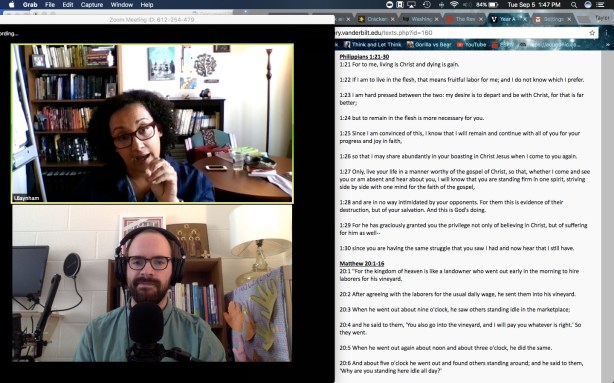
This week on the Strangely Warmed podcast I speak with Lindsey Baynham about the readings for the 16th Sunday after Pentecost (Exodus 16.2-15, Jonah 3.10-4.11, Philippians 1.21-30, Matthew 20.1-16). Lindsey is an elder in the Virginia Annual Conference of the United Methodist Church and currently serves as the Associate Director for Call, Candidacy & Discernment in the Center for Clergy Excellence. The conversation covers a range of topics including what it means to be “called”, the overabundance of arrogance, justice-oriented ministry, and the joy of serving the church. If you would like to listen to the episode or subscribe to the podcast you can do so here: Worthy of the Gospel

LB image

The God We’re Stuck With

strangely-warmed-spreaker-header

This week on the Strangely Warmed podcast I speak with Rev. Jason Micheli about the readings for the 15th Sunday after Pentecost (Exodus 14.19-31, Genesis 50.15-21, Romans 14.1-12, Matthew 18.21-35). The conversation covers a range of topics including the possibility that Episcopalians might listen to the podcast, violence, church arguments, forgiveness, and why O Brother, Where Art Thou? is so quotable. If you would like to listen to the episode or subscribe to the podcast you can do so here: The God We’re Stuck With

37867_1409543449591_1562302_n

The Mystery of Marriage – A Wedding Homily

1 Corinthians 13.1-3

If I speak in the tongues of mortals and of angels, but do not have love, I am a noisy gong or a clanging cymbal. And if I have prophetic powers, and understand all mysteries and all knowledge, and if I have all faith, so as to remove mountains, but do not have love, I am nothing. If I give away all my possessions, and if I hand over my body so that I may boast, but do not have love, I gain nothing.

Ecclesiastes 4.9-12

Two are better than one, because they have a good reward for their toil. For if they fall, one will lift up the other; but woe to one who is alone and falls and does not have another to help. Again, if two lie together, they keep warm; but how can one keep warm alone? And though one might prevail against another, two will withstand one. A threefold cord is not quickly broken.

21369500_10154707052062651_2839710461080071606_n

Marriage is a mystery. However, I am an expert. I am an expert because I am a pastor and I’m supposed to be an expert in these types of matters. When a family has a baby and they don’t know quite what to do when the baby becomes a toddler and starts talking back, the family brings the child to church in hopes that someone like me will teach them how to behave properly. Or when a family loses someone they love, they will have a funeral at a church in hopes that someone like me can use words to make sense out of such a terrible loss. Or when a couple is finally ready, and for you two I really mean the words “finally ready”, to take that next step into holy matrimony they start talking with a pastor in order to figure out what marriage is all about.

But all three of those things: life, death, marriage – they are the most profound mysteries we will ever encounter in this world.

I don’t understand why people get married. And I say that as a happily married man. To get all these people together, to make them sit and listen to someone like me wax lyrical about the virtues of love and commitment, to look someone in the eye and promise to love and to cherish them the rest of the days of your life is a strange and mysterious thing.

Brianna, I have no memory of my life without you in it. In fact some of my earliest memories are of your remarkably curly hair and wondering what might happen if I stuck a toy in it. I’ve been your friend for every major moment of your life, and frankly I consider myself more of your brother than a friend. I know you well enough to know that you are spectacular and funny and kind and dedicated. I know that there have been, are, and will be times when you know better what to do than anyone in the room. And you’re not afraid to let everyone know that you know. I know that you can be the most extraverted or the most introverted person in the room. And I know that you can throw one hell of a party.

But for as much as I think I’ve got you figured out, and even for as much as you might convince yourself that you know who you are: You are a mystery.

And Alex, I haven’t known you nearly as long as Brianna. But she hasn’t stopped talking about you since the day you met and she has basically forced me to ingest all of this knowledge about the one and only Alex Chatfield. I know that you can provide for other people in a way that will never stop, no matter the consequences. I know that your sense of values and morality are better than most of the Christians I know. And as you so eloquently put it recently, I too know that you’re pretty damn good-looking.

But for as much as I think I’ve figured you out, and even for as much as you think you know who you are: You are a mystery.

Which makes it all the weirder that the two of you are standing here on this occasion making a covenant toward the unknown.

21458112_10155713151057840_9203595134897334660_o

Now, all of us here can affirm that two are better than one. We know that from our experiences of life. And we know it because the writer of Ecclesiastes talks about it. It’s nice to have someone that can pick you up when you fall down. It’s good to have someone keep you warm when you’re cold. But the last line is the most important: A threefold cord is not quickly broken.

Three. Not Two.

The mystery that is marriage is made manageable and magnificent by God. Only God knows who the two of you really are, only God knows what it will take to make your relationship what it needs to be, only God can provide the strength and hope necessary for what you two are about to do.

One of the greatest mysteries in the church is what we call the Trinity: Father, Son, and Holy Spirit. Somehow, the three-in-one plurality in unity is what God is. We cannot see it, we cannot touch it, we cannot even understand it. And yet God is. The Trinity, like marriage, is a mystery.

God made the two of you into who you are. God is the one responsible for your quirks and idiosyncrasies. God is the one who ultimately brought your lives into tandem. And God is the one who is going to bless your marriage, who will be the third part of your cord; who will reveal to you what love really means.

Brianna, you once told me that you wanted to be committed to someone who wanted to be committed to you. In other words, you wanted to find a partner.

            Alex, you once told me that you wanted to find someone with whom you could speak the truth in love, even when it was the hardest thing to do.

Your relationship with one another has had its mountaintop moments of joy, and its deep valleys of challenge. From meeting at Webster Hall, to taking care of one another when you both had the Neuro Virus, to sleeping through meeting your future-father-in-law for the first time, to countless parties, vacations, and celebrations.

You’ve seen one another at your best, and at your worst. And with that full knowledge, you believe the time has come to make this holy vow to one another.

I believe both of you are right. And all the people here do too. That’s why they’re here after all. They were willing to travel to this place and listen to someone like me because they believe the two of you have found a partner in one another.

            All of us here are a testament to the love you two share.

And your love, thanks be to God, is deeper and truer than the Hallmark/Lifetime channel version of love we hear about all the time. Both of you know that you could have the greatest job or the greatest car, that you could have all wisdom and all knowledge, that you could have the kind of faith that could move mountains, but without love you would be nothing.

Love, the kind of love that will sustain your marriage, holy love, is Godly love. It is a love unlike anything else on this earth. It is beyond definition and explanation. It is deeper than the deepest ocean, and greater than the tallest mountain. It is sacrifice and resolution. It is compromise and dedication. The love that God has for you is the kind of love you are promising to one another and it is a mystery.

It is only something you can figure out while you’re figuring it out.

We never really know whom we marry; we just think we do. Who you are today will be different tomorrow. As the days, weeks, months, and year pass each of you will become someone new and different. And marriage, being the enormous mystery that it is, means that we are not the same person after we have entered it. The challenge of your marriage, of any marriage really, is learning how to love and care for the stranger to whom you find yourself married.

A few weeks ago the three of us talked about what you wanted your wedding to look like. You both shared how you wanted everyone to feel like they were part of the celebration, you wanted great music and lots of laughter, and above all you wanted your friends and family to recognize how we are all connected.

Through his ministry Jesus was often asked about the kingdom of heaven, and do you know what he compared it to the most? A wedding feast; a party, a time of celebration with great music and laughter, where all sorts of people recognize how connected they really are.

So, whether you knew it or not, your wedding is just about as close as any of us will ever get to having heaven on earth. For it is here, at your wedding, as we party together, that we see and feel the love that God first had for us. Here, in the promises and covenant you make with one another, all of us will be reminded of God’s promise to us in Christ that without love, we are nothing.

Brianna and Alex, I would like you to look one another in the eye for a moment. Bask in the strange, mysterious, and wonderful reality that you are about to take steps into the unknown. Rejoice in the fact that as you see one another, you can also catch glimpses of everyone else here who have promised to help sustain you in your relationship. Between them and God, you two have the best cord anyone could ever ask for. Between these people and God, you will have everything you need to care and love for the stranger you are staring at right now.

May God bless and sustain you in the mystery that will be your marriage, may God give you the strength and the wisdom of how to party like Jesus, and may God provide you with a holy love that will never be broken. Amen.

Devotional – Psalm 103.8

Devotional:

Psalm 103.8

The Lord is merciful and gracious, slow to anger and abounding in steadfast love.

Weekly Devotional Image

16 years ago I was sitting in my 8th grade band class when an announcement came over the PA system that I was needed at the main office. I walked down the hallway wondering why in the world they needed me in the main office of my middle school when I saw my father standing outside the doors beckoning me to hurry up. We quickly dashed toward the car where my sisters were already waiting and all I remember my dad saying was, “So many people have already died.”

It was September 11, 2001 and my father somehow got us out of school before they went under lockdown. I spent the entire day sitting on the living room floor at my parents’ house watching the World Trade Centers fall to the ground over and over again. And I was angry.

sept-11-Brigitte

Thinking back on that day 16 years ago, I can remember the anger I felt, but I can’t tell you who or what that anger was directed toward. The television contained images of violence I never thought possible in the world and it created in me a frustration and an anger that remained for a long time.

It was only years later that I came across a prayer written by one of my professors 30 minutes after the destruction of the World Trade Center. Dr. Hauerwas’ words articulate a feeling that I believe most Americans felt 16 years ago, but he was also bold enough to speak the truth in a time of fear, anger, and violence. This is the prayer he wrote 16 years ago today:

“Vulnerable – we feel vulnerable, God, and we are not used to feeling vulnerable. We are Americans. Nor are we used to anyone hating us this much. Such terrible acts. Killing civilians. We are dumbfounded. Lost. We are good people. We are a nation of peace. We do not seek war. We do not seek violence. Try to help us remember that how we feel may be how the people of Iraq have felt while we have been bombing them. It is hard for us to acknowledge the “we” in “We bombed them.” What are we to do? We not only feel vulnerable, but we also feel helpless. We are not sure what to feel except shock, which will quickly turn to anger and even more suddenly to vengeance. We are Christians. What are we to do as Christians? We know that anger will come to us. It does us not good for us to tell ourselves not to be angry. To try not to be angry just makes us all the more furious. You, however, have given us something to do. We can pray, but we wonder for what we can pray. To pray for peace, to pray for the end of hate, to pray for the end of war seem platitudinous in this time. Yet, of course, when we pray you make us your prayer to the world. So, Lord of peace, makes us what you will. This may be one of the first times we have prayed that prayer with an inkling of how frightening prayer is. Help us.” (Dr. Stanley Hauerwas – Disrupting Time)

So today, 16 years later, we still pray for God’s will to be done. We pray that we might become God’s prayer for the world. And, perhaps most boldly, we remember that while the world is consumed by fear and terror, we worship the God who is merciful and gracious, slow to anger, and abounding in steadfast love.

Lift High The Doorpost

strangely-warmed-spreaker-header

This week on the Strangely Warmed podcast I speak with Rev. Jason Micheli about the readings for the 14th Sunday after Pentecost (Exodus 12.1-14, Ezekiel 33.7-11, Romans 13.8-14, Matthew 18.15-20). The conversation covers a range of topics including Jason’s Judaic roots, why its hard to talk about blood, the morality of Christianity, and how Ezekiel is like the Jethro Tull of the Old Testament. If you would like to listen to the episode or subscribe to the podcast you can do so here: Lift High The Doorpost

10399274_1026151385029_5270_n

I AM WHO I AM

Exodus 3.1-15

Moses was keeping the flock of his father-in-law Jethro, the priest of Midian; he led his flock beyond the wilderness, and came to Horeb, the mountain of God. There the angel of the Lord appeared to him in a flame of fire out of a bush; he looked, and the bush was blazing, yet it was not consumed. Then Moses said, “I must turn aside and look at this great sight, and see why the bush is not burned up.” When the Lord saw that he had turned aside to see, God called to him out of the bush, “Moses, Moses!” And he said, “Here I am.” Then he said, “Come no closer! Remove the sandals from your feet, for the place on which you are standing is holy ground.” He said further, “I am the God of your father, the God of Abraham, the God of Isaac, and the God of Jacob.” And Moses hid his face, for he was afraid to look at God. Then the Lord said, “I have observed the misery of my people who are in Egypt; I have heard their cry on account of their taskmasters. Indeed, I know their sufferings, and I have come down to deliver them from the Egyptians, and to bring them up our of that land to a good and broad land, a land flowing with milk and honey, to the country of the Canaanites, the Hittites, the Amorites, the Perizzites, the Hivites, and the Jebusites. The cry of the Israelites has now come to me; I have also seen how the Egyptians oppress them. So come, I will send you to Pharaoh to bring my people, the Israelites, out of Egypt.” But Moses sais to God, “Who am I that I should go to Pharaoh, and bring the Israelites out of Egypt?” He said, “I will be with you; and this shall be the sign for you that it is I who sent you: when you have brought the people out of Egypt, you shall worship God on this mountain.” But Moses said to God, “If I come to the Israelites and say to them, ‘The God of your ancestors has sent me to you,’ and they ask me, ‘What is his name?’ what shall I say to them?” God said to Moses, “I AM WHO I AM.” He said further, “Thus you shall say to the Israelites, ‘I AM has sent me to you.’” God also said to Moses, “Thus you shall say to the Israelites, ‘The Lord, the God of your ancestors, the God of Abraham, the God of Isaac, the God of Jacob, has sent me to you’: This is my name forever, and this my title for all generations.


I have always loved churches. But before I loved the church for the people in the church, I loved churches because of their sanctuaries. Ever since I was a young child I felt a since of awe and wonder and peace whenever I entered a sanctuary. When I got my driver’s license I would drive myself over to the church in the middle of the week just to spend some time in the sanctuary. And it’s not like I would always kneel at the altar and pour out my soul to God, though I did, I just loved the feeling of being in the sanctuary.

When I was in seminary I was part of a church worship band, and I would drive to the church really early every week just to sit in the sanctuary before the rest of the group arrived. On one such occasion, I was sitting in a random pew and looking at a stained glass window when a man ran into the sanctuary screaming for help.

I immediately rushed to him and we met in the middle of the center aisle and before I had a chance to ask what was wrong he mumbled something out about being afraid and needing help and wanting prayer. I took him by the arm and tried to calm him down but the more I soothed the louder he wailed. Finally I grabbed him by the shoulders and said, “What’s your name?”

He stopped.

“I’m Marcus,” he said almost as if he was asking a question.

“Well then, Marcus, tell me what’s going on.”

Over the next fifteen minutes I listened to him as he described his fear and shock. His wife was pregnant and they had gone to the doctor that morning and heard the heart-beat for the first time. And instead of it filling him with joy, it terrified him. Not because of the responsibilities that were about to fall into his lap, but a terror about what would happen to his baby if he, as a father, died. He told me about how he had never been in a church before, that he never even wanted to go to church, but that he had been walking through the neighborhood crying, and before he knew it he started running. He told me about how he ran and he ran, and all the sudden he wound up in the sanctuary with me.

I listened as he shared his fears, and then I prayed for him. After the “amen” he hugged me and he left almost as quickly as he arrived.

Two weeks later I was driving near the church when I saw him walking down the road and before I knew what I was doing I pulled over, got out of my car and jogged up to him. “Marcus, Marcus!” I yelled, when he turned around it was like I was looking at a different person. He talked and he told me about how he was feeling better and that he was excited about the baby, and that he didn’t know who that God was I kept talking to that night but he felt like something changed. And then, as we were getting ready to say goodbye, he grabbed me by the arm and said something I’ll never forget: “Thanks for remembering my name.”
exodus 3-2_905

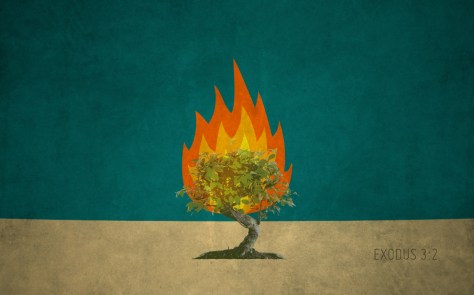
Moses was keeping the flock for his father-in-law when he came upon a burning bush. Moses saw the strange and wonderful sight and chose to turn toward it. And that’s when the Lord declared, “Moses, Moses!”

What follows is perhaps one of the most well known stories from the Bible. God speaks to Moses through the burning bush and calls him to help deliver God’s people out of Egypt. But Moses, like almost everyone encountered by God in scripture, feels unsure of the call. “Well, when the Hebrew people ask about you, who should I tell them you are?” And God said, “I AM WHO I AM.”

            The Tetragrammaton: I AM WHO I AM. YHWH. Yahweh.

For many Jews, the name of God revealed to Moses is so holy, so precious, that it cannot be uttered by the lips of mere mortals. Instead, there are other names for God like Adonai and Lord. In the Christian tradition, we will call God Yahweh, but the name of God revealed by God is unlike anything else and demands a respect and holiness that is rarely seen.

The passage about Moses in the wilderness with the burning bush is usually interpreted in such a way that it is all about Moses. Moses is walking, Moses is given a command, Moses responds. But there’s more to the story than Moses; it is the revealing of God’s holiness.

We could not have found this name, this Yahweh, by ourselves. Even if we entered into a long and passionate search through prayer or any other spiritual discipline we are not capable of finding out whom God is on our own. God’s name had to be revealed. God alone can tell us who God is.

And what does God say, “I AM WHO I AM.”

The divine name is a non-name in the best sense. Can you imagine Moses returning to the land of Egypt, mixing and mingling with the Hebrew slaves and saying, “Don’t worry, I AM WHO I AM sent me to set us free.”

What’s the purpose of a name? Do we name individuals to distinguish them from others? Do we give names to children in order to stroke our egos in attempts to live forever? Do we give names to people in order to build them up or break them down? What’s in a name?

I’ve been in enough hospitals to hear doctors refer to their patients not by Mrs. Smith or Mr. Jones, but by a room number (or worse: by their disease).

There are plenty of people who are judged simply because of the color of their skin, or their political persuasion, or their sexual orientation without their names ever being mentioned.

Names are important.

They are important in our everyday lives whether it’s learning the names of our neighbors, or our classmates, or our coworkers, or even the people in the pews next to us right now. Learning the name of the other, and actually using it, breaks down the walls and barriers that often lead us to judge rather than listen. Learning the name of the other prevents them from remaining a stranger. Learning the name of the other builds a bridge into something new instead of moving in the opposite direction.

God reveals God’s name to Moses in such a way that it bridges the divide but it also keeps the mystery. And I mean mystery in the most beautiful and theological way possible. We finite creatures cannot understand the infinite wonder that is I AM WHO I AM. There is a mystery to who God is simply because God is completely unlike us, but knowing how God reveals God’s name is important.

holyground_web (1)

If God is not given a proper name, God becomes a faceless unknown god with no story or history. But our God is a God of the story; our God has a name and is known by connections with other names.

God said to Moses, “I AM WHO I AM” and God also said so much more. God said, “I am the God of Abraham, of Isaac, and of Jacob.” Over and over again we are reminded in scripture that our God knows God’s people by their right names; God calls them and us by such: Abraham, Isaac, Jacob, Joseph, Hannah, Samuel, Saul, David, Mary, Martha, Peter.

God knows our names, and we should know God’s name as well.

If you’ve turned on your television or opened a newspaper this week you’ve seen some of the horrific and awful images coming out of Houston in the wake of hurricane Harvey. While some have taken to the internet to chastise and ridicule those in leadership about their lack of preparation or their delay in response, normal (and not-so-normal) people have done some heroic things so bring safety, life, and hope to the people who feel no hope.

And as I watched videos from Houston this week, as I saw boat after boat traveling up and down streets in attempts to bring people to safety, I was struck by one thing. In every instance of rescue, the rescuer began with the same question, “What’s your name?”

Think about that for a moment. While surrounded by signs of terror and fear, instead of commanding a person to leave their belongings or throw them over the shoulder, every rescuer looked in the eyes of the fearful other and asked the one question that would remove their otherness.

“What’s your name?”

From the burning bush God called Moses by name. Through words and flames Moses was changed through learning the name of God. I AM WHO I AM shows up in our lives at all kinds of strange moments, we could be shepherding, or sitting in a sanctuary, or waiting for rescue in a flooded house when the Lord calls out to us.

And we can trust I AM WHO I AM for the very same reason that Moses could. Because I AM WHO I AM is the God of Abraham, of Isaac, and of Jacob. Yahweh is the God who made a covenant with out ancestors, who delivered God’s people out of captivity in Egypt, who delivered us out of our captivity to sin and death. I AM WHO I AM is the God who was revealed to us in the person of Jesus Christ. I AM WHO I AM is the Spirit that lives and moves among us.

I AM WHO I AM is as mysterious as it is intimate. I AM WHO I AM comes to us in the intimacy of a piece of bread, and through the mystery of is being the flesh of Christ. I AM WHO I AM is as close as the person next to us and is as mysterious as the person sitting next to us. I AM WHO I AM is the name of our God who calls us by name. Amen.

Devotional – Jeremiah 15.16

Devotional:

Jeremiah 15.16

Your words were found, and I ate them, and your words became to me a joy and the delight of my heart; for I am called by your name, O Lord, God of hosts.

Weekly Devotional Image

Cokesbury Church celebrated its 58th anniversary on Sunday. For our Founder’s Day we had the choir singing and clapping, we were blessed by a sacred dancer, our children marched through the sanctuary singing happy birthday, each person in attendance was given a puzzle piece to add together in order to produce an image of the church, and we had one of our former members return to offer the sermon.

It was a strange a beautiful thing to witness a church reunion for which I am the newest part. While I am still learning about all of the traditions of the church, I had the opportunity to meet so many people on Sunday for whom Cokesbury is/was their home church for longer than I’ve been alive. Before the service started I was able to mill about and observe reunions between people who had gone far too long without seeing one another, and I overheard stories about the church from the past while also listening to hopes about the future.

21150212_10209733530326681_1060543143271111218_n (1)

All in all, it was a remarkable worship service and I count myself blessed for having played a small role in it.

When the service came to its conclusion, and I offered the benediction, I stood like I always do in the narthex and shook hands with people on their way to the social hall for our reception. The food was hot and ready by the time we finished and we could all smell the delicious feast awaiting us in the air.

While I was walking around and shaking hands a man walked up to introduce himself and I made some offhand comment about how he needed to stick around for the food otherwise I’d have to eat it all. In response he smiled, looked me right in the eye, and said, “Son, we just feasted on the Word and I don’t know if I’ve ever been more full in my whole life. But I’ll see what I can do.”

We can feast on any number of things: food, experiences, even television shows (aka binge watching). But how often do we feast on the Word? The prophet Jeremiah knew that feasting on God’s Word would bring a delight unmatched at any church potluck or dinner function. Jeremiah knew that God’s Word would fill his heart in a way that no relationship ever could. Jeremiah knew that when the Lord called his name it would sound better than any music to have ever touched his ears.

We feast on God’s Word whenever we worship, whenever we pray, and whenever we read the bible. And though we might try to alleviate our hunger with a number of empty solutions, God’s Word will always be there to offer us true satisfaction.

Discerning the Devil

strangely-warmed-spreaker-header

This week on the Strangely Warmed podcast I speak with Rev. Drew Colby about the readings for the 13th Sunday after Pentecost (Exodus 3.1-15, Jeremiah 15.15-21, Romans 12.9-21, Matthew 16.21-28). Drew is an ordained elder in the Virginia Annual Conference of the United Methodist Church and currently serves as an associate pastor at St. Stephen’s UMC in Burke, VA. The conversation covers a range of topics including beef tubes, identifying with biblical characters, nudity, kinship analogies, sleep, and knowing the devil. If you would like to listen to the episode or subscribe to the podcast you can do so here: Discerning the Devil 

Drew