This week on the Strangely Warmed podcast I speak with Drew Colby about the readings for the Third Sunday of Advent [A] (Isaiah 35.1-10, Psalm 146.5-10, James 5.7-10, Matthew 11.2-11). Drew is the lead pastor of Grace UMC in Manassas, VA. Our conversation covers a range of topics including the film Spirited, seasonal food/drinks, Cage The Elephant, Fleming Rutledge, Advent themes, the glory of the Lord, grief, radical goodness, divine agency, narrative theology, patience, Love Actually, and water in the desert. If you would like to listen to the episode or subscribe to the podcast you can do so here: The Gospel Is A Promise
A shoot shall come out from the stump of Jesse, and a branch shall grow out of his roots. The spirit of the Lord shall rest on him, the spirit of wisdom and understanding, the spirit of counsel and might, the spirit of knowledge and the fear of the Lord. His delight shall be in the fear of the Lord. He shall not judge by what his eyes see, or decide by what his ears hear; but with righteousness he shall judge the poor, and decide with equity for the meek of the earth; he shall strike the earth with the rod of his mouth, and with the breath of his lips he shall kill the wicked. Righteousness shall be the belt around his waist, and faithfulness the belt around his loins. The wolf shall live with the lamb, the leopard shall lie down with the kid, the calf and the lion and the fatling together, and a little child shall lead them. The cow and the bear shall graze, their young shall lie down together; and the lion shall eat straw like the ox. The nursing child shall play over the hole of the asp, and the weaned child shall put its hand on the adder’s den. They will not hurt or destroy on all my holy mountain; for the earth will be full of the knowledge of the Lord as the waters cover the sea. On that day the root of Jesse shall stand as a signal to the peoples; the nations shall inquire of him, and his dwelling shall be glorious.
“I’m going to keep this short.”
That’s an incredible way to start a speech, or even a sermon.
And 99% of the time, it isn’t true.
To start with such a declaration puts people at ease because they’ve been duped into thinking they only have to pay attention a little. For, brevity leads to clarity, doesn’t it?
“I’m going to keep this short,” is usually the prelude to a lot of pontificating that often leaves us no wiser than when we began.
It’s usually an indication that whatever follows wasn’t thought through, and is usually off the cuff.
Which, in a place like this, is a bad idea. Who knows what kind of random theological riff-raff might come forth from a short stump speech.
And, to be clear, I’m not railing against the strange promise of a short declaration just because Fred Sistler started his sermon that way last week.
I would never do something like that.
I’m a Christian!
Stump speeches. They are a regular occurrence in the political fabric of our reality. They trace back to the 19th century during which politicians would go about from town to town “stumping” – offering brief highlights on what they planned to do in office should they get elected, usually with key words and phrases that they repeated over and over and over again.
A stump speech is like having one sermon and using it week after week.
And, of course, the “stump” part of “stumpspeech” comes from the practice of standing on a tree stump to get high enough for better visibility and greater oration.
Other stumpy items from the 19th century included tables, chairs, and even whiskeybarrels.
John Wesley, founder of the Methodist movement, rather famously stood on his father’s gravestone in order to proclaim the gospel since he was no longer welcome to preach in churches.
I, myself, prefer preaching from a ladder.
But even here, right in the middle of the chancel area, slightly elevated, this is somewhat of an ecclesial stump where I, and plenty others, have stumped for Jesus.
We might call it our sanctified stump for salvation.
And stump speeches, though often short and repetitive, really can make all the difference in the world. Sometimes all it takes is one story, one word even, for the skies to open up, and all of God’s grace comes pouring down.
When the Good News actually sounds like good news, it changes everything.
Even us.
My former professor Stanley Hauerwas is known for his stump speeches. He has these recurring quotes and proclamations that he goes back to over and over again. I remember a classmate asking him why he said the same thing so many times, and he said, “Because they’re true.”
Some years ago, while lecturing in Scotland, using those same stumpy proclamations, Dr. Hauerwas was asked to preach at the cathedral of Edinburgh. Massive building with a huge pulpit, hardly a stump. The pulpit there is so large, in fact, that it has its own staircase that the preacher has to ascend in order to preach. And, when the appointed time arrived, Hauerwas marched up the stairs but right before he made it to the top, he heard a small door close behind him as well as a key turning in the lock.
Hauerwas, bewildered by the turn of events, demanded to know what was happening, when someone on the other side of the pulpit door said, “It’s a tradition in this church, dating back to the days of the Reformation. We lock the preacher in the pulpit, and we keep the preacher there until they give us the Gospel.”
Stumping for Jesus.
And yet, a stump is no glorious thing.
A stump, after all, is only possible if a tree has been chopped down. Stumps are signs of death.
By the time the prophet Isaiah rolls around, the Davidic kingdom is nothing but a stump. All the promise, all the hope, all the dreams had fizzled out. The holy city was sacked again and again, people were sent to live in exile. There was no bright hope for tomorrow.
And Isaiah says, “A shoot shall come out from the stump of Jesse, and a branch shall grow out of his roots!”
How strange. It’s as if the prophet has lost his ever-loving mind. He looks out on failed promises, idolatry, ruin, and yet he sees something more.
Feeling stumped is, sadly, all too familiar for God’s people even today, particularly during Advent. We might rejoice in memories from years ago, but we know that things can never really be like they once were. We might sit comfortably in these pews, but there’s a better than good chance that we’re also feeling the anxiety that is all to common during this season. We might sing the songs, and purchase the presents, and drive around looking at lights, but that doesn’t automatically make this the most wonderful time of the year.
We know what it means to be stumped, to feel as if nothing good is left.
And what do we do when we’re stumped? To whom do we turn? What relief can we find?
Netflix with the never ending assortment of holiday movies that follow the exact predictable formula over and over? Discounts at the ABC store? Scrolling through instagram seeing perfect people with their perfect lives?
Kurt Vonnegut once opined that no one should read beauty magazines because they will only make us feel ugly.
The same could be said of Instagram.
And yet, when Isaiah sees the stump, he sees hope! The roots are still pulling nutrients from the soil, a new shoot will sprout forth bringing life and life abundant. The new shoot from Jesse’s stump is the promise that God isn’t done with God’s people.
That’s what happens when you worship the God of impossible possibility, even stumps can bring about something new.
And that something new is a person.
Listen – the Spirit will rest upon him and he will know the fear of the Lord. He will even delight in his fear! He will come with judgment and righteousness and he will make all things right.
Sounds pretty good. This new shoot will be the difference maker, a warrior. But what strange weapons! He shall slay the enemy with the Word, not with swords. He will destroy all opponents with the Spirit, not by slaying. He will wear a belt of righteousness for the battle, not Batman’s belt with gadgets and gizmos aplenty.
And with the victory comes even stranger results! The wolf will live with the lamb, the calf and the lion and the fatling together. The cow and bear shall graze. And a little child shall lead them.
Everything about this proclamation is unexpected. The line of David is nothing but a stump, forsaken and dead. And yet, from it the ruler of the cosmos will come. Animals that have no business being together shall live in peace. And a child shall lead them.
It sounds so good and so perfect. And yet, 700 years after Isaiah’s announcement, John the Baptist arrives on the scene, preparing the way of the Lord, announcing a baptism for the repentance of sins. He calls the religious elite broods of vipers because they have lost sight of Isaiah’s vision.
John says, “Even now the ax is lying at the root of the trees!”
The stump of Jesse, the ax at the roots. John and Isaiah together see a reality that no one else does. They see the sign of the time. “On that day the root of Jesse shall stand as a signal to the peoples.”
What is the sign?
Have you ever wondered what became of the tree that was chopped down in order to make the stump? Have you ever seen the connection between Isaiah’s proclamation and John’s declaration?
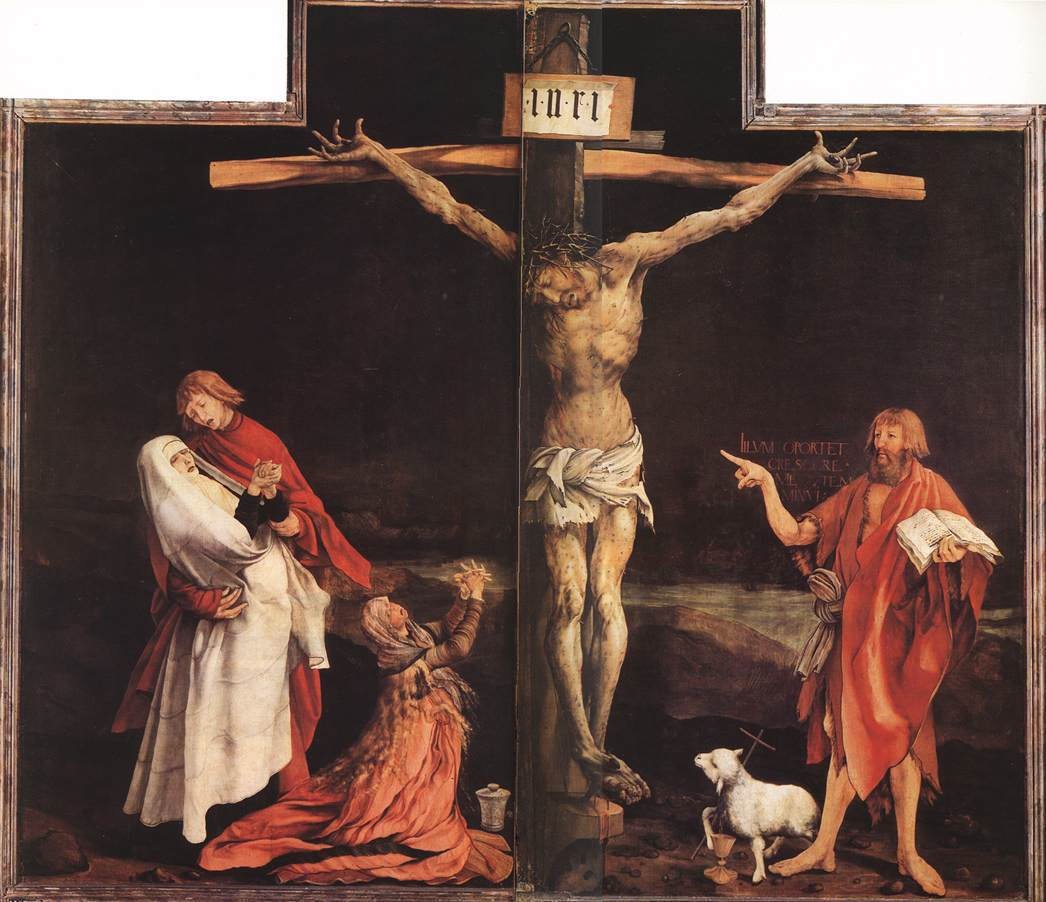
The stump is only possible because a tree was brought down. And do you know what we did with the tree? We nailed Jesus to it.
The root of Jesse is the cross. It stands on a hill far away, the emblem of suffering and shame. And it is glorious.
Some will say, this time of year, that we need to keep Christ is Christmas. Sure. That’s fine. But if we’re going to keep Christ in Christmas, we should also consider what it might mean to keep the Cross in Christmas.
It’s Advent. This is the time of year when we hear the most difficult, demanding, bad news to ever be called good – The Cross. Every Advent we have our worlds’ rocked, tables turned, foundations shaken, demons put to rot, and dead dreams brought back to life.
All things are possible in Advent because we worship the God of impossible possibly. The God who delights in upending all of our expectations of how the world is supposed to work.
Jesus really is the reason for the season, as is his cross. And lest we domesticate the Lord to mere flannel graphs and perfectly manicured manger scenes, Jesus was and is still so provocative that the powers and principalities are forever trying to shut him up. But nothing can stop Jesus. He’s going to say and do things that change everything.
Not even the cross can stop him.
In fact, the cross is our salvation. It’s a stump that brings forth new life. That’s why we can call it glorious.
Therefore, whenever someone stands in this place and stumps for Jesus, we are called to do exactly that – We point to Jesus Christ, the pioneer and perfecter of our faith, the shoot from the stump of Jesse, the one who makes a way where there is no way.
The promise of Advent is that no matter what stumps us in this life, God is going to get what God wants. Predator and prey will dwell together. Peace will reign. And a child will lead us.
The promise of Advent is that Jesus is the shoot, the branch that grows into a cruciform tree bearing the fruit that is salvation because Jesus is always stumping on our behalf, even when it costs him his life.
The promise of Advent is that new life always starts in the dark, whether in the womb or the tomb, whether underground or the lost being found; new life starts in the dark.
Therefore, the next time you encounter a stump, take a good look at it, because you may be looking at your salvation. Amen.
But when John saw many Pharisees and Sadducees coming for baptism, he said to them, “You brood of vipers! Who warned you to flee from the wrath to come?”
Tomorrow morning my six year old son will open up his Star Wars Lego Advent Calendar and will promptly put together a little droid, or a mini-figure, or some other object from a long time ago in a galaxy far, far away.
And he will rejoice.
But it’s hard for me to call it an actual “Advent” calendar. First, Advent started last Sunday, not December 1st. Second, the little trinkets are certainly fun but they don’t really have anything to do with the “hastening and waiting” that define this season. And, finally, Advent points to the arrival (and return!) of our Lord Jesus Christ, whereas most (if not all) Advent calendars point to the arrival of presents under a tree on Christmas morning.
Fleming Rutledge, my theological Advent hero, was once similarly struck by the strange juxtaposition of Advent calendars and the real message of Advent and said that the best Advent calendar would be one in which, every time you opened the next day/box, a strange bearded and camel-hair wearing man would jump out and shout, “You brood of vipers!”
John the Baptist gets to shine this time of year in church because he straddles the already but not yet. He sees the new world coming and warns the people of “the wrath that is to come.”
It just happens that the wrath of God is made manifest in the cross that is our salvation.
The church, in Advent, takes up John’s mantle and proclaims the truth that something is coming, and that we do need to prepare for it, but only because to miss it would ruin all the fun.
And yet, there is a strong temptation to make the call for preparation all about our need to finally make the world a good enough place for Christ to arrive. Preachers and pontificators alike will stand up and say things like, “You need to work on your racism, sexism, ageism, stop using styrofoam, go vegan, gluten-free, eat locally, think globally, live simply, practice diversity, give more, complain less, stop drinking so much.”
Which are all worthy things for us to do. But Christ arrives whether we do them or not. Frankly, Christ arrives because we do not do the things we should do. That’s the whole point!
Therefore, we don’t come to church in Advent (or any other time of year) to hear about what we need to do. Instead we come to hear about what’s been done, for us!
Or, as Martin Luther put it, “The Law says, ‘Do this,’ and it is never done. Grace says, ‘Believe in this,’ and everything is already done.”
The sad and bitter truth of this season is that we are “a brood of vipers” and that we have much to repent. And yet, the truly Good News of Advent is that Christ comes for us anyway. That’s why we sing of the hopes and fears of all the years – it is downright terrifying to be loved by God because we simply don’t deserve it.
This week on the Strangely Warmed podcast I speak with Drew Colby about the readings for the Second Sunday of Advent [A] (Isaiah 11.1-10, Psalm 72.1-7, 18-19, Romans 15.4-13, Matthew 3.1-12). Drew is the lead pastor of Grace UMC in Manassas, VA. Our conversation covers a range of topics including ASMR, lectionary cycles, spaghetti with maple syrup, The Muppets Christmas Carol, fear, the word of judgment, righteousness, ecclesial harmony, the magic of music, apple trees, the central advent character, and prophetic insanity. If you would like to listen to the episode or subscribe to the podcast you can do so here: Stumped
Rejoice in the Lord always; again I will say, Rejoice. Let your gentleness be known to everyone. The Lord is near.
Thanksgiving is not a liturgical holiday.
But it could be.
For, what could be more faithful than breaking bread with family (and foes) knowing that Jesus spent his entire ministry doing the same?
And yet, there is a sense in which what happens around the Thanksgiving table is more determinative over our lives than the One who gives us life. Rare is the family that is immune to the political pandering that happens over turkey and mashed potatoes. Gone are the days we could sit back and rejoice without worrying about who will say what and ruin the holiday mood. We, then, approach the table of blessings without feeling like it’s much of a blessing at all.
But what if God is the one calling us together for the explicit purpose of redeeming our Thanksgiving tables? What if this is the year to let forgiveness reign over judgment? What if we took seriously the claim that, as Paul put it, “The Lord is near,” even at the holiday table?
There’s no guarantee that anything good can come out of our Thanksgivings this year, save for the fact that we worship the God of impossible possibility! So keep your eyes and ears open, let your gentleness be known, and rejoice! The Lord is near!
And, in the spirit of bringing a little holiness to a moment that is sometimes devoid of holiness, I’ve put together a little “Thanksgiving Liturgy” that anyone can use. You may say it privately to yourself, or you may read it corporately with others, but the hope is that it will bring a sense of faithful clarity to an otherwise bewildering experience…
–
A Liturgy For Thanksgiving
Prayer:
Almighty God, Father of all mercies, we your unworthy servants give you humble thanks for all your goodness and loving-kindness to us and to all whom you have made. We bless you for our creation, preservation, and all the blessings of this life; but above all for your immeasurable love in the redemption of the world by our Lord Jesus Christ; for the means of grace and for the hope of glory. And, we pray, give us such an awareness of your mercies, that with truly thankful hearts we may show forth your praise, not only with our lips, but in our lives, by giving up ourselves to your service, and by walking before you in holiness and righteousness all our days; through Jesus Christ our Lord, to whom with you and the Holy Spirit, be honor and glory throughout all ages. Amen.
Scripture:
Psalm 100
Make a joyful noise to the Lord, all the earth. Worship the Lord with gladness; come into God’s presence with singing. Know that the Lord is God. It is God that made us, and we are God’s; we are God’s people, and the sheep of God’s pasture. Enter God’s gates with thanksgiving, and God’s courts with praise. Give thanks to God, bless God’s name. For the Lord is good; God’s steadfast love endures forever, and God’s faithfulness to all generations.
Meditation:
The delight of Thanksgiving is both in the thing itself, and what it anticipates. So many other holidays come and go and leave us feeling vacant. And yet, upon the conclusion of Thanksgiving, while we put away all the dishes and say our goodbyes, we do so with the knowledge that Advent is knocking at the door, and with it: Christmas!
Advent is the season of waiting and watching, but what we’re waiting and watching for is already present at our Thanksgiving tables. The splendor of Advent is made manifest in the One who breaks bread with us whenever we break bread: Jesus.
Therefore, let us rejoice in our Thanksgivings, much like we do when we come to the Lord’s Table in church. Advent is already around us, hiding in the basement, laughing upstairs, and dancing in the living room. The unknown day and hour of it bursting into our reality is something worth celebrating, not fearing.
Put another way: God is not our mother-in-law who comes over once a year checking to make sure we’ve kept the house in order and that we haven’t chipped her wedding-present china. Instead, God is like our delightful uncle, who barges in unannounced (and perhaps uninvited!) with a baguette under one arm, and a bottle of wine in the other. We do need to wait and watch for God, but only because it would be such a pity to miss all the fun.
Prayer:
Lord, free us from fear and worry that, trusting in your goodness, we may always praise your mighty deeds and give you thanks for the bounty of your gifts. Amen.
This week on the Strangely Warmed podcast I speak with Drew Colby about the readings for the First Sunday of Advent [A] (Isaiah 2.1-5, Psalm 122, Romans 13.11-14, Matthew 24.36-44). Drew is the lead pastor of Grace UMC in Manassas, VA. Our conversation covers a range of topics including Handel’s Messiah, Chicago, Advent themes, the house of the Lord, church attendance, Fleming Rutledge, hopes and fears, worldly preferences, divine peace, Good Mythical Morning, progress, and Dietrich Bonhoeffer. If you would like to listen to the episode or subscribe to the podcast you can do so here: Does Anybody Really Know What Time It Is?
When they came to the place that is called The Skull, they crucified Jesus there with the criminals, one on his right and one on his left. Then Jesus said, “Father, forgive them; for they do not know what they are doing.” And they cast lots to divide his clothing. And the people stood by, watching; but the leaders scoffed at him, saying, “He saved others; let him save himself if he is the Messiah of God, his chosen one!” The soldiers also mocked him, coming up and offering him sour wine, and saying, “If you are the King of the Jews, save yourself!” There was also an inscription over him, “This is the King of the Jews.” One of the criminals who were handed there kept deriding him and saying, “Are you the not the Messiah? Save yourself and us!” But the other rebuked him, saying, “Do you not fear God, since you are under the same sentence of condemnation? And we indeed have been condemned just, for we are getting what we deserve for our deeds, but this man has done nothing wrong.” Then he said, “Jesus, remember me when you come into your kingdom.” He replied, “Truly I tell you, today you will be with me in Paradise.”
“Jesus for President.”
That’s what the sign said. I saw it when I was going for a run during a particularly contentious election season (aren’t they all?). In just about every yard there was a red sign or a blue sign, with one name or the other.
I’ve always found political yard signs to be problematic.
I mean, why do we put them up? Do we honestly think anyone has ever changed their vote because of a yard sign?
I think we put those signs up in our yards, and attach them to our bumpers, and post them on Facebook, not because we want to change anyone, but because we want everyone to know where we stand.
We want everyone to know what side we’re on.
And so seeing yard signs is fairly normative. In fact, its the houses without signs that seem strange. Until I saw, “Jesus for President.”
It was so shocking I remember stumbling over my feet and nearly wiping out on the sidewalk.
Jesus for President?
Perhaps someone thought it fitting to cut through the political paraphernalia that year with some sort of prophetic pronouncement. Maybe they really thought Jesus presiding in the Oval Office would be a good idea.
Except, “take up your cross” doesn’t poll well. Turn the other cheek is a strange campaign slogan. And that’s not even mentioning the first will be last, and the last will be first. That doesn’t sound like a milk toast soundbite from a politician, it sounds like a threat.
Jesus for President. It could never work. Particularly since Jesus is already our King – Jesus is Lord.
Today is Christ the King Sunday. A remarkable offering on the liturgical calendar. With Advent hovering on the horizon, churches across the globe gather today with proclamations about the Lordship of Christ. And yet, this is a recent addition to our liturgical observances, as far as those things are concerned. We’ve celebrated Christmas for centuries and marked Easter for millennia, but Christ The King only started in 1925.
Why? Nearly 100 years ago, Pope Pius XI looked out at a world in which Mussolini had been in charge of Italy for 3 years, Hitler had just published his autobiographical manifesto Mein Kampf, and the economic frivolity the led to the Great Depression was in full effect. And bearing witness to the world at that moment led the Pope to announce a new liturgical holiday – Christ the King Sunday would round out the year to remind Christians across the globe that we have our own King, and it is to him alone we owe our allegiance.
Over the last year we’ve read from Genesis to Revelation, we’ve encountered the living God who encounters us, we’ve been transformed by the Lord who transforms bread and cup, and all of it, all of the Sundays all of the studies all of the sacraments, they all pointed to one thing: Jesus Christ is Lord.
That’s the thing about us Christians, everything starts and ends with Jesus. He is the first word and the last word.
And yet, we do well to remember that this King of ours is strange…
Listen, there was a man named Jesus who hailed from the town of Nazareth. He was poor and had no real standing in the world but he preached about the kingdom of God, and he usually drew a pretty good crowd. For centuries the people Israel had suffered hardship after hardship, persecution after persecution, and they waited for the One who was promised. And Jesus said, “I am he.”
Many signs and wonders were done, healings happened, bellies were filled, and the crowds grew until they didn’t. The more he talked the more he was rejected. The more he did the more people grumbled. And he was betrayed, arrested, and condemned to death.
By us.
Those two words are tough to admit, or even fathom. But they’re true. At the heart of the Christian witness is the fact that, when push comes to shove, we nail the Son of God to the cross. And, incidentally, it’s why we sing, every Good Friday, “I crucified thee.” The strange new world of the Bible refuses to let us walk away with our hands clean.
The soldiers place a purple robe on his shoulders, a crown of thorns upon his head, a cross on his back, and they force him to march to The Skull.
Jesus is painfully quiet in this moment. The gifted preacher and parable teller has no words left to share. The crowds, of course, are loud. Sick with anticipation. Hungry for blood.
And he’s nailed to the cross.
Only here, hung high for all to see, does Jesus speak his first words as king. Make no mistake, this is when Jesus is crowned our king and Lord. And what is his first decree?
Father, forgive them, for they do not know what they are doing.
How odd of God.
With all the possible words of recrimination, condemnation, accusation, the first thing Jesus says is, “Father, forgive.”
Earlier he commanded us to forgive our enemies and pray for those who persecute us. Easy to preach, hard to practice.
On the cross, Jesus dares to pray for his worst enemies. Us.
It’s rather strange that God units ignorance with forgiveness. We usually act and behave as if ignorance is the enemy of forgiveness. We want people to know they’re wrong before we forgive them. We want repentance before mercy.
And yet, for God in Christ, it is always preemptive forgiveness. Forgiveness is the first word.
Jesus doesn’t hang up on the cross until we realize we made a mistake. He doesn’t wait until someone from the crowds shouts, “Um, maybe we went a little too far this time. Sorry Jesus.” Jesus doesn’t forgive after we come to our senses, but right in the thick of our badness, Jesus’ offers his goodness.
Oddly enough, forgiveness is what it costs God to be with people like us who, every time God reaches out in love, beat God away.
Perfection in the Garden – We reject it for the taste of a little knowledge dangling from a tree.
Unified Community – We reject for selfish desires of power.
Covenanted Relationship – We reject it in favor of other hopes and dreams.
The story of the Bible is the story of our rebellion and foolishness. We worship at the altars of other gods, moving from one bit of idolatry to the next, over and over and over again.
And then, in the midst of our muck and mire, God arrives in the flesh.
Jesus Christ, the incarnate One, fully God and fully human, comes to make all things new, with promises of hope and peace and grace and mercy.
God looks at our miserable estate and condescends to our pitiful existence, God’s attaches God’s self to us sinners, and what happens? We nail God to the cross!
And look at us, with all the means at our disposal, with power and prestige, with sin and selfishness, what happens? We are forgiven.
The first word from the cross, from the throne, is forgiveness.
It’s strange! But then again, it should come as no surprise even though its the most surprising thing in the history of the cosmos. Jesus was forever walking up to people and, without warning, saying to those whom he met, “Your sins are forgiven.”
Have you ever noticed that almost none of them ever asked to be forgiven?
I’ve heard it said, and perhaps you have too, that this moment, when Jesus hangs on the cross, is when God is in total solidarity with humanity. The suffering crucified God.
And yet, that forgiveness is the first word is completely contrary to us. For us, if we forgive, it is almost always with conditions.
We wait around for an apology, we wait for amends to be made, and then (and only then) will we forgive.
Forgiveness is the currency of God’s kingdom. Forgiveness, as Dolly Parton notes, is all there is.
And it’s also the the hardest thing to do.
St. Augustine, theologian and preacher from the 4th century, once preached a sermon on forgiveness, and in the sermon he admonished his congregation because some of them, if not all of them, were omitting the phrase from the Lord’s prayer that said, “Forgive us our trespasses as we forgive those who trespasses us.”
They would let those words remain silent every time they came around, and they would just skip to the next phrase. They refused to say those words, according to Augustine, because they knew they’d be lying if they said them out loud.
Forgiveness is hard, and it always has been.
Perhaps that’s why Jesus preached about it so much, told so many stories about grace, and tossed around forgiveness every where he went. Even on the cross! With nails in his hands, with thieves at his sides, abandoned by his closest friends and disciples, before asking anything for himself, he asks something for us, Father, forgive them, for they do not know what they are doing.
Our King rules not with an iron fist, but with an open hand. The first word of the kingdom is forgiveness.
And if that were all, it would be enough to pop every circuit breaker in our minds, it would leave us scratching our heads bewildered at the outcome. We don’t deserve it one bit. Frankly, we deserve nothing. And instead we get everything.
But the story isn’t over!
The first word is forgiveness, a prayer within the Trinity, and then Jesus speaks to the criminal on his side.
The One who was forever accused of consorting with sinners now hangs next to one. The One who ate with sinners now dies with them.
One of the criminals looks at Jesus and says, “C’mon King of the Jews, it’s miracle time! Save yourself and us!”
But the other replies, “Are you not afraid? We deserve what we’re getting, but this guy has done nothing wrong.” And then he looks over to Jesus and says, “Remember me when you come into your kingdom.”
“Truly I tell you, today you will be with me in Paradise.”
Is the thief confessing his sin? Perhaps. At the very least, he owns up to getting what he deserves. But confession has nothing to do with getting forgiven. It is not a transaction, it is not a negotiation. Confession is nothing more than the after-the-last gasp we offer when we know the truth of who we are and whose we are.
We don’t confess to get forgiven. We confess because we are forgiven.
Forgiveness surrounds us, beats upon our lives constantly. Preachers proclaim it. We sing about it. We pray for it. And, miracle of miracles, we receive it.
When we confess, we confess only to wake ourselves up to what we already have.
Perhaps the thief is bold to ask Jesus to remember him because he was the first person to hear Jesus’ first word from the cross, “Father, forgive.”
It was almost 100 years ago when Christians across the globe needed the first Christ the King Sunday. They needed a day set apart to reflect on how the Lordship of Christ outshines even the most powerful of dictators and the most devastating of depressions.
Today, we need it just as much. We need Christ the King Sunday because it reminds us, beats upon us, that Jesus’ kingdom is not of this world. It forces us to confront the strange reality that our King rules from a cross. It compels us to hear the Good News, the very best news, the strangest news of all: Christ died for us while we were yet sinners; that proves God’s love toward us. In the name of Jesus Christ, you are forgiven! Amen.
Be still, and know that I am God! I am exalted among the nations, I am exalted in the earth. The Lord of hosts is with us; the God of Jacob is our refuge.
Christ the King Sunday started in 1925 when Pope Pius XI instituted it through a papal encyclical. Mussolini had been in charge in Italy for three years, a certain rabble rouser named Hitler had just published his autobiographical manifesto Mein Kampf, and economic frivolity that led to the Great Depression was in full effect. And it was at that moment the Catholic Church decided they needed a Sunday, every year, to remind the Christian community that we have our own King and it is to him alone that we owe our allegiance.
Today, nearly one hundred years after the institution of Christ the King Sunday, it is usually overlooked on the liturgical calendar in order to celebrate themes of Thanksgiving. Instead of reading about the lordship of Christ, churches talk about the blessings made manifest through turkeys and potatoes. And, to be clear, that’s all good and fine. However, Christ the King Sunday is a rare and blessed opportunity for the church to be unabashed in our convictions about power, allegiance, authority, and a host of other aspects of our discipleship.
It is the perfect time to be reminded that Jesus Christ is Lord, and everything else is bologna.
The first time I traveled to Guatemala for a church mission trip, we stopped briefly in the town of Chichicastenango, known for its traditional K’iche Mayan culture. We were told to explore for a few hours before returning to the various vans that were taking us to our final destination. And, after only a few minutes of wandering down a variety of streets, I realized I was completely lost.
So I did what anyone else would do: I looked for a higher vantage point to get my bearings. Eventually I found myself on the steps of a very old church. I trudged upward and yet, before turning back to look over the town, something (read: the Holy Spirit) drew me inside the church.
The sanctuary was damp, dark, and devoid of just about anything. The ground under my feet felt like soft soil, the walls were covered with black soot from centuries of fires, and the paintings of the walls were so smudged that I couldn’t even tell what they were portraying. The smell of melted candle wax filled my nostrils and I crept closer and closer to what I imagined was the altar.
Frankly, it was one of the least churchy churches I had ever experienced.
Without the help of lighting, I stumbled over a rickety wooden pew and fell on the floor right in front of the Lord’s Table. And there, hovering above my head, was the most pristine sculpture of Jesus that I had ever seen. The Lord stood in complete contrast with everything else in the space. Jesus stood with robes draped over his shoulders, his hand was outstretched as if inviting me closer, and upon his head rested a crown of thorns.
Christ the King.
What kind of king is Jesus? In that Guatemalan church I was confronted with the stark reality of what it means to confess Jesus as Lord. For, while I was surrounded by decay, desolation, and even disregard, Christ stood firmly in front of me as the King of the cosmos. Just as the psalmist proclaimed, I was still before the Lord, and saw God’s exaltation above all things; even death.
Our King reigns from a throne not made by the blood of his enemies, but with his own blood spilled on the cross.
Our King wears a crown not of gold, but of thorns.
Our King rules not by the power of judgment, but through the gift of mercy.
On Christ the King Sunday we confess the truly Good News that our King reigns not above us, but for us, beside us, and with us. Thanks be to God.
When some were speaking about the temple, how it was adorned with beautiful stones and gifts dedicated to God, he said, “As for these things that you see, the days will come when not one stone will be left upon another; all will be thrown down.” They asked him, “Teacher, when will this be, and what will be the sign that this is about to take place?” And he said, “Beware that you are not led astray; for many will come in my name and say, ‘I am he!’ And, ‘The time is near!’ Do not go after them. When you hear of wars and insurrections, do not be terrified; for these things must take place first, but the end will not follow immediately.” Then he said to them, “Nation will rise against nation, and kingdom against kingdom; there will be great earthquakes, and in various places famines and plagues; and there will be dreadful portents and great signs from heaven. But before all this occurs, they will arrest you and persecute you; they will hand you over to synagogues and prisons, and you will be brought before kings and governors because of my name. This will give you an opportunity to testify. So make up your minds not to prepare your defense in advance; for I will give you words and a wisdom that none of your opponents will be able to withstand or contradict. You will be betrayed even by parents and brothers, by relatives and friends; and they will put some of you to death. You will be hated by all because of my name. But not a hair on your head will perish. By your endurance you will gain your souls.”
“A Modest Proposal For Peace: Let The Christians Of The World Agree That They Will Not Kill Each Other.”
The Mennonite Central Committee came up with that slogan many years ago and started printing the words on posters. My former professor Stanley Hauerwas was quite taken by the sentiment of the poster, and hung one on his office door more than twenty years ago.
He also hung it up because he likes to stir up controversy whenever possible.
For, over the last twenty years, countless students (and professors) knocked on his door with anger and frustration. Each of them, in their own way, would barge into his office and declare, “Your sign makes me so mad. Christians shouldn’t kill anyone.”
And Hauerwas would reply the same way every single time: “The Mennonites called it a modest proposal – we’ve got to start somewhere.”
The disciples were walking by the temple, like a bunch of tourists with their eyes in the sky, taking in the beauty, and the large stones, and the gifts dedicated to God. And Jesus said to them, “The days are coming when not one of these stone will be left upon another.”
And, of course, the rag-tag group of would-be followers follow Jesus’ proclamation with a question, “How will we know this is taking place? What signs should we look for?”
It’s easy to knock the disciples for their hard-headedness. They’ve had the benefit of hearing and seeing and witnessing Jesus day after day for three years and they still can’t get it through their thick skulls what he’s all about.
But we’re no better.
We’re still obsessed with signs that will clue us in so that we might catch a peek behind the curtain of the cosmos.
The ever-enduring “next thing” demands our attention and allegiance. The next politician. The next prophet. The next program. We hope that one day, the next big thing will finally get it right and set things right. We pour our trust into these fleeting and flawed figures and we are disappointed time and time again. And, worse, we are led astray.
And Jesus warned us this would happen!
Listen – Many will come in my name, Jesus says, and they will lead you away from the kingdom of God. They will tell you that the end is near. Do not listen to them. Nation will rise against nation, kingdom against kingdom; there will be great earthquakes, and famines, and pestilence, terror, and great signs from heaven.
We well-meaning Methodists are not necessarily familiar with this type of language, at least in the church. We can hear all about it on the news at night. But here, on a Sunday morning, no thank you. We’re accustomed to hearing about God’s love and the need to be a little kinder toward our neighbors. We’re used to hearing about the relative comfort of the present, rather than being concerned with the terror of the future.
But Jesus, when asked about the possibilities for the future, was upfront about the end. Stones will be thrown down, wars will be waged, famines and plagues. It’s right there in the Bible, and it’s on our televisions, and it’s in our doom scrolling on Twitter.
And we can’t look away.
Paul Zimmer was 19 when the US Army sent him to Camp Desert Rock in 1955 to do something he was totally unprepared for. He wrote about his experience with these words:
“I’d seen pictures of Hiroshima, I knew it was bad, but I thought getting to watch atomic explosions would be kind of cool, a story to interest girls. I had no special training and the first time I had no idea what to expect. We traveled by bus at night out into the desert, chain smoking until we were ordered into the trenches. We wore steel helmets, and our fatigues, but nothing else. I did not become fearful until the countdown was broadcast.
And I only became terrified when I saw the flash; a flash so bright that, even with my eyes closed, I could see the bones of my hands over my eyes. A shockwave crashed over us, and we were ordered out of the trenches. We saw the mushroom cloud, glowing purple and changing colors, rising and rising. I saw 8 atomic blasts in total. Some from the air, some from underground. Some created such massive shockwaves that we were buried in our tenches and we had to claw our way out from our own graves. When clearance was radio’d over, were were ordered to march forward into the blast area and bear witness. As far as I could tell, bearing witness was the only reason we were there. Ozone hung in the air. Maimed animals in every direction. Houses were splintered and scattered. Total devastation. We never had to write reports, nor did anyone ask us what we saw. Because, it turns out, they were watching us. They wanted to see how young men reacted to an atomic blast. Lately, I’ve begun to realize that I am one of the last people living in America to have actually experienced close up explosions of Atomic bombs. Now, in my old age, when I can conjure that brief and surreal period of my youth I try in vain to make sense of it. It has become my responsibility to share how that great flash and blast permanently reached into my young mind and heart. How the sounds still ring in my ears even today. I feel it my duty to tell of the reckless absurdity of it all. We keep threatening to use these weapons, and I am sure that one day we will. Most of us have forgotten what we are capable of, I have not.”
I heard Zimmer’s story years ago, and I haven’t been able to get it out of my mind. To have experienced what he did, to turn on the news like we do every night with nothing but bad news, it’s easy to feel like the end is near.
And yet, it isn’t.
The end isn’t near, it’s already here. Our faith is predicated on the notion that we have already seen “the end,” that the world has come to a decisive crisis in the life, death, and resurrection of Jesus.
In Jesus’ death we believe that the whole history of the cosmos reached a turning point. At that moment, as the sky turned black, as the temple curtain tore in two, as he was nailed to the cross, the conflict between life and death, good and evil, was resolved in favor of Jesus’ lordship over everything.
We know the end because we know Jesus Christ and him crucified. We read the last chapter before the introduction. We heard the postlude before the anthem.
God establishes a new kingdom through the cross and it is not dependent on us getting everything solved, or by getting the right person elected, or by finally making the world a better place.
Do you know what the mission of the church is? Our denomination says we exist to make disciples of Jesus Christ for the transformation of the world. That’s fine. But it betrays the central claim of the Gospel. God has already transformed the world in the person of Jesus Christ!
The kingdom we live in is based upon what God has done and is doing for us, rather than upon what we do.
The church doesn’t have a mission – we are the mission. Our being is based on the presumption that we are witnesses first and foremost to Christ who is the difference that makes all the difference. We bear the marks of his life that gives life to us and others. Jesus has already made us different.
We, then, don’t exist to make changes, but living in the world made possible by the cross will, naturally, lead to transformation. It will lead to transformation because we embody the joy that comes from being part of Jesus’ body. It will lead to transformation because we can’t rest easy while the world is flushed down the toilet. It will lead to transformation because we know the truth (his name is Jesus) and that peace comes through weakness, not violence.
Paul Zimmer was commanded to bear witness to the power of our self-made destruction. We spend our days bearing witness to the brokenness of the world around us. And yet, more often than not, we dare not question why things are the way they are!
Jesus tells the disciples they will be hated because of his name. I don’t know if any of us here today have ever felt hated because of our discipleship. But I can assure you, the world will hate us if we call into question the powers and the principalities. To question our wanton disregard of the environment, or our obsession with weapons of mass destruction, or our never ending political industrial complex, will put us at odds with the world.
Put another way, in order to bring it a little closer to home, Thanksgiving is coming up, that hallowed occasion to gather with family and friends over a shared meal. Imagine, while seated at the table, when you are up to your elbows in mashed potatoes, what would happen if you said, “Can we have a conversation about our nuclear arsenal?”
I don’t know if you will be hated, per se, but you might not be invited back next year. And yet, to raise such a subject would be, at the very least, faithful!
Hear the Good News: the power of Jesus’ love is such that, even though we will be hated, we will be carried by his love through life. Even in distress we can trust, even in times of fear we can rejoice, because Jesus Christ is Lord.
I heard someone on the news a few weeks ago who expressed a total lack of hope for the future. They waxed lyrical about how politicians keep failing to live up to their promises, how we spend so much money on our military might all while kids go to bed hungry at night, how we willfully ignore the devastation we are wreaking on the environment, on and on.
And I thought, “No wonder they don’t have hope.” They could only imagine their hope being in us, in our ability to make things right. Let me tell you, we are hopeless. We’ve known, for longer than we care to admit, what we should and shouldn’t do, and yet we still continue to do things we shouldn’t and we avoid doing things we know we should!
We don’t have a hope in the world, unless the hope of the world comes to dwell among us. Which is exactly what Jesus did.
Jesus says we will be hated because of his name. And yet, we should rejoice because in those moments we will be given opportunities to testify, to bear witness. Which, in the end, is nothing more than living according to the world made new in the life, death, and resurrection of the Lord.
The old hymn is right and true: Our hope is built on nothing less than Jesus’ blood and righteousness. Christ is the solid rock upon which we stand, and all other ground is sinking sand.
Wars and rumors of wars will come. Churches will be built, and churches will crumble. Families will grow, and they will fall apart. And even though the world will change, we can hold fast to the truth, we can tell the truth, because we know how the story ends.
When Christ shall come with trumpet sound, O may we then in him we will be found, dressed in his righteousness alone, faultless to stand before the throne… On christ the solid rock we stand, all other ground is sinking sand, all other ground is sinking sand. Amen.
This week on the Strangely Warmed podcast I speak with Mikang Kim about the readings for the 23rd Sunday After Pentecost [C] (Isaiah 65.17-25, Isaiah 12, 2 Thessalonians 3.6-13, Luke 21.5-19). Mikang is the pastor of Epworth UMC on the Eastern Shore of Virginia. Our conversation covers a range of topics including itinerancy, the prophet Isaiah, pandemic preaching, joy, skepticism, Pauline discomfort, deadly sins, apocalyptic imagery, ecclesial hatred, and the difference Christ makes. If you would like to listen to the episode or subscribe to the podcast you can do so here: Chosen By The Word





 think and let think