The Final Week

Mark 11.7-10

Then they brought the colt to Jesus and threw their cloaks on it; and he sat on it. Many people spread their cloaks on the road, and others spread leafy branches that they had cut in the fields. Then those who went ahead and those who followed were shouting, “Hosanna! Blessed is the one who comes in the name of the Lord! Blessed is the coming kingdom of our ancestor David! Hosanna in the highest heaven!”

holy-week

It was early in the morning when Jesus sent two of his disciples to a village atop the Mount of Olives to find a donkey. The day had come for Jesus to enter the holy city of Jerusalem during Passover, a time when the city’s population would balloon up to 200,000 people entering to celebrate. On a Sunday morning, while the crowds gathered with palm branches, Jesus entered Jerusalem. Five days later he would be killed on a cross. This is what happened during the final week.

The two disciples procured a donkey and Jesus prepared to make his triumphal entry. Riding on a donkey was a richly symbolic act, one that can be traced back to the time of David. To arrive in the holy city on a donkey calls back to the prophet Zechariah who declared, “Rejoice greatly, O daughter Zion! Shout aloud, O daughter Jerusalem! Lo, your king comes to you; triumphant and victorious is he, humble and riding on a donkey.”

As he rode toward Jerusalem, droves of people arrived on the streets and they began to waves palm branches while he passed. They were so enraptured by Jesus that they took off their cloaks and placed them on the road with their palms in order to create a royal pathway for their king. They shouted things like “Blessed is he who comes in the name of the Lord!” and “Hosanna!” which means “Save us!

At the same time, on the other side of the city, Pontius Pilate (the Roman Governor of Judea) entered Jerusalem with at least 1,000 soldiers to demonstrate the power of Rome during the Jewish celebration of the Passover. It was a show of force to prevent the people from revolting against their imperial rulers while they remembered that time when God had delivered them from captivity in Egypt.

But with Jesus, there was no show of force. Instead of armor and swords, the people took off their cloaks and waved palm branches. Instead of cowering away in fear they rejoiced in the humble man on the back of a donkey.

Palm_frond

While the distance between the Lord and the city grew closer and closer, while the crowds were dancing and shouting, he began to cry. He looked out over the holy city and he wept for Jerusalem. He wept knowing that he was entering as the prince of peace, and within the next few days the very people who were begging for his salvation with their palm branches would reject him and call for his crucifixion.

And there was evening and there was morning, the first day.

On Monday, Jesus made his way to them Temple with countless other Jews. With the episode that had transpired the day before, all eyes were on the humble man with expectation of deliverance. As his feet walked over hallowed ground, Jesus encountered the moneylenders and changers who were taking advantage of all the Jews in Jerusalem. The prices for clean animals necessary for sacrificial rituals were vastly inflated to the benefit of the merchants and the religious elite.

Jesus, who had spent the better part of three years berating the elite for taking advantage of the poor and outcasts, Jesus, who had told the rich young ruler to sell everything he had and give it to the poor, became incensed when he saw the poor being ripped off in the name of God. He walked straight over to the tables and he lifted them off the ground and disrupted everything in the temple. He threw the merchants out of the Temple and declared that his Father’s house had been turned into a den of robbers.

The elite and powerful, who had heard about this mysterious man claiming to be the Son of Man, now had their attention on Jesus. It was one thing to have a crowd with palm branches welcoming him into the city, but to disrupt the economic scheme they had established was going too far. From this point forward, the tides began to turn against Jesus. The leaders started looking for a way to discredit him, or to remove him completely. For as long as Jesus stayed in Jerusalem, their power would be in question, and they would no longer make the money they had planned on.

  And there was evening and there was morning, the second day.

On Tuesday, Jesus once again entered the Temple and he began to teach. If people were excited to see him after his entry in Jerusalem, they were now even more eager to listen to the one who had throne the merchants out of the sacred space. The Pharisees and religious leaders began to interrupt his teaching and demanded to know whom he thought he was to speak with such authority. Jesus, the one who shared parables with his disciples and followers, used parables to respond to their accusations. Over and over again he used examples to show how the powerful and lost sight of their responsibility to take care of God’s creation and he labeled them “hypocrites.

He accused them of neglecting to practice what they preached, he called them “snakes” and a “brood of vipers” and he told them they had failed to do the one thing required of them which was to love the Lord their God with all their heart, soul, mind, and strength and to love their neighbors as themselves.

Jesus had a following, he had entered with a display of peace, but he had removed the leaders’ economic disparity, and now he had called them hypocrites. They tried to trap him in his words, but he continued to point to the love of God in all times and in all places.

And there was evening and there was morning, the third day.

On Wednesday Jesus left the arena of the Temple and continued his teaching on the Mount of Olives. Some of the disciples made comments about the beauty and the magnificence of the Temple and Jesus responded by foretelling the destruction of the temple and his own body. He revealed images of God’s cosmic plan for the world made manifest in Jerusalem and called for his disciples to stay vigilant no matter what.

He used parables to describe the call of his disciples and ended by saying that his followers would be blessed in the end if they had fed the hungry, gave water to the thirsty, welcomed the stranger, clothed the naked, cared for the sick, and visited the prisoner.

Word about Jesus continued to spread fast throughout Jerusalem and the leaders learned that he was now prophesying the end of their rule and the destruction of the temple. Gone was the joy the people felt on Palm Sunday. Fear was present with the leaders and the elite.

  And there was evening and there was morning, the fourth day.

On Thursday Jesus continued to teach and gathered with his twelve disciples in the upper room for the Passover celebration. Around the table they remembered God’s great work in the delivery of the Hebrew people out of slavery in Egypt to the Holy Land; they remembered God’s actions in the lives of God’s people including themselves. But before the supper was over, Jesus did something radical. He took a loaf of bread, gave thanks to God, broke it, gave it to his friends and said, “This is my body, and I’m giving it for you.” Later, he took the cup, gave thanks to God, passed it to his friends and said, “This is my blood, and I’m pouring it out for you and for the world.” Even though he knew that in short time his disciple Judas would betray him he still shared this incredible meal and gift with his friend.

Later that evening, they arrived in the Garden of Gethsemane, and Jesus urged his disciples to keep awake while he prayed. He knelt on the ground and he communed with his Father and prayed about what was about to happen. But he ended the prayer by saying, “Lord, with you all things are possible; remove this cup from me; yet, not what I want, but what you want.” In essence he prayed, “Let thy will be done.

When Jesus finished praying, Judas arrived with soldiers. They grabbed and arrested Jesus. The disciples fled into the distance. Jesus was dragged back into the city to be tried for blasphemy.

And there was evening and there was morning, the fifth day.

On Friday Jesus was brought to the Roman leader Pontius Pilate. The leaders demanded that he be crucified and executed, but Pilate could find no fault with Jesus. He then brought Jesus before the Jewish people and they chanted with loud and bellowing voices, “Crucify him!” The same people who had gathered on the road with palm branches yelling “Save us!” were now demanding Jesus’ death. In order to appease the crowds and the Jewish leaders, Pilate sentenced Jesus to death by crucifixion.

The soldiers whipped and beat Jesus nearly to the point of death and then, to mock him, they placed an opulent robe on his soldiers, and they made a crown of thorns for his head. They forced Jesus to carry his torture device, a cross, on his shoulders all the way to the place called The Skull. The crowds berated him on either side while he marched forward to his death. “If you really are the Messiah, save yourself!” “Where are all your disciples now?!” “Some King of the Jews you are!”

He arrived at the top of the hill and the soldiers nailed his hands and feet to the cross and hung him in the sky. For six hours Jesus’ life slowly slipped away while the crowds continued to mock him from the ground. With some of his final breaths he offered a prayer that has haunted the world ever since, “Father, forgive them, for they do not know what they are doing.” With two thieves on either side hanging on crosses, while some of his disciples watched from the distance, he died.

And there was evening and there was morning, the final week.

Jesus rode into Jerusalem on the back of a donkey proclaiming and inaugurating a time of humility and peace. Jesus rebuked the elite for preying on the poor and weak. Jesus confronted the hypocrites in leadership. Jesus called his followers to love God and neighbor. Jesus shared his final meal with the one who would betray him. Jesus was crowned with thorns and enthroned on a cross in the sky. Jesus forgave his murders from the moment of his death. And Jesus died so that we might participate in his kingdom and salvation. Amen.


Hosanna_988

How Can We Be Biblically Wise?

1 Kings 3.5-12

At Gibeon the Lord appeared to Solomon in a dream by night; and God said, “Ask what I should give you.” And Solomon said, “You have shown great and steadfast love to your servant my father David, because he walked before you in faithfulness, in righteousness, and in uprightness of heart toward you; and you have kept for him this great and steadfast love, and have given him a son to sit on his throne today. And now, O Lord my God, you have made your servant king in place of my father David, although I am only a little child; I do not know how to go out or come in. And your servant is in the midst of the people whom you have chosen, a great people, so numerous they cannot be numbered or counted. Give your servant therefore an understanding mind to govern your people, able to discern between good and evil; for who can govern this your great people?” It pleased the Lord that Solomon had asked this. God said to him, “Because you have asked this, and have not asked for yourself long life or riches, or for the life of your enemies, but have asked for yourself understanding to discern what is right, I now do according to your word. Indeed I give you a wise and discerning mind; no one like you has been before you and no one like you shall arise after you.”

xlba-00052

This morning we conclude our sermon series on Questions. After polling most of you about your queries regarding faith, scripture, and the church, I compiled three of the most prevalent questions: What Are Angels? What Does The Bible Say About Divorce? And How Can We Be Biblically Wise? Though there are no simple, black and white, answers to any of these questions, we have strived during this series to bring clarity to our wonder. This morning we finish with “How Can We Be Biblically Wise?”


Three men were trapped on a deserted island. During the months of their stranded captivity they learned to rely on one another for survival. Without entertainment, they told each other stories and grew very close together. Each day one of them was responsible for making minor repairs to their shelter, one was tasked with scavenging for food, and the last one had to comb the beaches for anything helpful that might’ve washed up.

One particularly beautiful morning, the third man was walking along the beach when he discovered a strangely colored bottle sticking up in the sand. He quickly procured it with his other discoveries and brought them all back to the shelter. Later that night, while they were looking through all the goodies from the beach, one of the men accidently rubbed the bottle and a genie popped right out!

Because there were three men present, the genie explained that he could grant each of them one wish, rather than giving each of them three wishes. The first man wasted no time and declared, “I miss my family and I wish that I could be back with them!” The genie snapped his finger and poof; the man disappeared.

The second man thought for a moment and said, “You know, I was engaged before I got trapped on this island, I wish I was back with my fiancé.” The genie snapped his finger and poof; the man disappeared.

The third man was now alone with the genie and he thought long and hard about his wish. After all, it’s not like you run into a genie everyday. So he stood there with the genie thinking about all of the things he could wish for when he causally said, “Geez, I wish my friends were back here to help me make my wish.”

Be careful what you wish for…

Solomon was young, inexperienced, and about to rule the kingdom when God showed up in one of his dreams. Almost like a genie, the Lord asks Solomon to make a wish. And, like a preacher in a bad sermon, Solomon over-explains his wish: “God, you were great and loving to my father David because he walked before you in faithfulness, righteousness, and in uprightness of heart. Throughout his years you kept your great and steadfast love for him, and now you have given him a son to sit on his throne; you gave him me. But God, I am only a little child, and I don’t know the first thing about taking care of others. I am in the midst of the people you have chosen, a great people, so numerous they cannot be counted. So Lord, if I can ask for anything, give me an understanding mind to govern your people, able to discern between what is good and what is evil. Give me wisdom.

the_god_kind_of_wisdom_std_t_nv

It pleased the Lord to hear Solomon wish for wisdom. God then replied to Solomon in his dream: “Solomon, because you have asked for wisdom, and have not asked for yourself long life or riches, or for the life of your enemies, but have asked to be able to discern what is right, I now do according to your word. Indeed, I will give you a wise and discerning mind; no one like you has been for you and no one like you shall arise after you.”

Of all the things Solomon could’ve requested: wealth, prosperity, and military victory… He chose wisdom. As a young ruler of God’s chosen people he selflessly asked for the knowledge to lead God’s people in the ways that lead to life.

Godly wisdom, or biblical wisdom, pleases the Lord when it is not self-serving, but other serving. Solomon’s desire for wisdom, because it was for the betterment of others, is what inclined the Lord to dispense it generously. It is in our willingness to use wisdom for others that we begin to experience God’s grace in the world around us.

Fred Craddock is widely regarded as one of the greatest preachers in recent history. His command of scripture is evident in his sermons and he captivated anyone with ears to hear. But before he became a great preacher, he was a normal Christian just like you and me.

During the height of the Civil Rights movement, Craddock found himself driving across the country. He was making his way through northern Mississippi early one morning and needed to stop for a cup of coffee and some food. He found a no name diner in the middle of a town and made his way in for breakfast. It was early enough in the morning that Craddock was alone in the diner with the cook and he ordered his food and coffee. While he was sitting at the counter, a black man entered and sat down a couple stools away and ordered a coffee. The cook turned around and said, “Get out! We don’t serve your kind here!”

The man patiently responded, “My money is just as good as his” while pointing at Craddock. But the cook continued to point at the door and said, “The sign says ‘Whites Only’ so get out before I put you out!

The black man sighed and slowly removed himself from the stool and the diner.

Craddock continued to finish his meal, paid, and left. But right before he was about to get back in his car, in that still and quiet morning moment, he heard a rooster crow in the distance.

Are any of you feeling chills? Some of us will immediately understand the significance of this moment: Craddock, after sitting and witnessing the racism and bigotry mere feet away from him, realized that he had just denied Jesus as Peter did right before his crucifixion. But some of us did not catch the meaning; we did not have an emotional response to the conclusion of Craddock’s little narrative. If we missed the power of the rooster crowing in the distance, it is because we are unfamiliar with the ways God works in the world.

I had a number of you request, for this sermon series, that I preach about biblical wisdom. I can summarize the whole answer to the question in one sentence: “How can we be biblically wise?” “By reading our bibles!”

Image of an old Holy Bible

If Craddock was not as familiar with scripture as he was, he easily could’ve entered his car after hearing the rooster crow, and would have missed the power of what God was trying to communicate to him. God used a particular moments to speak large and powerful words to Craddock and God does the same thing in our lives. But if we are not familiar with the ways God has communicated in the past, then we will probably miss the ways God is trying to speak to us right now.

To be biblically wise implies a willingness to bring our souls into alignment with God’s ways. Yet we, as broken and flawed people, have a propensity to become out of alignment with God’s ways. To reorient ourselves, to turn back to the ways of God, we do so by reading scripture.

If we’re here in this sanctuary then we are already on the right path. It was only a few minutes ago that God’s Word was read to us in this place. By taking the time to listen to scripture in a sanctuary we are taking the first steps down the path that will bring us back to the kind of wisdom God desires for us.

But just coming to church is not enough.

We can do some incredible things in this space on Sunday morning, we can re-enter the strange new world of the bible, we can see ourselves in the biblical characters of the past, we can learn about how God uses things like roosters to shock us in the midst of our lives, but it is not enough.

One of the things that Christian people do, is read the bible. The bible is completely unlike any other book that we might read. Any of us can pick up a piece of literature and say, “This is a nice story.” However, the bible is not “a story’, it is “our story”. Our lives began with Adam, Noah, Abraham, and Moses. Our history goes back to the very beginning. When we read these stories, whether in church or in our daily lives, these stories are about our family.

A strange thing happens when we start reading our bibles and to see them as the living Word of God. When we get to the point where we can let the Holy Spirit bring us inside scripture we begin to really recognize it as our story. Suddenly all of these bizarre and exciting figures from the past look us in the eyes and we recognize our own reflections. We begin to see that we are like them and they are like us.

God is speaking to us all the time. Though not necessarily as the big booming voice we often see portrayed in movies and stories. God uses things like people, scripture, and even roosters to speak the truth into our lives. We can listen all we want, but until we are willing to become a people of the book, then God’s words will fall on deaf ears.

If we want to be biblically wise, we have to read our bibles. Amen.


The Story (Chapter 2) – Sermon on Romans 12.1-8

Romans 12.1-8

I appeal to you therefore, brothers and sisters, by the mercies of God, to present your bodies as a living sacrifice, holy and acceptable to God, which is your spiritual worship. Do not be conformed to this world, but be transformed by the renewing of your minds, so that you may discern what is the will of God – what is good and acceptable and perfect. For by the grace given to me I say to everyone among you not to think of yourselves more highly than you ought to think, but to think with sober judgment, each according to the measure of faith that God has assigned. For as in one body we have many members, and not all the members have the same function, so we, who are many, are one body in Christ, and individually we are members of one another. We have gifts that differ according to the grace given to us: prophecy, in proportion to faith; ministry, in ministering; the teacher, in teaching; the exhorted, in exhortation; the giver, in generosity; the leader, in diligence; the compassionate, in cheerfulness.

Do-not-conform-daily-devotional-by-pocket-fuel-Romans-12

Years ago there was a young man, fresh out of seminary, ready to begin serving his very first church. He had taken all the appropriate classes in school, learned from the right professors, and had been prayed over by the bishop. With eager anticipation he had packed his bags and headed out to begin his first appointment to John Wesley UMC somewhere in Georgia. The young man was so anxious and filled with joy that he could hardly contain himself when he arrived that first day, so before he unpacked any of his belongings, he drove by the new church.

He got in the car and went to the listed address, but he saw no church. When he turned around he drove to the address again and realized why he had missed it the first time; there was one of the oldest and most decrepit looking trees he had ever seen stretching all over the ground with roots exposed and the sign (plus the building) were mostly covered by its long branches. The young pastor sat in his car looking at the tree and he couldn’t believe a church would let something so ugly block the beauty of the building.

Before he knew it, he had gone back to the parsonage to unpack his chainsaw, and promptly cut down the tree that was blocking the church. With sweat on his brow, he took a step back and admired his work: the sign and building were now completely visible from the road, and he thought that perhaps a few extra people might be in church on Sunday morning.

A few days later, as the young pastor sat in the study of the parsonage preparing his first sermon, the local District Superintendent called: “I hope you haven’t finished unpacking yet,” he said, “because you’re being reappointed.

You see, the church was named John Wesley UMC for a reason. John Wesley himself had planted that tree more than 200 years ago while he was in that community. The gathered people decided to build a church right where the tree had been planted in honor of the man who started a revolution, and that young pastor had chopped it down.

renew-your-mind

Stories are remarkably important. They contain and convey everything about who we were, who we are, and who we can be. Stories held within a community help to shape the ways we interact with one another, and how we obtain the collective memories of the past. We tell stories to make people laugh, to teach lessons, and remember the important elements of life.

Today, we live in a world of competing narratives. Every television station, and every website, are vying for out allegiance and attention. We are consistently bombarded with information attempting to tell us who we are, what we need, and where we are going.

We live during a time when more people recognize the golden arches of McDonald’s than they do the cross of Jesus Christ. We live during a time when people spend more time arguing about where they can see the best fireworks on the Fourth of July than they worry about children in their community who have no food to eat. We live during a time when we would rather store up our treasures on earth, than give our gifts to the church.

Right now the world is telling us what is important, and our ears have a difficult time discerning between the world, and the Lord.

The apostle Paul wrote about the world to the church in Rome and convicted their hearts: Do not be conformed to this world, but be transformed by the renewing of your minds. Do not listen to the people who try to define you and limit your abilities. Do not diminish God’s ability to radically transform your life and the world around you. Read your bibles. Pray your prayers. Listen to the wisdom of the past. Open your eyes to the beauty of the future. Do not think you are better than anyone else, but give God thanks for placing you within your community.

We are all different and this is worth celebrating! God’s has blessed each of us with unique gifts worthy of use for the kingdom. Some are made for teaching, or preaching, others have the gift of prayer and presence, others have been blessed with financial resources, and still yet others have been given the gift of patience in discernment. Whatever your gift, use it for the kingdom so that we might bear fruit in the world.

Do not conform to this world but be transformed by the renewing of your minds. When we gather together for worship we are retelling God’s great story so that our lives can be transformed. When we are in this place we reject conformity to the world’s expectations. When we proclaim the Word of God, our minds are being renewed again and again.

A few weekends ago thousands of Methodists throughout Virginia gathered together in Roanoke to discern God’s will for our denomination. We prayed over pertinent matters and voted accordingly, we honored those who had gone on to glory over the last year, and we ordained new pastors for the work of ministry. Annual Conference is a time of celebration, but it also a time of facts.

According to the ways of the world, the church is floundering. People are no longer regularly attending worship, tithing is starting to disappear, and many church buildings are being closed each year. Christianity has lost its status in the political arena, we are becoming biblically illiterate, and young people are largely absent from worship.

At Annual Conference this year we discussed a number of statistics affecting the church, but one really stood out to me:

The average person in a United Methodist Church invites someone to worship once every 38 years.

The world tells us that we are nearly defeated. That we’ve got to start pulling out all the stops to get people into our buildings. We have to be willing to do whatever it takes to get people sitting in the pews. We need to cut down the trees that are blocking the church building from the street. We need to abandon the past in order to embrace the future.

I say thanks be to God that we don’t have to conform to the ways of the world but get to be transformed by the renewing of our minds! While others might shrink and wail in fear regarding those types of statistics, imagine what would happen if we embraced them and saw them as an opportunity for transformation? How would our church start to look if we began creating our own vitality through a life-giving invitation to discover the Lord in community? What would it take to embrace the trees and traditions of church to reclaim the story that has already changed the world?

do-not-conform-redfish-donotconform-margherita-anna-mulas

For those of you with remarkably gifted memories, you will no doubt have noticed that everything we have done in worship today, from the opening greeting to the selection of hymns, from the scripture reading to the words of this sermon, is an almost exact replica of what we did two years ago during my first Sunday at St. John’s.

It brings me nothing but joy to look out from this pulpit and to see how much we have changed in our short time together. Our worship attendance has grown. Our weekly offering has grown. Our commitment to spiritual disciplines has grown. Our willingness to sacrifice for God’s kingdom has grown. Our faith and trust in the Lord has grown. St. John’s, through its prayers and practices, has begun to positively affect those kinds of statistics that frighten the world.

But we can do more.

We can do more because the words of worship today are just as relevant as they were two years ago. With a continued commitment to prayer our church can grow in its vitality. With a consistent connection to the Word our church can grow in its faith. With a calm composure compared to the world our church can grow in effectiveness.

When we retell the story we are transformed by the renewing of our minds. We don’t have worship just to catch up with our friends from the community, checking in on the events of life. Church isn’t just about making sure that we give one hour a week to God. Church is about transformation in our lives and in the lives of others.

When was the last time we invited someone to church? Has it been 38 years? And, as someone put it this week, if we don’t have anyone to invite to church, we are not spending time with the right people.

When was the last time we prayed about the money we give to church? Have we grown content with the same offering each week, or do we really recognize how much God has given to us, and how much more we can give back to God?

When was last time we felt transformed by the renewing of our minds? Are we so consumed by the ways of the world that we no longer trust the Lord?

The stories of scripture, from Genesis to Revelation, help to shape the way we live. They are more than just facts and histories, they are the living Word of God’s actions with God’s people. The stories speak greater truths than any news program or TV bulletin, they convey more than any tweet could ever contain, and they provide transformation for the disciples of Jesus Christ.

If we neglect to embrace the stories for the power they contain, then we are cutting down the great trees of tradition in our midst.

As we embark on our third year together I have some goals for our church, both personal and communal:

1) We grow in faithfulness by giving time everyday to God in prayer. This does not mean that we have to start every morning with our hands twisted together and our heads bowed low, but that at least once a day we take a moment to thank God for our blessings. We can do it before a meal, or in our cars on our way to work. How we pray is not as important as praying in the first place. So, we grow in faithfulness by giving time everyday to God in prayer.

2) We grow in attendance by inviting people to discover the love of God. This does not mean that we need to start knocking on doors and trying to convince people to come to St. John’s, but that we open our eyes to what God has done for us and embrace a culture of sharing that kind of love with others. We can do it by inviting our friends to try worship out with us on Sunday morning, or talking with them about what God has shared with us through this place. So, we grow in attendance by inviting people to discover the love of God.

3) We grow in stability by offering our gifts and talents to the Lord. This does not mean that we need to start a capital campaign or initiate a pledge drive, but that we see our lives as gifts and give back so that others can be blessed as well. We can do it by giving more when the offering plate comes around on Sunday morning, or by offering some of our God given talents for the betterment of this church in the kingdom. So, we grow in stability by offering our gifts and talents to the Lord.

According to the ways of the world the church is in a difficult place. We are told that we don’t have enough time to pray every day, we are reminded of the discomfort that comes with trying to invite others to worship, and we are bombarded with the fear about giving money and gifts back to God. But I’m not worried about any of that, and I’m not worried about anything because my hope is not in me, my hope is not in the ways of the world, but my hope is built on nothing less than Jesus Christ.

Christ is the solid rock upon which this church stands, comforting, nurturing, and sustaining us in all we do.

We can believe in the future of our church, we can share the story of the Lord, we can pray with every fiber of our being, we can invite others to experience God’s love, and we can give with glad and generous hearts because our faith is in almighty God!

The Lord is reminding us today, and everyday, “Do not be conformed to this world, but be transformed by the renewing of your minds.” Amen.

The Johns – Sermon on John 15.9-11, 1 John 2.15-17, and Revelation 21.1-5

John 15.9-11

As the Father has loved me, so I have loved you; abide in my love. If you keep my commandments, you will abide in my love, just as I have kept my Father’s commandments and abide in his love. I have said these things to you so that my joy may be in you, and that your joy may be complete.

1 John 2.15-17

Do not love the world or the things in the world. The love of the Father is not in those who love the world; for all that is in the world – the desire of the flesh, the desire of the eyes, the pride in riches – comes not from the Father but from the world. And the world and its desire are passing away, but those who do the will of God live forever.

Revelation 21.1-5

Then I saw a new heaven and a new earth; for the first heaven and the first earth had passed away, and the sea was no more. And I saw the holy city, the new Jerusalem, coming down out of heaven from God, prepared as a bride adorned for her husband. And I heard a loud voice from the throne saying, “See, the home of God is among mortals. He will dwell with them; they will be his peoples, and God himself will be with them; he will wipe away every tear from their eyes. Death will be no more; mourning and crying and pain will be no more, for the first things have passed away.” And the one who was seated on the throne said, “See, I am making all things new.” Also he said, “Write this, for these words are trustworthy and true.”

IMG_0058

“Taylor, the bishop is appointing you to St. John’s United Methodist Church in Staunton, Virginia. We believe the church fits with your gifts and graces and we are excited to see what the Holy Spirit can do through you there.” Those were the words used to let me know where I would be spending the next few years of my life. I remember how I felt with the phone next to my ear and Lindsey by my side when I found out that I would be coming here to serve this church.

Obviously, for the next few days all I could think about was the church and the community. What would you all be like? Would we enjoy living here? What would we do for fun? How would you respond to me as your pastor?

Of course I Googled the church, searched the church name in the local newspaper databases, and even looked up the address of the parsonage. And for as many things as I could discover, more questions began to develop to the point where I had to just stop and accept that this is where I was going.

However, one question remained in the back of my mind during the months leading up to my first Sunday. I was fine letting everything else go, I was content with the unknown, except for one thing: Why St. John’s?

Now I don’t mean why this church out of all the churches in the Virginia conference, though I have wondered about that at times. What I mean is this: Why is the church named St. John’s?

Do any of you know? Church naming often carries an interesting history. Like when a group of people from a Baptist church grow frustrated with another group and decide to leave and start a new church with the ironic name of Harmony Baptist.

Or like what we have here in town with 1st Presbyterian, 2nd Presbyterian, 3rd Presbyterian, etc. I would love to know the story behind that.

Anyway, why are we called St. John’s?

The story goes that a long time ago there was a particularly advantageous District Superintendent who dreamed of 4 new churches in the Staunton District. The population was booming in the valley and he believed it was time for the Methodist Church to start breaking ground and forming church homes for new people. He wanted 4 new churches and he wanted them to be named after the gospels: Matthew, Mark, Luke, and John. Though only two of them ever came to fruition: Mark and John.

Now, is that really how we got our name? I have no idea, but thats the story everyone seems to tell.

I want to know if thats the story we want to tell. That the name of this blessed house of the Lord got its name from some guy in the past who wanted to leave his mark in Staunton. Or do we want to take ownership of our name, and live into the reality of what it means to be St. John’s?

Our name is part of who we are, it is a part of our very identity, for better or worse. If we were First UMC I would expect that we were the first to break ground in Staunton, that we would be leading the community in what it means to love one another. If we were Harmony UMC I would expect a church full of people who agreed on everything all the time, no matter what. If we were Wesley UMC I would expect that John Wesley would be fundamental to our mission and work in the kingdom.

But if we call ourselves St. John’s, then who are we?

IMG_0063

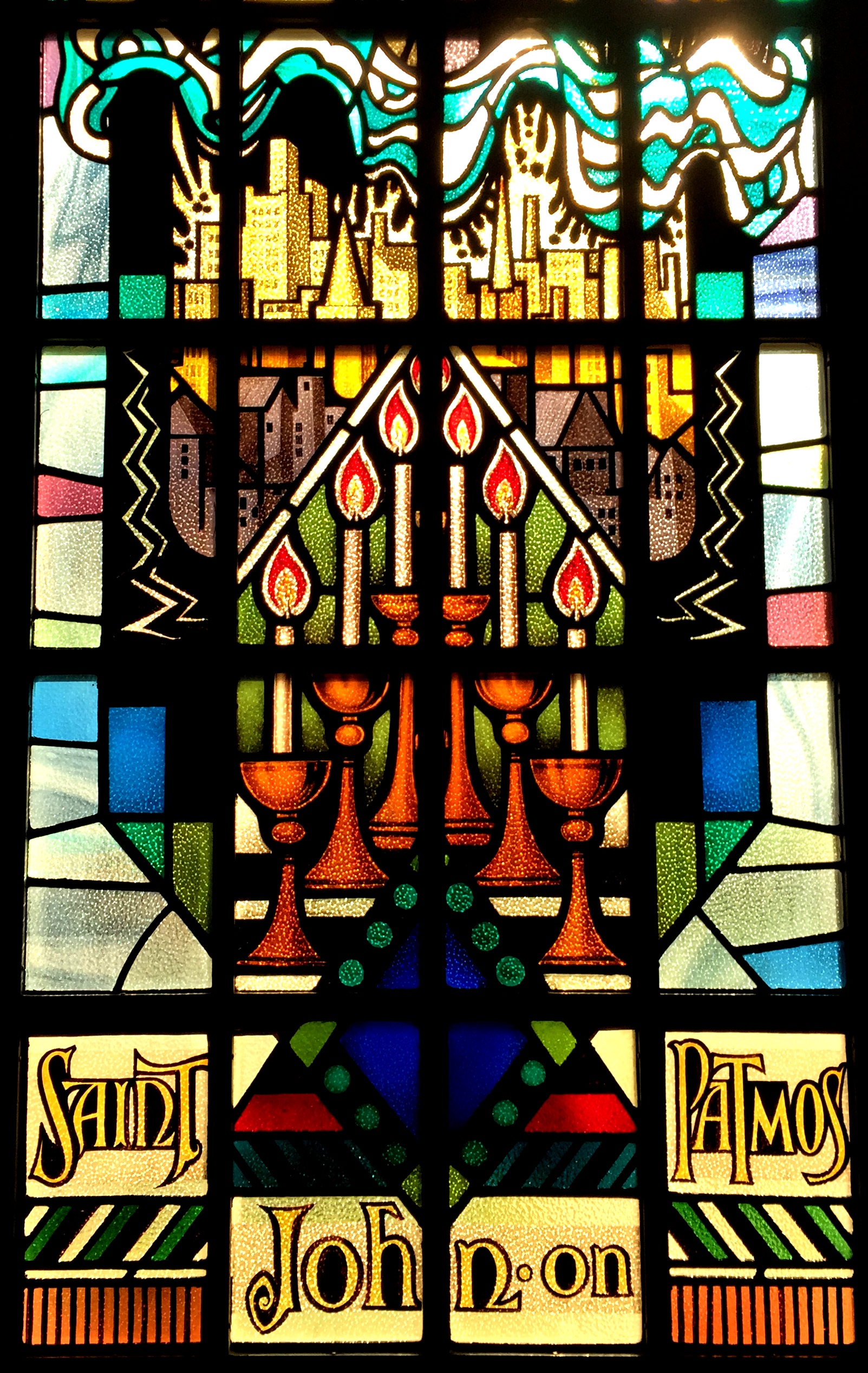
On the right side of our sanctuary we have three stained glass windows that I call The Johns. We have John the Evangelist, John of Patmos, and John the Presbyter. Do they represent three different and distinct men? Are they in fact all the same person, just being shown throughout the different decades?

Early Christian tradition held that John was one of the original 12 disciples who actually lived a long life and was not killed for his faith like the others. It is believed that he was responsible for writing the gospel according to John, the letters 1-3 John, and the final book of the New Testament Revelation. Of course modern scholars debate as to the particular authorship and whether or not one man was responsible for all of these different writings.

What is important for us is the fact that we affirm all of the writing as canon and life-giving, that Christians for centuries have come to discover the living God in the words attributed to John, and that we will continue to live into our discipleship through them.

Our first window displays the young John as the Evangelist. Today when we hear the word evangelism we tend to picture people converting others to follow Christ, but in its most simple meaning, an evangelist is someone who shares the Good News, and in this case, it came through a written account of Jesus life and ministry.

We see a young John holding a chalice and the image of an eagle. The chalice serves to emphasize the importance of the sacrament, and the pouring out of Jesus blood for us. Throughout the gospel of John, Jesus’ atoning sacrifice is a particular focus and theme. Reflecting on Jesus life later, John could remember everything through the lens of the resurrection, and we see the importance of Jesus’ life here in the chalice.

The other detail, the eagle, is very interesting. In Revelation, a book we will talk about shortly, there is a brief section where John describes four winged creatures from his dream. Each of them have come to represent a specific gospel and it’s respective author: Matthew is a man with wings, or an angel; Mark is a lion; Luke is an ox; and John is the eagle.

Whenever our eyes fall to this window we are called to remember the Father’s love in Christ Jesus. Like the winged eagle flying high in the sky we look up to the kind of love that Jesus exemplified and strive to live accordingly. The great sacrifice was made so that our joy could be complete in and with one another as we look on eternity without flinching as we journey toward the goal of communing with the Lord.

John the Evangelist wrote what he did to remember for us what his master taught him: As the Father has loved me, so I have loved you; abide in my love.

Our second window, the one to the right, contains John as the Presbyter. Presbyter comes from the greek word presbuteros which means “elder.” As John grew older and continued to play an integral role in the formation of the early church, it became necessary for him to write letters concerning the faith.

In the window we see a mature John with a quill and parchment. Like we still do today, whenever we encounter the struggles of fellow disciples, we strive to help them through their trials and tribulations. For John, having lived with Christ and experienced the true power of the resurrection, he devoted himself to the early Christians and helped them to understand the importance of love.

He wrote things like: “Do not love the world or the things in the world.” Only a man speaking from a life of wisdom could make such a statement. The desires of flesh and the prides in riches only serve to destroy us because they wither away. All of the false things that we put our faith and hope in are passing away, but the love of God endures forever and ever.

Whenever we glance to this window of John as the Presbyter, we are called to remember the value of wisdom and what it means to grow together. Being Christian is not something that can be done in isolation, but instead can only be fruitful and life-giving if we disciple as a community. John wrote letters to encourage and remind the faithful what it means to be faithful. As disciples we have the responsibility to build one another up for kingdom work.

John the Presbyter wrote to Christian communities about what faithful living was all about: those who do the will of God live forever.

The third window, in the middle, contains John on Patmos. After a life of faith, John was exiled away to Patmos, a small Greek island in the Aegean Sea where he wrote about his visions. The book of Revelation contains fantastic imagery of the way God has, is, and will move  in the world. Our final John is older with a fiery city at his feet, and the new Jerusalem above his head with the lamb.

The Lord gave John certain visions and told him to write them down because they were trustworthy and true. Our window displays the height of the revelation when God will make all things new. A holy city, the new Jerusalem, will come down from heaven. This is where God will dwell with the people, God will wipe away all of our tears. Death will be no more; mourning and crying and pain will be no more. The first things will pass away because God will make all things new.

In our window we see the former things, the earthly passions of the world at the bottom passing away. But God has not, and will not, abandon us to our own devices. The new city at the top will reign and the kingdom will be forever. 

Whenever our eyes fall upon this window we remember that the Lord is with us now and forever. That even in our death we will come closer to the new heaven and the new earth that the Lord has promised. In the midst of our grief and suffering now we can still give thanks to the Lord for that day when he will make all things new. This window calls us to trust the Lord just like John did throughout his life.

John on Patmos wrote down the visions the Lord had provided so that others would come to know what the future holds: The Lord will dwell with us and make all things new. 

St Johns logo

Who are we? A group of Christians who get together week after week to rediscover what it means to follow Christ? A ragtag collection of disciples who need to find a little more light in our lives?

If we want to live into our name, then we need a better story than being named by a District Superintendent. If we want to be the St. John’s that God is calling us to be, then we need to reclaim what that name means for us.

We are St. John’s. That very name carries with it the history of what our church has done for this community. Wherever I go in Staunton I love to tell people that I serve as the pastor here at St. John’s because our name is immediately met with recognition; “My children went to Preschool there!” “My wife and I were married in that sanctuary.” “We buy our Christmas tree from your church every year.”

But we are also more than what we do. Our identity is firmly rooted in the name of John and we should be proud of it. We were named after a man who was called to follow Jesus, remembered the Messiah’s life for other communities, wrote to churches about faithful wisdom, and caught glimpses of future glory. 

Likewise, we are a community of faith that believes in following the Lord, in sharing God’s story with other people, in teaching those younger in the faith about what it means to love, in celebrating the coming day when God will make all things new.

St. John’s; what a perfect name. Amen.

Lost and Found – Easter Sermon on Luke 24.13-35

Luke 24.13-35

Now on that same day two of them were going to a village called Emmaus, about seven miles from Jerusalem, and talking with each other about all these things that had happened. While they were talking and discussing, Jesus himself came near and went with them, but their eyes kept them from recognizing him. And he said to them, “What are you discussing with each other while you walk along?” They stood still, looking sad. Then one of them, whose name was Cleopas, answered him, “Are you the only stranger in Jerusalem who does not know the things that have taken place there in these days?” He asked them, “What things?” They replied, “The things about Jesus of Nazareth, who was a prophet mighty in deed and word before God and all the people, and how our chief priests and leaders handed him over to be condemned to death and crucified him. But we had hoped that he was the one to redeem Israel. Yes, and besides all this, it is now the third day since these things took place. Moreover, some women of our group astounded us. They were at the tomb early this morning, and when they did not find his body there, they came back and told us that they had indeed seen a vision of angels who said that he was alive. Some of those who were with us went to the tomb and found it just as the women had said; but they did not see him.” Then he said to the, “Oh, how foolish you are, and how slow of heart to believe all that the prophets have declared! Was it not necessary that the Messiah should suffer these things and then enter into his glory?” Then beginning with Moses and all the prophets, he interpreted to them the things about himself in all the scriptures. As they came near the village to which they were going, he walked ahead as if he were going on. But they urged him strongly, saying, “Stay with us, because it is almost evening and the day is now nearly over.” So he went in to stay with them. When he was at the table with them, he took bread, blessed and broke it, and gave it to them. Then their eyes were opened, and they recognized him; and he vanished from their sight. They said to each other, “Were not our hearts burning within us while he was talking to us on the road, while he was opening the scriptures to us?” That same hour they got up and return to Jerusalem; and they found the eleven and their companions gathered together. They were saying, “The Lord has risen indeed, and he has appeared to Simon!” Then they told what had happened on the road, and how he had been made known to them in the breaking of the bread.

the-road-to-emmaus-daniel-bonnell

I have been a Christian for as long as I can remember.

I was baptized at 19 days old and church has been there for me my entire life. As a child I loved hearing the incredible stories from scripture: Jesus walking on water, David defeating Goliath, Moses moving through the Red Sea. Church was an exciting place that was unlike anything else I did. In worship I learned how to listen, I learned what it meant to sing my faith, and I found tremendous joy in receiving communion.

Of course, as I grew older, the perfect glow of church began to fade away. We would learn about the importance of love and forgiveness during church, and then I would see a man screaming at his wife in the parking lot after worship. We learned about God’s kingdom as a rich and diverse new reality, but I only saw privileged white people in church. We heard about how important it was to keep the faith, but I started to have doubts about what scripture revealed.

Like most Christians, I have had my doubts. I have been kept awake late at night wondering about the divine, praying for God’s presence to be made known in my life and in the lives of others, and hoping for something to cleanse my unease.

Yet, it is almost always in the midst of a question, at the precise moment that I feel most lost, that God shows up and finds me.

The two disciples on the road were filled with doubt. We don’t know anything about the two who were walking to Emmaus; they weren’t famous, and they weren’t part of the 12 – they were just common, ordinary disciples like you and me.

I can’t even begin to imagine what it must have felt like to be walking on that road on that day so long ago. They had followed Jesus throughout Galilee and heard him proclaim the Good News, they had seen him heal the sick and feed the hungry, but just days previous they saw him betrayed, arrested, and murdered.

They might have known where they we walking, but I bet they felt lost. They had put all their hope and faith in a man who was buried in a tomb and now his body was missing. They thought the world was going to change, but the dirt under their feet felt even worse than before.

Suddenly, Jesus found them on the road and he went with them. Yet, they did not recognize the Lord in their midst. “What are you two talking about?” he asked. To which one of them replied, “Have you been living under a rock? How could you not have heard about the things that have taken place in Jerusalem?”

Jesus asked, “What things?

Immediately they began to explain all that they had seen and heard. “Jesus of Nazareth, a mighty prophet, was betrayed and sent to his death. We had hoped that he was the one who would save us. And now three days have passed and some of the women from our group went to his tomb and they say his body was missing and angels appeared, but no one has seen him.”

Jesus then began interpreting the scriptures to the men on the road, from Moses through the prophets, he showed how what had come to pass was part of God’s great cosmic plan. And yet, they still did not recognize him.

Later, as they came near Emmaus, Jesus kept walking on but the men invited him to stay. When they sat down at a table to eat, Jesus took bread, blessed it, broke it, and gave it to them. With the bread in their hands their eyes were opened and they finally understood who had been with them the whole time and he vanished.

All of the sudden everything started to make sense, the encounter on the road, the strange question, the interpretation of scripture, and even the holy meal. “Were not our hearts burning within us while we were together with the Lord?” Immediately they went back to Jerusalem to declare the good news: “The Lord has risen indeed!

resurrection-2

On Friday at noon I took the cross from our sanctuary, placed it on my shoulders and started walking around Staunton. When I did the same thing last year and I was largely ignored. For hours I walked through our community and most people averted their gaze, they tried to pretend that there was no cross for them to see.

This year, the opposite happened. People would honk their horns as they passed, they would roll their windows down and give me a thumbs-up. I saw familiar faces throughout my journey and felt glad for the sense of community that I experienced.

I carried the cross around because I want to bring the Lord to people outside of church. If we continue to falsely assume that we can only experience God’s grace in a place such as this, it will never grow and give life to other people.

Anyway, I was bearing my cross through Staunton and I was walking along the sidewalk on Beverly Street when I was stopped. In front of me stood an older woman with a large shawl draped around her shoulders and she kept staring at the cross. For a period of time that felt uncomfortably long we just stared at one another without saying anything until I saw her lip quiver and she asked a question that I was not expecting: “What will happen to me when I die?

I stood there with the cross digging into my shoulder and I felt the spirit of God fall upon us in that holy moment. Instead of giving some densely theological answer, and instead of evading the depth of her question I told her what I believed: “When we die God will take care of us. I don’t know what it will feel like or what we’ll experience, but the God that has been revealed to me will take care of us.

What kind of faith do you have?” she asked.

I explained that I am a pastor in the United Methodist Church, but above all I am a disciple of Jesus Christ.

Tell me about him,” she said.

So I did. I started with Christmas and the story of God coming in the form of flesh as a baby to be in the world with us. Jesus grew and called people to know that they were loved regardless of their life circumstances. This Messiah went out and found the people who were ignored by the rest of the world and he gave them value. He preached, healed, and he loved. And then Jesus was betrayed, arrested and killed on a cross for everyone to see, and three days later he was raised from the dead. The beauty of what Jesus did is that he died so that we might live. Jesus died for you, and for me, so that we might live.

Tears began to well up in her eyes, she reached forward to hug me, thank me, and before I knew it she was gone.

I can’t tell you anything about her other than our brief interaction, but to me it felt like she was lost and then Jesus found her in the cross and in the story. Whatever she had going on in her life suddenly fell away and she felt valued and loved by the one who came to live and die for us.

Jesus came to the disciples on the road, and not the other way around. They were lost in their thoughts and doubts and were incapable of recognizing Jesus in their midst. Only through the scriptures, and through the bread and wine did Jesus reveal himself to them, he demonstrated what his life had been all about: his resurrection means our resurrection.

Those of us here in church on Easter Sunday are in the same position as those two disciples on the road. Jesus has come to us here in this place through the reading of scripture, and in a few moments we will encounter the risen Christ through the bread and cup at the table.

I don’t know what you’ve got going on in your life. Most of us are pretty good about shielding away and hiding our doubts and insufficiencies. We turn on the smiles when we need to, and we know what we have to do to keep afloat. I don’t know what you might be wrestling with right now, or even if you’re wrestling with anything at all. But I do know this: If you took the time to come to a church on Easter, you believe in something more than yourself, even if its very faint.

road_emmaus

My faith is not perfect, and there are days that I struggle. I’ll be driving in my car on the way home from the hospital after praying with a family before a desperate surgery, or I’ll be standing above a casket with dirt still clinging to my fingers after saying goodbye to a faithful friend, or I’ll be reading the news online and be bombarded with never-ending negativity. There are many days that feel as if I’m walking to Emmaus all on my own with questions in my head just like those two disciples so long ago. But that’s when Jesus shows up.

Jesus isn’t looking for people with perfect faith and blind trust. God does not want puppets that he can string along. If Jesus is looking for anyone, it’s the people who are walking toward their own Emmaus. He’s looking for people like you and me who have questions.

Faith is an exciting thing not because it provides all the answers to our questions, but because it encourages us to ask questions in the first place. 

Jesus’ resurrection from the dead is not something that can be explained from a pulpit or from a book, it defies all logic and rationality, it exceeds our expectations, and often leaves us scratching our heads. But that’s the point. It is beyond anything we could ever imagine. Only the Lord who gives us life could have come up with something so incredible to change the world.

The resurrection is real, Christ appeared to the two on the road and revealed himself through the wonders of God’s word and holy table. God died in Christ on a cross and defeated death so that we might live with him in the kingdom; Christ died so that we might live.

The Lord is risen. God is on the move in the world seeking out those who are lost. God loves showing up in the words of scripture, in the bread and wine of communion, in chance encounters on the road, and in a variety of places to help find those of us who are lost.

Do we feel our hearts burning within us while we praise the living God? Do we feel the blessed holiness that comes with receiving this meal broken and shed for us? Are we ready to be found by the living God while we make our way to Emmaus?

The good news of Easter is that Christ’s resurrection has made our resurrection possible. But until that day when we feast with him at his heavenly banquet, I think the good news can be found when we feel lost on the old roads of life and Jesus finds us. Amen.

Think of the Children! – Sermon on Psalm 78.1-8

Psalm 78.1-8

Give ear, O my people, to my teaching; incline your ears to the words of my mouth. I will open in my mouth a parable; I will utter dark sayings from of old, things that we have heard and known, that our ancestors have told us. We will not hide them from their children; we will tell to the coming generation the glorious deeds of the Lord, and his might, and the wonders that he has done. He established a decree in Jacob, and appointed a law in Israel, which he commanded our ancestors to teach their children; that the next generation might know them, the children yet unborn, and rise up and tell them to their children, so that they should se this hope in God and not forget the works of God, but keep his commandments; and that they should not be like their ancestors, a stubborn and rebellious generation, a generation whose heart was not steadfast, whose spirit was not faithful to God.

kids-in-church

I love when scripture is straight-forward. With the amount of passages in both the Old and New Testaments that remain ambiguous, it is remarkably refreshing to encounter a text that is so simple with its claims and expectations.

Listen up! Open your ears to what I’m about to say regarding the mighty acts of God. I will remember for us the forgotten sayings from the past, we will not hide them from the children, we will share with them all the wonders of God. The Lord commanded our ancestors to teach our children, so that they would indeed teach their children, so that none of us would forget what God has done. Above all, let us not fall back into the rhythms of our distant ancestors, a stubborn and rebellious generation, a generation whose heart was not steadfast, nor was their spirit faithful to God.

What follows our reading from this morning is a record of history in song. The psalmist sets up his challenge: to remember the mighty acts of God for the future generations; and then declares the history of God with God’s creation. The tradition, the narrative, is so strong that the psalmist will not depart from it, since his purpose is to instruct rather than to entertain. That old old story has become so important to him, that he will tell it to the best of his ability for the sake of God’s people.

As I read the words to Psalm 78 this week, I couldn’t help but wonder about what we are teaching our children. If our desire to instruct the future generations regarding the mighty deeds of God is as strong as this Psalm claims, then how are we living that out today in our faith and in our church?

3rnvk6

On Tuesday morning, with the words from scripture percolating in my heart and soul, I made my way down to the Preschool to welcome our children into the building. I’ll admit that opening the door for our students is one of the things that I look forward to most during the week. The children are always so excited about entering the classrooms for the activities and learning that will enrich them. Whereas many parents have to drag their high-school students out of bed, banging pots and pans, even dumping water on them to wake them up, the Preschool students see school as something worth celebrating and waking up for!

It brings me so much joy to see their smiling faces every morning, to hear them shout “Pastor Taylor!” and run over to give me a hug as if they thought that they had lost me forever, to see them walking with their parents or guardians hand in hand hopeful for the day ahead. When I look at them in the morning I can’t help but think about the future generations of the church, and our community. In the basement of our building, we have the privilege of shaping, molding, and nurturing those who will one day take care of us.

Anyway, when the children arrived on Tuesday morning they came in with their normal excitement and made their way to their respective classes. I usually try to sneak back down around snack time for the selfish purpose of receiving some carrots with ranch dressing, or pretzel sticks, and I often ask each of the children what they had been learning about that morning.

“Pastor Taylor, I learned about the letter “G.” Goofy, Girl, Grass, and Grapes!”

“Pastor Taylor, I learned that spiders have eight legs and make a web to catch their food!”

“Pastor Taylor, I learned that we stole the land away from the Indians and forced them to move across the country!”

On Tuesday morning, every one of those children looked at me when I walked in, and shouted, “Pastor Taylor, we learned how to vote!” The teachers had set up a voting booth in the yellow room, and each child had the opportunity to vote on their snack for the day: Pringles Chips, or Oreo Cookies (obviously Oreos were victorious). Every child had the opportunity to go behind the curtain, place their vote in secrecy, and then received an “I Voted!” sticker.

10629408_721542274588756_4548535686040301173_o

Downstairs in the basement we work on educating the future generation on the important things: Letters, Shapes, and Numbers; Animals, Plants, and Weather; Hygiene, Responsibility, and even Civic Duty. However, sometimes we get so caught up in the education of our youth, that we lose sight of what God has called us to do. Because right now I know that every child from our Preschool can tell you why we vote, and how we vote, but I know that only a few of them can tell you who Jesus is, and what he came to do. What does it say about our culture when more people now recognize the McDonald’s Golden Arches than they recognize the cross of Jesus Christ? What does it say that we train our children regarding voting procedures, but we do not teach them how to pray?

I have very fond memories of growing up in church. I loved the change in the liturgical seasons, and the different colors around the altar. I loved getting invited up to the front of the church once a month to receive communion. I loved getting to hear the choir sing with passion on a regular basis. I loved church because it was fun.

Yet, I can’t really remember what I learned. I know that when I was much younger, we, the kids, were only allowed to stay in the sanctuary until the “children’s sermon” and then we were escorted out of the sanctuary to the classrooms to work on arts and crafts as if whatever was happening in worship was for adult audiences only; Aldersgate UMC Rated PG-13

I remember learning about the big stories, the ones that everyone knows: Noah and the Ark, David and Goliath, Jesus and his disciples. But there are so many things about church that I never learned. 

My grandmother remembers her mother placing a coin in her hand every Sunday so that she would place it in the offering plate. From a young age she was habituated into the practice of giving back to God out of the abundance that she had. But by the time my mother came around this was not something that was instilled in her, and therefore it was not instilled in me. I have no idea whether or not my parents ever gave money to the church because it was not something we ever talked about.

What I do remember is a story that one of my pastors told about receiving a letter from a young boy in the congregation. The boy had been mowing lawns in the community and his parents had talked to him about the importance of tithing so that boy collected 10% of his lawn-mowing earnings, and placed them in the offering plate inside of a ziplock bag. The way my pastor told the story was so powerful that it got many of the adults crying. Look at the faith of this young boy and his willingness to give back to God!

Photo of a Collection Plate

But when I think about that now, I don’t see it as something special, in fact I see it as something rather ordinary. The fact that it was something so deeply celebrated as a rarity is another testament to the fact that we have neglected to tell the story of God’s mighty acts to the coming generation. They recently did a study at my home church and they discovered that only 25% of the people who attend worship give money to the church. That means that 3/4 people in the pews let the offering plate pass right over them. What are we instilling in the future generations that allows them to witness the incredible acts of God in the world today? How are we sharing the story with others so that we remember who we are and whose we are?

Instead, we hope and expect that others will just figure it out on their own and that they will know to give 10%, that they will know how and when to pray for their enemies, that they will place their hope in the resurrection in the midst of death. We so desperately want to privatize everything in our lives that we don’t want to talk about our prayers, we don’t want to talk about how much we give to church, and we don’t walk to talk about when and how we doubt.

When I was in seminary we were required to take a class on preaching. For weeks we gathered in the basement of the Divinity School listening to our professor lecture on the importance of proclaiming the Word, and then we were asked to preach in front of our peers on assigned texts so that they could critique our style and form. One day however, our preaching class went on a field trip to one of the local funeral homes in Durham, NC. The point of the visit was to help prepare us for the sermons that we would be preaching at funerals, offer advice on how to interact with funeral home directors, and talk about the theology behind death.

We walked through the facility from the basement where they did the embalming to the chapel where they held smaller services. And when we passed through one of the rooms, I noticed that a coffin had been prepared and opened for a viewing that would happen that afternoon. I stopped to pay my respect and offer up a brief prayer when I saw one of my friends frozen in place with her gaze locked on the casket. At 27 years old, she had never seen a dead body. Even with all the training and reading, the practice and focus, she was completely shocked by the sight, and I had to physically help her out of the room to continue the tour. I can remember her muttering under her breath as if she was unaware that she was actually speaking “death is so real.” I learned later that she had never been to a funeral and seeing that embodiment of death for the first time came as a frightening and almost overwhelming dose of reality.

What does it say when we keep our young people from experiencing death through funerals? Are we so afraid of death that it blinds us from the hope of the resurrection? Are we so concerned about how it might affect the coming generation that we neglect to instill in them the story about how God conquered death through Christ on the cross?

Of course, this isn’t just about teaching children the stories. It’s about all of us, whether we’re nine or ninety. We gather here in this space to remember, over and over, the great acts of God in the world. We move from creation, to redemption, back and forth, to remind one another what God did for us, and what God continues to do through us.

The psalmist, so long ago, believed in retelling the story to help shape the people of God. The psalmist believed that in going back to their origins, by remembering who they are and whose they are, they would always find the living God. When we retell the story we become a people of habit and pattern, we become shaped by the Word to be Christ’s body in the world today. 

We tell the story to open our eyes to how God has provided us with so many blessings that we respond by giving back to God our tithes and offerings. We tell the story so that we can open our hearts to the ways that we can love God and love our neighbors as ourselves. We tell the story so that we can open our souls to the great cosmic victory over death and remember that we have the hope of the resurrection.

If we want the coming generations to be steeped in the Word of the Lord, if we want them to remember the glorious deeds of God, and his might, and the wonders that he has done, if we want them to be a people of hope, then its up to us to share the story with them.

Amen.

How Did You Two Meet? – Pentecost Sermon on Acts 2.1-13

Acts 2.1-13

When the day of Pentecost had come, they were all together in one place. And suddenly from heaven there came a sound like a rush of a violent wind, and it filled the entire house where they were sitting. Divided tongues, as of fire, appeared among them, and a tongue rested on each of them. All of them were filled with the Holy Spirit and began to speak in other languages, as the Spirit gave them ability. Now there were devout Jews from every nation under heaven living in Jerusalem. And at this sound the crowd gathered and was bewildered, because each one heard them speaking in the native language of each. Amazed and astonished, they asked, “Are not all these who are speaking Galileans? And how is it that we hear, each of us, in our own native language? Parthians, Medes, Elamites, and residents of Mesopotamia, Judea and Cappadocia, Pntus and Asia, Phyrgia and Pamphylia, Egypt and the parts of Libya belonging to Cyrene, and visitors from Rome, both Jews and proselytes, Cretans and Arabs – in our own languages we hear them speaking about God’s deeds of power.” All were amazed and perplexed, saying to one another, “What does this mean?” But others sneered and said, “They are filled with new wine.”

Acts 2:1-4. When the day of Pentecost came. Pastel & pen. 26 May 2012.

I had spent an entire week with countless young Christians from all over the world at a monastery in Burgundy, France. For most weeks during the summer, Taize attracts upwards of 5,000 young Christians dedicated to exploring their faith through prayer, service, and singing. Waking up in a tent every morning, I would trudge across the dew filled grass passing neon tents filled with 20-somethings snoring away as the sun came up over the horizon. Each little campsite held clues as to the nationality of the residents: the occasional German flag, a water bottle covered in French writing, an abandoned tee-shirt with a hispanic wrestler flexing on the front, I even saw a cricket bat one morning. As the crowds made their way to the sanctuary, it was impossible to eavesdrop or understand what anyone was talking about because no one was speaking English.

Just past the interior door to the incredibly large sanctuary, there were buckets filled with hymnals organized by language. On our first morning I was surprised to discover that there were more “English” hymnals left in the buckets than any others, because Americans were part of the minority of the gathered body.

Taize Altar

Taize Altar

We sat on the floor surrounded by other young people who were still half asleep fumbling through our hymnals before the service began. Suddenly, up at the front of the massive building, a simply lit sign displayed three numbers “312” and as if we were being controlled by a single operator we all flipped our pages to the corresponding hymn. Without any musical accompaniment, without any choral direction, the hymn began. I, of course, sang the hymn in English as the words were displayed on the page, but when I made my way to the end of the song, everyone continued singing. We were not told how many times to repeat the hymn, but it went on and on until in ended naturally at the same moment. It was unlike anything I had ever experienced. When I had finally caught on to the rhythm of our singing, I closed my eyes and began to hear all of the other voices singing faithfully in their native tongue. Without a doubt, that moment as I sat on the floor of a enormous sanctuary in France, was the closest I have ever been to experiencing the day of Pentecost in my own life.


The community of faith had recently witnessed Jesus’ ascension into heaven and then retreated to the upper room in Jerusalem to devote themselves to patience and prayer. For ten days they waited, as they had been told to do, waiting for something to happen. We are given very little in Acts about what they did those ten days but we do know that rather than taking matters into their own hands, instead of getting organized and venturing forth with pamphlets about “what God can do for YOU”, they waited for God to make the next move.

The day of Pentecost, what we celebrate and remember today here in church, was the first big thing to happen to the disciples after Jesus had left them. Like the start of any life or story, the beginning has major ramifications for how the rest will turn out. Just as with Jesus’ birth in the manger in Bethlehem to a virgin, so too the details surrounding the birth of the church would come to define the rest of the story for Jesus’ followers.

CELPentecost[1]

As the morning broke, while the disciples were all together in one place, an eruption of sounds and a wind from heaven filled the entire house. Things were coming loose and breaking open, new realities were taking shape, and the life of discipleship was changed forever. The wind swirled around the gathered people, the same wind which on the very first morning swept across the dark waters and brought order out of chaos. The wind of Genesis was again bringing something new to life.

Divided tongues, as of fire, appeared among them and each of them were filled with the Holy Spirit and began to speak in other languages, as the Spirit gave them ability. What a strange and profound moment this must have been! After days of waiting in prayer God had showed up and quickly put things into action. Though the Spirit brought order out of chaos in Genesis, this must have felt like the opposite. I imagine the disciples running about within the house exclaiming great things in languages they themselves had never heard before. Something this incredible and inexplicable could not be contained to one house alone, and a crowd quickly gathered and was bewildered by the indescribable moment.

Jews from all over had gathered in Jerusalem when this took place and they began to hear these nobody disciples speaking in the native languages of all the people. Amazed by this, they questioned how it was possible, and quickly decided to blame it on an excessive use of alcohol.

The crowd’s demand for an answer was a cue for one of the disciples to stand and speak. And who, among the disciples, could have imagined that Peter would have been the one to do so? Peter is the first, the very first to lift up his voice and proclaim proudly and faithfully the word that he was unable to when Jesus had been arrested. The man who had been so quick to deny Christ three times, is the one who stepped forward to share the glory of God’s kingdom with all who questioned this miracle.

Peter preached a sermon, he shared the story of God in Christ, all by the power of the Spirit: “listen to what I have to say: Jesus of Nazareth, a man attested to you by God with deeds of power, winds, and signs that God did through him among you, and you yourselves know — this man, who was handed over to be crucified and killed, was raised by God, having been freed from death because it was impossible for him to be held in its power…” Peter told the story that he had witnessed and thus helped give birth to the church that we now participate in today.


I have been here at St. John’s for almost a year. The last twelve months have been filled with changes, excitement, new life, and joy. I give glory to God for sending me to a place with such faithful people who have helped me to see God in new and wonderful ways, while also allowing me to do the same. 

I knew that, upon arrival, one of the most important things I could do would be to learn the collective story of the church. I have met with many of you to learn about your lives and your stories in such a way that I could learn about our community that gathers here for worship. When I meet with couples I almost always ask the same question: How did you two meet? I ask this question because how two people met says a considerable amount about their relationship, and most people love to tell that particular story.

I can tell you with joy this morning, that many of you met in wonderful and joyful ways. I have had the privilege to hear about a couple who met on a Greyhound bus traveling to Radford, VA over 65 years ago. We have a couple who met at a brewery when the young woman complimented the young man on his beard. Or there’s the couple who met in a spousal grief group after having both been divorced. We even have a couple who met here in church and the boy asked his brother to the get the number of the girl so he could ask her out later.

I love asking how a couple met because people can tell the story with all the important details. They can remember the outfits they were wearing, the weather outside, and the other people who were present. They can describe with vivid clarity that first smile they saw, or the way their fingers felt when they wove them together for the first time. And frankly, I love asking the question because it is hilarious to watch men and women argue about the details of a meeting from their own perspectives.

(Photo Credit: Jill Nicole Photography)

(Photo Credit: Jill Nicole Photography)

But sometimes I think about the gospel story and I wonder how that connects us. I freely admit that when I ask couples about how they met I am not expecting anyone to start talking about Moses or Abraham or the Holy Spirit. But the Gospel story is one that we should know just as well. Many of you have been attending church for your whole lives, and even those of you who have recently started to attend, have heard the story of God in Christ week in and week out. The story that we find in scripture is inescapable because it is ours. 

I ask people about who they met because it teaches me about whom they are. It helps to reveal parts and aspects of personality that would otherwise remain hidden, it sheds light on what brings people joy and how they connect with others. But in the same way, the Gospel is who we are. It is as much a part of our personalities and joy and interconnected as the story about how we met our spouses.

When Peter stood in front of the crowd on the day of Pentecost he told the story of God in the world through Jesus, his friend and Lord. With confidence and bravery he proclaimed the same story that we tell here in church every week. We should know the story that Peter shared, we should be able to tell it with the same clarity and detail and faithfulness. Imagine how powerful the gospel story would be, if you knew it and believed it and experienced it in the same way you met your spouse.

The gospel is something worth sharing. I don’t mean in the sense that you should start knocking on people’s doors to ask: “Have you heard about our Lord and Savior Jesus Christ?” But I want to question our willingness to keep telling this wonderful and life-giving story.

After all, how would anyone know whether or not you’re a Christian?

Maybe you wear a cross around your neck, or you pray before your meals at restaurants, or you tell people about what fun activities are going on at your church… But seriously, how would anyone know if you’re a Christian?

We can tell the story of God’s interaction in the world through ways that are both faithful and fruitful. Like those first disciples the Holy Spirit has been poured on to us in such a way that we are now filled with the Spirit and have been given gifts. The disciples were given the power to speak in numerous languages in order to convey the gospel to the multitudes. Today we have been given the power to meet people where they are in order to be Christ’s body for the world.

Imagine the next time someone started to tell you about a recent tragedy, you responded by asking to pray for them. Or the next time you hear about a family thats having a difficult time adjusting to a new life in Staunton, you invite them over for dinner out of kindness rather than expectation. Or the next time you believe that someone has been treated unjustly, you speak up for them rather than expect someone else to do it. And when you’re asked why you have done these things, answer truthfully and confidently: “I am a disciple of Jesus.”

The Spirit that empowered those disciples still empowers us. Like the cacophony of languages that were all singing to the Lord at Taize, we are called to raise our voices, to go public with the good news. As we see with the way Peter proclaimed the story on behalf of the church, we also have something to say, we need only the courage to stand up, open our mouths, and begin.

Amen.