This week on the Strangely Warmed podcast I speak with Alan Combs about the readings for the First Sunday After Christmas [A] (Isaiah 63.7-9, Psalm 148, Hebrews 2.10-18, Matthew 2.13-23). Alan is the lead pastor of First UMC in Salem, VA. Our conversation covers a range of topics including band names, timeliness, gracious deeds, Christmastide, corporate worship, belonging, praise, Winter Camp, Karl Barth, sanctification, reality, the implications of the incarnation, and presence. If you would like to listen to the episode or subscribe to the podcast you can do so here: The Politics of Christmas
This week on the Strangely Warmed podcast I speak with Drew Colby about the readings for the Fourth Sunday of Advent [A] (Isaiah 7.10-16, Psalm 80.1-7, 17-19, Romans 1.1-7, Matthew 1.18-25). Drew is the lead pastor of Grace UMC in Manassas, VA. Our conversation covers a range of topics including Christmas gifts, The Alabama Shakes, ghosts, signs, weariness, keeping the cross in Christmas, the bread of tears, salvation, epistolary preaching, grace, belonging, Sam Wells, prophecy, and The Mother of God. If you would like to listen to the episode or subscribe to the podcast you can do so here: The Obstinance of God
This week on the Strangely Warmed podcast I speak with Drew Colby about the readings for the Third Sunday of Advent [A] (Isaiah 35.1-10, Psalm 146.5-10, James 5.7-10, Matthew 11.2-11). Drew is the lead pastor of Grace UMC in Manassas, VA. Our conversation covers a range of topics including the film Spirited, seasonal food/drinks, Cage The Elephant, Fleming Rutledge, Advent themes, the glory of the Lord, grief, radical goodness, divine agency, narrative theology, patience, Love Actually, and water in the desert. If you would like to listen to the episode or subscribe to the podcast you can do so here: The Gospel Is A Promise
But when John saw many Pharisees and Sadducees coming for baptism, he said to them, “You brood of vipers! Who warned you to flee from the wrath to come?”
Tomorrow morning my six year old son will open up his Star Wars Lego Advent Calendar and will promptly put together a little droid, or a mini-figure, or some other object from a long time ago in a galaxy far, far away.
And he will rejoice.
But it’s hard for me to call it an actual “Advent” calendar. First, Advent started last Sunday, not December 1st. Second, the little trinkets are certainly fun but they don’t really have anything to do with the “hastening and waiting” that define this season. And, finally, Advent points to the arrival (and return!) of our Lord Jesus Christ, whereas most (if not all) Advent calendars point to the arrival of presents under a tree on Christmas morning.
Fleming Rutledge, my theological Advent hero, was once similarly struck by the strange juxtaposition of Advent calendars and the real message of Advent and said that the best Advent calendar would be one in which, every time you opened the next day/box, a strange bearded and camel-hair wearing man would jump out and shout, “You brood of vipers!”
John the Baptist gets to shine this time of year in church because he straddles the already but not yet. He sees the new world coming and warns the people of “the wrath that is to come.”
It just happens that the wrath of God is made manifest in the cross that is our salvation.
The church, in Advent, takes up John’s mantle and proclaims the truth that something is coming, and that we do need to prepare for it, but only because to miss it would ruin all the fun.
And yet, there is a strong temptation to make the call for preparation all about our need to finally make the world a good enough place for Christ to arrive. Preachers and pontificators alike will stand up and say things like, “You need to work on your racism, sexism, ageism, stop using styrofoam, go vegan, gluten-free, eat locally, think globally, live simply, practice diversity, give more, complain less, stop drinking so much.”
Which are all worthy things for us to do. But Christ arrives whether we do them or not. Frankly, Christ arrives because we do not do the things we should do. That’s the whole point!
Therefore, we don’t come to church in Advent (or any other time of year) to hear about what we need to do. Instead we come to hear about what’s been done, for us!
Or, as Martin Luther put it, “The Law says, ‘Do this,’ and it is never done. Grace says, ‘Believe in this,’ and everything is already done.”
The sad and bitter truth of this season is that we are “a brood of vipers” and that we have much to repent. And yet, the truly Good News of Advent is that Christ comes for us anyway. That’s why we sing of the hopes and fears of all the years – it is downright terrifying to be loved by God because we simply don’t deserve it.
This week on the Strangely Warmed podcast I speak with Drew Colby about the readings for the Second Sunday of Advent [A] (Isaiah 11.1-10, Psalm 72.1-7, 18-19, Romans 15.4-13, Matthew 3.1-12). Drew is the lead pastor of Grace UMC in Manassas, VA. Our conversation covers a range of topics including ASMR, lectionary cycles, spaghetti with maple syrup, The Muppets Christmas Carol, fear, the word of judgment, righteousness, ecclesial harmony, the magic of music, apple trees, the central advent character, and prophetic insanity. If you would like to listen to the episode or subscribe to the podcast you can do so here: Stumped
This week on the Strangely Warmed podcast I speak with Drew Colby about the readings for the First Sunday of Advent [A] (Isaiah 2.1-5, Psalm 122, Romans 13.11-14, Matthew 24.36-44). Drew is the lead pastor of Grace UMC in Manassas, VA. Our conversation covers a range of topics including Handel’s Messiah, Chicago, Advent themes, the house of the Lord, church attendance, Fleming Rutledge, hopes and fears, worldly preferences, divine peace, Good Mythical Morning, progress, and Dietrich Bonhoeffer. If you would like to listen to the episode or subscribe to the podcast you can do so here: Does Anybody Really Know What Time It Is?
Therefore I tell you, do not worry about your life, what you will eat or what you will drink, or about your body, what you will wear. Is not life more than food, and the body more than clothing?
The older I get the more complicated Thanksgiving becomes.
When I was a kid Thanksgiving was marked by plates upon plates of delicious food, eavesdropping on grown up conversation, and running around in the cold until one of the aforementioned adults beckoned us back inside.
But as an adult, Thanksgiving often feels more like a powder keg of political positioning where everyone waits for the one person to say the one thing that will set everyone off.
And that’s not even mentioning the logistic nightmare of figuring out who will cook what and how in a tight time frame!
Gone are the days of civil and non-partisan Thanksgiving tables (if they ever really existed). This year we are likely to hear opinions on presidential decrees, gubernatorial soundbites, and judicial rulings, just so that everyone else can know exactly what side of what issue we are on.
Which is remarkably strange, at least from a Christian perspective, considering the fact that Jesus came to destroy the very divisions we so desperately cling to and want to demonstrate around our tables.
Or, to put it another way, Jesus’ table makes what we usually do at our tables unintelligible.
Therefore, this year, I’ve put together a brief Thanksgiving Liturgy to be used by anyone in order to redeem the Thanksgiving table. You may say it privately to yourself, or you may read it corporately with others, but the hope is that it will bring a sense of clarity to an otherwise bewildering experience.
–
Prayer:
Almighty God, Father of all mercies, we your unworthy servants give you humble thanks for all your goodness and loving-kindness to us and to all whom you have made. We bless you for our creation, preservation, and all the blessings of this life; but above all for your immeasurable love in the redemption of the world by our Lord Jesus Christ; for the means of grace and for the hope of glory. And, we pray, give us such an awareness of your mercies, that with truly thankful hearts we may show forth your praise, not only with our lips, but in our lives, by giving up ourselves to your service, and by walking before you in holiness and righteousness all our days; through Jesus Christ our Lord, to whom with you and the Holy Spirit, be honor and glory throughout all ages. Amen.
Scripture:
Psalm 126: When the Lord restored the fortunes of Zion, we were like those who dream. Then our mouth was filled with laughter, and our tongue with shouts of joy; then it was said among the nations, “The Lord has done great things for them.” The Lord has done great things for us, and we rejoiced. Restore our fortunes, O Lord, like the watercourses in the Negeb. May those who sow in tears reap with shouts of joy. Those who go out weeping, bearing the seed for sowing, shall come home with shouts of joy, carrying their sheaves.
Meditation:
Jesus boldly proclaims in the midst of his temptations in the wilderness that, “One cannot live by bread alone.” It is certainly true that we need food to survive, but we need more if we want to really live. When we sit around the table with friends, family, and even strangers, we are participating in a moment that is more than merely sharing food. It is through our conversation and our prayers and our thanksgiving (the action, not the holiday), that Jesus’ presence is made manifest among us. In many ways the table at Thanksgiving is an extension of the Lord’s table to which we are beckoned again and again even though we don’t deserve it and we cannot earn it. So let us rejoice in the knowledge that, through the power of the Spirit, God has done great things for us.
Prayer:
Lord, help us to be mindful of those who do not have a table around which to gather, celebrate, remember, and rejoice in all that you’ve done, are doing, and will do. Work in and through us such that our tears turn into laughter, and our mourning into rejoicing. Let the feast around the table give us a foretaste of the Supper of the Lamb made possible through your Son, our Lord, Jesus Christ. Amen.
O Lord, our Sovereign, how majestic is your name in all the earth! You have set your glory above the heavens. Out of the mouth of babes and infants you have founded a bulwark because of your foes, to silence the enemy and the avenger. When I look at your heavens, the work of your fingers, the moon and the stars that you have established; what are human beings that you are mindful of them, mortals that you care for them? Yet you have made them a little lower than God, and crowned them with glory and honor.
Matthew 21.14-17
The blind and the lame came to him in the temple, and he cured them. But when the chief priests and the scribes saw the amazing things that he did, and heard the children crying out in the temple, “Hosanna to the Son of David,” they became angry and said to him, “Do you hear what these are saying?” Jesus said to them, “Yes; have you never read, ‘Out of the mouths of infants and nursing babies you have prepared praise for yourself’?” He left them, went out of the city to Bethany, and spent the night there.
It was a busy Sunday morning.
The confirmands were getting confirmed.
The choir was trying out a new anthem.
The sermon was a sitting at a solid B-.
Nevertheless, I stood and addressed the people of God, all while constantly referring to the overstuffed bulletin in hopes that I wouldn’t, accidentally, skip over part of the service.
God gathered us. God spoke God’s word to us. And the time had come for us to respond. The confirmands were, finally, confirmed, and were therefore the first in line to receive communion. They, being the good and holy tweenagers they were, made silly faces at me when I offered the bread, doing their best to mess me up. I kept my cool, being all holy up at the front with my long robe and made a mental note to teach those kids some some respect after the service.
I kept distributing the bread with the solemnity required at such a moment.
Eye contact.
Knowing head nods.
The subtle tap on the hand.
Until, the very end when the final person came forward to receive the body and the blood of our Lord.
Owen.
I confess I was momentarily surprised to see Owen standing before me and below me in the middle of the sanctuary because Owen was barely three years old, a child from our preschool, and his family had never been to church before.
I looked around for his mother, and father, and little sister and found them frantically rushing around the back of the church as if they had lost something.
The something they lost was standing right below me.
“It’s my turn pastor Taylor,” he said, “I want some Jesus please.” And he opened his mouth like a little baby bird and waited for me to drop a piece of bread in.
So I did.
I then, of course, picked him up and carried him to the back of the church where his family expressed their gratitude for the lost having been found, and then I sprinted down the center aisle to get us back on track.
As the big, grown-up, entirely responsible, never child-like adult that I am, I am quite good at making myself the center of all things.
It doesn’t matter whether I’m at a dinner party or standing up in a space like this on Sunday morning – I get used to things going a certain way, the ritual of it all, the comforting domestication of life. So much so that I, occasionally, forget to pay attention to the Spirit who insists on defying and upending expectations.
God, bewilderingly, likes to drop road signs pointing us in the right direction, or smacking us in the face with stop sign to halt us dead in our tracks.
God’s ways are not our ways.
One day, Jesus was walking with the disciples, teaching them about the Kingdom of God. All of them, being good and faithful disciples, were frantically taking down notes so as to not miss any of the important details.
But they were distracted.
One of them, perhaps Peter, interjected, “Lord, can’t something be done about all these kids who keep following us around? Shouldn’t we send them to the nursery, or children’s church, or maybe we could just put them down in front of an episode of Paw Patrol? They’re so distracting!”
And do you know what Jesus did? He plucked up the nearest kid and sat her down right in the middle of all of the disciples and said, “When you receive one such child… Surprise! You receive me also.”
One day Jesus was hanging out with his disciples in the Temple. Upturned tables littered the area and the money lenders grumbled in the corners. Meanwhile, the blind and lame came to Jesus and he cured them, he made them whole. But when the big whigs, the movers and the shakers, saw the amazing things that he did, and heard the children singing out in the temple, “Hosanna to the Son of David,” they became very angry with Jesus.
They said to him, “Do you hear what they’re singing???” Jesus replied, “Of course I can hear them singing! Don’t you remember what it says in Psalm 81? Oh, you don’t remember that one? Well, let me refresh your memory: ‘O Lord, our Sovereign, how majestic is you name in all the earth! You have set your glory above the heavens. Out of the mouth of babes and infants you have founded a bulwark because of your foes, to silence the enemy and the avenger.’”
And then Jesus left them standing there with the jaws on the floor.
Stanley Hauerwas is famous for saying: “Beware when you hear a Methodist minister quote his/her twelve-year old in a sermon. When that happens you know you’re fixin’ to hear some baloney.”
Though, when he says it, he uses a much saltier expression than baloney.
That he says it so often is indicative of his desire for sermons to be about God rather than about us. For, when someone like me stands in a place like this regaling people like you with stories of “Kids Say The Darndest Things” moments, it is worth wondering what, at all, that has to do with the Gospel.
We aren’t here to hear stories that make us chuckle about the whimsy of youth.
We’re here to hear a Word from the Lord, from God almighty!
And yet, as Jesus so wonderfully reminds us today, the child sitting in the middle of the crowd, the kid who sneaks away from his parents in the middle of a worship service, the children singing in the courtyard of the temple, they are here to distract us from our big, serious, but utterly self-centered adult religion, all so that another kid, a baby actually, might get our attention about what’s really important.
How odd of God to chose a baby born to an unwed virgin to change the cosmos.
How odd of God to chose the baby turned adult to speak greater truth than we could possibly bear.
How off of God to chose children singing songs by the temple to shake up the religious sensibilities of those in charge then and now!
Notably, when Karl Barth (the great theologian of the 20th century) was asked to summarize the entirety of his theology he responded by singing: “Jesus loves me this I know, for the Bible tells me so!”
Shortly before his wild temple tantrum, Jesus settled a dispute between his disciples about greatness by telling them, “Unless you change and become like children, you will never enter the kingdom of heaven!”
So, should there be any children paying extra close attention to the sermon today, the next time you hear an adult tell you to “act you age” you have pastoral permission to respond by saying, “Well Jesus says that unless you start acting like a kid you’ll never enter the kingdom!”
Of course, it’s not just about having a child-like faith. We’re not called to be naive about the world. But, at least according to this moment from Matthew, when Jesus spins a verse from his favorite playlist The Psalms, it has less to do with being small or unintelligent and more to do with the fact that even babies and children proclaim the goodness of God.
Consider, for a moment, what it is that the children are singing that day in the temple courtyard: “Hosanna to the Son of David.”
Literally, “Save us, Son of David.”
The adults, the chiefs priests and elders, are all angry because they can’t stand the thought of Jesus being God, being the promised Messiah. They can’t stand to hear children confessing a truth that runs counter to everything they think they know. Perhaps they’re furious because they can’t imagine a world in which someone like Jesus, a wandering rabbi with a rag tag group of would-be disciples, could actually be the one to bring about the salvation of the cosmos.
But the kids… the kids that day see something more than the adults do, they hope for something more than the adults could wrap their heads around.
In Jesus, they see God.
They witness the abundant mercy of the Messiah who stoops to heal the sick, and the blind, and the lame.
They encounter the power of the Anointed One who rids the temple of its economic disparity for a reality in which all are welcome to worship no matter the size of their wallet.
They experience the King of kings who, in the end, rules from the hard wood of the cross and uses his final earthly breaths to declare, of all things, forgiveness.
Sometimes, kids get it better than we do.
It all began, the father starts his story, a few Christmases ago when my 4 year old daughter began asking questions about what the holiday meant.
So I began explaining to her that this was in celebrating the birth of Jesus and she wanted to know more about that so I went out and got a children’s Bible and we would read together at night. She loved it. She wanted to know everything about Jesus.
So we read a lot about his birth and his teachings and she would ask constantly about this one particular phrase and I would explain that it was “Do unto others as you would have them do unto you.” And we would talk about those old words and what it all meant.
One day we were driving past a big church and out front was this big crucifix and she asked, “Who’s that?!” And I guess I never really told that part of the story, so I had to sort of fill the rest in. I told her that Jesus ran afoul of the Roman government and that his message was so radical and unnerving to the authorities at the time that they came to the conclusion that he would have to die.
About a month later her preschool had the day off for Martin Luther King Day and I took off the day from work and we went out for lunch together. We were sitting and right on the table was the local newspaper with a giant picture of Dr. King on the front. And she said, “Who’s that?” I said, “That’s Martin Luther King Jr. and he’s the reason you’re not in school today. This is the day we celebrate his life.”
She said, “Well, who is he?” And I said, “He was a preacher.” She looks up at me and goes, “For Jesus?” And I said, “Yeah, yeah he was. But there was another thing that he was famous for. He had a message. He said that you should treat everybody the same no matter what they look like.”
She thought about that for a moment and then she said, “Well that’s what Jesus said.”
I said, “I guess it is. I never thought about it that way but it is like ‘Do unto others as you would have them do unto you.’”
And my daughter looked down at the table for a long time before she said, “Did they kill him too?”
O Lord, our Sovereign, how majestic is your name in all the earth! You have set your glory above the heavens. Out of the mouth of babes and infants you have founded a bulwark because of your foes, to silence the enemy and the avenger. Amen.
Give ear, O my people, to my teaching; incline your ears to the words of my mouth. I will open my mouth in a parable; I will utter dark sayings from of old, things that we have heard and known, that our ancestors have told us. We will not hide them from their children; we will tell to the coming generation the glorious deeds of the Lord, and his might, and the wonders that he has done.
Matthew 13.33-35
He told them another parable: “The kingdom of heaven is like yeast that a woman took and mixed in with three measures of flour until all of it was leavened.” Jesus told the crowds all these things in parables; without a parable he told them nothing. This was to fulfill what had been spoken through the prophet: “I will open my mouth to speak in parables; I will proclaim what has been hidden from the foundation of the world.”
To what may we compare the scriptures?
Or, perhaps more plainly, what’s the Bible like?
Well, the strange new world of the Bible is like a giant house that is full of locked rooms. And on the floor in front of every door there is a key. But there’s a catch: the key doesn’t fit the lock on the particular door.
The challenge, then, is to gather up every single key and begin trying them out on each and every door until the proper key is found that will unlock each room.
So it is with the scriptures.
They are so obscure that the only way to understand them is by means of coming into contact with other passages containing different explanation that are dispersed throughout.
This is a parable about parables.
Consider – the Bible is full of just about every literary form.
Genealogy. Poetry. Prose. Drama. Instruction. Reflection. And, of course, parables.
Take it up and read – you’re just as likely to find something familiar as you are to find something bizarre.
This is the challenge of this thing that we come back to over and over again, like fools wandering around through a house with a pocketful of keys having no idea where any of them go.
So it is that we wander through the Bible while using the Bible to make sense of the Bible.
And, stretching the parable out a little more, we might hope and suppose that if any of the rooms in the house were already unlocked and opened, they would be Jesus’ parables.
That we would so hope is due to the fact that parables are usually use to clarify something about something – they are stories that reveal truths that we would otherwise miss.
And yet, at least with Jesus, the opposite seems to be true.
We don’t walk away from the parables with exclamations of, “Oh that’s what he meant!”
Instead we often walk away only to say, “What in the world was that all about?”
The late great Robert Farrar Capon put it this way: The device of parabolic utterance is used NOT to explain things to people’s satisfaction but to call attention to the unsatisfactoriness of all their previous explanations and understandings… Jesus’ parables are intentionally designed to pop every circuit breaker in the minds of those who receive them.
Consider, briefly, the parable of the Lost Sheep.
Jesus tells his disciples that God is like a shepherd who, if one sheep among one hundred goes missing, will leave the ninety-nine on the mountains and go in search of the one who went astray. And, if he finds it, he rejoices over it more than over the ninety-nine that never went astray.
Okay. A lot of us love this parable. We’ve heard it since we were kids in Vacation Bible School and the idea that God will never leave us lost is, truly, a comforting thought.
But, here’s the problem: The only thing guaranteed about going after one lost sheep is that the ninety-nine will go missing too. Going off after one is straight up bad advice because it puts all the other sheep at risk. And, in the end, there’s no guarantee that any of them will be found!
The parable of the lost sheep is, like all of Jesus’ parables, confounding and head-scratching Good News. It is a stark declaration that God saves losers and only losers. God finds the lost and only the lost. God raises the dead and only the dead.
The parables of Jesus, from the Lost Sheep, to the Prodigal Son, to the Good Samaritan, though they vary greatly in form and even function, they all point again and again to the fact that God is the one who acts first and God acts definitely without conditions.
Well, there might be one little condition, and if there is one it is this: we need only admit that we are lost and without a hope in the world unless a crazy shepherd is willing to risk it all on us.
But to the passage at hand – Jesus, resting in the vibes of his favorite playlist, the Psalms, chooses to speak in parables and only in parables in order to “proclaim what has been hidden from the foundation of the world.”
This is the exclamation mark on a string of stories that include the sower who scatters seed indiscriminately, the weeds among the wheat (which must be left to grow together until the harvest), and the mustard seed.
All three of these brief parables point to the circuit-breaking nature of Jesus’ ministry and kingdom.
The Sower refuses to sow only where the seeds will bear fruit and is determined to rain down grace upon every type of soil.
No good gardener lets the weeds grow among the wheat, but in the Kingdom of God there is room for all to grow and flourish.
And the mustard seed doesn’t do anyone any good until its buried deep into the soil, not unlike a first century carpenter turned rabbi who, after being buried in a tomb, was raised three days later.
But then Jesus decides to tie up all of these crazy stories with the parable of the leaven.
The kingdom of heaven is like yeast that a woman took and mixed with three measures of flower until all of it was leavened.
In one sentence Jesus has fulfilled the promise and proclamation of the psalm: He has drawn the people in to hear the words from his mouth – he speaks a parable, utter dark sayings from old. They will not be hidden from children, and this story will be told to every coming generation describing the wonders that God has done.
But what’s so wonderful about a woman mixing yeast with flour?
Better yet, what in the world does that have to do with the kingdom of God?
For a moment, let us rest in the great and sadly controversial fact that the surrogate for God in this story is, in fact, a woman. Contrary to how it has been spread throughout the history of the church, all that patriarchal nonsense doesn’t have any foundation to rest on. In other places Jesus specifically compares himself to a mother hen, women are the only disciples who don’t abandon Jesus at the end, and without women preachers none of us would’ve heard about the resurrection from the dead!
The kingdom of God, Jesus says, is like yeast that a woman took and kneaded it together with three measures of flower.
God, as the female baker, takes the yeast that is the kingdom of God, and mixes it thoroughly with the flour that is the world.
Now, think about this for a moment, the work of this baker isn’t just a nice little loaf for Sunday brunch. Jesus notes that she took three measures (SATA in Greek) of flour which is a bushel.
That’s 128 cups of flour!
When you’re done putting in the 42 cups of water necessary to get the bread going you’re left with over 100 pounds of dough.
But Jesus keeps going! That crazy 100 pound mass of dough is thoroughly mixed until all of it, ALL OF IT, was leavened.
The great, and at times terrible, part about baking bread is that once the yeast has been introduced it cannot be removed. It becomes hidden, it loses itself in order to become something else. It is a mysteriously wonderful thing to watch the yeast disappear into the mixture knowing that it will make something marvelous of something otherwise useless.
Which, parabolically, means that the kingdom of God, like leavened bread, has been with us from the very beginning and will always be with us. It is hidden in and among us doing it’s job and there’s nothing we can do to get rid to it.
No amount of badness, or even goodness, can do anything to the yeast that is already mixed with the flour and the water.
The baker has done her job and now the yeast will make something of the messy dough. The yeast works intimately and immediately and nothing can stop it.
But we, as usual, scratch our heads like the disciples and all who have received the parables. We keep wandering around the house with many rooms, struggling to hold all of the keys, without having any idea about which door to try next.
We wonder what, in the world, this parable has to do with us.
Well, perhaps this parable, this dark saying from of old, reminds us that the only thing we can do, other than admitting our need of Jesus, is wait for him to do his job.
Ask any baker, one of the worst things to do is throw the dough into the oven before it’s ready. And good bread, really good bread, is made when the yeast has the time to do what it needs to do without our mucking it up.
And, AND, when baking, the only way the yeast makes something of nothing is by, of all things, dying. When the yeast has finally mixed into the dough, and it is placed in the oven, it dies – and by dying it creates thousands of little pockets of air – it’s those pockets of air that makes the dough expand as its cooked.
Frankly, all of baking is a miracle.
If you’ve ever had the pleasure, and the patience, to bake bread it’s nothing short of incredible.
And here’s the real kicker – the air created by the death of yeast, warm carbon dioxide, is the same thing we create every time we breathe.
The whole of the Kingdom, Jesus seems to say, operates similarly by warm breath.
Remember: Jesus is the breathed Word of God, begotten not made, from the beginning of creation. God speaks creation into existence. God breathes the Spirit into Adam in the garden. That same Spirit, Ruah, breath, flows in and around all that we do giving life to the lifeless and possibility to countless impossibilities.
Remember: Jesus breathes out the Spirit after the resurrection onto his ragtag group of would be followers hiding in the Upper Room. Jesus speaks all of his parables only by use of a breath that was there before the foundation of the world.
Remember: The Spirit is blown on the day of Pentecost filling the newborn church with a mighty wind to go and share the Good News with the world. That same Spirit compels us, as the Psalm says, to tell the stories to the coming generations and declare the mighty works of our God.
Even me standing here and proclaiming the Word is only possible because of the warm breath that comes forth from my mouth. And, best of all, God is able to make something of my nothing every week that I stand to speak.
In the end, it’s all about warm air. Whether it’s in the bread backing in the oven, or the Spirit poured out on all flesh, or what all of us are doing right not simply to live.
Consider, for a moment, your own breath. From the time I started this sermon we’ve all, on average, breathed 150 times and we didn’t have to think about it at all for it to happen.
Just like the leavened bread, our breathing happens automatically. And when that leavened bread, the bread of life we call Jesus, is mixed definitively into our lives, it unfailingly expands and makes something miraculous of us.
The job, strangely and mysteriously, is already done. Finished and baked before the foundation of the world. Completed by the great baker who breathed out his life for us from the cross, forgave us with some of his final breaths, and forever prays on our behalf even when we can’t.
Which is all to say, whether or not we know what key matches with which door, we are as good and baked into salvation right here and right now. God, compelled by love, has kneaded us in with the holy baking trinity of flour, water, and yeast which will become something we never could on our own.
The only thing we have to do is listen to Jesus and trust that he has done and will forever do his yeasty work. And, in the end, when we start to small the fresh bread wafting in from the oven of the Kingdom, we will know that we are truly home, forever. Amen.
An account of the genealogy of Jesus the Messiah, the son of David, the son of Abraham.
Merry Christmas!
Here we are on the other side of the manger, the presents have been opened, the zooms with families have taken place, and we find ourselves back in worship waiting on a Word from the Lord.
There’s something about this season that tends to bring out the very best, and the very worst, in families whether or not we are in a pandemic.
In some homes, Christmastide is the blessed opportunity to be together, to rejoice in the past, present, and future of the people we are connected to. And, in other homes, Christmastide is when everyone waits anxiously for the inevitability of all the old arguments bubbling to the surface.
I can remember one particular Christmas Eve when, after the service ended, an extended family made their way up to the altar to take that perfect holiday photo with two adult brothers flanking either end of the framing with their respective families.
They hadn’t talked in 10 years but they never failed to have their families together for a picture.
Families are complicated.
And perhaps no family was and is more complicated than Jesus’.
The Gospel according to John begins with a connection to the cosmos – in the beginning was the Word.
The Gospel according to Mark doesn’t even have an introduction and just hits the ground running with J the B out in the wilderness.
The Gospel according to Luke gives us some authorial remarks regarding the necessity for the transmission of the Good News.
The Gospel according to Matthew gets down to earth and puts the family of Jesus in the particular context and the history of Israel. And the closer you get down to earth, the earthier it all becomes.
So, for the next 10 or so minutes, I’m going to try and bring us through the genealogy of the baby born King we were worshipping on Christmas Eve. And, hopefully, you will see that my claim of Jesus’ sordid family history is not in vain.
We begin with Abraham. We start with good ol’ Abe because everything that follows hangs on him and his faith. He is the one in whom and with whom God makes the covenant, in him the promise of blessed generations begins. Finally, near the end of his days when he was good and old, Abraham becomes the father of Isaac.
And yet, the faith of Abraham, a staple in both the Old and New Testaments, meant that, while Isaac was still a boy he nearly had his life ended by his faithful father. Nevertheless, he survived to father Jacob, a devious trickster of a kid who solidified his position in salvation history by lying and swindling his aging father.
Incidentally, Jacob was himself duped as well. He wound up sleeping with the wrong bride by mistake, and became the father of Judah.
And, because families are complicated, Judah accidentally slept with his own daughter-in-law Tamar, who pulled one over on him by dressing up as a harlot (more on them in a moment). When Judah discovered that his daughter-in-law got knocked up while a lady of the night he order her burned at the stake. He only relented when, of course, he discovered that he, himself, fathered the child in her, Perez.
And that’s just the first few generations.
Next follows a list of people we know nothing about until we get to Boaz.
Scripture tells us that Boaz was a good and honorable man and his conjugal connections with Ruth continue the family line. Notably, Ruth shows up at Boaz’s house late one night, prior to marriage, and uncovers his feet.
If you know what the Bible means.
And this kind of behavior should not have been surprising to Boaz because his mother was Rahab, the harlot who had the sweetest little house on the edge of Jericho, who hid the agents of Joshua, and who was brought into the people Israel after the city of massacred.
Anyway, Ruth and her Bo-az (get it?) made life in Bethlehem, the little town of bread, and part of their story (at least scripturally) often shows up as a preferred text in wedding services. You know, the whole “where you go I will go, your people will be my people” bit.
I wonder how many couples who hear those words at the altar know the other parts of the story…
But back to the family – what seems to be important for Matthew’s recollection of the genealogy is that Ruth, a pagan foreigner, felt compelled to do whatever it took to carry on the family line, a line that led to David and eventually to Jesus.
Ruth gave birth to Obed, who was the father of Jesse, the father of David.
If you couldn’t tell, the first section of the genealogy focuses heavily on reproduction and the ways in which reproduction gets messy.
The next section centers around violence.
King Dave, after all the battles and all the victories, chanced upon a naked bathing woman during some afternoon peeping. He used the power at his disposal to arrange her husband’s murder, raped her, and became the father of Solomon, the one with all the wisdom.
The whole story of David is full to the brim with intrigue and murder.
A lot of murder.
In many ways, David was simply a very successful bandit who, along with the Holy Spirit, brought together a bunch of tribes and started a real kingdom.
However, Solomon’s son Rehoboam lost almost all of David’s gain through insatiable greed. He, according to the strange new world of the Bible, encouraged pagan cults and even sacred male prostitutes.
The next few names int he genealogical record aren’t much to speak of, though at least two of them had some idea about what it meant to be covenanted with the great IAM.
Nevertheless, from Jehosophat through Joram and Ahaziah, its quite the sordid affair. Should you find some extra time on your hands, you can skim through the canon and learn about murdered sons, blood thirsty kings, assassins, and so on.
Perhaps the first Sunday after Christmas isn’t the best opportunity to take a peak behind the curtain of God’s Holy Word, but it’s all there. All the way up to, and through, the exile.
After the period of being strangers in a strange land, of wrestling between planting roots and getting plucked up, things only get marginally better for the holiest of families. But only because most of the names in Matthew’s genealogy aren’t mentioned anywhere else in scripture.
And finally, FINALLY, we make our way all the way down until we encounter the little town of Bethlehem with Joseph who Matthews describes as a just man (which must be saying something in comparison with his ancestors). And who does Joseph bring to the family village? His pregnant virgin fiancé Mary.
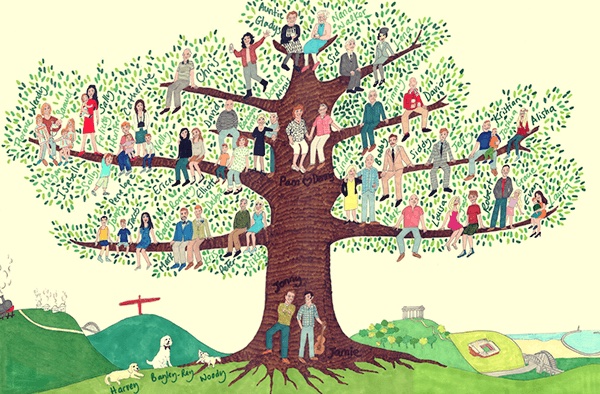
That’s Jesus’ family tree, in all its glory.
What should we make of it?
Well, not to put too fine a point on things, but Jesus obviously did not belong to the nice clean world of all the worst Hallmark Christmas movies, he did not belong to the reasonable, or honest, or sincere world of decency that we all too often claim for ourselves today.
Jesus belonged to a family of murderers, cheats, cowards, scoundrels, adulterers, and liars.
Jesus belonged to people like us, and he came for people like us.
No wonder God had to send his Son into the world. Jesus is the only hope we’ve got. Amen.






 think and let think