Have Yourself A Merry Little Apocalypse

strangely-warmed-spreaker-header

This week on the Strangely Warmed podcast I speak with Jason Micheli and Scott Jones about the readings for the 1st Sunday of Advent [Year B] (Isaiah 64.1-9, Psalm 80.1-7, 17-19, 1 Corinthians 1.3-9, Mark 13.24-37). Jason is the Executive Pastor of Aldersgate United Methodist Church in Alexandria, VA and Scott is the host of the Give and Take Podcast. The conversation covers a range of topics including clip-on bowties, looking for the next Advent, weak church confessions, singing in minor keys, Apple Watches, meditating on our deliverance, and kitten videos. If you would like to listen to the episode or subscribe to the podcast you can do so here: Have Yourself A Merry Little Apocalypse

Taylor Scot Jason

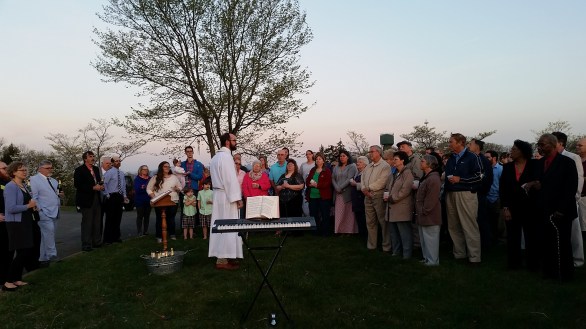
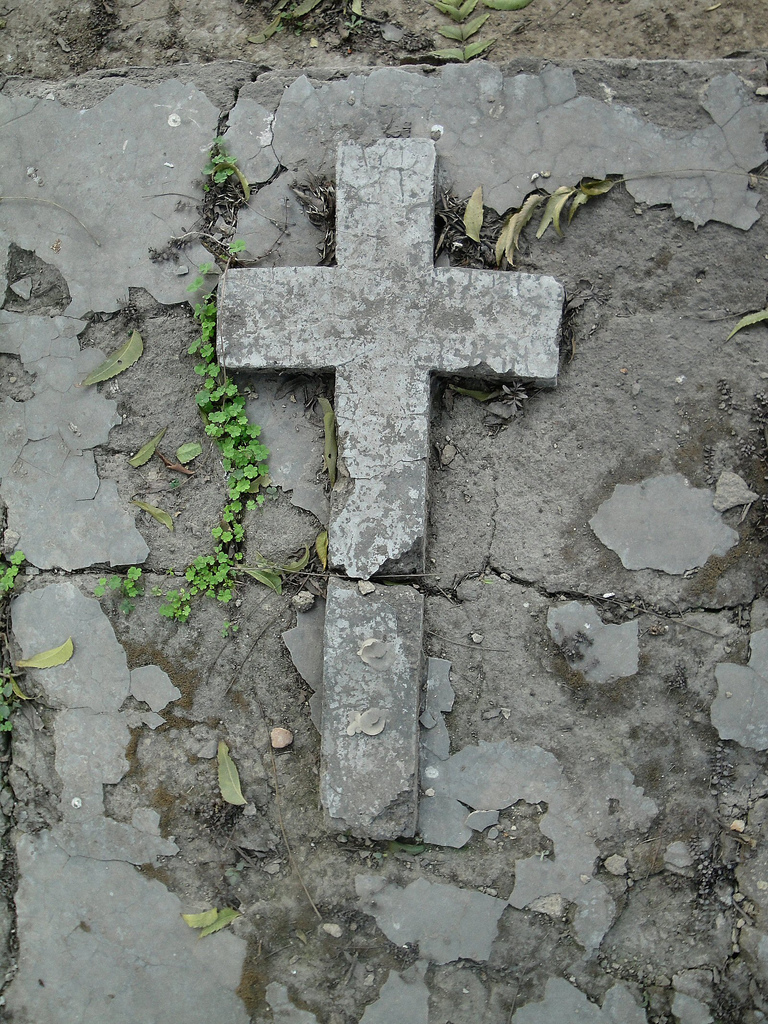
Practice Resurrection – Easter Sunrise Sermon

Mark 16.1-8

When the Sabbath was over, Mary Magdalene, and Mary the mother of James, and Salome bought spices, so that they might go and anoint him. And very early on the first day of the week, when the sun had risen, they went to the tomb. They had been saying to one another, “Who will roll away the stone for us from the entrance to the tomb?” When they looked up, they saw that the stone, which was very large, had already been rolled back. As they entered the tomb, they saw a young man, dressed in a white robe, sitting on the right side: and they were alarmed. But he said to them, “Do not be alarmed; you are looking for Jesus of Nazareth, who was crucified. He has been raised; he is not here. Look, there is the place they laid him. But go, tell his disciples and Peter that he is going ahead of you to Galilee; there you will see him, just as he told you.” So they went out and fled from the tomb, for terror and amazement had seized them; and they said nothing to anyone, for they were afraid.

17966886_10206879248298323_4940910702880605006_o


Hallelujah! Hallelujah! Hallelujah! Man it feels good to say that word! In the church I serve, we have purposely avoided saying “Hallelujah” since before Ash Wednesday. No hymns, no prayers, no sermons contained the word. And now we can shout it out with all the pent-up gusto we’ve been holding in throughout Lent. Hallelujah! He is risen!

NT Wright is quite a famous theologian and he has said on numerous occasions that on Easter Christians should break out the champagne! But, we’re good United Methodists, so we’re stuck with Welsh’s Sparkling Grape Juice, plus it’s 6:30 in the morning and a bunch of us have other church services to go to after this!

But nevertheless, it’s time to pop some bottles and celebrate! I’ve passed out bottles to all the clergy so just go to the closest pastor to receive your cup. It’s time to shout out some Hallelujah and drink some Methodist champagne!

A Toast: To the God of Grace and Glory who broke forth from the tomb; Hallelujah!

Easter: What is this day all about? For centuries people like you and me have gathered like this to remember the first Easter. But, has Easter changed throughout the centuries?

We have a lady at St. John’s who, I believe, is keeping Hallmark in business. Whenever I visit people from our church community there is a better than good chance that I will see a card from Dianne on a refrigerator, or on a countertop, just to brighten someone’s day. And, wanting to be more like Dianne, I started looking through the greeting cards at Rite-Aid the other day in the section titled, “Easter.”

I flipped through a handful, looking for something appropriate, but then I couldn’t stop myself. And before I knew it I had gone through every single Easter card. They were all filled with nice words like “renewal” and “rebirth” and “revival.” They had colorful pictures of butterflies, lilies, and baby bunnies. But not one of them contained the right word: Resurrection.

easter-sunday1120-1024x576

Easter is not the celebration of spring.

This is important! While we are bombarded with images and messages about spring being the season of rebirth and renewal, the resurrection is something entirely different.

I can assure you that the women who walked to the tomb that first Easter were not captivated by the birds singing in the air, or the new buds bursting from the trees. They, as Mark so eloquently puts it, were afraid.

But we are far removed from the strange new world of the bible, and instead we like to make Easter about the egg hunts, the bunny who comes like a thief in the night, and the rebirth of nature. Maybe then, we are actually just like the women who fled from the tomb; the message and power of the resurrection is such that we can barely bring ourselves to say anything about it at all.

I, or any of the fine preachers from Staunton, could stand before you this morning and talk all about the change of seasons, the wonder of the birds chirping as the sun rises, the call to a new life. But does any of that actually grab you? Does it terrify you? Does it fill you with such hope that you would stand against the tyranny of the Roman Empire?

Easter is not about spring. Easter is resurrection.

Resurrection is God’s penultimate Word to us, His creatures. And frankly, it should make us tremble and consider running in the other direction because recognizing this new truth and new reality means that we will, sooner or later, have to give up our dependence upon the things that the world tells us we need: beauty, security, wealth, power, careers, out loved ones, even our lives.

But since you’re here at the crack of dawn to worship the living God, you must surely get it already. You’re here because your lives have been transformed by the power of the resurrection and you can’t go back. Or maybe, just maybe, you’re like me and you’ve heard this story so many times before that you’ve become a little numb to the Good News of God bursting from the tomb. Perhaps we need to be shocked or afraid like the women who ran away. Maybe resurrection isn’t supposed to make us smile and grin. Perhaps resurrection is supposed to make us run away in bewilderment.

Resurrection changes everything.

Just shy of a year ago, my wife gave birth to our son Elijah. And at first it was terrifying. I’ll never forget pushing him in his little basinet down to the recovery room and Lindsey finally getting to rest after the draining ordeal of childbirth. My beautiful wife was sleeping soundly, and our beautiful baby boy was asleep at the foot of her bed. It was a profoundly holy moment. And then Elijah started choking.

At first I looked around for a nurse or a doctor to do something, and then remembered that we were all alone. So I got up, rushed to him, used a suction cup to clear his throat, and he promptly nuzzled into my neck.

Having a baby changed everything.

Eventually we made it home and started figuring out how to exist with another tiny little human being in the house. We got into a good rhythm. And, I decided to start reading to him every night.

He was barely a month old when I picked up my collection of the Chronicles of Narnia and began with The Lion, The Witch, and The Wardrobe. Every night I would flip through the old and worn pages that called us into the strange new land of Narnia. And, of course, it meant nothing to him, but it meant everything to Lindsey and me.

We read the entire collection in just over a month and the very last paragraph of the very last book goes like this: And for us, this is the end of all stories… But for them, it was only the beginning of the real story. All their life in this world and all their adventures in Narnia had only been the cover and the title page: now at last they were beginning chapter one of the Great Story, which no one on earth has read: which goes on forever: in which every chapter is better than the one before.

narnia1

The end of Mark’s gospel, this wonderful bit about the women running away afraid, is no ending at all. It is a great ellipsis in which the story continues through us. The women were afraid because the resurrection was unlike anything this earth had ever known. They could not comprehend the sheer magnitude of God’s dynamic and reality-altering gift in his Son breaking free from the chains of death.

But their story, and our story, does not end with the written gospel. Their story, and our story, is resurrection. The gospel of Jesus Christ, the Son of God, is always unfinished. There is an unwritten page left for each of us to write, in which we record the many glorious, joyful, and even frightening things that God has done for and through us.

Easter, resurrection, isn’t perfect like a hallmark card. We cannot contain the inexplicability of God raising Jesus from the dead in pastel colors with a simple quote about renewal. It’s strange, and complicated, and scary.

For some of us Easter creates more questions than it provides answers. For the women at the tomb it was frightening and astonishing. For all of you it probably feels uncomfortable as we passed around out Methodist champagne with shouts of Hallelujahs while gathering in a place like this: a cemetery.

Easter can be downright terrifying.

But’s its not the end of the story. Jesus came alive so that we could come alive. The resurrection forces us to not experience Easter as just a day when the seasons change, but the very life-altering, earth shaking, cosmically confusing, moment of transformation of all things.

This, what we’re doing here, is our witness to the fact that we do not know what will happen next. We do not know when the bell will toll for us. And, if we’re truly honest with ourselves, this frightens us.

But hear the Good News: resurrection is the beginning of a new story, which goes on forever, in which every chapter is better than the one before. Jesus’ story, our story, has no end.

Hallelujah! Amen.

God Won’t Give You More Than You Can Handle

Mark 2.1-5

When he returned to Capernaum after some days, it was reported that he was at home. So many gathered around that there was no longer room for them, not even in front of the door; and he was speaking the word to them. Then some people came, bringing to him a paralyzed man, carried by four of them. And when they could not bring him to Jesus because of the crowd, they removed the roof above him; and after having dug through it, they let down the mat on which the paralytic lay. When Jesus saw their faith, he said to the paralytic, “Son, your sins are forgiven.”


On the day of the funeral, everything felt too familiar. The pews were filling up with the same people who were here the week before, the same family was waiting in the narthex, and our organist was even playing some of the same music as people were walking in.

I stood right here in front of the gathered congregation and asked everyone to stand for the family. Leading the profession were two daughters who were about to bury their father after burying their mother the week before. Their grief and pain and anger were palpable as they slowly walking down the center aisle, and everyone watched them as they passed.

And we did what we do for a service of death and resurrection. We prayed. We opened up the hymnals and proclaimed God’s faithfulness through song. We listened. We grieved. We cried.

As we finished, I watched the pallbearers stand up and surround the coffin. With hands shaking in nervousness and fear they carried their friend’s body out of the church and put him in the hearse.

And we did what we do when travel to a cemetery. We got in our cars and turned on our hazard lights. We followed one another through the streets of Staunton. We watched cars slow down and pull over out of respect for what we were doing. We drove. We listened. We grieved. We cried.

After arriving at the cemetery, I watched the same pallbearers carry the coffin to the grave over uncertain soil. With sweat perspiring on their foreheads they lowered their friend to the ground and stood beside the family.

And we did what we do by the graveside. We prayed. We listened. We placed dirt on the coffin. We said what we needed to say. We listened. We grieved. We cried.

After the final “Amen” I waited by the grave with a few others, making sure the family was comforted. I overheard familiar and charming anecdotes about the man we just gathered to bury. I witnessed family members reach out to one another for the first time in many years. I saw a lot of tissues filled with tears wadded up in clenched fists.

And then I saw something I’ll never forget. A man, unknown to me, walked right over to one of the daughters devastated by the loss of both her parents. He placed his hand on her shoulder and said, “Don’t worry, God won’t give you more than you can handle.” And with that he turned around and walked away.

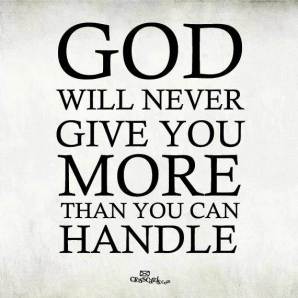
God won’t give you more than you can handle.

635787512482303409305489483_29f1979c65db2aa1627169bad37391df-imgopt1000x70

I’m sure that all of us here have heard this statement, or some form of it, in our lives. It is part of that trite and cliché Christian-lingo that we use to fill uncomfortable silences when we don’t know what else to say. And it’s not true.

Let’s start with the beginning: God won’t give you… We’ve talked about it with every sermon of this series so far; God doesn’t give us our sufferings. God is not some sadist who delights in our trials and tribulations. God is not some architect of divine destruction. God is not sitting up in heaven plotting away about what terrible things to send for us to handle.

Can you imagine going to a devastated neighborhood in Chicago to families whose sons have been killed by gunfire and saying, “Don’t worry God won’t give you more than you can handle”?

Can you imagine going to a young mother recently diagnosed with breast cancer and saying, “Don’t worry, God won’t give you more than you can handle”?

Can you imagine going to the millions of people in this country who are terrified of losing their healthcare coverage in the next few months and saying, “Don’t worry, God won’t give you more than you can handle?”

God did not kill those families’ sons, God did not give that woman breast cancer, and God is not responsible for the arguments about whether or not to eradicate the Affordable Care Act.

Sometimes, we say things like “God won’t give you more than you can handle” because we don’t know what else to say. We encounter the shadow of suffering that is so suffocating we don’t know how to respond. So instead, we will that awful void with awful words. And we make God into a monster.

The problem is that when we use trite and cliché words like the ones we are confronting this morning, we imply that God chooses to make people suffer.

Jesus, God incarnate, had been on the road for a while, going from town to town, synagogue to synagogue, proclaiming the Good News, teaching about the kingdom of God, and healing those on the margins of society. Word about his ministry spread pretty vast, and he returned to Capernaum for a few days, perhaps to rest. But so many people knew where he was that they surrounded his house and Jesus spoke the Word to them.

Some friends heard about what was happening, so they went to their paralyzed friend and carried him on a mat to Jesus. When they could not bring him to the Messiah because of the crowd, they carried him to the roof, dug through the ceiling, and lowered their friend to Jesus. And when Jesus saw the faith of the friends, he looked at the paralytic and said, “Son, your sins are forgiven.”

What a strange and beautiful story. Friends with such profound faith were willing to carry their friend, and dig through a roof, just so he could encounter the living God.

I often wonder about the tradition of pallbearers at funerals. Did it start of out a practical necessity? Is there strong theological purpose behind it? Is it a unique Christian behavior?

But on the day I buried a husband after burying his wife the week before, the day I saw a man dismissively respond to the daughter’s suffering, I saw the connection between pallbearers, and the friends who carried the paralytic to Jesus.

When we cannot handle what’s happening in our lives, we need people who can carry us, and the ones we love, to Jesus.

We will face adversity in our lives. We will experience hardships. We, or someone we love, may struggle with debilitating depression or suicidal thoughts or grief so heavy it feels like someone is sitting on our chest. We might give in to the temptation of an addiction and lose contact with the people we need most. We may fall into a pit of financial debt that feels impossible to climb out of.

If we are like most human beings, at some point we will absolutely face things that are more than we can handle.

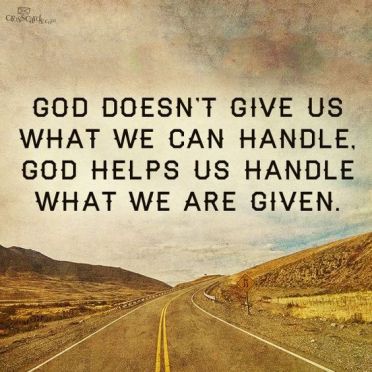
So here’s a corrective. It’s not that God won’t give you more than you can handle, but that God will help you handle all that you’ve been given.

6fa0c8a00d809d23761dfaa71b6b542a

This acknowledges that trials and tribulation will occur in our lives, and it promises that when we go through the muck and grime of life, God will be present.

When we’re walking through hard times, whether they were given to us by the random chance of life, or they’re a result of our own brokenness, or they’re signs of our captivity to the powers and principalities, it’s okay and good to admit, “I can’t handle this by myself, and I need help.” There are times when we need a doctor, or a therapist to carry us. More often, we need family, friends, pastors, neighbors, and brothers and sisters in our church family to come alongside us to carry us through.

God does not give us more than we can handle. God gives us Jesus Christ so that we can handle what life gives us.

For a lot of people, what happened on Friday in Washington DC was more than they could handle. Whether it was the pent up frustration with the political rhetoric that overflowed over the last 18 months, or witnessing a billionaire place his hands on Abraham Lincoln’s bible, or experiencing the great swing of the pendulum from one political ideology to another, it felt overwhelming. Some responded with violent protests and destroyed shop windows and attacked the police. Others responded with peaceful demonstrations making sure their voices were not stomped out among all the shouting debauchery. There were the political talking heads offering their opinions about who was right and who was wrong. There were smug smiles and there were frightening frowns. The inauguration, for some, was more than they could handle.

For others, the last eight years has been more than they could handle. Whether it was the constant feeling like the country was slipping out of their fingers, or the realization that the American dream is not what it once was, or the rise of oppositional and divisive voices, it felt overwhelming. Some responded with protests and boycotts of particular institutions, others responded by focusing inwardly and praying for change, and still yet others waited patiently for a new direction. For eight years there were plenty of talking heads offering their unsolicited opinions about who was right and who was wrong. The last eight years, for some, was more than they could handle.

Some say the time has come for all of us to just get along. A couple weeks ago I even told you that we, as a church, should have a collective New Year’s resolution to be more kind.

Kindness and getting along are good and nice. But there are people around us, people in our lives, who need more than kindness and getting along. There are people desperately clinging to the hope of their healthcare coverage completely unsure of what it about to happen. There are people who are hopeless when confronting their joblessness and economic futures. There are people shaking and quaking about their faith and whether or not they are going to be forced to register themselves because they wear a particular piece of cloth on their heads. There are people who see police officers as enemies and not community protectors.

There are people in our community; there are people in our church, who have more than they can handle right now.

We need people, like the friends who carried the paralytic to Jesus, to carry others who have more than they can handle. We need people who can look us in the eye and tell us we have a problem. We need people who will call their friends every night just to get them through a profound period of loss. We need people like all the women who marched in solidarity all across the world yesterday. We need people with eyes wide open to the horrible suffering of the people around us so that it does not go on unnoticed. We need people who are unafraid of the consequences for questioning the status quo. Right now, we need people who are brave enough to carry us to Jesus. Amen.


dumb-things-christians-say-sermon-series-idea

On The Death Penalty

Mark 10.26-27

They were greatly astounded and said to one another, “Then who can be saved?” Jesus looked at them and said, “For mortals it is impossible, but not for God; for God all things are possible.”

Luke 23.44-47

It was now about noon, and darkness came over the whole land until three in the afternoon, while the sun’s light failed; and the curtain of the temple was torn in two. Then Jesus, crying with a loud voice, said, “Father, into your hands I commend my spirit.” Having said this, he breathed his last. When the centurion saw what had taken place, he praised God and said, “Certainly this man was innocent.”

Controversy Original

Preachers can fall into the rut of preaching on whatever keeps the congregation pleased; keep them happy and they’ll keep coming back, or something like that. This sermon series is different. Instead of falling back to the familiar narratives that keep us smiling on our way out of church, we are confronting some of the greatest controversies facing the church. There is a better than good chance that I will say something from this pulpit during the series that you won’t agree with, and if (and when) that happens I encourage you to stay after worship, join us for lunch, and continue the conversation. We can only grow as Christians in community, and that requires some honesty and humility and dialogue. Today we continue with The Death Penalty.


He was sitting with his friends when the police rushed in. Everything moved in a blur while tables were overturned, bodies were thrown to the floor, and he was placed under arrest. The journey to jail and to the courthouse was strangely quiet, but he kept his head down and his mouth shut. Others came and went, he received strange and knowing looks, and he wondered if any of his friends were arrested as well.

When they dragged him in front of the judge, the courtroom was packed and people kept screaming from the back. The judge waited for everyone to calm down and the whole proceeding came down to one question, “Did you do it?” The man replied, “If I tell you what happened, you won’t believe me, and if I ask you a question, you won’t answer.” Again the judge asked, “Did you do it?” And the man replied, “You say that I did.”

In response, the judge smacked his gavel onto the wood and declared, “What further testimony to do we need? We’ve heard it ourselves from his own lips.” And with that, the man was condemned to death.

The courtroom erupted into celebration as the gathered people shouted “Kill him! Kill him! Kill him!” What made everything worse was the fact that the dead-man walking recognized some of the people who were shouting for his death, but nothing could stop the inevitable.

Time passed, and eventually he found himself walking to his own demise; walking down death row. With every footstep he thought about what had led him to this, he thought about his family and friends that had abandoned him at the end, he thought about how this would be the last time he’d feel the ground beneath his feet.

The executioners were ready to begin the moment he arrived. They took off his clothes, and laid him down. Only then did he notice that two other men were about to be executed as well. Their faces held grave expressions of fear, guilt, and sorrow. But just like with the man, they were on a path that had only one outcome- death.

It was about noon when everything started moving quickly, and the man noticed that it was strangely turning dark outside. They strapped him down until he could barely breathe and then they stood back and waited. With each moment he felt his life slipping away, his chest heaved for air that ceased to fill his lungs, his vision went blurry, and then he died.

His name was Jesus and he was executed by the state.

Image processed by CodeCarvings Piczard ### FREE Community Edition ### on 2016-05-12 18:53:36Z | http://piczard.com | http://codecarvings.comÿÿÿ–j¬+

Capital punishment, killing someone in response to a crime, is as old as civilization itself. Some of the earliest archeological discoveries of law codes contain the ramifications for shedding blood or taking someone’s life, and more often than not it comes down to this: “An eye for an eye, a tooth for a tooth, a limb for a limb, a life for a life.” It’s there in Hammurabi’s code from ancient Babylon, and we have it in the Old Testament in our Bibles.

The Death Penalty has been around for a very long time, and we still employ it for a number of reasons. To kill someone for committing a crime is the only way to guarantee they will never recommit the same crime. It works and functions as a deterrence to influence others to not commit the crime. It helps bring closure to a family who is grieving the loss of someone who was murdered. And it saves the state a lot of money from having to keep someone in prison year after year after year.

In the United States, there are roughly 3,000 people on death row right now, and the death penalty takes place primarily through lethal injections – a poison is injected into someone’s blood stream that brings a quick and painless death, but many states still let people choose between the electric chair and lethal injection. The state of Washington however, still uses a noose to kill those who have been convicted. Across the county at least 56% of Americans support the death penalty.

And the state of Virginia, where we live, has executed more prisoners than any other state.

So why are we talking about the Death Penalty in church? Why is this a controversy that we need to confront?

Because Jesus was killed by the Death Penalty.

The main reasons that people often sight to justify the death penalty can just as easily be argued from a different perspective. The death penalty often fails to work as a deterrence because in the south where 80% of all death penalty convictions occur is the only part of the country where crime rates continue to increase. The closure that families experience in the short-term is present, but in the long-term they tend to experience more guilt and depression in a response to another person’s death. It actually costs the state a lot more money to put someone to death because of the required appeals process and the amount of time and resources that it necessitates. And, this is a very important ‘and’, since 1976 about 1 in every 9 death row inmates have been exonerated, usually after decades of living in a prison cell.

But all of the statistics and the facts, all of the psychology and the economics, are dwarfed by the fact that Christians still support the death penalty, even when the Lord we worship was killed by the same means.

We Christians love our crosses. We put them up in our sanctuaries and in our living rooms, we tattoo them on our skin and we wear them around out necks, I even carry one over my shoulder all over Staunton every Good Friday. But we have become desensitized to what the cross means: death.

Let me put it this way: If Jesus died 100 years ago, then we’d be wearing nooses around our necks instead of crosses. If Jesus died 50 years ago, then we’d be bowing before an electric chair in the sanctuary instead of a cross. And if Jesus died today, then we’d hang up hypodermic needles in our living rooms instead of crosses.

The cross was the electric chair for the Romans. The cross is like the hangman’s nooses of lynching mobs. The cross is like the lethal injection of modern prisons. It is the way people were killed by the state as a punishment for their crime.

The fact that 1 in 9 death-row inmates have been exonerated should be enough to give us pause. The fact that the state has murdered innocent people just like Jesus was murdered should give the church reason to repent. But if that’s not enough, then maybe this is: With God nothing is impossible.

And I’ll admit, there are scriptures in the Old Testament that justify the practice of capital punishment. But there are also people in the Old Testament and the New Testament who committed capital crimes and God still used them for the kingdom.

We like to think about Moses’ encountering the burning bush, we like to imagine Moses leading God’s people to the Promised Land, but we don’t like thinking about the fact that Moses murdered an Egyptian in cold blood before he met God in the wilderness.

            We like to think about David approaching Goliath on the battlefield, we like to imagine him dancing in front of the Ark of the Covenant, but we don’t like thinking about the fact that David ordered one his soldiers to die so that he could sleep with his wife.

            We like to think about Paul being knocked to the ground by God on the road to Damascus, we like to imagine him writing letters to the churches by candlelight, but we don’t like thinking about the fact that Paul murdered countless Christians before his conversion.

christians-and-the-death-penalty-views-on-both-sides

            With God nothing is impossible.

That’s the beginning and the end of theology, that with God’s help and grace all things are possible. An alcoholic can kick the drink, an atheist can discover faith, and a sinner can receive forgiveness. Why then do we keep slinging out our nooses? Why do we keep sending people to the electric chair? Why do we keep strapping them down for a lethal injection? Why do we keep hanging people on crosses?

The message of Jesus’ ministry, of the cross, is mercy. Mercy for an adulteress woman who was about to be stoned by the crowd, mercy for short tax collector who preyed on the poor, mercy for a criminal who hung on a cross right next to Jesus. Mercy triumphs over judgment.

That doesn’t mean that people who commit horrendous crimes get to walk away without consequences, it doesn’t mean that we should break down the walls of our prisons and let everyone run wild, but it does require us to fundamentally reshape our imagination regarding the justice system.

For centuries the death penalty was something that took place in public – crosses on a hill, nooses in a tree. The state used the death penalty to publicly frighten potential criminals from committing the same crime. But now capital punishment takes place in hidden rooms with minimal witnesses. It has retreated from the public arena and can continue to take place without disrupting our daily lives.

But people are being murdered for murder.

Jesus once said, “You have heard that it was said, ‘An eye for an eye and a tooth for a tooth.’ But I say to you, Do not resist an evildoer. But if anyone strikes you on the right cheek, turn the other also.” To retaliate murder for murder will only ever beget more violence, or as Martin Luther King Jr. said, “An eye for an eye leaves everyone blind.

God sent his son into the world to transform the world. Not with the ways of the world, not with power and prestige, not with armies and aggression, but with mercy and sacrifice. God sent his son to walk among us in order that we might catch glimpses of the kingdom. God in Christ ministered to the last, the least, and the lost, people like those who are waiting for the end of their days on death row. And God sent his son to carry death on his back to the top of a hill to die, so that we might live.

So long as we employ the death penalty, we will deny the power of God to redeem, restore, and transform all human beings. As long as we sling our nooses, and prepare our needles, we will prevent true repentance and new life from taking place in those who have fallen prey to evil. As long as we murder murderers, we will never give God the chance to make the impossible possible. Amen.


The Kingdom of Chaos

Mark 4.30-32

He also said, “With what can we compare the kingdom of God, or what parable will we use for it? It is like a mustard seed, which, when sown upon the ground, is the smallest of all the seeds on earth; yet when it is sown it grows up and becomes the greatest of all the shrubs, and puts forth large branches, so that the birds of the air can make nests in its shade.”

parables

Today marks the second part of our July Sermon Series on The Power of the Parables. A favorite rhetorical device of Jesus’, a parable is a story that illustrates a lesson or principle usually without explanation. They are simple and life-sized with familiar characters and they are supposed to drive us crazy.

Over the centuries the parables have become so watered down through the church that they no longer carry the same weight and punch that they once did. The familiar parables are beloved to us, The Feast, The Mustard Seed, The Prodigal Son, The Good Samaritan, but during the time of Jesus they were frustrating and confusing. During this month we will do our best to recover this sense of strangeness and encounter the power of the parables.


The stories that Jesus tells about the kingdom of God are down to earth, literally. The kingdom is not some esoteric arena in the great by-and-by, but as close as a wedding feast, or a fishing net, or even a mustard bush.

A mustard bush is a strange thing. It develops from the smallest of seeds and grows like a weed choking out everything else. It is the kind of plant that farmers fear. The seeds are so tiny that if they get caught up in a group of others being sowed in a field, it can destroy the planned crop and replace it with mustard bushes.

One of the main points of Jesus’ parables is the fact that they are common stories that nearly everyone can appreciate or picture. But are we, today, familiar with a mustard seed or a mustard bush? I went out on Wednesday to a couple local plant nurseries, and I went to a couple hardware stores, and I found nothing. Not one bag of mustard seeds. Not one single mustard plant.

For the first century Jews and Gentiles this parable was as familiar as could be. Jewish law made it illegal to plant a mustard seed in a garden because they knew it would grow and grow and eventually take over the entire space. But for us today, we only know the mustard we buy in grocery stories. So, perhaps we need a new parable. Maybe we need a new comparison to what the kingdom of God is like. One that still holds true to the reality of a mustard seed but also resonates with our understanding of the world.

Jesus also said, “With what can we compare the kingdom of God, or what parable will we use for it? It is like one of those computer viruses that we receive in an email attachment from our grandmother. At first it seems harmless “Click here to learn the secret to weight-loss” or “Click here to see a video of a monkey playing a piano” and then before we know what hit us it spreads and spreads through our entire computer corrupting every file before sending the same email out to everyone in our address book.

Jesus also said, “With what can we compare the kingdom of God, or what parable will we use for it? It is like the flu, we try to stop it from spreading by receiving flu shots and preventing people from visiting others in the hospital, but once it takes hold it spreads through everything we touch until it reaches the next person and the next person and the next person.

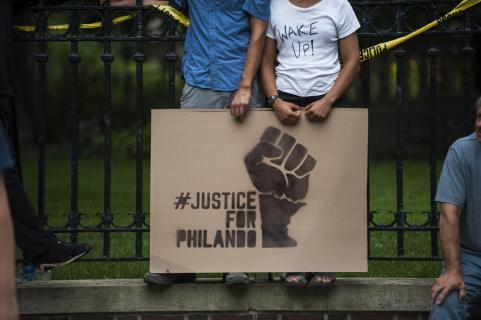
Jesus also said, “With what can we compare the kingdom of God, or what parable will we use for it? It is like a video posted on the Internet of a black man being shot by a police officer during a routine traffic stop. At first we try to scroll past because we know it is too graphic, too awful, too real, but we can’t help ourselves from watching. The longer we watch the more people we think about that need to see the video, we start to think about how the whole world needs to see this injustice so that justice might rain down like water. So we send it out for everyone to see until something changes.

If Jesus showed up in church today and shared any of those parables with us, how would we respond? I’d tell him that he is crazy, that he has no idea how no idea how the church is supposed to work, and that his vision of the kingdom does not match with mine.

Jesus’ parable of the mustard seed is one that confuses and creates frustration precisely because our version of the kingdom is different than the kingdom inaugurated in the life, death, and resurrection of Jesus Christ.

ST. PAUL, MN - JULY 07: A couple hold a sign protesting the killing of Philando Castile outside the Governor's Mansion on July 7, 2016 in St. Paul, Minnesota. Castile was shot and killed the previous night by a police officer in Falcon Heights, MN. (Photo by Stephen Maturen/Getty Images)

The kingdom of God strikes in ways that we almost cannot see, and certainly not in ways that we can expect. Like an idea popping up in the mind, it refuses to be stifled and it begins to spread out through our conversations and our writing. Ideas like “war is wrong” or “homophobia is wrong” or “the indiscriminate killing of black men and women” is wrong. Those ideas spread like wildfire and at some point they cease to be ideas and instead transform into revolutions. The original thought tangles in the mind and heart of the revolution and people become so moved that they are willing to die so long as that original idea will continue to spread.

More often than not, we know what we want the kingdom of God to look like and we know what we want the church to look like. We want clear lines to be drawn so that we know who is in and who is out, what is allowed and what is forbidden, what is black and what is white.

But then Jesus gives us this two-verse parable with the mustard seed – the tiniest symbol of how God is forever invading our ordinary and orderly sense of things. The mustard seed is there in plain sight but hidden by our ignorance. We overlook it in the fields, in the church, in our lives, and then it sprouts into the greatest of all the shrubs.

Since January of this year at least 123 black Americans have been shot and killed by police. This week saw a black man gunned down outside of a convenience store for selling CDs and a black man gunned down during a routine traffic stop for having a broken taillight. The saddest part of these stories is that they have become part of our common vernacular and experience of black culture. For a time we can remember the names of the individuals killed, names like Eric Garner and Michael Brown and Tamir Rice and Freddie Gray, but now the list has grown so long that the names begin to bleed together.

And how do we feel? Are we outraged? Or are we apathetic? Are we disgusted? Or are we disinterested? Are we on fire for change? Or do we want things to stay the same?

And the death of black men and women is a small fraction, or perhaps the mustard seed, of the larger picture of racial inequality in our country.

People of color make up about 30% of the total population in the U.S. but they account for 60% of those who are imprisoned. 1 out of every 3 black men can expect to go to prison at some point in their lifetime. Once convicted, black offenders receive sentences that are nearly 20% longer than white offenders for the same crime.

In preschools across the country black students account for 18% of the total number enrolled but make up 48% of preschoolers with multiple out-of-school suspensions. Preschoolers! In elementary, middle, and high schools across the country, black students are expelled at 3 times the rate of white students.

And 11am on Sunday morning is still, without a doubt, the most segregated hour in the United States.

The kingdom of God is like a mustard seed, the smallest of all the seeds, but when it is planted it grows into the grandest and largest of all the shrubs and puts forth branches so that all the birds of the air can find rest in its shade.

The kingdom of God is not like the kingdom of America where people are still persecuted because of the pigmentation of their skin, where immigrants are treated as second-class citizens, where members of the LGBTQ community are murdered because of their identity; where police are attacked in retaliation for events in other parts of the country.

On Thursday evening, during a peaceful protest in Dallas, Texas, five law enforcement officers were killed and six others were injured. Snipers were set up in strategic elevated areas and sent the downtown area into chaos as bullets continued to fly back and forth. It is unclear what the exact motives of the attack might be, though it is clear that it is somehow connected with the recent shootings of black men in other parts of the country.

Black men and women are shot and killed by the police. Black communities respond in rage and protest. Police are shot and killed by individuals whose anger manifested itself into violence and destruction.

What are we to do? Turn off the television because of the unending violence? Shrug off the waves of death because at least its not happening in Staunton? Fall to our knees in prayer that we might be transformed into a people of peace?

Today we grieve and mourn all the lives lost at the hands of the destructive power of death. We lift up our fists and rail against the prejudices that result in black persecution and police assassination. We demand answers from the Lord for why things like this continue to happen.

People take part in a rally on April 29, 2015 at Union Square in New York, held in solidarity with demonstrators in Baltimore, Maryland demanding justice for an African-American man who died of severe spinal injuries sustained in police custody. AFP PHOTO/Eduardo Munoz Alvarez (Photo credit should read EDUARDO MUNOZ ALVAREZ/AFP/Getty Images)

That’s the power of a parable like the mustard seed; it strikes us as something true whenever we hear it. A detail will emerge that we’ve never thought about and we realize that Jesus is still speaking to us through the story. The power of a parable is its ability to convey a deep and profound truth about Jesus in the midst of our lives today. The power of a parable is its ability to show us that God’s kingdom is strange, unexpected, and beautiful.

The kingdom of God, like the mustard seed, like a viral video, like a revolution, invades the cultivated soil of our certainties and creates something new. Hidden in plain sight, like words of a prayer, the seeds of faith grow in unexpected ways until what we thought we knew is transformed by our invasive and surprising God.

Our lives should transformed by the mustard seed quality of the kingdom of God when it stretches and reaches into every part of our existence and challenges us to be better. Not to pass the buck on to someone else, not to become apathetic to the tragedies of our time, but to be caught up in a revolution of the heart.

The power of the parable of the mustard seed is in the tiniest of seeds leading to a radical change. The mustard seed germinates and stretches out to grab hold of everything in its path. Oh that today the Lord would plant that mustard seed in our hearts, that the kingdom of God might grow and dwell among us, reaching out to everyone in our midst, that we might all believe that black lives matter, that we might believe that violence will only ever beget more violence.

We need that mustard seed. We need it planted deep into the soil of our souls, we need it to be cultivated, and we need it to grow with reckless abandon. We need a revolution of the heart, here and everywhere. Amen.

Calming the (Political) Storm

Mark 4.35-41

On that day, when evening had come, he said to them, “Let us go across to the other side.” And leaving the crowd behind, they took him with them in the boat, just as he was. Other boats were with him. A great windstorm arose, and the waves beat into the boat, so that the boat was already being swamped. But he was in the stern, asleep on the cushion; and they woke him up and said to him, “Teacher, do you not care that we are perishing?” He woke up and rebuked the wind, and said to the sea, “Peace! Be still!” Then the wind ceased, and there was a dead calm. He said to them, “Why are you afraid? Have you still no faith?” And they were filled with great awe and said to one another, “Who then is this, that even the wind and the sea obey him?”

160221104601-donald-trump-hillary-clinton-ted-cruz-marco-rubio-bernie-sanders-composite-exlarge-tease1


On Tuesday morning, Lindsey and I woke up early to hit the polls before work. We were expecting long lines so we made sure to plan for enough time and double check our voting location. When we arrived, we were both a little shocked to discover the limited number of participants but we walked into the building with excitement.

I went over to the table to receive instructions and eventually went over to the machine to cast my vote. Lindsey, however, was forced to reregister because of a filing error, so I stood off to the side and waited patiently.

I really try not to eavesdrop, but sometimes it feels impossible. When people walk into to a building and start shouting things, it’s hard not to notice.

The first man came in wearing bib overalls, dirt all over his boots, with his hair going every direction. When he arrived at the table the volunteer asked, “What party will you be voting for?” The man stared blankly back and then declared, “Well, I ain’t no socialist so I’ll be voting Republican.

The second man came in wearing a perfectly pressed suit, with a tie clip, and an expensive looking watch on his wrist. When he arrived at the table the volunteer asked, “What party will you be voting for?” Without taking time to think about his answer he said, “I can’t trust Hillary but I’m still voting Democrat.

The first woman came in wearing a completely coordinated outfit, her hair and makeup looked perfect, and her heels were so high they started giving me vertigo. When she arrived at the table the volunteer asked, “What party will you be voting for?” I don’t think the woman was really paying attention because she filled the next few minutes trying to convince the volunteer that our country is in a mess and the only good option we have left is the Christian Ted Cruz.

The next woman came in wearing a sweat suit, with spit-up on her shoulder, while making a comment about her baby waiting in the car. She was clearly in a rush so when the volunteer asked, “What party will you be voting…” She interrupted and yelled, “Anyone but Trump!

It didn’t take long for me to notice that all of the people coming in to vote were doing so out of fear. None of them were particularly satisfied with any of the candidates, they represented different walks of life, and the one thing that united them was fear.

On that day, when the evening had come, Jesus said, “Let us go across to the other side.” As the sun was setting in the distance, darkness was hovering over the waters, and Jesus suggested that it was time to go across the Sea of Galilee. And this was no simple journey; Jesus had been ministering to the Jews in the Jewish territory, but now he wanted his disciples to go across to the other side, to the gentiles.

This is probably Jesus’ first foray into dangerous territory, his first opportunity to proclaim a sense of inclusion that still mystifies most of us today.

And while they were out on the water, making the journey from their side to the other side, a great windstorm arose, smashing waves against the boat so hard that it was being swamped with water. But Jesus was asleep! So the disciples woke him up and asked, “Teacher, do you not care that we are going to die?

Jesus woke up, rebuked the wind, and said to the sea, “Peace! Be still!” and there was a dead calm. He turned to his disciples and said, “Why are you afraid? Have you no faith?

They were definitely afraid; afraid of the wind and the waves crashing against the boat, afraid about the journey to the other side, afraid for their very lives.

And notice that Jesus does not say, “There’s nothing to be afraid of.” There are plenty of things for Jesus’ disciples then, and now, to be afraid of: isolation, pain, illness, losing one’s job, money problems, failure, death. Instead, he asks, “Why are you afraid?”

            Why are you afraid for your lives when I’m here on the boat with you?

            Why are you afraid of rejection and failure when I’m here with you in life?

            Why are you afraid of death when you know that I rose from the grave?

What a fitting text for this political season in our lives. While many of us grow tired of the countless fights and arguments that break out on the news, while the chain of endless debates rattle with sound bite after sound bite, while people go to the polls to vote against someone rather than for someone, Jesus asks, “Why are you afraid?”

029-james-ensor-theredlist

We are afraid. We are afraid of the wind and the waves that assail our fragile ships. We are afraid for our lives, our church, our cities, our politics, our country, our world. We fear disapproval, rejection, failure, meaninglessness, illness, death… We are held captive by the power of fear.

And perhaps our greatest fear is of anything that differs from us. We are so contented in life that we fear death. We are so rooted in our Republicanism that we fear Democrats, or we are so Liberal that we fear Conservatism. We are so constantly surrounded by white middle-class Christian America, that we fear anyone who is black, or Hispanic, or Muslim, or Atheist. We are so used to seeing the traditional family unit of a husband and wife with 2.5 children that we are afraid of anyone who is lesbian or gay.

And Jesus is the one telling us its time to go to the other side. Jesus is the one who knows, even better than us, that there is plenty to be afraid of, but those things do not have the final word.

What we fail to remember and realize, is that we were once the outsiders that Jesus welcomed in. We were the gentiles waiting on the other shore for an incredible Messiah to show up and graft us in. If it were not for the incredible inclusiveness of Jesus’ ministry, none of us would be here in this place, none of us would have been blessed with grace, and none of us would have received the gift of the cross.

And now we face a time with other outsiders, people for whom many of us are afraid of, people who will rock our boats. And as we get closer, as the scales begin to fall from our eyes, as we begin to see others as brothers and sisters instead of enemies, that’s precisely when the storms start billowing in, playing toward our fears.

“If we start working with the Republicans, we will lose everything we once deemed sacred…”

“If we let another Democrat into the White House, God only knows what kind of terrible things will happen to us…”

“If we start changing what we do on Sunday mornings, the church will die…”

“If we start affirming their relationships, the traditional family will die…”

“If we start opening our borders, our country will die…”

Jesus knows best of all, that we cannot have resurrection without crucifixion.

The call to not be afraid bookends the gospel. It is there at the beginning when the angel Gabriel shares the news of the coming Messiah with Mary, and it is there at the end when the disciples encountered the angels on the first Easter. Not because there are no fearsome things on the seas of our days, not because there are no storms, but rather, because God is with us.

That night on the Sea of Galilee, Jesus brought peace in the midst of the storm. This kind of thing happens all the time when people are willing to look past their fear and remember that Jesus is in the boat with us.

Painting184B

It may be at the polls while people are arguing about the fate of our country, it may be at General Conference when people are arguing about homosexual relationships, it may be in our own families when people are arguing about anything under the sun.

We will face strong winds and huge waves in the middle of a storm. Jesus wants us to remember that he will always be in the boat with us; that we can rely on his strength and mercy when ours runs out; that the prince of peace will always calm the waters.

On Wednesday night I had the youth of our church read the story of Jesus’ calming the storm. We discussed the types of storms that we have witnessed in our lives and then we started to talk about fear. I gave each of them a permanent marker and a plate with the instructions to write down their deepest and truest fears. I promised them that whatever they wrote was between them and God, but they also talked about fears they felt comfortable sharing…

“I’m afraid of death.”

“I’m afraid of our government.”

“I’m afraid of being alone.”

Then we went out into the back parking lot and we smashed the plates into tiny pieces. After we collected all of our broken fears, we started to glue them back together in the shape of the cross (you can see it right here).

Christ’s cross shatters our fears, it breaks down the moments that haunt us, and remind us over and over again that we are not alone. To wear a cross around our necks, to see one in the sanctuary, is a witness to the fact that the cross shatters our fears. The cross is a reminder that God is with us; with us in on the seas of life, with us in our most frightened moments, with us when we need him.

This part of the sanctuary is called the nave. The word comes from the Latin navis, which means “ship.” If you look up at the ceiling, it looks like the inside of a boat. In this place we are bombarded with images of the cross and the ship on the sea as a reminder of how God is with us.

Every week we gather here into this boat, with Christ as the captain, calming the wind and the waves of our fears.

Every week we hear scriptures, and hymns, and prayers that help to remind us who is our real hope and salvation while the world feels like it’s falling apart.

Every week we gather in the boat to remember that Jesus promised to be with us always, even to the end of the age.

Don’t be afraid. Amen.

Baptism and Temptation

Mark 1.9-13

In those days Jesus came from Nazareth in Galilee and was baptized by John in the Jordan. And just as he was coming up out of the water, he saw the heavens torn apart and the Spirit descending like a dove on him. And a voice came from heaven, “You are my Son, the Beloved; with you I am well pleased.” And the Spirit immediately drove him out into the wilderness, and he was in the wilderness forty days, being tempted by Satan.

baptism (1)

This morning is the first Sunday in the season of Lent. Christians throughout the world will use this season to repent of past sins, and seek renewal in their commitment to follow Jesus Christ. Throughout this season we are going to explore and examine Jesus’ life from baptism to resurrection by walking in his footsteps on the way that leads to life. We are using Adam Hamilton’s book The Way to guide our weekly services, because it follows Jesus’ life in a way that is important for us to rediscover during Lent. We begin with Jesus’ baptism and temptation.


Before I became your pastor, I helped a number of churches with their ministries. One such church is nestled in the Great Smokey Mountains in the far reaches of western North Carolina. Bryson City United Methodist Church has a beautiful building right in the center of town. They have services every Sunday that are often interrupted by the sound of motorcycles during the summer. They have a dynamic choir that rivals choral groups from cathedrals. And it is within walking distance of one of my favorite restaurants: Bojangles.

I spent an entire summer doing everything I could for the church, but honestly they didn’t have many expectations – so long as I showed up on Sunday morning with something to say and checked in on people during the week, I was encouraged to spend my time exploring the local area by hiking and whitewater rafting. (It was a great summer).

I will never forget some of the characters that would show up on Sunday mornings. There was Ralph, the church organist and music minister, who had a ponytail and always wanted to talk more about fly fishing than the hymns we would use during a worship service. There was Mr. Outlaw who knew his bible better than the seminarian that had shown up for the summer. And there was Ben Bushyhead. I will never forget Ben Bushyhead, not just for his incredible last name, but because after I preached for the first time he walked right up to me and said (rather declaratively), “Son, you using too many of them big seminary words.”

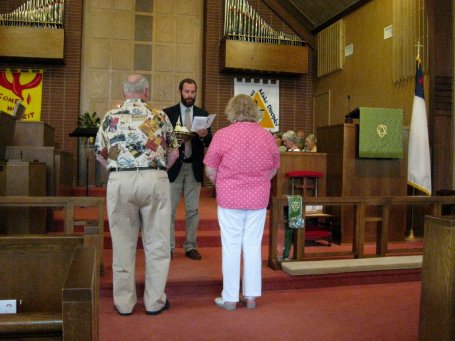
On one particular Sunday morning, toward the end of my time at the church, they were going to have their first baptism in a long time. A member of the church’s grandson was visiting and they all thought it was the right time and the right place to have him baptized. The excitement in the congregation that morning buzzed through the pews. This was what the church was all about: Welcoming visitors with signs of affection and love; returning to the great sacrament of baptism; and seeing young people standing near the altar.

The service built up toward the baptism at the end and the pastor invited the family to join him around the baptismal font. He spoke with conviction about how God had moved across the waters in creation to bring order out of chaos, he reminded us of the Israelites’ journey through the water on their way out of Egypt, and he even compared this sacrament to the baptism that John shared with his cousin Jesus at the Jordan River.

It was a holy moment seeing the congregation preparing for the baptism and a few of the older members were doing their best to cover up the tears that were slowly falling down their faces.

The pastor then motioned for the baby. He held the young boy with one hand, took of the top off the font with the other, and his eyes went wide. The beautifully and intricately carved baptismal font was empty; there was no water for the baptism.

The pastor looked up from the font and we locked eyes in the middle of the sanctuary. Without being told what needed to be done, I jumped up from my spot and ran to the kitchen. I frantically searched for any vessel that could hold water and settled on an old and chipped coffee mug. Using the sink, I filled the cup to the brim and then ran back to the sanctuary spilling a fair amount of water on the way.

While I stood in front of the congregation, I tried to make it look as liturgically appropriate as possible as I poured the water into the font, and the baptism went on as planned.

Bryson City UMC

Bryson City UMC

The beginning of the Good News of Jesus Christ. John was preaching and proclaiming in the wilderness when Jesus arrived to be baptized. This important and sacred event revealed the voice of the Lord identifying Jesus as the Beloved, while also setting in motion Jesus’ earthly ministry.

Jesus, as the Son of God, did not need to be baptized to be cleansed from his sins, but in going down to the water with the masses, he demonstrated his willingness to identify with sinful people. Jesus believed in doing ministry with others, rather than for others. In this scene we see God, in Christ, starting to bridge the great chasm between the earthly and the divine to inaugurate a new reality.

Yet, just as the baptismal scene comes to its conclusion, the Spirit of the Lord drives Jesus out to the wilderness where Satan tempted him for forty days.

During this time Jesus fasted from food and spent most of his time in prayer, though Satan was not inclined to leave him alone. He tempted Jesus with bread, with praise, and power. And Jesus remained steadfast; he resisted the temptations, and came out on the other side of the forty days strengthened and ready to begin his public ministry.

Again, in the temptations, we see Jesus’ willingness to identify with sinful people. All of us have moments where we wrestle with the devil.

We might feel helpless to resist the call of abundant and unhealthy foods. While countless people die of starvation everyday, few of us actively work to end hunger in the world.

We might feel helpless to the temptation of empty relationships and abusive power dynamics. We settle for the easy route so long as it benefits us completely, and few of us live selflessly instead of selfishly.

We might feel helpless to resist the urge to spend money on lottery tickets, or we cheat on our taxes, or we pretend to be something we’re not in order to further our quest for financial gain.

All of us are tempted one way or another. But chief among our temptations, is the temptation to forget what it means to be baptized.

In the small church in the Great Smokey Mountains, they had lost sight of the value of baptism; it had been so long since anyone was baptized that the font was empty and held no water! When we let the wells of baptism run dry in our churches and in our souls, we forget who we are and whose we are. When the identity we receive in baptism is forgotten, we quickly fall prey to the devil’s many temptations.

Baptism is a defining act. Through the sacrament of baptism God claims us, we are anointed with the Spirit, and we are set aside for God’s purposes. During baptisms in worship, the entire congregation makes a public commitment and covenant to raise the baptized person in the faith and become a new family. In baptism we receive the power of God’s Spirit to resist temptations through unending grace.

But when we forget who we are, when we forget how far God was willing to go for our sakes, our baptismal identity fades from our minds and is replaced with insatiable desires and temptations.

On Wednesday, many of us were reminded of our baptismal identities while ashes in the sign of the cross were marked on our foreheads. Wherever we went on Wednesday we were met with strange looks regarding the smudges on our skin, and whenever we glanced at our appearance in the mirror, we came face to face with our baptismal identities. But if you take a quick glance around the congregation, you will notice that all of the ashes have faded away.

Like empty baptismal fonts, and clear foreheads, we can fall to the temptation of forgetting who we really are.

In a few minutes all of us will be invited to remember our baptisms. We will use similar words just like the ones that have been used for centuries, we will pray over the water, and we will ask God to give us the strength to remember who we are each and every day. Whether we can vividly remember the moment we felt the water on our skin long ago, or it was done to us while we were babies, we will take time to give thanks for the people who surrounded us in those moments. We will give thanks for the congregations that promised to raise us in the faith, and do the same for others.

modern-artwork

But just in case this baptismal remembrance is not enough, we are going to take it one step further. After I take water and mark your forehead with the sign of the cross, you will receive a little plastic card with these words: “Lord, as I was my hands, I remember my baptism. Cleanse me by your grace. Fill me with your Spirit. Renew my soul. Amen.” Our challenge is to take these cards and place them near a sink in our homes. That way, whenever we go to wash our hands we can offer this prayer to God and remember who we are. That way, the baptismal font of our souls will never run dry. That way, we can resist the temptation to forget our baptisms.

Remember your baptism and resist temptation. Remember your baptism and receive strength. Remember your baptism and be thankful. Amen.

This Is Not The End

Mark 13.1-8

As he came out of the temple, one of his disciples said to him, “Look, Teacher, what large stones and what large buildings!” Then Jesus asked him, “Do you see these great buildings? Not one stone will be left here upon another; all will be thrown down.” When he was sitting on the Mount of Olives opposite the temple, Peter, James, John, and Andrew asked him privately, “Tell us, when will this be, and what will be the sign that all these things are about to be accomplished?” Then Jesus began to say to them, “Beware that no one leads you astray. Many will come in my name and say, ‘I am he!’ and they will lead many astray. When you hear of wars and rumors of wars, do not be alarmed; this must take place, but the end is still to come. For nation will rise against nation, and kingdom against kingdom; there will be earthquakes in various places; there will be famines. This is but the beginning of the birth pangs.

511238384_640


The temple in Jerusalem was something to behold. It captivated the hearts and imaginations of countless Israelites throughout the centuries and was the pivotal focus of their faith. During times of strife and warfare the Hebrews would pray for the foundation of the temple. When uncertainties remained in the air, the temple was the place to offer sacrifices. It stood as a beacon to all with eyes to see regarding the power and the glory of the Lord.

It is no wonder therefore why the disciples couldn’t help but marvel at the giant stones when they were walking with Jesus. After spending a considerable amount of time ministering to the last, least, and lost in Galilee, Jesus triumphantly entered Jerusalem on the back of a donkey and brought his friends to the temple.

“Look Lord! Look at the large stones and large buildings!” Like the dwarfing power of a modern skyscraper the temple kept the disciples’ eyes in the sky. But then Jesus said, “See these buildings? Not one stone will be left here upon another; all will be thrown down.

I can almost imagine the disciples rubbing their hands together in anticipation; “Finally Jesus is getting ready for the revolution! He keeps talking about the first being last and the last being first, now is the time to strike!”

Later, when Jesus was sitting on the Mount of Olives opposite the temple, the inner circle of disciples gathered close and asked Jesus privately, “Tell us, when is it going to happen? What will be the sign that all these things are about to be accomplished?”

Then Jesus began to teach them, “Beware that no one leads you astray with empty promises about the end. Many will come in my name declaring change and messianic power, and they will lead people astray. When you hear about wars and destruction, do not be alarmed; this must take place, the end is still to come. There will be earthquakes. There will be famines. This is just the first part of the birth pangs, the beginning of the end.

this-is-not-the-end

We call this an apocalypse. Commonly understood to mean the destruction of the world, it conveys much more than that. An apocalypse is a revelation from God; it is a vision of a timeless reality. It is the past, the present, and the future. Jesus’ friends saw the temple as the end-all-be-all of faithful living, and he quickly brushed it aside to say that even bricks and mortar will fall away. Don’t put your faith in the buildings and in the structure but in the Lord who reigns forever.

But then Jesus takes the time to warn his friends about the coming days, things that we are still experiencing even now. Watch out for the deceivers who claim to know when the end of the world is coming, beware of the preacher who proclaims words in Jesus name that don’t match what Jesus said, keep guard when you encounter the Christian as sales-rep and instead look for the Christian as servant.

Jesus’ words are tough to swallow in our comfortable contemporary condition. We would rather hear about the miracles or the ethical teachings of Jesus. But today we hear about the devastation, the destruction, and the death that will come before the end. When you look out at the world and it looks like the very fabric of life is unraveling, the end is still to come. When you feel lost and alone deep in your soul, unsure of your future and welfare, the end is still to come. When you lose a loved one to death, and you feel like you can’t go on, the end is still to come.

Only a Messiah like ours would dare to proclaim the end as the beginning, the fear as the new birth.

Francine Christophe is an 83-year-old French writer and poet who survived the Holocaust. She was recently interviewed for a documentary about what it means to be human and this is what she said:

“My name is Francine Christophe. I was born on August 18th, 1933. 1933 was the year when Hitler took power… When I was 11 years old in the Bergen-Belsen camp, an amazing thing happened. Let me remind you, as the children of prisoners of war, we were privileged. We were permitted to bring something from France. A little bag, with two or three small items. One woman brought chocolate, another some sugar, a third, a handful of rice. My mom had packed two little pieces of chocolate. She said to me, “We’ll keep this for a day when I see you’ve collapsed completely, and really need help. I’ll give you this chocolate, and you’ll feel better.

“One of the women imprisoned with us was pregnant. You couldn’t tell, she was so skinny… But the day came, and she went into labor. She went to the camp hospital with my mom, the barracks chief. Before they left, my mom said, “Remember that chocolate I was saving for you?” “Yes, Mama.” “How do you feel?” “Fine, Mama. I’ll be okay.” “Well, then, if it’s alright with you, I’d like to bring your chocolate to this lady, our friend Helene. Giving birth here will be hard. She may die. If I give her the chocolate, it may help her.” “Yes, Mama. Go ahead.”

“Helene gave birth to the baby. A tiny, little, feeble thing. She ate the chocolate. She did not die. She came back to the barracks. The baby never cried. Never! She didn’t even wail. 6 months later, the camp was liberated. They unwrapped the baby’s rags, and the baby screamed. That was when she was born. We took her back to France. A puny little thing, for 6 months.

“A few years ago, my daughter asked me, “Mama, if you deportees had had psychologists or psychiatrists when you returned, maybe if would have been easier for you.” I replied, “Undoubtedly, but we didn’t have them. No one thought of mental illness. But you gave me a good idea. We’ll have a lecture on that topic.” I organized a lecture on the theme: “If the survivors of concentration camps had had counseling in 1945, what would have happened?”

“The lecture drew a crowd. Elderly survivors, historians, and many psychologists, psychiatrists, psychotherapists… Very interesting. Many ideas emerged. It was excellent. Then, a woman took the podium and said, “I live in Marseille, where I am a psychiatrist. Before I deliver my talk, I have something for Francine Christophe.” In other words, me. She reached into her pocket, and pulled out a piece of chocolate. She gave it to me and she said, “I am the baby.”

I can’t imagine the fear of being pregnant while in one of the concentration camps. New birth and new life is supposed to be filled with such hope and promise, but to be pregnant in one of the camps was basically a death sentence.

Francine Christophe’s story is a powerful reminder of the power of new life in the midst of chaos and calamity. We see the truth and depth of Jesus’ words, “the end is not yet.

Today, faithfulness and religious observance is either a fanatical or apathetic endeavor. Turn on the news and you will quickly hear about the destructive powers of ISIS, the greed of the Church, or the failure of Christian politicians. The world quickly identifies the people who claim to speak on behalf of Jesus who then rapidly lead disciples away from the truth. They care more about the color of Starbucks coffee cups than they do about children going hungry. They preach intolerance instead of love, they emphasize death over resurrection, and they support destruction above new life.

On the other side, countless churches contain only the blandness of discipleship. Week after week the pews are filled with less and less people as the sermons are filled with more and more trite clichés about living a better life. Cultural Christians might take the time to attend worship and offer up a few dollars and change when the plate comes around but their once deeply rooted faithfulness has been replaced with apathy for all things religious. They have a bible displayed at their homes but it is covered in dust, they go to church simply because that’s what you’re supposed to do, and they only pray when they don’t know what else to do.

Against the fanatical religious leaders of today, Jesus warns us to “beware that no one leads us astray.” Hold fast to the love that has been revealed to you in scripture and in the church, remember who you are and whose you are.

            And against the apathetic churches of today, Jesus announces an electrifying message: the end is not yet!

This kind of scripture might terrify us to the core; we might see the world falling apart and immediately identify what we witness with what Jesus warned his disciples about. From our comfortable vantage point, these verses are more horrifying than hopeful. But for those for whom the present is a terrifying reality, it is a truly hopeful word.

For a pregnant woman in the middle of a concentration camp, “this is not the end” rings true in a young woman with a gift of chocolate.

For a grieving family preparing to gather for a funeral, “this is not the end” takes on a whole new meaning when they hear about the glory of the promised resurrection.

For a city in France that is still mourning the loss of so many innocent lives, “this is not the end” becomes powerful through the global community responding in love and prayer.

For a church that sees fewer and fewer people in the pews each week, “this is not the end” resonates in the commitment to spread the Good News of Jesus Christ.

No matter what you are going through in your life right now, hear Jesus’ hopeful words and know that they are meant for you, “this is not the end.” Amen.


151114-paris-peace-sign.jpg.CROP.promovar-mediumlarge

Beware of the Church

Mark 12.38-44

As he taught, he said, “Beware of the scribes, who like to walk around in long robes, and to be greeted with respect in the marketplaces, and to have the best seats in the synagogues and places of honor at banquets! They devour widows’ houses and for the sake of appearance say long prayers. They will receive the greater condemnation.” He sat down opposite the treasury, and watched the crowd putting money into the treasury. Many rich people put in large sums. A poor widow came and put in two small copper coins, which are worth a penny. Then he called his disciples and said to them, “Truly I tell you, this poor widow has put in more than all those who are contributing to the treasury. For all of them have contributed out of their abundance; but she out of her poverty has put in everything she had, all she had to live on.”

5415274279_d581c23043_b

The story of the Widow’s gift of the two small copper coins is a favorite among pastors for their stewardship sermons. All of the perfect details are there to entice, and guilt, a congregation into giving more money as they follow the example of the widow. It does not matter how much you make, but what you do with what you make! Pastors will be clear about thanking the rich for making their offering, but they will emphasize how even the poor have money to give.

But the story is much more complicated than that.

Jesus was teaching in the temple when he warned everyone with ears to hear about the religious elite. “Watch out for those scribes and priests. You know the ones who like to walk around in long robes and get all the respect in the marketplaces? You know those ministers and preachers who love to get the seats of honor at banquets? They are the type of people who prey on the widows and for the sake of appearance will fill their prayers with big and long words. They are not praying out of faithfulness but out of expectation and perception. Watch out for them.”

Then he immediately gathered around the treasury and watched as people filed in line to drop off their donations. Many rich people lined up, proud of the donation they were about to make publicly, but then a poor widow came up and put in two small copper coins, coins that amounted to a penny. Jesus pulled the disciples close and said, “This poor widow has put in more than all those who are contributing to the treasury. For all of them have contributed out of their abundance; but she out of her poverty has put in everything she had: her whole life.”

Is the widow an example of profound faith? Of course she is. She embodies the call to witness to God’s faithfulness by returning her gifts to the Lord, recognizing that the Lord will truly provide. She sacrifices deeply and stands as a worthy saint to be modeled after.

But does Jesus point her out to the disciples because of her worthy example of sacrifice, or does he point her out as a tragic example of how religious institutions can fail the people they are supposed to protect?

St. Mary’s Cathedral is a beautiful church in San Francisco that stands as a beacon of beauty and power to the people of the local community. For years its steeple has cut across the horizon as a worthy witness to God’s power. It is the kind of church that is filled with wealthy and put together people who want to hear about God’s love and grace. The parking lot is filled with expensive cars Sunday after Sunday. And they rarely worry about the future of the church because they believe God has a plan for them.

The church is also known for its beautiful and gothic architecture. The alcoves have been carved with deliberate care and focus and you can’t help but marvel when you see the structure. However, the beautiful alcoves create a problem for the church because homeless men, women, and children like to sleep in them to stay out of the rain. For some time the church attempted to turn a blind eye to the homeless who would gather on the property every night, but it got to the point where the lingering smell was so strong on Sunday mornings that the leaders of the church were worried about losing some of their strongest financial givers.

The church decided to install a sprinkler system in the ceilings of the three major alcoves in order to deter the homeless population from staying in them. Every night, from the time the Sun goes down until the early morning, the sprinklers will turn on for 75 seconds every 30 minutes for the pure and simple purpose of removing the people from where they gather. This church, in a state suffering from a tremendous drought, believed that installing the sprinkler system was the right thing to do.

Is that church an example of faithfulness? Or is it a tragic example of how the church has failed the people its supposed to protect?

Can you imagine how strange it would be to hear about this story from the gospel of Mark on a Sunday when the preacher asks for you to give more? I wrestle with how difficult it is to encourage generosity, particularly from those who are already sacrificing so much to the church. To be perfectly frank, the poor and vulnerable are often the strongest givers to the church and if the church fails to be good stewards of their gift, then we are failing our purpose.

Throughout the bible, both the Old and New Testaments, most of God’s anger is kindled against people who preserve their own wealth and power at the expense of the widow, the orphan, the stranger, and the poor. God commands the Israelites to not pick up the crops they drop in the fields so that the sojourner has something to eat. Just about every prophet addresses how the wealthy leaders neglected their responsibility to the poor and underprivileged. Even in the gospels, Jesus specifically references money and the care of it in regard to the last, least, and lost, more than almost any other ethical claim.

What we do with our money is incredibly important, particularly because we are supposed to use our blessings to bless others.

The church can only be a faithful place for the giving of gifts when we heed Jesus’ call to care for the outcast. If we were the kind of church that installed a sprinkler system to remove homeless people from sleeping under our bell tower, then we would have no right to ask for people to give generously because we would have failed to be the church.

RNitcfC

The church has little use for hypocrites; the world already has enough. For far too long we have missed the value of this story from scripture and have perpetuated a system whereby the pretentious and powerful show off their status only to draw more attention to themselves at the expense of the less fortunate.

I know it sounds strange to hear someone, particularly a pastor who wears a long robe, talk about hypocrisy in the church, when I am standing in this high pulpit for everyone to see. I know that it sounds strange to hear a sermon entitled “Beware of the Church,” while you are sitting in a church. But if we aren’t willing to be generous for the sake of God and others (more than ourselves), then we have no business calling ourselves “the church” in the first place.

There was once another church in the midst of a stewardship drive and the finance committee could not stop arguing. They gathered in one of the Sunday school rooms and bickered back and forth about who they could hit up for more money this year. They debated about how much money they would need to bring in in order to buy new brass flower holders next to the altar. They argued about whether the pastor should know who gave what and how much.

The meeting got to such a boiling point that they never came to any conclusions about what to do, and the argument spilled into the parking lot as they prepared to leave. However, sitting on the front steps of the church was a homeless man holding out a cup for donations. He had been there for most of the afternoon, hopeful for any gift, and he could not help from overhearing the church folk arguing in the parking lot.

After some time had passed he stood up from the steps, walked over to one of the older women, grabbed her by the hand, dumped the few dollars and spare change he had received and said, “You clearly need this more than I do.”

In the story from scripture, the widow’s gift is great because of her sacrifice. She is worthy of our attention and focus, but her sacrifice would not have been as much of a struggle if the wealthy and religious elite had done what they could to comfort the afflicted. The whole religious system had become perverted during the time of Jesus. It did not protect the widows, the poor, and the vulnerable. Instead, it lived off of them.

po9rbwd

Giving money and sacrificing to the church is a good and righteous thing to do, but only when the church uses the gifts as Jesus commands us. Feeding the hungry and providing clothing to the poor is an important thing to do, but we have to see that not as just a program or opportunity, but see it as the very life that flows from our worship.

This church is not perfect. After all, it’s filled with broken people like you and me. But we strive for transparency in our finances and a commitment to serving those in need. We believe in the power of the blessings God has given us to bless others. We believe that God can use us to change this community and the world.

Because the truth is, we can’t take our money with us to heaven. But we can use it here and now to make people feel a little bit of heaven on earth. Amen.

Why We Do What We Do – Pray

Mark 10.46-52

They came to Jericho. As he and his disciples and a large crowd were leaving Jericho, Bartimaeus son of Timaeus, a blind beggar, was sitting by the roadside. When he heard that it was Jesus of Nazareth, he began to shout out and say, “Jesus, Son of David, have mercy on me!” Many sternly ordered him to be quiet, but he cried out even more loudly, “Son of David, have mercy on me!” Jesus stood still and said, “Call him here.” And they called the blind man, saying to him, “Take heart; get up, he is calling you.” So throwing off his cloak, he sprang up and came to Jesus. Then Jesus said to him, “What do you want me to do for you?” The blind man said to him, “My teacher, let me see again.” Jesus said to him, “Go; your faith has made you well.” Immediately he regained his sight and followed him on the way.

download

The receiving line following worship is vastly underrated. A lot of people make their way out of the sanctuary quickly, whereas others will wait in line just to ask that one question that popped up during the service. It never ceases to amaze me that some of the most profoundly theological and spiritual moments that take place at St. John’s happen in that line after worship on Sunday mornings.

This month’s sermon series “Why We Do What We Do” has its roots in those conversations. Week after week I will hear some of you wonder about the purpose of an acolyte carrying in the flame for worship, or you ask about the value and importance of having a time for offering and collection, or you question why we talk so much about bible study, or you remark about how difficult it is to pray. If you’ve ever left church with a question on your heart and mind, this sermon series is for you.

Today we will explore why we pray.

We’ve all been there before. We’re driving through the parking lot, maybe running a little bit late, and we cannot find a parking spot to save our lives. We search and search, we circle and circle, but nothing opens up and the more we look at the clock the more nervous and frustrated we become.

The man was driving through the grocery store parking lot with a list of items to purchase in his pocket and not a parking spot in sight. To complicate matters, the man’s wife is pregnant at home and he knows that the only thing that will make her happy is a jar of pickles, ice cream, and a bag of Doritos (all on his list). He had rushed out of the house with the hope of returning home with the necessary items as soon as possible, but the lot is full and he’s running out of time.

He decides its time to resort to the guy in the sky. Not the normal praying type, he’s not sure how to start. “Um… God, I’m not sure if you can hear me, but it’s me calling. I need your help. I don’t know how long I’ve been circling this lot, but I need a parking space. Maybe you don’t realize how getting this stuff for my wife will earn me some major brownie points. And I need those brownie points.”

He keeps driving around with no spots opening up, so he decides its time to step up his game: “God, I’ve been a good guy. I give to charity. I listen to others. I try not to swear. Can’t you just help me out this one time?”

Nothing. If the man was desperate before, now he’s starting to panic. He decides it’s time to make a deal. “Okay God, if you give me a parking space I will go to church every Sunday for the rest of my life. I will start tithing money to the church. I’ll even volunteer in the nursery…” When all of the sudden he rounds a corner to see a perfect spot open up just within his reach and decides to finish his prayer: “Forget it God, I found a spot on my own.”

In the story immediately preceding our scripture today James and John (the sons of Zebedee) want something from Jesus. To which Jesus asks, “What do you want me to do for you?” “We want to sit on your right and left in your glory!” They want power and prestige, and they want Jesus to give it to them. And what does Jesus say? “You do not know what you are asking for.”

Why-Pray

Then they came to Jericho. As Jesus and the disciples were walking with a large crowd, Bartimaeus, a blind beggar, was sitting by the roadside. When he heard that it was Jesus of Nazareth walking by, he began to cry out, “Jesus, Son of David, have mercy on me!” However, the crowds were so large that Jesus was unable to hear Bartimaeus, and those closest to the blind man ordered him to be quiet. But Bartimaeus was no ordinary man so he continued to yell out, “Son of David, have mercy on me!” Jesus immediately stood still and called the man forward.

The crowds who have just moments ago ordered the blind man to be quiet now begin to shower him with praise: “Take heart! Get up, he is calling you!” Bartimaeus jumped up from the road and threw off his cloak, his one possession of value, and makes his way to the Lord. Then Jesus asks Bartimaeus the same question he asked the sons of Zebedee: “What do you want me to do for you.” But Bartimaeus’ prayer is completely different from the disciples and we can almost picture him kneeling before Jesus and saying, “My Lord, let me see again.

Why do we pray?

One answer, of course, is that we want God to do something for us. We cry out to God in the midst of suffering for healing, when we are lost we call out for direction, and when we are afraid we ask for peace. We need something from God so we ask for it through prayer.

Another reason to pray is to commune with God. These prayers are not based on receiving something in particular, but setting time apart to listen for the ways that God is speaking in the world. Instead of listing all of our needs and wants, we wait and tune into God’s frequency.

Yet, the majority of prayers come in the form of a need. Sadly, prayer is often our last resort when we can no longer bring order out of the chaos in life and we rely on a higher power to straighten out our mess.

How do we pray?

For centuries faithful disciples have experimented with ways to pray. Silence is always a good place to start. Finding a quiet space and time in our lives and just letting the worries of the world float away. Like Bartimaeus throwing off his cloak, we look for the ways we can rid ourselves of the baggage that clogs our ears and prevents us from listening.

Another form of prayer comes through the reading of small bits of scripture over and over. Like taking one of the psalms and slowly reading the words as our own prayers to God, letting the words of the past make manifest our needs in the present. We dive into the depth of God’s great Word and slowly begin to realize that God is still using scripture to shape us even today.

If all else fails, we can rely on the helpful acronym of PRAY for Prayer.

P – Praise

God, I praise you for all of your marvelous works in the world, and in particular the gift of you Son Jesus Christ.

R – Repent

Lord, I confess that I have not loved you with my whole heart and I have not loved my neighbor as myself. I am truly sorry and I humbly repent.

A – Ask

Father, give me the strength to be a better disciple and patience to accept the things I cannot change.

Y – Yield

God, even with my needs and wants, let your will be done in my life and here on earth. Amen.

pray-first

There are such a great number of ways to pray, that so long as we are doing what we do with intention, it can be a form of prayer. The greater question is not how do we pray, but are we praying for the right things?

On Wednesday night the youth gathered for The Circle. We went through the words of communion and feasted together, we checked in with each other and caught up about the comings and goings of the last week, and then we started to go through a few accountability questions. Someone pulled out the question “Who do I need to be praying for and why?” and the table responded in silence as we began to think about our responses. We listened as each person shared a particular need for someone else and it was obvious that our Adult volunteer was astounded by their maturity, and could not help himself from asking a new question: “Have any of you ever had your prayers answered? I’m not talking about praying for the Redskins to win, or to pass a test but a real and true prayer.”

It was truly a beautiful and holy moment as each of them shared a particular time when God had answered one of their prayers, a true prayer. Not prayers for a sports team, parking space, or academic grade, but for healing, patience, and purpose.

Bartimaeus is a model for discipleship. Instead of waiting for Jesus to just show up in his life, he calls out from the depth of his being for mercy. Instead of assuming that God will give him everything he needs without sacrifice, he quickly throws off the cloak of the past in order to embrace a new future. Instead of expecting a divine healing and a return the normalcy of life, he regains his sight and follows Jesus on the way to Jerusalem.

Bartimaeus calls out to Jesus, he fervently prays for mercy, and the crowds catch a glimpse of God’s grace. This event is a miracle. Miracles are those things that bring people from the darkness into the light, not just for the blind man, but everyone gathered around Jesus. Miracles turn our attention to what really matters in this life.

The true power of the miracle rests with Bartimaeus’ prayer. He calls out to Jesus. He comes to Jesus. He prays his true prayer. He sees Jesus better than the disciples, and he was blind.

What are we praying for?

In each of your bulletins you will find an envelope with a blank piece of paper inside. In a few moments I will be encouraging each of us to take out that paper and write down a true prayer to God. It has been my experience that when I pray out loud I don’t take the necessary time to really contemplate what I am asking for. But if we slow down enough to write down our prayer, it might encourage us to pray like Bartimaeus.

Cash-Envelopes

So we will take time to pray to God in written form, and then we will place the paper in the envelope and seal it. Then I would like each of us to write our name and address on the front and place it in the offering plate later in the service. No one will see this prayer but you and God. But we will mail them back to you in a number of months.

God answers our prayers, sometimes in different ways than we can imagine. My hope is that we will all take the time to earnestly pray to God, and in the months ahead we will begin to have our eyes opened, just like Bartimaeus, to the ways the God is moving in our lives. Amen.