Devotional – Luke 1.37

Devotional:

Luke 1.37

For nothing will be impossible for God.

Weekly Devotional Image

Our parsonage is beautiful. One of the many blessings of serving as a pastor for a United Methodist church is the fact that the local church often provides a parsonage for their pastor and family. I’ll freely admit that I was slightly nervous before arriving in Staunton for the first time because I would have no say about where I was living. Whereas other families can pick and choose a residence based upon their proclivities, I would be stuck with whatever St. John’s provided. However, when I began moving my belongings in, I realized how very fortunate I was.

Providing a parsonage is an incredible act of grace and generosity, one that I try to not take for granted. Whenever I pull into the driveway after a particularly stressful day at the church, I give God thanks for the people of our church community and their willingness to provide such a wonderful gift for my family. I am proud of the parsonage and I look forward to the changing seasons as an opportunity to adorn the house with different holiday elements.

Yesterday afternoon, my wife and I invited everyone from the church community for an open house at the parsonage. Part of our decision was born out of the fact that the parsonage belongs to the church, and we wanted to express our thankfulness for their generosity. (The other part of our decision was born out of the fact that Lindsey talked me into purchasing two Christmas trees this year, and she wanted to show off all of our ornaments.) We worked hard last week to clean and organize everything, prepare an abundance of food, and open our house to those near and dear to us.

Youth playing "Just Dance" during the Open House

Youth playing “Just Dance” during the Open House

At some point during the open house, I was struck by how remarkably blessed we are. In such a short amount of time Lindsey and I have been so welcomed into the local community, and to be surrounded by our church family was a humbling experience. I looked around and saw the people I have prayed with, and for, on a regular basis, I saw the children I have baptized, I saw the individuals I have counseled, and I saw God’s love manifest in the gathered people.

I have known for a long time that I felt called to be a pastor, but I never imagined that it would feel this incredible and graceful. I thought that being part of a loving community to this degree was impossible. But nothing is impossible for God.

The feelings that I experienced yesterday were only possible because of the incredible gift that God gave us in Jesus Christ. Without the impossible possibility of God coming in the form of flesh as a baby in a manger we would not have such a loving community. Without the impossible possibility of God’s unending love and grace, we would not see one another as precious gifts.

In these few remaining days of Advent, I encourage you to look around at the blessings in your life, give thanks to God for the gifts that you have been given, and remember that nothing is impossible for God.

In Those Days… – Christmas Eve Sermon on Luke 2.1-20

Luke 2.1-20

In those days a decree went out from Emperor Augustus that all the world should be registered. This was the first registration and was taken while Quirinius was governor of Syria. All went to their own towns to be registered. Joseph also went from the town of Nazareth in Galilee to Judea, to the city of David called Bethlehem, because he was descended from the house and family of David. He went to be registered with Mary, to whom he was engaged and who was expecting a child. And she gave birth to her firstborn son and wrapped him in bands of cloth, and laid him in the manger, because there was no place from them in the inn. In that region there were shepherds living in the fields, keeping watch over their flock by night. Then an angel of the Lord stood before them, and the glory of the Lord stood before them, and they were terrified. But the angel said to them, “Do not be afraid; for see – I am bringing you good news of great joy for all the people: to you is born this day in the city of David a Savior, who is the Messiah, the Lord. This will be a sign for you: you will find a child wrapped in bands of cloth and lying in a manger.” And suddenly there was with the angel a multitude of the heavenly host, praising God and saying, “Glory to God in the highest heaven, and on earth peace among those whom he favors!” When the angels had left them and gone into heaven, the shepherds said to one another, “Let us go now to Bethlehem and see this thing that has taken place, which the Lord has made known to us.” So they went with haste and found Mary and Joseph, and the child lying in the manger. When they saw this, they made known what had been told them about this child; and all who heard it were amazed at what the shepherds told them. But Mary treasured all these words and pondered them in her heart. The shepherds returned, glorifying and praising God for all they had heard and seen, as it had been told them.


Do not be afraid; for see — I am bringing you good news of great joy for all the people: to you is born this day in the city of David a Savior, who is the Messiah, the Lord.

lord-jesus-christ

In those days Augustus ruled over everything. The emperor of the powerful Roman empire had true and frightening power. His authority was known from the British Isles to Asia and into Africa. His very name meant wealth, rule, and power. His face and title was printed on currency, his decrees spread throughout the lands, and he was known by all. So, in those days, in the days of Augustus, our story begins.

And then one night in a tiny and seemingly obsolete town, part of Rome’s conquest, a baby was born. It was a tucked away village of little consequence to which the mother and her soon-to-be husband were traveling, not by choice, but because Augustus wanted the world to be registered. Both of them were poor, and when they arrived in the town no one took notice of their coming, no one offered to help them find a place to stay, no one even spoke to them. They went looking for space at the Inn, but there was no room, so the only place they could find to stay was a stable; that was where their child was born, a child named Jesus.

We learn then that within the region there were shepherds living in the fields who were confronted by an angel of the Lord. The angel brought great tidings of this new child’s birth, calling him a Savior, the Messiah, the Lord. And so these unnamed shepherds traveled into the city of Bethlehem to meet this child face to face, coming into contact with the incarnate God almighty. They shared their story with anyone who would listen and continuously glorified and praised God for all they had seen.

In those days, when everyone knew and feared the power of Augustus, a baby was born. And somehow, that tiny child born in the most unlikely of places and circumstances transformed the world forever. Augustus is only remembered in history books and lecture halls, whereas that baby grew into the man that embodied hope for the world from the day he was born to this very night. Augustus had all the power and money and influence to do whatever he wanted, yet Rome still fell. But of God’s kingdom there will be no end. Why? Because the power of Christ lives on, his light and love reaches into our very hearts and changes us into something new, different, and wonderful.

This story has been told for millennia. Gatherings of the faithful have taken place over and over again to remember this particular story, this radical moment that changed the fate of the world forever. It has been dramatized in countless films, books, songs, and plays. We, whether we come to church or not, hear this story as children and again and again as we grow older.

When you think of the manger, what do you see? Do you picture the animals lying silently with adoring eyes at the baby comfortably resting in the hay? Do you envision the wise men bringing their gifts of gold, frankincense, and myrrh? Do you imagine the warmth and the glow from the angelic presence as the incarnate God was brought into the world?

I know this might not be the Christmas message you want to hear, but Luke would have us imagine a very different scene.

Nativity

The story, as was read for us, is remarkably simple. Besides the appearance of the angels in the fields there is no great miracle or display of God’s power. The manger scene is quite stark, empty, and even frightening. Mary and Joseph were completely alone after traveling to Bethlehem while Mary was pregnant. They had to retreat to a stable at the back of, or underneath, the house (perhaps even in a small cave). When Jesus was finally born he was placed inside of a feeding trough, not the comfortable and clean version we often seen depicted on the mantle. There is a bare and frightening emptiness at Jesus’ birth, while two adults crouched in a cave feeling more alone than ever before.

Luke keeps the story clean of any decorations that would remove it from the lowly, the poor, and the marginalized — the people just like Mary and Joseph.

Sadly, in many Christmas celebrations we have not resisted the temptation to run to Matthew’s gospel where the royal visitors arrived with their gifts, or imagine a soft glow coming from the manger straw, and with the air filled with cherubs and angels. Luke has a glow in the story, but it is shining somewhere else.

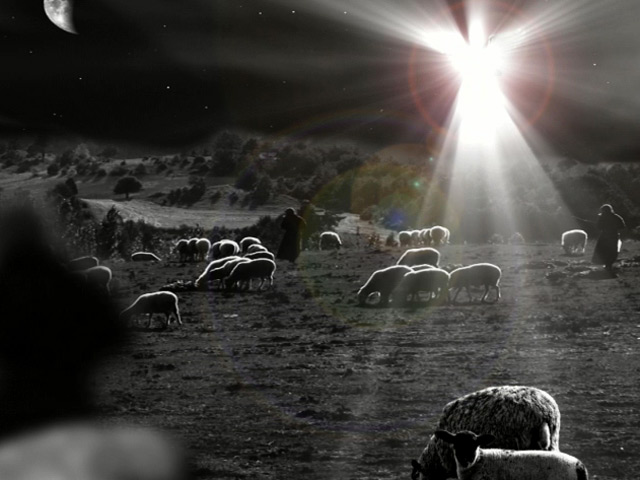
angelandshepherdsloop

So where does the story move? To shepherds who are living in the fields in order to watch over their flock at night. Shepherding was a despised occupation during the time of Jesus’ life. They were a homeless group of ragtag sheep watchers, worse off than even Mary and Joseph in their difficult manger. And for whatever reason the angel of the Lord appears to them in the wilderness — Not Augustus in his palace in Rome, not the chief scribes and the temple priest in Jerusalem, but the lowly shepherds in a field.

“Do not be afraid,” The angel bellowed. “for see – I am bringing you good news of great joy for all the people: to you is born this day in the city of David a Savior, who is the Messiah, the Lord. This will be a sign for you: you will find a child wrapped in bands of cloth and lying in the manger.” And without warning a multitude of the heavenly host appeared praising God and singing, “Glory to God in the highest heaven, and on earth peace among those whom he favors!”

And so the homeless shepherds traveled to Bethlehem to see this Savior, Messiah, and Lord waiting for them in a feeding trough born to an unwed couple.

So you see, Mary and Joseph were left alone that night — it was from the shepherds that they learned of the angel and the heavenly host. The two new parents, busy with the chores of childbirth in the most inhospitable of places under the most difficult of circumstances, did not get to experience heaven’s visit but instead heard about it from a group of homeless and wandering sheep watchers.

This is an unusual story, but it is precisely because of its strangeness, that it has made all the difference.

“I am bringing good news of great joy for all the people: for you is born this day in the city of David a Savior, who is the Messiah, the Lord.”

For whom is the child born? Not Augustus with all of his power, not the priests and the scribes who ruled the religious practices, not the super elite and fabulously powerful, but for those shepherds in the field, for all of you. For YOU this child has been born.

In that tiny dark manger God was born of the flesh in the baby Jesus. God became incarnate, took on our humanness. Jesus was both human and divine. Born into two worlds, from above and below, Jesus came as a new being in order to reconcile the world back to God. Though he carried the glories of God with him everywhere that he would eventually travel, he never ceased to care for our most basic needs: food, water, relationships. Wherever he went he ate with his friends and the marginalized, all of the shepherd types within the community, nurtured relationships so that all would come to know more about the love of God.

He knew that we could not truly live by earthly things alone… Do you have a Christmas tree at home filled with presents underneath but you cannot find pure joy in your life? Have you raised the perfect family with 2.5 children, a dog, a cat, and a white picket fence, but you feel like something is missing in your life? Do you find yourself searching for meaning, and even when you fill your life with all of the things that the world tells us we need, you never feel completely satisfied? Christ knows our emptiness, God came in the form of flesh to bear our emptiness, so that he could help fill us in a way that we never could on our own.

Haven’t we all had a Bethlehem moment in our lives? A time where it felt that no one knew us, no one understood what we were going through, no one reached out to help us? A period where we carried the weight of the world on our shoulders unable to share the burden with anyone else. A moment where it felt as if the darkness was too powerful for any light to shine forth. In many different ways, we have all traveled to our own Bethlehem.

How perfect is it then, that Bethlehem means “town of bread”? From a tiny manger, from an unwed couple, from the town of bread comes the incarnate God who is the bread of life. It is in this meal he came to bring us the bread of life that can and will sustain us in all things.

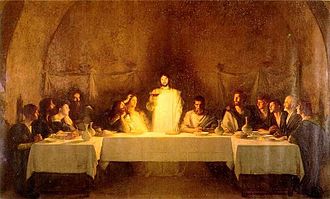
00029400_h

Because at this table, at Christ’s holy banquet, we are all invited into that tiny unlit manger, into the darkness and loneliness that Mary and Joseph must have felt. We are incorporated into this story because Jesus has welcomed us in. We are there, but more importantly Jesus is with us here. Christ is with us in all of our brokenness, in all the failed attempts to live perfect lives, in our fears and our frustrations, he is here because God came to be like us to help transform us.

That is Christmas! That is hope! That is grace!

That is the story worth telling over and over again, because the greatest thing to ever be, came to be with us.

Amen.


The Lord Is With You – Sermon on Luke 1.26-38

In the sixth month the angel Gabriel was sent by God to a town in Galilee called Nazareth, to a virgin engaged to a man whose name was Joseph, of the house of David. The virgin’s name was Mary. And he came to her and said, “Greetings, favored one! The Lord is with you.”But she was much perplexed by his words and pondered what sort of greeting this might be. The angel said to her, “Do not be afraid, Mary, for you have found favor with God. And now, you will conceive in your womb and bear a son, and you will name him Jesus. He will be great, and will be called the Son of the Most High, and the Lord God will give to him the throne of his ancestor David. He will reign over the house of Jacob forever, and of his kingdom there will be no end.” Mary said to the angel, “How can this be, since I am a virgin?” The angel said to her, “The Holy Spirit will come upon you, and the power of the Most High will overshadow you; therefore the child to be born will be holy; he will be called Son of God. And now, your relative Elizabeth in her old age has also conceived a son; and this is the sixth month for her who was said to be barren. For nothing will be impossible with God.” Then Mary said, “Here am I, the servant of the Lord; let it be with me according to your word.” Then the angel departed from her.
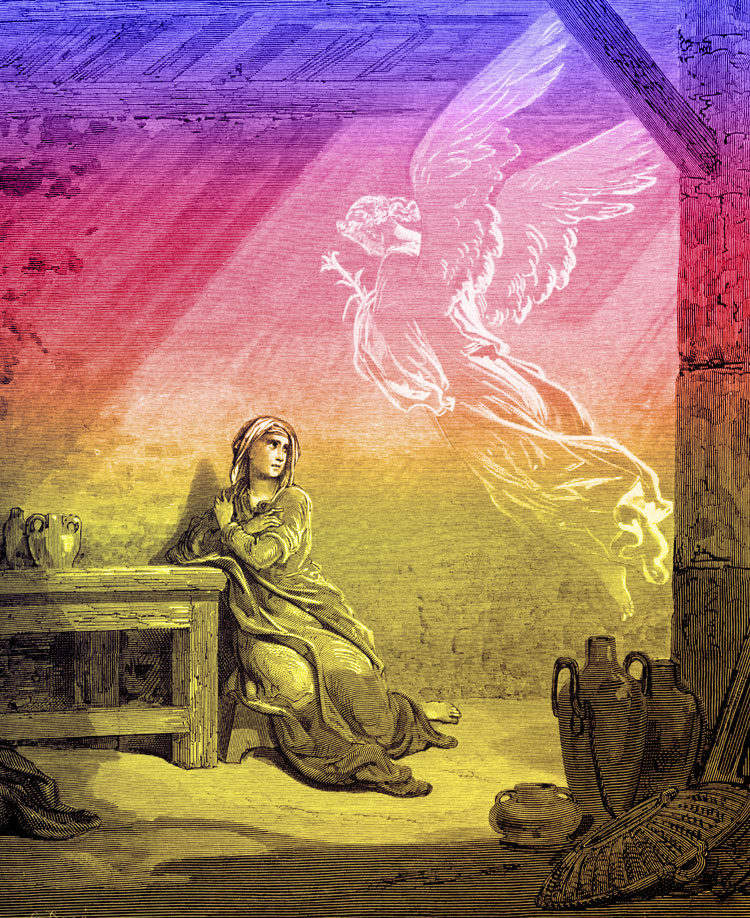
Luke-Chapter-1-The-Annunciation-to-Mary

Greetings, favored one! The Lord is with you.

In the sixth month, that is to say in the sixth month of Elizabeth’s pregnancy (from the scripture last week), the angel Gabriel was sent to another Israelite. Just as he had come to bring good news to Zechariah, Gabriel was now on a mission to find a young woman. And so it came to pass that Gabriel was sent by God to a town in Galilee called Nazareth, to a virgin engaged to a man whose name was Joseph, of the house of David. The virgin’s name was Mary.

This is a new episode in the gospel of Christ according to Luke, yet it is very clear how closely this story parallels the story of Zechariah in the Temple. Both interactions with the divine messenger are stories of God’s grace and power. Grace in that what is soon to take place will illumine God’s favor toward the world, and power in that God can work through the unable — an old childless couple, and an unmarried virgin. Both Elizabeth and Mary will become mothers because God is able, and they will have sons for our sake because God is righteous and gracious.

Gabriel said to her, “Greetings, favored one! The Lord is with you.” But Mary was much perplexed by his words and pondered what sort of greeting this might be. And the angel continued, “Do not be afraid, Mary, for you have found favor with God.”

Do you remember the story from last week? Do you remember how Zechariah was struck with fear when confronted by the angel in the most obvious of places, the innermost holy place of the Temple? Do you remember how his unbelief regarding the good news from Gabriel resulted in his becoming mute until the birth of John the baptist?
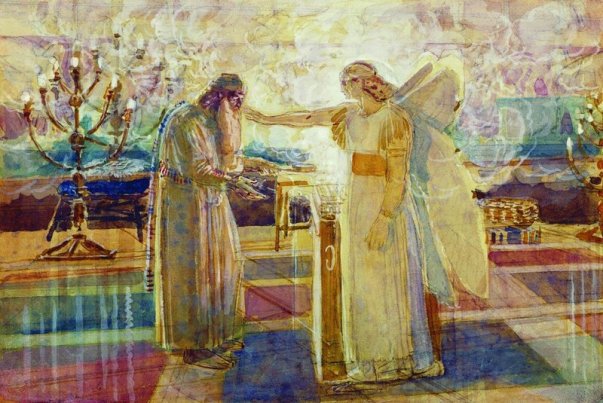
archangel-gabriel-struck-zechariah-mute-1824

Instead of a priest, one who should have been most familiar with the ways of God in the world and the stories from the past, Gabriel appears to a young unmarried virgin named Mary who does not respond in the same way.

Zechariah was overwhelmed with doubt and fear whereas Mary responded with awe and perplexity. Zechariah wanted to see a sign, wanted proof of the tidings brought by the angel, wanted to have his unbelief changed. Mary responds with curiosity. The messages from God speak into one’s insufficiencies, and brings good news of heavenly grace that must be trusted before its ways are known. There is great power in this story between the way Zechariah reacted, and the way Mary responded.

“And now Mary, you will conceive in your womb and bear a son, and you will name him Jesus. He will be great, and will be called the Son of the Most High, and the Lord God will give to him the throne of his ancestor David. He will reign over the house of Jacob forever, and of his kingdom there will be no end.”

This is good news. This is the kind of message that everyone had been waiting for. A new gift from God was going to come into the world through a young woman to be called the Son of the Most High. A new gracious leader is coming to take back the throne of David. The kingdom that God had always wanted for us is coming! And nothing will be able to stop God in all his majesty because this new kingdom will have no end!

“How can this be, since I am still a virgin?” Mary wondered. There is a difference here between doubt and curiosity. She believes the words from Gabriel, she understands that she will be bringing a child into the world. She is already preparing herself for God’s will in her life, but her curiosity regarding the fundamentals of God’s purposes come forth.

“The Holy Spirit will come upon you, and the power from the Most High will overshadow you; therefore the child to be born will be holy; he will be called Son of God. And even now, your relative Elizabeth in her old age has also conceived a son; and this is the sixth month for her who was said to be barren. For nothing will be impossible with God!

9

After explaining the elements of her coming conception, Gabriel ends his description with a final word of assurance. Gabriel recalls for Mary, and all of us, the creed behind all creeds, the very words spoken to Abraham and Sarah when they doubted the word that they were going to have a child in their old age: For with God nothing will be impossible.

And with perfect clarity, with willing submissiveness to God’s plans in the world, and with hope and joy, Mary responds to the calling of God: Here am I, the servant of the Lord; let it be with me according to your word. And then Gabriel departed from her.

How many times have you heard this story? Even for the so-called “unchurched” most people have heard, even just a sampling, of this story. The amount of art, Christmas decorations, and portrayals of Mary’s meeting with Gabriel are far and wide. This story is the source of great hope, frightening church schisms, and definitive reality shifts. Just as the prophet Isaiah told the Israelites, “Behold a virgin shall conceive a son and he will be called Immanuel,” the virgin Mary was met in the middle of the night by an angel to discover that she was to be the vessel of the Lord.

However, like the story of Zechariah in the temple, Mary’s midnight meeting has been told so many times that it is often difficult to discover something new and fresh when we approach the story. This week as I made my way through the first chapters of Luke, engaged in numerous conversations, and pondered over the heart of Advent, I began to wonder: Why Mary?

Why Mary? If God wanted to come into the world in a big way, with pomp and circumstance; If God wanted to come in the form of flesh to dwell among us as a king with power, he certainly could’ve picked a better mother. Why on earth did he choose her?

I’ve always had a hard time understanding what it is about Mary that made her highly favored in the eyes of the Lord. Remember Gabriel’s first words: “Greetings, favored one!” Really? How could she possibly be favored? Immediately following this episode she would presently go on a long and difficult journey to small town, not because she wanted to, but because the foreign rulers of her homeland forced her to go. She would be ridiculed, and judged, and even threatened for carrying a child conceived outside of normal circumstances, particularly before being married. She would give birth to this “son of the Most High” in one of the lowliest places, a stable. And after Bethlehem? Long years of obscurity and poverty with the world continually churning with its disapproval of the Jews, with the power from on high weighing down the life of the people. Her baby from Bethlehem would go on to become one of the most hated men in all of Israel and his life would increase in danger until the very end. The humble, marginalized, poor, and weak loved him, while the powerful and wealthy regarded him with hatred. Mary’s baby boy would be murdered on a cross, betrayed by the very people he came to serve. She would come to cradle her lifeless son’s body in her arms just as she did that first night in the manger. That was the favor of God?

Why Mary? Why an unwed, impoverished, and teenage girl?

Throughout the gospels Mary is portrayed as thoughtful, obedient, believing, worshipful and devoted to Jewish law. To us, and to all who knew her, she is the ideal Christian. However, none of these qualities are offered as reasons for God choosing her, God’s reasoning is tucked away from our view. We can guess, and we can come to our own conclusions, but the truth of God’s choice is known only to God in his eternal plan.

If Mary had wanted a perfect life on unbroken happiness, ease and pleasure in all things, then she certainly didn’t get it. If she had tried to measure up the favor of the Lord by the expectations of the world, then it would seem that the promise and salutation of the angel was only an illusion.

But the truth, and I mean real truth, is always deeper than it appears on the surface. 

The world would tell us, that God’s favor is to be found in ease, pleasure, and prosperity. God’s favor can be seen in a Christmas tree covered in perfect ornamentation with a plethora or present piled underneath. How many televangelists and “christian” writers make their millions and claim that God’s favor is with them, that God wanted them to be wealthy and powerful? Their messages always contain some sort of theologically problematic promise: If only you pray more, if you only read your bible more, if you only put more money in the offering plate, then God will make you healthy, happy, holy, and wealthy.

That is not the gospel.

It is a terrifying paradox, but, it is the lives which have been given something great to do and to bear, even though they may have been bruised and battered in the process, which have truly known the favor of God.

If God had wanted our discipleship to be easy then he would not have come into the world through the difficult situation of an unwed virgin. If God had wanted our faith to be easy then we would have no need for church, repentance, and forgiveness.

With Mary, and frankly with every single one of us, it comes down to obedience. Purely and humbly Mary put herself into the hands of God. She sacrificed so that God’s will could be done in the world. “Let it be with me according to your word.”

As the story continues, Mary meets with her relative Elizabeth, and when John leapt in his mother’s womb while in the presence of Jesus in Mary’s, she responds by praising God. She praises God even though the child in her womb will certainly make her life more difficult. And when we read the Magnificat it seems like Mary is continuing to praise God for the wrong reasons. Rather than celebrating God’s gifts to the proud, the powerful, and the rich, she offers joy that God has turned such values upside down.

I believe that we, myself included, are so often caught up with what the world defines as greatness, what the world defines as favor, that we lose sight of God’s kingdom right in front of us. We would all do well to join in with Mary’s song and magnify the Lord who lifts up the lowly and vulnerable in love. We would do well to open our eyes and ears to what God is doing in the world, what God wants to do through us, and respond with a resonating, “Here I am, let it be with me according to your word.

So, how is it with your soul? Where have you felt God tugging you in your life? Is there a pull or a nudge that has happened, perhaps you don’t know why, but you know that something is there? Have you seen a place in your life that you want to change but you’re unsure of whether or not you really can? Is God calling you to do something in your life and you, like Mary, are perplexed at how it would even be possible?

My guess is, we all have something. Whether large or small, grand or simple, God is always calling us to something new. To fix a broken relationship, to reach out to those marginalized in our own community, to shine a great light when it feels like the darkness is taking over.

As we prepare to make our way to Christ’s table let us all remember that with God nothing is impossible. An old childless couple can be given new life, a virgin can bear a child who came to save us, we can all be forgiven for the wrongs we have committed, death can be defeated, life after life after death is available through the grace of God, lives can be transformed, love can be discovered, and faith can be rekindled. Nothing will be impossible with God.

Amen.


Greatness – Sermon on Luke 1.5-23

Luke 1.5-23

In the days of King Herod of Judea, there was a priest named Zechariah, who belonged to the priestly order off Abijah. His wife was a descendant of Aaron, and her name was Elizabeth. Both of them were righteous before God, living blamelessly according to all the commandments and regulations of the Lord. But they had no children, because Elizabeth was barren, and both were getting on in years. Once when he was serving as priest before God and his section was on duty, he was chosen by lot, according to the custom of the priesthood, to enter the sanctuary of the Lord and offer incense. Now at the time of the incense offering, the whole assembly of the people was praying outside. Then there appeared to him an angel of the Lord, standing at the right side of the altar of incense. When Zechariah saw him, he was terrified; and fear overwhelmed him. But the angel said to him, “Do not be afraid, Zechariah, for your prayer has been heard. Your wife Elizabeth will bear you a son, and you will name him John. You will have joy and gladness, and many will rejoice at his birth, for he will be great in the sight of the Lord. He must never drink wine or strong drink; even before his birth he will be filled with the Holy Spirit. He will turn many of the people of Israel to the Lord their God. With the spirit and power of Elijah he will go before him, to turn their hearts of parents to their children, and the disobedient to the wisdom of the righteous, to make ready a people prepared for the Lord.” Zechariah said to the angel, “How will I know that this is so? For I am an old man, and my wife is getting on in years.” The angel replied, “I am Gabriel. I stand in the presence of God, and I have been sent to speak to you and to bring you this good news. But now, because you did not believe my words, which will be fulfilled in their time, you will become mute, unable to speak, until the day these things occur.” Meanwhile the people were waiting for Zechariah, and wondered at his delay in the sanctuary. When he did come out, he could not speak to them, and they realized that he had seen a vision in the sanctuary. He kept motioning to them and remained unable to speak. When his time of service was ended, he went to his home.


“Do not be afraid, Zechariah, for you prayer has been heard.”

archangel-gabriel-struck-zechariah-mute-1824

And so it came to pass in the days when King Herod ruled Judea, that a priest named Zechariah had his life turned upside down. Now Herod was a terrible king, responsible for countless atrocities, murders, and high levels of corruption. A man with frightening power ruled over a land and a people with such chaos that he dominated the attention of the masses. During his rule, a nobody priest married to a woman named Elizabeth, made his way through life.

Zechariah belonged to the priestly order of Abijah and was regularly responsible for activities around the Temple in Jerusalem. Though Zechariah and Elizabeth lived righteous lives, they had no children and were getting on in years.

One day, a day like any other, Zechariah made his way to the temple in order to perform his regular duties. As was the custom, lots were cast to decide who would enter the sanctuary and offer incense to the Most High God. While countless people gathered outside the walls, Zechariah made his way in to perform a simple task that had been done for as long as he could remember.

This is where the story gets interesting.

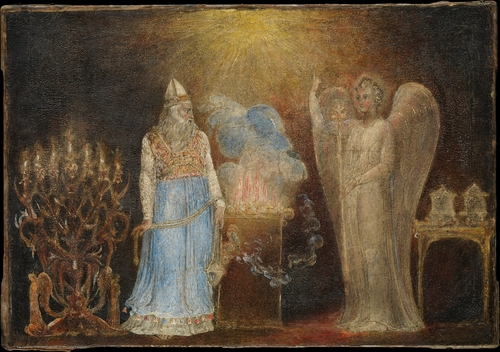
1-blake-z-and-angel

While standing within the closed room, an angel of the Lord appeared to Zechariah. We receive no description of this heavenly messenger in the biblical narrative, but the sight was enough to overwhelm and terrify Zechariah. Let your imaginations conjure up the confrontation with an angel to the degree that you would cower in fear and trembling.

Do not be afraid, Zechariah, for your prayers have been heard. Your wife Elizabeth will bear you a son, and you will name him John. You will be filled with joy and gladness and many will rejoice at his birth, for he will be great in the sight of the Lord. Take care to make sure that he never drinks wine or other strong substances, even before his birth he will be filled with the Holy Spirit. In time, he will turn the people of Israel back to the Lord their God. He will make ready a people prepared for the Lord.

And how does Zechariah react to this momentous declaration? How does he respond to the heavenly messenger carrying news of great joy?

“How will I know this is so? For I am an old man, and my wife is getting on in years.”

It’s moments like these in the scriptures that I wish I could jump into the story and smack some sense into the lives of the people experiencing the glory of God. How will you know this is so Zechariah? You fool! Don’t you know that with God all things are possible? Have you forgotten how he delivered your people from slavery and captivity in Egypt through the Red Sea to the Holy Land? Have you forgotten how the Lord provided a ram in the bushes for Abraham to sacrifice instead of his son? Have you forgotten how David was able to triumph over Goliath because the Lord was with him? Moreover, have you forgotten how many barren women the Lord has provided for? Sarah, Rebekah, Rachel, Hannah. Come on Zechariah, have a little faith. 

The angel responds to Zechariah: I am Gabriel and I stand in the presence of God. I was sent to bring you this good news, but now, because you did not believe my words, you will become mute and unable to speak until these things occur.

So Zechariah made his way out of the temple, stood before the crowds unable to speak, and eventually returned home.

Of course, thats not the end of the story, but we’ll save that for later.

What are we to make of this remarkable episode recorded at the beginning of the Gospel according to St. Luke?

God is at work here in ways familiar to us from the Old Testament: the story contains a casting of lots to make a decision, there is a vision in God’s holy Temple, a divine being appears to pass along a message, there is a promised sign, and a childless couple is given new life.

It is clear that God works in and through the normal avenues of life in the believing and faithful community. The community of faith can fall under the temptation to make God into whatever they desire for worship, but there is an important conviction present at the beginning of this New Testament: the stories of Israel are important, vital, and necessary for understanding how to be used for God’s purposes in the world.

Though this is a story from the past, doesn’t it sound familiar? Just as it is today, some horrible and frightening situation has gripped the people, a power reigns from above in order to control a community. Evil has taken root at the center of life and dominates the attention of the populace. This past week marked the one year anniversary of the shooting at Sandy Hook Elementary school and another shooting took place at a school in Colorado. You need only turn on the news or read a newspaper to be reminded how much fear and violence demands ALL of our attention.

However, in spite of all this fear and damage in the world, just as during the time of Herod, there is another sort of person, quiet, removed, and yet, more important than the powers that rule, men and women who are the core of society and give it the depth of its reality. Then and always there were and are the humble and brilliant men and women in whom the strength of the present and promise of the future lie.

Gabriel tells Zechariah that his son, John, will be great in the sight of the Lord. Sadly, according to the ways of the world, greatness has had its definition confused and reshaped. We have been told that greatness is measured in terms of selfishness rather than service, in terms of material rather than spiritual wealth, in terms of instant gratification rather than hard work and perseverance. But greatness as God sees it, the greatness that John will live into, is about being linked with the eternal purposes of redemption, about being an obedient instrument of God’s peace, and helping others to know and feel love in their lives.

But notice: the greater John will become for God, the more hostility he will arouse in those around him. Doing the will of the Lord, reaching out in love according to discipleship sends ripples through the fabric of what the world deems as “greatness.”

John is to be like the prophets from old: in light of their direct contact and experience of the divine, they drew the messages which burned within them like fire and would not rest until the decrees of God were delivered.

In every age we need the passion of people on fire for God to shout out in prophetic fervor. Our lives are so often filled with the dry wood of dull possibilities that desperately need to be rekindled by the divine spark that often comes through the words and actions of the prophets. We need to have our lives turned around and back to God in order to discover the passion that is waiting for us in our discipleship. The communion between God and the prophet allows for a divine condition to be present and the purposes of God can be realized in the world.

I love the juxtaposition of the story of Zechariah in the temple with Gabriel. It is precisely at the moment when John is being prepared to speak for God, Zechariah is struck mute for his unbelief. The typical, traditional, and tired voice of the priest, is being replaced by the fervent, fantastic, and faithful voice of the prophet.


Worship is at the center of the story. I’ve read it countless times, and heard it discussed and preached on during numerous advent services, but something fresh and new struck me this week about Zechariah’s encounter. I wondered: why was he so surprised and scared? Think about it for just a moment; Zechariah was a priest, well-versed in the stories from old about how God interacted with God’s people, a man who often found himself in the holiest of places performing the works of the Lord. What did he think would happen to him inside that holy space?

Being overwhelmed by the presence of an angel in the sanctuary of the temple is like going to McDonalds, ordering a Big Mac, and being surprised to discover beef between the bread… I mean this is how God works! God shows up, confronts us in the midst of a moment, and calls us to something. It does not need to be grand, and more often than not it occurs in the small silence in a moment we least suspect, but for Zechariah it came in a big way. He was in God’s holy temple confronted by an angelic messenger bringing the good news. So why was he so surprised? And more importantly, why did he doubt the validity of the message?

Our expectations about worship have major impacts on the way we live our lives.

What we believe shapes how we behave.

What to we think will happen to us when we gather in this space? Are we prepared to be confronted by the God who called John to greatness? Are we willing to let God dwell in our hearts and change the way we live in the world? Are we ready to take up our own crosses to follow Jesus. Are we prepared for God to show up in our lives in ways that we cannot expect or anticipate?

Unless we recognize the definitive need for real experiences and methods of discipleship which wake the whole depth of our experience, then what we do in worship will remain, as it did for Zechariah, thin and lacking. Until we prepare ourselves to be surprised by God’s desire to find us where we are, then this holy place will remain, as it did for Zechariah, boring and repetitive. Until we dare to step out into new forms of life and love, hearing the word of the Lord, and letting it become incarnate in the ways we live our lives, then faith will remain, as it did for Zechariah, dwindling and fruitless.

eucharist

What do we expect will happen when we gather together at Christ’s table? Are we repetitively entering the holy space to burn incense unaware that we are meeting God in all of his holiness? Or are we excited and nervous about the prospect of being welcomed to a table that we have no right to join? Are we so rooted in our habitual worship that we can no longer remember why we join at this table? Or are we prepared to be called forth toward greatness in the world through the redemptive and life-giving properties of God’s presence at his table?

Just as it happened with Zechariah, a heavenly voice might be trying to break out into the world. Perhaps God’s good news is striving to strike forth through the closed circle of our expectations of church, faith, and discipleship. Important for us this morning is to remember that God is always on the move, reaching out to find us and change our lives, that there is always a new message for those with ears to hear. The great need for us is to realize, as Zechariah eventually did, to not be caught up in the limited imagination of what God can do in the world which assumes that the present must always be governed by the past.

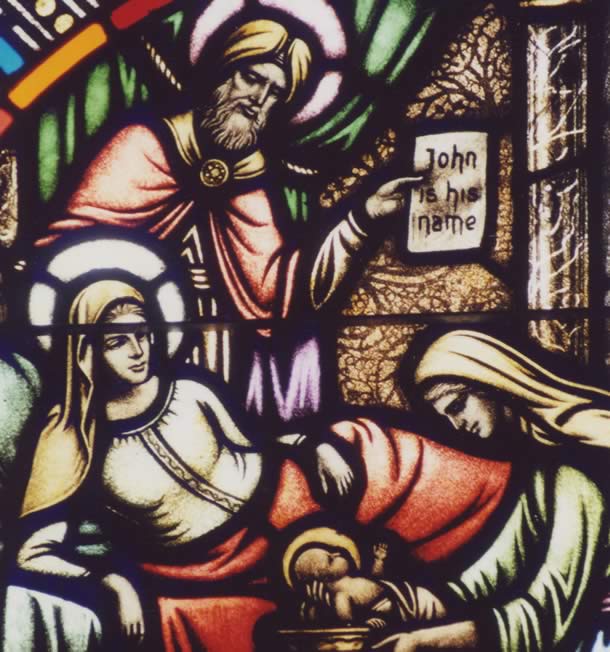
zech_eliz_john

Nine months after Zechariah was struck mute in the temple by Gabriel, his wife Elizabeth gave birth to a baby boy. When it came time to name the child, the family wanted to name him Zechariah after his father, but Elizabeth insisted that it was to be John, and after Zechariah confirmed this with writing on a tablet his mouth was freed. The plague of his disbelief had been wiped away by the miracle of his son’s birth. Now filled with the Holy Spirit Zechariah spoke these great words to his infant son: And you, child, will be called the prophet of the Most High; for you will go before the Lord to prepare his way, to give knowledge of salvation to his people by the forgiveness of their sins. By the tender mercy of our God, the dawn from on high will break upon us, to give light to those who sit in darkness and the shadow of death, to guide our feet into the way of peace.

This is one of the many places that God confronts us in our lives. Through the bread and the wine let us all be moved to live lives worthy of the greatness that God is calling us toward.

Amen.


Cross and Crown – Sermon on Jeremiah 23.1-6 and Luke 23.32-43

Jeremiah 23.1-6

Woe to the shepherds who destroy and scatter the sheep of my pasture! Says the Lord. Therefore thus says the Lord, the God of Israel, concerning the shepherds who shepherd my people: It is you who have scattered my flock, and have driven them away, and you have not attended to them. So I will attend to you for your evil doings, says the Lord. Then I myself will gather the remnant of my flock out of all the lands where I have driven them, and I will bring them back to their fold, and they shall be fruitful and multiply. I will raise up shepherds over them who will shepherd them, and they shall fear nor longer, or be dismayed, nor shall any be missing, says the Lord. The days are surely coming, says the Lord, when I will raise up for David a righteous Branch, and he shall reign as king and deal wisely, and shall execute justice and righteousness in the land. In his days Judah will be saved and Israel will live in safety. And this is the name by which he will be called: “The Lord is our righteousness.”


Luke 23.32-43

Two others also, who were criminals, were led away to be put to death with him. When they came to the place that is called The Skull, they crucified Jesus there with the criminals, one on his right and one on his left. Then Jesus said, “Father forgive them, for they do not know what they are doing.” And they cast lots to divide his clothing. And the people stood by, watching; but the leaders scoffed at him, saying, “He saved others; let him save himself if he is the Messiah of God, his chosen one!” The soldiers also mocked him, coming up and offering him sour wine, and saying, “If you are the King of the Jews, save yourself!” There was also an inscription over him, “This is the King of the Jews.” One of the criminals who were hanged there kept deriding him and saying, “Are you not the Messiah? Save yourself and us!” But the other rebuked him, saying “Do you not fear God, since you are under the same sentence for condemnation? And we indeed have been condemned justly, for we are getting what we deserve for our deeds, but this man has done nothing wrong. Then he said, “Jesus, remember me when you come into your kingdom.” He replied, “Truly I tell you, today you will be with me in Paradise.”


If you are the King of the Jews, save yourself! There was also an inscription over him, “This is the King of the Jews.

The first time I traveled to Guatemala I had no idea what to expect. Sure I had been on previous mission trips to different parts of the United States, but I had yet to serve the church in a truly different environment. Everywhere we traveled there was a sense of excitement in the air because everything was so remarkably fresh. The abundance of colors in the differing marketplaces, the worn and wrinkled faces of the elderly mayans carrying heavy loads, and the mountains scratching across the horizon.

285_1026151305027_4642_n

I had been looking forward to the trip for sometime and when we finally arrived, everything was meeting my expectations. I believed that we were truly serving God’s kingdom by serving our Guatemalan neighbors by building stoves in the indigenous highland areas. I believed that we had something to share with them, not to convert them, but to live out the gospel of Jesus Christ and demonstrate the love of God in the world.

On one of the early days of the trip, our team arrived in the town of Chichicastenango, known for its traditional K’iche’ Mayan culture. It was a pit stop for us on the way to the higher regions, and we were there for lunch and to explore the vast and dense market. Everywhere you turned you were overwhelmed by the sense of time and tradition, as if this place had remained unchanged for the last few centuries. I wandered through the winding streets, peeked in some of the different booths, but really I was just trying to soak up the culture.

6493_1147085688311_6475115_n

At some point, I became lost. I could not see anyone from my group and continued to travel aimlessly throughout the town. I tried to keep it together, not panic, and decided to find a high vantage point in order to get a bearing on my surroundings. I walked until the stones under my feet started to slant upwards and eventually found myself in front of a very old church. The stone steps were covered with Mayans, sitting and sprawling over every space, and I had to weave my way back and forth in order to reach the entrance of the church. Though I should have immediately turned around to look out at the town, something drew me inside.

6493_1147085808314_3679425_n

The church was damp, dark, and devoid of anyone else. The ground felt alive under my feet as it gave way to my weight, the walls were covered with black soot from centuries of fires, and the paintings and decorations had nearly all disappeared from view. The smell of melted wax filled my nostrils as I began to creep closer and closer toward what I imagined was the altar. It was the least church-like church I had ever entered. Without the help of lighting, I stumbled over rickety wooded seats until I finally found myself standing in the front of the church. There poised in front of me was perhaps one of the most pristine sculptures of Christ that I had ever seen. In complete contrast with the rest of the space, this Christ was unblemished, beautiful, and brilliant. Jesus stood elegantly with his robes draped over his shoulders with one hand outstretched with a remarkable golden crown resting on his forehead: Christ the King.


The celebration of Christ the King Sunday is a relatively recent addition to the Christian calendar. The greater church had celebrated the knowledge and image of Christ as king for centuries, but Pope Pius IX officially added to the Christian year in 1925. It took the church 1900 years to need this feast so bad in order to add it to the life of worship. When the first celebration of Christ the King occurred, Mussolini had been in charge of Italy for three years, the maniacal man named Hitler had been out of jail for a year and his Nazi party was growing in popularity, and the United States was preparing for the Great Depression. In such a time, when the world seemed out of control, the church asserted that, nevertheless, Jesus Christ is King of the universe.

This day, this celebration in the life of the church, became the church’s great nevertheless to the godlessness of the world. Despite the rise of dictators, wars, fear, and death, despite the widespread notion that religion was only a “private affair” for individuals, Christ the King asserted that Jesus Christ is the Lord, and he shall reign forever and ever. 

During the celebration of holy mass in the chapel of the Carmelite Monastery 6 members of the OCDS community made promises to the Order.  Dr. Jason Bourgeois and Judy Hawkins professed their temporary vows for 2 years and David Travers, Suzie Megown, Kath

On Christ the King Sunday the Lectionary provides for us scriptures that reflect the “kingliness” of Jesus. The Old Testament scripture from Jeremiah, contains a prophetic word about the coming Messiah: “The days are surely coming, says the Lord, when I will raise up for David a righteous Branch, and he shall reign as king and deal wisely, and shall execute justice and righteousness in the land. In his days Judah will be saved and Israel will live in safety. And this is the name by which he will be called: “The Lord is our righteousness.” Jeremiah reports the Word of the Lord to a people in a time of chaos: there are people who are unworthily leading and scattering God’s sheep. But nevertheless, God will bring about a righteous Branch, a king to rule all things, a king of righteousness.

What do we want out of a king? Someone who will execute justice and righteousness? Someone who has our best interests at heart? Someone who lowers our taxes? Someone who will lead us victoriously into battle?

The Israelites wanted a king like David. They so desired someone to come in the name of the Lord in order to overthrow the powers that be, and take a seat on their appointed throne. To be crowned with glorious gems and rubies, to bring about God’s kingdom on earth with power. What kind of a king do we want?


And he was led away to the place called The Skull with two others, who were criminals. There Jesus was crucified with the criminals, one on his right, the other on his left. With the blood still wet on his hands and feet, Jesus said, “Father, forgive them, for they do not know what they are doing.” those who had gathered to witness his death began to cast lots for his clothing, and people stood by watching, waiting. The leaders began to mock him, “He saved others; let him save himself if he is the Messiah of God, his chosen one!” The soldiers present also mocked him, coming up and offering him sour wine, “If you are the King of the Jews, save yourself!” And there was a sign hung over his head that read, “This is the King of the Jews.”

Crucifixion-PeterGertner

One of the criminals hung next to Christ kept deriding him and saying, “Are you not the Messiah? Save yourself AND us!” But the other criminal rebuked him, saying “Are you not afraid of God, since you are under the same punishment? And we were condemned justly, for we are getting what we deserve for our deeds, but this man has done nothing wrong.” Then he looked to the Christ, “Jesus, remember me when you come into your kingdom.” And Jesus replied, “Truly I tell you, today you will be with me in Paradise.”

That is our King.

When you really get down to it, when you hear Luke’s remembrance of the crucifixion, it is so simple and straightforward. This is in contrast with the flood of feeling-filled poetry, hymns, sermons, and images that have flowed ever since. Our King did not reign in glory according to the expectations of the world. Instead of a long flowing purple robe he was left nearly naked on the cross. Instead of a crown of rubies, diamonds, and gems, he wore a crown of thorns. Instead of a majestic throne inlaid with gold and comfort, Christ reigned from a cross.

The Romans were notorious for using crucifixion as a form of execution for common criminals because it not only warned the public about the crimes against Rome, but it also added shame, pain, and a slow death. Yet somehow, instead of being hung for shame, Jesus Christ was elevated to his throne on the cross.

In that simple moment of hanging for all to see, Christ the King reigned magnificently over God’s kingdom and demonstrated the depth of what it means to be our King. Jesus refused to test God and heed the call of his tormentors to save himself. Three separate times Jesus was mocked to “save himself,” with the one criminal adding, “and us.” In his final moments Jesus does save someone, and that the one he saved was a dying criminal fits perfectly with the greater message of God’s Good News of the world. In Jesus’ dying hour, he continued his ministry: For the Son of man came to seek and to save the lost. That is what it means to be King.


As I stood in that Guatemalan church, I was confronted for the very first time about what it really means to believe that Christ is the King. I was surrounded by decay, desolation, and disregard yet Christ stood before me as the King. In that moment I saw the paradox of the crucifixion, that the King of God’s glory was hung on a cross to die, that Christians in Guatemala can see the world slipping away from them, yet Christ is still King of the universe. I thought I was bringing something with me to Guatemala, that I was carrying God’s message. I believed I was looking for and seeking out God in my own life when God was the one looking for me; waiting to confront me in that dark and empty church.

How remarkable is it that we worship a God who loves us so much that he is continually looking for us, finding us in the differing moments of our lives to remind us who is really in charge? How beautiful is it that our God came in the form of flesh, to be the incarnate Word, and reign from a cross at the place called The Skull? How perfect is it that our King does not meet the expectations of the world, but instead turns the world upside down? How blessed are we that our King reigns not above us, but for us, beside us, and with us?

Today is the last Sunday of the Christian year, we have come to the conclusion of our liturgical calendar. We began with Christ’s birth made our way through his life death and resurrection. We have remembered the stories of the Old Testament where God made covenant with his people to be their God. We have witnessed the tragedies that have occurred in the world, we have lost loved ones, and suffered in our own lives.

Yet, nevertheless, Jesus Christ is King of all things.

christsinai

Jesus Christ, fully God and fully human, brought forth a new age in the life of humanity, ushered in a new kingdom by water and the Spirit, reigned triumphantly from the most unexpected of places. Jesus Christ, Son of Man, came not to be served but to serve and give his life as a ransom for many. Jesus Christ, Son of God, died on a cross for the world so that we might all be reunited and reconciled with God. Jesus Christ, the Holy One, taught us about how to live and love abundantly in God’s Kingdom. Jesus Christ, King of the universe, was resurrected from the grave to share life eternal with us.

Hallelujah! To God be the Glory forever and ever!

Amen.


Apocalypse When? – Sermon on Luke 21.5-19

Luke 21.5-19

When some were speaking about the temple, how it was adorned with beautiful stones and gifts dedicated to God, he said, “As for these things that you see, the days will come when not one stone will be left upon another; all will be thrown down.” They asked him, “Teacher, when will this be, and what will be the sign that this is about to take place?” And he said, “Beware that you are not led astray; for many will come in my name and say, ‘I am he!’ and, ‘The time is near!’ Do not go after them. When you hear of wars and insurrections, do not be terrified; for these things must take place first, but the end will not follow immediately.” Then he said to them, “Nation will rise against nation, and kingdom against kingdom; there will be great earthquakes, and in various places famines and plagues; and there will be dreadful portents and great signs from heaven. But before all this occurs, they will arrest you and persecute you; they will hand you over to synagogues and prisons; and you will be brought before kings and governors because of my name. This will give you an opportunity to testify. So make up your minds not to prepare your defense in advance, for I will give you words and a wisdom that none of your opponents will be able to withstand or contradict. You will be betrayed even by parents and brothers, by relatives and friends; and they will put some of you to death. You will be hated by all because of my name. But not a hair on your head will perish. By your endurance you will gain your souls.


            The disciples have gathered together with Jesus. They’ve probably shared some bread, fish, and wine while sitting around and talking about the latest news from Galilee and the recent happenings in Jerusalem. Peter, ever extraverted, decides to change the conversation to the majesty of the temple: “Oh how lovely it was, adorned with remarkable stones and the gifts dedicated to God. Have you ever seen such gold in your lives?” The other disciples nod in approval, while Jesus remained silent. Bartholomew furthers Peter’s claim: “The temple of God is indeed a witness to God’s majesty in the world. Only the God of Abraham, Isaac, and Jacob could have such a place!” They all begin to agree with one another, affirming the glory and might of their God, the God of Israel, worthy of such a temple.

            But then, in sharp contrast to their excited exclamations, Jesus speaks up, “All of these things that you see, the temple in all its glory, the days will come when not one of these stones will be left upon another; all of them will be thrown down.

            The disciples have been around Jesus long enough to know that when he says something like this, its important to pay attention. “But how could this be?” they wondered; the temple was a sign of God’s glory. So then one of the disciples, perhaps Peter, asked on behalf of the whole group, “Teacher, when will this be, and what will be the sign that this is about to take place?”

apocalypse-when

            What a question. Its stories like this one that help to remind me how similar we all are to the disciples. Because that question is the same one I would’ve asked. Okay Jesus, things are going to get rough, when? What will happen to let us know that this is about to take place?

            How appropriate and funny is it that Jesus’ first warning about the apocalypse is directed toward the would-be-prophets who predict the end of the world? Just within my lifetime I can think of a number of examples of the self-affirmed prophets who claim to know the exact date of the approaching end of the world. And even though Jesus has clearly warned us against them, when they come forth with their predictions, they never fail to get a hearing, media presence, and air time.

61786025


And people listen to them! Droves of people go to the bank and withdraw their life savings, bunkers are dug and filled with emergency supplies, and some even take their own lives rather than accept the coming doom and gloom predicted by these would-be prophets. Jesus looks out at his disciples, and therefore every one of us, and declares, “Beware that you are not led astray; for many will come in my name and say, ‘I am he,’ and, ‘The time is near!’ Do not go after them.

            There always seems to be some other form of allegiance in the world that appears better than what we learn to live into from God’s Word. Some affiliation more fruitful, some path through the trials of life that seems more certain and secure. We would rather rely on reason than faith. We would prefer to deal with material possessions than with spiritual growth. The tragedy of the history of God and God’s people is that we have continually been a people running off like that, generation after generation, in pursuit of other, perhaps easier, gods.

            After this first warning, Jesus continues his diatribe regarding the eschaton: “When you hear of wars and insurrections, do not be terrified; for these things must take place first, but the end will not follow immediately. Nation will rise against nation, and kingdom against kingdom; there will be great earthquakes, and in various places famine and plagues; and there will be dreadful portents and great signs from heaven. But before all this occurs, they will arrest you and persecute you; they will hand you over to synagogues and prisons; and you will be brought before kings and governors because of my name.”

tumblr_lxqyysSSQ61qlvp8so1_500

            I have often heard non-Christians remark about how easy it is to be Christian. Those with a limited knowledge of what it means to be a faithful people often charge the church as being a means of escape from the harsh realities of the world. “It must be so easy to be Christian, you don’t have to worry about what really goes on in the world, just waiting for your heavenly reward.” However, in sharp contradiction to these claims Jesus very bluntly puts forth how very difficult it is, and will be, to be Christian. In a way, being Christian, is in some sense, an escape, not our of life, but right into the depth of it; from meaningless into meaning, from futility into purpose, from bondage into freedom.

            The Good News of Jesus Christ has always been paradoxical in its ability to disturb the ways of the world. Those with privilege look on it with suspicion, those with power look at it with disappointment. The Jewish leaders were shaken by it and fearful. Rome outlawed it. The first disciples all suffered persecution and condemnation. Jesus did not get killed for loving too much, but for turning the world upside down; for changing the perspective of what it means to be first and last, for defeating death, and removing power from the powerful.

            “This will give you an opportunity to testify. So make up your minds not to prepare your defense in advance, for I will give you words and a wisdom that none of your opponents will be able to withstand or contradict.”

            When Jesus addresses the disciples, describing for them the very trials and tribulations that they were to face he makes it clear that these are the hours of opportunity. When the world shouts No, the church responds with a resounding Yes!

            Our faith is not a creed, not a way of thinking about life, not 5 steps to make a better you; it is the I and Thou of a God who calls us by name, addresses us, seeks us, a moment of meeting, the time for hearing and becoming. Our faith is about confronting the problems of the world, living into them, and transforming the world for God’s kingdom. The Bible, God, and our faith is never on pause. The time is now!

            What Jesus describes in this passage is what we often call the apocalypse. What kinds of images come to your mind when you think about the apocalypse? Death? Destruction? Zombies? Though these are the popular images often associated the apocalypse, apocalypse deals with a revelation, which discloses the realm of God behind the world of historical and interpretable events.

            Timing is important when we talk about revelation from God. What Jesus describes, the events surrounding the suffering of his followers will happen in the future. There will come a time when Christians are called to testify to their faith when everything around them will argue the contrary. The apocalypse is coming in the future.

            However, most of the events that Jesus described took place within the 1st century of the church. The temple was destroyed in 70 AD, the disciples were called before synagogues and governors to witness to their faith. They were rejected by the world and suffered because of their association with Jesus Christ. Nations rose against nations and wars took place. The apocalypse happened in the past.

            What becomes real for us today, though, is that God’s revelation, the apocalypse, is happening right now! What Jesus described in his apocalyptic descriptions helps to show how what is going on is mixed with what is really going on. Events set in the larger context of God’s purposes in the world. We have been caught up in God’s great cosmic victory and therefore we are surrounded by symbols, signs, and mysterious elements regarding what is really taking place. As strange as this may seem to us as enlightened, modern, and rational people, it is a dramatic witness to the tenacity of faith and hope among the people of God.

            “You will be betrayed even by parents and brothers, by relatives and friends; and they will put some of you to death. You will be hated by all because of my name. But not a hair on your head will perish. By your endurance you will gain your souls.”

            How easy is it to be Christian? Apparently, its not. What is at stake for us in this passage is the commitment and call to be faithful witnesses under unusual stress and frustration. For us, here in Staunton, it might be hard to imagine suffering for our Christian identities. But faithfulness and endurance under threat and disapproval (and even penalty of death) are the qualities of discipleship during the time of witnessing. Disciples, and that means all of us here, are not exempt from suffering. If there is any doubt of this period of testing and testimony is still present, you need only look to what recently happened in the Philippines, or the dozens of Christians who were recently executed in North Korea for having Bibles, or the suffering of members within this church right now. Some of you might know of the suffering within the church, perhaps its even happening to you, just look around.

            Jesus’ address to the disciples regarding the apocalypse, the revelation of God, calls us to reflect on our own discipleship. I have been told again and again that if people are not complaining about me in the church I serve, than I am not doing my job. Being Christian implies a willingness to be pushed into the discomfort of discipleship in order to live into the new reality that Christ initiated with his death on the cross.

            Are we almost Christians? Are we content to arrive on Sunday mornings in order to go back to work on Monday without any change in our lives? Are we comfortable with seeing all of the suffering around us and letting it pass by our vision without stopping to question why? Are we ready to witness God’s kingdom transform the world without our participation?

            Or are we fully Christian? Have we felt the love of God in our hearts and we are ready to respond to that love with our commitment to faithfulness? Do we sit in the shadow of the cross while awaiting the glory of the resurrection? Are we ready to witness to the goodness of God even amidst our own suffering?

            I love the question the disciples ask: “When is this going to happen?” But there’s another question I feel compelled to ask: “Why is it going to happen?” If our Christian lives are comfortable and easy, perhaps we’re not doing enough. If the amount of suffering the first disciples went through was part of God’s revelation, then maybe we should be going far enough to disrupt the powers of the world. What would it take for us to believe so fervently, that we would live such faithful lives worthy of persecution from those around us?

            We have to know that what Christ is talking about is the end. And we have to know with equal knowledge that it is also the beginning. That the God of grace and glory is bent on rescuing his own from the misery that finds us in life, and continually working toward that salvation. That God is committed to saving us with the Good News according to Christ, and eagerly doing it by means of every life that will give itself away to him and his kingdom.

            Teacher, when will this be, and what will be the sign that this is about to take place? The apocalypse, the revelation of God, is now.

            Amen.

Weekly Devotional – 10/28/2013

Devotional:

Luke 6.27-31

“But I say to you that listen, Love your enemies, do good to those who abuse you. If anyone strikes you on the cheek, offer the other also; and from anyone who takes away your coat do not withhold even your shirt. Give to everyone who begs from you; and if anyone takes away your goods, do not ask for them again. Do to others as you would have them do to you.”

images

I have a friend in ministry who once had this passage play itself out in his life in an interesting way. Though an ordained methodist, Jason experimented one Lenten season with wearing a clergy collar out in public. He was surprised to note how many people eyed him suspiciously at the local Starbucks and many strangers were willing to talk to him about their trials and tribulations in public locations. One week, while working on a sermon at a Barnes & Noble, Jason noticed a homeless man sleeping uncomfortably in one of the seats. It was clear that the man had not bathed in some time as many of the other patrons left a quarantine zone of empty seats between themselves and the man. Like many of us, Jason was used to seeing people in need and knew that somebody else could help this man. However, the more he attempted to work on his sermon, the more he realized that most of the people in the mini restaurant were staring at him, waiting for him to do something. Remember: he was wearing a clergy collar, everyone knew he was a Christian. So Jason reluctantly made his way to the counter, purchased a sandwich, and dropped in on the table in front of the homeless man. “Gracias” muttered the man under his pile of clothes while preparing to begin eating. “What’s your name?” Jason asked. “Jesus” the man replied.

Upon later reflection Jason wondered whether or not he would have given that man food if it were not for the fact that he marked himself as a Christian and therefore strangers had expectations of what he should do in the situation.


Jesus regularly challenged his disciples to change their lives in strange and uncomfortable ways. It is not easy to live into a new reality where we are called not to react to everything but instead continually act according to the kingdom principles of love, forgiveness, and generosity.


So, the next time you’re out in public and you see someone in need, or you’re being ridiculed by someone at work, know that following Christ’s commands are not always easy. But think about how you would act differently if everyone around you knew that you were a Christian and had expectations of you according to that identity. How would you act differently?

The answer to that question is what discipleship is all about.


(You can find out more about Jason and his ministry at www.tamedcynic.org)


Weekly Devotional – 10/21/2013

Devotional:

Luke 18.9-14

He also told this parable to some who trusted in themselves that they were righteous and regarded others with contempt: ‘Two men went up to the temple to pray, one a Pharisee and the other a tax-collector. The Pharisee, standing by himself, was praying thus, “God, I thank you that I am not like other people: thieves, rogues, adulterers, or even like this tax-collector. I fast twice a week; I give a tenth of all my income.” But the tax-collector, standing far off, would not even look up to heaven, but was beating his breast and saying, “God, be merciful to me, a sinner!” I tell you, this man went down to his home justified rather than the other; for all who exalt themselves will be humbled, but all who humble themselves will be exalted.’


There was a couple I knew growing up who had it all together, or at least it seemed like they did on the surface. They were in church every Sunday morning, sitting together holding hands, with children flanking them on either side sitting attentively. They attended the Wednesday night dinners, participated in bible studies, and volunteered for celebratory programs.

family of four on grass with hands up

However, on one particular Sunday morning I saw them out in the parking lot, before church, yelling at one another. I was shocked: not only were these two some of the best members of the church, but they were yelling so loud that many congregants were parking on the other side of the lot just to avoid them. Yet, 45 minutes later there they were standing in line with their palms outstretched ready to receive communion. They were surrounded by people who had seen them fighting in the parking lot, but they still came forward to receive the body and the blood.

I am often guilty of thinking I have to have it all together before I pray, before I read scripture, or before I arrive at church. Like the Pharisee in Jesus’ parable I tend to focus on all of the things I have done correctly. But, when I enter church thinking I’ve got it all worked out, I leave feeling empty, as if something is missing. Though I was perplexed by the juxtaposition of the fighting couple standing at the altar of God, I realized that we are all just like them, in different ways.

I think that this parable Jesus told is all about prayer and about the way we enter into a church on Sunday mornings (or any other day of the week). Jesus tells his disciples that there are two types of people who come to church – Pharisees and Tax collectors. Depending on the week, or the time of year, we are one or the other most of the time. There are times when we walk into the house of God, ready to worship as good bible-believing Christians, Pharisees of the 21st century. We are so pleased with ourselves for following all the rules and behaving appropriately all the time. And sometimes we go home after church with an emptiness because we were so full before we arrived. But there are other times when we enter the house of God as tax-collectors, needing everything, afraid, lost, full of doubt, and return home with more than we ever dared to ask in the first place.

So, the next time you prepare to worship, or to pray to God, know that sometimes we fail and sometimes we succeed. We all carry with us a lot of baggage and, occasionally, we are unaware of it. There will be sermons that you get nothing out of, a hymn that does not resonate deep in your heart, and a bible study that you already know all the answers to. But, there will come a time when you enter into prayer empty, afraid, and hopeless; a time when you do not have all the answers; a time when all you have left to say is “Lord, have mercy on me, a sinner!” And God will be there waiting.

Dinner in the Kingdom – Sermon on Luke 14.1, 7-14

Dinner in the Kingdom

Luke 14.1, 7-14

On one occasion when Jesus was going to the house of a leader of the Pharisees to eat a meal on the Sabbath, they were watching him closely. When he noticed how the guests chose the places of honor, he told them a parable. “When you are invited by someone to a wedding banquet, do not sit down at the place of honor, in case someone more distinguished than you has been invited by your host; and the host who invited both of you may come and say to you, ‘Give this person your place,’ and then in disgrace you would start to take the lowest place. But when you are invited, go and sit down at the lowest place, so that when your host comes, he may say to you, ‘Friend, move up higher’; then you will be honored in the presence of all who sit at the table with you. For all who exalt themselves will be humbled, and those who humble themselves will be exalted.” He said also to the one who had invited him, ‘When you give a luncheon or a dinner, do not invite your friends or your brothers or your relatives or rich neighbors, in case they may invite you in return, and you would be repaid. But when you give a banquet, invite the poor, the crippled, the lame, and the blind. And you will be blessed, because they cannot repay you, for you will be repaid at the resurrection of the righteous.


A few years ago, I sat in the depth of a couch listening to one of my best friends named Josh [you can check out his blog here] talk about our assignment for the week. A number of us had been gathering on a regular basis in a sort-of “spiritual discipline accountability group.” Every week we read through a chapter from James Bryan Smith’s The Good and Beautiful Life, discussed what we had learned, prayed, and then talked about our assignment for the next week. To be honest, the assignments were what I enjoyed most about the group because every week we were given a new challenge regarding our faith lives that we could live out.

37

For instance one week we discussed the super-abundance of technological distractions in our lives and our challenge was to go on a “media-fast.” This meant that for 48 hours we were to try our best to put our cell phones away, rid ourselves of Facebook and twitter, keep the television turned off, and the magazines closed. For those two days we would distance ourselves from the distractions in our lives.

Most of our assignments were straightforward, and the results predictable. By fasting from media, we would inevitably spend more time with God and realize how much time we waste every single day. When we spent the week praying for our enemies, we would realize how connected we really are as the body of Christ, etc.

However, when I sat on the couch that night a few years ago, we were given a task that I thought would be too easy. “This week,” my friend read aloud, “you are to give away possessions to people. (Easy, I remembered thinking to myself) But here’s the catch,” he continued, “you have to do it in secret. This doesn’t mean you need to go out and buy something nice for someone, but truly give away something that you love without any expectation of receiving anything in turn.”

Giving and receiving gifts can both be a joy and a challenge. We live in culture so saturated in capitalism that nearly everything we do is based on a “giving-receiving model.” When someone offers to pay for our lunch, the conversation usually continues with, I’ll get the next one. When we give someone a gift, whether we admit it to ourselves or not, we hope that we will receive something just as nice in return, eventually. We no longer know how to receive gifts with true gratitude because before we even enjoy whatever has been given, we feel indebted and begin to plan on giving something back in return.

And so it came to pass one evening that Jesus went to the house of a leader of the Pharisees to eat dinner. As everyone was getting settled, sitting down in their chairs, filling up their glasses of wine, Jesus looked around and noticed how the invited guests were choosing the places of honor. He cleared his throat, and started to tell those with ears to hear, a parable: “when you are invited by someone to a banquet, do not sit down in the best places, in case someone more distinguished than you arrives and then the host will have to tell you to go sit somewhere else. Instead, you should sit in the lowest place, so that when the host sees you they will say, “my friend, move up higher, take one of the better seats.” For all who exalt themselves will be humbled, and those who humble themselves will be exalted.”

eucharist

Jesus loves to use the mundane, the everyday, to help convey the depth of God’s kingdom. He uses the common experiences of people, the home or marketplace, farms and fishing boats, to reveal aspects of the character of his listeners, while also demonstrating the way of life in the kingdom of God. The Kingdom of God is like a mustard seed, the Kingdom is like a sower going out to sow, the Kingdom is like a dinner party. So the first part of our passage today is therefore fairly straightforward: Stay humble. When you get invited places, do not assume that you are worthy of the best seat, but seek the lowest.

But Jesus continues on beyond the parable by addressing the one who had invited him: “When you have people over for a lunch or dinner, do not invite your friends or your brothers or your relatives or your rich neighbors, who can all return the favor of your invitation. Instead, when you’re hosting a party invite the poor, the crippled, the lame, and the blind. And you will be blessed, because they cannot repay you, for you will be repaid at the resurrection of the righteous.”

It is very easy to read this passage from scripture and limit the meaning to social justice and ethics. In fact most of the commentaries written on this part of Luke 14 constrain the interpretation to simple ethical contributions. However, Luke gives us plenty of evidence to show that the real subject at hand is the Kingdom of God.

From the beginning of the passage Luke has given us a clue that there is more at stake here than etiquette; Jesus is telling a parable; Jesus is calling for kingdom behavior.

For the first part of the parable we do well to remember to resist the temptation to use humility as a means of receiving benefits. Taking the low seat because one is humble is one thing; taking the low seat as a way to move up is another. This is about maintaining our humility so that we embody the kind of life Jesus led and therefore receive exaltation in our humility.

As Jesus continues by addressing the host we can all imagine the wonderful elements that come with hosting a party. Inviting others embodies friendliness, generosity, graciousness, and concern for the comfort of others. However all of us know the ugly face of generosity that binds us when gifts come with strings attached. Just as in Jesus’ time, hosts often expect a return on their generosity toward others and therefore only invite people who are able to return the favor. But in the kingdom, God is the host, and who can truly repay God?

When we started our week of giving away possessions I was truly excited. I love giving gifts to people, and like the host in our parable I love inviting people over for dinner. I started scheming and planning on how I could start to give away my things to my friends. I analyzed them individually and started to think about who could use certain things. I went first to my collection of vinyl records and books, pulled out some of my very favorites, wrapped them up, and delivered them in secret without any indication that I had been the one to do so. I hid their gifts by their front doors, in the academic boxes at school, and I even left a few on the hoods of cars. Now to be clear, these were not just simple things that I had collected and would be willing to give away, but they were truly sentimental items that I had grown very attached to. I can remember wrapping up my first iTouch, my favorite Jazz LP from Dave Brubeck, and the first theological work I ever read from Karl Barth. These weren’t just  “things” but were part of who I am. In the days that followed after the surprise deliveries I felt absolutely miserable.

The hard part was not parting with the objects, but it was doing it in obscurity. I wanted all of my friends to know that I was the one who gave them their gifts. Keeping my mouth shut was so very difficult for me, because I wanted credit for the good deeds I had done. I thought that I wanted them to know how much time and energy I had put into their surprises, but what I really wanted was a little praise for what I had done. I realized that I was just like the host of the party in our scripture today; I was doing something nice to mask my own desire for affirmation.

But in the kingdom of God, things work differently.

kingdomofheaven3

The story from scripture today is about God’s continued commitment to make us into people who can be depended upon to love strangers since we have learned, in Christ, what its like to be a stranger and be loved, even when we least deserve it. Preachers often list off virtues for people to emulate but there is only one true virtue: the lowly acknowledgment of God. Preachers also often list off sins to be avoided, but there is only one true sin: self-worship, our attempt to set ourselves at the center of the world, and the center of God’s table.

Jesus confronts us this morning: Who are you inviting over? To whom are you showing hospitality? Are you having over the same old people who can continue to pay you back for what you’re doing? Or are you reaching out to the last, least, and the lost?

To entertain for those with whom we are most comfortable is to set one’s own circle as the center of the universe; it is selfish. To entertain people beyond our comfort zone is to remember that God sees humanity as one family and that his love runs most quickly to those who are most in need.

Jesus is the one who chooses us, not the other way around. Jesus is not calling us here to provide for the needs of the poor and the disabled; He very simply asks us to invite them over for dinner. True hospitality is not having one another over on Friday night, but welcoming those who are in no position to host us in return.

This week we cannot rationalize ourselves out of the text and we cannot use metaphors or other interpretative elements to make it say something different. Luke 14 is not just about “loving” people, because Jesus didn’t get killed for loving… a lot more is at stake than just being nice. God is pulling us out of our comfort and complacency to live radically transformed lives. It does not matter whether you 71 or 17, our lives have been transformed in Jesus Christ and it is never too late to rediscover that transformation.

Christ is the host of this party. This is not St. John’s table, or my table, or even our table, but it belongs to Christ. None of us deserve to be invited. We regularly forget the goodness of God in our lives, we ignore the commands to love the unloved, and we fall short of his glory over and over. Yet, here we are. We come to this table with empty hands and hungry hearts, needing God to do for us that which we cannot do for ourselves.

Christ freed, and continues to free us from the expectations of the world. We no longer have to follow along with everyone else but instead get to live new and exciting lives. Who do you know that needs to feel a little more love?

Christ has invited you to his table. Who are you inviting to yours?

Amen.

Who Are We To Be? – Sermon on Luke 12.13-21

(preached at St. John’s UMC  on 8/4/2013)

photo-006

Luke 12.13-21

Someone in the crowd said to him, “Teacher, tell my brother to divide the family inheritance with me.” But he said to him, “Friend, who set me to be a judge or arbitrator over you?” And he said to them, “Take care! Be on your guard against all kinds of greed; for one’s life does not consist in the abundance of possessions.” Then he told a parable: “The land of a rich man produced abundantly. And he thought to himself, ‘What should I do, for I have no place to store my crops?’ Then he said, ‘I will do this: I will pull down my barns and build larger ones, and there I will store all my grain and my goods. And I will say to my soul, Soul, you have ample goods laid up for many years; relax, eat, drink, be merry.’ But God said to him, ‘You fool! This very night your life is being demanded of you. And the things you have prepared, whose will they be?’ So it is with those who store up treasures for themselves but are not rich toward God.

It was late. I had been working for Duke University Hospital for some time and I was used to getting the random alerts on my pager. They always seemed to come in waves, or at moments when you were busy with something else. It had been a trying shift already, quite a few deaths, arguments in the lobby, too many prayers to count before surgeries… I remember looking at my watch after receiving the page, reluctantly putting on my white lab coat, and heading to the room number.

You never know what to expect on the other side of a patient’s door. Sometimes it was a family celebrating good news, or a patient wanting to complain about the hospital food, or sometimes death was waiting on the other side. On that particular night I entered the room and saw two brothers on opposite sides, ignoring one another, with their no longer living mother under blankets on the hospital bed. She had died from complications following surgery, and like any death at the hospital; I was called to offer my services to the family.

I introduced myself, and expressed my condolences to both men, but they refused to stand together or even acknowledge one another’s presence. So I stood there just inside the doorway, moving my body to the left and to the right attempting to convey my deepest sympathies for their recent loss, and give them the space to experience what had occurred. After prolonged periods of awkward silence I invited the men to join me in an adjacent room so that we could meet with Decedent Care in order to fill out the necessary paperwork regarding their mother’s body.

They filled out the appropriate forms, revealed which funeral home would be receiving the body, and I got my things together to leave when the real discussion started. “Where have you been?” one said to the other, “I’ve been with mom for months, watching her die, taking care of her… if you think I’m going to let you have any of the inheritance you are sorely mistaken.” “Don’t you dare speak to me that way!” he replied, “I was her son too, I deserve my share. I know she never loved me like she loved you, but you better believe I’m going to do whatever it takes to get my money.” And he stormed out of the room. Seconds passed before the remaining brother sighed, collected his paperwork, walked our of the room and left the hospital. So there I sat, all alone, after having witnessed two brothers fight about assumed inheritance while their mother lay dead in the next room.

The ugly fight and dispute in that hospital room is all too familiar: Arguing about inheritance. We see this kind of thing on TV, read about it in books, or have experienced it in our own lives: haggling over the furniture, dishes, paintings, property, and savings accounts. Most of the time this is done without a thought or consideration about the life that was lost, and the depth of one’s selfishness and greed shines frighteningly brighter than ever before.

In Luke 12 a crowd gathered by the thousands was pushing in to hear anything they could from Jesus. Jesus triumphantly exhorts the people to confess fearlessly before God because the Holy Spirit will teach them what to say. While standing before the throngs of people Jesus is interrupted by a man and asked to judge an inheritance dispute. “Teacher,” the man says, “tell my brother to divide the family inheritance with me.” Jesus knows that he is not such a judge and he does not want to be. According to the words and actions of Jesus, these kind of specific ethical questions that judges deal with are not the ultimately important ones. When brought this vexing situation Jesus refuses to be a referee between the brothers; after all, who can judge whose greed is right?

Instead of addressing the particularities of the interrupting man, Jesus turns to the crowd: “Take care! Be on your guard against all kinds of greed; for one’s life does not consist in the abundance of possessions.” Jesus then does what he does best, he tells a story…

There once was a rich man whose property produced abundantly. And he thought to himself, “What am I to do with all these extra crops?” So he devised a solution, “I will destroy my barns and build larger ones to hold all of my excess!” Then he said to his soul, “Soul, you have ample goods laid up for many years; relax, drink, be merry!” But God said to him, “You fool! This very night your life is being demanded of you, and the things you have prepared and saved, whose will they be?” And Jesus ties it all together, “So it is with those who store up treasures for themselves but are not rich toward God.”

Upon first inspection, it seems as if the farmer has done nothing wrong. This is not some easily identifiable caricature of human desire but a truism that we can all identify with. For all intents and purposes he is careful and conservative. He is not unjust in the way that a typical parable would make him out to be. He has done what any rational and forward thinking person would do. He invests. He takes his extra surplus and puts it away so that he might reap from it for years and years.

So, if he is not unjust, then what is he? Jesus tells us very directly: He is a fool! This farmer lives completely for himself, he plans for himself, he congratulates himself, and he even speaks to himself. He is a fool because his perspective can only go as far as himself. He is a fool because he is defined by nothing short of greed. He is a fool because God is nowhere in his story. The craving desire to hoard his possessions demonstrates how the farmer foolishly believes that he can do all things without God, that he will be fine without God. The farmer’s selfishness indicates the way is life is oriented: completely and totally inward.

Jesus uses this short parable to challenge an accepted set of values: he is denying that it is possible to have security by amassing wealth and property. Instead he proclaims that one becomes secure only by being rich toward God and others.

In the story the famer’s desire to hoard his goods not only ignores the role of God in his life, but is also an act of total disregard for the needs of others. What might appear as “good business” for the farmer actually has far reaching consequences for others in his community. It’s not explicit in the story, but the man is so focused on himself that he has ignored others around him who could also greatly benefit from his surplus. What good is a banquet of food if you are the only one in attendance?

Jesus looks out at the crowd and through this story sets forth a new perspective on what it means to be in the kingdom of God. We cannot find security through an accumulation of abundance, at least not in the way the farmer believed. There is however, an abundance we do have; it is through Father, Son, and Holy Spirit that we can be in all things more than the farmer, it is only in the abundance of the mercy of God that we can be confident that neither death, nor life, nor angels, nor rulers, nor things present, nor things to come, nor powers, nor height, nor depth, nor anything else in all creation will ever be able to separate us from the love of God in Christ Jesus our Lord. To know this love in our hearts, souls, minds, and bodies, is to be rich toward God.

People are always asking me questions about what they’re supposed to do. Like the man interrupting Jesus they want to know how to handle a specific situation according to what it means to live as a Christian. To be authentically Christian the question can no longer be, “What should I do?” but instead, “who am I to be?”

When we ask ourselves who we are to be, we can live our lives in such a way that we will already know the answer to the former question. We are to be disciples of Jesus Christ. We are to be a people of gifts. We may complain about one another to one another, like the interrupting man does, but this kind of bickering will never get through to God. Before God we are confessors not complainers. God is the center of the story, not us. All of the talk in the story about the farmer has been a monologue. He talks to himself, plans for himself, celebrates himself. All these things in my life, I accomplished them, I’ve earned this; I deserve this. It is only when God finally intrudes in the story that we get a glimpse of the truth: “You fool!”

We are to be disciples of Jesus Christ, intent on doing the will of God in the world so that his kingdom can reign abundantly, so that God can continually reconcile us to himself, to one another, and to his creation, so that we can be the body of Christ for the world redeemed by his blood.

For the first time in my life, I am tithing to the church. To be honest, this is the first time I’ve ever earned a salary and had the capacity to give back to God a tenth of what I am earning. Everyday I have been in Staunton God has continued to show me that this is exactly where I’m supposed to be, doing exactly what I’m supposed to do. This is a gift; to be here as the pastor of St. John’s is a gift.

We are to be a people of gifts. This means that we are called to give back to the good God who first gave to us. This doesn’t have to just come in the form of money because we are called to give to God through our gifts, our time, and our service. For me, I give part of my salary to God as a discipline, so that I can remember from whom all of this comes from first. How often have I been guilty of the same thoughts as the farmer? I did this, I’ve earned this, I deserve this. When in fact I have done very little for this graceful life. I owe everything to the people around me, and to the God who gave me the greatest gift of Jesus Christ.

Karl Barth

Karl Barth

We are to be a people of gifts willing to offer ourselves to one another. Karl Barth once wrote, “When I really give anyone my time, I thereby give him the last and most personal thing that I have to give at all, namely myself.” How beautiful it is to offer ourselves to those around us, to those in need, and to those who need to feel the love of God through us.

Giving ourselves to other people is beautiful because it is exactly what God did for us through the gift of his Son Jesus Christ. God came among us, to spend time with us, just as he does every day, to give us the most precious gift in the world: himself.

lord__s_supper_by_bclary-d37hhzp

Before us this morning the table has been prepared. Like our call to share ourselves with others, God desires to share this meal with us. We are invited to receive these gifts without any merit on our part but because God loves us. God has not kept his grace stored up in a barn for eternity, but out of God’s abundant love it has been presented to us in the death of his only begotten Son and the gifts of bread and wine.

Who are we to be? We are to be disciples of Jesus Christ, willing to share with others the gifts that God has given to each one of us. We can give back to the good God who first gave us life through our tithes and offering, we can give back by serving those in need, we can give back by sharing the love of God with others, we can give back by offering prayers for our enemies. We are not called to keep the riches of our lives kept away for our own selfish enjoyment; instead we are called to be a people who are rich toward God.  Amen.