Love The Sinner, Hate The Sin

Matthew 7.1-5

Do not judge, so that you may not be judged. For with the judgment you make you will be judged, and the measure you give will be the measure you get. Why do you see the speck in your neighbor’s eye, but do not notice the log in your own eye? Or how can you say to you neighbor, “Let me take the speck out of your eye,” while the log is in your own eye? You hypocrite, first take the log out of your own eye, and then you will see clearly to take the speck out of our neighbor’s eye.


We announced this sermon series a couple months back, and ever since then a number of you have expressed your excitement about the possibility of confronting these Christianisms. Whether you were in the middle of suffering and someone said, “God won’t give you more than you can handle” or a friend tried to explain how your struggles were given to you by the Lord because “everything happens for a reason” or any number of situations, these dumb things that Christians say are things all of us have heard.

However, some of you have also expressed your concern about today’s statement, the last one in the series, “love the sinner, hate the sin.”

It sounds so right doesn’t it? What could possibly be wrong with it?

We can all agree that Christians say a lot of dumb things, but this is a good thing to say, right?

post_image2-720x360

In my experience, when people say “love the sinner, hate the sin” they are usually referring to homosexuality. For many, it is a kind and Christian way to say, “I love my gay friends, but I hate that they’re gay.” In this post-truth, post-liberal, post-whatever period, it is a way for some of us to cover our true feelings while appearing congenial toward those whom we disagree with about sexuality.

Though recently, when I’ve heard people say it they are now using it with regard to the realm of politics. It is amazing how quickly the Christian cover-all for conversations about homosexuality has shifted to conversations about who, or who isn’t, running the country. “Well, I know she voted for that traitor Hillary Clinton, but I love her anyway.” Or “Donald Trump is ruining our country, but I love him anyway.” “I love my brother, but he can be a bleeding liberal.” “I love my sister, but she’s so conservative she’s off the political spectrum.”

Love the sinner, hate the sin.

It sounds good, but it’s pretty hard to hate another’s sin, without harming the sinner.

What is sin? We don’t talk about it anymore. Pastors like me would rather talk about God’s loving nature, than God’s judgment. We would rather tell people like you to love your neighbors, than to tell you to tell your neighbor they’re sinners. We would rather skip over the hard and strange passages about condemnation than truly proclaim that God’s scripture is still speaking to us today.

But for a long time, and I mean a LONG time, sin was THE thing that pastors talked about; sinners in the hands of an angry God, fire and brim stone, and repent or burn forever.

We’re afraid of sin. And not sin as a behavior; we’re afraid to talk about it because it makes us, and our congregations, uncomfortable. I hear again and again that people don’t want to leave church feeling miserable about their lives and their behavior, so preachers like me water down the gospel and we avoid even mentioning sin.

In fact, I had a professor in seminary who taught us to preach ten sermons about grace for every one sermon about sin. We preachers, and you Christians, can’t handle the topic of sin like we once could.

But what is it?

In both Hebrew and Greek the words for sin basically means “to wander from the path” or “to miss the mark.” Sin is any action, thought, or behavior that divides us from God. Sin can be any choice, or lack of choice, that results in failing to do something we know we should.

And here’s the thing: We all do it. All of us sin. From the guy standing before you in a white robe, to the decades long Sunday School teacher, to the child drawing on his bulletin, to the person in the pew across the aisle, to you. We are all sinners.

We think, say, and do things we should not. And we fail to think, say, and do things we should.

lovehate1-750x400

Love the sinner. Of course we are supposed to love the sinner. Jesus did it all the time. Most of his ministry was about loving sinners. The problem is that Jesus does not call his disciples to love sinners, but to love our neighbors.

This is an important difference. The difference being the starting point. If we say we are going to love sinners, we will view other people more like sinners and less like neighbors. It automatically puts us into a place of judgment where we are the righteous, and they are not.

Loving sinners also furthers the problematic identity problem where by we understand and identify others by their mistakes. We label people by their sins. Regardless of when the sin occurred, and even regardless of frequency, we still call people things like cheaters, adulterers, and liars.

Or, to put it another way: Instead of seeing our neighbors as our neighbors, we judge them and identify them by which political candidate’s name was on a sign in their front yard.

A while back one of my friends was starting a new job fresh out of college. He was understandably nervous when he entered the office building for the first time and made his way to a cubicle near the corner of the room. He quietly unloaded his boxes of pertinent materials onto his desk and set up pictures of his family and friends while other employees walked idly by.

There were signs that someone had used the cubicle before him: an accidental scratch across the desk, a piece of discarded paper in the trashcan, and finger smudges on the computer monitor. But other than that, the cubicle was empty.

He worked his first full day under the weight of focus, though a few people came by to introduce themselves. And when it was time to go home he packed his bag and opened the top drawer to grab his pen when he noticed a post-it note near the back. Without thinking much about it, he grabbed it and read three big words: DO NOT TRUST. And underneath those words were the names of five people from the office.

Can you imagine? No matter how hard he tried to forget the note, no matter how hard he tried to trust the people in spite of what he read, his entire perspective had been reshaped by those three words.

The same happens when we view others as sinners first, and neighbors second. We should always try to love them, but we can love them even more if we see them first as our brothers and sisters and less as sinners in our midst.

Jesus says, “Why do you look for the speck in your neighbor’s eye, but do not notice the log in your own eye?” We’re good at seeing the sin in others. That’s what Facebook is for! So we can vent about the sinners in our midst and all the problems they’re causing for the rest of us!

Jesus used this expression because he knew that the disciples would struggle with the tendency to judge others. So instead of loving the sinner, perhaps it’s better to say “I am a sinner, and I ‘m trying love my neighbor.”

But we still have to face the end, “hate the sin.”

Jesus spent a lot of time with sinners: drunks, prostitutes, thieves, murderers, traitors, and countless others who sinned against the Lord. Jesus routinely gathered with them to do what we will do in a few minutes, he broke bread with them. Jesus gave him the most precious gift he had to offer, his time. And then he told them to follow him.

But Jesus never, not even once, said to any of them, “I love you, but I hate your sin.”

Jesus, instead, offered forgiveness.

He encountered all kinds of people who were defined by their choices, and he saw them for who they were in spite of their sins. His love was such that it knew no bounds. It was enough.

            But we are not like Jesus. We fail to love the other as brother and the stranger as sister. We have logs in our eyes and say things like, “love the sinner, hate the sin.”

love

There was a man who died, and upon his death he arrived at the pearly gates in heaven. He looked all around and soaked up the sights of the fluffy clouds and he was so excited to see people just on the other side of the gate that he had missed for so long. He wanted to run straight to them but there was a line leading up to St. Peter. So the man got in line and waited patiently for his turn.

He knew it wasn’t the right thing to do, but as he got closer he couldn’t help eavesdropping on the conversations between St. Peter and the soon to be residents of heaven. “Oh you did so much for that soup kitchen!” “You’re the one who read scripture out loud in church every week, very good, very good.” And so on. But when the man’s turn came, St. Peter looked down in the Book of Life and then said, “Yeah you were a believer, but you skipped the ‘not being a jerk about it’ part.”

Saying, and living by, “love the sinner, hate the sin” makes us jerks. It means the log in our eye is so large that we are unable from seeing others as brothers and sisters. It means that our own sinfulness blinds us from truly loving.

There is sin in this world. People will make the wrong choice, they will choose evil. We will make sinful decisions; we will avoid doing the things we know we should do. But instead of rallying together and focusing on all the sins and problems of other people, instead of flocking to the Internet and like-minded dinner parties to declare the sins of the other, we all need to take a good hard look in the mirror. We need to recognize the log in our own eyes before we dare point out the speck in another.

Because Jesus, looks right into our hearts and says “I love you, log and all.”

God in Christ knows the prejudices we’re ashamed of, God knows the golden calves we worship instead of Him, God sees our self-righteousness and indignation and says, “I love you, log and all.”

God sees the emails we craft out of anger but are too afraid to send, God knows the ways we lie to our spouses and our children, God witnesses the depth of our depravity and says, “I love you, log and all.”

God was there with us in the voting booth, God hears the sighs we utter in response to someone on the other side of the political aisle, God knows how we really feel and says, “I love you, log and all.”

“Love the sinner, hate the sin.” We say it. We read it. We might even live by it. But we should just stop with the word “love.”

Love.

617564_1

Not Hallmark love. Not Valentine’s Day love. But love like Jesus. That might be good enough. Because loving like Jesus does not mean turning away from the sinners in our midst. It means walking up to a crowd of people who are about to do something terrible and saying, “Who among you is without sin? Let him cast the first stone!”

It means encountering the beauty of the Lord and responding with the truest words we can ever say: “Have mercy on me Lord, a sinner.”

It means being humble enough to seek out those whom we have wronged and asking for their forgiveness.

It means caring for those on the margins regardless of the decisions they’ve made or the sins they’ve committed.

It means reaching out to the people who we disagree with most not to change their mind, but to offer them the same thing Jesus offer us, time.

So the next time we say “love the sinner, hate the sin.” Let’s just stop with love. Amen.

Devotional – Romans 15.7

Devotional:

Romans 15.7

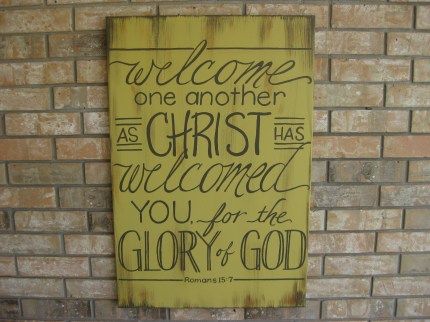
Welcome one another, therefore, just as Christ has welcomed you, for the glory of God.

Weekly Devotional Image

It is hard to welcome one another, until we ourselves know what it means to be welcomed. We can imagine what we need to do and how we need to behave, we can get out the best silverware and the matching dinner sets, we can fill everyone’s cups to the brims, but until we have experienced being welcomed, we will struggle to welcome others.

I spent the last week in Orlando, Florida with my in-laws for the Thanksgiving holiday. They were forced to practice a new type of welcoming and hospitality because they hosted their 7-month old grandson for the first time. In addition to the normal preparations for people visiting, they had to procure a stroller, pack-n-play, diapers, wipes, and an assortment of other necessary items. Moreover, they had to adjust their schedules to the sleeping habits of our son and reorient all of their plans around his general disposition and mood.

And while we sat around the dinner table on Thanksgiving I was struck by how welcomed I felt throughout the week. They could have made assumptions about what we needed and then acted on it, but instead they approached us and asked what they could do to help. They could have become quickly frustrated with Elijah changing their plans but they adapted and made us feel comfortable. They could have expected us to change to fit into their way of life, but instead they changed to fit into ours.

img_9511

One of the most brilliant aspects of the Advent season is our anticipation of the way God fit into our way of life by taking on flesh and being born as a baby in a manger. Rather than giving up on humanity’s inability to repent and turn back to God, God comes down and meets us where we are. God, in Christ, welcomes us into the kingdom of God by connecting with us in ways that we can perceive and understand.

The same holds true for the life of the church, and for us as individual Christians. We welcome one another just as Christ welcomed us, for the glory of God. When we encounter those for whom the church is a strange new world, we don’t just wait for them to “catch up,” instead we adapt our ways to meet them where they are. When we welcome people into our homes for food and fellowship, we don’t dominate the conversation with whatever we want, instead we seek to invite all present to shape what we talk about. When we discover new people sitting in the pews near us, we don’t make quick judgments about who they are based on their appearance, instead we remember how the Lord welcomed us and we do the same toward others.

Not To Boast, But…

2 Thessalonians 1.1-4, 11-12

Paul, Silvanus, and Timothy, To the church of the Thessalonians in God our Father and the Lord Jesus Christ: Grace to you and peace from God our Father and the Lord Jesus Christ. We must always give thanks to God for you, brothers and sisters, as is right, because your faith is growing abundantly, and the love of everyone of you for one another is increasing. Therefore we ourselves boast of you among the churches of God for your steadfastness and faith during all your persecutions and the afflictions that you are enduring. To this end we always pray for you, asking that our God will make you worthy of this call and will fulfill by his power every good resolve and work of faith, so that the name of our Lord Jesus may be glorified in you, and you in him, according to the grace of our God and the Lord Jesus Christ.

love_god_love_people_1x

“I’d like to come by and shoot a story about St. John’s.”

The producer from WHSV had called the church and when I heard his request through the phone I was both nervous and excited. A story. About St. John’s. On Television. But then I realized I needed to ask a question.

“About what exactly?”

We do a fair amount for our local community, but I had a feeling this request was for something else. And in the pit of my stomach I was worried that he wanted to do a story about the controversy series we recently finished. After two months of standing up in the pulpit and belaboring different points of friction, I was looking forward to leaving the controversies aside for a little while, and did not want to speak on behalf of a church where we are clearly divided over a number of issues.

But then he said, “I saw on your website that your church is hosting a communion service on Election Day, and I thought that was something more people should know about.”

He arrived about 30 minutes later with a bag full of camera equipment and a spiral bound notebook full of questions. He set everything up in the office and ran a microphone cable under the desk and into my lap to pick up on all of the dialogue. We tested for light and volume levels for a couple minutes, made sure I was in the frame, went over the specifics about looking at him and not directly into the camera, and then he pressed the record button.

“Tell me a little about the church…”

“Well,” I began, “Not to boast, but, this is the best church in the entire Shenandoah Valley. We’ve got a Preschool that has been in existence for about 30 years and has the greatest reputation for its education. The children are nurtured by our beloved teachers, they receive the necessarily information to excel when they leave for Kindergarten, and we strive to teach them about the virtues of love, grace, and mercy.

We have a solid youth group that meets on Wednesday evenings from 7-8pm for communion, discipleship formation, and bible study. The group contains the best and brightest kids from Staunton and they regularly out disciple me, their pastor. They have a hunger for the Word and are willing to vulnerably encounter one another in questions about their faith. To be honest, they give me hope for the future of the church because they believe in what we are doing almost more than most of the adults.

We have a lectionary bible study of which more than half of the attendees are not members of our church. Every week they gather in the room next door to read four scripture texts and prayerfully discern what God is saying to them through the text. They bring their experience and love of the bible to that group and all of us have grown in our faith because of that bible study.

On Sunday mornings we have some of the best worship that any church in Staunton has to offer. Our order of worship is streamlined for maximum impact, our hymns directly relate to the greater theme and narrative of worship, most of the time the sermons aren’t half bad, and we’ve got an organist who can really make our organ move and groove. The kind of hospitality that our church members extend to strangers and longtime members is worthy of imitation by all churches and they are truly the reason people come back week after week.

On any given week our building is used by a number of local civic organizations including girl scouts, cub scouts, and boy scouts. We have a quilt-for-a-cause team that regularly works on quilts that are then given away to local children in need. We’ve got a group of volunteers called the Cheer Team who take time to visit with those who are lonely or afraid in the community. We’ve got others who go to the Trinity Soup kitchen to cook and serve food to the homeless. We send a mission team of youth every summer to help different communities in need. We’ve got…”

“Just a little bit” he said. “Now,” he went on, “tell me about this Election Day communion service.”

“Are you sure you don’t want to know more about St. John’s? I really could go on, I was only really getting started.”

“No, let’s try to stay on task.”

So for the next 45 minutes he recorded as we went back and forth about the current state of politics in our country, we waxed lyrical about pamphlets and fliers we’ve received here at the church about who we should vote for as Christians, we explored the theological implications of a communion service in the midst of such political division, and we even discussed the practical matters of how much bread to purchase and how many people we should expect to attend.

All in all, we examined just about every aspect of the Election Day Communion service and when we had gone through all his questions, we shook hands and he left to get some exterior shots of the building. The last thing he said was, “It should be on the evening news in the next day or two.”

We don’t have cable at the parsonage, but you better believe I kept checking the WHSV website for the story about our church. With every click to reload the page I dreamt about how many people would see the wonderful descriptions of the church, I imagined how many people would hear all the things I boasted about, and I began picturing our pews filled to the brim on Sunday morning.

Two days later, the story finally appeared on in the news cycle. The opening shot was an image of our altar, the one right behind me, and as the news anchor began introducing the story my teeth chattered with excitement.

The anchor said, “St. John’s Pastor Taylor Mertins has this to say….”

Then the shot cuts to me in the office, with Star Wars figurines and works of theology on my shelves. Here was the big moment. And then I watched myself say, “We are going to pray for our political leaders whether it’s the person we voted for or not. That would be the most Christian thing we could do.”

And then it ended. 10 seconds. The vast majority of our conversation was left on the cutting room floor, and 45 minutes of bragging was reduced to a 10 second sound bite.

Now, don’t get me wrong. I am grateful that WHSV came to do a story about our Election Communion Service, it will be a profound moment of unity in the midst of chaos and division, I only wish that everyone watching got to hear and experience all the things that make our church what it is.

And then I reread our scripture text for this morning.

2 Thessalonians is one of the earliest Christian documents that the church has. It is the second letter written by Paul to the church in Thessalonica. And apparently, the Thessalonians have their act together. Not only does Paul mention the fact that he gives thanks and prays for their little community, but also Paul boasts about their church to all the other churches. They are the city on the hill to which all the others churches should aspire to, they are the standard by which other churches should measure themselves, and they are worth bragging about.

But why did Paul choose to brag about them?

Was it the number of people they had in the pews on Sunday morning? Perhaps they had a remarkable preschool that was helping to shape the future? Maybe they had a youth group that met once a week for communion, fellowship, and bible study? Or perhaps they had streamlined their worship services to connect all of the hymns with the scripture, and the sermon, and the offering, and the prayers?

No.

Paul boasted about the Thessalonians because they remained steadfast in their faith in the midst of persecutions and afflictions. Paul boasted about their church because they grasped and lived into the mission of the church: to grow in love of God and love of neighbor.

We, the church, are a different people. We, the church, are an alternative form of community. Rather than being labeled and defined by the marks of culture that surround us – consumption, power, greed, political parties, nationalities, sexual identities, economics – we are like strangers living in a strange land.

What we value and desire is not what the world values and desires.

            What we proclaim and believe is not what the world proclaims and believes.

            What we worship and affirm is not what the world worships and affirms.

            We are a different people, we Christians.

Though the world may change, though new presidents may reside in the oval office, though new pastors can be sent to different churches, we grow in love of God and love of neighbor. That is our mission, and if anyone can say we love God and others, if that’s what they boast about, well that’s good enough.

love-god-love-others-720-e1340940523238

So perhaps, the ten-second sound bite about the Election Day Communion service is precisely what the community should know about our church. They don’t need to know about our different activities and ministerial programs, they don’t need to know the specifics of our Sunday liturgy, they don’t need to hear a forty-five minute speech about all the best things we’ve got going on at St. John’s.

All they need to know is that we are growing in love of God and neighbor by putting aside things like all of our political differences and joining together to feast at God’s table. Instead of being captivated by the world as the results pour in on Novembers 8th, we will be here loving one another and remembering that we worship the living God.

Therefore, maybe it is our sense of challenge, our willingness to return to this place Sunday after Sunday that connects us with the church in Thessalonica from so long ago. They suffered under persecution and affliction and were able to keep the faith. We wrestle with the competing narratives that vie for our allegiance and we keep the faith. Rather than falling prey to the whims of the world, instead of being consumed by the popularity of politics, we remember that we are God’s people. This land is going through a time of great division and schism, but because of God’s grace, we have not lost sight of who we are and whose we are.

To this end we pray, asking that God will continue to make us worthy of the call and that God will fulfill by His power every good resolve and work of faith so that the name of our Lord Jesus may be glorified in us, and us in him, according to the grace and mercy of God.

The mission of the church, and the mission of all Christians, is to love God and love others. That’s it. Amen.


Devotional – Genesis 32.28

Devotional:

Genesis 32.28

Then the man said, “You shall no longer be called Jacob, but Israel, for you have striven with God and with humans, and have prevailed.”

Weekly Devotional Image

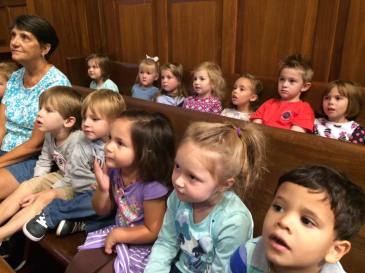
I gather in the choir loft of the sanctuary with the entirety of St. John’s Preschool every Wednesday morning at about 9:30am. By that time the children have all had an opportunity to get out most of their “wiggles” before sitting down in the stiff church pews and learning a story about God from the Bible. I generally try to start the academic year off with stories from Genesis and make my way through up to the stories of Jesus leading toward Easter Sunday.

When we learn about God making light from Creation, we turn the sanctuary lights off and on and talk about what a great gift it is to have light. When we talk about Adam and Eve hiding from God after eating from the tree of knowledge of Good and Evil, we play hide and seek in the sanctuary and talk about how God never stops looking for us even when we’re lost. And this year, when I was foolish enough to teach them about the story of Sodom and Gomorrah, we played red light green lights in attempts to reflect on how God offers us the wisdom of when to go and when to stop.

14440780_1104466649629648_5384631729784297628_n

Last week we met in the sanctuary to talk about one of my favorite stories from Genesis: Jacob wrestling by the banks of the Jabbok river. Jacob has run away from his family after stealing and tricking his brother Esau out of his birthright and blessing and is about to reencounter his brother. But before he can meet his fate in Esau, a strange man arrives in the middle of the night and wrestles Jacob until he, in a sense, learns his lesson. And from this struggle he receives a new name: Israel.

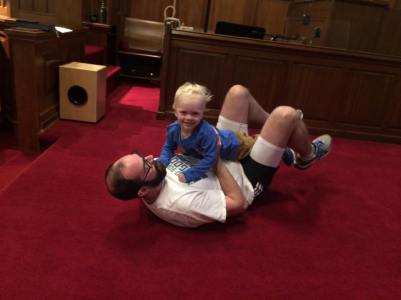
In order to bring the story to life, I had the preschoolers line up one by one and each of them were tasked with knocking me over in a wresting match. They all came forward and gave it their best shot (some were oddly more prepared for this than others) and I would pick them up and spin them around in circles. When one of our last two year olds came forward, I let him knock me to the ground, but instead of pounding on me like some of the older kids, he wrapped his arms around my neck and hugged me.

14502882_1104466592962987_8175825250906782039_n

I was then able to stand up with the boy in my arms and tell the kids the most important part of the lesson: God loves us so much that even when we’re angry, God will never let us go.

To be a Christian today almost implies a degree of struggling with God. We want to know why a hurricane, like Matthew, can wage destruction in places like Haiti, the Bahamas, and the East Coast of the US. We want to know why our presidential political system is filled with such vitriolic and hateful language. We want to know why bad things happen to good people and why good things happen to bad people. Yet, even amidst all the struggle and questions, what a blessing it is to know that God’s love is so strong that God will never let us go.

On Suicide

Isaiah 43.1-2

But now thus says the Lord, he who created you, O Jacob, he who formed you, O Israel: Do not fear, for I have redeemed you; I have called you by name, you are mine. When you pass through the waters, I will be with you; and through the rivers, they shall not overwhelm you; when you walk through fire you shall not be burned, and the flame shall not consume you.

Romans 8.35-39

Who will separate us from the love of Christ? Will hardship, or distress, or persecution, or famine, or nakedness, or peril, or sword? As it is written, “For your sake we are being killed all day long; we are accounted as sheep to be slaughtered.” No, in all these things we are more than conquerors through him who loved us. For I am convinced that neither death, nor life, nor angels, nor rulers, nor things present, nor things to come, nor powers, nor height, nor depth, nor anything else in all creation, will be able to separate us from the love of God in Christ Jesus our Lord.

suicide


It was 2003 and I was a freshman in High School. And like most High School freshman, I spent many an evening on my computer typing to my friends on Instant Messenger. This was long before Facebook’s wild popularity, Twitter’s terse communication style was far away from coming into reality, and none of us even had cameras on our cell phones. But night after night we would sit in front of our computer screens typing away about what we thought were the most important things in the entire world.

One night in the spring, I waited for my parents to go to bed and then I snuck downstairs to get back on the computer. Most of the conversations were frivolous and limited by the speed at which our fingers could move over the keyboard. I can’t remember what the topic was that evening, but I do remember a new box appearing on the screen that changed everything.

At the time, my best friend was dating a girl and things were less than perfect. They fought about all kinds of stupid things and were the epitome of every high school relationship cliché. She, the girlfriend, was the one who sent me a message that night. All it said was, “We got in a really bad fight, he told me he was going to kill himself, and I don’t know what to do.

Suicide is ugly. It leaves families and friends reeling in whiplash, it creates guilt and unanswered questions, and it produces feelings of morbidity and fear.

Suicide is controversial in the church for a number of reasons. Many churches and Christians believe that suicide is ultimately sinful and worthy of eternal damnation. To have suicidal thoughts is to not have enough faith. Some pastors will even refuse to preside over funerals for those who have committed suicide.

If you look through the entirety of scripture, both Old and New Testaments, you will not find a passage that condemns suicide. None of the prophets, or priests, or kings have anything to say about suicide or what happens to those who commit suicide. However, Augustine (an important theologian from the early church) read the commandment “thou shall not kill” as a prohibition against suicide. And from Augustine’s reflection on the topic, suicide became the black sheep of sins in the church.

For a thousand years, suicide was a mortal sin and an affront against God’s goodness. Those who committed suicide were treated as criminals and refused Christian burials. By the 1500s those who attempted suicide were excommunicated by the church and were punished by the civil authorities.

And still today, suicide carries an awful stigma in the realm of the church and is one that is either referred to with eternal damnation or complete silence.

            That silence, the utter and complete darkness of a topic that is remarkably relevant for our time and reflection, is a controversy worth confronting.

According to the Center for Disease Control (CDC), on average, one person dies by suicide in the state of Virginia every 8 hours. It is the 11th leading cause of death in our state, and it is the 2nd leading cause of death for people ages 10-34.

Among high school students across the country, 17% seriously considered suicide in the last 12 months. And 8% attempted suicide one or more times in the last year.

If you’re like me, you tend to think about young people being the most susceptible to suicide attempts, but suicide rates are actually highest among people middle aged and older, by a lot. In fact, middle aged and older adults are nearly twice as likely to commit suicide as young people.

And right now, suicide has surged to its highest levels in thirty years.

yqecn1ygjymjb3igsiev

When I received that message on my computer back at the beginning of high school, I grabbed my things and was out the door before I even had a chance to really think about what I was doing. All I knew was that my friend would not just make an empty threat about suicide like that, and I had to do something about it. So I grabbed my bicycle out of the garage and I started riding as fast as I possibly could in the middle of the night. He lived a couple miles away and when I screeched into his driveway I was drenched in sweat.

I dumped the bike right there and I ran to the front door and started banging with my fist and I started yelling. Within a minute his parents were coming down the stairs in their pajamas with tired and angry looks on their faces. When they opened the door and saw me standing and sweating in the dark they were utterly bewildered and then I told them why I was there.

We immediately went to check on him in his bedroom, but he wasn’t there. We searched the house from top to bottom and we finally found him in the basement. He was sitting on the couch with tears in his eyes and he had just swallowed an entire bottle of ibuprofen.

They wound up taking him to the hospital and had his stomach pumped. They sat there and held their son while he cried and cried. And they saved his life.

Suicide is not the way any human life should end. The church, this church, has an obligation to see that all persons are grafted into a community of love and are cared for in the midst of isolation, depression, and despair.

Life is a gift, plain and simple. It is a gift from God and therefore we are called to be good stewards of this gift: our lives and the lives of others.

We cannot ignore this topic as if it has nothing to do with us. The statistics confront us with a stark reality about the prevalence of suicide in our culture. With the advent of the Internet and instant communication, young people are being bullied and attacked at a degree that few of us can even fathom. With an economy that moves up and down like a roller coaster, people in the middle of life are undergoing identity crises and are wondering how they can provide for their families. Older people who receive a grim diagnosis or the loss of a spouse struggle to justify living with such a horrible outlook for the days ahead.

We know that we are supposed to be present for and with one another, like being there for friends and family at a moment of tragedy. We rarely know what to say on such occasions, but we know we should be there. We, above all things, are called to be present for others in the midst of suffering and loneliness and depression that often lead to the contemplation of suicide. To be part of the faithful community requires us to be for one another.

i_m_fine_by_black_avenger-d60mqnl

We live because life is a gift. We are not our own creators. We Christians are the people who must learn to live by the fact that life is a gift. We therefore can live each and every day not as a survival technique, but through recognizing that each and every day is an opportunity to live and love in the service of our Lord.

When we talk about suicide, we say it is “the taking of one’s life.” But even the way we talk about suicide shows how much a problem we have with it. Our lives are not our own. As the Lord says through the Prophet Isaiah: “Do not fear, for I have redeemed you; I have called you by name and you are mine.” We belong to the Lord and to one another. God tells us to not be afraid because God will be with us as we pass through the waters, and the rivers of life shall not overwhelm us, we shall not be burned by the fires of frustration. Not because they won’t hurt or be terrifying, but because we belong to the Lord and the Lord is with us.

If we’re here in the sanctuary this morning, we have some sense of this in our lives. We know that God is with us, we feel God’s presence in this place and we know that we are not alone. It is through encountering the divine love of God in worship that we are given the strength to be God’s presence for others who sink under the waters of life and who feel burned by the world. It is our charge to be shaped and called by God’s love and to reach out to those who contemplate ending their days. We have the challenge of showing all people, even those who see no value to their lives, how our lives are not defined by what we have done with them, but by what God will do with them.

Six months after my friend had his stomach pumped, he attempted to commit suicide again. This time he did it with a hose running from his exhaust pipe into his car. But his little brother heard the car door close and it woke him up, and then he woke up his parents. In the strange and quiet time of the darkness of night they pulled their son out of the car and they got him help. It took a long time for him to move on. It took counselors and therapists, it took friends and family, it took the power of God’s grace to show him that his life could get better, that there was hope for the future, that there was something worth living for. And because people in his life were brave enough to confront his suicide attempts, he still lives today.

But there will always be some that we cannot reach. There will be people who feel so suffocated by the weight of the world that they will make that dreadful decision to end the life that God’s has given to them. And for them, for those who will die by their own hand, what will happen to them? For centuries the church saw suicide as an unpardonable sin, something that eternally damns those who do it. Will God abandon them for making such a choice? Will God refuse to love the people who felt no love in their lives? Will the God of mercy punish them until the end of time?

           No. In all these things we are more than conquerors through him who loved us. For I am convinced that neither death, nor life, nor angels, nor rulers, nor things present, nor things to come, nor powers, nor height, nor depth, nor anything else in all creation, will be able to separate us from the love of God in Christ Jesus our Lord. Amen.


Controversy Original

Devotional – 1 Timothy 6.10

Devotional:

1 Timothy 6.10

For the love of money is a root of all kinds of evil, and in their eagerness to be rich some have wandered away from the faith and pierced themselves with many pains.

Weekly Devotional Image

In the United Methodist Church we spend a lot of time every fall preparing for Charge Conference. Charge Conference is an annual meeting in the life of the church where we evaluate where we’ve been and where we’re going, we discuss challenges and new approaches, and we vote on things like the budget and pastoral compensation.

Paying pastors is one of those things in the life of the church that we like to handle quickly and then move on to a different subject. Frankly, whenever we talk about money we want to address it as fast as possible and then get back to “doing church.” Money makes us uncomfortable.

On some level this is a good thing. We know that Paul writes to Timothy about the love of money being a root of all kinds of evil. Or we can think about a time when the fear regarding finances sent the church in a frightening direction. Or we can reflect on how the love of money has reshaped a relationship with a friend or with someone in our family.

tithe

However, money and wealth is one of the things that Jesus talks about more than anything else, and we have slowly removed it from our common experiences in the life of the church.

On the Virginia Conference website for the United Methodist Church there is a page dedicated to the bishop. On that particular page anyone can find narrative information about our bishop, but there is also a link to what is called the “Appointment Workbook.” If you click on the link you will have access to a list of all the pastors in the Virginia Conference, how long they served, how many new people are attending their churches, how much their churches are required to pay in apportionments, what percentage of the apportionments have they paid, AND their annual compensation. This is good and important information for the life of the church, but the fact that the entire list of pastors is not organized by name, or region, or new disciples, but by salary, shows how we have wandered away from the faith.

Paul warns us about the love of money in our individual lives and in the community of the church. When we become so consumed by the pursuit of money whether we are a teacher, or a doctor, or a denomination, we fall captive to the evil the sends us wandering away from the faith. As Christians, our ultimate call is to grow in our faith and Christlikeness, not in our annual salary.

On The Separation of Church and State

Romans 13.1

Let every person be subject to the governing authorities; for there is no authority except from God, and those authorities that exist have been instituted by God.

John 15.12-19

This is my commandment, that you love one another as I have loved you. No one has greater love than this, to lay down one’s life for one’s friends. You are my friends if you do what I command you. I do not call you servants any longer, because the servant does not know what the master is doing; but I have called you friends, because I have made known to you everything that I have heard from my Father. You did not choose me but I chose you. And I appointed you to go and bear fruit, fruit that will last, so that the Father will give you whatever you ask him in my name. I am giving you these commands so that you may love one another. If the world hates you, be aware that it hated me before it hated you. If you belonged to the world, the world would love you as its own. Because you do not belong to the world, but I have chosen you out of the world – therefore the world hates you.

rethinking

Preachers can fall into the rut of preaching on whatever keeps the congregation pleased; keep them happy and they’ll keep coming back, or something like that. This sermon series is something different. Instead of falling back to the familiar narratives that keep us smiling on our way out of church, we are confronting some of the greatest controversies facing the church. There is a better than good chance that I will say something from this pulpit over the next two months that you won’t agree with, and if that happens I encourage you to stay after worship, join us for lunch, and continue the conversation. We can only grow as Christians in community, and that requires some honesty and humility and dialogue. Today we begin with The Separation of Church and State.

The Church and the State have a long and complicated relationship. Like a number of romantic couples from popular TV shows, think Ross and Rachel, Sam and Diane, Jim and Pam, Luke and Lorelai, and even Kermit and Miss Piggy, the “will they/won’t they” question of their relationships has happened over and over and over again.

It began during the days of Jesus. A wandering and poor Jew developed a following that threatened the power dynamics of the Jewish leadership and the Roman Empire. His actions might have appeared innocuous, feeding the multitudes by the sea, healing the blind, walking on water, but what he said terrified those in power: “The last shall be first and the first shall be last,” sounds the beginning of a call to revolution.

And for living and healing and preaching the way he did, Jesus was nailed to a cross. But three days later he rose from the dead. The Christian church began in the wake of Jesus’ resurrection, the power of the Good News of God’s triumph over death spread throughout the region and small groups gathered together to worship the Lord Jesus Christ. The book of Acts, and Paul’s letters, help us to see how the story traveled and took hold of the communities where it was received. Lives were transformed; the gospel spread, and the kingdom began to become incarnate.

But whatever the church stood for, and whatever the state stood for, was very different.

635716335783776523-1907621126_shutterstock_96065306.imgopt1000x70

Most of what we know about the early church comes from scripture. Which is to say, we know what the church thought about the church. However, we do have some idea of what the state thought about the church. Pliny the Younger was the governor of Pontus (Asia Minor) from 111 to 113 CE. During his rule he wrote to the Roman Emperor Trajan about the Christians in his community in response to their unwillingness to worship the Emperor: “They [the Christians] asserted, however, that the sum and substance of their fault of error had been that they were accustomed to meet on a fixed day before dawn and sing responsively a hymn to Christ as to a god, and to bind themselves by oath, not to some crime, but not to commit fraud, theft, or adultery, not falsify their trust, not to refuse to return a trust when called upon to do so. When this was over, it was their custom to depart and to assemble again to partake of food – but ordinary and innocent food.”

The first Christians were strange, with their singing songs to a man who died on a cross, and sharing bread and wine, and promising to be good and trustworthy. How bizarre. And for nearly 300 years they were persecuted, abused, and killed for following Jesus. The state, Rome, resented the Christians and their weirdness. They refused to bow down to worship the Emperor like everyone else. Instead they believed some guy named Jesus was Lord. And for that, they were punished.

But then things changed.

In the year 312 CE something happened that forever affected the relationship between the church and the state. I cannot overemphasize this point enough; it changed everything. The story goes that emperor Constantine was preparing his troops for a battle against a rebellion from within the empire, and on the night before the battle he had a vision of the Greek letters Chi (X) and a Rho (P) in the sky and the words, “in this sign you will conquer.” From this vision Constantine ordered all of his troops to be marked with the Chi-Rho, which looks like the symbol on the right hand page of your bulletin. Chi and Rho are the first two letters of Christos (the Greek version of “Messiah”). After doing so, Constantine’s army won a decisive victory and he entered Rome shortly thereafter as the undisputed Emperor. The battle gave him complete control of the Western Roman Empire and it paved the way for Christianity to become the dominant faith.

tumblr_static_chi_rho_arrows_small

The very next year Constantine issued the Edict of Milan, which made Christianity an officially recognized and tolerated religion in the Roman Empire. Within a dozen years, he called for the Council of Nicaea, which was the first attempt to attain a consensus in the church through an assembly representing all of Christendom.

From a vision of two Greek letters in the sky, Christians went from being persecuted and murdered, to being part of the state religion.

And now we fast-forward to today, to the United States, to a country founded on the principles of religious freedom, tolerance, and the Separation of Church and State. After centuries of the church and state co-mingling to a frightening degree, the founders decided to move in a different direction. After being persecuted for their different religious convictions they envisioned a new way forward. Recognizing that this place was, and could continue to be, a melting pot of differing ideologies, the forefathers articulated a political system whereby the state could not control religion, nor could religion control the state, and that those two things would find their fullest potential while being completely separated.

Constantine’s vision of conquering under the sign of Christ was over, and the time of secularism began.

Paul, writing to the Christians in Rome, said, “Be subject to the governing authorities.” This is to say, follow the laws of the land, pay your taxes, be good citizens. Paul’s words echo through the centuries and reverberate here in this sanctuary: Do as the country tells you to do. If you’re called to serve in the military, go to war. If its time for a presidential election, vote with your conscience. If the government says there’s a separation of church and state, keep it that way.

And Jesus, speaking to his disciples said, “This is my commandment, that you love one another as I have loved you… If the world hates you, be aware that it hated me before it hated you. If you belonged to the world, the world would love you as its own. Because you do not belong to the world, but I have chosen you out of the world – therefore the world hates you.” Jesus’ words echo through the centuries and reverberate here in this sanctuary: Following me means acting like me.   If people are being persecuted, you are to love them with every fiber of your being. If the government starts belittling people for what they believe, you need to stand up for the oppressed. If you feel called to live like a disciple, prepare yourself to be hated by the world.

These two scriptures from Romans and John contain the tension of what it means to be a Christian in the United States. We constantly wrestle between being subject to the governing authorities and pushing back against the governing authorities. We wrestle between what it means to love the world and what it means to be hated by the world. We, as disciples, live in the world but we are not of the world. We may be citizens of the United States, but our truest citizenship is in heaven.

Years ago there was a civil case raised against an organization for displaying a nativity scene on public property. Because of the separation of Church and State, the concerned citizen believed the nativity scene had to be removed. However, when the matter was brought to trial, the court ruled in favor of the Christian display. The reasoning was that because the nativity scene was next to Rudolph the Red-Nosed Reindeer, Frosty the Snowman, and Santa Claus, it had every right to be there. Christians across the country rejoiced when the matter was settled and celebrated what they thought was a decisive victory for the church.

But was it? Should we celebrate a time when the nativity is one of many signs of the holiday? Or should we savor its sacredness? Do we want the nativity to be the same as holiday cartoons, or do we want it to symbolize the profound incarnation of God in the flesh being born in a manger?

A few years ago there was another civil case raised against a baker for refusing to bake a cake for a gay couple’s wedding. Because of the freedom of religion, the baker believed it was within his right to refuse service to people who went against his religious convictions. The matter went to trial and the judge ruled that the baker unlawfully and illegally discriminated the couple for their sexual orientation. Christians across the country protested when the matter was settled, and vehemently opposed the ruling.

Were they right? Should Christians support the freedom to pick and choose who they serve? Or should they follow the command to love the way Jesus loved? Do we want the church to be connected with the religious liberty that isolates particular people, or do we want to go against the conventions of fanatical Christianity and love people regardless of any particular identity?

The separation of the Church and the State is a good thing because for too long the state controlled the church. The Constantinian revolution was certainly responsible for spreading Christianity across the globe, but it also led to things like the Crusades and the Inquisition. Constantine co-opted the church for the role of government in such a way that it limited the qualities that made Christians strange, and instead made them normative. Gone were the days when people lived by the convictions of Christ, and instead they went to church because that’s what they were expected to do.

But the era of Constantine did not die when our nation was founded. Though we articulate beliefs like the Separation of Church and State, it still says, “in God we trust” on our national currency, children still pledge their allegiance to the flag and country under God every morning before school starts, and we still have many courts where we must place our hands on a bible and are asked, “Do you swear to tell the truth, the whole truth, and nothing but the truth, so help you God?”

So perhaps now is the time, the best time, to recover those qualities that will make the world hate us. Not the qualities of religious bigotry and prejudice that for too long have dominated the state’s view of the church. But the qualities of Christ-like love that drive the state crazy. Like refusing to bow and worship our country and our politicians as if they were gods, and instead worshipping the risen Lord. Like gathering together on a day set apart to hold ourselves accountable to honesty, truthfulness, and peace. Like sitting before a table of ordinary food of bread and wine that becomes the extraordinary gift of body and blood.

We are in the world, but we are not of the world. We might have national citizenship, but our true Lord is Jesus Christ. We are like strangers living in a strange land. Amen.


Controversy Original

Do Not Listen To Preachers (Including Me)

Jeremiah 23.23-29

Am I a God near by, says the Lord, and not a God far off? Who can hide in secret places so that I cannot see them? Says the Lord. Do I not fill heaven and earth? Says the Lord. I have heard what the prophets have said who prophesy in my name, saying, “I have dreamed, I have dreamed!” How long? Will the hearts of the prophets ever turn back – those who prophesy lies, and who prophesy the deceit of their own heart? They plan to make my people forget my name by their dreams that they tell one another, just as their ancestors forgot my name for Baal. Let the prophet who has a dream tell the dream, but let the one who has my word speak my word faithfully. What has straw in common with wheat? Says the Lord. Is not my word like fire, says the Lord, and like a hammer that breaks a rock in pieces?

Pastor Holding Bible ca. 2000


A young preacher stands in the pulpit after a long week of parish ministry. The visits have all been made. A new budget for the coming year is finished and ready for approval. Plans for the Community Cook-Out came to fruition as people from all over the community gathered together.

The young preacher stands in the pulpit and looks out at the congregation. He sees couples that he has counseled; children that he has baptized; families that are struggling; individuals whose husbands or wives he has buried; and he even sees people he has never seen before. He looks over the bulletin one last time just to make sure that everything is listed the way it is supposed to be, and then he begins by saying, “This morning the sermon will be short and sweet”

“Hallelujah!” Someone shouts out from a pew.

“Is that for the short, or for the sweet?” says the preacher.

The congregation laughs.

The preacher sighs.

The art of preaching is a strange thing, but an even stranger thing when we consider that what we want from a sermon is something short and sweet. Some of you have been quick to say that you want a sermon that leaves you feeling good on your way out from the sanctuary. Others have said that you want a sermon that gives you something to think about during the week, or one that helps to remind you that God is love, or that Jesus wants the world to be a better place, etc.

I would classify myself as a short and sweet preacher. I fundamentally believe that if you cannot say what you’re trying to say in 15 minutes then you’re never going to say it. Additionally, I love pleasing all of you. I live for those moments in the receiving line following worship when some of you offer praise for what you heard through the sermon. I know I’m supposed to be humble, but it feels pretty good to be congratulated and praised for preaching.

In the last few years we’ve had an abundance of sweet sermons; times when I wanted all of you to leave with just one thought: “God loves you.” I’ve done my best to make you laugh and smile when thinking about the abundant glory of God’s grace. I’ve tried to cheer you up during times of domestic and international strife. I’ve worked to make this place as appealing as possible for as many people as possible.

And that is why you should not listen to preachers, including me.

“Am I close to you?” says the Lord. “Or am I far away? Who thinks they can hide in secret places so I cannot see them? I am the Lord! Do I not fill up heaven and earth? I have heard what those prophets have said who prophesy in my name saying ‘I have dreamed, I have dreamed! How long will they continue like this?”

The prophet Jeremiah lived during a time filled with false prophets, people who would ascend to places like this in front of a gathered people and make claims on behalf of the Lord. They would spout off about their visions of what the Lord was doing, and the more they said, the further they moved away from God.

God warns us against listening to false prophets, about succumbing to their visions, and about what happens when we trust them more than the Word.

False-Prophets-Media-Header-960x350

It would be easy today to make this whole sermon about the false prophets of our contemporary experience. We’ve got plenty of false prophets who use their skill to sell us on what they believe the future should hold. In fact this whole sermon could just be a warning against listening to the likes of Donald Trump and Hillary Clinton.

What kind of dreams are they selling?

“I have dreamed of a future where everyone can, and should go to college for free. Where healthcare will be free for everyone. We need to remember what made us great and start taking from the wealthy and giving it to the poor. It’s not about progress; it’s about fairness. We need to make America fair again.”

“I have dreamed of a wall unlike any other wall. This wall will fix all of our problems. It will bring wealth back to our country. We need to bomb the Middle East into oblivion to assert ourselves as the top of the world. We need to make America great again.”

Politicians have always been false prophets making promises that cannot be kept; selling a vision of the future that rarely comes to fruition. And we know this is true. That’s why we’ve grown so jaded by our political seasons and apathetic about whatever will happen.

But there are more false prophets out there than just politicians, and one of them is talking to you right now.

Through the prophet Jeremiah, God warns us against listening to people like me, people who march up to the front of the gathered church and strive to proclaim God’s faithful word. For whenever we hear a preacher go on and on about the beauty and majesty of God’s Word, whenever the Lord is watered down to a spirit of love, whenever we hear more about the preacher’s dreams than God’s will, we need to be reminded that the Word of the Lord is like fire, and like a hammer that breaks a rock into pieces.

Since we’ve been together in this strange thing called church, I’ve preached over 150 sermons. I’ve preached from Genesis to Revelation. I’ve mentioned the patriarchs and the prophets. I’ve proclaimed the possibilities of the psalms. I’ve proudly preached on the power of parables. I’ve done different series on “Why We Do What We Do” and “The Basics” and “New Beginnings” and “Strange Stories from Scripture.” I’ve even dressed up and preached not one, but TWO sermons from the perspective of a donkey.

And for what?

Has the preaching in this place challenged you to be a better disciple? And maybe not just from me, but have you ever left this church really feeling convicted by what you heard and wanted to live differently? Or has your experience been like most, and you leave feeling pretty good on Sunday afternoon?

We preachers are tempted by the practices of false prophecy. We like to be liked. We want to fill pews with people to boost our egos. We need to hear praise from lay people on their way out the door. We yearn for success. We, after years of sermon preparation and proclamation, fall prey to hearing our own voice so deeply that we no longer hear others, nor do we hear the Lord.

For the last three years I’ve had a dream about the future of this church. I have dreamed of Sunday mornings where so many people fill the pews of this sanctuary that I cannot know everyone’s names. I have imagined crowds gathered around the baptismal font in anticipation of bringing a new person into the life of our church. I have pictured people having to park on the front lawn because there are not enough spaces left in our parking lot.

IMG_1691

And because I had this dream, I preached and worked toward things like our Community Cook-Out. I implored our Church Council to use enough money to give away the food and the games and the fellowship all for free. I sent out hundreds and hundreds of post-cards to all of our neighbors so that they might join us on the front lawn.

I have dreamed, and I want the dream to become real. So I work week after week on ideas and programs and sermons that will draw people into this sanctuary on Sunday mornings until that dream becomes reality.

A couple weeks ago I was standing in our narthex right before our opening hymn. Most of you were sitting in the pews; our liturgist had gone through the pertinent announcements and necessary welcome. Rick was playing something melodic on the organ as we prepared our hearts and minds for worship when I stepped onto the carpet with our acolyte.

Without thinking much about it, I started to count the back of all your heads. I started with the front left and made my way toward the back, then my eyes moved to the front right and all the way toward the back. My lips must have been moving because our acolyte looked at me and said, “What are you doing?”

“I’m counting…” I said while trying to not lose track of the number.

And then he asked, “Why?”

Why?

In his question, in the simple raise of an eyebrow at my action, my heart caught on fire, it burned like a blaze, and I felt it crumble into ashes.

For how long have I deceived my own heart? For how long have I been so consumed by the number of people in our pews that I have forgotten the call to share the Good News? For how long have I proclaimed a God of love who is so loving that he does not expect us to live changed and transformed lives? For how long have all of us listened to false prophets who preached their own dream instead of speaking the Word of the Lord faithfully?

In his question I heard the Lord convict my heart because I have been caught up in church growth not for the sake of the kingdom, but for my own affirmation. I have wanted the front lawn to be packed with people from the community not for the sake of the kingdom, but for the pews to be filled in worship. I have preached sermons to make us feel better not for the sake of the kingdom, but for all of you to come back the next Sunday.

Sermons are a good and strange thing. After all they are the means by which the Word of the Lord is interpreted for our lives on a weekly basis. But they cannot be blindly accepted without challenge. For to only ever hear about God’s grace does a disservice to the Lord who is always calling us to live more like Christ. And, on the other hand, to only ever hear about how sinful we are neglects to reveal the light of Christ that shines in the darkness.

God cares more about spreading the Good News than about filling up the pews.

And sometimes that Good News is that we need to be better than we were when we arrived, that we are called to a life of discipleship that pins us against the world, that the Lord expects great things from us. The Good News is that God has not abandoned us to our sinful desires and devices, that God believes we can be better even if we don’t, and that we can transform the world but we first must transform ourselves.

We need good preachers, men and women who are willing to lay down their egos at the altar and faithfully proclaim God’s Word. And we need good lay people who are willing to crucify their fears and speak the truth in love toward the preachers who have fallen into the trap of false prophecy.

So, may the Word of the Lord be like a hammer that breaks our lives into pieces! Let it shatter our false identities and insecurities, let it break down all our preconceived notions and assumptions, and let it burn and blaze forever and ever. Amen.

10 Things I Learned From My Third Year Of Ministry

10 Things I Learned From My Third Year Of Ministry

Screen Shot 2016-06-20 at 3.19.17 PM

  1. The Holy Spirit Moves in Mysterious Ways

At the end of last summer our youth leaders resigned from their position and we were in need of new leadership. After putting out the job description in a number of places, and receiving zero responses, I decided to take over the position for a limited basis. We restarted the youth group as a discipleship adventure whereby we would meet every Wednesday night from 7-8pm for communion, fellowship, and bible study. Each week I planned out activities for the bible study, and prayed over bread and grape juice, but the youth taught me more about God than I ever taught them. Throughout the year they wrestled with topics like being Christian and political, violence, bigotry, and identify; and not because I brought the subjects up, but because they initiated the dialogue. I often make the false assumption that I am bringing God to other people as a pastor, but the youth reminded me that the Holy Spirit moves in mysterious ways. I never anticipated leading the youth at St. John’s UMC, but now I can see that it has been one of the most rewarding parts of my ministry.


  1. Time = Trust

After 3 years in ministry, I am starting to feel the trust that has formed because of the amount of time we’ve had together. Of course I felt trusted from the beginning, but we are now at a place in our relationship as church and pastor whereby we can move in new and exciting ways because of our history. At first it was a hard sell for the church to participate in something like a free community cookout, but because we have seen the fruit that comes from providing food and fellowship for the community, the church is now pushing for the event to grow. Similarly, the church has a preschool that went underappreciated for too many years. Because I have taken the time to work with the preschool, and share stories about it in worship, the church now believes in the importance of connecting with the preschoolers and their families. The trust within the church has grown because of the good time we have spent growing together in faithfulness.


  1. The Job Is Big

The list of things I’ve had to do under the auspices of being a pastor gets longer every week. In seminary they prepare pastors for the work of preaching, teaching, praying, and visiting, but they are a fraction of what I actually do. On any given day I am: an office manager answering phones and responding to emails; a property manager changing light bulbs, working on the plumbing, tinkering with the boiler, and climbing up into the attic for the HVAC system; a sound technician addressing the speakers and microphones in the sanctuary; a babysitter watching over children from the preschool and the greater community; a spiritual guru answering questions about faith from strangers and friends alike; a social media ninja overseeing our Facebook, Twitter, and YouTube accounts; a webmaster maintaining the church website and internet presence; an animal control specialist removing birds that got into the social hall through the chimney; and an assortment of other jobs. To be a pastor is to wear many hats with many responsibilities.


  1. It’s Hard to Let Go

My wife gave birth to our first child at the end of April and I was able to take 4 weeks of paternity leave to be at home with them. Those 4 weeks were an absolute blessing to be there to comfort both of them during those difficult first weeks, and it also allowed me to bond with my son in a way that I will always cherish. However, taking that time off from the pulpit was really hard. After preaching nearly every Sunday for three years I grew accustomed to knowing the people of the church and how to faithfully proclaim God’s Word to them. In taking a month off, I had to trust that the Lord would provide even in my absence. I am thankful for the time away not only because of what it meant for my family, but also because it reminded me of the truth about the church; it belongs to God and not to me.


  1. If You Build It They Might Come

Just because you create a new program, or offer a new class, it does not necessarily mean that people will come. We’ve had a number of new things develop and become successful at St. John’s including a weekly lectionary bible study, weekly youth meeting, and occasional fellowship events. But for every successful venture we’ve developed, there have been an equal number of opportunities for discipleship that failed. I attempted to lead a weekly evening bible study on the book of James, and by the third week no one came. I tried to start a monthly gathering for fellowship on the first Sundays of the month and by the third month I was the only one in the fellowship hall. There is a temptation to take these kinds of failures too personally, so it is good to reflect on the times that even Jesus’ or Paul’s or Peter’s ministries were not successful. When we put our effort into something that doesn’t bear fruit, we do well to cut it off and let the vine remain strong instead of draining away its resources.


  1. A Phone Call Can Make All The Difference

I once heard a professor say that 90% of the church will show up for church on Sunday, so working on worship and sermon preparation should demand 90% of a pastor’s time. Though this is true on one level, it also neglects to account for those who either can no long come to church, or haven’t for some time. On a whim last fall I decided to go through the entire church directory and call every person that was not in church the previous Sunday. A number of people were simply out of town, or had not been to the church in a number of years, but every single person was grateful for the phone call nonetheless. I did not call in order to guilt the people into coming back to church, or with some other ulterior motive, but simply to say “hello” and the response has been incredible. For those who have fallen captive to loneliness they were reminded that the church still cares about them, and for those on the edge of regular church attendance they were reminded that the church knows them and wants to stay connected. All it takes is lifting up a phone and dialing a number and it can make all the difference.


  1. People Remember

It amazes me how people can remember a phrase from a sermon or a prayer from a year ago and demonstrate how it has developed into fruit in their daily lives. I’ll be sitting in a lectionary bible study and one of the people in the room will quote a sermon I offered on the text from three years ago. Or I will be sitting with a family in my office planning for a funeral and one of the family members will ask me to preach on a text they once heard me mention from the pulpit. Or I will be in the midst of concluding a chapel time lesson with the preschoolers when one of them will connect the message to a different lesson from earlier in the year (we were talking about the power of communion and I was holding the loaf of bread when one of our four-year-olds shouted out, “so Jesus was born in the house of bread (Bethlehem) and then he gives us the bread of life? Cool!”). Seeing and experiencing how people remember what I have said in the past is remarkably affirming, but it is also indicative of the power of our words.

12304502_10204993990640458_5137127778263361305_o (1)


  1. Thankfulness Breeds Generosity

For a long time the church I serve was in a difficult financial situation. They had not paid their apportionments in full for the better part of two decades and they regularly struggled making sure they had enough to keep the church open from month to month. As a congregation they became accustomed to hearing about the financial disparities and the need for them to sacrifice for the greater church. When I arrived we attempted to look at our financial situation from a completely different perspective and instead of talking about sacrifice, we talked about generosity. Little by little, as the church saw the tangible fruit from our ministries developing throughout the year, our offering started to increase which in turn allowed us to focus on more opportunities for ministry and not just keeping the church open from month to month. It took some time, but we were able to move from a maintenance model of the church to a missional model for the church. Last fall, after it was clear that we would be able to pay our apportionments in full for the third year in a row, I hand wrote a letter to everyone who gave to the church during the previous year. It took a long time, but I wanted everyone to know how thankful the church was for each person’s continued generosity and commitment to building God’s kingdom. What I never anticipated was the fact that our weekly offering grew almost immediately after the letters went out. I believe that knowing how our gifts have been used for God’s kingdom, and that the church is grateful for those gifts, has reshaped our church’s identity from scarcity to generosity.


  1. Though We May Not Think Alike…

John Wesley once famously said, “Though we may not think alike, may we not love alike? Without all doubt we may.” At the heart of Methodism is a commitment to think and let think. Which is to say, we are a church of differing opinions and somehow we can continue to do the work of the church because we are united in our love. This kind of commitment to radical love amidst disagreements has been evident in the way people have responded to my preaching. Over the last year I have been able to speak toward a variety of subjects that we are clearly divided over. I have addressed homosexuality, the pervasiveness of violence, divorce, and other subjects. I have made jokes about Bernie Sanders, Hillary Clinton, and Donald Trump. I have tried to comfort the afflicted and afflict the comfortable. And people keep showing up to church. Even though they let me know that might not agree with anything I said on a particular Sunday, they will be sitting in one of the pews the following week. Though we may not think alike, we are still loving alike in this strange and beautiful thing we call the church.


  1. I Still Have The Best Job In The World

Ordained ministry is an odd and wondrous calling. There are days that feel like I am carrying the weight of the world on my shoulders and I become frighteningly anxious over the future of the church. I will pull out my phone and learn about another person’s death, or I will receive an email about a divorce that is about to be finalized, or someone will show up at my office looking for any sense of hope in an otherwise hopeless situation. But most of the time, it is the greatest job in the world. Where else could I spend time deep in God’s Word reflecting on how the Lord continues to speak to us today? What job would give me the opportunity to preside over something as precious as the water dripping on a child’s head in baptism or breaking off a piece of bread for a faithful disciple? What vocation would bring me to the brink of life and death on such a regular basis? It is a privilege to serve God’s kingdom as the pastor of St. John’s and more rewarding than I could have ever imagined.

From Diapers to Diplomas

Psalm 46

God is our refuge and strength, a very present help in trouble. Therefore we will not fear, though the earth should change, though the mountains shake in the heart of the sea; though its waters roar and foam, though the mountains tremble with its tumult. There is a river whose streams make glad the city of God, the holy habitation of the Most High. God is in the midst of the city; it shall not be moved; God will help it when the morning dawns. The nations are in an uproar, the kingdoms totter; he utters his voice, the earth melts. The Lord of hosts is with us; the God of Jacob is our refuge. Come, behold the works of the Lord; see what desolations he has brought on the earth. He makes wars cease to the end of the earth; he breaks the bow, and shatters the spear; he burns the shields with fire. “Be still, and know that I am God! I am exalted among the nations, I am exalted in the earth.” The Lord of hosts is with us; the God of Jacob is our refuge.

graduation-sunday


Kurt Vonnegut Jr. once said that true terror is waking up one day and realizing your High School senior class is running the country. It’s a great quote, and one often used this time of year during graduation speeches. In fact, ten years ago, it was used by one of my friends at the beginning of her address during my graduation from High School: True terror is waking up one day and realizing your High School senior class is running the country.

Time can be terrifying. We, as human beings, are deeply rooted in time and when it feels like its going too fast, it leaves us shaking. It shakes us because we can wake up and wonder where it all went. I feel like I just graduated from High School; I can still remember the uncomfortable polyester graduation gown that created a frightening amount of static electricity. I can still picture the girls wearing too high high heels and attempting to walk across the stage without toppling over, and I can still remember the beginning of the speech and how true those words are.

We change all the time. It’s at the heart of what it means to be human. We’re born, we grow in size and knowledge, we move, we develop, we transform, we graduate from preschool to kindergarten, and then all the sudden we graduate from high school, and then with the blink of an eye our generation is running the country.

Things change, our lives change, our situations change, and when they do, it feels like the earth shakes under our feet.

Upon graduating from preschool we move on to Kindergarten. After a number of years with the same classmates and the familiarity of one school and one program, we have to move on to a new location, with longer hours, with a whole new set of expectations. I can still faintly remember my first day in kindergarten and wondering where to sit, and if anyone was going to sit with me. And the change that takes place for the parents is even more severe!

During the final months of Preschool here at St. John’s, we ask the parents to wait in the parking lot so that the children can get used to walking to their own classroom by themselves. This is one way of preparing them for Kindergarten. And honestly, on that first day, the children bound up and down the hallway without a care in the world, and it is the parents in the parking lot who are undergoing an existential crisis.

I’ve seen tears well up in the eyes of fathers, and mothers nervously pacing back and forth while their children enter into a new realm of being. I imagine they felt like the world was shaking under their feet and they needed something solid to hold on to.

After graduating from high school we go off to college and enter a whole new strange world. We often pack our belongings and start living with a stranger and won’t be home until the first break at Thanksgiving. For the student it is a time of great excitement and opportunity, whereas for the parents it can be downright terrifying. Will they be okay? Will they get enough food to eat? Are they going to be able to make new friends? Who is going to wake them up for class in the morning? Who is going to do their laundry? It shakes the parents to their core to watch their beloved child go from diapers to diploma in a blink of an eye.

Every graduation leads to a time of change and fear; Preschool to Elementary School, High School to College, Singleness to Marriage, Health to Death. We enter these periods of unknown, and that’s what makes us really afraid.

13434733_10154269000690536_1434707530486525089_n

When these changes occurs, when we graduate from one thing to another, we often respond in one of two ways; they either push us closer to God, or farther away.

A young couple has a baby and once the new domestic rhythm is established they realize they have no idea what it means to raise a child to be a decent human being so they start going to church it hopes of answers and direction. Or a recent graduate enters a university and is invited to a worship service filled with people who genuinely care about her well-being and she discovers who she is and whose she is. Or a recent widower listens while the church proclaims his deceased wife’s promised resurrection during the funeral and it gives him the strength to discover God’s love in church.

But change can also push us away. We convince ourselves that we can raise a child without the help of a larger community, we believe there is no place for the church in our lives while we are in college, or we grow cynical toward the words proclaimed when someone we love dies.

The church is bold to proclaim the words of the psalmist, the enduring truth, that even though the earth should change, even though the mountains shake and the seas tremble, even though kindergarten can be overwhelming (for children and parents), though the unknown of college stands like an undefined horizon, even though people die and we grieve till the end of our days, there is a river whose streams make glad the city of God. This city cannot be moved, because God dwells in the city forever.

God is the solid rock upon which we can stand when the world shakes underneath our feet. When we are filled with sorrow and doubt, God is the source of joy and light. While people push us to and fro with differing opinions, God speaks the truth in love. As we receive our identities in the hurtful comments of friends and foes, God tells us that we are beloved.

There is a great comfort that comes in knowledge that even though our lives will change, God will stay the same. That is the great story of scripture; God remains steadfast even when we fall away. In the wilderness journey of Exodus, while the people chose to worship idols and other gods, the Lord remained with them. After David fell into the clutches of sin, God was with him. After the exile, God called the people back to their homes and back to lives of faithfulness. Even after delivering Jesus Christ to the cross to die, God’s arms remained open to all of God’s children.

God stays the same.

psalm-46-1

A few months ago I asked one of our youth who just graduated from high school to share what kind of difference St. John’s has made in her life. Danielle was baptized in this sanctuary, was enrolled in our preschool, and has been in worship nearly every Sunday for 18 years. That kind of commitment to the church shaped her into the remarkably wonderful young woman she is today, and it gives me hope for the role of the church in all of our lives.

This is what she had to say:

“Since I was born, I have been coming to St. John’s UMC. It has always been there for me. Even when I was a small child, and unable to truly comprehend the grace of God, I still had a strong and living faith because of the church. As I grew up, I made many friendships at St. John’s that mean a great deal to me. And honestly, “friendship” doesn’t even do justice to what it has really been like. I grew up with these people, and they took the time to raise me in the faith. Without this church I never would have found God and the power of God’s word. I am blessed because I have a church that loved me the way God calls us to love. Moreover, this church has helped me not only find God, but find myself as well. No matter where I might end up in the future, I will always cherish the memories, family, spiritual growth, and prosperity that I experienced at St. John’s.”

I believe Danielle was able to craft those words because of God working through you. Danielle feels blessed because this church loves her the same way God calls all of us to love: without judgment or assumption, without malice or prejudice. From diapers to diploma, you and the other great saints of this church have nurtured her. You have shown her what it means for God to be our strength and refuge, a very present help in trouble.

When someone from the church died she could have fallen to the temptation of fear and trembling. But you showed up for the funerals, you rejoiced in the promise of salvation, you embodied the hope we have in the Lord who is with us.

When she moved from school to school, while life changed around her each and every day, this place was like the river whose streams mad glad the city of God. Here in this church she learned about the God of creation who brought forth order out of chaos, who called Abraham into a covenanted relationship, who wrestled with Jacob on the banks of the Jabbok river, who delivered the people out of slavery in Egypt, who called prophets and priests to bring the people back, who became incarnate in Jesus Christ and dwelt among us, who died on a cross, who was raised three days later.

Throughout Danielle’s life this church has said every Sunday, “Come, behold the works of the Lord!” Her eyes have been opened to the way God moves in the world, she found her identity as a child of God; she experienced God’s magnificent power and might.

Change can be a terrifying thing. But the God of Abraham, Isaac, and Jacob, the God of Jesus Christ, is our refuge and strength. Because we can do all things through Christ who strengthens us, therefore we will not fear even though our lives change. This church’s work propels a river whose streams make glad the city of God. Through our worship and our work, through our prayers and our presence, through our faith and our fellowship, we remember that God is in the midst of our lives. God will help when a new day dawns. The nation might be in an uproar, kingdoms will totter, but the Lord of hosts is with us.

So come, behold the works of the Lord. God makes wars cease, and peace reign. God makes the weak mighty, and brings down the principalities. God breaks the bonds of slavery, and opens up the doors to freedom. God brings hope to the poor and calls upon the wealthy to serve. God comforts the afflicted and afflicts the comfortable.

Be still and know that God is with us. From diapers to diplomas and even to death, God is with us. Amen.