Crumbly Faith – Sermon on Mark 7.24-37

Mark 7.24-37

From there he set out and went away to the region of Tyre. He entered a house and did not want anyone to know he was there. Yet he could not escape notice, but a woman whose little daughter had an unclean spirit immediately heard about him, and she came and bowed down at his feet. Now the woman was a Gentile, of Syrophoenician origin. She begged him to cast the demon out of her daughter. He said to her, “Let the children be fed first, for it is not fair to take the children’s food and throw it to the dogs.” But she answered him, “Sir, even the dogs under the table eat the children’s crumbs.” Then he said to her, “For saying that, you may go – the demon has left your daughter.” So she went home, found the child lying in the bed, and the demon gone. Then he returned from the region of Tyre, and went by way of Sidon towards the Sea of Galilee, in the region of the Decapolis. They brought to him a deaf man who had an impediment in his speech; and they begged him to lay his hand on him. He took him aside in private, away from the crowd, and put his fingers into his ears, and he spat and touched his tongue. Then looking up to heaven, he sighed and said to him, “Ephphatha,” that is, “Be opened.” And immediately his ears were opened, his tongue was released, and he spoke plainly. Then Jesus ordered them to tell no one; but the more he ordered them, the more zealously they proclaimed it. They were astounded beyond measure, saying, “He has done everything well; he even makes the deaf to hear and the mute to speak.”

crumbs

Brandy had high expectations for Staunton, Virginia. When she moved here with her adult son Verney, who suffers from Cerebral Palsy, she knew that one of the best ways she could get connected with the community was finding a church home so she went looking. Each Sunday she would get herself ready with just the right outfit, she would put Verney in his wheel chair, and they would worship with a different church. The days between Sundays were spent in prayer about whether or not it was the right fit.

At some point she felt that she had found her church home and she approached the pastor about whether she could join. The conversation was great, she immediately felt loved and welcomed, she learned about Sunday school options, and different opportunities to serve in the church. But before the meeting was over she asked another quick question. “When do you think you could baptize my son Verney, and when will he be able to start taking communion?” The pastor stared back at her with a puzzled look on his face. “Ma’am,” he began, “I will not baptize your son, nor will I offer him communion. He can’t understand what they mean. And honestly, there would be no point.”

Jesus entered the house and did not want anyone to know he was there. Yet, word about him had spread so quickly that he could not escape notice. A woman, whose daughter had an unclean spirit, heard that Jesus had entered the town and she went to bow at his feet.

Up to this point Jesus, as a Jew, had been ministering to the Jews. He had read to them from the Torah, he had proclaimed God’s reign like one of the prophets from old, and he lived according to the law. This woman who came to beg at Jesus’ feet was not Jewish, she was a Gentile of Syrophoenician origin.

The woman was prostrate on the floor begging the Lord to cast out the demon from her daughter. And Jesus said, “Let the children be fed first, for it is not fair to take the children’s food and throw it to the dogs.” But she answered him, “Sir, even the dogs under the table eat the children’s crumbs.”

Imagine a homeless person banging on your door to ask for a favor, or a mother with a handicapped son asking for her son to be given communion, and you can get a sense of what was taking place in front of Jesus.

The unnamed Syrophoenician woman was driven by something more than proper etiquette and expectation; she was so desperately afraid for her daughter’s life that she was willing to beg at the feet of Jesus, a man from a completely different culture and way of life. Yet, Jesus’ response to the woman is one that many of us would rather overlook. We don’t hear Jesus immediately proclaim the grand scope of God’s kingdom; Jesus doesn’t reach out with his hands for a blessing. Instead he calls the woman a dog, and tells her that his mission is for the Jews alone.

The Syrophoenician woman, with no worth or status, does not go quietly into the night. She holds her ground and pushes the point back to Jesus and says: “even dogs eat the crumbs from the table.” When I read this story I imagine a sly smile stretching across Jesus’ face, a smile of recognition that this woman understands the way God’s upside-down kingdom is supposed to work, she believes in God’s goodness, she yearns for the kind of love than goes beyond all borders of culture and race.

So in response to her declaration, Jesus blesses her daughter, and rids her of the demon.

But the story is not over yet.

Jesus continues on his way, and people brought him a deaf man with a speech impediment. The deaf man was brought into a private place away from the crowds and Jesus used the power within him to open the man’s ears and release his tongue. In response Jesus ordered the people to tell no one what he had done, but the more he ordered the more zealously they proclaimed it.

This was radical.

During the first century, the time of Jesus, people who were blind, people who were deaf, and even women had little or no status at all. They were consistently removed from populated areas of life and were largely ignored. In those days people were afraid of anything that was different than the status quo; Jesus embraced it.

The story of the Syrophoenician woman and the deaf man are intricately linked because they demonstrate Jesus’ willingness to upset the expectations of the world and welcome all into God’s love.

body-and-blood-mark-jennings (1)

After Brandy’s meeting with the pastor, the meeting where he told her there was no point for him to baptize or share communion with her son, she abandoned the church. When I met her for the first time and she told me her story, she couldn’t remember what eventually brought her to St. John’s, but when she got here she was afraid. She was afraid that this church would be like the first. She was afraid that this church would see her son as worthless, invisible, and unworthy of their time.

There is something about our own sinful nature, perhaps our deep insecurity, which pushes us to institute rules that give certain people an elevated status while denigrating others. These divisions can take place over differences in physicality, economics, race, gender, sexual identity, and an assortment of other identifiers. Even today in our modern contemporary world, there is a sense that we are supposed to avoid people who are unlike us, that we are entitled to brush past the people in need in our community and in the global community, and that we have no need to embrace the things that separate us.

Jesus’ actions in the two stories from Mark 7 are worth our careful consideration and emulation. Jesus shows how a worthless unnamed gentile woman and an ignorable deaf man are actually vital and worthy people in the kingdom of God. This story forces us to reopen our eyes and ears to the fact that there are no barriers between God and humankind. Nothing can ever separate us to from God’s love in Jesus Christ, not race, class, gender, ethnicity, age, sexual orientation, or physical condition. And if there are no barriers between God and God’s people, then there should be no divisions between us.

Brandy was afraid of how this church would respond, but this church knows the stories of Jesus. All those years ago this church community welcomed Brandy and Verney with open arms, he was baptized in the name of the Father, Son, and Holy Spirit and was always reminded that he had a place at God’s table. This church knows that the best kind of faith is crumbly faith; you only need a little taste for the world to change.

When God came in the form of flesh in Jesus Christ the world was turned upside down. Throughout his earthly ministry Jesus time and again demonstrated that all people are worthy of God’s love. His work and words testified to the fact that the Lord is gracious and merciful, slow to anger and abounding in love. Jesus did everything he could to embody how the Lord is good to all, God’s compassion is over all creation. Jesus even went so far as to carry a cross on his back, hike under the ridicule of the world, and die to defeat death.

communion_elements

We remember and experience how far God was willing to go for our sakes in the bread and in the cup of Communion. When we are invited to this table to feast on the crumbly bread of Jesus’ body and partake in his blood we are like the Syrophoenician woman, we are like the deaf man, and we are like Brandy and Verney. We all come with our shortcomings and brokenness, we all share disappointments and failures, but when we stand before the throne we are all made new in God’s love.

I don’t know what you might be going through in your life right now. Many of us are remarkably reluctant, if not downright afraid, to share where we feel broken in our lives. We don’t want to admit our shortcomings or fears.

But remember the people from God’s word, remember the strong and resilient faith of the Syrophoenician woman who gave voice to God’s power in the world. Remember the deaf man whose life was forever changed as he was welcomed back into the heart of the community. Remember Brandy and Verney who were given hope in the midst of fear. And remember that you are always welcome at Jesus’ table, where the crumbs of eternal life are waiting. Amen


Devotional – Ephesians 3.16

Ephesians 3.16

I pray that, according to the riches of his glory, he may grant that you may be strengthened in your inner being with power through his Spirit.

Weekly Devotional Image

Pre-marital counseling is the best. It is one of the few places where I am actually allowed to ask the questions I have racing in my head: What was your last fight about? How do you feel about your soon-to-be in-laws? Why do you deserve to marry each other? Similarly, it is one of the few places I feel comfortable being completely candid about the church’s role in marriage and how the covenant is not just between the couple, but it also incorporates the gathered body and the Lord.

At some point during the pre-marital counseling, I challenge each couple to go back to scripture and pick a passage that reflects their relationship for the wedding ceremony. My one caveat is that (unless they can demonstrate how necessarily important it is to them) they are not allowed to pick the part in 1st Corinthians about love being patient and kind, nor are they allowed to pick the part from Ephesians about wives being subject to their husbands. So it is with those few directions that couple have been forced to go back to their bibles and find something indicative of their relationship.

A few months ago I had the privilege of bringing together Chris and Chelsea Frumkin into the joy of marriage. I challenged them to pick their scripture and they quickly replied with Ephesians 3.16: “I pray that, according to the riches of his glory, he may grant that you may be strengthened in your inner being with power through his Spirit.” This verse had a particularly special meaning to the couple, because Chris has Ephesians 3.16 etched into the inside of Chelsea’s engagement ring.

11221675_10204258142484714_1762300626060138752_o

What a dynamic and perfect scripture for a wedding ceremony! When we stood together before their family, friends, and the Lord I made mention of the fact that their relationship had led to such a beautiful wedding precisely because they had prayed for one another. As a couple they were not content with the status quo. Instead, they consistently went to the Lord to discover renewed strength in their relationship.

The longer I spend time in ministry, the more I realize that scripture no longer holds the great value that it once did. Instead of a people defined by the Word of the Lord, many of us are content with knowing a handful of verses that make us smile, or would be worthy of a print that we could hang on our wall or Facebook page.

As we prepare to take steps into a new week, let us reflect on the great gift that scripture is for us: What stories from the bible have shaped who we are? Is reading the bible a priority in our lives, or a last resort? If we had to pick a verse that defined our character, what would it be and why?

monkimage

The Story (Chapter 2) – Sermon on Romans 12.1-8

Romans 12.1-8

I appeal to you therefore, brothers and sisters, by the mercies of God, to present your bodies as a living sacrifice, holy and acceptable to God, which is your spiritual worship. Do not be conformed to this world, but be transformed by the renewing of your minds, so that you may discern what is the will of God – what is good and acceptable and perfect. For by the grace given to me I say to everyone among you not to think of yourselves more highly than you ought to think, but to think with sober judgment, each according to the measure of faith that God has assigned. For as in one body we have many members, and not all the members have the same function, so we, who are many, are one body in Christ, and individually we are members of one another. We have gifts that differ according to the grace given to us: prophecy, in proportion to faith; ministry, in ministering; the teacher, in teaching; the exhorted, in exhortation; the giver, in generosity; the leader, in diligence; the compassionate, in cheerfulness.

Do-not-conform-daily-devotional-by-pocket-fuel-Romans-12

Years ago there was a young man, fresh out of seminary, ready to begin serving his very first church. He had taken all the appropriate classes in school, learned from the right professors, and had been prayed over by the bishop. With eager anticipation he had packed his bags and headed out to begin his first appointment to John Wesley UMC somewhere in Georgia. The young man was so anxious and filled with joy that he could hardly contain himself when he arrived that first day, so before he unpacked any of his belongings, he drove by the new church.

He got in the car and went to the listed address, but he saw no church. When he turned around he drove to the address again and realized why he had missed it the first time; there was one of the oldest and most decrepit looking trees he had ever seen stretching all over the ground with roots exposed and the sign (plus the building) were mostly covered by its long branches. The young pastor sat in his car looking at the tree and he couldn’t believe a church would let something so ugly block the beauty of the building.

Before he knew it, he had gone back to the parsonage to unpack his chainsaw, and promptly cut down the tree that was blocking the church. With sweat on his brow, he took a step back and admired his work: the sign and building were now completely visible from the road, and he thought that perhaps a few extra people might be in church on Sunday morning.

A few days later, as the young pastor sat in the study of the parsonage preparing his first sermon, the local District Superintendent called: “I hope you haven’t finished unpacking yet,” he said, “because you’re being reappointed.

You see, the church was named John Wesley UMC for a reason. John Wesley himself had planted that tree more than 200 years ago while he was in that community. The gathered people decided to build a church right where the tree had been planted in honor of the man who started a revolution, and that young pastor had chopped it down.

renew-your-mind

Stories are remarkably important. They contain and convey everything about who we were, who we are, and who we can be. Stories held within a community help to shape the ways we interact with one another, and how we obtain the collective memories of the past. We tell stories to make people laugh, to teach lessons, and remember the important elements of life.

Today, we live in a world of competing narratives. Every television station, and every website, are vying for out allegiance and attention. We are consistently bombarded with information attempting to tell us who we are, what we need, and where we are going.

We live during a time when more people recognize the golden arches of McDonald’s than they do the cross of Jesus Christ. We live during a time when people spend more time arguing about where they can see the best fireworks on the Fourth of July than they worry about children in their community who have no food to eat. We live during a time when we would rather store up our treasures on earth, than give our gifts to the church.

Right now the world is telling us what is important, and our ears have a difficult time discerning between the world, and the Lord.

The apostle Paul wrote about the world to the church in Rome and convicted their hearts: Do not be conformed to this world, but be transformed by the renewing of your minds. Do not listen to the people who try to define you and limit your abilities. Do not diminish God’s ability to radically transform your life and the world around you. Read your bibles. Pray your prayers. Listen to the wisdom of the past. Open your eyes to the beauty of the future. Do not think you are better than anyone else, but give God thanks for placing you within your community.

We are all different and this is worth celebrating! God’s has blessed each of us with unique gifts worthy of use for the kingdom. Some are made for teaching, or preaching, others have the gift of prayer and presence, others have been blessed with financial resources, and still yet others have been given the gift of patience in discernment. Whatever your gift, use it for the kingdom so that we might bear fruit in the world.

Do not conform to this world but be transformed by the renewing of your minds. When we gather together for worship we are retelling God’s great story so that our lives can be transformed. When we are in this place we reject conformity to the world’s expectations. When we proclaim the Word of God, our minds are being renewed again and again.

A few weekends ago thousands of Methodists throughout Virginia gathered together in Roanoke to discern God’s will for our denomination. We prayed over pertinent matters and voted accordingly, we honored those who had gone on to glory over the last year, and we ordained new pastors for the work of ministry. Annual Conference is a time of celebration, but it also a time of facts.

According to the ways of the world, the church is floundering. People are no longer regularly attending worship, tithing is starting to disappear, and many church buildings are being closed each year. Christianity has lost its status in the political arena, we are becoming biblically illiterate, and young people are largely absent from worship.

At Annual Conference this year we discussed a number of statistics affecting the church, but one really stood out to me:

The average person in a United Methodist Church invites someone to worship once every 38 years.

The world tells us that we are nearly defeated. That we’ve got to start pulling out all the stops to get people into our buildings. We have to be willing to do whatever it takes to get people sitting in the pews. We need to cut down the trees that are blocking the church building from the street. We need to abandon the past in order to embrace the future.

I say thanks be to God that we don’t have to conform to the ways of the world but get to be transformed by the renewing of our minds! While others might shrink and wail in fear regarding those types of statistics, imagine what would happen if we embraced them and saw them as an opportunity for transformation? How would our church start to look if we began creating our own vitality through a life-giving invitation to discover the Lord in community? What would it take to embrace the trees and traditions of church to reclaim the story that has already changed the world?

do-not-conform-redfish-donotconform-margherita-anna-mulas

For those of you with remarkably gifted memories, you will no doubt have noticed that everything we have done in worship today, from the opening greeting to the selection of hymns, from the scripture reading to the words of this sermon, is an almost exact replica of what we did two years ago during my first Sunday at St. John’s.

It brings me nothing but joy to look out from this pulpit and to see how much we have changed in our short time together. Our worship attendance has grown. Our weekly offering has grown. Our commitment to spiritual disciplines has grown. Our willingness to sacrifice for God’s kingdom has grown. Our faith and trust in the Lord has grown. St. John’s, through its prayers and practices, has begun to positively affect those kinds of statistics that frighten the world.

But we can do more.

We can do more because the words of worship today are just as relevant as they were two years ago. With a continued commitment to prayer our church can grow in its vitality. With a consistent connection to the Word our church can grow in its faith. With a calm composure compared to the world our church can grow in effectiveness.

When we retell the story we are transformed by the renewing of our minds. We don’t have worship just to catch up with our friends from the community, checking in on the events of life. Church isn’t just about making sure that we give one hour a week to God. Church is about transformation in our lives and in the lives of others.

When was the last time we invited someone to church? Has it been 38 years? And, as someone put it this week, if we don’t have anyone to invite to church, we are not spending time with the right people.

When was the last time we prayed about the money we give to church? Have we grown content with the same offering each week, or do we really recognize how much God has given to us, and how much more we can give back to God?

When was last time we felt transformed by the renewing of our minds? Are we so consumed by the ways of the world that we no longer trust the Lord?

The stories of scripture, from Genesis to Revelation, help to shape the way we live. They are more than just facts and histories, they are the living Word of God’s actions with God’s people. The stories speak greater truths than any news program or TV bulletin, they convey more than any tweet could ever contain, and they provide transformation for the disciples of Jesus Christ.

If we neglect to embrace the stories for the power they contain, then we are cutting down the great trees of tradition in our midst.

As we embark on our third year together I have some goals for our church, both personal and communal:

1) We grow in faithfulness by giving time everyday to God in prayer. This does not mean that we have to start every morning with our hands twisted together and our heads bowed low, but that at least once a day we take a moment to thank God for our blessings. We can do it before a meal, or in our cars on our way to work. How we pray is not as important as praying in the first place. So, we grow in faithfulness by giving time everyday to God in prayer.

2) We grow in attendance by inviting people to discover the love of God. This does not mean that we need to start knocking on doors and trying to convince people to come to St. John’s, but that we open our eyes to what God has done for us and embrace a culture of sharing that kind of love with others. We can do it by inviting our friends to try worship out with us on Sunday morning, or talking with them about what God has shared with us through this place. So, we grow in attendance by inviting people to discover the love of God.

3) We grow in stability by offering our gifts and talents to the Lord. This does not mean that we need to start a capital campaign or initiate a pledge drive, but that we see our lives as gifts and give back so that others can be blessed as well. We can do it by giving more when the offering plate comes around on Sunday morning, or by offering some of our God given talents for the betterment of this church in the kingdom. So, we grow in stability by offering our gifts and talents to the Lord.

According to the ways of the world the church is in a difficult place. We are told that we don’t have enough time to pray every day, we are reminded of the discomfort that comes with trying to invite others to worship, and we are bombarded with the fear about giving money and gifts back to God. But I’m not worried about any of that, and I’m not worried about anything because my hope is not in me, my hope is not in the ways of the world, but my hope is built on nothing less than Jesus Christ.

Christ is the solid rock upon which this church stands, comforting, nurturing, and sustaining us in all we do.

We can believe in the future of our church, we can share the story of the Lord, we can pray with every fiber of our being, we can invite others to experience God’s love, and we can give with glad and generous hearts because our faith is in almighty God!

The Lord is reminding us today, and everyday, “Do not be conformed to this world, but be transformed by the renewing of your minds.” Amen.

The Johns – Sermon on John 15.9-11, 1 John 2.15-17, and Revelation 21.1-5

John 15.9-11

As the Father has loved me, so I have loved you; abide in my love. If you keep my commandments, you will abide in my love, just as I have kept my Father’s commandments and abide in his love. I have said these things to you so that my joy may be in you, and that your joy may be complete.

1 John 2.15-17

Do not love the world or the things in the world. The love of the Father is not in those who love the world; for all that is in the world – the desire of the flesh, the desire of the eyes, the pride in riches – comes not from the Father but from the world. And the world and its desire are passing away, but those who do the will of God live forever.

Revelation 21.1-5

Then I saw a new heaven and a new earth; for the first heaven and the first earth had passed away, and the sea was no more. And I saw the holy city, the new Jerusalem, coming down out of heaven from God, prepared as a bride adorned for her husband. And I heard a loud voice from the throne saying, “See, the home of God is among mortals. He will dwell with them; they will be his peoples, and God himself will be with them; he will wipe away every tear from their eyes. Death will be no more; mourning and crying and pain will be no more, for the first things have passed away.” And the one who was seated on the throne said, “See, I am making all things new.” Also he said, “Write this, for these words are trustworthy and true.”

IMG_0058

“Taylor, the bishop is appointing you to St. John’s United Methodist Church in Staunton, Virginia. We believe the church fits with your gifts and graces and we are excited to see what the Holy Spirit can do through you there.” Those were the words used to let me know where I would be spending the next few years of my life. I remember how I felt with the phone next to my ear and Lindsey by my side when I found out that I would be coming here to serve this church.

Obviously, for the next few days all I could think about was the church and the community. What would you all be like? Would we enjoy living here? What would we do for fun? How would you respond to me as your pastor?

Of course I Googled the church, searched the church name in the local newspaper databases, and even looked up the address of the parsonage. And for as many things as I could discover, more questions began to develop to the point where I had to just stop and accept that this is where I was going.

However, one question remained in the back of my mind during the months leading up to my first Sunday. I was fine letting everything else go, I was content with the unknown, except for one thing: Why St. John’s?

Now I don’t mean why this church out of all the churches in the Virginia conference, though I have wondered about that at times. What I mean is this: Why is the church named St. John’s?

Do any of you know? Church naming often carries an interesting history. Like when a group of people from a Baptist church grow frustrated with another group and decide to leave and start a new church with the ironic name of Harmony Baptist.

Or like what we have here in town with 1st Presbyterian, 2nd Presbyterian, 3rd Presbyterian, etc. I would love to know the story behind that.

Anyway, why are we called St. John’s?

The story goes that a long time ago there was a particularly advantageous District Superintendent who dreamed of 4 new churches in the Staunton District. The population was booming in the valley and he believed it was time for the Methodist Church to start breaking ground and forming church homes for new people. He wanted 4 new churches and he wanted them to be named after the gospels: Matthew, Mark, Luke, and John. Though only two of them ever came to fruition: Mark and John.

Now, is that really how we got our name? I have no idea, but thats the story everyone seems to tell.

I want to know if thats the story we want to tell. That the name of this blessed house of the Lord got its name from some guy in the past who wanted to leave his mark in Staunton. Or do we want to take ownership of our name, and live into the reality of what it means to be St. John’s?

Our name is part of who we are, it is a part of our very identity, for better or worse. If we were First UMC I would expect that we were the first to break ground in Staunton, that we would be leading the community in what it means to love one another. If we were Harmony UMC I would expect a church full of people who agreed on everything all the time, no matter what. If we were Wesley UMC I would expect that John Wesley would be fundamental to our mission and work in the kingdom.

But if we call ourselves St. John’s, then who are we?

IMG_0063

On the right side of our sanctuary we have three stained glass windows that I call The Johns. We have John the Evangelist, John of Patmos, and John the Presbyter. Do they represent three different and distinct men? Are they in fact all the same person, just being shown throughout the different decades?

Early Christian tradition held that John was one of the original 12 disciples who actually lived a long life and was not killed for his faith like the others. It is believed that he was responsible for writing the gospel according to John, the letters 1-3 John, and the final book of the New Testament Revelation. Of course modern scholars debate as to the particular authorship and whether or not one man was responsible for all of these different writings.

What is important for us is the fact that we affirm all of the writing as canon and life-giving, that Christians for centuries have come to discover the living God in the words attributed to John, and that we will continue to live into our discipleship through them.

Our first window displays the young John as the Evangelist. Today when we hear the word evangelism we tend to picture people converting others to follow Christ, but in its most simple meaning, an evangelist is someone who shares the Good News, and in this case, it came through a written account of Jesus life and ministry.

We see a young John holding a chalice and the image of an eagle. The chalice serves to emphasize the importance of the sacrament, and the pouring out of Jesus blood for us. Throughout the gospel of John, Jesus’ atoning sacrifice is a particular focus and theme. Reflecting on Jesus life later, John could remember everything through the lens of the resurrection, and we see the importance of Jesus’ life here in the chalice.

The other detail, the eagle, is very interesting. In Revelation, a book we will talk about shortly, there is a brief section where John describes four winged creatures from his dream. Each of them have come to represent a specific gospel and it’s respective author: Matthew is a man with wings, or an angel; Mark is a lion; Luke is an ox; and John is the eagle.

Whenever our eyes fall to this window we are called to remember the Father’s love in Christ Jesus. Like the winged eagle flying high in the sky we look up to the kind of love that Jesus exemplified and strive to live accordingly. The great sacrifice was made so that our joy could be complete in and with one another as we look on eternity without flinching as we journey toward the goal of communing with the Lord.

John the Evangelist wrote what he did to remember for us what his master taught him: As the Father has loved me, so I have loved you; abide in my love.

Our second window, the one to the right, contains John as the Presbyter. Presbyter comes from the greek word presbuteros which means “elder.” As John grew older and continued to play an integral role in the formation of the early church, it became necessary for him to write letters concerning the faith.

In the window we see a mature John with a quill and parchment. Like we still do today, whenever we encounter the struggles of fellow disciples, we strive to help them through their trials and tribulations. For John, having lived with Christ and experienced the true power of the resurrection, he devoted himself to the early Christians and helped them to understand the importance of love.

He wrote things like: “Do not love the world or the things in the world.” Only a man speaking from a life of wisdom could make such a statement. The desires of flesh and the prides in riches only serve to destroy us because they wither away. All of the false things that we put our faith and hope in are passing away, but the love of God endures forever and ever.

Whenever we glance to this window of John as the Presbyter, we are called to remember the value of wisdom and what it means to grow together. Being Christian is not something that can be done in isolation, but instead can only be fruitful and life-giving if we disciple as a community. John wrote letters to encourage and remind the faithful what it means to be faithful. As disciples we have the responsibility to build one another up for kingdom work.

John the Presbyter wrote to Christian communities about what faithful living was all about: those who do the will of God live forever.

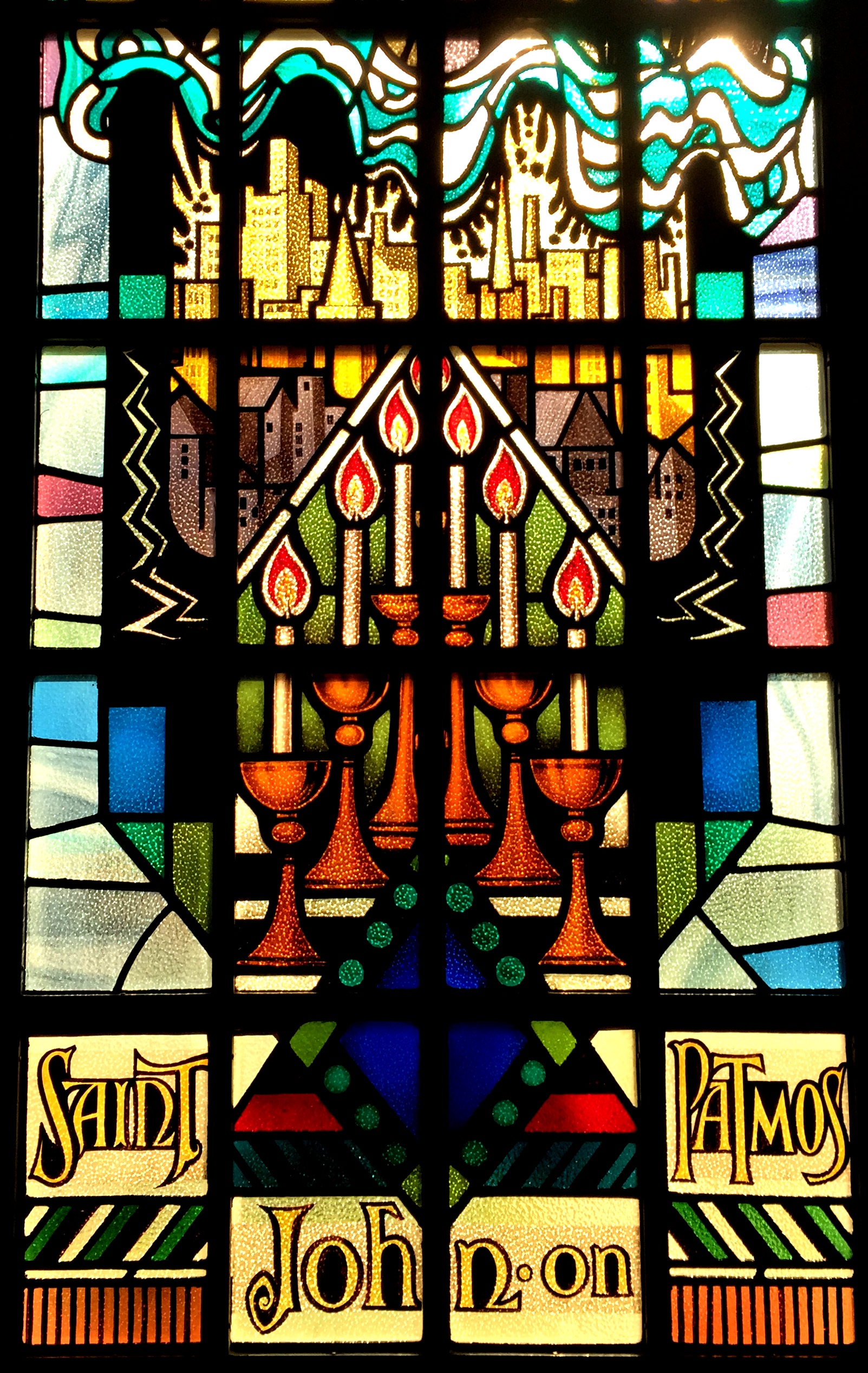
The third window, in the middle, contains John on Patmos. After a life of faith, John was exiled away to Patmos, a small Greek island in the Aegean Sea where he wrote about his visions. The book of Revelation contains fantastic imagery of the way God has, is, and will move  in the world. Our final John is older with a fiery city at his feet, and the new Jerusalem above his head with the lamb.

The Lord gave John certain visions and told him to write them down because they were trustworthy and true. Our window displays the height of the revelation when God will make all things new. A holy city, the new Jerusalem, will come down from heaven. This is where God will dwell with the people, God will wipe away all of our tears. Death will be no more; mourning and crying and pain will be no more. The first things will pass away because God will make all things new.

In our window we see the former things, the earthly passions of the world at the bottom passing away. But God has not, and will not, abandon us to our own devices. The new city at the top will reign and the kingdom will be forever. 

Whenever our eyes fall upon this window we remember that the Lord is with us now and forever. That even in our death we will come closer to the new heaven and the new earth that the Lord has promised. In the midst of our grief and suffering now we can still give thanks to the Lord for that day when he will make all things new. This window calls us to trust the Lord just like John did throughout his life.

John on Patmos wrote down the visions the Lord had provided so that others would come to know what the future holds: The Lord will dwell with us and make all things new. 

St Johns logo

Who are we? A group of Christians who get together week after week to rediscover what it means to follow Christ? A ragtag collection of disciples who need to find a little more light in our lives?

If we want to live into our name, then we need a better story than being named by a District Superintendent. If we want to be the St. John’s that God is calling us to be, then we need to reclaim what that name means for us.

We are St. John’s. That very name carries with it the history of what our church has done for this community. Wherever I go in Staunton I love to tell people that I serve as the pastor here at St. John’s because our name is immediately met with recognition; “My children went to Preschool there!” “My wife and I were married in that sanctuary.” “We buy our Christmas tree from your church every year.”

But we are also more than what we do. Our identity is firmly rooted in the name of John and we should be proud of it. We were named after a man who was called to follow Jesus, remembered the Messiah’s life for other communities, wrote to churches about faithful wisdom, and caught glimpses of future glory. 

Likewise, we are a community of faith that believes in following the Lord, in sharing God’s story with other people, in teaching those younger in the faith about what it means to love, in celebrating the coming day when God will make all things new.

St. John’s; what a perfect name. Amen.

“A Stick, A Carrot & String”

In preparation for Holy Week…

mewithoutyou – “A Stick, A Carrot & String”

The horse’s hay lay beneath His head our Lord was born to a manger bed, that all whose wells run dry could drink of his supply.

To keep Him warm the sheep drew near, so grateful for His coming here: You come with news of grace, come to take my place!

The donkey whispered in His ear: Child, in thirty-some-odd years, You’ll ride someone who looks like me (untriumphantly).

While the cardinals warbled a joyful song: He’ll make right what man made wrong, bringing low the hills, that the valleys might be filled!

Then Child, asked the birds, well, aren’t they lovely words we sing? The tiny Baby lay there without saying anything.

As a distance stood a mangy goat with crooked teeth and a matted coat, weary eyes and worn, chipped & twisted horns.

Thinking: Maybe I’ll make friends some day with the cows in the pens and the Rambouillet, but for now I’ll keep away – I got nothin’ smart to say.

But there’s a sign on the barn in Cabbagetown: “WHEN THE RAIN PICKS UP AND THE SUN GOES DOWN, SINNERS COME INSIDE! WITH NO MONEY, COME AND BUY. NO CLEVER TALK NOR GIFT TO BRING REQUIRES OUR LOWLY, LOVELY KING. COME YOU EMPTY-HANDED, YOU DON’T NEED ANYTHING.

And the night was cool and clear as glass with the sneaking snake in the garden grass, as Deep cried out to Deep, the disciples fast asleep.

And the snake perked up when he heard You ask: If You’re willing that this cup might pass we could find our way back home, maybe start a family all our own… but does not the Father guide the Son? Not my will but Yours be done! What else here to do? What else me but You?

And the snake who’d held the world, a stick, a carrot and a string, was crushed beneath the Foot of Your not wanting anything.

Crucified Faith – Lenten Homily on John 14.1-7

John 14.1- 7

“Do not let your hearts be troubled. Believe in God, believe also in me. In my Father’s house there are many dwelling places. If it were not so, would I have told you that I go to prepare a place for you? And if I go and prepare a place for you, I will come again and will take you to myself, so that where I am, there you may be also. And you know the way to the place where I am going.” Thomas said to him, “Lord, we do not know where you are going. How can we know the way?” Jesus said to him, “I am the way, and the truth, and the life. No one comes to the Father except through me. If you know me, you will know my Father also. From now on you do know him and have seen him.”

image

Jesus is the way, and the truth, and the life.

I know a lot of people who want the greatest amount of reward for the least amount of effort. They have a faulty perception about how much they deserve based on how much they work.

Its like the guy who lets his grass grow and grow until you can barely see his porch because he only wants to have to mow it once. Or like the woman I recently saw at Food Lion who was using every single finger and both elbows to carry all of her bags to the car instead of making multiple trips. Or like the foolish pastor (cough *Me* cough) who believes that so long as he picks a scripture and prays about it, that God will give him a sermon to preach that will having people jumping and shouting “Amen!”

Sadly, I have come across a number of people (even myself at times) who want God without Jesus. We believe on some level that so long as we show up to church, and live a decent life, that we are doing all that the Lord would have us to do. We want salvation without suffering. We want love without expectations. We want resurrection without crucifixion.

Jesus is the way, and the truth, and the life. No one comes to the Father except through him.

way

The disciples are confused. Jesus tells them that he will go and prepare a place for them because there are many rooms in his Father’s house and they know where he is going. Then Thomas asks the question that all the other disciples are thinking: “Lord, we do not know where you are going. How can we know the way?” Jesus responds with hopeful and frightening words: I am the way.

The destiny in store for Jesus is likewise laid up for his friends, and for us. Those who want to save their life will lose it. If we want to experience the presence of God here and now, we can only do so by following the way, by following Jesus.

Sam Wells, the former dean of Duke Chapel, was appointed to a new church, and wanted to experience every single aspect of its mission. For the first few months he spent a couple of days each week going through the ins and outs of the church as if he was not the pastor; He toured the preschool like a prospective parent with a three-year old; He went to weekly prayer services and sat in the back like a stranger might if they randomly walked in off the street; He stood in line at the food pantry and patiently waited for his turn to receive some food.

One of the last things he needed to experience was the homeless shelter. He had heard that it was frequently attended because they gave out the best food and had the nicest provisions and he wanted to see it with his own eyes and taste it with his own tongue. So, for a few days before the experience, he stopped showering and shaving, he found some of his oldest and rattiest clothes, and prepared to spend a night with others in the basement of the building.

He began by waiting outside in line with everyone else. He tried to keep a low profile, but most of the people spotted his costume immediately. For whatever reason they welcomed him into their little group anyway and spent most of the night talking and learning about one another. He asked about their pasts and what had led them to where they were, most of them had normal lives until some unforeseen circumstance sent them out to the streets.

However, before the night ended one of the men shared an important perspective with the pastor. “We don’t come here for the food or for the warmth,” he said, “we come here because this is the only place where we can be with other people like us. Sure the food and shelter is nice, but the community is what we really need.

I don’t think Sam would necessarily put it this way, but I believe he encountered the living God in those homeless men and women precisely because he was acting like Jesus. I don’t think Sam actively went out with the hope that he could walk around like Jesus, but in meeting the people where they were he followed the way that Christ set up for us.

Sometimes the hardest part of being a Christian is recognizing that we cannot have resurrection without crucifixion. More often than not we need to crucify a part of our lives before we can meet and encounter the living God.

Maybe we need to crucify our false assumptions about the poor and how they wind up living on the streets. Perhaps we need to crucify our ridiculous prejudices toward people who are of a different sexual orientation. Maybe we need to crucify our faulty self-perceptions. Perhaps we need to crucify our selfish desires to crave our passions. Maybe we need to crucify a program in our church that is no longer giving life to anyone involved. Perhaps we need to crucify our willingness to hold on to a grudge from the distant past. Maybe we need to crucify our love and obsession with money.

Jesus is the way and we have been given the precious opportunity to follow him, even to the cross. If we want to encounter the living God, we can only do so by crucifying our brokenness and seeking out ways to be resurrected here and now. Amen.

Marked and Cleansed – Ash Wednesday Homily on Psalm 51.1-12

Psalm 51.1-12

Have mercy on me, O God, according to your steadfast love; according to your abundant mercy blot out my transgressions. Wash me thoroughly from my iniquity, and cleanse me from my sin. For I know my transgressions, and my sin is ever before me. Against you, you alone, have I sinned, and done what is evil in your sight, so that you are justified in your sentence and blameless when you pass judgment. Indeed, I was born guilty, a sinner when my mother conceived me. You desire truth in the inward being; therefore teach me wisdom in my secret heart. Purge me with hyssop, and I shall be clean; wash me, and I shall be whiter than snow. Let me hear joy and gladness; let the bones that you have crushed rejoice. Hide your face from my sins, and blot out my iniquities. Create in me a clean heart, O God, and put a new and right spirit within me. Do not cast me away from your presence, and do not take your holy spirit from me. Restore me to the joy or your salvation, and sustain in me a willing spirit.

ash-wed-sq-300x300

How would someone know that you’re a Christian? I think this is a very important question for us to ask ourselves on a regular basis. During a normal day, how would anyone know that we affirm Jesus as Lord, that we pray to God the Father, that we believe the Spirit is with us in all things? Maybe you wear a cross around your neck, though even that symbol has become so innocuous to the general culture around us. Maybe you bring your bible with you to work or public places and you are not afraid to spend some time reading from the good book in front of other people. I personally like to wear my clerical collar when I’m out in town because it helps to show others who I am, and frankly it forces me to act like a Christian in public.

When I became a pastor I was so excited to wear my collar for the first time, to walk around Staunton, and let it speak for itself. I imagined the conversations that would begin at one of our local coffee shops: “Sir, would you please pray for my wife, she just received some tough medical news.” … “Do you mind if I pull up a chair and ask some questions? I’ve always wanted to ask a pastor about the miracles from the gospels.” … “I’m new in town, would you be able to help me find a church community?” However, after being here for some time, I can share that most of the time no one notices. I’ve gone to a local bar with the expectation that people would hide their beer bottles behind their backs, but they just keep talking like normal. I’ve been shopping at the grocery store and prepared myself for random questions, but people just keep scanning the aisles on their own. I’ve sat down at a coffee shop with my collar on, and bible open, and almost no one has made mention of my vocation.

That was the case until last week.

I was sitting at a table alone working on a sermon when two women came in, ordered coffee, and sat at the table next to me. I’m not ashamed to admit that I often eavesdrop on the conversations around me. It’s not that I intend to, or have a problem with it, but most of the time the place is quiet enough that its impossible not to hear what people are talking about. I went to grab my headphones, in order to drown out their conversation, but I heard something that peeked my interest: “Being a pastor must be the easiest job in the world

I decided then that the sermon could wait, this conversation was too good to miss.

One of them continued, “Seriously! They get paid to act like the rest of us. I mean, how hard is it to write a sermon every week and visit old people? Being a Christian is so much harder than being a pastor. It must be the easiest job in the world.

Without thinking about what I was doing, I stood up, walked over to their table, and said, “You’re absolutely right. Being a Christian is harder than being a pastor. The church has expectations about the way you are supposed to behave, and I get paid to behave appropriately, I am a professional Christian. The only difference is this, everyone knows I’m a Christian, what about you?” I then packed up my things and left.

Today, above all days, is an opportunity for us to be marked and cleansed. In a short while, each of us will be invited forward to have a cross of ashes placed on our foreheads, a sign for us to carry around for the rest of the day. Today, wherever you go, people will know who you really are. 

IMG_1957

Do you know where the ashes come from? We save some of the palm branches from Palm Sunday, and we burn them down into ashes. The same palms that some of us waved last spring to welcome Jesus in Jerusalem have been placed in the fire, and will now adorn our heads. This is done as a reminder that our shouts of “hosanna!” can quickly turn to “crucify!” I can go from being a well behaved Christian, minding my own business at a coffee shop, to walking over to strangers and letting my passive aggressive side get the better of me. We use these ashes to mark and cleanse ourselves for the coming season of lent.

All of us are sinners, the young and the old, the weak and the strong, we all fall short of God’s glory. This season of lent is an opportunity to turn back to God and reorient our perspectives about the way the world truly works. For the coming weeks our prayers should be for wisdom, for God to purge from us all wrong desires and failures. This is the time for us to be bold in our faithfulness as we enter the community around us. Lent is the time for God to create in us clean hearts, to put new and right spirits within us. We begin here with the ashes, remembering our finitude, so that God might restore us to the joy of salvation, and sustain us with a willing spirit to be faithful in the world.

How would someone know you’re a Christian? Today, everyone will know just by looking at your foreheads. But, the ashes will eventually fade away; the cross will disappear. The challenge for us is to act like it’s still there, to live full lives of discipleship so that everyone might know who we are, and whose we are. Amen.

Devotional – Psalm 25.4

Devotional:

Psalm 25.4

Make me to know your ways, O Lord; teach me your paths. 

Weekly Devotional Image

The air was pure and undisturbed. It was early enough that most of the neighbors were still asleep and the dog and I were the only ones about to roam the neighborhood. Snow covered everything in sight and I hesitated before taking my first step; until my foot hit the snow, all was still and smooth.

IMG_1949

When I typically walk our dog (Tennessee), in the mornings, we follow the same path. She has to hit the familiar spots and soak up all the smells, and only when we’ve gone everywhere on that path, is she ready to return home for food. The routine is repeated each day and I know that we both fall into the familiar rhythms each morning. And, if I ever forget something, Tennessee is quick to remind me with a quick bark or nudge.

Today, however, as soon as we hit the snow, everything changed. The familiar path was covered under inches of powder and Tennessee was so excited to walk that she began running in circles. I struggled to get her to the familiar spots while she was far more concerned with shoving her nose into the deep snow and turning to look at me as if saying, “This white stuff is awesome!”

10950725_10203503805826769_1322183989877696279_n

When it became clear that the familiar and routined walk was not going to take place, I decided to give in to her newfound excitement and began running around with her in the snow. Between shoveling mounds of snow up into the air, and Tennessee running around in circles, we were both quickly out of breath and at least one of us was laughing. By the time we returned to the parsonage it no longer mattered whether she hit all the same spots like most mornings; for us we simply enjoyed God’s creation in the beautiful snow.

The familiar routines of life often bring us stability and comfort: we wake up and drink the same coffee and read from the same sections of the newspaper; we listen to the same radio station while making the same commute to work; we pray the same prayers over meals with our family. Routines are important because they help to habituate us into faithful and fruitful patterns (We say the Lord’s Prayer every week in church because it helps to shape our lives around the Lord to whom we pray). However, life is not always so neat and tidy.

Changing the typical routines and patterns of life help to prepare us for the days when unforeseen circumstances change our plans. Taking the dog on different paths helps her, and her walker, to experience God’s creation in new environments. Learning to pray in different ways helps to keep our faith alive in new and vibrant ways. We need not wait for a snow day to change our rhythms and patterns; new opportunities are available every single day.

As we all prepare to take our first steps into the season of Lent, let us pray for God to reveal new paths in our lives. Let us see this season as an opportunity to rediscover that which makes our discipleship so exciting: a loving God whose paths are always open for new discoveries.

Yes, No, Maybe So – Sermon on Romans 13.1-2, John 18.36, and 1 Timothy 2.1-3

(Instead of a typical ~15 minute sermon from the pulpit, I broke the following sermon up into 3 homilies. I preached the first from the pulpit, the second from the lectern, and the third from the middle)

This morning concludes our Sermon Series on Questions. After polling the gathered body regarding your questions about God, Faith, and the Church this series was created. Last week we talked about the ever sensitive topic of forgiveness and whether or not to bury or cremate the dead. This week we finish by looking at the complicated relationship between politics and church. Before we begin I wanted to share with you some the actual questions that led to this sermon: How do we reconcile the divide between what we believe and particular political positions? The Old Testament seems to celebrate violence in God’s name. Jesus seems to permit only peaceful ways; So why do we live ready to go to war with whomever our government says we should? Is it right to have an American Flag in the sanctuary?

should-the-church-be-involved-in-politics

Let every person be subject to the governing authorities; for there is no authority except from God, and those authorities that exist have been instituted by God. Therefore whoever resists authority resists what God has appointed, and those who resist will incur judgment. 

Is the church political: YES

My office is far away from the main entrance to church. I can sit comfortably in the back hallway room, weeding through emails, making phone-calls, and preparing sermons while unaware of anyone entering the church and walking into the main office. If people arrive and desire to speak with me our secretary, Ashley, will either walk with them down toward my room, or call ahead to let me know that someone is on their way. I appreciate this system because I am rarely blindsided by a visit and can usually prepare myself for whatever enters the room. Usually.

Ashley had already gone home for the day when I heard the doorbell ringing. I have learned that I have to run from my office to the entrance if I want to catch people before they give up and assume no one is at the church. So it was with a bible and hymnal tucked under my arm that I found myself sprinting to the door to welcome whoever was waiting.

She was older, painfully shy, and carrying an absurd amount of political paperwork. She stuttered after I flung the door open and it took a lot of interpretation for me to gather that she wanted to talk about an upcoming election. On most days I would politely smile and decline her invitation, but I was in the mood to debate and argue, so I welcomed her in.

In my office we went through the expected pleasantries about how long I have been here, what the church is like, and other regular questions when the stuttering disappeared, and my shy visitor became extremely passionate about the subject of conversation. “Did you know” she began, “that Christians are voting less than they ever have in the past? While the world crumbles around us under the sinful temptations of the devil, people are neglecting their Christian duty to vote for politicians that can help turn the world right-side up… (of course, all I could think about is the fact that Jesus came to turn the world upside-down) … We need your help pastor. We need you, as the leader of this church, to use the pulpit as a tool to get good Christians back to the voting booths so we can bring our country back to the good old days.” I tried to stifle the sigh that was brewing within me, but before I had a chance to rebuke some of her statements, she dropped a bomb from scripture right on top of me, “remember what Paul wrote: ‘let every person be subject to the governing authorities; for there is no authority except from God.’ We greatly appreciate your helping our cause.

For as much as I was frustrated with some of her language, and her desire for our pulpit to become a political microphone, she was absolutely right. Throughout history Christians have wrestled with the relationship between church and state, and Paul had to address these growing concerns as a major problem in the first century. Christians, since the beginning, have either granted rulers too much power and latitude, or else have refused to give up what is fully entitled to the rulers (remember give to Caesar what belongs to Caesar?). This has resulted in Christians being too subservient in some periods, while in others they have neglected their duty to the area they found themselves in.

Paul wrote these profound words to the church in Rome because he thought that if we can be good citizens, we can be good disciples. We rely on governments, including our own, to bring order to the chaos of our world. As long as people persist in making our future unpredictable, Paul’s words will remain relevant. Wars will develop, evil will manifest itself in crime and violence, and the state will be here to protect the innocent.

Is the church political? YES. We are political because we are subject to authorities over us that were instituted by God. So, in honor of the woman who begged me in my office to do something I never wanted to do, I say this: “Remember to vote.” Amen.

——————————

Church and State

Jesus answered, “My kingdom is not from this world. If my kingdom were from this world, my followers would be fighting to keep me from being handed over to the Jews. But as it is, my kingdom is not from here.”

Is the church political? NO

I loved my AP Government class in high school. First of all, it was taught by the coach of our football team which meant that he spent more time working on the Xs and Os in his notebook than he did about the legislative branch and he was quick to reward us with stellar grades regardless of our effort. But mostly, I loved the class because it embodied, for me, all of the wonderful and incredible things I was about to experience. As a 17 year old, AP Government displayed the strange new world of our American System that I would soon be able to participate in through the right to vote. I eagerly absorbed our reading material because it was enlightening and it was relevant.

Midway through our year together a serviceman showed up in our classroom, and my excitement quickly dwindled and was replaced with disappointment and fear. The marine stood at the front of our class in his uniform while most of us were still rubbing our eyes to wake up, and began to explain the Selective Service. In mere moments I quickly learned that by no choice of mine I would be registered for the Selective Service along with every other male between the ages of 18-25. The marine attempted to calm the nerves that were developing in the room by claiming that it will probably never amount to anything, but that the government needed to have us on record just in case we were ever needed for war.

I was stupefied. How could our Government expect me to go to war when I believe in the one who calls me to love and pray for my enemies? How could our political system set aside young males, just in case, when it contradicts my understanding of God’s love and grace in the world?

God’s kingdom is not of this world, our allegiances are somewhere else. Doing things liking pledging allegiance to the flag and printing “In God We Trust” on our money draws us away from the one in whom we live and forces us to choose between God and country. Those two things are not the same. Having an American flag in our sanctuary is very dangerous because it, on some level, implies that what the cross represents is equal to what the flag represents. When we let the flag, and therefore the country it represents, come too far into our discipled lives, we run the risk of blurring the lines between God’s kingdom and America. It was not that long ago that a man named Hitler was able to bring one of the most advanced and progressive nations in the world into a war through the use of religious fanaticism that started with a nationalist church structure. That kind of thing still happens in the world today.

Is the church political? NO. God’s kingdom is not of this world, we believe in something greater than our country can represent, and we are held to a higher standard than what our country fights for. When our beliefs and faith go against what America proclaims as normative, we are reminded of the fact that God’s kingdom is not of this world. Our hope is built not on political parities but on Jesus Christ and his righteousness. Amen.

——————————

Blog Header World Compassion

First of all, then, I urge that supplications, prayer, intercessions, and thanksgivings be made for everyone, for kings and all who are in high positions, so that we may lead a quiet and peaceable life in all godliness and dignity. This is right and is acceptable in the sight of God our Savior.

Is the church political? MAYBE SO

I was hunched over the computer with my notes spread out across the desk when the text messages and phone calls started coming through. I quickly hid my phone in a drawer and continued to focus on my studies, my Old Testament Final Exam was in the morning and I felt woefully unprepared. But try as I might to remove the distraction of my phone, it continued to buzz and ring in the drawer when I began to realize that something big must’ve happened. All I needed to do was see the first message for the final to disappear from my thoughts: “We killed Osama bin Laden.

I spent the rest of the evening in front of the television witnessing the reports of our nation’s triumph in killing its greatest enemy, I saw crowds of people gathering in public and in front of political buildings celebrating a great victory while waving American flags back and worth. I even received a phone call from one of my childhood friends who was drunkenly celebrating in front of the White House who wished that I could be there to throw a cold one back with him.

In the days that followed, people continued to celebrate across the American landscape and I felt confused. On some level I kept recalling what it felt like to grow up in Alexandria and really remember the fear I felt when the Pentagon was hit, I remember the devastation that weighed on military families in my neighborhood, I remember the world changing forever on 9/11 and being angry at whoever was responsible. But while I witnessed people celebrating the death of Osama bin Laden, I couldn’t help but wonder if we had accomplished anything.

For weeks I struggled with how to feel and what it meant for our country to celebrate the death of a man who celebrated death. I was lost and unsure of my faith and what it meant to follow the one who died for us. The muslims I was used to seeing on Duke’s campus quickly disappeared from the public areas and were replaced with affluent kids dressed in red, white, and blue. Overwhelmed by everything that had taken place, I confided in a friend from seminary about my struggles and asked, “What are we supposed to do?

His response was quick and deliberate: “We pray.

The problematic relationship between church and politics is complicated by the fact that the Christian always belongs to two communities and has loyalties to both. Our identities are divided between God and Country and both are constantly striving for our allegiance. Sadly, there will never be a time that both of them stand for and represent the same things, and we will always live in this paradoxical struggle.

What are we to do when politicians fight for programs that go against our faith?

What are we to do when our country goes to war with our enemies while Jesus is the one who calls us to love them?

What are we to do with a sanctuary and worship service that displays an American flag while proclaiming the empty cross of Christ’s resurrection?

What are we to do when our country no longer stands for the Christian values everyone believes it was founded upon?

First of all then, I urge that supplications, prayers, intercessions, and thanksgivings be made for everyone, for kings and all who are in high positions, so that we may lead a quiet and peaceable life in all godliness and dignity.

We pray when confronted with the troubles of our world, when we are met with the political persuasions of our nation, and when we can no longer understand the balance between God and country. Karl Barth once said that “to clasp our hands in prayer is the beginning of an uprising against the disorder of the world.

Is the church political? MAYBE SO

We are political in the sense that we recognize that we are in the world, but we are not of the world. That God has called us to be brave and radical people who see the world turned upside down and live into a new reality. That when we clasp our hands together to pray for everyone, our leaders and enemies, our nations and others, we spark the beginning of an uprising against disorder.

The challenge of the relationship between faith and politics will always remain. Since the beginning of the church it has been a concern of Christians everywhere and it will continue to be.  But if we want to truly wrestle with this problem, is we want to take steps of faith into our political culture, we begin by asking: What Would Jesus Do about government?

He would pray for the government, he would listen to all people everywhere treating them with worth, and he would love them with all that he had.

Let it be so with us. Amen.

——————————

Sinners and Saints – Sermon on Psalm 34.1-8

Psalm 34.1-8

I will bless the Lord at all times; his praise shall continually be in my mouth. My soul makes its boast in the Lord; let the humble hear and be glad. O magnify the Lord with me, and let us exalt his name together. I sought the Lord, and he answered me, and delivered me from all my fears. Look to him, and be radiant; so your faces shall never be ashamed. This poor soul cried, and was heard by the Lord, and was saved from every trouble. The angel of the Lord encamps around those who fear him, and delivers them. O taste and see that the Lord is good; happy are those to take refuge in him.

All-Saints-Day-candles

Tomorrow will be my 6th funeral. Betty Lancaster, Georgeanna Driver, Brandy Garletts, Russ Wisely, Dick Markley, and now Chris Harris. I can remember the way my heart raced when I got the phone calls when each of them passed, I can still see their families in tears during the funeral, and I can still remember the sensation of the dirt in my hand when I dropped it on the caskets at the cemeteries. Without a doubt, preaching and presiding over funerals is one of the greatest privileges, and most difficult challenges, that I have as a pastor.

I am invited into one of the most sensitive aspects of a family’s life when I find out that someone has died. Those moments in the car on my way to a home or hospital, are filled with prayerful silence as I ask God to use me as a vessel of his grace and peace with a family who is in the midst of grief. You never know what to say, because there is nothing to say. You sit and listen, you provide the loving comfort of presence, and you pray for everyone you can think of.

Today is All Saints’; a day for us to remember those who have gone on to glory over the last year from our church, and from all of our families and friends. It is a hallowed time where we reflect on the ways that our friends and families shaped us into who we are today. It is that precious day when we give thanks to God for putting them in our lives, and then welcoming them back into his eternal arms. All Saints’, like funerals, is a time for us to speak truths about the lives of those close to us, with the hope of the promised resurrection.

green-funerals-green-resting-place

No matter what, funerals are always difficult. Funerals are a remarkably sensitive time for families and you have to be very careful about what you say, and how you say it. Yet even with the fear and trembling that comes with proclaiming someone’s life and death, I do look forward to sharing stories that help to reveal the character of the person’s life that we are remembering.

For instance:

The first time I met Brandy Garletts was early in my time here at the church. She was older and had been moved to a rehabilitation center when I went to visit her. I spent way too much time worrying about what I would say to this stranger for the first time, what her impression of me would be, and how could I speak words of hope in her situation. When I made my way to the facility, after finally finding her room, she motioned for me to sit across from her to lean in closer. Before I could even open my mouth to begin speaking all the prepared thoughts that I had, Brandy asked me a question that I was completely unprepared for: “Are you a registered voter?

There I was sitting across from an incredibly sweet woman, someone that many people from our church have admired and looked up to, prepared to talk about God, faith, and grace, and she wanted to find out if I was a democrat or a republican.

Brandy was a fiercely strong woman and fought for what she believed in. Asking me about my political ideology was indicative of the life she lived; always looking for new opportunities to make the world better for others.

Or I could tell you about a story that Russ Wisely shared with me in my office: “Many years ago,” he began, “we had another young pastor. Fletcher Swink had just graduated from Duke Divinity School and was sent to Staunton for his first appointment, just like you. In the beginning everything was great. Fletcher provided strong leadership, the church was growing, and we started to build the property that we are now sitting in. However, one day, Fletcher called me because he had a problem and had no idea what to do. He had performed a wedding for a young couple in Staunton, his very first, and only after signing the marriage certificate did he realize that he had not filled out the proper paperwork to legally marry people in the state of Virginia. He was at a loss for what to do, so I told him to come with me to the courthouse; I knew the judge and figured we might be able to work something out. When we brought the matter to the judge he looked at me and he asked ‘Russ, what do you think we can do?’ and I told him that we could sign the paperwork and just change the date to have happened before the wedding, to which he replied, ‘sounds like a good idea to me.

I sat there in my office stunned. Here was this older man telling me a story about how he had manipulated the legal system just to cover for a young pastor who had made a mistake. Was he telling me this story to make sure that I didn’t make any mistakes? Was he trying to scare me about the responsibilities of leading the church? I sat there in my chair, unsure of how the story would conclude. Russ then looked at me right in the eyes to finish, “That happened nearly 60 years ago. I helped Fletcher because it was important. I want you to know, young man, that I am here to help you as well. If you need anything I want you to call me.” And with that he stood up and prepared to leave my office. Only then did I realize that I never said a word. 

Russ Wisley sacrificed for others and was willing to work behind the scenes to make things happen. Whether here at church or in the community, Russ would help anyone he could, because he believed in the importance of supporting others.

What has struck me most about the lives we have celebrated over the last year, the people who we are remembering today, is that they understood the words from Psalm 34; their lives were a reflection of God’s goodness and they lived as saints for others to follow.

I will bless the Lord at all times; his praise shall continually be in my mouth.” Saints are those who can speak and live in such a way as to point to the Lord in all that they do. They give thanks to the Lord their God for the blessings they have received and give back to others from their abundance. Saints recognize the presence of God and do whatever they can to share that experience with others because they know how life-giving it can be.

O magnify the Lord with me, and let us exalt his name together.” Saints do what they can to benefit the greater community and not just their own lives. They are not content with having a “personal relationship with Jesus Christ,” but see the great gift that the community of faith can be. They worship together to praise the Lord of hosts, and exalt his name. At church they sing from the depth of their being, and greet others in Christian love. At home they pray fervently for their lives, for their friends and family, for their enemies, and for their church. They strive to magnify the Lord in all that they do so that others can know how life-giving it can be.

I sought the Lord, and he answered me, and delivered me from all my fears.” Saints understand that God has continued to seek them out throughout the years, and take the time to respond to God’s great calling. Instead of remaining complacent with their faith journeys, they seek out the God of Abraham, Isaac, and Jacob with the knowledge that in doing so, the Lord will answer. Instead of just hoping for good things to happen because they live good lives, they take leaps of faith to encounter the living God who will deliver them from fear. Saints believe that going to the Lord reorients all expectations and priorities and they encourage others to go to the Lord because they know how life-giving it can be.

Look to him, and be radiant; so your faces shall never be ashamed. This poor soul cried, and was heard by the Lord, and was saved from every trouble.” Saints know that life is not always easy, and that there will be times of suffering. To follow the commands of God, to live by the beatitudes, implies a willingness to see the world turned upside down where the first will be last and the last will be first. They do not let their sufferings get the best of them, but instead they remember that suffering produces endurance, endurance produces character, character produces hope, and hope does not disappoint. They encourage others to not give in to the suffering in their lives but to firmly place their hope in Jesus Christ because they know how life-giving it can be.

Our saints have lived lives worthy of emulation. The more I learned about their discipleship as I prepared for their funerals, the more I wanted to live like them. I was struck over and over again by how deeply rooted they were in their faith, and how much they worked to live like Jesus. However, that’s not to say that our saints have been perfect; even Jesus’ family tree is filled with broken and battered branches.

On All Saint’s Sunday, we remember the saints, and let us be sure to remember all of them. Not just the wonderful and psalm-like moments from their lives, but the bruised and blemished moments as well. Not just the saints from our church family that have died, but all the saints who have witnessed to God’s love for us.

Who do you think of when you hear the word “saint”? Do you picture Mother Teresa, Augustine, or John Wesley? Do you think about people who lived perfectly pure lives? Or do you think about the people in your life who have simply encouraged you in your faith?

SinnerSaint-2

Those who we remember today were both sinners and saints. There were times that they fell short of God’s expectations, there were times that they did not practice what they preached. There were moments that they neglected to praise and and magnify the Lord. But God has a crafty way of turning sinners into saints.

God almighty, maker of heaven and earth, has done, and will continue to do, some incredible things through the sinners in our midst. You might remember those that have died for all the negative, bad, and embarrassing things that they did, but God saw them in their sinfulness and saw potential. God has used our saints to change our lives for the better by shaping us into the disciples we are today.

The pulpit is a wonderful vantage point. From where I stand I can look out on the gathered body of Christ and take in the view in one fell swoop:

When I look out from here I see a church full of sinners. I see the brokenness that many of you have shared with me, but have refused to share with anyone else. I see the fights, frustrations, and failures that haunt so many of you on a regular basis. I look out and see the doubts that cloud your faith, the temptations that draw you away from God, and the selfishness that drives you away from one another.

But at the same time, when I look out from here I see a church full of saints. I see the body of Christ praising the Lord through prayer and song. I see the humble souls that are thankful for the blessing of life. I see the love, life, and vitality that invigorates so many of you toward wholeness. I look out and see the radiant faces that shine with God’s glory. I see a church that is full of people willing and excited to work for God’s kingdom.

So, like the psalmist says, let us come to the God’s table; see and taste how the Lord is good. Remember all of those who have gone before us to a table such as this, to take refuge in the Lord.

Let us also give thanks to the Lord for putting the saints we remember into our lives. For helping to shape and mold them out of their sinfulness and into saintliness. For their desire to share the Good News with us so that we might know what grace is really all about.

And let us hope and pray that God would continue to give us the strength to be saints for others in spite of our sinfulness. So that one day, God willing, the church will get together to worship the Lord and give thanks for us after we die.

Amen.