Devotional – Genesis 12.1

Devotional:

Genesis 12.1

Now the Lord said to Abram, “Go from your country and your kindred and your father’s house to the land that I will show you.”

 Weekly Devotional Image

And that’s how it all began. The Lord said to Abram, “Go.” In the entirety of the Old Testament, there are few passages as important and theologically profound as God’s calling of Abram to go to a strange new place. We can talk about Jacob wrestling with the emissary from God by the banks of the Jabbok river, we can talk about Joseph saving the Egyptian people from certain starvation, we can even talk about Moses’ trials and tribulations with the Hebrew people in the wilderness, but this moment with Abram, this call, sets in motion the great narrative of God with God’s people.

The sheer magnitude of such a call cannot be overlooked. During the time of Abram’s life, almost everything was dependent on staying in one’s country and with one’s family. Most people spent their entire lives, from birth to death, within a handful of miles and rarely explored anything outside the normal and comfortable dwelling of “home.” And yet God had the audacity, the boldness, and the faithfulness to call Abram to do the unthinkable: go to a strange new place and leave it all behind.

This, in a sense, is akin to the call of all Christians. We might not be asked to leave our home country, we might not be asked to leave our families, but we are certainly compelled to enter into strange relationships and moments around us. It is easy to stay within a certain bubble throughout our lives and never stretch too far into the unknown. We can develop rhythms and habits that actively prevent us from encountering anything out of the ordinary. But God is extraordinary.

go

Lent is a time for us to reflect and repent. We reflect on the many ways God’s has so graced us, and we repent for the many ways we have failed to positively respond to that grace. Lent is a time for us to all recognize the Abram within us, and wonder where God is calling us to go. What place are we avoiding because it makes us uncomfortable? What relationship have we let fall apart because it just felt like too much work? What frustrating behavior in a friend or a spouse or a child have we let percolate for far too long?

In some way, shape, or form God is calling each and every one of us to “go.” God calls us to “go” because our God is a God on the move. God cannot be relegated to a sanctuary on Sunday mornings at 11am, God is not absent until we pray for God’s presence, God is not sitting on a throne up in heaven watching us through a telescope. God moves, and so should we.

Open Hearts. Open Minds. Open Doors.

Romans 4.1-5, 13-17

What then are we to say was gained by Abraham, our ancestor according to the flesh? For if Abraham was justified by works, he has something to boast about, but not before God. For what does the scripture say? “Abraham believed God, and it was reckoned to him as righteousness.” Now to one who works, wages are not reckoned as a gift but as something due. But to one who without works trusts him who justifies the ungodly, such faith is reckoned as righteousness. For the promise that he would inherit the world did not come to Abraham or to his descendants through the law but through the righteousness of faith. If it is the adherents of the law who are to be the heirs, faith is null and the promise is void. For the law brings wrath; but where there is no law, neither is there violation. For this reason it depends on faith, in order that the promise may rest on grace and be guaranteed to all his descendants, not only to the adherents of the law but also to those who share the faith of Abraham (for he is the father of all of us, as it is written, “I have made you the father of many nations”) – in the presence of the God in whom he believed, who gives life to the dead and calls into existence the things that do not exist.


There are many many many versions of Christianity. And not just denominations like Presbyterians, Episcopalians, and Baptists; even within something like the United Methodist Church there is a great myriad of ideas about what it means to be the church. For instance: There are 7 UMCs in Staunton, and we could all use the same text on Sunday morning, and just about everything else would be completely different from one another.

But the one thing that might unite all churches, almost more than baptism or communion, is a desire to appear as welcoming and inclusive as possible.

All you need to do is check a church website, or bulletin, or marquee and you can find a self-made description that says something like: we are an open, friendly, inclusive, and welcoming church. Or just try asking someone about their church and you’re likely to hear: “we love everybody!”

In the United Methodist Church, we like to say we have open hearts, open minds, and open doors.

37807

What a righteous slogan.

Inclusivity, being open, they’re quite the buzzwords these days. Rather than appearing at all judgmental, we want people to know that we accept all people. Rather than seeming prejudiced, we want everyone to know that they are welcome. Rather than looking at people based on their outward appearance, we want to the world to know that we care about the content of one’s character.

But the truth is, there are a great number of people who have been ignored, if not rejected, by congregations claiming to be inclusive (including our own).

A couple weeks ago I preached a sermon on the mission of the church. I made the claim that instead of being consumed by a desire to fill the pews, instead of trying to make the world a better place, the church is called to be the better place that God has already made in the world. And as the better place, church should be the one place where no one is ever lonely. I must’ve said that last part no less than three times from the pulpit.

And when we finished worship, most of us walked up the stairs to the Social Hall for a time of food and fellowship. Like we usually do, a long line was formed and one by one we filled our plates and sat down.

The time difference between proclaiming the sermon and sitting down to eat could not have been more than 30 minutes. And yet there was a young family who were here with us in worship for the very first time, who sat alone in our social hall the entire time. And there was an older gentleman, who has served the needs of this church longer than I’ve been alive, who sat by himself for nearly the entire time.

It is not possible for any church, even St. John’s, to be “inclusive” of everyone. And not necessarily for the reasons we might think. We might not judge others for the stereotypical ways often publicized about the church like being homophobic, or racist, or elitist (though there is plenty of that). No, we also reject others for mental illness, politically different or incorrect views, or for poor social skills and status.

We reject people for all sorts of reasons.

Years ago, when I first entered seminary, I went on a bike ride with some friends to another house full of seminarians. We represented the great mosaic of mainline protestant Christianity and we quickly began addressing why each of us was attracted to the particular church we would serve in the future. The Episcopalian talked about her love of the Book of Common Prayer and being united with Christians all over the world who say the exact same words whenever they get together. The Baptist talked about the beauty of believer’s baptism and getting to bring adults into God’s flock.

One of the Methodists, me, talked about the wonder of God’s prevenient grace, a love that is offered to all without cost or judgment. But then I went on to express my chief disappointment: Our slogan of open hearts, open minds, open doors. I joked about how many Methodist churches regularly lock their doors, how many of them are filled with people whose minds are already made up about God and others, and how many of them have people with hearts that have no desire to be open to the strange new reality of God’s kingdom.

To be honest, I got pretty fired up about it. After all, it was the beginning of seminary and I was trying to show off.

But I meant what I said. Our slogan is something we can strive for, but it is not a fair description of who we are. There will always be a newcomer who sits in a pew by herself without anyone coming over to say hello. There will always be a family that risks being ostracized by coming to church only to being judged from afar. There will always be sermon series that make people feel like they are not welcome into the fold of God’s grace.

So I went on and on about this until I looked at the other Methodist whose face had turned bright red. “Is everything okay?” I asked. He paused and then said, “My Dad was on the committee at General Conference that created our slogan. I think it’s the best thing about the United Methodist Church.”

We have a slogan, a nice and pretty slogan that we should strive for, but oftentimes we fall short. When we fall short, we do so because of sin. Sin captivates us in a way that makes it virtually impossible for any church to “unconditionally accept” everyone who comes through the door.

We judge others based on physical and outward appearance. We make assumptions about families for a myriad of reasons. We shake our heads in disgust about couples that do not fit the normative mold that society has established.

And we should be cautious about advertising or describing ourselves as such. We might think we’re righteous enough to live by the slogan, we can even hope for it, but we are far from it.

Only Jesus, the one in whom we live and move, is capable of a truly open heart, open mind, open door ministry because Jesus was God in the flesh. Jesus was righteous.

But what about Abraham? Paul uses this part of his letter to the Romans to use Abraham as an example of righteousness. Abraham was the one who was called to leave the land of his ancestors and family to go where God called him. Abraham was the one in whom the covenant between God and God’s people was made. Abraham was the one who was promised to become the father of many nations. Abraham was the one who believed God and it was reckoned to him as righteousness.

Should we follow Abraham’s example? Would that make us more inclusive and righteous? Could we keep our slogan of open hearts, open minds, open doors?

Here’s the thing: Abraham did nothing to earn this honor and distinction from God. As Paul puts it, Abraham has no ground for boasting.

Whenever we read about the story of Abraham, whether in worship or in a bible study, he is often lauded for his journey into the unknown, for his faith and steadfast commitment to the Lord, and for his perseverance through suffering and tribulation. But his relationship with God, his faith being reckoned as righteousness, is only possible because of God’s faith in him. Abraham is righteous because God called him and empowered him to go into a strange new world.

Abraham, rather than being the perfect model for inclusivity and righteousness and faithfulness, is an example of a justified sinner. Abraham is one of many unlikely individuals whom God reshapes for God’s purposes. Abraham is chosen not because of anything he has done, but because of God who can do anything.

God is the one who worked in and through Abraham’s life, and not the other way around. Abraham does not justify himself, or transform himself, or redeem himself. That’s what God does.

And the same holds true for us today.

open_hearts_logo

We can have the perfect advertising campaign, with our slogan in big capital letters, but that does not redeem our sinful actions and behaviors. We might think we are righteous and that we are “color-blind” or “LGBTQ affirming” or “economically transparent” but we are nevertheless sinners in need of God’s grace and forgiveness. We can even leave the church doors unlocked all week long, but we will still be broken and in need of God’s redeeming love.

This passage, this beautiful piece of theology from Romans, is about more than the example of Abraham and why we need to have faith. Paul’s emphasis is on the fact that God made Abraham righteous. That God has freely poured out grace on the ungodly, people like us. And that God’s gift of Jesus Christ to us and to the world is grossly unmerited and undeserved, and yet it is given to us.

She came to church pretty regularly but she kept to herself. She’d sit off at the end of a pew and keep her head down so as not to attract too much attention. Whenever it was time to sing, she would stand up with everyone else but her voice never made it higher than a whisper. When it came time to say the Lord’s Prayer she would properly bow her head and mouth the words. But whenever the congregation was invited to the front to receive communion, she never left her seat.

young-woman-praying-in-church

Most of the church was preoccupied with thoughts about their own sins or about where they would eat lunch after the service to notice the woman who remained in her pew while they were feasting on the body and the blood. But the pastor noticed.

After a couple months he caught her after church, and wanted to know why she participated in almost every part of worship, but not in communion. She said, “I don’t feel like I deserve it.”

That, my friends, is the whole point. We don’t deserve it. You don’t, and I don’t. None of us have earned God’s salvation, there’s no list of things we can check off in order to get into heaven. This bread and this cup, the cross and the empty tomb, they are unmerited and undeserved gifts from God to us.

We cannot have a church that is open hearts, open minds, and open doors because we are already in it. Our presence, our sinfulness, makes it impossible to be a totally inclusive community.

Only Christ, only God, only the Spirit have open hearts, open minds, open doors. Only the triune God opens up the floodgates of grace to wash away our sins. Only the triune God opens up our eyes to view others without judgment or wrath or fear or anger. Only the triune God opens the doors of the church to the faithful community, to feast at the table that gives us a foretaste of heaven on earth.

Only the triune God gives life to the dead and calls into existence the things that do not exist. To God be the glory. Amen.


romans_feature-01


The End Of The Beginning – Ash Wednesday

Genesis 3.19

By the sweat of your face you shall eat bread until you return to the ground, for out of it you were taken; you are dust, and to dust you shall return.

If you’re here in this place, with these people, on this occasion right now, you are blessed. You are blessed because you understand, you grasp, what the church is really all about. We are a people called church, who follow Jesus and take upon ourselves the sins of the world.

However, we don’t take upon the sins of the world in the way Jesus did. We are told to take up our own crosses, but we don’t drag them up to a place called The Skull, and we don’t wait for people to nail us to them. We take upon the sins of the world in confession, a confession that God is our judge and has every right to be. Because we have failed to be the people God has called us to be over and over and over again.

The United Methodist Church has a document to help us whenever we gather together. The Book of Worship outlines the ways to serve the Lord for just about every occasion, including funerals.

The Service of Committal is brief and is reserved for the graveside. And in our Book of Worship you can find these directions for clergy: “Stand at the head of the coffin and while facing it, cast earth upon it as it is lowered into the grave. The pastor then says, ‘Almighty God, into your hands we commend your son/daughter, in sure and certain hope of resurrection to eternal life through Jesus Christ our Lord. This body we commit to the ground, earth to earth, ashes to ashes, dust to dust.’”

The last time I did a graveside burial, I held the Book of Worship in my hands like I’ve done too many times before, I read the all too familiar words, and when it came time to cast dirt upon the coffin, I couldn’t find any. I frantically looked at the area around the hole, and they had covered it with a frighteningly sharp bright green carpet of AstroTurf. So I bent down in my robe onto my knees, and I started ripping up the perfectly manicured grass on the edge of the fabricated lawn. I needed some dirt. I needed to dirty this pristine and picturesque committal service because death is ugly and disruptive. I clawed the ground and threw the grass to the side until I scraped enough bare earth with my hands to have a solid mound to drop onto the coffin.

It was a holy thing.

dirt-placeholder

I took my dirt covered hands and placed them on the coffin, I prayed the words from the Book of Worship, and then I slowly walked away giving the family time to grieve before leaving. And just as I began backing away, the funeral director motioned for the pall bearers to come forward. But they did not bend down to the hole in the ground I had just revealed. No, they took roses, the boutonnieres, from their lapels and laid them silently on the recently dirt covered coffin.

It is, of course, much nicer to throw roses than dirt. But like almost everything in the tradition of the church regarding worship, the dirt has important theological significance.

I wound venture to guess that many Christians, though they hear the words about ashes to ashes and dust to dust at funerals and at Ash Wednesday services, they have no idea where those words come from. But you do. You know where they come from because you just heard it. It is the final announcement from God to Adam and Eve as they are kicked out of the Garden of Eden.

By the sweat of your face you shall eat bread until you return to the ground, for out of it you were taken; you are dust, and to dust you shall return.

            For us humans, this is the end of the beginning.

Much has been made about the Genesis story of eating from the tree of knowledge of Good and Evil. The slithering serpent who manipulates Eve’s desire; Eve’s treachery through inviting Adam to join her in the prohibited act; Adam hiding his shame and nakedness from God when the Lord returns to the Garden. And its all pretty harsh.

By this act sin was brought into the world. Because of our ancestors’ choice, we were banished from the paradise of God’s created order and were punished. Women must suffer through childbirth. Humans must work and sweat over the earth in order to glean enough produce to survive. Families are torn apart by an individual’s choice that has ramifications far greater than they can ever imagine.

And then we come to a place like this to have ashes smeared across our foreheads in an effort to remember what happened long ago, and what will happen to all of us one day.

We will die.

But we’re content with spending the rest of our days prettying everything that we can. We bring roses to place on the coffins at graveyards. Politicians bump up statistics to make things appear better than the actually are. We do our best to cover our scars, both physical and emotional, as if they were never there. And some churches spend Ash Wednesday not in sanctuaries confessing their sins with their brothers and sisters in faith, but in their parking lots presenting “Ashes to God with a cup of Joe.”

We would rather cover the harsh realities of truth than look at them in the eye.

God’s pronouncement to Adam and Eve, that terrifying moment when they were expelled and told that they will suffer until they return to the ground, that strange and all too familiar expression you are dust and to dust you shall return, they strike fear in the hearts of us mortals.

Sometimes its good to be afraid because it reminds us what a tremendous blessing it is to be alive at all. Sometimes its good to get down on our knees and confess our sins before the Lord because it reminds us that we are not God. And sometimes we need to catch a glimpse of ourselves in the mirror on Ash Wednesday to remember who we are, and whose we are.

This day, this Ash Wednesday, is a moment for us to confess our sins, and for all the sins of the people who are not here. We bow our heads and are adorned with a sign of death, not just as a reminder to us and to others that we will die, but that God will not let death be the final Word.

And here is the hope, my brothers and sisters, the hope we need on a day like today. We know how the story ends. We know that the pronouncement at the edge of the Garden was not the final word. We know the final word is not suffering, nor death, nor dirt, nor even dust. We know that the final Word is Jesus Christ.

The ashes that will soon be on our skin are not our crosses to bear, but Christ’s who carried it to The Skull and was nailed to it for the world. Jesus Christ is God’s greatest and final Word because in him the fullness of the Lord was pleased to dwell. In Him the sin of Adam and Eve were reconciled unto the Lord. In Him we are brought back into the dwelling of God’s grace where the light always shines in the darkness.

So wear the ashes with fear and trembling, let them dirty your lives a little bit, but also remember the hope that has been available to us in the one who hung on the cross, and rose again. Amen.

maxresdefault-2

Jesus’ Temptation or: Who Does Government Belong To?

The team from Crackers & Grape Juice interviewed Stanley Hauerwas about the Lectionary Readings for Lent 1 (3/4/17). You can listen to our conversation here: Strangely Warmed

hauerwas

There is a temptation, during the season of Lent, to make it all about our temptations rather than Jesus’ temptation. While people today (Ash Wednesday) are embarking on the beginning of their 40 fast from the likes of chocolate, coffee, and candy, the Revised Common Lectionary forces us to confront the truth about Jesus’ temptation on the first Sunday of Lent. Our conversation with Hauerwas brought forth some interesting insights about comparing Jesus temptation by the devil with the serpent’s tempting of Eve in the Garden for both pastors and laypeople. If you’re preaching the first Sunday of Lent, or if you are interested in the connections between Genesis and Matthew, check out the episode from Strangely Warmed.

strangely-warmed-spreaker-header


Devotional – Matthew 4.1-2

Devotional:

Matthew 4.1-2

Then Jesus was led up by the Spirit into the wilderness to be tempted by the devil. He fasted forty days and forty nights, and afterwards he was famished.

Weekly Devotional Image

In a few days churches across the globe will begin the season of Lent through Ash Wednesday services. Countless disciples will have ashes in the shape of the cross on their foreheads at school, at work, at the gym, and everywhere in between. The season of Lent marks our journey with Jesus’ journey toward Jerusalem that culminates in the empty tomb on Easter.

For a long time, Lent has been a season in the life of the church focused on personal piety and repentance. It is an opportunity for Christians to confess their sins and spend a number of weeks turning back to the Lord in spite of their previous choices. And this emphasis on repentance has been made manifest in the popular decision to “give something up for Lent.”

We are told that it is good and right to give up a temptation during the season because it allows us to focus more on God and because it allows us to mirror Jesus’ temptation in the wilderness by the devil. When done faithfully, giving something up can be a truly fruitful activity; fasting has always had a place in the life of disciples. However, the season of Lent is about a lot more than personal piety, and when we limit our participation in this important season to “giving something up” we neglect to remember that Jesus’ temptation is not our temptation.

577342031dea80418edd74d681006901

When Jesus was hungry the devil challenged him to turn stones into bread and yet Jesus refused. When the devil enticed Jesus to jump from the pinnacle of the temple to put God to the test, Jesus refused. And finally, when the devil offered Jesus all the governments of the world in exchange for Jesus worshipping the devil, Jesus refused.

The devil offers things to Jesus that only the devil can offer to the Son of man. We, like Jesus, can be tempted by hunger, contractual prayers with God, and with a desire to control our lives through things like government, but they are not offered to us in the way that they are offered to Jesus. Jesus’ temptation marks the beginning of a ministry that will upset the expectations of the world and eventually result in his death on a cross. As the Son of God, Jesus is offered, and tempted, with the devil’s way out but he refuses. He refuses because he is God incarnate and cannot deviate from the path that leads to resurrection.

If we want to give something up during Lent in order to grow closer to God, by all means we can. However, perhaps a better thing to give up is not a physical and tangible item like chocolate or watching TV, but instead we can give up the false notions that we are the central characters of scripture, that we can earn our salvation, that we are more important than we really are.

Instead, maybe this Lent we give thanks to the Lord our God who came to walk among us, be tempted like us, yet be totally unlike us, and save us from sins, from death, and from ourselves.

Unity in the UMC

Psalm 133

How very good and pleasant it is when kindred live together in unity! It is like the precious oil on the head, running down upon the beard, on the beard of Aaron, running down over the collar of his robes. It is like the dew of Hermon, which falls on the mountains of Zion. For there the Lord ordained his blessing, life forevermore.

12495241_10153458160651297_8700736706336599235_n

I love meeting people in our community and introducing myself as a pastor for the United Methodist Church. I love doing this because I never know what people will say in return.

“Oh, you must be that pastor who encouraged his church to start wearing hardhats to worship because God has a knack for tearing down walls…”

“No, you’re thinking of Clayton Payne at Cherryvale UMC.”

“Oh, you must be the pastor who loves shouting things like ‘Mercy!’ and ‘Praise the Lord!’ in the pulpit”

“No, you’re thinking of Bryson Smith at St. Paul’s UMC

“Oh, you must be the pastor who is forever mentioning apple butter and its many uses and applications.”

“No, you’re thinking of Sarah Locke at Christ UMC.”

“Oh, you must be the pastor who is absolutely obsessed with the Washington Redskins and even had the office painted burgundy and gold.”

“No, you’re thinking of Bob Sharp from Marquis Memorial UMC. Though I wish my office looked like his.”

“Oh, you must be the pastor who loves using objects in sermons, like handing out mirrors for people to remember the need to shine Jesus’ light.”

“No, you’re thinking of Janet Knott at Jollivue UMC.”

“Oh, well you don’t look Korean…”

“No, you’re thinking of Won Un at Central UMC.”

“Oh, you must be the pastor everyone raves about with a particular gift for preaching, handsome features, and can get congregations to shout ‘Amen!’ with feeling.”

(Sigh) “No, you’re thinking of John Benson at Augusta Street UMC.

“Oh, well then who are you?”

All of us pastors, and all of our churches are known for a variety of things. We’re known for our community engagement: Fish Fries, Apple Days, and Christmas Tree Sales. We’re known for the ways that our pastors like to preach and pray. We are known for a variety of things. We are known for how different we are from one another.

But the one thing I wish all people in Staunton knew about the United Methodist Church is that we love and worship the living God.


How very good and pleasant it is when kindred live together in unity!

The psalmist is right. We all know, on some level, the beauty of a community in unity. When we are working in one accord, when we harmonize with one another, it is very good and pleasant. But then we grimace at the way the psalmist talks about the beauty of unity. Can you imagine what would happen if I pulled John Benson up to the front of the sanctuary and poured extra virgin olive oil all over his head? And what is it about heavy dew that it supposed to elevate the blessing of unity?

Well, in the world of the psalmist, oil and dew were signs of God’s blessing. Like manna in the wilderness and the anointing of the prophets, these images speak to something greater at work than mere mortals. Yet, we are so removed from the time of the psalmist that these images no longer carry the weight they once did. Perhaps we need a new way of imagining the beauty of unity in community.

About a year ago, we started putting plans together for a community wide Trunk-or-Treat. Many of our churches had participated in some sort of Halloween celebration over the last few years, but we began imagining how much of an impact we could have if we worked together.

By the time October came around, all of the pieces were set and we were ready to host the Trunk-or-Treat at Gypsy Hill Park. On the day of the event I arrived super-early with hopes of setting the area up and organizing volunteers. We really had no idea how many people would show up but we were prepared for whatever would happen.

We handed out extra candy to all of the trunks, we set up safe areas for children to wander around, and we passed out orange vests to volunteers. The whole afternoon honestly felt like a whirlwind as we were trying to get everything together.

At the height of our preparations I noticed a small family off to the side of the parking lot watching us run around. They must’ve been standing there for ten minutes when I finally walked over to introduce myself.

What are you all doing?” the mother asked while keeping her three young boys close.

I said, “We’re calling it a Trunk-or-Treat, it’s a safe way to celebrate Halloween. We’ll be finished setting up in about an hour and we’d love it if you’d come through.” And with that she smiled shyly smiled and left the park.

Hours later, after 3,500 people came through the Trunk-or-Treat I was exhausted. Some of the last families were making their way through the few trunks that still had candy when I noticed the small family from earlier standing by the edge of the lot. The boys were not wearing costumes, but each of them held a bag full of candy with huge grins across their faces. I started walking over to find out if they had enjoyed themselves, but as I got closer I realized that even though the children were smiling, the mother was crying.

Is everything okay?” I asked.

With a wipe of her sleeve she tried to cover her tears and then said, “My boys have never had a Halloween before. All these people gave them candy and talked to us and asked us questions and they don’t even know us. You invited us to come earlier and you don’t even know us.

I replied, “You’re right. I don’t know you. But God does. And God loves you.

12182395_10204873871677559_710633466728393275_o (1)

How very good and pleasant it is when kindred live together in unity. It is like a mother all on her own, trying to raise her boys, who is treated with love and dignity by a strange community called the church. It is like the tears of a young mother rolling down her cheeks in recognition that she is not alone, and that she is loved no matter what.

How very good and pleasant it is when kindred live together in unity. It is like a group of people striving to be Christ’s body for the world through acts of grace and mercy. It is like volunteers giving out candy to countless children for no other reason than the fact that they too are children of God.

How very good and pleasant it is when kindred live together in unity. It is like a church that no longer treats other churches as competition, but instead sees them as brothers and sisters in Christ. It is like a group of people who believe that need trumps greed, that there can be unity in community, and that by the power of God’s grace the world can be transformed.

How very good and pleasant it is when kindred live together in unity. Amen.

The Healing Ministry

Luke 4.14-21

Then Jesus, filled with the power of the Spirit, returned to Galilee, and a report about him spread through all the surrounding country. He began to teach in their synagogues and was praised by everyone. When he came to Nazareth, where he had been brought up, he went to the synagogue on the Sabbath day, as was his custom. He stood up to read, and the scroll of the prophet Isaiah was given to him. He unrolled the scroll and found the place where it was written: “The Spirit of the Lord is upon me, because he has anointed me to bring good news to the poor. He has sent me to proclaim release to the captives and recovery of sight to the blind, to let the oppressed go free, to proclaim the year of the Lord’s favor.” And he rolled up the scroll, gave it back to the attendant, and sat down. The eyes of all in the synagogue were fixed on him. Then he began to say to them, “Today the scripture has been fulfilled in your hearing.”
ws_On_the_way_1366x768

This morning we continue in the season of Lent. Christians throughout the world will use this time to repent of sins and seek renewal in their commitment to follow Jesus Christ. We are exploring and examining Jesus’ life from baptism to resurrection by walking in his footsteps on the way that leads to life. We are using Adam Hamilton’s book The Way to guide our weekly services because it follows Jesus’ life in a way that is important for us to rediscover during Lent. Today we are looking at Jesus’ healing ministry.


Have you ever listened to a sermon that made you so mad you wanted to kill the preacher?

Jesus, after his baptism by John and his temptations in the wilderness, was filled with the power of the Spirit when he returned to Galilee. He began teaching in synagogues and people were praising him left and right.

When he came home to Nazareth, the place where he grew up, a town of no more than 200 people, he went to the synagogue on the Sabbath, as was his custom. The place was filled to the brim with people who had known him his entire life, filled with friends who were more like family, filled with people full of expectation.

He stood up to read, and the scroll of Isaiah was handed to him. He unrolled the scroll and started to read, “The Spirit of the Lord is upon me, because he has anointed me to bring good news to the poor. He has sent me to proclaim release to the captives and recovery of sight to the blind, to let the oppressed go free, to proclaim the year of the Lord’s favor.

Jesus then slowly rolled the scroll back up, and sat down to begin his lesson. Everyone was glued to Jesus. They sat around him and waited to hear what he had to say. When he opened his mouth, he said these words, “Today the scripture has been fulfilled in your hearing.”

The people could not believe their ears. Who in the world does this son of a carpenter think he is? The Messiah? They began to murmur among themselves regarding his audacity and some even wondered if he would perform miracles like they ones that were rumored.

Jesus, however, cut through the air, “I’m sure that some of you want a sign, you want me to do some quick healings. But the truth is, prophets are never accepted in their hometown. Prophets get rejected all the time. I am here for bigger things than Nazareth. Do you remember what happened during the time of Elijah? There was a severe famine across the whole land, but God only sent the prophet to one widow in Sidon. And do you remember what happened during the time of Elisha? There was lepers all across the land, but God only sent the prophet to cleanse Naaman the Syrian.”

When the people in the synagogue heard his words, they were filled with rage. They got up, drove him out of the town, and led him to the brow of the hill so that they might hurl him off the cliff. But he passed through the midst of them and went on his way.

Prayer-can-Heal-yes-or-no__82367

Have you ever listened to a sermon that made you so mad you wanted to kill the preacher?

Jesus spent the majority of his ministry looking for the sick and the oppressed. Rather than showing up at the palaces of the wealthy and powerful, Jesus looked for the people living on the margins of life and made them whole.

Healing, at least the kind of healing Jesus did, was not limited to physical health. He cleansed the sick, and brought sight back to the blind, and helped the lame to walk, but he also did so much more.

He proclaimed that he came to bring good news to the poor. He did not give them money to reverse their socio-economic situations. Instead he pointed out how, in the kingdom of God, the last would be first and the first would be last. He gave meaning to their lives by giving them the time and attention they deserved.

He proclaimed that he came to bring release to the captives. He did not go around encouraging insurrections against prison guards and corrupt politicians. Instead he reunited broken families, forgave wrongdoers, and encouraged the downtrodden; all that were held captive by the power of sin.

He proclaimed that he came to recover the sight of the blind. He did not go around healing individual’s eyes and leave them to their own devices. He healed them and sent them back to the families that had disowned them, to the friends that had abandoned them, and to the towns that had forgotten them.

Jesus’ ministry of healing went beyond biology and into the realm of relationships. He brought newness to people’s lives and then expected the culture to change at the same time. Jesus came to heal the sick of body, and of spirit, all at the same time.

And while Jesus loved healing others, he also loved disrupting contentment. He showed up in his hometown, proclaimed an incredible and powerful message, and then basically told the people that they needed something more than cheap grace. The kinds of people who really needed Jesus’ physical healing were not in the synagogue that day. They were the ones forced out of town, abandoned by friends, and disowned by families. By withholding his physical healing ministry from their gathering, he implicitly told them to start healing their brokenness first.

alternative-healing-arts-modalities

Have you ever listened to a sermon that made you so mad you wanted to kill the preacher?

Let me tell you, Jesus is a tough pill to swallow. You think the message in the synagogue that day was bad? Wait till you hear some of the other things Jesus told his followers.

Full disclosure: What I am about to say are not my own words. If, while you’re listening, you start noticing that your fists are clenched, and you start wondering about where the closest cliff might be to throw me off, just remember that these are Jesus’ words and not my own.

“Woe to you that are rich, for you have already received your consolation. Woe to you who are full now, for you will be hungry. Woe to you that are laughing now, for you will mourn and weep.” (Luke 6.24-25)

“Do not store up for yourselves treasures on earth, where moth and rust consume and where thieves break in and steal.” (Matthew 6.19)

“You have heard that it was said an eye for and eye and a tooth for a tooth. But I say to you, do not resist an evildoer. But if anyone strikes you on the right cheek, turn the other also; and if anyone want to sue you and take your coat, give your cloak as well; and if anyone forces you to go one mile, go also the second mile. Give to anyone who begs from you, and do not refuse anyone who wants to borrow from you.” (Matthew 5.38)

“How hard it will be for those who have wealth to enter the kingdom of God! It is easier for a camel to go through the eye of a needle than for someone who is rich to enter the kingdom of God.” (Mark 10.24-25)

“You have heard that it was said, ‘You shall love your neighbor and hate you enemies.’ But I say to you, Love your enemies and pray for those who persecute you.” (Matthew 5.43-44)

Feeling angry yet?

Jesus loved disrupting people’s false contentment. He came to comfort the afflicted, and afflict the comfortable. Even today, Jesus loves gathering people in a place like this and then turning our heads around to the people we are supposed to be healing.

What we often fail to realize is that God uses people like us to accomplish his will on earth. We are the instruments of God’s peace to deliver healing to the people around us.

Healing for others and ourselves can only come when we are willing to get uncomfortable in church and start living like Jesus outside the church.

When we catch ourselves mocking the people begging for money on the streets, Jesus wants us to know that if we ignore them, we are ignoring him.

When we catch ourselves serving the master of money and losing sleep over how much we have in our bank accounts, Jesus wants us to know that we are supposed to be using our blessings to bless others.

When we catch ourselves cursing the people fleeing their countries out of fear, Jesus wants us to remember that he once had to abandon his home out of fear.

If we want to walk in the footsteps of Jesus, if we want to be part of his kingdom on earth, then we need to start healing our broken understanding of reality and start healing others.

Have you ever listened to a sermon that made you so mad you wanted to kill the preacher? When it happened to Jesus in Nazareth, he was able to sneak back through the crowd and continue his ministry. But when it happened to Jesus in Jerusalem, they nailed him to a cross. Amen.

Baptism and Temptation

Mark 1.9-13

In those days Jesus came from Nazareth in Galilee and was baptized by John in the Jordan. And just as he was coming up out of the water, he saw the heavens torn apart and the Spirit descending like a dove on him. And a voice came from heaven, “You are my Son, the Beloved; with you I am well pleased.” And the Spirit immediately drove him out into the wilderness, and he was in the wilderness forty days, being tempted by Satan.

baptism (1)

This morning is the first Sunday in the season of Lent. Christians throughout the world will use this season to repent of past sins, and seek renewal in their commitment to follow Jesus Christ. Throughout this season we are going to explore and examine Jesus’ life from baptism to resurrection by walking in his footsteps on the way that leads to life. We are using Adam Hamilton’s book The Way to guide our weekly services, because it follows Jesus’ life in a way that is important for us to rediscover during Lent. We begin with Jesus’ baptism and temptation.


Before I became your pastor, I helped a number of churches with their ministries. One such church is nestled in the Great Smokey Mountains in the far reaches of western North Carolina. Bryson City United Methodist Church has a beautiful building right in the center of town. They have services every Sunday that are often interrupted by the sound of motorcycles during the summer. They have a dynamic choir that rivals choral groups from cathedrals. And it is within walking distance of one of my favorite restaurants: Bojangles.

I spent an entire summer doing everything I could for the church, but honestly they didn’t have many expectations – so long as I showed up on Sunday morning with something to say and checked in on people during the week, I was encouraged to spend my time exploring the local area by hiking and whitewater rafting. (It was a great summer).

I will never forget some of the characters that would show up on Sunday mornings. There was Ralph, the church organist and music minister, who had a ponytail and always wanted to talk more about fly fishing than the hymns we would use during a worship service. There was Mr. Outlaw who knew his bible better than the seminarian that had shown up for the summer. And there was Ben Bushyhead. I will never forget Ben Bushyhead, not just for his incredible last name, but because after I preached for the first time he walked right up to me and said (rather declaratively), “Son, you using too many of them big seminary words.”

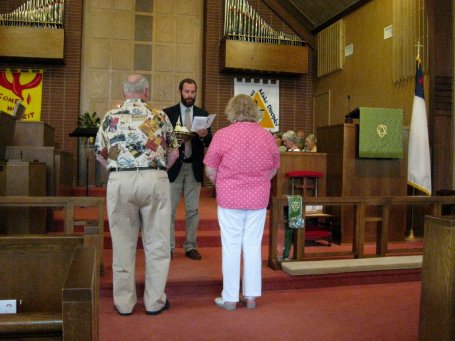
On one particular Sunday morning, toward the end of my time at the church, they were going to have their first baptism in a long time. A member of the church’s grandson was visiting and they all thought it was the right time and the right place to have him baptized. The excitement in the congregation that morning buzzed through the pews. This was what the church was all about: Welcoming visitors with signs of affection and love; returning to the great sacrament of baptism; and seeing young people standing near the altar.

The service built up toward the baptism at the end and the pastor invited the family to join him around the baptismal font. He spoke with conviction about how God had moved across the waters in creation to bring order out of chaos, he reminded us of the Israelites’ journey through the water on their way out of Egypt, and he even compared this sacrament to the baptism that John shared with his cousin Jesus at the Jordan River.

It was a holy moment seeing the congregation preparing for the baptism and a few of the older members were doing their best to cover up the tears that were slowly falling down their faces.

The pastor then motioned for the baby. He held the young boy with one hand, took of the top off the font with the other, and his eyes went wide. The beautifully and intricately carved baptismal font was empty; there was no water for the baptism.

The pastor looked up from the font and we locked eyes in the middle of the sanctuary. Without being told what needed to be done, I jumped up from my spot and ran to the kitchen. I frantically searched for any vessel that could hold water and settled on an old and chipped coffee mug. Using the sink, I filled the cup to the brim and then ran back to the sanctuary spilling a fair amount of water on the way.

While I stood in front of the congregation, I tried to make it look as liturgically appropriate as possible as I poured the water into the font, and the baptism went on as planned.

Bryson City UMC

Bryson City UMC

The beginning of the Good News of Jesus Christ. John was preaching and proclaiming in the wilderness when Jesus arrived to be baptized. This important and sacred event revealed the voice of the Lord identifying Jesus as the Beloved, while also setting in motion Jesus’ earthly ministry.

Jesus, as the Son of God, did not need to be baptized to be cleansed from his sins, but in going down to the water with the masses, he demonstrated his willingness to identify with sinful people. Jesus believed in doing ministry with others, rather than for others. In this scene we see God, in Christ, starting to bridge the great chasm between the earthly and the divine to inaugurate a new reality.

Yet, just as the baptismal scene comes to its conclusion, the Spirit of the Lord drives Jesus out to the wilderness where Satan tempted him for forty days.

During this time Jesus fasted from food and spent most of his time in prayer, though Satan was not inclined to leave him alone. He tempted Jesus with bread, with praise, and power. And Jesus remained steadfast; he resisted the temptations, and came out on the other side of the forty days strengthened and ready to begin his public ministry.

Again, in the temptations, we see Jesus’ willingness to identify with sinful people. All of us have moments where we wrestle with the devil.

We might feel helpless to resist the call of abundant and unhealthy foods. While countless people die of starvation everyday, few of us actively work to end hunger in the world.

We might feel helpless to the temptation of empty relationships and abusive power dynamics. We settle for the easy route so long as it benefits us completely, and few of us live selflessly instead of selfishly.

We might feel helpless to resist the urge to spend money on lottery tickets, or we cheat on our taxes, or we pretend to be something we’re not in order to further our quest for financial gain.

All of us are tempted one way or another. But chief among our temptations, is the temptation to forget what it means to be baptized.

In the small church in the Great Smokey Mountains, they had lost sight of the value of baptism; it had been so long since anyone was baptized that the font was empty and held no water! When we let the wells of baptism run dry in our churches and in our souls, we forget who we are and whose we are. When the identity we receive in baptism is forgotten, we quickly fall prey to the devil’s many temptations.

Baptism is a defining act. Through the sacrament of baptism God claims us, we are anointed with the Spirit, and we are set aside for God’s purposes. During baptisms in worship, the entire congregation makes a public commitment and covenant to raise the baptized person in the faith and become a new family. In baptism we receive the power of God’s Spirit to resist temptations through unending grace.

But when we forget who we are, when we forget how far God was willing to go for our sakes, our baptismal identity fades from our minds and is replaced with insatiable desires and temptations.

On Wednesday, many of us were reminded of our baptismal identities while ashes in the sign of the cross were marked on our foreheads. Wherever we went on Wednesday we were met with strange looks regarding the smudges on our skin, and whenever we glanced at our appearance in the mirror, we came face to face with our baptismal identities. But if you take a quick glance around the congregation, you will notice that all of the ashes have faded away.

Like empty baptismal fonts, and clear foreheads, we can fall to the temptation of forgetting who we really are.

In a few minutes all of us will be invited to remember our baptisms. We will use similar words just like the ones that have been used for centuries, we will pray over the water, and we will ask God to give us the strength to remember who we are each and every day. Whether we can vividly remember the moment we felt the water on our skin long ago, or it was done to us while we were babies, we will take time to give thanks for the people who surrounded us in those moments. We will give thanks for the congregations that promised to raise us in the faith, and do the same for others.

modern-artwork

But just in case this baptismal remembrance is not enough, we are going to take it one step further. After I take water and mark your forehead with the sign of the cross, you will receive a little plastic card with these words: “Lord, as I was my hands, I remember my baptism. Cleanse me by your grace. Fill me with your Spirit. Renew my soul. Amen.” Our challenge is to take these cards and place them near a sink in our homes. That way, whenever we go to wash our hands we can offer this prayer to God and remember who we are. That way, the baptismal font of our souls will never run dry. That way, we can resist the temptation to forget our baptisms.

Remember your baptism and resist temptation. Remember your baptism and receive strength. Remember your baptism and be thankful. Amen.

Return to the Lord – Ash Wednesday Homily

Joel 2.12-17

Yet even now, says the Lord, return to me with all your heart, with fasting, with weeping, and with mourning; rend your hearts and not your clothing. Return to the Lord, your God, for he is gracious and merciful, slow to anger, and abounding in steadfast love, and relents from punishing. Who knows whether he will not turn and relent, and leave a blessing behind him, a grain offering and a drink offering for the Lord, your God? Blow the trumpet in Zion; sanctify a fast; call a solemn assembly; gather the people. Sanctify the congregation; assemble the aged; gather the children, even infants at the breast. Let the bridegroom leave his room, and the bride her canopy. Between the vestibule and the altar let the priests, the ministers of the Lord, weep. Let them say, “Spare your people, O Lord, and do not make your heritage a mockery, a byword among the nations. Why should it be said among the people, ‘Where is their God?’”

Ash_Wednesday (1)


While I was growing up, I remember being jealous off all the Christians with ashes on their foreheads every year. I grew up in a church that did not celebrate Ash Wednesday and so it always came as sort of a shock when I would get to school on a Wednesday morning and a whole bunch of people were walking around with smudges on their skin. Part of my jealously stemmed from the fact that they were excused from being on time in the morning and got to miss part of a class. But the depth of my envy came from the fact that they stood out for what they believed.

Of course, at the time, I had no idea what the crosses stood for or why they used ashes, I just thought they looked cool. I can vividly recall the feeling of spiritual inadequacy I experienced because I felt like, even though I went to church every week, I would never compare with the Ash Wednesday Christians. For years I witnessed their piety and was jealous.

When I finally got to an age and a church that celebrated Ash Wednesday, and I sat down in front of a pastor like all of you are doing right now, I was shocked by the words I heard: “You are dust, and to dust you shall return.

12711025_10205393920598457_5324242656613500482_o

For centuries Christians like you and I have gathered to mark the beginning of Lent with this solemn and holy service. Lent is a season set apart for renewal and repentance. Lent is a time for us to confront our brokenness. Lent is a time to give thanks for our blessings and stop taking them for granted.

These ashes convey our willingness to confront mortality. We hear, “You are dust, and to dust you shall return” as a reminder that the bell will toll for us all. This moment is a public witness to our need to return to the Lord.

The prophet Joel describes our need for repentance and renewal through the voice of the Lord: “Return to me with all your heart, with fasting, with weeping, and with mourning. Return to me, for I am gracious and merciful, slow to anger, and abounding in steadfast love.”

We know not when our days will end, and because of this we need to embrace each and every day for the gift that it is. I’m not saying we should spend the next 40 days contemplating death every single moment, but instead this season should be a time filled with gratitude for all of our blessings.

Ashes are a reminder for all of us, young and old alike, that life is precious. Because when we hear the words, and when we feel ashes crossed against our foreheads, we confront our limited time on earth. These ashes should prevent us from moving through each day without reflection, they should caution us against rehashing the old arguments and frustrations, they should shock us into giving thanks right here and right now.

God encourages us to use this season, a time that begins right now, as an opportunity to return to the Lord with our hearts, with outwards signs like fasting, praying, and reading. Take this time and embrace the gift that it is by doing things like reconcile with people that you have been arguing with, open up your bibles and discover the richness of God’s Word, and resist the temptation to believe that you are invincible.

I’ve been a pastor long enough now to have placed ashes on individual’s foreheads and then eventually place dirt on their coffins as they are lowered into the ground. I have stood in this sanctuary and made the sign of the cross with ashes on people who have returned to the dust from whence they came. So take this sign, take these ashes, and make good with the life you’ve been given. Stop taking your blessings for granted. Love one another. Give thanks for what you have. And return to the Lord. Amen.


Devotional – Matthew 6.1

Devotional

Matthew 6.1

Beware of practicing your piety before others in order to be seen by them; for then you have no reward from your Father in heaven.
Weekly Devotional Image

When I was in seminary we called the season of Lent, “The Spiritual Olympics.” For those of us enrolled in higher theological education, we loved competing with our peers regarding our public piety during a season of fasting. Whereas many Christians rightly use the season of Lent to return to God’s way by confronting their finitude, we used the season to show off how holy we thought we were.

It was not uncommon to hear subtle brags throughout the hallways of our esteemed institution: “This year I’m going to give up sweets…” “Sweets? That’s easy! I’m going to give up meat in order to honor the glory of God’s creation…” “Meat? Give me a real challenge! I’m giving up television so that my focus can remain of the Word of God…” And I was there in the thick of it, offering up my own sacrifices to demonstrate my piety for anyone with eyes to see, and ears to hear.

What made the Lenten season so ridiculous was the fact that everyone knew what everyone else was giving up because it became the forefront of our conversations. In those moments of “Spiritual Olympics” we wanted everyone to know how pious we thought we were, and we had lost contact with Jesus’ words to his disciples: “Beware of practicing your piety before others in order to be seen by them; for then you have no reward from your Father in heaven.” It was frightening how easy it was for us to turn the gospel around to be more about our own selfishness than the good news of Jesus Christ.

Beware

Resisting temptation is a powerful practice during the season of Lent. When we take the time and energy away from bad habits and give that time back to God, it gives glory to the Lord. But if we take this season as an opportunity to flaunt our piety, it bears no fruit.

This Lent let us challenge ourselves to engage in acts of piety. Perhaps we know of something in our lives that we need to give up this season, a distraction away from recognizing God’s grace in our midst. Maybe we know of a practice that we need to add into our daily rhythms like prayer or bible study. But instead of sharing what we are giving up, or adding, with everyone around us, instead of making this vulnerable season in the life of the church into “Spiritual Olympics,” let us keep our piety to ourselves.

If we can keep our piety in check, which is to say if we can be pious for God’s sake and not our own, we will begin walking down the path that Jesus’ prepared for us.