Authorized for What? – Sermon on Matthew 21.23-32

Matthew 21.23-32

When he entered the temple, the chief priests and the elders of the people came to him as he was teaching, and said, “By what authority are you doing these things, and who gave you this authority?” Jesus said to them, “I will also ask you one question; if you tell me the answer, then I will also tell you by what authority I do these things. Did the baptism of John come from heaven, or was it of human origin?” And they argued with one another, “If we say, ‘From heaven,’ he will say to us, ‘Why then did you not believe him?’ But if we say, ‘Of human origin,’ we are afraid of the crowd; for all regard John as a prophet.” So they answered Jesus, “We do not know.” And he said to the, “Neither will I tell you by what authority I am doing these things. “What do you think? A man had two sons; he went to the first and said, ‘Son, go and work in the vineyard today.’ He answered, ‘I will not’; but later he changed his mind and went. The father went to the second and said the same; and he answered, ‘I go, sir’; but he did not go. Which of the two did the will of his father?” They said, “The first.” Jesus said to them, “Truly I tell you, the tax collectors and the prostitutes are going into the kingdom of God ahead of you. For John came to you in the way of righteousness and you did not believe him, but the tax collectors and the prostitutes believed him; and even after you saw it, you did not change your minds and believe him.”

446190966_640

Jesus does what Jesus wants. He has gone all over Galilee proclaiming the Good News, bringing sight to the blind, and healing to the sick. He has fed the multitudes miraculously, walked on water, and calmed the storm. He entered the holy city of Jerusalem on the back of a derelict donkey, charged into the temple and drove out the money-lenders while overturning the tables. Radical and revolutionary, Jesus does what he wants, and now the chief priests and the elders want to stop him in his tracks.

“Who in the world do you think you are? Who gave you the authority to do these things?” Of course, “these things,” refer to him cleansing the temple, curing the blind and lame, feeding the hungry, providing for the poor, listening to the weak, and giving hope to the hopeless. The question has been posed to Jesus before, but never has the question been more ominous; Jesus is in enemy territory and those asking the question will constitute the court that will later sentence him to death by crucifixion.

What gives you the right to come in here and tell us how we are supposed to understand the world?” They do not really want an answer to their question. Instead, they are seeking an opportunity to trap Jesus by means of his response. So Jesus does what he wants: He ignores their question for the moment and proposes a counter-question that they too cannot answer without getting in trouble.

“I will ask you a question; if you tell me the answer, then I will also tell you by what authority I do these things. Did the baptism of John come from heaven, or was it of human origin?” The chief priests and the elders argue among themselves about how they can answer. This is a classic Catch-22; “If we say his baptism was from heaven then Jesus will ask why we did not believe him and have him beheaded, and if we say it was an earthly thing the crowds will revolt against us because they all regard John as a prophet.” Caught in a dilemma of their own making, they recognize that there is no way they can answer the question without putting themselves in a worse position, so they answer with the answer that students have relied on for centuries, “We do not know.”

I imagine then, that Jesus smiled while saying, “neither will I tell you by what authority I am doing these things.”

Rev. Dr. Warren Smith

Rev. Dr. Warren Smith

When I was in seminary a professor named Warren Smith led my class through the great wonders of Church History. We studied some of the greatest theologians and mapped the various trajectories of theological positions that have brought our church through the centuries. After a semester of heavy reading and writing, Dr. Smith ended his final lecture with a story…

When he was a young pastor he was appointed to a church fresh out of seminary and did his best to proclaim the Word, serve those in need, and live into God’s kingdom on earth. For months the church listened deeply to his sermons and prayers, and grew in their love of God and neighbor. However, there was one older woman who never spoke to Dr. Smith after worship. She would sit patiently in her pew, unaffected by his words and gestures, and would return to the parking lot without saying a word to the young pastor. That was the typical routine until one Sunday she made her way in the receiving line following church.

Who do you think you are?” she began. “To come into this church and tell us how to live our lives. I have been a Christian longer than you have been alive. What could you possibly teach me about what it means to follow Christ?” And with that, she left.

Her words struck deep in Dr. Smith’s soul. Was she right? What could he possibly teach someone who had been following the Lord for decades when he had just graduated from seminary? Dr. Smith however, is not one to go gently into the night.

The following Sunday, Dr. Smith made his way to the pulpit and began to preach with words that resonated throughout the sanctuary: “I know I may look young from this pulpit. I know that some of you might be concerned with my ability to preach and teach in this church considering my age. But when I stand in this pulpit I AM 4,000 YEARS OLD. I speak with the great cloud of witnesses that have gone before me. I am equipped by the Holy Spirit to proclaim the Good News of Christ because the Lord is with me even to the end of the age.”

“So too,” he said to my class, “remember that you have been authorized to do incredible things and you are older than you think.”

When Dr. Smith’s authority was challenged he responded by recalling the great tradition of the living Word that is brought forth into new life on a regular basis. He looked back in order to look forward. He validated his responsibility by acknowledging his earthly youth while at the same time affirming his divine wisdom through the Holy Spirit.

When Jesus’ authority was challenged by the chief priests and the elders he responded with an unanswerable question, and then with a parable. The parable becomes the lens by which they can see their error and envision a proper understanding of God’s reign in the world.

What do you think? There was a man with two sons. He went to the first and asked him to work in the vineyard. The first son refuses, but later he changed his mind and went to work in the field. The father went to the second son and asked him to work in the field as well. The second son agrees to work, but never went to the vineyard. Which of these two sons did the will of his father?

The chief priests and elders respond in unison, “the first.” It is obvious that even though the son refused to work, the fact that he did, in the end, is far better than the son who agrees to work and never enters the vineyard. Jesus then uses the parable to draw the unmistakable conclusion that they, the chief priests and elders, are the second son who has failed to do the father’s will. “The tax collectors and the prostitutes are going into the kingdom of God ahead of you. John came in the way of righteousness and you did not believe him, but they did. Even after you saw what he did, you did not change your minds and believe. You preach and preach, but you never practice the words you proclaim.

Jesus responding with a parable is typical of the gospels, and helpful for bringing about new understanding. He uses a story in order to open up the kingdom of God to show that it works in a way that is approachable and livable.

What do you think of the parable? In your faith journey do you feel like the first brother? Was there a time that you rejected the calling of God on your life, refused to believe, only to find yourself caught up in the grace of God and working in the vineyard of the kingdom? Is your faith vibrantly alive and fruitful?

Or do you feel like the second brother? Was there a time that your faith was so alive that you were willing to say “yes yes” to God’s call on your life only to find yourself apathetic to the work of the church in the kingdom? Is your faith stagnant and fruitless?

use-me

Individually, we can respond to God’s call in faithful ways by reaching out to others in our community and letting God’s love abound in their lives through our actions. But collectively, as a church, it can be quite difficult to be Christ’s body for the world.

This week I met with a handful of other Methodist clergy from the valley and we discussed our local churches, some of the challenges facing our congregations, and the fruit that has come forth during our time of service. We talked about new ministry ideas that might help share the Good News with people in our communities while also affirming the many challenges of being the church for the world today. But, to be honest, most of the conversation was a time for the leaders to complain about the lack of enthusiasm in their churches, their inability to see the call of the church and the mission of God in the world. At one point a friend of mine shook his head and said softly, “It can be so depressing to hear that most of our churches are far more concerned with maintenance, than mission.

One of the hardest things to admit, as a church, is that we are more often like that second son than the first. After all, here we are sitting in the vineyard, preparing to go out to harvest the grapes. But as Christians, we can become blind to what God is doing in the world around us. How sad is it that “church work” can quickly degenerate into conversations about maintaining our building, with no excitement about what God’s living Word and grace are doing in our community? How sad is it that the majority of our conversations and budget are focused on making sure that the church will still be here next Sunday instead of focusing on the renewal of the church and the formation of disciples of Jesus Christ for the transformation of the world? Like the second brother we say that we are going to work in the vineyard, but instead of harvesting grapes we spend our time rearranging the stones along the path. 

I’ll admit that our church is changing, we are slowly moving away from the maintenance model and are becoming lively and excited about the ways we can be Christ’s body for the world. We are no longer content with just being a building where people can sit together on a Sunday morning. A church is not a building. A church is the work of the people for the vineyard, for the kingdom.

Jesus was authorized by his father in heaven to do the will of God on earth. To overturn the tables in the temple, to call out the leaders of the people for their hypocrisy and limited vision, to seek out the last, least, and lost, to bring them a sense of wholeness, to feed the hungry, to clothe the naked, to make disciples.

In the same way, Christ has authorized us to be his body for the kingdom of God. Today we have the remarkable responsibility of acting like God’s son, and the first son from the parable; even when we doubt our responsibility to the mission of God we are needed in the vineyard.

What are we doing as a church? Are we giving our tithes and offerings to God so that the church will stay open, so that we can hear an articulate and thoughtful 15 minute sermon every week. Are we content with letting our discipleship look like maintenance?

What are we doing as Christians? Are we radical people who believe that God continues to do amazing things in the world? Do we hope and pray for God’s will to really be done here on earth among us?

We have been authorized to do great and wonderful things in the world. Let us remember and believe that the Lord will provide, that nothing will ever separate us from God’s love, and that we have been called to work in the vineyard.

Amen.

Interrupted Salvation – Sermon on Mark 5.21-43

Mark 5.21-43

When Jesus had crossed again in the boat to the other side, a great crowd gathered around him; and he was by the sea. Then one of the leaders of the synagogue named Jairus came and, when he saw him, fell at his feet and begged him repeatedly, “My little daughter is at the point of death. Come and lay your hands on her, so that she may be made well, and live.” So he went with him. And a large crowd followed him and pressed in on him. Now there was a women who had been suffering from hemorrhages for twelve years. She had endured much under many physicians, and had spent all that she had; and she was no better, but rather grew worse. She had heard about Jesus, and came up behind him in the crowd and touched his cloak, for she said, “If I but touch his clothes, I will be made well.” Immediately her hemorrhage stopped; and she felt in her body that she was healed of her disease. Immediately aware that power had gone forth from him, Jesus turned about in the crowd and said, “Who touched my clothes?” And his disciples said to him, “You see the crowd pressing in on you; how can you say, ‘Who touched me?’” He looked all around to see who had done it. But the woman, knowing what had happened to her, came in fear and trembling, fell down before him, and told him the whole truth. He said to her, “Daughter, your faith has made you well; go in peace, and be healed of your disease.” While he was still speaking, some people came from the leader’s house to say, “Your daughter is dead. Why trouble the teacher any further?” But overhearing what they said, Jesus said to the leader of the synagogue, “Do not fear, only believe.” He allowed no one to follow him except Peter, James, and John, the brother of James. When they came to the house of the leader of the synagogue, he saw a commotion, people weeping and wailing loudly. When he had entered, he said to them, “Why do you make a commotion and weep? The child is not dead but sleeping.” And they laughed at him. Then he put them all outside, and took the child’s father and mother and those who were with him, and went in where the child was. He took her by the hand and said to her, “Talitha cum,” which means, “Little girl, get up!” And immediately the girl got up and began to walk about (she was twelve years of age). At this they were overcome with amazement. He strictly ordered them that no one should know this, and told them to give her something to eat.

hemorrhagingwoman 6-26-12

This Sunday marks the conclusion of our sermon series on Women of Faith. Over the last few weeks we have focused on women from the Old Testament who lived our their faith in such a way that it continues to speak to us in our faith journeys. The point has been to explore some of the great females from scripture, particularly those who are not regularly mentioned from the pulpit. We began by looking at Rahab the harlot before the fall of Jericho and talked about how our pasts do not define our lives. Last week we looked at Deborah and Jael from Judges and talked about how women are powerful and being faithful is complicated. Today we conclude by looking at the unnamed hemorrhaging woman from Mark 5. So, here we are, may God bless out time together as we look at one more woman with profound faith.

The loneliness is getting unbearable. She lives in Staunton, has a full time job, while also maintaining the aspects of home life. Her husband largely ignores her, never asks about her day, and expects dinner and the laundry to have been taken care of by the time he gets home. The children are involved in such a high number of activities throughout town that she can barely keep track of who is supposed to be where and when. Though she won’t admit it to anyone, her life feels empty, as if its being drained from her slowly and decisively.

Twice a day she finds herself driving up and down Augusta street and whenever she passes St. John’s she struggles to keep her eyes glued ahead. She has admired the witty marquee in the past, and she feels something drawing her to the building, but church is the last thing she wants in her life.

For months this goes on, and every time she passes she catches herself glancing more and more at our building. She sees the children during preschool walking on the front lawn looking for insects and leaves for projects, she observes the Christmas tree sales with families giggling as they explore the various options, she witnesses a number of older adults laughing manically as they fall down the 18 ft. inflatable slide during the Community Cook-Out. On certain Sundays she finds herself getting in the car and driving to the parking lot but she never leaves the vehicle; she can’t explain why she’s here and she’s too afraid to come inside.

One morning, when the emptiness and loneliness has become so frighteningly palpable she drives to St. John’s on a typical Sunday and bravely makes her way from the car to the sanctuary. She hopes against hope that something incredible can happen here.

But we’re in the middle of something else, worship has already started and I’m up here in the pulpit going on and on about the grace of God, or the service has yet to start but most of us are greeting our friends and asking them about their weekends, or worship is already over but most of us are solidifying plans for lunch. We might not even notice the woman who risked it all to be here with us.

—————————

Jesus was beckoned by Jairus, the leader of the synagogue, to come and heal his daughter. “Please Lord. My little daughter is at the point of death. Come and lay your hands on her, so that she may be made well and live.” So Jesus, doing his Jesus thing, went with Jairus to heal his daughter. Like worship on a Sunday morning, Jesus going to heal someone is typical and part of his routine. He is prepared to meet the young girl and heal her as he has done so many times before.

However, on the way to Jairus’ house a strange thing happens. A woman who had been suffering from hemorrhages for twelve years, who had been isolated from her family and community, sees the Messiah that she had heard so much about. Building up her courage she stepped forward, reached out her hand and touched his clothes, hoping that it would cure her. And immediately she felt in her body that she had been healed. But Jesus will not leave it at that; feeling the power go out from him he turns to the crowd and demands to know who touched his clothes. With fear and trembling the woman stepped forward and told Christ the whole truth, and he responded by saying “Daughter, your faith has made you well; go in peace, and be healed of your disease.”

healing-of-the-woman-thumb-300x3861

Jesus was interrupted on his journey to heal Jairus’ daughter by a hemorrhaging woman, and in so doing the young girl died at home. He took too much time with the other woman’s problems, and now an innocent girl has passed away when Jesus could have done something about it.

—————————

The woman sits in one of the pews of our church alone and afraid to speak to anyone. She has never been in a church before and so much of what we are doing is strange and bizarre to her. She is thankful for the bulletin directing her to the hymnal with tunes she has never heard, and prayers that she has never uttered. Most of it means nothing to her but she continues to worship with the hope that something will help. 

Our service ends and she follows the people around her as they file out toward the back of the sanctuary. She keeps her head low and whispers thank you as I shake her hand, I thank her for being with us today, and she walks out, perhaps never to return again. She came looking for something life-changing, hoping for something to heal her and make her well, and all she got was a strange youth message, a mediocre sermon, and more loneliness.

—————————

When Jesus arrived at Jairus’ house, even with the young girl dead, Jesus comforts the father, “Do not fear, only believe. Your daughter is not dead but sleeping.” And the people in the house laughed at him, but he put them all outside and took Jairus and the child’s mother and went to the girl. He took her by the hand and said to her, “Little girl, get up!” and she immediately got up and began to walk around, hungry for something to eat.

Jesus allowed the interruption in the street by the unnamed woman knowing that he would be able to still make it to Jairus’ house and bring about the healing and salvation that was needed. He might have been content with merely allowing her to touch his clothing and be healed but he took the extra time for personal touch and contact.

—————————

When the woman comes to St. John’s we could happy with letting her experience worship on her own, free to return to the life of loneliness and emptiness, but if we are to act like Christ we have to go one step farther. The terrible disease of loneliness is something that we have the power to fight against, we just have to be open to interrupted salvation.

Mark 5 is an incredible reminder for all of us, for the teachers who are so often interrupted by students, parents harried by the demands of their children, and even preachers that are stopped while working on a sermon, that interruptions are important. Someone once said, “You know… my whole life I have been complaining that my work was constantly interrupted, until I discovered that my interruptions were my work.

I was having lunch on Thursday with a clergy friend, talking about the ways that we are trying to serve our churches, when a man casually mentioned something about his cancer and we invited him to join us for lunch. He interrupted our conversation to share with us his struggles and fears. I was preparing for worship two weeks ago, running around the building just trying to make sure that everything would be ready, when Steve Wisely scared me half to death. He interrupted me in the midst of my work to tell me that his father, Russ, was dying. Every Sunday I stand at the back of the church, thanking all of you for being with us in worship when I am often dealt a hard and frightening truth about someone’s struggles, I am interrupted while doing my job with a difficult diagnosis, a struggling marriage, or a lonely woman.

What do we do with our interruptions? When the stranger arrives at church, sitting alone in the pew near us while we are in the middle of a conversation, how do we respond? Are we content with introducing ourselves, shaking hands, and then going back to our routine, or do we act like Christ and take the extra step to offer them not only a smile, but wholeness? When your child struggles with a decision in their life, do you offer a few bits of wisdom, or do you drop what you are doing to demonstrate that you deeply love them? Do you see interruptions as interruptions, or do you see them as opportunities for salvation?

That woman with the hemorrhage has more faith than I’ll ever have. She, in the deep recesses of fear and disappointment, reached out to the Lord with the hope of receiving something so improbable, that we would mock it today. Her faith is so real and palpable because she lived it out, she took those frightening steps to the Lord and believed that he could do something incredible with, through, and for her.

That unnamed woman who arrives at our church and sits in her car unsure of whether to enter has more faith than I’ll ever have. Though deeply rooted in the fear of her own loneliness and emptiness, she bravely enters the church with the hope that the Lord, with the people inside, can do something so improbable that we often ignore it. Her faith is so real and palpable because she lives it out, she takes those humbling steps to the sanctuary and believes that the God of Christ can do something incredible through us for her.

Showing up to church is wonderful. When it becomes part of the routine of life it begins to habituate us toward a new understanding of discipleship where we can truly act as Christians without having to overthink what we are doing.

But believing that God can actually do something for you, that the church can bring about a sense of salvation in your life is what faith is really all about. 

The woman walks out the main doors and makes her way toward the parking lot. Frustrated by her foolishness in believing that the church could actually change anything about her circumstances she is surprised when she hears a person hurrying up behind her. Someone from St. John’s, one of you, tries to catch up with her to apologize for not introducing yourself earlier. You tell her that you saw her sitting by herself and you felt God pushing you to do something more and you ask if she would like to get a cup of coffee sometime this week, just so that you can get to know her better. “I would love that” she says with a shy smile.

The final few steps to her car are filled with the brightness of hope, something she has not experienced for a long time. Still smiling from the invitation she hears a soft voice, as light as the wind, “Daughter, your faith has made you well.

Amen.

Devotional – Matthew 18.21-22

Devotional:

Matthew 18.21-22

Then Peter came and said to him, “Lord, if another member of the church sins against me, how often should I forgive? As many as seven times?” Jesus said to him, “Not seven times, but, I tell you, seventy-seven times.

Weekly Devotional Image

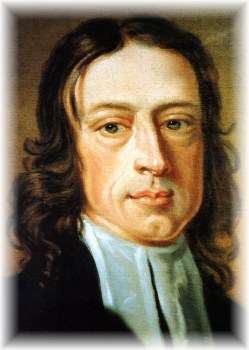
In October of 1735 John Wesley and his brother Charles left England and sailed to Savannah, Georgia where John would be the minister in the newly formed Savannah parish. Part of his religious upbringing had already instilled a desire for holiness of heart and life and Wesley believed that his new appointment provided a wonderful opportunity to hone his craft and enrich his faith. During his time serving as the pastor attendance at the church services steadily increased though he was disappointed by the lack of lived-out faith outside of worship.

John Wesley

John Wesley

Even with the growth in worship, many in the community disliked Wesley’s high church background and it proved to be a continual element of controversy. During this same time Wesley began to fall in love with the young and beautiful Sophia Hopkey. They courted for a period of time but after a brief visit to preach the Good News to the local Native Americans, Wesley was remarkably disappointed to discover that Sophia had married William Williamson. Wesley was devastated by the news and took out his frustration in a rather inappropriate way; he denied Sophia communion during church services.

Wesley, of course, had “reasons” to justify his actions (he believed that her zeal for living out her Christian faith had declined and he followed the guidelines from the Book of Common Prayer in prohibiting her sacramental participation) but he was also fueled by his heartache and anger in withholding the bread and wine. It quickly became quite the controversy and legal action was taken against Wesley eventually leading to him fleeing the colony and returning to England.

One of the highest, and most difficult, callings of Christian disciples is to forgive. When confronted with the question of forgiveness in the community Peter ventured forth the idea of forgiving someone seven times when Christ augmented the proposal to seventy-seven or seventy times seven times. Forgiveness, it would seem, is not something to be measured and checked off the list, but instead something that is deeply entrenched within the life of the community. Wesley let his personal feelings get the better of him, and he foolishly barred a young woman from Christ’s table. Christians, both clergy and lay, are called to the difficult task of everlasting forgiveness, even when it hurts.

Is there someone that you are still holding a grudge against? Who do you need to forgive in your life?

Divine Irony – Sermon on Exodus 2.1-10

Exodus 2.1-10

Now a man from the house of Levi went and married a Levite woman. The woman conceived and bore a son; and when she saw that he was a fine baby, she hid him three months. When she could hide him no longer she got a papyrus basket for him, and plastered it with bitumen and pitch; and she put the child in it and placed it among the reeds on the bank of the river. His sister stood at a distance, to see what would happened to him. The daughter of Pharaoh came down to bathe at the river, while her attendants walked beside the river. She saw the basket among the reeds and sent her maid to bring it. When she opened it, she saw the child. He was crying, and she took pity on him. “This must be one of the Hebrews’ children,” she said. Then his sister said to Pharaoh’s daughter, “Shall I go and get a nurse from the Hebrew women to nurse the child for you?” Pharaoh’s daughter said to her, “Yes.” So the girl went and called the child’s mother. Pharaoh’s daughter said to her, “Take this child and nurse it for me, and I will give you your wages.” So the woman took the child and nursed it. When the child grew up, she brought him to Pharaoh’s daughter, and she took him as her son. She named him Moses, “because,” she said, “I drew him out of the water.”

newjudaicia4

Can you imagine what was going through the mother’s mind when she placed her little son in the papyrus basket? Can you see her tears flowing down on to the boy who would change the course of history because she was forbidden to let him live?

Everything had changed in Egypt. Joseph had been sold into slavery but saved the Egyptian people by storing up food for the coming famine. He was widely respected and his people were held in safety because of his actions. But eventually a new king arose over Egypt and he did not know Joseph. He feared the Israelites, their power, and their numbers.

The Israelites quickly went from being a powerful force within another nation, to a group of subjugated slaves who feared for their lives. They were forced to work in hard service in every kind of field labor, they were oppressed and belittled, and their family lives were slowly brought into jeopardy. Pharaoh commanded the Hebrew midwives to kill all the males born to Hebrew women, but when they resisted, he changed the decree so that “every boy that is born to the Hebrews shall be thrown into the Nile, but every girl shall live.

Once a prosperous and faithful people, the Israelites had lost everything. Yet, even in the times of greatest distress, people continue to live and press forward… A Levite man married a Levite woman and she conceived and bore a son. When he was born and she saw that he was good, she kept him hidden for three months. But a time came when she could no longer hide the child and she found herself making a basket to send her baby boy into the Nile.

Kneeling on the banks of the river, she kissed her son goodbye, placed him in the crude basket, and released him to the unknown. The boy’s sister, who was allowed to live in this new regime, sat along the dunes and watched her baby brother float down the river toward where a group of women we beginning to gather.

Exodus-Chapter-2-The-Child-Moses-on-the-Nile

Pharaoh’s daughter saw the basket among the reeds, and when she opened it she saw the boy, and took pity on him. She recognized that he was one of the Hebrew boys but she was compelled to be compassionate toward him. The sister, with a stroke of genius, realized that she had the opportunity to save her brother and stepped forward from her hiding place to address the princess. “Shall I go and find a nurse from the Hebrew woman to nurse the child for you?” Pharaoh’s daughter said to the young slave, “Yes.” So the girl went and found her mother, the mother of the child she had just released into the Nile, and brought her to the princess. Pharaoh’s daughter charged her, “Take this child and nurse it for me, and I will give you your wages for doing so.” So the mother received back her own son and nursed him. However, when the child grew up, she brought him back to Pharaoh’s daughter, and she adopted him as her son, and she called him Moses because “I drew him out of the water.”

This story about the birth and the childhood of Moses is one of the most familiar texts from the Old Testament. It has just the right amount of suspense, intrigue, serendipity, divine irony, human compassion, intervention, and it concludes with a happy ending. Moses’ birth has captivated faithful people for millennia and offers hope even amidst the most hopeless situations.

One of the greatest pastors I have ever known serves a new congregation in Northern Virginia. Jason Micheli has inspired countless Christians to envision a new life of faithfulness previously undiscovered. He played a pivotal role in my call to ministry, we have traveled on countless mission trips together, he presided over Lindsey’s and my wedding, but above all he is my friend.

1934842_1140098793643_1336612_n

Jason and his wife Ali embody, for me, what a Christian relationship looks like. They support one another in their different ventures without overstepping their boundaries, they challenge each other to work for a better kingdom, and they believe in the Good News.

For a long time Jason and Ali knew that they wanted to adopt a child and they traveled to Guatemala when Gabriel was 15 months old to bring him home. As a young pastor and lawyer, Jason and Ali had busy schedules that were filled with numerous responsibilities that all dramatically changed the moment Gabriel entered their lives. They went from understanding and responding to the rhythms of one another to having a 15 month old living with them, a child who they were responsible for clothing, feeding, nurturing, and loving. I know that the first months must have been tough, but Ali and Jason are faithful people, they made mistakes and learned from them, they loved that precious child, and they continued to serve the needs of the community the entire time.

Jason and Gabriel

Jason and Gabriel

A year and a half later, just when the new patterns of life were finally becoming second nature, a lawyer who helped them find Gabriel contacted them. There was another family in the area who had adopted a 5 year old Guatemalan boy named Alexander, but they no longer wanted him. The lawyer recognized that Jason and Ali had recently adopted a child but wanted to find out if they would adopt another. However, the lawyer explained that this 5 year-old was supposedly very difficult, his adoptive family was ready to get rid of him, and he didn’t speak any English. Jason and Ali had a choice: lift this child out of the Nile, or let him continue to float down the river?

The story of Moses’ adoption by the Egyptian princess is filled with irony:

Pharaoh chose the Nile as the place where all Hebrew boys would be killed, and it became the means of salvation for the baby Moses.

The unnamed Levite mother saves her precious baby boy by doing precisely what Pharaoh commanded her to do.

The daughters of the Hebrews are allowed to live, and they are the one who subvert the plans of the mighty Pharaoh.

A member of the royal family, the Pharaoh’s daughter, ignores his policy, and saves the life of the one who will free the Hebrew people and destroy the Egyptian dynasty.

The Egyptian princess listens to the advice of the baby’s sister, a young slave girl.

The mother gets paid to do exactly what she wants to do most of all.

The princess gives the baby boy a name and in so doing says more than she could possibly know. Moses, the one who draws out, will draw God’s people out of slavery and lead them to the Promised Land.

Divine Irony! God loves to use the weak and the least to achieve greatness and change the world. God believes in using the low and despised to shame the strong and the powerful. God, in scripture and in life, works through people who have no obvious power and strengthens them with his grace.

How fitting that God’s plan for the future and the safety of the Hebrew children rests squarely on the shoulders of a helpless baby boy, a child placed in a basket, an infant released into the unknown. How fitting that God promised to make Abraham, a childless man with a barren wife, a father of more nations than stars in the sky? How fitting that God chose to deliver Noah from the flood on an ark, and young Moses from death in a basket floating on a river? God inverts the expectations of the world and brings about new life and new opportunities through the most unlikely of people and situations.

Jason and Ali prayed and prayed about the five-year old Guatemalan boy named Alexander. What would happen to them if they brought him into their lives? Everything was finally getting settled with Gabriel and they believed they had their lives figured out. They had planned everything perfectly, yet they we now being asked about bring a completely unknown, and perhaps devastating, element into their lives.

What would you have done? If you knew that there was a child, even with an unknown disposition, that was being abandoned by his adoptive family how would you react? Would you respond with open arms?

Alexander is now 11, soon to turn 12, and is without a doubt one of the most mature and incredible human beings I have ever met. After Jason and Ali met him for the first time they knew that God was calling them to bring him into their family, to love him with all that they had, and they responded like the faithful people they are, with open arms.

Jason, Ali, Alexander, and Gabriel

Jason, Ali, Alexander, and Gabriel

When Alexander arrived at Jason and Ali’s home, he came with the clothes on his back and nothing else. A five year old Guatemalan boy with little English was dropped off at their home; I can’t even imagine what it must have felt like for him. Yet, Jason and Ali brought him into their family and they never looked back. 

In the beginning, they had to sleep with him in his bed night after night, in attempts to comfort him and let him know that they were never going to leave him. That no matter what he did, no matter how far he fell, there was nothing that would ever separate their love for him. For a child that had been passed from person to family to family, Alexander had no roots, he had little comfort, and he had not experienced love.

Jason and Ali stepped into his life just as Alexander stepped into theirs. Perhaps filled with fear about what the future would hold for their little family Jason and Ali’s faithfulness shines brilliantly through the life of a young man named Alexander who I believe can, and will, change the world.

I imagine that for some time Jason and Ali believed that they, like Pharaoh’s daughter, had drawn Alexander out of the river of abandoned life. But I know that now when they look back, when they think about that fear of the unknown, they realize that Alexander was the one who drew them out of the water into new life. Divine Irony. 

In the story of Moses’ adoption out of the Nile, God is never mentioned. There are no divine moments when God appears on the clouds commanding his people to do something incredible, there are no decrees from a burning bush (not yet at least), and there are no examples of holy power coming from the heavens. Yet, God is the one working in and through the people to preserve Moses’ life and eventually the life of God’s people. God, like a divine conductor, orchestrates the music of life with changing movements and tempos that bring about transformation in the life of God’s people.

I believe that most of you, if not all of you, would take up a new and precious child into your lives. Whether you feel that you are too young, too old, too poor, too broken, you would accept that child into your family and raise it as your own. We are people of compassion, we are filled with such love that we can do incredible and beautiful things.

But it becomes that much harder when you look around and understand what we have become through baptism. Every child, youth, or adult, that it baptized into the body of Christ has been lifted out of the Nile of life into a new family. The people in the pews have truly become your brothers and sister in the faith through God’s powerful baptism. The Divine Irony is that we might feel we are called to save the people in church, when in fact they might be the ones called to save us. 

The story of Moses’ birth and childhood is beloved. It contains just enough power to elicit emotional responses from those of us lucky enough to know the narrative. It is a reminder of God’s grace and love through the powerful and the powerless. But above all it is a reminder that like a great and loving parent, Moses has been taken into the fold of God’s merciful love and grace. That we, through our baptisms and commitments to being disciples of Jesus Christ, have been brought out of the frightening waters of life into the adoptive love and care of God almighty. That we, though unsure of our future and plans, are known by the God of beginning and end.

Just as Jason and Ali held Alexander every evening, just as Pharaoh’s daughter cradled Moses in her arms, we have a God who loves us, who holds us close, and will never let us go. 

Amen.


Gabriel and Alexander in 2009

Gabriel and Alexander in 2009

Devotional – Romans 12.2

Devotional:

Romans 12.2

Do not be conformed to this world, but be transformed by the renewing of your minds, so that you may discern what is the will of God – what is good and acceptable and perfect.

Weekly Devotional Image

“Taylor,” he began, “I have been attending worship at United Methodists churches nearly every Sunday since I was a child and I have never heard anyone preach on the texts you chose this month.” We were sitting in the church social hall after worship yesterday afternoon when a member of our church made it known that he was still learning something new and church and growing in his discipleship. Georgeanna Driver, one of our members who passed away last week, made a similar comment two weeks ago about not knowing that story (Elisha and the she-bears) was even in the bible. It has been exciting and thrilling over the last three weeks to challenge peoples’ perspective on what the Word of the Lord can still speak into our lives today, even stories we might otherwise choose to ignore.

tumblr_mdhatd0Ybh1qhmhdfo1_500

When I was at Duke for seminary our Dean, Dr. Richard Hays, reminded us that the responsibility of the Christian is to be constantly transformed by the renewing of our minds. Etched in the marble archway leading into the chapel, Romans 12.2 is a relevant reminder for students of God’s Word but even more so for the people who have been called to follow Christ. In today’s world/society it is too easy to remain complacent with our understanding of faith and overreact when a new person/idea challenges our faith. In stark contrast Jesus was regularly pushing his disciples into new territory with understandings about the kingdom of God.

What we do as Christians is primarily about God, and only secondarily about us. We gather on Sunday’s to hear the Word of the Lord and then live it out in the world. Worship is that time that helps in the transformation and renewal of our minds so that we may discern God’s will for our lives, rather than be conformed to the ways of the world.

Outside of worship we can be transformed through the reading of scripture. Try opening your Bible to a book or a chapter you’ve never read (or haven’t read in a long time), read a set number of verses, and then pray over them. Ask yourself: what might God be saying to me through these words today?

The Word of God is alive and speaking anew everyday, we need only the faith to hear it and live it out.

Strange Stories from Scripture: Bored To Death (Almost) – Sermon on Acts 20.7-12

Acts 20.7-12

On the first day of the week, when we met to break bread, Paul was holding a discussion with them; since he intended to leave the next day, he continued speaking until midnight. There were many lamps in the room upstairs where we were meeting. A young man named Eutychus, who was sitting in the window, began to sink off into a deep sleep while Paul talked still longer. Overcome by sleep, he fell to the ground three floors below and was picked up dead. But Paul went down, and bending over him took him in his arms, and said, “Do not be alarmed, for his life is in him.” Then Paul went upstairs, and after he had broken bread and eaten, he continued to converse with them until dawn; then he left. Meanwhile they had taken the boy away alive and were not a little comforted.

SAMSUNG

This morning marks the beginning of our three part sermon series on Strange Stories from Scripture. Part of our series was born out of the immense treasure that is begging to be discovered from God’s Word in addition to the fact that it is too easy to fall into a rut with preaching the same and familiar texts over and over. Today we are talking about the fate of a young man who was bored to death (almost).


A young man named Eutychus, who was sitting in the window, began to sink off into a deep sleep while Paul talked longer. Overcome by sleep, he fell to the ground three floors below and was picked up dead.

When I have the opportunity to attend different church services, a very rare occurrence since becoming a pastor, I usually sit toward the front on the right hand side. I am of the persuasion that sitting toward the front helps the worshipper with their ability to participate fully in the service. Yet, I know that others have very different opinions on where they should sit for worship.

When I was in North Carolina, I worshipped for a long time at Duke Memorial United Methodist Church. I, like many of you, sat in nearly the exact same spot every Sunday. I grew accustomed to seeing the same heads in front of me, and the voices surrounding me during the hymns, to the degree that where I sat played a pivotal role in my worship experience. 

One Sunday morning I was surprised to discover a Duke undergraduate student sitting in my spot. I can vividly recall the wave of emotions I felt seeing someone encroaching on my sanctuary territory, but I eventually gave in and sat down next to the young man. He had all the markings of a polite and proper gentleman: his outfit had been perfectly ironed, not a wrinkle in sight, his hair was parted to the side, and he sat with precise posture. I attempted to introduce myself before the service started by I was interrupted by the beginning notes of the organ prelude.

As we made our way through the service, offering up our prayers to God, singing hymns, and reading scripture I took little notice of the young man to my left and genuinely enjoyed our morning service. However, about midway through the sermon I began to notice a sudden change in my neighbor’s disposition. Out of the corner of my eye I witnessed him participating in the age old “my-head-keeps-drooping-down-while-I’m-trying-to-stay-awake.

mr-bean-asleep

While our pastor weaved through the beauties of scripture, this young man was doing everything he could think of to stay awake: he scratched his eyes, stretched his back, and even slapped his own cheek. However, nothing was helping. His head would continue to fall down only to be slingshotted back into position every minute or so.

At this point I was so distracted by the young man that I became worried for him. What if the pastor notices him sleeping and calls him out during the sermon? What if he begins to snore and everyone starts to look at us? What if he actually fell asleep and his head crashed on the pew in front of us? So I did what any good Christian would do…

Hey bud,” I whispered while tapping on his shoulder. He quickly woke up and abruptly turned to stare at me. “If you put your hands like this (hands in the form of prayer) you can rest your head between them on the pew in front of us, you can catch some Zs and everyone will think you’re praying. If you start to snore I’ll nudge you.” With a smile he slapped me on the back and declared, a little too loudly, “thanks Bro!” and promptly fell back asleep.

Falling asleep in church can have dire consequences. What happened to Eutychus that night should be a fair warning for us about what happens when we fall asleep. Paul had come into town and would be leaving the next day. This night time gathering was the last and best opportunity for him to share the Word of the Lord with the people. It happened on the first day of the week, Sunday, when the people joined together to break bread.

This is the first reference to breaking bread as a community since the day of Pentecost in Acts 2; the budding Christian community has begun to sustain one another through the presence of God as experienced through the bread and the cup.

Paul had limited time to discuss the Good News with the church so he continued to speak until midnight. There were many lamps in the room upstairs helping to illuminate the space as Paul conveyed the depth and wonder of God with the people. A young man named Eutychus, which means “lucky,” was sitting in the window while Paul preached from the front of the room. Before too long his eyes began to feel heavy, the warmth of the lamps inviting him to rest his eyes, when he sank into a deep sleep as Paul continued to speak.

44_Ac_20_02_RG

Eutychus fell three stories from the window and was picked up dead. Paul immediately went down, bent over the young man and took him into his arms and said, “Do not be alarmed, for his life is in him.” And then Paul went back to the room upstairs and after breaking bread with his brothers and sisters, he continued to speak with them until dawn. Meanwhile the people had taken the boy away alive and were greatly comforted.

Oftentimes when we talk about the church during the time of Acts, and when we talk about our responsibility to be the church for the world, we compartmentalize the message of faith to going out of our comfort zones, opening our doors, and appealing to unbelievers. Yet this story is a sobering reminder that Christians are called to persevere through many trials, requiring the task of worship to comfort weary travelers on the journey of faith. Paul takes the time to gather with God’s people, break bread, proclaim the Word, and encourage them in faith.

Preaching is that opportunity to teach and enable disciples to discern between true and false gospels, authentic tradition, and how God’s Word continues to speak living and life-giving words into our lives today.

Even if we have the most wonderful and dedicated lives of service, we are weak without the revealed Word of God resonating deep into our souls. Watered-down, inarticulate and unexamined beliefs lead to weak disciples.

What do you want from a sermon?

preach-word

Do you want to be affirmed in your faith? Listen to words about scripture that leave you patting your back for having done a good job? Do you want to be challenged to live a better life through the proclamation of a sermon? What is it that you hope for from someone like me when I stand in the pulpit. Do you want to be kept awake? Do you want something to think about until next Sunday?

Preaching at its finest is, as Paul understood it, that remarkable time when God’s Word becomes incarnate again in our lives. We take the time to sit and listen to the incredible ways that God’s speech speaks something new and fresh in our lives. Preaching is about encouragement, challenge, love, hope, faith, recollection, and dedication. On that evening in Troas the preacher for the day went on a bit too long and it resulted in a young man falling to his apparent death from a window. What can I do to keep you awake to the faith that God has in you?

What do you want to discover in the breaking of bread?

Hands breaking open a baguette --- Image by © Beau Lark/Corbis

Paul was with the gathered church to proclaim the Word and break bread. When we gather together on the first Sunday of the month for communion, what do you want to find? Do you want to walk up to the front feeling unworthy of the gift with your head hung low? Are you hopeful for a feeling of complete joy as you dip the bread into the cup to partake in this heavenly meal?

Communion is that remarkable time when the divine and human come into contact. We come to the table to feast on Christ’s body and blood remembering what Christ did for us and for his disciples that last incredible evening. We partake of this spiritual food that sustains us for our journeys of faith. We break bread and in so doing we join together with all the saints that came before us and will follow after us.

Why do you come to church?

worship

This perhaps is the most important question for us to answer as a worshipping community. Why do we get together to do this week after week? Are we here to check up on old friends, hoping to hear about all the new and wonderful things going on in the community? Do we do church because it is what our parents did and they taught us to do the same thing?

When we hear words proclaimed in this place, when we break bread and gather at the table, God is made known to us. Much like the time when Jesus walked on the road to Emmaus with his disciples, they did not know that he was with them. It was only after he interpreted the scriptures and broke bread with them that their eyes were opened to his presence among them. We gather as Christ’s body to proclaim his Word and feast at his table so that God might become known among us. 

The church today has found itself in a strange place. Unlike the past when preachers and pastors had to worry about maintaining perfect, articulate, and sound theology (fearful of sounding heretic), today one of the greatest challenges facing the church is the ethos of boredom.   Instead of being caught up in the fear of making someone upset or angry because of something in a sermon, the contemporary church faces the incredible task on fighting against boredom, and in particular, being bored to death, at least spiritually.

In the last few weeks I have had a number of Christians from other churches in our community come to meet with me in order to vent their complaints about other pastors. “He doesn’t preach from the Bible!” “She moves too much when she preaches!” “His sermons no longer mean anything to me!” When doing church becomes boring we risk losing people, not just the young, to the temptation of falling asleep to the incredible glories of God.

If we come to church expecting it to be more like a funeral, a boring drab of an excuse to remember and anticipate God’s acts in the world, then it will remain as such. But that crazy night so long ago when Paul went on preaching until the late hours of the night, the gathered people might’ve expected their worship to turn into a funeral, yet Paul confidently broke bread, ate, continued to proclaim, and the boy was presented as alive.

The words and acts of the discipled life rehabilitates the church and the community. It brings us back to life, and transforms us from a fearful little group of people who keep our faith to ourselves to a incredible group of prophets who are able to confront the world’s ways and declare the words that Paul shouted, “there is life!”

There is life in our worship! We have encountered the living God who breathes and moves through us. We sing the hymns of our faith with resounding voices to declare the ways of God. We pray the words of our hopes, our joys, and our concerns by lifting them up to the Lord. We are called to feast at the table like all the apostles and disciples before us to be filled with the grace of God.

Is church boring you to death, or is it offering you life?

Amen.

Devotional – Isaiah 55.1-2

Devotional:

Isaiah 55.1-2

Ho, everyone who thirsts, come to the waters; and you that have no money, come, buy and eat! Come, buy wine and milk without money and without price. Why do you spend your money for that which is not bread, and your labor for that which does not satisfy? Listen carefully to me, and eat what is good, and delight yourselves in rich food. 

Weekly Devotional Image

I stood behind a table filled with enough food for a feast. We had completed our service and work in Beckley, West Virginia and now we were hosting a community meal for the many families that we had worked with during the week. The room was full of exhausted middle-schoolers sitting next to the children they had been reading with all week in addition to the parents and relatives that were invited as well. The meal was free for all in attendance and there was a steady line for 45 minutes as we served and ate together.

Offering food and drink without a cost is a remarkable gift that the church has to offer to our communities. In two weeks our church will be hosting a Community Cook-Out for the people in our neighborhood for free. Like the prophet Isaiah we are inviting everyone who thirsts to come to drink from our waters, to eat what is good, and delight themselves in rich food.

isaiah_55_1_by_sweetlysouthern-d5i6t2r

However, we recognize that (as Paul said) “food will not bring us close to God” (1 Corinthians 8.8). Without a willingness to build relationships with the people we serve and dine with, food will remain an ordinary element of life. When we served the food to the people in Beckley, West Virginia it would have remained a simple and nice gesture unless we were willing to sit side by side with our brothers and sisters and foster new relationships. Even with all the greatest and most delicious food it would have meant very little without our youth sitting down and laughing with their new friends. It is my hope and prayer that everyone in attendance that night will remember the joy of conversation rather than the food that we provided.

Offering food and drink is a wonderful thing to do as Christians. Hosting a meal at our homes for neighbors and friends reflects the goodness and abundance that God has provided in our lives. Yet, if we are not willing to offer our friendship with our food than we have neglected to take the necessary step to live out God’s Word in the world.

This week I challenge you to think about someone in your life who could benefit from receiving a free and delicious meal. Perhaps you have someone that you could take out to lunch, or invite over for dinner. But more than that I encourage you to think of how your willingness to love them and offer your sincere friendship will have a greater impact than any food or drink you could ever offer.

Devotional – Psalm 119.135

Devotional:

Psalm 119.135

Make your face shine upon your servant, and teach me your statutes. 

Weekly Devotional Image

St. Augustine once wrote, “There are three types of life: the contemplative, the active, and the contemplative-active. People can live the life of faith in any of these but everyone must make time both to seek the truth through contemplation and perform the actions that charity demands” (City of God, 19.19) I would slightly change Augustine’s language to say that there are three types of life for Christians: the prayerful, the server, and the prayerful-server. It is a tremendous element of our faith that we get to be in communion with God not only through our prayer, but also in our service of others.

St. Augustine

St. Augustine

Even with this threefold understanding of faithful living there is a temptation to elevate one over the other without seeking a balance of both. No one should be so totally committed to prayer that they neglect the needs of the community and no one should be so absorbed in serving others that he/she gives up praying to the Lord.

Both serving and prayer are intimately connected in the life of discipleship. Throughout my years of faith I have met delightful prayer-warriors that are committed to bring their joy and concerns to the Lord but as soon as they are asked to serve those in need they quickly receded into the shadows. Likewise I have had the pleasure of going on a number of mission trips with young and old Christians alike who worked tremendously hard for the kingdom but as soon as they were asked to pray about their experience they also quickly receded into the shadows.

It is a difficult challenge to keep both types of life together in such a way that we can be prayerful-servers. A balance of the two allows us to avoid burnout, on the one hand, and self-indulgence on the other. It is through the love and commitment of prayerful-servers that the kingdom of God becomes real and experiential for Christians.

When the psalmist calls for God to shine upon the servant and teach the statues they are calling for God to help them with their life of prayer (face shining) and service (teach me your statutes). It is a difficult challenge, but one worthy of our focus.

As the St. John’s mission team spends this week in Raleigh County, West Virginia it is my hope and prayer that we can balance both of these callings in all that we do. Moreover I hope that we can continue to keep both of these in tandem when we return back to Staunton.

As you embark on a new week I ask you to consider whether you are more attracted to a life of prayer, or a life of service. What could you to do to start living as a prayerful-server?

Take Up Your (Cross) Collar – Sermon on Matthew 11.25-30

Matthew 11.25-30

At that time Jesus said, “I thank you, Father, Lord of heaven and earth, because you have hidden these things from the wise and the intelligent and have revealed them to infants; yes, Father, for such is your gracious will. All things have been handed over to me by my Father; and no one knows the Son except the Father, and no one knows the Father except the Son and anyone whom the Son chooses to reveal him. Come to me, all you that are weary and are carrying heavy burdens, and I will give you rest. Take my yoke upon you, and learn from me; for I am gentle and humble in heart, and you will find rest for your souls. For my yoke is easy, and my burden is light.”

Yoke_Is_Easy

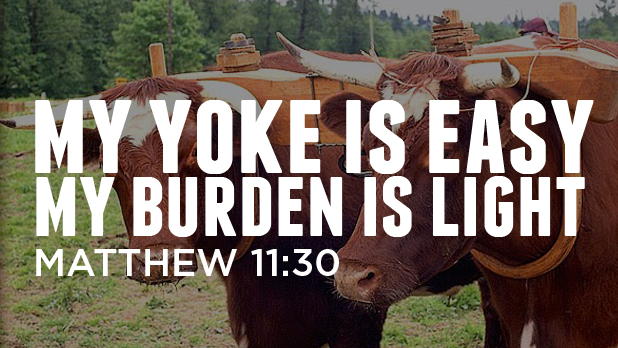
I wonder what the disciples thought when Jesus said, “my yoke is easy, and my burden is light.

Bartholomew probably nodded along in agreement, James and John might have clapped in approval, but there’s a chance that Peter said what I think whenever I come across this passage: “Is he serious?

I mean, in reality, it would seem that what Jesus is talking about here is rather ironic. My yoke is easy and the burden is light? Coming from the one who said: take up your cross and follow me, those who wish to save their life must lose it, sell all of your possessions and give to the poor, let the dead bury the dead, is it easier for camel to go through the eye of a needle than for a rich person to enter heaven… it seems a little paradoxical for him to claim that is yoke his easy and the burden is light. 

When we take a step back and look at the greater picture of this address, Jesus’ invitation is not to the work burdened, nor the sin-burdened, but to the law burdened, to those who felt the heavy weight of religiosity. At a time when law observance was followed by some to a ridiculous degree, Jesus triumphantly invited the weary to come to him for rest.

The promise for the weary is not, however, a rest from inactivity. What Christ offers to the tired is not a vacation from the law but a less burdensome way of fulfilling it. At particular points during his ministry Jesus’ interpretation of the law was more lenient (observing the Sabbath) and at other times more stringent (divorce, acts of mercy, forgiveness). The main thrust being that the weighted matters of the law can be simplified by justice, mercy, and faithfulness.

Compared to the other law followers of his time, Jesus is offering a lesser burden of religious existence. Yet, I can’t help but feel that there is something inherently wrong with the idea that Jesus’ yoke is easy and the burden is light.


It brings me more joy than I can describe to know that I have been serving as the pastor of St. John’s for more than a year. I have only begun to scratch the surface of our collective story, the way we have all come to know God in our lives, and I look forward to our continued journeys of faith.

Years ago a good friend of mine had just finished his first year in ministry, like me, when the “honeymoon” period came to an abrupt end. They say that the “honeymoon” period can last anywhere from 6-18 months; the church body becomes so excited with a new pastor that they are willing to look past the old problems to envision a new reality of faith. However, as with all things, the honeymoon eventually comes to an end. Honeymoons can end by a simple mistake from the pulpit, a forgotten phone call to a parishioner in need, or simply when the new shiny toy looses its luster. For my friend, the honeymoon came to a screeching halt during a church council meeting.

After serving for an entire year it appeared as if things were finally getting better for the church; they had new visitors attending worship, new programs had taken off, and they even had a few youth present during church gatherings. Some of the lay people had come to describe this new young pastor as the shot in the arm that the church had desperately needed. He was their little Messiah, inaugurating a new age and time for the church when it could return to its former glory.

The church council meeting took place in the damp church basement that smelled of mold and burnt coffee one evening shortly after his one year anniversary. The leadership of the church sat appropriately in the stiff folding chairs and exchanged pleasantries about the comings and goings of town until the real business came to the floor: The much needed update to the curtains in the fellowship hall. He describes the moment as a eternity of debating what color would best accent the needs of the hall where peoples’ feeling were hurt over the color-coordination. And then they talked about replacing the organ, and the sanctuary windows. They talked about the only two children in worship, just two, who were deemed disruptive to the older folk. And when they were done complaining about the children, they started to complain about my friend…

presbytery-580x491-300x253

The shut-in list was passed around the table until it arrived in his lap when someone said, “the only explanation must be that you don’t have this list. Our last pastor made sure that each of them were visited one a week.” “Thats wonderful” my friend replied, “Who visits them?” “The pastor does!” they all agreed in unison.

My friend looked down at the list and read the names of the faithful church members who could no longer attend. While he sat there in silence reading over the list one of the older women spoke up, “this is the way we’ve always done it, and we’ve always been successful

“Successful at what?” he said. “There are 36 names on this list. That means there were 4 more people on this list than there were in church last Sunday. I don’t think you’ve been successful at all.”

And thus the honeymoon came to an abrupt conclusion. 


My friend was young, brash, and foolish, and he was wrong. It is part of the pastor’s vocation to visit the shut-ins, to maintain a connection between the people and their church. But he was also right about something; the call of discipleship rest on all of us, not just the pastor.

Once, while I was working on a sermon, I got a call letting me know that a beloved woman from the church I was serving had just been admitted to the local hospital after having a stroke. I remember leaving my my computer and bible open on my desk, and driving straight to the hospital. I sat by her bed and held her hand as she talked to me about everything that had happened to her, her inability to move some of her fingers, her fears about being able to return to the normalcy of life, but the thing that stuck with me most was the last thing she said before I left.

“Thank you for coming to see me,” she said. “I miss my church. I’m so sorry that I haven’t had a chance to come hear you preach, but I’ve been too sick to leave the house and my hearing has gotten so bad. I miss the people. I’ve received a lot of cards that have helped to cheer me up. But you know what? No one has come to visit me. And the only reason you’re here is because I’m in the hospital.

I am a professional Christian. I have it easy. I am paid by you to live out my faith, order the church, preside over the sacraments, proclaim the Word of the Lord, and serve the needs of the community. I attend our committee meetings to help with the ordering of the church, I pray over the waters of baptism and the bread and wine of communion, I preach sermons from this pulpit every week, and when someone has a need I leave what I’m doing to be with them. Going to visit someone in the hospital is what I am called to do. However, one of the hardest things to accept and live into, is our shared commitment to take care of one another.

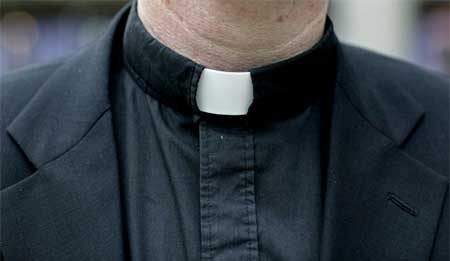
I went to see that woman in the hospital because I knew it was what I was supposed to do. I went because I am a pastor, but more importantly I went because I am a Christian. When I wear my clergy collar it is a constant reminder that I am called to act, think, live, and behave like a Christian. This collar has become my yoke. It sits uncomfortably around my neck as a constant reminder of who I am and whose I am. Im not proud to admit it but, sometimes, I need to wear it in order to live out my faith. Without this yoke around my neck it becomes too easy to fade into the crowd and forget my obligation to make God’s kingdom alive in the world. I am weak enough that I need to have something like this to help me remain faithful.

dogcollar

And so I wonder… I ask myself: Did I go see her because it was the right thing to do? Or did I go see her because that’s what you expect me to do?

When you wear something like this around your neck you begin to act differently. It is an inescapable demarkation that I have given my life to Christ to live a radically transformed life that often feels burdensome and heavy, unlike the easy yoke of today’s scripture.

Jesus calls the weary to come to him because his yoke is easy. A good yoke is one that is carefully shaped so that there will be a minimum of chafing for the animal. Jesus’ yoke therefore is one that is supposed to be kind to our shoulders, enabling us to carry the load more easily. But I will be the first to tell you, sometimes the weight feels unbearable.

Take my yoke upon you and learn from me.” In our discipleship we are not merely called to listen to Jesus’ words and reflect on them. In other words, our faith in not one that is limited to the mind. From Christ we are to learn not only to think, but to do. We gather in this place every Sunday to learn by listening and then living out God’s Word in the world. The yoke of discipleship, much like this collar, is not one that Jesus imposes on us, but one that he wore and continues to wear alongside us. 

When the weight of discipleship begins to feel too heavy for me, I call for Christ’s help with the load. I cannot do this on my own for I am a wretched man, full of sin and devoid of glory. Only through Christ’s love and grace am I able to take up my cross, which is to say I am able to take up my collar, and live as a Christian fully and deeply. 

Imagine what it would look like if we all started acting like Jesus here and everywhere. The burden of wearing a collar like this in the world is mine to bear. But think, if you can, how differently you would act if you wore one around your neck. That’s why I have placed 100 collars in our sanctuary this morning. Take one home with you, leave it in a place where you will see it regularly, and when you do, ask yourself, “how would I behave today if that yoke was hanging around my neck?”

Christ is on the other side of your yoke, helping you to carry this burden of being his body for the world; it is not easy being Christian. The cost of discipleship is one that will cost us our very lives. And just as Christ is helping to carry your yoke, so also are we called to help one another.

When we hear about the sufferings within our community we have been given the great privilege to help carry those who are in their deepest valleys while at the same time recognize that we need to be helped through our sufferings as well.

I count myself blessed to serve the needs of this church, to wear this collar that comes at a price, to take Christ’s yoke upon my shoulders because it is through God’s love, Christ’s mercy, and the Spirit’s presence through people like you that the yoke becomes easy and the burden is light.

Let us all put Christ’s yoke upon our shoulders, let us take up our collars to live as Christ’s body for the world, serving the needs of others while lifting up one another in faith.

Amen.

Devotional – Isaiah 55.10-11

Isaiah 55.10-11

For as the rain and the snow come down from heaven, and do not return there until they have watered the earth, making it bring forth and sprout, giving seed to the sower and bread to the eater, so shall my word be that goes out from my mouth; it shall not return to me empty, but it shall accomplish that which I purpose, and succeed in the thing for which I sent it. 

Weekly Devotional Image

In church life we love to talk about “planting seeds of faith.” I have heard countless professors, theologians, pastors, and Christian leaders all convey something akin to “you never know how the seeds you plant might grow into beautiful lives of faith.” The point being that we must choose our words carefully because they contain enormous power; at times our words can help nurture someone in their faith, and at other times our words can destroy someone’s faith.

Dick Dickerson, a beloved man in our congregation, once told me a story about a particular Christmas Eve that he experienced while fighting in World War II. Dick had spent the previous days at the front lines frightened for his life and for the lives of his friends. Through the bitter cold they continued to push forward into enemy territory unsure of what they would discover. Without realizing it they serendipitously found themselves sleeping in the comfort of a church sanctuary on Christmas Eve enjoying a welcome reprieve from the fighting.

Dick describes that evening with vivid details: the wax from the candles spilling over onto the wooden pews, the hole in the roof letting in the tiniest snow flakes, and the huddled soldiers staying close to one another for warmth. Though he cannot explain what prompted him to speak up, he asked the young military men around him whether they would like to pray for anything. To him he seemed like the right thing to do on Christmas eve while gathered in a church sanctuary, regardless of the circumstances. One soldier prayed for his family and friends back home, another prayed for the weather to warm up, and another prayed for his fellow comrades in the fight against oppression.

The praying went on for sometime, but after a rather long pause one of the youngest soldiers spoke up: “I seem to remember Jesus saying something about praying for our enemies,” he began, “so tonight I would like to pray for the men we’re fighting against, I pray that God would be them as He is with us.” Upon hearing this man’s words Dick was worried that an argument or fight would break out between the men but he was surprised to discover that everyone was silent with their heads bowed down. With tears beginning to form in his eyes he joined his brothers and prayed for his enemies.

raining-on-yellow-daisies-natural-selection-craig-tuttle

God’s Word is mysterious, strange, and powerful. There are times when we hear or read something from scripture that will not become relevant or real for us until a later time. But like the prophet Isaiah said, “my word will not return to me empty, but it will accomplish that which I purpose.” The scriptures from both the Old and New Testaments are life-giving; they are like the blessed rain that fall from the sky in order to give new life from the earth.

Today let us all reflect on the ways that God’s Word has affected our lives.

Let us ask ourselves: What scriptures have transformed the way we see the world?