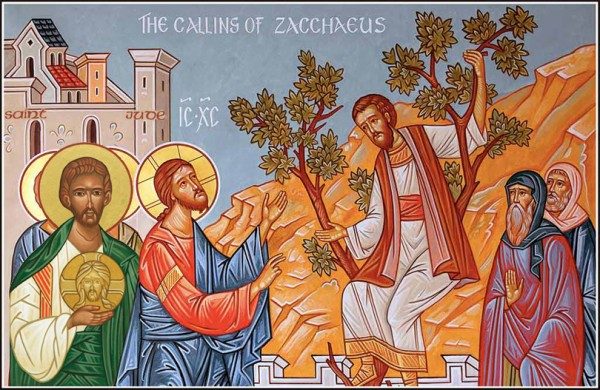
Jesus entered Jericho and was passing through it. A man was there named Zacchaeus; he was a chief tax collector and was rich.
We love the story of Zaccheaus. And by we, I mean the church. We tell Z’s story to children in Sunday school, we use it in VBS curricula, and we even have a nice little song that conveys the whole thing:
Zacchaeus was a wee little man and a wee little man was he / He climbed up in a sycamore tree for the Lord he wanted to see / And as the Savior came that way he looked up in the tree / And he said, “Zacchaeus, you come down, cause we’re going to your house today.
The song, and the ways we tell the story, make Zaccheaus out to be this smaller than life character (pun intended) who just wanted to catch a glimpse of heaven on earth, and how God in Christ chose him to be the vehicle of an internal transformation, particularly as it regards money.
But one of the things we miss, or downright ignore, is how horrible Zaccheaus was. He was a tax collector, someone who stole from his fellow Israelites and kept a fat portion for himself before passing the rest of the money up the chain. He was a traitor to his people, and to his God, and he stood for everything that was wrong during the time of Jesus.
And Jesus picks this no good dirty rotten scoundrel out from the tree and says, “Hey, let’s get something to eat.”
And, in a way that could only happen in the Gospel, Zacchaeus reacts to this strange man with an even strange proclamation. After a couple sandwiches, and a glass of lemonade on the front porch, Zacchaeus says, “Wow, the only way I know how to respond to you is to give back half of my wealth to the poor and pay back the people I cheated four time over.”
And Jesus responds, “Now that’s what salvation looks like! Let’s have a party!”
It’s a confounding story, and one that we often water down. Zacchaeus doesn’t deserve to be in the presence of God and God shows up for lunch. Zacchaeus has swindled countless people and Jesus has the gall to give him salvation.
And yet, his story is precisely why we can call the Good News good.
We are happy with a Jesus who forgives the tame sins of the nearly righteous. We are content to hear about the need to love one another a little bit more. But it’s another thing entirely to encounter the radical nature of Jesus’ proclamation of grace. Jesus’ willingness to cancel sins, big sins, is downright scandalous.
Which is why we sing of Zacchaeus but keep him at a distance. For, to approach the wee little man is to admit the truth of who we are and whose we are: Sinners in the hands of a loving God.
All of us are like Zacchaeus. We all hurt people close to us, we all ignore the needs of strangers, and we all focus on our wants, needs, and desires at the expense of others. We distance ourselves from true unabashed goodness, though we don’t mind taking a peek from the vantage point of a tree (or a pew). But be warned! All it takes is a glimpse for the Lord to see us and say, “Want to grab some lunch?”
He also told this parable to some who trusted in themselves that they were righteous and regarded others with contempt…
There is a man who is good and faithful. He’s not a crook, or a womanizer, or an alcoholic. He loves his wife and plays on the floor with his kids when he gets home from work. He even tithes when the offering plate comes around on Sunday morning. He is good and faithful.
And there’s another man, a legal crook, who steals from his fellow people and bleeds all the money out of them that he possibly can. He’s like a mid-level mafia boss who skims from the top before sending the rest up the chain. He’s got enough cars and boats that he can’t even keep track of where he keeps all of them.
They both show up for worship one day. The good and faithful man thanks God that he’s not like the crook and, meanwhile, the crook asks God to have mercy on him, a sinner.
The parable of the publican and the pharisee. Jesus tells this tale to his disciples and then mic-drops the ending: “I tell you, this man (the crook) went down to his home justified rather than the other; for all who exalt themselves will be humbled, but all who humble themselves will be exalted.”
It’s all wrong, right? This parable runs against the grain of how we think it’s all supposed to work.
Put another way: Which of the two would we prefer to see sitting in the pews on a Sunday morning? How would we feel if the crook was part of our church? What would we do if he took a little money out of the offering plate or showed up with a new woman on his arm every Sunday?
This parable is one of Jesus’ final declarations about the business of grace. Grace – the totally unmerited and undeserved gift from God. And here, with a resounding conclusion, Jesus tells the disciples and all of us that the whole game is unfair.
Grace is unfair because what we think is good and right and true matters little to God. Ultimately, not one of us matches up to the goodness of God and yet, instead of kicking us out of the party for being unworthy, God says, “I will make you worthy.”
Do you see what that means?
It means that the good religious work of the Pharisee is not able to justify him any more than the crazy sins of the Publican can kick him out. The whole point of the parable, of almost all the parables, is that these two are both dead in the eyes of God, their good works and their sins can’t earn them or prevent them from salvation.
In short, they have no hope in the world unless there is someone who can raise the dead.
Someone in the crowd said to him, “Teacher, tell my brother to divide the family inheritance with me.” But he said to him, “Friend, who set me to be a judge or arbitrator over you?” And he said to them, “Take care! Be on your guard against all kinds of greed; for one’s life does not consist in the abundance of possessions.” Then he told them a parable: “The land of a rich man produced abundantly. And he thought to himself, ‘What should I do, for I have no place to store my crops?’ Then he said, ‘I will do this: I will pull down my barns and build larger ones, and there I will store all my grain and my goods. And I will say to my soul, Soul, you have ample goods laid up for many years; relax, eat, drink, be merry.’ But God said to him, ‘You fool! This very night your life is being demanded of you. And the things you have prepared, whose will they be?’ So it is with those who store up treasures from themselves but are not rich towards God.”
Someone interrupted Jesus one day, “Lord, tell my brother to divide up the family inheritance.”
The man probably has just cause for his request, even though the conventions of the day dictated that the eldest son would receive the inheritance. But, don’t we agree it would be a good thing for Jesus to make everything fair?
Jesus replies, “Hey, what’s the deal? Who made me a judge over all you people?”
Apparently, Jesus has more important things to deal with than the incidental patching up of a intra-family dispute over finances.
But then Jesus does what Jesus does best – he tells a story.
There was a man who had it all. At first, he used the excess cash to fill his house with all sorts of trinkets and wares that served only one purpose: showing others how wealthy he was. It started with some paintings, until he ran out of wall space. Next he redid his wardrobe, until his closet was full. And then he bought an extra luxury car, until he realized there wasn’t enough room in the garage.
What was he to do?
And then the man had a vision! Why not tear it all down, and build an even bigger house to fit even more stuff inside?
So that’s what he did.
And it came to pass, after months of deconstruction and reconstruction, of differing architectural bids and various contractors, he looked at all he had and he said to himself, “You’ve done well old boy! Time to eat, drink, and be merry!”
Suddenly a booming voice from the heavens shatters all the new glass in the windows: “You fool! This very night your life is being demanded of you. And the things you spent your life obsessing over, whose will they be?”
Jesus sure could tell a story.
And yet, I don’t know if this story has “worked.”
And by “worked” I mean, I don’t know if we’ve changed all that much in response to this particular parable.
Throughout his earthly ministry, Jesus talked about money and possessions more than any other subject. And for good reason: we’re just as obsessed with what we have now as we were back then. Even a couple hundred years ago John Wesley was addressing wealth with the early Methodists: “In seeking happiness from riches, you are only striving to drink out of empty cups.”
There’s a great irony with Jesus’ parable of the rich fool: We all know that it’s true, and yet we live as if it isn’t.
It’s a bonafide fact that we can’t take anything with us when we die, but that hasn’t stopped us from trying. ($10,000 caskets…)
Everything in the world, and even the church at times, runs on avarice. Extreme greed for wealth and material goods. It’s the lie we were fed as children, and it’s the lie that we give to our children. It’s reinforced with every magazine cover, every instagram post, and every commercial we encounter.
Happiness is yours, if you can afford it!
And it’s all one big lie.
The world will tell us over and over and over again that we are defined by our bank accounts, and the clothes we wear, and the cars we drive. But in the kingdom of God it’s through poverty, not wealth, that God saves us.
Let the same mind be in you that was in Christ Jesus, who, though fully God, did not regard divinity as something to be exploited, but emptiedhimself, being born in human likeness, and was obedient to the point of death – even death on a cross.
Why does God do this? Because we need all the help we can get.
Whether we’re rich or poor or somewhere in between, all of us are sin-sin with our insatiable desire for more.
And not just more, but more, more more!
We clutch at all that is around us rather than opening our hands to ever being open to anything else.
We’d rather receive than give.
We lay awake at night worrying about one thing and one thing only: money.
And then Jesus has the nerve to tell us this parable!
Notice: the man in Jesus’ story does with his avarice what we all do: We congratulate ourselves on all we have accomplished.
The wealthy man sees only himself: “He thought to himself, ‘What should I do, for I have no place to store my crops?’ Then he said, ‘I will do this: I will pull down my barns and build larger ones, and there I will store all my grain and my goods. And I will say to mysoul, Soul, you have ample goods laid up for many years; relax, eat, drink, be merry.”
He’s living in a monologue.
And yet, all of the things we have in this life, all of the things we think we’ve earned or deserved, every one of them is actually a gift. We are products of what is done for us more than by what we do for ourselves.
Jesus sets up the man as the paradigm for everything we think is good, and right, and true in this life. He’s fiscally responsible after all. He’s earned his good fortune. And yet, the man is only a master of a life that is completely and radically out of his control – the rich man is nothing more than the captain of a ship that has been taking on water since it left the dock.
The man lives only for himself, talks only to himself, sees only himself, until the Lord knocks him to the ground for being a fool.
He is foolish because no matter how much he talks to himself, and congratulates himself, and rejoices in himself, he neglects to recognize that his crops, or his stock portfolio, or whatever the good thing is was always first a gift.
And gifts require givers.
The land that our food comes from, the institutions that give us the space and knowledge to grow, the families that provide our basic needs, the friends that support us in times of pain and grief, on and on and on.
And yet, we are far more possessed by what we think we possess. Our possessions possess us!
We keep acquiring more and more hoping we can control our lives or, at the very least, to make it appear like we have our lives together.
We spend most of our lives in pursuit of wealth, material and immaterial, only to come in the end to the greatest poverty of all: death.
Jesus’ parable ends with that frightening final note, one that lingers long after the Lord calls us fools: no matter how much we make, no matter how much we accumulate, we all die in the end.
John Ortberg tells this great story about how for years he and his grandmother played monopoly. She taught him the ins and the outs of the game, differing strategies, and she always always won. Until one day, after countless games, he finally beat her. And as he celebrated is victory, dancing across the living room, she said, “Don’t forget, when the game is over, it all goes back in the box.”
All the money, property, houses, hotels, they never really belonged to him. They were in the box before he started and they returned when he finished.
A challenging aspect of Christianity is our profound willingness to stare death in the face. It’s why we have crosses in our sanctuaries. We know, better than most, that time is now fleeting the moments are passing, passing from you and from me. And when the bells tolls for us, what will happen to all our stuff?
And yet, again, the “our” in “our” stuff betrays the Christian understanding that all of it, the money, possessions, talents, they are not “ours.” They are given to us by God who trust us to be good stewards of the gifts we’re given.
This church is a product of your stewardship, and the stewardship of those who came before us. Our sanctuary windows are marked with the names of those long gone who believed in God’s working in the world that they returned to God the gift they were given.
Even today, your gifts are what makes this church possible. The gifts of your time, showing up for worship and prayer and study and service. The gifts of your talents that you share with God and with one another. And, of course, the gifts of your finances.
Giving is normative in discipleship. It’s how we live into God’s mission of transforming the world.
But it’s also how we keep the lights on, and keep the building warm in the winter and cool in the summer. It’s how we are able to welcome and provide space for so many outside groups. It’s how we pay the salaries to support the livelihood of our staff and their families. It’s how we live into the strange and even foolish (at least according to the world) Gospel of Jesus Christ.
Because, in the end, the parables are stories Jesus tells about himself and Jesus is the one who doesn’t store up his life on earth and, instead, freely gives it for you and me. Rather than clinging to his own life, Jesus mounts the hard wood of the cross for people undeserving, us.
This parables stings, and it frightens, perfect for the month of October, even better for stewardship! But it is Good News!
Nothing can separate us from the love of God in Christ Jesus, not our money or lack of it, not our possessions or our minimalism, not our goodness or our badness, not our lives and not even our deaths.
We might not see it, or even believe it, but there is greater wealth in the salvation of Christ than in every bank account in the world.
And it’s ours for free.
We can’t earn it.
We don’t deserve it.
It’s not cheap, nor is it expensive.
It’s free.
It’s free for you and me and every fool the world will ever see.
–
Wesley said, “In seeking happiness from riches, you are only striving to drink out of empty cups.” Thankfully, we worship the God who never stops giving. Which is why the psalmist can sing, “our cups runneth over.” The only question is, what are we going to do with what we’ve been given?
Now every year his parents went to Jerusalem of rite festival of the Passover. And when he was twelve years old, they went up as usual for the festival. When the festival was ended and they started to return, the boy Jesus stayed behind in Jerusalem, but his parents did not know it. Assuming that he was in the group of travelers, they went a day’s journey. Then they started to look for him among their relatives and friends. When they did not find him, they returned to Jerusalem to search for him. After three days they found him in the temple, sitting among the teachers, listening to them and asking them questions. And all who heard him were amazed at his understanding and his answers. When his parents saw him they were astonished; and his mother said to him, “Child, why have you treated us like this? Look, your father and I have been searching for you in great anxiety.” He said to them, “Why were you searching for me? Did you not know that I must be in my Father’s house?” But they did not understand what he said to them. Then he went down with them and came to Nazareth, and was obedient to them. His mother treasured all these things in her heart. And Jesus increased in wisdom and in years, and in divine and human favor.
I would like everyone to close your eyes for a moment, find a comfortable posture, and I would like you to imagine the perfect church…
What does it look like?
What kind of people are in it?
What are some of the things the church does?
–
It’s a little terrifying how easy it is to imagine “the perfect church” only to open our eyes and be stuck here with each other. It’s so easy to picture a particular church in our minds because that’s what life has conditioned us to do. We usually curate everything we can to benefit our own tastes, and leanings, and hopes, and dreams.
If we don’t agree with someone else on Facebook, we can just block and unfollow them.
If we start watching a movie and within ten minutes it’s boring we can push a few buttons and watch something else.
If we’re hungry for a particular meal, we need only open an app on our phones to have it delivered right to our door, despite all the food we might already have in the pantry.
Basically, we are consumers living in a consumable world. We choose exactly what we want, take what we want, and move on with unlimited choices and unlimited speed.
And, frankly, we bring this understanding of reality to the church as well. That’s why there’s every flavor of Christian denominationalism on Grandin Road. If you encounter a church that doesn’t give you what you want, there’s always another one to try.
The only problem with that is the fact that what we want is not often what we need.
An example: We are blessed in this church to have visitors nearly every Sunday. That is something worthy celebrating, but a very strange phenomenon when taking in the scope of Christian history. Up until the last 100 years, you went to church where you could. Now we go to church where we want.
Anyway, we get a fair number of visitors here, those church shopping for a new church home. And, every once in a while, visitors come back again and again and I will meet with them to talk about what it might mean for them to join or become more involved. During that conversation I always ask about where they were attending church before.
And, more often than not, someone will describe their last church, usually somewhat local, and how they attended for years until something particular happened. A too-political sermon. A unfortunate song choice on a Sunday morning. A stinging stewardship season. And that was enough to say goodbye.
According to the world this is a normal thing that happens. We can move on over and over again.
But in the realm of the church this is downright strange.
Charles Spurgeon, 19th century preacher, put it this way:
“If I had never joined a church till I had found one that was perfect, I should never have joined one at all; and the moment I did join it, if I had found one, I should have spoiled it, for it would not have been a perfect church after I had become a member of it. Still, imperfect as it is, it is the dearest place on earth to us.”
Strangely enough, the church is where we discover the comforting gospel of Jesus Christ that leads us to live uncomfortable lives for him. Uncomfortable because, living for Jesus means living for the people in the church around us too.
When someone joins a United Methodist Church they covenant to support the church with their prayers, presence, gifts, service, and witness. To support the church by presence is literally that, it means being present.
Part of our discipleship is a willingness to be present with God and with one another. We gather week after week to remember the stories of God and to be re-membered into the body of Christ. We break bread with one another in worship, and during the Garden, as a recognition that the Christian life is one that is meant to be shared. We show up for Bible studies, and outreach programs, and all sorts of other things because, on some level, we understand that being present together is at the heart of what it means to follow Jesus.
Luke’s Gospel has all the best stories. Mark is short and brief, Matthew is theological, John is all over the place, and Luke’s got the stories. And the story of Jesus at the temple is just so good.
It’s got drama and intrigue, family strife, and youthful rebellion.
And when we read it we tend to fixate on Jesus teaching the elders. He’s a 12 year old boy and everyone is amazed at his teaching. And so people like me stand up in a place like this and say things like, “Our youth are not the future of the church, they are the church right now.” And a 3.5 minute story will usually be shared about a youth and how they understand the kingdom better than we do. And so on.
And that’s all good and fine.
Jesus does say that if we want to get into the kingdom of heaven we have to act like children.
And yet, I fear we miss something else in the story when we emphasize Jesus’ teaching in the temple alone. What we miss is the fact that this is also a story about horrible parenting!
Listen to it again: They traveled all the way to Jerusalem for Passover, a six days journey by foot, and when they were done they returned home Mary and Joseph did not know that they left their son behind.
What? How does that happen? It’s one thing to lose track of a wayward child in the grocery store, but leaving them behind in a foreign city? C’mon!
And that would be bad enough. But then it says they traveled a whole day before they noticed. AND THEN once they turned back it took them another 3 days to find him!
Jesus was in the Temple teaching and his parents were astonished and Mary said, “Child, why have you treated us like this? Look, your father and I have been searching for you in great anxiety.”
Which is the Bible’s version of, “Boy, you had us worried sick! You are grounded from now until eternity!”
And how does Jesus respond? “Why were you searching for me? Did you not know that I must be in my Father’s house?”
Must is a strong word. In life all of our must and shoulds don’t muster up to much in the kingdom of God, but Jesus’ response is notable.
It is good and right to be in the house of God. Honor and keep the sabbath, that’s 1 of the 10 commandments.
The psalmist writes, “I was glad when they said to me, let us go to the house of the Lord.”
To be in the house of God was as necessary to Jesus as it is to breathe.
And yet, there are a few more staggering details in this story that really bring it all home. The Holy Family went to Jerusalem for Passover. Some 21 years later, on Passover in the same city, Jesus will take a loaf of bread and a glass of wine and share it with his friends. He will become the Passover Lamb for the them, the exodus for the rest of us.
Mary and Joseph abandon Jesus in the city, much like the aforementioned disciples will abandon him to the cross the day after Passover.
It take Mary and Joseph three days to find their son, much like Jesus sat in the tomb for three days before the resurrection.
And notably, after the family’s confrontation in the Temple, scripture says that Jesus returned home and was obedient to his parents and Mary treasured it in her heart. Which is another way of saying that Jesus forgave his parents for what they did to him, much like Jesus returns to his abandoning and denying disciples on the other side of Easter.
A crucial eccentricity of the Christian faith is the claim that salvation does not come to us by natural inclination, by birthright, by earning, or deserving. Salvation is a gift from God. And because it is a gift it can only be received on God’s terms, not ours. The church is the witness to the gift of salvation, reminding us time and time again what we have been given even though we deserve absolutely nothing.
That’s a hard truth to swallow, the “we deserve nothing.” But it’s true. We all do things we shouldn’t, we all avoid doing things we should. We are imperfect people. We might not be the type of people who forget our children back in Jerusalem and wander around for a few days before we find them, but we do have a lot more in common with Mary and Joseph than we let on. What’s more, even though we fail to be an obedient church, even though we fail to love God and one another, God offers us grace anyway.
Therefore, the perfect church is actually an imperfect one, constantly reminding us of our imperfections and the great Good News that someone has come to help us. And that someone has a name: Jesus
Without the church how can we know that grace is given to us, how can we discover that we are caught up in Jesus’ story, how can we receive the sacraments?
We need one another, because you can’t baptize yourself no more than you can give communion to yourself. We need someone to give those gifts to us. We need the church to tell us again and again, “The world will only ever see you through your faults and failures, but God loves you.”
We need the church because it holds us together even when it feels like everything else is falling apart.
Rich Mullins once said, “Nobody goes to church because they’re perfect. If you’ve got it all together, you don’t need to go. You can go jogging with all the other perfect people on Sunday morning. Every time we go to church we’re confessing again to ourselves, our families, to the person in the pew next to us, that we don’t have it all together. That we need direction, we need accountability, we need help.”
The reason for being present in church is the strange fact that this is the only community that is consciously formed, criticized, and sustained by the truth. Which is Good News for a world that runs by lies.
Church is the last vestige of place where we willfully gather with those who are not like us, this is the fellowship of differents. And though we are different, the truth that is Jesus Christ, somehow makes us one.
I often wonder why I kept going to church throughout my life. At first I was present in church because my parents made me – they couldn’t leave me home alone as a child even though Mary and Joseph clearly would have.
But then, around my teenage years, I started running the sound system so I had to be present in church. And then I left for college, and there was a church that needed a drummer so I was still present in church. On and on and on.
And when I look back now, I know the answer to why I kept showing up for church: Jesus.
Jesus churched me. The church is how God dealt with me. I am who I am because of the church. Through sermons and sacraments, through friends and even foes, I was shaped into who I am.
God is in the business of remembering us. That is, God re-members us, puts us together, like pieces from a puzzle. And yet, have you ever pulled out a puzzle and worked away on a rainy day only to realize that one or two of the puzzle pieces we missing?
The picture isn’t complete.
The church is complete, the body of Christ is complete, when we are together. Your presence here makes the church the church. When we are present before God’s presence, we live God’s future in our present and it actually changes things.
So welcome to the perfect church! It’s perfect because God does God’s best work with imperfect people like us. Amen.
Of course, there is great gain in godliness combined with contentment; for we brought nothing into the world, so that we can take nothing out of it; but if we have food and clothing, we will be content with these. But those who want to be rich fall into temptation and are trapped by many senseless and fearful desires that plunge people into ruin and destruction.
A recent study noted that at least 80% of Americans experience daily stress regarding the economy and their personal finances. More than 50% are worried about being able to provide for their families basic needs. 56% are fearful about job security. And 52% report lying awake at night thinking about one thing and one thing only: $$$
Admittedly, those statistics probably aren’t that shocking considering how much of our daily lives revolve around our wallets. With the ubiquity of online banking we can figure out exactly how much, or how little, we have at any given moment.
And yet, the “we have” in that sentence betrays the basic Christian conviction that our money doesn’t belong to us: it belongs to God.
A professor of mine once opined about how different the church would be if, when individuals took vows of membership, they read their tax return aloud from the year before. Can you imagine the fervor that would follow if the church announced personal financial disclosures as new membership requirements? And yet, to do so would be faithful!
Jesus talks about money/possessions, and the use of them for others, almost more than any other single subject in the New Testament, and yet (outside a stewardship campaign) we rarely talk about them in church.
Instead, wealth is something so privatized that we can scarcely imagine what it would mean to share it with others, let alone the church. We hoard it, like the man with his store houses in one of Jesus’ parables. Or, we spend it with such reckless abandon that we go into a debt we have no hope of ever repaying.
A relevant question for anyone, particularly those who are part of a faith community, is: when is enough, enough?
The gifted preacher Fred Craddock tells the story of a time when he and his wife had a guest in their home who was spending the night. As Craddock read from the newspaper in the corner of the room, consumed by the movement of the Market, the guest was rolling around on the floor with Craddock’s kids teaching them a new game. And Craddock thought to himself, “How long has it been since I came home from work, got down on the floor, and had fun with my kids?”
Later, after dinner, the guest declared, “That’s just about one of the best meals I’ve had in a long time.” And Craddock thought to himself, “When was the last time I thanked my wife for our dinner?”
Craddock was merely going through the familiar patterns of life, keeping up with the rat race of all things: coming home from work, reading the paper, eating dinner. And then, through the guest, everything started to look different. Craddock said to himself, “Where in the world have I been?”
God has richly blessed each and every single one of us in a variety of ways. From the air we breathe, to the food we eat, to the friends we love.
Sometimes it takes a guest in our home, or a particularly striking passage from scripture, for us to finally ask ourselves the same question, “Where in the world have I been?” Which is just another version of, “When is enough, enough?”
Then Jesus said to the disciples, “There was a rich man who had a manager, and charges were brought to him that his man was squandering his property. So he summoned him and said to him, ‘What is this that I hear about you? Give me an accounting of your management, because you cannot be my manager any longer.’ Then the manager said to himself, ‘What will I do, now that my master is taking the position away from me? I am not strong enough to dig, and I am ashamed to beg. I have decided what to do so that, when I am dismissed as manager, people may welcome me into their homes.’ So, summoning his master’s debtors one by one, he asked the first, ‘How much do you owe my master?’ He answered, ‘A hundred jugs of olive oil.’ He said to him, ‘Take your bill, sit down quickly, and make it fifty.’ Then he asked another, ‘And how much do you owe?’ He replied, ‘A hundred containers of wheat.’ He said to him ‘Take your bill and make it eighty.’ And his master commended the dishonest manager because he had acted shrewdly; for the children of this age are more shrewd in dealing with their own generation than are the children of light. And I tell you, make friends for yourselves by means of dishonest wealth so that when it is gone, they may welcome you into the eternal homes. Whoever if faithful in a very little is faithful also in much; and whoever is dishonest in a very little is dishonest also in much. If then you have not been faithful with the dishonest wealth, who will entrust to you the true riches? And if you have not been faithful with what belongs to another, who will give you what is your own? No slave can serve two masters; for a slave will either hate the one and love the other, or be devoted to the one and despise the other. You cannot serve God and wealth.
I would like to have a word with whomever decided this would be the text for today. It’s one thing to assign different, and even strange, texts to retired clergy filling in while a certain pastor was on paternity leave. But for that pastor to return after a month only to dust off the homiletical muscles with the hardest parable?
Who thought this would be a good idea?
Apparently I did months ago when I chose this text for this Sunday.
Some fools for Christ are just fools.
Even if you’ve only spent a little time reading the Bible, it is clear that some of the stories that Jesus tells are in need of an editor’s touch. Or, as we might say in this part of Virginia, they need fixin’.
Here are a few examples: The parable of the so-called Good Shepherd. Jesus says the kingdom of God is like a shepherd who goes off in search of one lost sheep. A quaint little tale. We might even like it. We certainly enjoy telling it to children during Vacation Bible School. But do you know what happens when you leave behind the ninety nine in search for the one lost? Ninety nine more lost sheep. It’s not way to run a business!
Or, the parable of the Good Samaritan. I’d rather us call it the Dumb Samaritan. This fool comes across a beaten and bedraggled figure on the side of the road, and puts him up in the four seasons and leaves his Amex card behind for any additional charges. Bad idea!
And then there’s the creme de la creme – The Prodigal. A son commands his father to drop dead, runs off and ruins his inheritance, only to come home with a pitiful repentance worked up in his head and his aforementioned father throws him the greatest block party in history before the kid even gets a chance to apologize.
And then Jesus does it again!
The Pharisees, good religious folk like us, heaven’t even had a chance to lift their jaws off the ground when Jesus tells another story.
There was a man who worked for an investment bank. And, after a few ill advised stock purchases, the CEO marches into his office and says, “You’re fired. I want this office cleared by the end of the day and I’m taking a deeper look into all your recent trades.”
The money-manager finds himself going down the elevator with a cardboard box of office trinkets and thinks to himself, “What am I going to do? I’m too old to go back to school and I’m too proud to beg!” And then he gets an idea. He still has the company credit card in his wallet and he calls us some of his best clients and takes them out to lunch. In between appetizers, and glasses of wine, he pulls out his phone and starts typing away reducing the debt of his soon-to-be former clients knowing that even though he is no longer employed, it helps to have well connected people in your debt.
And then, Jesus says, the CEO calls up his the fired money manager and congratulates him: You have acted shrewdly; for the children of this age are more shrewd in dealing with their own generation than are the children of light.
That’s not a very responsible story Jesus! I don’t know if that’s the type of tale we want people hearing in church. Shouldn’t end more like this?
And the CEO calls up the fired money manager and rips into him yet again for being such a conniving no good dirty rotten scoundrel. And Jesus looks out at the crowds and commands them to live honest and virtuous lives.
The great challenge of the parables, this one included, is that Jesus tells them because they are true, and not because the actions of the characters in them can be recommendations for imitation. Good Samaritans are often taken advantage of. Any shepherd who makes a practice of leaving the ninety-nine behind is quick to go out of the sheep-keeping business. Any Father who throws a party for a wayward child is rightly rebuked for encouraging bad behavior. And any money manager who swindles clients, or bosses, out of money will usually spend some time paying for their crime.
And yet, the parables are not stories about us. The parables are stories that Jesus tells about himself.
Which means, oddly enough, Jesus is the shepherd to risks it all on the one who is lost. Jesus is the Samaritan who lavishly helps those down in the ditch. Jesus is the Father who forgives before apologies are offered. And Jesus is the unjust steward, the dishonest manager, who fudges the account, our accounts, when we don’t deserve it.
Don’t get me wrong, this is, indeed, the hardest parable. For some strange reason the master in the story praises the shrewdness of the steward. In a matter of verses the master goes from wanting to ring his neck to congratulating him for his bizarre intellect. The master goes from being an insufferable ledger keeper to the strange celebrator of the Good News.
And it doesn’t make any sense. Just like the shepherd, the samaritan, and the prodigal, these stories don’t make sense.
But this one really takes the cake.
Even St. Augustine once said he refused to believe this story came from the lips of Jesus.
And yet, here it is. And we all just said, “Thanks be to God” after it was read!
What makes this parable the hardest is the fact that no preacher can water it down or manipulate it enough to make it say something that it doesn’t. Perhaps it would make more sense if the dishonest manager was punished for his crimes, or, at the very least, the money he stole from his master was given away to the poor like a first century Robin Hood.
But instead, the unjust steward is a liar, a cheater, and a thief. And Jesus has him commended, rewarded even, for what he did.
And yet the “what he did” in that sentence betrays the immensity of what transpires in the parable. You see, grace only works on those it finds dead enough to raise.
And, just as sure as you and I are in this room, the unjust steward was dead. Dead as a doornail. While the nails are hammered into his vocational coffin, he makes life a little easier for others by wiping away their debt. But he is not the only one who dies. The master dies as well, he dies to his bookkeeping.
This is such a strange and bizarre story that it should leave us scratching our heads, but perhaps it should make us laugh. Grace is the divine lark offered to a world so sin-sick with seriousness that it can even stop to enjoy the roses.
This parable is outrageous, but so is the Gospel.
It is everything for nothing. It is Good News for a world drowning in bad news. It is life out of death.
What makes the parables true is that they describe who God is. Every single parable, from mustard seeds to wedding banquets to unjust stewards, are about the foolishness by which Grace raises the dead. They describe in weird, wild, and wonderful ways how God is in the business of making something out of our nothing, of making the impossible possible, and making a way where there is no way.
Jesus is the unjust steward. The misguided money manger dies to his career and rises with forgiveness, just like Jesus. By his death and resurrection he resurrects others wiping away their debts, just like Jesus. But most of all, the dishonest manager is Jesus because he is a crook.
Christ the crook: words I never thought I’d say from the pulpit but here we are!
We often betray the reckless nature of the Messiah today with our songs and our paintings. We like our Jesus well manicured with perfect morality and good manners.
But this parable, and all the rest of them for that matter, is a ringing reminder that grace cannot come through respectability or through achievement or through perfection.
Grace comes only through losing.
Grace works for losers and only losers, the only problem is that no one wants to hang out with losers.
No one, that is, except for Jesus.
Jesus spent his life among the last, least, lost, little, and dead. Jesus broke the Sabbath, consorted with criminals, supped with sinners, and he died the death of an insurrectionist. Jesus became sin for us sinners, weak for us weaklings, lost for is losers, and even dead for those of us who go around pretending we’ve got it all figured out when we don’t have much to show for our so-called lives.
It’s almost as if, parable after parable, Jesus is begging us to see ourselves for who we really are.
Have you ever noticed that whenever Jesus says he came to seek and save sinners, we always imagine that Jesus is talking other people and not us?
Why is it that, when we encounter the truly Good News even in this parable, we are offended by it rather than rejoicing because of it?
Because when it comes to our accounts, our debt to sin is not something we can repay. Each and every one of us, the tall and the small, we all do things we know we shouldn’t and we all avoid doing things we know we should. And it’s hard to admit the truth of who we are. That’s why we bristle at the parables, not just because they tell us the truth of God, but because they also tell us the truth about ourselves.
Namely: we’re just a bunch of lost and wandering sheep, stuck in the ditches of our own making, constantly squandering the gifts of God, with no hope in the world unless the hope of the world decides to fudge the accounts in our favor.
In the words of Anne Lamott: everyone is screwed up, broken, clingy, scared, even the people who seem to have it more or less together. They are much more like you and me than we would believe.
Which, oddly enough, is Good News. Really Good News. Because, in the end, Christ is not interested in role models, moral perfectionists, or those who have it all together. Jesus comes for people like us whose ledgers are brimming with failure, and those who can’t find a way out of the mess we’ve made, in order to set us free.
It’s outrageous. And it just so happens to be the Gospel. Amen.
This week on the Strangely Warmed podcast I speak with Drew Colby about the readings for the 16th Sunday After Pentecost [C] (Jeremiah 32.1-3a, 6-15, Psalm 91.1-6, 14-16, 1 Timothy 6.6-19, Luke 16.19-31). Drew is the lead pastor of Grace UMC in Manassas, VA. Our conversation covers a range of topics including honest introductions, namesakes, book recommendations, divine real estate, arrogant hope, hymnody, perfect playlists, spiritual formation, Stanley Hauerwas, stewardship campaigns, and the parables. If you would like to listen to the episode or subscribe to the podcast you can do so here: Hope In A Warzone
Blessed be the name of the Lord from this time on and forevermore.
The writer, novelist, preacher, and theologian Frederick Buechner died on August 15th at the age of 96. His works attracted those inside and outside of the church and in the wake of his death countless tributes were made on his behalf. Among his remarkable books and witness to the faith, there is one longish quote that has stayed with me ever since I first encountered it:
“After centuries of handling and mishandling, most religious words have become so shopworn nobody’s much interested anymore. But not so with grace for some reason. Mysteriously, even derivatives like gracious and graceful still have some of the bloom left. Grace is something you can never get, but only be given. There’s no way to earn it or deserve it or bring it about, anymore than you can deserve the taste of raspberries and cream or earn good looks or bring about your own birth. A good sleep is grace, and so are good dreams. Most tears are grace. The smell of rain is grace. Somebody loving you is grace. Loving somebody is grace. Have you ever tried to love somebody? A crucial eccentricity of the Christian faith is the assertion that people are saved by grace; there’s nothing you have to do, there’s nothing you have to do, there’s nothing you have to do. The grace of God means something like: Here is your life, you might never have been, but you are because the party would never have been complete without you. Here is the world, beautiful and terrible things will happen. Do not be afraid. I am with you. Nothing can ever separate us. It is for you that I created the universe. I love you. There’s only one catch: like any other gift, the gift of grace can be yours only if you reach out and take it. Maybe being able to reach out and take it is a gift too.”
The passage has come to my mind a lot recently, not only because of Buechner’s death, and not only because “grace” really is such a unique word, but also because he describes grace as a good sleep and it’s been more than a month since I’ve had a good sleep! (I’ve been on paternity leave for a month; Phoebe Wren Mertins was born August 19th, 2022) Nevertheless, Buechner’s willingness to take a “stained glass word” and bring it down to earth is, I think, one of the most important hermeneutical tools in the church today. Therefore, I had decided to offer my own spin on the prompt “Grace is…”
Grace is driving to the hospital in the middle of the night while your wife is in labor, and every person goes out of their way to make sure she makes it straight to the delivery unit. It’s nurses telling us to stop apologizing for the things we need. It’s lactation consultants and pediatricians and doctors who bend over backward to show love and patience during a decisively impatient time. Grace is coming home from the hospital to countless cards and notes from friends and strangers alike rejoicing in the arrival of our daughter. It’s food being delivered to the door and dismissing hand movements every time we try to express our gratitude. Grace is the delivery of various gift cards to grocery stores and restaurants just to make the first few weeks a little easier. It’s the way grumpy old men make fools of themselves when they see you walking around the block with a newborn baby in your arms. It’s the curiosity of wide-eyed children leaving school seeing such a tiny little person and realizing, in some way, they used to be that tiny too. Grace is returning to work after a month with nothing but gratitude and excitement. Grace is waking up in the middle of the night over and over again for yet another diaper change, only to turn the lights on and see your daughter smiling at you.
Grace is God’s disposition toward us and we cannot earn it or deserve it. The only thing we have to do is reach out and accept it. And once we do, it truly is the difference that makes all the difference.
Now faith is the assurance of things hoped for, the conviction of things not seen. Indeed, by faith our ancestors received approval. By faith we understand that the worlds were prepared by the word of God, so that what is seen was made from things that are not visible. By faith Abraham obeyed when he was called to set out for a place that he was to receive as an inheritance; and he set out, not knowing where he was going. By faith he stayed for a time in the land he was promised, as in a foreign land, living in tents, as did Isaac and Jacob, who were heirs with him of the same promise. For he looked forward to the city that has foundations, whose architect and builder is God. By faith he received power of procreation, even though he was too old – and Sarah herself was barren – because he considered him faithful who had promised. Therefore from one person, and this one as good as dead, descendants were born, “as many as the stars of heaven and as the innumerable grains of sand by the seashore.” All of these died in faith without having received the promises, but from a distance they saw and greeted them. They confessed that they were strangers and foreigners on the earth, for people who speak in this way make it clear that they are seeking a homeland. If they had been thinking of the land that they had left behind, they would have had opportunity to return. But as it is, they desire a better country, that is, a heavenly one. Therefore God is not ashamed to be called their God; indeed, he has prepared a city for them.
We do a lot of looking backward in the church. And we come by it honest. We say words from ancient creeds, we sometimes sing songs written long before we were born, we sit in a room week after week constructed by people long dead, and we read from a book that has been passed down generation after generation.
Even the writer of Hebrews is quick to mention ancestors of the faith like Abraham and Sarah, and yet, we are also wonderfully reminded that faith is about looking forward, it’s about leaning toward God’s promises that have not yet come to fruition.
Consider this church for a moment…
At some point, 100 years ago, a group of people looked out at the world. A world coming out of a devastating global pandemic, teetering on the edge of a recession and depression, threats of international war hovering on the horizon, and they decided that the thing Roanoke needed most, this neighborhood in particular, was a church.
That had hope for things not yet seen.
They had hope for us.
Sometimes I’ll wander into our history room downstairs for a dose of wonder. We’ve got all the pictures and documents and we’ve even got a giant quilt, and whenever I’m surround by the stories and the people of this church, I wonder if they daydreamed about us. I wonder if they pictured us sitting in these pews singing these songs hoping these hopes.
I wonder if we day dream about those who will be here after we’re gone.
Part of the future is a relative unknowability. We do not, and cannot, know what tomorrow brings.
We only know that whatever tomorrow brings, God will be there.
And that’s faith.
Faith is such a churchy word. It’s in our scriptures and songs and prayers. It’s up on the wall of our classrooms, and it’s in our hearts. Faith is our word and yet it shows up in all sorts of unchurchy places. We talk of having faith in the economy, we hear about placing our faith in our politicians, we talk about movies being faithful to their source-text.
But what is faith?
Better put, what makes faith faithful?
I put the question out to a ton of people this week, online and in-person, churchy folk and decisively non-churchy folk. And I got a lot of answers. But I also got a lot of blank stares, and more than a few of those were from church people!
What is faith?
Faith is a five letter word that begins with f and ends with h and people use it to mean all sorts of things.
Faith is a possible wordle answer.
Faith is what keeps me going.
Faith is the gift to trust that the narrative shape of Jesus’ death and resurrection is the constitution of reality.
Faith is a genuine response to the experience of God.
Faith is accepting God’s acceptance of you.
Faith is a kind of homesickness, an inclination toward something you have not seen but you sense.
Martin Luther said that faith is often nothing more than believing God when God makes a promise.
It seems that Luther stole that from Hebrews.
Listen – By faith, by trust, Abraham responded to the call of God and traveled as a stranger in a strange land. He did not know where he was going. He only knew the One who called him to go. He stayed for a time living in tents, as did his descendants Isaac and Jacob who were also part of the promise of God.
Abraham looked forward to the city whose architect and builder is God.
Taking a step back from the strange new world of the Bible, it’s a bit odd that Abraham was so willing to march toward the unknown. When the comfort of familiarity surrounds us, why in the world would we leap into mystery? We read and read of Abraham’s faith, but his faith isn’t special, at least not really. It’s not some super gift that he had, or a blessing that was uniquely his.
What makes Abraham’s faith faith, it’s not the one who had it, but what his faith was in.
It’s like the thief on the cross next to Jesus. I’ve said this before, but I can’t wait to meet him in the resurrection of the dead. I want to ask him how it all worked out.
I can only imagine the angels whispering about his person. And then, a well-meaning delegate of the Lord steps up and says, “Excuse me, are you familiar with the doctrine of justification by faith?”
“Never heard of it.”
“Oh, well, did you tithe to the church? Were you present in worship at least 50% of the Sundays each year? Did you serve on any church committees?”
“What’s a church?”
And then finally, overwhelmed by the ridiculousness of this fellow, the angel says, “On what basis are you here?”
And he says, “The guy on the middle cross said I could come.”
From Abraham to Isaac to Jacob to Joseph to Moses, all of them died in faith without having received the promises. From a distance they saw the holy city; in faith they longed for something. Each of them, in their own way, were seeking a homeland, a place of knowing.
Faith, then, seems to be a homesickness for a home that is not yet here. A world in which the lion lays down with the lamb, where death is no more, where God wipes away all of our tears.
We catch these glimpses, every one in a while, in which our faith is made manifest in the present. It is the in-breaking of the kingdom of God, it is the assurance of things hoped for, the conviction of things not seen.
It’s the line of the faithful, marching forward to the table with hands outstretched ready to receive a gift we simply do not deserve, but the gift that is the difference that makes all the difference in the world.
It’s the kids of Vacation Bible School going buck wild singing songs about Jesus, cultivating friendship that are only possible because of the friendship of God.
It’s the man who came by the church this week, sheepishly knocking on the door, hoping for something to eat after being turned away from so many other places.
It’s the note in the song that lands so perfectly that we feel the tension easing out of our shoulders, or we find tears landing on the hymnal, or our smiles widen so much that we can’t even sing the next line.
And yet, each of those are not about what we do. When it comes to the matter of faith, we don’t bring much of anything to the table. The gospel doesn’t tell us to have faith, it gives us Jesus to place our faith in.
Again, think of the Table. When we come forward someone offers us the bread and the cup saying, “This is Jesus for you.”
There’s no talk of faith, or what we must believe, even though it’s true that everything depends on our believing in. The bread and cup, the body and blood of the Lord, direct our attention away from faith, which after all is weak and not much bigger than the size of a mustard seed. Instead of telling us to believe, it builds up our faith by giving us Jesus in the flesh.
I heard once that the church is like a beggar telling another beggar where to find bread. And perhaps there’s some truth in that. But it’s also deeply flawed. If all we can muster is the advice or the recommendation of where to find some sustenance for our bellies, then it’s not good news. If we’re really that hungry, we might not have the strength to go find the bread we’ve been directed toward.
Instead, the church is not one beggar telling another beggar where to find bread, it’s one beggar giving bread to another beggar. It’s someone standing at the front of the church and saying, “This is Jesus” and then placing it right in your hands.
The only thing you have to do, is receive it.
Faith is not a list of mental calculations that make you good enough to be part of the church. It’s not adhering to a set of doctrinal creeds that guard our theology.
Faith is merely a way of being.
And yet, the “merely” in that sentence betrays the wonderful and joyful truth of faith that changes everything.
Faith, for being the churchy word that it is, gets tossed to and fro all the time. We sing of faith, we literally have a hymnal called The Faith We Sing, we’re told to keep the faith, or that we must guard the faith.
But faith, again, isn’t about us. Faith is about Jesus.
Robert Farrar Capon, beloved grace-filled theologian, writes, “Faith doesn’t do anything.”
Talk about grabbing your audience from the first sentence.
“Faith doesn’t do anything; it simply enables us to relate ourselves to someone else who has already done whatever needs doing.”
And then he has this remarkable metaphor for faith.
Imagine you’re laid up in the hospital. There’s been an accident and your bones are broken. In time you will heal, but it will take time. And while you’re waiting for your body to get back in shape, you friend comes by to visit you upon occasion. You’re a half-decent person, you try to stay on the sunny side, but when your friend comes you can’t help but complain. The hospital food is atrocious, you don’t know if any of the hospital staff even know your name, and there are so many things you should be doing, but you can’t. Your house is a mess, the outside needs to be painted, a few of the boards on the deck need to be replaced, on and on and on.
And then, one day, your friend walks into the hospital room and says, “Listen, I hired a contractor to fix all the problems at your house. It’s all taken care of. It’s a gift from me to you.”
So what can you do?
You have two choices: you either believe your friend, or you don’t. Remember, you’re stuck in the hospital, and you can’t go inspect all the changes for yourself.
So, if you disbelieve your friend, well then you go on being a miserable bore whose no fun to be around.
But if you believe your friend, well then you have your first good day in a really long time.
This week on the Strangely Warmed podcast I speak with Peter Kwon about the readings for the 9th Sunday After Pentecost [C] (Isaiah 1.1, 10-20, Psalm 50.1-8, 22-23, Hebrews 11.1-3, 8-16, Luke 12.32-40). Peter is one of the pastors serving Annandale UMC in Annandale, VA. Our conversation covers a range of topics including the unexpected Gospel, Holes, sacrifices, Fleming Rutledge, relationships, LCD Soundsystem, singing our prayers, God’s loquaciousness, judgment, eschatological hope, Dogmatics In Outline, Sunday clothes, and preparation. If you would like to listen to the episode or subscribe to the podcast you can do so here: One Of Us







 think and let think