The End Of The Beginning – Ash Wednesday

Genesis 3.19

By the sweat of your face you shall eat bread until you return to the ground, for out of it you were taken; you are dust, and to dust you shall return.

If you’re here in this place, with these people, on this occasion right now, you are blessed. You are blessed because you understand, you grasp, what the church is really all about. We are a people called church, who follow Jesus and take upon ourselves the sins of the world.

However, we don’t take upon the sins of the world in the way Jesus did. We are told to take up our own crosses, but we don’t drag them up to a place called The Skull, and we don’t wait for people to nail us to them. We take upon the sins of the world in confession, a confession that God is our judge and has every right to be. Because we have failed to be the people God has called us to be over and over and over again.

The United Methodist Church has a document to help us whenever we gather together. The Book of Worship outlines the ways to serve the Lord for just about every occasion, including funerals.

The Service of Committal is brief and is reserved for the graveside. And in our Book of Worship you can find these directions for clergy: “Stand at the head of the coffin and while facing it, cast earth upon it as it is lowered into the grave. The pastor then says, ‘Almighty God, into your hands we commend your son/daughter, in sure and certain hope of resurrection to eternal life through Jesus Christ our Lord. This body we commit to the ground, earth to earth, ashes to ashes, dust to dust.’”

The last time I did a graveside burial, I held the Book of Worship in my hands like I’ve done too many times before, I read the all too familiar words, and when it came time to cast dirt upon the coffin, I couldn’t find any. I frantically looked at the area around the hole, and they had covered it with a frighteningly sharp bright green carpet of AstroTurf. So I bent down in my robe onto my knees, and I started ripping up the perfectly manicured grass on the edge of the fabricated lawn. I needed some dirt. I needed to dirty this pristine and picturesque committal service because death is ugly and disruptive. I clawed the ground and threw the grass to the side until I scraped enough bare earth with my hands to have a solid mound to drop onto the coffin.

It was a holy thing.

dirt-placeholder

I took my dirt covered hands and placed them on the coffin, I prayed the words from the Book of Worship, and then I slowly walked away giving the family time to grieve before leaving. And just as I began backing away, the funeral director motioned for the pall bearers to come forward. But they did not bend down to the hole in the ground I had just revealed. No, they took roses, the boutonnieres, from their lapels and laid them silently on the recently dirt covered coffin.

It is, of course, much nicer to throw roses than dirt. But like almost everything in the tradition of the church regarding worship, the dirt has important theological significance.

I wound venture to guess that many Christians, though they hear the words about ashes to ashes and dust to dust at funerals and at Ash Wednesday services, they have no idea where those words come from. But you do. You know where they come from because you just heard it. It is the final announcement from God to Adam and Eve as they are kicked out of the Garden of Eden.

By the sweat of your face you shall eat bread until you return to the ground, for out of it you were taken; you are dust, and to dust you shall return.

            For us humans, this is the end of the beginning.

Much has been made about the Genesis story of eating from the tree of knowledge of Good and Evil. The slithering serpent who manipulates Eve’s desire; Eve’s treachery through inviting Adam to join her in the prohibited act; Adam hiding his shame and nakedness from God when the Lord returns to the Garden. And its all pretty harsh.

By this act sin was brought into the world. Because of our ancestors’ choice, we were banished from the paradise of God’s created order and were punished. Women must suffer through childbirth. Humans must work and sweat over the earth in order to glean enough produce to survive. Families are torn apart by an individual’s choice that has ramifications far greater than they can ever imagine.

And then we come to a place like this to have ashes smeared across our foreheads in an effort to remember what happened long ago, and what will happen to all of us one day.

We will die.

But we’re content with spending the rest of our days prettying everything that we can. We bring roses to place on the coffins at graveyards. Politicians bump up statistics to make things appear better than the actually are. We do our best to cover our scars, both physical and emotional, as if they were never there. And some churches spend Ash Wednesday not in sanctuaries confessing their sins with their brothers and sisters in faith, but in their parking lots presenting “Ashes to God with a cup of Joe.”

We would rather cover the harsh realities of truth than look at them in the eye.

God’s pronouncement to Adam and Eve, that terrifying moment when they were expelled and told that they will suffer until they return to the ground, that strange and all too familiar expression you are dust and to dust you shall return, they strike fear in the hearts of us mortals.

Sometimes its good to be afraid because it reminds us what a tremendous blessing it is to be alive at all. Sometimes its good to get down on our knees and confess our sins before the Lord because it reminds us that we are not God. And sometimes we need to catch a glimpse of ourselves in the mirror on Ash Wednesday to remember who we are, and whose we are.

This day, this Ash Wednesday, is a moment for us to confess our sins, and for all the sins of the people who are not here. We bow our heads and are adorned with a sign of death, not just as a reminder to us and to others that we will die, but that God will not let death be the final Word.

And here is the hope, my brothers and sisters, the hope we need on a day like today. We know how the story ends. We know that the pronouncement at the edge of the Garden was not the final word. We know the final word is not suffering, nor death, nor dirt, nor even dust. We know that the final Word is Jesus Christ.

The ashes that will soon be on our skin are not our crosses to bear, but Christ’s who carried it to The Skull and was nailed to it for the world. Jesus Christ is God’s greatest and final Word because in him the fullness of the Lord was pleased to dwell. In Him the sin of Adam and Eve were reconciled unto the Lord. In Him we are brought back into the dwelling of God’s grace where the light always shines in the darkness.

So wear the ashes with fear and trembling, let them dirty your lives a little bit, but also remember the hope that has been available to us in the one who hung on the cross, and rose again. Amen.

maxresdefault-2

God Is Out Of Control

In an attempt to live into my fear, I stepped up to the pulpit without a pre-written sermon and offered this about The Transfiguration…


tansfiguration_abstract_paintings_600

Less Preaching, More Praying

Psalm 119.33-40

Teach me, O Lord, the way of your statutes, and I will observe it to the end. Give me understanding, that I may keep your law and observe it with my whole heart. Lead me in the path of your commandments, for I delight in it. Turn my heart to your decrees, and not to selfish gain. Turn my eyes from looking at vanities; give me life in your ways. Confirm to your servant your promise, which is for those who fear you. Turn away the disgrace that I dread, for your ordinances are good. See, I have longed for your precepts; in your righteousness give me life.


I’ve mentioned The Circle in a number of recent sermons, and for good reason. Every week, our youth gather together as a witness to the loving nature of God made manifest in their lives. While others their age are consumed by that which they consume: the Internet, social media, attention from co-eds, false identities, and even politics, our kids are consumed by another thing they consume: the body and the blood of Jesus Christ.

But I don’t want to lay it on too thick. I love our youth, but they can be miserable at the same time. I have never been more self-conscious about my balding head than when one of our boys insists on bringing the subject up every single week. (Honestly, I think he does it not because he cares about my lack of follicles, but because he enjoys watching my reaction to his provocation.)

Another one of our youth will miss a meeting (too much homework, play practice, or some other obligation) only to have her brother tell me that she’s not at The Circle because a recent sermon I preached made her lose her faith.

Another one of our youth will purposely pretend like he can’t find a particular book in the bible, forcing one of us to flip through and declare the page number only to have him smile diabolically in return.

Like I said, we’ve got wonderful and miserable youth at this church.

Anyway, as I’ve mentioned on a number of occasions, we follow the same formula every week – we gather around the table for communion, fellowship, and bible study. Communion looks a lot like it does in this room whereby we pray together for God to pour out the Holy Spirit on us, and on the gifts of bread and the cup. And after we feast we go to the box.

The box contains a random assortment of questions designed to get all of us to share and reflect on what it means to be faithful. An example: “Who do you trust the most and why?” The question propels us to think about the value of our friendships, and implores us to be thankful for the people we trust.

One of the more frustrating questions is: “When was the last time you shared your faith with someone?” Everyone always sighs deeply when that one is pulled, but one by one they’ll each struggle to share a moment from the last week or so when they talked with someone about their faith.

But recently we read a new question: “If you could change one thing about the church what would it be and why?” Without hesitation, my follicle-conscious friend said, “I’d get rid of the preacher!” Another youth however, took the question seriously and said she would make the youth group larger so we could share the stories of Jesus with more people.

One by one each youth got a chance to reflect about a particular change to the church, and we ended with our adult volunteer for the evening. You see, everyone has to answer the question from the box whether you’re in the sixth grade of you’re sixty.

After giving the question some deep thought she said, “I’d get rid of the preaching… I’ve always thought that preaching in worship was okay, but it’s not the most important part of what we do. Sometimes you go on a little too long. But I would definitely increase our prayer time. In fact, what if all we did was pray?”

I got burned.

The preaching on Sunday is a little long? Seriously? You all should be grateful! I get you out of here before the Baptist churches in town every week, and we want to talk about the length of the sermon?!

I’m only teasing. But maybe she’s on to something. What if we prayed more, and I preached less?

less-is-more-blog-image

The psalmist, at least the author of Psalm 119, was a praying poet pleading with God. No preaching, no pontificating; only praying.

Teach me Lord, give me understanding, lead me in the path of your commandments, turn my heart to your decrees, turn my eyes from looking at vanities, give me life.

Where does this life of prayer come from? Praying like the psalmist requires an awareness of God’s presence. We can pray like the psalmist when we poetically plead with God, not to show that we are above anyone else, not out of arrogance, but with remarkable humility and hope – we ask God to give us what only God can give us.

And we can dispense with polite trivialities. No more do we need to start our prayers with a listing of God’s divine attributes, no more do we need a long list of adjectives before we begin to converse with the Lord. We need only pause, breathe, and then declare our faith in the Lord who hears and responds to our prayers.

Teach us, O Lord, your ways and we will follow on the path to the end. Give us understanding God, so that we can observe your will here on earth with our whole hearts. Lead us on your paths and we will delight in traveling the way that leads to life. Turn our hearts to your commandments, and not to our own selfish and arrogant ambitions. Turn our eyes from looking at vanities, the things that fade away, the things that do not give life, and instead give us life in you. Confirm to us your promises God because we are worthy when we fear you. Turn away the disgrace that we are ashamed of, for you are forgiving. O God, we have longed for your will; nothing more, nothing less, nothing else. In your righteousness, give us life.

When those words become our words, when we can utter them with true faith and humility, when we can ask for God’s will to be done and mean it, then our prayers will always mean more than my preaching. As Karl Barth said, when we clasp our hands together in prayer, it is the beginning of an uprising against the disorder of the world.

Because this is what we need God to do for us. We need God’s help to empower our uprising against the disorder of the world. We need God to teach us, to lead us, and to turn us. We cannot do this stuff on our own.

God, thank you for gathering us together in this place, at this time, with these people to call on you to make us into your people. Come to us now! Awaken us! Give us your light! Be our Teacher and our Comforter! Speak to us through the scriptures, through the prayers, through the hymns, through the sermon, so that we may hear just what we need and what will help. Preserve us by your Word; protect us from hypocrisy, error, boredom, and distraction. Give us knowledge and hope and joy.

We can pray like that. We can pray like the psalmist. We can do it from the comfort of our bedrooms when we wake up and right before we fall asleep. We can pray from the depths of our souls in this holy place whenever we gather together. Our prayers can be as long and as profound as the entirety of Psalm 119, or they can be as short and as simple as: Lord have mercy on me, a sinner.

Praying to God is a good and right thing because it actively makes us participate with the divine. Praying calls us to question the status quo, and to wonder about what could be. Praying challenges us to see ourselves for who we really are and to ask for God’s help to be better. Prayer changes things, and more often than not the thing that prayer changes is us.

prayer-changes-me

But sometimes we need to be prayed for, more than we need to pray for ourselves. Do you hear the difference? It is good and right for us to pray to the Lord like the psalmist, but at the heart of being a disciple of Jesus Christ is a willingness to share our burdens and needs with others, and to receive their prayers for us when we cannot pray on our own.

Years ago, I helped lead a mission trip to Costa Rica. We went for a week, and I was responsible for keeping track of the youth at our different work sites, and led devotions each night. A large focus of the trip was partnering with the local community in order to empower them, rather than helping with something only to disappear a few days later.

Every day, whether we were working on construction for a new school building, or we were helping young children in a day care program, the whole trip was about creating relationships with people.

Of course, for some of us, myself included, this was quite a difficult task since there was a language barrier. We quickly learned to speak with our hands and with the few words we knew of each other’s languages, and we did the best we could.

At the end of the trip I asked the youth to each pair up with someone they connected with during the week, but not someone from our own team. The kids quickly dispersed to find the friends they made over the week and I watched my sister Haley walk over to Jose. Haley and Jose were the same age; both had wonderful and loving personalities; but they couldn’t have been more different.

One grew up with all the advantages and privileges of an American who grew up outside of Washington D.C. The other lived day to day without a clear understanding of what the future held.

And yet, even though they spoke different languages, and had different hopes, and different dreams, they sat down together and prayed for each other. Haley went first, she prayed for Jose and lifted him up to the Lord. I only later realized it was the first time that Haley had ever prayed for another person out loud. And after Haley said “amen” Jose grabbed her by the hands and prayed for her.

Haley could not understand a word he uttered, but she wept as Jose prayed for her.

I know this is going to drive some of you crazy, but I am here not just to comfort the afflicted, but also to afflict the comfortable. So, in just a moment, we are going to pray for one another. You will feel tempted to find one of your friends in the congregation, someone you are comfortable with, but we all need to resist that temptation. We are going to stand up, and move about the sanctuary until we find someone we are not as familiar with, and they will be our prayer partners. And we’re going to talk to them. We’re going to listen to them. We’re going to pray for them. And they are going to do the same for us.

Remember, God does not need ornate and complicated prayers; God only needs our hearts. Pray for one another as you feel led, and then I will lead us in a congregational prayer. So, let us pray.

We are afraid, God, and we believe we can and should hide ourselves from you. We did it in the Garden, we did it in the wilderness, and we still do it today. We even think we can hide from ourselves. For better or worse, usually for worse, our desire to hide scatters and shatters our identity in you. As a result, we begin to hate ourselves, our families, our neighbors, and even You. We hate ourselves, and one another, because You refuse to believe that we are the masks we wear. God, help us learn to trust your love. Help us to learn we do not need to pretend to be something we are not. Help us accept that we are who we are because of You. Forgive us God. And as forgiven people, help us follow your Son in this world shaped by lies and deception. As your forgiven people, make us your salvation, that the world might see how good and great it is to be who we are, your children. Amen.

Devotional – Matthew 5.23-24

Devotional:

Matthew 5.23-24

So when you are offering your gift at the altar, if you remember that your brother or sister has something against you, leave your gift there before the alter and go; first be reconciled to you brother or sister, and then come and offer your gift.

Weekly Devotional Image

“I want you to write down the name of someone who is currently driving you crazy.” That’s how I chose to begin a sermon more than a year ago. Each bulletin had a blank piece of paper inside, and after writing down the name I asked everyone to crumple it up and hold it in their hands until the end of the sermon.

The sermon was focused on Isaiah 6.1-8 and I talked about how Christians, for centuries, have been called by God to confront conflict. I said that to be faithful is to meet the outcasts where they are and show them love, that to be a disciple means a willingness to forgive people when they have done something wrong, and that to follow Jesus means having the courage to ask for forgiveness when we have done something wrong.

I concluded the sermon by asking everyone to look at the names crumpled up in their hands, and seriously consider making the first move to confront the conflict with that person. I warned everyone that it might not go well, and that it might blow up in our faces, but that the longer the conflict remains, the harder it would be to hear the living God speaking in our lives.

1be9b5bd635fbd64716dbb286ad38d4d

Like a lot of sermons, I preached it and hoped the people of St. John’s took the challenge seriously. Over the next few months I occasionally heard about what happened when certain individuals confronted the conflict in their lives, but a few people told me that it was too hard and they were too afraid to face the person whose name they wrote at the beginning of the sermon.

Jesus, in the Sermon on the Mount, takes the art of reconciliation very seriously: Before you bring a gift to the altar (before you place your tithe in the offering plate during worship) you need to leave; first be reconciled to your brother or sister, and then come back to offer your gift.

I’ve often thought about what this would look like in the middle of a worship service: How would people respond if we told them to leave the church right then and there to be reconciled with the people they are quarreling with before giving their gifts to the church? Would any of them come back the next Sunday? Would anyone walk straight up to me because I’m the person they’re frustrated with?

It is easy to show up to church every week as if we have everything in our lives figured out and squared away, when the truth is that we are quarreling with people in our lives and that we don’t have everything figured out. Church, however, is the place where we learn what it means to be broken, and how God is working through us to put the pieces back together.

So, if we took Jesus’ words seriously, who would we need to reconcile with before we show up to church next Sunday?

Love The Sinner, Hate The Sin

Matthew 7.1-5

Do not judge, so that you may not be judged. For with the judgment you make you will be judged, and the measure you give will be the measure you get. Why do you see the speck in your neighbor’s eye, but do not notice the log in your own eye? Or how can you say to you neighbor, “Let me take the speck out of your eye,” while the log is in your own eye? You hypocrite, first take the log out of your own eye, and then you will see clearly to take the speck out of our neighbor’s eye.


We announced this sermon series a couple months back, and ever since then a number of you have expressed your excitement about the possibility of confronting these Christianisms. Whether you were in the middle of suffering and someone said, “God won’t give you more than you can handle” or a friend tried to explain how your struggles were given to you by the Lord because “everything happens for a reason” or any number of situations, these dumb things that Christians say are things all of us have heard.

However, some of you have also expressed your concern about today’s statement, the last one in the series, “love the sinner, hate the sin.”

It sounds so right doesn’t it? What could possibly be wrong with it?

We can all agree that Christians say a lot of dumb things, but this is a good thing to say, right?

post_image2-720x360

In my experience, when people say “love the sinner, hate the sin” they are usually referring to homosexuality. For many, it is a kind and Christian way to say, “I love my gay friends, but I hate that they’re gay.” In this post-truth, post-liberal, post-whatever period, it is a way for some of us to cover our true feelings while appearing congenial toward those whom we disagree with about sexuality.

Though recently, when I’ve heard people say it they are now using it with regard to the realm of politics. It is amazing how quickly the Christian cover-all for conversations about homosexuality has shifted to conversations about who, or who isn’t, running the country. “Well, I know she voted for that traitor Hillary Clinton, but I love her anyway.” Or “Donald Trump is ruining our country, but I love him anyway.” “I love my brother, but he can be a bleeding liberal.” “I love my sister, but she’s so conservative she’s off the political spectrum.”

Love the sinner, hate the sin.

It sounds good, but it’s pretty hard to hate another’s sin, without harming the sinner.

What is sin? We don’t talk about it anymore. Pastors like me would rather talk about God’s loving nature, than God’s judgment. We would rather tell people like you to love your neighbors, than to tell you to tell your neighbor they’re sinners. We would rather skip over the hard and strange passages about condemnation than truly proclaim that God’s scripture is still speaking to us today.

But for a long time, and I mean a LONG time, sin was THE thing that pastors talked about; sinners in the hands of an angry God, fire and brim stone, and repent or burn forever.

We’re afraid of sin. And not sin as a behavior; we’re afraid to talk about it because it makes us, and our congregations, uncomfortable. I hear again and again that people don’t want to leave church feeling miserable about their lives and their behavior, so preachers like me water down the gospel and we avoid even mentioning sin.

In fact, I had a professor in seminary who taught us to preach ten sermons about grace for every one sermon about sin. We preachers, and you Christians, can’t handle the topic of sin like we once could.

But what is it?

In both Hebrew and Greek the words for sin basically means “to wander from the path” or “to miss the mark.” Sin is any action, thought, or behavior that divides us from God. Sin can be any choice, or lack of choice, that results in failing to do something we know we should.

And here’s the thing: We all do it. All of us sin. From the guy standing before you in a white robe, to the decades long Sunday School teacher, to the child drawing on his bulletin, to the person in the pew across the aisle, to you. We are all sinners.

We think, say, and do things we should not. And we fail to think, say, and do things we should.

lovehate1-750x400

Love the sinner. Of course we are supposed to love the sinner. Jesus did it all the time. Most of his ministry was about loving sinners. The problem is that Jesus does not call his disciples to love sinners, but to love our neighbors.

This is an important difference. The difference being the starting point. If we say we are going to love sinners, we will view other people more like sinners and less like neighbors. It automatically puts us into a place of judgment where we are the righteous, and they are not.

Loving sinners also furthers the problematic identity problem where by we understand and identify others by their mistakes. We label people by their sins. Regardless of when the sin occurred, and even regardless of frequency, we still call people things like cheaters, adulterers, and liars.

Or, to put it another way: Instead of seeing our neighbors as our neighbors, we judge them and identify them by which political candidate’s name was on a sign in their front yard.

A while back one of my friends was starting a new job fresh out of college. He was understandably nervous when he entered the office building for the first time and made his way to a cubicle near the corner of the room. He quietly unloaded his boxes of pertinent materials onto his desk and set up pictures of his family and friends while other employees walked idly by.

There were signs that someone had used the cubicle before him: an accidental scratch across the desk, a piece of discarded paper in the trashcan, and finger smudges on the computer monitor. But other than that, the cubicle was empty.

He worked his first full day under the weight of focus, though a few people came by to introduce themselves. And when it was time to go home he packed his bag and opened the top drawer to grab his pen when he noticed a post-it note near the back. Without thinking much about it, he grabbed it and read three big words: DO NOT TRUST. And underneath those words were the names of five people from the office.

Can you imagine? No matter how hard he tried to forget the note, no matter how hard he tried to trust the people in spite of what he read, his entire perspective had been reshaped by those three words.

The same happens when we view others as sinners first, and neighbors second. We should always try to love them, but we can love them even more if we see them first as our brothers and sisters and less as sinners in our midst.

Jesus says, “Why do you look for the speck in your neighbor’s eye, but do not notice the log in your own eye?” We’re good at seeing the sin in others. That’s what Facebook is for! So we can vent about the sinners in our midst and all the problems they’re causing for the rest of us!

Jesus used this expression because he knew that the disciples would struggle with the tendency to judge others. So instead of loving the sinner, perhaps it’s better to say “I am a sinner, and I ‘m trying love my neighbor.”

But we still have to face the end, “hate the sin.”

Jesus spent a lot of time with sinners: drunks, prostitutes, thieves, murderers, traitors, and countless others who sinned against the Lord. Jesus routinely gathered with them to do what we will do in a few minutes, he broke bread with them. Jesus gave him the most precious gift he had to offer, his time. And then he told them to follow him.

But Jesus never, not even once, said to any of them, “I love you, but I hate your sin.”

Jesus, instead, offered forgiveness.

He encountered all kinds of people who were defined by their choices, and he saw them for who they were in spite of their sins. His love was such that it knew no bounds. It was enough.

            But we are not like Jesus. We fail to love the other as brother and the stranger as sister. We have logs in our eyes and say things like, “love the sinner, hate the sin.”

love

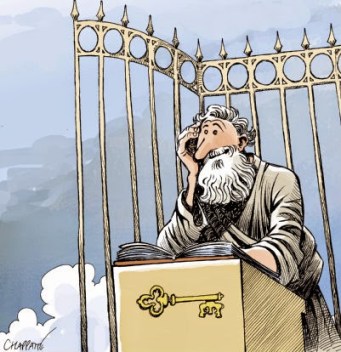
There was a man who died, and upon his death he arrived at the pearly gates in heaven. He looked all around and soaked up the sights of the fluffy clouds and he was so excited to see people just on the other side of the gate that he had missed for so long. He wanted to run straight to them but there was a line leading up to St. Peter. So the man got in line and waited patiently for his turn.

He knew it wasn’t the right thing to do, but as he got closer he couldn’t help eavesdropping on the conversations between St. Peter and the soon to be residents of heaven. “Oh you did so much for that soup kitchen!” “You’re the one who read scripture out loud in church every week, very good, very good.” And so on. But when the man’s turn came, St. Peter looked down in the Book of Life and then said, “Yeah you were a believer, but you skipped the ‘not being a jerk about it’ part.”

Saying, and living by, “love the sinner, hate the sin” makes us jerks. It means the log in our eye is so large that we are unable from seeing others as brothers and sisters. It means that our own sinfulness blinds us from truly loving.

There is sin in this world. People will make the wrong choice, they will choose evil. We will make sinful decisions; we will avoid doing the things we know we should do. But instead of rallying together and focusing on all the sins and problems of other people, instead of flocking to the Internet and like-minded dinner parties to declare the sins of the other, we all need to take a good hard look in the mirror. We need to recognize the log in our own eyes before we dare point out the speck in another.

Because Jesus, looks right into our hearts and says “I love you, log and all.”

God in Christ knows the prejudices we’re ashamed of, God knows the golden calves we worship instead of Him, God sees our self-righteousness and indignation and says, “I love you, log and all.”

God sees the emails we craft out of anger but are too afraid to send, God knows the ways we lie to our spouses and our children, God witnesses the depth of our depravity and says, “I love you, log and all.”

God was there with us in the voting booth, God hears the sighs we utter in response to someone on the other side of the political aisle, God knows how we really feel and says, “I love you, log and all.”

“Love the sinner, hate the sin.” We say it. We read it. We might even live by it. But we should just stop with the word “love.”

Love.

617564_1

Not Hallmark love. Not Valentine’s Day love. But love like Jesus. That might be good enough. Because loving like Jesus does not mean turning away from the sinners in our midst. It means walking up to a crowd of people who are about to do something terrible and saying, “Who among you is without sin? Let him cast the first stone!”

It means encountering the beauty of the Lord and responding with the truest words we can ever say: “Have mercy on me Lord, a sinner.”

It means being humble enough to seek out those whom we have wronged and asking for their forgiveness.

It means caring for those on the margins regardless of the decisions they’ve made or the sins they’ve committed.

It means reaching out to the people who we disagree with most not to change their mind, but to offer them the same thing Jesus offer us, time.

So the next time we say “love the sinner, hate the sin.” Let’s just stop with love. Amen.

Devotional – Isaiah 58.1

Devotional:

Isaiah 58.1

Shout out, do not hold back! Lift up your voice like a trumpet! Announce to my people their rebellion, to the house of Jacob their sins.

Weekly Devotional Image

Sin is an ugly word. It is an ugly word because it makes us uncomfortable. When I encounter people in my life who no longer attend church, they often describe their reasoning as “church was only about sin” or “I left every week feeling miserable.” Sin is an ugly word.

It is true that in some churches sin is the focus of nearly everything. But in Mainline Protestant Christianity, we avoid even mentioning sin because of its ugliness. We preachers would rather talk about God’s loving nature than God’s judgment. We would rather tell our people to love their neighbors as themselves than to tell their neighbors that they’re sinners. We would rather skip over the hard passages about condemnation than reflect on how they are still speaking directly to us even today.

And yet, God speaks through Isaiah to say, “Shout out, do not hold back! Lift up your voice like a trumpet! Announce to my people their rebellion, to the house of Jacob their sins.”

There are definitely bad ways to “shout out” about people’s sins. Logging on to Facebook in order to belittle the other for their differing political or social opinion might sound like a blaring trumpet blast, but it accomplishes nothing good. Sending anonymous letters or notes to people because of their former lifestyles might feel like “not holding back” but it usually just leaves them hurt and afraid. Judging others from afar with our like-minded peers might feel like “announcing their rebellion” but it will just harden our hearts.

ba5a88_745ed11d50df4caf94abfd12d5025422

However, there are good ways to “shout out” about people’s sins. First, we must remember that we too are sinners who have fallen short of God’s glory. Second, we can only speak the truth of another’s sin in love, which is to say, we need to be in relationship with the person to such a degree that they can hear what we have to say without blowing it off. Third, we can only “announce rebellion” if we are willing to help the person to move out of their sinfulness; we cannot simply declare their sin like a trumpet blast unless we are willing to do the hard work of helping them out of it. And finally, we can only announce another person’s sins if we are prepared to hear our sins as well.

The existence of the church is a response to our need to hear about our sinfulness. We gather together to hear the Word so that we might be transformed into God’s people. But this cannot happen if we are more concerned with transforming others, than with transforming ourselves. We cannot announce the sins of another, unless we can first say “Have mercy on me O Lord, for I am a sinner.”

So shout out, and lift up your voices like a trumpet. But beware, for the trumpet will blow in your direction as well.

God Said It, I Believe It, That Settles It

Deuteronomy 23.12-14

You shall have a designated area outside the camp to which you shall go. With your utensils you shall have a trowel; when you relieve yourself outside, you shall dig a hole with it and then cover up your excrement. Because the Lord your God travels along with your camp, to save you and to hand over your enemies to you, therefore your camp must be holy, so that he may not see anything indecent among you and turn away from you.

1 Corinthians 14.32-35

And the spirits of prophets are subject to the prophets, for God is a God not of disorder but of peace. As in all the churches of the saints, women should be silent in churches. For they are not permitted to speak, but should be subordinate, as the law also says. If there is anything they desire to know, let them ask their husbands at home. For it is shameful for a woman to speak in church.


We have a problem. I’m sorry that I have to use the pulpit to bring it up, but this is the best way to reach the highest number of people. We, as a church, have fundamentally broken one of God’s laws and we need to do something about it. We need to pray for forgiveness. We need to seek God’s mercy. And, we should get moving on this issue quickly in order to establish our faithfulness before the Lord.

We need to stop using the church bathrooms.

Now, some of you might be thinking: What in the world? Stop using the bathrooms? We’ve heard him say some strange stuff from the pulpit, but this has to be the strangest!

But scripture is pretty clear. We are supposed to have a designated area, outside the church, where we shall go when nature calls. We are supposed to keep a trowel with us at all times so that when we relieve ourselves outside, we can dig a hole and then cover up our excrement. We need to do this because the Lord is with us when we are in church, therefore this church must be holy and we can’t let the Lord see anything indecent among us.

So, after prayerful consideration, the trustees have voted to permanently close all the bathrooms in the church building, and we will construct some outhouses on the edge of the property for excrement disposal.

Just kidding.

lexica

Have you ever heard someone preach on Deuteronomy 23.12-14? I haven’t, nor have I even encountered it during a bible study. But in the 1880’s, churches and bathrooms were quite the topic of sermonic conversation. The advent of indoor plumbing had arrived and the question about whether or not to have bathrooms in churches started to pop up.

By the logic of the Old Testament, churches were seen just like the Israelite encampments and because of this the same rules about where people could relieve themselves were applied. Many preachers used this argument from their pulpit more than a century ago to fight the growing trend to build bathrooms in churches!

Today, when designing a new church, one of the first questions isn’t what the sanctuary should look like, or what kind of design will enhance the altar, or even how many people can fit in it, but how many bathrooms should there be, and where should they be put.

How do we understand the Word of God? Do we believe that all scriptures have been inspired by God and are useful for teaching? What does it even mean that God inspired the writing of scripture?

Years ago I was invited to participate in a bible study that met once a week. At the time we were going through the gospel of Matthew when one of the women in attendance interrupted with a dilemma for the group. Her son told her that he was thinking about getting a tattoo and she knew that God forbids this kind of behavior in the Old Testament. It was clear that she was looking for approval from the rest of us, but I opened my big mouth and said something like, “Well, I don’t think its that big of a deal” To which she replied, “If God says it in the bible, then the issue has been settled!”

I should have stopped right there, but I couldn’t help myself. “So, you don’t eat pork or shrimp? And you are going to rally the community together to stone your son to death for rebelling against you? And you didn’t mean to wear earrings today because you know the bible forbids them as well?”

This sort of extreme biblical literalism is problematic, and basically impossible. If we try to live by the Word with extreme rigidity, we would not be allowed to wear clothing with blended fabrics, we’d have to completely rethink our diets, working on the Sabbath would get us killed, and men would not be allowed to trim their beards. Ever.

            God said it, I believe it, that settles it.

This is another one of the trite and cliché Christianisms that float around in conversation. When Christians get into an argument about a particular biblical precept, like prohibitions against tattoos or homosexuality, they will take a verse and use it like a weapon against the person they disagree with. God said it, I believe it, that settles it.

But, whether we admit it or not, rarely do we read the bible and think, “Okay, that settles it then.”

Today, no one worries about whether to build a church without a bathroom, we don’t hear preachers belabor biblical dietary restrictions, and we neglect a great number of scriptures while at the same time we use scripture to attack others.

There are all sorts of rules and regulations in scripture that, if we’re honest, we pick and choose to emphasize.

bible-and-its-interpretation

As we read earlier, Paul is clear in more than one letter that women should not speak in church. And yet, this church had a female pastor for a number of years, and our liturgist this morning just read out loud from the bible! Heaven forbid! A woman speaking in church! Can you believe it?

Of course, some churches still believe that the words about the subordination of women are the gospel truth. In those church, women are not allowed to serve in leadership positions, they are not allowed to teach Bible Studies where men are present, and they are not allowed to serve in any capacity that would require them to speak in front of the congregation.

I’ll tell you right now, this church would not be here if women kept their mouths shut. We are as faithful as we are because the women in our midst have been brave enough to speak what God has placed on their hearts, and because we have listened.

So what are we to do? We can’t just throw out the bible, but at the same time we can’t live by every single word within it.

Like the apostles and disciples before us, we read scripture and we hear God speaking through it. But we also ask questions of it. We consider context. We wonder if God really intended women to remain silent in church. We recognize that things like slavery are counter to God’s will, despite more than 200 verses that support it in the Bible. We don’t preach and teach that having bathrooms inside churches are offensive to God.

We follow Jesus’ example.

Jesus, Son of Man and Son of God, did not adhere to strict biblical literalism. He had different interpretations of the Sabbath restrictions, he had stronger opinions about divorce and adultery, and he regularly disobeyed the Law by eating with those deemed unclean.

Living as a Christian, reading the bible, it’s all about interpretation. And, to be clear, interpretation does not mean to change the text, or to ignore it, but to proclaim it for this time and for this place.

Even the Bibles in our pews are themselves a work of interpretation. Someone, and more often than not some people, made particular choices about how to translate particular words from Hebrew and Greek into English. This might not seem like a big deal, but if you take something like one of the most beloved of all scriptures: For God so loved the world that he gave his only begotten son that whosoever believe in him may not perish but have everlasting life. The word for “perish” in Greek is apollumi which can mean perish, but it can also mean to die, to be destroyed, to be lost, killed, or ruined. Each of these translations can change the meaning of the text slightly, and are therefore a product of interpretation.

So whenever we take up a bible, whenever we flip to a specific passage, the work of interpretation started long before our eyes flow over the English translation. But nevertheless, even the best translations leave us to continue the task of interpretation.

How do we do it? Well, we don’t do it in isolation. We don’t read our bibles in our living rooms never to speak about the words again, we don’t listen to a sermon only to have that be the only time we encounter the words.

We interpret God’s Word in community. We go to bible studies, we send emails to our friends and to our pastor, and we do what we need to do in order to comprehend that which is often incomprehensible.

And we let Jesus help us interpret. In the beginning was the Word and the Word was with God, and the Word was God. As the definitive Word, Jesus helps us to understand the words of scripture. We read from the Old and New Testament alike through the lens of Jesus and we begin to wrestle with how these words continue to live and breathe in our lives today.

But that requires a lot more work than “God said it, I believe it, that settles it.” It compels us to actually take up our bibles, read them, and talk about them. It challenges us to ask hard questions and produce new ideas. It requires us to believe that this book is in fact the living Word of God and that it continues to speak truth in new and exciting ways, perhaps in ways we cannot even imagine.

This last week has been filled with controversy from the Oval Office. In their first week, the new administration put forth a number of executive orders including a call to begin construction on a wall at our southern border, a gag order for the EPA, and the halting of refugee migration from a number of countries.

c3nffwbxaae5lbr

On the same day we celebrate the liberation of the concentration camps in Europe, our country said, “we don’t want them” to people fleeing persecution and destruction.

Now, no one has said that this has been done because of scripture, but the bible should have played a role in the decision if our politicians are going to keep claiming their Christian allegiance.

Moses was a refugee after fleeing from Egypt.

            Ruth was a refugee after her husband died and she followed her mother-in-law to a strange new land.

            The entire Israelite people were refugees in Babylon.

            Jesus, the one we worship here in church, was a refugee. Jesus, like people in the Middle East today, had to flee his home out of fear of violence, persecution, and even death.

And yet, we tout these certain stories from scripture and hold them over people’s heads about behavior and identity. But when we start actively preventing the oppressed from entering the country, we forget all about the story of our Lord and Savior.

People have used this book, with understandings like “God said it, I believe it, that settles it,” to attack and belittle people for far too long. It has been used to justify the horrific practice of slavery. It has been used to subjugate and relegate women’s rights. It has been used to rationalize physical violence and aggression toward people of different religions. It has been used to incite fear and terror in those who do not believe. It has been used as a weapon again and again and again.

And now we, the people of God, join together to say “no more!”

“No more!” to the use of scripture like a weapon to oppress the weak and the marginalized. “No more!” to the complacent Christianity that stands idly by as people are attacked for whom they are. “No more!” to the backwards ways of the past that lose sight of God’s grace here and now.

“No more!” to God said it, I believe it, that settles it.

Devotional – 1 Corinthians 1.27

Devotional:

1 Corinthians 1.27

But God chose what is foolish in the world to shame the wise; God chose what is weak in the world to shame the strong.

Weekly Devotional Image 

When Pharaoh enslaved the descendants of Abraham, God chose a weak little baby abandoned by his mother to the Nile River to deliver the people out of bondage. When Goliath stood in front of the Philistine and Hebrew armies, God chose a foolish and weak little shepherd named David to bring him down. When the time came for the defeat of death, God chose to come in the form of a baby to die at the hands of the government in order to rise again.

Through the Old and New Testaments, God is forever subverting the expectations of the world with something foolish or weak. We can only imagine what people thought of Noah building his giant ark, or Isaiah wandering the streets naked for three years, or Jesus praying over a loaf of bread and cup of wine. God chooses what is foolish in the world to shame the wise; God chooses what is weak in the world to shame the strong.

For far too long, the world has treated an entire gender as foolish and weak. Even in this progressive land we call the United States of America, women still only make $0.80 for every $1 that men earn. The belittling of women is made manifest in a number of ways from churches that believe women do not have the right to preach, to companies that overlook hiring women because of their gender, to women who are made to feel that their fundamental role is to support their husbands.

But on Saturday, God subverted the perspective of the world through the gathering and marching of “foolish and weak” women to shame the wise and the strong. They did not need weapons and aggression and violence to achieve their goal, they did not need the tools the world values so dear, they used the foolishness and weakness of peace to say more than any weapon ever can.

632318086-dc-rally-women-march-washington

What good news it is to know that God is still upsetting and overturning the world to shame the wise and strong! How glorious to know that women all across the world can come together in such a holy way to protect those whom the world has dismissed! How beautiful to see women powerfully and deliberately march for empowerment!

God makes the first last, and the last first. The great story of scripture is the narrative of God turning the world upside down. O that God would do the same to all of our hearts who are more convicted by the ways of the world, than by the truth of the Good News.

God Won’t Give You More Than You Can Handle

Mark 2.1-5

When he returned to Capernaum after some days, it was reported that he was at home. So many gathered around that there was no longer room for them, not even in front of the door; and he was speaking the word to them. Then some people came, bringing to him a paralyzed man, carried by four of them. And when they could not bring him to Jesus because of the crowd, they removed the roof above him; and after having dug through it, they let down the mat on which the paralytic lay. When Jesus saw their faith, he said to the paralytic, “Son, your sins are forgiven.”


On the day of the funeral, everything felt too familiar. The pews were filling up with the same people who were here the week before, the same family was waiting in the narthex, and our organist was even playing some of the same music as people were walking in.

I stood right here in front of the gathered congregation and asked everyone to stand for the family. Leading the profession were two daughters who were about to bury their father after burying their mother the week before. Their grief and pain and anger were palpable as they slowly walking down the center aisle, and everyone watched them as they passed.

And we did what we do for a service of death and resurrection. We prayed. We opened up the hymnals and proclaimed God’s faithfulness through song. We listened. We grieved. We cried.

As we finished, I watched the pallbearers stand up and surround the coffin. With hands shaking in nervousness and fear they carried their friend’s body out of the church and put him in the hearse.

And we did what we do when travel to a cemetery. We got in our cars and turned on our hazard lights. We followed one another through the streets of Staunton. We watched cars slow down and pull over out of respect for what we were doing. We drove. We listened. We grieved. We cried.

After arriving at the cemetery, I watched the same pallbearers carry the coffin to the grave over uncertain soil. With sweat perspiring on their foreheads they lowered their friend to the ground and stood beside the family.

And we did what we do by the graveside. We prayed. We listened. We placed dirt on the coffin. We said what we needed to say. We listened. We grieved. We cried.

After the final “Amen” I waited by the grave with a few others, making sure the family was comforted. I overheard familiar and charming anecdotes about the man we just gathered to bury. I witnessed family members reach out to one another for the first time in many years. I saw a lot of tissues filled with tears wadded up in clenched fists.

And then I saw something I’ll never forget. A man, unknown to me, walked right over to one of the daughters devastated by the loss of both her parents. He placed his hand on her shoulder and said, “Don’t worry, God won’t give you more than you can handle.” And with that he turned around and walked away.

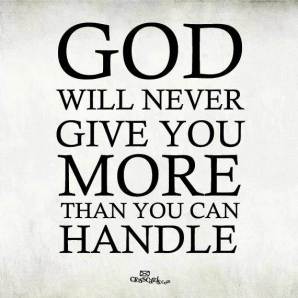
God won’t give you more than you can handle.

635787512482303409305489483_29f1979c65db2aa1627169bad37391df-imgopt1000x70

I’m sure that all of us here have heard this statement, or some form of it, in our lives. It is part of that trite and cliché Christian-lingo that we use to fill uncomfortable silences when we don’t know what else to say. And it’s not true.

Let’s start with the beginning: God won’t give you… We’ve talked about it with every sermon of this series so far; God doesn’t give us our sufferings. God is not some sadist who delights in our trials and tribulations. God is not some architect of divine destruction. God is not sitting up in heaven plotting away about what terrible things to send for us to handle.

Can you imagine going to a devastated neighborhood in Chicago to families whose sons have been killed by gunfire and saying, “Don’t worry God won’t give you more than you can handle”?

Can you imagine going to a young mother recently diagnosed with breast cancer and saying, “Don’t worry, God won’t give you more than you can handle”?

Can you imagine going to the millions of people in this country who are terrified of losing their healthcare coverage in the next few months and saying, “Don’t worry, God won’t give you more than you can handle?”

God did not kill those families’ sons, God did not give that woman breast cancer, and God is not responsible for the arguments about whether or not to eradicate the Affordable Care Act.

Sometimes, we say things like “God won’t give you more than you can handle” because we don’t know what else to say. We encounter the shadow of suffering that is so suffocating we don’t know how to respond. So instead, we will that awful void with awful words. And we make God into a monster.

The problem is that when we use trite and cliché words like the ones we are confronting this morning, we imply that God chooses to make people suffer.

Jesus, God incarnate, had been on the road for a while, going from town to town, synagogue to synagogue, proclaiming the Good News, teaching about the kingdom of God, and healing those on the margins of society. Word about his ministry spread pretty vast, and he returned to Capernaum for a few days, perhaps to rest. But so many people knew where he was that they surrounded his house and Jesus spoke the Word to them.

Some friends heard about what was happening, so they went to their paralyzed friend and carried him on a mat to Jesus. When they could not bring him to the Messiah because of the crowd, they carried him to the roof, dug through the ceiling, and lowered their friend to Jesus. And when Jesus saw the faith of the friends, he looked at the paralytic and said, “Son, your sins are forgiven.”

What a strange and beautiful story. Friends with such profound faith were willing to carry their friend, and dig through a roof, just so he could encounter the living God.

I often wonder about the tradition of pallbearers at funerals. Did it start of out a practical necessity? Is there strong theological purpose behind it? Is it a unique Christian behavior?

But on the day I buried a husband after burying his wife the week before, the day I saw a man dismissively respond to the daughter’s suffering, I saw the connection between pallbearers, and the friends who carried the paralytic to Jesus.

When we cannot handle what’s happening in our lives, we need people who can carry us, and the ones we love, to Jesus.

We will face adversity in our lives. We will experience hardships. We, or someone we love, may struggle with debilitating depression or suicidal thoughts or grief so heavy it feels like someone is sitting on our chest. We might give in to the temptation of an addiction and lose contact with the people we need most. We may fall into a pit of financial debt that feels impossible to climb out of.

If we are like most human beings, at some point we will absolutely face things that are more than we can handle.

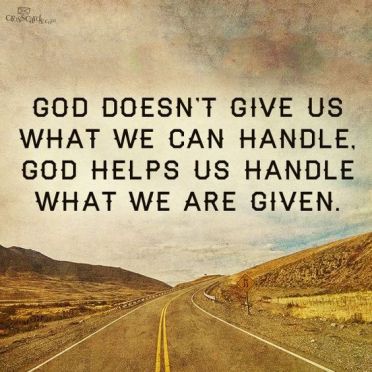
So here’s a corrective. It’s not that God won’t give you more than you can handle, but that God will help you handle all that you’ve been given.

6fa0c8a00d809d23761dfaa71b6b542a

This acknowledges that trials and tribulation will occur in our lives, and it promises that when we go through the muck and grime of life, God will be present.

When we’re walking through hard times, whether they were given to us by the random chance of life, or they’re a result of our own brokenness, or they’re signs of our captivity to the powers and principalities, it’s okay and good to admit, “I can’t handle this by myself, and I need help.” There are times when we need a doctor, or a therapist to carry us. More often, we need family, friends, pastors, neighbors, and brothers and sisters in our church family to come alongside us to carry us through.

God does not give us more than we can handle. God gives us Jesus Christ so that we can handle what life gives us.

For a lot of people, what happened on Friday in Washington DC was more than they could handle. Whether it was the pent up frustration with the political rhetoric that overflowed over the last 18 months, or witnessing a billionaire place his hands on Abraham Lincoln’s bible, or experiencing the great swing of the pendulum from one political ideology to another, it felt overwhelming. Some responded with violent protests and destroyed shop windows and attacked the police. Others responded with peaceful demonstrations making sure their voices were not stomped out among all the shouting debauchery. There were the political talking heads offering their opinions about who was right and who was wrong. There were smug smiles and there were frightening frowns. The inauguration, for some, was more than they could handle.

For others, the last eight years has been more than they could handle. Whether it was the constant feeling like the country was slipping out of their fingers, or the realization that the American dream is not what it once was, or the rise of oppositional and divisive voices, it felt overwhelming. Some responded with protests and boycotts of particular institutions, others responded by focusing inwardly and praying for change, and still yet others waited patiently for a new direction. For eight years there were plenty of talking heads offering their unsolicited opinions about who was right and who was wrong. The last eight years, for some, was more than they could handle.

Some say the time has come for all of us to just get along. A couple weeks ago I even told you that we, as a church, should have a collective New Year’s resolution to be more kind.

Kindness and getting along are good and nice. But there are people around us, people in our lives, who need more than kindness and getting along. There are people desperately clinging to the hope of their healthcare coverage completely unsure of what it about to happen. There are people who are hopeless when confronting their joblessness and economic futures. There are people shaking and quaking about their faith and whether or not they are going to be forced to register themselves because they wear a particular piece of cloth on their heads. There are people who see police officers as enemies and not community protectors.

There are people in our community; there are people in our church, who have more than they can handle right now.

We need people, like the friends who carried the paralytic to Jesus, to carry others who have more than they can handle. We need people who can look us in the eye and tell us we have a problem. We need people who will call their friends every night just to get them through a profound period of loss. We need people like all the women who marched in solidarity all across the world yesterday. We need people with eyes wide open to the horrible suffering of the people around us so that it does not go on unnoticed. We need people who are unafraid of the consequences for questioning the status quo. Right now, we need people who are brave enough to carry us to Jesus. Amen.


dumb-things-christians-say-sermon-series-idea

Devotional – Psalm 27.4

Devotional:

Psalm 27.4

One thing I asked of the Lord, that will I seek after: to live in the house of the Lord all the days of my life, to behold the beauty of the Lord, and to inquire in his temple.

Weekly Devotional Image

Of all the questions I get asked, the one I hear the most is: “What’s heaven like?” I’ll be down in the preschool when one of the children will saunter over and randomly ask the question with their eyebrows askew. Or I’ll be sitting with a grieving family planning a funeral service when a new widow will ask the question as if she’s never really thought about it before. Or I’ll be working on a sermon in a coffee shop with my bible open on the table when a stranger will walk up to ask the question out of nowhere.

“What’s heaven like?”

If Hallmark, the Lifetime channel, and uncles who tell bad jokes have anything to say about it, then heaven is a mysterious place in the clouds with fat little cherubic babies floating around playing harps, golden arches keeping certain people out, and Saint Peter sitting with a ledger.

st-peter-pearly-gates

If one of our preschool parents has something to say about it, then heaven (as she told her daughter) is a place filled to the brim with her favorite candy.

But if scripture has anything to say about it, then heaven is like a never-ending worship service. Which, to some people, sadly, sounds more like hell than heaven.

However, the bible is forever making connections between the worship of the Lord here and now, with the worship of the Lord in the New Kingdom. And not the announcements that always take to long to list at the beginning, and not the logistics of sitting down and then standing back up for hymns, but the beauty and wonder of encountering the beauty and wonder of the Lord.

The psalmist says the one thing worth seeking after is to live in the presence of the Lord each and every single day, to behold the beauty of the Lord, and to wonder and inquire in the house of God. In weekly worship, when we experience God’s faithful presence through a choice phrase in a prayer, or a melodic move in a hymn, or even a powerful sermon, we are catching a glimpse of heaven on earth. For when we gather in the house of the Lord, when we are confronted with God’s majesty, what could be better?

As Christians, we do well to seek out the presence of the Lord here and now as foretaste of the kingdom of heaven. We do it on Sundays when we gather together to proclaim and respond to God’s Word. We do it when we are invited to the table for communion. We do it when we sit with a friend and earnestly pray together. We do it when we hear God speak to us in the still small voice. And when we do, we receive an answer to the question, “What’s heaven like?”