Why Do We Give?

Matthew 22.15-22

Then the Pharisees went and plotted to entrap him in what he said. So they sent their disciples to him, along with the Herodians, saying, “Teacher, we know that you are sincere, and teach the way of God in accordance with truth, and show deference to no one; for you do not regard people with partiality. Tell us, then, what you think. Is it lawful to pay taxes to the emperor, or not?” But Jesus, aware of their malice, said, “Why are you putting me to the test, you hypocrites? Show me the coin used for the tax.” And they brought him a denarius. Then he said to them, “Whose head is this, and whose title?” They answered, “The emperor’s.” Then he said to them, “Give therefore to the emperor the things that are the emperor’s, and to God the things that are God’s.” When they heard this, they were amazed; and they left him and went away.

When I was in my final year of seminary, I had a friend who asked me to fill in and preach at his church one Sunday morning. He had labored for the previous years as a full time student and a full time pastor and needed a little break. Also – he was given tickets to a Carolina Panthers football game, though I was forbidden from telling his church that where he was instead of with them on a Sunday morning for worship.

The tiny United Methodist Church was in the middle on nowhere North Carolina, and I was nervous about leading worship for a congregation that I had never met. However, I figured God is good and that God would show up even if my sermon fell flat.

The sanctuary was simple and charming with white walls and florescent lights hanging from the ceiling, there was a cross above the altar that was draped with an American flag, and it was so quiet I actually thought that maybe I had showed up at the wrong church.

However, within a couple minutes, the lay leader of the church arrived and greeted me enthusiastically as if I was a first time visitor of the church, only to later realize that I was the stand-in pastor for the day. He quickly guided me through the sanctuary, gave me the grand tour (he even showed off the recently renovated bathroom) and then informed me that he was the head usher, the liturgist, the organist, and the treasurer.

From what I can remember the service went fairly well, through most of the congregation was utterly bewildered by academic deconstruction of an apocalyptic prophecy from the book of Daniel (something I thank gave up doing that day), and there was an infant who wailed throughout the entirety of the sermon. I like to think that she liked my preaching so much that it drove her to tears.

When the service ended, I finally had a better chance to look around the sanctuary and I noticed a list on the wall behind the pulpit for the hymns of the day, the offering brought in from the week before, and the deficit regarding the annual budget. There in big numbers for everyone to see was how far away they were from keeping up with their plan, and it was a staggering amount of money.

On my way out I thanked the lay-leader/usher/organist/treasurer for the opportunity to preach and asked why the church felt the need to display the deficit for everyone to see every Sunday.

I’ll never forget how casually he shrugged his shoulders and said, “Guilt is the only way to get them to give.”

Offering

Why do we give? Taking time to talk about financial giving in the church is about as awkward and uncomfortable as it gets. Money, in general, is one of the taboo topics of normal conversations. We don’t ask how much someone makes in a year, even if we’re curious. We avoid asking for financial assistance or help because it requires too much vulnerability. But then we take the taboo subject of money, and put it together with religion (another taboo) and we get the double whammy of things we don’t like talking about.

It seems some things never change.

The Pharisees and the Herodians wanted to trap Jesus in his words. “Tell us,” they said, “should we pay our taxes to the emperor, or not?” There’s no good answer to the question. If Jesus said, “Yes, you must pay your taxes” it would cause a rift among those who suffered under the weight of dictatorial Roman rule. And if Jesus said, “No, you don’t owe the government anything,” his critics could have charged him with insurrection and he would have been executed.

And it was all about money.

Jesus however, answered in a way that has captured the hearts and minds of Christians for millennia: “Bring me a coin… whose head is this and whose title?” The people responded, “The emperor’s.” And Jesus said, “Give therefore to the emperor the things that are the emperor’s, and to God the things that are God’s.” And when the crowds heard his response they were amazed and they went away.

2000 years later and taxes and money and giving still drive us crazy. It’s a hard subject to talk about. I certainly don’t enjoy it. We, and by we I really mean you and we, we would rather have a service about grace and mercy than one about sin and sacrifice. Which is strange when we consider the fact that Jesus talked about money more than just about anything else during his earthly ministry. For Jesus, money was a subject worth confronting because it had taken over the lives of his peers and it was leading them on a path of disappointment, regret, and fear.

We don’t like talking about money because what we do with our money is personal and private right?

collection-plate-money-hands

A UMNS photo illustration by Mike DuBose. Accompanies UMNS story #099. 3/20/12.

To talk about giving in the church, to address the subject of why we give, we have to get personal. It would be shameful for me to stand here each and every week calling for the gathered body to give your gifts to God if I, myself, was afraid to talk about my own giving. If we want to be a church of gifts, then we must first be a church of vulnerability and honesty.

Before I became a pastor, I rarely gave to the church. I have vivid memories of sitting in church throughout my adolescence, and feeling waves of guilt as I passed the offering plate over my lap to whomever else was in the pew. It helped that I was a kid and had no money to give in the first place but the guilt was still there.

It is a powerful thing here at Cokesbury when the children come up for their message and they place their offering in the plate. They are creating a habit of generosity that was largely absent from my childhood.

By the time I made it to college and seminary, I still attended church but rarely gave to the church. I certainly volunteered my time, led mission trips, and taught bible studies, but giving money to the church was not on my radar.

Then I was appointed to my first church. I had a steady income, and Lindsey and I started to tithe. And honestly it was really hard. We were a young married couple with seminary debt, and then we had a baby. Yet, we covenanted with God and one another to give 10%. In the first months it was harder that I thought it would be. I would find myself thinking about those thousands of dollars that I could have spent on other things, but we got into the habit and we kept giving. And after a while it became pretty easy because I just withheld the 10% from my paycheck and after time I stopped thinking about it at all.

But then we came here. We had to move and buy a house. It was easy when the money was taken out automatically, but now we needed to write a check and place it in the plate. There is a place of power and privilege that comes with being a pastor of the church, particularly when it comes to money. I get to sit up here while the offering plates make their way throughout the sanctuary. But the covenant to give is not one for pastors alone, nor is it for laypeople alone. The covenant to give is one made by all Christians, one that is challenging, but one that is ultimately what faith is all about.

My conversion toward tithing did not happen in a big shiny moment, but was a gradual transformation. The more I give, the longer the habit continues, the better it becomes, and things start to change.

            Instead of imagining what I could do with the money I’ve given to church, I’ve started tangibly witnessing what the money I give is doing for the church and for the kingdom.

Give, Donate, Charity

Giving to the church requires a conversion; it is built on a vision where we recognize how our blessings can be used to bless others. It is built on the knowledge that we give because so much has been given to us. It is built on the call to give not out of guilt, but out of generosity.

We are called to give because we have a shared vision and are invited into the mission of God through the church. Even a seemingly small act of generosity can grow into something far beyond what we could ever imagine – The creation of a community of love in this world.

Our generosity helps God build the kingdom here on earth.

But, we should not be expected to give, nor feel inclined to give without knowing why or to what we are giving. To just stand before you and say, “give give give” or to have a sign on the wall about out finances prevents us from developing strong relationships with the people and programs we serve. So, here are just three aspects of what our church does with our gifts.

At Cokesbury we believe in providing meaningful, fruitful, and life changing worship every week of the year. We plan months in advance, connect messages with the music, and look for imaginative ways to respond to God’s Word in the world. This means that we keep our sanctuary in the best shape possible for the worship of God, and use the great gifts of all involved in the church to make it happen. As a church we regularly welcome first-time visitors to discover God’s love in this place and help to develop professions of faith in Jesus Christ.

At Cokesbury, we believe in nurturing those in the midst of their faith journeys. We spend a significant amount of time and resources to help disciples grow in their faith and love of God and neighbor. We have numerous classes and opportunities to study God’s Word, whether its through Sunday School, Thursday Night Bible Studies, or Vacation Bible School. Everyone that participates in any of our groups is able to take what they learn and apply it to their daily lives whether they’re eight or eighty.

And at Cokesbury, we believe in witnessing to our faith in service beyond ourselves. We strive to serve those in need through a mosaic of opportunities in order to be Christ’s body for the world. Every year we have apportioned giving that directly impacts people in our local community and across the world. We provide support to agencies in our area like Hilda Barg and ACTS, and others. We help people with acute needs through discretionary accounts. And we have a great number of other missional activities that are all focused on helping other experiences God’s love through the work of the church.

We give from our abundance to bless others. Whether it’s the people in the pews next to us who gather for worship, kids from the community who show up for church events, or the countless people around the world who need help. We give out of generosity because so much has been given to us.

Sometimes when we read the story about Jesus’ response to the question of taxes, we liable to water it down to something like: Jesus leaves the choice up to us. Rather than falling into the trap of the Pharisees or the Herodians, rather than siding with the empire or inciting insurrection, Jesus breaks down the question and put the ball in our court.

But that leaves the passage without saying much of anything and prevents it from ringing out the stinging truth: We can put all of our trust in our money, we can use it to do all sorts of things in the world, but if we think that it all belongs to us, or has come to us simply because we deserve it, then we’ve failed to recognize the One from whom all blessings flow.

This passage about money isn’t so much about whether or not we should pay our taxes. Instead, it calls into question what we are doing with our money, and why we are doing what we are doing. It forces us to confront whether or not we believe God is the source of our being, or if we believe material objects can bring us satisfaction in this life. It begs us to reconsider what we’ve spent our money on, and if it helped the kingdom at all.

Give therefore to the emperor the things that are the emperor’s, and to God the things that are God’s. Yet, as Christians, we believe that we, and everything we hold dear, belong to God. Amen.

An Inconvenient Truth

Matthew 18.21-35

Then Peter came and said to him, “Lord, if another member of the church sins against me, how often should I forgive? As many as seven times?” Jesus said to him, “Not seven times, but, I tell you, seventy-seven times. For this reason the kingdom of heaven may be compared to a king who wished to settle accounts with his slaves. When he began the reckoning, one who owed him ten thousand talents was brought to him; and, as he could not pay, his lord ordained him to be sold, together with his wife and children and all his possessions, and payments to be made. So the slave fell on his knees before him, saying, ‘Have patience with me, and I will pay you everything.’ And out of pity for him, the lord of that slave released him and forgave him the debt. But that same salve, as he went out, came upon one of his fellow slaves who owed him a hundred denarii; and seizing him by the throat, he said, ‘Pay what you owe.’ Then his fellow slave fell down and pleaded with him, ‘Have patience with me, and I will pay you.’ But he refused; then he went and threw him into prison until he would pay the debt. When his fellow slaves saw what had happened, they were greatly distressed, and they went and reported to their lord all that had taken place. Then his lord summoned him and said to him, ‘You wicked slave! I forgave you all that debt because you pleaded with me. Should you not have mad mercy on your fellow slave, and I had mercy on you?’ And in anger his lord handed him over to be tortured until he would pay his entire debt. So my heavenly Father will also do to every one of you, if you do not forgive your brother or sister from your heart.”

I don’t know what it is about weddings, but people really let themselves go when they gather to celebrate two individuals joining together. Maybe it’s the beauty of a ceremony focused on love, or perhaps it’s the atmosphere of family members and friends rejoicing together, or maybe its just the abundance of free alcohol, but weddings are a rare moment where people appear to be the truest selves.

If you were here last week you’ll know that I wasn’t. While Michael was bringing the Word I was flying back from Maine where I had just presided over a wedding ceremony for one of my best friends. And I want you all to know that I missed you. I missed being here in this place worshiping together, I missed the choir, I missed seeing all of your beautiful faces.

That’s not to say that I had a bad time at the wedding. On the contrary, I had a great time. People were so over-the-top with their compliments about the wedding sermon and ceremony, perhaps because of the libations, or maybe because many of the people in attendance had bad experiences of weddings in the past and I offered something different. I don’t know what it was, but people seemed to like it.

Now, I want to share with you all that I made a few mistakes at the wedding. During the prayer before the dinner at the reception I made an offhand comment about how people needn’t hide their wine glasses behind their backs when they talk to me because, after all, Jesus’ first miracle was turning water into wine. I even prayed about how we should celebrate together and learn to party like Jesus.

If only I hadn’t used those last three words. Because, throughout the rest of the evening, a slew of people who were really enjoying themselves would wander over, slap me with a high five and scream, “Party like Jesus!”

Another mistake: I never quite know what to do when the bride and groom kiss for the first time. I mean, I’m right up there next to them and that moment is a favorite for photographers. So, right before I said, “You may kiss the bride” I took a step back and bowed my head so as not to appear too creepy in any photographs. However, what I didn’t anticipate was how my baldhead would appear like a shining beacon in the photos that are now all over Facebook.

But all in all, it was a remarkable celebration and I count myself blessed to have been part of it.

21458112_10155713151057840_9203595134897334660_o

During the reception, while I was milling about and striking up conversations with people, there was a youngish man who approached me and outstretched his hand. He made a few kind comments about the ceremony and as if he felt guilty due to my presence he said, “You know, I haven’t been to church in a long time.” I hear that kind of thing all the time and I never know how to respond so I just don’t.

And then he continued, “But,” he said, “If church was like that ceremony I’d be there every Sunday.”

I should’ve said “Thanks” and politely walked away. But instead I opened my big mouth: “Church shouldn’t be like that every week.”

“Why not?” he asked.

            “Because, if church was like that every week, we wouldn’t need it.”

I’m not sure what has happened over the last few decades in the church, at least in the United Methodist Church, but there was a time when one could expect to hear just about the same sort of message every Sunday: we are sinners.

But no more. Instead of confronting that rather inconvenient truth, we want to make believe that the church is full of saints. We’d rather hear about grace than sin, we want to talk about mercy and not sacrifice, we want to be built up and not broken down.

We want our Sunday services to look more like celebratory wedding ceremonies than the confrontational and convicting services of the past.

It’s as if, because we want to appear so perfect on the outside, we have forgotten who we really are on the inside.

Peter said to Jesus, “Lord, how many times should I forgive someone in the church who has sinned against me? Seven times?” And Jesus said, “You’ve got to forgive seventy-seven times.”

Forgive-Me

Notice the context of Peter’s question, because it’s important. Forgiveness is often used in this overwhelming sense of totality. If someone gossips about me at work, should I forgive them? If someone cuts me off on the highway should I forgive them? But Peter doesn’t ask about anyone sinning against him, he asks about people who sin against him in the church.

Forgiving someone from the church is very different than just forgiving an individual from the community or even someone on the other side of the world. Frankly, its easier to forgive someone you’ll never see again than it is to forgive someone you’re going to see every Sunday for the rest of your life.

And notice the fact that Peter assumes he will be the one in a position to forgive. Which is to say, Peter assumes he will be the one who has the power to forgive.

Peter was a sinner, just like the rest of us. And, just like the rest of us, his chief sin was being blind to the fact that he was a sinner.

The inconvenient truth of our sinful and broken identities is that we expect the world, and others, to be perfect. Peter listens to Jesus and wants to know how many times he should forgive another person. A man goes to a wedding and wishes that church services could be filled with joy and happiness every single week. We want to know how many times we have to forgive someone because we are so convinced that others will sin against us and we forget that we sin against others as well.

Jesus’ response to Peter probes and prods us to ask ourselves, “How can we be at peace with one another?” But more than that, even more than forgiving one another seventy-seven times, Jesus’ words are all about how God has first forgiven us.

please_forgive_me

The man at the wedding just stared at me while people were gyrating on the dance floor. He thought about my comment for what seemed like a mini-eternity and then finally said, “Well, I think more people would go to church if it were like that every week.”

“Perhaps,” I said, “but the church isn’t in the business of growing for the sake of growing. The church is about telling the truth. And sometimes, offering and receiving the truth hurts.

I don’t like preaching about forgiveness because I’m so bad at it. I don’t like having to stand it this place and talk to people like you about it, because in doing so it’s like I’m holding up a mirror and realizing, all over again, that I’m a sinner.

Maybe you’re like me and you hold grudges, or you get frustrated with people, or sometimes you just can’t imagine forgiving someone for what they’ve done.

Maybe you’re like me and you want to put conditions on forgiveness.

Maybe you’re like me and sometimes the golden rule of, “do unto others as you would have them do unto you” turns into “do unto others as they have done unto you.”

Offering forgiveness isn’t easy.

            Receiving it might be even worse.

Jesus doesn’t leave Peter and the disciples with the seventy-seven times of forgiveness. He goes on to tell them a story.

A king forgives the debt of one of his slaves, who then berates a fellow slave for a much smaller debt. When the king receives word of what happened, he confronts the first slave about his inability to be merciful and orders him to be tortured. And then Jesus ends with this: “so it will be with you if you do not forgive your brother and your sister.

Jesus’ story, this parable meant to shed light on the virtues of forgiveness, is purposely intense. It is meant to be shocking. There is no way a slave could ever owe a king so much money, there’s no way the slave would ever be able to pay it back, nor would a king ever forgive such an outrageous debt.

But that’s what forgiveness is really like. It feels impossible and out of touch with reality.

Someone can do something that seems so small to others, but to us it can feel like a debt that is unachievable. We can be so fueled with anger over what people have done to us that we might want them to be tortured for what they’ve done.

Jesus’ response to Peter, to be honest, is pretty irresponsible. I mean, how logical is it to grant unlimited forgiveness? What kind of community can be sustained where individuals will be forgiven over and over and over and over?

But Jesus’ parable isn’t about us! It’s about God.

God is the one who first forgives our debt that we can never repay. Our sin, who we really are on the inside, our prejudices and our judgments and our mistakes, the things that are only known to us are such that we should never be forgiven. If we took the time to lay out all of our sins on the altar, if we listened to one another confess who we really are, we might not be able to look at one another ever again.

My friends, hear this inconvenient truth: You and I, we’re sinners. We’re broken. Some of us more than others, but all of us are sinners.

            That’s not something that’s easy to hear: I know it. I don’t like holding the mirror up to who I really am either.

Jesus knew that those who chose to follow him would wrong one another, that the disciples then and now would sin against each other, that there would be conflict. Therefore Jesus doesn’t offer a way to eliminate or avoid conflict, instead Jesus tells Peter and us what to do with it: We must remember who we really are.

If we are to be peacemakers capable of forgiving one another, we have to remember that God first forgave us.

If we are to take seriously Jesus’ command to forgive over and over again, we can only do so when we remember how God first forgave us.

If we are to be the church, then we have to know and believe that church is going to be messy sometimes. We’re going to hear and receive things in this place that will be hard to hear and receive.

The church cannot be a never-ending wedding feast.

Earlier in the service each of you were given an index card and you were asked to write down the name of someone from whom you need forgiveness.

I think it would’ve been all to easy to write down someone’s name you need to forgive and say, “when you leave church today, call them or text them and let them know they are forgiven.” But that would be too easy.

What’s harder is to look at the name of the person you wrote down and think about how, today, you can get in touch with them and ask them to forgive you. I promise it’s going to be hard to do, and it might actually make the situation worse than it is right now. When you have to ask someone for forgiveness you’re forced to recognize that you’re not as perfect as you think you appear to be.

This isn’t going to fix everything; it’s not going to make all the problems in your life disappear. And for that I am sorry. But we have no business, at all, talking about forgiving someone else unless we are willing to ask someone to forgive us for what we’ve done. Amen.

Devotional – Romans 13.10

Devotional:

Romans 13.10

Love does no wrong to a neighbor; therefore, love is the fulfilling of the law.

Weekly Devotional Image

On Saturday evening I will stand in front of Alex Chatfield and Brianna Gays in order to join them together in what we call “holy matrimony.” Months of planning will come to fruition in their wedding vows as they stare lovingly and longingly into one another’s eyes in front of friends, family, and the Lord. And I will have the best seat in the house (though I won’t be sitting and it won’t be inside) because I have the privilege of asking for God’s help to bless and sustain their marriage.

I have known Brianna longer than just about anyone else in my life. Her father and my father went to high school together and Brianna and I were basically raised as siblings. When she was on the homecoming court at a different High School (my school’s rival), I went to support her. When I was ordained, her family was there to worship with the entire Annual Conference. Countless birthday parties, and gatherings, and family vacations have solidified a friendship that really makes us feel like brother and sister.

IMG_2912

And on Saturday I get to challenge and charge her with a task far greater than anything she has experienced up to this point in her life; I will require and charge her (and Alex) to love one another knowing full and well that they are each marrying the wrong person.

Now to be clear: they are not marrying the wrong person because there’s something wrong with their relationship. They are each marrying the wrong person because they (and we) never really know another person in such a way that we can call a marriage “right.” They will promise to love and to cherish one another without knowing what their lives will look like in five years, or even what they will look like in five years. And they will do all of this under the auspices of “love.”

But what is love? Or, at the very least, what is the kind of love that sustains something like a marriage? Is love about attraction and aesthetics? Is love about commitment and loyalty? What is love?

Love, like marriage, is a mystery.

14711208_10154629498264438_6187026163682556235_o

Paul writes a lot about love, and more often than not the “love” Paul talks about has nothing to do with the Hallmark version of love that most of us are familiar with. Love, according to Paul, does no wrong to a neighbor. Love, according to Paul, is the fulfilling of the law.

What Alex and Brianna will promise to one another on Saturday night is really no different than what all Christians promise one another. As Christians we make covenants (through baptism) to love one another knowing full and well that we don’t really know one another.

And I believe that Alex and Brianna can, and will, do so faithfully, just as Christians can, not because of any power on their own part, but because God empowers them and us to do some wonderful and strange and remarkable things in this life; like getting married, like having lasting friendship, and like doing no wrong to our neighbors.

Devotional – Matthew 16.13

Devotional:

Matthew 16.13

Now when Jesus came into the district of Caesarea Philippi, he asked his disciples, “Who do people say the Son of Man is?”

Weekly Devotional Image

We were walking along the beach on Monday morning in North Myrtle Beach, South Carolina when a young teenage girl kept looking over at us. I had my son Elijah in my arms and my wife Lindsey was standing next to me and we were talking about nothing in particular when the girl shyly walked up to us. Before she opened her mouth I thought maybe she was going to ask us to take her picture, and then for a strange moment I thought she was going to ask to hold Elijah, but then she asked a question, “Excuse me, but do you know who Jesus is?”

In my mind I started to answer the question much like Peter answered: “Jesus is the Messiah, the Son of God.” I thought about scriptural situations to answer the question in as many ways as possible, I thought about famous images of Jesus that I could describe from memory, and I did all of this in my mind before I realized that she was trying to evangelize us.

So, all I said was: “Yeah, I know Jesus. I’m a United Methodist Pastor.” And at that moment I noticed the girl’s father standing off to the side as if to make sure she was doing it the right way. Upon hearing my answer, he walked up to introduce himself as a Nazarene preacher and we had a brief conversation about seminaries and church work.

42in-wide-23in-tall-beach-reach

But as they walked away to find their next victim, all I could think about was what would have happened if I had answered the question differently; what would she have said if my answer was simply, “No”?

Beach evangelism, walking up to a stranger with a question about Jesus, is not a new thing. For decades Christians have used it and other forms as tools to get people “saved.” But simply asking about Jesus as a means to talk about Jesus often results in shallow connections whereas Jesus commanded the disciples to share the good news in such a way that it resulted in the formation of friendships and communities. Or to put it another way: asking about Jesus in order to make disciples is different than living like Jesus so that others will be formed into disciples.

Peter was only able to answer Jesus question after spending years with him ministering to the crowds. Sometimes sharing the good news with other people takes years of living alongside them without trying to insert our faith into their schedules. I know God can work miracles through Christians approaching strangers on the beach, I know that those questions can be the seed that changes someone’s life, but I know that intentionally spending time with others over the long term will do far more for the kingdom than approaching people on the beach that we will never see again.

Sinners In The Hands Of A Loving God

Isaiah 56.6-8

And the foreigners who join themselves to the Lord, to minister to him, to love the name of the Lord, and to be his servants, all who keep the Sabbath, and do not profane it, and hold fast my covenant – these I will bring to my holy mountain, and make them joyful in my house of prayer; their burnt offerings and their sacrifices will be accepted on my altar; for my house shall be called a house of prayer for all peoples. Thus says the Lord God, who gathers the outcasts of Israel, I will gather others to them besides those already gathered.


“Jews will not replace us! Jews will not replace us! Jews will not replace us!”

So shouted the throngs of white people in Charlottesville last weekend. They carried tiki torches burning in the night, they marched in formation, and they shouted for all to hear what they really felt.

Their anti-Semitic slogan could have gone any number of ways. While carrying around Nazi flags and weapons of violence, while defending white superiority and aggression, they could’ve shouted “Blacks will not replace us!” or “Homosexuals will not replace us” or “The Handicapped will not replace us!”

All of those groups were targeted by the Nazi regime more than half-a-century ago for being “inferior” or a threat to their dominance. The angry and assailing white people in Charlottesville could have picked any number people to shout about, but they picked the Jews. They were there to protest the removal of a Confederate Civil War General’s statue, many of them claimed to be there to protect their white Christianity, and yet they announced for everyone to hear, “Jews will not replace us!”

White Supremacists March with Torches in Charlottesville

People reject other people for all sorts of reasons. White supremacists reject those who represent everything antithetical to their values. Hardline Democrats often reject neo-Conservative values (and vice-versa). Some even reject people for the sport team they root for.

But in the realm of the church, in Christianity, to reject Jews, or any other marginalized group, is simply unchristian. For in God’s vision of the holy mountain, Christians are the gentiles who are gathered to join the Jews. We are the outcasts, the foreigners, the outsiders grafted into God’s great communion. To reject the outcast is to reject ourselves.

There are a great number of Christian churches in the world today with a wide array of views and theologies. In the US, the number of Christian denominations increases every year while the number of actual Christians is falling. And though the church is so varied and different, there is one thing that might unite all churches: the desire to appear as welcoming and inclusive as possible.

All you need to do is check a church website or a bulletin and you can find descriptions of the church that all say something like: we are an open, friendly, inclusive, and welcoming congregation.

In our denomination, we say we have open hearts, open minds, open doors.

Inclusivity is quite the buzzword in the church these days. Rather than appearing at all judgmental, we want people to know that we accept all people. Rather than seeming prejudiced, we want everyone to know they are welcome. Rather than looking at people based on their outward appearance, we want the world to know that we care more about the content of one’s character.

But the truth is there are a great number of people who have been ignored, if not rejected, by congregations claiming to be inclusive. Including our own.

Much like the droves of people protesting in Charlottesville last weekend, we reject others for all sorts of reasons. Non-Christians often assume, thanks to the way the church is talked about in the greater world, that Christians are homophobic, or racist, or elitist, and now anti-Semitic. And you know what, some Christians are. And we should be ashamed for the horrible rhetoric of our past, we should repent for what we have done even if we weren’t there, because whenever the church has rejected “the other” we are forgetting the truth that we were once the rejected outsiders welcomed by God.

art-03

There’s an old story that preachers love to tell about being inclusive and it goes like this: A church was in the middle of a worship service one Sunday morning, the preacher was up in the pulpit, and from where he stood everyone in the pews looked perfect. They were all wearing their Sunday best, the children were all quiet and well-behaved, and no one had fallen asleep. But while the preacher was preaching, a young man entered the back of the church as if he had just come off the street. He smelled up to high heaven, and the congregation quickly moved from focusing on God’s Word to wondering if one of the ushers was going to usher him out.

But the young homeless man walked down the center aisle and took a seat on the floor right in front of the pulpit. The congregation sat stunned while the oldest usher made his way down to the front and instead of berating the young man, he slowly made his way to the floor and sat next to him.

The preacher, witnessing all of this, said to the church, “You all can forget everything I say today, but don’t ever forget what you just saw happen here at the front.”

It’s a nice story right? We can all imagine ourselves in a church setting like that. It even makes us all warm and fuzzy to think about witnessing a holy moment in front of a pulpit.

But the problem with a story like that one is the fact that it makes the church out to be the kind of people who do all the accepting, instead of giving thanks to God for being the One who accepts us in the first place.

It results in us worshipping ourselves instead of worshiping God.

The prophet Isaiah had a tall order. The Israelites were returning from captivity in Babylon to a confused place they’d never even seen. The Word from God came to those who were returning, to those who were too poor to have been exiled in the first place, and to the foreigners who found themselves in a politically unstable part of the world. All of them were unsure of their future when Isaiah offered them a vision of a place where all of them have a place.

It is radical and unnerving Word to those of us with modern sensibilities, whether we’d like to admit it or not, but in God’s kingdom… everyone has a place, including us.

Prior to the return from the exile, membership in God’s community was largely based on being born into the right family, but the vision of who God invites to the holy mountain has nothing to do with genetics, or cultural customs, or skin-pigmentation, or even sexual orientation, but rather on behavior – keep the Sabbath, obey the covenant.

Who we are as Christians is not about what we look like or whom we spend our time with. It’s about loving God and loving our neighbors. God doesn’t even care what church we go to, though Cokesbury is the best one around, God simply hopes for us to live our lives in such a way that we honor and protect every person created by God.

This text, this proclamation from the prophet is good news to the outcasts – to those on the margins of life. It is good news to those who are belittled for their identity, for the people who are not welcomed in many churches on a Sunday morning, and for those who are shamed by the media.

But it is also good news for us, because we are outcasts as well. We are gentiles who have been graciously grafted into God’s vision of a mountain where all are invited to a house of prayer for all people. The good news of this text is that we, not just the people who aren’t here yet, but we are invited to this place even though we don’t deserve it.

And there’s the challenge with being an inclusive church; being inclusive puts all of the power in our hands. But God is the one who invites people to the mountain; God is the one gathering them, not us… because if it were left up to us, we would fail.

Thus says the Lord God, who gathers the outcasts of Israel, I will gather others to them besides those already gathered. Being inclusive of all peoples means the people on the margins, the ones who suffer at the hands of those in power. But it also means the people in power, the people who thirst for power, the people who are violent for the sake of power.

What happened in Charlottesville last week was terrible, and what makes it even more terrible is the fact that what happened there also happens here in small ways every day.

The practice of racism and bigotry is incompatible with Christian teaching.

To gather together with torches and chants of “The Jews will not replace us!” is incompatible with Christian teaching.

Using tactics of violence and oppression to assert white superiority is incompatible with Christian teaching.

If you turned on the news at all this week and saw what happened in Charlottesville you caught a glimpse of evil. White men and women shooting pepper spray into the faces of black men and women is sinful and shameful. A white man driving a car into a crowd to indiscriminately hurt and main and kill is contrary to the gospel of Jesus Christ. An armed militia marching to intimidate and threaten others does not make sense in the kingdom of God.

And it’s much more than what happened in that sleepy little down. The high rate of incarceration that is so heavily skewed toward black bodies is antithetical to the gospel. The muttering of racial slurs and religious discrimination that happens here in our community is offensive and wrong. The assumption that white is right and black is bad, in whatever way, shape, and form it manifests itself, is incompatible with Christian teaching.

From the riots in Charlottesville, to the backyard barbeque racism of Woodbridge, we are a fallen people in need of grace.

And this is why the vision of God’s holy mountain is so important today in particular. Because it is far too easy to talk about loving and including others, it is way too easy to condemn a group of people for the way they treat others, when the very people we are meant to love and include are not just the people on the margins, but also the people responsible for the riots and the racism.

If the vision of the holy mountain and the house of prayer were left to us to achieve, it would never happen. Our judgments and our fear of the other would prevent us from ever bringing that vision to fruition. We, like the Israelites coming home from captivity, or the ones who were left behind, or the foreigners witnessing it all from the outside, can scarcely imagine what it would look like to have everyone gathered together by God.

Only God could make that vision a reality. Only the Lord has the power and the freedom to gather all to the holy mountain. For our God is in the business of making the impossible possible. Our God makes a way where there is no way. Our God sees us not for the sins of our past but for the potential of our future. God sees the people responsible for the riots as sinners who are not outside the realm of mercy. God sees the racist tendencies of our culture and begins transforming perspectives through little seeds of faith that germinate in ways we can scarcely imagine. And God sees us as the sinners we are; God knows how judgmental we can be in our heart of hearts and beckons us to turn back.

God’s vision of the holy mountain, of the house of prayer, is for all: the oppressed and the oppressor, the powerful and the powerless, the rioters and the peacemakers. Only a God who would give his only Son to change the world could prepare a place where all are welcomed. Only a God of impossible possibility could invite people like us into the fold. Only a God of mercy could open the house of prayer for all people. Amen.

On Not Looking Like A Pastor

Stanley Hauerwas is known for telling his seminary students that they should never marry couples off the street and they should never do a funeral in a funeral home. His instructions to soon-to-be-pastors can sound a bit harsh the first time around but they are worthy commands.

Pastors should not preside over funerals in funeral homes because we are supposed to have Services of Death and Resurrection in the same place that baptisms take place. Our life with God begins in baptism, and finds its new beginning in our death; those two things should not be separated.

However, in my time as a pastor I’ve done a handful of funerals in funeral homes simply because the family was afraid of the cost of having the funeral home transport the body/urn and they were overwhelmed by the total cost to begin with.

But the prohibition to never marry someone off the street is one that I have taken very seriously.

In our current culture, the divorce rate is creeping above 50% which means that by the time I retire from ministry, there’s a chance that half of the marriages I presided over will have already come to an end. This terrifies me.

In response to the continually growing trend of separations and divorces, I have made a concerted effort to spend as much time with couples before their wedding so that whether I knew them before their request or not, they will not be strangers by the time I stand with them by the altar. I insist on having a minimum of three pre-marital counseling sessions and I reserve the right to not perform the marriage if I feel either something is wrong, or that I am not the one to bring them together.

Of all the questions that I ask, (and I do ask a lot) the one that makes couples the most uncomfortable is not the question about sex, or even how they handle money, but about why they want me to perform the wedding. And I don’t mean me personally, but why do they want it to be a religious service.

I ask this question because it is a lot easier (and cheaper) to drive down to the local courthouse and be married by a justice of the peace. There’s no premarital counseling involved, there’s no need to have a packed room full of people and for a liturgy. So, why have a religious ceremony?

Last night I was having a pre-martial counseling session with a couple whose wedding is coming up, and upon asking the question the soon-to-be husband very honestly answered that he is suspicious of organized religion, that my involvement has less to do with his choice than with the family’s choice, but that in the end he wanted it to be religious (and wanted me to do it) because I don’t seem like a normal pastor.

IMG_2758

Drinking Methodist “Champagne” at the Easter Sunrise Service

I hear that kind of thing all the time. I’ll be at a local coffee shop working on a sermon when someone will strike up a conversation and when it moves to the topic of employment, and they learn I’m a United Methodist pastor, they’ll say something like “Are you sure?”

Or I’ll be at a party with mutual friends and when I’m introduced, as a pastor from a nearby church, people will always hide their beer cans or glasses of wine behind their back until they see that I am holding one as well.

Or when I drop off my son at day care after months of learning about the teachers and other parents I’ll be wearing a clergy collar and someone will ask me if it’s a joke.

I, apparently, don’t look, sound, or act like a pastor.

And I think this is a good thing.

I think it is a good thing precisely because of what Dr. Hauerwas taught me: Never marry people off the street. When I am invited into the intimacy that is shared between two people prior to their wedding, when I can have real and vulnerable conversations with them about the sanctity of marriage and God’s ultimate role in it, I can break down these strange stereotypes about what a pastor is supposed to look and sound like.

Being myself, rather than having a presumed pastor-like personality, helps to show the world that Christians (and the church) are not what the world makes of us. We Christians are not all like the Westboro Baptists who are forever picketing certain events, nor are we all like the gay-shaming ultra-conservatives who belittle people for their identity, nor are we all like the quiet, antiquated, and archaic pastors from television shows and movies.

We, Christians and Pastors alike, are more than how the world portrays us. We are broken people who are in need of grace. We are faithful people filled with the joy of the Spirit. We are hopeful people who believe the church is the better place God has made in the world.

So I am grateful for not appearing like a pastor. I am grateful because I believe it will help me help others to see what the grace of God has done for me.

(I Can’t Get No) Satisfaction

Isaiah 55.1-5

Ho, everyone who thirsts, come to the waters; and you that have no money, come, buy and eat! Come, buy wine and milk without money and without price. Why do you spend your money for that which is not bread, and your labor for that which does not satisfy? Listen carefully to me, and eat what is good, and delight yourselves in rich food. Incline your ear, and come to me; listen, so that you may live. I will make with you an everlasting covenant, my steadfast, sure love for David. See, I made him a witness to the peoples, a leader and commander for the peoples. See, you shall call nations that you do not know, and nations that do not know you shall run to you, because of the Lord your God, the Holy One of Israel, for he has glorified you.

I’ve been here in Woodbridge for about a month and I feel like I’m finally getting my bearings. I know where all of the essential stores are; I know what roads to avoid during rush hour; and I’m even starting to learn most of your names!

To preach properly you need to know your people.” I heard that over and over again in seminary and it’s so true. You’ve got to know the people before you can just stand up and tell them what God is saying. And so, over the last month, I’ve tried to learn a lot about a lot of you. And not just your names… I know who makes the best food and where it’s kept in the church kitchen. I know that a lot of the real meetings happen in the parking lot and not the conference room. And for a good number of you, I’ve learned what drew you here in the first place. But for as much as I want to learn about you, I also want to learn about the people who are not here yet.

This means I want to know about our community, what makes it tick, and how it transforms the people who call it home.

For instance: I’ve gone to a few local businesses just to ask questions without expectations. I’ve started conversations with total strangers in restaurants just to ask questions without expectations. And a few weeks ago, my wife, son, and I went to the most culturally relevant location in the area: Potomac Mills.

For those of you who are unfamiliar, Potomac Mills is one of the largest outlet malls in the country and it is what smaller malls aspire to be. It’s huge. It’s overwhelming. It’s capitalism at it’s finest.

Anyway, we got in the car and drove over to the mall with our stroller. When we parked and strapped Elijah in, we headed for the nearest door and entered the great arena of commerce. Now, some of you are probably wondering what we were looking for at the mall, you’re pondering the specific item we were searching for. But here’s the thing: we weren’t looking for anything. We just wanted to see what the mall was like.

And now some of you are thinking that we’re crazy.

It took a long time to do the whole loop at the mall, particularly with all of the random people and families moving about like fish against the current. And the thing that surprised me most wasn’t how many stores there were, or even how many people there were, but how quiet it was.

It was a strange and eerie experience to be in a place with so many people and have it be so subdued. At first I was worried that my ears were stopped up, but then I realized that it was so quiet because so many people were on their cell phones.

And that’s honestly what made it so hard to navigate, not the number of people, but the fact that most of the people had their heads down in their hands and were completely oblivious to everything else going on. Even the venders in their middle kiosks could have cared less about us as we milled about Potomac Mills.

And I can’t help but wonder if that’s what Isaiah felt like trying to reach God’s people. The prophet of the Lord attempts to interrupt the sensibilities of the crowd with a declaration, but the people were in Babylon, far removed from home, and they had other things to worry about. Like a crowd of people at the mall focused on their phones, perhaps Isaiah struggled to captivate the attention of the passing people with his enthusiasm and excitement. Picture, if you can, a person doing everything he or she can to convey the truth to a group of people who are far happier with a lie.

That’s Isaiah in our scripture today.

Attention! If you’re thirsty, come to the water. And those of you without money, come, buy, and eat! Why do you keep spending your money on things that cannot bring you satisfaction? Listen to the Lord so that you may live. God is making a covenant, a promise, to love us even when we cannot love ourselves. God is blessing us daily, God is glorifying us, and most of the time we completely miss it.

Today many, if not most, of us are so caught up in our gadgets and spider-webs of false connections that we really feel empty inside. Or we are spending our money and our savings on products and commodities that offer no real satisfaction. Or we believe that so long as we ascertain the right car, or the right job, or the right spouse, we will finally find that one missing thing to give meaning to our lives.

But in the kingdom of God, the normal rules of commerce and capitalism do not apply. In fact, they have been completely overturned.

Unlike just about everything else in the world, at God’s celebration we need not bring goods or money in order to procure a place at the table. Instead, water, bread, wine, and food will be provided without cost. Whereas we think that who we are, and what we’ve earned, and what we’ve saved defines us, God only requires that we bring two things: our thirst and our hunger.

Unlike the world, where many of us prefer to fellowship and worship and commune and eat with those whose income and status and skin tone are similar to our own, God’s vision of life in the kingdom is completely different.

banner-en

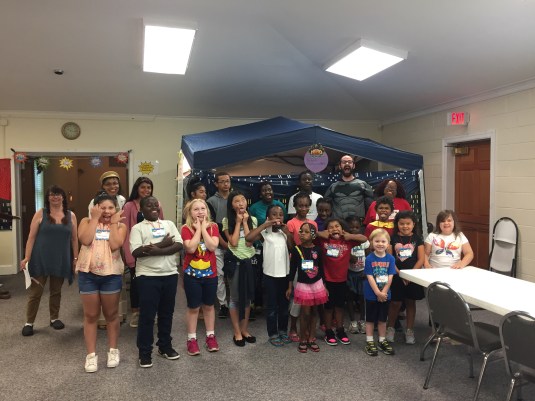
On Monday morning we opened our doors to children and youth from the community for Vacation Bible School. I, like a fool, stood by the entrance in my adult size Batman costume and welcomed everyone for a week of experiencing the love of God through Hero Central. Each day the kids learned about what it takes to be a hero in God’s kingdom: heroes have heart, courage, wisdom, hope, and strength. They did crafts and science experiments, they danced and sang, and they feasted around a common table. They learned bible stories about King David, Abigail, Jesus, the Beatitudes, and Pentecost.

On our last day I was sitting at the table with all of the kids, when one of them approached me with a huge smile on her face and all she said was, “I wish church was like this every day.”

I imagine that she wished church could be like that every day because Vacation Bible School was fun and exciting, but I think there was more to her wish than that alone. This week, the distractions of phones and the siren call of social media disappeared. Instead of a mall filled with adults staring into screens, the children experienced a church full of adults who got down on their level to share with them the love of God.

Instead of an experience where everyone looked the same, earned the same, and sounded the same, the children experienced a church full of disciples who could not have been more different from one another.

This week, our children and youth caught a glimpse of the kingdom of God made manifest on earth in a way that so few of us ever get to experience. Because in God’s kingdom, the place that Isaiah beckons the crowds to experience, invitations are made to all people: the rich and the poor, the old and the young, the perfect and the broken. The beautiful wonder and glory of this scripture is the fact that God welcomes ALL to the table. Always.

IMG_2824

During the time of Isaiah, and today, so much time is wasted on sustaining existence. We hear about the next new thing and we become obsessed even though we know that when it finally arrives we will be distracted by the next new thing coming down the pike. We ask ourselves questions that are predicated on maintaining the status quo. We go to things like the mall hoping for consumerism to fill a hole that no amount of money, or goods, or experiences ever can.

But God offers us something different. God looks at the shallow nature of our lives, God examines the mistakes and sins of our past, God evaluates what our minds stay focused on, and instead of leaving us to our own devices, God shares with us a new covenant. God makes a promise to be with us in spite of us.

God shows us a life that is based not on blessing the wealthy, but on protecting the poor.

God offers a covenant in which greed is shunned, and humility is glorified.

God presents a promise in which divisions are destroyed and community is congratulated.

Isaiah pleaded with the people of the Lord to open their eyes to the truth that no product could ever offer. Isaiah interrupted the distracted crowds with a vision of the kingdom on earth where those who are different are brought together in unity around a table where God is the host.

Opening up the doors of this church for a week of Vacation Bible School is a radical thing. We gave the children food, and education, and time for no other reason than the fact that God loves them. Compared to the priorities of the world, this place was strange this week.

Gathering together in a space like this for worship is a radical thing. While the world is consumed by the next new thing and a false community you can keep in your pocket, the church stands as a witness to the truth of God’s dominion. We lift up our prayers and we bend our knees because we know that what we believe shapes how we behave.

Coming to the table to feast on the Lord’s Supper is a radical thing. We search daily for products and goods to fill the holes we feel, we spend our time with people who look like us and sound like us. And yet at this simple meal, we are invited to a table with people who are completely unlike us. At this meal we get to taste a little bit of heaven on earth and we receive the only thing that can bring real satisfaction.

Today we live in a world where we are forever asking “Who gets in?” What does it take to earn a spot at the table? What kind of grades do I need to make to get into college? How long will I have to wait before it’s my turn?

But in the kingdom of God, at this table, all are welcome. Always. Amen.

tcaa-come-to-the-table-sermon-series-header

Devotional – Psalm 145.9

Devotional:

Psalm 145.9

The Lord is good to all, and his compassion is over all that he has made.

 Weekly Devotional Image

I arrived at church this morning mentally prepared for Vacation Bible School. I had read over the “Bible Story Teller” section, I knew where I needed to be and at what time, and I even had the perfect costume picked out: Batman.

However, I had assumed, foolishly, that the other adults would also arrive in some form of superhero costume. So, instead of blending in among a crowd of heroes, I stuck out like a sore thumb. However, when the children arrived (some from the church and some from the community) they were all shocked that the Caped Crusader was making his way around the building.

After our initial assembly time we broke out into age groups and then began making the rounds through the different centers. I made my way to the storyteller room and started teaching all of the children and youth about Samuel anointing a young David. The groups listened to my rendition and appropriately laughed at my silly jokes, they left with a sense that to be a hero in God’s kingdom one needs to have a compassionate heart, and they learned about how God is our true hero.

IMG_2824

Toward the end of the day, in my last bible story session, one of the youth was not as engaged in the others. I tried to include her as much as possible, but there was clearly something distracting her. When we finished, the rest of the youth walked out of the room, but she stayed behind as if to ask a question. Without prompting she lifted up her head and said, “Did you really mean that?” I said, “What do you mean?” She replied, “That God really loves everyone? Even me? You said that God’s love for David is the same as God’s love for eveyrone, and I want to know if that’s true.” And I said the only thing I could say, “Of course it’s true.”

I don’t know what’s going in her life to warrant her isolated behavior, or even her stark wonder at the fact that God could love her, but I am grateful for the opportunity to tell her the truth. As the psalmist says, “The Lord is good to all, and his compassion is over all that he has made.” God’s love and grace and mercy know no bounds. They are for ALL. And all means all!

From the youth who arrived for Vacation Bible School while wrestling with something beyond herself, to the man panhandling on the street corner, to the family sitting in the pews on Sunday morning, God’s love is for ALL.

Sometimes we lose sight of the tremendous extent of God’s love when we encounter people that we cannot love. When we disagree with them, or are angry with them, they feel outside the realm of God’s grace.

And sometimes we lose sight of the tremendous extent of God’s love when we feel like we know longer deserve it. When we really think about how we have sinned, or how we could be better, we feel outside the realm of God’s grace.

Then let us all hear the good news, the best news: The Lord is good to ALL, and his compassion is over ALL that he has made.

The Cost of Heaven

Matthew 13.45-46

Again, the kingdom of heaven is like a merchant in search of fine pearls; on finding one pearl of great value, he went and sold all that he had and bought it.

In my experience sermons are often very one sided. Someone like me, will stand in a place like this, and tell people like you, what God is saying. But sermons are meant to be more than a monologue, they need to be more than a lecture, they must be more than what I come up with in isolation.

So, I would like some of you to describe heaven for me. What do you think it will look like? Who will be there? What’s on the daily agenda?


There was once a man who lived a devout life and toward the end of his days God spoke to him and said, “I am so proud of the way you’ve lived that I’m going to do something I don’t usually do: I’m going to allow you to bring something with you to heaven. You may fill a briefcase with whatever you like and it shall be with you for eternity. Now remember I don’t often make this deal, so make sure you give it some thought.”

So the man did. For weeks and months he wrestled with what he would bring with him to heaven. He made pros and cons lists, he consulted his pastor (who was utterly bewildered by his question) and finally he decided on what to put in the briefcase.

Eventually the time came for the man to die and upon arriving at the Pearly Gates, St. Peter was patiently waiting to greet the man. St. Peter looked him up and down and said, “Hey man, look I’ve gotta ask: what’s in the briefcase? God never lets people bring something inside and he made an exception for you. So, can I see it?”

The man proudly opened his case and showed off 6 gold bars.

St. Peter stood there for a moment and then beckoned for the nearby angels, “Hey everybody, you’ll never believe it. God told this guy he could bring anything he wanted into heaven and he brought asphalt!”

In heaven the streets are paved with gold… Have you ever heard this before? Or maybe the image of heaven inside your mind is a cloud-like place filled with little fat cherubs floating around the air. Or maybe you think heaven is like a never-ending buffet with all of your favorite food.

the-pearl-of-great-price-daniel-bonnell

I get asked a lot of questions as a pastor. “How am I supposed to pray?” “Where is God in all of this?” “Should I tell my husband what happened?” But the question I’m asked the most, by far, is “What is heaven like?”

Today, when most of us think about heaven, the images conjured in our minds have far more to do with Hallmark than with scripture. Our hopes and dreams about our heavenly reward often reflect what movies and books describe than what the Lord describes.

I wonder if the crowds around Jesus were disappointed when he started talking about the kingdom of heaven. His parables, his long list of comparisons, contain nothing about pearly gates, or endless buffets, or even reuniting with long lost relatives.

The stories Jesus tells about the kingdom of heaven are down to earth, literally. At times he talks about the kingdom of heaven like a mustard seed. People disregard it and toss it away, but when it takes root it grows greater than any plant and won’t stop growing.

At other times he talks about the kingdom of heaven like yeast being mixed in with three measures of flour. When mixed and baked properly it would’ve been enough bread to feed hundreds of people.

At other times Jesus talks about the kingdom of heaven as a never-ending worship service. Which, to some people, sounds less like heaven and more like hell.

And more often than not, when Jesus talks about the kingdom of heaven he compares it to a wedding feast. I like the wedding feast connection because weddings are fun and full of joy and celebration. And, perhaps most importantly, there are always a couple people at the wedding who we never would’ve invited if it was our own, but God’s invitation is not like our invitation.

In today’s short passage, Jesus tells the crowds (and us) that the kingdom of heaven is like a merchant in search of fine pearls; on finding one pearl of great value, he went and sold all that he had and bought it.

Pearl of Great Price

More than a year ago I was down in Roanoke for the start of Annual Conference. Annual Conference is the once a year opportunity for United Methodist from all over Virginia to get together for prayer, worship, renewal, and church business. I arrived early last year to meet with some of my friends for breakfast, and half of us were about to be ordained in full connection. Though we had all served as pastors for a number of years, we had finally made it through the journey to kneel before the Annual Conference and would now serve the Lord as ordained elders.

And though the time at breakfast was filled with great joy and anticipation, there was also a dark cloud hovering over the gathering. The church is not what it once was and it’s hard to ignore how much it has changed. Gone are the days when one could assume that a church would grow simply by being in a neighborhood. Gone are the days when young couples and families show up on Sunday morning without an invitation. Gone are the days when the church is regarded with high esteem by the surrounding culture.

Last year, as it is now, the church is in a place where just having the doors open is not enough. The church is disproportionately skewing to an older age demographic. And the church is forever suffering under the weight of controversies like the Book of Discipline’s language about homosexuality.

So there we were at breakfast, sharing our excitement about joining the ship of Methodism in full connection, while the ship appears to flooding and without direction. We lamented the church’s current state of affairs, we offered opinions about how we might fix certain items, or how to change certain opinions, and then my friend Morgan interrupted everything.

He said, “I’ve been thinking a lot about Jesus’ parables recently, and one in particular. He tells the disciples that the kingdom is like a merchant in search of fine pearls; on finding one pearl of great value, he went and sold all that he had and bought it.” He had been looking down at the table up to this point, but then he raised his head and looked us in the eyes and said, “Do we still feel that way about the kingdom? I mean, are we willing to risk it all, to throw ourselves completely in? Or, at the very least, have we found a pearl in our churches?”

Today the church feels afraid. Few are willing to takes risks, we hold up frightening statistics as a way to guilt people into doing more, and we ask so many questions about the viability of the church going forward. But Jesus doesn’t transform life by scaring the hell out of people. No, Jesus transforms life by helping people like us see how heaven is close at hand.

Morgan’s question has haunted me for more than a year. With all the talk of negativity in the church, with all the fear and frustrations, Morgan turned it all upside down. Where is the pearl of great price in this place? What would I give up everything to possess in the kingdom?

When my son was one month old we brought him to church for the first time. I had taken 4 Sundays off to be at home with Lindsey as we adjusted to life with a newborn, but the time had come to return to the pulpit. I can’t tell you much about the service because I was so sleep deprived that most of it is a blur. But I will never forget the moment Lindsey brought him up to the front to receive communion. Without talking about it ahead of time I took the tiniest piece of bread, dipped it in the cup, and placed it in his mouth.

He has no idea what communion means or even what it is. But for the majority of his little life he has been in church every single week, learning the habits of God in worship, and receiving the body and blood of the one we call Lord. My son knows of no life outside the church. His life has been one defined by the movements not of the world, but by the liturgy.

And seeing him in church, watching him receive communion, hearing him say “amen” without even knowing what it means… I think I would sell everything to keep that.

On Thursday morning I got to church early after working on the sermon a little bit and I discovered a great crowd of people in our parking lot. There were volunteers from Cokesbury, Old Bridge UMC, and from the Salvation Army, and they were all working together to distribute food to those in need. There was no cash box at the front for community members to pay for the food, there was no expectation that they would ever repay us, and (perhaps most importantly) there was no judgment about the fact that they needed food.

I stayed toward the sides of our lot and took it all in for the first time, though I introduced myself to a handful of families patiently waiting for the food. There was one woman who kept her eyes on me while I was moving about and I eventually went up to introduce myself. As I got close she took my hand all she said was, “Thank you. This has saved my life.”

20369172_10209226181322580_3977426946611839100_o

Experiencing her salvation in our parking lot, seeing the wonder and joy in her eyes, feeling her hope… I think I would sell everything to keep that.

Tomorrow morning we are going to open our doors to all sorts of kids from the community for Vacation Bible School. Some will come from privileged families and will have been here before. Some will come from situations they won’t talk about though it will be clear that the food we offer them will be the first food they taste that day. And a few will come from somewhere in between.

Our volunteers will fill the halls with joy and hope and laughter as we do arts and crafts, as we sing and dance, and as we all learn more about the bible.

Seeing the children and volunteers working together, hearing children excited to learn more about God, seeing individuals interact with one another in a place like this… I think I would sell everything to keep that.

And all of them, from my son in worship, to the woman in the parking lot, to the children in our building will experience the grace of God and they will leave transformed without cost.

In the parable the man sells everything he has for the pearl of great value – the pearl of God’s kingdom is of such importance that merchant gives away his very livelihood to hold on to a little slice of heaven. More important than the money he uses to purchase the pearl is his willingness to trust that the gift of God’s kingdom is more important than any earthly thing.

Friends, the kingdom of heaven is at hand. It is not just some place waiting for us in the by and by, it is also something that we can experience here and now. Because the kingdom is something that God is doing, and it is to be received as a gift; a gift like the bread and the cup, a gift like food in a parking lot, a gift like vacation bible school.

The kingdom of heaven is not something that can be acquired, or earn, or purchased; it is a way of being into which we can enter.

This beautiful and brief parable from the lips of Jesus is not about the cost of heaven. It is, instead, a testament to the fact that our response to the kingdom is total, it is everything we have. To be joined up in to this kingdom of heaven on earth, the kingdom that is both here and not yet, means committing our whole beings, without reserve, and with totality.

The kingdom of heaven is a gift that transforms every bit of our lives here and now.

There is no amount of money on earth that can purchase salvation. As the old hymn goes, “Jesus paid it all.” But the parable begs us to ask ourselves the same questions that Morgan asked me, “Do we feel like the merchant? Are we willing to risk it all, and throw ourselves completely in? Or, at the very least, have we found a pearl in this place?” Amen.

We Don’t Belong To Babylon

Isaiah 44.6-8

Thus says the Lord, the King of Israel, and his Redeemer, the Lord of hosts: I am the first and I am the last; besides me there is no god. Who is like me? Let them proclaim it, let them declare and set it forth before me. Who has announced from of old the things to come? Let them tell us what is yet to be. Do not fear, or be afraid; have I not told you from of old and declared it? You are my witnesses! Is there any god besides me? There is no other rock; I know not one.


Years ago I spent a summer working for a Toyota Dealership up in Alexandria. I was a porter and I was responsible for parking customer’s cars, driving them into the bays, and then bringing them back out when the work was completed. Every day I hopped into more cars than I could count and drove with great care through a parking lot that had twice as many cars as it should have.

I loved working there. I loved how every day was different, I loved all the strange and bizarre things people kept in the cars, I even enjoyed the great range of music that people chose to blare through their sound systems. But the part of the job that I loved the most was the people I worked with.

All of the other porters were at least twenty years older then me, and none of them were white. We were quite the motley crew standing together waiting to park cars, and during the slow moments we regaled one another with stories. That summer I learned about Carlos’ difficult journey from Mexico to the United States, I learned about Jamal’s continued experience of racism even though we lived in a supposedly progressive place, and I learned about Michael’s love for his home country of Ghana.

Of all the other porters Michael took me under his wing and always made sure that I was always drinking enough water. He called me Mr. Taylor and would clap his hands when he saw me walking up early in the morning.

We worked side by side for an entire summer and by the end he felt more like a friend than a co-worker.

On one particularly rainy afternoon, while business was slow, I asked Michael about what it was like to live here after spending most of his life in Ghana. He told me about how for years he only dreamed of one thing; saving enough money to bring him and his family to the US. How for years they watched American movies and read American books and they knew they had to do everything they could to get here.

And when they finally saved enough, when they finally came to the US, they were disappointed.

I remember thinking: “Disappointed? How could they be disappointed with all we have to offer here?”

And then he told me that they were disappointed because it was dirty, because there were people in need, and that he and his family still felt like strangers in a strange land.

18540

Isaiah’s message from the Lord isn’t just some random call from a prophet for the people to know more about God – it comes at a particular time to a particular people in a particular place. These words were, and still are, meant for a people in captivity.

The people of God had grown distant from the Lord and after countless attempts to bring the people back into the fold; they were taken into captivity in Babylon. For two generations God’s people were in a foreign land and it was in the midst of the Babylonian captivity that Isaiah spoke these words from the Lord: I am the first and I am the last, there is no one else like me. If any are so bold as to claim to be like the Lord let them declare what is to come. Do not fear, or be afraid. Have I not told you what was to happen? You are my witnesses!

The people receiving the Word from Isaiah were a people without hope. They had lost their homes, their nation, their possessions, their faith, their traditions, their roots, their identity, and their sense of belong. The Babylonian empire was known for its power and its majesty, but it was not what they thought it would be. Like my friend Michael from Ghana arriving in a new place, the Israelites were strangers in a strange land. Babylon was a nation with its own roots and customs and gods, and Israel was a tiny nation that had been assimilated into the greater empire.

Every single day God’s people were surrounded by idols clamoring for their worship. But unlike all the idols of Babylon, unlike all of the customs and the experiences, Isaiah declared that only the Lord is first and last, only God calls the future into being.

And to be honest, it is almost impossible for us to connect with the captive situation during the time of Isaiah. We are so entrenched in the culture around us that we cannot even fathom what it would look like to be in bondage, to be chained down, to be strangers in a strange land. But we are.

We are in bondage to the next new thing; in just a few months droves of people will be lining the streets for the next iPhone, Potomac Mills will be nearly impossible to navigate through, and the promise of big deals will cause people to make irrational decisions and choices.

We are controlled by the current political structures that we think determine our lives. Just ponder about how much time we spend watching or reading the news that is now completely and totally focused on who said what, the next vote down the line, and the latest tweet from the White House.

We are chained to economic plateaus that are relatively inescapable. Here in this country we cherish the American Dream, but the truth is that the overwhelming majority of us will die in the same economic bracket we were born into.

We think that all of those things determine our lives. They have become our Babylon.

On any given day we will spend more time worrying about a new product, or politics, or our prosperity far more than anything else. Like the Israelites in Babylon, like Michael at the dealership, we Christians are strangers in a strange land. And here’s the frightening part: the longer we spend time in the strange land, the less strange it appears.

I know a man who started attending church later in life and quickly got involved. At first he volunteered as an usher, and pretty soon he was helping to lead worship as a liturgist. He loved church. He embraced the different rhythms and habits of the congregation and threw himself completely in.

And, of course, it didn’t take long for him to join one of the many committees at church. For months he attended the meetings and all of the other activities at church, but suddenly he stopped appearing around the church as frequently until he disappeared all together.

I asked to meet with him to discuss what happened and his answer was simple and hard to hear. He said, “I loved church because it was unlike anything else in my life, but at some point it started feeling the same. I experienced arguments in church meetings, apathy in the pews, and people never stopped lamenting about the past. I came to church to escape that kind of stuff from my life, only to discover that it was here as well.”

If the church is no better than the culture that surrounds it, if it doesn’t embody a different way of being, then it simply isn’t the church.

We are supposed to be strangers in a strange land. While the world around us strives to change our priorities the words of Isaiah ring even louder. While the culture tells us that we have to make it through this life on our own, Jesus tells us that we cannot do it on our own. While cultural idols strive for our allegiance, the Lord speaks loud and clear: I am the first and I am the last; besides me there is no God.

We don’t belong to Babylon. We belong to God.

And, as Isaiah is bold to proclaim, our God comes to us from the future. God is concerned about where we are going, whereas we often spend far too much time stuck in the past.

0f01ca760818853c9a197c7f191b52d3--religion-quotes-tattoo-quotes

The Israelites in captivity were stuck in the past just as much as they were stuck in Babylon. Their minds were focused on the old things, the failures of a distant time, memories from days long ago. They needed to hear the good and the true Word of God: “Who else can tell you what is to come? Let them try to prophesy the future. I am coming to you from the future for I am the first and the last, the beginning and the end. Do not fear, or be afraid! You are my witnesses. Remember what I have done for you, and you will know there is no other rock.

At the time of Isaiah’s proclamation the people were in danger of forgetting who they were, and whose they were. They wallowed in their present circumstances and were giving themselves over to the idols in their midst. They needed a probing and holy Word from the Lord. They needed deliverance from their chains. They needed to hope for things not seen, they needed to believe, they needed to know that God was with them even in the midst of captivity.

But maybe all this Babylonian captivity stuff is too much for today. We haven’t been stolen from our homes and delivered into a foreign country. Perhaps the talk of idols and nationalism, the comparisons within politics, and the particles of God’s time traveling omnipotence are just too heavy. Maybe we’ve got other things to worry about: bills to pay, people to call, children to raise, a marriage to sustain, a future to figure out. Perhaps we are so deeply rooted in this strange land that we can no longer see it as strange. Maybe our captivity has become our home.

Well then let us all hear the adapted word from the prophet Isaiah:

We cannot save ourselves. We have been and will be saved by God. There is nothing on this earth, or in the entire cosmos, like the living God. No amount of materialistic accumulation, economic growth, or political power will ever bring us satisfaction. Every little thing that we want to give meaning to our lives will fall away.

God, however, is almighty, eternal, and full of mercy. God is the one reaching out to us when we no longer have the strength to reach back. God is the one who surrounds us when we feel completely alone. God is the one who delivers us from the captivity to the Babylons in our midst.

As Christians, we are strangers in a strange land. Everything surrounding us is constantly telling us what to think, how to act, and what to believe. The world tries to tell us who we are and whose we are.

But we don’t belong to Babylon. We belong to God. The world’s ways are not our ways!

We are more than the stories of the past. We are more than the failures of the present. We are more than our captivity to the idols competing for our allegiance. We are God’s children.

And our God is an awesome God! Our God is the first and the last. Our God is the beginning and the end. Our God is in control. Our God makes a way where there is no way. Our God is king of the cosmos. Our God is the solid rock upon which we stand. Our God is concerned with our future. Our God believes in our future. Our God know where we’re going.

Thanks be to God that we don’t belong to Babylon. Amen.