The Final Week

Mark 11.7-10

Then they brought the colt to Jesus and threw their cloaks on it; and he sat on it. Many people spread their cloaks on the road, and others spread leafy branches that they had cut in the fields. Then those who went ahead and those who followed were shouting, “Hosanna! Blessed is the one who comes in the name of the Lord! Blessed is the coming kingdom of our ancestor David! Hosanna in the highest heaven!”

holy-week

It was early in the morning when Jesus sent two of his disciples to a village atop the Mount of Olives to find a donkey. The day had come for Jesus to enter the holy city of Jerusalem during Passover, a time when the city’s population would balloon up to 200,000 people entering to celebrate. On a Sunday morning, while the crowds gathered with palm branches, Jesus entered Jerusalem. Five days later he would be killed on a cross. This is what happened during the final week.

The two disciples procured a donkey and Jesus prepared to make his triumphal entry. Riding on a donkey was a richly symbolic act, one that can be traced back to the time of David. To arrive in the holy city on a donkey calls back to the prophet Zechariah who declared, “Rejoice greatly, O daughter Zion! Shout aloud, O daughter Jerusalem! Lo, your king comes to you; triumphant and victorious is he, humble and riding on a donkey.”

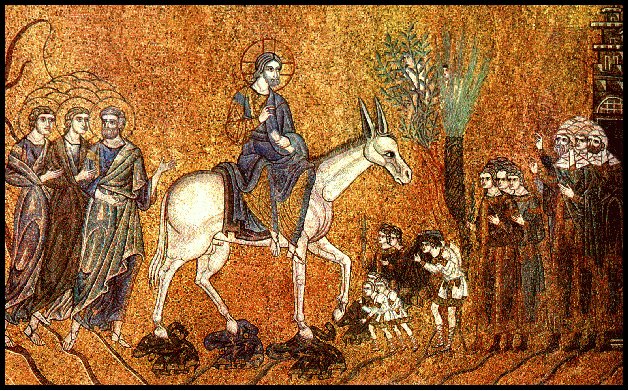
As he rode toward Jerusalem, droves of people arrived on the streets and they began to waves palm branches while he passed. They were so enraptured by Jesus that they took off their cloaks and placed them on the road with their palms in order to create a royal pathway for their king. They shouted things like “Blessed is he who comes in the name of the Lord!” and “Hosanna!” which means “Save us!

At the same time, on the other side of the city, Pontius Pilate (the Roman Governor of Judea) entered Jerusalem with at least 1,000 soldiers to demonstrate the power of Rome during the Jewish celebration of the Passover. It was a show of force to prevent the people from revolting against their imperial rulers while they remembered that time when God had delivered them from captivity in Egypt.

But with Jesus, there was no show of force. Instead of armor and swords, the people took off their cloaks and waved palm branches. Instead of cowering away in fear they rejoiced in the humble man on the back of a donkey.

Palm_frond

While the distance between the Lord and the city grew closer and closer, while the crowds were dancing and shouting, he began to cry. He looked out over the holy city and he wept for Jerusalem. He wept knowing that he was entering as the prince of peace, and within the next few days the very people who were begging for his salvation with their palm branches would reject him and call for his crucifixion.

And there was evening and there was morning, the first day.

On Monday, Jesus made his way to them Temple with countless other Jews. With the episode that had transpired the day before, all eyes were on the humble man with expectation of deliverance. As his feet walked over hallowed ground, Jesus encountered the moneylenders and changers who were taking advantage of all the Jews in Jerusalem. The prices for clean animals necessary for sacrificial rituals were vastly inflated to the benefit of the merchants and the religious elite.

Jesus, who had spent the better part of three years berating the elite for taking advantage of the poor and outcasts, Jesus, who had told the rich young ruler to sell everything he had and give it to the poor, became incensed when he saw the poor being ripped off in the name of God. He walked straight over to the tables and he lifted them off the ground and disrupted everything in the temple. He threw the merchants out of the Temple and declared that his Father’s house had been turned into a den of robbers.

The elite and powerful, who had heard about this mysterious man claiming to be the Son of Man, now had their attention on Jesus. It was one thing to have a crowd with palm branches welcoming him into the city, but to disrupt the economic scheme they had established was going too far. From this point forward, the tides began to turn against Jesus. The leaders started looking for a way to discredit him, or to remove him completely. For as long as Jesus stayed in Jerusalem, their power would be in question, and they would no longer make the money they had planned on.

  And there was evening and there was morning, the second day.

On Tuesday, Jesus once again entered the Temple and he began to teach. If people were excited to see him after his entry in Jerusalem, they were now even more eager to listen to the one who had throne the merchants out of the sacred space. The Pharisees and religious leaders began to interrupt his teaching and demanded to know whom he thought he was to speak with such authority. Jesus, the one who shared parables with his disciples and followers, used parables to respond to their accusations. Over and over again he used examples to show how the powerful and lost sight of their responsibility to take care of God’s creation and he labeled them “hypocrites.

He accused them of neglecting to practice what they preached, he called them “snakes” and a “brood of vipers” and he told them they had failed to do the one thing required of them which was to love the Lord their God with all their heart, soul, mind, and strength and to love their neighbors as themselves.

Jesus had a following, he had entered with a display of peace, but he had removed the leaders’ economic disparity, and now he had called them hypocrites. They tried to trap him in his words, but he continued to point to the love of God in all times and in all places.

And there was evening and there was morning, the third day.

On Wednesday Jesus left the arena of the Temple and continued his teaching on the Mount of Olives. Some of the disciples made comments about the beauty and the magnificence of the Temple and Jesus responded by foretelling the destruction of the temple and his own body. He revealed images of God’s cosmic plan for the world made manifest in Jerusalem and called for his disciples to stay vigilant no matter what.

He used parables to describe the call of his disciples and ended by saying that his followers would be blessed in the end if they had fed the hungry, gave water to the thirsty, welcomed the stranger, clothed the naked, cared for the sick, and visited the prisoner.

Word about Jesus continued to spread fast throughout Jerusalem and the leaders learned that he was now prophesying the end of their rule and the destruction of the temple. Gone was the joy the people felt on Palm Sunday. Fear was present with the leaders and the elite.

  And there was evening and there was morning, the fourth day.

On Thursday Jesus continued to teach and gathered with his twelve disciples in the upper room for the Passover celebration. Around the table they remembered God’s great work in the delivery of the Hebrew people out of slavery in Egypt to the Holy Land; they remembered God’s actions in the lives of God’s people including themselves. But before the supper was over, Jesus did something radical. He took a loaf of bread, gave thanks to God, broke it, gave it to his friends and said, “This is my body, and I’m giving it for you.” Later, he took the cup, gave thanks to God, passed it to his friends and said, “This is my blood, and I’m pouring it out for you and for the world.” Even though he knew that in short time his disciple Judas would betray him he still shared this incredible meal and gift with his friend.

Later that evening, they arrived in the Garden of Gethsemane, and Jesus urged his disciples to keep awake while he prayed. He knelt on the ground and he communed with his Father and prayed about what was about to happen. But he ended the prayer by saying, “Lord, with you all things are possible; remove this cup from me; yet, not what I want, but what you want.” In essence he prayed, “Let thy will be done.

When Jesus finished praying, Judas arrived with soldiers. They grabbed and arrested Jesus. The disciples fled into the distance. Jesus was dragged back into the city to be tried for blasphemy.

And there was evening and there was morning, the fifth day.

On Friday Jesus was brought to the Roman leader Pontius Pilate. The leaders demanded that he be crucified and executed, but Pilate could find no fault with Jesus. He then brought Jesus before the Jewish people and they chanted with loud and bellowing voices, “Crucify him!” The same people who had gathered on the road with palm branches yelling “Save us!” were now demanding Jesus’ death. In order to appease the crowds and the Jewish leaders, Pilate sentenced Jesus to death by crucifixion.

The soldiers whipped and beat Jesus nearly to the point of death and then, to mock him, they placed an opulent robe on his soldiers, and they made a crown of thorns for his head. They forced Jesus to carry his torture device, a cross, on his shoulders all the way to the place called The Skull. The crowds berated him on either side while he marched forward to his death. “If you really are the Messiah, save yourself!” “Where are all your disciples now?!” “Some King of the Jews you are!”

He arrived at the top of the hill and the soldiers nailed his hands and feet to the cross and hung him in the sky. For six hours Jesus’ life slowly slipped away while the crowds continued to mock him from the ground. With some of his final breaths he offered a prayer that has haunted the world ever since, “Father, forgive them, for they do not know what they are doing.” With two thieves on either side hanging on crosses, while some of his disciples watched from the distance, he died.

And there was evening and there was morning, the final week.

Jesus rode into Jerusalem on the back of a donkey proclaiming and inaugurating a time of humility and peace. Jesus rebuked the elite for preying on the poor and weak. Jesus confronted the hypocrites in leadership. Jesus called his followers to love God and neighbor. Jesus shared his final meal with the one who would betray him. Jesus was crowned with thorns and enthroned on a cross in the sky. Jesus forgave his murders from the moment of his death. And Jesus died so that we might participate in his kingdom and salvation. Amen.

Hosanna_988

The Shadow of the Cross – Good Friday Homily on Luke 23.32-46

Luke 23.32-46

Two others also, who were criminals, were led away to be put to death with him. When they came to the place that is called The Skull, they crucified Jesus there with the criminals, one of his right and one on his left. Then Jesus said, “Father, forgive them; for they do not know what they are doing.” And they cast lots to divide his clothing. And the people stood by, watching; but the leaders scoffed at him, saying, “He saved others; let him save himself if he is the Messiah of God, his chosen one!” The soldiers also mocked him, coming up and offering him sour wine, and saying, “If you are the King of the Jews, save yourself!” There was also an inscription over him, “This is the King of the Jews.” One of the criminals who were hanged there kept deriding him and saying, “Are you not the Messiah? Save yourself and us!” But the other rebuked him, saying, “Do you not fear God, since you are under the same sentence of condemnation? And we indeed have been condemned justly, for we are getting what we deserve for our deeds, but this man has done nothing wrong.” Then he said, “Jesus, remember me when you come into your kingdom.” He replied, “Truly I tell you, today you will be with me in Paradise.” It was now about noon, and darkness came over the whole land until three in the afternoon, while the sun’s light failed; and the curtain of the temple was torn in two. Then Jesus, crying with a loud voice, said, “Father, into your hands I commend my spirit.” Having said this, he breathed his last.

8812217-good-friday

Religious people aren’t supposed to fail, or suffer, or get arrested. They’re not supposed to hang out with vagrants, and criminals, and failures. Religious people are supposed to live good lives, surrounded by good people, doing good things. They’re supposed to have life all figured out, to be content, and to be filled with joy.

Jesus was beaten, dirtied, and was marched to his death with two criminals. While they walked along the way, the few disciples who had yet to abandon him must’ve lost all their hope; their Messiah was carrying a cross to the place called The Skull where he was to be crucified. Yet while the crowds screamed and threw their complaints into the air, Jesus calmly forged ahead with his eyes on the ground and the cross digging into his shoulder.

When they arrived on the hill, the guards nailed Jesus and the two thieves to their crosses and hung them in the air. The crowds must have grown larger the closer they came to the place and they hurled insults at the man in the air, ridiculing him for all that he had said and done. With the chaos erupting around him, Jesus bowed his head to speak with his Father: “Forgive them, for they don’t know what they’re doing.” 

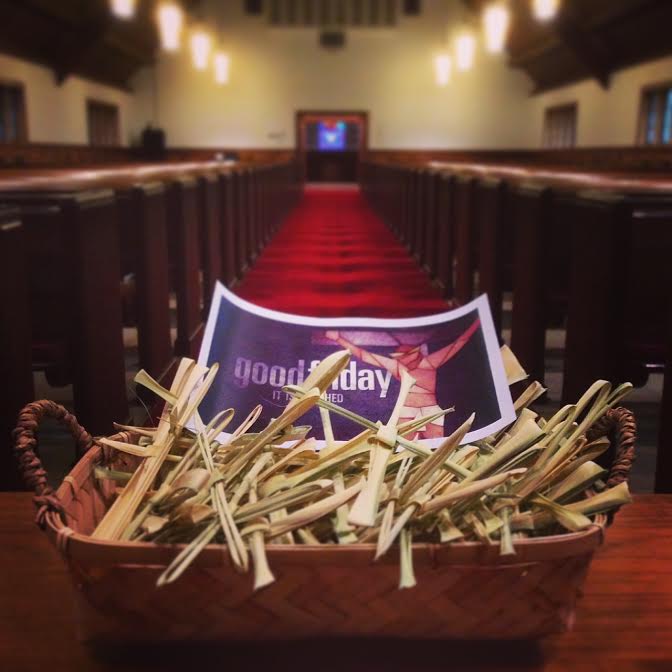
In the entirety of the Christian year, Ash Wednesday and Good Friday are the least attended services. Christmas Eve and Easter are big days in the life of the church because we celebrate the incarnation and Jesus’ resurrection from the dead. But Ash Wednesday and Good Friday are all about death; “You are dust and to dust you shall return,” “Father, into your hands I commend my spirit.”

We don’t want to talk about death, we don’t want to talk about our own suffering, we don’t want to “bring other people down.

One of the things that surprises me most about funerals is our inability to confront death. When I preside over services of death and resurrection I am tasked with talking about, and affirming, the one thing that most people are afraid of: death being real. The juxtaposition between a funeral and the reception afterwards is sometimes nauseating.

Here in the sanctuary we speak the truth about death, we begin the process of grieving, we talk about what the person did with their lives and we acknowledge the void we now feel. But then I go to a reception and everyone wants to talk about everything else: March Madness brackets, the latest movies, new restaurants, and children’s activities. I’m not saying that we need to wallow in the sadness of death, but it is clear that we want to avoid death because it stinks.

goodfriday

By the time Jesus made it to the cross, the disciples had all cleared out. They had abandoned him for the same reasons that we avoid death today, it is too frightening, too heavy, and too sad.

The people began to mock the messiah in the tree: “he saved others; let him save himself if he really is the Messiah!” The soldiers taunted him with sour wine and scream out: “If you are the King of the Jews, save yourself.” And above his head they hung a sign containing his conviction: “This is the King of the Jews.”

Verbal attacks kept pouring in from the ground, but the scene now moves to the air. One of the criminals rebuked Jesus: “If you are the Messiah, save yourself and us!” But the other criminal spoke up, “we are getting what we deserve, but this man has done nothing wrong. Jesus please remember me when you come into your kingdom.

Jesus replied, “Truly I tell you, today you will be with me in paradise.

For the next three hours darkness came over the whole land and the temple curtain was town in two. Then Jesus, crying out with a loud voice, said, “Father, into your hands I commend my spirit.And he died.

For a long time I always inserted myself into the story as the forgiven criminal. I believed that even at the end I would’ve understood what Jesus was doing. As I grew older I started seeing myself as one of the disciples who abandoned the Lord and was nowhere to be found. I recognized that my faith isn’t as strong as I would like it to be, and that I would’ve been more concerned with my safety than with Jesus on the cross. But now, now I see myself as one of the bystanders who was there on Palm Sunday screaming “Hosanna” and then quickly began to scream “crucify!” a few days laters.

We sinners are lousy and fall short of God’s glory. We avoid people who are not like us, we want to shy away from common criminals, we want our lives to be perfect, and organized, and clean, and comfortable. And more often than not we enjoy witnessing the suffering of others.

But there is no shade in the shadow of the cross.

It is vitally important for us to remember that Jesus Christ was executed as a criminal among criminals! His death was made real on a cross because it warned the people about crimes agains the state and it added shame, pain, and public ridicule.

From the cross Jesus had no anger, only peace. He did not save himself, instead he saved a criminal. He did not thrash about with frustration, instead he was filled with serenity. He did not doubt God’s presence, he only trusted and kept faith.

Death is messy and ugly. I have been in enough hospitals, and stood over enough caskets to know how frightening death can be. Jesus’ death was likewise ugly. It was filled with shame and embarrassment. How did this prophetic Messiah go from the crowds cheering his name to being killed on a cross? How did he go from having faithful disciples to spending his finals moments with two criminals?

Jesus’ crucifixion was dirty and shameful. Yet, the hardest thing to comprehend is his willingness to forgive. More than the physical suffering and his literal death, his forgiving spirit is what stops us in our tracks when we read these words from so long ago.

From the cross Jesus announces forgiveness – this is the heart of the Gospel, it is the crux of the story, and it is what we are called to do if we are to follow him.

Last year I asked us to look at the cross and live. I implored us to give thanks to God for dying in Christ on our behalf to save us. I handed out crosses so that we might ponder the kind of divine love that was made real for us. I asked us to look at the cross and live.

This year I want to ask us to look at the cross and forgive. If Jesus was willing to use some of his final breaths to forgive the crowds for betraying him and bringing him to the cross, why are we so unwilling to forgive? If Jesus was so filled with love, shouldn’t we do the same?

Being a Christian is messy, ugly, and frightening if we are willing to follow Jesus. If we really want to be like him, then we have to start by forgiving others, and forgiving ourselves.

Amen.

unnamed

Washing With Tears – Maundy Thursday Homily on John 13.12-20

John 13.12-20

After he had washed their feet, had put on his robe, and had returned to the table, he said to them, “Do you know what I have done to you? You call me Teacher and Lord – and you are right, for that is what I am. So if I, your Lord and Teacher, have washed your feet, you also ought to wash one another’s feet. For I have set you an example, that you also should do as I have done to you. Very truly, I tell you, servants are not greater than their master, nor are messengers greater than the one who sent them. If you know these things, you are blessed if you do them. I am not speaking of all of you; I know whom I have chosen. But it is to fulfill the scripture, ‘The one who are my bread has lifted his heel against me.’ I tell you this now, before it occurs, so that when it does occur, you may believe that I am he. Very truly, I tell you, whoever receives one whom I send receives me; and whoever receives me receives him who sent me.”

bbo_ob_mcmca_40_slide

The disciples had already finished their food, they had passed around the bread and the cup, and Jesus had told them it was his body and blood. For many of them these words might’ve gone in one ear and out the other; after all Jesus was known for saying all sorts of the things that didn’t make sense right away. Perhaps some of them were picking up the crumbs from the bread when Jesus got up from the table. Others might have been refilling their cups with wine when Jesus tied a towel around his waist. But by the time he started to wash their feet the room must have been silent. 

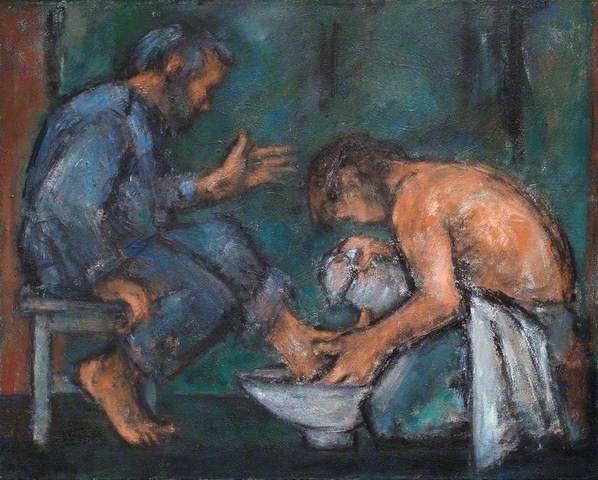
Imagine how profound it would have been to see Jesus kneeling on the floor and using water to wash away the grime of Jerusalem. Even more amazing is the fact that Jesus doesn’t waste time explaining what he’s about to do, he just gets down on the ground and goes to work.

However, Peter, the ever vocal disciple interrupts the serene mood with a question: “Lord, are you going to wash my feet?

“Right now it won’t make sense my friend, but soon it will all come together. If you want to be in this with me, you must let me wash your feet.”

Jesus went from one disciple to the next taking as much time as necessary, holding their feet in his hands, letting the water drip upon them, until he finished.

I took a group of middle-schoolers on a mission trip a number of years ago to Winchester, Virginia. We worked in trailer parks building wooden steps up to the doors, we worked on a wheel chair ramp that took up an entire yard, and we worked on clearing out areas that had been long forgotten. All week we did everything we could to serve the needs of the people from the nearby community, and every night we gathered to sing songs and praise our Lord.

At the end of the week we were invited into the fellowship hall for a foot-washing ceremony. I don’t know if any of you have had the chance to spend a week working outside with middle-schoolers, but it begins to smell pretty bad pretty fast; the prospect of washing one another’s feet was not high on my list of priorities. The leader explained that long ago Jesus washed his disciples feet and we would be doing the same thing. Everyone was invited to participate, but if you were uncomfortable you could simply ask for a prayer instead.

A few chairs and basins were set in the middle of the space, and when the music began we were on our own.

In my work group there was a precious young girl who had worked so incredibly hard all week and there was a young boy that annoyed her every chance he had. He would begin by playfully flicking paint onto her clothes, but when she asked him to stop he became relentless. He called her names behind her back, and schemed to turn the other kids against her. Even after I pulled him aside to set him straight he continued to prey on her at every opportunity. 

As we sat in the room waiting for the first people to go forward for the foot washing, I watched the young girl stand up, and bee-line across the room for the annoying boy. For a fleeting moment I was afraid that she had finally had too much and she was about to sock him in the face, but instead she leaned over and asked if she could wash his feet.

While other people started to do the same, my gaze was transfixed on the boy and girl from my group. The boy had gone over the line time and time again yet there she was holding his foot in her hand and washing it. When I looked closer I saw that she was crying and her tears were falling on his feet. And when I looked even closer I saw that he was crying and his tears were falling in her hair.

Foot washing is a service among equals in a company where no one’s status stands out. When Jesus finished with his friends, he called them to do the same to one another. We wash and are washed by our Lord through our brothers and sisters in Christ. When we kneel before a fellow Christian and hold their feet in our hands we make our way back to the upper room so long ago. We aren’t just called to wash the feet of those whom we love, but even the ones who drive us crazy and fill us with anger. Remember: Jesus washed Judas’ feet knowing full and well what he was about to do. 

Sometimes the people we need to reconcile with most are the ones in the pews next to us. We tend to sweep under the rug all of the proverbial problems we have with our friends and family and are far more inclined to complain about strangers. If we are filled with stress regarding the closest people in our lives than this might be the best place to embark on a new beginning. Perhaps the water can bring new life for us and for the ones we love and hate.

Jesus took time after breaking bread with his friends to wash their feet. He humbled himself to the floor and showed them what faithful love looks like. With each foot he equipped them for bringing the peace of God into the world. He washed away their insufficiencies and doubts. He rid them of labels and assumptions. He showed them how important they were for the kingdom of God.

If you want to know what faithful love looks like, look no further than this time when we follow the example of Jesus and wash one another. Amen.

IMG_2100

“A Stick, A Carrot & String”

In preparation for Holy Week…

mewithoutyou – “A Stick, A Carrot & String”

The horse’s hay lay beneath His head our Lord was born to a manger bed, that all whose wells run dry could drink of his supply.

To keep Him warm the sheep drew near, so grateful for His coming here: You come with news of grace, come to take my place!

The donkey whispered in His ear: Child, in thirty-some-odd years, You’ll ride someone who looks like me (untriumphantly).

While the cardinals warbled a joyful song: He’ll make right what man made wrong, bringing low the hills, that the valleys might be filled!

Then Child, asked the birds, well, aren’t they lovely words we sing? The tiny Baby lay there without saying anything.

As a distance stood a mangy goat with crooked teeth and a matted coat, weary eyes and worn, chipped & twisted horns.

Thinking: Maybe I’ll make friends some day with the cows in the pens and the Rambouillet, but for now I’ll keep away – I got nothin’ smart to say.

But there’s a sign on the barn in Cabbagetown: “WHEN THE RAIN PICKS UP AND THE SUN GOES DOWN, SINNERS COME INSIDE! WITH NO MONEY, COME AND BUY. NO CLEVER TALK NOR GIFT TO BRING REQUIRES OUR LOWLY, LOVELY KING. COME YOU EMPTY-HANDED, YOU DON’T NEED ANYTHING.

And the night was cool and clear as glass with the sneaking snake in the garden grass, as Deep cried out to Deep, the disciples fast asleep.

And the snake perked up when he heard You ask: If You’re willing that this cup might pass we could find our way back home, maybe start a family all our own… but does not the Father guide the Son? Not my will but Yours be done! What else here to do? What else me but You?

And the snake who’d held the world, a stick, a carrot and a string, was crushed beneath the Foot of Your not wanting anything.

Who Is This? – Sermon on Matthew 21.1-11

Matthew 21.1-11

When they had come near Jerusalem and had reached Bethphage, at the Mount of Olives, Jesus sent two disciples, saying to them, “Go into the village ahead of you, and immediately you will find a donkey tied, and a colt with her; untie them and bring them to me. If anyone says anything to you, just say this, ‘The Lord needs them.’ And he will send them immediately.” This took place to fulfill what had been spoken though the prophet, saying, “Tell the daughter of Zion, Look, your king is coming to you, humble, and mounted on a donkey, and on a colt, the foal of a donkey.” The disciples went and did as Jesus had directed them; they brought the donkey and the colt, and put their cloaks on them, and he sat on them. A very large crowd spread their cloaks on the road, and other cut branches from the trees and spread them on the road. The crowds that went ahead of him and that followed were shouting, “Hosanna to the Son of David! Blessed is the one who comes in the name of the Lord! Hosanna in the highest heaven!” When he entered Jerusalem, the whole city was in turmoil, asking, “Who is this?” The crowds were saying, “This is the prophet Jesus from Nazareth in Galilee.”

Christ's Entry into Jerusalem by Hippolyte Flandrin c. 1842

When Jesus tells you to do something, you do it. Sometimes it takes us a long time to figure this out, but for the disciples it must have been second nature. Two disciples were told to enter the next village and there they would find the necessary transportation; a donkey and a colt. “If anyone asks what you are doing, don’t worry about it, just tell them, ‘The Lord needs them.’

So the disciples went into the village, found the animals, and brought them back to Jesus. The rest of the disciples took off their cloaks and placed them on the donkey for Jesus to sit on. As they approached Jerusalem crowds of people took off their own cloaks, gathered palms from the fields, and placed them on the road for Jesus’ donkey to trample on. The people were shouting “Hosanna (Save us now!) to the Son of David! Blessed is the one who comes in the name of the Lord! Hosanna in the highest heaven!

Finally, when he entered Jerusalem, the whole city was in turmoil, asking, “Who is this?” The crowds were saying, “This is the prophet Jesus from Nazareth in Galilee.”

Hosanna_988

This story opens up for us Jesus’ royal status in a public setting. Rather than entering the holy city with an army wielding swords and shields, this king of kings entered Jerusalem humbly and gently on the back of a donkey. This was, of course, to fulfill what had been spoken through the prophet, “Tell the daughter of Zion, Look, your king is coming to you, humble, and mounted on a donkey.” Yet, you have to wonder, what did the crowds make of this prophet entering Jerusalem the way he did?

Matthew tells us that the crowds rejoiced to such a degree that they took off their clothes to place them on the road. They were so enamored by this coming prophet that they took it upon themselves to adorn the dirty roads with their cloaks as a symbol of royalty. They shouted “Hosanna Hosanna” while waving the palms branches just as we did this morning. But, at the end of the scripture, the whole city of Jerusalem is apparently in turmoil, as if an earthquake had happened, and they begin to ask, “Who is this?

The irony that follows our particular story is tragic. Within a week’s time the crowds that were shouting “Hosanna!” began to shout “Crucify!” The disciples that were so willing to find the donkey and use their own clothing as a saddle, would fall asleep on their Lord in the garden of Gethsemane. The people who walked before Jesus announcing his triumphant entry in the holy city, would follow behind him as he dragged his own cross to the top of calvary. In Jesus’ last pilgrimage to Jerusalem, the son of David reenters David’s city, but the only throne he will find is on a cross.

Is is frighteningly easy for us to think that by celebrating Palm Sunday we are acknowledging Jesus as a king in the way that Jerusalem failed to do! We need to be constantly reminded of how easy our shouts of “Hosanna” can change to “Crucify.”

Over the course of Lent this year, our confirmation class has been gathering together every week after church to learn more and more about this thing we call discipleship. Every time we gathered we shared a meal, just like Jesus would have with his disciples, and then we jumped right into the lesson. We focused on how Jesus is the vine, and we are the branches; to follow Christ we need to bear fruit in our lives.

The weekly lesson always had activities paired with them in order to flesh out what we had been talking about. When we looked at God the Father we discussed creation, sin, and redemption. We cut out pictures from magazines that reminded us of sin and discussed ways to avoid the temptations of our lives. When we focused on the Holy Spirit we all took turns wearing blind folds and walked around the church property helping to guide one another the way that the Spirit guides us. When we talked about Paul we wrote letters to our church about things we do well, and things that we need to change. I gave the youth old dinner plates and a permanent marker, inviting them to write down any negative memories, disappointments, or frustrations, and then we took the plates into the parking lot and smashed them into a hundred pieces. The following week we used those broken pieces to adorn our cross that now stands here in the sanctuary.

IMG_1279

One of my favorite actives from confirmation this year occurred when we talked about God the Son, Jesus Christ. I invited each of the confirmands to take 10 minutes to walk around our church building and look for Jesus. They were told to find words, phrases, or pictures that reminded them of their Lord and then write it down. Once we gathered back together, we shared what we had found and then I asked them the same question that the people in Jerusalem asked after Jesus entered on the back of a donkey: “Who is Jesus?”

The room was silent. Even though they had walked around the building and shared their discoveries with one another, they were reluctant to even attempt to answer the question.

As I stood there before our confirmands, uncomfortably waiting in the silence, I realized how difficult that question is: Who is Jesus?

I have often heard people remark that the youth are the future of the church. Logically speaking, this is true. One day we will return to dust and those who are younger than us will remain. But they are also very much the church right now. So, young people, listen to me very carefully: Confirmation is just like taking those first steps into Jerusalem. All of the adults here are looking at you to save them and the church. But, be careful, because their cries of hosanna can change to crucify before you even realize it.

We all do it. We look at the promise of youth, thanking God for their lives and imaginations, but as soon as they step too far we are ready to chastise them. So, as an example, here are some of the things that our confirmands wrote to our church:

Dear St John’s… I love the way that you greet everyone when they enter church. I love how our church feels like one big family. I love the way you care about me.

All wonderful and positive affirmations about what we do. Hosanna indeed.

But each letter also had to include things that we could change, ways that we could be better:

I wish we had younger people in church on Sundays. I think that we need actually start doing something for those in need. Maybe we can start a garden and give all of the produce away. I think we should start clapping for the choir after they sing a really wonderful song, rather than just sit in silence.

Not terribly offensive, but certainly different. I imagine that these young minds have countless suggestions of how we can do church differently, how we can embody the will of God in what we do, how we can make the Word incarnate in our lives. But, if it makes us uncomfortable, if it pushes us too far, how are we going to react? Will we still look at them with “hosannas” on our mind, or will we dismiss these new innovative ideas just as Jesus was dismissed by the crowds?

So, to the more mature gathered here at St. John’s this morning: I encourage you to look on these bright young confirmands with hope and respect. Do not jump to conclusions about their ideas simply because they are young and inexperienced, they could be closer to the will of God than any of us. Their answer to the question, “Who is Jesus?” might be completely different than yours, but if you ask them, they can show you a side of our Lord that you’ve never known.

And to the confirmands I say this: Remember that Jesus entered Jerusalem in a humble way, without a sword, vulnerable to whatever his enemies wished to do to him. As Albus Dumbledore once said, “the truth is a beautiful and terrible thing, and should therefore be treated with caution.” We want to hear your ideas, we want to see the world and the church through new perspectives, but be humble in the way you share what you see with us. Be kind in your sharing, and we will return that kindness in our hearing. Their answer to the question, “Who is Jesus?” might be completely different than yours, but if you ask them, they can show you a side of our Lord that you’ve never known.

entry-into-jerusalem-12th-century-mosaic2

Today, Jesus’ triumphant entry into Jerusalem is a cautionary tale reminding us of how quickly our opinion can sway; how quickly we can be divided; how quickly we can forget that we are one body in Jesus Christ. Young or old, experienced or recent to the faith, we are in this church together. We join together for worship week after week learning to speak and act and think and live and love as Christians.

This message isn’t just for our confirmation class; its for each and every single one of us gathered here today. We have a choice, we can choose to follow our own path, ignore the needs of those who bother us, and learn to take care of ourselves alone. We can move with the crowds and let our shouts from “hosanna” quickly change to “crucify” whenever we so choose. Or, we can march up to Calvary with our Lord carrying our own crosses. We can work together to bear fruit in God’s kingdom on earth. We can love the unlovable because God loves us.

“Who is this?” the crowds asked. Who is this strange man entering into the holy city to turn the world upside down? Who is this prophet who knows our innermost desires and listens to us when we feel alone? Who is this king who sits on the throne of a cross? Who is this priest that shares his bread and wine, body and blood, with and for us? Who is this incarnate God who died for the sins of the World? Who is this man that healed the sick, fed the hungry, and clothed the naked? Who is this teacher that shares all of his parables with us? Who is this Lord that humbles himself to be just like us? Who is this Savior that is completely unlike us?

If someone asked you, “Who is this?” how would you respond?

Amen.


Devotional – Psalm 36.7-9

Psalm 36.7-9

How precious is your steadfast love, O God! All people may take refuge in the shadow of your wings. They feast on the abundance of your house, and you give them drink from the river of your delights. For with you is the fountain of life; in your light we see light.

Weekly Devotional Image

There is something tremendously powerful about baptizing and confirming youth who are old enough to make decisions and act on their own. Over the last two months it has been my distinct privilege to walk alongside some of my younger brothers and sisters in the faith as we made our way through differing confirmation classes. Every week I was surprised, astonished, and impressed with their willingness to participate and ask deep and meaningful questions.

Adult-Confirmation-Web-Image

Yesterday morning I stood before the congregation at St. John’s and confirmed seven youth. I called them individually to kneel before our church and invited their families to lay hands on the particular confirmand. As I placed a cross necklace over their head, and placed my hands on their shoulders, I confirmed each one of them in the love and grace of God the Father, Son, and Holy Spirit. It was a tremendously powerful experience and I noticed a number of people crying throughout the sanctuary as each youth was called forward.

As we surrounded the confirmands I felt, as the psalmist writes, that each youth was “taking refuge in the shadow of God’s wings.” Over the last few months they have feasted on God’s Word in God’s house learning about what it means to be disciples of Jesus Christ. It is my hope and prayer that they have truly come to know and see the light that comes from God.

Holy Week is a strange time in the life of Christians. Over the next few days we will be encouraged to remember Jesus’ final week as he made his way closer and closer to the tomb. On this Monday of Holy Week I hope that you can find yourselves held within the warm embrace and care of God’s wings. As you re-experience the depth of Jesus’ death, and the glory of the resurrection, I encourage you to feast on God’s Word, let it nourish your souls, and believe in the Good News of Jesus Christ.

Holy Week is our time to reconfirm our faith in the God who walked the streets of Jerusalem in preparation for death and life after death. These next days are an opportunity for us to rediscover the mighty acts of God in the world. This week encompasses our need to see and hear the story of God becoming like us to save us.

May God be with each of us as we feast with Jesus on Thursday, weep with him on Friday, and wait for him on Sunday.