My heart overflows with a goodly theme; I address my verses to the king; my tongue is like the pen of a ready scribe.
Poetry is not my forte.
That is, I can neither write poetry nor do I often understand it.
Give me a big work of theology, or nonfiction, or fiction and I will plow through the words.
But poetry? No thank you.
Poetry, unlike just about all other writing, is not meant to be consumed quickly.
Poetry takes time.
And so I force myself to read poems out loud and with a slow pace, otherwise I run the risk of leaving the poem no wiser than I was at the beginning.
Lots of scripture is poetic, or at least it’s meant to be received poetically. We are not called to be masters of the text but instead we are called to be servants of the Word.
And that takes time.
Frankly, it’s why we keep returning to the same scriptures year after year because those words reveal to us something about the Word. And when we come closer to the Word we discover more about who we are and whose we are.
A few years ago, while forcing myself through a collection of poems, one jumped out at me. It was so powerful and so moving that I read it over and over not because of a lack of comprehension, but because it was so true.
That poem is below and I encourage you to take the time to read it slowly, read it out loud if you have to, until you can rest in the knowledge that grace really is the fund by which alone we live.
This week on the Strangely Warmed podcast I speak with Josh Munnikhuysen about the readings for the 13th Sunday After Pentecost [B] (1 Kings 8.22-30, 41-43, Psalm 84, Ephesians 6.10-20, John 6.56-69). Josh is the pastor of Trinity UMC in Orange, VA. Our conversation covers a range of topics including spicy spices, Solomonic wisdom, the power of place, door holders, the agency of armor, Martin Luther, the powers and principalities, rational arguments, The Dude, discipleship, Bo Giertz, and pickles. If you would like to listen to the episode or subscribe to the podcast you can do so here: Subtle Allegiances
So then, putting away falsehood, let all of us speak the truth to our neighbors, for we are members of one another. Be angry but do not sin; do not let the sun go down on your anger, and do not make room for the devil. Thieves must give up stealing; rather let them labor and work honestly with their own hands, so as to have something to share with the needy. Let no evil talk come out of your mouths, but only what is useful for building up, as there is need, so that your words may give grace to those who hear. And do not grieve the Holy Spirit of God, with which you were marked with a seal for the day of redemption. Put away from you all bitterness and wrath and anger and wrangling and slander, together with all malice, and be kind to one another, tenderhearted, forgiving one another, as God in Christ has forgiven you. Therefore, be imitators of God, as beloved children, and live in love, as Christ loved us and gave himself up for us, a fragrant offering and sacrifice to God.
I am convinced that the crucible of Sunday morning worship doesn’t actually happen in this space, but takes place in the 5-10 minutes immediately following the service, and the email inbox on Monday mornings.
Yes, what we do in our hour together is powerful and faithful and transformative. We gather, we proclaim, we respond, we are sent forth. That’s all good and fine.
But it’s in the time after our time in here that really shows what happened during our time together.
The Sunday morning debrief, otherwise known as the receiving line following worship, is wonderful, bewildering, and terrifying.
More often than not someone will make a comment about the weather or about lunch plans. A few of you have noted, as of recent, that it hasn’t rained since I arrived in town, so thanks for trying to pin that on me. Good stuff.
Occasionally I’ll hear something profound like, “I really heard God speak today” or, “You really gave me something to think about.” Good stuff.
But every once in a while I hear a comment that cuts through all the rest. Someone, usually waiting until most people clear out, will step forward and say something like, “I didn’t like it. But I’m not sure which part I enjoyed less, the sermon or the scripture.”
And, frankly, I can’t blame those who feel that way. Have you read the Bible? Be careful! There’s some wild stuff in there.
Two female bears descend from the wilderness and maul 42 young boys for making fun of a bald headed prophet (2 Kings 2).
A preacher goes on a little too long while a young man dozes in a window and then he falls out of said window to his death (Acts 20).
God commands a prophet to walk around naked for three years as a sign against foreign nations (Isaiah 20).
And those are just the first three that come to mind!
But even Jesus has a penchant for strange stories.
God is like a shepherd with 100 sheep. And, when one sheep goes missing, the Good Shepherd delights in leaving the 99 behind in order to find the one who is lost.
That’s a quaint little story, one we teach to our children. But you know what happens when you leave the flock behind to go in search of the one missing? It only guarantees 99 more lost sheep! That’s no way to run a shepherding business.
God is like a sower who sows seeds all over the place regardless of the soil upon which the seeds land.
That’s another nice one, it’s good imagery for those who enjoy gardening. Except, if you ask anyone who has spent any time with agriculture, that’s no way to do it. It’s a tremendous waste of seeds if you toss them onto the sidewalk and what about tiling the soil and moisture management? God, apparently, doesn’t have a very green thumb.
Or how about this one:
Two men enter a temple to pray, one a Pharisee – a man committed to the word of the Law, attentive to the demands of scripture, he gave a tenth of all he had to the poor and needy, prayed, fasted, and kept himself clean. He could’ve run for office without fear of anyone finding a skeleton in his closet. He was proud of being who he was.
The other man was a reprehensible tax collector, a publican, taking money from his own people and giving it to the empire, a political traitor, he was dirty. The kind of man no one made eye contact with.
And that day the Pharisee saw the good for nothing tax collector and declared, in prayer, “Lord, thank you that I am not like him!” Meanwhile, the tax collector, with fear and trembling, prayed, “Please God, have mercy on me, a sinner.” And the tax collector walked away forgiven, justified.
I mean, Jesus, what kind of ship are you running? That’s not fair! You keep telling stories like that and no one will want to do any of this religious stuff. It’s irresponsible. The parable of the publican and the pharisee is all wrong. It’s the Pharisee that should walk away forgiven, he’s done all the right things. And the the publican, he should’ve been thrown in jail, or at the very least, kicked out of town by the very people he swindled.
You know, two weeks ago I decided to retell the parable of the prodigal and one of you came up to me after the service and said, with good intentions I think, “Well, I can’t believe you said the F word in church.”
Friends, I confess that for the briefest of moments I had to think back – Did I, a preacher of the Word, use such a word in my sermon?
But before I had a chance to respond this person said, “Forgiveness. What a dangerous word: forgiveness.”
Paul writes to the budding church in Ephesus about the positive and negative consequences of the great shadow that God casts upon the lives of disciples. When God grabs hold of us, everything changes whether we want it to or not. Somewhere along the line we discover that God, bewilderingly, has given us a sacred and indestructible trust – we are stuck with the body of Christ.
It’s not easy being stuck with people, especially with pharisees and tax collectors. It’s a challenge to be among such individuals, and yet here we are, surrounded by sinners and scoundrels alike.
But it is when discipleship becomes challenging that we know the mercy of God is at work in our lives. The weight of all these weighty expectations that Paul drops on us: put away all your wrath and bitterness and slander and malice, be kind and tenderhearted, forgiving one another as God has forgiven you – the call to this kind of life is for those who know they stand in and on God’s grace alone.
Put another way – It’s only the Spirit of freedom that give us the freedom to forgive.
Why does the publican walk away forgiven while the Pharisee doesn’t? We can try to insert reasons – perhaps the publican was a man of the people, maybe he was kind in spite of all his tax collecting. And maybe the pharisee was a religious bigot, a viper, a terror to the community.
But Jesus doesn’t provide an answer to those sorts of questions.
Forgiveness is an odd thing, and I don’t need to tell you that most of us don’t believe in it. Give us the good ol time religion, we’ll read with kids, and purchase school supplies, and feed the hungry, and all sorts of stuff. But forgive the one who has wronged us?
No thank you.
That’s irresponsible behavior! You can’t just let people get away with stuff, we can’t be too soft on sin!
What makes forgiveness so difficult?
Once, when Jesus was teaching, the disciples said, “Wait a minute JC. What you’re saying is too much for us. We need you to increase our faith!”
And what was the topic of conversation? Going the extra mile? Turning the other cheek? Praying for our enemies? No. Jesus was talking about forgiveness.
So Peter speaks up, “Lord, perhaps we should put some limits on this whole forgiveness thing. How does 7 times sound?”
“No,” the Lord replies, “I tell you: 70 times 7 times.”
And Peter, the rock of the church, says something like, “But Jesus, if we forgive that many times, then we’ll go to our grave forgiving.”
“Right,” Jesus says, “You’ll go to your grave forgiving.”
We can’t do it Lord, increase our faith!
Forgiveness comes at a cost – a cost for the one offering forgiveness and for the one receiving. To offer forgiveness implies a willingness to truly see those who have wronged us as fellow sheep in need of a shepherd. And to receive forgiveness implies a willingness to admit that we are people who have wronged the other sheep in the fold.
Jesus routinely criticized the religious leaders of his day for all sorts of nonsense. They were hypocrites and slanderers and thieves and they kept heaping sins upon the backs of those who kept the faith. And then Jesus, God in the flesh, kept passing out forgiveness to those who asked for it and even for those who didn’t know they needed it!
Why then, do we insist on holding our grudges, big and small, when our Lord, the Good Shepherd, is forever out and about beating the bushes of life looking for some lost sheep, some tax collector, and even a pharisee to bring them back in?
Forgiveness is hard.
And yet, it negates and fulfills all righteousness.
In the end, we’re all publicans and pharisees. We facilitate between lives of honesty and lives of denial. We hold on to our anger toward one another and we also foolishly assume that no one could ever be angry at us.
The worst kind of lostness is not knowing how lost we are at all.
The worst kind of sin is to believe that we are without sin.
The worst kind of unforgiveness is to presume that we don’t need forgiveness.
But we are lost, each and every one of us. We’re stuck in the bushes of life, far removed from our shepherd, for the things we’ve done and the things we’ve failed to do. And yet, God keeps insisting meeting us where we are, in the midst of our sins, and never ever stops.
Forgiveness is dangerous stuff, but it gets even wilder because God forgives us before we even have a chance to repent.
Consider the sheep, it’s probably going to get lost again and again and again. The sheep doesn’t say, “Oh my shepherd, I will never ever get lost again so long as you rescue me.” The sheep just says “Baa!” and the shepherd comes.
Consider the sower, scattering seeds this way and that before the soil has a chance to get itself in shape to receive the seeds that are the Word and God never stops sowing.
Consider the publican, he walks away forgiven but we don’t hearing anything about whether or not he mended his ways. He could go back day after day, 70 times 7 days, and he would walk away forgiven each and every time.
Forgiveness surrounds us in the church, it beats down upon our lives. It’s in the strange new world of the Bible, its in the prayers we pray and the songs we sing, its in the water with which we baptize and it’s in the bread and the cup that we share.
If we ever confess, it is only ever a confession to waking up to what we already have.
In other words, we are forgiven not because we make ourselves forgivable, but only because we have a Forgiver.
And because we have a Forgiver, the only One who can really offer it in the first, we can do impossible things. We can, to borrow the language from Ephesians, put away all malice and anger and strife and fear because we are members of one another, we are one body, we are Christ’s body.
Look at us! We’re different people from different places with different faces – we are unique from one another in unfathomable ways and yet, we are all equal in this – we are sinners who have been forgiven.
In the end, the sheep who stray happen to be all of us, pharisees and publicans alike. Each and every single one of us here are in need of forgiveness, and each and every single one of us have someone we need to forgive.
It isn’t easy – it might even be dangerous. But there is something much much worse than forgiveness – a life of hatred, resentment, and selfishness.
It’s outrageous stuff, forgiveness. It just also happens to be the way Jesus runs the kingdom. Amen.
The apostles gathered around Jesus, and told him all that they had done and taught. He said to them, “Come away to a deserted place all by yourselves and rest a while.” For many were coming and going, and they had no leisure even to eat.
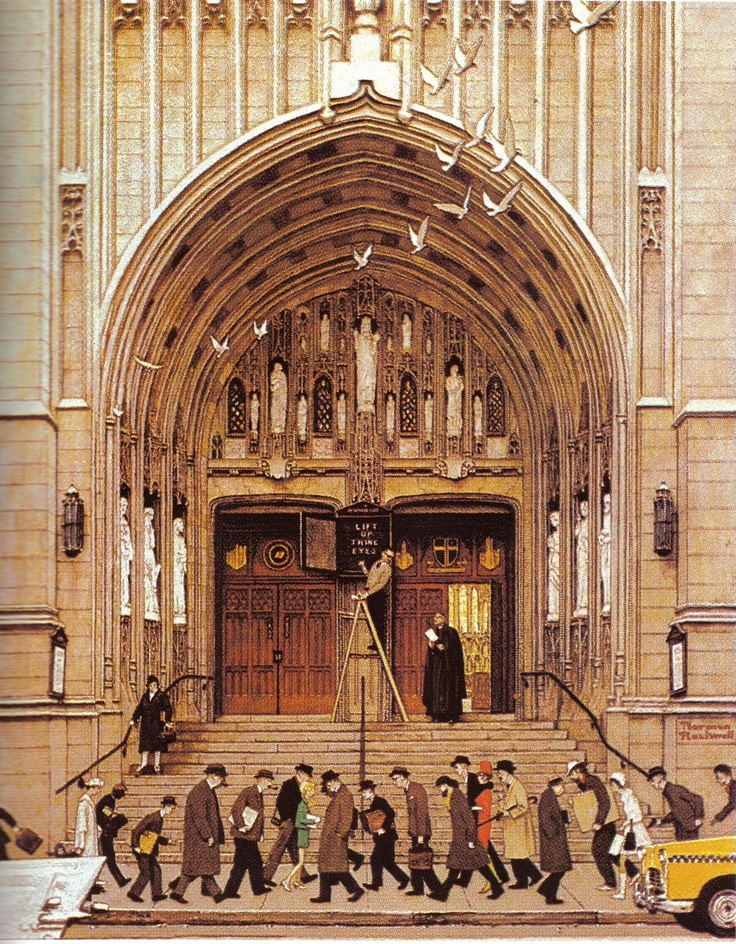
Have you ever seen Norman Rockwell’s 1957 painting “Lift Up Thine Eyes”? It portrays the sidewalk outside of a cathedral in a busy city in which all of the passersby have their heads bowed not in reverence but in distraction.
You can see the burdens of the world in their posture and in their gaze but behind them, up toward the doors to the sanctuary, a solitary church figure is replacing the letters on a small sign that says “Lift Up Thine Eyes” and no one seems to be getting the message.
The painting haunts me.
It haunts me because life, it seems, has done its worst to the people passing by. Shuffling to and fro they carry the burden of their burdens – some are on their way to work, other are perhaps looking for work, and all of them can only see what’s right in front of them: a dirty sidewalk trample upon by countless footsteps.
And yet, what haunts me most is the fact that even though the painting was completed 64 years ago, it is still just as relevant today! Simply put a smart phone or an iPad in every person’s hand and you’ve got a modern Rockwell for 2021.
It should come as no surprise that many of us have spent far more time on devices over the last year and a half than we ever had before. The pandemic cloistered us away from one another such that the only way we could really interact was through a phone (that most people no longer even use as a phone!). This dramatic increase in usage has led to the dramatically ironic arrival of Zoom webinars on “Zoom Fatigue”, silent meditations apps only accessible as podcasts, and week-long digital conferences on the dangers of devices.
I was talking with someone the other day and she casually remarked about how hungry she was, and when I asked what she had for lunch she responded: “I was so busy on my computer that I forgot to eat.”
And it’s not just our addiction to our devices – getting rid of them, or hiding them away for a few hours a day, doesn’t rid of of the weight of the world that we carry around all the time. We carry the expectations we place on ourselves and the expectations the world places on us. We carry the sins and the shames of our past (and our present). We carry the terror of tomorrow and the fear of the future.
And yet, when we return to Rockwell’s painting – the majority of the scene is in reference (and reverence) to something more. The top portion of the painting displays doves (a sign of the Holy Spirit) almost floating in the air, the saints of the cathedral stand in defiance to the burdens of life, and the church door stands awkwardly open barely beckoning anyone to discover what’s on the other side.
Perhaps what the people in the painting need is an interruption – a person who can meet them where they are and who can show them where they can be, a person who can break into their brokenness to bring relief, healing, and even joy.
Thanks be to God, then, that that’s exactly what we get in the person of Jesus Christ. For, God looked down upon our sins and our shames and chose to become one of us in order to redeem and rectify us. God still looks down upon our imperfections and our shortcomings and calls for us to lift up our eyes not to unattainable achievements or superior morality or continued suffering, but instead God calls for our attention to be lifted to the Cross, to the One who lifts us out of our navel-gazing and into the strange new world made possible by God.
Blessed be the God and Father of our Lord Jesus Christ, who has blessed us in Christ with every spiritual blessing in the heavenly places, just as he chose us in Christ before the foundation of the world to be holy and blameless before him in love. He destined us for adoption as his children through Jesus Christ, according to the good pleasure of his will, to the praise of his glorious grace that he freely bestowed on us in the Beloved. In him we have redemption through his blood, the forgiveness of our trespasses, according to the riches of his grace that he lavished on us. With all wisdom and insight he has made known to us the mystery of his will, according to the good pleasure that he set forth in Christ, as a plan for the fullness of time, to gather up all things in him, things in heaven and things on earth. In Christ we have also obtained an inheritance, having been destined according to the purpose of him who accomplishes all things according to his counsel and will, so that we, who were the first to set out hope on Christ, might live for the praise of his glory. In him you also, when you had heard the word of truth, the gospel of your salvation, and had believed in him, were marked with the seal of the promised Holy Spirit; this is the pledge of our inheritance toward redemption as God’s own people, to the praise of his glory.
You learn, after a little while, not to tell people that you’re a preacher.
It doesn’t really matter where the interaction takes place or with whom, the responses are generally the same.
I’ll be at a BBQ and when the beans get spilled everyone starts hiding their beers behind their backs, or I’ll strike up a casual conversation in a grocery store and when the truth gets out the person across from me will confess they haven’t been to church in a very long time, or a fellow parent at a soccer practice, having seen me in my collar, will begin to list off a litany of complaints about the church he/she grew up in.
Right before the pandemic I was introduced to someone as a pastor and the person responded: “Good for you, but I don’t need to go to church.”
I was hooked.
“What do you mean you don’t need to go to church?”
“Well,” he began, “I don’t need someone like you to tell me how I’m supposed to be living my life. I’m a good person already.”
Is that what the church is for? Do we exist to make people into better versions of themselves? Is all of this designed to bring about better moral and ethical behavior?
We put a lot, and by a lot I mean A LOT, of emphasis on self help these days. The pandemic saw immense spike in the sales of Pelotons, designed to make our bodies look the way we really want them to, Diet Programs, designed to make our bellies look the way we want them to, and a whole slew of “How To Be The Best You” books, designed to make us look, think, act, and speak the way we want to.
We like to imagine ourselves as “self-made” individuals and we regularly lift up those who have done so in the greater and wider culture.
And yet Paul, in his letter to the church in Ephesus, speaks not of what we must do, but instead begins by only addressing what God does. And, to really hit the nail on the head, it’s all in the past tense – It’s all already done and decided.
Listen – God has blessed us by choosing us in Jesus Christ. He has made us holy and blameless by bringing us out of bondage to sin and death by the price of his own blood – That’s what redemption means.
Our holiness, whatever it may be, is only because of Christ’s own righteousness. Jesus’ perfect life under the Law has been transferred and credited to us as our own. The Judged judge has come to be judged in our place.
God has done all of this and has made us his children. Children by adoption with an inheritance.
Now, consider – Paul doesn’t say this is all something we must earn by our doing or by our faith – he says its already ours, gifted to us unconditionally and irrevocably by way of Jesus.
This is all God’s work from before the foundation of the world.
And that’s just the first bit of our scripture today!
Paul is emphatic that God is the one who acts, so much so that he strings this entire passage together as one rather long run-on sentence in the Greek. In fact, it’s the longest single sentence in the entire New Testament, and God is the subject of all it’s verbs.
Put simply: It’s all about God.
And yet, we can’t help ourselves, at times, from making church all about us.
Sermons and Sunday school curricula all join the mighty chorus of self-help programs.
We start by telling everyone that God loves them, but before too long we starting dropping lists of expectations if people want God to keep loving them.
We say things like, “God commands us to love our neighbors as ourselves so, you might want to write all of this down because it’s important, you all need to work on your racism, sexism, classism, ageism, ethnocentrism, STOP USING STYROFOAM, go vegan, gluten-free, eat locally, think globally, fight against gentrification, DON’T DRINK SO MUCH, practice civility, mindfulness, inclusiveness, take precautions on dates, keep the sabbath, live simply, practice diversity, do a good deed daily, give more, complain less, and while you’re at it, STOP DRINKING SO MUCH.”
If people have ever been evangelized by fear mongering or higher moral standards, they might be converted away from something, but not to the Gospel.
To be clear: that long list is, undoubtedly, filled with good things, things we should all probably work on, but Jesus comes not to make us struggle under the weight of additional expectations, he doesn’t wait up on the cross until we’ve righted all of our wrongs, he doesn’t hide behind the stone in the tomb until we have enough faith.
Jesus does what Jesus does for us without us having to do much of anything AT ALL.
Last week, after worship, a lot of you said a lot of things to me. But one of you said something I haven’t been able to get out of my head: “It’s good to know that God is still God no matter who stands in the pulpit.”
That’s some pretty good theology!
And, to be clear, I didn’t actually say that in my sermon, nor was it said in any other part of the service. But if that’s what was conveyed, well then “Thank you Holy Spirit!”
You see, we’re not the Good News. Not pastors, not lay people, not even the church.
It’s actually very Good News that we’re not the good news, because if we were then we’d be doing a terrible job.
We’re not the Good News. We all do things we know we shouldn’t and we all avoid doing things we know we should.
But here’s where the Good News gets really good: we’re the objects of it.
That is: God does for us what we could never, and would never, do on our own.
God, bewilderingly, chooses to come to us, and not the other way around.
Sure, there are plenty of people in scripture who seek the Lord, but not a one of em deserved anything the Lord gave em.
Have you heard about the wee little man up in a tree? The one who stole money from the likes of you and me? Well, Jesus invites himself over to lunch at Zacchaeus’ house and transforms his life forever.
Do you know about the crowds who were hungry after listening to Jesus preach for an entire afternoon? Well, he multiplies some loaves of bread and a handful of fish without even taking the time to discern whether or not the people were really worthy of such a miracle.
Again and again in the strange new world of the Bible, God meets the people of God in the midst of their sins, down in the muck of life, and offers grace.
And grace, as Robert Farrar Capon so wonderfully puts it, grace isn’t cheap or even expensive, its free.
God says to us, “Look, I don’t care what the world has told you about who you are. That’s not who you are! You are mine and I am thine!”
The thing that makes the church different than any other organization, different from political parties or rotaries or corporations is the Gospel.
The Gospel is what God has chosen to do, from before time!
For us, by the cross.
And through us, by the Spirit.
In the end, we don’t really bring much of anything to church. Sure, we can sing and we can pray, we can even drop some money in the offering plate when it comes around, but all of the pales in comparison to what God has already done for us.
If we bring anything here, week after week, we bring our brokenness in hopes and anticipation that God will make something of our nothing.
Do you see it? Church isn’t about what we do – it’s about being reminded, again and again, of what God has done for us.
And then, and only then, in the knowledge of what is already done, we get to take steps into the adventure that is called faith.
There was a man in one of my churches who I just couldn’t stand.
Now, I know that’s not very pastoral, but I’m a sinner in need of grace just like the rest of you.
Everything about this guy drove me crazy. He was older than dirt, he treated people like dirt, he was extremely racist, and he always felt it necessary to drive over to the church once a week to tell me how I, and the entire church, were failing to do what we were supposed to do.
He was regarded similarly by nearly about everyone I met. Just about once a week some poor soul would stumble into my office having been ripped a new one by the man in question.
I even tried to work the Gospel on him when I had the chance, but it never worked. He stuck to his well-worn path of belittling everyone within earshot, scoffed at the thought of ever needing to change any of his opinions, and rested comfortably knowing he was always the smartest, wisest, and all around best person to ever walk on the face of this earth.
And then he died, and I had to do his funeral.
In the days leading up to the service I lamented the fact that we would have a nearly empty sanctuary for his funeral. Even though he drove me wild, no one should be laid to rest without a church to worship in the midst of it all.
And so it came to pass that I stood at the doors of the church, ready to begin the service for a small gathering of people when, all of the sudden, cars started steaming into our parking lot. I could hardly believe my eyes when, one by one, church members who had been so wronged by the now dead man made their way into the sanctuary.
The last person to cross the threshold was a fiery old woman who was a regular target of the dead man’s insults and I grabbed her my the arm and said, “What are you doing here? I thought you hated the man.”
“Preacher,” she said, “Aren’t you the one who said we have to love our enemies and pray for those who persecute us?”
“Well, yeah I’m sure I said…”
“And didn’t you also say that even the worst stinker in the world is someone for whom Christ died?”
“Well, that’s certainly one way…”
“And didn’t you declare from the pulpit just last week that nothing, literally nothing, can get between us and the love of God in Christ Jesus?”
“Uhh, that might’ve been…”
“Well then so be it!”
And with that she marched right into the sanctuary to worship.
Our forgiveness, offered before the foundation of the cosmos, is the beginning to which we return to over and over again. It’s what we need to be reminded of throughout our lives lest we fall prey to the temptation of believing that we have to save ourselves. And it runs so counter to everything we think we know because it doesn’t make any earthly sense.
But that’s why God is God, and we are not.
We’re told, in ways big and small, that we have to do it all.
The Gospel tells us that it’s all already done.
Paul beckons our attention to the truth of our condition in that God willed our blessing before ALL things.
Put another way, before God said “Let there be light,” God’s first words were, “Let there be Gospel.”
That’s why, as my parishioner so vividly reminded me, Paul can proclaim in another letter that nothing, literally nothing, can get between us and the love of God in Christ Jesus because God’s love for us precedes all things.
Which is all just another way of saying, God loves you and there ain’t nothing you can do about it. Amen.
This week on the Strangely Warmed podcast I speak with Haley Husband about the readings for the 7th Sunday After Pentecost [B] (2 Samuel 6.1-5, 12b-19, Psalm 24, Ephesians 1.3-14, Mark 6.14-29). Our conversation covers a range of topics including family ties, Money Heist, liturgical dance, food, the heart of the psalter, embracing the unknown, grace in parenting, theological adoption, absent sermons, and the story within the story. If you would like to listen to the episode or subscribe to the podcast you can do so here: Faithful Consequences
I appeal to you therefore, brothers and sisters, by the mercies of God, to present your bodies as a living sacrifice, holy and acceptable to God, which is your spiritual worship. Do not be conformed to this world, but be transformed by the renewing of your minds, so that you may discern what is the will of God – what is good and acceptable and perfect.
Years ago there was a young man, still early in his ministry, who was appointed to serve a new church.
At least, it was new to him.
He had gone to the right seminary, and studied all the right books, and prayed all the right prayers, and served in the right ways, and was excited about this next step in the adventure that is faith.
So with eager anticipation, he packed his bags and got in the car to go check out John Wesley UMC somewhere in Georgia.
This preacher was so excited, in fact, that when he arrived in town, before he unpacked his bags, he drove to the church. He typed the requisite address and admired the different varieties of trees planted perfectly along the road, but when came to his destination, he saw no church.
So he turned around, drove down the road once more and, again, no church to be found.
Finally, he got out of the car, and walked along the sidewalk for a closer inspection until he eventually found the church and he discovered why he missed it so many times: there was one of the oldest and most decrepit looking trees he had ever seen stretching all over the grounds with roots exposed and the church sign, plus the majority of the building, were hidden behind the tree’s long branches.
The preacher stood awkwardly on the front lawn of the church taking in the sight of the godforsaken tree, and decided he was going to do something about it.
So he drove back to his house, found the box containing his chainsaw, and then he set out to cut the tree down. He made short work of it, moving methodically from branch to branch (he was a Methodist after all) until, before long, he took a step back to admire his work.
The sign and the building were now completely visible from the road and he thought, rather proudly, that maybe just a few extra people would be in church on Sunday morning.
A few days later, as the pastor sat down to continue chipping away at his first sermon for the church, he received a call from his District Superintendent: “I hope you haven’t finished unpacking yet,” the DS said, “because you’re being reappointed.”
You see, the church was named John Wesley UMC for a reason.
John Wesley himself had stood on the roots of that tree nearly 300 hundred years ago and preached to that community. Afterward, the gathered people decided to build a church right next to the tree in honor of the man who started a revolution of the heart, and that young pastor chopped it down.
Stories are remarkably important. Put another way: We are the stories we tell.
They contain and convey just about everything regarding who we were, who we are, and who we can be. Stories held by and within a community help to shape the ways we interact with one another, and how we obtain the collective memories of the past. We tell stories to make people laugh, to teach lessons, and to share what it ultimately means to be human.
Today we live in a time of competing narratives in which every television show, every streaming service, every website, and every social media platform are vying for our allegiance and our attention. We are constantly bombarded, whether we like it or not, with information that attempts to tell us who we really are, what we really need, and where we are really going.
We live in a time in which more people recognize the golden arches of McDonald’s than they do the cross of Jesus Christ. We live in a time in which people spend more time debating where they see the best view of fireworks, or what’s really going on in Loki, or which politician is finally going to set things right than they will consider the children in their community who have nothing to eat. We live in a time in which plenty of us would rather store up all of our treasures on earth without thinking at all about how every gift first comes from the Lord.
Right now, the world is telling us what is important and it’s not easy to discern between the voice of the world, and the voice of God.
But listen to St. Paul: Do not be conformed to this world, but be transformed by the renewing of your minds. Do not listen to the powers and principalities that try to define you. Do not diminish God’s ability to radically transform your life and the world around you. Open your eyes to the beauty of the strange new world made possible by Jesus Christ and him crucified.
Whenever people like us gather like this we are bound together in loyalty to a story that once was not our story. But, through God’s wonderful and confounding actions in the world, that story is now our story. It is a story of cross and resurrection, of the first being last and the last being first, of undeserving people being forgiven.
That story will always but us at odds with the world.
And, according to the ways of the world, the church is between a rock and a hard place. People are no longer regularly attending worship and that started long before a pandemic kept us in our houses on Sunday mornings. Christianity has lost its status in the public arena, we are becoming frighteningly illiterate (biblically speaking), and young people are almost nowhere to be seen when it comes to the body of Christ.
Did you know that the average age of a United Methodist is 58?
That means I still have 25 years to go before I’m average!
Did you know that the average person in a United Methodist Church invites someone to worship once every 38 years?
The world will tell us that the church is dead, that we have to do whatever we can, however we can, to get people in our building, that we need to cut down every tree (real or otherwise) that is blocking the church from the street, that we need to abandon the past in order to embrace the future because the church is dead.
Thanks be to God then, that we worship the Lord who works in the business of resurrection, of making a way where there is now way, of impossible possibility.
We don’t have to conform to the ways of the world, but instead we get to be transformed by the renewing of our minds!
While others might shrink away or wail in fear regarding the statistics I just mentioned, imagine what would happen if we embraced them and saw them as an opportunity for transformation? How would the church change if we took seriously the radical nature of God’s grace? What would happen if we embraced the trees and traditions of the church to reclaim the story that has already changed the world?
We are the stories we tell.
Here’s part of mine:
I am a cradle Methodist – I was baptized when I was 19 days old at Aldersgate UMC in Alexandria VA, where I was raised and confirmed. I ran the sound system for worship as a tweenager, played for two of our worship bands, and spent even more time at the church because it was where my boy scout troop met every week. As a teenager one of my dearest friends died tragically in a car accident and I found myself ministering to friends and family using words that were not my own, but words that had been habituated into my life because of the church and the Spirit.
I began feeling like this might be what God was calling me to do with my life and when I told the senior pastor at my church his response was, “You wanna preach in a few weeks?”
I went to JMU to study religion, I went to Duke for my Masters in Divinity, met my now wife Lindsey while I was in North Carolina and we have a remarkable 5 year old named Elijah Wolf.
My first appointment was to St. John’s UMC in Staunton, my last appointment was to Cokesbury UMC in Woodbridge.
I love the church, I always have and I always will. For me, the church is the last vestige of a place where people willfully gather with people they have nothing else in common with save for the fact that Jesus has called them his friends.
I also love the church because I believe it is the better place God has made in the world. When we pray, when we break bread, when we baptize, we are all getting foretastes of the Supper of the Lamb that goes on and on forever.
Here’s what I know of your story:
I know that the church has been a beacon of the Gospel in Roanoke for 100 years. I know that you care deeply about the Word, about worship, and about mission. I know that you pride yourselves on your hospitality, something my family and I have been the beneficiaries of over the last few weeks. I know that you believe in the work of the Kingdom and are ready for the next 100 years.
And now God has seen fit to string and knit our stories together.
Being a Christian is all about being brought into another story, a different telling of where we have come from and where we are going, a story that we call the Gospel – The Good News.
And the stories from the strange new world of the Bible really do shape us – they speak greater truths than simple facts and statistics, they tell us who we are and, more importantly, whose we are. That’s why Jesus never really simply explains anything to anyone, but instead is forever going on and on telling stories, stories we call parables.
At the heart of the church is a willingness to share and to learn the art of story-telling. We learn one another’s stories by gathering for worship, or studying God’s Word, or serving the local and global community. We tell stories and receive stories so that we can cherish the roots of our foundations while, at the same time, looking to the future because God makes all things new.
The story of Raleigh Court United Methodist Church is entering into a new chapter. God is stirring things up in Roanoke. God is bombarding us with the grace that we don’t deserve but we surely need. And God is doing this not because there is a new pastor in town, and God is doing this not because the church is looking forward to the next hundred years – God is doing this simply because that’s who God is.
All of this, the church, the community of faith, grace, it’s all one remarkable gift. It’s the gift of a new past, in which the mistakes we’ve made are healed and the damage we’ve done is redeemed. We call it forgiveness. In the church and in the kingdom of God we are more than what we have failed to do, we are what God has done for us.
But it is all also a gift of a new future, in which the fear of punishment is annihilated and the terror of nothingness is obliterated – we’ve been promised resurrection.
The Church is a new past, present, and future – it is a way of life made possible by Jesus in anticipation of God doing what God does best.
The world might tell us that the church is in a difficult place. But I look out from this pulpit to all of you gathered here in person, and to all of you gathered online, and I’m not worried about what the world has to say. I’m not worried about anything because my hope isn’t in me or even in any of you, my hope is built on nothing less than Jesus’ blood and righteousness – I dare not trust the sweetest frame but wholly lean on Jesus’ name!
Christ is the solid rock upon which this church stands; all other ground is sinking sand, all other ground is sinking sand. Amen.
This week on the Strangely Warmed podcast I speak with Teer Hardy about the readings for the 3rd Sunday After Pentecost [B] (1 Samuel 15.34-16.13, Psalm 20, 2 Corinthians 5.6-17, Mark 4.26-34). Teer is one of the pastors at Mt. Olivet UMC in Arlington, VA. Our conversation covers a range of topics including handsomeness, green thumbs, passages for pastors, election and rejection, enthusiasm for the future, idolatry, confidence, human points of view, parable prejudices, and impossible possibilities. If you would like to listen to the episode or subscribe to the podcast you can do so here: We Know How The Story Ends
And the crowds came together again, so that they could not even eat. When his family heard it, they went out to restrain him, for people were saying, “He has gone out of his mind.” And the scribes you came down from Jerusalem said, “He has Beelzebul, and by the ruler of the demons he casts out demons.” And he called them to him, and spoke to them in parables, “How can Satan cast out Satan? If a kingdom is divided against itself, that kingdom cannot stand. And if a house is divided against itself, that house will not be able to stand. And if Satan has risen up against himself and is divided, he cannot stand, but his end has come. But no one can enter a strong man’s house and plunder his property without first tying up the strong man; then indeed the house can be plundered. Truly I tell you, people will be forgiven for their sins and whatever blasphemies they utter; but whoever blasphemes against the Holy Spirit can never have forgiveness, but is guilty of an eternal sin” — for they had said, “He has an unclean spirit.” Then his mother and his brothers came; and standing outside, they sent to him and called him. A crowd was sitting around him; and they said to him, “Your mother and your brothers and sisters are outside, asking for you.” And he replied, “Who are my mother and my brothers?” And looking at those who sat around him, he said, “Here are my mother and my brothers! Whoever does the will of God is my brother and sister and mother.”
This is a difficult passage.
We’re still relatively early in the gospel story: Jesus is baptized by his cousin John in the Jordan. Jesus is tempted in the wilderness for forty days and forty nights. Jesus sets out in the place of Galilee proclaiming the Good News of God, calls disciples, cures the sick, makes some pronouncements about the Law, and word starts spreading. Fast.
So much so that the crowds kept coming together to see, and hear, and experience more of this Jesus to the degree that people couldn’t even eat because there wasn’t enough room. And when Jesus’ family found out, they were less than enthusiastic.
Scripture puts it this way, “They went out to restrain him because they thought he had gone out of his mind.”
Immediately, the scribes come busting in from Jerusalem taking Jesus to task for all of his actions and words and Jesus responds to all their accusations with parables.
“You think I’m wild? You think I have Beelzebul? How can I cast out demons if I am a demon? Kingdoms divided cannot stand, nor can divided houses. You can go on and on all you want but let me tell you, sins are being forgiven, and the only thing you have to do is accept it. If you don’t want any part of forgiveness, no worries, you can blaspheme the Spirit all you want.”
Then Jesus’ mother and brothers came in order to get him in order when Jesus delivers the sting: “Who are my mother and my brothers? Whoever does the will of God is my brother and my sister and my mother.”
I know I’ve preached on this text at least four times and I’ve never really been satisfied with whatever I attempted to say. This is all just so foreign to our ears. Beelzebul? Satan? Demons? We’re respectable Methodists! We don’t talk about such strange things here!
And that’s not even getting into the tricky and rather confounding nature of Jesus’ rejection of the family unit, upon which everything seems to be founded in our society.
This little brief anecdote toward the beginning of the Gospel, the early stages of Jesus’ ministry, is filled to the brim with both conflict and confusion. It forces us, whether we like it or not, to confront the difficulties involved with following Jesus.
And yet, it is still hilariously Good News.
Clashing with religious authorities seems to be Jesus’ cup of tea. Whether it’s eating with the wrong people, or working on the wrong day, or simply saying the wrong things to the wrong people on the wrong day, controversy abounds.
Basically, the people with power didn’t like him.
Whenever they heard Jesus preach about the Kingdom of God, whenever he went about from town to town, the authorities didn’t say, “Oh, he’s so sophisticated. Have you ever heard such an articulate son of a carpenter in all your life?”
No. They said he was out of his mind.
But Jesus wasn’t out of his mind. He wasn’t a stark raving lune. It’s just that the stuff he said sounds incompatible with reality whenever he is heard from the stand point of what the world teaches us to regard as good, right, and proper.
Everywhere he went, Jesus proclaimed and enacted and embodied a very different sort of reality than the one we’ve convinced ourselves we have. Jesus points to a different world that runs completely counter to all of our expectations for life.
That reality is called The Kingdom of God, in which the first are last and the last are first – the weak are strong and the strong are weak – the lowly are lifted up and the mighty are brought down.
Jesus is all about reversal. The psalms talk about it as the hills being made low and the valleys being raised up. And it’s for talk of such things that everyone thought Jesus was out of his mind, his family included.
And perhaps they had a point.
Jesus says, “I am the good shepherd and I am willing to die for my sheep.”
That’s not a plan for a strong business model, but instead its a recipe for disaster.
Jesus says, “I am the fatted calf slaughtered for the celebration of the prodigal’s forgiveness.”
That doesn’t sound like a program for do-goodery, but instead its an undeserved celebration.
Jesus says, “I am the bread of life, and whosoever eats of me will never be hungry.”
Um, Jesus, cannibalism is inadvisable and even if it’s spiritual, you can’t just give yourself away for free…
Consider this Jesus – No seminary education. He never published a book. He lived with his parents until he was thirty years old. He never held a steady job, never owned a home, never saved away for retirement. He was known for going to a lot of parties with twelve unattached men and was regularly accused of disturbing the peace.
No wonder everyone thought he was out of his mind.
And it doesn’t stop there!
Listen to the Lord: You can only grow up by turning and becoming like a child.
You can only win by losing.
You can only receive by giving.
You can only live by dying.
Um… Thanks Jesus, but have you got anything else to offer us?
Blessed are you who are poor. Happy are you who are hungry. Congratulations are in order for those at the very bottom of life.
And this is the Lord to whom we pledge our allegiance!
Do you remember what St. Paul wrote to the church in Philippi? Let the same mind be in you that was in Christ Jesus.
Paul doesn’t write to the early church about the need to have the best mind, or going off to study all the important subject under the sun. No, he said, “Think like Jesus!”
And what happened to Jesus for thinking like Jesus?
His family tried to restrain him and the religious elites called him into question. Eventually, his disciples abandoned him. And, in the end, we killed him for it.
The crowds were fine with most of what Jesus said and did. Who wouldn’t want to see the hungry filled with good food, or the naked clothed with the finest wares? Who wouldn’t want to see the sick healed and the outcast welcomed back?
But when Jesus started to push into the territory we call the Kingdom of God, people got all sorts of upset.
It’s one thing to talk about raising the lowly, but it’s another thing entirely to talk about bringing down the mighty. It’s one thing to talk about the inauguration of a new reality, but it’s another thing entirely when you start publicly entrusting that kingdom to a bunch of would-be fishermen and tax collectors. It’s one thing to talk about the virtues of forgiveness, it’s another thing entirely when you’re actually asked to forgive the very people who have wronged you.
But “out of mindedness” is rather contagious. At least, it has been in the realm of the church. Get one taste of that body and blood, receive a foretaste of the grace that knows no end, and you can’t really ever go back.
If you think about it, one of the great joys of the Christian faith is that it’s actually quite fun to have our minds messed up by Jesus. We have the great fortune of being freed from the expectations of reality in order to live into a kingdom in which we are no longer defined by what we failed to do and instead are defined by what has been done for us.
The church really is a new understanding of the way things can be.
It might not be easy for us to receive, but the proclamation that those who do the will of God are the family of Jesus is great Good News. It means that water is thicker than blood. That is – we have a solidarity with people beyond our biological connections. Baptism incorporates us into something we would never otherwise have.
It implies a desire to weep with those who weep and to rejoice with those who rejoice. It means that no matter what you’ve done or left undone, the church is a community of people who will always be there for you.
Could there be any better news than that?
But wait, there’s more!
Because the real hilarity behind the Good News in our text is this: we often say that insanity is doing the same thing over and over again and expecting a different result. And for us humans, that’s probably true. How many of us have endeavored to initiate a diet only to sneak that extra piece of cake when no one was looking? How many of us have set out to live by a strict budget only to go further into debt? How many of us have made internal promises to make the world a better place only to wake up to a world that is seemingly worse than it was the day before?
Doing the same thing over and over again and expecting something to change might be definitionally living outside of our minds.
But what about for God?
God, unlike us, delights in impossible possibilities. The insanity of the Gospel is that, over time, God actually changes us. We are not what we once were because God will not let us stay that way. God, through bread and wine, through water and Spirit, is making all things new.
Including us!
The liturgy, the practice of week in and week out, using the same words and saying the same prayers, isn’t an act of craziness. It is, instead, a fundamental belief in possibility. It is the habituation and embodiment of things not yet seen. It is, literally, Good News.
Jesus responds to the accusations and the attacks from the crowds, from the religious elites, and even his family by saying that whoever does the will of God is his family. The will of God, the claim that incorporates and institutes the church, is a reign of forgiveness.
And forgiveness might be the craziest thing of all.
Everything about the way we live is a denial of the power of forgiveness. We’ve got our minds stuck in the rut of an eye for an eye. But the only thing that an eye for an eye accomplishes is an entire society of people who cannot see. We’ve got our minds stuck in the rut of believing that we should, and must, view one another through our mistakes, our failures, and our shortcomings. But doing so only leads to walls of division rather than avenues of connection. We’ve got our minds stuck in the rut of assuming that things will largely stay the same. But living as such is what makes things stay the same!
Forgiveness is an entirely different reality constituted by the behavior of the Lord. For, though we deserve it not one bit, God delights in forgiving us. God took each and every one of our sins past, present, and future, nailed them to the cross, and left them there forever.
Living in the light of forgiveness, that is: doing the will of God, is the recognition that our identities are not based on the ways in which we fail.
That’s the joy of Christianity – it is an ever present and unconditional starting afresh and anew in the light of God’s grace rather than the shadow of our mistakes.
So hear the Good News: Christ died for us while we were yet sinners and that proves God’s love toward us. In the name of Jesus Christ you are forgiven! Let us rejoice in the knowledge that Christ has messed up our minds! Amen.
I am the good shepherd. The good shepherd lays down his life for the sheep. The hired hand, who is not the shepherd and does not own the sheep, sees the wolf coming and leaves the sheep and runs away — and the wolf snatches them and scatters them. The hired hand runs away because a hired hand does not care for the sheep. I am the good shepherd. I know my own and my own know me, just as the Father knows me and I know the Father. And I lay down my life for the sheep. I have other sheep that do not belong to this fold. I must bring them also, and they will life to my voice. So there will be one flock, one shepherd. For this reason the Father loves me, because I lay down my life in order to take it up again. No one takes it from me, but I lay it down of my own accord. I have power to lay it down, and I have power to take it up again. I have received this command from my Father.
I was on vacation with my extended family and decided that, as a pastor, I should still probably go to church on Sunday morning. I googled “nearby United Methodist Churches,” picked the one with the least bad website, and announced my intention to the family. When Sunday morning arrived, the only takers I had for church were my sister, my son, and myself.
So we loaded into the car and left everyone to sleep in on Sunday morning as we prepared to worship the Lord in glory and splendor.
The church was beautiful, situated right in the middle of town (a town that will remain unnamed for reasons soon to be proclaimed), and when we pulled into the parking lot we were immediately greeted by a cheerful older couple dressed in their Sunday best.
Our little trio ascended the stairs leading into the sanctuary and were immediately bombarded by two things: an oppressive wave of heat wafting from the chancel area, and a slew of congregants who could sense fresh blood in the water.
Regarding the former: the AC had apparently died and the design of the sanctuary trapped the summer heat inside and we were to be treated to a sauna-like atmosphere for the service.
Regarding the latter: I couldn’t blame the church folk. Here we were looking like a new little family in town and they were all so happy to see people they’d never seen before.
And in that briefest of moments I had a choice. Well, I had a few. I could’ve grabbed my son and sister and made for the nearest exit so that we could find a church that had their air conditioning running. But seeing as I am a pastor, I felt that a tad impolite. Which brings me to the main choice I had: To share, or not to share, my vocation.
There’s something that happens when a pastor attends another church – people become, as my grandmother says, beside themselves. They want to pull out all the stops, and find you the best pew in the house, and they want to be their very best.
Why?
I’m not sure.
It’s not as if, as a pastor, I would ever come back on another Sunday. I have a job that requires me to be in a particular place at a particular time nearly every Sunday of my adult life.
Nevertheless, I had to choose. And, seeing as I was on vacation, I decided to truly rest, and allow the congregation to rest, and when the first person stepped forward to shake my hand, he sure enough asked what I did for a living. I opened my mouth to say something about being a librarian, or construction worker, or being a mid-tier manager at a sufficiently boring data company when my son, all of three years old at the time, stepped right in front of me and yelled, “I’m Elijah and this is my dad. He’s a pastor!”
And so it began.
15 minutes later, having received a tour that included a forgotten church library, three sets of bathrooms, and a hallway filled with more pamphlets than I’ve ever seen in one place at one time, I found myself sitting in what I was assured to be the best pew in the sanctuary, next to my sister and son and the three of us were completely drenched in sweat.
We stood for the appropriate hymns, we bowed for the requisite prayers, and finally we sat back for the sermon.
I love listening to other people preach. It is so much of what I do after all, and I don’t get to hear a lot of preaching, so I settled in to hear what God had to say through this particular preacher.
The text was John 10 – I am the good shepherd.
The preacher wax eloquently about John’s gospel in general, and the importance of the various I am statements (I am the bread of life, I am the light of the world, I am the way, the truth, and the life). The preacher made various allusions to Exodus 3 when Moses encountered God as the burning bush who declared I Am Who I Am.
It was all well and good, until it wasn’t.
The preacher was wrapping up the homiletical insights and ended with this: “Jesus is the good shepherd who watches out for the sheep. All of you out there are the sheep. You don’t know what to do and what not to do which is why you need Jesus. But I am neither shepherd nor sheep. I, as the pastor, am the sheep dog. Now I know that John doesn’t mentioned the sheep dog but I’m sure that he just forgot to write that part down. As the sheep dog my primary responsibility is to keep all of you in line. I will nip at your legs to make sure you know what you can and can’t do, where you can and you can’t go. So let me do my job.”
In the name of the Father, Son, and Holy Spirit, Amen?
The church universal has traditionally observed this, the 4th Sunday of Easter, as Good Shepherd Sunday. In all three years of the lectionary cycle, four different texts assigned for each Sunday, today is all about shepherds and sheep from both the Old and New Testaments.
Which, when you think about it, is kind of the perfect “life after Easter” message – Jesus returns to us, Jesus finds us, and Jesus will never let us go.
We are given an assurance from the Good Shepherd, just on the other side of rejection and resurrection, that we are loved, that we are cared for, that we matter not based on what we do or do not do, but on what Jesus does for us.
Which, to be clear, is rather counter to what I heard on vacation.
Consider the sheep: The sheep cannot do much of anything for themselves or their situations. The only thing sheep can do, really, is follow. And even that can be a trying endeavor. And when a sheep is lost, it is, for all practical purposes, a dead sheep. The only hope a lost sheep has is being found by the shepherd.
Jesus, as the Good Shepherd, tell us exactly what he will do, how far he will go, to save a bunch of dumb sheep who can’t do anything for themselves.
Jesus, to put it simply, does it all.
Jesus gets all the good verbs in scripture and yet, in Christian preaching, he often feels like an after-thought. But Jesus, even here, warns us about that possible proclamation! The hired hand, who is not the shepherd and does not own the sheep, sees the wolf coming and leaves the sheep and runs away! Jesus is rebuking religious leaders then, and now, who neglect the people of God.
Do you see? Discipleship is all about the admission of our condition – we’re sheep; we are dead in our sins. It is all about coming to grips with the fact that we have no power to save ourselves or to convince anyone that we are worth saving.
Consider – More than 18 million children in the US live in food insecure homes.
For the first time since the 1960’s life expectancy in the US has gone down.
And, while people celebrated (or lamented) the conviction of Derek Chauvin, the police officer who murdered George Floyd last year, a police officer in Columbus, Ohio shot and killed a 16 year old girl named Ma’Khia Bryant.
I could go on and on.
We truly are sheep without a hope in the world unless we have a shepherd who is willing to do for us that which we cannot do on our own.
Thankfully, that’s exactly what we get in Christ Jesus.
God in Christ finds us in the desert of death, not in the garden of progress. God meets us right smack dab in the middle of our sins, not in the triumph of our accomplishments.
The life of faith is predicated on recognizing how lost we are, how our lives really are out of our hands, how if we will ever really live again it will entirely be the gift of some gracious shepherd who delights in putting us on his shoulders and carries us home.
We can call the Good Shepherd a good shepherd because while the hired hands run away at the first sign of danger, or puts all sorts of unhelpful (and unattainable) expectations on us, Jesus remains steadfast. And (!) Jesus does not merely care for the sheep within reach, but also gathers the whole flock together!
For all of the talk in the church today about inclusion (open hearts, minds, doors), the most inclusive claim of the Gospel is that Jesus came to save sinners, which includes each and every single one of us!
And that’s the most important part of whatever this thing is that we call church – its about proclaiming God’s grace imputed to sinners through the work of Jesus Christ. If that’s not the beginning, middle, and end of everything we do, then we’re not really doing anything.
But, instead of making that profound proclamation, we are far more likely to be consumed by sheep dogs nipping at our legs both inside, and outside, the church. We hear it from pastors, politicians, pundits, and everyone in between. Things like: You need to work on your racism, sexism, classism, ageism, ethnocentrism, stop using styrofoam, go vegan, gluten free, eat locally, thinking globally, don’t drink so much, practice mindfulness, inclusiveness, keep the sabbath, live simply, practice diversity, on and on and on.
And, all of things are good and fine, we probably should start doing that stuff – but they are not where we begin. If those things are anything, they are a response to what God has already done.
A Bishop, from another denomination (thankfully), used to be in charge of recruiting for a seminary. He would seek out those who felt called to lead the church and he would end every single interview the same way, with a role play. He would say, “Pretend I’m not someone from the seminary, but that everything else about my life is true – I’m a 50 something, over-educated, occasionally kind, straight white male. Now, tell me why I should go to church…”
Every single person, throughout the years, would mention something about the value of community. But the Bishop would say, “I attend AA and I have all the community support I need.” Then the candidates would mention something about outreach. But the Bishop would say, “I’m a member of Rotary and I already help the needy.” Then the candidates would make a point to emphasize the beauty of the music at church. But the Bishop would say, “I have season tickets to the local symphony.”
He recruited for years and not a single candidate ever mentioned anything, specifically, about Jesus.
The church is not in the business of societal rearrangement, we are not the paragons of community service, and we certainly don’t hoard all of the musical prodigies. Church may have those gifts, but if we’re serious about being the church then we really only have one thing to offer at all: God’s grace in Jesus.
For the church today, the main thing is to keep the main thing, the main thing. We might think the main thing is convincing other people to adopt our positions on social issues. We might think the main thing is making sure that everyone falls asleep at night with a full belly. We might think the main thing is putting on the greatest performance in the world every single Sunday. But those are not the main thing.
The main thing is Jesus Christ and him crucified. The main thing is Jesus Christ, God in the flesh, born to dwell among us. The main thing is Jesus Christ, the Good Shepherd, who never ever stops tending to the sheep.
Friends, the only thing we’ve got that other group don’t, is Jesus Christ and him crucified, the Good Shepherd who lays down his life for the sheep; for us!
People can get everything they need, except Jesus, from other places and other people. And they might even be better at that stuff than we are.
But we’re in the Jesus business. That is: we are here to proclaim the Good News, frankly the best news, that God has seen fit to rectify all that we’ve wronged, that we are love in spite of all the reasons we shouldn’t be loved, and that, and the end of all things, we know how the story ends because we know Jesus Christ. Amen.








 think and let think