Devotional – John 20.19

Devotional:

John 20.19

When it was evening on that day, the first day of the week, and the doors of the house where the disciples had met were locked for fear of the Jews, Jesus came and stood among them and said, “Peace be with you.”

Weekly Devotional Image

The doors were locked because the disciples were afraid. Jesus broke forth from the chains of death in the morning, but by the evening the disciples were locked up at the house. And John is quick to tell us that they did so for fear of the Jews. Perhaps the disciples were afraid that the fate of crucifixion was coming for them next, or at the least they would be attacked and driven from the city. But nevertheless, the Word become flesh is resurrected and the closest followers of Jesus are hidden in a room.

Were they really afraid of the Jews? Or was there something else that drove them to lock the doors and cower in the corner?

I think that the disciples were certainly afraid of the Jewish leaders, particularly in light of what they had done to Jesus, but I also think the disciples were afraid of the risen Jesus. These disciples, these followers of the Messiah, had all abandoned him at the end, they had denied him, and now he’s back! I would be hiding too.

How often do we fail our friends only to cower in fear as we wait for their response? I know far too many people (myself included) who will ignore that email, text message, or phone call from a particular individual not because of anything he/she did, but because of what we did.

Thanks be to God that Jesus did not leave the disciples hiding in fear behind locked doors. Thanks be to God that the gospel was too important to remain hidden. Thanks be to God that Jesus came in, stood among them, and said, “Peace be with you.”

682086_1_e9135b

Do we believe that Jesus could show up in our lives when we are ashamed for something we’ve done? How often do we hide (literally or figuratively) behind locked doors when we have failed our friends or families? What would it look like to live like we believed in the resurrection of Jesus from the dead?

As Easter people we are committed to practicing resurrection here and now in anticipation of our promised resurrection. This means that we cannot take the people around us for granted, it means we cannot stay hidden in shame, it means that we have to be brave and courageous people willing to say “peace be with you” to the people with whom we feel no peace.

Devotional – Matthew 6.28-29

Devotional:

Matthew 6.28-29

Consider the lilies of the field, how they grow; they neither toil nor spin, yet I tell you, even Solomon in all his glory was not clothed like one of these.

Weekly Devotional Image

In a few hours I will gather with members of the community for a Service of Death and Resurrection for one of St. John’s long-time members, Gracie Jackson. During my first two months serving at St. John’s (almost 4 years ago), I tried to visit as many people as possible from the church community, particularly those who could no longer attend worship on Sundays. I want them to know that the church still cared about them and that they were in our prayers regardless of their presence.

Throughout those first months I was welcomed into a great number of homes and learned so much about Staunton and the impact St. John’s has had throughout the decades. One of my first visits was to the Jackson home where I sat and talked with Lenard and Gracie Jackson. But we didn’t sit for long. Instead, they wanted to give me the grand tour including the basement workshop and the green house in the backyard. There were plants everywhere but one in particular was striking and unlike anything I had seen before. Lenard explained that it was a Night-Blooming Cereus, and like the name implies, it only blooms at night. At the time, I casually mentioned my interest in the plant and we continued the door.

However, a couple days later Gracie told Lenard that he HAD to invite me over to witness the Night-Blooming Cereus in all it’s glory. (Lenard recently told me that in his life there were always two ways to doing things, and both of them were Gracie’s!). So at 10pm Lindsey and I drove over to the Jackson house and the four of us sat in their living room in our pajamas patiently waiting for the plant to do its magic.

When the right time arrived, we huddled in the green house with the dark sky coming through the windows and the cactus bloomed right in front of us. It produced the most exquisite scent and filled the room with its glory. And in that moment I was struck by the holy space we were sharing and was reminded of Jesus’ words from Matthew 6: “Consider the lilies of the field, how they grow; they neither toil nor spin, yet I tell you, even Solomon in all his glory was not clothed like one of these.”

6e7f0caa6dfe8f6541d5babc77c32ecf

That Night-Blooming Cereus was one of the most spectacular things I have ever seen and I never would’ve experienced if it weren’t for Gracie’s insistent invitation. Similarly, our faith is something that is offered to us as an invitation. We can read all about the Lord in Scripture, we can pray privately on our own time, but when we share our faith with another person it can bloom in the most exquisite of ways.

I am so remarkably grateful for the time I got to spend with Gracie, and for the many ways she embodied God’s grace for me.

Devotional – Job 19.23-25

Devotional:

Job 19.23-25

O that my words were written down! O that they were inscribed in a book! O that with an iron pen and with lead they were engraved on a rock forever! For I know that my Redeemer lives, and that at the last he will stand upon the earth.

Weekly Devotional Image

Last Thursday, while my wife, son, and I were visiting family in Alexandria, I received a phone call about one of St. John’s long-time members having died. Ruth Cassidy joined the church weeks after it formally began back in 1954 and while it was still meeting in a basement down the road. Ruth was easily one of the kindest people I ever had the chance to spend time with, and she will be greatly missed by our church community, and by her family.

A couple years ago I received a phone call about Ruth’s husband Howard, and it was clear that he was close to the end of his life. And so, I made my way over to their retirement home and when I walked into the room Ruth was sitting next to her husband, she was lovingly holding his hand in hers, and he had just taken his final breath. I, not wanting to intrude on the holiness of the moment, slowly started to back away but Ruth insisted on me sitting down with her on the couch. She immediately started asking me questions about my family and St. John’s and I was still in a state of shock; I was overwhelmed by the totality of the moment, and the fact that Howard had literally just died. Ruth continued to ask me questions, but I wanted to acknowledge what had just happened. It took a couple minutes, but I finally mustered the courage to ask: “Ruth, are you okay? I mean, Howard just died…”

She looked right into my eyes, smiled, and said, “Oh, everything is fine; I know where he really is.”

Rarely have I encountered such faith, such hope, and such love as what I regularly experienced through Ruth Cassidy. Like the biblical character of Job, she had an assurance about the way things really are. In that holy and profound moment immediately after her husband died, I could almost hear the words of scripture floating in the room with us: “I know that my Redeemer lives, and that at the last he will stand upon the earth.”

job-19-25-26

Ruth’s assurance, her blessed assurance, was one worthy of our emulation.

Do you know that your Redeemer lives? What words or thoughts would you want to engrave on a rock forever? Can you feel the Holy Spirit moving and breathing into your life? Are you filled with an assurance about who you are and whose you are?

O that my words were written down and engraved forever! I know that my Redeemer lives! And that at the last he will stand upon the earth!

Devotional – Genesis 12.1

Devotional:

Genesis 12.1

Now the Lord said to Abram, “Go from your country and your kindred and your father’s house to the land that I will show you.”

 Weekly Devotional Image

And that’s how it all began. The Lord said to Abram, “Go.” In the entirety of the Old Testament, there are few passages as important and theologically profound as God’s calling of Abram to go to a strange new place. We can talk about Jacob wrestling with the emissary from God by the banks of the Jabbok river, we can talk about Joseph saving the Egyptian people from certain starvation, we can even talk about Moses’ trials and tribulations with the Hebrew people in the wilderness, but this moment with Abram, this call, sets in motion the great narrative of God with God’s people.

The sheer magnitude of such a call cannot be overlooked. During the time of Abram’s life, almost everything was dependent on staying in one’s country and with one’s family. Most people spent their entire lives, from birth to death, within a handful of miles and rarely explored anything outside the normal and comfortable dwelling of “home.” And yet God had the audacity, the boldness, and the faithfulness to call Abram to do the unthinkable: go to a strange new place and leave it all behind.

This, in a sense, is akin to the call of all Christians. We might not be asked to leave our home country, we might not be asked to leave our families, but we are certainly compelled to enter into strange relationships and moments around us. It is easy to stay within a certain bubble throughout our lives and never stretch too far into the unknown. We can develop rhythms and habits that actively prevent us from encountering anything out of the ordinary. But God is extraordinary.

go

Lent is a time for us to reflect and repent. We reflect on the many ways God’s has so graced us, and we repent for the many ways we have failed to positively respond to that grace. Lent is a time for us to all recognize the Abram within us, and wonder where God is calling us to go. What place are we avoiding because it makes us uncomfortable? What relationship have we let fall apart because it just felt like too much work? What frustrating behavior in a friend or a spouse or a child have we let percolate for far too long?

In some way, shape, or form God is calling each and every one of us to “go.” God calls us to “go” because our God is a God on the move. God cannot be relegated to a sanctuary on Sunday mornings at 11am, God is not absent until we pray for God’s presence, God is not sitting on a throne up in heaven watching us through a telescope. God moves, and so should we.

God Said It, I Believe It, That Settles It

Deuteronomy 23.12-14

You shall have a designated area outside the camp to which you shall go. With your utensils you shall have a trowel; when you relieve yourself outside, you shall dig a hole with it and then cover up your excrement. Because the Lord your God travels along with your camp, to save you and to hand over your enemies to you, therefore your camp must be holy, so that he may not see anything indecent among you and turn away from you.

1 Corinthians 14.32-35

And the spirits of prophets are subject to the prophets, for God is a God not of disorder but of peace. As in all the churches of the saints, women should be silent in churches. For they are not permitted to speak, but should be subordinate, as the law also says. If there is anything they desire to know, let them ask their husbands at home. For it is shameful for a woman to speak in church.


We have a problem. I’m sorry that I have to use the pulpit to bring it up, but this is the best way to reach the highest number of people. We, as a church, have fundamentally broken one of God’s laws and we need to do something about it. We need to pray for forgiveness. We need to seek God’s mercy. And, we should get moving on this issue quickly in order to establish our faithfulness before the Lord.

We need to stop using the church bathrooms.

Now, some of you might be thinking: What in the world? Stop using the bathrooms? We’ve heard him say some strange stuff from the pulpit, but this has to be the strangest!

But scripture is pretty clear. We are supposed to have a designated area, outside the church, where we shall go when nature calls. We are supposed to keep a trowel with us at all times so that when we relieve ourselves outside, we can dig a hole and then cover up our excrement. We need to do this because the Lord is with us when we are in church, therefore this church must be holy and we can’t let the Lord see anything indecent among us.

So, after prayerful consideration, the trustees have voted to permanently close all the bathrooms in the church building, and we will construct some outhouses on the edge of the property for excrement disposal.

Just kidding.

lexica

Have you ever heard someone preach on Deuteronomy 23.12-14? I haven’t, nor have I even encountered it during a bible study. But in the 1880’s, churches and bathrooms were quite the topic of sermonic conversation. The advent of indoor plumbing had arrived and the question about whether or not to have bathrooms in churches started to pop up.

By the logic of the Old Testament, churches were seen just like the Israelite encampments and because of this the same rules about where people could relieve themselves were applied. Many preachers used this argument from their pulpit more than a century ago to fight the growing trend to build bathrooms in churches!

Today, when designing a new church, one of the first questions isn’t what the sanctuary should look like, or what kind of design will enhance the altar, or even how many people can fit in it, but how many bathrooms should there be, and where should they be put.

How do we understand the Word of God? Do we believe that all scriptures have been inspired by God and are useful for teaching? What does it even mean that God inspired the writing of scripture?

Years ago I was invited to participate in a bible study that met once a week. At the time we were going through the gospel of Matthew when one of the women in attendance interrupted with a dilemma for the group. Her son told her that he was thinking about getting a tattoo and she knew that God forbids this kind of behavior in the Old Testament. It was clear that she was looking for approval from the rest of us, but I opened my big mouth and said something like, “Well, I don’t think its that big of a deal” To which she replied, “If God says it in the bible, then the issue has been settled!”

I should have stopped right there, but I couldn’t help myself. “So, you don’t eat pork or shrimp? And you are going to rally the community together to stone your son to death for rebelling against you? And you didn’t mean to wear earrings today because you know the bible forbids them as well?”

This sort of extreme biblical literalism is problematic, and basically impossible. If we try to live by the Word with extreme rigidity, we would not be allowed to wear clothing with blended fabrics, we’d have to completely rethink our diets, working on the Sabbath would get us killed, and men would not be allowed to trim their beards. Ever.

            God said it, I believe it, that settles it.

This is another one of the trite and cliché Christianisms that float around in conversation. When Christians get into an argument about a particular biblical precept, like prohibitions against tattoos or homosexuality, they will take a verse and use it like a weapon against the person they disagree with. God said it, I believe it, that settles it.

But, whether we admit it or not, rarely do we read the bible and think, “Okay, that settles it then.”

Today, no one worries about whether to build a church without a bathroom, we don’t hear preachers belabor biblical dietary restrictions, and we neglect a great number of scriptures while at the same time we use scripture to attack others.

There are all sorts of rules and regulations in scripture that, if we’re honest, we pick and choose to emphasize.
bible-and-its-interpretation

As we read earlier, Paul is clear in more than one letter that women should not speak in church. And yet, this church had a female pastor for a number of years, and our liturgist this morning just read out loud from the bible! Heaven forbid! A woman speaking in church! Can you believe it?

Of course, some churches still believe that the words about the subordination of women are the gospel truth. In those church, women are not allowed to serve in leadership positions, they are not allowed to teach Bible Studies where men are present, and they are not allowed to serve in any capacity that would require them to speak in front of the congregation.

I’ll tell you right now, this church would not be here if women kept their mouths shut. We are as faithful as we are because the women in our midst have been brave enough to speak what God has placed on their hearts, and because we have listened.

So what are we to do? We can’t just throw out the bible, but at the same time we can’t live by every single word within it.

Like the apostles and disciples before us, we read scripture and we hear God speaking through it. But we also ask questions of it. We consider context. We wonder if God really intended women to remain silent in church. We recognize that things like slavery are counter to God’s will, despite more than 200 verses that support it in the Bible. We don’t preach and teach that having bathrooms inside churches are offensive to God.

We follow Jesus’ example.

Jesus, Son of Man and Son of God, did not adhere to strict biblical literalism. He had different interpretations of the Sabbath restrictions, he had stronger opinions about divorce and adultery, and he regularly disobeyed the Law by eating with those deemed unclean.

Living as a Christian, reading the bible, it’s all about interpretation. And, to be clear, interpretation does not mean to change the text, or to ignore it, but to proclaim it for this time and for this place.

Even the Bibles in our pews are themselves a work of interpretation. Someone, and more often than not some people, made particular choices about how to translate particular words from Hebrew and Greek into English. This might not seem like a big deal, but if you take something like one of the most beloved of all scriptures: For God so loved the world that he gave his only begotten son that whosoever believe in him may not perish but have everlasting life. The word for “perish” in Greek is apollumi which can mean perish, but it can also mean to die, to be destroyed, to be lost, killed, or ruined. Each of these translations can change the meaning of the text slightly, and are therefore a product of interpretation.

So whenever we take up a bible, whenever we flip to a specific passage, the work of interpretation started long before our eyes flow over the English translation. But nevertheless, even the best translations leave us to continue the task of interpretation.

How do we do it? Well, we don’t do it in isolation. We don’t read our bibles in our living rooms never to speak about the words again, we don’t listen to a sermon only to have that be the only time we encounter the words.

We interpret God’s Word in community. We go to bible studies, we send emails to our friends and to our pastor, and we do what we need to do in order to comprehend that which is often incomprehensible.

And we let Jesus help us interpret. In the beginning was the Word and the Word was with God, and the Word was God. As the definitive Word, Jesus helps us to understand the words of scripture. We read from the Old and New Testament alike through the lens of Jesus and we begin to wrestle with how these words continue to live and breathe in our lives today.

But that requires a lot more work than “God said it, I believe it, that settles it.” It compels us to actually take up our bibles, read them, and talk about them. It challenges us to ask hard questions and produce new ideas. It requires us to believe that this book is in fact the living Word of God and that it continues to speak truth in new and exciting ways, perhaps in ways we cannot even imagine.

This last week has been filled with controversy from the Oval Office. In their first week, the new administration put forth a number of executive orders including a call to begin construction on a wall at our southern border, a gag order for the EPA, and the halting of refugee migration from a number of countries.

c3nffwbxaae5lbr

On the same day we celebrate the liberation of the concentration camps in Europe, our country said, “we don’t want them” to people fleeing persecution and destruction.

Now, no one has said that this has been done because of scripture, but the bible should have played a role in the decision if our politicians are going to keep claiming their Christian allegiance.

Moses was a refugee after fleeing from Egypt.

            Ruth was a refugee after her husband died and she followed her mother-in-law to a strange new land.

            The entire Israelite people were refugees in Babylon.

            Jesus, the one we worship here in church, was a refugee. Jesus, like people in the Middle East today, had to flee his home out of fear of violence, persecution, and even death.

And yet, we tout these certain stories from scripture and hold them over people’s heads about behavior and identity. But when we start actively preventing the oppressed from entering the country, we forget all about the story of our Lord and Savior.

People have used this book, with understandings like “God said it, I believe it, that settles it,” to attack and belittle people for far too long. It has been used to justify the horrific practice of slavery. It has been used to subjugate and relegate women’s rights. It has been used to rationalize physical violence and aggression toward people of different religions. It has been used to incite fear and terror in those who do not believe. It has been used as a weapon again and again and again.

And now we, the people of God, join together to say “no more!”

“No more!” to the use of scripture like a weapon to oppress the weak and the marginalized. “No more!” to the complacent Christianity that stands idly by as people are attacked for whom they are. “No more!” to the backwards ways of the past that lose sight of God’s grace here and now.

“No more!” to God said it, I believe it, that settles it.

The Tyranny of Titles – A Christmas Pageant Homily

Matthew 18.1-5

At that time the disciples came to Jesus and asked, “Who is the greatest in the kingdom of heaven?” He called a child, whom he put among them, and said, “Truly I tell you, unless you change and become like children, you will never enter the kingdom of heaven. Whoever becomes humble like this child is the greatest in the kingdom of heaven. Whoever welcomes one such child in my name welcomes me.”

img_2120

A father was with his four year old daughter last Christmas, and it was the first time she ever asked what the holiday meant. He explained that Christmas is all about the birth of Jesus, and the more they talked the more she wanted to know about Jesus so he bought a kid’s bible and read to her every night. She loved it.

They read the stories of his birth and his teachings, and the daughter would ask her father to explain some of the sayings from Jesus, like “Do unto others as you would have them do unto you.” And they would talk about how Jesus teaches us to treat people the way we want to be treated. They read and they read and at some point the daughter said, “Dad, I really like this Jesus.”

Right after Christmas they were driving around town and they passed by a Catholic Church with an enormous crucifix out on the front lawn. The giant cross was impossible to miss, as was the figure that was nailed to it. The daughter quickly pointed out the window and said, “Dad! Who’s that?”

He realized in that moment that he never told her the end of the story. So he began explaining how it was Jesus, and how he ran afoul of the Roman government because his message was so radical and unnerving that they thought the only way to stop his message was to kill him, and they did.

The daughter was silent.

A few weeks later, after going through the whole story of what Christmas meant, the Preschool his daughter attended had the day off in celebration of Martin Luther King Jr. The father decided to take the day off as well and treat his daughter to a day of play and they went out to lunch together. And while they were sitting at the table for lunch, they saw the local newspaper’s front-page story with a picture of Martin Luther King Jr. on it. The daughter pointed at the picture and said, “Dad! Who’s that?”

“Well,” he began, “that’s Martin Luther King Jr. and he’s the reason you’re not in school today. We’re celebrating his life. He was a preacher.”

And she said, “for Jesus?!”

The father said, “Yeah, for Jesus. But there was another thing he was famous for; he had his own message and said you should treat everyone the same no matter what they look like.”

She thought about it for a minute and said, “Dad, that sounds a lot like do unto others as you would have them do unto you.”

The dad said, “Yeah, I never thought about it like that but it’s just like what Jesus said.”

The young girl was silent again for a brief moment, and they she looked up at her dad and said, “Did they kill him too?”

img-wallpapers-christmas-eve-omohit-158401

Kids get it. They make the connections that we’re supposed to make. And even though 2016 has been a rough year with the political rhetoric and partisanship at its worst, and all the culturally significant individuals we lost (David Bowie, Leonard Cohen, Prince, Gene Wilder, John Glenn, etc.), and with the migration of refugees from the Middle East to Europe at the highest levels since the Second World War… our preschoolers have had a tremendous year.

Today, we adults live under the tyranny of titles. We want to label individuals based on a crazy assortment of criterion. He’s a Republican, she’s a Democrat, that family is poor, that family is rich, that woman is black, that man is Hispanic, that couple is gay, that couple is straight.

But the Preschoolers who gather in our basement don’t see the world and one another the way we see the world and one another.

Instead they see each other as Cruz, and Hadley, and Charlie, and Ellie Rose, and Owen, and Maddie, and Graham, and Henry. They, unlike us, do not view the world through the cynical lens that so many of us have adopted over the years. They, unlike us, see the world like Jesus.

Like that little girl with her father, they understand the cost of discipleship in a way that few us can.

I’ve been here long enough to have spent a lot of time thinking about what the Preschool should be teaching the children. I’ve had consultations with the teachers about curricula and paradigms. I’ve even met with some of you to discuss the growth and transformation of your children in response to the nurture and education they receive in the basement.

I’m guilty of the same cynicism that treats young people like objects to be molded in a factory to come out prepared for the world. When Jesus is the one who calls us not to make children into adults, but to change adults into children.

This Christmas, I have a challenge for you. Instead of being consumed by the desire to transform your little ones to fit into one of the labels of society, try to let them transform you. Try to look at the world the way they do. Try to love one another the way they do.

For it is on Christmas that we celebrate the birth of God in the flesh, born as a baby in a manger to a young couple all alone in the world. God did not come to change the world through political power or through economic wealth or through militaristic might. God changed the world through a baby, not unlike the ones we are celebrating with tonight. Amen.

Let’s Talk About Doubt – Sermon on Isaiah 7.10-16

Isaiah 7.10-16

Again the Lord spoke to Ahaz, saying, Ask a sign of the Lord your God; let it be deep as Sheol or high as heaven. But Ahaz said, I will not ask, and I will not put the Lord to the test. Then Isaiah said: “Hear then, O house of David! Is it too little for you to weary mortals, that you weary my God also? Therefore the Lord himself will give you a sign. Look, the young woman is with child and shall bear a son, and shall name him Immanuel. He shall eat curds and honey by the time he knows how to refuse the evil and choose the good. For before the child knows how to refuse the evil and choose the good, the land before whose two kings you are in dread will be deserted.”


What a strange promise. The Lord will give you a sign. Look, the young woman is with child and shall bear a son, and shall name him Immanuel. The promise sounds nice and sweet, after all its part of a lot of the hymns we sign during this time of year. We read these verses and our minds immediately jump to the manger scene with Mary and Joseph carefully cradling the baby Jesus with the animals remaining perfectly quiet and still. But this promise is made to a particular person in a particular moment, and that’s what makes it strange.

At the time of Isaiah’s proclamation, forces were gathering and attempting to attack and invade Jerusalem. The King, Ahaz, is deeply afraid. And it is in the midst of his fear that God offers the King a sign, any sign that he wants, let it deep as hell or high as heaven. God offers Ahaz any sign he wants so that the king will remember to trust the Lord. Ahaz, appearing quite faithful, says he will not put the Lord to the test (the same thing Jesus says during the temptations in the wilderness), but the Lord ignores Ahaz and proclaims the coming sign nonetheless.

So it is while King Ahaz is shaking in his boots, while troops are gathering at the gates, that he receives a sign of God’s promised presence: A young woman will bear a son named Emmanuel.

Now, let’s be real for a moment: God’s promise of a baby is weird. And it’s rather ambiguous. God does not say, “I will destroy the invading forces with terrible violence” nor does the Lord promise that Ahaz will survive. Instead, God says that a baby is coming to save the world.

I don’t know about you, but Christmas, to me, always seems full of happy go lucky faith without any doubt or questions. Lights are hung up on all the houses, people tune their radios to the Christmas stations, and parents want their children to behave themselves in the Christmas pageants.

But doubts and questions are there, perhaps just barely below the surface of the façade we wear around during these weeks we call Advent.

doubt

Do we doubt? Are we allowed to? What happens to us if we do? More than a few of us will be sitting in the pews on Christmas Eve singing Joy to World and celebrating the Christ-child while we’re really wondering what it means to believe.

King Ahaz doubted. While surrounded by enemies, and offered a miracle by God, he insists on not putting God to the test. This might sound really faithful, but God offers something incredible and Ahaz turns it down. His pious response is more a dismissal of the Lord being able to actually help.

Moses doubted. When the Lord asked him to go and deliver the people from the tyranny of Egypt, Moses quickly listed off the excuses for why he shouldn’t be the one to go.

Jeremiah doubted. When the Lord called him to be a prophet to God’s people his response was quick, “I am only a boy! Surely I can’t speak on your behalf”

Jonah doubted. When the Lord commanded him to travel to Nineveh he traveled in the opposite direction in order to avoid what he had been asked to do.

Zechariah doubted. When the Lord spoke to him and told him that his wife was going to become pregnant he did not believe the Lord could perform such a miracle.

John Wesley doubted. You know, the guy in the stained glass window right there. He was asked to go travel to a strange place called Georgia and preach the Good News but he did not have faith. And when he told his superiors about it, they said, “Preach faith until you have it; and then, because you have it, you will preach faith.”

Even Jesus doubted, though only for a moment. When he found himself all alone and nailed to the hard wood of the cross, he cried out, “My God, my God, why have you forsaken me?”

Sometimes we feel like if we have doubts it is the complete opposite of having faith. In fact, many leave the church whenever that first doubt starts to creep in and they begin to wonder about the truth and promises of God’s Word.

I know more people than I can count who, at some point, were devout and faithful followers of Jesus Christ. And all it took was a little dose of the dirty word for their faithfulness to crumble. Was there really a virgin birth? Did Jesus really walk on water and feed the 5,000 and bring sight to the blind? Does God really care about our individual lives? Did God really raise Jesus from the dead?

Their entire discipleship hinged on the answer to one of those questions, and when they could not find an answer that was satisfying, they left.

I have friends from seminary who felt called to the ministry but have since left the church because a professor told them something like, “Moses didn’t write the first five books of the bible.” Or “Paul did not write the epistle to the Hebrews.” Or “Some of the psalms attributed to David were not written by David.”

            Doubt is such a dirty word. For a long time it has been shunned from the church and treated like a mortal sin. It has been seen as a weakness. But doubting is often a sign that our faith has a pulse, that it is alive and well and exploring and searching.

            Doubt and faith are not opposites.

            You can’t really have one without the other.

We’re now going to try something a little different, something a little strange, and frankly it might not work. But I’m going to leave this pulpit and come down to you and we’re going to talk about our doubts. Now the point of this is not for you to say something like, “I have trouble believing the virgin birth” and then have me completely remove your doubts with some sort of speech. No, the point of this is for us to be vulnerable and intentional with one another, for us to connect as a community of faith around the fact that we have doubts, but that God is big enough to handle our doubts.

So, what are your doubts?

This week, as I was scrolling through the seemingly endless cycle of news from around the world, I read about Russia’s apparent involvement in the democratic election cycle of the United States, and I read about Apple’s struggle to provide Bluetooth compatible headphones in time for Christmas consumers, and I read and read and read.

But then I saw a picture that still haunts me. In the image, a man and a woman are walking through the city Aleppo, Syria. The woman’s face is covered and her husband is cradling their baby in his arms, while holding up an IV bag that’s running down into the bundle of swaddling clothes.

            I’ll admit that what I should have been struck by most was the violence in the background and the terror in their posture, but what struck me the most was how much it reminded me of Mary, Joseph, and the baby Jesus.

A man carries a child with an IV drip as he flees deeper into the remaining rebel-held areas of Aleppo, Syria December 12, 2016. REUTERS/Abdalrhman Ismail

Over 250,000 people have died in Syria as a result of their civil war, most of them innocent civilians. And while we fret over the incoming president-elect and whether or not consumer goods will arrive on time, modern Marys and jaded Josephs are doing everything they can to protect their babies.

And it makes me doubt. I read the statistics, I see the photos, and I want to know where God is in the midst of all this. How can the God who knows us by name and has counted the hairs on our heads rest easy while innocent men, women, and children are dying at a rate we can barely fathom?

And while this is happening across the world, Christians in our country are worried about Muslims and are seriously considering instituting a registration of all Muslims. And do you know what’s happening in Aleppo? Christians and Muslims are serving shoulder to shoulder pulling children from rubble, consolidating food and resources to share with as many as possible, and are the remaining sources of light in a city under the shadow of death.

I doubt God’s presence in the midst of something as terrible as what’s happening in Aleppo, but then I have hope when I read about Christians and Muslims working together to bring joy to people who feel no joy.

And so I live in this tension between faith and doubt. We all do. We vacillate between the two like a frenetic sphere in a pinball machine. We doubt and we trust. We break down under the tyranny of violence and are built back up by the very nature of love. We weep for the world and its destructive desires, and are comforted by the God who came down to take on our flesh. We lift up our clenched fists in frustration to the sky, and we hear God speak in the still small voice: “Lo, I am with you always.”

Faith and doubt; you can’t have one without the over. Amen.


doubt

Devotional – Luke 17.5-6

Devotional:

Luke 17.5-6

The apostles said to the Lord, “Increase our faith!” The Lord replied, “If you had faith the size of a mustard seed, you could say to this mulberry tree, ‘Be uprooted and planted in the sea.’ And it would obey you.”

Weekly Devotional Image

We are a people consumed and captured by the power of instant gratification. We want the greatest reward for the smallest effort. We post a picture online and we expect people to like it right away. We show up to church on Sundays and we want to be rewarded for our effort. We pray and we assume that God will answer us quickly.

But we, if we are anything, are slaves to God’s will and that requires patience and hardwork.

We have a church member at St. John’s who wears just about every hat you can think of; Dianne Wright is the lay leader and so much more. On Sunday afternoons she walks across the front lawn with a bunch of letters from the alphabet under her arm to change the marquee. On any given day she is writing cards to, and off visiting, the shut-ins from the church community. And she is forever on the look out for “churchy” objects and images that will help others grow in faith.

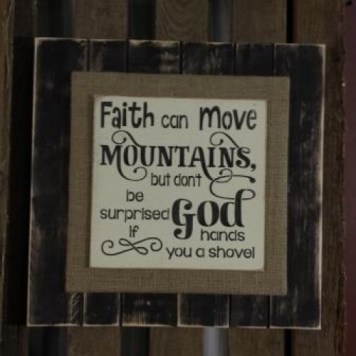
A couple months ago Dianne brought a sign over to the church and hung it against the refrigerator in the kitchen. She does things like this all the time but from the moment I saw this sign, the words have percolated in my mind: “Faith can move mountains, but don’t be surprised if God hands you a shovel.”

faith-can-move-mountains-but-dont-be-surprised-if-god-hands-you-a-shovel-4

Faith and discipleship is hard work. The disciples once asked Jesus to increase their faith, as if he could snap his fingers and it would just happen. But Jesus responds by telling them that faith the size of a mustard seed could pull a mulberry bush out of the ground move it to the sea. Have you ever tried to move a mulberry bush? The roots go deep down into the earth and make the work of replanting quite difficult.

Being a slave in God’s kingdom, yielding to God’s will, means that we have to do the right kind of work to increase our faith. We can’t just ask for it and expect everything to change immediately. It takes the habits of prayer, scripture reading, and communal worship to increase our faith. When we work to follow the commands of Jesus, difficult though they may be, our faith will increase.

God owes us nothing, and yet we are still loved. God’s invites us back into the realm of grace over and over even when we do not deserve it. Christ still loved us while we were yet sinners. And God gives us the power to move mountains and uproot mulberry bushes, but only if we’re willing to work for it.

On Creation vs. Evolution

Genesis 1.1-5

In the beginning when God created the heavens and the earth, the earth was a formless void and darkness covered the face of the deep, while a wind from God swept over the face of the waters. Then God said, “Let there be light”; and there was light. And God saw that the light was good; and God separated the light from the darkness. God called the light Day, and the darkness he called Night. And there was evening and there was morning, the first day.

Controversy Original

Preachers can fall into the rut of preaching on whatever keeps the congregation pleased; keep them happy and they’ll keep coming back, or something like that. This sermon series is different. Instead of falling back to the familiar narratives that keep us smiling on our way out of church, we are confronting some of the greatest controversies facing the church. There is a better than good chance that I will say something from this pulpit during the series that you won’t agree with, and if (and when) that happens I encourage you to stay after worship, join us for lunch, and continue the conversation. We can only grow as Christians in community, and that requires some honesty and humility and dialogue. Today we continue with Creation vs. Evolution.


“How old is the earth?” The fifth grader looked up from his homework assignment as if to say, “Well, dude, what’s the answer?” We were sitting inside Forest View Elementary School in Durham, North Carolina, and I was in the middle of a tutoring session. Each week we would sit in the library and go through his homework together. His class was finishing up a unit on earth sciences and his worksheet was filled with questions about the subject.

“How old is the earth?” I, of course, could not remember the answer so I promptly pulled out my cell phone to Google the answer and the young man rolled his eyes and opened up his textbook with dramatic emphasis. We flipped through the pages together looking for key words or pictures that would indicate we were on the right path and then we found it in big bold numbers on the bottom of a page: 4.54 billion years.

I waited patiently for my young tutee to copy the number down into the answer column on his worksheet, but he just kept looking at the textbook with a glazed-over look in his eyes. Then I heard him say, almost as if a whisper, “That can’t be right.”

“Well of course it’s right!” I said, “I mean its in the book, it has to be right.”

            And then he said, “But my pastor told me the earth is only 6,000 years old.”

creation-evolution-possible

In the beginning, the very beginning, there was nothing. All matter was formless. What we now know and see was a soup of nothingness, a bottomless emptiness, and inky blackness. And in the midst of this nothingness, there was something: God. And God said, “Let there be light”; and there was light. God saw that the light was good; and God separated the light from the darkness. God called the light Day, and the darkness he called Night. And there was evening and there was morning, the first day.

Perhaps no words in all of scripture have been more analyzed, prayed over, and interpreted throughout the centuries. Genesis 1 is beginning, and not just a beginning to a story, but the beginning to the story.

And it stands on the battlefield of the fight between Creation and Evolution.

Here’s the controversy: Centuries ago a man named James Ussher set out to date the earth. He dove deep into the Old Testament and, with the help of genealogies, established the exact time and date of God’s creation as 6pm on October 22nd 4004 BC. Therefore, according to Ussher, the earth is approximately 6,000 years old. However, with the advent of modern science and the likes of evolutionary biology and carbon dating, scientists have determined that the earth is 4.5 billion years old.

There is a big difference between 6,000 and 4.5 billion.

For a very long time, we humans considered the earth a relatively recent phenomenon. The Christian church established itself as the predominant leader of information distribution, and when that came into conflict with Science, the battle began.

This has manifested itself throughout the centuries in a number of ways including the fight between the Galileo and the church, Darwin and the church, and even the American Government with the church.

“How old is the earth?” It may seem like a pretty simple question without too many ramifications, but it is a big one, and the way we answer it has a lot of consequences.

A couple of years back, the state of Kansas removed questions about evolution from its standardized tests. This meant that teachers were still allowed to teach evolution, but the children would not be tested on it at the end of the year. Some Christians rejoiced in the victory Creation over Evolution, and others were concerned that children from Kansas would pale in comparison to students from other states by the time they entered college.

It would seem that the church has one answer to the question, and science has another.

I remember learning about the theory of evolution when I was in the 8th grade. With all my hormonal angst, and pimply face, and peach fuzzed mustache, I sat in my science class and learned about how all life can trace its origins back to one single cellular being: That over millions of years that first cell grew and evolved and developed new traits; how life began in the sea, and eventually developed to live on land and in the air; how humanity is one of the last developments in a tremendously long line of evolved species.

I thought it was awesome! The science-fiction nerd within me went into overdrive and I relished in learning about where we came from, how the earth has changed, and how beautifully unique we really are. And the whole time I dove into evolution I saw God’s handiwork all over the place. Who could have brought life into that first being, who could have the imagination to force molecules and atoms together in such a way that life began, who could have moved the development of species to its zenith in humanity?

But at the same time, some of my Christian friends stopped going to youth group and they stopped going to church. In learning about evolution their faith in church diminished. What they heard in the classroom became more important than what they heard in the sanctuary. When they learned that the earth was older than what they heard in church, their faith was crushed. I, however, was fortunate to have pastors and older Christians who helped me to see the similarities between science and faith. But my friends only saw the battle.

2852667_orig

The title of this sermon is Creation vs. Evolution for a reason. I titled it this way precisely because that is the way that many of us see the relationship between the two; Faith and Science represent opposite ends of the spectrum. One is archaic and illogical; the other is scientific and intellectual. One represents backward thinking; the other is forward thinking. One should be left to sanctuaries; the other is for the classroom.

The conflict between science and faith exists because of us; Christians who became defensive when scientists learned more about the world instead of rejoicing in God’s creative majesty. Christians who were quick to jump ship when we discovered there was more to the world than just what we can read about in the bible; Christians who saw scientific discovery as a work of the devil and retreated further away from the world.

But are science and faith really at odds with one another?

Young-Earth Creationists are those who believe (like Ussher) that God created the earth over 6 24 hours days 6,000 years ago. They dismiss scientific discoveries like the Dinosaurs and carbon dating as a way for God to test our faith.

However, there are other ways of looking at the biblical account of creation from Genesis 1 that harmonizes with, rather than battles against, science.

First, the word for “day” in Hebrew is “yom.” And it carries with it a number of definitions and interpretations. Yom is used in the Old Testament as a general term for time, like a time period of finite but unspecified length. We can also read in Psalm 90.4 “For a thousand years in your sight are like yesterday when it is past, or like a watch in the night.” What we understand the word “day” to mean is different than what it means in scripture. God’s time is not our time.

We could then read Genesis 1 to be that in the beginning God created light, and after light God created air, and after air God created earth and sky and sea. But how long it took God to do this is unknown. One day? One million years? Only God knows.

Genesis, and the rest of the bible, is not meant to be read like a science or history textbook. The bible, over and over again, rejects our desire to master the text and instead calls us to be servants of the Word. We might be concerned with how and when God created, but the bible only tells us who and why God created.

Then we can look at the order of creation itself and the similarities with the theory of evolution. Though it was written thousands of years before Darwin’s On the Origins of Species the order of creation parallels Darwin’s and modern evolutionary scientist’s ideas. The first thing to exist was light and energy. Then matter began to fuse together into celestial beings like stars and planets. Eventually the earth developed an atmosphere and water and land. The first life began in the sea, eventually evolved to fly in the air and crawl on the earth, and the last life to be developed, the zenith of God’s creation, was human life.

            Knowing this, countless Christians are able to hold that evolution is real, but that God set it in motion. They are able to assert that the earth is 4.5 billion years old AND God created it in the way described in Genesis. They are able to hold together science and faith in such a way that it gives glory to God’s glorious creation.

The conflict between science and religion, between creation and evolution, exists because people like us have treated the book just like every other book. We see it as our own historical textbook, or as our scientific journal, or as our genealogical record. We import the ways we read other texts into the way we read God’s great Word.

And then many of us take it up like a weapon against anyone who disagrees with us.

But the bible is fundamentally unlike anything ever written. It is historical, and scientific, and literary, and poetic, and every other form we can think of. It is beyond our ability to fully comprehend, it breaks down and exceeds the expectations we place on it, it is the living Word of the Lord.

In the beginning, the very beginning, there was nothing. All matter was formless. What we now know and see was a soup of nothingness, a bottomless emptiness, and inky blackness. And in the midst of this nothingness, there was something: God. And God said, “Let there be light”; and there was light.

           The bible is far less concerned with explaining how things happened, and is far more concerned with proclaiming God’s handiwork. It comforts us when we are afflicted, and it afflicts us when we are comfortable. It can make us laugh and it can make us cry. It can bring us to our knees and it can propel us to dance on our feet. It identifies God as creator and us as creature. It harmonizes with the marvelous developments in science. It humbles us and exalts us. It is who we are and who we aren’t. It is God Word for us. Amen.

The Problem with The Pledge of Allegiance

“I pledge allegiance to the Flag of the United States of America, and to the Republic for which it stands, one Nation under God, indivisible, with liberty and justice for all.”

bible-american-flag

It has been ten years since the last time I placed my hand over my heart and said the words to the pledge of allegiance. For the better part of eighteen years, I started every morning in school by standing up with my classmates, turning to the corner where the flag was standing, and saying those words that countless Americans have said throughout the decades. But then I stopped, and I haven’t since.

I was in 8th grade and living in Alexandria, VA when 9/11 happened. I can remember my father taking me out of school before it went on lockdown. I can remember sitting on the carpet in the living room watching the towers fall over and over and over again on television. I can remember my dad saying, “I bet Osama bin Laden had something to do with it” and I had no idea who Osama bin Laden was, or how my dad knew who he was. I can even remember realizing that nothing would ever be the same.

In the weeks that followed everything was a blur of red, white, and blue. The country had not experienced a wave of patriotism and nationalism to that degree since the end of World War II. My friends and I had conversations in the lunch hall about how we needed to go to war and kill the people who killed our people. We seriously wondered if the country would reinstitute the draft. And we proudly stood each and every morning to pledge our allegiance to the flag that was now flying in every front yard and on every car-bumper.

Over the next few years my dedication to the eradication of terrorism grew and grew. When members of Amnesty International painted our high school rock with words about peace and love, I got my friends together and we painted over it in black and red paint with things like “Pro-War” and “Bomb Saddam.” When we learned about how our country had played a major role in the chaos of the Middle East, I tuned out my teachers and ignored the textbooks. And when President Bush landed on the aircraft carrier to declare that we were victorious I beamed with pride.

But then a strange thing happened; I started really paying attention in church. I waited for our pastor to echo the same sentiment of celebration that President Bush declared. I waited to hear him give thanks to God for our victory over tyranny and oppression. I waited to learn about God’s saving hand over America from the pulpit. And those things never came. Instead we were asked to do something bizarre: pray for our enemies.

I heard the words of Jesus in a way I never had before, and it forced me to confront my own sinfulness. The more I read the bible the more I realized that my behavior was just like the crowds standing before the cross shouting, “crucify!” The more I read about Jesus’ way, the more I realized that I had fallen short of God’s glory and that I needed to repent. The more I experienced God’s grace the more I realized that my feelings were in conflict with my faith.

And then the words of the pledge of allegiance started sounding strange. I continued to stand with my peers throughout high school, I placed my hand on my heart and said the same words, but it made me uncomfortable. And then one day I stopped, and I haven’t since.

This has been particularly awkward at times; like when I was asked to speak before a local Kiwanis meeting and I felt the eyes of everyone in the room when I did not participate in the pledge of allegiance, or like when I gathered with a community band on the Fourth of July to play patriotic music and I was the only one who did not pledge allegiance to the giant flag waving gently in the breeze.

I am not against the American Flag, and I do not wish to be disrespectful toward it. I am not against our military nor am I a traitor. Instead, as a Christian, I have problems with the pledge of allegiance.

When we pledge our allegiance to a flag and whatever it stands for, it means we are pledging our allegiance to everything the flag represents; The flag that stood at the frontlines of Native American massacres; the flag that orchestrated coups in foreign countries for our own benefit; the flag that suppressed minority voices and segregated races; the flag that has benefited the rich at the expense of the poor; the flag that symbolizes “freedom” but really means “if you’re not with us, then you’re against us.” Our flag, and what it stands for, is something that puts me at dis-ease and is not something that I can blindly pledge allegiance to.

When we pledge allegiance to one nation under God it means that we believe that we are one nation, and that we believe in one God. We are not one nation. Just turn on the news for five minutes, or listen to the bickering of our politicians, or the activists from Black Lives Matter, or anything else and it is clear that we are not one nation. Day after day we are at odds with one another over some of the most important and some of the most frivolous things. And we are certainly not all Christian. Oddly enough, the words “under God” were not added to the pledge until the 1950’s when the Christian church in America started to decline. Though Christians are called to make disciples, we are not called to do so by conscription. To expect and force all citizens to pledge an allegiance to one nation under God fundamentally goes against the freedom of religion that we so dramatically praise on a regular basis. Moreover, to expect and force all citizens to pledge their allegiance to one nation under God fundamentally goes against Jesus’ command to “love our neighbors as ourselves.” If we would not stand to pledge our allegiance to one nation under Allah, or under Buddha, or under Krishna, then we should not expect others to do the same to God.

When we pledge allegiance to a nation that stands for liberty and justice for all we must wrestle with the fact that our country does not have liberty and justice for all. The rise of voter registration laws that unfairly affect those of a lower socio-economic status means we do not have liberty and justice for all. The frighteningly high incarceration rates of minorities mean we do not have liberty and justice for all. The unbelievably prevalent examples of gender discrimination and wage gaps mean we do not have liberty and justice for all. The seemingly endless episodes of violence against those who are different than the norm mean we do not have liberty and justice for all.

I am grateful for the freedoms that this country affords me. I believe in paying my taxes even if they are used for something I might not agree with. I am thankful for a military that defends the weak across the world. But my allegiance is not with America; it is with Jesus Christ. And that doesn’t make me un-American. It just makes me a Christian.