Advent Lights

Isaiah 2.1

The word that Isaiah son of Amoz saw concerning Judah and Jerusalem. In days to come the mountain of the Lord’s house shall be established as the highest of the mountains, and shall be raised above the hills; all the nations shall stream to it.

I’m a stickler for liturgical purity. That is, I feel very strongly about following the liturgical calendar because God’s time is not our time. Therefore, while the community still rests in the comforts of Thanksgiving this Sunday, we’ve already changed the colors in the sanctuary and shifted our theological mood – it’s Advent! 

Advent is the great beginning of the Christian year during which we stand firmly between the already, but not yet. We explore the scriptures of the Israelites awaiting the Messiah, while also looking forward to the time when Christ returns to make all things new. 

And yet, Advent for me started weeks ago. For as much as I might complain about the stores dragging out Christmas paraphernalia prior to Halloween, we decorate our house way in advance. We do so out of a practical concern since I am busier at this time of year than any other with various church responsibilities, but also because, as Christians, we’re always living in Advent – Advent is who we are.

When the prophet Isaiah paints a picture of the Lord’s house being raised higher than any hill, I think of the joy of the neighborhoods filled with twinkling lights in celebration of the culmination of this season. They provide a different light among times of darkness. However, even the brightest house pales in comparison to the light of the Lord that changes everything.

This Advent, let us rest in between the times, giving thanks for what God has done while also anticipating God making all things new, even us. 

A Liturgy For Thanksgiving

Philippians 4.4-5

Rejoice in the Lord always; again I will say, Rejoice. Let your gentleness be known to everyone. The Lord is near.

Thanksgiving is not a liturgical holiday. 

But it could be.

For, what could be more faithful than breaking bread with family (and foes) knowing that Jesus spent his entire ministry doing the same?

And yet, there is a sense in which what happens around the Thanksgiving table is more determinative over our lives than the One who gives us life. Rare is the family that is immune to the political pandering that happens over turkey and mashed potatoes. Gone are the days we could sit back and rejoice without worrying about who will say what and ruin the holiday mood. We, then, approach the table of blessings without feeling like it’s much of a blessing at all.

But what if God is the one calling us together for the explicit purpose of redeeming our Thanksgiving tables? What if this is the year to let forgiveness reign over judgment? What if we took seriously the claim that, as Paul put it, “The Lord is near,” even at the holiday table?

There’s no guarantee that anything good can come out of our Thanksgivings this year, save for the fact that we worship the God of impossible possibility! So keep your eyes and ears open, let your gentleness be known, and rejoice! The Lord is near!

And, in the spirit of bringing a little holiness to a moment that is sometimes devoid of holiness, I’ve put together a little “Thanksgiving Liturgy” that anyone can use. You may say it privately to yourself, or you may read it corporately with others, but the hope is that it will bring a sense of faithful clarity to an otherwise bewildering experience…

A Liturgy For Thanksgiving

Prayer:

Almighty God, Father of all mercies, we your unworthy servants give you humble thanks for all your goodness and loving-kindness to us and to all whom you have made. We bless you for our creation, preservation, and all the blessings of this life; but above all for your immeasurable love in the redemption of the world by our Lord Jesus Christ; for the means of grace and for the hope of glory. And, we pray, give us such an awareness of your mercies, that with truly thankful hearts we may show forth your praise, not only with our lips, but in our lives, by giving up ourselves to your service, and by walking before you in holiness and righteousness all our days; through Jesus Christ our Lord, to whom with you and the Holy Spirit, be honor and glory throughout all ages. Amen.

Scripture:

Psalm 100

Make a joyful noise to the Lord, all the earth. Worship the Lord with gladness; come into God’s presence with singing. Know that the Lord is God. It is God that made us, and we are God’s; we are God’s people, and the sheep of God’s pasture. Enter God’s gates with thanksgiving, and God’s courts with praise. Give thanks to God, bless God’s name. For the Lord is good; God’s steadfast love endures forever, and God’s faithfulness to all generations. 

Meditation:

The delight of Thanksgiving is both in the thing itself, and what it anticipates. So many other holidays come and go and leave us feeling vacant. And yet, upon the conclusion of Thanksgiving, while we put away all the dishes and say our goodbyes, we do so with the knowledge that Advent is knocking at the door, and with it: Christmas! 

Advent is the season of waiting and watching, but what we’re waiting and watching for is already present at our Thanksgiving tables. The splendor of Advent is made manifest in the One who breaks bread with us whenever we break bread: Jesus. 

Therefore, let us rejoice in our Thanksgivings, much like we do when we come to the Lord’s Table in church. Advent is already around us, hiding in the basement, laughing upstairs, and dancing in the living room. The unknown day and hour of it bursting into our reality is something worth celebrating, not fearing. 

Put another way: God is not our mother-in-law who comes over once a year checking to make sure we’ve kept the house in order and that we haven’t chipped her wedding-present china. Instead, God is like our delightful uncle, who barges in unannounced (and perhaps uninvited!) with a baguette under one arm, and a bottle of wine in the other. We do need to wait and watch for God, but only because it would be such a pity to miss all the fun. 

Prayer:

Lord, free us from fear and worry that, trusting in your goodness, we may always praise your mighty deeds and give you thanks for the bounty of your gifts. Amen. 

What Kind Of King Is Jesus?

Psalm 46.10-11

Be still, and know that I am God! I am exalted among the nations, I am exalted in the earth. The Lord of hosts is with us; the God of Jacob is our refuge.

Christ the King Sunday started in 1925 when Pope Pius XI instituted it through a papal encyclical. Mussolini had been in charge in Italy for three years, a certain rabble rouser named Hitler had just published his autobiographical manifesto Mein Kampf, and economic frivolity that led to the Great Depression was in full effect. And it was at that moment the Catholic Church decided they needed a Sunday, every year, to remind the Christian community that we have our own King and it is to him alone that we owe our allegiance.

Today, nearly one hundred years after the institution of Christ the King Sunday, it is usually overlooked on the liturgical calendar in order to celebrate themes of Thanksgiving. Instead of reading about the lordship of Christ, churches talk about the blessings made manifest through turkeys and potatoes. And, to be clear, that’s all good and fine. However, Christ the King Sunday is a rare and blessed opportunity for the church to be unabashed in our convictions about power, allegiance, authority, and a host of other aspects of our discipleship.

It is the perfect time to be reminded that Jesus Christ is Lord, and everything else is bologna.

The first time I traveled to Guatemala for a church mission trip, we stopped briefly in the town of Chichicastenango, known for its traditional K’iche Mayan culture. We were told to explore for a few hours before returning to the various vans that were taking us to our final destination. And, after only a few minutes of wandering down a variety of streets, I realized I was completely lost.

So I did what anyone else would do: I looked for a higher vantage point to get my bearings. Eventually I found myself on the steps of a very old church. I trudged upward and yet, before turning back to look over the town, something (read: the Holy Spirit) drew me inside the church.

The sanctuary was damp, dark, and devoid of just about anything. The ground under my feet felt like soft soil, the walls were covered with black soot from centuries of fires, and the paintings of the walls were so smudged that I couldn’t even tell what they were portraying. The smell of melted candle wax filled my nostrils and I crept closer and closer to what I imagined was the altar.

Frankly, it was one of the least churchy churches I had ever experienced.

Without the help of lighting, I stumbled over a rickety wooden pew and fell on the floor right in front of the Lord’s Table. And there, hovering above my head, was the most pristine sculpture of Jesus that I had ever seen. The Lord stood in complete contrast with everything else in the space. Jesus stood with robes draped over his shoulders, his hand was outstretched as if inviting me closer, and upon his head rested a crown of thorns.

Christ the King.

What kind of king is Jesus? In that Guatemalan church I was confronted with the stark reality of what it means to confess Jesus as Lord. For, while I was surrounded by decay, desolation, and even disregard, Christ stood firmly in front of me as the King of the cosmos. Just as the psalmist proclaimed, I was still before the Lord, and saw God’s exaltation above all things; even death.

Our King reigns from a throne not made by the blood of his enemies, but with his own blood spilled on the cross. 

Our King wears a crown not of gold, but of thorns. 

Our King rules not by the power of judgment, but through the gift of mercy. 

On Christ the King Sunday we confess the truly Good News that our King reigns not above us, but for us, beside us, and with us. Thanks be to God.

The Most Important Election In History

Psalm 146.3

Do not put your trust in princes, in mortals, in whom there is no help. 

Don’t mix politics with religion.

We’re told to keep these seemingly incompatible things as far away from one another as possible. Whatever political proclivities we hold and whatever we might believe are meant to remain in the private sphere and the world has no right to interfere with either.

And yet, we confuse them all the time! We put up American Flags in our sanctuaries and frighteningly blur the line between church and state, we view one another through the names on our bumper stickers rather than through “the name that is above all names,” we believe that what happens on a Tuesday in November is more important than what happens every Sunday. 

Whether we like it or not, the so-called “Separation of Church and State” actually looks more like an extremely complicated marriage in which neither partner knows why they are still together.

It then becomes increasingly difficult for Christians to think and speak theologically about what it means to be Christian! Such that our faith has become so privatized that it is relegated to Sunday mornings and only Sunday mornings.

This is a rather strange proposition considering the language of faith articulated to and by Christians who confess Jesus as Lord.

Or, to put it another way, if we believe that Jesus is Lord then all of our assumptions about who we are and whose we are cannot remain the same.

The psalmist writes, “Do not put your trust in princes, in mortals, in whom there is no help.” What a wonderful word for a people who are running amok drunk on democratic idealism! I have heard, more times than I can count, that each subsequent election is the most important election in history. Well, here’s a controversial and theological statement: This is not the most important election in history – the most important election in history was Jesus electing us.

The psalmist’s words echo through time and they indict us. We worship our politicians in a way that Jesus would call idolatry and we keep believing that so long as our candidate gets elected then everything will be fine and good for us. But politicians (princes) and political ideologies have come and gone with failed promises again and again.

The democratic practices we hold so dear are fine and good, but they will not bring us salvation.

Stanley Hauerwas puts it this way: “Voting is often said to be the institution that makes democracies democratic. I think, however, this is a deep mistake. It is often overlooked but there is a coercive aspect to all elections. After an election 50.1% get to tell 49.9% what to do.”

Perhaps the proclamation from the psalmist is beckoning us to remember that our unending desire for power is but another way of falling prey to the practice of idolatry. If we take our Christian convictions seriously, then we are bound to a life of loving our neighbors just as we love God, regardless of their political affiliation. Which is just another way of saying, the Lamb is more important than the Donkey or the Elephant.

Therefore, as we continue to wrestle with what it means to be faithful, let us pray that the Lord will grant us the grace and peace necessary to bear with one another in love, knowing full and well that there is no hope in us, but that the hope of the world has come to dwell among us. That hope is named Jesus Christ whom we did not elect.

The Good News is that he elected us. 

Jesus Changes Everything

Luke 20.38

Now God is God not of the dead, but of the living; for to God all of them are alive. 

The Sadducees ask Jesus a question. If a woman remarries 7 times, to whom will she be married in the resurrection of the dead?

Jesus has two choices in terms of an answer. 

1) He could pick 1 of the 7 husbands, perhaps the first, or the last, or one in the middle, to be her husband in heaven. But none of them make for a good answer since 6 of the former husbands would be left to inherit the wind.

2) He could admit that the Sadducees have a point – If she can’t be married to one of her husbands in the resurrection, then perhaps there is no promised resurrection.

But, of course, Jesus doesn’t go with either of those options. Instead, he breaks through with an answer previously unthought of. Jesus simply asserts that the resurrection is an entirely new ballgame in which the present rules and assumptions about marriage no longer apply. Additionally, he furthers his answer with the claim that the Torah proves the resurrection since God is the God of Abraham, Isaac, and Jacob all of whom were not alive at the same time and if God is to be their God they all must be alive together in some other way

Jesus’ answer is less about the nuts and bolts of marriage, and more about how the kingdom of God works. He asserts, in just a few verses, that the people we marry and bury in this life don’t really belong to us.

And that’s Good News.

However, for some of this this might actually sound like radically bad news; we shudder to think of a time when we will lose the people we’ve taken hold of in this life. We don’t want to imagine a moment in which someone wearing a ring is no longer bound by that ring.

But that’s exactly the kind of assumption that Jesus is overturning.

It’s why we say, “‘Till death do us part.”

Jesus changes everything. The life, death, and resurrection of the Lord obliterates all of our previous notions of possession, particularly when it comes to people. Notably, the Sadducees held to a rigid understanding that women belonged to men as if property. But then Jesus stands and offers a truly radical witness to marriage: We aren’t lesser halves or better halves until (and after) we get married. We are fully and wonderfully made by God whether we get married or not. Marriage is something that happens in this life, but in the resurrection of the dead all notions of labels fade away as we gather at the Supper of the Lamb. 

It’s as if Jesus addresses the crowd and says, “Listen up! A new world is colliding with the old. Behold, I am doing a new thing, something beyond even your wildest imaginations. In this world, the world you’re so wedded to, there is death. But in the world I’m bringing there is life and life abundant. In this world, your world, people are made to feel less than whole. But in the world to come, all people are children of the living God.”

On Sunday, Christians across the globe will gather to remember the saints (unless they did so already on Tuesday). It is an occasion for us to give thanks to God for those now dead while, at the same time, rejoicing with the knowledge that they now await us at the Supper of the Lamb. Oddly enough, we can happily remember the saints, even in our grief, because we worship the God of the living.

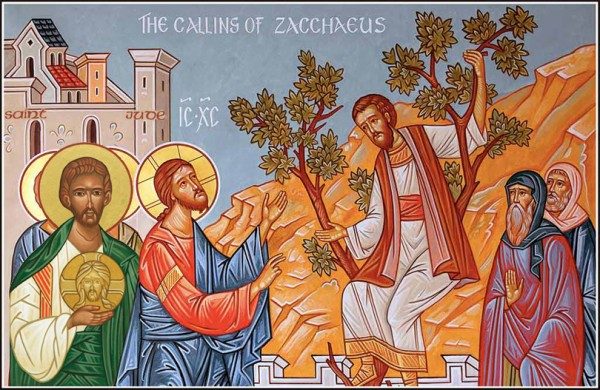
Lunch with Jesus

Luke 19.1-2

Jesus entered Jericho and was passing through it. A man was there named Zacchaeus; he was a chief tax collector and was rich. 

We love the story of Zaccheaus. And by we, I mean the church. We tell Z’s story to children in Sunday school, we use it in VBS curricula, and we even have a nice little song that conveys the whole thing:

Zacchaeus was a wee little man and a wee little man was he / He climbed up in a sycamore tree for the Lord he wanted to see / And as the Savior came that way he looked up in the tree / And he said, “Zacchaeus, you come down, cause we’re going to your house today.

The song, and the ways we tell the story, make Zaccheaus out to be this smaller than life character (pun intended) who just wanted to catch a glimpse of heaven on earth, and how God in Christ chose him to be the vehicle of an internal transformation, particularly as it regards money.

But one of the things we miss, or downright ignore, is how horrible Zaccheaus was. He was a tax collector, someone who stole from his fellow Israelites and kept a fat portion for himself before passing the rest of the money up the chain. He was a traitor to his people, and to his God, and he stood for everything that was wrong during the time of Jesus.

And Jesus picks this no good dirty rotten scoundrel out from the tree and says, “Hey, let’s get something to eat.”

And, in a way that could only happen in the Gospel, Zacchaeus reacts to this strange man with an even strange proclamation. After a couple sandwiches, and a glass of lemonade on the front porch, Zacchaeus says, “Wow, the only way I know how to respond to you is to give back half of my wealth to the poor and pay back the people I cheated four time over.”

And Jesus responds, “Now that’s what salvation looks like! Let’s have a party!”

It’s a confounding story, and one that we often water down. Zacchaeus doesn’t deserve to be in the presence of God and God shows up for lunch. Zacchaeus has swindled countless people and Jesus has the gall to give him salvation.

And yet, his story is precisely why we can call the Good News good. 

We are happy with a Jesus who forgives the tame sins of the nearly righteous. We are content to hear about the need to love one another a little bit more. But it’s another thing entirely to encounter the radical nature of Jesus’ proclamation of grace. Jesus’ willingness to cancel sins, big sins, is downright scandalous.   

Which is why we sing of Zacchaeus but keep him at a distance. For, to approach the wee little man is to admit the truth of who we are and whose we are: Sinners in the hands of a loving God. 

All of us are like Zacchaeus. We all hurt people close to us, we all ignore the needs of strangers, and we all focus on our wants, needs, and desires at the expense of others. We distance ourselves from true unabashed goodness, though we don’t mind taking a peek from the vantage point of a tree (or a pew). But be warned! All it takes is a glimpse for the Lord to see us and say, “Want to grab some lunch?”

And the rest, as they say, is Gospel. 

Grace Is Unfair

Luke 18.9

He also told this parable to some who trusted in themselves that they were righteous and regarded others with contempt…

There is a man who is good and faithful. He’s not a crook, or a womanizer, or an alcoholic. He loves his wife and plays on the floor with his kids when he gets home from work. He even tithes when the offering plate comes around on Sunday morning. He is good and faithful.

And there’s another man, a legal crook, who steals from his fellow people and bleeds all the money out of them that he possibly can. He’s like a mid-level mafia boss who skims from the top before sending the rest up the chain. He’s got enough cars and boats that he can’t even keep track of where he keeps all of them.

They both show up for worship one day. The good and faithful man thanks God that he’s not like the crook and, meanwhile, the crook asks God to have mercy on him, a sinner.

The parable of the publican and the pharisee. Jesus tells this tale to his disciples and then mic-drops the ending: “I tell you, this man (the crook) went down to his home justified rather than the other; for all who exalt themselves will be humbled, but all who humble themselves will be exalted.”

It’s all wrong, right? This parable runs against the grain of how we think it’s all supposed to work.

Put another way: Which of the two would we prefer to see sitting in the pews on a Sunday morning? How would we feel if the crook was part of our church? What would we do if he took a little money out of the offering plate or showed up with a new woman on his arm every Sunday?

This parable is one of Jesus’ final declarations about the business of grace. Grace – the totally unmerited and undeserved gift from God. And here, with a resounding conclusion, Jesus tells the disciples and all of us that the whole game is unfair.

Grace is unfair because what we think is good and right and true matters little to God. Ultimately, not one of us matches up to the goodness of God and yet, instead of kicking us out of the party for being unworthy, God says, “I will make you worthy.”

Do you see what that means?

It means that the good religious work of the Pharisee is not able to justify him any more than the crazy sins of the Publican can kick him out. The whole point of the parable, of almost all the parables, is that these two are both dead in the eyes of God, their good works and their sins can’t earn them or prevent them from salvation. 

In short, they have no hope in the world unless there is someone who can raise the dead.

Thankfully, that’s exactly what Jesus came to do. 

No Condemnation Now I Dread

Luke 18.2-6

Jesus said, “In a certain city there was a judge who neither feared God nor had respect for people. In that city there was a widow who kept coming to him and saying, ‘Grant me justice against my opponent.’ For a while he refused; but later he said to himself, ‘Though I have no fear of God and no respect for anyone, yet because this widow keeps bothering me, I will grant her justice, so that she may not wear me out by continually coming.’” And the Lord said, “Listen to what the unjust judge says.”

Jesus says that’s what God is like. Not like a widow who persistently goes looking for justice. Not like a bailiff dutifully following orders. Not even like a stenographer observing and recording every little detail of a trial.

God is like the unjust judge.

Jesus is saying to us here, in ways both strange and captivating, that God is willing to do for us what we need for no other reason than the fact that it will get all of us off of God’s back. 

Jesus spins the tale and we are left with the bewildering knowledge that God is content to fix all of our mess even while we’re stuck in the midst of it.

In other words: While we were still sinners, Christ died for the ungodly.

There are few sentences in scripture as unnerving and beautiful as that one. It’s beautiful because its true and it includes all of us. But it’s unnerving precisely because it includes all of us! 

We might like to imagine that God is waiting around hoping to dispense a little bit of perfection like manna from heaven if we just offer the right prayer or rack up the right amount of good works. 

But Jesus’ story about the unjust judge screams the contrary. It’s as if Jesus is saying, “Do you think it makes the least bit of difference to God whether or not you are right, or if your case is just? Truly I tell you, God isn’t looking for the right, or the good, or the true, or the beautiful. God is looking for the lost, and you are all lost whether you think you are lost or not.”

Jesus tells this parable as Golgotha and the cross get clearer and clearer on the horizon. The cross is God’s mercy made most manifest. Just like the unjust judge, God hung up the ledger-keeping forever while Jesus was hung up on the cross. The cross is God, as the judge, declaring a totally ridiculous verdict of forgiveness over a whole bunch of unrepentant losers like the widow, like me, and like you. 

The cross is a sign to all of us and to the world that there is no angry judge waiting to dispense a guilty verdict on all who come into the courtroom – there is therefore no condemnation because there is no condemner.

The old hymn has it right: “No condemnation now I dread; Jesus, and all in him, is mine; alive in him, my living Head, and clothed in righteousness divine, bold I approach the eternal throne, and claim the crown, through Christ my own!”

Thanks be to God.

The Adventure That Is Church

Luke 17.5

The apostles said to the Lord, “Increase our faith!”

I have a conflicted and tumultuous relationship with church membership.

I went through confirmation as a tween-ager in my home United Methodist Church and became a member at the conclusion, though we never once talked about what that meant. Instead we watched the 6 hour long film Jesus of Nazareth over 6 different Sundays and talked about what prayer was supposed to look like and feel like.

But covenanting to support the church with my prayers, presence, gifts, service, and witness? Nope.

Additionally, when other people joined the church it would take place like this: The pastor would occasionally announce, right before the concluding hymn, that if anyone felt the Spirit moving them to join the church, then they could come forward and do so. And, occasionally, people would march forward, share their names and vocations before the benediction, and that was that.

Moreover, I am part of a generation that is deeply suspicious of joining anything

Therefore, when it comes to church membership I often let people come to me with their questions rather than pushing people to join.

And, after serving the UMC for nearly a decade, I think I’ve been wrong.

My wrongness stems from the fact that I have treated membership to the church like membership to any other number of organizations, whereas to join the church as a member is actually a profound witness to our faith.

For example: There’s a bishop from another denomination (thankfully) that often tells a story about recruiting for a local seminary. Over the years the bishop would meet with candidates and at some point in the conversation he would say, “Why should I join the church?” And the candidates would often wax lyrical about the music program, or the value of community outreach, or the fellowship that is present on Sunday mornings, but not a single candidate ever said anything about Jesus.

The church is not the local symphony through which you can experience dynamic music every once in a while. The church is not yet another social agency through which you can feel better about making other people’s lives better. The church is not a country club through which you can meet people of a similar social strata.

The church can be like those things, but the one thing the church is and has that nothing else does is Jesus.

Therefore, to join the church as a member is a remarkable thing. It is a strange adventure that is made possible only by faith.

Notably, when the Lord teaches the disciples about forgiveness they can’t wrap their heads around it. It would be one thing if Jesus told them they should try to forgive one another but instead he tells them they can never stop forgiving one another. That runs against everything the world teaches us. But forgiveness is the currency of the kingdom, and of the church.

If we insist on being right and perfect and only ever surrounding ourselves with right and perfect people then, according to the Lord, our lives will be miserable and boring.

The church, then, stands as a dynamic witness to the power of the Spirit. The great gifts of the church include connecting us with people we would otherwise never connect with, the sacraments that make our lives intelligible in the first place, and the promise of the empty tomb that offers us a new past where we are no longer defined by our mistakes and a new future where resurrection is reality. 

I didn’t know what I was getting into when I became a member of my home church, but it was the difference that made all the difference in the world. It was the difference because, week after week, the church gave me Jesus.

In the end, the church is a miracle and, like the early disciples, we need all the faith we can get for it to be the blessing that it is and can be.

Therefore, if you are not (yet) a member of a church, I encourage you to prayerfully consider joining. It will take faith, but even faith the size of a mustard seed is enough in the kingdom of God. 

When Is Enough, Enough?

1 Timothy 6.6-9

Of course, there is great gain in godliness combined with contentment; for we brought nothing into the world, so that we can take nothing out of it; but if we have food and clothing, we will be content with these. But those who want to be rich fall into temptation and are trapped by many senseless and fearful desires that plunge people into ruin and destruction. 

A recent study noted that at least 80% of Americans experience daily stress regarding the economy and their personal finances. More than 50% are worried about being able to provide for their families basic needs. 56% are fearful about job security. And 52% report lying awake at night thinking about one thing and one thing only: $$$

Admittedly, those statistics probably aren’t that shocking considering how much of our daily lives revolve around our wallets. With the ubiquity of online banking we can figure out exactly how much, or how little, we have at any given moment. 

And yet, the “we have” in that sentence betrays the basic Christian conviction that our money doesn’t belong to us: it belongs to God.

A professor of mine once opined about how different the church would be if, when individuals took vows of membership, they read their tax return aloud from the year before. Can you imagine the fervor that would follow if the church announced personal financial disclosures as new membership requirements? And yet, to do so would be faithful! 

Jesus talks about money/possessions, and the use of them for others, almost more than any other single subject in the New Testament, and yet (outside a stewardship campaign) we rarely talk about them in church.

Instead, wealth is something so privatized that we can scarcely imagine what it would mean to share it with others, let alone the church. We hoard it, like the man with his store houses in one of Jesus’ parables. Or, we spend it with such reckless abandon that we go into a debt we have no hope of ever repaying.

A relevant question for anyone, particularly those who are part of a faith community, is: when is enough, enough?

The gifted preacher Fred Craddock tells the story of a time when he and his wife had a guest in their home who was spending the night. As Craddock read from the newspaper in the corner of the room, consumed by the movement of the Market, the guest was rolling around on the floor with Craddock’s kids teaching them a new game. And Craddock thought to himself, “How long has it been since I came home from work, got down on the floor, and had fun with my kids?”

Later, after dinner, the guest declared, “That’s just about one of the best meals I’ve had in a long time.” And Craddock thought to himself, “When was the last time I thanked my wife for our dinner?”

Craddock was merely going through the familiar patterns of life, keeping up with the rat race of all things: coming home from work, reading the paper, eating dinner. And then, through the guest, everything started to look different. Craddock said to himself, “Where in the world have I been?”

God has richly blessed each and every single one of us in a variety of ways. From the air we breathe, to the food we eat, to the friends we love.

Sometimes it takes a guest in our home, or a particularly striking passage from scripture, for us to finally ask ourselves the same question, “Where in the world have I been?” Which is just another version of, “When is enough, enough?”