Think Small or: Don’t Think At All

1 Peter 1.18-21

You know that you were ransomed from the futile ways inherited from your ancestors, not with perishable things like silver and gold, but with the precious blood of Christ, like that of a lamb without defect or blemish. He was destined before the foundation of the world, but was revealed at the end of the ages for your sake. Through him you have come to trust in God, who raised him from the dead and gave him glory, so that your faith and hope are set on God.

With each passing day of this pandemic, I’ve come across countless posts and articles all about how to make the most of the time we now have on our hands. Which, of course, doesn’t even address the many who still have to work in the midst of all this and those who are putting their lives on the line so that others can have the aforementioned extra time on their hands. Nevertheless, I know people who are using this time to lose those ten pounds they’ve been meaning to get rid of, or become amateur sourdough bakers, or become professional live-streaming worship pastors.

Meanwhile, the talking heads on television are pitting the different political operatives against one another while blaming them for putting us in the mess in the first place.

Similarly, certain individuals are choosing to directly ignore the calls for social-distancing because they believe it is infringing on their freedoms.

And finally, special interest groups are pressuring elected leaders to “reopen” their respective jurisdictions for fear of what the long-term effects will be for the economy.

All of this can fall into the category of “thinking big.” Rather than addressing the small and local concerns that are, somewhat, within our control, we pass the buck along to someone else in hopes that they can bring about the change that requires the least from us. Or, a little closer to home, we’re feeling pressured to make the most of this pandemic by reimagining ourselves and fixing all the things we’ve let go for too long. 

The problem with “thinking big” is that it almost never works. 

Wendell_Berry_C_Guy_Mendes

Back in 1972, in the midst of the rise of feminism, racial reconciliation, and environmentalism, Wendell Berry had this to say on “thinking big”:

“For most of the history of this country our motto, implied or spoken, has been Think Big. A better motto, and an essential one now, is Think Little. That implies the necessary change of thinking and feeling, and suggests the necessary work. Thinking Big has led to the two biggest and cheapest political dodges of our time: plan-making and law-making. The lotus-eaters of this era are in Washington, D.C., Thinking Big. Somebody perceives a problem, and somebody in the government comes up with a plan or a law. The result, mostly, has been the persistence of the problem, and the enrichment of the government. But the discipline of thought is not generalization; it is detail, and it is personal behavior. While the government is “studying” and funding and organizing its Big Thought, nothing is being done. But the citizen who is willing to Think Little, and, accepting the discipline of that, to go ahead on his/her own, is already solving the problem. A person who is trying to live as neighbor to their neighbors will have a lively and practical understanding of peace and humanity, and let there be no mistake about it – they are doing that work.” – Wendell Berry, A Continuous Harmony 1972

The challenges, and problems, that feminism/racial reconciliation/environmentalism aimed to erase are still very much a part of the fabric of our reality. It’s been nearly fifty years since Wendell Berry wrote those words and women are still paid less than men, racism is very much alive, and the environment has passed the point of no return. (However, strangely enough, certain cities across the globe are seeing the skylines without smog for the first time in decades because everyone has been forced to stay inside).

The critique from 1972 is just as relevant today as it was then. The more we assume, or hope, that necessary changes will be accomplished by other people further up the ladder, the longer we will be disappointed. The same holds true with our own desires for self-improvement. If we want to use this time to become master bakers, or perfect painters, or marathon runners, that’s fine, but there’s a better than good chance we’re just going to disappoint ourselves.

Wendell Berry’s alternative, and an alternative from the gospel is to think little. Instead of waiting for the world to change, we can make small changes in our own lives. We can absolutely start and try new things, but keeping our goals in check will help us in these challenging times rather than shaming us into not accomplishing what we wanted.

In 1 Peter there’s this great line about how, through Jesus, we’ve come to trust in God. I love that because it’s not about trusting in ourselves or in other people. For, more often than not, we are masters of disappointment. But God? God remains steadfast no matter the circumstances; Jesus’ is still raised from the dead whether we can worship together in church, or we can run a marathon, or we can bake the perfect loaf of bread.

This is a strange time we find ourselves in. We can do things now we’ve never done before. But it’s also a pandemic. It’s okay if we don’t do anything at all. We can watch Netflix until our eyes hurt. We can go all the way to the end of the bag of Cheetos. We can wear pajamas all day long. The gospel has set us free from the expectations we place on ourselves and the expectations the world has placed on us.

The only thing we need to do is trust. Which, in the end, isn’t much at all. Because in the end, the rest is up to God. 
This Is The Day…

Psalm 118.24

This is the day that the Lord has made; let us rejoice and be glad in it.

Weekly Devotional Image

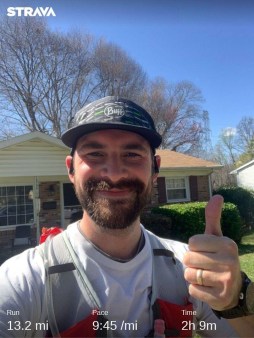
I ran a half-marathon yesterday afternoon. 13.1 miles in roughly two hours all over the Woodbridge area. I was supposed to the run the Rock ’n’ Roll Half Marathon in DC last Saturday but it was canceled in light of the Coronavirus. However I had been training for long enough that I figured, “Why not just go out and see if I can do it?”

The weather yesterday was perfect, giving extra meaning to the “this is the day that the Lord has made” and I decided to rejoice and be glad in it by putting one foot in front of the other until I put in the requisite miles.

Now, a day later, I can tell you there wasn’t much to rejoice about.

Or to put it a different way, my legs are sore!

During the months of training I was looking forward to being surrounded by scores of people all running toward the same goal. I was excited about the prospect of passing the finish line to be embraced by my family in celebration. I even anticipated the proud feeling of wearing around the medal for the rest of the day.

Yesterday was different.

IMG_2333

I ran all alone for two hours. I didn’t even tell my family that I was going to do it. And the only prize for completing it was knowing that I did it.

A lot of us have been experiencing profound feelings of isolation as the Coronavirus has forced us to remain physically separated from one another and forced us to limit our interactions outside of our homes. For some of us we’ve retreated into new or familiar books, we’ve binged terrible and incredible television shows, or we’ve picked up the phone to call people we’ve needed to reconnect with for a long time.

But for others of us, we’ve retreated further into our minds and our worries and our anxieties. We keep checking out bank accounts and wonder how we’re going to make it through all of this. We see updates from others on social media that make it seem like they are having a vacation while social distancing while our time have felt nerve wracking. 

And yet, as Christians, we believe that each new day is a gift from the Lord. That doesn’t mean that we have to force ourselves into optimism, but it does call us to rejoice knowing we’ve been given another day. The season of Lent, the season we’re in right now, is an ever-present reminder that tomorrow is never promised and that the bell will toll for us all. We didn’t need the Coronavirus to remind us of this but it certainly has helped to focus our attention on that which we cannot take for granted. 

I for one am grateful that I was able to get outside yesterday and run, even if my body feels miserable today. I am grateful I have another day to spend time with my family. But most of all I am grateful to know that God has not abandoned us to our own devices. 

The season of Lent always ends with Easter – a reminder that death is not the end.

If nothing else, that is certainly worth rejoicing. 

Comforted?

Devotional:

Psalm 23.4

Even though I walk through the darkest valley, I fear no evil; for you are with me; your rod and your staff — they comfort me.

Weekly Devotional Image

I love and loathe the 23rd Psalm. I love it because it brings a sense of peace whenever I read it and I loathe it because it is, by far, the most overused psalm from the entirety of the Psalter. 

When I visit folk in the hospital and ask if they would like me to read some scripture, they invariably ask for Psalm 23. When I meet with families to prepare funeral services they request a read of Psalm 23. If you’re with a group of Christians and someone says, “The Lord is my…” there’s a better than good chance that the room will finish the sentence and keep on going to the very end.

Now, to be clear, there’s nothing inherently wrong with it being the most popular psalm, but it does mean that we know it without really knowing it. 

When was the last time you thought about how the Lord prepares a table for you, in the presence of your enemies? For many that would strike a sense of fear, rather than comfort. Or, when was the last time you thought about dwelling in the house of the Lord your entire life? I know some of you love church, but to dwell in the house of the Lord for the rest of your life would have to mean that you really love church.

5132_Psalm_23_Cross-1

But today, the bit that sticks out the most to me is the psalmist declaration that the rod and the staff of the Lord are a comfort. This sticks out to me because the rod and the staff are tools used by shepherds to keep their wandering sheep in check. 

Another way to encounter the verse would be like this: “Even though I’m going through some tough stuff, I’m not going to be afraid, because God is with me and knocking me around until this stuff really starts to sink in.”

These are uncertain times – the numbers of confirmed Coronavirus cases in Virginia keep going up day after day, schools are closed for at least another 3 weeks, and local grocery stores are starting to shift around their operating hours to help mitigate the rate of exposure. 

And yet, strangely, the psalmist reminds us that, even though we are sequestered into our homes and are limiting our interactions with others, are not alone. God in Christ has come to dwell among us, to be present in our prayers, to be revealed in the reading of the Word, and even to rest in the silence with us that we otherwise try to avoid. 

Sometimes it takes a lifetime of Sundays before the Gospel message finally hits home. Sometimes it takes a pandemic to remind us of our fragility in a world that keep foolishly promising us that we’re invincible. Sometimes it takes reading the most popular Psalm for the thousandth time before we can start to see the most beautiful aspect of it: the fact that its true. 

Unity?

Devotional:

Romans 5.6

For while we were still weak, at the right time Christ died for the ungodly. 

Weekly Devotional Image

About a year ago I was sitting in the upstairs area of Wegman’s, sipping on a cup of coffee, while my computer, Bible, and United Methodist Hymnal were out on the table in front of me. I was there in the hopes of stringing together a worship service and a sermon, but I was distracted. My distraction stemmed from the, at the time, recent Special General Conference in which the UMC doubled down on its language regarding the so-called incompatibility of homosexual Christians.

Every time I lifted my hands to get something down in writing, I was at a loss of what to say.

So I sat there and I sipped on my coffee and I rested in my distractions. Until a man walked over from the other side of the space and asked if he could sit with me. I noted that there were plenty of other empty seats available, but motioned for him to sit down. He paused for a moment, and then asked, “Are you a pastor in the UMC?”

“Did the hymnal give it away?”

“That, and the glum disposition. I read about the big church meeting in the newspaper the other day. You know, I used to be a United Methodist once upon a time.”

“Oh really. But you’re not anymore?”

“Nope. I can remember when the church really was together on everything, as if we were all on the same page. But then it got so divisive that I just decided to call it quits.”

“That’s too bad. Well, what kind of a church do you go to now?”

“Oh. Um, I haven’t been to a church in years to be honest… Anyway, I’m not really sure why I came over but, good luck with the church. I think you’re gonna need it.” 

I’ve had a lot of interactions like that one over the last year, some with total strangers and some with people I’ve known my whole life. People who have approached me because of the United Methodist Church’s position on human sexuality, their struggling to come to any sort of conclusion about it, and their admission that church really isn’t for them anyway.

Unity-Ephesians-4-1-3-1080x608

I’ve found each and every one of those conversations to be remarkably enlightening. For one thing, they demonstrated that the church does remain in the cultural consciousness for those outside the church, though they tend to only think about it one-dimensionally. Secondly, people are hungry for conversations about things they do not understand, even if they can’t articulate it. And thirdly, a whole lot of people inside and outside the church believe the church can only be the church if the people in the church are unified.

Spoiler warning: The church has never been unified.

If it ever felt unified, whether it was last year or 1,000 years ago, it was because particular voices were being stifled or kicked out altogether. We, in the church, have often confused unity with uniformity, and uniformity is only achieved through suppression.

The church is a strange and wondrous thing. I have noted on many occasions that the church is the last surviving place where people willfully gather with people who are different from themselves – to be clear, not every church is like this, but there are some where the people in the pews on Sunday share one thing, and only one thing, in common: Jesus.

The church is at its best when we are all busy changing each other and being changed by one another. The church is not some static institution that was the same yesterday, today, and forever. It is a living and transforming thing that is guided by the voice of the Lord that continues to speak even into the wilderness of our sin. 

Or, to put it another way, the church gathers again and again to remember that while we were weak, Christ died for the ungodly. And, though it pains us to admit, we (all of us) are the ungodly for whom Christ died. 

If there is any unity in the church, let it be that. 

On Voting For Jesus

Devotional:

Psalm 121.1-2

I lift up my eyes to the hills – from where will my help come? My help comes from the Lord, who made heaven and earth.

Weekly Devotional Image

For months (years) the cultural consciousness has been fixated on politics, and in particular on presidential politics. The build up to the 2016 Presidential election, the wake of that election, and now here on Super Tuesday in 2020 we are still talking about presidential politics ALL THE TIME.

Which, in a sense, is fine. We’re Christians after all, we can talk about whatever we want. And yet, the more we talk about the politics of a country the less we remember that our truest citizenship is in heaven.

Or, to put it another way, we keep treating our politicians as if they are in charge of our lives when, as Christians, we affirm that Jesus Christ is Lord.

vote-300x219

In Jesus’ kingdom, the rules and the ruler are different. All assumptions about what is important, and who we are to be, and what we are to care about have been changed.

It’s like being dropped into a strange new world in which everyone else is speaking a different language. It takes time to learn the lingo, to adapt to the habits of the people around us, and to recognize that we are transformed in the process. It’s not a simple matter of fitting Jesus into our present way of thinking, nor is it just giving an hour of our time to the church. We don’t fit Jesus into our lives – Jesus drags us into his.

We move from the kingdom of consumption to the kingdom of communion, from the kingdom of popularity to the kingdom of poverty, from the kingdom of destruction to the kingdom of deliverance, from the kingdom of competition to the kingdom of cooperation.

Today, people are taking selfies with their “I Voted” stickers to show their allegiance to the democratic processes of America. They are sending text messages and making phone calls to make sure that everyone gets out to make “the right choice.” And I keep hearing about how this is the most important election in history, which is what we say every single time there’s an election!

And all the while, I can’t help but think of how we would never elect Jesus to lead us.

Bible-and-Flag

We would never willingly elect someone who told us the first will be last and the last will be first.

We would never willingly elect someone who told us to sell of our our possessions and give all the proceeds to the poor.

We would never willingly elect someone who spent of all their time hanging out with the riff-raff of society.

In order to get elected by the likes of u,s Jesus would have to make promises to the rich in order to stabilize economic prosperity. He would have to compromise with leaders who treat their citizens like dirt. He would have to keep his mouth shut and stop telling parables out of fear that he wouldn’t get re-elected in the future. 

Thank God we’re not voting on Jesus. And, more importantly, instead of electing him, he elected us.

In this broken and flawed and sinful world, we see and know God because we see and know Jesus. Jesus is the image of the invisible, the very beginning of everything in creation. Jesus is before all things and in him all things hold together.

He is the one from whom our help comes. 

So, instead of being consumed by the politics and priorities of this world, remember that we are consumed by the grace of God made manifest in Jesus Christ our Lord. 

Get Your Ash In Church (And Leave It There)

Devotional:

Matthew 6.1

Beware of practicing your piety before others in order to be seen by them; for then you have no reward from your Father in heaven.

Weekly Devotional Image

Today is Ash Wednesday.

Christians across the globe are gathering together to hear words that the church has heard for centuries: “Remember you are dust and to dust you shall return.”

Those are the words I intoned this morning as I marked the gathered body with ashes, and they will be the words I will use tonight. And, God willing, they will be the words I use every Ash Wednesday until the end.

But what happens after the church leaves the church with those ashen crosses on their foreheads is a strange and bewildering thing.

I, for one, left church this morning and then drove my son to his Preschool. Like most mornings we patiently waited outside the door of his classroom, only this time 3 of his classmates approached me and, independently of one another, made comments about the smudge on my forehead while their parents tried to pull them away.

63872-ash-wednesday-thinkstockphotos-902323194-azer.1200w.tn

On other Ash Wednesdays I have been approached in grocery stores and on street corners by inquisitive people as to what in the world happened to my head.

But there’s a good case to be made that before we leave the church with our ashen crosses, we should wash them off.

Jesus says, “Beware of practicing your piety before others in order to be seen by them; for then you have no reward from your Father in heaven.”

Of course we can leave the ashes on our heads until they naturally fade away, but if we keep them just so we can be seen by others for our faithfulness, then we have failed to take the words of Jesus seriously.

My fried Teer Hardy puts it this way, “Wash your ash today. Let us not allow the world see our fasting as an attempt for pious righteousness but rather let our fasting be a witness to the judgement that was due to us but because of Christ’s sacrificial life we receive the justification we do not deserve.”

Ash Wednesday, and Lent for that matter, is a unique time in the life of the church when, rather than focusing outwardly, we are encouraged to look inward, to consider the condition of our condition, and to recognize our absolute dependence on the grace of Jesus Christ.

So get your ash in church, and leave it there.

The rest is up to Jesus.

Make The Good News Good Again

Devotional:

Psalm 119.1

Happy are those whose way is blameless, who walk in the law of the Lord. Happy are those who keep his decrees, who seek him with their whole heart, who also do no wrong, but walk in his ways.

Weekly Devotional Image

Be perfect as your heavenly Father is perfect.

Jesus said that.

And he meant it.

Or so I, and countless Christians, have been told over and over again. We Christians must hold ourselves to a higher standard! How else will the rest of the world know how badly they need to repent and turn their lives back to the Lord?

When I was in college, those statements covered much of what I heard about the church. While classmates were off doing whatever it was they did on the weekends (whether I joined them or not) I was made to feel guilty or ashamed for the choices I was making because, I was told, I would be happier if I was “walking in the law of the Lord.”

The same comments about the church were made while I was in seminary, and I’m sure that for a while in the beginning of my ministry I made the same points.

But they never really made me feel happy, no matter how well behaved I was. I was caught in a conundrum – Either be perfect and unhappy, or let my guard down and feel guilty. 

It took me a long time to realize that when Jesus calls his disciples to be perfect as God is perfect, he does so knowing that we won’t be able to do it. That’s kind of the whole point of the gospel – God does for us what we cannot do for ourselves.

But does that mean we shouldn’t try? Of course not. But if the gospel is only about how we have to constantly do better all the time, then we will walk away from church without the Good News sounding like good news.

karl-barth-smoking

Karl Barth put it likes this:

“Basically, the gospel is a very simple thing. The gospel is no system of this or that truth, no theory on life in time and eternity, no metaphysics or the like, but simply the sign that God has blessed the world, this poor world in which we live, with all its difficulties, with all its misery, with this whole ocean of death. And in this world we dare to live in the knowledge that God loves us, but not only us Christians who believe that God loves the whole world. Every person, even the most miserable, even the most evil, is loved by God. This is the privilege: to be commissioned and enabled as a Christian to proclaim that.” (Barth in Conversation – Volume II. Interview with George Casalis on November 7th, 1963.)

It is a rather radical proposition and yet it is precisely what makes the Good News so good.

Elected

Devotional:

Isaiah 58.1

Shout out, do not hold back! Lift up your voice like a trumpet! Announce to my people their rebellion, to the house of Jacob their sins. 

Weekly Devotional Image

Don’t mix politics with religion.

We’re told to keep these seemingly incompatible things as far away from each other as possible. Whatever political proclivities we hold and whatever we might believe are meant to remain in the private sphere and the world has no right to interfere with either.

And yet, the world interferes with both of them all the time! In the last twenty four hours I have been inundated with calls for a “Christian response to the inappropriateness of the Super Bowl Halftime show” as well as emails reminding me, as a clergy person, of my apparent responsibility to “get all of my congregants registered to vote locally and nationally.”

Whether we like it or not, the so-called “Separation of Church and State” actually looks more like a very complicated marriage within which neither partner is sure why they are still together.

It then becomes increasingly difficult for Christians to think and speak theologically about what it means to be Christian. Such that we often privatize whatever it is we do on Sundays at the expense of letting it shape how we behave Monday-Saturday.

This is a strange thing considering the language of faith articulated to, and by, Christians when they gather for worship.

Or, to put it another way, if we believe Jesus is Lord then all of our assumptions about who we are and whose we are cannot remain the same. 

121101065950-red-blue-state-jesus-custom-1

“Do not hold back,” Isaiah is told by the Lord, “Announce to my people their rebellion, to the house of Jacob their sins.” I have yet to meet anyone who enjoys being told they’re a sinner, but that doesn’t change the fact that all of us are sinners. We chose to do things we know we shouldn’t and we avoid doing things we know we should – we bicker among ourselves about Super Bowl commercials and halftime performances – we write people off because of the name of a political candidate they display on their bumper sticker.

This evening we will all begin to receive the results of the Iowa Caucus, further propelling the nation into another presidential election cycle (as if we ever get out of election cycles). The talking heads will wax lyrical about what it all means and they will all say, as they always do, “this is the most important election in our history.”

Well, here’s a controversial political and theological statement: This is not the most important election in history. The most important election in history was Jesus electing us.

Today, we throw all of our eggs into our respective political baskets with candidates, campaigns, and elections. And, even though there is plenty of evidence to the contrary, we keep believing that so long as our candidate gets nominated/elected then everything will be fine and good for us. But politicians and political ideologies have come and gone with failed promises again and again.

The democratic practices we hold so dear are fine and good, but they will not bring us salvation.

Stanley Hauerwas puts it this way: “I think voting is overvalued. We forget that voting is inherently a coercive activity – its where 50.1% get to tell 49.9% what to do! People forget that voting is not an end in itself… Democracy, in its fundamental form, is patience; it requires us to listen, in the Pauline sense, to the lesser members among us.”

Perhaps the language from Isaiah is beckoning us to remember that our unending desire to win is but another way to refer to our rebellion against God and God’s kingdom.

So, as we continue to wrestle with what it means to be both faithful and political, let us pray that the Lord grants us the peace necessary to bear one another in love, knowing full and well that salvation isn’t something we have to hope for because it’s already been given to us by the Lord of lords, Jesus Christ, whom we did not elect.

Instead, he elected us. 

Blessed

Devotional:

Matthew 5.3

Blessed are the poor in spirit, for theirs is the kingdom of God. 

On Sunday I left church after a few meetings to swing by the hospital to meet with a sick parishioner. My mind was going over all of the details from Sunday morning as I trudged across the parking lot and was surprised to be greeted with a loud, “Excuse me, Father.” Before looking up I knew that whoever was speaking had confused me for a Catholic priest since I was wearing all black with a white clergy collar, and rather than spending the new few moments trying to explain my protestantism I just said, “Yes?” and then lifted up my gaze to meet the speaker face to face.

Starring back at me was a heavily bearded and ruffled looking man who was clearly carrying all of his earthly possessions in his ripped and stained backpack.

He said, “Could I bother you for a cigarette?”

I said, “Sorry, I don’t smoke.”

Then he said, “What kind of priest doesn’t smoke cigarettes?”

And I honestly had no idea how to respond, so I just shrugged my shoulders and started back toward the entrance of the hospital. Right before I passed through the doors I heard him yell at my back across the lot, “I wish your God had done more for me!” And by the time I turned around he was gone.

blessed-main-image

This coming Sunday churches across the world will hear some of Jesus’ most powerful words, the so-called Beatitudes. Blessed are those who mourn, for they will be comforted – Blessed are the meek, for they will inherit the earth – Blessed are the pure in heart, for they will see God. Of all the Beatitudes, I think my favorite is, “Blessed are the poor in spirit, for theirs is the kingdom of heaven.” And it was that particular beatitude that I found myself saying over and over while I walked through the hospital. 

We live in a world in which we reward, and are rewarded for, spiritual successes. We lift up and praise those who demonstrate their faith whether it’s showing up in church every Sunday morning, or leading those perfect corporate prayers, or even having certain Bible passages memorized. And all of that is good and fine, except for the fact that Jesus says the poor in spirit, not the strong in spirit, are blessed and the kingdom belongs to them. It’s in weakness that God’s sees strength, and in spiritual poverty that the kingdom of heaven becomes the most real.

I wish I had spent more time with that man in the parking lot, I wish that I could’ve listened to him express whatever it was that was torturing his soul, but mostly I wish I told him something that, probably, would have come as a surprise: 

“God’s kingdom belongs to you.” 

Favor Fades

Devotional:

Matthew 4.12

Now when Jesus heard that John had been arrested, he withdrew to Galilee.

Weekly Devotional Image

Having the favor of the people can disappear in an instant. I have known too many beloved leaders in their respective communities who took one step too far and then lost the popularity or the respect they once held. Preachers, politicians, and professionals alike are often at the whim, and the opinions, of the people they serve. 

Jesus was widely praised by crowds of people when he first initiated his earthly ministry, but then he was run out of town (incidentally, his home town) as soon as he claimed that the scriptures were being fulfilled in him. Likewise, Martin Luther King Jr. was revered and praised for the kind of prophetic proclamations he made, but in the end those kind of declarations led to his assassination.

Years ago I was asked to speak at a community gathering in memory of Martin Luther King Jr. and, to be honest, it was terrifying. How could I possibly do justice to the man who I had admired throughout most of my life? How could I find the right words to offer in memory of a preacher I still strive to emulate on a regular basis? How could I speak a word of hope and truth while so many people are still being persecuted for the color of their skin?

martin_luther_king_jr_montgomery_arrest_1958

But then, shortly before I was invited forward toward the microphone, I remembered a few words that Martin Luther King Jr. often said, words that Jesus similarly uttered in the garden of Gethsemane: “I just want to do God’s will.”

Whatever we do in our lives, it should have less to do with what we think people will think, and more to do with striving to live out God’s will for, and in, our lives. Rather than sugar-coating messages of false hope, we are called to seek justice for the many ways we have failed to love our brothers and sisters with every fiber of our beings.

Which is all to say, sometimes our faith will drive others crazy.

And now, in honor of Dr. King, I would like to end this devotional with a prayer from the man himself – a prayer that is worth our time and consideration particularly today…

“Thou eternal God, out of whose absolute power the infinite intelligence of the whole universe has come into being, we humbly confess that we have not loved thee with our hearts, souls, and minds, and we have not loved our neighbors as Christ loved us. We have all too often lived by our own selfish impulses rather than by the sacrificial love as revealed by Christ. We often give in order to receive. We love our friends and hate our enemies. We go the first mile but dare not travel the second. We forgive but dare not forget. And so as we look within ourselves, we are confronted with the appalling fact that the history of our lives in the history of an eternal revolt against you. But thou, O God, have mercy upon us. Forgive us for what we could have been but failed to be. Give us the intelligence to know your will. Give us the courage to do your will. Give us the devotion to love your will. In the name and spirit of Jesus, we pray. Amen.”