Greatness – Sermon on Luke 1.5-23

Luke 1.5-23

In the days of King Herod of Judea, there was a priest named Zechariah, who belonged to the priestly order off Abijah. His wife was a descendant of Aaron, and her name was Elizabeth. Both of them were righteous before God, living blamelessly according to all the commandments and regulations of the Lord. But they had no children, because Elizabeth was barren, and both were getting on in years. Once when he was serving as priest before God and his section was on duty, he was chosen by lot, according to the custom of the priesthood, to enter the sanctuary of the Lord and offer incense. Now at the time of the incense offering, the whole assembly of the people was praying outside. Then there appeared to him an angel of the Lord, standing at the right side of the altar of incense. When Zechariah saw him, he was terrified; and fear overwhelmed him. But the angel said to him, “Do not be afraid, Zechariah, for your prayer has been heard. Your wife Elizabeth will bear you a son, and you will name him John. You will have joy and gladness, and many will rejoice at his birth, for he will be great in the sight of the Lord. He must never drink wine or strong drink; even before his birth he will be filled with the Holy Spirit. He will turn many of the people of Israel to the Lord their God. With the spirit and power of Elijah he will go before him, to turn their hearts of parents to their children, and the disobedient to the wisdom of the righteous, to make ready a people prepared for the Lord.” Zechariah said to the angel, “How will I know that this is so? For I am an old man, and my wife is getting on in years.” The angel replied, “I am Gabriel. I stand in the presence of God, and I have been sent to speak to you and to bring you this good news. But now, because you did not believe my words, which will be fulfilled in their time, you will become mute, unable to speak, until the day these things occur.” Meanwhile the people were waiting for Zechariah, and wondered at his delay in the sanctuary. When he did come out, he could not speak to them, and they realized that he had seen a vision in the sanctuary. He kept motioning to them and remained unable to speak. When his time of service was ended, he went to his home.


“Do not be afraid, Zechariah, for you prayer has been heard.”

archangel-gabriel-struck-zechariah-mute-1824

And so it came to pass in the days when King Herod ruled Judea, that a priest named Zechariah had his life turned upside down. Now Herod was a terrible king, responsible for countless atrocities, murders, and high levels of corruption. A man with frightening power ruled over a land and a people with such chaos that he dominated the attention of the masses. During his rule, a nobody priest married to a woman named Elizabeth, made his way through life.

Zechariah belonged to the priestly order of Abijah and was regularly responsible for activities around the Temple in Jerusalem. Though Zechariah and Elizabeth lived righteous lives, they had no children and were getting on in years.

One day, a day like any other, Zechariah made his way to the temple in order to perform his regular duties. As was the custom, lots were cast to decide who would enter the sanctuary and offer incense to the Most High God. While countless people gathered outside the walls, Zechariah made his way in to perform a simple task that had been done for as long as he could remember.

This is where the story gets interesting.
1-blake-z-and-angel

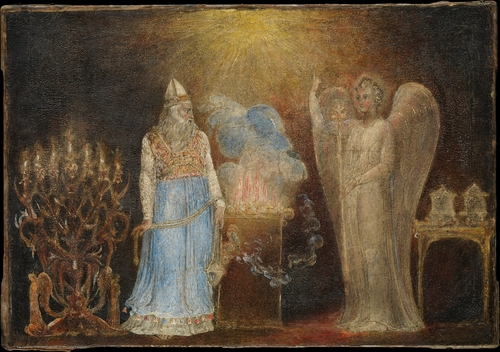
While standing within the closed room, an angel of the Lord appeared to Zechariah. We receive no description of this heavenly messenger in the biblical narrative, but the sight was enough to overwhelm and terrify Zechariah. Let your imaginations conjure up the confrontation with an angel to the degree that you would cower in fear and trembling.

Do not be afraid, Zechariah, for your prayers have been heard. Your wife Elizabeth will bear you a son, and you will name him John. You will be filled with joy and gladness and many will rejoice at his birth, for he will be great in the sight of the Lord. Take care to make sure that he never drinks wine or other strong substances, even before his birth he will be filled with the Holy Spirit. In time, he will turn the people of Israel back to the Lord their God. He will make ready a people prepared for the Lord.

And how does Zechariah react to this momentous declaration? How does he respond to the heavenly messenger carrying news of great joy?

“How will I know this is so? For I am an old man, and my wife is getting on in years.”

It’s moments like these in the scriptures that I wish I could jump into the story and smack some sense into the lives of the people experiencing the glory of God. How will you know this is so Zechariah? You fool! Don’t you know that with God all things are possible? Have you forgotten how he delivered your people from slavery and captivity in Egypt through the Red Sea to the Holy Land? Have you forgotten how the Lord provided a ram in the bushes for Abraham to sacrifice instead of his son? Have you forgotten how David was able to triumph over Goliath because the Lord was with him? Moreover, have you forgotten how many barren women the Lord has provided for? Sarah, Rebekah, Rachel, Hannah. Come on Zechariah, have a little faith. 

The angel responds to Zechariah: I am Gabriel and I stand in the presence of God. I was sent to bring you this good news, but now, because you did not believe my words, you will become mute and unable to speak until these things occur.

So Zechariah made his way out of the temple, stood before the crowds unable to speak, and eventually returned home.

Of course, thats not the end of the story, but we’ll save that for later.

What are we to make of this remarkable episode recorded at the beginning of the Gospel according to St. Luke?

God is at work here in ways familiar to us from the Old Testament: the story contains a casting of lots to make a decision, there is a vision in God’s holy Temple, a divine being appears to pass along a message, there is a promised sign, and a childless couple is given new life.

It is clear that God works in and through the normal avenues of life in the believing and faithful community. The community of faith can fall under the temptation to make God into whatever they desire for worship, but there is an important conviction present at the beginning of this New Testament: the stories of Israel are important, vital, and necessary for understanding how to be used for God’s purposes in the world.

Though this is a story from the past, doesn’t it sound familiar? Just as it is today, some horrible and frightening situation has gripped the people, a power reigns from above in order to control a community. Evil has taken root at the center of life and dominates the attention of the populace. This past week marked the one year anniversary of the shooting at Sandy Hook Elementary school and another shooting took place at a school in Colorado. You need only turn on the news or read a newspaper to be reminded how much fear and violence demands ALL of our attention.

However, in spite of all this fear and damage in the world, just as during the time of Herod, there is another sort of person, quiet, removed, and yet, more important than the powers that rule, men and women who are the core of society and give it the depth of its reality. Then and always there were and are the humble and brilliant men and women in whom the strength of the present and promise of the future lie.

Gabriel tells Zechariah that his son, John, will be great in the sight of the Lord. Sadly, according to the ways of the world, greatness has had its definition confused and reshaped. We have been told that greatness is measured in terms of selfishness rather than service, in terms of material rather than spiritual wealth, in terms of instant gratification rather than hard work and perseverance. But greatness as God sees it, the greatness that John will live into, is about being linked with the eternal purposes of redemption, about being an obedient instrument of God’s peace, and helping others to know and feel love in their lives.

But notice: the greater John will become for God, the more hostility he will arouse in those around him. Doing the will of the Lord, reaching out in love according to discipleship sends ripples through the fabric of what the world deems as “greatness.”

John is to be like the prophets from old: in light of their direct contact and experience of the divine, they drew the messages which burned within them like fire and would not rest until the decrees of God were delivered.

In every age we need the passion of people on fire for God to shout out in prophetic fervor. Our lives are so often filled with the dry wood of dull possibilities that desperately need to be rekindled by the divine spark that often comes through the words and actions of the prophets. We need to have our lives turned around and back to God in order to discover the passion that is waiting for us in our discipleship. The communion between God and the prophet allows for a divine condition to be present and the purposes of God can be realized in the world.

I love the juxtaposition of the story of Zechariah in the temple with Gabriel. It is precisely at the moment when John is being prepared to speak for God, Zechariah is struck mute for his unbelief. The typical, traditional, and tired voice of the priest, is being replaced by the fervent, fantastic, and faithful voice of the prophet.


Worship is at the center of the story. I’ve read it countless times, and heard it discussed and preached on during numerous advent services, but something fresh and new struck me this week about Zechariah’s encounter. I wondered: why was he so surprised and scared? Think about it for just a moment; Zechariah was a priest, well-versed in the stories from old about how God interacted with God’s people, a man who often found himself in the holiest of places performing the works of the Lord. What did he think would happen to him inside that holy space?

Being overwhelmed by the presence of an angel in the sanctuary of the temple is like going to McDonalds, ordering a Big Mac, and being surprised to discover beef between the bread… I mean this is how God works! God shows up, confronts us in the midst of a moment, and calls us to something. It does not need to be grand, and more often than not it occurs in the small silence in a moment we least suspect, but for Zechariah it came in a big way. He was in God’s holy temple confronted by an angelic messenger bringing the good news. So why was he so surprised? And more importantly, why did he doubt the validity of the message?

Our expectations about worship have major impacts on the way we live our lives.

What we believe shapes how we behave.

What to we think will happen to us when we gather in this space? Are we prepared to be confronted by the God who called John to greatness? Are we willing to let God dwell in our hearts and change the way we live in the world? Are we ready to take up our own crosses to follow Jesus. Are we prepared for God to show up in our lives in ways that we cannot expect or anticipate?

Unless we recognize the definitive need for real experiences and methods of discipleship which wake the whole depth of our experience, then what we do in worship will remain, as it did for Zechariah, thin and lacking. Until we prepare ourselves to be surprised by God’s desire to find us where we are, then this holy place will remain, as it did for Zechariah, boring and repetitive. Until we dare to step out into new forms of life and love, hearing the word of the Lord, and letting it become incarnate in the ways we live our lives, then faith will remain, as it did for Zechariah, dwindling and fruitless.
eucharist

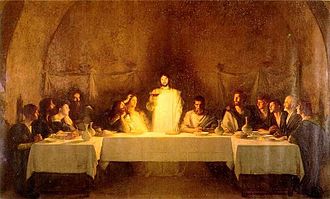
What do we expect will happen when we gather together at Christ’s table? Are we repetitively entering the holy space to burn incense unaware that we are meeting God in all of his holiness? Or are we excited and nervous about the prospect of being welcomed to a table that we have no right to join? Are we so rooted in our habitual worship that we can no longer remember why we join at this table? Or are we prepared to be called forth toward greatness in the world through the redemptive and life-giving properties of God’s presence at his table?

Just as it happened with Zechariah, a heavenly voice might be trying to break out into the world. Perhaps God’s good news is striving to strike forth through the closed circle of our expectations of church, faith, and discipleship. Important for us this morning is to remember that God is always on the move, reaching out to find us and change our lives, that there is always a new message for those with ears to hear. The great need for us is to realize, as Zechariah eventually did, to not be caught up in the limited imagination of what God can do in the world which assumes that the present must always be governed by the past.
zech_eliz_john

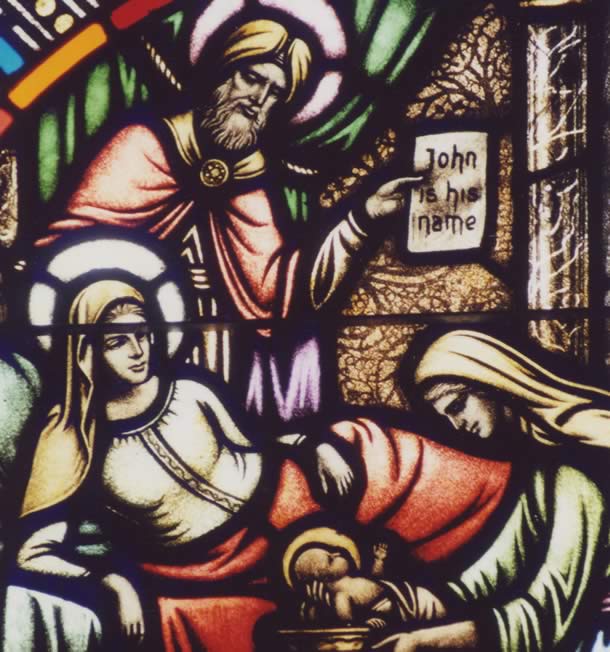
Nine months after Zechariah was struck mute in the temple by Gabriel, his wife Elizabeth gave birth to a baby boy. When it came time to name the child, the family wanted to name him Zechariah after his father, but Elizabeth insisted that it was to be John, and after Zechariah confirmed this with writing on a tablet his mouth was freed. The plague of his disbelief had been wiped away by the miracle of his son’s birth. Now filled with the Holy Spirit Zechariah spoke these great words to his infant son: And you, child, will be called the prophet of the Most High; for you will go before the Lord to prepare his way, to give knowledge of salvation to his people by the forgiveness of their sins. By the tender mercy of our God, the dawn from on high will break upon us, to give light to those who sit in darkness and the shadow of death, to guide our feet into the way of peace.

This is one of the many places that God confronts us in our lives. Through the bread and the wine let us all be moved to live lives worthy of the greatness that God is calling us toward.

Amen.


Wake Up! – Sermon on Romans 13.11-14

Romans 13.11-14

Besides this, you know what time it is, how it is now the moment for you to wake from sleep. For salvation is nearer to us now than when we became believers; the night is far gone, the day is near. Let us then lay aside the works of darkness and put on the armor of light; let us live honorably as in the day, not in reveling and drunkenness, not in debauchery and licentiousness, not in quarreling and jealousy. Instead, put on the Lord Jesus Christ, and make no provision for the flesh, to gratify its desires.

00036884_h

On April 4th, 1742, Charles Wesley came up for appointment as university preacher in St. Mary’s in London. Charles preached from Ephesians 5.14 which reads, “Awake, thou that sleepest, and arise from the dead, and Christ shall give thee light.”

Now, just for context sake, Charles Wesley was the younger brother of John Wesley, the primary founder of the Methodist renewal movement that eventually led to the formation of the United Methodist Church. Both brothers believed that, at the time, the Church of England was losing a sense of purpose and needed to be renewed. They were strongly rooted within their church structure, but they considered their ministries to be caught up in spreading scriptural holiness throughout the land. While John was known for his organization and preaching, Charles was known for his ability to write hymns; some of his more celebrated hymns are sung on a regular basis in many churches: Christ the Lord is Risen Today, Come Thou Long Expected Jesus, Hark! the Herald Angels Sing, O for a Thousand Tongues to Sing, to name a few.

So, Charles found himself invited to preach in front of a university audience that he largely believed had lost sight of what it meant to be Christian in the world. Those in attendance that day were far more consumed with the “academic pursuits” of Christianity rather than a deep and inward sense of what it meant to be forgiven and loved.

Like many young and naive pastors, Charles preached a sermon filled with a barrage of frightening assumptions and left many in attendance frustrated, angry, and ignorant.

ArtMuseum-Awake-thou-that-sleepest

Here are a few of his lines, adapted for our contemporary period: Wake up! Everyone of you, wake up out of your dreams of worldly happiness. What is the state of your soul? If God required you to die right now while I am preaching, are you ready to meet death and judgement? Have you fought the good fight and kept the faith? Have you secured the one thing needful? Have you recovered the image of God, even righteousness and true holiness? Are you clothed in Christ? Do you know that God dwells in you by his Spirit that he has given to you? Have you received the Holy Spirit? Or do you even know if there is a Holy Spirit at all? If any of these questions offend you, be assured that you are not a Christian nor do you desire to be one. Indeed, your very prayers have been turned into sin; and you have definitively mocked God this very day by praying for the inspiration of his Holy Spirit when you did not even believe that such a thing existed!

Needless to say, this was Charles’ first, and very last, occasion for preaching there.

Though Charles chose to preach from Paul’s letter to the church in Ephesus, Paul also wrote in a similar vein to the church in Rome: “Besides this, you know what time it is, how it is now the moment for you to wake from sleep!” What is the “this” that he is talking about? Love is the fulfillment of the Law. So, besides knowing that love is the fulfillment of the law, it is now time for us to wake up! For salvation is nearer to us now than when we became believers; the night is far gone, the day is near. Let us then lay aside the works of darkness and put on the armor of light; let us live honorably as in the day, not in reveling and drunkenness, not in debauchery and licentiousness, not in quarreling and jealousy. Instead, put on the Lord Jesus Christ, and make no provision for the flesh, to gratify its desires.

A-Thanksgiving-meal-has-at-least-3000-calories

Coming off of a major holiday weekend where we have all gratified our desires with mountains of mashed potatoes, rivers of gravy, quarries of cranberries, and seas of stuffing, where many of us were filled with debauchery and quarreling as we competed for the best holiday shopping prices on Black Friday, where we are now more focused on Santa Claus than Jesus Christ… it is very difficult for a young foolish pastor like myself to preach this text without ruffling some feathers. I used to laugh when I read Charles Wesley’s sermon “Awake, thou that sleepest” but now I’m beginning to understand how important it was for him to preach those words.

ap_black_friday_21_dm_121123_wg

Today is the first Sunday of Advent, the beginning of the Christian year. Just as we came to a conclusion with Christ the King Sunday last week, today we begin by looking forward, with expectation, to the birth and arrival of our King. But here’s the great paradox, even though we are looking forward to Christmas, it feels like we’re stuck looking to the past. In many areas of church life this is a plague that has permeated throughout a multitude of ministries, relationships, and conversations. We talk about where we are as a church, what we want to do, but far too many of our imaginations are trapped by the past. 

If, as Paul argues, love is the fulfillment of the law in he past, then love is most assuredly also the appropriate mode of action in the present.

Being Christian is all about love in action; not just a reflection on the past, but also a waking up to the present and the future. 

For disciples of Jesus Christ, one of the hardest things to wrap our heads around is “time.” We are a people who regularly remember the past, in order to live into the present, while also looking forward to God’s promises. We are a people rooted in time, removed from time, and unaware of God’s time. Our past is constantly invading the present, and the future has already met with the present in the presence of the Holy Spirit within the faithful community.

If your head is spinning, don’t worry. It should be.

God-in-time

God’s future casts a light into the present and provides the illumination of the reality by which we are all called to live. Because God has promised to come again and make all things new, a new heaven and a new earth where death will be no more, death will die, then we are called to live into God’s future reality in the present. We are called to love in order to fulfill the Law.

What makes us unique as a people is precisely the fact that God has invaded our present with the Spirit, with his Son who walked among us, with his Word, with his sacraments, that we are a distinctive people with expectations of how the world needs to be.

For us, the time is now! Wake up! 

As Christians we are not to be content with passively accepting injustices and evils in the world. Our faith demands that we reach out in love to combat the sinfulness of the world. How often do we think about our obligations to love outside of our families and our church community? What could this world look like if we seriously considered loving all, and all means ALL, of God’s creatures?

We are creatures of the present, though we are so consumed with our pasts. Our text today encourages us to look to the future in order to know how to act. As Paul wrote elsewhere in Romans, do not be conformed to this world, but be transformed by the renewing of your minds. Discover newness in your lives which the future will bring.

Wake up! We are no longer burdened by living for ourselves, but we are privileged to live for God, we are a people who obey his will for our lives. That is what Paul means when he says we are to clothe ourselves in the Lord Jesus Christ. Its what he means by putting off the darkness and putting on the armor of light!

Because of Christ’s redemptive act on a cross in a place called The Skull we have all been liberated from the burdens of a sinful past. We strive forth with confident steps into a future that is always bringing us closer and closer to the fulfillment of God’s redemptive plan for the entirety of creation. We are here as a people of anticipation, here the first Sunday of advent, remembering while anticipating Christ’s in breaking in the world in order to bring about God’s kingdom on Earth.

Wake up! This moment is the eternal moment – the now – when the past and the future stand still, when the past ceases its going, and the future its coming. This moment is not a time that comes and goes, it is God’s eternal moment, a spot of clarity amidst the ridiculous chaos of our lives.

This passage from Paul, read for us this first Sunday of Advent, deepens our understanding of the future whose coming we celebrate both in the birth and in the return of Jesus Christ.

So, how can we wake up from the sleep that we are caught up in? How can we love in such a degree so as to fulfill the law?

Love is always the essentially revolutionary action.

We love the way that Christ loved, and still loves us…

We can reach out to the lonely in our community, those who do not have a family to share this holiday season with. We can gather together in the front of the church selling Christmas trees while demonstrating Christ’s love in the world through the way we reach out to those who stop by. We can participate in quilt for a cause, letting our fingers and needles and thread create a tangible sense of love for individuals in our community. We can donate money for the Children from Social Services who we have adopted for Christmas presents this year, reminding them that nothing will ever separate them from the love of God in Jesus Christ.

We can open our eyes to the injustices within our local community, and abroad, and be willing to speak out against the disparity present. We can love the unlovable, reconcile with friends and family from whom we have been separated, and we can provide a little warmth this coldest time of the year.

Our love for others, creation, and God is never just a concrete act, something that once began and continues on a course. Our love is the Beginning, the Miracle, the Creation in every moment of time, it sets our hearts aflame for Christ Jesus and allows us to be his body for the world.

And so, though paradoxical, what we are doing, the ways that we embody love, can be no more than point to the victory which has occurred, does occur, and will occur in Jesus Christ. Love directs us to the one whose very birth we now await and anticipate. Love awaits the ends of darkness which is the Beginning of the light of the world.

Wake up! You all know what time it is, and it is time for us to wake from our sleep. This is the beginning, another chance to start again. Whatever baggage you are carrying, whatever sin you believe is too harsh to be forgiven, whatever frustration you are dealing with in your life, today is a new beginning. We have gathered together as a community to rid ourselves of the darkness in our lives. We are here to care for one another. You are not alone. You are part of a community of faith that loves you because God loves us. Put on the armor of light. Prepare yourselves to be surprised by God’s grace in the world.

Wake up! Put on the Lord Jesus Christ. Do not be consumed by your past, but with excited expectation live in the present and anticipate God’s future for you.

This table is our Beginning. For it is here that we gather to confess our faults, receive forgiveness, reconcile with our community, and feast at Christ’s table. This place is where past, present, and future all wind themselves together. Christ’s table is the matrix of time; it is where we remember God’s mighty acts, anticipate his birth and coming again, and live into the new reality of love, mercy and forgiveness.

Wake up! God is waiting for you.

Amen.

00036884_h

Jesus Said What? – A Thanksgiving Sermon on John 6.25-35

(preached at Cherryvale UMC in Staunton, VA on 11/27/13)

John 6.25-35

When they found him on the other side of the sea, they said to him, “Rabbi, when did you come here?” Jesus answered them, “Very truly, I tell you, you are looking for me, not because you saw signs, but because you are your fill of the loaves. Do not work for the food that perishes, but for the food that endures for eternal life, which the Son of Man will give you. For it is on him that God the Father has set his seal.” Then they said to him, “What must we do to perform the works of God? Jesus answered them, “This is the work of God, that you believe in him whom he has sent” So they said to him, “What sign are you going to give us then, so that we might see it and believe you? What work are you performing? Our ancestors ate the manna in the wilderness; as it is written, ‘He gave them bread from heaven to eat.’” Then Jesus said to them, “Very truly, I tell you, it was not Moses who gave you the bread from heaven, but it is my Father who gives you the true bread from heaven. For the bread of God is that which comes down from heaven and gives life to the world.” They said to him, “Sir, give us this bread always.” Jesus said to them, “I am the bread of life. Whoever comes to me will never be hungry, and whoever believes in me will never be thirsty.”

Jesus said to them, “I am the bread of life. Whoever comes to me will never be hungry, and whoever believes in me will never be thirsty.”

00029400_h

After miraculously feeding 5,000 people, the crowd stayed on the other side of the sea. Though they had been properly fed by the Word, the loaves, and the fishes, when they discovered that this miracle man was nowhere to be found, they got into the boats and went to Capernaum looking for Jesus.

When they finally caught up with him on the other side, they called out, “Teacher, where did you come from?!?” Jesus responded, “Very truly, I tell you, you are looking for me for the wrong reasons, you came here not looking for signs, but because I gave you enough to eat yesterday. Do not work for the food that spoils, but instead for the food that endures for eternal life, which the Son of Man will give you. For it is on him that God the Father has set his seal.”

“Okay, okay, so what do we have to do in order to perform the works of God?

Jesus answered simply, “This is the work of God, that you believe in him whom he has sent.”

“Well, who do you think you are Jesus of Nazareth? What sort of sign are you going to perform? Why should we listen to you? How can you prove what you are saying to us? Sure, yesterday you fed all of us, made something out of nothing, but so did Moses in the wilderness. Why should we turn away from him, to you?”

“Very truly, I tell you, it wasn’t Moses who gave you the bread from heaven, the manna, but it is my Father who gives you the true bread from heaven. For the bread of God is that which comes down from heaven and gives life to the world.”

“Now Jesus that sounds pretty good to us, we would like some of that bread!”

jeswelcom

“No, you don’t get it. I AM THE BREAD OF LIFE. Whoever comes to me will never be hungry, and whoever believes in me will never be thirsty.”

One of the great paradoxes of what it means to be Christian, is that we already know the end of the story while we’re stuck in the middle of it. Because we read from God’s word in order to remember the mighty acts of God in the world, we are all well versed on what happens in conclusion. Therefore it becomes nearly impossible for us to imagine the depth and meaning of these narratives in and of themselves.

Try with me, if you can, to imagine that you are there among the crowd. Yesterday you were blown away by this nothing of a man who made something out of nothing. As you stood in line with your stomach rumbling, you were given more fish and bread than you had ever seen in your life. Now, you were so hungry that you ate until your stomach was about to explode, (just like many of us will do tomorrow…) and the next day, the miracle man was gone. As your hunger started to creep back up, you agreed with those around you to go looking for this Jesus.

So here you are, gathered together to hear him speak once again. Some of the people in the front challenged him about Moses’ miracle in the wilderness, something about Manna, but you just want him to provide some more food. So as Jesus begins to describe this true bread from heaven that gives life to the world, your mouth begins to water. You imagine a glowing loaf cooked perfectly, warm and moist on the inside, with just enough crust on the outside. You join the chorus around you, “Give us some of that bread Jesus! We want that always!” And Jesus responds, “I am the bread of life.”

For us, the temptation to jump to the end of the story is great. We hear “bread of life” and we think about Holy Communion, we think about the last supper that Jesus shared with his disciples, we think about the crucifixion and the resurrection. And though it is important to know the end of the story, we’re not there yet.

I imagine that many who had gathered together that day were very confused. “What did he say? He’s the bread of life? What in the world could that mean?”

They don’t get it. The crowds that had witnessed Jesus’ miracle the day before knew exactly what they wanted, but thats not what Jesus is offering.

Today too many of us give the impression that numbers and popularity and packed pews are all important and sufficient in themselves. Many churches seem willing to accept people on any terms, if only they will come at all. How interesting is it then, that Christ would only accept the crowds on his terms, and would not want them upon any others. It hurt and frustrated him that they were merely interested in his ability to provide an easing of material difficulties or an increase in their comforts. “You came to me only for the chance of loaves and fish.”

8105338460_5b6fa706bf_z

Similarly, in our contemporary culture people are hugely interested in the by-products of Christianity, but hardly at all in Christianity itself. Crowds of folk are constantly looking for whatever they can get out of church and worship. They are primarily interested in the kind of faith that will give them bread and fish, bigger homes, shorter hours, better health, happier families. Today Christ looks into the depth of our hearts and triumphantly declares, “there are far better and more satisfying things within your reach than you have realized.”

The whole exchange begins with an accusation by Jesus regarding the crowds’ overwhelming desire and interest in full stomachs, instead of the power of theologically oriented signs. Jesus proposes to give them enduring food and not the kind they consumed the day before. The exchange then elicits a question from the crowd about the “works of God” which Jesus reduces to one, namely belief; belief “in him whom he has sent.”

What is belief? What does belief mean for each of you? Are we called to believe in God, in Jesus Christ, in the Holy Spirit? Is belief about accepting the bible as truth? Can we boil down our belief to something like the Apostles’ Creed?

Often times belief in Christian living is compartmentalized into believing that God simply exists.

The kind of belief that Jesus talks about with the crowds in John 6 is a different kind of belief. Belief is more than mental affirmation, belief is a world view, belief is a paradigm shift, belief is about a redefinition of reality.

What we believe, shapes how we behave.

Everything about what we do begins with belief; we believe in Jesus Christ and the things for which he stands, the way and the truth and the life he teaches us, the God whom he reveals to us, the grace and faith he came to offer us, the victory over death which he makes possible even for the least likely of us, the kingdom of God that he inaugurates for us. 

Okay Jesus, you want us to believe, to drop everything, to change our lives, to pick up our own crosses, to follow you. But why? Moses fed us with the manna in the wilderness, what can your belief offer us?

Moses was Moses, a mighty servant and steward of the Lord. Yet what Moses gave to the wandering Israelites was not the bread from heaven; it is God the Father who gives you the bread from heaven, and that is being offered to you this day. What Moses provided, rather what God provided through Moses, was merely food. What Jesus offers the crowd is the almighty God.

Tomorrow, millions will gather together with friends and family to celebrate the wonderful holiday of Thanksgiving. Crowds will develop in all of the airports, the roads will be filled with traffic, and kitchens will be teaming with individuals trying to concoct the perfect mashed potato – turkey – gravy – cranberry – stuffing combination of all time. After exchanging pleasant and cliche reflections on what we are most thankful for this year, most of us will partake to ridiculous degrees on the food set before us. Mountains of mashed potatoes will be eroded with rivers of gravy. Quarries of cranberry salad will rival seas of stuffing.

A-Thanksgiving-meal-has-at-least-3000-calories

Perhaps most frightening is the fact that within 24 hours, we can go from thanking God for all the blessing in our lives, to fighting one another at Best Buy in order to purchase something to fill our insatiable appetite.

ap_black_friday_21_dm_121123_wg

We know what we want, but thats not what Jesus is offering.

I like to think that, as the church, we have matured from our fragile days of discipleship in the first century. I like to believe that because we know the end of the story, we are better prepared to heed Jesus’ call to a life in the kingdom. I like to imagine that, as moderns, we are ready to take up our crosses in brilliant fashion and follow Jesus into glory.

But the truth is, we are still standing in that crowd asking Jesus for the bread.

We struggle so desperately to find meaning in our lives through failed relationships, the accumulation of material possessions, and vocational discernment. We hear the word of the Lord in scripture, and then quickly fall back away into the shadow of our lives. We thank God for our families and then bicker and fight as if they were not precious gifts in our lives.

Just as He did that day in the crowd, Christ looks out to all of us this thanksgiving season and offers us something more fulfilling than anything else. “I am the bread of life, whoever comes to me will never be hungry, and whoever believes in me will never be thirsty.”

“I am the bread of life”; search throughout the scriptures, I challenge you to find something equally simple and profound in summarizing the Good News. This the gospel of Jesus Christ at its very finest! How ample in its sweep, how generous in its description, how impossible to evade. This is a passage to which we can all cling in the darkest moments in our lives. With this one sentence we discover an everlasting hope that will endure all things.

“I am the bread of life”; Jesus Christ is as important to us as the very food we eat. Indeed, Christ is more important to us than food. No amount of food or drink or any material thing will ever fill us the way that Christ does. Through the bread of life that Christ offers we receive strength to live out our faith, we are sustained and nurtured and loved in all things.

“I am the bread of life”; The triune God is an end to all the craving and discontent in our lives. The bread of life roots our identities in the one from whom all blessings flow, the maker in whom we live and move and have our being.

lord__s_supper_by_bclary-d37hhzp

In a few moments all of you will be invited to Christ’s table to partake of him through the bread and the wine. Just as Jesus stood before the crowd to proclaim his identity as the bread of life, Jesus once gathered with his disciples to remember the stories of God in the world and share one final meal.

What are you thankful for this year? How have you been trying to fill the voids in your life? If you want to be filled, if you want to find a sustenance in your life, if you desire to have your life transformed, if you need to be made whole, if you want to discover purpose and faithfulness in your life, if you desire to know God, if you hope to find peace in your lives, then come. Come to Christ’s table. Feast on the true bread from heaven, believe in Jesus Christ, and be filled by the Spirit.

Amen.

00029400_h

Then and Now – Sermon on Ephesians 1.11-23

Ephesians 1.11-23

In Christ we have also obtained an inheritance, having been destined according to the purpose of him who accomplishes all things according to his counsel and will, so that we, who were the first to set our hope on Christ, might live for the praise of his glory. In him you also, when you had heard the word of truth, the gospel of your salvation, and had believed in him, were marked with the seal of the promised Holy Spirit; this is the pledge of our inheritance toward redemption as God’s own people, to the praise of his glory. I have heard of your faith in the Lord Jesus and your love toward all the saints, and for this reason I do not cease to give thanks for you as I remember you in my prayers. I pray that the God of our Lord Jesus Christ, the Father of glory, may give you a spirit of wisdom and revelation as you come to know him, so that, with the eyes of your heart enlightened, you may know what is the hope to which he has called you, what are the riches of his glorious inheritance among the saints, and what is the immeasurable greatness of his power for us who believe, according to the working of his great power. God put his power to work in Christ when he raised him from the dead and seated him at his right hand in the heavenly places, far above all rule and authority and power and dominion, and above every name that is named, not only in this age but also in the age to come. And he has put all things under his feet and has made him the head over all things for the church, which is his body, the fullness of him who fills all in all.

allsaintsday

Today is All Saints’ Sunday, a particular fixture in the Christian liturgical calendar, often celebrated the first Sunday of every November. All Saints is a time and opportunity to name the death of our saints over the last year. And for us, as United Methodist in particular, “saints” refers to all Christians past and present, so we celebrate the church universal as well as those we have lost. Today is a day about remembrance and honor.

Paul writes to the church in Ephesus, “In Christ we have also obtained an inheritance, having been destined according to the purpose of him who accomplishes all things according to his counsel and will, so that we, who were the first to set our hope on Christ, might live for the praise of his glory.” What is this inheritance that he is referring to?

Bob Foley. Bob Foley was a long time usher at the church where I grew up. As a kid I can remember Bob handing me some of the children’s bulletins that I doodled over throughout the church services, and I can remember him patiently waiting on Christmas Eve’s services with candles in his hands. The first time I ever talked to Bob was when I was fourteen, the first Sunday that I ever ran the sound-system for our services. Bob fulfilled his usher obligations, handing out bulletins, helping new visitors and families find a pew, when he finally stood behind me looking over my shoulder. Now imagine with me if you will, a fourteen year old standing in front of a mixing board with hundreds of knobs, lights, and volume controls, at a church with a large sanctuary with hundreds of people prepared for worship. So with fear and trepidation defining my inner struggles Bob leaned forward and whispered in my ear, “good luck.”

soundboard01_big

I’m sure I messed something up that morning, perhaps I forgot to turn off our minister’s microphone so everyone wound up hearing him horribly attempt to keep the tune to “Be Thou My Vision,” or I turned the volume too high and there was feedback in the sanctuary, or no one heard the prayer over the Tithes and Offerings because I forgot to turn the microphone back on. I’m sure I messed up, but Bob walked over to me after the service ended, shook my hand, told me to call him Bob, and smiled while telling me how proud he was.

Thus started an incredible friendship that played itself out every Sunday morning as Bob and I would joke around in the back. He was old enough to be my grandfather but he never treated me like a child; he was encouraging, and respectful, but above all he was a happy man. Whereas many people would drag themselves into church on Sunday mornings, wiping away the sleep from under the eyes and trying to find a trash can for their coffee they had just chugged, Bob was always standing by the door with a smile because he genuinely cared about the church, he loved being there, and he loved God.

When Bob passed away it crushed me. I’ll never forget the feeling in the pit of my stomach when my mother called me during college to let me know what had happened, and I’ll never forget the awful feeling of walking back into the church for the first time without having Bob there with his customary smile.

Paul talks about an inheritance from Christ, something we receive through his mighty acts in the world. There is something special about getting to share the stories of the bible with someone, young or old, to talk about what God did with God’s people, but there is something indescribable about the way God is working in the world right now.

Bob Foley was a saint in my life. But what Bob offered for me and my Christian life was more than the typical church friendship. Bob never sat me down with scripture or told me how to live my life. He never criticized my decisions or offered unwarranted advice. What Bob did for me, was demonstrate how important faith is in the now. He might’ve loved to hear those old stories from scripture, but Bob felt God living in the world in the immediate, thats why he committed to being in church and sharing his smiles with everyone else; to him there was nothing better than being a Christian because he felt God’s presence.

When we read from Paul’s letter to the Ephesians, its as if he’s saying “It is such a great thing to be a Christian!” But, I wonder if that is the first thought that comes to our minds when we think about our Christian heritage today. May it be that the joy and excitement of the gospel has grown stale for many of us? Is living out our Christianity filled with images of too many commitments and disappointments? Have we grown complacent with what it means to be the church in the world? Perhaps a lot of us here are like the elder brother from Christ’s great parable, we see our wayward younger brother return home for a celebration and we are envious. Maybe we hear the words from our Father saying, “You are always with me, and all that I have is yours,” but the thrill and glory of these words have seemed to vanish.

Why are we here? Why did we wake up this Sunday morning and come to church? What brought us, what drove us to ever join together in the first place?

All of us are here because someone loved us enough to bring us, to invite us, to nurture us. Who was that person for you? Who was that saint in your life?

Paul writes about a “love toward all the saints” present in the community in Ephesus. That same love may, in fact, be half-present today in our lives through the casual “hello” at the Food Lion, in the wave as a car drives by in the neighborhood, and in the church fellowship activities in which we participate. But there is a temptation to take all of these things for granted, to live into them everyday, and never value them for what they really are.

I’m not proud to admit that I never realized how important Bob Foley was to my life until after he died. It was only in his absence that I began to appreciate the joy that he taught me every Sunday morning. I took my relationship with Bob for granted and I wish that I had lived into our friendship more while he was still here with us.

Like our relationship, it has taken me some time to discover what made Bob’s faith so worthy of emulation. I have wondered what it was that made him excited about the church, when so many others arrived more out of obligation than expectation.

Have you ever noticed that Paul almost never writes about the actual life of Jesus in his letters? Do you find it interesting that as a leader for the blossoming church in the first century, Paul rarely referenced the exciting life of Jesus Christ? He paid little attention to the Sermon on the Mount, the parables, the miracle stories, or other moving elements from the gospels. It seems, therefore, for the first Christians, what was most important was not what had happened in the past, but how Christ was living in and through them in the present. They most certainly remembered the words and actions of Christ in their worship, but their Christianity was exciting because Christ was still moving in their world.

Paul wrote to the church, “I pray that the God of our Lord Jesus Christ, the Father of glory, may give you a spirit of wisdom and revelation as you come to know him, so that, with the eyes of your heart enlightened, you may know what is the hope to which he has called you, what are the riches of his glorious inheritance among the saints, and what is the immeasurable greatness of his power for us who believe, according to the working of his great power.” The key word in this whole passage is “power.” When the first Christians appealed for conversion to the new faith they did not just talk about what had happened on a hill outside of Jerusalem in the year 33, but they witnessed to what Christ had done for them in their own lives.

Christ is a present power, rather than simply being an admired person from history, Christ transcends time and is with us in the present; that was the paramount miracle for the early church.

On this All Saint’s Day we are called to remember the saints of our lives, the Bob Foleys of the world, to be thankful for what they did for us, but to also live in the present. Be grateful for what they did, and live out our faith today. The saints and Christ are not just some historical influences in our lives but continually live and move through us in the ways that we continue to be faithful in the world.

Do you know God? I don’t mean some sort of dense theological knowledge, but real and tangible and simple. Do you know God in your life? We cannot have knowledge of a person until we see them in action and we shall not have faith in God until we trust and experience his divine love in the world.

There is a difference between the Word of God (Jesus Christ) and the word of God (scripture). Our knowledge of God in this community rests upon God’s Word as Jesus Christ. The Bible is not a textbook in the ordinary sense as a collection of facts that need to be checked and memorized but it is instead a story. In contains the majestic drama of God’s interaction with God’s people. The climax of the story is God’s coming down to dwell among us in the form of flesh, dying for us on a cross, rising again from the grave, returning to glory, and leaving behind a people of God endowed with knowledge of him.

When we remember the saints, when we gather together to read and proclaim scripture, it is important for us to remember God’s mighty acts in the world. However, what makes church and faith compelling, what moves us toward excitement, is God’s present power in the world! Today is the day that we can celebrate the lives that we have lost while also living into the exciting faith of what it means to be Christ’s body for the world.

Today we are called to remember those saints from our lives who shaped us into the people we are now. It is the time to remember disciples like Bob Foley who lived out his faith in his relationships with others, who felt the joy of Christ in his own life and in his own heart.

We remember those who have gone on with joy and with longing, for they are being held in the arms of our great Lord and we anticipate with joy the great reunion of all the saints of the church in God’s time.

Christians are not called to be motivated by the question: “what happens to me when I die?” but rather ”what am I doing with my life right now?” What we do in the here and now, how we live out our faith in the world, is what makes being the body of Christ an exciting and wonderful thing.

Jesus Christ is not a man of the past, a person to be remembered and recorded in history. Christ is alive! Christ is with us here and now in the gifts of bread and wine. Christ continues to live and breathe and change the world because we partake of him when we gather at his table.

If you are looking to find Christ in your life, if you want your faith to move from remembrance to lived reality, and if you want to find a joy worthy of celebration, then come. Come to Christ’s table and discover the inheritance that will change your life forever.

Amen.

Communion

Dinner in the Kingdom – Sermon on Luke 14.1, 7-14

Dinner in the Kingdom

Luke 14.1, 7-14

On one occasion when Jesus was going to the house of a leader of the Pharisees to eat a meal on the Sabbath, they were watching him closely. When he noticed how the guests chose the places of honor, he told them a parable. “When you are invited by someone to a wedding banquet, do not sit down at the place of honor, in case someone more distinguished than you has been invited by your host; and the host who invited both of you may come and say to you, ‘Give this person your place,’ and then in disgrace you would start to take the lowest place. But when you are invited, go and sit down at the lowest place, so that when your host comes, he may say to you, ‘Friend, move up higher’; then you will be honored in the presence of all who sit at the table with you. For all who exalt themselves will be humbled, and those who humble themselves will be exalted.” He said also to the one who had invited him, ‘When you give a luncheon or a dinner, do not invite your friends or your brothers or your relatives or rich neighbors, in case they may invite you in return, and you would be repaid. But when you give a banquet, invite the poor, the crippled, the lame, and the blind. And you will be blessed, because they cannot repay you, for you will be repaid at the resurrection of the righteous.


A few years ago, I sat in the depth of a couch listening to one of my best friends named Josh [you can check out his blog here] talk about our assignment for the week. A number of us had been gathering on a regular basis in a sort-of “spiritual discipline accountability group.” Every week we read through a chapter from James Bryan Smith’s The Good and Beautiful Life, discussed what we had learned, prayed, and then talked about our assignment for the next week. To be honest, the assignments were what I enjoyed most about the group because every week we were given a new challenge regarding our faith lives that we could live out.

37

For instance one week we discussed the super-abundance of technological distractions in our lives and our challenge was to go on a “media-fast.” This meant that for 48 hours we were to try our best to put our cell phones away, rid ourselves of Facebook and twitter, keep the television turned off, and the magazines closed. For those two days we would distance ourselves from the distractions in our lives.

Most of our assignments were straightforward, and the results predictable. By fasting from media, we would inevitably spend more time with God and realize how much time we waste every single day. When we spent the week praying for our enemies, we would realize how connected we really are as the body of Christ, etc.

However, when I sat on the couch that night a few years ago, we were given a task that I thought would be too easy. “This week,” my friend read aloud, “you are to give away possessions to people. (Easy, I remembered thinking to myself) But here’s the catch,” he continued, “you have to do it in secret. This doesn’t mean you need to go out and buy something nice for someone, but truly give away something that you love without any expectation of receiving anything in turn.”

Giving and receiving gifts can both be a joy and a challenge. We live in culture so saturated in capitalism that nearly everything we do is based on a “giving-receiving model.” When someone offers to pay for our lunch, the conversation usually continues with, I’ll get the next one. When we give someone a gift, whether we admit it to ourselves or not, we hope that we will receive something just as nice in return, eventually. We no longer know how to receive gifts with true gratitude because before we even enjoy whatever has been given, we feel indebted and begin to plan on giving something back in return.

And so it came to pass one evening that Jesus went to the house of a leader of the Pharisees to eat dinner. As everyone was getting settled, sitting down in their chairs, filling up their glasses of wine, Jesus looked around and noticed how the invited guests were choosing the places of honor. He cleared his throat, and started to tell those with ears to hear, a parable: “when you are invited by someone to a banquet, do not sit down in the best places, in case someone more distinguished than you arrives and then the host will have to tell you to go sit somewhere else. Instead, you should sit in the lowest place, so that when the host sees you they will say, “my friend, move up higher, take one of the better seats.” For all who exalt themselves will be humbled, and those who humble themselves will be exalted.”

eucharist

Jesus loves to use the mundane, the everyday, to help convey the depth of God’s kingdom. He uses the common experiences of people, the home or marketplace, farms and fishing boats, to reveal aspects of the character of his listeners, while also demonstrating the way of life in the kingdom of God. The Kingdom of God is like a mustard seed, the Kingdom is like a sower going out to sow, the Kingdom is like a dinner party. So the first part of our passage today is therefore fairly straightforward: Stay humble. When you get invited places, do not assume that you are worthy of the best seat, but seek the lowest.

But Jesus continues on beyond the parable by addressing the one who had invited him: “When you have people over for a lunch or dinner, do not invite your friends or your brothers or your relatives or your rich neighbors, who can all return the favor of your invitation. Instead, when you’re hosting a party invite the poor, the crippled, the lame, and the blind. And you will be blessed, because they cannot repay you, for you will be repaid at the resurrection of the righteous.”

It is very easy to read this passage from scripture and limit the meaning to social justice and ethics. In fact most of the commentaries written on this part of Luke 14 constrain the interpretation to simple ethical contributions. However, Luke gives us plenty of evidence to show that the real subject at hand is the Kingdom of God.

From the beginning of the passage Luke has given us a clue that there is more at stake here than etiquette; Jesus is telling a parable; Jesus is calling for kingdom behavior.

For the first part of the parable we do well to remember to resist the temptation to use humility as a means of receiving benefits. Taking the low seat because one is humble is one thing; taking the low seat as a way to move up is another. This is about maintaining our humility so that we embody the kind of life Jesus led and therefore receive exaltation in our humility.

As Jesus continues by addressing the host we can all imagine the wonderful elements that come with hosting a party. Inviting others embodies friendliness, generosity, graciousness, and concern for the comfort of others. However all of us know the ugly face of generosity that binds us when gifts come with strings attached. Just as in Jesus’ time, hosts often expect a return on their generosity toward others and therefore only invite people who are able to return the favor. But in the kingdom, God is the host, and who can truly repay God?

When we started our week of giving away possessions I was truly excited. I love giving gifts to people, and like the host in our parable I love inviting people over for dinner. I started scheming and planning on how I could start to give away my things to my friends. I analyzed them individually and started to think about who could use certain things. I went first to my collection of vinyl records and books, pulled out some of my very favorites, wrapped them up, and delivered them in secret without any indication that I had been the one to do so. I hid their gifts by their front doors, in the academic boxes at school, and I even left a few on the hoods of cars. Now to be clear, these were not just simple things that I had collected and would be willing to give away, but they were truly sentimental items that I had grown very attached to. I can remember wrapping up my first iTouch, my favorite Jazz LP from Dave Brubeck, and the first theological work I ever read from Karl Barth. These weren’t just  “things” but were part of who I am. In the days that followed after the surprise deliveries I felt absolutely miserable.

The hard part was not parting with the objects, but it was doing it in obscurity. I wanted all of my friends to know that I was the one who gave them their gifts. Keeping my mouth shut was so very difficult for me, because I wanted credit for the good deeds I had done. I thought that I wanted them to know how much time and energy I had put into their surprises, but what I really wanted was a little praise for what I had done. I realized that I was just like the host of the party in our scripture today; I was doing something nice to mask my own desire for affirmation.

But in the kingdom of God, things work differently.

kingdomofheaven3

The story from scripture today is about God’s continued commitment to make us into people who can be depended upon to love strangers since we have learned, in Christ, what its like to be a stranger and be loved, even when we least deserve it. Preachers often list off virtues for people to emulate but there is only one true virtue: the lowly acknowledgment of God. Preachers also often list off sins to be avoided, but there is only one true sin: self-worship, our attempt to set ourselves at the center of the world, and the center of God’s table.

Jesus confronts us this morning: Who are you inviting over? To whom are you showing hospitality? Are you having over the same old people who can continue to pay you back for what you’re doing? Or are you reaching out to the last, least, and the lost?

To entertain for those with whom we are most comfortable is to set one’s own circle as the center of the universe; it is selfish. To entertain people beyond our comfort zone is to remember that God sees humanity as one family and that his love runs most quickly to those who are most in need.

Jesus is the one who chooses us, not the other way around. Jesus is not calling us here to provide for the needs of the poor and the disabled; He very simply asks us to invite them over for dinner. True hospitality is not having one another over on Friday night, but welcoming those who are in no position to host us in return.

This week we cannot rationalize ourselves out of the text and we cannot use metaphors or other interpretative elements to make it say something different. Luke 14 is not just about “loving” people, because Jesus didn’t get killed for loving… a lot more is at stake than just being nice. God is pulling us out of our comfort and complacency to live radically transformed lives. It does not matter whether you 71 or 17, our lives have been transformed in Jesus Christ and it is never too late to rediscover that transformation.

Christ is the host of this party. This is not St. John’s table, or my table, or even our table, but it belongs to Christ. None of us deserve to be invited. We regularly forget the goodness of God in our lives, we ignore the commands to love the unloved, and we fall short of his glory over and over. Yet, here we are. We come to this table with empty hands and hungry hearts, needing God to do for us that which we cannot do for ourselves.

Christ freed, and continues to free us from the expectations of the world. We no longer have to follow along with everyone else but instead get to live new and exciting lives. Who do you know that needs to feel a little more love?

Christ has invited you to his table. Who are you inviting to yours?

Amen.

Who Are We To Be? – Sermon on Luke 12.13-21

(preached at St. John’s UMC  on 8/4/2013)

photo-006

Luke 12.13-21

Someone in the crowd said to him, “Teacher, tell my brother to divide the family inheritance with me.” But he said to him, “Friend, who set me to be a judge or arbitrator over you?” And he said to them, “Take care! Be on your guard against all kinds of greed; for one’s life does not consist in the abundance of possessions.” Then he told a parable: “The land of a rich man produced abundantly. And he thought to himself, ‘What should I do, for I have no place to store my crops?’ Then he said, ‘I will do this: I will pull down my barns and build larger ones, and there I will store all my grain and my goods. And I will say to my soul, Soul, you have ample goods laid up for many years; relax, eat, drink, be merry.’ But God said to him, ‘You fool! This very night your life is being demanded of you. And the things you have prepared, whose will they be?’ So it is with those who store up treasures for themselves but are not rich toward God.

It was late. I had been working for Duke University Hospital for some time and I was used to getting the random alerts on my pager. They always seemed to come in waves, or at moments when you were busy with something else. It had been a trying shift already, quite a few deaths, arguments in the lobby, too many prayers to count before surgeries… I remember looking at my watch after receiving the page, reluctantly putting on my white lab coat, and heading to the room number.

You never know what to expect on the other side of a patient’s door. Sometimes it was a family celebrating good news, or a patient wanting to complain about the hospital food, or sometimes death was waiting on the other side. On that particular night I entered the room and saw two brothers on opposite sides, ignoring one another, with their no longer living mother under blankets on the hospital bed. She had died from complications following surgery, and like any death at the hospital; I was called to offer my services to the family.

I introduced myself, and expressed my condolences to both men, but they refused to stand together or even acknowledge one another’s presence. So I stood there just inside the doorway, moving my body to the left and to the right attempting to convey my deepest sympathies for their recent loss, and give them the space to experience what had occurred. After prolonged periods of awkward silence I invited the men to join me in an adjacent room so that we could meet with Decedent Care in order to fill out the necessary paperwork regarding their mother’s body.

They filled out the appropriate forms, revealed which funeral home would be receiving the body, and I got my things together to leave when the real discussion started. “Where have you been?” one said to the other, “I’ve been with mom for months, watching her die, taking care of her… if you think I’m going to let you have any of the inheritance you are sorely mistaken.” “Don’t you dare speak to me that way!” he replied, “I was her son too, I deserve my share. I know she never loved me like she loved you, but you better believe I’m going to do whatever it takes to get my money.” And he stormed out of the room. Seconds passed before the remaining brother sighed, collected his paperwork, walked our of the room and left the hospital. So there I sat, all alone, after having witnessed two brothers fight about assumed inheritance while their mother lay dead in the next room.

The ugly fight and dispute in that hospital room is all too familiar: Arguing about inheritance. We see this kind of thing on TV, read about it in books, or have experienced it in our own lives: haggling over the furniture, dishes, paintings, property, and savings accounts. Most of the time this is done without a thought or consideration about the life that was lost, and the depth of one’s selfishness and greed shines frighteningly brighter than ever before.

In Luke 12 a crowd gathered by the thousands was pushing in to hear anything they could from Jesus. Jesus triumphantly exhorts the people to confess fearlessly before God because the Holy Spirit will teach them what to say. While standing before the throngs of people Jesus is interrupted by a man and asked to judge an inheritance dispute. “Teacher,” the man says, “tell my brother to divide the family inheritance with me.” Jesus knows that he is not such a judge and he does not want to be. According to the words and actions of Jesus, these kind of specific ethical questions that judges deal with are not the ultimately important ones. When brought this vexing situation Jesus refuses to be a referee between the brothers; after all, who can judge whose greed is right?

Instead of addressing the particularities of the interrupting man, Jesus turns to the crowd: “Take care! Be on your guard against all kinds of greed; for one’s life does not consist in the abundance of possessions.” Jesus then does what he does best, he tells a story…

There once was a rich man whose property produced abundantly. And he thought to himself, “What am I to do with all these extra crops?” So he devised a solution, “I will destroy my barns and build larger ones to hold all of my excess!” Then he said to his soul, “Soul, you have ample goods laid up for many years; relax, drink, be merry!” But God said to him, “You fool! This very night your life is being demanded of you, and the things you have prepared and saved, whose will they be?” And Jesus ties it all together, “So it is with those who store up treasures for themselves but are not rich toward God.”

Upon first inspection, it seems as if the farmer has done nothing wrong. This is not some easily identifiable caricature of human desire but a truism that we can all identify with. For all intents and purposes he is careful and conservative. He is not unjust in the way that a typical parable would make him out to be. He has done what any rational and forward thinking person would do. He invests. He takes his extra surplus and puts it away so that he might reap from it for years and years.

So, if he is not unjust, then what is he? Jesus tells us very directly: He is a fool! This farmer lives completely for himself, he plans for himself, he congratulates himself, and he even speaks to himself. He is a fool because his perspective can only go as far as himself. He is a fool because he is defined by nothing short of greed. He is a fool because God is nowhere in his story. The craving desire to hoard his possessions demonstrates how the farmer foolishly believes that he can do all things without God, that he will be fine without God. The farmer’s selfishness indicates the way is life is oriented: completely and totally inward.

Jesus uses this short parable to challenge an accepted set of values: he is denying that it is possible to have security by amassing wealth and property. Instead he proclaims that one becomes secure only by being rich toward God and others.

In the story the famer’s desire to hoard his goods not only ignores the role of God in his life, but is also an act of total disregard for the needs of others. What might appear as “good business” for the farmer actually has far reaching consequences for others in his community. It’s not explicit in the story, but the man is so focused on himself that he has ignored others around him who could also greatly benefit from his surplus. What good is a banquet of food if you are the only one in attendance?

Jesus looks out at the crowd and through this story sets forth a new perspective on what it means to be in the kingdom of God. We cannot find security through an accumulation of abundance, at least not in the way the farmer believed. There is however, an abundance we do have; it is through Father, Son, and Holy Spirit that we can be in all things more than the farmer, it is only in the abundance of the mercy of God that we can be confident that neither death, nor life, nor angels, nor rulers, nor things present, nor things to come, nor powers, nor height, nor depth, nor anything else in all creation will ever be able to separate us from the love of God in Christ Jesus our Lord. To know this love in our hearts, souls, minds, and bodies, is to be rich toward God.

People are always asking me questions about what they’re supposed to do. Like the man interrupting Jesus they want to know how to handle a specific situation according to what it means to live as a Christian. To be authentically Christian the question can no longer be, “What should I do?” but instead, “who am I to be?”

When we ask ourselves who we are to be, we can live our lives in such a way that we will already know the answer to the former question. We are to be disciples of Jesus Christ. We are to be a people of gifts. We may complain about one another to one another, like the interrupting man does, but this kind of bickering will never get through to God. Before God we are confessors not complainers. God is the center of the story, not us. All of the talk in the story about the farmer has been a monologue. He talks to himself, plans for himself, celebrates himself. All these things in my life, I accomplished them, I’ve earned this; I deserve this. It is only when God finally intrudes in the story that we get a glimpse of the truth: “You fool!”

We are to be disciples of Jesus Christ, intent on doing the will of God in the world so that his kingdom can reign abundantly, so that God can continually reconcile us to himself, to one another, and to his creation, so that we can be the body of Christ for the world redeemed by his blood.

For the first time in my life, I am tithing to the church. To be honest, this is the first time I’ve ever earned a salary and had the capacity to give back to God a tenth of what I am earning. Everyday I have been in Staunton God has continued to show me that this is exactly where I’m supposed to be, doing exactly what I’m supposed to do. This is a gift; to be here as the pastor of St. John’s is a gift.

We are to be a people of gifts. This means that we are called to give back to the good God who first gave to us. This doesn’t have to just come in the form of money because we are called to give to God through our gifts, our time, and our service. For me, I give part of my salary to God as a discipline, so that I can remember from whom all of this comes from first. How often have I been guilty of the same thoughts as the farmer? I did this, I’ve earned this, I deserve this. When in fact I have done very little for this graceful life. I owe everything to the people around me, and to the God who gave me the greatest gift of Jesus Christ.

Karl Barth

Karl Barth

We are to be a people of gifts willing to offer ourselves to one another. Karl Barth once wrote, “When I really give anyone my time, I thereby give him the last and most personal thing that I have to give at all, namely myself.” How beautiful it is to offer ourselves to those around us, to those in need, and to those who need to feel the love of God through us.

Giving ourselves to other people is beautiful because it is exactly what God did for us through the gift of his Son Jesus Christ. God came among us, to spend time with us, just as he does every day, to give us the most precious gift in the world: himself.

lord__s_supper_by_bclary-d37hhzp

Before us this morning the table has been prepared. Like our call to share ourselves with others, God desires to share this meal with us. We are invited to receive these gifts without any merit on our part but because God loves us. God has not kept his grace stored up in a barn for eternity, but out of God’s abundant love it has been presented to us in the death of his only begotten Son and the gifts of bread and wine.

Who are we to be? We are to be disciples of Jesus Christ, willing to share with others the gifts that God has given to each one of us. We can give back to the good God who first gave us life through our tithes and offering, we can give back by serving those in need, we can give back by sharing the love of God with others, we can give back by offering prayers for our enemies. We are not called to keep the riches of our lives kept away for our own selfish enjoyment; instead we are called to be a people who are rich toward God.  Amen.