Ten Things I Learned From My First Week At A New Church

In United Methodism pastors are subject to appointment and that means we go as the Spirit leads the church. A particular pastor can serve as short as one year in a particular place and some can serve one church for their entire vocation. The point of itinerancy is to be subject to the movement of the Spirit and to go where you can best serve the Lord.

I just finished my first full week as the pastor of Cokesbury UMC in Woodbridge, VA after serving St. John’s UMC in Staunton since 2013. Like all churches, Cokesbury is unique in a number of ways and has been around longer than I’ve been around (and will be here long after I’m gone). Below are ten things I learned from my first week in the new appointment.
IMG_0141

  1. Names Are Important

Of course names are important, but they can mean a whole lot to a whole lot of people during the first week. I did my best to match names to faces as quickly as possible such that when I was serving communion for the first time I was able to call a few people by name as I handed them the body of Christ. After the first service was over, the individuals whom I had called by name all made comments about how valued they felt because I had made the effort to know them. Names are important and learning the names of the people you serve God with is the beginning to a strong ministry.


  1. You’re Not The Only Visitor

On Sunday morning I stood in the parking lot greeting people on their way into church and welcomed them even though I had never been there before. I made a lot of jokes about welcoming people into their own church and when a younger couple walked up I did the same thing. However, it was their very first time at Cokesbury just as much as it was my first time. It was an important lesson to learn before the service because it reminded me not to use “insider language” and therefore made it as welcoming to people as possible whether they’d been in the church every Sunday of their life or if it was their first Sunday.


  1. Prepare To Be Surprised

You can plan a whole worship service and line up all the hymns and the prayers and the liturgist but something will always spring out of nowhere. I hadn’t even made it to the scripture reading when a group of lay leaders brought forth a prepared liturgy to welcome me as the new pastor of the church. At the moment I was so consumed by the feeling that I needed to get everything right that I reeled when the service was taken by other people in order to ask God’s to lead me and guide me in the best ways possible for the church. I needed those words and prayers more than I can describe.


  1. Something Will Go Wrong

Like being surprised, it’s important to remember that something will go wrong. On my first Sunday at St. John’s I completely forgot to give the offering plates to the ushers and they just stood by the altar patiently waiting until one of the choir members waved her hands to get my attention. For my first Sunday at Cokesbury we didn’t have anyone to play music. The long time organist retired the day before I arrived and the back up players were either out of town or don’t know how to read music. So instead of singing along to an organ or a piano or a guitar we did everything acapella and (thanks be to God) we made it through the service.


  1. God Is In The Business Of Doing New Things

Just because the church has done something a certain way, that doesn’t mean it has to continue that way. This can be true on a number of levels from how many committees there are to what kind of songs is the church supposed to sing. For the first service at Cokesbury I tweaked the order of worship around a little bit but biggest change came during communion; instead of allowing the gathered people to tear their own piece of bread from the common loaf I offered a piece to each individual and instructed them to come forward with their hands outstretched in order to recognize the gift they were receiving. I can’t pinpoint the exact moment that I felt led to change it this way but in response to the change in communion many people remarked about how holy it felt and how the experienced the Spirit’s presence in worship. God is in the business of doing new things, some big and some small but all for the glory of the kingdom.

IMG_2769


  1. God Provides

After preaching nearly 250 sermons in once place I was nervous and anxious about preaching to a relatively unknown congregation. I knew what the last church needed to hear and what they were familiar with and what kind of stories would resonate in their heart of hearts. And even though I stressed about the words for the first sermon, God provided the words I needed to hear and the words Cokesbury needed to hear. The sermon came when I remembered that I am not the one called to provide for the church, only God can do that. And when I submitted to God’s will, the right sermon came forth.


  1. A Familiar Face Can Go A Long Way

We had already started worship when I saw one of my oldest friends walk into the back of the sanctuary with her infant daughter. She lives about 30 min away and made the drive down my first Sunday to be there in worship. I cannot convey in words how humbling it was to see her sitting in the back pew and how much it helped me to feel God’s presence in the midst of worship. A familiar face can go a really long way during the first worship service.


  1. Hope Does Not Disappoint

After the first service I showed up at the church every day for work this week and people from the community kept swinging by. Some wanted to ask questions, other wanted to offer advice, but all of them were filled with the hope that comes from the Lord; hope for things unseen; hope for new life and new ministries; hope for resurrection. Their hope in the Lord is infectious and I can’t wait to see what God is going to do next for Cokesbury.


  1. The Church Is Not A Building

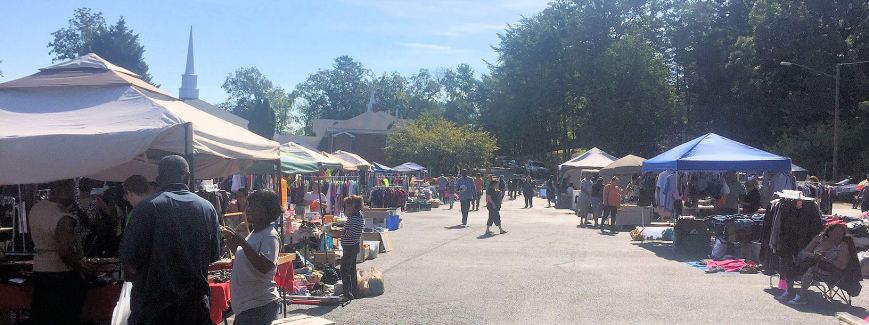
One of the strongest ministries of Cokesbury is a weekly flea market that takes place in the parking lot every Saturday morning. I drove over to the church this morning to check it out for the first time and I was overwhelmed by the number of people, and by the interactions between people from the church and people from the community. In my limited ministry experience there are too many programs that feel like “us and them” whereby there is a divide between those who serve and those who are served. But this morning there was no line. Instead I saw conversations and interactions that triumphantly declared the church is not a building!


  1. Christ Is Alive

Christ is alive in the community of Woodbridge, VA and in the community of Cokesbury Church. Whether singing or praying, worshipping or praising, talking or eating, Christ has been fully present in the interactions I’ve had during my first week and is surely alive in this place. Thanks be to God.

Devotional – Matthew 28.16-17

Matthew 28.16-17

Now the eleven disciples went to Galilee, to the mountain to which Jesus had directed them. When they saw him, they worshipped him; but some doubted.

Weekly Devotional Image

Doubt has been with the church since the very beginning. Even after the resurrection while the disciples were worshipping Jesus on the mountain in Galilee there was doubt. This is a particularly interesting note in scripture considering the fact that doubt is so ridiculed and berated in parts of the church today.

In some so-called “prosperity gospel” churches if someone gets sick or loses a job the rest of the church blames the occurrence on the doubt of the individual. In other churches you might hear a sermon that makes it plainly obvious that doubting the Lord is a sign of weakness and it needs to be dismissed from the mind (or the heart). And still yet in some churches the “d” word is never mentioned because of it’s supposed negativity.

But doubt was with the disciples from the beginning! How else could a group of finite human beings respond to the infinite wonder and grace and mercy of God made manifest in the flesh?

doubt1

Doubt is not the opposite of faith. In fact, doubt is often the prerequisite and part of the cyclical nature of faith.

Two summers ago I took a group of people from the church on a mission trip to War, West Virginia and while we were there serving the needs of the community one of our members expressed doubt in God’s love and compassion when confronting the destitute poverty of the people in the community. One afternoon, while working on the floor of a house, he said, “It’s hard to believe in a God who could let something like this happen.” At that precise moment the homeowner walked around the corner laughing and said, “Honey, you are the proof that God is not done with us yet!”

Oftentimes when we are in the midst of doubt, whether a particular event has led us to begin questioning the Lord or it comes out of nowhere, it usually takes another person to show us back to The Way. In West Virginia is took a poverty-stricken homeowner to show my friend what the grace of God really looks like. When I begin questioning aspects of the kingdom or scripture or any number of things it usually takes a word or phrase from our hymnal to knock me back into the reality of God’s reign. For some people they need a friend or relative to reach out and ask to pray together. For others it takes something close to a miracle to show how God still rules this world and is the author of our salvation.

Regardless of what we doubt, or even if we doubt, the Good News is that God is not done with us yet!

The Uninvited Guest

Acts 2.1-4

When the day of Pentecost had come, they were all together in one place. And suddenly from heaven there came a sound like the rush of a violent wind, and it filled the entire house where they were sitting. Divided tongues, as of fire, appeared among them, and a tongue rested on each of them. All of them were filled with the Holy Spirit and began to speak in other languages, as the Spirit gave them ability.

i-will-pour-out-my-spirit-on-all-my-people-marianne-gonzales-sims

I only have three opportunities left to proclaim God’s Word in this place. After preaching for 4 years from the Old and New Testaments, after listening for the Spirit’s movement for more than 250 sermons, I only have 3 left.

It’s hard not to think about what my final thoughts should be. I’ve been the pastor of St. John’s for some incredible mountaintop moments, and some frighteningly deep valleys. I’ve gone on a bunch of mission trips, taught lots of bible studies, and implored us to do some pretty strange things in this sanctuary all under the auspices of “worship.”

What do I want to leave with all of you? Should I try to whittle the entirety of the gospel down to an easily digestible sentence like “do unto others as you would have them do unto you”? Should I use my last three sermons to build you up with stories of love and grace and generosity? Should I use these final sermons to break you down with talk of sin, evil, and repentance?

I’ve got to admit that over the last few weeks I’ve found myself far more concerned with what I want to say than with what God wants to say.


Here we are my friends, today is Pentecost, the so-called birthday of the church. I know some pastors who will spend part of this morning in worship gathering their congregations around a giant birthday cake and will encourage an off-key rendition of “Happy Birthday.” Others will spend the service talking about how it is our responsibility to offer gifts to the church for her birthday and will then not-so-subtly move to the time of tithes and offerings. And others will use the church’s birthday as an opportunity to talk about inviting others to celebrate and make the whole thing into a guilt trip about evangelism and church growth.

All of which don’t have much to do with what God is saying in the text.

But, of course, Pentecost seems like a party. There are people gathered together in one place, the house is filled with something that propels the guests to do something, and everyone leaves with a gift.

But if Pentecost is a party, how long had God planned it? Who was on the guest list? Is it the kind of party we would hope to be invited to?

Pentecost may be the birthday of the church, the beginning of the gathering of disciples to worship the living God, but it is NOT the birthday of the Spirit.

In the beginning, when God created the heavens and the earth… sound familiar? When nothing existed but chaos the Spirit of God swept across the waters and brought forth order. The Spirit is not new, it was there in the creation of all things, it rested on the likes of Abraham, Isaac, Jacob, Moses, David, Solomon, and the prophets. By the day of Pentecost in the upper room the Spirit had already overshadowed Mary’s womb, and called Jesus forth from the tomb. It was there at Jesus’ baptism, it compelled him to preach his first sermon, it fed the 5,000, it healed the sick, Jesus even breathed it on the disciples in the upper room shortly after his resurrection.

The story of Pentecost is not about the arrival of some previously unknown force that we call the Spirit; the entire bible is the story of the Spirit of God made manifest in and among God’s people.

What happened on Pentecost began long before that day, and will continue long after we’re gone.

Near the beginning, the people of God had grown restless. They wanted something more than life was offering, they wanted answers to their questions, and they began work on a giant tower. With brick and mortar, sweat and tears, they cut through the horizon in an attempt to reach God, and become like God. And God saw what we humans were doing and decided to confuse our language and scatter us across the earth. The unity and connection at the heart of our species was ripped apart and never again would we so brazenly attempt to reach and control our Lord.

Or so we thought.

Later, while Moses was on top of the mountain with God, at a place called Sinai, the people down in the valley grew restless. They wanted something more than life was offering, they wanted answers to their questions, and they began forming a golden calf to worship. With a gathering of precious gems, with kneeling and praising, they chose a new god to put their hope in. And God saw what we humans were doing and decided to wipe us from the face of the earth. But Moses pleaded with the Lord and instead only 3,000 were killed for worshipping the golden calf.

The Tower of Babel in Genesis and the Golden Calf in Exodus are stories we’d like to explain away. Not just for their strange and supernatural elements, but also because they don’t match with our anachronistic and modern sensibilities. We’d rather talk about what we think the text means than what it is actually saying.

But the stories of Babel and the Golden Calf do not end with a division of language or in a slaughter.

Pentecost is the undoing of Babel with God’s magnificent power reuniting God’s people under a common tongue: the Gospel.

            Pentecost is the undoing of the episode with the Golden Calf where, instead of 3,000 being killed, 3,000 were added to the budding church in order to redeem what happened in the valley long ago.

            The Spirit at Pentecost is the one who brings forth life out of death, hope out of despair, and a beginning out of an ending.

perfectchurch

We here in church like everything nice and orderly, or at least I do. I want to have a bulletin that is clear and organized, I want a theme that stretches throughout the entirety of the service, I want people like you to get exactly what you want and what you need.

But the Spirit is not one for white linens, and perfect bulletins, and calm consciences. On Pentecost the Spirit did not come with manners and a polite disposition. No, the Spirit comes with power that could knock someone to the ground, fill a room as if with fire, and even turn the world upside down.

The Spirit shows up at Pentecost like an uninvited guest.

During the height of segregation, there was a well-known church in the heart of Durham that was filled with proper looking white families every Sunday. They all made sure their children were quiet in worship, knew when to bow their heads, and stood to sing the hymns. Their clothes were always clean and coordinated, they always had plans for lunch after worship, and to them the church was perfect.

On one particular communion Sunday however, a young black man showed up at the main door and attempted to walk in. The ushers promptly blocked his path and used a few choice words to explain what they thought about his presence.

The next month he showed up with a few of his friends and there were even more ushers blocking the entrance.

Finally, in the deep heat of the summer, the young black community members decided to wait until the service started before walking in. They waited for the ushers to head inside and stand in the back and then they made their way through the doors precisely when the preacher stepped forward with the bread and with the cup and invited everyone forward.

At that cue the group pushed through the back pews and made their way down to the altar to receive the body and blood of Jesus.

I wish I could tell you in that holy moment the white people of the church were filled by the grace of God to receive their black brothers and sisters in love.

I wish I could tell you that the whole congregation stood to sing Amazing Grace and gather with their new friends at the altar.

I wish I could tell you that the whole white community of Durham came to their senses in that profound moment and began working to end segregation.

            But that’s not what happened.

The nice people sitting in the pews with their perfect families and their perfect worship service saw the young black men and women as uninvited guests, and they did what some people do when the unwanted show up, they kicked them out.

A fight broke out that Sunday in the aisles and in the pews, clothes were torn, blood was spilt, and windows were broken.

The police were called to break up the fight, which made matters even worse, and the church was evacuated before anyone even got communion.

The Spirit does not always arrive as a still small voice or a faint stirring of the heart. Sometimes the Spirit is electric, atomic, volcanic, and even violent.

img_mouseover3

The human community divided by God at Babel, and punished at Sinai, was brought back together in the upper room on Pentecost. Instead of overwhelming confusion there was a new cooperation. At Babel and at Sinai the people of God wanted to move vertically to become like God. At Pentecost, God connected the people of God horizontally through the kingdom.

God, on Pentecost, offered us a new way, but sometimes we fall back to the Babels and the Golden Calves of the past. At that church in Durham, they believed that one’s skin pigmentation meant more than just about anything. And it took a fight between the pews to show them how far they had fallen.

For some of us we care more about what political party we’re affiliated with than anything else. We therefore ignore or even attack those who disagree with us.

For others we divide ourselves over ethnicity, race, sexual preference, age, socio-economic status, and a great slew of other factors.

But at Pentecost God did what God had to do to unite humanity back together. Like an uninvited guest God arrived as a violent wind rushing throughout the room and filled the entire house. Divided tongues like fire appeared among the disciples and a new tongue rested on each of them. All of them were filled with the Holy Spirit, the same Spirit that was there at the creation of existence, there in the virgin’s womb, and there in the empty tomb.

God interrupted the sensibilities and the gathering of the first disciples to offer a new way, a way filled with a frightening and powerful Spirit. God united the people under a common tongue of the gospel of His Son through the power of His Spirit and it forever altered the way we understand the world.

For at Pentecost we discover that WE are the church, and that “we” often includes people we can’t imagine; people who do not look like us, think like us, speak like us, or even worship like us.

Don’t get me wrong; I love the way we worship. I love our hymns and our prayers and even the way our sanctuary looks. I love the way we greet each other as we enter the building, I love the way we share signs of Christ’s peace, I even love how many of us are wearing red this morning in honor of Pentecost.

But the church should be a disruptive thing because that’s precisely what God’s Spirit did at Babel, at Sinai, at Pentecost, and it’s precisely what the Spirit did at that church in Durham, and frankly it’s what the Spirit is going to do to the youth of this church on our mission trip this week. The Spirit will upend our expectations and our hopes and our dreams. The Spirit is the one who will show us that WE are the church, all of us, and all of the people that we can’t imagine, they and we are the church, whether we like it or not. Amen.

Devotional – John 14.18

Devotional:

John 14.18

I will not leave you orphaned; I am coming to you.

Weekly Devotional Image

I stood by the bell tower in my robe and I casually greeted everyone as they walked into the building for worship. Just inside the doors were greeters, ushers, and handful of other church members eagerly waiting to address those entering with greetings and salutations. I talked with individuals and families under the bell tower and when one particular woman stepped forward she was greeted by the small crowd with, “Happy Mother’s Day!” and she immediately grimaced; she is not a mother, and will never be one.

On Monday I spoke with a member of the church about a number of matters pertaining to the local community and right before we said goodbye she apologized for not being in church the day before. I asked if everything was okay, or if there was a specific reason she avoided church to which she responded, “I never come to church on Mother’s Day. It just hits too close to home.” She is not a mother, and will never be one.

mothers-day-church

Mother’s Day is a strange Sunday in the liturgical life of the church. There is nothing in scripture about the need to have a specific day focused on the glorification of those who are mothers, but in many churches that is exactly what it becomes. And it happens to such a degree that while trying to be grateful for mothers, we often ostracize a sizable community within our churches who can’t be, don’t want to be, or never will be, mothers.

To so emphasize and value the roles of the presumed normative domestic situation does a disservice to the truth of what the church is called to be: the new family.

Jesus, near the end of his earthly life, promised to not leave his friends orphaned. In a sense Jesus’ promise is a prediction of his own death and resurrection, but it also speaks to the future existence of the community of faith. Just as Jesus’ friends were not abandoned after the cross, so too have we not been abandoned in our communities of faith.

Through the sacraments of baptism and communion we are grafted into a community whereby the common identifiers and labels of mother and father are no longer limited by their biological connections. Instead we become brother and sister and mother and father to the entire community that gathers together to encounter the living God.

Being a mother is a remarkable responsibility and should be lauded on a regular basis, but it is not the most important identity that one can have. Following Jesus Christ as a disciple implies a willingness to be maternal toward all people regardless of whether or not we are biological mothers.

In the community of faith we are called to open our eyes to the realities of those around us so that, rather than discomforting someone on their way in or ostracizing someone to the point that they don’t even come, we remember that God will not leave us orphaned, not even in church.

On Stealing Sermons (and the similarities between Jesus and NT Wright)

strangely-warmed-spreaker-header

The team from Crackers & Grape Juice recently spent an afternoon interviewing Brian Zahnd (founder and lead pastor of Word of Life Church, a nondenominational congregation in St. Joseph, Missouri) for our lectionary podcast Strangely Warmed. During our time together we talked about the readings for the season of Easter during year A from the Revised Common Lectionary. For the sixth Sunday of Easter, Brian challenged us to make it all about joy (again) while the world struggles under the weight of the current political climate. If you want to hear the conversation and learn more about stealing sermons, the difference between making disciples and church members, golden calf ministries, and how Jesus (in the gospel of John) is like NT Wright you can check out the podcast here: Easter 6A – Brian Zahnd

Concept: Copy paste buttons on the keyboard. 3D rendering.

Best Day Ever

John 14.1-7

“Do not let your hearts be troubled. Believe in God, believe also in me. In my Father’s house there are many dwelling places. If it were not so, would I have told you that I go to prepare a place for you? And if I go and prepare a place for you, I will come again and will take you to myself, so that where I am, there you may be also. And you know the way to the place where I am going.” Thomas said to him, “Lord, we do not know where you are going. How can we know the way?” Jesus said to him, “I am the way, and the truth, and the life. No one comes to the Father except through me. If you know me, you will know my Father also. From now on you do know him and have seen him.

18449317_10208649403543496_1358279190100268299_o


Dear Teagan Leigh…

We are the stories we tell. Stories make up the very fabric of our existence here on earth. As you grow older your parents and grandparents and teachers will tell you tales and fables in order to teach you lessons about the world around you. When you mature enough you will be told stories about the past in order to avoid the mistakes of those who came before you. And when you get old like me, you’ll start telling stories in order to comprehend the events of life and in attempts to derive meaning out of the mundane.

We are taught by stories, we are convicted by stories, and we are entertained by stories.

Teagan, when your parents got married, I stood in front of them and their friends and their families and I told them about the importance of stories. After listening to them describe their love and commitment to and for one another in the months leading up to that moment, I knew that their stories were coming together in that holy space as I pronounced them husband and wife.

I told the story of how when your Dad, Tucker, was 4 years old he went shopping with your great grandmother. The whole trip was planned around your Dad finding something for his mom for Mother’s Day. He was given complete and total freedom to pick out whatever he wanted from the store, and sure enough he found the perfect Mother’s Day gift. They went home and wrapped it and then you’re grandmother, Lisa, opened her gift to discover that your 4 year old father, out of all the items he could’ve pick in that store, chose for her a broom and a dust pan… Your grandmother mustered up all the strength she could to accept her gift with pride, though she couldn’t help herself from asking, “Tucker, why the broom and the dust pan?” To which your father replied, “Momma, they’re green, just like your eyes!”

Teagan, I also told a story about your mother, Jess. When your Mom was about 5 years old, she started playing tee ball. She practiced and practiced and then the first real game finally arrived. When your mother got up to the plate for that first at-bat, she swung as hard as she could and she started running. By the time she rounded second base she was beaming with pride thinking about how she was about to score her very first run, and when she was closing in on third base, her coach yelled, “Home Jess! Go home!” but instead of rounding third, your mother ran straight into the dugout and, if her friends and parents hadn’t been there, she would have literally kept running all the way back to her house.

I told those stories at your parents’ wedding because we are the stories we tell. You’re mother is a remarkably loving friend who takes people at their word. Her trust for others is such that she would go to great lengths for the people in her life, even if it meant running all the way home. And your Dad is easily one of the most genuine people I’ve ever met in my life; he will tell you exactly how he feels rather than waste anyone’s time and he knows how to make the best out of any situation, even if he bought your grandmother a broom.

At your parents wedding, I stood before them, their friends, and the rest of your amazing family and told stories. I told those stories to show how your mother and father were about to have their stories join together and you, sweet precious Teagan Leigh, are one of the wonderful results of that union.

And frankly, I would like to take a little credit for your existence. Had I not been there to marry your parents together, had I not joined them in holy matrimony, you wouldn’t be here this morning for your baptism. So, you’re welcome.

I’m just kidding, but there is someone else we need to talk about, someone else whose story makes possible your story. And you might think that I’m going to start talking about Jesus… nope (or at least not yet). We need to talk about your grandfather Marshall.

At your parents’ wedding, your grandfather stood up at the reception and gave one of the best speeches I’ve ever heard. To be honest, I was a little disappointed when I was listening to it because I realized that no one would remember what I said during the ceremony, but everyone would remember what your grandfather said. And, if I may be so bold, I can condense his 45-minute speech into one phrase: Best Day Ever.

Your grandfather Marshall went on and on about all the memories he had of your Dad and your Mom and how every day was the best day ever, all the way up to the wedding day, and that throughout their marriage they would continue to experience the best day ever.

It was perfect.

What made it perfect was how faithful it was. Because marriage, the joining together of two people is based on an assurance of commitment, what we like to call a covenant. Your parents covenanted to love and cherish and remain with one another recognizing that life will change, that circumstances would move them into strange and unknown places, and yet they believed in the power of God to hold them together in spite of the great mystery we call marriage.

Which brings me to Jesus…

Teagan, your parents are crazy. In their marriage they looked into the abyss of the unknown and jumped right in, and they’re doing it again today in your baptism. Bringing you forth to be baptized is one of the craziest and most faithful things that you parents will ever do, because in doing so they are recognizing that you don’t belong to them.

            You belong to God.

Teagan, there is this profoundly awesome moment in the gospel of John when Jesus was talking to his disciples about what it would mean to follow him. Jesus went on and on in attempts to strengthen his friends and provide for them a glimpse of the kingdom of God on earth and Thomas responded by saying, “Lord how will we know the way?”

i-am-the-way

Thomas’ question is all of our questions. Throughout your life Teagan you will encounter this question in its many forms: Who should I sit next to at lunch? What should I get my mom for Mother’s Day? What school should I attend? Who should I marry? What kind of family should I raise? What kind of job should I pursue? What kind of church should I attend? How will I know when it’s the right time to retire? All of these questions are predicated on the assumption that we do not know where we’re going and we need all the help we can get.

Thomas wanted to know how to get where Jesus was going, he wanted an answer to his question, he wanted to know the way. And Jesus responded like this, “I am the way, and the truth, and the life.”

Teagan, there are many ways that you can live your life, you can find a great number of answers to your many questions. But Jesus is THE way, and THE truth, and THE life. And unlike many of the means by which the world will try to entice you with a great number of choices, attempts at making you the author of your own story, Jesus is the one who acts upon your behalf.

There might come a day when you’ll look back and regret the choice that your parents made for you. You might wonder if you would’ve made the same choice for yourself had they waited until you were old enough to make it. Your experience of the baptized life might be such that you’ll even be mad at me for being the one who doused you in water. But this thing we call baptism doesn’t really have anything to do with you, or your parents, or even me. Instead it has everything to do with God revealing THE way through THE Son.

In your baptism, something you won’t remember outside of stories and photographs, God is the one acting on your behalf. It is the Spirit that moves through the water and calls you forth into a new life, it is God who has worked in and through the waters of so many who have been grafted into the church, it is Jesus who makes possible the kind of radical transformation that takes place in the water.

When your parents got married, they stood before the altar of the Lord and asked for God’s help to navigate the difficult and challenging covenant of marriage. And in your baptism they will do much the same, and we will all join them in their covenant. The people of God’s church, and not just the people of St. John’s but all Christians everywhere, are making the promise to raise you in the faith, to support you when you falter, to congratulate you when you succeed, and to call you out when you wander from THE way.

In a sense, we are making the public proclamation that you are a gift to us from God.

For many of us Teagan, this is the best day ever. When we look up to see you at the font surrounded by such love it will give those of us who have followed THE way a great deal of hope. In the water that will cover your head we will be reminded of THE truth of what Jesus came to do for the world through THE life of God offered on the cross and resurrected from the grave. And Teagan, I hope that one day you will look back at this day, the day of your baptism, as the best day ever.

But even that would be a disservice to the living God who breathed the breath of life into you, the living God who called your mother and father to live in holy matrimony all of their days, and the living God who revealed THE way and THE truth and THE life in his Son. For to follow Jesus on THE way as THE way is to know that every day is the best day ever. Because every day is another opportunity to encounter the incredible grace of God in the laughter of a friend, in the tear of a spous e, in the smile of a stranger. Every day offers us a chance to live into THE truth that God is the author of our stories. Every day presents an occasion to give thanks for THE life that reorients all of our lives.

Teagan Leigh, you are a gift. You are a gift to your mother and father and to your family. You are a gift to the church. You are a reminder of what God’s grace actually looks like. So today we give thanks to God for you, for making this the best day ever, and for THE truth that even greater days are yet to come. Amen.

The Politics Of The Church

Acts 2.42-47

They devoted themselves to the apostles’ teaching and fellowship, to the breaking of bread and the prayers. Awe came upon everyone, because many wonders and signs were being done by the apostles. All who believed were together and had all things in common; they would sell their possessions and goods and distribute the proceeds to all, as any had need. Day by day, as they spent much time together in the temple, they broke bread at home and ate their food with glad and generous hearts, praising God and having the goodwill of all the people. And day by day the Lord added to their number those who were being saved.

On Thursday President Donald Trump signed an executive order titled “Promoting Free Speech and Religious Liberty.” This brought to fruition one of his many campaign promises that he would give “our churches their voices back.”

The order was designed to dismantle the Johnson Amendment that bans tax-exempt organizations, like churches, from endorsing political candidates and activities or they run the risk of losing their tax-exempt status. To be clear: fully repealing the Johnson Amendment would require congressional action, but the order certainly takes a step in that direction.

Basically, churches and other tax-exempt organizations are now on a path that will potentially lead to a time where preachers like me can stand in pulpits like this and tell you how we think you should vote according to the Lord. It means we, as a church, can give money from our tithes and offerings to specific political individuals or campaigns if we believe they match our religious convictions. And we can do all this without fear or retribution from the federal government.

Freedom.

On Thursday, the same day the executive order regarding religious liberty was signed into action, the House voted to approve legislation to repeal and replace major parts of the Affordable Care Act, another one of President Trump’s campaign promises. It still faces an uphill battle in the Senate, but the people who represent us in the House approved it.

In the wake of the vote, people on either side of the issue have been going ballistic. Some are thrilled that the bill would eliminate tax penalties for people who go without health insurance. Some are terrified that it would roll back state by state expansions of Medicaid, which covers millions of low-income Americans (40% of which are children).

Freedom.

So here we are, days after the executive order and the House vote, and I can’t help but imagine how many pastors are standing up in places like this one this morning, with a new found sense of freedom to speak either for or against what our government is doing. I can already imagine what a lot of the posts on Facebook and Twitter are going to look like this afternoon from either side of the political spectrum.

shutterstock_357934955_edit

In the early days of the church the disciples devoted themselves to the apostles’ teaching, to fellowship, to the breaking of bread, and to the prayers. And during this time awe came upon everyone, because many wonders and signs were being done by the apostles’, perhaps most spectacular was the fact that the Lord was adding to their number those who were being saved. And what makes that spectacular? All who believed were together and had all things in common; they would sell their possessions and goods and distribute the proceeds to all, as any had need.

Who signs up for something like that? Come join our group, we’d love to have you! And once you start participating all you have to do is sell everything you have so that we can take care of everyone. We believe in recognizing the inherent blessings of God in our lives and we don’t really believe in personal property. So join us on Sundays at 11am and don’t forget to sell your stuff!

That sounds a whole lot more like Communism than Capitalism.

            Where’s the freedom in that?

And here’s the point: Religious figures on the right and left have come out in droves about what the government has done as of recent, as is their right, but inherent in their declarations is a grave sin: idolatry.

Today we worship our government the way we once worshipped the Lord. We follow the never-ending political news-cycle like we once checked in on our brothers and sisters in faith. We read and repost articles about votes in the house and senate and executive orders like we once shared the story of Jesus Christ.

And I am guilty of this sin too; hence the great number of sermons as of recent that have revolved around the current political climate.

This story about the budding church sounds so weird and bizarre because we are so far removed from it. Instead of looking like this idyllic church community we’ve been co-opted by the assumption that our government is supposed to be the church, or at least it’s supposed to act like the church. Therefore we support political candidates who agree with our personal beliefs regarding issues like abortion rather than attempt to be present for women who wrestle with the fear of having an unplanned child. We spend more time talking about how our government should vet political refugees than pooling our resources together to bring them out of their war torn areas. We verbally attack people on the Internet for being politically opposed to our position instead of realizing that we often sit shoulder to shoulder with them in our church pews and that we have far more in common than we think we do.

Christians in America have played this political game for so long that we can almost no longer differentiate between America and God, something that scripture and Jesus call idolatry.

The church does not exist to serve our political aspirations, nor does the government exist to serve the needs of the church. The church does not represent a particular partisan agenda to be made manifest on Capitol Hill.

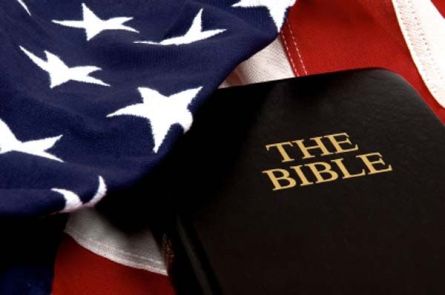
bible-american-flag (1)

The church itself is a politic. We do well to remember that we are a politic and that there are many ways for the church to be political. But the way to be the church is not synonymous with pursuing democratically elected representatives who can therefore represent our personal political opinions. As one of my former professors recently noted, “There’s only one instance of democratic voting in the gospels, and the people chose Barabbas.”

Gathering with others around the body and the blood of Christ is one way for Christians to be political, and it is the original way. For it is in gathering around a table such as this one, particularly with people who do not necessarily agree with us politically, we live and lean into the strange mystery that we call the kingdom of God. For us, this table is an ever-present reminder that we are not the authors of our salvation and neither is our government.

Here in America we greatly celebrate our freedom, and in particular our freedom of speech. But honestly, we are mostly only concerned with our freedom to say what we want. And the moment we hear someone speak from the other perspective we either cover our ears in anger, or we rush against them with vitriol.

For far too long we’ve limited our imagination of the church to being the mechanism by which we can develop strategies that can, to put it in political terms, Make America Great Again. But that is not the task nor is it the mission of the church. The task of the church is to be a community of character that can survive as a witness to the truth.

All of this is not meant to be a critique of the policies of the political right or the political left. Nor is in meant to be an endorsement of policies representing either side of the political spectrum. No, this is about our captivity to the presumption that our politics determine our lives more than the living God.

And that is why we worship, it is why we gather together to tell the stories of scripture and break bread and say the prayers. This is why we still do what they started doing back during the time of Acts. We gather together in witness to what the risen Christ is doing in and through our community. And in so doing we respond to the risen Christ by doing strange things like freely giving of our income to bless others who are in need, like giving of our time to work down at the Trinity Kitchen so provide food to those who are in need, like showing up in a different community every summer to help with modest home repairs for those who are in need, like breaking bread with people we disagree with to create meaningful relationships for those who are in need.

We’ve come a long way throughout the centuries as the strange community we call the church. You can tell how far we’ve come, or to put it another way how far we’ve moved, by how much we bristle when we read about selling our possessions and distributing the needs to all as any have need. That doesn’t match with what the world has told us life is all about.

Instead we’re captivated by a narrative that tells us to earn all we can and save all we can, that freedom is more important than faithfulness, and that the world is ruled by politics.

No. God rules the word. Faithfulness is more important than freedom. It is better to give all that we can rather than to gain all that we can.

And so we worship. We listen to the stories of scriptures, we enter the strange new world of the bible, and we learn to speak the truth. Worship id where we begin. In worship we develop an imagination capable of forming us into the people God is calling us to be, a people who can live into the difficult reality of Acts 2, who can be political, even more political than our government, by recognizing who we are and whose we are.

As Christians, we know that Jesus is Lord and therefore we do not need executive orders to grant us freedom to speak truth. We know that Jesus is Lord and therefore we believe in taking care of our brothers and sisters regardless of whether or not our government does. We know that Jesus is Lord and therefore we are not captivated by political policies geared toward keeping us “safe.” After all, we worship a crucified God and we seek to be in fellowship with the One who mounted the hard wood of the cross.

Being a Christian is not about freedom, denying responsibility, or being safe. Following Jesus is all about challenging the presumptions of the world with the truth of the lordship of Christ that often puts us in a place of danger. Because, as Christians, we believe in loving the Lord our God with all our heart, soul, mind, and strength and loving our neighbor as ourselves, which is not the same thing as being a Democrat or a Republican. We believe in serving the needs of those on the margins, which means helping those who cannot help themselves.

We believe the greatest freedom we’ve ever received did not come with the Declaration of Independence but through a poor Jewish rabbi who was murdered by the state.

And as Christians, we know that we can act politically: we can vote, we can march, we can lobby all we want. But we also believe that gathering together to do this thing we call church is the most political thing we could ever do. Amen.

Less Preaching, More Praying

Psalm 119.33-40

Teach me, O Lord, the way of your statutes, and I will observe it to the end. Give me understanding, that I may keep your law and observe it with my whole heart. Lead me in the path of your commandments, for I delight in it. Turn my heart to your decrees, and not to selfish gain. Turn my eyes from looking at vanities; give me life in your ways. Confirm to your servant your promise, which is for those who fear you. Turn away the disgrace that I dread, for your ordinances are good. See, I have longed for your precepts; in your righteousness give me life.


I’ve mentioned The Circle in a number of recent sermons, and for good reason. Every week, our youth gather together as a witness to the loving nature of God made manifest in their lives. While others their age are consumed by that which they consume: the Internet, social media, attention from co-eds, false identities, and even politics, our kids are consumed by another thing they consume: the body and the blood of Jesus Christ.

But I don’t want to lay it on too thick. I love our youth, but they can be miserable at the same time. I have never been more self-conscious about my balding head than when one of our boys insists on bringing the subject up every single week. (Honestly, I think he does it not because he cares about my lack of follicles, but because he enjoys watching my reaction to his provocation.)

Another one of our youth will miss a meeting (too much homework, play practice, or some other obligation) only to have her brother tell me that she’s not at The Circle because a recent sermon I preached made her lose her faith.

Another one of our youth will purposely pretend like he can’t find a particular book in the bible, forcing one of us to flip through and declare the page number only to have him smile diabolically in return.

Like I said, we’ve got wonderful and miserable youth at this church.

Anyway, as I’ve mentioned on a number of occasions, we follow the same formula every week – we gather around the table for communion, fellowship, and bible study. Communion looks a lot like it does in this room whereby we pray together for God to pour out the Holy Spirit on us, and on the gifts of bread and the cup. And after we feast we go to the box.

The box contains a random assortment of questions designed to get all of us to share and reflect on what it means to be faithful. An example: “Who do you trust the most and why?” The question propels us to think about the value of our friendships, and implores us to be thankful for the people we trust.

One of the more frustrating questions is: “When was the last time you shared your faith with someone?” Everyone always sighs deeply when that one is pulled, but one by one they’ll each struggle to share a moment from the last week or so when they talked with someone about their faith.

But recently we read a new question: “If you could change one thing about the church what would it be and why?” Without hesitation, my follicle-conscious friend said, “I’d get rid of the preacher!” Another youth however, took the question seriously and said she would make the youth group larger so we could share the stories of Jesus with more people.

One by one each youth got a chance to reflect about a particular change to the church, and we ended with our adult volunteer for the evening. You see, everyone has to answer the question from the box whether you’re in the sixth grade of you’re sixty.

After giving the question some deep thought she said, “I’d get rid of the preaching… I’ve always thought that preaching in worship was okay, but it’s not the most important part of what we do. Sometimes you go on a little too long. But I would definitely increase our prayer time. In fact, what if all we did was pray?”

I got burned.

The preaching on Sunday is a little long? Seriously? You all should be grateful! I get you out of here before the Baptist churches in town every week, and we want to talk about the length of the sermon?!

I’m only teasing. But maybe she’s on to something. What if we prayed more, and I preached less?

less-is-more-blog-image

The psalmist, at least the author of Psalm 119, was a praying poet pleading with God. No preaching, no pontificating; only praying.

Teach me Lord, give me understanding, lead me in the path of your commandments, turn my heart to your decrees, turn my eyes from looking at vanities, give me life.

Where does this life of prayer come from? Praying like the psalmist requires an awareness of God’s presence. We can pray like the psalmist when we poetically plead with God, not to show that we are above anyone else, not out of arrogance, but with remarkable humility and hope – we ask God to give us what only God can give us.

And we can dispense with polite trivialities. No more do we need to start our prayers with a listing of God’s divine attributes, no more do we need a long list of adjectives before we begin to converse with the Lord. We need only pause, breathe, and then declare our faith in the Lord who hears and responds to our prayers.

Teach us, O Lord, your ways and we will follow on the path to the end. Give us understanding God, so that we can observe your will here on earth with our whole hearts. Lead us on your paths and we will delight in traveling the way that leads to life. Turn our hearts to your commandments, and not to our own selfish and arrogant ambitions. Turn our eyes from looking at vanities, the things that fade away, the things that do not give life, and instead give us life in you. Confirm to us your promises God because we are worthy when we fear you. Turn away the disgrace that we are ashamed of, for you are forgiving. O God, we have longed for your will; nothing more, nothing less, nothing else. In your righteousness, give us life.

When those words become our words, when we can utter them with true faith and humility, when we can ask for God’s will to be done and mean it, then our prayers will always mean more than my preaching. As Karl Barth said, when we clasp our hands together in prayer, it is the beginning of an uprising against the disorder of the world.

Because this is what we need God to do for us. We need God’s help to empower our uprising against the disorder of the world. We need God to teach us, to lead us, and to turn us. We cannot do this stuff on our own.

God, thank you for gathering us together in this place, at this time, with these people to call on you to make us into your people. Come to us now! Awaken us! Give us your light! Be our Teacher and our Comforter! Speak to us through the scriptures, through the prayers, through the hymns, through the sermon, so that we may hear just what we need and what will help. Preserve us by your Word; protect us from hypocrisy, error, boredom, and distraction. Give us knowledge and hope and joy.

We can pray like that. We can pray like the psalmist. We can do it from the comfort of our bedrooms when we wake up and right before we fall asleep. We can pray from the depths of our souls in this holy place whenever we gather together. Our prayers can be as long and as profound as the entirety of Psalm 119, or they can be as short and as simple as: Lord have mercy on me, a sinner.

Praying to God is a good and right thing because it actively makes us participate with the divine. Praying calls us to question the status quo, and to wonder about what could be. Praying challenges us to see ourselves for who we really are and to ask for God’s help to be better. Prayer changes things, and more often than not the thing that prayer changes is us.

prayer-changes-me

But sometimes we need to be prayed for, more than we need to pray for ourselves. Do you hear the difference? It is good and right for us to pray to the Lord like the psalmist, but at the heart of being a disciple of Jesus Christ is a willingness to share our burdens and needs with others, and to receive their prayers for us when we cannot pray on our own.

Years ago, I helped lead a mission trip to Costa Rica. We went for a week, and I was responsible for keeping track of the youth at our different work sites, and led devotions each night. A large focus of the trip was partnering with the local community in order to empower them, rather than helping with something only to disappear a few days later.

Every day, whether we were working on construction for a new school building, or we were helping young children in a day care program, the whole trip was about creating relationships with people.

Of course, for some of us, myself included, this was quite a difficult task since there was a language barrier. We quickly learned to speak with our hands and with the few words we knew of each other’s languages, and we did the best we could.

At the end of the trip I asked the youth to each pair up with someone they connected with during the week, but not someone from our own team. The kids quickly dispersed to find the friends they made over the week and I watched my sister Haley walk over to Jose. Haley and Jose were the same age; both had wonderful and loving personalities; but they couldn’t have been more different.

One grew up with all the advantages and privileges of an American who grew up outside of Washington D.C. The other lived day to day without a clear understanding of what the future held.

And yet, even though they spoke different languages, and had different hopes, and different dreams, they sat down together and prayed for each other. Haley went first, she prayed for Jose and lifted him up to the Lord. I only later realized it was the first time that Haley had ever prayed for another person out loud. And after Haley said “amen” Jose grabbed her by the hands and prayed for her.

Haley could not understand a word he uttered, but she wept as Jose prayed for her.

I know this is going to drive some of you crazy, but I am here not just to comfort the afflicted, but also to afflict the comfortable. So, in just a moment, we are going to pray for one another. You will feel tempted to find one of your friends in the congregation, someone you are comfortable with, but we all need to resist that temptation. We are going to stand up, and move about the sanctuary until we find someone we are not as familiar with, and they will be our prayer partners. And we’re going to talk to them. We’re going to listen to them. We’re going to pray for them. And they are going to do the same for us.

Remember, God does not need ornate and complicated prayers; God only needs our hearts. Pray for one another as you feel led, and then I will lead us in a congregational prayer. So, let us pray.

We are afraid, God, and we believe we can and should hide ourselves from you. We did it in the Garden, we did it in the wilderness, and we still do it today. We even think we can hide from ourselves. For better or worse, usually for worse, our desire to hide scatters and shatters our identity in you. As a result, we begin to hate ourselves, our families, our neighbors, and even You. We hate ourselves, and one another, because You refuse to believe that we are the masks we wear. God, help us learn to trust your love. Help us to learn we do not need to pretend to be something we are not. Help us accept that we are who we are because of You. Forgive us God. And as forgiven people, help us follow your Son in this world shaped by lies and deception. As your forgiven people, make us your salvation, that the world might see how good and great it is to be who we are, your children. Amen.

Devotional -Leviticus 19.1-2

Devotional:

Leviticus 19.1-2

The Lord spoke to Moses, saying: Speak to all the congregation of the people of Israel and say to them: You shall be holy, for I the Lord your God am holy.

Weekly Devotional Image

Before I became the pastor of St. John’s, I had a meeting with other clergy from the Virginia Conference who were all about to start at their first appointments. We represented a number of different seminaries and all of us were nervous in some way, shape, or form about what we were about to embark upon. A few of us were about to serve as deacons connecting the church to the world through youth ministry positions and hospital chaplaincy, a few of us were going to large churches as associate pastors, and a few of us were being sent to serve a church all by ourselves.

After a few ice-breakers designed to build bridges between us, we were all asked to answer the question: “What are you most worried about?” I remember someone jumping right in to say, “I am terrified of having to do funerals.” Another person said, “I have no idea what it takes to create and implement a church budget.” Another person said, “I’m nervous about being single and whether or not people will respect me for who I am.” And my friend Drew ended with, “I just want to be holy.”

217387_578604105493543_912821730_n

We all listened and offered advice to one another, but Drew’s comment has always stuck with me. While the rest of us were nervous and anxious about specific and practical matters, Drew was thinking about his holiness. How in the world can pastors lead people to holiness when they feel unholy? What does it even mean to be holy in the first place?

Some might say that to be holy means going to church every Sunday. Others might say that holiness comes with reading the bible every morning. And still yet others might say that you can only be holy if you pray to God every night before you fall asleep.

Holiness, however, is about living a life of total devotion to God. That might manifest itself in showing up to church, and reading the bible, and talking to God, but it also entails a fundamental commitment to the Lord in everything we do.

It means that when we encounter the stranger we see them as a brother and sister in Christ. It means that when we spend our money we reflect on whether or not it is bringing harm to someone else. It means that we strive to take nothing for granted because tomorrow is never promised.

Being a Christian is not a hobby, or something to be turned on and off whenever we choose. Being a Christian is about living a life of holiness and being totally devoted to God.

So then we must ask ourselves: What am I currently doing that is unholy? What relationships are preventing me from being totally devoted to God? What idols am I being consumed by instead of committing myself to the Lord? How can I be holy?

The Mission Of The Church

1 Corinthians 3.1-9

And so, brothers and sisters, I could not speak to you as spiritual people, but rather as people of the flesh, as infants in Christ. I fed you with milk, not solid food, for you were not ready for solid food. Even now, you are still not ready, for you are still of the flesh. For as long as there is jealousy and quarreling among you, are you not of the flesh, and behaving according to human inclinations? For when one says, “I belong to Paul,” and another, “I belong to Apollos,” are you not merely human? What then is Apollos? What is Paul? Servants through whom you came to believe, as the Lord assigned to each. I planted, Apollos watered, but God gave the growth. So neither the one who plants nor the one who waters is anything, but only God who gives the growth. The one who plants and the one who waters have a common purpose, and each will receive wages according to the labor of each. For we are God’s servants, working together; you are God’s field, God’s building.


When I lived in Harrisonburg, I played drums for a worship service that met every Sunday evening. On Sunday mornings the sanctuary would be packed with individuals and families from the community who would listen to the organ, sing from the hymnal, pray from the pews, and worship together. On Sunday evenings however, we would set up for a very different type of worship service: we had two electric guitars, a bass, a drum set, and a couple singers. Instead of suits and dresses most people came as they were, and instead of the sanctuary being packed, we were lucky if there were more people in the pews than in the band.

The basic worship formula included playing four or so songs, reading scripture, hearing a sermon, celebrating communion, and then playing one more song. Which meant that I spent most of the evenings sitting behind a drum kit looking out at everyone else. From this vantage point I quickly learned who always came late, who refused to sing certain songs, who let themselves go and put their hands in the air to praise, and who pretended to pray while they were actually texting someone on their phone.

I had been playing with the band for a while when I started to notice a young man, probably about my age, who walked in during the first song, and left during the last song every week. We had other people show up for one Sunday a month, or would be there for a couple weeks in a row only to disappear for a months at a time, but this guy was there EVERY WEEK.

Week after week I watched him arrive only to depart before I had a chance to talk to him. But, even though we didn’t talk, his faithfulness was palpable. As a college student, he came to worship week after week while others were choosing to put their allegiances in other places.

When the academic year was coming to a close, the leadership team for the service met to discuss changes for the future. It was abundantly clear that we were not growing and we wanted to make more disciples of Jesus Christ so we started discussing ways we could get more people to join us.

I suggested that we speak to the young man who snuck in and snuck out; after all, he showed up more than anyone else, and I thought he would have some ideas for us.

So the next Sunday, we purposefully ended with a song that did not use the drums so that I could talk to him before he jettisoned out of the sanctuary. We met by the doorway and I introduced myself. I explained that I saw him come in every week, and apologized for not doing more to make a connection. I then launched into a dense theological reflection about why we need more people to come to the service and that all of us thought he would be a great person to speak with. He listened as I went on and on until he raised his hand and said, “That sounds nice and all, but I’m not a Christian.”

            “Not a Christian? What do you mean you’re not a Christian? Why have you been here every week if you’re not a Christian?”

            “I don’t feel like I belong anywhere else, and I don’t have any friends.”

eternal-mission-church_620

We, as human beings, want to belong. We want to belong in the worst ways whether we’re in preschool, high school, or it’s been a long time since we’ve been in school. Out of this desire for belonging we join communities: neighborhood associations, sport teams, civic organizations, and even scout troops.

But they tend to disappoint us. We hope for a sense of identity and purpose and community to magically erupt soon after we begin participating, but because people are so focused on themselves, or someone forgets our name, or someone else argues with us over a matter of opinion, we become disappointed and disillusioned. And before long, we fall back into that pit of loneliness.

The same human desire for belonging was apparently true of the folk in Corinth. The church that Paul helped to inaugurate was struggling. The people wanted desperately to belong, to be part of something. And they joined the church, but then (like we always do) they broke up into factions: I belong to Paul, I belong to Apollos, or some other leader.

One need not stretch the imagination to hear the same sorts of declarations in the church today: I’m a Republican, I’m a Democrat. Zig Volskis was the best pastor we ever had. Steve Greer was the best pastor we ever had.

Paul caught word of these divisions and wrote to the church: Who do you belong to? Why are you dividing over issues of leadership? I came to you with the message of Jesus Christ and him crucified, but clearly it did not take root deep enough. So long as you continue to quarrel you will not be ready to be Christ’s church.

Who do we belong to?

We have a book in the United Methodist Church called The Book of Discipline. In it, its paragraph 120 if you’re interested, we have the mission of the church written out plainly for all to read and understand.

mission_umc_logo

The mission of the United Methodist Church is to make disciples of Jesus Christ for the transformation of the world.

Making disciples is at the heart of what it means to be a United Methodist. I mean, its what Jesus calls the disciples to do at the end of Matthew’s gospel: Go therefore and make disciples of all nations baptizing them in the name of the Father, Son, and Holy Spirit.

But making disciples is often confused with filling the pews.

It results in having conversations about how to get more people in the building while neglecting to interact and connect with the people already in the building. It results in infantile discipleship. It results in working for the numbers, and not the kingdom.

And then we’ve got this bit about transforming the world. Is that really our mission? Do we have the church to change the people and the community around us? Should that be our soul purpose? Does the church exist to make the world a better place?

The church is defined by the sacraments of communion and baptism in order to be a community of difference and peace. The church, therefore, is called not to make the world a better place, but to be the better place God has already made in the world.

Of course, the problem is whether or not our experience of the church matches its definition of being the better place.

I suspect that many of you have experienced the church as Paul experienced it: Disagreements, petty arguments, and at times suffocating silence between bickering factions. For some, the pews of the sanctuary are more like walls of division and less like avenues of connection.

If church is the better place that God has already made in the world, then it should, like it was for that young man in Harrisonburg, be the place to cure loneliness. Because loneliness is something all of us have experienced in some way, shape, or form, and is a wound not easily healed.

I spend an hour every week with the youth of our church at our gathering called The Circle. We always have communion and answer questions and study the bible. But we often just talk about what’s going on in each other’s lives. And, without breaking their trust, I’ll tell you: their lives are not easy. There is such a tremendous amount of pressure placed on them by outside forces. They feel compelled and pushed to change their image, the way they talk, the way they think, and even what they believe in order to be accepted.

Some weeks I leave our Circle meeting feeling broken by what they have to endure on a regular basis, only to have a conversation the next day with an adult who is going through basically the same things in a different context.

The world would have us change. Change your image, hide your faults, be someone else.

As Christians, however, we walk with our wounds and our cracks and our brokenness instead of running away from them. We cannot accept who we are until we discover that we are loved by God because of who we are.

The church can be the better place that God has made in the world because the church is the place where we walk with our wounds and loneliness because of Christ and him crucified. The broken and lonely Christ on the cross knows our brokenness and our loneliness. But he also carries our wounds so that we might see the One who truly loves us.

God is transforming the world. God is the one who makes the first last and the last first. God does, and should, get all the good verbs. Our God is a God of action, of change, of transformation. We are the church, we are the vineyard of God’s garden, we plant the seeds, we water the seeds, but God is the one who makes them grow.

You and I, with our sins and our disappointments, with our fears and loneliness, we have a place here. God invites us to the better place where we are welcomed not because we fit the mold, but because we do not fit the mold. We have a place in this better place because we are caught up in God’s great story.

Just look at the cross, consider the waters of baptism. God is made manifest in the world not through the powerful, not through the expectations of the mighty, but through the weak and through the shamed; through babies and wandering Israelites; through tax collectors and fishermen; through a poor rabbi murdered by the state.

This is the better place God has made in the world. And in this place we remember our baptisms, we remember our death to self and our resurrection in Jesus Christ. We remember our baptism and through that water we remember the story of creation, of the flood, of the exodus. We remember that in our baptism we became part of the body of Christ, the church, where we should never be lonely. Where we should never be made to feel as if we are not enough.

In baptism we joined the better place God has made in this world.

Who then do we belong to?

Do we belong to political rhetoric and partisan ideology? Do we belong to church growth programs co-opted by a desire to see more people in the pews? Do we belong to isolationism or interventionism? Do we belong to a world that pressures us to become that which we are not? Do we belong to Paul or to Apollos? Do we belong to the flesh and are consumed by jealousy and quarreling?

No.

            In this better place, we belong to God. Amen.


(With thanks to Jason Micheli, Stanley Hauerwas, and Will Willimon)