Devotional – Genesis 32.28

Devotional:

Genesis 32.28

Then the man said, “You shall no longer be called Jacob, but Israel, for you have striven with God and with humans, and have prevailed.”

Weekly Devotional Image

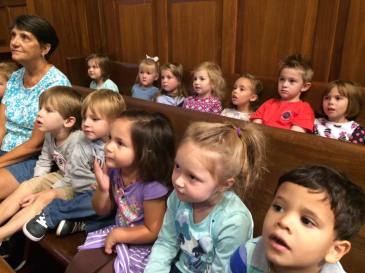
I gather in the choir loft of the sanctuary with the entirety of St. John’s Preschool every Wednesday morning at about 9:30am. By that time the children have all had an opportunity to get out most of their “wiggles” before sitting down in the stiff church pews and learning a story about God from the Bible. I generally try to start the academic year off with stories from Genesis and make my way through up to the stories of Jesus leading toward Easter Sunday.

When we learn about God making light from Creation, we turn the sanctuary lights off and on and talk about what a great gift it is to have light. When we talk about Adam and Eve hiding from God after eating from the tree of knowledge of Good and Evil, we play hide and seek in the sanctuary and talk about how God never stops looking for us even when we’re lost. And this year, when I was foolish enough to teach them about the story of Sodom and Gomorrah, we played red light green lights in attempts to reflect on how God offers us the wisdom of when to go and when to stop.

14440780_1104466649629648_5384631729784297628_n

Last week we met in the sanctuary to talk about one of my favorite stories from Genesis: Jacob wrestling by the banks of the Jabbok river. Jacob has run away from his family after stealing and tricking his brother Esau out of his birthright and blessing and is about to reencounter his brother. But before he can meet his fate in Esau, a strange man arrives in the middle of the night and wrestles Jacob until he, in a sense, learns his lesson. And from this struggle he receives a new name: Israel.

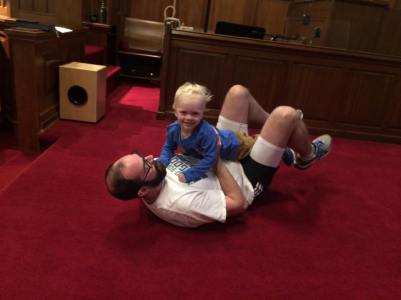
In order to bring the story to life, I had the preschoolers line up one by one and each of them were tasked with knocking me over in a wresting match. They all came forward and gave it their best shot (some were oddly more prepared for this than others) and I would pick them up and spin them around in circles. When one of our last two year olds came forward, I let him knock me to the ground, but instead of pounding on me like some of the older kids, he wrapped his arms around my neck and hugged me.

14502882_1104466592962987_8175825250906782039_n

I was then able to stand up with the boy in my arms and tell the kids the most important part of the lesson: God loves us so much that even when we’re angry, God will never let us go.

To be a Christian today almost implies a degree of struggling with God. We want to know why a hurricane, like Matthew, can wage destruction in places like Haiti, the Bahamas, and the East Coast of the US. We want to know why our presidential political system is filled with such vitriolic and hateful language. We want to know why bad things happen to good people and why good things happen to bad people. Yet, even amidst all the struggle and questions, what a blessing it is to know that God’s love is so strong that God will never let us go.

On War

Matthew 5.43-48

“You have heard that it was said, ‘You shall love your neighbor and hate your enemy.’ But I say to you, Love your enemies and pray for those who persecute you, so that you may be children of your Father in heaven; for he makes his sun rise on the evil and the good, and sends rain on the righteous and the unrighteous. For if you love those who love you, what reward do you have? Do not even the tax collectors do the same? And if you greet only your brothers and sisters, what more are you doing than others? Do not even the Gentiles do the same? Be perfect, therefore, as your heavenly Father is perfect.”

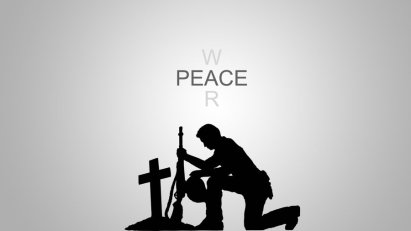
peace_war__wallpaper__by_jackth31-d55t58i

Preachers can fall into the rut of preaching on whatever keeps the congregation pleased; keep them happy and they’ll keep coming back, or something like that. This sermon series is different. Instead of falling back to the familiar narratives that keep us smiling on our way out of the sanctuary, we are confronting some of the greatest controversies facing the church. There is a better than good chance that I will say something from this pulpit during the series that you won’t agree with, and if (and when) that happens I encourage you to stay after worship, join us for lunch, and continue the conversation. We can only grow as Christians in community, and that requires some honesty and humility and dialogue. Today we continue with the topic of War.


The airfield was remarkably dark in the middle of the night so the commanding officer turned on floodlights for posterity. There were so many people wandering around on the field that the captain had to lean out the window of the aircraft to direct the bystanders out of the way of the propellers before take off. Though he did have time to offer a friendly wave to photographers before departing.

The flight lasted six hours and they flew through nearly perfect conditions. At 8:15 in the morning they finally arrived directly above their target of Hiroshima and the bomb was released. It fell for 43 seconds before it reached the perfect height for maximum destruction and was detonated. 70,000 people were killed and another 70,000 were injured.

At about the same time the bomb was detonated, President Truman was on the battle cruiser Augusta. When the first report came in about the success of the mission, Truman turned to a group of sailors and said, “This is the greatest thing in history.”

We, as American Christians, have a problem with War. Historically, the early church and Christians did not engage in war – they believed their convictions in following Christ’s commands prevented them from waging violence against others. And, frankly, they were being persecuted and killed at such a rate that they didn’t have time to think about fighting in wars, nor were militaries interested in having Christians fight for them. You know, because of the whole “praying for their enemies” thing,

But then Constantine came onto the scene, following Jesus Christ turned into Christendom, and everything changed. With Christianity as the state sanctioned religion, Rome could tell its citizens to fight, and they did.

But still, there have always been those who respond to War throughout the church differently. There are Pacifists who believe conflict is unwarranted and therefore should be avoided. There are those who believe in the Just War Theory and that there can be a moral response to war with justifiable force. And still yet there are others who believe in the “Blank Check” model where they are happy to support those in charge of the military without really questioning who they are killing and why.

We might not realize it, but most Americans believe in the “blank check” model, in that our government regularly deploys troops and drones to attack and kill people all over the world (in war zones and other places) and we rarely bat an eye. So long as we feel safe, we are happy to support those leading without question.

christianity-military-750x400

But as Christians, Jesus commands us to love our enemies and pray for the people who persecute us. Now, to be clear, this is not a nice invitation or even a call to a particular type of ministry. We like imagining the “white, blonde hair, blue eyed” Jesus with open arms who loves us and expects the minimum in return. But more often than not, Jesus commands his disciples to a radical life at odds with the status quo.

“I say to you, ‘Love your enemies and pray for those who persecute you.’ Anybody can respond to love with love, but what good does it do to only love the people who love you. Instead, be perfect as your heavenly Father in perfect.”

            This is our command.

            And it is also our dilemma.

Jesus commands us to love our enemies and love our neighbors. But what are we to do when our enemies are killing our neighbors, or vice versa? Is there really such a thing as a just war? Are we called to remain pacifists even when innocent lives are being taken? Was it okay for us to take boys from Virginia and send them to Vietnam to kill and be killed? Should we send our military to Syria to kill and be killed?

This is the controversy of War.

War, a state of armed conflict between two groups, is like an addictive drug. It gives people something worth dying and killing for. It often increases the economic wealth and prosperity in our country. It achieves for our nation all that a political ideal could ever hope for: Citizens no longer remain indifferent to their national identity, but every part of the land brims with unified life and activity. There is nothing wrong with America that a war cannot cure.

When the North and South were still economically and relationally divided after the Civil War, it was World War I that brought us back together as one country. When we were deep in the ravages of the Great Depression, it was Word War II that delivered us into the greatest economic prosperity we’ve ever experienced. When we were despondent after our failure in Vietnam (and subsequent shameful treatment of Veterans), the supposed weapons of mass destruction in Iraq gave us every reason to rally behind our country.

But we don’t like talking about death and war – that’s why the least attended worship services during the year are Ash Wednesday and Good Friday when we can do nothing but confront our finitude. But War commands and demands our allegiance, it is the fuel that turns the world, it has been with humanity since the very beginning.

And Jesus has the gall to tell us to love and pray for our enemies.

To follow Jesus, to be disciples of the living God, requires a life of pacifism. It is not just one of the ways to respond to War, it is the way. And yet, pacifism is a privilege of the powerful. It is very easy for me to stand up in this pulpit, in the beauty of the Shenandoah Valley, and preach about the virtues of pacifism. No one is dropping bombs on our picturesque community. We are not at risk for an invasion from a foreign oppressor.

It is easy to be a pacifist in America.

And we will never get anywhere near a kingdom of peace if pacifists keep perceiving themselves as superior or entitled, otherwise people in the military who return from conflict will return as those from Vietnam – to a country that did not understand.

War is complicated and ugly and addictive. It reveals our sinfulness in a way that few controversies can. War illuminates our lust for bloodshed and retribution. War offers a view into our unadulterated obsession with the hoarding of natural resources. War conveys our frightening disregard for the sanctity of human life. War is our sinfulness manifest in machine guns and atomic weapons. War is the depth of our depravity.

Even the word “War” fails to express the sinfulness of the act. We so quickly connect the word “War” with the righteous outcomes of our wars. We believe we fought the Civil War to free the slaves, when in fact it had far more to do with economic disparity. We believe we fought Word War II to save the Jews, when in fact it had more to do with seeking vengeance against the Germans and the Japanese. We believe we went to War in the Middle East with terrorism because of September 11th, but it had a lot to do with long-standing problems and an unrelenting desire for oil.

Can you imagine how differently we would remember the wars of the past if we stopped calling them wars and called them something else? Like World Massacre II, or the Vietnam Annihilation, or Operation Desert Carnage?

soldier-peace-logo

On August 6th, 1945, we dropped the first atomic bomb on the city of Hiroshima in order to end the bloodiest war the world had ever seen. With the push of a button we exterminated 70,000 people in an instant, and our president called it the greatest thing in history. Truman was a lifelong Baptist and was supported by the overwhelming majority of American Christians, most of whom expressed little misgiving about the use of the atomic bomb. But that very bomb is the sign of our moral incapacitation and the destruction of our faithful imagination.

For we Christians know, deep in the marrow of our souls, that the “greatest thing in the history of the world” is not the bomb that indiscriminately murdered 70,000 people, but the life, death, and resurrection of Jesus Christ.

Jesus Christ is, and forever will be, the greatest thing in the history of the world because Jesus broke the chains of death and sin and commands us to follow him. Jesus Christ, Son of Man and Son of God, embodied a life of non-violent pacifism that shakes us to the core of our being and convicts our sensibilities.

There is, of course, the privilege of pacifism and its ineffectiveness when combatted by the evil in the world. Pacifism pales in comparison to the immediacy of armed military conflict, but it is the closest example we have to what it means to live like Jesus. And Jesus wasn’t particularly interested in offering us the path of least resistance toward salvation. Instead, he demanded our allegiance.

So where does that leave us? What are we to do about the controversy of War?

Right now, countless innocent lives are being killed in Syria as a result and consequence of War. For years, Syrians have struggled to escape their war-torn homes and find a new beginning somewhere else, but many of them are still there. The United States has largely remained uninvolved in the conflict due to diplomatic and militaristic complications. So I thought it would be the perfect example to bring up this week in one of our bible studies regarding the moral responsibility of our country. Should we send troops into Syria in order to prevent the loss of innocent lives? Should we remain isolated from the conflict?

I turned the question on the group and asked, “What are we to do as Christians?”

“We could take in more refugees.”

“We can advocate for better responses out of our politicians.”

“We can pray about it.”

Then I said, “Well, what if the United Methodist Church announced that it was sending 5,000 missionaries to Syria? We know how to send missionaries, we do it all the time.”

And someone responded by saying, “We can’t do that; they’d be easy targets.”

I’ll admit that we can’t do that, but not because they would be easy targets. We can’t go there and do that because we no longer have a church that produces people who can do something that bold. But we once did.

God in Christ came in order to reconcile the world through the cross. The living God through the Messiah spoke difficult commands and orders to the disciples, things we still struggle with today. But God was bold enough to send his son to die in order to save us, not by storming the Temple with swords and shields, not by overthrowing the Roman Empire and instituting democracy, but with a slow and non-violent march to the top of a hill with a cross on his back. Amen.

Controversy Original

From the Archive: The Power of Words

talt-ad

One of the remarkable things about posting sermons online every week, is the fact that I can look at the statistics of which sermons receive the most attention. For instance: Over the last year my sermon titled, “What Does The Bible Say About Divorce?” is easily in the top three as well as a recent reflection on the Pledge of Allegiance.

But ever since I started posting sermons, there is one that has dominated in popularity. In August of 2013, in my second month as a pastor, I preach a sermon on Jeremiah 1.4-10 and I titled it, “The Power of Words.” Over the last three years thousands of people have come to the blog for this one particular sermon and yet there were only 80 people in church the day that I preached it.

Here is what I said…


Jeremiah 1.4-10

“Now the word of the Lord came to me saying, “Before I formed you in the womb I knew you, and before you were born I consecrated you; I appointed you a prophet to the nations.” Then I said, “Ah, Lord God! Truly I do not know how to speak, for I am only a boy.” But the Lord said to me, “Do not say, ‘I am only a boy’; for you shall go to all to whom I send you, and you shall speak whatever I command you. Do not be afraid of them, for I am with you to deliver you, says the Lord.” Then the Lord put out his hand and touched my mouth; and the Lord said to me, “Now I have put my words in your mouth. See, today I appoint you over nations and over kingdoms, to pluck up and to pull down, to destroy and to overthrow, to build and to plant.”

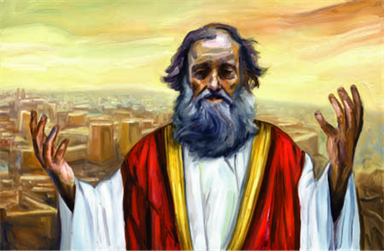
prophet-jeremiah

The Power of Words

Words are powerful. The perfectly timed phrase or expression can carry more meaning and accomplish more than just about anything else. From the pulpit they carry even greater value because they are so connected with the Word of the Lord. At their best words can be used in a fruitful way, demonstrating the kind of building-up that the bible often refers to, in order than we can affirm one another in love. At their worst, words can be used in a destructive way, hurting those around us, and ignoring the truth of God’s role in the world.

On January 30th, 1933, Adolf Hitler became the democratically elected chancellor of Germany. This was the beginning of the Third Reich. Germany, the land that had produced the likes of Bach, Goethe, Durer was now being led by a man who consorted with criminals and was often seen carrying around a dog whip in public. Hitler was known for using his words in public propaganda for destructive purposes. Some of you here this morning can remember how the world shuddered when this began to take place.

Two days after Hitler was elected, a twenty-six year old theologian name Dietrich Bonhoeffer gave a radio address throughout the German nation. The speech was titled “The Younger Generation’s Altered Concept of Leadership.” Though the talk was itself highly philosophical, it constructively argued against the type of leadership that Hitler would use for the next twelve years, inevitably leading a nation and half the world into a nightmare of violence and misery.

Dietrich Bonhoeffer

Dietrich Bonhoeffer

Bonhoeffer spent a significant portion of his speech discussing the differences between a true leader, and the Fuhrer. He used his words in a calm and collected way, appreciating the power they held: A true leader must know the limitations of his/her authority. The good leader serves others and leads others to maturity. He puts them above himself, as a good parent does with a child, wishing to lead that child to someday be a worthy parent. Another word for this type of leadership is discipleship. “Only when we see that leadership is a penultimate authority in the face of an ultimate, indescribable authority, in the face of the authority of God, has the real situation been reached. The individual is responsible before God.”

Before Bonhoeffer could finish, the speech was cut off. Only two days after Hitler’s election, the Nazis were suppressing this young man who spoke out against the type of leadership that would come to define Germany over the coming decade.

What we find in the first chapter of Jeremiah is an encounter between the human and the divine. We discover how powerful words can be through God’s call. As the divine Word, God is a genuine and invisible otherness when compared to Jeremiah. During this particular encounter the word of the Lordcame to Jeremiah and the prophet meets in faith the God who meets him through the Word.

“Jeremiah! Before I formed you in your mother’s womb, I knew you, and before you were born Iconsecrated you; I appointed you a prophet to the nations.” Then Jeremiah said, “Ah, Lord God! You cannot expect me to speak! I am only a boy.” But the Lord responded, “Do not say ‘I am only a boy’; for you shall go to all whom I send you, and you shall speak whatever I command you. Do not be afraid of them, for I am with you to deliver you.”

In his Word, God does not deliver a course of lectures on dogmatic theology, He does not submit the content of a creed of a confession of faith, and he does not even produce a perfectly prepared three-point sermon. Instead He makes himself accessible to us. An exchange takes place here in scripture that is beyond any analogy in the sphere of rational thinking. Instead, we have here a simple encounter, just like one between any two people, where God makes Himself available and known through relationship.

Jeremiah’s experience guides him into boundary, toward his own finitude, being reminded of his humanity, as over and against God. Jeremiah’s encounter is a reminder for us that we are not God. God is wholly other when compared with his creation. When Jeremiah meets God, his personality sinks away into the background; he feels his words being replaced by the Word of God. When we truly encounter the depth and beauty of the triune God, everything about us begins to sink away as well.

It is no wonder therefore why Jeremiah evades the commission of God. “Surely you can’t use me God, for I am only a boy.” Jeremiah protests because he is overwhelmed and intimidated by the call to set aside priests, princes, and people to become a prophet to the nations. He was afraid to proclaim the Word of God, which would go beyond the comprehension of his time.

This isn’t in scripture, but I can imagine God’s full response to Jeremiah’s evasion: “have you not seen and have you not heard what I have done with mere people? Have you forgotten the stories of Abraham, Isaac, and Jacob? What about Moses and Joshua? David was but a boy when I had him defeat the Philistines. Solomon became the wisest king to rule the nation All of the prophets, the judges, the priests? This isn’t about you Jeremiah, this is about what I am going to do through you.”

Recoiling from a divine appointment is common throughout scripture. It only takes a moment to remember Moses standing in the heat of the burning bush and then turning his face away because he was afraid to look at God.

The theologian Paul Tillich once said: “we always desire to escape God… People of all kinds, prophets and reformers, saints and atheists, believers and unbelievers, have the same experience.” It is safe to say that a person who has never tried to flee God has never experienced the truth of who God is.

God dismisses Jeremiah’s excuse; Young or old, learned or uninformed, handsome or ugly, none of things matter to God because they all pertain to our own self-centeredness: my powers, my status, mydesire to have reality on my terms. Because of the power in God’s Word Jeremiah does not react in silence, nor does he step aside to let someone else take his place, instead he steps into the situation, which has in a way stepped into him. He responds to the encounter of God, feels the Word of the Lord placed on his lips, and is prepared to do God’s work.

From this point forward Jeremiah will not go forth on his own terms; God will send him, and he will move according to God’s will. It is because of God working in and through Jeremiah that he will be able to speak and act in the specific situations as they arise. The encounter has changed Jeremiah so that he will be able to narrate God’s plucking up and planting again. Jeremiah will speak the truth of the Word of God regardless of whether or not they are agreeable to his youth, ambitions, moods, or self-examination.

It is only when it is made plainly clear to Jeremiah that the point at issue has nothing to do with his own abilities or the extent of his talents that the truth of God’s reign is made abundant and it becomes possible for Jeremiah to become a messenger.

Like Jeremiah, the young German theologian Dietrich Bonhoeffer felt the call of God to proclaim the Word. Things became very difficult for Bonhoeffer after he made that first radio address. As the German nation descended into Fuhrer worship with the German church emphasizing politics more than theology, he struggled with how to be authentic to the Word of God as a pastor and a theologian. He trained young pastors through an underground seminary at Finkenwalde and preached about remaining faithful and obedient to God before anything else. As it became harder and harder for him to proclaim the good news in Germany, Bonhoeffer learned that war imminent and was frightened about being conscripted into the army.

dBonhoeffer

Bonhoeffer was a committed pacifist and was adamantly opposed to the Nazi regime, therefore he would never swear an oath to Hitler nor fight in his army. However, to refuse this would be a capital offense. It was at this time that Bonhoeffer accepted a position at Union Theological Seminary in New York. While in the United States Bonhoeffer had somewhat of a Jeremiah experience, because even though he had the freedom to run away from his calling in Germany, Bonhoeffer realized that his responsibility was to God with the German people. Just as God would pluck up and replant the Israelites in Jeremiah’s time, Bonhoeffer knew that the German nation would have to be destroyed in order for it to be fruitful once again. And so Bonhoeffer returned to Germany on the last scheduled steamer to cross the Atlantic before the war.

Upon arriving back in Germany, Bonhoeffer’s desire to speak powerful words against the Third Reich resulted in him being forbidden to speak publically starting in 1940 and he had to regularly report his activities to the police. Within a year he was forbidden to print or publish. And on April 5th, 1943, ten years after making his radio address, Bonhoeffer was arrested by the Gestapo for his continual Anti-Nazi remarks and involvement with the Abwehr’s plot to undermine Hitler’s regime.

He remained in prison for two years, able to write letters and theology that were smuggled out by sympathetic guards.

0800697030h


Though he remained hopeful for the end of the war and his eventual release, he was condemned to death in April of 1945. He was killed by hanging just two weeks before the United States liberated the camp where he was being held. Before his execution, Bonhoeffer was led away as he was concluding his final Sunday service and said to one of his fellow prisoners: “This is the end – for me the beginning of life.”[1]

I fear that whenever we hear stories of people like Jeremiah or Bonhoeffer we regard them as a special kind of people, set apart for the work God ordained for them. And to be quite honest, it is very unlikely that anyone of us in this room will ever be imprisoned, or suffer, for our Christian identity. But we are all called to be Jeremiahs and Bonhoeffers in our commitment to following Jesus Christ. Just like those two prophets God has formed us, consecrated us, and placed the Word on our lips.

There is a power in words that we regularly underestimate. The way that we often talk about other behind their backs carries with it a great destructive energy. When we ignore the truth of our interconnected as the body of Christ in this place by speaking poorly of one another does a disservice to the God who formed you from the womb. Our words are powerful, use them wisely.

So too, there is a power in the words that we use to affirm and address one another in love; By caring for and reaching out to those around us we continue to live out the kind of fruitful lives that God has always envisioned for us. This church is called to be a place where we understand the power of our Words and use them appropriately.

Do not be afraid of this power that God has given to you. Jeremiah and Bonhoeffer did not go in their own strength and neither do you. They did not speak on their own authority and neither do you.God is our strength and our authority. “I am with you to deliver you, says the Lord.” The thoughts of our selfish lives can be cast away to the side so that we can assume the proper posture as messengers of God. As Paul wrote to the Galatians “Yet not I, but Christ working in me” (Gal. 2.20).

Throughout their lives both Jeremiah and Bonhoeffer saw the collision of powers in the world. What defined them was their ability to see God’s decisive acts in history, remembering that God is the true authority over all things in spite of the powers that dominated their cultures. Jeremiah and Bonhoeffer were ordinary people. They were just like us. They were living their lives, expecting everything to be fine when God put something on their lips to say. Hearing and responding to the Word of God is a difficult thing, but God is always speaking and our response to that Word will define us as a people of faith, hope, and love.

Do not be afraid to speak the truth, for the Lord is with you.

Amen.

Devotional – 2 Timothy 2.8-9

Devotional:

2 Timothy 2.8-9

Remember Jesus Christ, raised from the dead, a descendant of David – that is my gospel, for which I suffer hardship, even to the point of being chained like a criminal. But the word of God is not chained.

Weekly Devotional Image

A few of my friends recently embarked on a new venture into the world of podcasting. They call themselves “Crackers and Grape Juice” and they regularly interview people about their faith in order to share the conversations with others through the Internet. One of their regular interviewees is Fleming Rutledge, a retired Episcopal priest, who truly has the gift of preaching. In a recent interview they asked Fleming about her love of scripture and her response was powerful: “If I love scripture, it is because my grandmother read me those stories when I was a child. The role of someone we love, loving us enough to read us scripture, makes all the difference.”

1200x630bf

What do we think of the bible? Is it a text that we are called to master like a subject from school? Should we memorize the facts and dates like a work of history? Should we analyze the literary techniques like a famous work from Shakespeare?

Today, in the lives of Christians, the Word of the Lord is often chained to the realm of the church. If we want our children to learn about the bible, we send them to a Sunday School classroom. If we have a friend grieving the loss of a spouse, we recommend that they go speak with a pastor. If we are unsure about how to encounter a troubling topic, we ask to hear a sermon about it in worship.

But, as Paul reminds us, the word of God is not chained! The bible demands our attention and our affection. It yearns to be read and savored. It should not be relegated to the confines of a church building and should instead sit at the heart of what it means to be a family and what it means to be a community.

Can you imagine how all children would feel about scripture if someone they loved took the time to read them the stories? Can you imagine how differently you would feel about the bible if someone took the time to read it to you when you were younger?

The call of Christians, all Christians, is to remember Jesus Christ, raised from the dead. We remember the great stories of the bible when we gather together in worship on Sundays, but that is not enough. We remember the greatness of the risen Lord whenever we share his gospel with the people we love: our families, friends, and neighbors. We remember the acts and grace of God whenever we sit down with one of our children and grandchildren to tell them about how Jesus changed our lives. We remember the resurrection when we believe the Word of God is unchained and worthy of our time.

Devotional – Luke 17.5-6

Devotional:

Luke 17.5-6

The apostles said to the Lord, “Increase our faith!” The Lord replied, “If you had faith the size of a mustard seed, you could say to this mulberry tree, ‘Be uprooted and planted in the sea.’ And it would obey you.”

Weekly Devotional Image

We are a people consumed and captured by the power of instant gratification. We want the greatest reward for the smallest effort. We post a picture online and we expect people to like it right away. We show up to church on Sundays and we want to be rewarded for our effort. We pray and we assume that God will answer us quickly.

But we, if we are anything, are slaves to God’s will and that requires patience and hardwork.

We have a church member at St. John’s who wears just about every hat you can think of; Dianne Wright is the lay leader and so much more. On Sunday afternoons she walks across the front lawn with a bunch of letters from the alphabet under her arm to change the marquee. On any given day she is writing cards to, and off visiting, the shut-ins from the church community. And she is forever on the look out for “churchy” objects and images that will help others grow in faith.

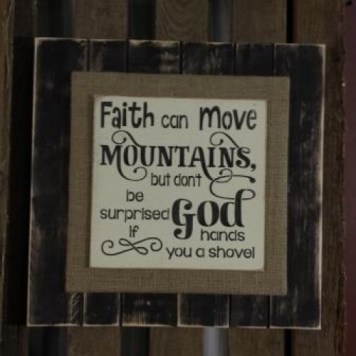
A couple months ago Dianne brought a sign over to the church and hung it against the refrigerator in the kitchen. She does things like this all the time but from the moment I saw this sign, the words have percolated in my mind: “Faith can move mountains, but don’t be surprised if God hands you a shovel.”

faith-can-move-mountains-but-dont-be-surprised-if-god-hands-you-a-shovel-4

Faith and discipleship is hard work. The disciples once asked Jesus to increase their faith, as if he could snap his fingers and it would just happen. But Jesus responds by telling them that faith the size of a mustard seed could pull a mulberry bush out of the ground move it to the sea. Have you ever tried to move a mulberry bush? The roots go deep down into the earth and make the work of replanting quite difficult.

Being a slave in God’s kingdom, yielding to God’s will, means that we have to do the right kind of work to increase our faith. We can’t just ask for it and expect everything to change immediately. It takes the habits of prayer, scripture reading, and communal worship to increase our faith. When we work to follow the commands of Jesus, difficult though they may be, our faith will increase.

God owes us nothing, and yet we are still loved. God’s invites us back into the realm of grace over and over even when we do not deserve it. Christ still loved us while we were yet sinners. And God gives us the power to move mountains and uproot mulberry bushes, but only if we’re willing to work for it.

On Suicide

Isaiah 43.1-2

But now thus says the Lord, he who created you, O Jacob, he who formed you, O Israel: Do not fear, for I have redeemed you; I have called you by name, you are mine. When you pass through the waters, I will be with you; and through the rivers, they shall not overwhelm you; when you walk through fire you shall not be burned, and the flame shall not consume you.

Romans 8.35-39

Who will separate us from the love of Christ? Will hardship, or distress, or persecution, or famine, or nakedness, or peril, or sword? As it is written, “For your sake we are being killed all day long; we are accounted as sheep to be slaughtered.” No, in all these things we are more than conquerors through him who loved us. For I am convinced that neither death, nor life, nor angels, nor rulers, nor things present, nor things to come, nor powers, nor height, nor depth, nor anything else in all creation, will be able to separate us from the love of God in Christ Jesus our Lord.

suicide


It was 2003 and I was a freshman in High School. And like most High School freshman, I spent many an evening on my computer typing to my friends on Instant Messenger. This was long before Facebook’s wild popularity, Twitter’s terse communication style was far away from coming into reality, and none of us even had cameras on our cell phones. But night after night we would sit in front of our computer screens typing away about what we thought were the most important things in the entire world.

One night in the spring, I waited for my parents to go to bed and then I snuck downstairs to get back on the computer. Most of the conversations were frivolous and limited by the speed at which our fingers could move over the keyboard. I can’t remember what the topic was that evening, but I do remember a new box appearing on the screen that changed everything.

At the time, my best friend was dating a girl and things were less than perfect. They fought about all kinds of stupid things and were the epitome of every high school relationship cliché. She, the girlfriend, was the one who sent me a message that night. All it said was, “We got in a really bad fight, he told me he was going to kill himself, and I don’t know what to do.

Suicide is ugly. It leaves families and friends reeling in whiplash, it creates guilt and unanswered questions, and it produces feelings of morbidity and fear.

Suicide is controversial in the church for a number of reasons. Many churches and Christians believe that suicide is ultimately sinful and worthy of eternal damnation. To have suicidal thoughts is to not have enough faith. Some pastors will even refuse to preside over funerals for those who have committed suicide.

If you look through the entirety of scripture, both Old and New Testaments, you will not find a passage that condemns suicide. None of the prophets, or priests, or kings have anything to say about suicide or what happens to those who commit suicide. However, Augustine (an important theologian from the early church) read the commandment “thou shall not kill” as a prohibition against suicide. And from Augustine’s reflection on the topic, suicide became the black sheep of sins in the church.

For a thousand years, suicide was a mortal sin and an affront against God’s goodness. Those who committed suicide were treated as criminals and refused Christian burials. By the 1500s those who attempted suicide were excommunicated by the church and were punished by the civil authorities.

And still today, suicide carries an awful stigma in the realm of the church and is one that is either referred to with eternal damnation or complete silence.

            That silence, the utter and complete darkness of a topic that is remarkably relevant for our time and reflection, is a controversy worth confronting.

According to the Center for Disease Control (CDC), on average, one person dies by suicide in the state of Virginia every 8 hours. It is the 11th leading cause of death in our state, and it is the 2nd leading cause of death for people ages 10-34.

Among high school students across the country, 17% seriously considered suicide in the last 12 months. And 8% attempted suicide one or more times in the last year.

If you’re like me, you tend to think about young people being the most susceptible to suicide attempts, but suicide rates are actually highest among people middle aged and older, by a lot. In fact, middle aged and older adults are nearly twice as likely to commit suicide as young people.

And right now, suicide has surged to its highest levels in thirty years.

yqecn1ygjymjb3igsiev

When I received that message on my computer back at the beginning of high school, I grabbed my things and was out the door before I even had a chance to really think about what I was doing. All I knew was that my friend would not just make an empty threat about suicide like that, and I had to do something about it. So I grabbed my bicycle out of the garage and I started riding as fast as I possibly could in the middle of the night. He lived a couple miles away and when I screeched into his driveway I was drenched in sweat.

I dumped the bike right there and I ran to the front door and started banging with my fist and I started yelling. Within a minute his parents were coming down the stairs in their pajamas with tired and angry looks on their faces. When they opened the door and saw me standing and sweating in the dark they were utterly bewildered and then I told them why I was there.

We immediately went to check on him in his bedroom, but he wasn’t there. We searched the house from top to bottom and we finally found him in the basement. He was sitting on the couch with tears in his eyes and he had just swallowed an entire bottle of ibuprofen.

They wound up taking him to the hospital and had his stomach pumped. They sat there and held their son while he cried and cried. And they saved his life.

Suicide is not the way any human life should end. The church, this church, has an obligation to see that all persons are grafted into a community of love and are cared for in the midst of isolation, depression, and despair.

Life is a gift, plain and simple. It is a gift from God and therefore we are called to be good stewards of this gift: our lives and the lives of others.

We cannot ignore this topic as if it has nothing to do with us. The statistics confront us with a stark reality about the prevalence of suicide in our culture. With the advent of the Internet and instant communication, young people are being bullied and attacked at a degree that few of us can even fathom. With an economy that moves up and down like a roller coaster, people in the middle of life are undergoing identity crises and are wondering how they can provide for their families. Older people who receive a grim diagnosis or the loss of a spouse struggle to justify living with such a horrible outlook for the days ahead.

We know that we are supposed to be present for and with one another, like being there for friends and family at a moment of tragedy. We rarely know what to say on such occasions, but we know we should be there. We, above all things, are called to be present for others in the midst of suffering and loneliness and depression that often lead to the contemplation of suicide. To be part of the faithful community requires us to be for one another.

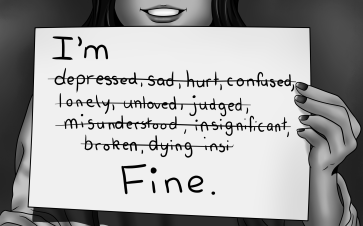
i_m_fine_by_black_avenger-d60mqnl

We live because life is a gift. We are not our own creators. We Christians are the people who must learn to live by the fact that life is a gift. We therefore can live each and every day not as a survival technique, but through recognizing that each and every day is an opportunity to live and love in the service of our Lord.

When we talk about suicide, we say it is “the taking of one’s life.” But even the way we talk about suicide shows how much a problem we have with it. Our lives are not our own. As the Lord says through the Prophet Isaiah: “Do not fear, for I have redeemed you; I have called you by name and you are mine.” We belong to the Lord and to one another. God tells us to not be afraid because God will be with us as we pass through the waters, and the rivers of life shall not overwhelm us, we shall not be burned by the fires of frustration. Not because they won’t hurt or be terrifying, but because we belong to the Lord and the Lord is with us.

If we’re here in the sanctuary this morning, we have some sense of this in our lives. We know that God is with us, we feel God’s presence in this place and we know that we are not alone. It is through encountering the divine love of God in worship that we are given the strength to be God’s presence for others who sink under the waters of life and who feel burned by the world. It is our charge to be shaped and called by God’s love and to reach out to those who contemplate ending their days. We have the challenge of showing all people, even those who see no value to their lives, how our lives are not defined by what we have done with them, but by what God will do with them.

Six months after my friend had his stomach pumped, he attempted to commit suicide again. This time he did it with a hose running from his exhaust pipe into his car. But his little brother heard the car door close and it woke him up, and then he woke up his parents. In the strange and quiet time of the darkness of night they pulled their son out of the car and they got him help. It took a long time for him to move on. It took counselors and therapists, it took friends and family, it took the power of God’s grace to show him that his life could get better, that there was hope for the future, that there was something worth living for. And because people in his life were brave enough to confront his suicide attempts, he still lives today.

But there will always be some that we cannot reach. There will be people who feel so suffocated by the weight of the world that they will make that dreadful decision to end the life that God’s has given to them. And for them, for those who will die by their own hand, what will happen to them? For centuries the church saw suicide as an unpardonable sin, something that eternally damns those who do it. Will God abandon them for making such a choice? Will God refuse to love the people who felt no love in their lives? Will the God of mercy punish them until the end of time?

           No. In all these things we are more than conquerors through him who loved us. For I am convinced that neither death, nor life, nor angels, nor rulers, nor things present, nor things to come, nor powers, nor height, nor depth, nor anything else in all creation, will be able to separate us from the love of God in Christ Jesus our Lord. Amen.


Controversy Original

Devotional – 1 Timothy 6.10

Devotional:

1 Timothy 6.10

For the love of money is a root of all kinds of evil, and in their eagerness to be rich some have wandered away from the faith and pierced themselves with many pains.

Weekly Devotional Image

In the United Methodist Church we spend a lot of time every fall preparing for Charge Conference. Charge Conference is an annual meeting in the life of the church where we evaluate where we’ve been and where we’re going, we discuss challenges and new approaches, and we vote on things like the budget and pastoral compensation.

Paying pastors is one of those things in the life of the church that we like to handle quickly and then move on to a different subject. Frankly, whenever we talk about money we want to address it as fast as possible and then get back to “doing church.” Money makes us uncomfortable.

On some level this is a good thing. We know that Paul writes to Timothy about the love of money being a root of all kinds of evil. Or we can think about a time when the fear regarding finances sent the church in a frightening direction. Or we can reflect on how the love of money has reshaped a relationship with a friend or with someone in our family.

tithe

However, money and wealth is one of the things that Jesus talks about more than anything else, and we have slowly removed it from our common experiences in the life of the church.

On the Virginia Conference website for the United Methodist Church there is a page dedicated to the bishop. On that particular page anyone can find narrative information about our bishop, but there is also a link to what is called the “Appointment Workbook.” If you click on the link you will have access to a list of all the pastors in the Virginia Conference, how long they served, how many new people are attending their churches, how much their churches are required to pay in apportionments, what percentage of the apportionments have they paid, AND their annual compensation. This is good and important information for the life of the church, but the fact that the entire list of pastors is not organized by name, or region, or new disciples, but by salary, shows how we have wandered away from the faith.

Paul warns us about the love of money in our individual lives and in the community of the church. When we become so consumed by the pursuit of money whether we are a teacher, or a doctor, or a denomination, we fall captive to the evil the sends us wandering away from the faith. As Christians, our ultimate call is to grow in our faith and Christlikeness, not in our annual salary.

On The Death Penalty

Mark 10.26-27

They were greatly astounded and said to one another, “Then who can be saved?” Jesus looked at them and said, “For mortals it is impossible, but not for God; for God all things are possible.”

Luke 23.44-47

It was now about noon, and darkness came over the whole land until three in the afternoon, while the sun’s light failed; and the curtain of the temple was torn in two. Then Jesus, crying with a loud voice, said, “Father, into your hands I commend my spirit.” Having said this, he breathed his last. When the centurion saw what had taken place, he praised God and said, “Certainly this man was innocent.”

Controversy Original

Preachers can fall into the rut of preaching on whatever keeps the congregation pleased; keep them happy and they’ll keep coming back, or something like that. This sermon series is different. Instead of falling back to the familiar narratives that keep us smiling on our way out of church, we are confronting some of the greatest controversies facing the church. There is a better than good chance that I will say something from this pulpit during the series that you won’t agree with, and if (and when) that happens I encourage you to stay after worship, join us for lunch, and continue the conversation. We can only grow as Christians in community, and that requires some honesty and humility and dialogue. Today we continue with The Death Penalty.


He was sitting with his friends when the police rushed in. Everything moved in a blur while tables were overturned, bodies were thrown to the floor, and he was placed under arrest. The journey to jail and to the courthouse was strangely quiet, but he kept his head down and his mouth shut. Others came and went, he received strange and knowing looks, and he wondered if any of his friends were arrested as well.

When they dragged him in front of the judge, the courtroom was packed and people kept screaming from the back. The judge waited for everyone to calm down and the whole proceeding came down to one question, “Did you do it?” The man replied, “If I tell you what happened, you won’t believe me, and if I ask you a question, you won’t answer.” Again the judge asked, “Did you do it?” And the man replied, “You say that I did.”

In response, the judge smacked his gavel onto the wood and declared, “What further testimony to do we need? We’ve heard it ourselves from his own lips.” And with that, the man was condemned to death.

The courtroom erupted into celebration as the gathered people shouted “Kill him! Kill him! Kill him!” What made everything worse was the fact that the dead-man walking recognized some of the people who were shouting for his death, but nothing could stop the inevitable.

Time passed, and eventually he found himself walking to his own demise; walking down death row. With every footstep he thought about what had led him to this, he thought about his family and friends that had abandoned him at the end, he thought about how this would be the last time he’d feel the ground beneath his feet.

The executioners were ready to begin the moment he arrived. They took off his clothes, and laid him down. Only then did he notice that two other men were about to be executed as well. Their faces held grave expressions of fear, guilt, and sorrow. But just like with the man, they were on a path that had only one outcome- death.

It was about noon when everything started moving quickly, and the man noticed that it was strangely turning dark outside. They strapped him down until he could barely breathe and then they stood back and waited. With each moment he felt his life slipping away, his chest heaved for air that ceased to fill his lungs, his vision went blurry, and then he died.

His name was Jesus and he was executed by the state.

Image processed by CodeCarvings Piczard ### FREE Community Edition ### on 2016-05-12 18:53:36Z | http://piczard.com | http://codecarvings.comÿÿÿ–j¬+

Capital punishment, killing someone in response to a crime, is as old as civilization itself. Some of the earliest archeological discoveries of law codes contain the ramifications for shedding blood or taking someone’s life, and more often than not it comes down to this: “An eye for an eye, a tooth for a tooth, a limb for a limb, a life for a life.” It’s there in Hammurabi’s code from ancient Babylon, and we have it in the Old Testament in our Bibles.

The Death Penalty has been around for a very long time, and we still employ it for a number of reasons. To kill someone for committing a crime is the only way to guarantee they will never recommit the same crime. It works and functions as a deterrence to influence others to not commit the crime. It helps bring closure to a family who is grieving the loss of someone who was murdered. And it saves the state a lot of money from having to keep someone in prison year after year after year.

In the United States, there are roughly 3,000 people on death row right now, and the death penalty takes place primarily through lethal injections – a poison is injected into someone’s blood stream that brings a quick and painless death, but many states still let people choose between the electric chair and lethal injection. The state of Washington however, still uses a noose to kill those who have been convicted. Across the county at least 56% of Americans support the death penalty.

And the state of Virginia, where we live, has executed more prisoners than any other state.

So why are we talking about the Death Penalty in church? Why is this a controversy that we need to confront?

Because Jesus was killed by the Death Penalty.

The main reasons that people often sight to justify the death penalty can just as easily be argued from a different perspective. The death penalty often fails to work as a deterrence because in the south where 80% of all death penalty convictions occur is the only part of the country where crime rates continue to increase. The closure that families experience in the short-term is present, but in the long-term they tend to experience more guilt and depression in a response to another person’s death. It actually costs the state a lot more money to put someone to death because of the required appeals process and the amount of time and resources that it necessitates. And, this is a very important ‘and’, since 1976 about 1 in every 9 death row inmates have been exonerated, usually after decades of living in a prison cell.

But all of the statistics and the facts, all of the psychology and the economics, are dwarfed by the fact that Christians still support the death penalty, even when the Lord we worship was killed by the same means.

We Christians love our crosses. We put them up in our sanctuaries and in our living rooms, we tattoo them on our skin and we wear them around out necks, I even carry one over my shoulder all over Staunton every Good Friday. But we have become desensitized to what the cross means: death.

Let me put it this way: If Jesus died 100 years ago, then we’d be wearing nooses around our necks instead of crosses. If Jesus died 50 years ago, then we’d be bowing before an electric chair in the sanctuary instead of a cross. And if Jesus died today, then we’d hang up hypodermic needles in our living rooms instead of crosses.

The cross was the electric chair for the Romans. The cross is like the hangman’s nooses of lynching mobs. The cross is like the lethal injection of modern prisons. It is the way people were killed by the state as a punishment for their crime.

The fact that 1 in 9 death-row inmates have been exonerated should be enough to give us pause. The fact that the state has murdered innocent people just like Jesus was murdered should give the church reason to repent. But if that’s not enough, then maybe this is: With God nothing is impossible.

And I’ll admit, there are scriptures in the Old Testament that justify the practice of capital punishment. But there are also people in the Old Testament and the New Testament who committed capital crimes and God still used them for the kingdom.

We like to think about Moses’ encountering the burning bush, we like to imagine Moses leading God’s people to the Promised Land, but we don’t like thinking about the fact that Moses murdered an Egyptian in cold blood before he met God in the wilderness.

            We like to think about David approaching Goliath on the battlefield, we like to imagine him dancing in front of the Ark of the Covenant, but we don’t like thinking about the fact that David ordered one his soldiers to die so that he could sleep with his wife.

            We like to think about Paul being knocked to the ground by God on the road to Damascus, we like to imagine him writing letters to the churches by candlelight, but we don’t like thinking about the fact that Paul murdered countless Christians before his conversion.

christians-and-the-death-penalty-views-on-both-sides

            With God nothing is impossible.

That’s the beginning and the end of theology, that with God’s help and grace all things are possible. An alcoholic can kick the drink, an atheist can discover faith, and a sinner can receive forgiveness. Why then do we keep slinging out our nooses? Why do we keep sending people to the electric chair? Why do we keep strapping them down for a lethal injection? Why do we keep hanging people on crosses?

The message of Jesus’ ministry, of the cross, is mercy. Mercy for an adulteress woman who was about to be stoned by the crowd, mercy for short tax collector who preyed on the poor, mercy for a criminal who hung on a cross right next to Jesus. Mercy triumphs over judgment.

That doesn’t mean that people who commit horrendous crimes get to walk away without consequences, it doesn’t mean that we should break down the walls of our prisons and let everyone run wild, but it does require us to fundamentally reshape our imagination regarding the justice system.

For centuries the death penalty was something that took place in public – crosses on a hill, nooses in a tree. The state used the death penalty to publicly frighten potential criminals from committing the same crime. But now capital punishment takes place in hidden rooms with minimal witnesses. It has retreated from the public arena and can continue to take place without disrupting our daily lives.

But people are being murdered for murder.

Jesus once said, “You have heard that it was said, ‘An eye for an eye and a tooth for a tooth.’ But I say to you, Do not resist an evildoer. But if anyone strikes you on the right cheek, turn the other also.” To retaliate murder for murder will only ever beget more violence, or as Martin Luther King Jr. said, “An eye for an eye leaves everyone blind.

God sent his son into the world to transform the world. Not with the ways of the world, not with power and prestige, not with armies and aggression, but with mercy and sacrifice. God sent his son to walk among us in order that we might catch glimpses of the kingdom. God in Christ ministered to the last, the least, and the lost, people like those who are waiting for the end of their days on death row. And God sent his son to carry death on his back to the top of a hill to die, so that we might live.

So long as we employ the death penalty, we will deny the power of God to redeem, restore, and transform all human beings. As long as we sling our nooses, and prepare our needles, we will prevent true repentance and new life from taking place in those who have fallen prey to evil. As long as we murder murderers, we will never give God the chance to make the impossible possible. Amen.

 

Devotional – 1 Timothy 2.1-2

Devotional:

1 Timothy 2.1-2

First of all, then, I urge that supplications, prayers, intercessions, and thanksgivings be made for everyone, for kings and all who are in high positions, so that we may lead a quiet and peaceable life in all godliness and dignity.
Weekly Devotional Image

Two weeks ago I preached a sermon on the separation of church and state. As a congregation we looked at a few passages that addressed the tension between the state and the church and I proclaimed that perhaps now is the time for Christians to reclaim those things that make us seem strange in the eyes of the state (like refusing to bow and worship our country and politicians as if they were gods, or gathering together on a day set apart to hold ourselves accountable to honesty, truthfulness, and peace, or sitting before a table of ordinary bread and wine that become the extraordinary gift of body and blood).

After worship I invited everyone to join us for a time of further conversation on the topic so that it would feel less like a lecture and more like a dialogue. I used guided questions to help get the conversation rolling, and one particular question got everyone fired up: “Should Christians vote in the upcoming presidential election?”

Immediately individuals asserted that not only should we vote, but that we have to vote. As a right given to us through the constitution we must line up at the polls and decide who should be running the country. I tired to get the gathered group to think harder on the subject by asking if it would be more faithful not to vote, and therefore actively embody the fact that Jesus is Lord and that it doesn’t matter to us who wins the election; they didn’t buy it.

screen-shot-2015-06-19-at-3-11-31-pm

The conversation moved on from there to an assortment of other subjects, and when it was clear that we had exhausted the topic, we prayed together and prepared to leave. However, one person approached me as we were cleaning up and said, “I think the most faithful thing we could do is actually pray for our politicians, and in particular for the one we don’t want to wind up in the White House.”

Paul wrote to Timothy and urged him to remember to pray for everyone, including the kings and people in powerful positions. This was, and is, a call to pray for people who do not reflect the same kind of values and beliefs that we might hold. This was, and is, a call to pray for both Republicans and Democrats, for Hillary Clinton and Donald Trump.

To be faithful during this particularly tumultuous political season requires prayerful discernment, and it also requires us to actually pray for our politicians.

On Creation vs. Evolution

Genesis 1.1-5

In the beginning when God created the heavens and the earth, the earth was a formless void and darkness covered the face of the deep, while a wind from God swept over the face of the waters. Then God said, “Let there be light”; and there was light. And God saw that the light was good; and God separated the light from the darkness. God called the light Day, and the darkness he called Night. And there was evening and there was morning, the first day.

Controversy Original

Preachers can fall into the rut of preaching on whatever keeps the congregation pleased; keep them happy and they’ll keep coming back, or something like that. This sermon series is different. Instead of falling back to the familiar narratives that keep us smiling on our way out of church, we are confronting some of the greatest controversies facing the church. There is a better than good chance that I will say something from this pulpit during the series that you won’t agree with, and if (and when) that happens I encourage you to stay after worship, join us for lunch, and continue the conversation. We can only grow as Christians in community, and that requires some honesty and humility and dialogue. Today we continue with Creation vs. Evolution.


“How old is the earth?” The fifth grader looked up from his homework assignment as if to say, “Well, dude, what’s the answer?” We were sitting inside Forest View Elementary School in Durham, North Carolina, and I was in the middle of a tutoring session. Each week we would sit in the library and go through his homework together. His class was finishing up a unit on earth sciences and his worksheet was filled with questions about the subject.

“How old is the earth?” I, of course, could not remember the answer so I promptly pulled out my cell phone to Google the answer and the young man rolled his eyes and opened up his textbook with dramatic emphasis. We flipped through the pages together looking for key words or pictures that would indicate we were on the right path and then we found it in big bold numbers on the bottom of a page: 4.54 billion years.

I waited patiently for my young tutee to copy the number down into the answer column on his worksheet, but he just kept looking at the textbook with a glazed-over look in his eyes. Then I heard him say, almost as if a whisper, “That can’t be right.”

“Well of course it’s right!” I said, “I mean its in the book, it has to be right.”

            And then he said, “But my pastor told me the earth is only 6,000 years old.”

creation-evolution-possible

In the beginning, the very beginning, there was nothing. All matter was formless. What we now know and see was a soup of nothingness, a bottomless emptiness, and inky blackness. And in the midst of this nothingness, there was something: God. And God said, “Let there be light”; and there was light. God saw that the light was good; and God separated the light from the darkness. God called the light Day, and the darkness he called Night. And there was evening and there was morning, the first day.

Perhaps no words in all of scripture have been more analyzed, prayed over, and interpreted throughout the centuries. Genesis 1 is beginning, and not just a beginning to a story, but the beginning to the story.

And it stands on the battlefield of the fight between Creation and Evolution.

Here’s the controversy: Centuries ago a man named James Ussher set out to date the earth. He dove deep into the Old Testament and, with the help of genealogies, established the exact time and date of God’s creation as 6pm on October 22nd 4004 BC. Therefore, according to Ussher, the earth is approximately 6,000 years old. However, with the advent of modern science and the likes of evolutionary biology and carbon dating, scientists have determined that the earth is 4.5 billion years old.

There is a big difference between 6,000 and 4.5 billion.

For a very long time, we humans considered the earth a relatively recent phenomenon. The Christian church established itself as the predominant leader of information distribution, and when that came into conflict with Science, the battle began.

This has manifested itself throughout the centuries in a number of ways including the fight between the Galileo and the church, Darwin and the church, and even the American Government with the church.

“How old is the earth?” It may seem like a pretty simple question without too many ramifications, but it is a big one, and the way we answer it has a lot of consequences.

A couple of years back, the state of Kansas removed questions about evolution from its standardized tests. This meant that teachers were still allowed to teach evolution, but the children would not be tested on it at the end of the year. Some Christians rejoiced in the victory Creation over Evolution, and others were concerned that children from Kansas would pale in comparison to students from other states by the time they entered college.

It would seem that the church has one answer to the question, and science has another.

I remember learning about the theory of evolution when I was in the 8th grade. With all my hormonal angst, and pimply face, and peach fuzzed mustache, I sat in my science class and learned about how all life can trace its origins back to one single cellular being: That over millions of years that first cell grew and evolved and developed new traits; how life began in the sea, and eventually developed to live on land and in the air; how humanity is one of the last developments in a tremendously long line of evolved species.

I thought it was awesome! The science-fiction nerd within me went into overdrive and I relished in learning about where we came from, how the earth has changed, and how beautifully unique we really are. And the whole time I dove into evolution I saw God’s handiwork all over the place. Who could have brought life into that first being, who could have the imagination to force molecules and atoms together in such a way that life began, who could have moved the development of species to its zenith in humanity?

But at the same time, some of my Christian friends stopped going to youth group and they stopped going to church. In learning about evolution their faith in church diminished. What they heard in the classroom became more important than what they heard in the sanctuary. When they learned that the earth was older than what they heard in church, their faith was crushed. I, however, was fortunate to have pastors and older Christians who helped me to see the similarities between science and faith. But my friends only saw the battle.

2852667_orig

The title of this sermon is Creation vs. Evolution for a reason. I titled it this way precisely because that is the way that many of us see the relationship between the two; Faith and Science represent opposite ends of the spectrum. One is archaic and illogical; the other is scientific and intellectual. One represents backward thinking; the other is forward thinking. One should be left to sanctuaries; the other is for the classroom.

The conflict between science and faith exists because of us; Christians who became defensive when scientists learned more about the world instead of rejoicing in God’s creative majesty. Christians who were quick to jump ship when we discovered there was more to the world than just what we can read about in the bible; Christians who saw scientific discovery as a work of the devil and retreated further away from the world.

But are science and faith really at odds with one another?

Young-Earth Creationists are those who believe (like Ussher) that God created the earth over 6 24 hours days 6,000 years ago. They dismiss scientific discoveries like the Dinosaurs and carbon dating as a way for God to test our faith.

However, there are other ways of looking at the biblical account of creation from Genesis 1 that harmonizes with, rather than battles against, science.

First, the word for “day” in Hebrew is “yom.” And it carries with it a number of definitions and interpretations. Yom is used in the Old Testament as a general term for time, like a time period of finite but unspecified length. We can also read in Psalm 90.4 “For a thousand years in your sight are like yesterday when it is past, or like a watch in the night.” What we understand the word “day” to mean is different than what it means in scripture. God’s time is not our time.

We could then read Genesis 1 to be that in the beginning God created light, and after light God created air, and after air God created earth and sky and sea. But how long it took God to do this is unknown. One day? One million years? Only God knows.

Genesis, and the rest of the bible, is not meant to be read like a science or history textbook. The bible, over and over again, rejects our desire to master the text and instead calls us to be servants of the Word. We might be concerned with how and when God created, but the bible only tells us who and why God created.

Then we can look at the order of creation itself and the similarities with the theory of evolution. Though it was written thousands of years before Darwin’s On the Origins of Species the order of creation parallels Darwin’s and modern evolutionary scientist’s ideas. The first thing to exist was light and energy. Then matter began to fuse together into celestial beings like stars and planets. Eventually the earth developed an atmosphere and water and land. The first life began in the sea, eventually evolved to fly in the air and crawl on the earth, and the last life to be developed, the zenith of God’s creation, was human life.

            Knowing this, countless Christians are able to hold that evolution is real, but that God set it in motion. They are able to assert that the earth is 4.5 billion years old AND God created it in the way described in Genesis. They are able to hold together science and faith in such a way that it gives glory to God’s glorious creation.

The conflict between science and religion, between creation and evolution, exists because people like us have treated the book just like every other book. We see it as our own historical textbook, or as our scientific journal, or as our genealogical record. We import the ways we read other texts into the way we read God’s great Word.

And then many of us take it up like a weapon against anyone who disagrees with us.

But the bible is fundamentally unlike anything ever written. It is historical, and scientific, and literary, and poetic, and every other form we can think of. It is beyond our ability to fully comprehend, it breaks down and exceeds the expectations we place on it, it is the living Word of the Lord.

In the beginning, the very beginning, there was nothing. All matter was formless. What we now know and see was a soup of nothingness, a bottomless emptiness, and inky blackness. And in the midst of this nothingness, there was something: God. And God said, “Let there be light”; and there was light.

           The bible is far less concerned with explaining how things happened, and is far more concerned with proclaiming God’s handiwork. It comforts us when we are afflicted, and it afflicts us when we are comfortable. It can make us laugh and it can make us cry. It can bring us to our knees and it can propel us to dance on our feet. It identifies God as creator and us as creature. It harmonizes with the marvelous developments in science. It humbles us and exalts us. It is who we are and who we aren’t. It is God Word for us. Amen.