Weekly Devotional – 10/14/2013

Devotional:

Psalm 119.103-105

How sweet are your words to my taste, sweeter than honey to my mouth! Through your precepts I get understanding; therefore I hate every false way. Your word is a lamp to my feet and a light to my path.

Adjusting to life in Staunton has been incredible! The pace of life is a welcome relief from the hustle and bustle that I have experienced in other places. I look forward to my regular trips to Food Lion because I know I will inevitably run into someone from church and we will be able to catch up between the ketchup. Additionally, Lindsey and I have fallen in love with the culture here in town. There are so many great restaurants, used bookstores, and a movie theater that always has an open seat!

Recently, I have found myself engaging in conversations with people about the latest book I read (Hard-boiled Wonderland and the End of the World by Haruki Murakami), the latest meal I had at a local restaurant (Pepperoni Pizza from Shenandoah Pizza), and the latest movie I saw (Gravity). It amazes me how so much of our conversations are about the wonderful things we experience and how we want to share them with others; we hope that they can derive as much pleasure from the activities as we did.

Haruki Murakami

Haruki Murakami

Gravity

Gravity


Now, think of something you did recently that was great, perhaps a delectable meal, or an incredible movie, or an exciting novel. Did you tell anyone about it? Did you share your experiences?


If those things were good for our lives, why are we so afraid to talk about the Good News?

I’ll be the first to admit that talking about a book or a meal is a lot easier than sharing the gospel, particularly with a stranger. But, when I really think about it, God has done far more for my life than any movie or meal ever has.

The psalmist writes, “How sweet are your words to my taste, sweeter than honey to my mouth!” (Psalm 119.103) Part of what it means to live out are faith in the world, is to soak up the delectable qualities of God’s word, and then be ready to share the good news with those around us. This doesn’t mean that we need to be bible-carrying evangelists ready to knock on every door on our street. But if God’s Word has been sweeter than honey in your life, isn’t it worth sharing with those around us?

So, the next time that you start sharing an experience with someone, remember that God’s Word has been a light for our feet and a lamp for our paths, that it has sustained us through the valleys and celebrated with us on the mountaintops, that it is our story.

Prepare To Be Surprised – Sermon on 2 Kings 5.1-15

2 Kings 5.1-15

Naaman, commander of the army of the king of Aram, was a great man and in high favor with his master, because by him the Lord had given victory to Aram. The man, though a mighty warrior, suffered from leprosy. Now the Arameans on one of their raids had taken a young girl captive from the land of Israel, and she served Naaman’s wife. She said to her mistress, “If only my lord were with the prophet who is in Samaria! He would cure him of his leprosy.” So Naaman went in and told his lord just what the girl from the land of Israel had said. And the king of Aram said, “Go then, and I will send along a letter to the king of Israel.” He went, taking with him ten talents of silver, six thousand shekels of gold, and ten sets of garments. He brought the letter to the king of Israel, which read, ‘When this letter reaches you, know that I have sent you my servant Naaman, that you may cure him of his leprosy.” When the king of Israel read the letter, he tore his clothes and said, “Am I God, to give death or life, that this man sends word to me to cure a man of his leprosy? Just look and see how he is trying to pick a quarrel with me.” But when Elisha the man of God heard that the king of Israel had torn his clothes, he sent a message to the king, “Why have you torn your clothes? Let him come to me, that he may learn that there is a prophet in Israel.” So Naaman came with his horses and chariots, and halted at the entrance of Elisha’s house. Elisha sent a messenger to him, saying, “Go, wash in the Jordan seven times, and your flesh shall be restored and you shall be clean.” But Naaman became angry and went away, saying, “I thought that for me he would surely come out, and stand and call on the name of the Lord his God, and would wave his hand over the spot, and cure the leprosy! Are not Abana and Pharpar, the rivers of Damascus, better than the waters of Israel? Could I not wash in them, and be clean?” He turned and went away in a rage. But his servants approached and said to him, “Father, if the prophet has commanded you to do something difficult, would you not have done it? How much more, when all he said to you was, ‘Wash, and be clean’?” So he went down and immersed himself seven times in the Jordan, according to the word of the man of God; his flesh was restored like the flesh of a young boy, and he was clean. Then he returned to the man of God, he and all his company; he came and stood before him and said, “Now I know that there is no God in all the earth except in Israel; please accept a present from your servant.”

Prayer

Have you ever gone looking for God? Maybe your church or your prayer life was no longer cutting it, and you thought about actively seeking out the God who you used to meet in the sanctuary.

For a long time, I made it my duty to help other people find God.

I would help organize trips to domestic or foreign locations, often leading youth and adults into uncomfortable situations so that they could live out the calling of the gospel by serving their neighbors.

Whether you lead a group to Winchester, Virginia or Xela, Guatemala the paradigm remains basically the same: Take a group of people out of their comfort zone, encourage them to serve others through physical means, participate in theological reflection and fellowship, and return home a changed individual.

I have been blessed to see wealthy American men weep in the arms of poor Guatemalan women after working for a week in a remote village, I have seen privileged teenagers play in the destroyed and desolate streets of New Orleans with other children who had lost everything. I have seen college-age Christians sing and chant hymns fervently with their eyes closed after having not stepped foot in a church in years.

Desktop

All of these trips were fantastic and were remarkably important for the people who participated. The only problem was, after returning home, it only took a few weeks to fall back into the same routine as if nothing had actually happened. In fact I’ve seen nearly the same thing occur after a group does a Bible study for months: as soon as they finish, they are on fire for Christ, but within a few weeks, that fervor has disappeared. The thought usually goes something like, “I did what I could but I can only do so much” “I tried to keep the fire alive, but I have other responsibilities” “I know this is what Christ wants me to do, but it’s too hard.”

We often engage in these activities expecting to experience God on our terms, only to return back to life the same as before…

Many, many years ago, a foreign warrior named Naaman had it all. He had the favor of his king, he was consistently victorious on the battlefield, and he had power. He was the kind of guy that you hated in high school. The proverbial quarterback of the football team, straight-A student, the guy who had everything just fall into his lap easily. But Naaman had a big problem: he was a leper. Covered in this invasive skin condition, there was nothing he could do to rid himself of the suffering.

The CEO of the huge multinational corporation can get the best table at any restaurant in town without even calling for a reservation, but his son is in rehab for an addiction to heroin. The famous and celebrated writer travels the world to give lectures and presentations – but he’s an alcoholic. The beautiful actress can turn every man’s head, but she dreads the lights and cameras in case they show an unflattering angle. The envied mother in the community has perfect children that never get in trouble but she weeps every night out of her loneliness and depression.

In every life there is a “but.” What’s yours?  Naaman was a successful military man in great favor with the king, but he was a leper.

However, one day, an unnamed completely insignificant Israelite, the quiet girl who always sat in the shadows, the one whose name no one could remember said the obvious: “Naaman, all you have to do is visit the prophet in Samaria, he can cure your leprosy.”

Why Naaman listened to this woman, we will never know, but he gathered his treasures and traveled to visit the king of Israel. After an embarrassing episode, where it is clearly apparent that Naaman does not know the way God works because he seeks healing from the king rather than the prophet, Elisha invites Naaman to his home so that he will learn there is a prophet in Israel.

The scene that follows is remarkably comical. Naaman comes in full regalia, with an impressive entourage, and gifts galore: ten talents of silver, six thousand shekels of gold, and ten sets of garments. He stands proudly before the house of the prophet but he does not even get invited inside. Instead, Elisha sends out a messenger to instruct the officer to wash seven times in the Jordan River.

Naaman is incensed! “This so called ‘prophet’ doesn’t even have the decency to come greet me? And then he is so bold as to claim that his river is mightier than ours?” So Naaman went away in a rage.

But, just as before with the unnamed woman, some unnamed servants approach Naaman, “If the prophet had commanded something difficult, would you not have done it? How much more, when all he said to you was, ‘Wash, and be made clean’?” And so Naaman went down to the Jordan and immersed himself seven times and his flesh was restored.

de-saussure-elisee-et-naaman

Before returning to his homeland, Naaman went to Elisha and proclaimed, “Now I know that there is no God in all the earth except in Israel!”

Like many people who go out seeking to find God, Naaman knew how it was supposed to work. However, the scripture today confirms Naaman’s lack of understanding when interacting with the divine. First, he brings all of his treasures to the king of Israel assuming that he would have the power to cleanse him. Second, he arrives at Elisha’s home expecting to be regarded as the dignified warrior he is, only to be slighted by Elisha’s lack of welcome.

Like Naaman, so many of us go out expecting to find God on our terms and in the ways we want.

If we travel to an impoverished part of the country, or if we go visit a remote village on the other side of the planet we will surely find God. If we sweat in the mud all day long for our brothers and sister we will be blessed by God almighty for our actions. Yet, like Naaman, we cannot meet God on our own terms, but it is God who meets us.

What takes place here with Naaman is the way the Bible often deals with God. The extraordinary arises within the ordinary. The heavenly breaks out amid the earthly. What we tend to view as ordinary and plain, the Bible wants to depict as the realm of God’s amazing work among us.

Elisha, and all the other prophets from the Old Testament have something that we have lost in the church these days. They have freedom from the society around them. They are not blown about by the winds of doctrine or expectation, they are not captive to special interest groups, they do not follow all the latest fads, they do not unquestionably serve the latest liberal or conservative agenda. They serve, rather, their living God – that God who is on the move toward the establishment of the kingdom on earth.  – They hear God and follow him accordingly; this gives them the freedom from all the voices of this world and from every ideology that would capture them for its own selfish purposes. They meet God in the ordinary ways of life, respond to the call, and are transformed.

The healing of Naaman is one remarkable story. God takes an enemy of his chosen people and restores him to good health. In spite of the antagonism between two seemingly opposed people, God interrupts Naaman’s life in order to bring about a revelation.

Naaman was healed, but in what way? Yes, there is the physical healing, by washing himself seven times in the Jordan Naaman loses the leprosy that had so plagued him, but there was something else more powerful going on here in the story.

In this narrative Naaman learns about humility and encounters the living and active God. It is not the kings, nor the warrior, in the story who understand the ways of God, but it is through the unnamed servants that Naaman comes to experience the divine. It was through humbly following the commands of his servants that Naaman found cleansing in the muddy waters of the Jordan, but more importantly he found new life in a God that meets us in the ordinary.

What is your “but”? What is your excuse for not letting God meet you where you are? When we meet the triune God it would seem that it happens without regard for being rich or poor. Perhaps even more dramatically God extends his mercy, and works out his plans through the unnamed people in our lives, the ones we so often overlook in our day-to-day living.

Somewhere in your life, God is calling you away from the distraction that you are so rooted in. Perhaps God has been using someone to bear a word of hope for your leprosy, for your “but”. Maybe its your mother who you have neglected to call for the last few months that just wants to tell you that God loves you. Maybe it’s the homeless man on Beverly Street who muttered “Thank God” under his breath when you gave him a dollar. Maybe it’s the co-worker who doesn’t treat you with enough respect or your own child who drives you mad when they neglect to clean their room or do their homework. It might be someone who you are jealous of, or threatened by.

Our scripture today boldly declares that God is the one looking for you. If you want to meet God, then you don’t have to go off on some mountaintop, or move to some sort of spiritual summit. You just have to let yourself go, like Naaman, and be willing to let God take over and ready for the changes in your life.

Be prepared to be surprised. When you meet the unnamed person that God is using to address your leprosy, it will almost inevitably offend you in some way, just as Naaman was furious over Elisha’s lack of decorum. The message will cut deep into your life by way of its simplicity, or its unexpectedness, and it will occur in a way that only you will be able to comprehend.

When God comes to meet us where we are, it does not occur through overwhelming theatrics, flashing lights and great booming sounds. God does not meet us where we expect him to, but rather through simple things:

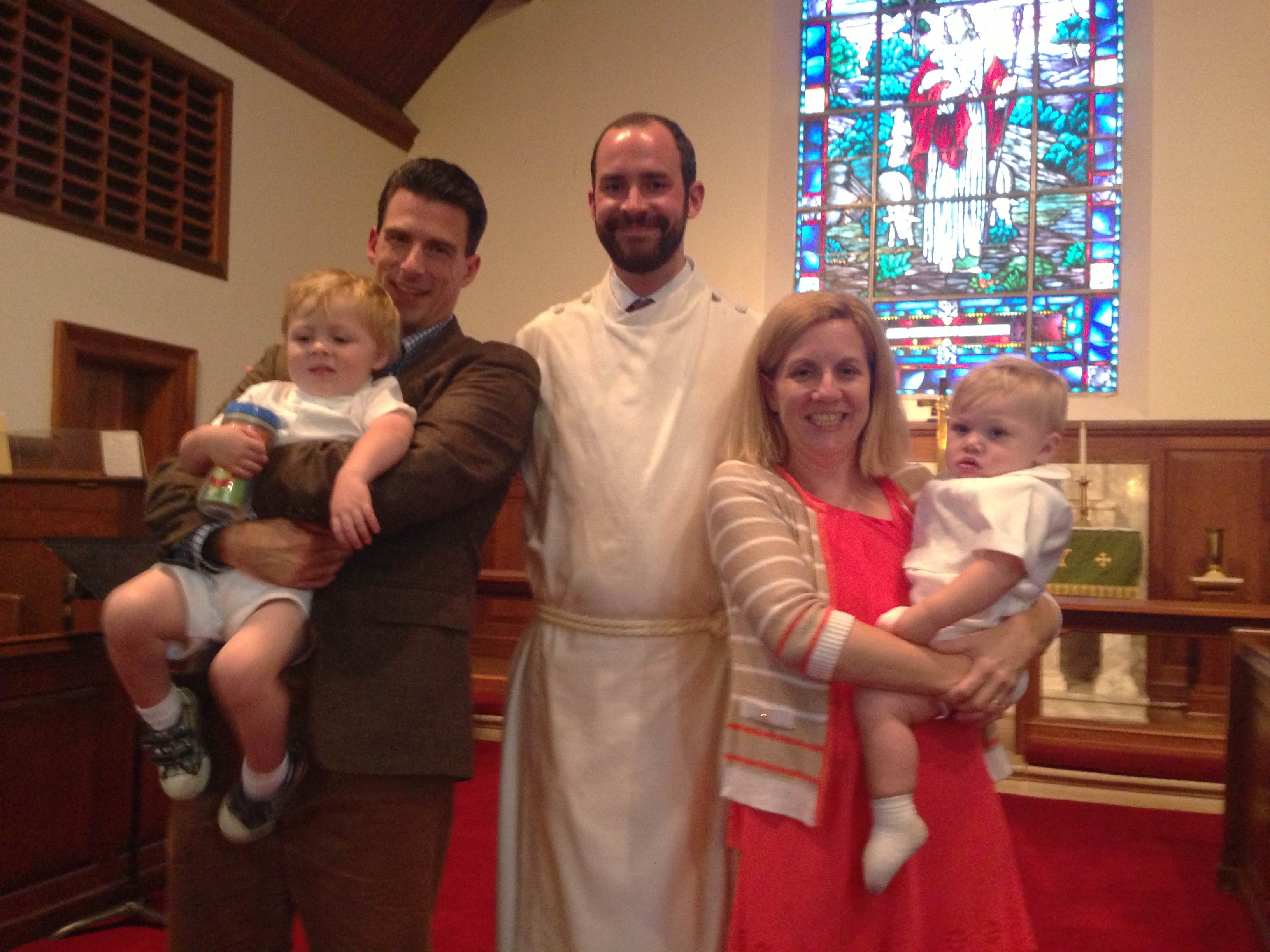
Yesterday morning I stood here right in front of the altar with my cousin Devin. Devin is currently part of a confirmation class in Alexandria, VA at Aldersgate UMC regularly learning more about faith, God, and the Bible. At the end of this confirmation period, Devin will kneel before his home congregation and will be welcomed as a member into the church. But, Devin has not been baptized, and baptism is a requirement for confirmation.

Devin and I talked and he made it clear to me that he wanted me to be the one to baptize him. So after a conversation regarding the importance of the sacrament of baptism, about what it will mean for him and his life, I welcomed Devin to come here for the weekend and be baptized.

So there we stood yesterday, with the muted overcast light coming through the “I am the good shepherd” stained glass window lighting up the altar. I ran my fingers through the cold water talking to Devin about the glorious ways that God has interacted with his people through water over the centuries. And as I held the water in one hand, and Devin in my other, I said, “Devin, many years ago Jesus gathered at the Jordan River and was baptized by his cousin John. In the same way Jesus calls all of us to be baptized in order to be brought into his body, the church.”
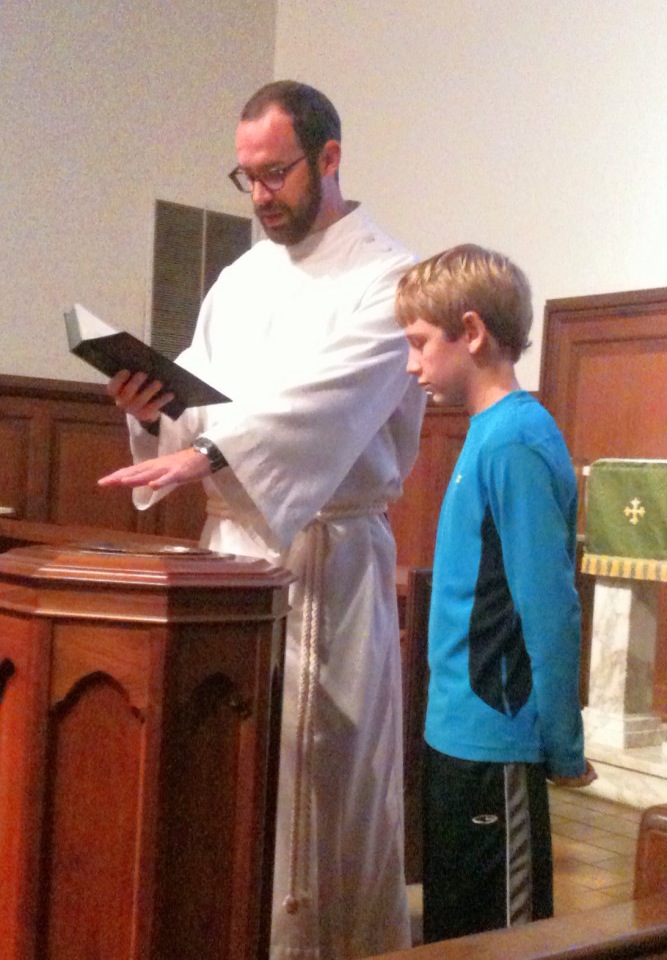
1373497_10151926400772840_183143865_n

I stood there for perhaps just a moment frozen in my own words. As I looked down at his blonde head I realized that just as John baptized his cousin, here I was, blessed to be doing the same thing to my cousin.

God confronted me in that moment. In a solitary blink of time I was flooded with the knowledge that the Jordan River where Jesus was baptized is the same river where Naaman was cleansed of his leprosy. That I was standing before almighty God baptizing my cousin in the same way that John baptized his. It was not grand: the sky did not open up with the Sun beating down on us, no trumpets were heard blaring from heaven, and the wind did not blow through the building. But it was perfect, because in that moment God met us in the ordinary: through the simple water and words of baptism.

water2

God does not meet us where we expect him to, but through the ordinary rather than the extraordinary. God meets us in the proclamation of his Word, in the remembrance of a man named Naaman who walked down to the Jordan River, and through a young man’s baptism on a rainy Saturday morning.

What is God calling you to? Where has God been trying to meet you?

Prepare to be surprised.

Amen.

(preached at St. John’s UMC on 10/13/13)

Dear Archer and Abram… – Sermon on Jeremiah 29.1, 4-14

(Preached at St. John’s UMC on 9/29/13)

Jeremiah 29.1, 4-14

“These are the words of the letter that the prophet Jeremiah sent from Jerusalem to the remaining elders among the exiles, and to the priests, the prophets, and all the people, whom Nebuchadnezzar had taken into exile from Jerusalem to Babylon.

It said: Thus says the Lord of hosts, the God of Israel, to all the exiles whom I have sent into exile from Jerusalem to Babylon: Build houses and live in them; plants gardens and eat what they produce. Take wives and have sons and daughters; take wives for your sons, and give your daughters in marriage, that they may bear sons and daughters; multiply there, and do not decrease. But seek the welfare of the city where I have sent you into exile, and pray to the Lord on its behalf, for in its welfare you will find your welfare. For thus says the Lord of hosts, the God of Israel: Do not let the prophets and the diviners who are among you deceive you, and do not listen to the dreams that they dream, for it is a lie that they are prophesying in my name; I did not send them, says the Lord. For thus says the Lord: Only when Babylon’s seventy years are completed will I visit you, and I will fulfill to you my promise and bring you back to this place. For surely I know the plans I have for you, says the Lord, plans for your welfare and not for harm, to give you a future with hope. Then when you call upon me and come and pray to me, I will hear you. When you search for me, you will find me; if you seek me with all your heart, I will let you find me, says the Lord, and I will restore your fortunes and gather you from all the nations and all the places where I have driven you, says the Lord, and I will bring you back to the place from which I sent you in exile.”

photo (4)

The year was 594 BC, and everything was falling apart.

The prophet Jeremiah had seen it all. Coming from a village from the small tribe of Benjamin, he had been called by God and given the unenviable task of being appointed over nations and kingdoms, to pluck and pull down, to destroy and overthrow, to build and to plant (Jer. 1.10).

Babylon was growing stronger and stronger, while Judah was growing weak from internal turmoil. By the time the year 594 had come around, most of the Israelites had been exiled to Babylon, removed from their precious promised land.

In the midst of particular unrest in Jerusalem, Jeremiah learned of similar frustrations among the exiles in the foreign land. More specifically, Jeremiah learned that false prophets were claiming that the exiles would soon be going home had provoked the unrest. However, God’s plan for the exiled Israelites would have to take place on God’s time.

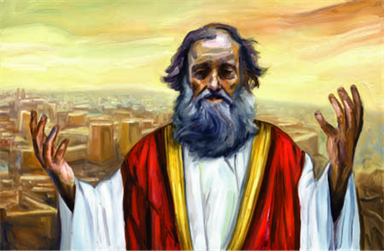
prophet-jeremiah

In the year 594, with unrest brewing in Babylon, Jeremiah sent a letter to the exiles against their false hope for an early return.

For our sermon today I have decided to try something different. In many ways, the letter Jeremiah wrote to his fellow Jews living in a foreign land, speaks to the no longer dominant Christians today living in our culture.

This sermon has been prepared as a letter, using Jeremiah’s epistle as a template, written for both Archer and Abram Pattie, the two young boys who will be baptized later in the service. I hope however, that you will notice that this letter is not just for them, but also for all of us…

Dear Archer and Abram,

Build houses and live in them; plant gardens and eat what they produce… But seek the welfare of the city where I have sent you into exile, and pray to the Lord on its behalf, for in its welfare you will find your welfare.

Today is the day that you are welcomed into God’s church through baptism. All of us have gathered together to witness this incredible event, prayerfully waiting and watching for the water to be poured over your heads. We are all here because we love you, because we are committing ourselves to you, and because we have been down your path before.

But, it won’t be easy.

The world today is an entirely differently place than it used to be. 50 years ago, this church was packed with people filling up nearly every single pew. Most of the restaurants, businesses, movie theaters, were all closed on Sunday because it was expected that we maintained Sabbath and reverence for holy worship. When you went out in public you could expect to see families together in prayer, the bible and its wonderful scriptures were a part of daily living often being read from the dining room table, and churches were growing and growing.

Today, you two are being baptized into a church that no longer fits that mold. Instead of the glory days of Jerusalem, you are entering into a time where the church feels like it is in Babylonian captivity.

The church and the world have changed but that’s a good thing! You are privileged to grow up in a church that no longer has to fit the expectations of the world, but gets to instead meet the expectations of almighty God.

Grow up in this community. Dig deep roots. Make friends. Play sports. Study Hard. Take advantage of the opportunities around you. Spend time with people who do not look like you, do not talk like you, and do not act like you; learn about yourself from them. But remember one thing: God’s kingdom is not of this world. You are being welcomed into a new family that is defined by its love of God and neighbor and therefore you are part of something so much bigger and so much greater than yourselves. Rejoice in what you have here, and hold fast to the love of God that will shower down on you every single day.

Do no let prophets and the diviners who are among you deceive you, and do not listen to the dreams that they dream, for it is a lie that they are prophesying in my name; I did not send them.

Archer and Abram, growing up will be tough. There are going to be people, and corporations, and television shows, and politicians, and advertisements, and all sorts of other false prophets that will try to tell you about the world. Every time you turn around you will be force-fed new information about how you are supposed to see, feel, believe, and understand everything. You will be told about the importance of maintaining your individuality and allegiances to the powers around you: Truly I tell you Caesar can come in all shapes and sizes.

They will try to fill holes and spots and negativity in your lives with all sorts of garbage.

False prophets will always tell you exactly what you want to hear: If you take this weight loss pill you will have the body of your dreams, if you drive this car your neighbors will respect and admire you, if you invest enough money in our company you will never have to worry about finances again…

The only one who can ever make you whole, the only one who will every truly love you, no matter what, is the triune God.

False prophets and diviners will try to label you and help you create your own identity on their terms. But today they can never compare to your new identity in Jesus Christ. Today you are being baptized in the name of the Father, Son, and Holy Spirit. Today you are becoming God’s children and nothing, nothing, can ever compare to that. We, the church, are here to help nurture you in your discipleship, we will take vows of love and commitment to help mold you in the faith, so that you will always remember that nothing, nothing, will ever separate you from the love of God in Jesus Christ.

For surely I know the plans I have for you, says the Lord, plans for your welfare and not for harm, to give you a future with hope.

Archer and Abram, God has a plan for both of you. From the very beginning it was God who breathed the breath of life into both of you, you were each uniquely created in the image of God. Many have claimed over the centuries that being made in the image of God means we have rational thought, or an imagination, but today I am telling you that being made in the image of God means that you were both created to be in community.

God’s plans for you include growing up in a place like this, feeling the love of God through your brothers, sisters, mothers, and fathers in Christ. God wants us to be here for you, and you to be here for us.

Things will get tough in your lives. There will be moments when it feels like God does not have a plan for you, that all you see and feel and hear is anything but your welfare. But God will always be there. This church will always be there. Because of our baptismal commitments to you we will always wait with open arms ready to help you, nurture you, believe in you, and support you in everything you go through.

Many years after Jeremiah sent his letter, after Israel had fallen captive to foreign nations, after Rome had laid siege to great Jerusalem, there was little hope. But one remarkable night, God came and dwelt among us in the flesh and became hope incarnate. God walked through the streets in Jesus Christ teaching about the kingdom, healing the sick, feeding the hungry, and bringing people into fellowship with one another. When our love failed, when we crucified Jesus on the cross, God’s love remained steadfast and the hope that we have always waited for became real and tangible in the resurrection.

In the beginning of our faith, when Christianity was still a budding movement there was pain and fear and frustration. Many people died for the faith that is now being passed on to you, but you will probably never be required to die for your faith. More likely, you will be given the dilemma, or opportunity, to summon up the courage to react against an injustice at the grocery store, or speak up for the voiceless in an argument, or love someone who is so unlovable. It will not be large and it will not be grand, but it will be good enough. Remember who you are, and whose you are.

20130929_114851        20130929_114826

God has a plan for you, a plan for your welfare, to give you a future with hope. There is something greater than this world; there is something more powerful than we can imagine, something brighter than the sun, and lovelier than the moon. It is your future, your future with hope because God loved you enough to die on the cross.

Then when you call upon me and come and pray to me, I will hear you. When you search for me, you will find me; if you seek me with all your heart, I will let you find me.

Archer and Abram, God is the one who lets us come to him with our requests and he hears and answers them. God’s gracious will to hear us, to know us, and to love us in prayer is the basis of the covenant that will take place in the waters of your baptism. God’s love is so superior, so majestic, and so clear that it makes our prayers immediately necessary.

God is ready for us to call on him. By living into a new reality, one that is shaped by prayer and scripture, by seeking God with our whole hearts, by practicing justice and loving-kindness we will find God with you.

We do not keep God locked up in this church, you do not have to be sitting in the pews or singing in the choir loft to find God. All you have to do is call upon him. When you search for God, you will find him. You will find God in the wonderment of creation, in the perfectly pitched harmonic notes of a song, in the warmth of the fire in the winter, in the hug of your mother when you make it home, in all sorts of places because God is always there.

Today you are being wrapped up into God’s great cosmic story. When you open the Bible you will now discover that it is not just some story about some people from the past but it is the very story of your lives. We are all here to rejoice with you today.

Sincerely,

Rev. Taylor Mertins


Nearly 2,500 years ago Jeremiah wrote a letter of truth to his friends in exile. He warned that things would not turn around immediately, that they would have to persevere through tough times before God would bring them home. This letter continues to live on for all of us today. The false diviners will continue try to make sense of the world for us, we will continue to feel like a strange people in a strange land, but God has plans for us.

God wants us to love each other in the same way that he first loved us. God wants us to wrap Archer and Abram up in love to teach them the stories of scriptures and how to be in communion with the divine. And above all, God wants us to know that no matter what we are loved.

Amen.

photo (5)

Family and Faith: God – Sermon on Proverbs 3.1-8 & Ephesians 4.1-6

(Preached at St. John’s UMC on 9/8/2013. I am indebted to Will Willimon’s sermon “Don’t Think For Yourself” for inspiring parts of the following sermon (Willimon, Will. The Collected Sermons of William H. Willimon (Louisville: John Knox Press, 2010), 123-127.))


Proverbs 3.1-8

My child, do not forget my teaching, but let your heart keep my commandments; for length of days and years of life and abundant welfare they will give you. Do not let loyalty and faithfulness forsake you; bind them around your neck, write them on the tablet of your heart. So you will find favor and good repute in the sight of God and of people. Trust in the Lord with all your heart, and do not rely on your own insight. In all your ways acknowledge him, and he will make straight your paths. Do not be wise in your own eyes; fear the Lord, and turn away from evil. It will be a healing for your flesh and a refreshment for your body.

Ephesians 4.1-6

I therefore, the prisoner of the Lord, beg you to lead a life worthy of the calling to which you have been called, with all humility and gentleness, with patience, bearing with one another in love, making every effort to maintain the unity of the Spirit in the bond of peace. There is one body and one Spirit, just as you were called to the one hope of your calling, one Lord, one faith, one baptism, one God and Father of all, who is above all and through all and in all.


Is that really written in Proverbs? Trust in the Lord with all your heart, and do not rely on your own insight? I was always taught to think for myself. Haven’t we been told to do that all of our lives? We can assign you the right books, we can help you get into college, we can show you the door, but you’re the one who has to walk through it. Think for yourself! We can teach you all about God, politics, or even healthy eating habits, but freedom is important, make your own choices.

Be independent, employ your true freedom; create your own way of life. Go out and get your hands dirty, lose yourself in something beyond yourself, fight for something worth fighting for but above all think for yourself. What a perfect bumper sticker for our culture. All I need to get through this world is me, my thoughts, my opinions, and my beliefs.

When I read through our scripture for today it made me think about a time I was helping a church in Michigan. Now this church was HUGE. While I was attending the services there were easily over 1000 people in worship on Sundays between their multiple services. You could choose between different styles of worship and at different times, you could choose between preachers and types of sermons. When I started helping out, there were five pastors on the staff each working in a different area within the church. They offered activities every week from Bible Studies, to service opportunities, to Yoga classes. In fact the first week I was there I served on a panel to discuss the theological virtues of the hit series The Hunger Games for concerned parents and parishioners. They had a lot going on.

IMG_0839

Even though on the surface it seemed like everything was great at the church, there was something missing. There was basically no one in their 20s attending the church. Now, perhaps they assumed that because I was 24 I could explain this phenomenon they decided to give me the results of their recent questionnaire to make sense of it all. The church had recently done a massive survey of the congregation, the community, and members who had left the church. They asked all the typical questions: Has you attendance increased or decreased over the last year? Why or why not? Do you prefer to receive information from phone calls, text messages, mail, or email? Etc. But what they were really trying to discover was why none of the young people were in attendance.

What I discovered surprised me, and I believe it greatly reflects our current culture, and the scriptures for today.

Indeed, the 20-30 year age group was the lowest number for attending church, but they did not need to use a questionnaire to discover that fact. Do you know what surprised me the most? The largest group to decrease in attendance over the last year was the 45-55 year age group. Why?

As far as I can tell here is the common cycle for church attendance: A lot of people grow up in the church, when they go off to college they stop attending until the get married, have kids, realize they have no idea what they’re doing and so they start attending again. This cycle has been true for many people that I have met in my life but there is a newer trend developing. A significant portion of parents stop attending church once their children leave for college. That’s why they went back in the first place, they went back for their kids, and now that they’ve grown up, there’s no reason for them to keep attending. So that child comes back home for the first time, maybe at thanksgiving break: “Hey Mom and Dad, what time are we leaving for church tomorrow?” “Oh honey, we haven’t been recently, but I guess we can go tomorrow…

think-for-yourself

Think for yourself. Isn’t that what we want for our children, for our friends, for our families? We don’t want to push people too far, no indoctrination, we want everyone to be free to do anything they want… but thinking for ourselves, only for ourselves, often gets us in trouble. Thinking for ourselves has led to the current situation in Syria where we spend days and weeks debating whether or not to drop strategic bombs, thinking for ourselves has led to the growing number of impoverished people across the world and even in our own neighborhoods, thinking for ourselves has led to great numbers of people no longer attending church because they can handle life on their own…

God speaks to us through the writer of Proverbs: “My child, do not forget my teaching, but let your heart keep my commandments; for length of days and years of life and abundant welfare they will give you.” Paul similarly speaks to us in his letter to the Ephesians: “I therefore, the prisoner of the Lord, beg you to lead a life worthy of the calling to which you have been called, with all humility and gentleness, with patience, bearing with one another in love, making every effort to maintain the unity of the Spirit in the bond of peace. There is one body and one Spirit, just as you were called to the one hope of your calling, one Lord, one faith, one baptism, one God and Father of all, who is above all and through all and in all.”

In many ways, God is pleading through these verses: Do not think just for yourself. Think beyond yourself. I know that sounds drastic and remarkably contradictory when compared to the American dream, but to be followers of Jesus Christ requires us to orient ourselves and our thinking toward God, and not the other way around.

God begins by addressing us as we truly are: his children. We all have one heavenly Father who is above all and through all and in all. God has called us to lead worthy lives with humility and gentleness, patience and bearing with one another in love.

Being a part of this church community carries with it the responsibility to remember God’s teachings, and to keep his commandments. During the time of the Old Testament the Israelites were taught to remember and keep God’s commands: Deuteronomy 6.4-9: “Hear, O Israel: The Lord is our God, the Lord alone. You shall love the Lord your God with all your heart, and with all your soul, and with all your might. Keep these words that I am commanding you today in your heart. Recite them to your children and talk about them when you are at home and when you are away, when you lie down and when you rise. Bind them as a sign on your hand, fix them as an emblem on your forehead, and write them on the doorposts of your house and on your gates.” Remember these words, because they are an alternative for the world’s desire to isolate us from one another; They calls us to be in unity as a body. They call us to remember. We can maintain our individuality but we must not lose sight of our interconnectedness as the body of Christ. It’s important for us to remember how unique each of us are, but we are all in this together.

Instead of commanding us to think for ourselves, God calls us to keep his words! Teach them to your children and your friends. Live out your vocation as a Christian in your actions, words, and deeds. Trust in the Lord with all of your heart, soul, mind and strength. Do not rely on your own insight, do not think for yourself alone, do not be wise in your own eyes, fear the Lord and turn away from evil.

Where God sits in your life will extend to people outside of you. When you keep his words and live out you’re calling as Christians your families and your friends will notice. Be holy just as God is holy…

When I discovered the decrease in attendance of parents whose children had grown up, I was surprised, but it made so much sense. Think about what it says to those around you when you decide that church is no longer a priority, what it says when God is no longer at the center of your life? Our words and behavior are powerful things, not just for ourselves but also for those around us.

I met a man once, perhaps you know someone just like him. He lived a good life, came to church at Christmas and Easter, and made it through day after day by relying on himself. Sure his family was a little dysfunctional, but whose isn’t? His kids had grown up, went off to college, and had little contact with their father. He assumed everything was normal until one day, out of the blue, one of his friends invited him to a group that met before work hours at the church to pray and enjoy coffee together. He went, reluctantly, sat in the back, and kept his head down. But the more he attended the meetings, the more he started to notice little changes in his life. After reaching a certain comfort level with the other men he started to share his own prayer concerns, his own questions about the bible, and even his own disappointments in his life. His prayer life grew outside of the group and he began to regularly commune with God.

When I met him, he had been attending the group for five years; he told me that his entire disposition toward life had been transformed. He spoke with his children regularly, he found pleasure in his career, and above all he had discovered his relationship with God. “It changed everything,” he told me, “praying like this, reading scripture, opening up. It changed my work, it changed my family, but most importantly it changed me. I realized that I’m not going through life all on my own and its not up to me to do everything; God is with us.”

family_praying_hands

Families of Faith: that’s the title of this sermons series. What does it mean today to be a family of faith. One of the greatest joys of being part of a family of faith, like this church, is realizing that we have been freed from the burden of having to always and constantly think for and care for ourselves alone.

Can you imagine how truly freeing that is? Have you ever experienced that kind of relief in your lives? Having a relationship with God does not guarantee that everything will be completely turned around like the man that I met, but it can at least bring newness and a sense of peace previously undiscovered.

Families of faith contain three important priorities: God, the family itself, and others, but it must first begin with God. By heeding the words of scripture from Proverbs and Ephesians, we can teach and remind our family and friends the commandments that were first handed to us. If we write the love of God on the tablet of our hearts it will be conveyed to the people around us.

One of the ways that we can live out our relationship with God in the family is to reclaim our commitment to reading scripture and having a regular prayer life. When I was growing up the only time we ever prayed as a family was before meals, and we certainly never read the bible aloud. How can we convey faith to our children, our parents, or our friends? Unlike the families that leave their children and friends to “think for themselves” in isolation we can show how wonderful it is to trust in the Lord. It is my hope that starting this week we can all start to read a little more and pray a little more and maybe, just maybe, we’ll start to see the fruitful value of these practices in our lives.

Trusting in the Lord and not relying on our own insight is a challenge because the world has always been telling us to think for ourselves. However, there is one body and one Spirit, one Lord, one faith, one baptism, one God and Father of all, who is above all and through all and in all.

What a great God we have: the one who freed us from the loneliness of the world.

Amen.

Dietrich Bonhoeffer On Canonical Reading

As a devotional practice I have been reading through Dietrich Bonhoeffer’s Letters & Papers From Prison. It has been my experience that preachers today, and for some time, have tended to preach almost entirely from the New Testament leaving the Old Testament to collect dust. In a letter to his friend Eberhard Bethge, which had to be smuggled out of the prison, Bonhoeffer speaks toward a more canonical reading of scripture [both Old and New Testaments]:

dietrich-bonhoeffer-2

To Eberhard Bethge (Advent 2) December 5th 1943 from Tegel

My thoughts and feelings seem to be getting more and more like those of the Old Testament, and in recent months I have been reading the Old Testament much more than the New.

It is only when one knows the unutterability of the name of God that one can utter the name of Jesus Christ;

it is only when on loves life and the earth so much that without them everything seems to be over that one may believe in the resurrection and a new world;

it is only when one submits to God’s law that one may speak of grace;

and it is only when God’s wrath and vengeance are hanging as grim realities over the heads of one’s enemies that something of what it means to love and forgive them can touch our hearts.

In my opinion it is not Christian to want to take out thoughts and feelings too quickly and too directly from the New Testament.


Bonhoeffer, Dietrich. Letters & Papers From Prison (New York: Macmillan Publishing, 1972), 156-157.

The Power of Words – Sermon on Jeremiah 1.4-10

Jeremiah 1.4-10

“Now the word of the Lord came to me saying, “Before I formed you in the womb I knew you, and before you were born I consecrated you; I appointed you a prophet to the nations.” Then I said, “Ah, Lord God! Truly I do not know how to speak, for I am only a boy.” But the Lord said to me, “Do not say, ‘I am only a boy’; for you shall go to all to whom I send you, and you shall speak whatever I command you. Do not be afraid of them, for I am with you to deliver you, says the Lord.” Then the Lord put out his hand and touched my mouth; and the Lord said to me, “Now I have put my words in your mouth. See, today I appoint you over nations and over kingdoms, to pluck up and to pull down, to destroy and to overthrow, to build and to plant.”

prophet-jeremiah

The Power of Words 

Words are powerful. The perfectly timed phrase or expression can carry more meaning and accomplish more than just about anything else. From the pulpit they carry even greater value because they are so connected with the Word of the Lord. At their best words can be used in a fruitful way, demonstrating the kind of building-up that the bible often refers to, in order than we can affirm one another in love. At their worst, words can be used in a destructive way, hurting those around us, and ignoring the truth of God’s role in the world.

On January 30th, 1933, Adolf Hitler became the democratically elected chancellor of Germany. This was the beginning of the Third Reich. Germany, the land that had produced the likes of Bach, Goethe, Durer was now being led by a man who consorted with criminals and was often seen carrying around a dog whip in public. Hitler was known for using his words in public propaganda for destructive purposes. Some of you here this morning can remember how the world shuddered when this began to take place.

Two days after Hitler was elected, a twenty-six year old theologian name Dietrich Bonhoeffer gave a radio address throughout the German nation. The speech was titled “The Younger Generation’s Altered Concept of Leadership.” Though the talk was itself highly philosophical, it constructively argued against the type of leadership that Hitler would use for the next twelve years, inevitably leading a nation and half the world into a nightmare of violence and misery.

Dietrich Bonhoeffer

Dietrich Bonhoeffer

Bonhoeffer spent a significant portion of his speech discussing the differences between a true leader, and the Fuhrer. He used his words in a calm and collected way, appreciating the power they held: A true leader must know the limitations of his/her authority. The good leader serves others and leads others to maturity. He puts them above himself, as a good parent does with a child, wishing to lead that child to someday be a worthy parent. Another word for this type of leadership is discipleship. “Only when we see that leadership is a penultimate authority in the face of an ultimate, indescribable authority, in the face of the authority of God, has the real situation been reached. The individual is responsible before God.”

Before Bonhoeffer could finish, the speech was cut off. Only two days after Hitler’s election, the Nazis were suppressing this young man who spoke out against the type of leadership that would come to define Germany over the coming decade.

What we find in the first chapter of Jeremiah is an encounter between the human and the divine. We discover how powerful words can be through God’s call. As the divine Word, God is a genuine and invisible otherness when compared to Jeremiah. During this particular encounter the word of the Lord came to Jeremiah and the prophet meets in faith the God who meets him through the Word.

“Jeremiah! Before I formed you in your mother’s womb, I knew you, and before you were born I consecrated you; I appointed you a prophet to the nations.” Then Jeremiah said, “Ah, Lord God! You cannot expect me to speak! I am only a boy.” But the Lord responded, “Do not say ‘I am only a boy’; for you shall go to all whom I send you, and you shall speak whatever I command you. Do not be afraid of them, for I am with you to deliver you.”

In his Word, God does not deliver a course of lectures on dogmatic theology, He does not submit the content of a creed of a confession of faith, and he does not even produce a perfectly prepared three-point sermon. Instead He makes himself accessible to us. An exchange takes place here in scripture that is beyond any analogy in the sphere of rational thinking. Instead, we have here a simple encounter, just like one between any two people, where God makes Himself available and known through relationship.

Jeremiah’s experience guides him into boundary, toward his own finitude, being reminded of his humanity, as over and against God. Jeremiah’s encounter is a reminder for us that we are not God. God is wholly other when compared with his creation. When Jeremiah meets God, his personality sinks away into the background; he feels his words being replaced by the Word of God. When we truly encounter the depth and beauty of the triune God, everything about us begins to sink away as well.

It is no wonder therefore why Jeremiah evades the commission of God. “Surely you can’t use me God, for I am only a boy.” Jeremiah protests because he is overwhelmed and intimidated by the call to set aside priests, princes, and people to become a prophet to the nations. He was afraid to proclaim the Word of God, which would go beyond the comprehension of his time.

This isn’t in scripture, but I can imagine God’s full response to Jeremiah’s evasion: “have you not seen and have you not heard what I have done with mere people? Have you forgotten the stories of Abraham, Isaac, and Jacob? What about Moses and Joshua? David was but a boy when I had him defeat the Philistines. Solomon became the wisest king to rule the nation All of the prophets, the judges, the priests? This isn’t about you Jeremiah, this is about what I am going to do through you.”

Recoiling from a divine appointment is common throughout scripture. It only takes a moment to remember Moses standing in the heat of the burning bush and then turning his face away because he was afraid to look at God.

The theologian Paul Tillich once said: “we always desire to escape God… People of all kinds, prophets and reformers, saints and atheists, believers and unbelievers, have the same experience.” It is safe to say that a person who has never tried to flee God has never experienced the truth of who God is.

God dismisses Jeremiah’s excuse; Young or old, learned or uninformed, handsome or ugly, none of things matter to God because they all pertain to our own self-centeredness: my powers, my status, my desire to have reality on my terms. Because of the power in God’s Word Jeremiah does not react in silence, nor does he step aside to let someone else take his place, instead he steps into the situation, which has in a way stepped into him. He responds to the encounter of God, feels the Word of the Lord placed on his lips, and is prepared to do God’s work.

From this point forward Jeremiah will not go forth on his own terms; God will send him, and he will move according to God’s will. It is because of God working in and through Jeremiah that he will be able to speak and act in the specific situations as they arise. The encounter has changed Jeremiah so that he will be able to narrate God’s plucking up and planting again. Jeremiah will speak the truth of the Word of God regardless of whether or not they are agreeable to his youth, ambitions, moods, or self-examination.

            It is only when it is made plainly clear to Jeremiah that the point at issue has nothing to do with his own abilities or the extent of his talents that the truth of God’s reign is made abundant and it becomes possible for Jeremiah to become a messenger.

            Like Jeremiah, the young German theologian Dietrich Bonhoeffer felt the call of God to proclaim the Word. Things became very difficult for Bonhoeffer after he made that first radio address. As the German nation descended into Fuhrer worship with the German church emphasizing politics more than theology, he struggled with how to be authentic to the Word of God as a pastor and a theologian. He trained young pastors through an underground seminary at Finkenwalde and preached about remaining faithful and obedient to God before anything else. As it became harder and harder for him to proclaim the good news in Germany, Bonhoeffer learned that war imminent and was frightened about being conscripted into the army.

dBonhoeffer

Bonhoeffer was a committed pacifist and was adamantly opposed to the Nazi regime, therefore he would never swear an oath to Hitler nor fight in his army. However, to refuse this would be a capital offense. It was at this time that Bonhoeffer accepted a position at Union Theological Seminary in New York. While in the United States Bonhoeffer had somewhat of a Jeremiah experience, because even though he had the freedom to run away from his calling in Germany, Bonhoeffer realized that his responsibility was to God with the German people. Just as God would pluck up and replant the Israelites in Jeremiah’s time, Bonhoeffer knew that the German nation would have to be destroyed in order for it to be fruitful once again. And so Bonhoeffer returned to Germany on the last scheduled steamer to cross the Atlantic before the war.

Upon arriving back in Germany, Bonhoeffer’s desire to speak powerful words against the Third Reich resulted in him being forbidden to speak publically starting in 1940 and he had to regularly report his activities to the police. Within a year he was forbidden to print or publish. And on April 5th, 1943, ten years after making his radio address, Bonhoeffer was arrested by the Gestapo for his continual Anti-Nazi remarks and involvement with the Abwehr’s plot to undermine Hitler’s regime.

            He remained in prison for two years, able to write letters and theology that were smuggled out by sympathetic guards.

0800697030h


Though he remained hopeful for the end of the war and his eventual release, he was condemned to death in April of 1945. He was killed by hanging just two weeks before the United States liberated the camp where he was being held. Before his execution, Bonhoeffer was led away as he was concluding his final Sunday service and said to one of his fellow prisoners: “This is the end – for me the beginning of life.”[1]

            I fear that whenever we hear stories of people like Jeremiah or Bonhoeffer we regard them as a special kind of people, set apart for the work God ordained for them. And to be quite honest, it is very unlikely that anyone of us in this room will ever be imprisoned, or suffer, for our Christian identity. But we are all called to be Jeremiahs and Bonhoeffers in our commitment to following Jesus Christ. Just like those two prophets God has formed us, consecrated us, and placed the Word on our lips.

            There is a power in words that we regularly underestimate. The way that we often talk about other behind their backs carries with it a great destructive energy. When we ignore the truth of our interconnected as the body of Christ in this place by speaking poorly of one another does a disservice to the God who formed you from the womb. Our words are powerful, use them wisely.

            So too, there is a power in the words that we use to affirm and address one another in love; By caring for and reaching out to those around us we continue to live out the kind of fruitful lives that God has always envisioned for us. This church is called to be a place where we understand the power of our Words and use them appropriately.

            Do not be afraid of this power that God has given to you. Jeremiah and Bonhoeffer did not go in their own strength and neither do you. They did not speak on their own authority and neither do you. God is our strength and our authority. “I am with you to deliver you, says the Lord.” The thoughts of our selfish lives can be cast away to the side so that we can assume the proper posture as messengers of God. As Paul wrote to the Galatians “Yet not I, but Christ working in me” (Gal. 2.20).

            Throughout their lives both Jeremiah and Bonhoeffer saw the collision of powers in the world. What defined them was their ability to see God’s decisive acts in history, remembering that God is the true authority over all things in spite of the powers that dominated their cultures. Jeremiah and Bonhoeffer were ordinary people. They were just like us. They were living their lives, expecting everything to be fine when God put something on their lips to say. Hearing and responding to the Word of God is a difficult thing, but God is always speaking and our response to that Word will define us as a people of faith, hope, and love.

            Do not be afraid to speak the truth, for the Lord is with you.

Amen.


[1] Bethge, Eberhard. Dietrich Bonhoeffer: A Biography (Fortress Press, 2000), 927.

Worship in God’s Church – Sermon on Isaiah 1.10-20

Isaiah 1.10-20

Hear the word of the Lord, you rulers of Sodom! Listen to the teaching of our God, you people of Gomorrah! What to me is the multitude of your sacrifices? says the Lord; I have had enough of burnt offerings of rams and the fat of fed beasts; I do not delight in the blood of bulls, or of lambs, or of goats. When you come to appear before me, who asked this from your hand? Trample my courts no more; bringing offerings is futile; incense is an abomination to me. New moon and Sabbath calling of convocation – I cannot endure solemn assemblies with iniquity. Your new moons and your appointed festivals my soul hates; they have become a burden to me, I am weary of bearing them. When you stretch out your hands, I will hide my eyes from you; even though you make many prayers, I will not listen; your hands are full of blood. Wash yourselves make yourselves clean; remove the evil of your doings from before my eyes; cease to do evil, learn to do good; seek justice, rescue the oppressed, defend the orphan, plead for the widow. Come now, let us argue it out, says the Lord: though your sins are like scarlet, they shall be like snow; though they are red like crimson, they shall become like wool. If you are willing and obedient, you shall eat the good of the land; but if you refuse and rebel, you shall be devoured by the sword; for the mouth of the Lord has spoken.

isaiah-1

When I was in college I tried to attend as many different worship experiences as I could. At times I gathered with high church Presbyterians, Free Church Pentecostals, non-denominational evangelicals, and southern Baptists. After having already begun to wrestle with a call to ministry, and knowing that I was a Methodist through and through, I thought it would be helpful to experience many forms of Christian liturgical worship, and discover the individual strengths and weaknesses.

There was one campus Christian organization that met every a week in one of the lecture halls at JMU in order to have their worship service. Now this group was one of the most talked about throughout the university and people always raved about the spirit, vigor, and excitement of the services. A few of my friends from the Religion department regularly attended, so one week I decided to give it a shot.

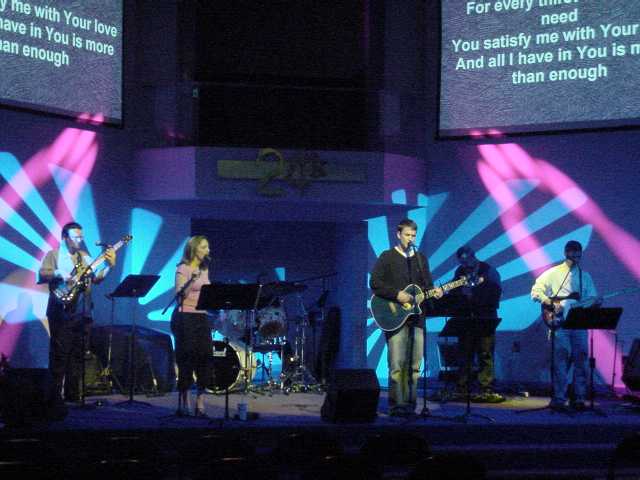
Let me tell you: those people knew how to worship. If you can imagine a full band: drum kit, 3 guitarists, bass, keyboard, and multiple singers. They had stage lighting set up that would change dramatically during the songs, and even during the sermon. They had giant projectors that displayed lyrics, prayers, and even sermonic notes. When the band was playing, everyone had their hands in the air praising. When the preacher was praying, everyone had their heads bowed in submission. It was an experience. The energy in the room was so palpable that I felt on fire for Jesus when I left.

CrossTalk_PCBC_050403

About a week later, after spending way too many hours in the library, I found myself walking back across the quad late at night toward my locked up bicycle. Across the perfectly mowed grass I saw a young man stumbling and trying desperately to maintain his balance. As our paths inevitably drove us closer and closer I recognized him from the worship service I had been in the week before, this young inebriated college student was the bass player for the worship band. It was obvious that he needed help, and remembering that I was a Christian and thinking that this would be a Christian thing to do, I offered him my arm and began to walk him back to his dorm.

“I loved your service the other night,” I said, “The music was particularly moving.” He met my statements with a suspicious eyebrow, so I awkwardly continued “It was really powerful for me.” “Look man,” he slurred, “I don’t believe in God. I just play in the band because they pay me to.”

Worship is important. As Christians we have gathered together for the last 20 centuries first in synagogues, then basements and homes, eventually we started to build churches, and then cathedrals. Worship is at the heart of what it means to be Christian because we participate in the kind of life that Jesus led with his disciples in the 1st century. You might not realize it, but the basic pattern of our worship service has its roots in the ancient practices of the Israelites, and have been handed down to Christians ever since.

First we gather together: we are brought into this place as a community, the body of Christ. We assemble together from the outside world preparing ourselves to be launched into the realm and praise of God almighty.

Second we proclaim the Word of God. We read from the scriptures of the Old and New Testaments. We remember the mighty acts of God in the world as recorded in the Bible and then a sermon is given in order to let the Word become incarnate in our hearing and living.

Third we respond to the proclaimed Word. After hearing about and remembering God’s actions in our lives and the lives of others we return to God with our own participation. Sometimes this response takes place in the form of Communion where we recommit ourselves and are welcomed to God’s table. Other weeks we respond with affirmations of our beliefs such as the Apostles’ Creed.

Finally, we conclude by being sent forth. We re-enter the world bringing with us the light of Christ. As a gathered community we recommit ourselves to life outside of the church being the body of Christ for the world.

Here’s the frightening part: All of that is meaningless unless our lives are transformed.

One of the things that we definitively learn from scripture, particularly the Old Testament is this: the children of God, the objects of divine grace, are not in any way worthy of it. Time and time again in the scriptures we learn about the people of Israel who, by way of their faithlessness, were transgressors of the commandments given to them by almighty God. Just think of some of the so-called “heroes” of the Old Testament: Noah – saved his family and all the animals in his ark and then got drunk and cursed one of his sons for all eternity. Abraham – entered into the holy covenant with God and then pretended to be his wife’s brother and nearly murdered his son. David– delivered the Israelites from the Philistines by killing Goliath, and then stole Bathsheba from her husband and tried to have him murdered. I could go on and on.

The normal sermonic response to these stories of failure and sin is that the children of God are corrupted children. However, in time, God came to dwell among his people and came in the form of a baby named Jesus, the one Israelite who took the place of the disobedient children, the faithless people, and their faithless priests and kings. The Word made flesh. It is only in the light of who Jesus is and was that we see how far humanity had fallen from the grace of God.  What we miss though is the fact that this type of behavior, this faithlessness, does not only apply to the Israelites and the people of Isaiah’s critique, but in fact acts as a mirror for all of us.[1]

Its very easy to read this passage from Isaiah and assume that the Israelites were the one’s who got it wrong, but us enlightened folk in the 21st century, we United Methodists, we’ve got our worship lives together, we are appropriately liturgical. But the Word of God has a most perturbing way of disregarding dates and making truth contemporary.

Isaiah begins, “Hear the word of the Lord, you rulers of Sodom! Listen to the teaching of our God, you people of Gomorrah!” He continues by pointing out all of the failures of their worship: “What to me is the multitude of your sacrifices? I have had enough burnt offerings!” It’s as if God were looking at us today and saying: “I don’t care about your opening Hymn, I have heard enough of the scriptures read aloud.” All these elements of worship, the types of things we take for granted every week are relatively meaningless to God unless what we do in this place translates into the way we live our lives.

“Wash yourselves, make yourselves clean, remove the evil of your doings from before my eyes; cease to do evil, learn to do good, seek justice, rescue the oppressed, defend the orphan, plead for the widow.” These are the things that are important to God. The Hebrew prophets Isaiah, Amos, Micah, Hosea, and Jeremiah each denounce worship practices that have no influence on the way we handle our lives. The prophets try again and again to demonstrate that God is far more concerned with the relationships between people than with the details of public worship.

“Wash yourselves, make yourselves clean.” It is precisely at this moment that the voice of God, through the prophet Isaiah reaches us across the centuries and bids us to look into our own hearts before we come to God. Sometimes we don’t like to admit it, but there is a relationship between corporate worship and individual character. What we believe shapes how we behave.

When I ran into the young man on campus, the bass player for the worship service, I got a glimpse into what Isaiah is getting at in this passage. You can have the “perfect” worship service, we could get the lights going with the projectors and the band and the PowerPoint and the over the ear microphones. We could get people to wave their hands in the air and sing at the top of their lungs. But, worship ceases to be true worship unless our lives are changed when we re-enter the world. Worship becomes just a routine for us if we treat it like that bass player did: just a gig.

We here, good Christian United Methodists, we might not be guilty of the same hypocrisy in our worship, but we need to face the truth that to raise no voice against the evils and injustices of the world, to remain silent in the shadow of corruption and sin, is to leave a fatal gap between the type of Worship we offer to a righteous God, and the attitudes we have toward the wrongs of the world. Throughout history there has been a deep inconsistency between the faith we proclaim on Sunday mornings in the fatherhood, justice, and holiness of God and the type of ethics and moral decisions to which we consent in our lives and particularly in our dealings with other people.

book_of_isaiah

We should ask ourselves: Is our worship changing the way we live our lives? Are we heeding the call to love the oppressed? Are we content to remain almost Christians, or are we fully embodying what it means to be disciples of Jesus Christ? Why do we gather together once a week?

All of this, gathering, proclaiming, responding, being sent forth, remains empty until we are transformed. They will continue to act only as a routine for us unless we enter the strange new world of the Bible and realize that our world has been turned upside down. We gather weekly to turn ourselves back toward God so that we can live lives that follow the teachings and practices of God in Jesus Christ. What we do in this place can function to help transform our lives if we continue to learn the grammar of discipleship and speak that new language when we go back into the world.

The only true worship worthy of God, the worship that God seeks from his people, is the time and space that reveals God’s character through justice, righteousness, unselfishness, and purity. What we are must ratify what we say. Or as one of my professors used to say: We can only live in a world we can see, and we can only see in a world we have been taught to speak. When we learn the stories of scripture, let the tunes and words of the hymns resonate deeply in our lives, we can then learn to be a new people for the world.

It is the responsibility of this church to make the love of God known and to comfort all people with the Good News of our Lord Jesus Christ. This cannot be done through worship alone, through singing hymns alone, through preaching alone, or by any other institutional method we can come up with, but only through living lives which reflect God’s loving spirit. When you walk out of church this morning I encourage you to remember that God has already transformed you through the life and death of Jesus Christ. As you interact with others remember that we have been called to love the oppressed, and seek justice in the world. I challenge you to do something this week that is truly worthy of God’s worship.

Worship in God’s church takes place right here in this space, but the results of our worship should be manifest in the way we live our lives here and in the world. Amen.


[1] Barth, Karl. Church Dogmatics V.1. (Peabody, Mass.: Hendrickson Publishing, 2004), 523.

Shaped By The Word – Sermon on Psalm 25.1-10

(preached at St. John’s UMC on 7/14/2013)

Psalm 25.1-10

To you, O Lord, I lift up my soul. O my God, in you I trust; do not let me be put to shame; do not let my enemies exult over me. Do not let those who wait for you be put to shame; let them be ashamed who are wantonly treacherous. Make me to know your ways, O Lord; teach me your paths. Lead me in your truth, and teach me, for you are the God of my salvation; for you I wait all day long. Be mindful of your mercy, O Lord, and of your steadfast love, for they have been from of old. Do not remember the sins of my youth or my transgressions; according to your steadfast love remember me, for your goodness’ sake, O Lord! Good and upright is the Lord; therefore he instructs sinners in the way. He leads the humble in what is right, and teaches the humble his way. All the paths of the Lord are steadfast love and faithfulness, for those who keep his covenant and decrees.

wordle-psalm-251-9-advent-1-29nov09-11152009-101459-pm


I remember being really cold. I had walked out of my house in a hurry with books in one hand and my lunch box in the other. I jogged down the hill to the bus stop hoping that I would make it in time. As my feet swept over the damp and life-less leaves on the path I struggled to maintain my balance, hurrying to the sign at the bottom. After reaching my destination, and seeing my breach hanging in the air, I reached into my pocket in order to check the time on my iPhone, but my pocket was empty. In the rush out of my house that morning, I had forgotten to unplug my phone from the wall and place it in my pocket.

So there I stood, all alone at the bus stop, waiting for my transportation to arrive, with nothing to do. Every other normal day I would pull out my phone, check some emails, send a few texts messages, play some games, listen to music, examine the news; But not that day. I stood there shivering and bored. After what seemed like an hour, but was probably only a few minutes, the bus arrived and I hopped on. As I made my way to a seat, I found myself even more frustrated that I had left my phone at home, and I would have to wait a whole 7 minutes on the bus with nothing to do. So I looked around hoping to strike up a conversation with someone on the bus in order to pass the time. My eyes scanned from back to front, side to side, and literally every single person on the bus was starring at their cell phone, or had headphones in. And that’s when I noticed the silence; no one was talking to anyone else. Admittedly I remember again wishing that I had not forgotten my phone, so that, ironically, I wouldn’t have to feel so lonely on the bus.

We are increasingly moving away from a relational society, toward a functional one. We are so caught up in what we need and want that we put up blinders to those around us and we seek to serve ourselves rather than others. The advents of technological developments have benefited our society greatly, but at the same time I fear that they are actually driving us farther and farther apart. I no longer see families praying together at restaurants, but I do see families who are all on their cell phones at the same time.

modern-family-tech-use

In a similar way we no longer know how to read anymore. We become so caught up with the quantity of texts rather than the quality. Young people are no longer taught handwriting in school, but instead are given computers that can spell-check their words faster than you could say them. Our culture is moving rapidly toward an increasing fast-paced existence and the church is barely holding on. Our culture has begun to reshape what the church looks like, what is says, and what it hopes to accomplish. I took a class at school during my final year of seminary where we were actively encouraged to tweet during a few class periods, which only resulted in me no longer remembering what we covered during those days.

Now I’m not saying that any of these technological developments, or cultural shifts, are necessarily bad things, but what they say about us and how they affect us makes all the difference. When we approach something like the Bible today, it is nearly impossible to take it up in a way that rejects the pressures of our surrounding culture. We are not called to read the bible like everything else. We are called to be servants of the Word, rather than masters of the text.

What we discover in the Bible, what we read, informs what we believe. And what we believe shapes how we behave.

If we wanted to talk about Psalm 25 in the way that our culture would dictate I could deliver to you short and concise facts, so that you could become masters of the texts: Psalm 25, in its original Hebrew is an acrostic individual lament psalm. It can be attributed to the post-exilic period because of its acrostic form and its combination of hymnic and wisdom motifs. It contains three subsections: a prayer of faith, a description of the uprightness of God, and what to do when lonely or in trouble.

But, if we wanted to talk about Psalm 25 in a way that we could be shaped by the Word, we have to slow down, we have to let it rest on our souls, and we have to listen for what the text is saying to us, rather than what we can dig out of it.

To you, O Lord, I lift up my soul. O my God, in you I trust;

The psalmist did not compose these words on his own behalf, but instead constructed a form of prayer that can be used by anyone who seeks help from God during a time of fear and frustration. Above all there is a confession of trust in the midst of a plea for help. This is not done because of religious constancy of blind faith, but because the psalmist knows of God’s unchangeable character. Our stories, our past with God, confirms our trust and hope in God. In the deepest and darkest moments of our lives there has always been a shimmer of God’s light ready to break through, we have never been abandoned to our own devices, but God has always resided with us in everything that we have done. O my God, in you I trust.

Do not let me be put to shame; do not let my enemies exult over me. Do not let those who wait for you be put to shame, let them be ashamed who are wantonly treacherous.

These enemies don’t have to be just physical beings; our enemies can be spiritual as well. How helpful might it be for us to personify the impersonal, and to imagine spiritual enemies worthy to be combatted? God do not put me to shame, do not let my addictions, do not let my doubts, do not let my fears exult over me.

Some of us are terribly tempted, but all of us know what it is like to succumb to simple temptations. We make them more formidable by dwelling on them and continue to tempt ourselves. As the psalmist cries out, we should be ashamed of those easily avoided temptations. Like putting off calling your son or daughter who has been bothering you, like neglecting to reach out to those around you that truly need help, like pretending everything in your life is peachy when its really not. Do not let my enemies exult over me.

Make me to know your ways, O Lord; teach me your paths. Lead me in your truth, and teach me, for you are the God of my salvation; for you I wait all day long.

This is perhaps one of the greatest and simplest lines throughout the psalms. If there was ever an ancient prayer that should be on our lips constantly it is this: “make me to know your ways, O Lord.” If we can learn to pray this sincerely, then we first need to be willing to be taught and to be changed. With open hearts, minds, and souls we can give everything we have to give in order to answer the demands that Christ places on our lives. There are times when the darkness will seem to overshadow and encompass all things, but we can trust that the Lord our God is with us. Make me to know your ways, O Lord.

Be mindful of your mercy, O Lord, and of your steadfast love, for they have been told from old. Do not remember the sins of my youth or my transgressions; according to your steadfast love remember me, for your goodness’ sake, O Lord!

Do not remember my sins God! How bold are we to ask this of the almighty, and how blessed are we that he hears this prayer? But just because God forgets our sin, that we can be forgiven for our wrongs and nothing divides us from the love of God in Jesus Christ, the consequences from our sins can continue to affect out lives. We can be courageous enough to call God to forget our sins because we are not defined by how, and how often we fall. There is also the spark of God within each and every single one of us and while there is life – that breath of life breathed into us by God – there is hope.

Good and upright is the Lord; therefore he instructs sinners in the way. He leads the humble in what is right, and teaches the humble his way. All the paths of the Lord are steadfast love and faithfulness, for those who keep his covenant and his decrees.

It is certainly not always true that if we are good we shall necessarily be happy and prosperous. Bad things happen to good people. So how do we wrestle with this final verse: those who keep God’s testimonies remain unshaken in their confidence of the outcome for humanity as a whole, and for themselves as a part of that whole. Those who trust in the goodness of God, those who are shaped by the Word can be confident in what God will do through us and for us. The paths of the Lord are steadfast love and faithfulness so long as we remember that they come from the God who loves us.

The first ten verses of Psalm 25 open up for us the depth of God’s being and give us a glimpse of what God has done, and will continue to do for us: Psalm 25 is a prayer that we can keep close to our hearts and lips because it conveys the spectrum of feelings that we experience within the world. The words are meant to be pondered over again and again, not something merely to be read quickly for understanding, but to resonate within our own lives and bear fruit.

Being shaped by the Word allows us to enter into a state of being harmoniously in relationship with God. It gives us the capacity for praise and lament, slowing down our ways of life to remember that God is in control. It means that we cannot treat the Bible like an app on our smart phones, a website to be skimmed over, or even a 30 minute television show. If we can remember that the bible is the living Word of God then we will be thankfully open and receptive to the shaping purpose of God in all the circumstances of life, humbly yielded to being the word God speaks us forth to be for others.

If we allow our lives to reverberate the Word of God, then we can begin to experience increasing levels of wholeness in our being because to be fully human, as the psalmist conveys, is to have a profound, unshakable, elemental trust in Yahweh as reliable, present, and strong. To be fully human means acting on the basis of that confidence in God even when He is not visible and everything attests to the contrary.

I encourage you to come back to this psalm in times of distress or uncertainty. Read the words and let them sink into every fiber of your being because this psalm reminds us what it means to be shaped by the Word: to have everlasting hope, faith, and trust in God. We are called to be a people of hope, not in the sense of foolish optimism, but in the conviction that our destinies are powerfully presided over by the One who has greater plans for us than we can possibly imagine.

Amen.

Daniel’s Nightmare – Sermon on Daniel 7.1-18

(Preached at Bullocks UMC and Stem UMC on November 18th 2012)

Youtube videos of the sermon at Stem UMC:  

Daniel 7.1-18: In the first year of King Belshazzar of Babylon, Daniel had a dream and visions of his head as he lay in bed. Then he wrote down the dream: (2) I, Daniel, saw in my vision by night the four
winds of heaven stirring up the great sea, (3) and four great beasts came up out of the sea, different from one another. (4) The first was like a lion and had eagles’ wings. Then, as I watched, its wings were plucked off, and it was lifted up from the ground and made to stand on two feet like a human being; and a human mind was given to it. (5) Another beast appeared, a second one, that looked like a bear. It was raised up on one side, had three tusks in its mouth among its teeth and was told, “Arise, devour many bodies!” (6) After this, as I watched, another appeared, like a leopard. The beast had four wings of a bird on its back and four heads; and dominion was given to it. (7) After this I saw in the visions by night a fourth beast, terrifying and dreadful and exceedingly strong. It had great iron teeth and was devouring, breaking in pieces, and stamping what was left with its feet. It was different from all the beasts that preceded it, and it had ten horns. (8) I was considering the horns, when another horn appeared, a little one coming up among them; to make room for it, three of the earlier horns were plucked up by the roots. There were eyes like human eyes in this horn, and a mouth speaking arrogantly. (9) As I watched, thrones were set it place, and an Ancient One took his throne, his clothing was white as snow, and the hair of his head like pure wool; his throne was fiery flames, and its wheels were burning fire. (10) A stream of fire issued and flowed out from his presence. A thousand thousands served him, and ten thousand times ten thousand stood attending him. The court sat in judgment, and the books were opened. (11) I watched then because of the noise of the arrogant words that the horn was speaking. And as I watched, the beast was put to death, and its body destroyed and given over to be burned with fire. (12) As for the rest of the beasts, their dominion was taken away, but their lives were prolonged for a season and a time. (13) As I watched in the night visions, I saw one like a human being coming with the clouds of heaven. And he came to the Ancient One and was presented before him. (14) To him was given dominion and glory and kingship, that all peoples, nations, and languages should serve him. His dominion is an everlasting dominion that shall not pass away, and his kingship is one that shall never be destroyed. (15) As for me, Daniel, my spirit was troubled within me, and the visions of my head terrified me. (16) I approached one of the attendants to ask him the truth concerning all this. So he said that he would disclose to me the interpretation of the matter: (17) “As for these four great beasts, four kings shall arise out of the earth. (18) But the holy ones of the Most High shall receive the kingdom and possess the kingdom forever – forever and ever.”

Dreams are beginnings. It is through our dreams that we discover images of what could be, what may be, and perhaps most exciting, what will be. The dream in Daniel 7 presents for us the fullness of a vision where God’s glory is revealed. I imagine that, rather than a just a simple dream, Daniel was having a nightmare. He tossed and turned under the warm cover of his bedding as he began to shake and sweat. While the images and sounds poured vividly through his mind, things slowly came into focus; this was no ordinary dream. While sleeping, Daniel saw before him the four winds of heaven stirring up the great sea. The fury of the wind shook Daniel to his core and he could feel that he was witnessing something on a divine scale. From the sea four great beasts emerged, each different from one another. The vividness of the beasts was unlike any dream Daniel had ever had:

The first beast was like a lion and had eagles’ wings. As Daniel’s eyes followed the feathers attached to the beast they were plucked off and it stood on its two hind legs like a human being. Before he had time to contemplate what had happened, a second beast emerged from the deep. This one looked like a bear. It was raised up on one side and had three tusks coming from its mouth. Suddenly a voice cried out to the second beast, “Arise, devour many bodies!” Immediately a third beast arose, this one like a leopard with four heads and four wings of a bird on its back. Finally, a fourth beast appeared in Daniel’s dream, this one too terrible to describe and unlike any natural animal on earth. The fourth beast had iron teeth and was devouring everything in its sight while crushing anything it could under its feet. Daniel saw its ten horns jolting off in every direction, and a little horn suddenly appeared requiring three of the original horns to be plucked up by their roots. The terror of these four beasts gripped Daniel’s soul, as he stood transfixed before them. But before he could even move thrones were set in place in the sky and an Ancient One took his throne. The Ancient One’s clothing dazzled whiter than anything Daniel had ever seen and the throne burned with fiery flames yet remained unconsumed. Surrounding the Ancient One Daniel witnessed a thousand thousands serving him as the great book was opened. Immediately the fourth beast was put to death and its body destroyed. And then one like a Son of Man came with the clouds of heaven. The Ancient One gave him dominion, glory, and kingship, an everlasting dominion where all people, nations, and languages would serve him. As Daniel stood witnessing this cosmic battle he was greatly troubled and frightened. Before he awoke he approached one of the attendants, an angel, near the throne of the Ancient One and questioned him about the truth of the vision: “As for the four great beasts, four kings shall arise out of the earth. But the holy ones of the Most High shall receive the kingdom and possess the kingdom forever – forever and ever.”  And as Daniel awoke from the frightening vision, he quickly reached for some parchment in order to write down everything he had seen.

Daniel 7 is one of those scripture passages that pastors either love, or loathe, to preach. The ones that love preaching on apocalyptic texts will often stand in the pulpit and proclaim wonderful messages. Their sermons come to them naturally and they see the scripture as being straightforward and easily explained. And then you have preachers like me, who are daunted by a text such as this. The connections with our daily living are no so cut-and-dry, and the passage demands prolonged attention. For me, Daniel’s dream is not one that can be simply explained, but must be proclaimed.

This was no ordinary dream, because Daniel was no ordinary man. Daniel was a man of God, one of the beloved prophets of the Old Testament. Daniel was the one who correctly interpreted the Babylonian King Nebuchadnezzar’s dream, the one who was friends with the three men who survived the fiery furnace, the one who was thrown into the lions’ den for praying and then delivered from their jaws of destruction. Daniel lived his life faithful to the One who had created him and breathed into him the breath of life. Daniel believed in God’s righteousness at a time when God seemed absent from the lives of the Israelites as they waited in Babylonian captivity. Daniel was no ordinary man, and this had been no ordinary dream. This was a vision given to Daniel by God in order that he could experience God’s glory and understand the world around him.

The dream goes against everything we understand about the world: The beasts are combinations of natural animals, and are absolutely terrifying; the fiery throne of the Ancient One burns in the sky, but rests unconsumed; one like a Son of Man comes on the clouds of heaven and is given total dominion. Daniel’s dream is an apocalyptic vision, not because it explains the “end of the world,” but because it is a way of revealing God’s action in the world. Daniel lived during a time of significant Israelite persecution, a time where people were thrown in furnaces or lion’s dens for worshipping the wrong God. God revealed this vision to Daniel to show how even when the most terrible rulers dominate on earth, even when people are devoured by the beasts of the world, God’s rule is swift and everlasting. God’s glory and kingdom is one that shall endure forever and ever. There is no epic cosmic battle between the fourth beast and the Ancient One – before Daniel can even fully appreciate what he is witnessing the Ancient One destroys the fourth beast immediately. God’s rule extends far beyond our expectations and imaginations.

For far too long, apocalypses have been understood as something that either happened in the distant past, or are events that will culminate in the distant future. The cosmic quality of the visions lends to these separate interpretations, but apocalypses also reveal God’s character and actions to us right now today. In Daniel’s dream the four beasts come from the great sea and reign destruction over the earth. I wonder: How many of us are surrounded by beasts in our daily lives that appear far worse than those in Daniel’s dream? For Daniel there was nothing worse than a foreign ruler persecuting his people, and God presented those rulers to Daniel as beasts. Perhaps for some of us, God has presented the beasts this morning to represent terrible things in our lives; our beast might be an addiction, or unemployment, or a broken relationship. Maybe we’ve lost a child, or our way of life, or our faith in God. Truly I tell you, there are beasts in our lives surrounding us everyday. I know that for some of us when we wake up every morning, the beasts of Daniel’s apocalyptic vision have become manifest in what seems like an unending, and very real, nightmare. Yet, like Daniel we are called to a life of faith predicated on looking to God when the world spirals out of control.

This past semester I have been serving as one of the on-call chaplains, along with your pastor Brock Meyer, at Duke University Hospital. We are required to arrive at the hospital by 8am and we cannot leave until 8 am the following morning. We are there to serve and respond to the many pastoral needs of the hospital, both patients and staff. A few weeks ago while making my way from one patient’s room to another I received an urgent page on my beeper. Before arriving to the designated room, I could hear the patient screaming down the hall. The situation was incredibly chaotic when I entered, the nurses and doctors were yelling, the patient was attempting to, and then succeeded, in ripping out her IV, and I stood there in the middle not sure what to do. I attempted to mediate and within a few minutes a compromise had been made. The patient desperately wanted to the leave the hospital but she was not well enough to do so, and the staff feared that if they let her leave the room she would attempt to leave the hospital, so I was assigned the task of walking the patient around the hospital, allowing her to escape from her room for a little while, before bringing her back.

As the patient and I made our way through the halls, I offered her my arm to steady her walking, and we began to talk. “I just can’t stand being here,” she said, “At night I can’t sleep because of all the noises of the hospital, and whenever I finally fall asleep, I wake up feeling like I’m in a nightmare. I just feel like I’m losing control.” As we navigated our way through the continuing corridors I encouraged her to speak all of her fears and frustrations; I learned about how she can no longer take care of herself but fears losing her independence, I learned about how lonely she felt and how scared she was about going back to an empty house. I learned about how she knew that God loved her, but she had a hard time seeing it in her life. “What about your church?” I asked, “Have they been able to help?” She shook her head, “I haven’t been to church in some years, after I started getting sick I realized I wasn’t able to keep helping and serving others, and I didn’t feel like I should go anymore.”

In the dream it is God, the Ancient One, who is in control. Though the beasts arise from the great sea, God’s purposes run triumphant over and against them. And then it is the Son of Man coming on the clouds of heaven who inherits the dominion of God. In keeping his gaze on the divine, Daniel’s vision of the world is made right. He begins to see a world where the foreign rulers are no longer in control, but God is the one who reigns. He begins to imagine the way the world could be through faith in the Ancient One on High. Daniel was given his apocalyptic dream so that he could envision a new beginning for the world.

Dreams are beginnings. It is from our dreams that our lives can be changed. Many of us dream about success, earning high wages, and making the world a better place for our children. We dream about moving out of difficult situations, doctors finding a cure for our cancers, a future without war and suffering. We dream about finding eternal life after we die.

As a church we come together to worship the good God who breathed into each of us the breath of life, to sing songs of praise and lament, to question the ways of the world and compare them to the ways of God, to dream about making God’s kingdom come on earth. This church is where our dreams begin. We listen to the Word proclaimed through scripture and song, imagining a world more like the one Jesus calls us to. We believe in a God who makes our dreams into realities.

For the rest of our time together that afternoon in the hospital, the patient and I continued in silence. I kept thinking about all the fears she had shared with me, and I marveled at how calm she had become after the episode in her room. Before I brought her back to her room I placed my hand on her shoulder and looked into her pale blue eyes, “Ma’am I’ve been thinking a lot about what you said about your life. I know that you are afraid; afraid of losing your independence, afraid of being lonely. Maybe now is the perfect time for you to go back to your church. I know you’re worried about not being able to help other, but perhaps the best way you can follow Christ is to let your brothers and sister in Christ serve you. Now is the time for you to receive love.”

At the end of Daniel’s dream, after questioning about the meaning of the vision he was told that the Holy Ones of the Most High shall receive the kingdom and possess the kingdom forever; Daniel learned that the people of God will share rule with the Son of Man. The Church has been granted a wonderful place in the kingdom. We are called to serve and love one another and our neighbors. The church exists as a place where that patient from the hospital can begin to dream about what will be, a place where she can be taken care of, a place where she can feel God’s love. This church can be the place where we seek refuge from the beasts in our lives, where we can hold each other through the nightmares, and celebrate in our new dreams.

Just as Daniel kept his eyes on the throne of the Ancient One, today we are called to turn our eyes to Jesus. The beasts do not have the final word. God came in the form of flesh, dwelt among us, and mounted the cross on our behalf. God has triumphed over the greatest beast, death,  and will continue to do so. Though the beasts of our lives will surely torment us, the God of Grace and Glory has come to us as the Son of Man, God has granted us to receive the kingdom, and God will continue to reign with us from this time forth, and forevermore. Amen.

Kurt Vonnegut and Preaching on Narratives

This semester I am enrolled in a class at Duke Divinity School on “Preaching the Old Testament.” (Taught by Dr. Stephen Chapman and Bishop Will Willimon) While we have analyzed the many literary forms of Old Testament Scripture I have been reminded of Kurt Vonnegut’s 8 Tips for Writing. Though Vonnegut would be the last person to offer advice on theological homiletics, I believe his insight in “story crafting” is useful for preparing narrative sermons:


1. Use the time of a total stranger in such a way that he or she will not feel the time was wasted.

2. Give the reader at least one character he or she can root for.

3. Every character should want something, even if it is only a glass of water.

4. Every sentence must do one of two things—reveal character or advance the action.

5. Start as close to the end as possible.

6. Be a Sadist. No matter how sweet and innocent your leading characters, make awful things happen to them—in order that the reader may see what they are made of.

7. Write to please just one person. If you open a window and make love to the world, so to speak, your story will get pneumonia.

8. Give your readers as much information as possible as soon as possible. To hell with suspense. Readers should have such complete understanding of what is going on, where and why, that they could finish the story themselves, should cockroaches eat the last few pages.