Then a cloud overshadowed them, and from the cloud there came a voice, “This is my Son, the Beloved; listen to him!”
Did any of you see the commercial during the Super Bowl where Bruce Springsteen is a survivor of some kind of global apocalypse and he just drives around Kansas in a Jeep looking for the possibility of other humans?
Regardless, here’s the narration that The Boss shares while wistfully gazing into the middle distance over the barren landscape of “middle America.”
“There’s a chapel in Kansas standing on the exact center of the lower 48. It never closes. All are more than welcome to come and meet here. In the middle. It’s no secret: the middle has been a hard place to get to lately. Between red and blue, between servant and citizen, between our freedom and our fear. Now fear has never been the best of who we are. And as for freedom, its not the property of just the fortunate few. It belongs to us all. Whoever you are, wherever you’re from, it’s what connects us. And we need that connection. We need the middle. We just have to remember the very soil we stand on is common ground. So we can get there. We can make it to the mountaintop, through the desert. And we will cross this divide. Our light has always found its way through the darkness. And there’s hope… on the road… up ahead.”
The screen cuts to black and we are left with these words: “To the ReUnited States of America – JEEP.”
Now, to those who feel compelled to go out and buy a Jeep in order to live into the middle ground, go for it.
But if you were a little surprised to see some of those sights while hearing those words, I offer this, theological, corrective:
Theres’ a chapel in Kansas standing on the exact center of the lower 48.
As a Christian worship space, it is the place where sinners gather to be reminded of their sinfulness while hearing the Good News of the Gospel made manifest in Jesus Christ. All are welcome to come and meet here, but don’t be surprised if it shakes you to your core. For, Jesus is one strange Lord. He commands his followers to turn the other cheek, pray for their enemies, and sell their possessions in order to distribute the proceeds to all who are in need.
It’s no secret: the middle has been a hard place to get to lately.
And yet, the chapel of middle places proclaims a Word that is anything but the middle. In the new kingdom the chapel points to, the first will be last and the last will be first. There is a table to which all are invited, but it is a table that reminds us, rather starkly, that Jesus died for us while we were yet sinners, and that proves God’s love toward us.
Now fear has never been the best of who we are. And as for freedom, its not the property of just the fortunate few. It belongs to us all… We just have to remember the very soil we stand on is common ground… We can make it to the mountaintop… Our light has always found its way through the darkness…
If we have any freedom, it comes through and from Jesus Christ who frees us from the power of sin and death. Any other freedom pales in comparison. And yes, it does belong to everyone but not because the soil we stand on his common ground – freedom belongs to us because the soil we stand on is holyground. God has upturned the cosmos in the person of Jesus Christ. It is not freedom that takes us to the mountaintop or gets us to a place of hope – It is God who takes us to the mountaintop through the desert, and who is the light that shines in the darkness.
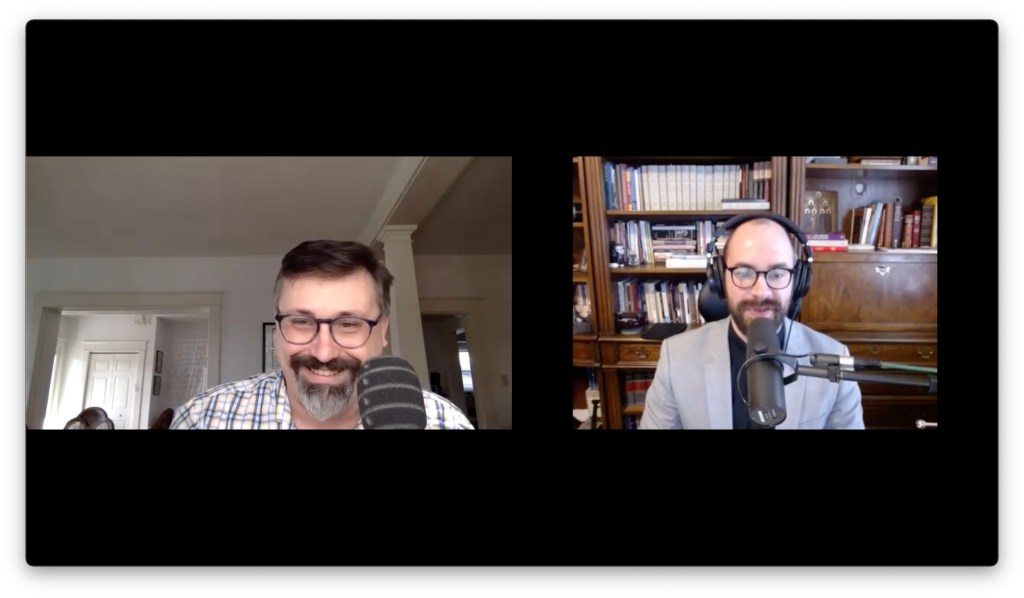
This week on the Strangely Warmed podcast I speak with Jason Stanley about the readings for Transfiguration Sunday [B] (2 Kings 2.1-12, Psalm 50.1-6, 2 Corinthians 4.3-6, Mark 9.2-9). Jason serves as the co-ordinator for Church Revitalization for the Elizabeth River District of the Virginia Conference of the UMC. Our conversation covers a range of topics including pandemic parenting, transfiguring the Transfiguration, Thor of Asgard, real peace, church revitalization, living in the light, the Law and the Prophets, and listening to the Lord. If you would like to listen to the episode or subscribe to the podcast you can do so here: The Vocative God
I thank you that you have answered and have become my salvation. The stone that the builders rejected has become the chief cornerstone. This is the Lord’s doing; it is marvelous in our eyes. This is the day that the Lord has made; let us rejoice and be glad in it. Save us, we beseech you, O Lord! O Lord, we beseech you, give us success!
Luke 20.9-19
He began to tell the people this parable: “A man planted a vineyard, and leased it to tenants, and went to another country for a long time. When the season came, he sent a slave to the tenants in order that they might give him his share of the produce of the vineyard; but the tenants beat him and sent him away empty-handed. Next he sent another slave; that one also they beat and insulted and sent away empty-handed. And he sent still a third; this one also they wounded and threw out. Then the owner of the vineyard said, ‘What shall I do? I will send my beloved son; perhaps they will respect him.’ But when the tenants saw him, they discussed it among themselves and said, ‘This is the heir; let us kill him so that the inheritance may be ours.’ So they threw him out of the vineyard and killed him. What then will the owner of the vineyard do to them? He will come and destroy those tenants and give the vineyard to others.” When they heard this, they said, “Heaven forbid!” But he looked at them and said, “What then does this text mean: ‘The stone that the builders rejected has become the cornerstone’? Everyone who falls on that stone will be broken to pieces; and it will crush anyone on whom it falls.” When the scribes and the chief priest realized that he had told this parables against them, they wanted to lay hands on him at that very hour, but they feared the people.
Listen.
There was a man who planted a great vineyard. But it was too big for him to manage it all by himself so he leased it out to tenants and then decided to go on a little vacation.
When the appointed season came, the landowner sent someone to the tenants in order to receive his share of the harvest.
But the tenants, they beat him up, insulted him, and sent him away with nothing.
The landowner, not one to give in easily, sent someone else, but this one was also wounded and tossed to the dirt.
This pattern kept repeating itself until the landowner decided to send his son, his beloved son, the one with whom he was well pleased, but when the son arrived the tenants decided to murder him where he stood in order that they might receive his inheritance.
What do you think the landowner will do next?
Jesus’s parabolic stories are, as Robert Farrar Capon puts it, used not to explain things to our satisfaction, but to call attention to the unsatisfactoriness of all our previous explanations and understandings.
This story, this parable of the so-called “wicked tenants” is, as we like to call it in the church, a parable of judgment. However, the parables of judgment don’t often function the way we think they’re supposed to work. Judgment, after all, is supposed to come down on all the evil-doers and the sinners and the riffraff with swift condemnation.
And yet, Jesus presents divine judgment in all sorts of stories against the backdrop of an all-inclusive grace. That is, characters are completely included far before they are excluded – they are accepted before they are judged.
Grace and mercy, rather than punishment and retribution, are the starting points.
Contrary to how the church so often functions, Jesus isn’t really trying to convince us, or the crowds, of anything. He simply stands to deliver story after story giving us glimpses behind the curtain of the cosmos and dares us to do nothing more than believe.
But, of course, that sounds too good to be true.
No matter how much we talk about God’s mercy, no matter how many times we talk about God as love, no matter how many times we sing Amazing Grace, we don’t really like it. Because, taken seriously, God’s grace is far too available. It throws parties for prodigal sons, it drags in undeserving people right off the street, it makes space for the last, least, lost, little, and dead and it doesn’t have much of anything to do for those who consider themselves “good” people.
Therefore, the hearers of Jesus’ parables of judgment, including us, are those in need of help. We, too often, forget about God’s mercy for sinners. We’ve deluded ourselves into thinking that, by and large, we’re all perfectly fine (thank you very much).
No need for forgiveness if you haven’t made any mistakes.
No need for absolution when you haven’t sinned.
The only problem with all this is the fact that we’re all sinners!
We all do things we know we shouldn’t, and we all avoid doing things we know we should.
But we like the church, part of God’s incarnate Kingdom, to be a little more orderly.
We can take it from here God! We don’t need You mucking up our good thing.
We assure people that God loves them, but we make it clear that they all need to fit into a certain mold before they will fit in with the rest of us. We want the kingdom of our own making rather than the in-breaking of God’s Kingdom in which the first will be last and the last will be first.
And for that, we stand accused.
But, it’s precisely here that the Gospel really comes into its own. Because, as the accused, we haven’t a change in hell of making an argument for ourselves. But then, wonder of wonders, Jesus as the judge and the jury stands not only to defend us, but also to take our sentence upon himself, seeing us free for no good reason except the Gospel!
Listen – Jesus’ authority has been called into question, yet again, and he responds with a parable: A man planted a vineyard. Vineyards, notably, are a favorite setting of Jesus’ and they echo throughout the scripture from Genesis, to Isaiah, to Jesus’ favorite playlist of all, the Psalms.
The man plants the vineyard and leases it out to tenants. But when he sends a messenger to collect his portion of the harvest, the tenants beat him and send him away.
Jesus, throughout his ministry, tells a whole lot of strange tales, and this one is no different in it’s bizarreness.
Consider – There is no good reason for the landowner to expect that the wicked tenants will do anything but murder his son just as they had done horrible things to his previous messengers.
Equally crazy is the tenants thinking that by murdering the heir of the vineyard they, themselves, will inherit it. The only thing they’ll inherit is the unquenchable wrath of the landowner who will now bring down the hammer of righteousness.
In the end, the problem with the tenants (in addition to their violent and murderous rampage) is that they, simply, can’t and don’t trust the landowner. Who, by the way, gave them land to till that they never would have had were it not for the landowner’s generosity!
The tenants trust only in themselves and look where it gets them.
Having thus parabolically flipped things on their head, Jesus dangles a question and answer for the authorities who called into question his authority – What will the landowner do next? He will come and destroy the tenants and give their land to other people.
“Heaven forbid!” they reply.
And then Jesus ties it all up with, of all things, a reference to the Psalms: “What do you think it means that the stone the builders rejected has become the chief cornerstone?”
“Don’t you see?” Jesus seems to say, “All of this is exactly what God has promised from long ago. The Messiah is not like you have imagined, the Messiah is not like the tenants who take matters into their own hands and use violence as the means by which they accomplish their goals. The Messiah is going to be rejected, murdered, and abandoned.”
The stone will be rejected by the builders, and will still become the chief cornerstone of God’s cosmic victory!
It is precisely in rejection, in unacceptability, that the Messiah brings salvation.
The world, in the end, isn’t saved through works, or in goodness, or in any other of our machinations – the world is, instead, saved through the rejection of the Jesus, in his crucifixion, death, and resurrection.
Now, that all sounds good, but in our heart of hearts we mutter, along with the authorities of Jesus’ day, “Heaven forbid!”
We don’t really want the landowner’s son to come up to us and say that all has been forgiven. We think of ourselves as generally good people who do good things – for what then would we need forgiveness?
We don’t really like to consider the ramifications of the Good News and what it means for all of us. Because if the Good News is really for everyone, then God’s inviting to his party a whole lot of people we wouldn’t be caught dead with.
We don’t really want this to be true, because we’ve been spoon fed a version of faith in which we think being well behaved, or pious, or holy, is more important than trusting God to do what God said God would do.
In the end, we want to be the ones in control. We, like the foolish tenants in the story, we try to stop the paradoxical power of grace that alone can save us, and instead we take refuge in a who lot of nonsense that only insures we will lose in the end.
We flock to the likes of Facebook and Twitter assuming that our self-righteousness will be enough to correct all the problems with other people.
We assume that if we just elect the right politicians everything will be perfect.
We take matters into our own hands whenever possible believing we know what’s best for ourselves and for the world.
But, and here’s the truly Good News, we can’t stop the paradoxical power of grace that is Jesus Christ! Jesus died for the sins of those who killed him, even for the sin of believing in ourselves more than in the One who has come to save us.
For as bizarre as the parables are, perhaps the most confounding part of Jesus’ stories is that, having told all of them, he then goes and acts out what he’s been talking about from the beginning. Like the psalm pointing ahead to the rejection of the stone that will become the cornerstone, it’s in Jesus’ passion, death, and resurrection that he makes manifest the mystery of the kingdom in which no one has to do anything to be saved except truth that someone has done it all for us.
The stone that the builders rejected has become the chief cornerstone. This is the Lord’s doing; it is marvelous in our eyes. This is the day that the Lord has made; let us rejoice and be glad in it. Amen.
“Christ did not enchant men; He demanded that they believe in Him: except on one occasion, the Transfiguration. For a brief while, Peter, James, and John were permitted to see Him in His glory. For that brief while they had no need of faith. [Then] the vision vanished, and the memory of it did not prevent them from all forsaking Him when He was arrested, or Peter from denying that he had ever known Him.” – W.H. Auden, A Certain World
I’ve always been enchanted with Jesus’ Transfiguration.
It’s one of those Gospel stories that is so filled to the brim with details that I discover something new every time I return to it.
Moses and Elijah appear – representing both the Law and the Prophets.
God speaks from a cloud – not unlike the pillar of smoke that accompanied the Israelites post Egypt.
Peter requests to build dwelling places – honoring the traditional response to a divine moment only to be brushed aside by Jesus.
But this year I’m sitting with the fact that, as Auden notes, those three disciples saw Jesus in his glory and still abandoned him in the end.
The life of faith is a transfigured life in that, we cannot return to what we once were, but we’re always falling back into the same rhythms – God will not leave us to our own devices and yet, we sure are hellbent on returning to them over and over again.
The disciples catch a glimpse behind the curtain of the cosmos and they still throw it all away.
While this should certainly give us pause, it should also give us encouragement – God does not give up on us even if (and when) we give up on God.
Michael Kiwanuka’s “I’ve Been Dazed” has a melancholic feel but the lyrics point to something greater. For a singer/songwriter wrestling with self-doubt, the song stands as a witness to the power of music. The repetitious “The Lord said to me / Time is a healer / Love is the answer / I’m on my way” feels as if the words could’ve been on the lips of Jesus heading down from the mountain knowing that Jerusalem was hanging on the horizon.
One of my favorite musical moments occurs when an artist blindsides the listener with a change in tone and feel midway through the song. Loving’s “If I Am Only In My Thoughts” hits with this one guitar note right in the middle that leads into a simple solo with all sorts of ear-wormy goodness. Similar to Kiwanuka’s “I’ve Been Dazed,” the song, to me, feels reminiscent of Christ’s Transfiguration.
Finally (because, how could I not include it?) we’ve got Sufjan Stevens’ “The Transfiguration.” I will never forget hearing the opening banjo strumming live in Asheville NC more than a decade ago, and a huge crowd joining together in one voice at the end to triumphantly declare: “Lost in the cloud, a voice. Have no fear! We draw near! / Lost in the cloud, a sign. Son of man! Turn your ear. / Lost in the cloud, a voice. Lamb of God! We draw near! / Lost in the cloud, a sign. Son of man! Son of God!”
This week on the Strangely Warmed podcast I speak with Alan Combs about the readings for the 5th Sunday after Epiphany [B] (Isaiah 40.21-31, Psalm 147.1-11, 20c, 1 Corinthians 9.16-23, Mark 1.29-39). Alan serves at First UMC in Salem, VA. Our conversation covers a range of topics including online prayer, defining the divine, Beastie Boys, practiced patience, Five Irony Frenzy, unpacking the Gospel, lettuce sermons, the heart of integrity, and preaching the same sermon over and over again. If you would like to listen to the episode or subscribe to the podcast you can do so here: God’s Reigning Attribute






 think and let think