When Should We Pray? – Sermon on James 5.13-20

James 5.13-20

Are any among you suffering? They should pray. Are any cheerful? They should sing songs of praise. Are any among you sick? They should call for the elders of the church and have them pray over them, anointing them with oil in the name of the Lord. The prayer of faith will save the sick, and the Lord will raise them up; and anyone who has committed sins will be forgiven. Therefore confess your sins to one another, and pray for one another, so that you may be healed. The prayer of the righteous is powerful and effective. Elijah was a human being like us, and he prayed fervently that it might not rain, and for three years and six months it did not rain on the earth. Then he prayed again, and the heaven gave rain and the earth yielded its harvest. My brothers and sisters, if anyone among you wanders from the truth and is brought back by another, you should know that whoever brings back a sinner from wandering will save the sinner’s soul from death and will cover a multitude of sins.

00030228_h


Sunday morning: 11am. The gathered community of faith was sitting patiently in the pews waiting for the worship service to begin. Week after week the people sat in the same pews with the same expressions on their faces. Year after year they listened to preachers come and go telling the same stories about Jesus from different perspectives.

It was just like every other Sunday morning. Mr. Smith sat all the way up on the right hand side in the front pew with his notebook and pen in hand ready to take notes on whatever he heard. Jimmy, John, and Josh were midway back on the left quietly giggling while drawing stick figure battles all over the bulletin. And Miss Ethel, old and frail, was still slowly making her way up the center aisle while the first hymn was being played.

Worship is repetitive; for nearly two millennia Christians have gathered once a week to say the same prayers, hear the same stories, and sing the same songs. Worship is just like any good habit, and the longer you have it, the more fruitful it will become.

The congregation sat attentively while the pastor preached on the power of prayer. The seasoned Christians had heard sermons like this one before; they could almost imagine how the preacher would tie it together before he even spoke the words. The newer Christians were getting a little tired of hearing about prayer week after week, they wondered about when the pastor would call for them to lead a revolution to turn the world upside-down, they wanted to hear about power, not about prayer. And the youth, bless their hearts, if you had called their names from the pulpit in the middle of the service they would have looked up with bug-eyed expressions as if their teacher had singled them out in the middle of class.

The preacher was getting to what he imagined was the pinnacle of his proclamation, the words were flowing accordingly, and he no longer needed to look at his notes to drive the point home. As he stood up in the pulpit, gazing out over his gathered flock, he lifted up his fist for the final paragraph and froze in mid-sentence when he saw Miss Ethel slowly slump over in her pew having taken her final breath on earth.

Hands

When are we supposed to pray? James would have us pray all the time. Are any among you suffering? They should pray. Are any cheerful? They should sing songs of praise. Are any among you sick? They should call for the elders of the church and have them pray over them, anointing them with oil in the name of the Lord.

No matter what is going on in life, whether we’re on a mountaintop of joy, or in the bottom of a valley of sorrow, we should pray. We pray in celebration and in defeat, we pray during the mundane, and we pray during the extraordinary.

The end of James’ letter is a favorite among preachers because it explains itself. There’s no need to go digging through the grammar to exegete a strange or divergent meaning. James means what he says:

We should pray all the time.

            Prayers of deep faith will bring about salvation on earth.

The Lord will raise us up.

            Through prayer, any sin can be forgiven.

            We should confess our sins to other people, and pray for others to be healed.

            Righteous prayers are powerful and effective.

            Elijah was just like us, and he prayed for a drought for three years and it did not rain, and as soon as he prayed for the rain to fall, it did.

            If anyone begins to wander away from faithful life, we do well to reach out and bring them back out of love.

            That’s it.

So, then why is prayer such a last resort for many of us?

James clearly outlines that if Christians do anything, they should pray. As individuals and as a community we are defined by the fact that we believe in relying on something bigger than ourselves being active in the world. Yet, more often than not, Christianity has been compartmentalized into just having a personal relationship with Jesus Christ (something you can do without the church). But having a personal relationship with Jesus Christ, though wonderful, is not what Jesus wants from us. Instead, we are called to be people of prayer who live like Jesus in community with our brothers and sisters in faith.

James clearly outlines what prayer can accomplish: it keeps us humble when life is full of success, and it keeps us hopeful when life is full of disappointment; it encourages us to open our eyes to the ways God is moving in the world, and it encourages us to be active participants in God’s kingdom here on earth.

Prayer is about relationship; it’s about connecting with God through the people around us.

The pastor stood in the pulpit and did not know what to do. He was trying desperately to string the final thoughts of his sermon together when Ms. Ethel fell over in her pew and died. He could feel all the eyes in the sanctuary look from her pew, to him in the pulpit, expecting him to do something. But he panicked and froze.

This was not something they covered in seminary, there was no class on ministering to the dead in the middle of a worship service, so the pastor stood in the pulpit and stared back at the church.

One of the ushers immediately called the rescue squad, but the rest of the church slowly stood up from their pews and began to gather around Ms. Ethel’s pew. No directions were offered, no specific pages of the hymnal were referenced, but as if God’s was orchestrating the entire thing, the congregation gathered around her lifeless body and began to pray and sing.

The words of faith came pouring from their mouths, thanksgivings were uttered, and intercessions were demanded. The great songs like Amazing Grace and How Great Thou Art were sung and hummed by the church. And by the time the ambulance had taken Ms. Ethel away, the pastor and the entire church were holding each other in tears of pain and joy, recognizing the loss of life while acknowledging the hope of the resurrection.

When asked later about the moment of prayer, the parishioners simply explained that in the midst of something so profound, the only thing they could do was pray.

james-4x3

Prayer can be beautiful, but it can also be uncomfortable. We don’t like having to wrestle with our finitude, we don’t like having to admit that one day we will die, that’s why weddings are much more crowded than funerals. But prayer, done rightly, is the most faithful thing we can ever do as Christians.

If James had it his way, we would spend more of our time confessing our sins to our fellow Christians. Talk about uncomfortable. When I encouraged all of you to take time to walk up to the pulpit and proclaim your sins, I did so in jest, but it would make us a more faithful community.

Look around the room: you all are beautiful. On the surface you’ve got the right outfits and dispositions. But on the inside, everyone is facing a battle that they rarely share with anyone else. It is a mistake to assume that we are eager to surrender our privacy to the church, but imagine (if you can) what it would be like if we trusted each other enough to do so.

If we could find just one person to confess to, we would make ourselves vulnerable and ready for healing. Confession is the beginning of transformation.

How are we, as a church, shaped by prayer?

Worship is structured around prayer. We pray for God’s presence to be made known to us in this place on Sunday mornings. We pray collectively for the world toward the beginning of the service. We pray silently from our pews lifting up our own joys and concerns. We pray for the offering that is collected by the ushers. We pray through the hymns we sing and the creeds we confess. The best sermons we hear are the ones less about our lives and more like prayers offered to and about God. And we end worship with a prayer.

In addition to worship we pray before our bible studies and youth meetings. We pray before every committee and before the church council. We are a people of prayer… but are we being shaped by prayer?

We are now going to try something that will probably make us uncomfortable.

In a few moments I will ask us to find someone else in church and ask for their prayers. We tried this on Wednesday night at The Circle meeting and it was a challenge. I asked for the youth to give me just one thing that I could pray for regarding their lives. Immediately I heard about friends or family members that needed prayer, but that wasn’t what I was talking about. I asked, “How can I pray for you right now?” and I want each of us to ask that same question right now.

So, as your able, I encourage you to find someone else in the church, you don’t have to wander too far, but find someone that is not in your immediate family. Once we’ve paired up, I want both people to take an opportunity to share something they need prayers for. This doesn’t have to be an ultimate confessional moment, maybe the thing you need is more patience with your children, perhaps you feel confused about decision and you could use some discernment, or maybe you’re unsure about what God is doing in your life.

Whatever that thing is I want you to share it, and the person who hears it will pray about it. The prayer can be as simple as “Lord, in your mercy, hear our prayer.” Or it can be filled with other words. The point is, I want everyone in this church to have the opportunity to share a need they have, and have someone in this church pray for them right away.

I know this is uncomfortable, but sometimes the most faithful things we do as disciples are born out of discomfort. So, let’s give it a try….

In the words of James: Are any of us suffering? We should pray. Are any of us filled with joy? We should sing songs of praise. Are any of us sick? We should call for our brothers and sisters in Christ to come and pray over us. We should confess our sins to one another, and pray for one another, so that we may be healed and transformed. Amen.


Devotional – Deuteronomy 4.9

Devotional:

Deuteronomy 4.9

But take care and watch yourselves closely, so as neither to forget the things that your eyes have seen nor to let them slip from your mind all the days of your life; make them known to your children and you children’s children.

Weekly Devotional Image

Rev. Tom Berlin stood in front of a room filled with pastors in the midst of the ordination process and asked us to consider this important question: “How is your church transforming the world?” He asked us to briefly write down the stories of transformation that we had heard since we started at our appointments, and whether or not we had shared them with the congregation. When we felt like we had enough time to answer the question, we broke up into small groups and debated how the stories could be used to help grow the churches we serve.

Rev. Berlin then told us his favorite story from Florris UMC. Long before he arrived as the pastor, on a typical Sunday morning, a new couple from the community decided to try out the church. The husband sheepishly stood in the middle of the congregation during worship, but when the hymns began he could not contain his operatic and beautiful singing voice. When worship ended a couple from the choir beelined over to the new couple to introduce themselves and invited the man to join the choir. A few days later they called him on the phone and reminded him about choir practice. In the weeks that followed they made sure to check in with the couple in church and ask about their lives in the community. And after the new man had practiced with the choir for a few weeks, the couple baked a pie and brought it over to the new couple’s house to show them how valued they were.

“I know it sounds like such a simple story,” Rev. Berlin said, “and I’m sure each of you have a story just like that one from the church you serve. The point is to keep telling that story over and over until new people start living into it as well. The people of Florris are probably sick of that story, but it has truly shaped the ways we reach out to people even today.”

pass-it-on

We read in scripture about the importance of remembering who we are and whose we are. We learn about the value of taking hold of the moments that have shaped our lives and share them with our children and our children’s children. When we remember what shaped us into the disciples we are today, we are caught up in God’s great story that will continue to unfold into the future.

This week, let us each take time to reflect on the ways the church has shaped our lives: How have you been transformed by your church? What important stories are you telling to you children and your children’s children?

Devotional – Psalm 51.1

Devotional:

Psalm 51.1

Have mercy on me, O God, according to your steadfast love; according to your abundant mercy blot out my transgressions.

Weekly Devotional Image

When I am asked to preside over a wedding, I take full advantage of the opportunity to share the beauty of God’s love. During pre-marital counseling I encourage couples to find a bible verse that relates to their relationship, we discuss what it looks like to pray for our spouse, and we use God’s love as a lens by which we view the love we have for our partner. During the actual wedding ceremony I am unashamedly open about God’s love being at the center of this relationship, and that only with God’s power can all couples live in harmony and peace with one another.

This past Saturday I stood before a gathered community outside under the hot sun for a wedding. With sweat beading on my forehead I shared reflections on the joy of marriage and how God plays an integral role in all of our relationships. I used stories from the couple’s history in order to make the homily approachable, and I even included a number of lines from famous movies because the groom is a self-avowed movie buff. (For example: “Enjoy this time because life moves pretty fast, and if you don’t stop to look around once in a while, you could miss it” –Ferries Bueller’s Day Off)

11781683_10153086252896267_3300763643978016391_n

Following the ceremony I was mingling among the wedding guests when a young woman approached me and said, “I wish my pastor was like you.” Startled by the compliment, I asked her to explain and she described how her pastor “never connects the scripture with regular life” and that she leaves church feeling like she “listened to a lecture.” Our conversation continued for a few minutes, and before we went our separate ways she asked where I was a pastor and told me that she would be joining the church for worship sometime soon.

As I stood there taking in the complimentary conversation, feeling affirmed in my words, and hopeful about a new person coming to church, I was struck with the sensation that I had lost my focus. I let myself get puffed up by her kinds words and I recognized that I selfishly wanted her and her family to start attending the church I serve. I like the idea that she wanted to come to the church because of me. It only took a few words to stroke my ego to such a degree that I forgot my place in the kingdom.

So before she had a chance to walk away and disappear into the crowd I asked her to do me a favor and I said, “Before you come to St. John’s, I think you need to pray for the pastor you have. Maybe God wants you to help him grow and learn what it means to serve your church rather than leaving to just try something different.”

The psalmist calls for God to “blot out my transgressions.” In our daily prayers we thank God for our blessings, and we ask God to intervene in our lives and in the lives of others, but rarely do we pray for God to make us clean, to rid us of our selfishness and false pride. This week, let us take time to be honest about our sinfulness, pray for God to transform us, and begin taking steps into a new way of life.

God Is God And We Are Not – Sermon on Psalm 24

Psalm 24

The earth is the Lord’s and all that is in it, the world, and those who live in it; for he has founded it on the seas, and established it on the rivers. Who shall ascend the hill of the Lord? And who shall stand in his holy place? Those who have clean hands and pure hearts, who do not lift up their souls to what is false, and do not swear deceitfully. They will receive blessing from the Lord, and vindication from the God of their salvation. Such is the company of those who seek him, who seek the face of the God of Jacob. Lift up your heads, O gates! and be lifted up, O ancient doors! that the King of glory may come in. Who is the King of glory? The Lord, strong and mighty, the Lord, mighty in battle. Lift up your heads, O gates! and be lifted up, O ancient doors! that the King of glory may come in. Who is this King of glory? The Lord of hosts, he is the King of glory.

P-019-w_I_Am_Not_God.37205641_std

Be careful.” That’s what they kept saying when they found out I was invited to preach at a church in the heart of Detroit. I had been living in Birmingham, Michigan (a rather wealthy suburb north of Detroit) helping serve a church for the summer when I received the opportunity to fill in at another church one Sunday. And as soon as I was asked, all the warnings started coming in: “Be careful” “Park as close as possible to the church” “Keep your wallet in your front pocket.

I remember thinking these people were crippled by fear, how bad could it really be? We were talking about driving into Detroit on a Sunday morning to preach at a church…

When the morning arrived I was filled with excitement. I picked out the perfect bow tie to go with my blazer, hoping to assert my authority regardless of my young age, I had a prepared a theologically profound manuscript sermon, hoping that it would get people to shout “amen!” from the pews, and I spent the long drive down Woodward Avenue in silence, hoping to boost my holiness before the service began.

The closer I got to the church, the stranger I began to feel. I hadn’t noticed it at first, but the longer I drove, the less people I saw on the streets. The buildings went from inviting homes and businesses to abandoned shells of carpentry. The streets went from well maintained to pot holes that required a car to drive up on the sidewalk in order to avoid.

In a matter of minutes I had gone from “Pleasantville” to a post-apocalyptic movie set, and my excitement was quickly replaced by fear.

By the time I pulled in the parking lot, I realized that I hadn’t seen another human being for at least ten minutes. The streets had been largely deserted leading up to Cass UMC, and it was strangely silent when I stepped out of my car.

So here I was, standing in the heart of Detroit, in a bowtie and blazer, with a bible and sermon tucked under my arm, completely alone on a Sunday morning.

My footsteps across the concrete reverberated in echoes through the abandoned buildings flanking the church and even though it was a bright sunny day, I felt like I was walking down a dark alley in the middle of the night. The building itself was an architectural masterpiece having been built in 1883 with Tiffany’s stained glass windows, though I could tell from the street that bullet holes had cut through the once remarkable windows.

When I reached out my hand to open the doors, the height of my new fears were realized: It was locked.

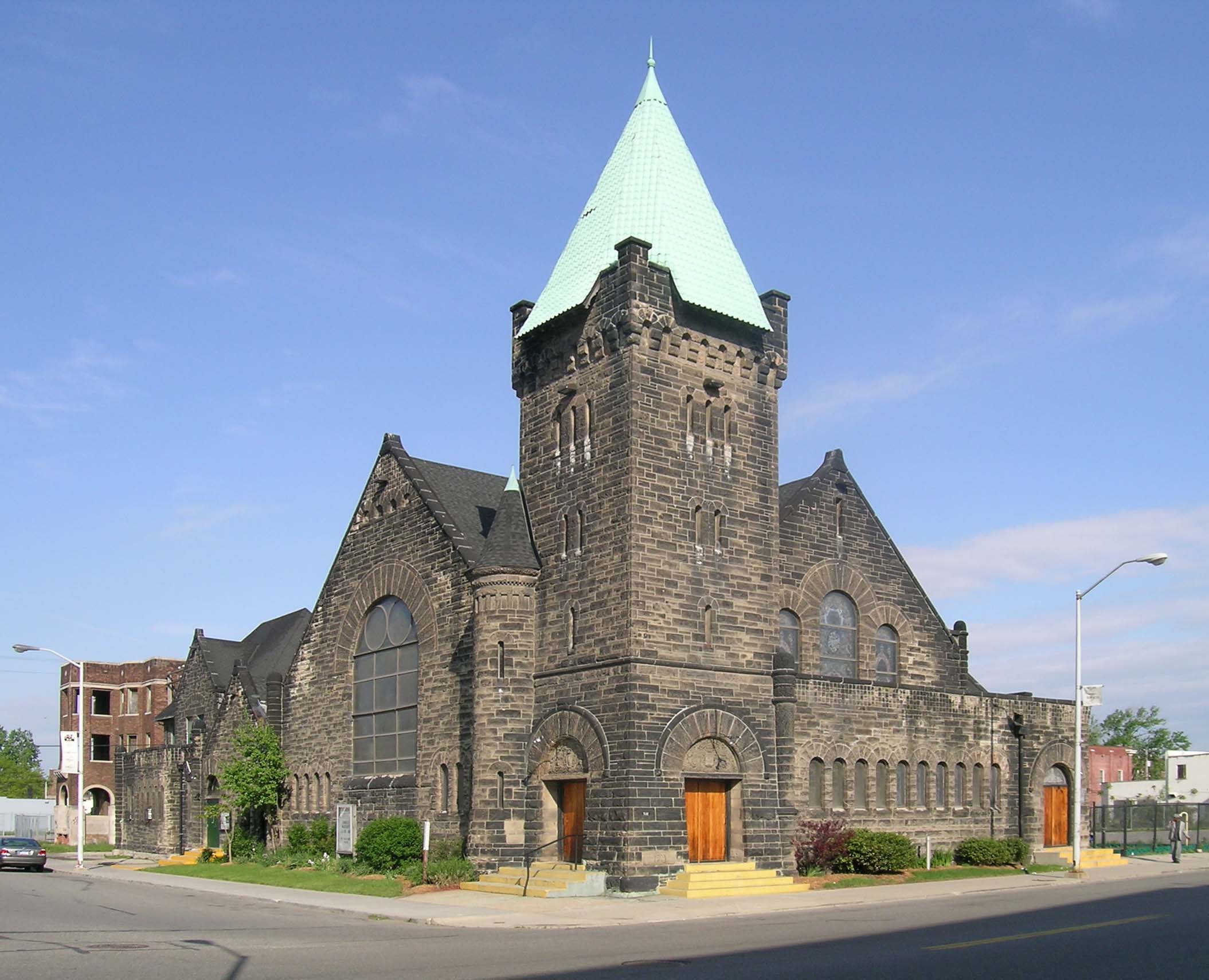
Cass_Avenue_Methodist_Episcopal_Church_-_Detroit_Michigan

I knew no one from the church, I had no way to contact anyone, and all of the warnings started to really flow through my mind. But I did what any good pastor would do, I sat down on the front steps and waited for someone to open the door.

30 minutes later, a disheveled looking old man, the first person I had seen in a long time, peeked from around the corner, walked up the steps, and unlocked the front door without saying a word. I wandered around the building until I found the sanctuary, searched in vain for a worship bulletin, and resigned myself to sit down in a chair by the altar.

During the next hour, the most random assortment of people started flowing in through the sanctuary doors. The church, once renown in the heart of Detroit, was being filled with people who slept outside the night before, people who had no money to put in the offering plate, and people who were having conversations with themselves at a volume loud enough for everyone else to experience.

A group of 7 older black women arranged themselves on folding chairs near the front, and without really discussing it they all flipped their hymnals to the same page and started to sing. A man with wrinkled fingers was hunched over a piano in the corner struggling to keep up with the singing, and a young man had seated himself behind a drum-set hidden in the corner, and was wailing away to a song that only he could hear.

When the first hymn ended, the women huddled together to pick another hymn and began singing. At some point in the middle of their fourth hymn, with the pianist still planking away, and the drummer smashing the cymbals, a gentleman stood up in the middle of the sanctuary with his eyes trained on me. He walked down the main aisle slowly and deliberately until he was towering over me and then declared, “Son, if you don’t start talking, they ain’t liable to quit singing.

The earth is the Lord’s and all that is in it, from the sea to the mountains, from the rivers to the deserts, from the people to the animals; for the Lord has founded life upon the earth. Who then shall worship the Lord in holiness? And who shall stand with the Lord in the holiest of places? Only those who have clean hands, and pure hearts, those who do not lift up their souls to what is false, who do not break their promises. They will receive a blessing from the Lord, and vindication from the God of their salvation. Such is the company of those who seek the Lord.

I stood up after the end of the next hymn, and grabbed the hand held microphone to start participating in worship. I felt like a fool standing in my khakis and blazer, with my bowtie tilted just slightly to the side. I felt ridiculous with my over examined sermon under my arm, and bible in my hand. I felt like I didn’t deserve to stand before the congregation, but all of their eyes were on me. (just like all of yours are right now)

I took off the jacket and tie, rolled up my sleeves, ditched the sermon on my chair, and let the Holy Spirit go to work.

Let us pray” I began, and before I could start praying for our service, the people started shouting out their own prayers. “O Lord, help this boy to preach.” “Yes Lord, show us your mercy.”My God show me your glory!” “Remove our sins, give us your Spirit, clean our hearts!” “Your will be done!” “Have thine own way Lord!” “Help this boy preach, preach preach.

It was only after a few moments of silence that I finally said “amen” without having added any of my own prayers.

I preached on the apostle Paul’s second letter to the church in Corinth, about the new creation that comes in knowing Christ. I talked about moments that transform our lives. I said things like “there is a new life in Christ, but just because we find Christ it doesn’t mean our life will get better, but that we are called to make other lives better.” And instead of the typical, and silent, congregation I was used to, the people kept shouting at me while I preached. “Ain’t that the truth!” “Yes Lord!” “We know it, we know it” “Lord, give him strength to preach.” “Speak through him God.

When I got around to the close of the service, when I offered a benediction to the congregation, when the final amen was uttered, I heard them say in return, “Thank you Jesus.”

be-still-and-know-that-i-am-god-960x250

Lift up your heads, O gates! Open up you ancient doors! the King of glory is coming. Who is the King of glory? The Lord, strong and mighty, merciful and majestic, the Lord. Jesus Christ the author of salvation, the Good News, the Messiah. The Holy Spirit full of wisdom and truth, giver of life, and partner to our prayers. Lift up your heads, O gates! Open up you ancient doors! The King of glory is coming! Who is the King of glory? The Lord of hosts, he is the King of glory.

We can dress the part, we can read all the right books, we can memorize all the hymns and prayers, but unless we are looking for holiness in our lives, unless we are ready to bow down to the King of glory, then we are forgetting the truth: God is God and we are not.

Many of us are good Christians, we pray for our friends and family, we come to church, we put money in the plate, but there is a profound difference between believing we are holy, and wanting to be holy.

When I arrived at that church in Detroit years ago, I foolishly thought I was bringing something to them. With my well prepared outfit and sermon, I made the assumption that I was bringing God with me, nice and shiny, like a school project. I became my own main character in the story of worship, and it prevented me from seeing the King of glory.

When I stood up in the pulpit to proclaim the words, the people did not see a young man with a seminary education, they did not see some white fool trying his best to not pass out, they saw a vessel for the Lord. Their prayers were not to me, but for the Lord to work through me. The recognized the great division between God and me, and knew that Jesus was the bridge between the two.

They knew that God is God and we are not.

In our contemporary American culture, we tend to view ourselves as the center of the universe.

We assume that everything revolves around us, and that so long as our needs are being me, then everything else should be fine.

We believe that if we wear the right clothes, and get the right education, that holiness will follow accordingly.

We feel holy for giving up an hour every week to sit in a place like this and sing hymns, offer prayers, and listen to a sermon.

That church in Detroit had something that I never knew I needed: They believed that God was the center of the story, that God had the power to transform their lives, and that God really was the King of glory.

Too many of my friends have left the church because they “didn’t get anything out of it.” They might try different styles of worship and different denominations, but if they don’t get anything out of it, they will rarely return. However, church isn’t about what we get out of it, its about what God gets out of us.

Believing we are already holy limits God’s power to make us holy.

It is in the recognition of the great divide between humanity and the Lord that we can let Jesus get to work on our hearts and souls. It is in the great admission of Jesus as the King of glory we start to see ourselves, not as the center of the universe, but instruments for God’s love to be heard in the world. It is in the words of our worship that we recognize the Holy Spirit’s movement in our midst and our lives start to change.

If we remain in the assumption of our holiness, then our lives will stay the same.

But if we truly desire for the Lord to make us holy, then our lives will be transformed. Amen.

Devotional – Psalm 85.12

Devotional:

Psalm 85.12

The Lord will give what is good, and our land will yield its increase.

Weekly Devotional Image

When I was appointed to serve St. John’s UMC two years ago I asked a number of people about the goals of the church: What do we want to look like in five years? What ministries need greater attention? Where is the church heading? I asked and asked and was surprised to discover that our collective vision did not extend past next Sunday; so long as our doors stayed open, and we had people sitting in the pews, we would be content.

For two years this limited vision permeated everything we did as a church and we have been far more concerned with maintenance than mission. Yet at the same time our church has grown in numbers and faithfulness as we continue to discern the will of God for our lives and for the church. In light of this, I grew so accustomed to the status quo, and the consistent growth, that I neglected to start looking toward the future until I heard a sobering statistic at Annual Conference this year: The average person in a United Methodist Church invites someone to worship once every 38 years.

grow

In the wake of discovering this frightening statistic, I felt convicted by the Lord so start looking further than next Sunday and create goals for our church.

1) We grow in faithfulness by giving time every day to God in prayer.

2) We grow in attendance by inviting people to discover the love of God.

3) We grow in stability by offering our gifts and talents to the Lord.

If the mission of the church is to form disciples of Jesus Christ for the transformation of the world, then it is our responsibility to pray faithfully, invite lovingly, and give generously. We are called to be Christ’s body for the world and are equipped by the Lord to do so.

Our first goal is to grow through prayer so that we might be transformed into better disciples. By giving time to God every day in prayer we will start to see how true the psalmist really was: “The Lord will give what is good, and our land will yield its increase.” The Lord will grow our faithfulness, attendance, and stability so long as we are willing to play a part in this mission as well.

As we prepare to take steps into a new week, let us take time to reflect on the church that God has so graciously given to us. How can we be better stewards of this place? Where is God calling us to serve within the community? What goals do we have for the church?

Devotional – Psalm 130.1

Devotional:

Psalm 130.1

Out of the depths I cry to you, O Lord.

Weekly Devotional Image

When I heard about the shooting at Emanuel AME Church in Charleston, South Carolina I was shocked. The initial details conveyed a frightening scene: a lone gunman had attacked and killed 9 individuals who had gathered together for prayer. But perhaps the most frightening detail is the fact that he had participated in their prayer meeting for an hour before he began shooting. The attack at Emanuel AME is harsh reminder of the powers of evil that are manifest in our world.

The day following the shooting I knelt in the sanctuary at St. John’s and tried to pray but the words would not come. What good are words in the midst of such tragedy? How can we pray to our God when our emotions are so devastated by the events swirling around us? How can we be faithful and angry at the same time? So, when I was invited to a prayer vigil that evening at Allen Chapel AME in Staunton I knew I needed to go.

When the service began, the pastor invited all of his fellow clergy to surround him in the pulpit because “the only way we can get through this is in community.” While he prayed for the Good Lord to strike our hearts and calm our fears and frustrations, he was surround by pastors from a myriad of denominations, the sanctuary was filled with faithful disciples spanning the great mosaic of Christianity, and we all struggled to pray in the midst of such tragedy.

There was no order of worship. There was no list of scriptures to be read. There was no attendance pad being passed through the pews. Instead we called for the Holy Spirit to guide us, shape us, and nurture us throughout our vigil. As the Spirit led us we read words from the psalms and each pastor took a turn leading the congregation in corporate or silent prayer. Our responses ranged from lifting our fists in angry frustration to singing together “Thank You Lord.” At times we stood and held one another and at others we prayed on our hands and knees. We did as the Spirit commanded and we discovered the Lord in our midst.

hear_my_cry_o_lord_wide_t_nv

One of the most faithful prayers we can ever utter starts with the words from Psalm 130: “Out of the depths I cry to you, O Lord.” Prayer is not something that has to be precise and perfect, it does not need to be all lovey-dovey, and it does not have to be filled with theological and academic language. The truest prayers are the ones that come naturally and really affirm where we are while we pray. It was from the depths of human suffering that we all prayed to the Lord that night, and the Lord listened.

This week, as we pray for the people in South Carolina, let us all remember that it is good for us to pray from the depths of our souls, that it okay for us to be angry with God while venting our frustrations, and that the only way we can get through this is in community.

If you would like to know more about the prayer vigil that took place at Allen Chapel you can watch a video about it here: Staunton Prayer Vigil

10 Things I Learned From My Second Year Of Ministry

Last year my friend, peer, colleague, and theological-hero Jason Micheli (The Tamed Cynic) asked me to write a post on ten things I learned my first year of ministry. Next week marks the beginning of my third year as a United Methodist pastor so I decided to write another post on ten things I learned during year two.

10872995_835432513146512_7937253830158410370_o

1.       The Church Is Huge

How do you measure the size of a church? Is the church as large as the Sunday worship attendance? The membership role? Throughout the last two years I have realized that the church is almost always larger than I think it is. I’ll be out somewhere with my wife when a stranger will ask if I am the pastor of St. John’s. Between our preschool and missional involvement, the community of faith (also known as the church) has connections with people all over the place. It is always important for me to remember that I have been called to serve the needs of the community, which is usually larger than I think it is.

2.       Praying Is As Important As Breathing

The Bishop for the Virginia Annual Conference, Young Jin Cho, is known for saying “No spiritual vitality, no vital congregations.” And he’s right. Prayer, and other spiritual disciples, are immensely important for the work of ministry and the local church. I strive to begin every morning in the sanctuary with time dedicated to prayer. If I neglect this discipline it has a negative impact on the rest of my day. Like feeling short of breath, I am not as active nor am I as attuned to the Spirit’s work in my midst. Regular prayer is as important to discipleship as breathing is to living.

3.       Collaboration > Competition

There are a lot of churches in the community I serve (I can see four different steeples from my front yard). I have heard on a number of occasions that there are more churches in Staunton per capita than anywhere in the United States. I have no way to confirm whether or not this is true, but just driving around town leads me to believe that it could be true. Over the last two years I have had the privilege of working with other pastors to help live into the kingdom of God here on earth. When we work in collaboration, and stop seeing each other as competition, we participate in Jesus final prayer: “I in them and you in me, that they may become completely one, so that the world may know that you have sent me and have loved them even as you have loved me.” (John 17.23) If the church wants to thrive, then we need to realize that we are all in this together, regardless of our denominational affiliations.

4.       Weddings Are Hard

Compared to some of my colleagues I have done a high number of weddings during my short time in ministry. At the age of 27 I meet a lot of people who are nearing their wedding and I am often asked to officiate. I love celebrating the covenant of marriage, but it can be very hard. What an average person experiences during a wedding is a beautiful thing, but it requires a tremendous amount of planning and work to go well. Not only do I have to take the time to meet with the couple ahead of time for premarital counseling, but I want to make sure that I give them all that I can to make their day worthy of God’s blessing. The metaphor of a shepherd with sheep finds its fullest meaning during weddings when I feel like I am primarily a people-mover. Weddings are great, but they can be hard.

5.       Funerals Are Harder

I once heard a pastor say, “I would take a funeral over a wedding any day.” That comment confused me when I heard it for the first time, and still confuses me to this day. During my first year of ministry no one passed away within the community of faith, and I therefore was not required to preside over a funeral. During my second year of ministry I had 14 funerals. Most of the people had lived long and full lives, but that does not diminish the amount of grief that our community has experienced over the last year. It is such a privilege to be invited into the midst of such uncertainty in people’s lives, but it is also incredibly difficult. I spend a tremendous amount of time preparing for every funeral because I believe in the incredible importance of celebrating every life, death, and resurrection.

6.       Trust Happens

Over the last two years I have lost track of how many times I have heard someone say, “You’re the first person I’ve ever shared that with.” It happens on a regular basis that an individual will come to my office, share a vulnerable story, and then slowly realize that they had never shared that with anyone. Regardless of what I say of Sunday mornings, or even how I pray, people trust the office of pastor. There is an acceptance of confidentiality and a comfort of confession that takes place in my office that I am rarely prepared for. Trust happens all the time and it is at the heart of what it means to be in relationship with others.

7.       Change Happens

11070416_10203768021631999_8256385505868925548_n

Just because something worked the first year, it doesn’t mean that it will work the second. And just because something failed the first year, it doesn’t mean that it won’t succeed during the second. For example: During my first Good Friday I carried a cross on my shoulder through the greater Staunton community and received almost no response. People avoided me on the streets, averted their eyes, and acted as if I was invisible. This year I did the same thing on Good Friday and people would not stop talking to me! People wanted to know what I was doing, offered to pray with me, and I even shared the story of Jesus with a woman who started crying when she saw me on the street. Change happens in ministry and that is a good thing! If doing church was just about maintaining the status quo year after year, we would cease to be fruitful for God’s kingdom.

8.       I Am My Own Worst Enemy

I know of few vocations where someone has to produce something on such a regular basis and is met with immediate feedback. In two years I have written and preached more than 104 sermons. Every Sunday, within 30 minutes of preaching, everyone lines up to shake my hand and tell me what they thought. I have discovered that the sermons I worried about the most are the ones that were the most life-giving to the congregation, and the sermons I was most confident about meant very little to the gathered body. I am my own harshest critic when it comes to ministerial responsibilities and I have to constantly remind myself of who I am, and whose I am. If I put too much weight on my inner-monologue, I neglect to remember that I am working for the kingdom, and not for myself.

9.       Numbers Are Important [And Dangerous]

Every week churches in United Methodism are required to log their statistical data and send it along to the conference. Though I actively worry about how the measuring of statistical data is negatively affecting God’s church, it is important because numbers represent people. Whether we like to admit it or not, Jesus commanded his disciples to “go and make disciples.” If we are serious about being disciples of Jesus Christ, then we have to be willing to go outside of our comfort zones to welcome people into our church and help to grow the kingdom. However, even though numbers are important, they are also dangerous. I have caught myself, on a number of Sunday mornings, counting the number of heads in worship before the opening hymn. And sometimes I let that number have too much of an impact of what takes place after the opening hymn (both positively and negatively). Doing ministry is about living in the tension between growing the vineyard, and nurturing the vines. Numbers are important, but they are also dangerous.

10.   I Still Have The Best Job In The World

Stanley Hauerwas once said that “doing ministry is like being nibbled to death by ducks.” There are days in ministry that affirm his comment, but most of the time it is the greatest job in the world. Where else could I spend time deep in God’s Word? What job would give me the opportunity to preside over something as precious as the water dripping on a child’s head in baptism or breaking off a piece of bread for a faithful disciple? What vocation would bring me to the brink of life and death on such a regular basis? It is a privilege to serve God’s kingdom as the pastor of St. John’s and more rewarding than I could have ever imagined.

Confronting Conflict – Sermon on Isaiah 6.1-8

Isaiah 6.1-8

In the year that King Uzziah died, I saw the Lord sitting on a throne, high and lofty; and the hem of his robe filled the temple. Seraphs were in attendance above him; each had six wings: with two they covered their faces, and with two they covered their feet, and with two they flew. And one called to another and said: “Holy, holy, holy is the Lord of hosts; the whole earth is full of his glory.” The pivots on the thresholds shook at the voices of those who called, and the house filled with smoke. And I said: “Woe is me! I am lost, for I am a man of unclean lips, and I live among a people of unclean lips; yet my eyes have seen the King, the Lord of hosts!” Then one of the seraphs flew to me, holding a live coal that had been taken from the altar with a pair of tongs. Then seraph touched my mouth with it and said: “Now that this has touched your lips, your guilt has departed and your sin is blotted out.” Then I heard the voice of the Lord saying, “Whom shall I send, and who will go for us?” And I said, “Here am I; send me!”

6292687510_a9b81d37f4_z

Tell me about your last fight.” So began one of my recent premarital counseling sessions. The couple danced around the question for a few moments, claiming they couldn’t remember the last time they had a fight, but when I started to ask more specific questions the answers started pouring out. Their conflict could be boiled down to a lack of communication, and when I sat there with them I saw them begin to share things with one another for the very first time. Before we went on, I couldn’t help myself from asking, “Why haven’t you talked about this stuff before?”

The woman sat in my office with her head hung low. It took her a few minutes to muster the courage to begin telling her story, and when she started it came out like the floodgates were opening. She felt invisible to her husband, no matter what she did, he would brush it off and continue to focus on the task before him. She was afraid that she had done something wrong and didn’t know where else to turn so she came to me. We talked together about her situation, but I couldn’t help myself from wondering, “Why hasn’t she told her husband how he makes her feel?

We were sitting on the edge of a property in West Virginia after nearly a week on our mission trip. The young boy was from a different church, but I could tell something had sent him over the edge. His tears fell slowly and deliberately as he confided in me about his struggles. He could not longer stand being treated like an infant or a child. He had important ideas and things to share but everyone brushed him aside instead of treating him with worth. Rather than being supported in his discipled journey, he felt like he was all alone and he was worried. I listened, but I also knew that when the end of the trip arrived he would be going home to a different community and a different church so I asked, “Is there someone from home that you can share all of this with?” And he said, “I don’t know, I’m afraid.

In each of your bulletins you will find a piece of paper about the size of an index card and I would like you to hold it in your hand. We’re going to have some time for silence, and during that time I want everyone to write down the name of one person that you are currently in conflict with.

Maybe your mother-in-law has been driving you crazy with her relentless need to tell you how to raise your family. Perhaps your boss continues to heed your advice, but then takes all the credit when things go right. Maybe your son has made some poor choices and you can’t remember the last time you had a decent conversation about anything. Perhaps one of your best friends is letting their backwards political opinions isolate them from what it means to be a decent human being. Maybe your pastor has been preaching all sorts of sermons that you definitely do not agree with.

So take a moment, and write down a name. No one will see it but you. When you’ve finished, I want you to hold the card in your hand for the rest of the sermon.

In the year King Uzziah died, Isaiah saw the Lord sitting on a throne. God encountered the soon-to-be prophet in the midst of something important. Uzziah was an arrogant ruler, and his arrogance led to his death. Even though his reign brought economic prosperity, he neglected to respect the temple and the worship of God. It was at this particular time, in the wake of Uzziah’s death that Isaiah was called to speak.

The call is frightening. The Lord is high and lofty with the hem of his robe filling up the entirety of the temple. Seraphs, winged creatures, were flying above the Lord, each with six wings. One of them called out to another and declared, “Holy, holy, holy, is the Lord of hosts; the whole earth is full of his glory!

Everything around Isaiah began to shake and tremble and the room filled with smoke. Only then does Isaiah muster up the courage to say anything at all, “Woe is me! I am lost, for I am a man of unclean lips, and I live among a people of unclean lips; yet my eyes have seen the King, the Lord of hosts!

Isaiah was confronted with the utter and radical holiness of the Lord. With wind spinning, floors shaking, and voices trembling, Isaiah is struck with the realization of his own unworthiness and the unworthiness of his people. Have you ever felt unworthy when confronted by something greater than yourself?

When I saw my wife Lindsey walking down the aisle at my home church to meet me at the altar for the covenant of marriage, I felt completely unworthy. When I held Archer and Abram Pattie in my arms above the baptismal font and brought them into the fold of God’s kingdom, I felt completely unworthy. Every month when I serve communion here at the front of the church, I am met with eyes of Christians who have lived far more faithfully than I ever will, and I feel completely unworthy.

God’s majesty, whether through the beauty of creation, a call vision, or the people in our lives often leaves us feeling pretty feeble. When we discover the divine we can only feel that much more mortal. When we encounter the infinite, we are reminded of our finitude. When we meet the living God, we can’t help but wonder about the lives that he gave to us.

God’s call is frightening. God calls the young and old, men and women, to abandon their former and sinful ways to live fully in Christ. God called a young prophet to speak harsh truths to a community that had grown far too complacent. God continues to call all of his children to be prophetic with our words and our actions.

The call is frightening and scary enough. But when we respond, when we answer the call, the real trouble begins.

hereami2

Then one of the seraphs flying high above the Lord came down to Isaiah with a live coal that had been taken from the altar with a pair of tongs. The seraph touched his mouth with the burning coal and said, “Now that this has touched your lips, your guilt has departed and your sin is blotted out.” Then Isaiah heard the voice of the Lord saying, “Whom shall I send, and who will go for us?” and Isaiah said, “Here am I; send me!

Isaiah was dramatically changed through his encounter. The flaming coal not only cleansed him, but it also gave the him the power to speak on behalf of the Lord. In a matter of moments he went from crying out, “Woe is me! I am lost” to “Here am I; send me!

This whole story about Isaiah’s call is a lot like what we do in worship. We come together to praise the almighty God, we pray and confess our unworthiness, and then seek forgiveness. We pray for God to give us the grace and strength to hear the Word with faith so that we can respond accordingly.

How we worship matters because it shapes us into the disciples we are called to be. Every Sunday is like Isaiah’s call. We meet the Lord in the words from scriptures, prayers, hymns, and our brothers and sisters. Through that encounter we are called to live out our faith as soon as we depart in a way that will make God’s kingdom reign. All of these things that we do on a weekly basis, they are done to attune us to the voice of God who speaks into our lives.

Isaiah’s call, this dramatic and overpowering moment in the temple, reminds us that when we encounter the living God, there is not way to know God without being changed. Like a coal coming from the altar to our lips, we are tasked with speaking words like fire. Like a frightened prophet we are given the power to cry out “Here am I; send me!

The prophet was called to speak during a particular time, to sinners in the midst of sin. If we hear something from God’s Word today it should be a similar call. We should not be afraid to names the sins of our time, just as Isaiah did when he confronted the people’s political arrogance, spiritual pride, and economic injustice.

Abraham had to confront the Lord who promised to make his descendants more numerous than the stars. Jacob had to confront his twin brother Esau who sought to kill him for stealing his blessing. David had to confront King Saul who was jealous of the Lord’s favor. Isaiah had to confront a people who neglected to thank God for being the source of all their blessings. Jesus had to confront a religious elite who no longer practiced what they preached. Peter had to confront the gentiles and welcome them into the fold of the church. Paul had to confront his own sinfulness and call others to do the same.

Christians, for centuries, have been called by God to confront the conflict in their lives. To be faithful is to meet the outcasts where they are and show them love. To be a disciple means a willingness to forgive people when they have done something wrong. To follow Jesus means having the courage to ask for forgiveness when we have done something wrong.

What situation are you in right now that God is calling you to confront? I believe the holy Lord of hosts is personally addressing each and every one of us in the scripture today. Who do we need to call out? Where are the conflicts in our lives?

In each of our hands we have a name that represents a conflict in our life. Some of them can be confronted with a phone call or a conversation. Some of them can be confronted with our willingness to forgive a wrong that was done toward us. Some of them can be confronted with the simplest of gestures.

It might not go well. If we take the first step to confront one of our conflicts, it might blow up in our faces. But the longer we let these names stay on paper, the longer the conflict will keep us from fully living out our identities as disciples. The longer we let the conflict simmer, the longer we will be people of unclean lips living amidst unclean lips. The longer the conflicts remain, the harder it will be to hear the living God speaking into our lives.

The voice of the Lord is saying to all of us, “Whom shall we send, who will go for us to confront the conflict?” Our answer should be the same as Isaiah’s, “Here am I, send me!” Amen.

00021958_h

Devotional – Psalm 29.2

Devotional:

Psalm 29.2

Ascribe to the Lord the glory of his name; worship the Lord in holy splendor. 

Weekly Devotional Image

Every church is unique. Even if you had the same architect and the same builders and the same property size, churches are what they are because of people, and people are always different. Some churches value high liturgy and spend their Sunday services standing up, sitting down, kneeling, praying, singing, and listening. Others believe in the importance of contemporary music with big bands, projections screens, and coffee at the front door. Every church is unique.

Before I arrived at my current appointment I wondered about the uniqueness of this place. I pondered about their comfort with the hymnal, what expectations they had out of worship, and where they would be heading. Did they use the Lord’s Prayer? Did they affirm their faith with the Apostles’ Creed? etc. And I spent a good amount of time wondering how they dressed for church on Sundays.

hangars

I grew up in a church where ushers were required to wear ties on Sunday mornings. I have helped a church that expected men to wear full suits, and women to wear dresses for worship. And I have spent time at a church that if you weren’t wearing blue jeans, you were the odd one out. What people wear to church says a lot about what they expect from worship, and the kind of people they are hoping to attract.

I was therefore pleasantly surprised to discover that the people at St. John’s arrive on Sundays in a great plethora of fashion. We have suits, dresses, khakis, jeans, flip-flops, yoga pants, and everything in between. No one is judged for what they wear (so long as they are wearing something).

Yet, a few weeks ago, a child from our congregation asked why I wear my “black dress” (clergy robe) on Sunday mornings. I shared that, for me, it is important for Sundays to be different than the rest of the week. I expect to discover something I can’t normally find on my own Monday-Saturday, and when I dress differently, it allows me to act like the Christian I really am in the first place. The little boy thought about my answer for a few moments and then said, “Well then, I think I should wear my Iron Man costume next week.”

The psalmist call us to “worship the Lord in holy splendor.” Whether we wear our suits and dresses or our clergy robes and comic-book costumes, we do so in hopes that we can live into the reality of what it means to be a disciple in the world today.

This week, let us reflect on how we worship the Lord in holy splendor. Would changing our outfits for Sundays change the ways we worship? How can we better reflect what it means to follow Christ through our clothing, our words, and our actions?

We Are The Church – Pentecost Sermon on Acts 2.43-47

This Pentecost we celebrated the outpouring of the Holy Spirit by handing over our worship service to the youth. The following sermon was proclaimed by Clinton Fitzgerald & Danielle Hammer.

Acts 2.43-47

Awe came upon everyone, because many wonders and signs were being done by the apostles. All who believed were together and had all things in common; they would sell their possessions and goods and distribute the proceeds to all, as any had need. Day by day, as they spent much time together in the temple, they broke bread at home and ate their food with glad and generous hearts, praising God and having the goodwill of all the people. And day by day the Lord added to their number those who were being saved.

Pentecost-2015

Clinton: Would you please pray with us?

Danielle: May the words of our mouths, and the meditations of our hearts, be acceptable in thy sight, O Lord, our Rock and our Redeemer. Amen.

Clinton: Honestly, preaching a sermon on Youth Sunday, on Pentecost, is really intimidating. For years, I have sat in this sanctuary and listened to countless people describe what it means to be faithful in the world, and now I am one of those people. What does it even mean to preach in the first place? Why do we gather in a place such as this week after week? We spend so much time talking about what the church should be doing, that we rarely talk about what the church is in the first place.

Danielle: Yet here we are. For one reason or another God has called us to be here in this place on this day. We have faith that regardless of what we say, the Lord will use our words in spite of ourselves to share something life-giving with everyone in worship. Which makes preaching all the more strange: Clinton and I are here to tell you what God is saying to us this day. We are both far more used to being the ones sitting in the pews, than being the ones standing in the pulpit, but we’re going to preach anyway.

Clinton: When Taylor asked us to preach, we suspected that he had something up his sleeve, but if you want to know the truth… he’s just lazy and wanted to spend this Sunday listening from the pews.

Danielle: We’re not even really sure if he’s cut-out for this whole “being a pastor thing.” We’ve heard him preach a lot of sermons and offer a lot of prayers… we keep praying for him to get better, but he kinda just does the same thing every week. The poor guy always looks so nervous while he rocks back and forth from one foot to the other while he’s preaching.

Clinton: And have you noticed that he never really knows what to do with his hands? They kind of wander all over the pulpit, and sometimes it looks like the pulpit is the only thing holding him up at all. But hopefully, with enough prayer, we can make him into a good pastor one day.

Danielle: Emphasis on “hopefully”

Clinton: Anyway, we’re not here to bash Taylor. Even if it is fun to make fun of him.

Danielle: We are here to proclaim what it means to be the church, what it means to celebrate Pentecost, and explore how we can be better disciples in the world. In preparation for this sermon, Taylor began polling certain people within the church about why they come to church.

Clinton: Many of the adults had wonderful responses to his question. They described how much they love coming to a sanctuary on Sunday mornings that has such beautiful stained glass windows. Others said that the minute they saw the exposed wood in the sanctuary they knew they would worship here for the rest of their lives.

Danielle: Some of the adults went on and on about how much they loved knowing that we sing traditional hymns in a traditional service. They described how the words of the old hymns reconnect them with the Lord and so long as the church used the hymnal, it would be the church for them. Others shared reflections about how St. John’s has always put an emphasis on prayer in worship. They attend and support this church because they believe in the importance of communing with the Lord.

Descent-of-the-Holy-Spirit-at-Pentecost

Clinton: Pretty good responses. But did you notice something missing? Taylor didn’t even notice until he started asking the youth what we love about St. John’s. The adults all described physical and worshipful aspects of our church whereas the youth focused primarily on the people. Now, don’t get us wrong, we like the way this church looks, and we like the things we do in worship. But we love this church because of you.

Danielle: In Sunday School last week, this is how some of us described our love for St. John’s: I love coming to this place because it is God’s house. Sometimes we don’t take the time to pray in our own lives, but the people here encourage me to be a better Christian during the week when we’re apart. I love the fellowship with others. When we read the bible on our own we often have questions that we can’t answer on our own, but here, in this community, I know I have people that can help me.

Clinton: I love this church because the people give me strength. I have a hard time standing up for what is right, but when I’m here I learn that God gives me all the strength I need to be faithful. All of the people here are so nice, how could I not love it? They notice me, they care about me, they ask me questions about what’s going on in my life, they make me feel important and significant. I love the people and how they care about me.

Danielle: What is the church? The church is the body of Christ for the world, which means we are the church! We could have the most beautiful building in the world, we could have the best music in the world every Sunday, but without people, this church would be nothing. Shepherds are nothing without their sheep, and churches are nothing without their people.

Clinton: Personally speaking, St. John’s has played a pivotal role in my life, from the moment I was baptized till right now. I have seen how we support each other through trials and tribulations. Our church is one that, rather than raising our voices or becoming defensive, sits back and listens in the midst of questions and challenges. We leave room for God’s light to shine through us so that we may be more compassionate Christians.

Danielle: While the world continues to spin with competing narratives and organizations vying for our attention, this church with it’s love, support, and community continues to amaze us. In Acts chapter 2, when we learn about the birth of the church, there are no descriptions about the size of sanctuaries, they don’t talk about the order of worship for Sunday mornings, they don’t list out what hymns should be used at what time. It’s all about the people, God’s people, spending time together.

be-the-church-650

Clinton: Awe came upon everyone, because many wonders and signs were being done by the apostles. Every Sunday we confront the same kind of wonders and signs the first apostles’ witnessed. We see friends and family who have carried us through the hard moments. We see people who have left their failures of the past to discover new lives in Christ.

Danielle: All who believed were together and had all things in common. We share our life experiences at St. John’s. Whether talking in the narthex or on the front lawn or during the passing of the peace, we share what we can with one another. They would sell their possessions and goods and distribute the proceeds to all, as any had need. When we pass the plates for the offering, we are redistributing our goods so that those who are in need will receive.

Clinton: Day by day, as they spent time together in the temple, they broke bread at home and ate their food with glad and generous hearts. Throughout our lives we have seen this church change with new people coming, and old friends going on to be with the Lord. When we spend our time together, when we break bread and feast during communion, we are living into the reality of what it means to be the church today.

Danielle: And day by day, the Lord added to their number those who were being saved. You might not know it, or even believe it, but each of you have contributed to our mission to be God’s church. Whether this is the first time you’ve entered our doors, or you’ve been coming here your whole life, when we are together, we are the church. Through our relationships with the people in the pews next to us, we become Christ’s body for the world.

Clinton: Danielle and I are who we are because of the tremendous witness this church has been to Christ’s love. We love this building and we love Sunday mornings, but what we really love are the people. We give God thanks for putting you in our lives, and putting us in yours.

Danielle: It is truly a blessing to be standing here before all of you proclaiming God’s Word this day. But it is an even greater privilege to know that we are the church together. We offer this to you in the name of the Father, the Son, and the Holy Spirit, One God now and forever. Amen.