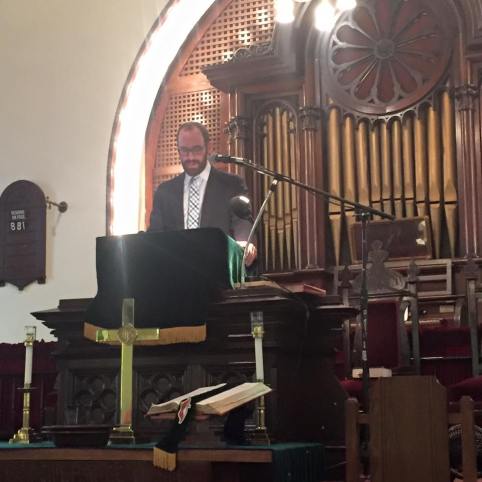
Make the Church Great Again

Psalm 146

Praise the Lord! Praise the Lord, O my soul! I will praise the Lord as long as I live; I will sing praises to my God all my life long. Do not put your trust in princes, in mortals, in whom there is no help. When their breath departs, they return to the earth; on that very day their plans perish. Happy are those whose help is the God of Jacob, whose hope is in the Lord their God, who made heaven and earth, the sea, and all that is in them; who keeps faith forever; who executes justice for the oppressed; who gives food to the hungry. The Lord sets the prisoners free; the Lord opens the eyes of the blind. The Lord lifts up those who are bowed down; the Lord loves the righteous. The Lord watches over the strangers; he upholds the orphan and the widow, but the way of the wicked he brings to ruin. The Lord will reign forever, your God, O Zion, for all generations. Praise the Lord!

Psalms-Series-graphic


In the beginning, we met in people’s homes. The church wasn’t even called the church; it was called “ecclesia” which means a gathering. The earliest disciples of Jesus gathered together in homes to retell the story, break bread together, and engage in prayer.

As the centuries passed and the Good News spread across the world, gathering spaces called churches were erected in certain communities. Through this period, we met for worship in whatever church was closest. In didn’t matter if we didn’t agree with what the person at the front said, or even if we hated the people in the pews next to us, we only really had one option for church and it was good enough.

Today, in the American context, we have every possible flavor of church you could ever want. In our town alone there are at least 87 different churches within the city limits. We are no longer bound to attend church based on proximity; instead we attend church based on denominational affiliation, pastoral performance, and opportunities for youth. Whereas we once gathered as a truly diverse community of faith, we now tend to gather with people who make us comfortable and appear just like us. Whereas we used to be stuck with the church in our neighborhood, now there are websites dedicated to church reviews and helping people find the church that fits them best.

This week, I got online and I started reading church reviews from all over the country. After all, it could only help to see what people think of other churches to get an idea about what many of you might think about St. John’s. And, I’ve got to be honest; most of them are awful…

“Absolutely doumbfounded. Checked this church out for the first time today, and really wish I had read some of the other reviews first. It was creepy how strangers kept smiling and maintaining eye contact even after the service started. I lost track after 15 people introduced themselves. And the sermon was about nothing more than tithing. The ushers passed around cards talking about a “90 day challenge” … giving 10% of your income to that church for three months, but that’s not all folks, it said, “if you don’t feel blessed after those 90 days, there is a money back guarantee!!!” It felt more like an infomercial than a worship service. But they did share how they are giving away a free cruise on Father’s day weekend… The thing I regret most is not walking out of there in the middle of the service.

“Young people ruined the church. God used to be the foundation of our community and members got to know each other until they came and everything went downhill. The new young families came in wearing blue jeans and tee shirts; they were disrespectful of what it means to be holy. My heart is heavy that my church has become just another soulless generic space in hipsterland.”

“This was the worst restaurant ever. First of all, their bread was terribly sweet, and they make you literally stand in line for it. Then, you wait in line to dip your bread into a cup of what tastes like decades old grape juice. There was no main course. I sat in a stiff wooden bench for an hour before I was able to eat and there was a man wearing a dress who shouted the whole time. It was free however, though they asked for donations near the end and passed around a plate. I give it 1 star, and do not recommend it to anyone.”

However, I found one review that was so positive that I had to share it:

“In my life, I have never been with a group of people who were so fired up to make positive changes in the world. The entire experience was surreal, in the best way possible. There was a lady near me who came up at the beginning and wanted to know all about me. I honestly didn’t know it could be this exciting. I loved that the speaker didn’t need to use notes while he was talking. It felt genuine and meaningful and he even encouraged us to shout back when we felt the need to do so. Other people might make comments about how the parking lot was crowded but I think that’s a good thing! I’ve gone to gatherings like this my whole life, and for the first time I feel like we’re moving in the right direction and I left feeling charged up for action. It’s time to make America great again!”

15154070

That last review was a mash-up of descriptions from two recent political rallies centered on presidential candidates Hillary Clinton and Donald Trump. After reading negative church reviews for an hour, it shocked me that gatherings in support of the next president of the United States were garnering better reviews than households of God. And even more than their positive language, what they described appears like a perfect worship service; except for the fact that they are worshipping politicians rather than almighty God.

From the beginning we have looked for other people to take care of our needs. Whether it was in the Garden, or just the other day in Staunton, it is part of our human condition to rely on the “other” to help us. This is even more prevalent when it comes to our modern days “princes” otherwise known as politicians.

Now there isn’t anything inherently wrong with politicians: they stand before us and tell us what they will do for us. We vote for them and they represent our interests. Our failure is in our tendency to look for politicians to be our saviors.

The psalmist knew this basic fact of the human condition. The Hebrew people wanted kings just like all the other gatherings of people and so they got what they wanted. But in raising political leaders to be saviors they committed the ultimate sin that we still commit today: believing that we can save ourselves.

Praise the Lord! Do not put your trust in politicians, in feeble and broken individuals. When their breath departs, when their days come to an end, their plans perish. However, the Lord endures forever. Happy are those whose hope is in the Lord, who keeps faith forever, who executes justice for the oppressed; who gives food to the hungry.

God is the one from whom our help will come. God is a nurse who opens the eyes of those who refuse to see. God is a social worker who lifts up those who are bowed down under the weight of the world. God is a political activist who sets the prisoners free and watches over all foreigners. God is the one who reigns and remains steadfast forever.

The question for us, the question the psalm begs us to ask is this: Who do we really worship?

A few weeks ago the General Conference of the United Methodist Church met in Portland, Oregon, and among other things, they voted on a global annual budget. From now until 2020 the global United Methodist church projects needing and spending $604 million dollars. This money will be used in a variety of ways to support the denomination’s mission of making disciples of Jesus Christ for the transformation of the world.

The number, I’ll admit, is staggering. However, it pales in comparison to the 1 billion dollars that has been raised and spent in the 2016 presidential race. Add that to the countless hours we have spent glued to the television during debates, or the infinite number of Internet articles that support the candidate of our choosing, or just the mind-boggling number of bumper stickers and yard signs in Staunton alone and you will start to realize who we really worship.

The-Church-and-Politics-Sermon-Title-sm-535x428

It’s time to make the church great again. Not by going back to the days of old to be what we once were, but to look boldly to the future and believe that God can save us, not politicians, not public leaders, not even pastors. Can you imagine how much good the church could do if it was supported like a presidential campaign? Can you picture how many lives could be changed for the better if we worshipped the Lord the way we worship our politics?

God can use politicians to bring about God’s will on earth, but there is a limit to what they can accomplish. Moreover, the longer we wait for our politicians to save us, the longer we pass the buck on to someone else, the longer we will prevent God from using people like us to make the kingdom come here on earth. Believe it or not, God uses people like us to work for justice, feed to the hungry, love the outcasts; watch over strangers, orphans, and widows. As disciples of Jesus Christ our work is to act like Jesus.

If you get online and search for reviews of St. John’s, you won’t find any. Trust me, I looked. Either we haven’t offended people enough, or we haven’t inspired people enough to write a review of a “worship experience.” But maybe, just maybe, there are no reviews of St. John’s because we know the church is not something to be done and reviewed. We know the church isn’t like a restaurant or business that we can experience at our leisure. We know the church isn’t like a political party that makes promises that cannot be kept. We, after worshipping in these pews – offering these prayers – eating this bread and drinking from this cup, we understand that church isn’t about what we get out of it, but instead it’s about what God gets out of us.

If we really want to make the Church great again, then we need not look further than this table and the meal that has been prepared for us. For it is here, where heaven and earth meet for a brief moment, where we confess and are reconciled, that we remember how the Lord is the one who lifts us up when we’re down; how the Lord opens our eyes when we are blinded by the world; how the Lord reigns forever. Praise the Lord! Amen.


With A Little Help From My Friends

John 20.19-29

When it was evening on that day, the first day of the week, and the doors of the house where the disciples had met were locked for fear of the Jews, Jesus came and stood among them and said, “Peace be with you.” After he said this, he showed them his hands and his side. Then the disciples rejoiced when they saw the Lord. Jesus said to them again, “Peace be with you. As the Father has sent me, so I send you.” When he had said this, he breathed on them and said to them, “Receive the Holy Spirit. If you forgive the sins of any, they are forgiven them; if you retain the sins of any, they are retained.” But Thomas (who was called the Twin), one of the twelve, was not with them when Jesus came. So the other disciples told him, “We have seen the Lord.” But he said to them, “Unless I see the mark of the nails in his hands, and put my finger in the mark of the nails and my hand in his said, I will not believe.” A week later his disciples were again in the house, and Thomas was with them. Although the doors were shut, Jesus came and stood among them and said, “Peace be with you.” Then he said to Thomas, “Put your finger here and see my hands. Reach out your hand and put it in my side. Do not doubt but believe.” Thomas answered him, “My Lord and my God!” Jesus said to him, “Have you believed because you have seen me? Blessed are those who have not seen and yet have come to believe.”

img_1433


Before I became your pastor, I was a pulpit-filler. If a pastor became sick, or was otherwise unavailable to preach, I was tapped on to come up with something to say from the pulpit. A phone call would arrive in the middle of a week, or even on Sunday morning, and I would have to whip something together right quick. For years I took the ”undesirable” Sundays: Memorial Day, Labor Day, Thanksgiving Sunday, and the Sunday after Easter; those Sundays when the regular pastor needed a break.

Every time I was tasked with preaching was an opportunity to grow in my faith while attempting to articular the faith for others.

When I was in college I got the phone call one week to preach for a Sunday evening service. I was fairly familiar with the context because I played the drums for the church every week, but this time they wanted me to come out from behind the drum set to proclaim God’s Word.

At the time I was living with a couple of roommates, but of course none of them went to church. Week after week they would rib me for waking up early on Sunday morning, they would jokingly mock me with questions about God’s presence, and they made sure I knew they thought there were better things I could be doing with my time.

So I thought this would be the perfect opportunity to get them to church.

It was on a Sunday night, so they couldn’t complain about sleeping in. We would be playing contemporary Christian rock songs, so they couldn’t complain about the music. And I was supposed to preach, so they couldn’t complain about it being archaic or a waste of time (I hoped).

I casually invited them to worship while we were having dinner one night; I shared that I was the preacher and that it would be a relatively short sermon, and I made sure to mention that it would really mean a lot to me if they would come.

Under the weight of my communal invitation and guilt, they all came to church that night and sat together in a pew near the back.

The service went well; the music balance was good, and the sermon was short and to the point, and then we moved to the communion table. Our resident pastor began talking about how whenever Jesus gathered with his friends he would breathe new life into them through his words and his presence. And on his final night he took bread, broke it, gave it to his friends and said, “Take. Eat. This is my body.” And then he took the cup and shared it with his friends saying: “Take. Drink. This is my blood.

One by one every person in the sanctuary gathered in the center aisle and started walking forward for communion. The pastor stood next to me holding the bread, and I stood next to her holding the cup and for each person that came forward we said, “The body of Christ given for you.” Or: “The blood of Christ shed for you.” Hands were outstretched penitently while people feasted on the Lord, and then the end of the line came forward, with my roommates.

Unsure of what was actually taking place, they stood up like everybody else and came forward without knowing what to do next. As they stood in front of us, and in front of the whole congregation, the pastor’s eyes darted back and forth between myself, and the ragtag roommates standing in front of us. Her eyes screamed, “Do something!”

So I did what anyone in my position would do. I whispered to my friends as quickly as possible: “I know this will sound weird… But you need to take a piece of bread, dip it in the grape juice, and eat it. Don’t worry I’ll explain it to you later.” And with that they all feasted on the body and blood of our Lord, and returned to their pews confused and bewildered.

On the day of Jesus’ resurrection, after appearing to Mary Magdalene and calling her by name, Jesus appeared before the disciples. They were locked away in a room full of fear and trembling when Jesus said, “Peace be with you.” Perhaps they were afraid of being crucified like he was by the Jews, or they were afraid of how the crowds would taunt them when they came out of hiding, or they were afraid of seeing their risen friend in their midst. But Jesus found it fitting to speak words of peace in the midst of their terror.

And immediately Jesus outlined what they were supposed to do: “Go. As the Father sent me, now I send you.” With his proclamation, Jesus empowered his friends to proclaim the Good News for everyone to hear.

But Thomas, one of the disciples, was not there to experience the resurrected Jesus. The disciples tried to explain what they had seen, heard, felt, and experienced. Yet, their eyes and fingers were not enough for Thomas. He did not trust his friends. He wanted to see and touch Jesus for himself.

09b

Sure enough, a week passed, and Jesus showed up again before the disciples and Thomas. Again Jesus greeted them by saying, “Peace be with you.” And he told Thomas to feel the scars on his hands and side, but before Thomas could even reach out he declared, “My Lord and my God!” And thus Jesus concluded the moment by saying, “Have you believed because you have seen me? Blessed are those who have not seen and yet have come to believe.

Thomas gets a pretty bad rap. Every year we follow Easter Sunday with this reading about doubting Thomas. He is the one disciple who gets a qualifier in front of his name. We don’t refer to eager Peter, or betraying Judas, but we do say doubting Thomas. For years pastors like me have used this Sunday and this story to call people like you to learn from the example of Thomas, to not doubt the Lord, to believe without seeing.

But the real problem with Thomas is not his lack of faith in the Lord, but his lack of faith in his friends. For three years he had traveled with this ragtag group of disciples, shoulder-to-shoulder they had watching Jesus perform countless miracles, and now when they tell him the Gospel, he does not believe them.

After the episode of my friends confusedly attending worship and receiving communion, I avoided the topic of church. I knew they had a strange experience through their lack of addressing the service in any way shape or form, and they stopped mocking me for going to church. At the time, I thought they thought I was nuts.

A few weeks passed and the topic of faith was still avoided like the plague until one morning I walked down the stairs and discovered one of my roommates crying on the couch. He had just received a phone call from a long time friend of ours whose father had died. The man was a staple in our community, regularly coached little league sports, and was another father figure for most of us. And when my roommate received the news, it devastated him.

I slowly made my way across the room and sat down next to him. For the longest time neither of us spoke. Finally my roommate looked up from his tears and he said, “I want you to pray for me.

I sat shocked. I didn’t know what to say. But he continued: “You know I don’t know much about God or church. But I know it’s important to you. When you were standing up before us in church I could tell that you really believed. I don’t know what I believe. And I can’t describe it, but I really feel like you need to pray for me.”

So I did.

When Thomas heard the news of the risen Lord through his friends, he didn’t believe them. Even though they were some of the people he should’ve trusted the most, he refused to accept their words.

When my friend felt the sting of death and loss, he didn’t know what to believe. But, for better or worse, he trusted me. Even though he had every reason to be suspicious and weirded out by what he had experienced in worship, he believed in God’s presence through prayer.

Thomas’ kind of radical suspicion of his friends still takes place in our lives today. We view church as a private thing, something we do on the weekends and don’t need to bring up during the week. We might know people in our lives that are suffering or are alone, but we assume that God will send them to us when they’re ready.

SnapshotImage

If we want to be faithful followers of Jesus, then me must stop distrusting our friends and neighbors. At the very least, we should stop questioning motives or thinking the worst in others when they express a difference of opinion.

To be faithful followers of Jesus requires a willingness to be sent by God to people who do not know God. It requires us to be vulnerable and uncomfortable while inviting others to discover God’s love in a place like this. It requires us to be the agents of belief for people who have not yet seen.

All of us are here because we are the product of someone influencing our faithfulness. Whether a parent or a friend or even a stranger, we were once invited to discover God through the power of church.

Friends, I promise you that the days of people showing up to church because a church is in their neighborhood are long gone. Today, people discover God’s presence, they begin to believe what they see and see what they believe when people like us are brave enough to invite them to church.

Because, for us, this table is the closest we can get to the presence of Christ. In the bread and the cup God invites us into the upper room when Christ shared the meal with his friends. When we feast on his body and blood we receive the grace necessary to be Christ’s body in the world.

This thing we call communion, whether at the table or just gathering in worship, has transformed my life. If you’re here in church, it’s probably changed your life too. So, may the God of grace and glory give us the courage to invite others to be transformed as well. Amen.

Unity in the UMC

Psalm 133

How very good and pleasant it is when kindred live together in unity! It is like the precious oil on the head, running down upon the beard, on the beard of Aaron, running down over the collar of his robes. It is like the dew of Hermon, which falls on the mountains of Zion. For there the Lord ordained his blessing, life forevermore.

12495241_10153458160651297_8700736706336599235_n

I love meeting people in our community and introducing myself as a pastor for the United Methodist Church. I love doing this because I never know what people will say in return.

“Oh, you must be that pastor who encouraged his church to start wearing hardhats to worship because God has a knack for tearing down walls…”

“No, you’re thinking of Clayton Payne at Cherryvale UMC.”

“Oh, you must be the pastor who loves shouting things like ‘Mercy!’ and ‘Praise the Lord!’ in the pulpit”

“No, you’re thinking of Bryson Smith at St. Paul’s UMC

“Oh, you must be the pastor who is forever mentioning apple butter and its many uses and applications.”

“No, you’re thinking of Sarah Locke at Christ UMC.”

“Oh, you must be the pastor who is absolutely obsessed with the Washington Redskins and even had the office painted burgundy and gold.”

“No, you’re thinking of Bob Sharp from Marquis Memorial UMC. Though I wish my office looked like his.”

“Oh, you must be the pastor who loves using objects in sermons, like handing out mirrors for people to remember the need to shine Jesus’ light.”

“No, you’re thinking of Janet Knott at Jollivue UMC.”

“Oh, well you don’t look Korean…”

“No, you’re thinking of Won Un at Central UMC.”

“Oh, you must be the pastor everyone raves about with a particular gift for preaching, handsome features, and can get congregations to shout ‘Amen!’ with feeling.”

(Sigh) “No, you’re thinking of John Benson at Augusta Street UMC.

“Oh, well then who are you?”

All of us pastors, and all of our churches are known for a variety of things. We’re known for our community engagement: Fish Fries, Apple Days, and Christmas Tree Sales. We’re known for the ways that our pastors like to preach and pray. We are known for a variety of things. We are known for how different we are from one another.

But the one thing I wish all people in Staunton knew about the United Methodist Church is that we love and worship the living God.


How very good and pleasant it is when kindred live together in unity!

The psalmist is right. We all know, on some level, the beauty of a community in unity. When we are working in one accord, when we harmonize with one another, it is very good and pleasant. But then we grimace at the way the psalmist talks about the beauty of unity. Can you imagine what would happen if I pulled John Benson up to the front of the sanctuary and poured extra virgin olive oil all over his head? And what is it about heavy dew that it supposed to elevate the blessing of unity?

Well, in the world of the psalmist, oil and dew were signs of God’s blessing. Like manna in the wilderness and the anointing of the prophets, these images speak to something greater at work than mere mortals. Yet, we are so removed from the time of the psalmist that these images no longer carry the weight they once did. Perhaps we need a new way of imagining the beauty of unity in community.

About a year ago, we started putting plans together for a community wide Trunk-or-Treat. Many of our churches had participated in some sort of Halloween celebration over the last few years, but we began imagining how much of an impact we could have if we worked together.

By the time October came around, all of the pieces were set and we were ready to host the Trunk-or-Treat at Gypsy Hill Park. On the day of the event I arrived super-early with hopes of setting the area up and organizing volunteers. We really had no idea how many people would show up but we were prepared for whatever would happen.

We handed out extra candy to all of the trunks, we set up safe areas for children to wander around, and we passed out orange vests to volunteers. The whole afternoon honestly felt like a whirlwind as we were trying to get everything together.

At the height of our preparations I noticed a small family off to the side of the parking lot watching us run around. They must’ve been standing there for ten minutes when I finally walked over to introduce myself.

What are you all doing?” the mother asked while keeping her three young boys close.

I said, “We’re calling it a Trunk-or-Treat, it’s a safe way to celebrate Halloween. We’ll be finished setting up in about an hour and we’d love it if you’d come through.” And with that she smiled shyly smiled and left the park.

Hours later, after 3,500 people came through the Trunk-or-Treat I was exhausted. Some of the last families were making their way through the few trunks that still had candy when I noticed the small family from earlier standing by the edge of the lot. The boys were not wearing costumes, but each of them held a bag full of candy with huge grins across their faces. I started walking over to find out if they had enjoyed themselves, but as I got closer I realized that even though the children were smiling, the mother was crying.

Is everything okay?” I asked.

With a wipe of her sleeve she tried to cover her tears and then said, “My boys have never had a Halloween before. All these people gave them candy and talked to us and asked us questions and they don’t even know us. You invited us to come earlier and you don’t even know us.

I replied, “You’re right. I don’t know you. But God does. And God loves you.

12182395_10204873871677559_710633466728393275_o (1)

How very good and pleasant it is when kindred live together in unity. It is like a mother all on her own, trying to raise her boys, who is treated with love and dignity by a strange community called the church. It is like the tears of a young mother rolling down her cheeks in recognition that she is not alone, and that she is loved no matter what.

How very good and pleasant it is when kindred live together in unity. It is like a group of people striving to be Christ’s body for the world through acts of grace and mercy. It is like volunteers giving out candy to countless children for no other reason than the fact that they too are children of God.

How very good and pleasant it is when kindred live together in unity. It is like a church that no longer treats other churches as competition, but instead sees them as brothers and sisters in Christ. It is like a group of people who believe that need trumps greed, that there can be unity in community, and that by the power of God’s grace the world can be transformed.

How very good and pleasant it is when kindred live together in unity. Amen.

Devotional – Luke 1.52

Devotional:

Luke 1.52

He has brought down the powerful from their thrones, and lifted up the lowly.

Weekly Devotional Image

Some sermons stick with us, while others fade away. I can remember interactive sermons from the church where I grew up that required congregational participation for the message to hit home. I can remember specific lines from the church I attended in college that continued to resonate in my relationships and activities. And I can definitely remember a preacher from seminary who connected the hymns in worship with the sermon better than anyone else.

After preaching steadily for the last few years, I have noticed how much I miss listening to sermons. I enjoy the art of crafting words to proclaim God’s Word in worship, but I also need to have words preached toward me as well. I will often listen to, or read, sermons online but they are no substitute for the depth of experiencing a sermon in worship.

Last advent, Clayton Payne, one of my clergy peers from Staunton, preached for a community advent service. I served as the liturgist for the service, welcoming the congregation, announcing the hymns, praying when necessary, and introducing the speaker. And then Clayton walked up in to the pulpit and brought the Word.

He preached from Mary’s Magnificat, Luke 1.46-55, a song of praise that she delivered after meeting with Elizabeth. The beginning of the sermon was striking because Clayton specifically confronted how joyful Christmas is for us, and how Mary’s song should really put us in our place. Mary proclaims that God will bring down the powerful from their thrones, and lift of the lowly. Clayton then made it very clear that most of us are not the lowly that God will be raising up. We who rest in comfort, we who have presents piled under the Christmas tree, we who always know that we will have another meal, are like the powerful that God needs to bring down from our thrones of privilege.

I remember thinking that Clayton was mighty brave for preaching such a convicting sermon, and then I realized how right he was. Christmas should be a time of great joy and celebration, but it should also be a time when we take a hard look in the mirror and recognize our place of privilege. The words of scripture around the first Christmas are filled with hope for the lowly, but they are also filled with terror for the powerful.

the-virgin-mary-cared-for-her-child-jesus-with-simplicity-and-joy-elizabeth-wang-

Some sermons stick with us, while others fade away. Though it still makes me uncomfortable, I am grateful for Clayton’s words that helped me to see another angle of the great story of God coming to change the world.

This week, as we prepare for Christmas, let us reflect on the sermons from the past that have stayed with us. Let us give thanks to the preachers who faithfully proclaimed God’s Word. And let us remember our place in the story.

Devotional – Psalm 146.1

Psalm 146.1

Praise the Lord! Praise the Lord, O my soul!

Weekly Devotional Image

On Thursday afternoon I made my way over to the parking lot at Gypsy Hill Park to prepare for the UMC Trunk or Treat. The pastors and lay leaders from the Staunton area United Methodist churches had been planning the event for a number of months and it was my responsibility to set up the parking lot and organize the first wave of volunteers. For months we had collected candy and advertised in the local community and I was anxious to see how it would turn out.

In our earliest conversations we thought we would be lucky to receive a few hundred children and their parents for our Trunk or Treat. We continued to organize, plan, and pray for the event and when it was time to start trunk or treating a long line had already started to form; All of our hard work was about to come to fruition.

Over the next two hours the line of people never dwindled. Volunteers were running around in order to maintain the safety of the young children while also replenishing the candy supplies that had run low in some of the trunks. Children were dressed in some of the wittiest and most delightful costumes as they came forward with grateful hands to receive a peace of candy. And every trunk was attended by a faithful Christian eager and willing to share God’s love through the tiniest of gifts.

At about 7pm I left Lindsey with the candy at our trunk and made my way to the top of a hill for a better vantage point; I wanted to see how well the line was moving and if people were still enjoying themselves. I resisted the temptation to turn and look until I got to the very top and when I did I was stunned. From where I stood I could see no end to the numbers of children and families that had gathered in the park. I tried taking a picture and I could not even come close to capturing everyone in it. By the time the Trunk or Treat came to a conclusion over 3,500 people had come through.

12182395_10204873871677559_710633466728393275_o

When I stood on top of the hill and looked out at what the United Methodist Church could do in connection I wanted to praise God. Only an almighty and powerful God could call us to work in community with one another instead of in competition. Only a faithful and loving God could stir our hearts to give generously to this wonderful community. Only a redemptive and sustaining God could accomplish something in us as powerful as our Trunk or Treat.

We truly serve an almighty God who is worthy of our praise!


Devotional – Ezekiel 2.3

Ezekiel 2.3

He said to me, Mortal, I am sending you to the people of Israel, to a nation of rebels who have rebelled against me; they and their ancestors have transgressed against me to this very day.

Weekly Devotional Image

God loves to send people where they least expect. Moses was shepherding when God spoke to him through the burning bush and told him to go back to Egypt in order to lead the people out of captivity. Jonah was minding his own business when the Lord told him to go to Nineveh. Paul was in the middle of his campaign against the early Christians when God told him to go see Ananias in Damascus.

In the United Methodist Church pastors are appointed (sent) to serve different churches. Rather than being interviewed and examined by every individual placement, a bishop (and cabinet) discern God’s will and send pastors accordingly. This style of appointments allows for churches to be challenged by their pastors (and pastors by their churches) because neither of them have a choice in the matter. Yet, I can’t help but imagine that some UM pastors feel like they are being sent to “a nation of rebels” whenever they are reappointed.

Yesterday marked the completion of my second year serving the needs of St. John’s UMC in Staunton, Virginia. I can still recall the first phone call I received detailing my appointment, and I will freely admit they I felt a little uncomfortable about where I was being sent. After all, I knew nothing about the town, the people, or the church.

I can also recall the feeling in the pit of my stomach two years ago when I approached the pulpit to preach for the first time (Between the nerves and the excitement we were lucky that I even made it through a sermon at all). I looked out from my vantage point and saw the people of God gathered together to hear the Word and respond accordingly. To this day I still thank God for blessing us with the Holy Spirit that morning who allowed us to listen, laugh, and love.

jesus-is-lord-graphic

In the beginning of my time at St. John’s I foolishly thought I was bringing something to the church that they previously lacked. I believed that I was the one who could turn the ship around. I expected that I would grow the church, have us start paying our apportionments (in full), and preach in the midst of the rebels. For a time I thought I could be the savior.

I quickly realized that my expectations were way off. Instead of being a prophet sent to the rebels, I myself was a rebel in the midst of rebels. To believe that I could save the church meant that I was putting faith in myself, rather than the Lord. To believe that I had the power to make the church start paying its apportionments meant that I did not trust God to provide. To believe that I could be the savior meant that I forgot that only Jesus is our savior.

If we have done anything to please the Lord over the last two years, it has only come because God gave us the power to do so, and only secondarily because of us (me).

We are all called to go and be Christ’s body for the world in different ways, but it is vitally important for us to remember that we have just as much to learn as we have to teach; that no matter where God’s sends us, we will be transformed just as much as we transform others; and that in the end Jesus is Lord, and we are not.

This week, let us reflect on the places the Lord has sent us to be Christ’s body, and on the people who have been sent to be Christ’s body for us.

10 Things I Learned From My Second Year Of Ministry

Last year my friend, peer, colleague, and theological-hero Jason Micheli (The Tamed Cynic) asked me to write a post on ten things I learned my first year of ministry. Next week marks the beginning of my third year as a United Methodist pastor so I decided to write another post on ten things I learned during year two.

10872995_835432513146512_7937253830158410370_o

1.       The Church Is Huge

How do you measure the size of a church? Is the church as large as the Sunday worship attendance? The membership role? Throughout the last two years I have realized that the church is almost always larger than I think it is. I’ll be out somewhere with my wife when a stranger will ask if I am the pastor of St. John’s. Between our preschool and missional involvement, the community of faith (also known as the church) has connections with people all over the place. It is always important for me to remember that I have been called to serve the needs of the community, which is usually larger than I think it is.

2.       Praying Is As Important As Breathing

The Bishop for the Virginia Annual Conference, Young Jin Cho, is known for saying “No spiritual vitality, no vital congregations.” And he’s right. Prayer, and other spiritual disciples, are immensely important for the work of ministry and the local church. I strive to begin every morning in the sanctuary with time dedicated to prayer. If I neglect this discipline it has a negative impact on the rest of my day. Like feeling short of breath, I am not as active nor am I as attuned to the Spirit’s work in my midst. Regular prayer is as important to discipleship as breathing is to living.

3.       Collaboration > Competition

There are a lot of churches in the community I serve (I can see four different steeples from my front yard). I have heard on a number of occasions that there are more churches in Staunton per capita than anywhere in the United States. I have no way to confirm whether or not this is true, but just driving around town leads me to believe that it could be true. Over the last two years I have had the privilege of working with other pastors to help live into the kingdom of God here on earth. When we work in collaboration, and stop seeing each other as competition, we participate in Jesus final prayer: “I in them and you in me, that they may become completely one, so that the world may know that you have sent me and have loved them even as you have loved me.” (John 17.23) If the church wants to thrive, then we need to realize that we are all in this together, regardless of our denominational affiliations.

4.       Weddings Are Hard

Compared to some of my colleagues I have done a high number of weddings during my short time in ministry. At the age of 27 I meet a lot of people who are nearing their wedding and I am often asked to officiate. I love celebrating the covenant of marriage, but it can be very hard. What an average person experiences during a wedding is a beautiful thing, but it requires a tremendous amount of planning and work to go well. Not only do I have to take the time to meet with the couple ahead of time for premarital counseling, but I want to make sure that I give them all that I can to make their day worthy of God’s blessing. The metaphor of a shepherd with sheep finds its fullest meaning during weddings when I feel like I am primarily a people-mover. Weddings are great, but they can be hard.

5.       Funerals Are Harder

I once heard a pastor say, “I would take a funeral over a wedding any day.” That comment confused me when I heard it for the first time, and still confuses me to this day. During my first year of ministry no one passed away within the community of faith, and I therefore was not required to preside over a funeral. During my second year of ministry I had 14 funerals. Most of the people had lived long and full lives, but that does not diminish the amount of grief that our community has experienced over the last year. It is such a privilege to be invited into the midst of such uncertainty in people’s lives, but it is also incredibly difficult. I spend a tremendous amount of time preparing for every funeral because I believe in the incredible importance of celebrating every life, death, and resurrection.

6.       Trust Happens

Over the last two years I have lost track of how many times I have heard someone say, “You’re the first person I’ve ever shared that with.” It happens on a regular basis that an individual will come to my office, share a vulnerable story, and then slowly realize that they had never shared that with anyone. Regardless of what I say of Sunday mornings, or even how I pray, people trust the office of pastor. There is an acceptance of confidentiality and a comfort of confession that takes place in my office that I am rarely prepared for. Trust happens all the time and it is at the heart of what it means to be in relationship with others.

7.       Change Happens

11070416_10203768021631999_8256385505868925548_n

Just because something worked the first year, it doesn’t mean that it will work the second. And just because something failed the first year, it doesn’t mean that it won’t succeed during the second. For example: During my first Good Friday I carried a cross on my shoulder through the greater Staunton community and received almost no response. People avoided me on the streets, averted their eyes, and acted as if I was invisible. This year I did the same thing on Good Friday and people would not stop talking to me! People wanted to know what I was doing, offered to pray with me, and I even shared the story of Jesus with a woman who started crying when she saw me on the street. Change happens in ministry and that is a good thing! If doing church was just about maintaining the status quo year after year, we would cease to be fruitful for God’s kingdom.

8.       I Am My Own Worst Enemy

I know of few vocations where someone has to produce something on such a regular basis and is met with immediate feedback. In two years I have written and preached more than 104 sermons. Every Sunday, within 30 minutes of preaching, everyone lines up to shake my hand and tell me what they thought. I have discovered that the sermons I worried about the most are the ones that were the most life-giving to the congregation, and the sermons I was most confident about meant very little to the gathered body. I am my own harshest critic when it comes to ministerial responsibilities and I have to constantly remind myself of who I am, and whose I am. If I put too much weight on my inner-monologue, I neglect to remember that I am working for the kingdom, and not for myself.

9.       Numbers Are Important [And Dangerous]

Every week churches in United Methodism are required to log their statistical data and send it along to the conference. Though I actively worry about how the measuring of statistical data is negatively affecting God’s church, it is important because numbers represent people. Whether we like to admit it or not, Jesus commanded his disciples to “go and make disciples.” If we are serious about being disciples of Jesus Christ, then we have to be willing to go outside of our comfort zones to welcome people into our church and help to grow the kingdom. However, even though numbers are important, they are also dangerous. I have caught myself, on a number of Sunday mornings, counting the number of heads in worship before the opening hymn. And sometimes I let that number have too much of an impact of what takes place after the opening hymn (both positively and negatively). Doing ministry is about living in the tension between growing the vineyard, and nurturing the vines. Numbers are important, but they are also dangerous.

10.   I Still Have The Best Job In The World

Stanley Hauerwas once said that “doing ministry is like being nibbled to death by ducks.” There are days in ministry that affirm his comment, but most of the time it is the greatest job in the world. Where else could I spend time deep in God’s Word? What job would give me the opportunity to preside over something as precious as the water dripping on a child’s head in baptism or breaking off a piece of bread for a faithful disciple? What vocation would bring me to the brink of life and death on such a regular basis? It is a privilege to serve God’s kingdom as the pastor of St. John’s and more rewarding than I could have ever imagined.

Devotional – Mark 4.37-38

Devotional:

Mark 4.37-38

A great windstorm arose, and the waves beat into the boat, so that the boat was already being swamped. But he was in the stern, asleep on the cushion; and they woke him up and said to him, “Teacher, do you not care that we are perishing?”

Weekly Devotional Image

In a few days thousands of United Methodists will gather in Roanoke for Annual Conference. Once a year clergy and lay representatives throughout the state meet for a couple days of holy conferencing in order to prayerfully discern the future of the denomination. Annual Conference provides opportunities for clergy peers to reconnect, lay people to learn about our organizational structure, and helps to reignite the flame of faith in our churches.

The first time I went to Annual Conference was years ago and I was completely overwhelmed. I was a lay delegate for my home church and was supposed to vote on matters of church polity that made very little sense (I didn’t even know what ‘polity’ meant at the time). When I think back on that first conference it felt like a blur and I hope that I voted according to the Lord’s will. However, the one thing I do remember with accuracy was the Statistician’s Report.

Every year the Statistician from the Conference announces our net gain or loss of members over the last 12 months. During my first Annual Conference the Statistician announced that we had grown by ~200 members to which the entire arena erupted with applause. I remember thinking, “200? That’s all? And why is everyone celebrating such a low number for the entire state of Virginia?” I only learned later that it was the first time we had a positive growth in a very long time.

2015-Annual-Conference-Slide

Sometimes when I am sitting at Annual Conference I feel as if the great windstorm is rolling and the waves are beating us down. I listen to report after report pleading for more money, more resources, and more volunteers. I witness people approach the microphones to make comments about other human beings that should have been left in the 1950’s. I meet people from churches that will be closing their doors in the next few years and see the tears welling up in their eyes. I feel like one of the disciples on a boat that is already being swamped.

But then I remember that after the disciples woke Jesus up, he quickly calmed the storm, and then questioned their faith. When we am confronted with the waves of conference we need to remember that Jesus is the one who controls the wind and the sea. When we witness events that make us feel like the ship is sinking, we need to remember that Jesus is the one who walks on water. So long as we keep believing that we control the church, Jesus will keep sleeping in the stern while we run around in fear. We need a change of heart and perspective to remember that Jesus is Lord, not us.

This week, let us pray for the renewal of the church. As delegates gather in Roanoke, let us pray for wisdom and discernment of God’s will rather than our will. And let us all remember that even when the ship of life is being attacked by waves, Jesus is the one who calms the storm, and puts our faith into perspective.

AC-2015-color-logo

Devotional – John 10.16

Devotional:

John 10.16

I have other sheep that do not belong to this fold. I must bring them also, and they will listen to my voice. So there will be one flock, one shepherd.  

Weekly Devotional Image

“What is the greatest challenge ahead for you?” This question is asked on a regular basis between myself and a number of clergy colleagues who live in the same community. Whether we are meeting for a cup of coffee, bumping into one another at a grocery store, or during an assigned clergy gathering, this question has helped us to grow as pastoral leaders and offer advice to our friends.

When I arrived at my current appointment, I assumed that other pastors would reach out and welcome me to the community. For the first few months I waited and waited and heard nothing. So one afternoon I pulled out a map and decided to visit all of the nearby churches and introduce myself as the new United Methodist pastor at St. John’s. I will never forget the look of shock on a number of pastors faces when I showed up at the door with my hand outstretched; for some of them I was the first pastor they met in our community even though many of them had been here for a number of years.

At the foundation of the United Methodist Church is our connectional system. By way of polity, and theology, we are (supposed to be) intimately connected with our brother and sister churches. We rely on one another for kingdom work and sharing resources to better live out God’s will on earth. However we also have a responsibility to connect with other churches outside of our denomination. After all, there is one true shepherd and we are all part of his one flock.

Over the last two years I have formed strong bonds with other clergy in Staunton and I believe that our willingness to grow in faith with one another has been a blessing to the greater community. Every church is different and faces unique challenges. Yet, when we spend time working with other leaders it allows us to learn and glean from one another, rather than trying to do it all on our own.

Fired-loveoneanother

Jesus told the disciples there were other sheep that did not belong to that particular fold, but there would be one flock and one shepherd. Today, many communities are peppered with varying churches and denominations representing a number of traditions. If we cannot learn to work with, and appreciate, one another then we are preventing the Church from being led by the Good Shepherd. If churches continue to view others as competition, rather than brothers and sisters, then the Church will continue to decline and no longer bear fruit in the world.

We are in this great and cosmic thing called discipleship together. We can learn from other traditions and denominations because we are all part of God’s flock and Jesus, as the shepherd, will always be here for the sheep. This week, let us challenge ourselves to really see fellow Christians as Christians, instead of seeing them as Presbyterians, Baptists, Catholics, Methodists, Anglicans, Episcopalians, etc. Let us learn to ask good and important questions so that we might all grow in faithfulness together.


Devotional – Psalm 147.1

Devotional:

Psalm 147.1

Praise the Lord! How good it is to sing praises to our God; for he is gracious, and a song of praise is fitting. 

Weekly Devotional Image

Selecting the hymns for worship on Sunday mornings is a pastoral privilege. Each week I pray over the words for the sermon and seek to find hymns that fit with the general direction of worship. Our hymnal is an invaluable resource that helps us to discover God’s majesty in ways that are powerful and beautiful.

Growing up as a United Methodist, I cherished our hymnal and learned to “sing my faith” on a weekly basis. Though I regularly listened to secular music, is was the tunes from the likes of “O For a Thousand Tongues to Sing” and “Be Thou My Vision” that I found myself whistling and humming during the day. When I became a pastor, and therefore received the responsibility of selecting our hymns, I was very thankful that some of the previous pastors at St. John’ penciled in the dates for hymn selections in the office copy. I immediately knew which tunes were familiar, and which hymns would be a little harder to sing.

hqdefault

Yesterday our worship service was focused on the importance of love being greater than knowledge. I went through my usual sermon preparation and then went to the hymnal and decided that #617 “I Come with Joy” would be a great way to start our worship service (particularly since we would also be feasting at the Lord’s Table). I processed down the center aisle with an acolyte as the organ moved along and the gathered body was singing, but when we arrived at the 4th verse, perhaps by a push from the Holy Spirit, our organist stopped playing and allowed for us to sing a cappella. The words resonated throughout our sanctuary in such a way that I felt shivers in my body: “And thus with joy we meet our Lord. His presence, always near, is in such friendship better known; we see and praise him here, we see and praise him here.”

The psalmist writes that is good for us to sing praises to our God for he is gracious. When the gathered body is together and we can sing the hymns with every fiber of our being, we are truly praising the Lord! However, singing praises to God is not something that is limited to Sunday morning alone; every day is a new opportunity to sing praises to our gracious God. We can do this through our actions, our prayers, and our conversations with others. So long as we remember that God is the source of goodness in life, singing God’s praise will be as natural as breathing.

This week, as we seek to love God and neighbor, let us explore the many different ways we can sing our praises to the Lord. It can be as easy as humming one of your favorite hymns, and it can be as simple as thanking God for something wonderful in your life. Let us praise the Lord!