The Advent of Abram – Sermon on Genesis 12.1-9

Genesis 12.1-9

Now the Lord said to Abram, “Go from your country and your kindred and your father’s house to the land that I will show you. I will make of you a great nation, and I will bless you, and make your name great, so that you will be a blessing. I will bless those who bless you, and the one who curses you I will curse; and in you all the families of earth shall be blessed.” So Abram went, as the Lord had told him; and Lot went with him. Abram was seventy-five years old when he departed from Haran. Abrams took his wife Sarai and his brother’s son Lot, and all the possessions that they had gathered, and the persons whom they had acquired in Haran; and they set forth to go to the land of Canaan. When they had come to the land of Canaan, Abram passed through the land to the place at Shechem, to the oak of Moreh. At that time the Canaanites were in the land. Then the Lord apprised to Abram, and said, “To your offspring I will give this land.” So he built there an altar to the Lord, who had appeared to him. From there he moved on to the hill country on the east of Bethel, and pitched his tent, with Bethel on the west and Ai on the east; and there he built an altar to the Lord and invoked the name of the Lord. And Abram journeyed on by stages toward the Negeb.

advent art

Today we begin our Advent Sermon Series on “New Beginnings.” Advent comes from the latin adventus which means “coming.” These few weeks are integral to the life of our church in the sense that we are preparing our hearts, minds, and souls, for the coming of God in Christ on Christmas day. This season lends itself to new beginnings, not just in our church, but in each of our lives. This morning we begin with the Advent of Abram.

Wow,” he exclaimed a little too loudly as he began gripping deeply into my shoulder. I found myself staring at one of the groomsmen from the bridal party. We had spent the better part of an hour attempting to line everything up for the wedding during the rehearsal and were now at the Mill Street Grill for the rehearsal dinner.

Wedding rehearsals are crazy; a conflation of friends and family gather together in a church they have never seen, and listen to a pastor they have never met, telling them where to stand and what to do. In no other aspect of ministry is the metaphor of a shepherd and his sheep more appropriate than when I plead with the groomsmen to pay attention and start acting appropriately. Things would go so smoothly if the groomsmen would act like the bridesmaids.

10635731_10101905692618667_3865158961821357384_n

Anyway, I was staring at the groomsmen when he began to lay on the compliments about how well the rehearsal went and how impressed he was with my disposition. “I can’t believe you’re a pastor! I mean, dude, you’re younger than me! And the way you pray, it sounds like you’re actually talking to God, and for real that was awesome.” I will admit that people are rather honest with me, particularly when the rehearsal dinner has an open bar.

A little later another young person from the bridal party came forward to introduce herself and began opening up about her faith. “It has been a long time since I was in a church, but hearing you speak and seeing how serious you are about all this has reignited my faith; If I lived around here, I would want to worship at St. John’s.”

Still later another young man from the wedding walked over and began speaking to me through jovial chuckles and slaps on my back. “Now man I have got to ask, that good looking girl with the blue eyes, are you two together? Cause if not I would love to get her number.” To which I replied, “Till death do us part” and I walked away.

Conversations as a pastor are often one sided: people bring their own sets of questions and baggage about the church and they are looking for me to confirm their suspicions. “Are you really allowed to be married?” “I never knew pastors could be so young” “What do you think about the Catholic church?” are all frequent elements of dialogue.

However, toward the end of the night, after the last call had been made from the bar, yet another groomsmen came forward. At this point I was getting tired of the same trivial conversations about how I knew the bride, what it takes to become a pastor, and how long had I felt called to the ministry. I am sure that I sighed as he came forward, but his question was unlike any of the others…

“How long have you been serving here?” “It’s been about a year and a half” “Is it still everything you thought it would be?” 

Many-of-God’s-finest-men-in-the-Bible-were-Polygamists-Abraham

To follow a call from God may be a costly matter, particularly when it leads to a lonely road. Abram was tasked with following the call of God to leave everything based on God’s Word.

One day, an ordinary day, the Lord told Abram to go from his country and his family to the land that God had prepared with the promise that God would make of him a great nation, he would be blessed, and his name would become so great that he would be a blessing. So Abram went.

The simplicity of “so Abram went” is one of the most deceptive phrases in all of scripture. The extraordinary nature of those three words are lost in Genesis 12 if we gloss over it too quickly. Abram was free from indecision, self-doubt, or stubbornness. His willingness to go is the opposite of what took place in the garden of Eden, and demonstrates a radical dependence on the providence of God.

Abram must turn his back on what had been the familiar and the friendly to go out toward the unwelcome and the unknown. His life would be forever changed in his decision to respond to God’s simple push, something that changed the history of humankind.

The call of Abram is not unlike the many callings that God places in each of our lives. It might not come in the definitive and spoken Word as if from the wind, but there are subtle moves and pushes that God does in order to bring about his will on earth. Many people prefer to stay where they are and as they are rather than to try hard to arrive at something different. Once they reach a level of comfort in their lives, they become content with keeping their eyes trained on the dirt instead of gazing up into the stars.

People of apathy appear throughout the bible, people who might have made their lives significant but never wanted to put their effort in to change. The likes of Esau, Jonah, and Solomon grew complacent with their blessings, and stopped dreaming about the future. Their failure was not generally aiming at anything bad as it was in the fact that they did not aim strongly enough at anything!

Abram could have been apathetic, but instead he responded enthusiastically. He took his wife, his brother’s son, and all his possessions and set forth toward the land of Canaan. When he arrived, God made it clear that this would be the place of his offspring, and Abram made an altar to praise the Lord.

Abram might have accepted the divine message with the momentary enthusiasm of a man who is proud to feel that he has been singled out for something special, but quickly cools when he finds where he must go.

Is is still everything you thought it would be?” As soon as I was asked images from the past year and a half floated through my mind – the baptisms, the deaths, the weddings. The tears spilt in my office, the dreaded phone calls from the hospitals, the shaking hands gripped in prayer. The kids laughing in the Preschool, the palms outstretched for communion, the knocks on the door that carried the weight of the world.

Has my enthusiasm cooled? Is this call to ministry everything I thought it would be? I always dreamed about the sermons that would get people to shout AMEN! from the pews. I dreamt about the people who I would help bring to the light of Christ, people whose lives would be radically transformed through God’s Word from this church. I dreamt about all the positive affirmations I would receive from people at the back of the sanctuary following worship.

The more time I have spent following this call from God, the more that I have realized how similar it is to Abram’s journey. Responding to God is not about the results, packed pews, lots of money in the offering plate, and people lining up to commit their lives to Christ. Responding to the call is about walking the lonely path, standing up for what is right, and calling all of us, including myself, to live better and holier lives. 

Moreover, the call is not just for pastors, but for all of us as Christians. God is not looking for people to say all the right things at the right times, people who will proudly place money in the offering plates, people who have perfect posture in prayer. God is looking for disciples who are willing to say “yes” when the world says “no”, people who fight against injustice, and go into the unknown like Abram.

God tells Abram that he will be blessed in responding to the call. The bible makes it very clear that a person can know and recognize their blessedness not when they have managed to get rid of all the dangers and risks and burdens, but when they have been given great and gallant strength to bear them.

The collective group can only move forward when an individual breaks the path ahead. On every level of life there must be a pioneer. Joseph had to dream dreams that went beyond what his brothers wanted, Moses had to stand before the Lord and plead for the forgiveness of God’s people, and Jesus had to push his friends further and farther than they ever wanted to go.

Only when people are brave enough to rise above the crowd, only when they set out on new beginnings, do they follow the roads of freedom for their souls.

The past week has been filled with frightening examples of our need to start standing up against the crowd mentality of our culture:

kSicf3v

We need a new beginning when it comes to the foolishness of sitting around a family table to give thanks, to then punch one another in the face while wrestling for Black Friday deals. 

We need a new beginning when it comes to a nation flocking to Facebook to express their opinions about what is going on in Ferguson, when they neglect to create real and meaningful relationships with those around them. 

We need a new beginning when it comes to our denomination meeting for a day of “holy conferencing” about homosexuality when we keep talking about it as an “issue” instead of it being about people. 

We need new beginnings all around us, and its up to people like you and me to listen like Abram and start walking down the strange new road.

Wherever Abram went he built an altar to the Lord. While responding to the call of God he recognized the importance of worshipping the Maker in whom we live for the true blessings of life. Having a new beginning implies understanding that worship is important for the cultivation of one’s soul. We gather here in this place week after week to hear the Word of God and respond to it in our lives, we gather to feast on the Word so that we can encourage our brothers and sisters in Christ to take radical steps of faith into new beginnings just like Abram.

Abram left it all for a new beginning in a new place. He traveled as the Lord commanded and wound up in the hill country on the east of Bethel. Many years later a young virgin named Mary and a man named Joseph traveled to Bethlehem for a new beginning in a new place. They traveled as the Lord commanded and wound up in a village without space at the inn, but brought a child into the world who changed everything.

Is it still everything you thought it would be?” the man asked. I thought for a long time before I responded, reflecting on all that has happened to our precious church over the last year and a half. “No, its not everything I thought it would be. It is so much harder. But thats why its worth it.”

Amen.

The Talent Show – Sermon on Matthew 25.14-30

Matthew 25.14-30

“For it is as if a man, going on a journey, summoned his slaves and entrusted his property to them; to one he gave five talents, to another two, to another one, to each according to his ability. Then he went away. The one who had received the five talents went off at once and traded with them, and made five more talents. In the same way, the one who had the two talents made two more talents. But the one who had received the one talent went off and dug a hole in the ground and hid his master’s money. After a long time the master of those slaves came and settled accounts with them. then the one who had received the five talents came forward, bringing five more talents, saying, ‘Master, you handed over to me five talents; see, I have made five more talents.’ His master said to him, ‘Well done, good and trustworthy slave; you have been trustworthy in a few things, I will put you in charge of many things; enter into the joy of your master.’ And the one with the two talents also came forward, saying, ‘Master, you handed over to me two talents; see, I have made two more talents.’ His master said to him, ‘Well done, good and trustworthy slave, you have been trustworthy in a few things, I will put you in charge of many things; enter into the joy of your master.’ Then the one who had received the one talent also came forward, saying ‘Master, I knew that you were a harsh man, reaping where you did not scatter seed; so I was afraid, and I went and hid your talent in the ground. Here you have what is yours.’ But his master replied, ‘You wicked and lazy slave! You knew, did you, that I reap where I did not sow, and gather where I did not scatter? Then you ought to have invested my money with the bankers, and on my return I would have received what was my own interest. So take the talent from him, and give it to the one with the ten talents. For to all those who have, more will be given, and they will have an abundance; but from those who have nothing, even what they have will be taken away. As for this worthless slave, throw him into the outer darkness, where there will be weeping and gnashing of teeth.’

Burying-His-Talent

I have an idea. We are going to start things off in the sermon a little differently this morning. Instead of sitting patiently and attentively while I spout off about theological ideas and anecdotes, we are going to do an activity…

In the parable of the talents, the master gives to the first slave five talents, the second slave two talents, and to the third slave he gives one talent. During the time of Christ, a talent was worth more than fifteen years of wages for a daily laborer; therefore this was a tremendous amount of money. So, here’s our activity: I want us to imagine that we are the modern equivalent of the master’s slaves, and we are going to discuss what we are going to do with the talents. If you’re sitting in the front third of the sanctuary I want you to imagine that the master has given you $50,000. In the middle third I want you to imagine that the master has given you $20,000. And the back third I want you to imagine that the master has given you $10,000. (If you remember anything from worship today, let it be this: It pays to sit near the front!) Anyway, I would like you to break up into groups of three or four and discuss what you would do with the money for the benefit of the kingdom of God. Begin.

Okay. The master would like to know what you are planning to do with his talents…

Of course, in the parable things work out a little differently. The master has decided to go on a great journey, and entrusts an incredible amount of money to three of his slaves. He provides them with five talents, two talents, and one talent, to each according to his ability. After the master leaves the five talent slave goes off and works hard with his talents and makes five more. Likewise the two talent slave goes off and works hard to earn two more talents. However the one talent slave went off and dug a hole in the ground to hide his master’s money.

The master returns and is greatly thrilled with the first two slaves. He rewards their trustworthy and hardworking nature by placing them in charge of many things, and then invites them into the joy of their master. But with the one talent slave, the master is very disappointed. The third slave was afraid of his master and saw that he was harsh, so he hid the talent in the ground. To which the master replies, “You wicked and lazy slave! You knew, did you, that I reap where I did not sow, and gather where I did not scatter? Then you ought to have invested my money with the bankers, and on my return I would have received what was my own interest.” The master takes away the one talent and orders the slave to be thrown into the outer darkness where there will be weeping and gnashing of teeth.

Out of all the parables that Jesus shared with his disciples, this one has probably been more abused and misused than any other. Once any parable is abstracted from the proclamation of the kingdom, misreading is inevitable. Jesus shared a story about a shepherd who goes after the one sheep that is missing – God rejoices in seeking out those who are lost, even if they appear insignificant. Jesus tells another story about a young man who squanders his inheritance and comes back to his father begging to be welcomed as a slave and the father throws a great banquet for the return of the prodigal – God, though harsh, is a loving, reconciling, and forgiving presence.

Parable Definition

The parable of the talents however, has been twisted around to fit the arguments of many pastors and theologians throughout the centuries. For instance, this passage has been cited, in prosperity gospel churches, as a defense for why God wants us to become wealthy; God blesses us money so that we can make more money! Additionally this scripture has been used to claim that the poor are poor because of their own faults and problems, God gave them all the opportunities in the world to become rich, but they failed to pull themselves up by their boot straps and make something of themselves.

Jesus is not using this parable to recommend to his followers that we should work hard, make all the money we can, to give all we can. Instead, the story is a judgment against those who think they deserve what they earned, and a judgment against those who do not know how precious is the gift that they have been given.

The slaves did nothing to earn their five, two, and one talents. They were given as gifts! What becomes crucial is how they regarded the gifts and what they did with them.

A professor of mine in seminary named Stanley Hauerwas is widely regarded as a radical ethicist in the church. He has made some stunning proposals throughout his career about the need for the church to be the church and reclaim a sense of its radical nature in order to return to its mission for the kingdom of God.

Stanley Hauerwas

Stanley Hauerwas

He argued that we, as pastors, should never perform funerals in funeral homes because the services of death and resurrection should always take place where baptisms happen. He argued that we, as pastors, should never marry strangers off the street but take the time to know them intimately before bringing them together in holy marriage. He argued that we, as pastors, should remove American Flags from sanctuaries because the flag’s presence blurs the line between what our country expects of us, and what God requires of us. But one of the strangest proposals he ever made has to do with money and the church.

When we receive new members we often have them stand up here in front of the church like Tom and Linda will do a little bit later and take vows of membership. They promise to serve the church with their time and gifts for the glory of God. We then applaud them and shake their hands after the service.

Hauerwas believes that we should add a new requirement to membership. Whenever we receive new members, they should stand in front of the entire gathered body and announce how much money they earn in a calendar year… (pause for dramatic emphasis)

“Hi, I’m Taylor Mertins. Born and raised in Alexandria, Virginia, I am a transplant to the Staunton region and I really enjoy the pace of life here. I serve as a pastor in the United Methodist Church and I make $36,500 a year.”

His reasoning behind this is two-fold: It would allow the church to have greater transparency regarding the wealthy during times of need. If everyone knows who the bigger earners are, they can seek them out when someone in the community is in dire straits, or if the church needs immediate help with something.

It would also allow the church to recognize the great gaps of wealth within the local congregation regarding the rich and the poor. When a family joins that make very little during the year, it would allow us to know who it is that we can truly help by consolidating our resources. We, as Americans, do such a good job at trying to cover up our socioeconomic status that we are blind to those who are in need in the pews next to us. 

What do you think? Should we adopt his plan here at St. John’s?

I’m not so sure. I understand his idea on principle, but I believe that it would result in us abusing one another and it would prevent us from viewing everyone as part of the body of Christ. If you discovered that one of the humble women in the church was a millionaire wouldn’t you treat her differently? If you discovered that one of the men who appears very wealthy has no money at all, wouldn’t you treat him differently?

Yet, at the same time, I really like Hauerwas’ idea. It would push us to be more vulnerable with one another about what we have to offer, and what we need. So I’m going to offer a slightly different proposal. What if, when we received new members, we required them to share their talents with us?

00024924_h

Jesus’ parable of the talents uses money, but in the big picture it has nothing to do with money at all. God, as the master, has given each of us unique abilities and talents that we have been tasked to use in the world for the kingdom. To some he has given more talents than to others, which is to say the hand is not the foot, nor is the arm like the leg, in the body of Christ. Yet everyone has been blessed with some talent that is beautiful, wonderful, and incredibly important. 

Jesus’ disciples are called to do the work that Jesus has given us to do — work as simple and hard as learning to tell the truth and learning to love our enemies. Such work is the joy that our master invites us to share with him.

The slaves that earned more with their talents did so because they worked with what they had. No effort is made to describe how the slaves doubled their talents, but that they worked hard with the talents the master had given them. However the one talent slave rationalizes his failure to do anything with the talent entrusted to him by blaming the master! How often are we guilty of the same thing? —Blaming God for the failures that are indeed our fault.

Since the beginning of the church is has been a routine for Christians to excuse themselves by protesting that their gifts are too modest to be significant. How can little ole me possibly do anything for God’s kingdom?

Let me assure each of you of the contrary: You have been given gifts, wonderful and unique talents, that are begging to be used in the church for the world, and in the world for the church. You might not recognize them as such, you might feel insecure about whatever they are, but God has endowed you with the gifts so that they can be used. If you hide them inwardly, if you dig a hole in the ground, you fail to make good on the investment that God has made in you.

Jesus insists, through the parable, that the talents that God has provided us are to be used and implemented to their full ability. Christian discipleship is not something that we can just hope our pastors or churches can carry us through, but instead requires hard work. It demands that we take a good look at our lives and talents and ask how we can put them to use for God’s kingdom.

What talents do you see in your life? Are you a teacher who has the gift of sharing the Good News of God’s Word with others? A carpenter who has the gift to repair and shape shelters for others? A prayer warrior who has the gift to pray for our church, our community, and our world? A financially savvy individual who has the gift of helping others learn how to manage and invest their money? A nurse or doctor who has the gift of healing and presence?

I see a church full of Christians who have gifts that God has given.

Church should be like a great talent show where we share with others what God has given us, so that we can them employ those gifts for the kingdom. What are you doing with your talents?

Amen.

Think of the Children! – Sermon on Psalm 78.1-8

Psalm 78.1-8

Give ear, O my people, to my teaching; incline your ears to the words of my mouth. I will open in my mouth a parable; I will utter dark sayings from of old, things that we have heard and known, that our ancestors have told us. We will not hide them from their children; we will tell to the coming generation the glorious deeds of the Lord, and his might, and the wonders that he has done. He established a decree in Jacob, and appointed a law in Israel, which he commanded our ancestors to teach their children; that the next generation might know them, the children yet unborn, and rise up and tell them to their children, so that they should se this hope in God and not forget the works of God, but keep his commandments; and that they should not be like their ancestors, a stubborn and rebellious generation, a generation whose heart was not steadfast, whose spirit was not faithful to God.

kids-in-church

I love when scripture is straight-forward. With the amount of passages in both the Old and New Testaments that remain ambiguous, it is remarkably refreshing to encounter a text that is so simple with its claims and expectations.

Listen up! Open your ears to what I’m about to say regarding the mighty acts of God. I will remember for us the forgotten sayings from the past, we will not hide them from the children, we will share with them all the wonders of God. The Lord commanded our ancestors to teach our children, so that they would indeed teach their children, so that none of us would forget what God has done. Above all, let us not fall back into the rhythms of our distant ancestors, a stubborn and rebellious generation, a generation whose heart was not steadfast, nor was their spirit faithful to God.

What follows our reading from this morning is a record of history in song. The psalmist sets up his challenge: to remember the mighty acts of God for the future generations; and then declares the history of God with God’s creation. The tradition, the narrative, is so strong that the psalmist will not depart from it, since his purpose is to instruct rather than to entertain. That old old story has become so important to him, that he will tell it to the best of his ability for the sake of God’s people.

As I read the words to Psalm 78 this week, I couldn’t help but wonder about what we are teaching our children. If our desire to instruct the future generations regarding the mighty deeds of God is as strong as this Psalm claims, then how are we living that out today in our faith and in our church?

3rnvk6

On Tuesday morning, with the words from scripture percolating in my heart and soul, I made my way down to the Preschool to welcome our children into the building. I’ll admit that opening the door for our students is one of the things that I look forward to most during the week. The children are always so excited about entering the classrooms for the activities and learning that will enrich them. Whereas many parents have to drag their high-school students out of bed, banging pots and pans, even dumping water on them to wake them up, the Preschool students see school as something worth celebrating and waking up for!

It brings me so much joy to see their smiling faces every morning, to hear them shout “Pastor Taylor!” and run over to give me a hug as if they thought that they had lost me forever, to see them walking with their parents or guardians hand in hand hopeful for the day ahead. When I look at them in the morning I can’t help but think about the future generations of the church, and our community. In the basement of our building, we have the privilege of shaping, molding, and nurturing those who will one day take care of us.

Anyway, when the children arrived on Tuesday morning they came in with their normal excitement and made their way to their respective classes. I usually try to sneak back down around snack time for the selfish purpose of receiving some carrots with ranch dressing, or pretzel sticks, and I often ask each of the children what they had been learning about that morning.

“Pastor Taylor, I learned about the letter “G.” Goofy, Girl, Grass, and Grapes!”

“Pastor Taylor, I learned that spiders have eight legs and make a web to catch their food!”

“Pastor Taylor, I learned that we stole the land away from the Indians and forced them to move across the country!”

On Tuesday morning, every one of those children looked at me when I walked in, and shouted, “Pastor Taylor, we learned how to vote!” The teachers had set up a voting booth in the yellow room, and each child had the opportunity to vote on their snack for the day: Pringles Chips, or Oreo Cookies (obviously Oreos were victorious). Every child had the opportunity to go behind the curtain, place their vote in secrecy, and then received an “I Voted!” sticker.

10629408_721542274588756_4548535686040301173_o

Downstairs in the basement we work on educating the future generation on the important things: Letters, Shapes, and Numbers; Animals, Plants, and Weather; Hygiene, Responsibility, and even Civic Duty. However, sometimes we get so caught up in the education of our youth, that we lose sight of what God has called us to do. Because right now I know that every child from our Preschool can tell you why we vote, and how we vote, but I know that only a few of them can tell you who Jesus is, and what he came to do. What does it say about our culture when more people now recognize the McDonald’s Golden Arches than they recognize the cross of Jesus Christ? What does it say that we train our children regarding voting procedures, but we do not teach them how to pray?

I have very fond memories of growing up in church. I loved the change in the liturgical seasons, and the different colors around the altar. I loved getting invited up to the front of the church once a month to receive communion. I loved getting to hear the choir sing with passion on a regular basis. I loved church because it was fun.

Yet, I can’t really remember what I learned. I know that when I was much younger, we, the kids, were only allowed to stay in the sanctuary until the “children’s sermon” and then we were escorted out of the sanctuary to the classrooms to work on arts and crafts as if whatever was happening in worship was for adult audiences only; Aldersgate UMC Rated PG-13

I remember learning about the big stories, the ones that everyone knows: Noah and the Ark, David and Goliath, Jesus and his disciples. But there are so many things about church that I never learned. 

My grandmother remembers her mother placing a coin in her hand every Sunday so that she would place it in the offering plate. From a young age she was habituated into the practice of giving back to God out of the abundance that she had. But by the time my mother came around this was not something that was instilled in her, and therefore it was not instilled in me. I have no idea whether or not my parents ever gave money to the church because it was not something we ever talked about.

What I do remember is a story that one of my pastors told about receiving a letter from a young boy in the congregation. The boy had been mowing lawns in the community and his parents had talked to him about the importance of tithing so that boy collected 10% of his lawn-mowing earnings, and placed them in the offering plate inside of a ziplock bag. The way my pastor told the story was so powerful that it got many of the adults crying. Look at the faith of this young boy and his willingness to give back to God!

Photo of a Collection Plate

But when I think about that now, I don’t see it as something special, in fact I see it as something rather ordinary. The fact that it was something so deeply celebrated as a rarity is another testament to the fact that we have neglected to tell the story of God’s mighty acts to the coming generation. They recently did a study at my home church and they discovered that only 25% of the people who attend worship give money to the church. That means that 3/4 people in the pews let the offering plate pass right over them. What are we instilling in the future generations that allows them to witness the incredible acts of God in the world today? How are we sharing the story with others so that we remember who we are and whose we are?

Instead, we hope and expect that others will just figure it out on their own and that they will know to give 10%, that they will know how and when to pray for their enemies, that they will place their hope in the resurrection in the midst of death. We so desperately want to privatize everything in our lives that we don’t want to talk about our prayers, we don’t want to talk about how much we give to church, and we don’t walk to talk about when and how we doubt.

When I was in seminary we were required to take a class on preaching. For weeks we gathered in the basement of the Divinity School listening to our professor lecture on the importance of proclaiming the Word, and then we were asked to preach in front of our peers on assigned texts so that they could critique our style and form. One day however, our preaching class went on a field trip to one of the local funeral homes in Durham, NC. The point of the visit was to help prepare us for the sermons that we would be preaching at funerals, offer advice on how to interact with funeral home directors, and talk about the theology behind death.

We walked through the facility from the basement where they did the embalming to the chapel where they held smaller services. And when we passed through one of the rooms, I noticed that a coffin had been prepared and opened for a viewing that would happen that afternoon. I stopped to pay my respect and offer up a brief prayer when I saw one of my friends frozen in place with her gaze locked on the casket. At 27 years old, she had never seen a dead body. Even with all the training and reading, the practice and focus, she was completely shocked by the sight, and I had to physically help her out of the room to continue the tour. I can remember her muttering under her breath as if she was unaware that she was actually speaking “death is so real.” I learned later that she had never been to a funeral and seeing that embodiment of death for the first time came as a frightening and almost overwhelming dose of reality.

What does it say when we keep our young people from experiencing death through funerals? Are we so afraid of death that it blinds us from the hope of the resurrection? Are we so concerned about how it might affect the coming generation that we neglect to instill in them the story about how God conquered death through Christ on the cross?

Of course, this isn’t just about teaching children the stories. It’s about all of us, whether we’re nine or ninety. We gather here in this space to remember, over and over, the great acts of God in the world. We move from creation, to redemption, back and forth, to remind one another what God did for us, and what God continues to do through us.

The psalmist, so long ago, believed in retelling the story to help shape the people of God. The psalmist believed that in going back to their origins, by remembering who they are and whose they are, they would always find the living God. When we retell the story we become a people of habit and pattern, we become shaped by the Word to be Christ’s body in the world today. 

We tell the story to open our eyes to how God has provided us with so many blessings that we respond by giving back to God our tithes and offerings. We tell the story so that we can open our hearts to the ways that we can love God and love our neighbors as ourselves. We tell the story so that we can open our souls to the great cosmic victory over death and remember that we have the hope of the resurrection.

If we want the coming generations to be steeped in the Word of the Lord, if we want them to remember the glorious deeds of God, and his might, and the wonders that he has done, if we want them to be a people of hope, then its up to us to share the story with them.

Amen.

Sinners and Saints – Sermon on Psalm 34.1-8

Psalm 34.1-8

I will bless the Lord at all times; his praise shall continually be in my mouth. My soul makes its boast in the Lord; let the humble hear and be glad. O magnify the Lord with me, and let us exalt his name together. I sought the Lord, and he answered me, and delivered me from all my fears. Look to him, and be radiant; so your faces shall never be ashamed. This poor soul cried, and was heard by the Lord, and was saved from every trouble. The angel of the Lord encamps around those who fear him, and delivers them. O taste and see that the Lord is good; happy are those to take refuge in him.

All-Saints-Day-candles

Tomorrow will be my 6th funeral. Betty Lancaster, Georgeanna Driver, Brandy Garletts, Russ Wisely, Dick Markley, and now Chris Harris. I can remember the way my heart raced when I got the phone calls when each of them passed, I can still see their families in tears during the funeral, and I can still remember the sensation of the dirt in my hand when I dropped it on the caskets at the cemeteries. Without a doubt, preaching and presiding over funerals is one of the greatest privileges, and most difficult challenges, that I have as a pastor.

I am invited into one of the most sensitive aspects of a family’s life when I find out that someone has died. Those moments in the car on my way to a home or hospital, are filled with prayerful silence as I ask God to use me as a vessel of his grace and peace with a family who is in the midst of grief. You never know what to say, because there is nothing to say. You sit and listen, you provide the loving comfort of presence, and you pray for everyone you can think of.

Today is All Saints’; a day for us to remember those who have gone on to glory over the last year from our church, and from all of our families and friends. It is a hallowed time where we reflect on the ways that our friends and families shaped us into who we are today. It is that precious day when we give thanks to God for putting them in our lives, and then welcoming them back into his eternal arms. All Saints’, like funerals, is a time for us to speak truths about the lives of those close to us, with the hope of the promised resurrection.

green-funerals-green-resting-place

No matter what, funerals are always difficult. Funerals are a remarkably sensitive time for families and you have to be very careful about what you say, and how you say it. Yet even with the fear and trembling that comes with proclaiming someone’s life and death, I do look forward to sharing stories that help to reveal the character of the person’s life that we are remembering.

For instance:

The first time I met Brandy Garletts was early in my time here at the church. She was older and had been moved to a rehabilitation center when I went to visit her. I spent way too much time worrying about what I would say to this stranger for the first time, what her impression of me would be, and how could I speak words of hope in her situation. When I made my way to the facility, after finally finding her room, she motioned for me to sit across from her to lean in closer. Before I could even open my mouth to begin speaking all the prepared thoughts that I had, Brandy asked me a question that I was completely unprepared for: “Are you a registered voter?

There I was sitting across from an incredibly sweet woman, someone that many people from our church have admired and looked up to, prepared to talk about God, faith, and grace, and she wanted to find out if I was a democrat or a republican.

Brandy was a fiercely strong woman and fought for what she believed in. Asking me about my political ideology was indicative of the life she lived; always looking for new opportunities to make the world better for others.

Or I could tell you about a story that Russ Wisely shared with me in my office: “Many years ago,” he began, “we had another young pastor. Fletcher Swink had just graduated from Duke Divinity School and was sent to Staunton for his first appointment, just like you. In the beginning everything was great. Fletcher provided strong leadership, the church was growing, and we started to build the property that we are now sitting in. However, one day, Fletcher called me because he had a problem and had no idea what to do. He had performed a wedding for a young couple in Staunton, his very first, and only after signing the marriage certificate did he realize that he had not filled out the proper paperwork to legally marry people in the state of Virginia. He was at a loss for what to do, so I told him to come with me to the courthouse; I knew the judge and figured we might be able to work something out. When we brought the matter to the judge he looked at me and he asked ‘Russ, what do you think we can do?’ and I told him that we could sign the paperwork and just change the date to have happened before the wedding, to which he replied, ‘sounds like a good idea to me.

I sat there in my office stunned. Here was this older man telling me a story about how he had manipulated the legal system just to cover for a young pastor who had made a mistake. Was he telling me this story to make sure that I didn’t make any mistakes? Was he trying to scare me about the responsibilities of leading the church? I sat there in my chair, unsure of how the story would conclude. Russ then looked at me right in the eyes to finish, “That happened nearly 60 years ago. I helped Fletcher because it was important. I want you to know, young man, that I am here to help you as well. If you need anything I want you to call me.” And with that he stood up and prepared to leave my office. Only then did I realize that I never said a word. 

Russ Wisley sacrificed for others and was willing to work behind the scenes to make things happen. Whether here at church or in the community, Russ would help anyone he could, because he believed in the importance of supporting others.

What has struck me most about the lives we have celebrated over the last year, the people who we are remembering today, is that they understood the words from Psalm 34; their lives were a reflection of God’s goodness and they lived as saints for others to follow.

I will bless the Lord at all times; his praise shall continually be in my mouth.” Saints are those who can speak and live in such a way as to point to the Lord in all that they do. They give thanks to the Lord their God for the blessings they have received and give back to others from their abundance. Saints recognize the presence of God and do whatever they can to share that experience with others because they know how life-giving it can be.

O magnify the Lord with me, and let us exalt his name together.” Saints do what they can to benefit the greater community and not just their own lives. They are not content with having a “personal relationship with Jesus Christ,” but see the great gift that the community of faith can be. They worship together to praise the Lord of hosts, and exalt his name. At church they sing from the depth of their being, and greet others in Christian love. At home they pray fervently for their lives, for their friends and family, for their enemies, and for their church. They strive to magnify the Lord in all that they do so that others can know how life-giving it can be.

I sought the Lord, and he answered me, and delivered me from all my fears.” Saints understand that God has continued to seek them out throughout the years, and take the time to respond to God’s great calling. Instead of remaining complacent with their faith journeys, they seek out the God of Abraham, Isaac, and Jacob with the knowledge that in doing so, the Lord will answer. Instead of just hoping for good things to happen because they live good lives, they take leaps of faith to encounter the living God who will deliver them from fear. Saints believe that going to the Lord reorients all expectations and priorities and they encourage others to go to the Lord because they know how life-giving it can be.

Look to him, and be radiant; so your faces shall never be ashamed. This poor soul cried, and was heard by the Lord, and was saved from every trouble.” Saints know that life is not always easy, and that there will be times of suffering. To follow the commands of God, to live by the beatitudes, implies a willingness to see the world turned upside down where the first will be last and the last will be first. They do not let their sufferings get the best of them, but instead they remember that suffering produces endurance, endurance produces character, character produces hope, and hope does not disappoint. They encourage others to not give in to the suffering in their lives but to firmly place their hope in Jesus Christ because they know how life-giving it can be.

Our saints have lived lives worthy of emulation. The more I learned about their discipleship as I prepared for their funerals, the more I wanted to live like them. I was struck over and over again by how deeply rooted they were in their faith, and how much they worked to live like Jesus. However, that’s not to say that our saints have been perfect; even Jesus’ family tree is filled with broken and battered branches.

On All Saint’s Sunday, we remember the saints, and let us be sure to remember all of them. Not just the wonderful and psalm-like moments from their lives, but the bruised and blemished moments as well. Not just the saints from our church family that have died, but all the saints who have witnessed to God’s love for us.

Who do you think of when you hear the word “saint”? Do you picture Mother Teresa, Augustine, or John Wesley? Do you think about people who lived perfectly pure lives? Or do you think about the people in your life who have simply encouraged you in your faith?

SinnerSaint-2

Those who we remember today were both sinners and saints. There were times that they fell short of God’s expectations, there were times that they did not practice what they preached. There were moments that they neglected to praise and and magnify the Lord. But God has a crafty way of turning sinners into saints.

God almighty, maker of heaven and earth, has done, and will continue to do, some incredible things through the sinners in our midst. You might remember those that have died for all the negative, bad, and embarrassing things that they did, but God saw them in their sinfulness and saw potential. God has used our saints to change our lives for the better by shaping us into the disciples we are today.

The pulpit is a wonderful vantage point. From where I stand I can look out on the gathered body of Christ and take in the view in one fell swoop:

When I look out from here I see a church full of sinners. I see the brokenness that many of you have shared with me, but have refused to share with anyone else. I see the fights, frustrations, and failures that haunt so many of you on a regular basis. I look out and see the doubts that cloud your faith, the temptations that draw you away from God, and the selfishness that drives you away from one another.

But at the same time, when I look out from here I see a church full of saints. I see the body of Christ praising the Lord through prayer and song. I see the humble souls that are thankful for the blessing of life. I see the love, life, and vitality that invigorates so many of you toward wholeness. I look out and see the radiant faces that shine with God’s glory. I see a church that is full of people willing and excited to work for God’s kingdom.

So, like the psalmist says, let us come to the God’s table; see and taste how the Lord is good. Remember all of those who have gone before us to a table such as this, to take refuge in the Lord.

Let us also give thanks to the Lord for putting the saints we remember into our lives. For helping to shape and mold them out of their sinfulness and into saintliness. For their desire to share the Good News with us so that we might know what grace is really all about.

And let us hope and pray that God would continue to give us the strength to be saints for others in spite of our sinfulness. So that one day, God willing, the church will get together to worship the Lord and give thanks for us after we die.

Amen.

What’s Love Got To Do With It? – Sermon on Matthew 22.34-40

Matthew 22.34-40

When the Pharisees heard that he had silenced the Sadducees, they gathered together, and one of them, a lawyer, asked him a question to test him. “Teacher, which commandment in the law is the greatest?” He said to him, “You shall love the Lord your God with all your heart, and with all your soul, and with all your mind. This is the greatest and first commandment. And a second is like it: You shall love your neighbor as yourself. On these two commandments hang all the law and the prophets.”

1304770_orig

Teacher, which commandment in the law is the greatest?

What a great question. The bible is full of teachings, so many in fact that a number of passages contradict. It details the history of God with God’s people from the beginning of creation, through the patriarchs, politicians, and prophets. The law is complex and detailed at times with provisions for how to treat one another, and behave faithfully. Are we to live by all of the commandments equally or is there one that stands alone? “Teacher, which commandment in the law is the greatest?

Jesus is asked about the greatest commandment, the one that stands alone as a beacon under which all the other laws pale in comparison. The lawyer is looking for a solitary answer, yet Jesus refuses to name only one; for Christ the love of God and neighbor are inseparable.

Jesus said to the lawyer, “You shall love the Lord your God with all your heart, and with all your soul, and with all your mind. This is the greatest and first commandment. And a second is like it: You shall love your neighbor as yourself. On these two commandments hang all the law and the prophets.”

What I want to know is this: What does it actually mean to love God and neighbor?

A number of years ago I was flying back from Guatemala after a week-long mission trip when I had one of the strangest encounters with love. In order to save money the church had purchased tickets from all over the aircraft and none of us were sitting together. Frankly, after a week of building stoves in the remote highlands of Guatemala I was perfectly fine sitting away from everyone; we smelled, we were irritable, and we were tired. When I boarded the plane all I could think about was the thrill of falling asleep and waking up back at home. My seat was located toward the front of the coach section on the left side, the middle of three seats. I arrived before my seat-mates, and when it was clear that they were a married couple, with me in the middle, I offered to move to the aisle so that they could sit next to one another. Big mistake.

Don’t get me wrong, they were remarkably kind and in good spirits. They had been vacationing together in Guatemala at a resort and were full of joy and happiness. I think they were in their early sixties, and though they had been probably married for a few decades, they looked like the trip had helped them to fall in love all over again.

From what I remember our conversation was pleasant, they told me about their resort, I told them about the stoves we built, they talked about the exquisite food, I told them about my Peanut-Butter and Jelly sandwiches. They asked me about my calling to ministry, and I asked them about their family. Without a doubt the funniest moment occurred when the steward came by and asked what we would like to drink; I was prepared to ask for a ginger ale but they insisted on purchasing me a glass of wine. When I told them that I was not yet old enough to drink alcoholic beverages they giggled and and exclaimed, “well sweetie, we won’t tell anyone,” right in front of the steward. Needless to say: I did not have a glass of wine.

Anyway, when the inflight movie started up on the headsets in front of us, I was dismayed to discover that the entire plane would be watching the romantic comedy “P.S. I Love You.” Now even if you’ve never heard of the movie, thats fine, suffice it to say that it is a romantic comedy with apathetic acting and a very limited narrative; within the first five minutes you know exactly how the movie will end. I decided to rest my eyes and catch some Zs but the couple next to me were hooked. With their headphones plunged deep into their ear canals they kept asking each other questions out loud, “Wait was he her husband?!” “Oh poor thing, what will she do now?!” “Do you think he’s right for her?!” Try as I might, I was unable to fall asleep. When the movie finally ended I muttered a quick prayer to God, thanking him for delivering me from the captivity of the couple sitting next to me, but that’s when the kissing began.

I’m not talking about your simple peck on the lips of affection, but full-on “sitting in the back seat of a car at a drive in movie” kind of kissing. All I can remember is forcing myself as far away as possible in my seat in order to clear myself from being hit by a wayward arm or leg. It was awful. I tried listening to music, I tried reading from a book, but there was nothing that could distract me from the love fest happening to my left. Suddenly however the husband stopped kissing his wife, pulled her away from his face and said with completely sincerity, “PS I Love You honey” and they commenced kissing to an even higher degree.

How are we supposed to love God and neighbor? Are we called to be filled with the Romantic-Comedy-kiss-your-spouse-on-an-airplane kind of love?

Love, in my opinion, is one of the most over-used and underwhelming words that we use on a regular basis. We teach our children to be careful with their hearts and affection unless they are in love. We wait to value a romantic relationship as something with a future only when we love and feel loved by the other. Even in our preschool I witness our children hugging one another and talking about love as if it is a prerequisite for friendship.

DO-YOU-LOVE-YOUR-NEIGHBORS

In the church, sadly, the call to love God and neighbor has become so routined in Christianity that we have become numb to it, or only view it superficially. When we hear that we are called to love our neighbor as ourselves, we don’t ask what it means to love, we just want to know who are neighbors are supposed to be!

In a time when the word “love” is greatly abused, it is important to remember that the fundamental component of biblical love is not affection, but commitment. Warm feelings of love and gratitude may fill our souls as we consider all that God has done for us, but it is not a warm and fuzzy feeling that Christ demands of us. Instead, love for God and neighbor is a stubborn and unwavering commitment. We do not have to feel affection for our neighbor, nor for God; to love our neighbors is to imitate God by taking their needs seriously.

It is true that God loves us in an affectionate and sweet way. He has called us by name and breathed life into us. But most of God’s love for us can be summarized as putting up with us in spite of all our faults and shortcomings. God has stayed with us when we no longer deserved his presence.

Pre-marital counseling is a privilege in my profession. I must admit that in the beginning I was afraid of pre-martial counseling sessions, but now I really enjoy them. I used sit with couples without having been married myself, but now with 6 months of married life experience, I am an expert! There is something indescribably precious about getting to meet with a couple before their wedding to talk about the deep realities of life-long commitment. When we gather together, it is a time of holiness and vulnerability that, I hope, will help them in the days, weeks, months, and years to come.

I also greatly enjoy those counseling sessions because I get to ask questions that would otherwise be completely inappropriate in any other circumstance. If I’m feeling particularly gung-ho I begin with the zinger: “tell me about your last fight.” Couples upon stare back at me in disbelief, or claim that they have never fought. Or I begin with a standard question turned upside down: “Why in the world do you want to get married in the church?” I inform them that we could get in the car and drive down to the courthouse and they could be married that afternoon; it would be easier and cheaper. So what is it that makes you want to get married in a church?

All of the questions I ask are aimed at trying to get them to start thinking about life beyond love. Because when I ask why they want to get married, I almost always hear “because I love her” or “because I love him.”

Love is nice, but love is not enough.

At least not the kind of love that we have been habituated into through Hallmark, Romantic-Comedies, and Trashy Novels. Love, to us, often has more to do with lust and affection than it does with commitment and patience.

Love is not enough because she is not going to look that good in ten years, and nor will he. Whatever physical love you feel for each other, it will change. You think you know each other? You think that love is enough? Just wait till you wake up next to them every morning for an entire year, or he starts snoring every night, or she forgets what you asked her to do week after week.

Are we supposed to love God and neighbor the way we are called to love our spouse? Yes, but it is a type of love that we often lose sight of. It is not the way the world tells us to love, but a love that we learn from God.

For centuries Israel disobeyed the God who brought them out of Egypt, the God of their ancestors, yet God’s love remained steadfast. For centuries the church has disobeyed the Word of the Lord and let sinfulness run rampant. When we act on behalf of the Lord for our own selfish purposes, when we make a mockery of this beautiful thing called the church, when we refuse to go to God in our prayers, we neglect to love the God who loves us in spite of what we do. God has put up with people like you and me for centuries, he has be stubbornly present with us, and thats what love is all about.

LoveNeighbor

Christ calls us to be stubbornly loving with our neighbor, who, by the way, is everyone, with unwavering commitment. Christians, Jews, Muslims, Atheists, Agnostics, Catholics, and even Baptists. Blacks, Whites, Heterosexuals, Homosexuals, the rich, the poor, the strong, the weak, the elderly, and the youthful. Loving the neighbor must teach us how to love God. Jesus has radically pushed us into a way of being where we are told to love all our neighbors, even our enemies, and we can only do so when we imitate the kind of love that God has for us.

Someone this week put it this way: It is often easier to love someone than to like them.

Truly to love God is to love the neighbor; truly to love the neighbor is to love God.

You might not like what God is doing in your life right now, you might want to cry out with clenched fists in anger about God’s presence, you might feel that God has abandoned you. You don’t have to like God to love God.

You might feel like the people closest to you have ignored your needs and have stopped listening to you, you might feel like the outcasts in our community don’t deserve any of your time or energy, you might feel like your neighbor has done something to you that is beyond forgiveness. You don’t have to like your neighbor, to love your neighbor.

It sure is a strange thing to follow Christ. How bizarre is it that he has turned the world upside down and called to the first to be last and the last to be first? How weird is it that he has shattered the world’s vision to be replaced with God’s imagination?

My friends, let us be stubborn with our patience, unwavering with our commitment, and radical with our love toward God and neighbor. 

Amen.

What’s Right With The Church? – Sermon on Philippians 4.1-9

Philippians 4.1-9

Therefore, my brothers and sisters, whom I love and long for, my joy and crown, stand firm in the Lord in this way, my beloved. I urge Euodia and I urge Syntyche to be of the same mind in the Lord. Yes, and I ask you also, my loyal companion, help these women, for they have struggled beside me in the work of the gospel, together with Clement and the rest of my co-workers, whose names are in the book of life. Rejoice in the Lord always; again I will say, Rejoice. Let your gentleness be known to everyone. The Lord is near. Do not worry about anything, but in everything by prayer and supplication with thanksgiving let your requests be made known to God. And the peace of God, which surpasses all understanding, will guard your hearts and your minds in Christ Jesus. Finally, beloved, whatever is true, whatever is honorable, whatever is just, whatever is pure, whatever is pleasing, whatever is commendable, if there is any excellence and if there is anything worthy of praise, think about these things. Keep on doing the things that you have learned and received and heard and seen in me, and the God of peace will be with you.

right with church

What’s right with the church? Easy sermon topic… I thought. I was having lunch with a some friends a few days ago when I casually mentioned the theme for our worship service this week, and shared with them my desire to accentuate the positive aspects of communal Christianity. I realized that this sermon was going to be very difficult to write when I asked them to share their ideas about what the church is doing right, and the table remained silent for an uncomfortable amount of time. What’s right with the church?

Two weeks ago Sue Volskis walked into my office before our lectionary bible study and in addition to the crossword puzzles that she so graciously gives to me, she handed over a manuscript. The title read: “What’s Right With The Church; a sermon by Zig Volskis; May 17, 1987.” She had been going through some of Zig’s things and found a sermon about the state of the church that he had preached the year before I was born. Whatever I had planned to do for the rest of the afternoon was placed on the back burner and I dove straight into his writing.

It is a beautiful sermon, and I wish that I could have been there to hear it in person. Instead of focusing on all the negative elements of church life, of which there are plenty, Zig dedicated the sermon to looking at the positive and life-giving elements of the body of Christ that is the church.

Zig proclaimed that as a child he would have responded to his question with the church bells and music. They both represented the energy and depth of the worshipping community through sounds and music. The music of church reassured the people that God was the one in control, even if the world claimed the contrary.

As an adult, Zig claimed that his answer had changed over a career of serving the church for thirty years. The first and foremost thing that is right about the church is that it endures! Empires come and go, churches are destroyed by war and exodus, yet the body of Christ endures.  With all its blindness, and plundering, for all its refusal to use its enormous resources, the church, nevertheless, has sought to minister to human need in a thousand different ways. And for untold numbers of persons the helping hand of the church has been a life-saver.

Zig ended the sermon with a call to those who love the church: make more room for it, bring to it your best and highest devotion. And to those who are not sure about the church: you will not find perfection here, but come in anyway, and help us make it better. There are so many things right about the church that the things that are wrong don’t really matter that much anyway. Amen.

On Monday morning I read through our scripture lesson for today, part of Paul’s letter to the church in Philippi, and I kept hearing Zig’s words in my mind. Paul, like Zig, could have listed all of the things wrong with the church and then implore the people to be better. He could’ve listed their sins and talked about the importance of temperance and self-control. But he didn’t. Like Zig, Paul instead calls the people to focus on the goodness in their church lives. Let your gentleness be known through your living. Remember that the Lord is near, and don’t worry about the trivial moments of life but instead go to the Lord in prayer and the peace of God will guard your minds and souls. Whatever is true, whatever is honorable, whatever is just, whatever is pure, whatever is pleasing, whatever is commendable, if there is any excellence and if there is anything worthy of praise, think about these things.

This is not a call to ignore the negative, nor is it a command to turn a blind eye to the problems of church. Paul is instead offering the church a way of understanding the world through the beauty and joy of what church can be.

Take it from a young pastor – there are plenty of problems in the church; from here at St. John’s to the global church. Churches are broken because they are filled with broken people. I could stand up here this morning and outline the depth of our depravity, I could talk to you about the problems facing the Middle East, we could talk about the Ebola Crisis, I could share with you the remarkably inappropriate comments I heard other clergy make this week about homosexuality. We could spend our church service focusing on all the negative but we already do enough of that.

whats-right-with-the-church-576x180

It is nearly impossible to turn on the television, open a newspaper, or get online without being bombarded with the problems of the world. And if the media is so inclined to mention something about the church is it almost always a controversy or a reminder of our brokenness.

So today, I want us to be different from the world. I want to follow Zig’s example, which is to say I want to follow Paul’s example, and talk about what’s right with the church.

I never had a choice about being a Christian. There was a never a time in my life where my family was not part of the church. Some of my earliest memories are of Church services, living nativities, and sitting at the altar during children’s messages.

As a kid I would have answered the question by saying the church is fun! Where else do we get to spend time on a weekly basis hearing about the incredible stories of God with God’s people? Where else will adults make fools of themselves for the sake of sharing the Good News with young people? For me the church has always been fun and I therefore had no reason to choose something else to do. The continued presence of the church in my life, and its influence over my actions and decisions, is a reminder that (unlike the popular American perspective) the choices made for us and in spite of us are often of more lasting consequences than the choices made by us (Willimon, What’s Right With The Church, 35-36). We like to think that we choose God, when in fact God is the one who chooses us.

What’s right with the church? The church is the place where people discover and live-into the reality that God has gone looking for them. I might experience God in the middle of the woods, or in the loving embrace of a friend, but church is the place where I learn the language to articulate those experiences. My eyes are opened by the church regarding how to experience God in this place, and in the world. The community of faith proclaims the Word so that we can absorb it, and live it out in the world. The people who gather as Christ’s body reach out to us in love through God’s will to call us in.

As I got older I might’ve answered the question by saying that the church’s music is awesome! Whether singing the incredible hymns from the hymnal, or wailing on the drums during a contemporary worship service, I have always loved church music. The words and tunes that we rely on every week articulate the faith of scripture and the value it plays in our lives.

I love those moments when I find myself whistling a tune, or mumbling through the lyrics of a song only to realize that it fits perfectly with my present moment. Sometimes the music of church gets the better of me and my emotions runneth over. Some of you might not realize it, but I stand behind this pulpit when I sing the hymns, so that, just in case I start crying, none of you will see it.

The music of our church is awesome because it can bring us to tears, bring smiles to our faces, reignite the flame of faith, and give us goosebumps. I love the music of church because it is so unlike the music we hear Monday through Saturday; it encourages us in our faith.

While in seminary I might’ve answered the question by saying the church is a radically alternative community. This place in unlike anything else you can experience. The church at its best is a place where everyone can belong regardless of anything else in your life.

Paul calls the church “a colony of heaven.” We are like an island of one kingdom in the midst of another. We exist communally because we could not survive on our own, we need others to help us stay accountable to the grace that God has poured on our lives. We work through our faith and live together in harmony as an alternative community where the world, for us, has been turned upside down.

We are a strange group of people who are more focused on others than ourselves, we believe the first will be last and the last will be first. In this alternative community we are habituated by love for love. In baptism we take vows to raise children in love and faith, in marriage we take public vows to help the new couple remain accountable to God and one another, in funerals we offer honest and truthful words about someone’s life, death, and promised resurrection.

But if you asked me today, right now, “What’s right with the church?” My answer would be: it’s incarnational. In the incarnation God took on our human flesh in Jesus Christ to be both fully God and fully human. Our church is incarnational. We gather together to hear the Word of the Lord and let it become flesh in the ways we live our lives.

Incarnational_2

The church is the fundamental location for discovering and receiving the peace of God. This peace is something that is beyond my ability to describe with words, but it is a peace that the world cannot give; money cannot by it, nor can we earn it through social positioning. The peace of God comes from God as a gift, peace which surpasses all understanding. It is a comfort that soothes every fiber of our being, while at the same time electrifies our existence into something new, bold, and incredible. In church we confront the living God who first breathed life into us, who walks along the paths of understanding with us side-by-side, and will stay with us no matter what.

The incarnational church refuses to be moved by the expectations of the world, and instead remains committed to the love of God in our daily lives. We who have been Christians for any reasonable amount of time can remember others who have lived before us a life that was full of incarnational joy, people who heard the Word and let it become flesh in their lives. We are better, stronger, and fuller Christians for having known and watched such fellow disciples. And now we have the same opportunity to be a source of incarnational joy and life to others with whom we come in contact.

What’s right with the church?

In spite of its obvious corruptions and imperfections, it is the church that reminds us about the love of God that will not let us go, as it points us toward the true home of our souls.

So, let me say to you who love the church: make more room for it, bring to it your best and highest devotion. Pray fervently for its renewal and commitment toward being Christ’s body in the world.

And let me say to you who are not so sure about the church: You will not find perfection here, but come in anyway, and help us make it better. Help us open our eyes to the way the living God is moving and speaking in the world so that we can continue to be the body of Christ for the world.

There are so many things right about the church that the things that are wrong don’t really matter that much anyway.

Amen.

Why Do We Pray? – Sermon on Psalm 19.7-14

Psalm 19.7-14

The law of the Lord is perfect, reviving the soul; the decrees of the Lord are sure, making wise the simple; the precepts of the Lord are right, rejoicing the heart; the commandment of the Lord is clear, enlightening the eyes; the fear of the Lord is pure, enduring forever; the ordinances of the Lord are true and righteous altogether. More to be desired are they than gold, even much fine gold; sweeter also than honey, and drippings of the honeycomb. Moreover by them is your servant warned; in keeping them there is great reward. But who can detect their errors? Clear me from hidden faults. Keep back your servant also from the insolent; do not let them have dominion over me. Then I shall be blameless, and innocent of great transgressions. Let the words of my mouth and the meditation of my heart be acceptable to you, O Lord, my rock and my redeemer.

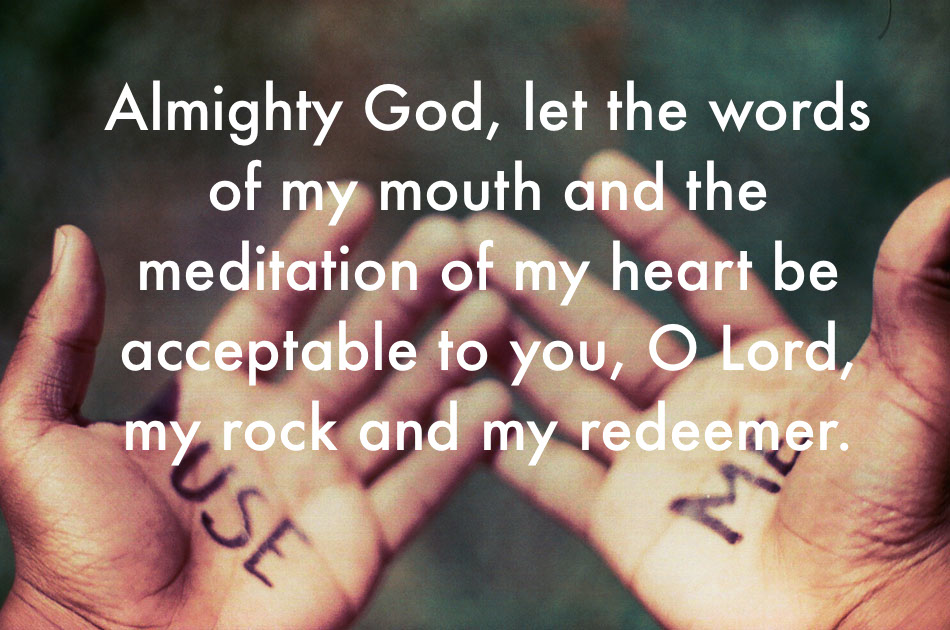
use-me

There were two men. The first lived his life perfectly and blamelessly; everything was coordinated and examined. He never wasted a moment and did his utmost to plan for every contingency and minor catastrophe. If he could live his life in consistent repetition, he believed he could achieve perfection. Every morning he awoke to eat the same breakfast and spend precisely 15 minutes reading from his bible, offering up the same lifeless prayer. He wasn’t sure that he actually believed in God, but he wanted to be safe. He took the same roads to work, ordered the same lunch, used the same pencil brand. Everything was accounted for. He made his money, invested in the right companies, provided for his family. On the surface he had everything you could want. Except he did not have life.

The second man lived a life of apparent chaos as he tried desperately to cling to something solid as the world continued to spin around him. Every morning was a new and exciting, though sometimes terrifying, adventure. He would often oversleep leading him to rush off to work without his breakfast or morning coffee. He was a faithful Christian, he somehow was able to make it to church every week, his bible was often found in different places throughout his house with ear marks and underlined passages in the Old and New Testament. He believed deeply that God was a living and loving presence in his life and looked forward to his moments of silence during the day when he felt he could best commune with the divine. Speaking with God was not about rhythm or repetition, but a life-giving and humbling experience. He made his money, tried to invest, but believed that spending time with his family would be more rewarding than a large portfolio. On the surface he was missing some of the things that make up the American dream. But he had life.

It has taken me a long time to learn how to pray; and I’m still not satisfied with my prayer life. I go through waves of devoting time everyday to sitting in silence and talking with God, and then there are days when I have realized that I felt too busy to pray. I have spent weeks praying prayers that have been written in books, and I have spent months praying extemporaneous prayers from my heart and soul. I have experimented with numerous spiritual disciplines, and I’m not sure that I have found the one that is just for me, perhaps I never will.

Prayer is one of those things in the life of Christian discipleship that we expect, but rarely talk about. Whenever we get together as a church, before an activity begins, all eyes fall on me to lead us in prayer so that we can start. Sometimes those prayers feel life-giving, but oftentimes they feel like an expectation. When I am asked to pray before a meal, there are times that I feel truly genuine in expressing my thankfulness to the Lord, but there are also times when I feel that I am just going through the motions.

prayer

There was a long period in my life where I felt like the first man. I would wake up early and ride my bike to Duke Divinity School just so that I could be there for Morning Prayer with the Anglicans and Episcopalians. I even started to lead the daily worship service. But there was a time when in meant very little to me. It became so routine that I stopped listening to the words, and felt that it was more important for me to be there in body, than it was for me to be there in heart and soul.

Last week I asked us to examine a simple, yet profound, question: What is the point of Church? Why do we spend time each week gathering in this place? I attempted to proclaim God’s Word in such a way that we could begin to move away from a maintenance model of Church, to a missional model where we live as Christ’s body for the world.

Today I would like to ask an equally simple, yet profound, question: Why do we pray and read scripture? Why do we take the time to halt the busyness of our lives to read God’s Word and commune with him?

The psalmist writes that the law of the Lord is perfect, it revives the soul, it makes us wise, it allows us to rejoice in our hearts. The commandments are clear, they open our eyes. The fear of the Lord is pure and endures forever. The ordinances of the Almighty are true and righteous. The psalmist even goes on to claim that the Word of the Lord is to be desired more than gold and sweeter than honey.

You could give me a biscuit with honey on it right now, and I would tell you that is the sweetest thing in the world. Yet, as I have grown older, as I have spent more time deep in God’s Word, its sweetness has been revealed to me. In a conversation with someone during bible study, or deep in prayer about someone’s life and suffering, a new vision and understanding is presented to me out of God’s Word. It truly is a sweet gift, one that speaks to us, even today, from God.

The difference between the two men, is that the first saw his responsibility to prayer and scripture as simply that – a responsibility. He sets aside the time to read and pray, but the words on paper and the words on his lips are lifeless. He believes the first part of the psalm but expects that so long as he maintains his regular practice it will be enough. The second man, however, recognizes that he can do more, that speaking with God can be different and casual and faithful.

Psalm 19 begins to answer our question: Why do we pray and read scripture? It refreshes our souls.

When we spend time reflecting on God’s Word and going to him with our thoughts, desires, hopes, and fears we honor the living Lord who refreshes our souls for a new day. It simplifies the way we envision the world, and reminds us who we are following and why. It humbles us and rewards us.

However, even with the benefits and warnings in scripture, we cannot completely avoid hidden sins and mistakes nor can we control others around us and prevent them from doing the same.

God’s Word operates as a warning about the transgressions of life. It has not only the green light of “allowed”, and the red light of “forbidden,” but also the yellow light of “caution.” Ordinary and humble people do not normally go plowing through the red lights of life. Deliberate and precise sins come with practice and committed degeneracy. But we are all constantly taking chances with the yellow lights of behavior.

That is why the end of the psalm is so important: Who can detect all of their own errors? Who can look at their life and faithfully say I was wrong? Great God, cleanse me from my hidden faults, keep me from those who would do harm to my soul.

The greatest test of our faith is found in our willingness to seek forgiveness from our sins, particularly those no one knows about except us. When we have committed a wrong against someone, and everyone else knows about it, I believe we are more inclined to seek forgiveness. But when we do something wrong in secret, when we sin while no one is watching, I believe we are less inclined to ask for forgiveness, because it is entirely on us. God’s word and a life of prayer are therefore the ways by which we might have the strength to admit our faults, as we read about so many who have sinned before us, and seek forgiveness as we commune with the Lord in prayer. Reading and praying are as essential for us as are eating and breathing – they all give us life.

If you want to become a United Methodist Pastor, there are a number of requirements you have to meet. One of the most stressful is planning a full worship service, leading it, preaching, and having the entire thing videotaped. I was still in seminary when I asked my home church if I could “take over” for one Sunday in order to film the service and send it off to the people who would determine whether I should become a pastor or not.

I fretted about the service, overanalyzed the bulletin, worried about the hymns I selected, stressed about the scripture, and never felt the sermon was good enough. After all the weeks of planning and communication I showed up at my home church Sunday morning, and prepared to put it all on the line. I remember standing in the back, and giving my father the “thumbs up” to start recording when Jason, my friend and pastor, walked ahead of me to address the congregation.

“For those of you that don’t know,” he began “we have one of our very own here this morning to lead us through worship. Taylor is applying to be considered for an appointment in the United Methodist Church and everything we do this morning is being filmed. You and I all know that he is not really that funny, but if you could try to laugh at his jokes, I’m sure that it will help him out with the Board of Ordained Ministry.

The service was oriented around a reading from the end of James about sharing our sufferings with one another. The role of disciples in the church is to rejoice with one another at times of happiness, and weep together during times of sorrow. We are called to love one another through the good times and the bad, but we can only begin to find healing and reconciliation if we share our struggles.

When I was finally able to offer the benediction at the end of the service I breathed out a huge sigh of relief, a sigh that was so loud that you can hear it in the recording! I had made it through the whole thing without tripping and embarrassing myself, without stuttering through the scripture reading, and I even got a few laughs during the sermon though I could never tell whether they were genuine or not…

I made my way out of the sanctuary proud of the service and hopeful that it was good enough for the Board that would be viewing it. But while my mind was caught up in my own selfish reflections about the service, I saw a member of the church, someone I knew very well, crying in her pew.

She shared with me that her daughter had been suffering with bulimia through the last six months and she had refused to share it with anyone. She was embarrassed that she had failed as a mother and she felt as if she was carrying the whole world on her shoulders. She said that after hearing the scripture read, and the words of the sermon, she prayed in her pew, and she realized (for the first time) that the church was the place that she could share her burden. And while others were preparing to leave she reached out to the stranger in her pew and asked if she could share with him her struggles and pray together. With tears flowing down her face she said that this was the best she had felt in months.

prayer-bible

The Word of the Lord is greater than gold and sweeter than honey. In the moments of our reading and praying we are opened up to the strange new world of the bible and of faithful living that can change everything.

We pray and read to cleanse our souls and to give us life. It is not something that has to be strictly observed with militaristic expression, but instead something that we believe can change our lives.

The final line of the Psalm 19 is a beloved and permanent aspect of worship; they are the words I pray before preaching every single Sunday. If our words and thoughts are acceptable in the Lord’s sight we are on the path toward renewed spirits and discipled living. When those words become our truest prayer and hope then we are speaking and thinking as if Jesus was at our elbow which, after all, is the whole point of prayer.

Amen.

Authorized for What? – Sermon on Matthew 21.23-32

Matthew 21.23-32

When he entered the temple, the chief priests and the elders of the people came to him as he was teaching, and said, “By what authority are you doing these things, and who gave you this authority?” Jesus said to them, “I will also ask you one question; if you tell me the answer, then I will also tell you by what authority I do these things. Did the baptism of John come from heaven, or was it of human origin?” And they argued with one another, “If we say, ‘From heaven,’ he will say to us, ‘Why then did you not believe him?’ But if we say, ‘Of human origin,’ we are afraid of the crowd; for all regard John as a prophet.” So they answered Jesus, “We do not know.” And he said to the, “Neither will I tell you by what authority I am doing these things. “What do you think? A man had two sons; he went to the first and said, ‘Son, go and work in the vineyard today.’ He answered, ‘I will not’; but later he changed his mind and went. The father went to the second and said the same; and he answered, ‘I go, sir’; but he did not go. Which of the two did the will of his father?” They said, “The first.” Jesus said to them, “Truly I tell you, the tax collectors and the prostitutes are going into the kingdom of God ahead of you. For John came to you in the way of righteousness and you did not believe him, but the tax collectors and the prostitutes believed him; and even after you saw it, you did not change your minds and believe him.”

446190966_640

Jesus does what Jesus wants. He has gone all over Galilee proclaiming the Good News, bringing sight to the blind, and healing to the sick. He has fed the multitudes miraculously, walked on water, and calmed the storm. He entered the holy city of Jerusalem on the back of a derelict donkey, charged into the temple and drove out the money-lenders while overturning the tables. Radical and revolutionary, Jesus does what he wants, and now the chief priests and the elders want to stop him in his tracks.

“Who in the world do you think you are? Who gave you the authority to do these things?” Of course, “these things,” refer to him cleansing the temple, curing the blind and lame, feeding the hungry, providing for the poor, listening to the weak, and giving hope to the hopeless. The question has been posed to Jesus before, but never has the question been more ominous; Jesus is in enemy territory and those asking the question will constitute the court that will later sentence him to death by crucifixion.

What gives you the right to come in here and tell us how we are supposed to understand the world?” They do not really want an answer to their question. Instead, they are seeking an opportunity to trap Jesus by means of his response. So Jesus does what he wants: He ignores their question for the moment and proposes a counter-question that they too cannot answer without getting in trouble.

“I will ask you a question; if you tell me the answer, then I will also tell you by what authority I do these things. Did the baptism of John come from heaven, or was it of human origin?” The chief priests and the elders argue among themselves about how they can answer. This is a classic Catch-22; “If we say his baptism was from heaven then Jesus will ask why we did not believe him and have him beheaded, and if we say it was an earthly thing the crowds will revolt against us because they all regard John as a prophet.” Caught in a dilemma of their own making, they recognize that there is no way they can answer the question without putting themselves in a worse position, so they answer with the answer that students have relied on for centuries, “We do not know.”

I imagine then, that Jesus smiled while saying, “neither will I tell you by what authority I am doing these things.”

Rev. Dr. Warren Smith

Rev. Dr. Warren Smith

When I was in seminary a professor named Warren Smith led my class through the great wonders of Church History. We studied some of the greatest theologians and mapped the various trajectories of theological positions that have brought our church through the centuries. After a semester of heavy reading and writing, Dr. Smith ended his final lecture with a story…

When he was a young pastor he was appointed to a church fresh out of seminary and did his best to proclaim the Word, serve those in need, and live into God’s kingdom on earth. For months the church listened deeply to his sermons and prayers, and grew in their love of God and neighbor. However, there was one older woman who never spoke to Dr. Smith after worship. She would sit patiently in her pew, unaffected by his words and gestures, and would return to the parking lot without saying a word to the young pastor. That was the typical routine until one Sunday she made her way in the receiving line following church.

Who do you think you are?” she began. “To come into this church and tell us how to live our lives. I have been a Christian longer than you have been alive. What could you possibly teach me about what it means to follow Christ?” And with that, she left.

Her words struck deep in Dr. Smith’s soul. Was she right? What could he possibly teach someone who had been following the Lord for decades when he had just graduated from seminary? Dr. Smith however, is not one to go gently into the night.

The following Sunday, Dr. Smith made his way to the pulpit and began to preach with words that resonated throughout the sanctuary: “I know I may look young from this pulpit. I know that some of you might be concerned with my ability to preach and teach in this church considering my age. But when I stand in this pulpit I AM 4,000 YEARS OLD. I speak with the great cloud of witnesses that have gone before me. I am equipped by the Holy Spirit to proclaim the Good News of Christ because the Lord is with me even to the end of the age.”

“So too,” he said to my class, “remember that you have been authorized to do incredible things and you are older than you think.”

When Dr. Smith’s authority was challenged he responded by recalling the great tradition of the living Word that is brought forth into new life on a regular basis. He looked back in order to look forward. He validated his responsibility by acknowledging his earthly youth while at the same time affirming his divine wisdom through the Holy Spirit.

When Jesus’ authority was challenged by the chief priests and the elders he responded with an unanswerable question, and then with a parable. The parable becomes the lens by which they can see their error and envision a proper understanding of God’s reign in the world.

What do you think? There was a man with two sons. He went to the first and asked him to work in the vineyard. The first son refuses, but later he changed his mind and went to work in the field. The father went to the second son and asked him to work in the field as well. The second son agrees to work, but never went to the vineyard. Which of these two sons did the will of his father?

The chief priests and elders respond in unison, “the first.” It is obvious that even though the son refused to work, the fact that he did, in the end, is far better than the son who agrees to work and never enters the vineyard. Jesus then uses the parable to draw the unmistakable conclusion that they, the chief priests and elders, are the second son who has failed to do the father’s will. “The tax collectors and the prostitutes are going into the kingdom of God ahead of you. John came in the way of righteousness and you did not believe him, but they did. Even after you saw what he did, you did not change your minds and believe. You preach and preach, but you never practice the words you proclaim.

Jesus responding with a parable is typical of the gospels, and helpful for bringing about new understanding. He uses a story in order to open up the kingdom of God to show that it works in a way that is approachable and livable.

What do you think of the parable? In your faith journey do you feel like the first brother? Was there a time that you rejected the calling of God on your life, refused to believe, only to find yourself caught up in the grace of God and working in the vineyard of the kingdom? Is your faith vibrantly alive and fruitful?

Or do you feel like the second brother? Was there a time that your faith was so alive that you were willing to say “yes yes” to God’s call on your life only to find yourself apathetic to the work of the church in the kingdom? Is your faith stagnant and fruitless?

use-me

Individually, we can respond to God’s call in faithful ways by reaching out to others in our community and letting God’s love abound in their lives through our actions. But collectively, as a church, it can be quite difficult to be Christ’s body for the world.

This week I met with a handful of other Methodist clergy from the valley and we discussed our local churches, some of the challenges facing our congregations, and the fruit that has come forth during our time of service. We talked about new ministry ideas that might help share the Good News with people in our communities while also affirming the many challenges of being the church for the world today. But, to be honest, most of the conversation was a time for the leaders to complain about the lack of enthusiasm in their churches, their inability to see the call of the church and the mission of God in the world. At one point a friend of mine shook his head and said softly, “It can be so depressing to hear that most of our churches are far more concerned with maintenance, than mission.

One of the hardest things to admit, as a church, is that we are more often like that second son than the first. After all, here we are sitting in the vineyard, preparing to go out to harvest the grapes. But as Christians, we can become blind to what God is doing in the world around us. How sad is it that “church work” can quickly degenerate into conversations about maintaining our building, with no excitement about what God’s living Word and grace are doing in our community? How sad is it that the majority of our conversations and budget are focused on making sure that the church will still be here next Sunday instead of focusing on the renewal of the church and the formation of disciples of Jesus Christ for the transformation of the world? Like the second brother we say that we are going to work in the vineyard, but instead of harvesting grapes we spend our time rearranging the stones along the path. 

I’ll admit that our church is changing, we are slowly moving away from the maintenance model and are becoming lively and excited about the ways we can be Christ’s body for the world. We are no longer content with just being a building where people can sit together on a Sunday morning. A church is not a building. A church is the work of the people for the vineyard, for the kingdom.

Jesus was authorized by his father in heaven to do the will of God on earth. To overturn the tables in the temple, to call out the leaders of the people for their hypocrisy and limited vision, to seek out the last, least, and lost, to bring them a sense of wholeness, to feed the hungry, to clothe the naked, to make disciples.

In the same way, Christ has authorized us to be his body for the kingdom of God. Today we have the remarkable responsibility of acting like God’s son, and the first son from the parable; even when we doubt our responsibility to the mission of God we are needed in the vineyard.

What are we doing as a church? Are we giving our tithes and offerings to God so that the church will stay open, so that we can hear an articulate and thoughtful 15 minute sermon every week. Are we content with letting our discipleship look like maintenance?

What are we doing as Christians? Are we radical people who believe that God continues to do amazing things in the world? Do we hope and pray for God’s will to really be done here on earth among us?

We have been authorized to do great and wonderful things in the world. Let us remember and believe that the Lord will provide, that nothing will ever separate us from God’s love, and that we have been called to work in the vineyard.

Amen.

Interrupted Salvation – Sermon on Mark 5.21-43

Mark 5.21-43

When Jesus had crossed again in the boat to the other side, a great crowd gathered around him; and he was by the sea. Then one of the leaders of the synagogue named Jairus came and, when he saw him, fell at his feet and begged him repeatedly, “My little daughter is at the point of death. Come and lay your hands on her, so that she may be made well, and live.” So he went with him. And a large crowd followed him and pressed in on him. Now there was a women who had been suffering from hemorrhages for twelve years. She had endured much under many physicians, and had spent all that she had; and she was no better, but rather grew worse. She had heard about Jesus, and came up behind him in the crowd and touched his cloak, for she said, “If I but touch his clothes, I will be made well.” Immediately her hemorrhage stopped; and she felt in her body that she was healed of her disease. Immediately aware that power had gone forth from him, Jesus turned about in the crowd and said, “Who touched my clothes?” And his disciples said to him, “You see the crowd pressing in on you; how can you say, ‘Who touched me?’” He looked all around to see who had done it. But the woman, knowing what had happened to her, came in fear and trembling, fell down before him, and told him the whole truth. He said to her, “Daughter, your faith has made you well; go in peace, and be healed of your disease.” While he was still speaking, some people came from the leader’s house to say, “Your daughter is dead. Why trouble the teacher any further?” But overhearing what they said, Jesus said to the leader of the synagogue, “Do not fear, only believe.” He allowed no one to follow him except Peter, James, and John, the brother of James. When they came to the house of the leader of the synagogue, he saw a commotion, people weeping and wailing loudly. When he had entered, he said to them, “Why do you make a commotion and weep? The child is not dead but sleeping.” And they laughed at him. Then he put them all outside, and took the child’s father and mother and those who were with him, and went in where the child was. He took her by the hand and said to her, “Talitha cum,” which means, “Little girl, get up!” And immediately the girl got up and began to walk about (she was twelve years of age). At this they were overcome with amazement. He strictly ordered them that no one should know this, and told them to give her something to eat.

hemorrhagingwoman 6-26-12

This Sunday marks the conclusion of our sermon series on Women of Faith. Over the last few weeks we have focused on women from the Old Testament who lived our their faith in such a way that it continues to speak to us in our faith journeys. The point has been to explore some of the great females from scripture, particularly those who are not regularly mentioned from the pulpit. We began by looking at Rahab the harlot before the fall of Jericho and talked about how our pasts do not define our lives. Last week we looked at Deborah and Jael from Judges and talked about how women are powerful and being faithful is complicated. Today we conclude by looking at the unnamed hemorrhaging woman from Mark 5. So, here we are, may God bless out time together as we look at one more woman with profound faith.

The loneliness is getting unbearable. She lives in Staunton, has a full time job, while also maintaining the aspects of home life. Her husband largely ignores her, never asks about her day, and expects dinner and the laundry to have been taken care of by the time he gets home. The children are involved in such a high number of activities throughout town that she can barely keep track of who is supposed to be where and when. Though she won’t admit it to anyone, her life feels empty, as if its being drained from her slowly and decisively.

Twice a day she finds herself driving up and down Augusta street and whenever she passes St. John’s she struggles to keep her eyes glued ahead. She has admired the witty marquee in the past, and she feels something drawing her to the building, but church is the last thing she wants in her life.

For months this goes on, and every time she passes she catches herself glancing more and more at our building. She sees the children during preschool walking on the front lawn looking for insects and leaves for projects, she observes the Christmas tree sales with families giggling as they explore the various options, she witnesses a number of older adults laughing manically as they fall down the 18 ft. inflatable slide during the Community Cook-Out. On certain Sundays she finds herself getting in the car and driving to the parking lot but she never leaves the vehicle; she can’t explain why she’s here and she’s too afraid to come inside.

One morning, when the emptiness and loneliness has become so frighteningly palpable she drives to St. John’s on a typical Sunday and bravely makes her way from the car to the sanctuary. She hopes against hope that something incredible can happen here.

But we’re in the middle of something else, worship has already started and I’m up here in the pulpit going on and on about the grace of God, or the service has yet to start but most of us are greeting our friends and asking them about their weekends, or worship is already over but most of us are solidifying plans for lunch. We might not even notice the woman who risked it all to be here with us.

—————————

Jesus was beckoned by Jairus, the leader of the synagogue, to come and heal his daughter. “Please Lord. My little daughter is at the point of death. Come and lay your hands on her, so that she may be made well and live.” So Jesus, doing his Jesus thing, went with Jairus to heal his daughter. Like worship on a Sunday morning, Jesus going to heal someone is typical and part of his routine. He is prepared to meet the young girl and heal her as he has done so many times before.

However, on the way to Jairus’ house a strange thing happens. A woman who had been suffering from hemorrhages for twelve years, who had been isolated from her family and community, sees the Messiah that she had heard so much about. Building up her courage she stepped forward, reached out her hand and touched his clothes, hoping that it would cure her. And immediately she felt in her body that she had been healed. But Jesus will not leave it at that; feeling the power go out from him he turns to the crowd and demands to know who touched his clothes. With fear and trembling the woman stepped forward and told Christ the whole truth, and he responded by saying “Daughter, your faith has made you well; go in peace, and be healed of your disease.”

healing-of-the-woman-thumb-300x3861

Jesus was interrupted on his journey to heal Jairus’ daughter by a hemorrhaging woman, and in so doing the young girl died at home. He took too much time with the other woman’s problems, and now an innocent girl has passed away when Jesus could have done something about it.

—————————

The woman sits in one of the pews of our church alone and afraid to speak to anyone. She has never been in a church before and so much of what we are doing is strange and bizarre to her. She is thankful for the bulletin directing her to the hymnal with tunes she has never heard, and prayers that she has never uttered. Most of it means nothing to her but she continues to worship with the hope that something will help. 

Our service ends and she follows the people around her as they file out toward the back of the sanctuary. She keeps her head low and whispers thank you as I shake her hand, I thank her for being with us today, and she walks out, perhaps never to return again. She came looking for something life-changing, hoping for something to heal her and make her well, and all she got was a strange youth message, a mediocre sermon, and more loneliness.

—————————

When Jesus arrived at Jairus’ house, even with the young girl dead, Jesus comforts the father, “Do not fear, only believe. Your daughter is not dead but sleeping.” And the people in the house laughed at him, but he put them all outside and took Jairus and the child’s mother and went to the girl. He took her by the hand and said to her, “Little girl, get up!” and she immediately got up and began to walk around, hungry for something to eat.

Jesus allowed the interruption in the street by the unnamed woman knowing that he would be able to still make it to Jairus’ house and bring about the healing and salvation that was needed. He might have been content with merely allowing her to touch his clothing and be healed but he took the extra time for personal touch and contact.

—————————

When the woman comes to St. John’s we could happy with letting her experience worship on her own, free to return to the life of loneliness and emptiness, but if we are to act like Christ we have to go one step farther. The terrible disease of loneliness is something that we have the power to fight against, we just have to be open to interrupted salvation.

Mark 5 is an incredible reminder for all of us, for the teachers who are so often interrupted by students, parents harried by the demands of their children, and even preachers that are stopped while working on a sermon, that interruptions are important. Someone once said, “You know… my whole life I have been complaining that my work was constantly interrupted, until I discovered that my interruptions were my work.

I was having lunch on Thursday with a clergy friend, talking about the ways that we are trying to serve our churches, when a man casually mentioned something about his cancer and we invited him to join us for lunch. He interrupted our conversation to share with us his struggles and fears. I was preparing for worship two weeks ago, running around the building just trying to make sure that everything would be ready, when Steve Wisely scared me half to death. He interrupted me in the midst of my work to tell me that his father, Russ, was dying. Every Sunday I stand at the back of the church, thanking all of you for being with us in worship when I am often dealt a hard and frightening truth about someone’s struggles, I am interrupted while doing my job with a difficult diagnosis, a struggling marriage, or a lonely woman.

What do we do with our interruptions? When the stranger arrives at church, sitting alone in the pew near us while we are in the middle of a conversation, how do we respond? Are we content with introducing ourselves, shaking hands, and then going back to our routine, or do we act like Christ and take the extra step to offer them not only a smile, but wholeness? When your child struggles with a decision in their life, do you offer a few bits of wisdom, or do you drop what you are doing to demonstrate that you deeply love them? Do you see interruptions as interruptions, or do you see them as opportunities for salvation?

That woman with the hemorrhage has more faith than I’ll ever have. She, in the deep recesses of fear and disappointment, reached out to the Lord with the hope of receiving something so improbable, that we would mock it today. Her faith is so real and palpable because she lived it out, she took those frightening steps to the Lord and believed that he could do something incredible with, through, and for her.

That unnamed woman who arrives at our church and sits in her car unsure of whether to enter has more faith than I’ll ever have. Though deeply rooted in the fear of her own loneliness and emptiness, she bravely enters the church with the hope that the Lord, with the people inside, can do something so improbable that we often ignore it. Her faith is so real and palpable because she lives it out, she takes those humbling steps to the sanctuary and believes that the God of Christ can do something incredible through us for her.

Showing up to church is wonderful. When it becomes part of the routine of life it begins to habituate us toward a new understanding of discipleship where we can truly act as Christians without having to overthink what we are doing.

But believing that God can actually do something for you, that the church can bring about a sense of salvation in your life is what faith is really all about. 

The woman walks out the main doors and makes her way toward the parking lot. Frustrated by her foolishness in believing that the church could actually change anything about her circumstances she is surprised when she hears a person hurrying up behind her. Someone from St. John’s, one of you, tries to catch up with her to apologize for not introducing yourself earlier. You tell her that you saw her sitting by herself and you felt God pushing you to do something more and you ask if she would like to get a cup of coffee sometime this week, just so that you can get to know her better. “I would love that” she says with a shy smile.

The final few steps to her car are filled with the brightness of hope, something she has not experienced for a long time. Still smiling from the invitation she hears a soft voice, as light as the wind, “Daughter, your faith has made you well.

Amen.

The Tent Peg of Doom – Sermon on Judges 4.4-9

Judges 4.4-9

At that time Deborah, a prophetess, wife of Lappidoth, was judging Israel. She used to sit under the palm of Deborah between Ramah and Behtel in the hill country of Ephraim; and the Israelites came up to her for judgment. She sent and summoned Barak son of Abinoam from Kedesh in Naphtali, and said to him, “The Lord, the God of Israel, commands you, ‘Go, take position at Mount Tabor, brining ten thousand from the tribe of Naphtali and the tribe of Zebulun. I will draw out Sisera, the general of Jabin’s army, to meet you by the Wadi Kishon with his chariots and his troops; and I will give him into your hand.’” Barak said to her, “If you go with me, I will go; but if you will not go with me, I will not go.” And she said, “I will surely go with you; nevertheless, the road on which you are going will not lead to your glory, for the Lord will sell Sisera into the hand of a woman.” Then Deborah got up and went with Barak to Kedesh.

Jael and Sisera

Today marks the second part of our Sermon Series on Women of Faith. Throughout the last year or so I have been excited to hear questions in, and outside of, church regarding the role women play in both the Old and New Testaments. This series is focused on exploring some of the great women of faith from the Bible, particularly those who are not regularly mentioned from the pulpit. So, here we are, may God bless our time together as we explore two more women with dynamic and powerful faith.

Deborah was a judge over Israel. She had a wide range of responsibilities with her position; deciding controversies, announcing verdicts, and implementing judgments. For her to have been given, and honored with, this responsibility is exceptionally rare for a woman in the Old Testament. Moreover, she is remembered as one of the finest rulers: she is sought out for her counsel, she is referred to as a prophetess and mother of Israel, she boldly proclaims the Word of the Lord, and there are no controversies surrounding her rule.

The Israelites are once again in bondage in their own land, and they beg God to deliver them from oppression. For the past 20 years the people have suffered under the vicious hand of Jabin and his general Sisera. The Lord then moved Deborah to call upon Barak, an Israelite general, to go to war with 10,000 men against the mighty Sisera. Barak, however, is reluctant to do so, even with the promise of the Lord’s presence, he knows the kind of weaponry and army that Sisera has, and feels that this might be a suicide mission. Barak refuses to go to war unless Deborah goes with him. 

One of the great generals of God’s people is afraid to follow the Lord’s command unless a woman goes with him.

So Deborah agrees to travel with Barak but warns him that the battle will not bring him glory, because the Lord will deliver the evil Sisera into the hands of a woman.

Thats where out scripture reading ends for the day, but of course that is not the end of the story. If you keep reading Judges 4 you learn that Barak summoned the 10,000 warriors and traveled to Mount Tabor. When Sisera learned of Barak’s movement he called out all his chariots of iron and all of his troops to go to war. The battle ensues and the Lord threw Sisera and all his army into a panic before the Israelites. Sisera retreated from the battle, but the entirety of his army fell at the hand of Barak and the Israelites.

Sisera fled to a nearby village and was met by a woman named Jael outside of her tent. She implored him to come inside where she would hide him and take care of him. In the tent she covered him with a rug and offered him milk to drink. After he fell asleep she took a tent peg in one hand and a hammer in the other, went softly to Sisera, and drove the tent peg into his temple, until it went down into the ground and he died. Only later did Barak arrive in the village surprised to discover that Sisera had been killed, still stuck to the ground by the tent peg.

It would seem to me, therefore, that the message from our scripture today is to be very careful about accepting invitations into the tents of strange women, particularly if they have extra tent pegs lying around.

I offer this in the name of the Father, the Son, and the Holy Spirit. Amen…


Just kidding.

What a crazy and awesome story. It plays out like a movie; Barak is told that he will receive no glory but he heads into battle anyway. Deborah promises him that the Lord will deliver Sisera into the hands of a woman, and we assume that means the Lord will hand the evil general over to Deborah.

The scene then shifts from the giant battlefield to the interior of a small tent with the candles burning in the corner. Perhaps still nursing his wounds from the battle Jael offers Sisera comfort and safety. Under the warmth of the carpet, filled with the cool milk from the caring woman, Sisera drifted off to sleep.

When suddenly Jael drives the tent peg through his skull leaving his lifeless body stuck to the ground like a tent in a wind storm.

So what are we to make of these dynamic women of faith, both Deborah and Jael? What do they teach us about our faith today?

we_can_do_it___remastered_by_thedrifterwithin-d56rqh1

Women are powerful.

The story begins with Deborah and Barak, the female is obviously stronger than the male. As I mentioned before, the assumption of leadership by a woman is extraordinary during this time and something that we should not overlook. Deborah is a priestess and a judge over God’s people, she contained insight, perspective, and knowledge far beyond the average person, and held an awareness of the movements of God’s spirit. Though it is not written in scripture, she appears to be a woman of prayer, regularly in communion with the divine, someone who let her faith lead her, rather than the other way around.

Deborah was not the domestic type of woman that so many women are made out to be today. Yes she was married, but she committed herself to God’s people, to helping, guiding, leading, and shaping them. She was not relegated to a sphere of domicile power, but was intimately involved in the lives of others, respected for her wisdom, and sought after for judgment. It is no small thing that when she tells Barak to fight for God’s people, he was unwilling to do so without her. Women are powerful, and therefore deserve more respect than is often given. 

Without Deborah, Barak would never have had the confidence and courage to lead the army into battle. This is not the same thing as “behind every great man is an even greater woman.” Deborah was a great woman. Her role was not to make men look better, or stay hidden at home to take care of other responsibilities, she was a profound individual full of power and glory, one who stands as an example for how we should view women today.

In ministry women are still facing challenges to be taken seriously and respected in their vocation. In saddens me to hear stories from my female peers who are often neglected and ignored because they are women. Too often I hear about church attendance declining significantly on the Sundays that the female pastor is slated to preach, or funeral directors refusing to believe that a female pastor has been called to proclaim someone’s life, death, and resurrection, or men making inappropriate comments to women in the ministry.

In particular I can remember receiving a page from one of my female colleagues at Duke University Hospital that a patient wanted a different pastor to visit. The patient was an older woman who had recently arrived and when I entered her room I wanted to find out why she needed a different chaplain. Had my friend said something inappropriate? Did she offend the woman laying in the hospital bed? The patient’s response was simple and sweeping: “Women are not meant to be pastors!

Deborah stands in stark contrast to the negative perspectives of women in ministry, and outside of service in the church. Women can be, and are, just as powerful as men. They can live and lead like Deborah with power, respect, and wisdom. We just need to have our eyes opened to the ways that God would have us see one another, neither male nor female, but made one in Jesus Christ.

In addition to the call to see women in a new light, the stories of Deborah and Jael remind us that having faith is complicated. We cannot compress what we believe into a tweet or an announcement on the marquee in front of church. The Good News cannot be compartmentalized onto a bumper sticker or a tee-shirt logo. Our faith is dynamic, organic, and complicated.

Jael striking Sisera dead with a tent peg is a frightening end to an otherwise typical story in the Old Testament. It had astounded faithful people for centuries; even John Wesley expressed his ethical qualms about Jael’s murderous actions in Judges 4 and wondered if this was divinely inspired, or written by someone who was subject to mistake.

However, God’s ways are sometimes like that; they are beyond explanation and justification. Considering the calls to love our neighbor and turn the other cheek, this story from Judges 4 seems contradictory compared with Christ’s commands in the New Testament. Yet we affirm this as God’s Word, that even in this story we receive an element of God’s ways with God’s people.

God, in scripture and in life, works in ways that surprise us. God delivers the people from the murderous Sisera with a tent peg from a deceitful woman. God calls a young shepherd to defeat the mighty Goliath and lead his people, only to fall to the temptation of lust in Bathsheba. God saved the two spies who entered Jericho through a harlot named Rahab who hid them on her roof. And God chose to save all of us through a carpenter who was nailed to the cross.

We affirm many things about God through worship. But one of the things that we neglect to mention, is that God is strange. God’s ways are not our ways. We cannot, and should not, presume to know why God does what God does. 

1010170_10200106510816517_20363525_n

A year and a half ago, I thought I was supposed to be an associate pastor at one of the larger churches in the Virginia Conference. After going straight from college to seminary and then into the ministry I believed it might be a good thing for me to follow under the leadership of a seasoned senior pastor who could help me learn the most fruitful ways of doing church. Knowing that I was going to propose to Lindsey, and hoping she would say yes, I figured that working in a larger area would give her a greater opportunity for finding a job in social work. I had it all planned out in my head, exactly how I would follow God’s call on my life.

And then I received a phone call: “Taylor, we’re taking your name off the associate list. We believe that your gifts and graces fit best with serving as the pastor of St. John’s United Methodist Church in Staunton, Virginia. The bishop has appointed you, and we are praying for your ministry.”

As a 25 year old coming straight out of seminary, I never imagined that this would be the church that I was serving. I thought that I had it all figured out.

But God’s ways are not my ways. Our God loves to surprise us and save us in ways that we cannot imagine. I’m still trying to work out why God chose to send me here, but every day that I serve as the pastor of this church is a constant reminder that I am exactly where I am supposed to be. Because whether you know it or not, you have saved me in ways that I cannot even begin to describe.

Women are powerful and being faithful is complicated. Deborah and Jael remind us that the ways of the world are not the ways of God. That we are called to a new perspective on how to view one another: male-female, black-white, gay-straight, young-old, we are all God’s children full of value and worth. That God works in ways that are unexplainable and bizarre, calling people like you and me to serve our community side-by-side.

I’ll admit that its frightening and disconcerting, but sometimes God needs a tent peg to jolt, shock, and knock some sense into us.

Amen.