Who Are You? – Sermon on James 1.17-27

James 1.17-27

Every generous act of giving, with every perfect gift, is from above, coming down from the Father of lights, with whom there is no variation or shadow due to change. In fulfillment of his own purpose he gave us birth by the word of truth, so that we would become a kind of first fruits of his creatures. You must understand this, my beloved: let everyone be quick to listen, slow to speak, slow to anger; for your anger does not produce God’s righteousness. Therefore rid yourselves of all sordidness and rank growth of wickedness, and welcome with meekness the implanted word that has the power to save your souls. But be doers of the word, and not merely hearers who deceive themselves. For if any are hearers of the word and not doers, they are like those who look at themselves in a mirror; for they look at themselves and, on going away, immediately forget what they were like. But those who look into the perfect law, the law of liberty, and persevere, being not hearers who forget but doers who act — they will be blessed in their doing. If any think they are religious, and do not bridle their tongues but deceive their hearts, their religion is worthless. Religion that is pure and undefiled before God, the Father, is this: to care for orphans and widows in their distress, and to keep oneself unstained by the world.

who-am-i


The small town sheriff was frustrated when he received a phone-call from the station that interrupted his Sunday supper. A report had come in that a group of young boys were throwing water balloons at strangers walking along Main Street. Reluctantly, the sheriff changed out of his Sunday best into his uniform and went to find the hooligans.

Just as the report noted, a group of young boys were standing on a street corner with a bucket of water balloons and were striking anyone within distance. As he approached in his patrol car, he expected to hear the boys laughing and hollering, but they were rather silent as he inched his way forward. He recognized all the boys from his local church, and dreaded the phone calls he would be making to all of their parents, but he knew their behavior had to stop.

The boys were smart enough not to throw a balloon at the police car, but the sheriff was still nervous to roll down his window in case a wayward throw made it inside. “What do you think you’re doing?” he yelled to the boys. In unison they all solemnly replied, “we’re working for the Lord.” He was mystified by their response, after all how could throwing water balloons at strangers be equated with the almighty? So the sheriff sat in his car with one eyebrow raised and motioned for them to explain.

The ringleader then stepped forward and said, “Didn’t you hear the preacher this morning sheriff? He told us to go out baptizing in the name of the Father, Son, and Holy Spirit. We’ve got Holy Water Balloons and we’ve done already made 45 Christians.”

Every good thing in our lives, every generous act of giving, every perfect gift, every blessing, every compliment, is from above.

Throughout our days, the Lord nurtures, guides, and provides all that we need. More often than not, God uses the people around us to do so, but nevertheless God supplies the goodness in our lives.

The letter of James is beautiful, and it begins with a quick assessment of the discipled life and what it means to live into this identity.

James knew how to notice the small things, because the small acts of life are the nuts and bolts of existence. It is the little things, the small actions and the tiny compliments, that hold together the fabric of our lives and give us the power to build and shape community. What we say and how we act are more important than we can possibly imagine.

The Lord has given us new life by the Word of truth and the power of scripture so that we would become a kind of first fruits. We have been given the great blessings of God’s presence, scripture, and Jesus Christ and now we have the responsibility to let those blessings bear fruit in our lives, and in the lives around us.

We must understand this, children of God, we should be quick to listen, slow to speak, and slow to anger, because our anger does not produce God’s righteousness. How many times have we jumped to a conclusion, or said something without thinking it through and immediately regretted it? How valuable is James’ advice: be quick to listen, slow to speak, and slow to anger?

Our contemporary conversations are filled with “uhhs” “buts” “likes” and other verbal bridges because we are afraid of silence. Rather than actually listening to others, or at least giving them the chance to speak, we fill up every ditch between our words out of fear that someone else will jump in with something else to say. Imagine how much our relationships would change if we only heeded James’ words in our conversations? Can you picture how different our identities would be if we were quick to listen, slow to speak, and slow to anger?

If we have the strength to change the way we converse, then we will begin to welcome with meekness the implanted word that has the power to change the world. Instead of relying on our own words at all times and places, with patience we can remember the great Word of God in Jesus Christ and put all our trust in him. Instead of believing that we are alone in the world and in our situations, we will come to see that God is with us, and has carried God’s people through this before and will again.

But it’s not just about the words we use and speak, as Christians we are invited to be doers of the Word and not merely hearers who deceive themselves.

Have you ever departed from church on a Sunday morning, after hearing a particularly convicting message, only to believe that it had nothing to do with you? Have you ever picked up the bible and started reading only to think about the other people the scripture should apply to instead of you?

For if we are hearers of the word and not doers, then we are like those who look at a mirror and as soon as we walk away immediately forget who we are. Our identities are rooted in the scriptures we read, and in the water of our baptism. But too often, we leave from church, or we put down the bible, or the water dries from our hair, and we immediately forget who we are and whose we are.

If church is supposed to accomplish anything on a regular basis, it is to act like a giant mirror so that we catch a glimpse of who God is calling us to be, and then never forget what we have seen.

who-am-i-1024x575

It was New Year’s Eve 1999 and Javier was afraid. For months news pundits and writers speculated about the “end of the world” coming with the year 2000. In addition to some strange and warped biblical prophecies, technologically proficient workers warned about the change that might come with the digits 99 changing to 00 and the blackouts that could ensue. For weeks people throughout the world prepared for the worst, and the rhetoric about the end times increased.

So Javier found himself getting ready to attend a worship service with his family and friends in El Salvador on the eve of the new millennium and he was afraid. The service itself was fine; it proclaimed the word of God’s faithfulness in spite the warnings about the new millennium, yet Javier could not rid himself of the fear that was shaking him to his core. Before the service came to a close, Javier stood up, walked to the front and asked to be baptized. He did not know what the New Year would bring, he did not know what would happen to the world, but he figured that a little water on his head couldn’t hurt.

Except, that simple affirmation that God was bigger than himself, that simple humbled moment of reverence to God’s power to save was enough to change Javier’s life forever. Of course, the year 2000 did not bring about the end of the world, but it did bring about Javier’s new identity in Jesus Christ. From that night forward he saw himself as a disciple and has lived into that ever sense.

My own baptism took place when I was 19 days old. Other than some strange blurry photographs of my mother and father standing at the front of the church, I have no idea what it was like or what happened. But it came to shape my very identity. The people who were present in worship that day 27 year ago took seriously the commitment to raise me in faith, and helped me hold on to my identity in Jesus.

The Sunday before I became the pastor at St. John’s I stood before my home congregation and thanked them for nurturing me in the faith all these years and said goodbye. But while I stood in the narthex shaking hands after the service, a much older woman came up with a very worn bible in her hands. Without saying much she turned to the back inside cover and showed me my name and the date of my baptism. For decades she had written down the name and date of every person baptized in her presence and made a point to pray for every single one of them, every single day. Her prayers shaped me into who I am.

Those of us to look in the mirror and remember who we are when we walk away, those of us who are doers of the word will be blessed in our actions. Our religion is pure when we, like the disciples from long ago, actually live into the Word of God and start caring about the people in our midst. Our religion is pure when we clasp our hands together and pray for the world. Our religion is pure when we remember our baptisms and are thankful.

tumblr_m8lkq3H8zQ1rqn80jo1_500

Who are you?

What defines your identity?

Perhaps we’ve forgotten who we are and whose we are. Instead of seeing disciples of Jesus Christ in the mirror, we only see fathers, mothers, brothers, sisters. Instead of holding on the image of God in our hearts, we turn away from the mirror of church and we immediately forget what God is speaking into our lives.

Do you remember your baptism? Can you recall the details of what eventually led you to yearn for the water of a new identity? Were you, like Javier, led to baptism out of fear? Were you, like me, led to baptism before you even had a chance to know what was happening?

Baptism is not about quantity; we’re not interested in throwing Holy Water Balloons at everyone within distance. Baptism is instead about discovering our fullest identity in Christ through a covenant by water and the Spirit.

Today, we are all invited to remember our baptisms and be thankful. In a few moments I will pray over our baptismal font, and everyone may come forward to remember and give thanks. The mirror behind the water is there for us to take a good look, so that when we turn around we will not forget who we are.

Disciples of Jesus Christ: Remember that every good thing is from above, that God has given us the word of truth so that we may bear fruit in our lives. Remember to be quick to listen, slow to speak, and slow to anger. Remember that we are called to be doers of the Word. Remember your baptism and be thankful. Remember who you are. Amen.

Too Blessed To Be Stressed – Sermon on Ephesians 6.10-20

Ephesians 6.10-20

Finally, be strong in the Lord and in the strength of his power. Put on the whole armor of God, so that you may be able to stand against the wiles of the devil. For our struggle is not against enemies of blood and flesh, but against the rulers, against the authorities, against the cosmic powers of this present darkness, against the spiritual forces of evil in the heavenly places. Therefore take up the whole armor of God, so that you may be able to withstand on that evil day, and having done everything, to stand firm. Stand therefore, and fasten the belt of truth around your waist, and put on the breastplate of righteousness. As shoes for your feet put on whatever will make you ready to proclaim the gospel of peace. With all of there, take the shield of faith, with which you will be able to quench all the flaming arrows of the evil one. Take the helmet of salvation, and the sword of the Spirit, which is the word of God. Pray in the Spirit at all times in every prayer and supplication. To that end keep alert and always persevere in supplication for the saints. Pray also for me, so that when I speak, a message may be given to me to make known with boldness the mystery of the gospel, for which I am an ambassador in chains. Pray that I may declare it boldly, as I must speak.

too-blessed-to-be-stressed

Friends, I want to share with you the secret of being too blessed to be stressed. Have you felt yourself crumbling over the demands of life? Are you frustrated with your children and their inability to actually listen? Are you worried about your loss of independence? Well then, this sermon is for you.

I know that it might seem impossible to get to a place where being blessed wipes away all the stress of our lives, but we can do it!

Here are my top five tips on how to be too blessed to be stressed:

1) Walk away from the problems! Life is too short to worry about other people. When you start to feel that stress bubbling in your gut, just walk away. We are not our brothers’ keepers. We don’t need to let other people bring us down with their worries, so just walk away.

2) Read or watch something funny! Laughter is the cure to stress. The purpose of life is to be happy all the time, so it is time for us to start embracing the hilarity of life. Instead of complaining and being stressed, we need to turn on our TVs to that witty sitcom and let the laughter loose.

3) Stop procrastinating! Seize the day. Don’t put off to tomorrow what can be done today. Avoid procrastination and stress will disappear.

4) Give your money to church! You just have to plant that little seed, and you will be rewarded one hundred-fold. Money is the root of all evil, but the point of life is to prosper. If you give you money to church, you will start to receive even more blessings than you can imagine. Give your money to the church, and you will really be too blessed to be stressed.

5) Praise the stress away! Give thanks in the midst of your troubles and peace will start to slip right in. Just look at your problems and say to yourselves, “I am thankful for this” and everything will change. But what if your too stressed to even say a praise? Try holding your arms out to your side and take in deep breath, and as you breathe out, slowly lower your arms. Once you pushed out all the air, breathe in and out 5 times in quick suggestion. I would check with your doctor before trying this, because it might not be safe for everyone, but it sure works for me!

If you follow my five easy tips, you will be too blessed to be stressed!

7b839f659cabce0fbe9c4eafa477161b

Ok, let’s be real for a moment. Everything I just said, from the praising your stress away, to breathing in and out in repetition, I stole from other sermons. In just a quick search on the internet I found a seemingly limitless amount of prosperity-gospel sermons aimed at ridding stress, by being blessed. From the likes of Joel Osteen and others, I created a list of five bits of advice that I had found that guarantee to turn your life around.

Here’s the problem: All these promises of wealth, health and happiness by following a simple list, a guaranteed better life by blind faith, do not resonate with scripture.

The praise service had been hitting all the marks. The band was in sync, people had their hands up in the air thanking the Lord, and a few were even dancing in front of their fold out chairs. The gymnasium had been transformed into a space of worship, and they were quickly running out of room.

The sermon was delivered with a never ending smile, encouraging people to look on the sunny side side, celebrate successes, and praise God in all time in all places. Coffee was passed around to all the worshippers, and whether it was the caffeine or not, people were jazzed up for God.

Following the service, as was customary, the preacher waited by the door and shook hands with people as they exited. His smile had remained bright and white from the sermon throughout the whole service, and was now shining upon families as they departed. However, one woman paced back in forth at the back of the line before finally throwing up her hands and walking out.

Worried that he had done something wrong, that pastor apologized to the couple in front of him and chased the woman out the door. “Ma’am,” he shouted as she stormed off to her car, “Don’t forget to praise God!

She stopped dead in her tracks on the asphalt, made a quick 180, walked right up to the preacher, and put her finger up to his nose. “I’ve had it up to here with you and all your silly happiness and praise. I can’t stand coming to a church that won’t let me be angry.

As Christians, and as human beings, we are often told to “go with the flow” “chill out” and “relax” but Paul’s words to the church in Ephesus are a reminder to stand firm. Not with antiquated and backwards beliefs, but firm in our convictions. That woman stomped out of worship because her life was in shambles, and the preacher was telling her to be joyful and praise God. In not so many words he was telling her that being a Christian is easy, and requires us to be happy 24-7-365.

Paul’s words to the church were unpopular. We would rather hear from the prosperity preachers, and the praise preachers, that tell us how easy life can be if we only have faith in God, if we only “walk away from the problems”, if we only give our money to church.

Friends, being a Christian is not popular, nor is it easy.

Paul’s words are still unpopular because they are a challenge to such a secular society, particularly the one we live in.

Be strong in the Lord in the strength of his power. Put on the whole armor of God. There will come times when the wiles of the devil tempt us at the very heart of our being. Our truest struggles are not against enemies of blood and flesh, but against rulers, and authorities that strive for injustice at every turn.

Following Christ means standing firm in defense of justice and love. Taking up our crosses means that we will suffer for the love of God, and if we are too blessed to be stressed, then we are not working hard enough for the Kingdom.

So, take up the whole armor of God and stand firm. God has provided us with the power of truth, righteousness, peace, faith, salvation, the Spirit, and prayer. These are our tools to work against the evils of our world, we shall adorn them over our bodies for our lives, and we can remain steadfast in our convictions.

If we walk away from the problems of life, then we are not following Jesus’ command to minister to the last, least, and lost. Ignoring the stresses and injustices of life means that we are not loving our neighbors as ourselves.

If we give our money to church with the expectation that it will solve all of our problems, it will not! The offering plate of worship in not a cash register for a commodified exchange. We give as a response to God’s goodness, not as an expectation of blessing in return.

And if we try to praise the stress away, if we only want to hear about the joy, then we will continue to ignore the truth of reality and what it means to really follow Jesus.

Put on the whole armor of God because you will need it.

For a long time being Christian was just what everyone did. Most people were born into Christian families and went to the same church their whole lives without ever giving it a second thought. We lived in a Christian culture.

Interestingly enough, today following Christ means being counter-cultural. Imagine how strange a thing it is that we come back week after week to learn about being humble and risking unpopularity. We hear stories about how suffering and ridicule, if not worse, are part of our identity.

I like to joke that Jesus could use some new PR, because the stuff church offers doesn’t sell. There are no quick fixes and simple schemes. There are no “five easy steps to happiness.” Even in during Jesus ministry, the crowds grew to an incredible degree, but by the end, he was all alone marching up the hill with a cross on his back.

Jesus speaks to us through the words of scripture today calling us to be counter-cultural, to stand firm in the strength of God’s power.

“I am too blessed to be stressed” is such a strange thing for a Christian to claim. Having faith implies struggle. Discipleship is a journey filled with wonder, joy, and hardship.

This is the kind of thing that we are bold to proclaim. That God came in the form of Christ to walk among the people and turn the world upside-down. That Christ offered stories and commands that help to shape our lives so that we can shape others. That Jesus went to the very limit of his life dedicated to the profound power of love and it got him killed on a cross. That three days later he rose from the grave, defeated death, and offered salvation to the world.

maxresdefault

We are not too blessed to be stressed. If we are anything we are too blessed to be content. When we remember all that God was willing to do for us and for the world, it ignites a desire in our hearts to start transforming the world. When we feel God’s love in our lives through a friend, we are given the strength to do the same for someone else. When we break down and raise our clenched fists in the air at God, when we pray from the depth of our being, God shows up and starts to reorient our lives through change.

We are too blessed to be content. The world is full of rulers, authorities, cosmic powers of darkness, and spiritual forces of evil. God has blessed us to stand firm against the injustices of life and say “no more!” We will not sit idly by while the world tells people they have no value, we will not participate in a system that perpetuates economic disparity, we will not give in to the evil powers of prejudice and presumption.

We say, “no more!” and we clothe ourselves with the whole armor of God and we go marching against the evils of the world. We wear the belt of truth and open our eyes to what is really going on. We strap on the breast plate of righteousness and live according to love rather than hate. We put on shoes that allow us to get on the move and declare the gospel of peace. We brandish the shield of faith, holding on to the promises of God. We adorn our heads with the helmet of salvation, hold the sword of the Spirit, and we persevere in prayer.

We say “no more!” to the rulers, and the authorities, and the cosmic powers of darkness because we are too blessed to be content. Amen.

Strange Stories From Scripture: A Week In The Word – Sermon on Judges 3.12-23

Judges 3.12-23

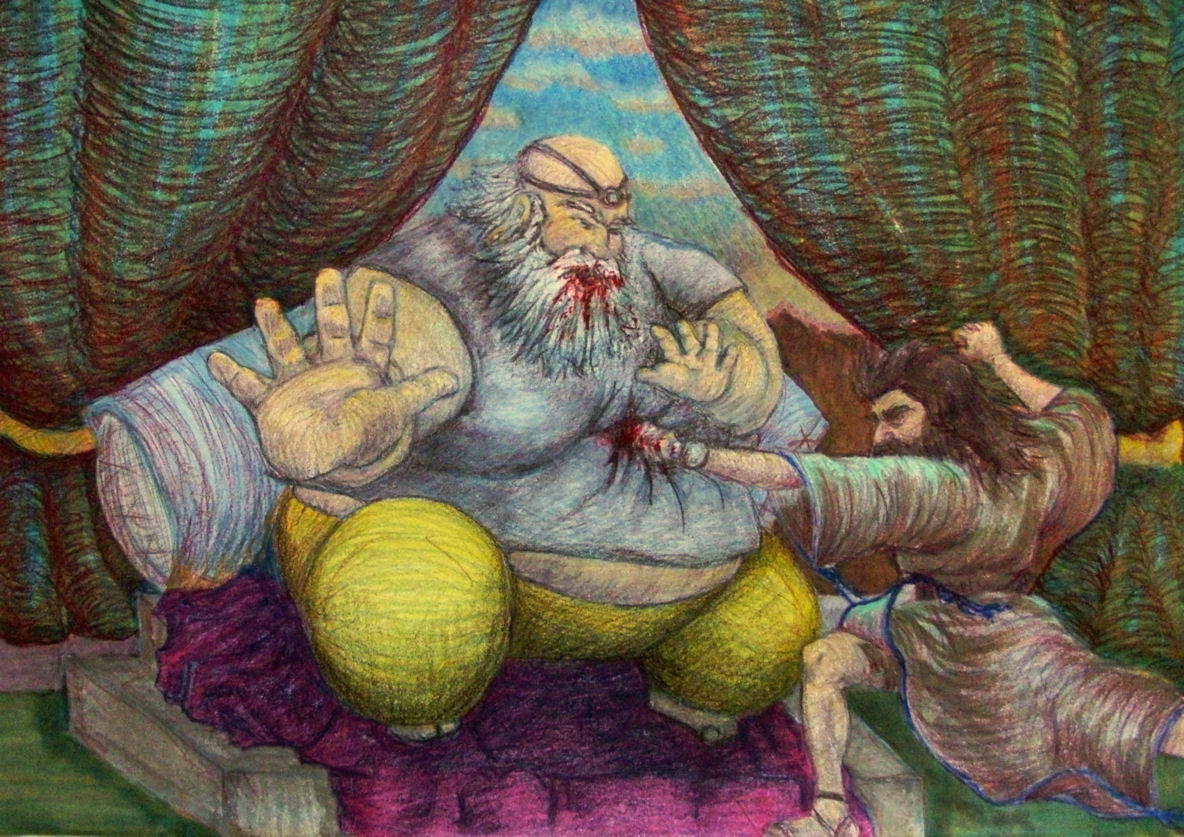
The Israelites again did what was evil in the sight of the Lord; and the Lord strengthened King Eglon of Moab against Israel, because they had done what was evil in the sight of the Lord. In alliance with the Ammonites and the Amalekites, he went and defeated Israel; and they took possession of the city of palms. So the Israelites served King Eglon of Moab eighteen years. But when the Israelites cried out to the Lord, the Lord raised up for them a deliverer, Ehud son of Gera, the Benjaminite, a left-handed man. The Israelites sent tribute by him to King Eglon of Moab. Ehud made for himself a sword with two edges, a cubit in length; and he fastened it on his right thigh under his clothes. Then he presented the tribute to King Eglon of Moab. Now Eglon was a very fat man. When Ehud had finished presenting the tribute, he sent the people who carried the tribute on their way. But he himself turned back at the sculptured stones near Gilgal, and said, “I have a secret message for you, O king.” So the king said, “Silence!” and all his attendants went out from his presence. Ehud came to him, while he was sitting alone in his cool roof chamber, and said, “I have a message from God for you.” So he rose from his seat. Then Ehud reached with his left hand, took the sword from his right thigh, and thrust it into Eglon’s belly; the hilt also went in after the blade, and the fat closed over the blade, for he did not draw the sword out of his belly; and the dirt came out. Then Ehud went out into the vestibule, and closed the doors of the roof chamber on him, and locked them.

Today marks the second part of our series on Strange Stories from Scripture. As a church we are taking time to look at those wonderful moments from the bible that they never talked about during Sunday school. These are the stories that make us blush, raise our eyebrows, and leave us scratching our heads.

Many of us are familiar with the well-known stories of Moses leading the Israelites through the wilderness, we know all about King David and his kingdom, we can even recall the miracles of Jesus, but the bible is also full of tales that are just begging to be used in worship and our daily lives.

Our first story was from the book of Numbers regarding the foolish prophet Balaam and his talking donkey. We explored how the donkey attempted to steer Balaam in the right direction, and pondered about the donkeys in our lives.

Today we are talking about Ehud and King Eglon from the book of Judges.

Ehud-and-Eglon (1)

Monday.

I’m sitting in my office, going over the emails from the weekend when I pull out the list of all the scriptures from now until Christmas Eve. I reread the plan for the sermon series on Strange Stories from Scripture, I wonder if people felt convicted by the sermon on Balaam and his donkey yesterday. I check the email once again to see if anyone took the time to send me a complaint about the sermon. The only one I receive makes a comment about seeing such a “smart… donkey” in the pulpit, but I file it away for later.

The A.C. is pumping out cold air, and I open up my bible to Judges 3 to read the scripture for Sunday. The story of Ehud and Eglon. As the words flow past my eyes, I can’t help myself from giggling in the office: Ehud stabs him in the belly, and Eglon was so fat that the blade disappeared and the dirt came out. I quickly scan through a number of other translations to see what they do with the vague “dirt” description. Some call it dirt, most call it dung, but at least one calls it poop.

When I see the word poop in the bible, it just makes me laugh.

I wonder if people will let me get away with saying poop from the pulpit on Sunday morning. I quickly make a note to pray about it during the week, before deciding whether or not to put “poop” in the sermon.

This has got to be one of the funniest and strangest stories in the bible, but before I dive into sermon writing, I decide to leave the word document open on my computer, and get to some of my other daily tasks before returning.

Tuesday.

The screen stares back at me empty. So I decide to get the mental juices flowing and rewrite the story in my own words:

The Israelites messed up again. Whether they were grumbling for more food, or worshipping false idols, they messed up, and the Lord decided to raise up King Eglon of Moab against God’s people, because they were continually messing up. King Eglon, with the help of God, went and defeated Israel and ruled over God’s people for 18 years.

But then, of course, the Israelites started to cry out to the Lord for delivery, perhaps they had seen the error of their ways, so God decided to provide their savior, Ehud, a left-handed man.

The Israelites, at the time, were in the habit of sending their taxes to King Eglon, and Ehud used this delivery to make his attack. He fashioned himself a double-edged sword, and attached it to his thigh under his clothes.

King Eglon was a very fat man.

ehud2

When Ehud finished delivering the money, he sent his compatriots away, and teased the King with the promise of a secret message from God. Eglon sent away all of the people from his inner court and invited Ehud to share this secret. But as Ehud leaned in to deliver the precious secret, he removed the hidden dagger and thrust it into Eglon’s belly.

Strangely enough, the further Ehud pushed, more of Eglon fat rolled over the blade until it disappeared from view, and Eglon’s poop came out. Then Ehud snuck out of the chamber and locked the doors behind him.

I rewrite the story, looking for sermonic inspiration that would drop down from heaven like manna in the wilderness, but I just sit in my office wondering what in the world God is trying to say through the text. Throughout the day the phone and doorbell continue to ring at church, and I welcome the distractions.

Wednesday.

I pull out some commentaries on the text, and decide to see what other people think God was saying. A few of them go into remarkable detail about the significance of Ehud being left-handed, while others address how detailed the descriptions were, and a few even propose a sexually metaphorical interpretation.

The more I read, the less the story makes me laugh. Instead of looking at the story like a cartoon with poop on the floor, I see human beings driven by enough anger and fear to conquer a nation, and murder a king.

Reluctantly, I start searching online for other sermons about Ehud and Eglon. Do people preach about this? What in the world do they say?

One of the sermons is titled, “Lefty vs. Hefty” and it is all about the differences between the two central characters. The writer emphasizes Ehud’s cunning against Eglon’s girth.

One of the sermons is titled, “Salvation” and it goes into profound detail regarding how, supposedly, God ordains the killing of people even today who get what they deserve. The preacher calls for the people to commit themselves to a radical system of justice, where they take matters into their own hands, just like Ehud did.

One of the sermons is titled, “The Power of Praise” and it focuses on how Ehud was able to trick Eglon into giving him the opportunity to strike. It ends with a reminder for the listeners to be careful about the promises they hear and the compliments offered their way, because a dagger might be lurking in the corner.

The more I read from God’s Word and from other sermons the more I regret picking the scripture for the series:

Eglon, the fat king, is now less a caricature, and more like the punishment God ordained for the people for messing up.

Ehud, the people’s deliverer, is now less a righteous judge, and more like a murderer.

Months ago I thought it would be perfect and hilarious to use this text during a series on Strange Stories, but now I worry about what I will actually say about it when the time comes.

Thursday.

Sitting in a coffee shop in attempts to begin crafting a sermon, I continue to stare at a blank screen. I have started at least three different sermons but before I am able to start really crafting a deep response to the Word, I highlight the text and pressed “delete.” Nothing feels good enough, all of the attempts feel flat.

How is this story speaking anything into our world today? What does the death of Eglon at the hand of Ehud have anything to do with the life of St. John’s and the community of disciples?

I close the computer and grab a nearby newspaper in hopes to distract myself from the seemingly endless flicker of the cursor on my computer. The top article says “US drops Atomic Bomb on Japan 70 years ago today.

1945-08-07-New-York-Times-headline

Before I realize it, I am sucked into the article, and the sermon floats away from the forefront of my mind. The writer has reproduced the original texts used the Associated Press the day the Atomic Bomb was first reported:

“An atomic bomb, hailed as the most terrible destructive force in history and as the greatest achievement of organized science, has been loosed upon Japan… The atomic bomb destroyed more than 60 percent – 4.1 square miles – of Hiroshima, city of 343,000 and radio Tokyo reported “practically every living thing” there was annihilated… Secretary of War Henry Stimson said, “If they do not now accept our terms, they may expect a rain of ruin from the air the like of which has never been seen on this earth.” (From the original AP article http://bigstory.ap.org/urn:publicid:ap.org:3fd267ba7b3c40479382189c99172d61)

I read the article and tears begin to form and fall down my face. Normally I would hide my face from the other patrons, but I am so struck by the words that I forget where I am and what I’m doing. 70 years ago we dropped the most powerful weapon we had ever created on a nation and virtually wiped out an entire city in a matter of seconds.

I start to remember where I am, and the sermon that needs to be written. The connections between the article and the scripture start to form:

Did Ehud leave the sword in Eglon because he wanted the effects to be devastating? Did he want to leave his mark in such a way that death was not the only consequence? Was the Atomic Bomb our sword that we had hidden under our clothes? Did we attack Japan in such a way that death was only the beginning of what we wanted to accomplish?

I wonder what people will think if I try to draw a connection between the anniversary of the Atomic Bomb with the death of Eglon at the hand of Ehud. Did Ehud do the right thing? Did we do the right thing? I have no idea where the sermon is heading.

Friday

I sigh deeply in front of my computer. Picking the Ehud and Eglon story was a bad idea. I explore an idea about dressing up like Ehud with a sword in church but it feels trite, impractical, and vaguely irreligious. I start writing a poem about how the Lord calls people to do extraordinary things during extraordinary times, but then it feels like I’m telling people its okay to murder and steal.

I sit in silence with my hands outstretched praying for the Lord’s will to be done, and for the sermon to be written. And I wait.

Saturday

The Community Cook-Out is going well; children are running around, adults are being fed, and conversations are flowing all over the place. I am thankful for the distraction the cook-out has provided, though I’m also worried about tomorrow morning. What will I say when the time comes? What is God’s Word speaking into our lives right now?

I watch the community in action. Not just the church, but all the people who make Staunton what it is and I think about Jesus. I remember the call to live radically transformed lives based on love and forgiveness, not on fear and retribution. I see people breaking bread for the first time, and I see Jesus in the midst of the people providing hope, the Holy Spirit giving life to our words and relationships, and God making new and lasting connections.

I think about Jesus and the new life he invites his disciples to experience. I think about the lengths God was willing to go to to respond to the cries of God’s people, raising up prophets and judges. I think about God finally offering the most precious gift he ever could, his Son, to die for all the people out on the front lawn of the church, and for the world.

I wonder if the story of Ehud and Eglon isn’t so much about how we react when the world pushes us into a corner, but about the trajectory of God’s gifts to the world. That at one time God would raise up a judge to save Israel, but that now God raised up his Son to save us from ourselves and from death.

Sunday

I stand in the sanctuary before disciples hungry for the Word of God and I say: I offer this to you in the name of the Father, and the Son, and the Holy Spirit. Amen.

How The Dishwasher Taught Me To Pray – Sermon on Ephesians 3.14-21

Ephesians 3.14-21

For this reason I bow my knees before the Father, from whom every family in heaven and on earth takes its name. I pray that, according to the riches of his glory, he may grant that you may be strengthened in your inner being with power through his Spirit, and that Christ may dwell in your hearts through faith, as you are being rooted and grounded in love. I pray that you may have the power to comprehend, with all the saints, what is the breadth and length and height and depth, and to know the love of Christ that surpasses knowledge, so that you may be filled with all the fullness of God. Now to him who by the power at work within us is able to accomplish abundantly more than all we can ask or imagine, to him be glory in the church and in Christ Jesus to all generations, forever and ever. Amen.

pray

I loved my college roommates. Some of us knew each other from high school, and others were grafted in along the way, but nevertheless, when we lived together it felt like a little family. We tried our best to communicate needs within the domicile, we kept it quiet when someone had a midterm the next morning, and we quickly learned to share common appliances for the betterment of the entire living situation.

Between us we would come to earn Bachelor degrees in Philosophy, Religion, Biology, Communications, and History. I always kind of imagined that we would be a awesome group Jeopardy team with the wealth of knowledge spread between us. Living together in college was great, but it wasn’t always easy.

There was the time we discovered mice in the house. We did our best to keep the kitchen clean, and spread mouse traps throughout the house, but during the cold winter months they came back like clockwork.

There was the time a huge snow storm came through, trapping all of our cars, and we ran out of heating oil to keep the house warm.

There was the time that we all contracted swine flu at different intervals. As one person became sicker and sicker, those of us who were well shared the responsibility of caretaker, until we started displaying our own symptoms.

Part of the beauty of living with other people was the sharing of life experiences. We celebrated each others successes, and grew to really rely on one another. Part of the challenge of living with other people was learning how to change our habits and needs based upon the habits and needs of other people.

Ephesians 3.14-21 is a prayer. Paul is writing to this new faith community in the hopes that his prayers will be answered by the Lord of hosts. He prays for the congregation because he knows that he cannot give them what they need in order to grow, but through prayer the church will learn to fully rely upon God.

The beginning of the prayer establishes the main focus: Paul prays for the church to be strengthened in its inner being, from the inside out, by the power of God. He hopes that the individuals that make of the community will see the vital importance of letting Christ into their lives and then change accordingly.

If Christ dwells in the hearts of the people, if they are rooted and grounded in love, then they may have the power to comprehend what is the breadth and length and height and depth of Christ’s love that surpasses all knowledge.

During college, I was the only person from the house that went to church. While my roommates enjoyed the comfort of their beds on Sunday mornings, I was making my way out the door to worship the Lord. I learned to accept their priorities, and on some level they learned to accept mine.

For instance: I made them pray with me whenever we ate dinner that I had prepared. I felt that if I was willing to go through all of the steps necessary to make a dinner for all of us, then they could bow their heads with me in prayer. So once a week, we would sit in our living room, eating on paper plates with plastic silverware, and they would listen to me pray.

prayer (1)

It is difficult for many of us to hear about God’s unending love, particularly a group of college-age men who just wanted to eat. It may seem so obvious to us that it no longer strikes at the core of our being. We hear “God is love,” and “love is patient, love is kind,” and “Love you neighbor as yourself,” and “God’s love knows no bounds” and instead of that love becoming clearer, it just floats around in the air.

Faithful love is even harder to grasp for those of us who do come to church because we hear about all these beautiful and wonderful things, we look around at a church filled with people who appear to have their lives figured out, when in reality we are all struggling with a myriad of secrets, private disappointments, lost hopes, and frustrations.

It’s hard to hear about love, when we don’t feel love in our lives.

Paul’s prayer for the church in Ephesus is all about letting Christ in to change lives: I pray that, according to the riches of his glory, he may grant that you may be strengthened in your inner being with power through his Spirit, and that Christ may dwell in your hearts through faith, as you are being rooted and grounded in love.

Letting Christ into our hearts is like moving in with a new roommate. At first, we spend a lot of joyful time getting to know one another, discovering common likes and interests. We do a great job putting all the dishes away and keeping the house clean, but then we have to start making compromises, whether we want to or not.

I learned about this type of faithful living the right way through my wife Lindsey. When we were dating, and I was getting ready to ask her to marry me, I dreamed about what it would be like to live together. I imagined the way we would set up our living room, where we would put the record player, and even where we would dance to all of our old jazz 33s.

After the wedding, while we were still giddy from the honeymoon, we decided to tackle the challenge of combining all of our possessions in the kitchen. We debated the value of keeping our plates in one cabinet versus putting the coffee cups near the coffee pot. We worried about the safety of keeping our knives in a drawer or right on the counter top. And we experimented with the location of the microwave in relation to the toaster and whether or not we would blow the fuse if they were both on at the same time.

praying_hands_clean_dirty_dishwasher_magnet-rcfdd698c86904ddaa1e6594a1d17e547_x7qgu_1024

The real challenge came to the precipice over the dishwasher. I was of the opinion that it did not matter where dishes and cups were placed in the dishwasher, so long as we could fit as many things as possible. Lindsey was not of the same opinion. For the first few weeks, whenever I put a plate away, she would come behind me and rearrange the dishwasher. It got to a point that I started purposely putting items wherever I wanted because I didn’t think it mattered, but sweet Lindsey would watch me live out my frustration, and then when I left the room, she would bring order to the dishwasher.

I don’t know how long this continued, but I do know when it stopped. Lindsey was working late one night, and the dishwasher was almost full. I saw my opportunity to prove that the dishwasher works fine no matter where the dishes are placed. So with a mischievous grin on my face I rearranged the order into chaos, I started the dishwasher. I couldn’t wait to see her face when she got home, I imagined the apology she would offer me regarding her wrong interpretation of dishwasher etiquette, it was going to be something beautiful.

But when the dishwasher cycle finished, I knew I was in trouble.

How could this have happened? Whenever Lindsey ran the dishwasher, everything came out all nice and clean and ready to use. But this time, there was still food on a few of the dishes, and some of the utensils looked worse than when I put them in!

I was wrong, and I learned to change. Now I will freely admit that sometimes I still place something in the wrong place, but after my passive-aggressive experiment, I have learned to alter my focus because Lindsey was right.

prayer_2014_02_07-13

The incident with the dishwasher taught me that prayer is about change. When I forced my roommates to pray in college, was I doing it because I was concerned about them, or was I doing it because I thought I was better than them? Did I earnestly pray to the Lord during that time, or did I just want them to hear the sound of my voice?

The beauty of prayer comes to fruition when we let Christ in to change us, and when we are willing to give up some of our space for the Lord. The dishwasher taught me that if prayer is only about myself, that if I am only concerned with my thoughts and actions, then I am neglecting to let God in to make some important changes.

Faithful living is about giving up those habits and behaviors that are no longer fruitful, reprioritizing and reorganizing our lives, so that God can make us clean.

In a few moments we are going to end our service not here in the sanctuary, but outside on the front lawn. We are going to gather in a group and we are going to pray.

First we will pray for God to give us the strength to give up some room, and let Christ in. That instead of focusing on just our needs and wants that we will begin to comprehend the love of Christ and the fullness of God.

Then we will face the sanctuary and we are going to pray for our church. So many of us, myself included, get caught up in such a tunnel-visioned view of prayer that we neglect to pray, like Paul did, for the community of faith.

And finally we will turn to face the community around us and pray once more. Prayer is not just about you and me, and it is not just about the church, prayer is about communing with the Lord about the very fabric of life.

If we want our lives to change, if we want our church to change, if we want to let God’s love reign, then we have to be willing to give up some space. We have to learn to rearrange the dishwashers of our lives so that everything can be made clean.

Amen.

The Upside-Down Kingdom – Sermon on Mark 6.30-34

Mark 6.30-34

The apostles gathered around Jesus, and told him all that they had done and taught. He said to them, “Come away to a deserted place all by yourselves and rest a while.” For many were coming and going, and they had no leisure even to eat. And they went away in the boat to a deserted place by themselves. Now many saw them going and recognized them, and they hurried there on foot from all the towns and arrived ahead of them. As he went ashore, he saw a great crowd and he had compassion for them, because they were like sheep without a shepherd; and he began to teach them many things.

251121425_640

Last Sunday our mission team gathered in the parking lot after worship, prayed together, and then set out for the beautiful bounty of West Virginia. I don’t know how the rest of the team felt as we made our way west, but I was excited; we were committing ourselves to a community, we were going to be Christ’s hands and feet, and we were going to experience God’s upside-down kingdom.

McDowell County, West Virginia is nothing short of beautiful. While the roads twist back and forth and the topography ebbs and flows, you are constantly bombarded by the beauty of God’s creation. Sitting behind the wheel, the scenery flies past the window and all evidence of humanity’s presence is gone except for the occasional roadside house and the road beneath the wheels.

By the time we finally made it to Welsh, WV we were ready to work, and we were ready to get out of the cars. But the scenery had drastically changed from the journey; when we arrived in Welsh it felt as if time had stopped. At one time Welch was one of the ten most populated places in the United States. More coal has been found and produced in McDowell County than nearly every other coal mining venture in the rest of the country. The community grew rapidly as the industry boomed, but now it is a ghost town.

IMG_0228

The final moments as we drove up to where we would be staying for the week were met with silence as we absorbed our surroundings. Countless empty buildings littered the streets, handwritten signs adorned the windows begging people and businesses to consider renting the space, and for the longest time we drove without seeing another human being.

The apostles, those first ragtag disciples, had gathered all around their teacher to share with him all they had done and taught. They went on and on about the lives they had changed, the miracles they were able to perform, and moments they had experienced God’s presence. But then Jesus said to them, “Come away to a deserted place all by yourselves and rest awhile.” For many were coming and going, and they had no leisure even to eat.

Our mission team had arrived in our deserted place, but we would find little rest. Our church team was divided into two different work groups; the first would be working in a local food pantry, helping them to organize different donations before the weekly distribution on Saturday, the other would be working on painting the floors of house in the small town of War. The time before and after working would be spent in prayer, bible study, fellowship building, and learning about the local community.

From the Food Pantry group we learned that 100% of the children in McDowell County are on Free/Reduced lunch and that more than 50% of the children are considered homeless. From a former coal miner we learned that for a long time McDowell County was one of the wealthiest in the nation thanks to their coal mining, but that now the mines are being shut-down, and more and more people are without work and purpose.

11145167_10204335886108256_7977281946266719389_o

It would have been easy to show up in McDowell, roll up our sleeves, work hard, and leave feeling good about the work we had done. It would have been easy to make a few friendships, pray for the people we met, and return to our lives in Staunton. It would have been easy to return to the pace of life here without being affected by what we had seen and experienced, but Jesus calls us to live in the Upside-Down Kingdom where our lives are flipped around.

When the crowds were gathering to see this special man named Jesus, many were coming and going and the had no leisure even to eat; what a perfect description of the lives that many people are living today. Far too many of us rush through the mundane aspects of daily living without taking the time to reflect on what we are actually doing.

Kids grab Pop-tarts on their way out the door in the morning, young professionals order the same cup of coffee with urgency before their daily commute, families sit down at a communal table to eat but each member has their nose down in a smart phone in order to connect with others, while actually disconnecting from the people in their midst.

Many of us Christians spend our faith lives just like the crowds so long ago. We treat church not like the precious gift that it is, but like any other commodity in our lives. Instead of seeing it as a vital and life-giving space, we see it as another item on the never-ending check-list of existence. Some of us have so much to do, that church has become an occasional venture, rather than a regular necessity. So many of us are coming and going at such a tremendous speed that we no longer have the time to feast on God’s Word in prayer and in worship.

The mission team, however, abandoned the fast pace regularity of life, and were forced to adjust to God’s schedule. Every morning we woke up to eat and begin our devotions; How were we experiencing God’s Upside-Down Kingdom? Where had we seen brokenness in the community? What is God trying to do through us this week? We began and ended every single activity with prayer, and we devoted ourselves to the people we were serving.

PPT-UpsideDownKingdom

Now many saw the disciples and Jesus, so they hurried there on foot from all the nearby towns and arrived ahead of them. As Jesus went ashore, he saw a great crowd and had compassion for them, because they were wandering like sheep without a shepherd; and he began to teach them many things.

Jesus loved to teach people about the kingdom of God, and he did so with parables. The Kingdom of God is like a mustard seed; though tiny and small, it grows into one of the greatest plants providing shade and offering life. The Kingdom of God is like a wedding-feast where the least of society are invited to eat at the head table. The Kingdom of God is like a sower who goes out to sow, he knows not how the seeds grow but provides rich soil for the seeds to settle in.

While we settled into the rhythms of mission work in McDowell County, we started to  experience what God’s Upside-Down Kingdom is really like.

The Kingdom of God is like a group of privileged folk from Staunton, Virginia who gave up a week of their lives to serve a community of people they had never met. Time and time again they were questioned by the people about their work. No one could understand why a group such as ours would give up their precious time, give up their vacation, to get down on their hands and knees to change a person’s life. We did not go in order to earn our own salvation, we did not go to make ourselves feel better about our faith, we went because God’s Kingdom is one that has been flipped upside-down by the work of Christ, one that compels us to go and love when the world stands bewildered at our actions.

The Kingdom of God is like a house with plywood floors. Rough around the edges, with splintered pieces jutting out all over the place, in need of a few good coats of paint. The pieces of plywood met in different angles and sizes with the grain of the wood running in different directions, requiring dedicated attention while painting. God invites all to participate in this Kingdom, and we are not meant to be all alike. In fact God calls us to celebrate the things that separate us, so that we can learn to live in harmony with one another in the midst of differing grains.

The Kingdom of God is like a child laughing while running around a tiny yard in the middle of West Virginia with a 6 week old puppy. While adults slaved away in the house painting the floors, young children were laughing in a way that helped us to remember why God called us here in the first place; not to just help someone with their material needs, but share in the joy that comes with recognizing God’s grace in something as simple as a puppy, or as profound as a young family moved to tears because of our sacrifice.

The Kingdom of God is like a foot-washing the night before Jesus died, and the last night of a mission trip. Each of us took a turn in the chair and were prayed over by the rest of the church group. Every person was lifted up to God and we gave thanks for all that they had given, praised God for the witness they were discovering in their life, and asked God to be with them as they were sent forth into new places. Each person was valued, appreciated, and celebrated. In God’s Upside-Down Kingdom, even the smallest of servants, even the tiniest bits of effort, are embraced and lifted up for the true value they contain.

The Kingdom of God is like leaving a mission field, to return home only to realize that everywhere we go is a mission field. That whether we are serving the needs of a community in West Virginia, or living into a new reality of love right here in Staunton, God’s Upside-Down Kingdom is everywhere.

The people we served in West Virginia we hungry for something greater than themselves. Though desperately in need of things like food, clothing, and shelter, they actually hungered for something much more precious: value and worth.

The challenge of the story of Jesus with the crowds, is that we read about a people who were hungry while so many of us are full. We are not like the people who gathered to discover Jesus, we are not like the desperate crowds rushing to meet the Lord ahead of the disciples. Nobody here is so eager to find God that they beat me to this sanctuary on Sunday mornings.

For many of us, church is just one of the many activities that fills our modern lives, rather than the one place where we discover lives worth living.

11745349_10207136174344490_769335585716666659_n

Like many mission trips, I think we got more out of it than the people we served. We thought we were going to help them in the midst of suffering, only to discover that we needed to be healed just as much. We needed to stop viewing ourselves as better than the people we were serving, we needed to learn to love them in spite of their behavior and past experiences, we needed to start looking at them the ways God looks at the world: with love.

We went all the way to West Virginia to learn about God’s Upside-Down Kingdom only to realize that we are part of it as well.

When the crowds gathered at the feet of Jesus, when he had compassion on them because they were like sheep without a shepherd, he taught them about things like the Kingdom of God. When we get together every week for worship, we are just like those crowds resting at the feet of the Lord eager and ready to learn. It is through our prayers and hymns, through the people in the pews next to us, and through the words of scripture and a sermon that we discover ourselves in the midst of God’s Upside-Down Kingdom, and we begin living accordingly.

What a blessing to know then, that every day is an opportunity to serve God’s kingdom from the beauty of McDowell, West Virginia to the beauty of Staunton, Virginia. We are called to be Christ’s hands and feet for the world, so let’s get out there and do it. Amen.

God Is God And We Are Not – Sermon on Psalm 24

Psalm 24

The earth is the Lord’s and all that is in it, the world, and those who live in it; for he has founded it on the seas, and established it on the rivers. Who shall ascend the hill of the Lord? And who shall stand in his holy place? Those who have clean hands and pure hearts, who do not lift up their souls to what is false, and do not swear deceitfully. They will receive blessing from the Lord, and vindication from the God of their salvation. Such is the company of those who seek him, who seek the face of the God of Jacob. Lift up your heads, O gates! and be lifted up, O ancient doors! that the King of glory may come in. Who is the King of glory? The Lord, strong and mighty, the Lord, mighty in battle. Lift up your heads, O gates! and be lifted up, O ancient doors! that the King of glory may come in. Who is this King of glory? The Lord of hosts, he is the King of glory.

P-019-w_I_Am_Not_God.37205641_std

Be careful.” That’s what they kept saying when they found out I was invited to preach at a church in the heart of Detroit. I had been living in Birmingham, Michigan (a rather wealthy suburb north of Detroit) helping serve a church for the summer when I received the opportunity to fill in at another church one Sunday. And as soon as I was asked, all the warnings started coming in: “Be careful” “Park as close as possible to the church” “Keep your wallet in your front pocket.

I remember thinking these people were crippled by fear, how bad could it really be? We were talking about driving into Detroit on a Sunday morning to preach at a church…

When the morning arrived I was filled with excitement. I picked out the perfect bow tie to go with my blazer, hoping to assert my authority regardless of my young age, I had a prepared a theologically profound manuscript sermon, hoping that it would get people to shout “amen!” from the pews, and I spent the long drive down Woodward Avenue in silence, hoping to boost my holiness before the service began.

The closer I got to the church, the stranger I began to feel. I hadn’t noticed it at first, but the longer I drove, the less people I saw on the streets. The buildings went from inviting homes and businesses to abandoned shells of carpentry. The streets went from well maintained to pot holes that required a car to drive up on the sidewalk in order to avoid.

In a matter of minutes I had gone from “Pleasantville” to a post-apocalyptic movie set, and my excitement was quickly replaced by fear.

By the time I pulled in the parking lot, I realized that I hadn’t seen another human being for at least ten minutes. The streets had been largely deserted leading up to Cass UMC, and it was strangely silent when I stepped out of my car.

So here I was, standing in the heart of Detroit, in a bowtie and blazer, with a bible and sermon tucked under my arm, completely alone on a Sunday morning.

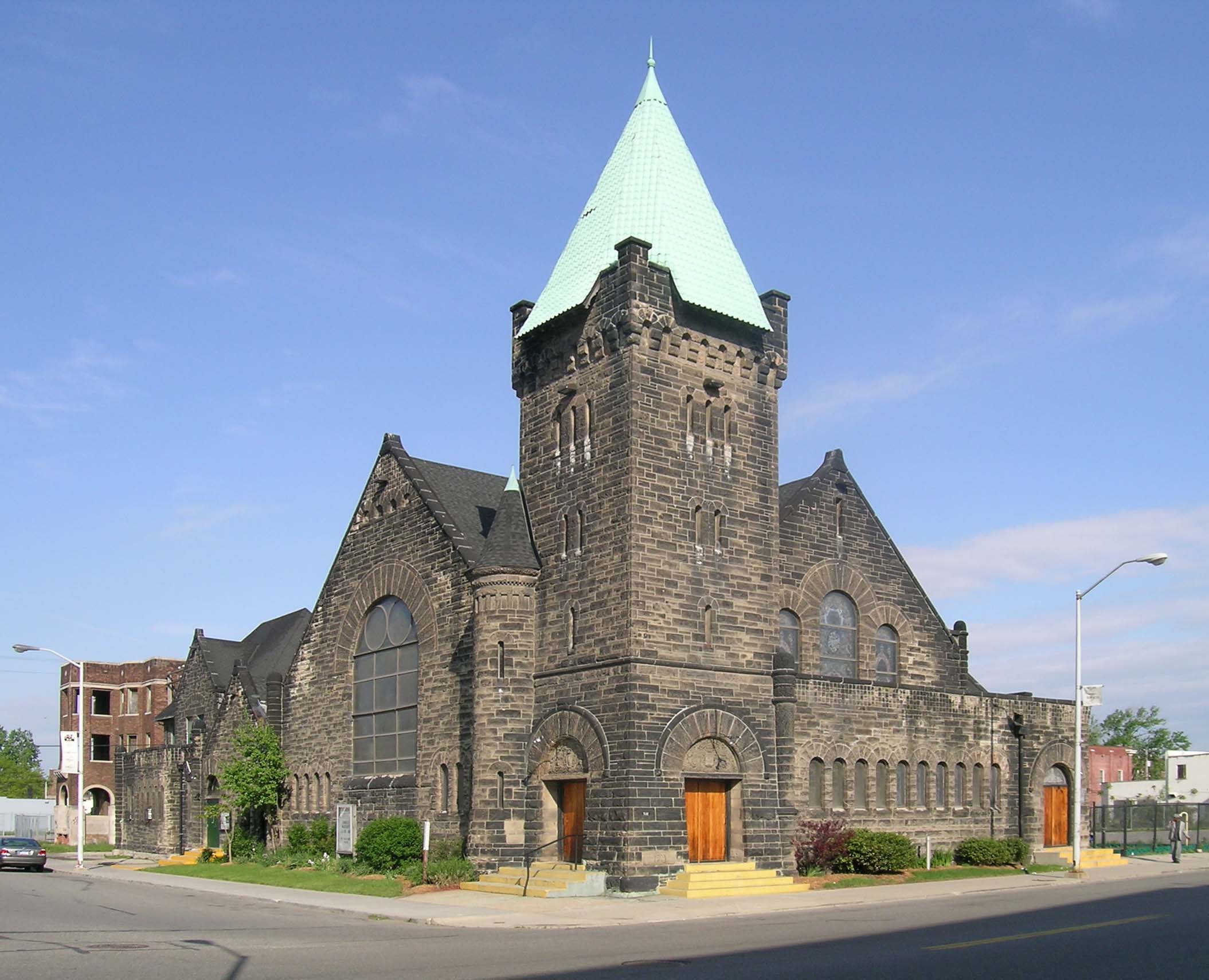
My footsteps across the concrete reverberated in echoes through the abandoned buildings flanking the church and even though it was a bright sunny day, I felt like I was walking down a dark alley in the middle of the night. The building itself was an architectural masterpiece having been built in 1883 with Tiffany’s stained glass windows, though I could tell from the street that bullet holes had cut through the once remarkable windows.

When I reached out my hand to open the doors, the height of my new fears were realized: It was locked.

Cass_Avenue_Methodist_Episcopal_Church_-_Detroit_Michigan

I knew no one from the church, I had no way to contact anyone, and all of the warnings started to really flow through my mind. But I did what any good pastor would do, I sat down on the front steps and waited for someone to open the door.

30 minutes later, a disheveled looking old man, the first person I had seen in a long time, peeked from around the corner, walked up the steps, and unlocked the front door without saying a word. I wandered around the building until I found the sanctuary, searched in vain for a worship bulletin, and resigned myself to sit down in a chair by the altar.

During the next hour, the most random assortment of people started flowing in through the sanctuary doors. The church, once renown in the heart of Detroit, was being filled with people who slept outside the night before, people who had no money to put in the offering plate, and people who were having conversations with themselves at a volume loud enough for everyone else to experience.

A group of 7 older black women arranged themselves on folding chairs near the front, and without really discussing it they all flipped their hymnals to the same page and started to sing. A man with wrinkled fingers was hunched over a piano in the corner struggling to keep up with the singing, and a young man had seated himself behind a drum-set hidden in the corner, and was wailing away to a song that only he could hear.

When the first hymn ended, the women huddled together to pick another hymn and began singing. At some point in the middle of their fourth hymn, with the pianist still planking away, and the drummer smashing the cymbals, a gentleman stood up in the middle of the sanctuary with his eyes trained on me. He walked down the main aisle slowly and deliberately until he was towering over me and then declared, “Son, if you don’t start talking, they ain’t liable to quit singing.

The earth is the Lord’s and all that is in it, from the sea to the mountains, from the rivers to the deserts, from the people to the animals; for the Lord has founded life upon the earth. Who then shall worship the Lord in holiness? And who shall stand with the Lord in the holiest of places? Only those who have clean hands, and pure hearts, those who do not lift up their souls to what is false, who do not break their promises. They will receive a blessing from the Lord, and vindication from the God of their salvation. Such is the company of those who seek the Lord.

I stood up after the end of the next hymn, and grabbed the hand held microphone to start participating in worship. I felt like a fool standing in my khakis and blazer, with my bowtie tilted just slightly to the side. I felt ridiculous with my over examined sermon under my arm, and bible in my hand. I felt like I didn’t deserve to stand before the congregation, but all of their eyes were on me. (just like all of yours are right now)

I took off the jacket and tie, rolled up my sleeves, ditched the sermon on my chair, and let the Holy Spirit go to work.

Let us pray” I began, and before I could start praying for our service, the people started shouting out their own prayers. “O Lord, help this boy to preach.” “Yes Lord, show us your mercy.”My God show me your glory!” “Remove our sins, give us your Spirit, clean our hearts!” “Your will be done!” “Have thine own way Lord!” “Help this boy preach, preach preach.

It was only after a few moments of silence that I finally said “amen” without having added any of my own prayers.

I preached on the apostle Paul’s second letter to the church in Corinth, about the new creation that comes in knowing Christ. I talked about moments that transform our lives. I said things like “there is a new life in Christ, but just because we find Christ it doesn’t mean our life will get better, but that we are called to make other lives better.” And instead of the typical, and silent, congregation I was used to, the people kept shouting at me while I preached. “Ain’t that the truth!” “Yes Lord!” “We know it, we know it” “Lord, give him strength to preach.” “Speak through him God.

When I got around to the close of the service, when I offered a benediction to the congregation, when the final amen was uttered, I heard them say in return, “Thank you Jesus.”

be-still-and-know-that-i-am-god-960x250

Lift up your heads, O gates! Open up you ancient doors! the King of glory is coming. Who is the King of glory? The Lord, strong and mighty, merciful and majestic, the Lord. Jesus Christ the author of salvation, the Good News, the Messiah. The Holy Spirit full of wisdom and truth, giver of life, and partner to our prayers. Lift up your heads, O gates! Open up you ancient doors! The King of glory is coming! Who is the King of glory? The Lord of hosts, he is the King of glory.

We can dress the part, we can read all the right books, we can memorize all the hymns and prayers, but unless we are looking for holiness in our lives, unless we are ready to bow down to the King of glory, then we are forgetting the truth: God is God and we are not.

Many of us are good Christians, we pray for our friends and family, we come to church, we put money in the plate, but there is a profound difference between believing we are holy, and wanting to be holy.

When I arrived at that church in Detroit years ago, I foolishly thought I was bringing something to them. With my well prepared outfit and sermon, I made the assumption that I was bringing God with me, nice and shiny, like a school project. I became my own main character in the story of worship, and it prevented me from seeing the King of glory.

When I stood up in the pulpit to proclaim the words, the people did not see a young man with a seminary education, they did not see some white fool trying his best to not pass out, they saw a vessel for the Lord. Their prayers were not to me, but for the Lord to work through me. The recognized the great division between God and me, and knew that Jesus was the bridge between the two.

They knew that God is God and we are not.

In our contemporary American culture, we tend to view ourselves as the center of the universe.

We assume that everything revolves around us, and that so long as our needs are being me, then everything else should be fine.

We believe that if we wear the right clothes, and get the right education, that holiness will follow accordingly.

We feel holy for giving up an hour every week to sit in a place like this and sing hymns, offer prayers, and listen to a sermon.

That church in Detroit had something that I never knew I needed: They believed that God was the center of the story, that God had the power to transform their lives, and that God really was the King of glory.

Too many of my friends have left the church because they “didn’t get anything out of it.” They might try different styles of worship and different denominations, but if they don’t get anything out of it, they will rarely return. However, church isn’t about what we get out of it, its about what God gets out of us.

Believing we are already holy limits God’s power to make us holy.

It is in the recognition of the great divide between humanity and the Lord that we can let Jesus get to work on our hearts and souls. It is in the great admission of Jesus as the King of glory we start to see ourselves, not as the center of the universe, but instruments for God’s love to be heard in the world. It is in the words of our worship that we recognize the Holy Spirit’s movement in our midst and our lives start to change.

If we remain in the assumption of our holiness, then our lives will stay the same.

But if we truly desire for the Lord to make us holy, then our lives will be transformed. Amen.

The Story (Chapter 2) – Sermon on Romans 12.1-8

Romans 12.1-8

I appeal to you therefore, brothers and sisters, by the mercies of God, to present your bodies as a living sacrifice, holy and acceptable to God, which is your spiritual worship. Do not be conformed to this world, but be transformed by the renewing of your minds, so that you may discern what is the will of God – what is good and acceptable and perfect. For by the grace given to me I say to everyone among you not to think of yourselves more highly than you ought to think, but to think with sober judgment, each according to the measure of faith that God has assigned. For as in one body we have many members, and not all the members have the same function, so we, who are many, are one body in Christ, and individually we are members of one another. We have gifts that differ according to the grace given to us: prophecy, in proportion to faith; ministry, in ministering; the teacher, in teaching; the exhorted, in exhortation; the giver, in generosity; the leader, in diligence; the compassionate, in cheerfulness.

Do-not-conform-daily-devotional-by-pocket-fuel-Romans-12

Years ago there was a young man, fresh out of seminary, ready to begin serving his very first church. He had taken all the appropriate classes in school, learned from the right professors, and had been prayed over by the bishop. With eager anticipation he had packed his bags and headed out to begin his first appointment to John Wesley UMC somewhere in Georgia. The young man was so anxious and filled with joy that he could hardly contain himself when he arrived that first day, so before he unpacked any of his belongings, he drove by the new church.

He got in the car and went to the listed address, but he saw no church. When he turned around he drove to the address again and realized why he had missed it the first time; there was one of the oldest and most decrepit looking trees he had ever seen stretching all over the ground with roots exposed and the sign (plus the building) were mostly covered by its long branches. The young pastor sat in his car looking at the tree and he couldn’t believe a church would let something so ugly block the beauty of the building.

Before he knew it, he had gone back to the parsonage to unpack his chainsaw, and promptly cut down the tree that was blocking the church. With sweat on his brow, he took a step back and admired his work: the sign and building were now completely visible from the road, and he thought that perhaps a few extra people might be in church on Sunday morning.

A few days later, as the young pastor sat in the study of the parsonage preparing his first sermon, the local District Superintendent called: “I hope you haven’t finished unpacking yet,” he said, “because you’re being reappointed.

You see, the church was named John Wesley UMC for a reason. John Wesley himself had planted that tree more than 200 years ago while he was in that community. The gathered people decided to build a church right where the tree had been planted in honor of the man who started a revolution, and that young pastor had chopped it down.

renew-your-mind

Stories are remarkably important. They contain and convey everything about who we were, who we are, and who we can be. Stories held within a community help to shape the ways we interact with one another, and how we obtain the collective memories of the past. We tell stories to make people laugh, to teach lessons, and remember the important elements of life.

Today, we live in a world of competing narratives. Every television station, and every website, are vying for out allegiance and attention. We are consistently bombarded with information attempting to tell us who we are, what we need, and where we are going.

We live during a time when more people recognize the golden arches of McDonald’s than they do the cross of Jesus Christ. We live during a time when people spend more time arguing about where they can see the best fireworks on the Fourth of July than they worry about children in their community who have no food to eat. We live during a time when we would rather store up our treasures on earth, than give our gifts to the church.

Right now the world is telling us what is important, and our ears have a difficult time discerning between the world, and the Lord.

The apostle Paul wrote about the world to the church in Rome and convicted their hearts: Do not be conformed to this world, but be transformed by the renewing of your minds. Do not listen to the people who try to define you and limit your abilities. Do not diminish God’s ability to radically transform your life and the world around you. Read your bibles. Pray your prayers. Listen to the wisdom of the past. Open your eyes to the beauty of the future. Do not think you are better than anyone else, but give God thanks for placing you within your community.

We are all different and this is worth celebrating! God’s has blessed each of us with unique gifts worthy of use for the kingdom. Some are made for teaching, or preaching, others have the gift of prayer and presence, others have been blessed with financial resources, and still yet others have been given the gift of patience in discernment. Whatever your gift, use it for the kingdom so that we might bear fruit in the world.

Do not conform to this world but be transformed by the renewing of your minds. When we gather together for worship we are retelling God’s great story so that our lives can be transformed. When we are in this place we reject conformity to the world’s expectations. When we proclaim the Word of God, our minds are being renewed again and again.

A few weekends ago thousands of Methodists throughout Virginia gathered together in Roanoke to discern God’s will for our denomination. We prayed over pertinent matters and voted accordingly, we honored those who had gone on to glory over the last year, and we ordained new pastors for the work of ministry. Annual Conference is a time of celebration, but it also a time of facts.

According to the ways of the world, the church is floundering. People are no longer regularly attending worship, tithing is starting to disappear, and many church buildings are being closed each year. Christianity has lost its status in the political arena, we are becoming biblically illiterate, and young people are largely absent from worship.

At Annual Conference this year we discussed a number of statistics affecting the church, but one really stood out to me:

The average person in a United Methodist Church invites someone to worship once every 38 years.

The world tells us that we are nearly defeated. That we’ve got to start pulling out all the stops to get people into our buildings. We have to be willing to do whatever it takes to get people sitting in the pews. We need to cut down the trees that are blocking the church building from the street. We need to abandon the past in order to embrace the future.

I say thanks be to God that we don’t have to conform to the ways of the world but get to be transformed by the renewing of our minds! While others might shrink and wail in fear regarding those types of statistics, imagine what would happen if we embraced them and saw them as an opportunity for transformation? How would our church start to look if we began creating our own vitality through a life-giving invitation to discover the Lord in community? What would it take to embrace the trees and traditions of church to reclaim the story that has already changed the world?

do-not-conform-redfish-donotconform-margherita-anna-mulas

For those of you with remarkably gifted memories, you will no doubt have noticed that everything we have done in worship today, from the opening greeting to the selection of hymns, from the scripture reading to the words of this sermon, is an almost exact replica of what we did two years ago during my first Sunday at St. John’s.

It brings me nothing but joy to look out from this pulpit and to see how much we have changed in our short time together. Our worship attendance has grown. Our weekly offering has grown. Our commitment to spiritual disciplines has grown. Our willingness to sacrifice for God’s kingdom has grown. Our faith and trust in the Lord has grown. St. John’s, through its prayers and practices, has begun to positively affect those kinds of statistics that frighten the world.

But we can do more.

We can do more because the words of worship today are just as relevant as they were two years ago. With a continued commitment to prayer our church can grow in its vitality. With a consistent connection to the Word our church can grow in its faith. With a calm composure compared to the world our church can grow in effectiveness.

When we retell the story we are transformed by the renewing of our minds. We don’t have worship just to catch up with our friends from the community, checking in on the events of life. Church isn’t just about making sure that we give one hour a week to God. Church is about transformation in our lives and in the lives of others.

When was the last time we invited someone to church? Has it been 38 years? And, as someone put it this week, if we don’t have anyone to invite to church, we are not spending time with the right people.

When was the last time we prayed about the money we give to church? Have we grown content with the same offering each week, or do we really recognize how much God has given to us, and how much more we can give back to God?

When was last time we felt transformed by the renewing of our minds? Are we so consumed by the ways of the world that we no longer trust the Lord?

The stories of scripture, from Genesis to Revelation, help to shape the way we live. They are more than just facts and histories, they are the living Word of God’s actions with God’s people. The stories speak greater truths than any news program or TV bulletin, they convey more than any tweet could ever contain, and they provide transformation for the disciples of Jesus Christ.

If we neglect to embrace the stories for the power they contain, then we are cutting down the great trees of tradition in our midst.

As we embark on our third year together I have some goals for our church, both personal and communal:

1) We grow in faithfulness by giving time everyday to God in prayer. This does not mean that we have to start every morning with our hands twisted together and our heads bowed low, but that at least once a day we take a moment to thank God for our blessings. We can do it before a meal, or in our cars on our way to work. How we pray is not as important as praying in the first place. So, we grow in faithfulness by giving time everyday to God in prayer.

2) We grow in attendance by inviting people to discover the love of God. This does not mean that we need to start knocking on doors and trying to convince people to come to St. John’s, but that we open our eyes to what God has done for us and embrace a culture of sharing that kind of love with others. We can do it by inviting our friends to try worship out with us on Sunday morning, or talking with them about what God has shared with us through this place. So, we grow in attendance by inviting people to discover the love of God.

3) We grow in stability by offering our gifts and talents to the Lord. This does not mean that we need to start a capital campaign or initiate a pledge drive, but that we see our lives as gifts and give back so that others can be blessed as well. We can do it by giving more when the offering plate comes around on Sunday morning, or by offering some of our God given talents for the betterment of this church in the kingdom. So, we grow in stability by offering our gifts and talents to the Lord.

According to the ways of the world the church is in a difficult place. We are told that we don’t have enough time to pray every day, we are reminded of the discomfort that comes with trying to invite others to worship, and we are bombarded with the fear about giving money and gifts back to God. But I’m not worried about any of that, and I’m not worried about anything because my hope is not in me, my hope is not in the ways of the world, but my hope is built on nothing less than Jesus Christ.

Christ is the solid rock upon which this church stands, comforting, nurturing, and sustaining us in all we do.

We can believe in the future of our church, we can share the story of the Lord, we can pray with every fiber of our being, we can invite others to experience God’s love, and we can give with glad and generous hearts because our faith is in almighty God!

The Lord is reminding us today, and everyday, “Do not be conformed to this world, but be transformed by the renewing of your minds.” Amen.

Ready To Die – Sermon on 2 Samuel 1.17-27

2 Samuel 1.17-27

David intoned this lamentation over Saul and his son Jonathan. (He ordered that the Song of the Bow be taught to the people of Judah; it is written in the Book of Jashar.) He said: Your glory, O Israel, lies slain upon your high places! How the mighty have fallen! Tell it not in Gath, proclaim it not in the streets of Ashkelon; or the daughters of the Philistines will rejoice, the daughters of the uncircumcised will exult. You mountains of Gilboa, let there be no dew or rain upon you, nor bounteous fields! For there the shield of the mighty was defiled, the shield of Saul, anointed with oil no more. From the blood of the slain, from the fat of the mighty, the bow of Jonathan did not turn back, nor the sword of Saul return empty. Saul and Jonathan, beloved and lovely! In life and in death they were not divided; they were swifter than eagles, they were stronger than lions. O daughters of Israel, weep over Saul, who clothed you in crimson, in luxury, who put ornaments of gold on your apparel. How the mighty have fallen in the midst of battle! Jonathan lies slain upon you high places. I am distressed for you, my brother Jonathan; greatly beloved were you to me; your love to me was wonderful, passing the love of women. How the mighty have fallen, the weapons of war perished!

maassen_resurrection_sml

Funerals are strange, difficult, and at times, beautiful. I usually receive the phone call from someone in the family, or from a funeral home, that someone has died and they were hoping that I would preside over the service. No matter who the person is, I am immediately filled with sadness knowing that someone, anyone, is now gone. Regardless of my personal connection to the individual, there is a sense of loss that comes with death and not even I can avoid it.

But then I have to get to work. I have to take that grief and hold it for a moment while I help others properly grieve their loss. I have to balance the proper amount of mourning with hope, sadness with peace, and death with resurrection.

When I receive that first phone call I have to start taking care of the logistics: Where will the funeral take place and when? Do they want someone to play the organ? Are they hoping for a particular soloist? Does anyone from the family want to speak on behalf of the dead? And only after the plans are made can we begin talking about the person, making sure that I know everything I can in order to properly proclaim their life, death, and resurrection.

Most of the time funerals take place in the middle of the day in the middle of the week. Friends and family have to take time off from work, or take their children out of school, in order to attend the service. Yet, funerals are not meant for immediate friends and family alone. The entire community of faith is called to witness to the life of those who have died so that we can continue to live out their witness regardless of how well we knew them, or not.

So, this morning, as I mentioned before, we are doing something a little different. A few weeks ago one of our church members named Dick Dickerson passed away. He had only been coming for a few years, but he was a staple in worship. He always sat in the back of the church on the right side, he flirted with every female that crossed his path, and he was incredibly sweet.

When I found out that his family would be having a private service in Kentucky at a later date I knew that we still needed to do something here in order to say goodbye. I knew that we needed to praise God for putting Dick in our lives. And I knew that we were going to have our own little funeral for him on a Sunday morning.

Dick Dickerson

Dick Dickerson

Dick Dickerson called me “honey.” I know that this might’ve bothered other young pastors, but to me it was endearing and precious. I would walk over to visit Dick next door at Brightview/Baldwin Park and the moment I entered his room he would always say something like “Come on honey and sit down with me.” For months I cherished this identification, it made me feel special that Dick felt so connected to me. It was only later that I learned he called most of the people in his life “honey”!

My wife Lindsey would stop by to say hello before a church service started and he would hug her while calling her “honey,” Grace Daughtrey would smile and politely nod her head as he greeted her with a “good morning honey,” and even Marshall Kirby would start to blush when Dick would refer to his Sunday driver as “honey.”

Dick Dickerson was a man of profound love, who deeply appreciated all that God had given him from the very beginning till the very end.

Dick grew up in Kentucky with a family in the midst of financial struggles. Living through the depression was, as he put it, one of the hardest things to witness. But at some point there was a family in the community who saw Dick’s potential, and they brought him under their wing and helped to provide for his education. He always maintained a connection with his biological family, but in his quasi-adoptive family he saw the Christian commitment to loving others, something that would affect the rest of his life.

Dick was a man of stories, stories that shaped his life and the lives of others. When he served as a quartermaster in Patton’s army during World War II he used to offer whisky to his fellow soldiers so long as they affirmed the beliefs of the Republican party. He told me that at the beginning of the war most of his friends were Democrats, but by the time they got home (and enjoyed the whisky) they had become staunch conservatives!

He, unlike others who served in World War 2, was ready and willing to share reflections on his experiences precisely because he did not want anyone to have to experience what he did. He often told a story about an evening that took place in the middle of the war on Christmas Eve when he found himself resting for the night in a bombed out church building. He could remember the wax dripping from the candles, the hole in the roof letting in the tiniest of snowflakes, and all the soldiers huddling together for warmth.

He asked a question of the men that night that he only later attributed to the Holy Spirit. He asked if the men wanted to pray for anything. One soldier prayed for his family back home, another prayed for warmer weather, but one of the youngest said something that would stay with Dick the rest of his life: “I seem to remember Jesus saying something about praying for our enemies, so tonight I would like to pray for the men we’re fighting against. I pray that God would be with them as He is with us.” Dick said that while other men might have grown angry or dismissed the prayer, all of the men joined together in that tiny church on Christmas eve, and prayed for their enemies.

Prayer was at the heart of Dick Dickerson’ life. He spent most of his free time going through a list of people that he lifted up to the Lord and regularly invited me to join him in his prayers. He once told me that prayer was the only thing that got him through the war, and that prayer was the only thing that kept him together once he returned home.

Dick lived a wonderful and blessed life. He married his sweetheart Mildred, had two children, and eventually began working for Madison College in Harrisonburg. Dr. Dickerson, as he was known to his students, made himself available to everyone all all times because he saw the value in other people. Whether in the classroom or at home, you knew that he would make time for you no matter what.

I spent a lot of time with Dick over the last two years, we talked about a great number of things, but the one thing we talked about the most was death. In fact during our very first and our very last conversations he said the same thing to me: “Honey, I’m ready to die.

In the beginning of 2 Samuel we have a song that David wrote in memory of Saul and Jonathan. After giving their lives for the Lord and the people, David called the nation to weep for their loss: “O how the mighty have fallen.” In life David and Saul were seemingly opposed, but in the experience their death David wept and mourned.

ProgramPage_MightyFallen

Many of us take the people in our lives for granted. We grow so accustom to their presence and persistence, that we rarely think about what life would be like without them. It is only when someone is truly gone that we can really appreciate what they always meant to us. It happened to David after Saul died. It happened to the disciples during those three days before Jesus rose again. And it has happened to me with nearly every person that I have buried while I have served this church.

But friends, resurrection comes into its fullest meaning when we lose someone we love.

Can you imagine the exultation the disciples experienced when they saw their Lord again after he broke free from the chains of death? Can you picture the joy on their faces when they were able to sit again with their teacher and friend? Can you imagine how David would have felt if he knew that one day someone from his family tree would eventually hang in a tree for the sins of the world so that we could all rise again in the resurrection?

Dick Dickerson was ready to die because he trusted the Lord. His trust was evident in our many conversations, and in is interactions with others, but it was most present while he prayed at this altar.

Dick rarely missed a communion Sunday. Even while his bone cancer was spreading throughout his body, he would make the long and slow journey to the front of this sanctuary to pray on his knees to the Lord. After feasting on the body and the blood, Dick would lay all the worries of his life out for the Lord, he would pray for God’s forgiveness over his sins, and he would thank the Almighty for surrounding him at every moment throughout his blessed life.

Are we ready to die? Every death in this church community is a constant reminder that the bell will toll for us all, and that tomorrow is never guaranteed. Are we ready to die? What kind of faith would it take to be ready to give our lives over to the Lord?

Dick Dickerson certainly had that kind of faith, a faith born out of prayer, presence, and praise, a kind of faith shaped by World War 2, and a kind of faith made real through the witness of Christ’s church.

lord__s_supper_by_bclary-d37hhzp

As we prepare to take steps toward this altar, to feast at Christ’s table, we do well to remember all who have gone before us to eat and pray. We remember Dick Dickerson and his willingness to lift us up. We remember the saints before us, in our midst, and those who will come after and discover God’s grace in a moment like this. And we remember that Jesus came to die so that we would all live, so that death would be defeated, so that the resurrection would be offered to us all.

So, thanks be to God for the great gift at this table and for the life of Dick Dickerson, a man who lived by faith, prayed with every fiber of his being, and was ready to die. Amen.

Stranger In A Strange Land – Sermon on Ezekiel 17.22-24

Ezekiel 17.22-24

Thus says the Lord God: I myself will take a sprig from the lofty top of a cedar; I will set it out. I will break off a tender one from the topmost of its young twigs; I myself will plant it on a high and lofty mountain. On the mountain height of Israel I will plant it, in order that it may produce boughs and bear fruit, and become a noble cedar. Under it every kind of bird will live; in the shade of its branches will nest winged creatures of every kind. All the trees of the field shall know that I am the Lord. I bring low the high tree, I make high the low tree; I dry up the green tree and make the dry tree flourish. I the Lord have spoken; I will accomplish it.

stranger-in-a-strange-land

During my first year of college I felt like a stranger in a strange land. I grew up in a family that believed in sitting together for dinner every night. I was raised in a church that took the baptismal vows seriously and helped me pursue my vision of ministry. I had friends that supported my belief systems, and wanted me to be happy. I was strongly rooted in my home, and when I left I felt like I was wandering around without a map.

In the beginning, college was completely unlike home. Instead of eating with my family, I was lucky to eat a meal in the dining hall with anyone. Instead of a supportive church, I tried out a number of campus ministries that made it clear that if I wasn’t converting my heathen classmates I had no business being a part of their group. Instead of friends that loved me, I had surface level connections that were based on a system of consumerism more than genuine friendship.

The things I had grown to love (the comforts, the familiarity, and the rhythms) were gone and I felt like a stranger in a strange land.

Imagine, if you can, the prophet Ezekiel sitting by the river among the exiles. They had been taken from their homeland, uprooted, and planted in a new place. Families were separated, homes were lost, and they no longer knew how to worship their Lord. But the Lord continued to call prophets to proclaim the truth, even in the midst of the unknown.

Ezekiel, a prophet to the exiles, declared what the Lord had said. The Lord will take a branch from the full top of a cedar tree and will set it apart. Then the Lord will break off one of the most tender pieces of the young twigs and plant in on a high and grand mountain. The Lord will plant this piece so that it would produce boughs and bear fruit and become a noble tree unlike any other. Under it, in the protection of its shade, every kind of bird will live and find comfort.

All the rest of the trees will know what the Lord has done. Because the Lord brings low the high tree, and makes the low tree grow. The Lord dries up the green tree, and helps the dry tree flourish. The Lord has spoken, and he will do it.

The message is beautiful and hopeful. The poetic language of God’s creation helps us to imagine a mighty cedar giving life and shade to all who are in need. We can almost smell the scent of the cedar wafting through the air as we hear the words. We are reminded of God’s great power in upsetting normal expectations.

But when we remember who the words were for, when we remember the exiles in captivity, the passage becomes all the more powerful.

The remaining faithful had been carried off into captivity in Babylon. Their suffering was great and their questions were many. “Why has the Lord abandoned us?” “When will we return to the great city of Jerusalem?” “Where is the Lord in the midst of our suffering?”

The foundations of their religion were laid waste by a rampaging army. Those who survived would have witnessed the destruction of the temple, they would have smelled the burnt scrolls in the air, they would have heard the screams of fear and suffering.

The new home of Babylon brought subjection, and powerlessness. The people were small in number, weak in strength, and limited in faith.

They were strangers in a strange land.

Yet, in all of the great stories from scripture, a small people, of little account and worth, are the ones chosen by God to do something incredible. Though insignificant by the world’s standards, they were extraordinary in the eyes of God.

In the midst of the unknown, while their fear was real and palpable, Ezekiel shared this tender message from the Lord. I, the Lord your God, am the one who turns things upside down. I will have the final say about what it going on in your lives. You see the powers around you and you believe they have prevailed, but I will make things new, I will plant the seed that gives shade to the tired, strength to the weak, and life to the dead.

Today we are celebrating our graduates, those who have mastered their present set of educational expectations and are moving on to new horizons.

We have graduates from high school that will be entering the new area of the university. We have graduates with Bachelor’s and Master’s degrees that will be entering the new area of the so-called “working world.”

In a few minutes they will stand before the congregation and we will pray for God’s blessing on them in all that they do. But before we send them off, we need to help open their eyes to the truth.

Soon, and very soon, you will feel like strangers in a strange land. No matter how confident you feel taking the next steps in your life, there will be things that happen that shake the very foundation of what you know and believe. You will encounter new and strange ideas. You will miss your friends, and your family, and hopefully your church.

Moments will come that you will ask the same kinds of questions that the exiles did in Babylon: “Why has the Lord abandoned me?” “When will things get back to normal?” “Where is God in the midst of all this?

So, this message from the Lord through Ezekiel is meant for you as much as it was meant for them. God’s message of love and presence and growth is directed to you in a time of new beginnings and uncertainty. Whether you are about to start at a new school or a new job, let these words be comforting and full of life.

The Lord God almighty took a sprig, a tiny and powerless little thing, and planted him in a place called Bethlehem. He grew up as the son of a carpenter and was ignored by most people until he started to give shade to all the birds of the air, when he started inviting the multitudes into the kingdom of God. Through his words and actions Jesus Christ gave hope to the hopeless, strength to the weak, and life to the dead. Through him the people began to know and experience the love of God and the world was turned upside down.

Ezekiel17.24-660x371

Doesn’t all of this sound familiar? The Lord will plant a new tree… just like the sower who goes into the field… just like a tiny mustard seed become the greatest of all the plants. The Lord will make high the low tree and make low the high tree… just like the first shall be last and the last shall be first… just like the poor being welcomed into the kingdom of God and the religious elite were left scratching their heads.

This kind of inversion has been part of God’s great cosmic plan all along and we are still being swept up in it. The Lord calls on the strangers in a strange land to give hope for the world. The Lord uses the weak and least of these to show how the great tree of life in Jesus Christ gives shade and comfort to all of God’s children.

To those who are about to embark on something new: take heart and know that the Lord is with you. Even when you feel lost and alone, you are not. We, the gathered people, are praying for you and will continue to so long as we have life. But more importantly the Lord has faith in you to do incredible things, to help continually turn the world upside down.

To those who remain: look upon these graduates with hope. Because just as the Lord planted Jesus Christ to be a source of hope, the Lord is about to do the same thing with all of them. He will scatter them like seeds in the earth, he will nurture them through the power of his Spirit, and they will stretch out their arms to the world and will be a source of light in the darkness. Wherever they are planted, they will bear fruit for the world.

During my first year of college I felt like a stranger in a strange land. I wanted to cry out to the Lord like one of the lost exiles in Babylon. I felt abandoned, I felt alone, and I felt afraid. Weeks passed and nothing changed, my relationships started to suffer, and I started putting in the minimal amount of effort necessary in my classes. But it was also when I really learned how to pray.

I didn’t read about it in some book about faith, but I read about it in the book of faith. I looked for the times that Jesus prayed. It helped put things in perspective about what I was going through. It didn’t change my circumstances, but it changed me.

Because true prayer is not about asking God to fix something. True prayer is the gutsy willingness to let God be God in your life. So I gave it over, I prayed less like myself and more like Jesus, I prayed for God’s will to be done in my life instead of for my life to get better. But it did.

When we really pray, its not important what we say, but that we let God have time to speak. Prayer is far more about listening than it is about speaking. Prayer is not listing what we want, but a risk of being exposed to what God wants.

Prayer really changes things, and sometimes what prayer changes is us.

prayer-changes-me

So, whether we are about to embark on a new experience in a new place or we are still spreading our roots here in Staunton; whether we are confident in our faith, or filled to the brim with doubt; whether we feel surrounded by discipled witnesses, or feel completely alone. We are all strangers in a strange land.

As Christians we are called to see the world through the resurrection which means we will never feel comfortable where we are. We love our enemies and turn the other cheek. We offer a tenth of our income and pray for the weak. We listen for the Lord and lift up the meek. Being Christian is about living in the tension between what the world explains and what the Lord proclaims.

But with prayer, by taking time to be holy, we start to see the world turned upside down, we experience the beauty of God’s kingdom, and we find rest in the shade of God’s great cedar tree: Jesus Christ. So let us pray:

O Lord, let your will be done, nothing more, nothing less, nothing else.

O Lord, let your will be done, nothing more, nothing less, nothing else.

O Lord, let your will be done, nothing more, nothing less, nothing else.

Amen.

The Problem With Families Today – Sermon on Mark 3.20-30

Mark 3.20-30

And the crowd came together again, so that they could not even eat. When his family heard it, they went out to restrain him, for people were saying, “He has gone out of his mind.” And the scribes who came down from Jerusalem said, “He has Beelzebul, and by the ruler of the demons he casts out demons.” And he called them to him, and spoke to them in parables, “How can Satan cast out Satan? If a kingdom id divided against itself, that kingdom cannot stand. And if a house is divided against itself, that house will not be able to stand. And if Satan has risen up against himself and is divided, he cannot stand, but his end has come. But no one can enter a strong man’s house and plunder his property without first tying up the strong man; then indeed the house can be plundered. Truly I tell you, people will be forgiven for their sins and whatever blasphemies they utter; but whoever blasphemes against the Holy Spirit can never have forgiveness, but is guilty of an eternal sin” – for they had said, “He has an unclean spirit.”

process

What a strange story. Jesus has been going around healing people and listening to their stories, he has called the twelve disciples together and announced what their ministry will be, and now so many people have gathered together to see this incredible man, that they couldn’t even eat. And what happens? His family catches wind of the crowds gathering and they go out to stop Jesus because they thought he was going out of his mind.

But then the scribes from Jerusalem arrive and accuse him of having a demon. Does this passage sound bizarre to you? Beelzebub? Satan? Demons?

Jesus hears the accusations and then responds in parables, furthering the confusion of the crowds and modern readers: “How can Satan cast out Satan? If a kingdom is divided against itself, that kingdom cannot stand. If someone entered the house of a rich man, they would not be able to steal anything unless the man was first tied up. Truly, people will be forgiven their sins and doubts, but anyone who ignores what the Holy Spirit is doing will be guilty of an eternal sin.”

What? I don’t know about you, but when I come across passages like this I am often left scratching my head about what Jesus is saying. I read words like Beelzebub and Satan and I can’t help myself from questioning the text. I read about Jesus’ family appearing to restrain him and I can’t help but agree with them; maybe Jesus has lost his mind.

Who can blame them for trying to get him under control? If not out of fear for his life, at least to remove their own embarrassment for what he was doing and saying. We all have a need to uphold our reputations amidst the crowds of life and if a family member starts going out and proclaiming strange things, it might reflect poorly on us.

A few summers ago I had the opportunity to attend the Detroit Annual Conference session in Michigan. For a few days, clergy and lay representatives gathered together to worship the Lord, pray for the renewal of the church, and vote on pertinent matters affecting the denomination.

When I arrived the assembly was debating whether or not secretaries should be allowed to keep handguns in the church offices to protect themselves. Later that afternoon they argued about the bishop sending a letter to the President Obama about whether or not unmanned drones should be allowed to fly over the Upper Peninsula.

When the evening rolled around, I was invited by a colleague to attend the “Young Adult” gathering. I thought that sounded splendid after spending what felt like eternity with a bunch of blue-haired Methodists, so I quickly made my way to the basement of a nearby building. I assumed the designation “Young Adult” meant that I would be spending time with people in their mid-twenties to early-thirties, but it was just a bunch of high-schoolers and myself. Nevertheless I had a wonderful time with the group as we talked and prayed together for the future of the church.

That night I had one of the most powerful conversations of my life with a 16 year old boy named Sam. After introducing ourselves to one another, Sam informed me that this was his 8th Annual Conference in a row. He came for the first time when he was 8 years old and had come back every summer. I immediately thought he was crazy! Annual Conference, for me, can be a life-giving endeavor while at the same time a constant reminder of the brokenness of our church. But he wasn’t crazy. He was faithful.

I saw in his eyes a sincerity about the value of conferencing so I asked him to explain what it meant to him. He said, “Going to church every week has done a lot to help me grow in faith, but being around the same people all the time just kind of felt boring. But when I come here, I encounter thousands of Methodist from all over Michigan who have given their lives to Jesus, I sing with the faithful remnant and our voices echo like the angels in heaven, I discover that I am part of something so much bigger than myself.”

I was stunned. While I felt apathetic and cynical about Annual Conference, this young man had discovered, and grabbed hold of, what it could be.

Our conversation continued and he told me that about a year prior he started wrestling with a call to ordained ministry. How perfect – here I was a young seminarian responding to the call of God on my life and I had the opportunity to share this moment with a faithful and clearly gifted young man.

But I’ll never become a pastor.” He said.

“What are you talking about?” I nearly shouted. “In just a few minutes you have articulated a deeper faith than many Christians I know. You have all the potential in the world to be a gifted pastor. Are you worried about how much it will cost? The conference can help you out. Are you worried about how much work it will take? God will give you the strength to make it through.”

No” he sighed. “I’m gay.

I’m gay and I’m open about it. I am not ashamed of who I am and how God made me. But I also know that if I’m openly gay I can never become a pastor in the United Methodist Church.

I was speechless. This young man felt so committed to the church that he had attended Annual Conference eight years in a row, and yet he knew that same church believed there was something wrong with him. I didn’t know what to say in return. How could he be sitting with me in the midst of all this denominational stuff knowing what the denomination believed?

In reaction to my silence he continued, “When I told my family, they disowned me, told me I was wrong and that I had lost my mind. But my church… they welcomed me just as I am. My church has become my new family. But that same church says I can never become a pastor and that who I am is incompatible with Christian teaching.

racism_sexism_homophobia

The story of Jesus with the crowds is a strange one. We hear about demons and Beelzebub and Satan and we immediately wonder what it means. But Satan does not necessarily mean a person with horns and a bifurcated tail, but the name does represent a demonic power that attempts to divide us from the Lord. Satan is anything that separates us from doing what is right, and good, and true.

The powers of Satan, demonic powers that capture our attention cause us to hurt ourselves, others, and our relationship with God.

There is the demonic power of Racism – which tells us to believe and act as if one group’s pigmentation or cultural values are superior to another.

There is the demonic power of Patriarchy – which tells us that men should dominate women.

There is the demonic power of Materialism – which tells us that the accumulation of wealth and goods will bring us everything we need to be happy.

And there is the demonic power of Homophobia – which tells us that anything outside of male-female relationships is an abomination.

Whether or not we believe that Satan is a real person acting in our midst is not as important as recognizing our captivity to powers of evil signified by Satan, powers that continue to affect our lives everyday.

Regrettably, churches are often the focal arena where these powers take hold: hostility, fear, and anger boil over between groups debating the value of human beings. Yet, through the story of Jesus with the crowds, we learn that the powers of Satan must be recognized and confronted if we are to truly experience the incredible love of God.

Jesus’s family tried to stop him. Just like a racist white mother tries to stop her daughter from going on a date with a black man. Just like a homophobic father berates his son for holding hands with another boy. Just like a liberal college student chastises his parents for being too conservative. Jesus’ family tried to stop him. Sam’s family tried to stop him too.

Living out our faith means discovering a new solidarity with ALL of God’s people; all of humanity. Jesus bids us to cry with those who are suffering and rejoice with those who feel free to live their lives as they are. Jesus asks us to look on the people around us who are different from us and love them because they are different from us.

peace-love-no-violence-no-homophobia-no-sexism-no-racism

Whether we admit it or not, we are products of our families and culture. We might believe in the idea of equality, but we grow hesitant because we were cultured into things like racism, and homophobia, and materialism, and sexism. We were taught by the people around us, not because they were evil, but because they were caught captive to the same evil powers that are desperately seeking our allegiances.

The problem with families today is that we don’t challenge ourselves enough to be better. Jesus was not against his family, but he saw them as a challenge to the kind of community and kingdom he was preparing. Today we still face the challenge of how our families prevent us from seeing one another the way God see us: equal.

Wrestling with the powers of the world is difficult. The story of Jesus being accused of having a demon is not easy to handle. Learning about a young man who loves the church in spite of it’s declaration about his identity is sad.

But they also remind us of the great possibilities for hope, love, and recreation in God’s kingdom. They help us to see the moments where we can become better, opportunities for us to dig deeper in our faith, and occasions to say “Yes” to the wonder of God’s kingdom while saying “No” to the backwards values of the past.

Jesus Christ, Lord of lords and King of kings, came into the world to turn it upside down, to show us the way the truth and the life, and to create a new family where ALL are welcome. And all means ALL. Amen.

no-homophobia