Everything Happens For A Reason

Deuteronomy 30.19-20

I call heaven and earth to witness against you today that I have set before you life and death, blessings and curses. Choose life so that you and your descendants may live, loving the Lord your God, obeying him, and holding fast to him; for that means life to you and length of days, so that you may live in the land that the Lord swore to give to your ancestors, to Abraham, to Isaac, and to Jacob.


Since Thanksgiving, I have been at a lot of tables with a lot of people and talked about a lot of things. That’s what the holidays are often about, and frankly what we remember the most; we might forget the first present we opened, or who was the first person to arrive, but we can almost always recall those table side discussions.

A lot of things happened in 2016 that warranted conversation at those particular tables. The deaths of celebrities, cultural icons, and transformative leaders; the rise in popularity of strange things like Pokemon Go, the Netflix hit Stranger Things, and Bruno Mars’ 24K Magic; the never-ending saga of suffering in Syria, the increase in terrorist related events throughout the world, and the ever thinning ice like situation in the middle east; the incredible Rogue One, the magical Fantastic Beasts and Where To Find Them, and vibrant color palette of Trolls.

But do you know what was talked about more than anything else?

Politics.

Politics. Politics. Politics.

And then when you throw a pastor into the fray at the tables, you start mixing together the real forbidden topics of conversations.

So I have learned, over the years, to keep my mouth shut. Whether I agree with a political policy or not, I nod my head along with the speaker regardless of their position and then reign myself to sit in silence.

In the last few months I have been at tables where people bashed the political rhetoric of the Republican Party, I listened to people re-imagine a new Democratic platform with notes hastily written on cocktail napkins, I watched people force index fingers at others while berating the likes of Bashar al-Assad and Vladimir Putin, I’ve heard people place bets over how long it will take Donald Trump to build a fence at the border with Mexico, and I’ve seen people cry with tears of pain, and people cry with tears of joy, while talking about the political future of the United States of America.

But I heard something the other day that I can’t get out of my head, one theologically politicized statement that has rattled through my brain ever since.

It went like this:

“Did you hear what Franklin Graham said?”

            “You mean the son of Billy Graham?”

            “Yes, him.”

            “No, what did he say?”

            “He said that it wasn’t the Russians who intervened in the presidential election, it was God.”

Now, before we really get into this, I want to be clear. Donald Trump is going to be the president of the United States. That’s a fact. Even though we now live in the so-called time of “post-truth,” the truth is that Donald Trump will be president.

But how Donald Trump became the president elect is something we should talk about. Particularly when one of the leading Christian evangelists in this country can say something like “God made Donald Trump president.”

dumb-things-christians-say-sermon-series-idea

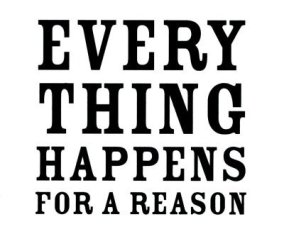
Everything happens for a reason. This is true, of course, in the sense that actions have consequences. If I step down from this pulpit and walk to the back and flip the switch in the breaker box, all of the lights in the sanctuary will turn off. If plants do not receive enough moisture and sunlight they will not grow. If I give my wife a mop for Christmas, I’m going to get in trouble.

In our scripture from Deuteronomy, Moses offers the Israelites a similar reflection: if you choose life and love the Lord you may live in the land the Lord promised. Actions have consequences. However, the problem with “everything happens for a reason” is that we almost always imply that God is the reason that everything happens.

So, to take the recent election as our example, if it was God who intervened to make sure that Donald Trump became president, why wasn’t the victory more lopsided? Or, does it mean that everyone who voted for Clinton is a sinner for doing so because they went against God’s will? Did God choose not to “show up” for the Obama elections in 2008 or 2012? If everything happens for a reason, then why did God choose to have Donald Trump elected as president while all sorts of other things (like the situation in Syria, Police shootings, etc.) are still happening?

And this logic can also be applied to a number of things: If everything happens for a reason, then why did one of my best friends die in a car accident when she was a teenager? What is the reason for men who beat their wives, or women who abuse their children, or children who assault their parents?

When we throw out a trite and cliché sentence like “everything happens for a reason” it removes all responsibility from us and puts it all on God. And yet, we do believe that God is in control, that God is the author of our salvation, and that God continues to move and act in this world of ours.
everything-happens-for-a-reason

This is fundamentally at the heart of the strange mystery of what it means to be a disciple. On one side we affirm that God rules, and on the other side we affirm that God has given us perfect freedom to live and act in this place that God rules.

God has given us the freedom to make choices, for better or worse. From the Garden of Eden to the sanctuary of St. John’s on this first day of 2017 we are free. When we do something right or wrong, we can’t blame it on God. It is our freedom to choose who we are to be, that allows this world to be as strangely beautiful as it is, but it makes it strangely broken and flawed as well.

We are not marionettes being strung along by a divine puppeteer. God gives each of us, his creatures, a brain, a heart, a soul, to make choices and act in this world. We use things like prayer and the reading of scripture to help us determine how our choices can coincide with God’s will, but the choices are fundamentally ours to make.

All of us know that terrible things happen that cannot be explained. They are a part of life. But we also know that those terrible things do not have the final word. We know that God is working through us, helping us to see and to know who we are to be in order to transform this world into his kingdom. And we know that God is the one who has the final Word, thats what Jesus’s birth and resurrection changed. God came into the world in order to free us from the last vestige that had a hold on us, death. God broke the chains of death’s dark shadow in order to guide us into the light of resurrection. We know that even though terrible things happen, and will continue to happen, God’s love in Jesus Christ is the final Word.

Living in this tension of God’s perfect sovereignty and our perfect freedom is one of the things that makes being a Christian so challenging. For when we encounter those terrible things that happen in the world we often vacillate between “everything happens for a reason” or “life is meaningless.” Whereas Christians, people like us, are called to live somewhere in the middle.

In the early hours of April 15th 1912, more than a hundred years ago, the infamous ship named the Titanic sank in the Northern Atlantic Ocean. 1,500 people were lost at sea when the ship ran into an iceberg and it is still one of the worst maritime disasters to have ever happened.

Much like other events that grab the attention of the world, many pastors felt called to speak about the disaster the following Sunday in order to make sense of the tragedy. In a small sleepy Swiss village was a young pastor named Karl Barth who regularly bored his congregation with long theologically dense sermons, but the Sunday after the sinking of the Titanic called for something a little more meaningful.

He used the beginning part of the sermon to outline the power of the almighty from creating the cosmos to bringing life to all creatures. He referenced heavily from the book of Genesis and went on and on. But at the end he said something that grabbed their attention.

It went like this: God most certainly put the iceberg in the water, but God did not make the captain feel pressured to beat the record time across the Atlantic and thereby neglect to pass slowly and safely through a region filled with large icebergs.

1101620420_400

Barth’s simple reflection is by no means perfect, but it points toward a better way of thinking about, “Everything happens for a reason.” Sometimes there are reasons things happen, people feel tempted to go faster than they should and it means they run through red lights, they neglect to check their blind spots, or they run into icebergs. Sometimes people feel disaffected and forgotten by their government and they come out in droves and subvert the majority of polls and elect a political outsider to the most powerful position in our earthly world.

But that doesn’t mean that God made a car accident happen, or that God willed the sinking of the Titanic, or that God had a reason for making Donald Trump the next president of the United States.

And sometimes things happen for no reason at all. Fathers in perfect health and in the prime of their lives die of sudden heart attacks. Natural disasters like tsunamis and hurricanes come out of nowhere and devastate entire communities. Marriages fall apart for no particular reason other than the build up of tiny disagreements that never get settled.

And still there is hope. There is hope because God can work through people like you and me to bring about the kingdom on earth. God still speaks through the ancient scriptures to remind us of the importance of ministering to the last, the least, and the lost. God places opportunities in our lives that we can choose to respond to, and in so doing, we can become the reason good things happen.

God has set before us life and death, blessings and curses. We have the choice to choose life so that our families and friends may live to love the Lord and obey what he has taught. If we choose the good we may all live in the peace that God promised to God’s people from Abraham, to Isaac, to Jacob, to David, to Isaiah, to Jesus, to Peter, to Paul.

So it is good and right for us to start this New Year in this place, where God makes all things new. At this table we receive the spiritual food necessary for the journey of life. We break bread knowing that strange things are afoot in this world, but that God moves in and through people like us to shine as a light in the darkness. We surround the cup together knowing that Jesus’ sacrifice opens up the glory of the resurrection and gives us the strength to do incredible things here and now.

Not everything happens for a reason. But sometimes God calls us to be the reason something good happens to someone else. Amen.


The Humanity of God – Christmas Eve Sermon on Luke 2.1-7

Luke 2.1-7

In those days a decree went out from Emperor Augustus that all the world should be registered. This was the first registration and was taken while Quirinius was governor of Syria. All went to their own towns to be registered. Joseph also went from the town of Nazareth in Galilee to Judea, to the city of David called Bethlehem, because he was descended from the house and family of David. He went to be registered with Mary, to whom he was engaged and who was expecting a child. While they were there, the time came for her to deliver her child. And she gave birth to her firstborn son and wrapped him in bands of cloth, and laid him in a manger, because there was no place for them in the inn.

Colorful holiday lights background, defocused

Christmas Eve! No matter how old or jaded we may be, no matter what kind of year precedes this night, Christmas Eve never fails to brighten our spirits. I look forward to Christmas Eve with a kind of painful excitement: I know there are people here tonight who will not be here the rest of the year, I know this holiday carries with it more meaning than can be contained in a 15 minute sermon, and yet to share the story of salvation is one of my greatest privileges.

But then the question must be asked: Why are you here tonight? Some of you were raised in this church and can’t imagine being anywhere else. Some of you have come alone; others are with large families taking up an entire pew. Some of you have been planning to come here for weeks and some of you decided on a last-minute impulse. Some of you have been dragged here against your will, out of loyalty and guilt. And some of you are here for the first time in a very long time.

Some of you are young and are full of hope and anticipation; most of your Christmases are still in front of you. Some of you who are older are filled with memories of Christmases past that will never come again. Some of you are looking forward to getting back home to the fireplace and the presents and the tree; others dread going home. Whoever you are, and whatever you’re feeling, I’m glad you’re here tonight.


On April 26th, I woke up to the sounds of my excited wife declaring, “I think it’s happening.” The due date for our son had come and gone and each day we waited with anticipation of his coming arrival. So, being the incredible husband that I am, I started offering Lindsey all kinds of things: “Do you want me to make you breakfast? Can I massage your feet? Would you want me to call the doctor?”

She, however, was distracted from my offers by the pain she was starting to experience.

As the day progressed I must’ve checked our hospital bag no less than 42 times, I made sure we had enough clothes and snacks, I went through the 3 birthing playlists (one for calm, one for happy, one for pushing), and I asked Lindsey how she was feeling every fifteen minutes. While I was frantically going through my list over and over, Lindsey was on the couch trying to find a comfortable position to sit in until things really got going.

Mary and Joseph spent the day before their son’s birth traveling over harsh terrain while Joseph led the donkey that was carrying his pregnant fiancé. With every bump and slip, the pain Mary experienced increased and she hoped against hope they would find a place to stay in Bethlehem.

When my wife’s contractions started coming at a regular interval we called the doctor’s office and they told us to come in. Under the caring gaze of the nurses and medical staff Lindsey went through a number of tests before they told her, as kindly as they could, that it was still too early to go to the hospital, so we went home instead.

Mary’s contractions must’ve started to really ramp up as they arrived in the sleepy little town of Bethlehem. All the people they encountered were busily talking about the census that the emperor had required, how they all had to be there in Bethlehem without a choice. To the degree that no one even noticed the man escorting the pregnant woman on a donkey as they passed through the outskirts of the town.

We waited all day and finally at 9pm, the contractions we regularly occurring at such intensity that we knew the time had come. Being the good husband that I am, the car had been packed with our hospital bags for hours and all I had to do was gingerly walk Lindsey to the car and drive to the hospital with care and focus. When we were given a room time seemed to increase in speed dramatically. With every passing minute the contractions were intensifying and the nurses came in at a higher frequency to check on Lindsey and the baby.

Mary and Joseph wandered through the town at a snail’s pace hoping to find somewhere to stay, or a relative to encroach upon. But the farther they walked, the less hope they had of finding a place for the night.

At some point, my beloved wife was breathing strongly through a particularly rough contraction when the nurse said, “Honey, I think it’s time to talk about pain management.” I, watching her go through this thought to myself, “Gee, I think its time for me to have some pain management.” But, being the good husband that I am, I knew not to speak that thought out loud.

Joseph guided the donkey to their last hope, the inn, while his wife was breathing heavily through a particularly rough contraction. The innkeeper saw them walking up and went to the door to announce: “We’re full.” Being the good man that he was, Joseph then led the donkey and Mary to a stable, the only place left and helped her down into some crinkly hay.

At 7am on April 27th, Lindsey started to push. She was surrounded by a team of medical staff, machines monitoring every heartbeat and contraction, and by me trying to figure out what I could to do help.

When Mary could tell that the time had arrived, she started to push. She was surrounded by dirty animals huddled together for warmth, hay that was covered in dirt and hair from the animals, and a man who was trying to figure out what he could do to help.

And with a final push, a son was born into the world. The baby was quickly placed into his mother’s arms and for a fleeting moment nothing happened. In our hospital room the medical team waited with blankets and devices, in the stable the animals watched as the miracle of life came to fruition.

And then, with what sounded like a rush of wind, the baby sucked and breathed in air for the very first time.

From a dirty barn house to an immaculately clean hospital delivery room, the first breath of Jesus and my son Elijah highlights the fragility of this thing we call life. And don’t we take it for granted? All of us have been breathing throughout this sermon without even thinking about it, but we can only live because we can breathe.

In the beginning God’s breathed the breath of life into Adam, God breathed life into Jesus, God breathed life into my son Elijah, God breathed life into every one of you.

It is something worth celebrating because it is a miracle.

But this service, what we’re doing here tonight, is not a mere celebration of a mother and her newborn child’s arrival into the world. It is about more than the miracle of life. This is the unique story of God in the flesh. The baby placed in the manger is not us and we are not Him. He is totally other.

And yet – and this is the real mystery of Christmas – Jesus is the incarnation of the living God, but at the same time, though he is entirely other than us, he has become one of us. Nothing less than God himself has become Emmanuel, God with us.

In Jesus’ birth, God entered history in a new and strange way with the promise that in the kingdom that has no end, sadness will be turned into joy, sin will be destroyed by righteousness, and death will be defeated by resurrection.

But it all started in a tiny little stable with a couple all-alone in the world. That is the true miracle of Christmas – the fragility and humanity of God in a breath. For it is in our breathing that we constantly encounter the one thing we have to do to survive and the one thing we have from the beginning to the end of our days. And that is where God is; with every single breath we inhale the Spirit of the Lord who first breathed life into us. And in our breathing we connect with the one who breathed for the first time in the manger long ago…

And through that first breath, God emptied himself of all power and reign and might and majesty, leaving it all behind to enter our corrupted, polluted, and tragic world. Gone were the days of abandonment, gone were the times of uncertainty, and gone was the power of death. For God came into the world through a baby in a manger to save us from ourselves; to be with us in every single breath; to offer us the true gift of Christmas: God with us.

Merry Christmas. Amen.

christmascandle

Too Busy To Welcome – Advent Homily on Romans 15.7

Romans 15.7

Welcome one another, therefore, just as Christ has welcomed you, for the glory of God.

too-busy-for-christmas-1

When Bob Sharp was sent to Marquis Memorial, I know that he was welcomed because it didn’t take long for the church to paint his office burgundy and gold in honor of his dedicated devotion to the Washington Redskins.

When Courtney Joyner started at St. Paul’s, I know she was welcomed because she is a triple-threat: She can sing, she can jam, and she can preach.

When John Benson first preached at Augusta Street, I know he was welcomed because his people haven’t stopped shouting “Amen!” since his first sermon.

When Won Un showed up at Central, I know he was welcomed because their entire church community has developed an affinity for Kimchi and they know that if they can’t find Won on a nice day, it’s because he’s out riding his bike.

When Janet Knott arrived at Jollivue, I know she was welcomed because she preaches with gifts, and who doesn’t love presents?

When Clayton Payne began at Cherryvale, I know he was welcomed because people keep showing up week after week even though he keeps preaching the same sermon over and over again.

When Bryson Smith was appointed to St. Paul’s, I know he was welcomed because they know if the sermon falls flat, he can always sing a solo and get the people to shout “Praise the Lord!” and “Mercy!”

When Sarah Locke was sent to Christ, I know she was welcomed because people started showing up in her kitchen while she was still unpacking boxes. I know that because I was there!

I know the United Methodist churches of Staunton are a welcoming bunch because you have so warmly welcomed your pastors. But I wonder, do we welcome everyone to our churches in the same way we welcome the pastor when he or she first arrives? Do you really welcome one another just as Christ welcomed us?

When I arrived in Staunton, Won and I got together and thought it seemed about time to resurrect the Lenten and Advent luncheons. We were not here when they used to happen and so we were able to tweak the schedule and the organization a little bit. Important for us was the shifting of host churches and guest speakers so that everyone got a chance to welcome, and every preacher got a chance to preach.

Fun fact: As of Christmas day, I will have preached in every single United Methodist Church in Staunton. And it only took me three and a half years!

Anyway, we got the Lenten luncheons started again, and the first time I was invited to preach we were gathering at Central UMC. At the time, I was young and naive, and I thought it would be a good idea to wear my Carharrt Overalls when I preached from the pulpit in order to really drive home the message. Maybe you were there. Maybe you even remember some of the things I said.

I poured out my heart and soul from the pulpit at Central UMC and I did my best to make the people of St. John’s as proud as possible. Afterwards, during lunch, after the tenth or so person made a comment about my attire, an older woman came up to me and asked if we could talk (I won’t say which church she was from).

So we moved to the corner of the social hall, and she gingerly placed her hand on my shoulder and said, “I understand that you’re new to town you might be looking for a church home, so we’d love to have you join us for worship on Sunday.”

I remember just standing there stunned. I mean, it was a kind gesture for her to invite me to church (particular when the average person in a United Methodist Church invites someone to worship once every 33 years). But going to another church on Sunday is impossible.

She welcomed me, but she didn’t listen to me. I suspect that she was more concerned with having people in the pews, than with knowing who the people are in the pews.

Welcome one another, therefore, just as Christ welcomed you, for the glory of God.

How did Jesus welcome? Well, he certainly didn’t wait for people to just show up because he was having a service on a Wednesday afternoon, or a Sunday morning, or even on Christmas Eve. Jesus welcomed others by showing up in their lives, he met them where they were and ministered to them in terms and in ways they could understand. He told stories that connected with their daily living, stories about the soil and the birds of the air. He welcomed them in the midst of their suffering and isolation. He welcomed the very people who would abandon him to a table without cost.

At St. John’s we have a Preschool and I spend time every week leading the kids in what we call chapel time. I’ll take a lesson from scripture and try to rework it in ways that can understand and apply to their life.

Last week, after practicing the Christmas pageant for what felt like the thousandth time, I set up a small table near the altar and I invited the kids to come sit and listen. The thirty minutes prior to chapel time were filled with pushing and tripping and laughter and debauchery, but when they sat down around the table I started speaking in a soft voice, and they all started to listen.

I said, “My friends, I have something I want to share with you. This is bread and grape juice, but it is about to me much more than that. For this is a gift that Jesus gives to us. Some of you might do this in your church on Sundays, and whenever we sit at the table we are remembering Christ’s love for us. At this table, all of us are welcome no matter what. So let’s pray… God thank you for loving us so much that you welcome us no matter what we’ve done and no matter who we are. I pray that you would pour out your Spirit on us and make us more like Jesus so we can love others. Amen.”

And then one by one I called them by name, I gave each of them a piece of the bread, they dipped it into the cup, and the received communion.

Unlike us, the preschoolers have the benefit of not rushing around through this season of Advent endlessly crossing items off our to-do lists. Unlike us, the preschoolers don’t feel burdened by the tyranny of things and can sit quietly for a moment to receive a gift better than anything under the tree.

It often happens around this time of year that we feel too busy to welcome. We become more concerned with the wrapping paper and the ornaments and appearance of things than with the welcoming love of the Lord who was born into an unwelcoming town. When our sanctuaries fill up with more people than usual on Christmas Eve we are more often burdened by making sure everything is in the right place, than we are by making sure we are in the right place to welcome and be welcomed by the Lord.

And it is at the meal, the Lord’s Supper, the thing that most of us do on the first Sunday of the month, where we learn what it really means to welcome like Jesus. For Jesus is the one inviting you to the table, not merely hoping that you will show up to fill an empty place in a pew, but earnestly and truly yearning for your presence. You are invited because you are unique, you are wonderful, and you are a child of God. There is a place for you at the table no matter what.

Can you imagine what our churches would really look like if we welcomed others as Christ welcomed us?

Amen.

Let’s Talk About Doubt – Sermon on Isaiah 7.10-16

Isaiah 7.10-16

Again the Lord spoke to Ahaz, saying, Ask a sign of the Lord your God; let it be deep as Sheol or high as heaven. But Ahaz said, I will not ask, and I will not put the Lord to the test. Then Isaiah said: “Hear then, O house of David! Is it too little for you to weary mortals, that you weary my God also? Therefore the Lord himself will give you a sign. Look, the young woman is with child and shall bear a son, and shall name him Immanuel. He shall eat curds and honey by the time he knows how to refuse the evil and choose the good. For before the child knows how to refuse the evil and choose the good, the land before whose two kings you are in dread will be deserted.”


What a strange promise. The Lord will give you a sign. Look, the young woman is with child and shall bear a son, and shall name him Immanuel. The promise sounds nice and sweet, after all its part of a lot of the hymns we sign during this time of year. We read these verses and our minds immediately jump to the manger scene with Mary and Joseph carefully cradling the baby Jesus with the animals remaining perfectly quiet and still. But this promise is made to a particular person in a particular moment, and that’s what makes it strange.

At the time of Isaiah’s proclamation, forces were gathering and attempting to attack and invade Jerusalem. The King, Ahaz, is deeply afraid. And it is in the midst of his fear that God offers the King a sign, any sign that he wants, let it deep as hell or high as heaven. God offers Ahaz any sign he wants so that the king will remember to trust the Lord. Ahaz, appearing quite faithful, says he will not put the Lord to the test (the same thing Jesus says during the temptations in the wilderness), but the Lord ignores Ahaz and proclaims the coming sign nonetheless.

So it is while King Ahaz is shaking in his boots, while troops are gathering at the gates, that he receives a sign of God’s promised presence: A young woman will bear a son named Emmanuel.

Now, let’s be real for a moment: God’s promise of a baby is weird. And it’s rather ambiguous. God does not say, “I will destroy the invading forces with terrible violence” nor does the Lord promise that Ahaz will survive. Instead, God says that a baby is coming to save the world.

I don’t know about you, but Christmas, to me, always seems full of happy go lucky faith without any doubt or questions. Lights are hung up on all the houses, people tune their radios to the Christmas stations, and parents want their children to behave themselves in the Christmas pageants.

But doubts and questions are there, perhaps just barely below the surface of the façade we wear around during these weeks we call Advent.

doubt

Do we doubt? Are we allowed to? What happens to us if we do? More than a few of us will be sitting in the pews on Christmas Eve singing Joy to World and celebrating the Christ-child while we’re really wondering what it means to believe.

King Ahaz doubted. While surrounded by enemies, and offered a miracle by God, he insists on not putting God to the test. This might sound really faithful, but God offers something incredible and Ahaz turns it down. His pious response is more a dismissal of the Lord being able to actually help.

Moses doubted. When the Lord asked him to go and deliver the people from the tyranny of Egypt, Moses quickly listed off the excuses for why he shouldn’t be the one to go.

Jeremiah doubted. When the Lord called him to be a prophet to God’s people his response was quick, “I am only a boy! Surely I can’t speak on your behalf”

Jonah doubted. When the Lord commanded him to travel to Nineveh he traveled in the opposite direction in order to avoid what he had been asked to do.

Zechariah doubted. When the Lord spoke to him and told him that his wife was going to become pregnant he did not believe the Lord could perform such a miracle.

John Wesley doubted. You know, the guy in the stained glass window right there. He was asked to go travel to a strange place called Georgia and preach the Good News but he did not have faith. And when he told his superiors about it, they said, “Preach faith until you have it; and then, because you have it, you will preach faith.”

Even Jesus doubted, though only for a moment. When he found himself all alone and nailed to the hard wood of the cross, he cried out, “My God, my God, why have you forsaken me?”

Sometimes we feel like if we have doubts it is the complete opposite of having faith. In fact, many leave the church whenever that first doubt starts to creep in and they begin to wonder about the truth and promises of God’s Word.

I know more people than I can count who, at some point, were devout and faithful followers of Jesus Christ. And all it took was a little dose of the dirty word for their faithfulness to crumble. Was there really a virgin birth? Did Jesus really walk on water and feed the 5,000 and bring sight to the blind? Does God really care about our individual lives? Did God really raise Jesus from the dead?

Their entire discipleship hinged on the answer to one of those questions, and when they could not find an answer that was satisfying, they left.

I have friends from seminary who felt called to the ministry but have since left the church because a professor told them something like, “Moses didn’t write the first five books of the bible.” Or “Paul did not write the epistle to the Hebrews.” Or “Some of the psalms attributed to David were not written by David.”

            Doubt is such a dirty word. For a long time it has been shunned from the church and treated like a mortal sin. It has been seen as a weakness. But doubting is often a sign that our faith has a pulse, that it is alive and well and exploring and searching.

            Doubt and faith are not opposites.

            You can’t really have one without the other.

We’re now going to try something a little different, something a little strange, and frankly it might not work. But I’m going to leave this pulpit and come down to you and we’re going to talk about our doubts. Now the point of this is not for you to say something like, “I have trouble believing the virgin birth” and then have me completely remove your doubts with some sort of speech. No, the point of this is for us to be vulnerable and intentional with one another, for us to connect as a community of faith around the fact that we have doubts, but that God is big enough to handle our doubts.

So, what are your doubts?

This week, as I was scrolling through the seemingly endless cycle of news from around the world, I read about Russia’s apparent involvement in the democratic election cycle of the United States, and I read about Apple’s struggle to provide Bluetooth compatible headphones in time for Christmas consumers, and I read and read and read.

But then I saw a picture that still haunts me. In the image, a man and a woman are walking through the city Aleppo, Syria. The woman’s face is covered and her husband is cradling their baby in his arms, while holding up an IV bag that’s running down into the bundle of swaddling clothes.

            I’ll admit that what I should have been struck by most was the violence in the background and the terror in their posture, but what struck me the most was how much it reminded me of Mary, Joseph, and the baby Jesus.

A man carries a child with an IV drip as he flees deeper into the remaining rebel-held areas of Aleppo, Syria December 12, 2016. REUTERS/Abdalrhman Ismail

Over 250,000 people have died in Syria as a result of their civil war, most of them innocent civilians. And while we fret over the incoming president-elect and whether or not consumer goods will arrive on time, modern Marys and jaded Josephs are doing everything they can to protect their babies.

And it makes me doubt. I read the statistics, I see the photos, and I want to know where God is in the midst of all this. How can the God who knows us by name and has counted the hairs on our heads rest easy while innocent men, women, and children are dying at a rate we can barely fathom?

And while this is happening across the world, Christians in our country are worried about Muslims and are seriously considering instituting a registration of all Muslims. And do you know what’s happening in Aleppo? Christians and Muslims are serving shoulder to shoulder pulling children from rubble, consolidating food and resources to share with as many as possible, and are the remaining sources of light in a city under the shadow of death.

I doubt God’s presence in the midst of something as terrible as what’s happening in Aleppo, but then I have hope when I read about Christians and Muslims working together to bring joy to people who feel no joy.

And so I live in this tension between faith and doubt. We all do. We vacillate between the two like a frenetic sphere in a pinball machine. We doubt and we trust. We break down under the tyranny of violence and are built back up by the very nature of love. We weep for the world and its destructive desires, and are comforted by the God who came down to take on our flesh. We lift up our clenched fists in frustration to the sky, and we hear God speak in the still small voice: “Lo, I am with you always.”

Faith and doubt; you can’t have one without the over. Amen.


doubt

Ridiculous Renewal – Sermon on Isaiah 35.1-10

Isaiah 35.1-10

The wilderness and the dry land shall be glad. The desert shall rejoice and blossom; like the crocus it shall blossom abundantly, and rejoice with joy and singing. The glory of Lebanon shall be given to it, the majesty of Carmel and Sharon. They shall see the glory of the Lord, the majesty of our God. Strengthen the weak hands, and make firm the feeble knees. Say to those who are of a fearful heart, “Be strong, do not fear! Here is your God. He will come with vengeance, with terrible recompense. He will come and save you.” Then the eyes of the blind shall be opened, and the ears of the deaf unstopped; then the lame shall leap like a dear, and the tongue of the speechless sing for joy. For waters shall break forth in the wilderness, and streams in the desert; the burning sand shall become a pool, and the thirsty ground springs of water; the haunts of jackals shall become a swamp, the grass shall become reeds and rushes. A highway shall be there, and it shall be called the Holy Way; the unclean shall not travel on it, but it shall be for God’s people; no traveler, not even fools, shall go astray. No lion shall be there, nor shall any ravenous beast come up on it; they shall not be found there, but the redeemed shall walk there. And the ransomed of the Lord shall return, and come to Zion with singing; everlasting joy shall be upon their heads; they shall obtain joy and gladness, and sorrow and sighing shall flee away.

advent_2015_screen


On Christ the King Sunday, the sermon was titled “Not My President.” And before we even started worshipping, more than a few of you made sure I knew your concerns about the impending proclamation. After all, Donald Trump had just procured the necessary electoral college votes to be labeled as president-elect, and people across the country were (and still are) protesting his election with signs saying, “Not My President.” If you were here on Christ the King Sunday, you know that the sermon had very little to do with Mr. Trump, and in fact was all about how grateful we should be that Jesus is not our President.

However, like the good Methodists we are, the sermon was not the pinnacle of our worship that Sunday. You might remember a few lines that I proclaimed from the pulpit, you might even remember one of the hymns we used, but if you sat in the front half of the congregation, I bet the thing you remember most from that service happened during communion.

As always I stood behind the table and I prepared to pray over the bread and the cup. Together we confessed our sins and asked for God to forgive us. We stood up from our pews and shared signs of Christ’s peace with one another. And then I asked God to pour out the Spirit on us gathered together and on the gifts of bread and the cup.

One by one each of you came forward to the front of this sanctuary with hands outstretched to receive the body and the blood of Jesus Christ. One by one I looked each of you in the eye as I tore off a piece of the bread and placed it into your hands. Some of you came up with tears in your eyes. Some of you came up with your eyes focused on the ground, perhaps out of reverence for the precious thing you were about to receive. And some of you came forward with eyebrows askew as if to say, “Who thinks of preaching a sermon about Jesus not being our president?”

The last family to come up for communion sat in the very last pew during worship, and they are connected to the church through our Preschool. Their son is here in the building every week learning about what it means to grow in knowledge, in wisdom, and in love of God. So when his father came up with his hands outstretched I asked if I could offer the bread to his son. The father smiled and said, “Of course.” With his blessing, I knelt down onto the floor and looked at my young friend in the eye and I said, “Owen, this is Jesus.”

To which he smiled, titled his head back slightly, opened his mouth, and waited for me to drop the bread right in.

Without really thinking about it, I took the piece and put it in his mouth, and in response he started chewing while smiling and trying to say, “Thank You Pastor Taylor.”

And I lost it. For whatever reason, I could not contain the laughter that was brewing inside me and I started cracking up. I laughed so hard that I actually snorted. Perhaps it was the seriousness of our service getting flipped upside down by a two year old receiving communion like a little bird from his mother, or maybe it was the smile he offered me while pieces of barely chewed bread were falling out onto the floor, or perhaps it was the little skip in his step while his cheeks were filled like a chipmunk preparing for winter, but I couldn’t stop laughing.

            In that simple and yet profound moment, the desert of our ritualistic liturgy was transformed with blossoms of laughter as other people laughed in response to my snort. In that brief and beautiful moment, God brought this church some much-needed joy.

You see, after spending the better part of two months confronting controversies facing the church and addressing the deep seeded political anger felt in this congregation and across the country, we needed to laugh.

man-jumps-for-joy

Isaiah says the wilderness and the dry land shall be glad. The desert shall rejoice and blossom. The prophet looks to the future and shares the ridiculousness of the renewal that is waiting for God’s people. Like a desert blooming in the middle of a drought, like old and worn out people finding strength in their knees, like tongues of the speechless being filled with words, so will the glory of the Lord transform the world.

In this vision everything is made new from the farthest reaches of creation, to the deepest aspects of our souls. The deserts shall rejoice and blossom, flowers will grow abundantly in the forgotten places, the blind will see, the deaf will hear, and waters will break forth in the wilderness.

God promises transformation and joy. Though not necessarily the transformations and joys we pray for, but ridiculous and redemptive reversals nonetheless. Isaiah sings of liberation, joyful homecomings, and the end of all sorrow and sighing.

Signs of this future of joy will be made manifest in the weak being strengthened, those with feeble knees will stand firm, the fearful will be strong. Those who have long been isolated to the powers of loneliness will be grafted in and never forgotten.

Isaiah sings about the Holy Highway cutting through the wilderness, a way for God’s travelers to move without threat or fear, a place where the people of God’s can sing on their way home.

It sounds a lot like the Garden of Eden, and it sounds a lot like heaven.

But just like last week, Isaiah’s song about the promises of God are not just things that will happen in the distant future; they are part of God’s wonderful and creative reality here and now.

Yet, there are things in this world that hold us back, accidents on the highway of God’s grace, that prevent us from traveling the way to God’s promised salvation. There are chains and bumps that derail us from the pathway to glory: economic fears, political disappointments, spiritual droughts, emotional baggage, relational frustration, and seasonal depression, to name a few. And yet over and over again, whether it’s through a child walking back to his pew with bits of saliva soaked bread falling out of his mouth, or a host of other means, God transforms this world and fills us with joy.

I love to tell stories. From the time we are young children we learn important lessons more through stories and less through object lessons. That’s why scripture is so powerful, and it’s why Jesus used parables to relate the immensity of God to his disciples. This week, in anticipation of this sermon, I emailed a number of you to ask for stories of how God has transformed your life. I wanted to hear about the times that God’s living water broke forth in the midst of an otherwise desert-like existence.

And you did not disappoint.

One of you came to church for years without it really meaning much. It was just the thing you were supposed to do. And on one particular occasion, you were sitting in these pews listening to the choir sing an anthem. There wasn’t anything particularly moving about the words or even the melody, but you found yourself watching the individuals as they were singing and you could tell they meant it. Though you had seen and heard the choir many times, God spoke to you through their faithfulness that fateful day, and since then you have known and experienced the power of God through the music of our church, and through those who provide it.

One of you expressed how narrow-minded and intolerant you used to be. Whether it had to do with politics, or religion, or social status, you judged others unfairly. And then a pastor came to this church named Zig Volskis and he changed everything for you. His spiritual presence and demeanor taught you the importance of asking the right questions, and the importance of being content with answers that pushed you into a new direction. Instead of treating you like a student who needed to be lectured, Zig encouraged you with amazing insights and discernment. And through God working in him, you began to see the Bible not as a book to be consumed, but a life-giving witness to the reality of God.

One of you wrote about recent event whereby you attended a funeral for a man out of guilt because you were afraid that very few people would be in attendance. And yet, when you arrived, there was a line out the door and across the street full of people trying to get into the chapel. You described the experience as a moment through which God made you aware of one of your many sins, your judgment of others based on accomplishments you deemed as worthy, and through it you were transformed to know and believe that everyone has worth, and everyone is sacred.

God transformed the world through the advent of Jesus Christ, and God continues to transform our lives in ways we cannot even anticipate or imagine. The devastated deserts of our souls will once again blossom through a crowded funeral, a faithful pastor, a passionate choir, or a child-receiving communion. God uses people in our lives to change our lives so that we might change other lives.

Isaiah’s song is all about the ridiculous renewal awaiting us, God’s people. That through God’s transformative work, joy will rain down from the skies, and all the scattered promises of the bible will be fulfilled like a dance – the earth will spring forth new life, bodies will be remade, freedoms will be conferred, the city will be reclaimed, joys will erupt from unexpected places, and sorrow and sighing will be banished from the earth.

Isaiah’s song ends with the happy and joyful homecoming of those who have been liberated from the bondage that keeps them from traveling on the Holy Highway. For there is a new way that cuts through desolate deserts and turns them into beautifully blooming fields. God’s people will travel on this path without threat or fear, they will sing with joyful hearts, because the Lord is doing a new thing.

God is not done.

            God is not done with creation and God is not done with us.

            God breaks the chains of our slavery to sin and death.

            God delivers us to places yet unknown.

            God transforms our hopes and dreams into real and tangible experiences.

            God fills the deserts of our souls with living water.

            God blossoms and brings forth new life and opportunities in ways we cannot even imagine.

            God offers unending joy to the redeemed.

            God makes a way where there is no way. Amen.


Kidnapping Santa Claus


Isaiah 11.1-10

A shoot shall come out of the stump of Jesse, and a branch shall grow out of his roots. The spirit of the Lord shall rest on him, the spirit of wisdom and understanding, the spirit of counsel and might, the spirit of knowledge and the fear of the Lord. His delight shall be in the fear of the Lord. He shall not judge by what his eyes see, or decide by what his ears hear; but with righteousness he shall judge the poor, and decide with equity for the meek of the earth; he shall strike the earth with the rod of his mouth, and with the breath of his lips he shall kill the wicked. Righteousness shall be the belt around his waist, and faithfulness the belt around his loins. The wolf shall live with the lamb, the leopard shall lie down with the kid, the calf and the lion and the fatling together, and a little child shall lead them. The cow and the bear shall graze, their young shall lie down together; and the lion shall eat straw like the ox. The nursing child shall play over the hole of the asp, and the weaned child shall put its hand on the adder’s den. They will not hurt or destroy on all my holy mountain; for the earth will be full of the knowledge of the Lord as the waters cover the sea. On that day the root of Jesse shall stand as a signal to the peoples; the nations shall inquire of him, and his dwelling shall be glorious.

advent_2015_screen


One Christmas, many years ago, there was one thing I wanted more than anything else: I wanted to kidnap Santa Claus.

I must’ve been 7 years old when I decided it was time to enter the world of criminal activity and I began plotting my plan. At the time, my bedroom was in the basement just down the hall from the living room and the fireplace where Santa usually entered the house. For months I eagerly anticipated that hallowed night when we would leave out the cookies and the milk, when we would deck ourselves out in matching pajamas, when we would struggle to sleep with the excitement of the morning presents so close at hand, but this time I was going to be ready.

In the days that led up to Christmas, the time we call Advent, I went through every drawer and found items that could be used for my trap. I took every tie and belt that I owned and tied them together in one long rope. It wasn’t quite enough so I started collecting random bits of string I found around the house and added them to my dress clothes accessories. I carefully laid out the entirety of it from my bed, through my room, down the hall, around the corner, and right up to the front of the fireplace.

The key to the whole operation was the last piece attached to the last tie, my plastic Fisher-Price stethoscope. You see, with the stethoscope at the very end, it would functionally wrap around Santa’s ankle so that I could pull from my end in my bedroom and bring ole Saint Nick down to the ground.

And so I practiced. I set up the elaborate trap and forced my little sister to stand by the fireplace while I ran back to my bedroom, got under the covers and pulled as hard as I could. Over and over again I yanked on the line perfecting the angles and the force necessary to bring my prey into captivity. It was perfect. Now of course, my mother was very concerned when she discovered that all of my nice belts and ties were wrapped together and when she asked what I was up to, I replied, “Don’t worry about it.”

On Christmas Eve, we went to church with everyone else and I didn’t listen to a word. All I wanted was to get back to the house and catch the red-dressed man.

Why? Well I’m not entirely sure, but why not? After all, this guy shows up in homes every year and brings overwhelming cheer to so many. I guess I just couldn’t stand all the mystery, I wanted to know what compelled him to do what he did, and I wanted to know what he would say.

And so, after setting out the milk and cookies, after being tucked into bed, I waited until my parents went back upstairs and I set the trap. For minutes, which seemed like hours, I laid in bed with my hand tightly gripping the last belt. My focus was pure and unwavering. I listened for any sound that would indicate the moment to pull, I sniffed the air for the delicious smells of peppermint that accompany those from the North Pole, I held on for the slightest vibrations in response to Santa’s boot falling perfectly into the stethoscope.

            And then I woke up.

Anticipation, expectation, patience, waiting: These are the words we can’t stand during this season we call Advent. Instead, we’d rather know what’s wrapped under the Christmas tree, we have lights hung up on the gutters before Thanksgiving, and we plan our holiday meals weeks in advance. We want to skip right to Christmas morning, and we can’t imagine it any other way.

And who can blame us? Christmas is all about the presents, and the songs, and the lights. The word “Christmas” conjures images of trees, and children ripping through wrapping paper, and squeals of delight. At least, that what Christmas means to the world.

Christmas is actually about Jesus. But with the advent of consumer driven commodities and the need for economic growth, Christmas has become the competition of corporations. Black Friday doesn’t even start on Friday anymore, but at 5pm on Thanksgiving Day. Americans will spend almost as much money on material goods from Thanksgiving to Christmas as we do the rest of the year combined. And we do all this to celebrate a homeless baby born in a stench-filled manger. Or, just take a drive around Staunton at night sometime this week, there used to be mangers and magi in yards, now you’re lucky it you can find a plastic baby Jesus behind Frosty the Snowman, Rudolf the Red-Nosed Reindeer, and giant inflatable renditions of Santa Claus.

Advent, this strange and beautiful season in the life of the church, is all about our re-participation in the season of anticipation, expectation, patience, and waiting.

It’s like planning to kidnap Santa Claus for weeks and dreaming about what might happen. Advent is a time where we are forced to wait, like the Israelites did so long ago, for so long, to find out what would happen. While the world fast-forwards to the next consumer driven holiday, while retailers are already putting out decorations for Valentine’s Day, while the world rushes on and on and on, we wait.

We wait and remember how long God’s people waited for what we have: Jesus the Christ.

A shoot shall come out of the stump of Jesse, and a branch shall grow out of his roots. Peace comes from a stump. Out of something that appears completely and utterly finished, an object that others would gloss over comes the sign of new life – a green sprig.

3f187ee188f77c511fdbb525f08307d2

This is how hope and peace begin – they emerge like a tiny tendril in unexpected places through the least likely of people. Like a child foregoing their Christmas presents so that other might rejoice in the celebration this year; hope and peace appear in this world in strange and beautiful ways.

From the line of David will come a child, and the Spirit of the Lord shall rest upon him, wisdom and understanding, counsel and might, knowledge and fear, will be his. He will not judge by what his eyes see or by what his ears hear, but with righteousness he will transform the world.

For centuries the Israelites waited for a child such as this. While new powers and principalities dominated their very existence, they prayed in anticipation of the Messiah who would come to turn the world upside-down, they proclaimed the faithfulness of the Lord in sending the shoot from the stump, and they dreamed about how reality would change.

In that day, the wolf shall live with the lamb, the leopard shall lie down with the kid, the calf and the lion and the fatling together, and a little child shall lead them.

This is not what the world looks like today. There are no predators and prey lying sweetly together in the fields. Republicans and Democrats are not skipping hand in hand down the main streets of our communities. Children are not content with Christmas trees without presents bursting from the bottom. The protestors at Standing Rock are not dancing around the fires with the leaders of the Dakota Access Pipeline while snow falls from the sky.

2016-09-16-1474044012-2676960-defend_the_sacred

Isaiah’s vision of a child leading the way to peace is strange because it is so different from what the Israelites experienced, and it is so different compared to the terror and brutality and greed that we experience.

We don’t know peace.

            We know fear and violence and pain.

We see the images of fires raging through communities and leveling places like Gatlinburg to the ground. We hear the screams of children in Aleppo on the news as they run from bombs falling out of the sky. We experience the terror of ever-shrinking bank accounts when we feel pressured to fill this particular season with as many material goods as possible.

We are a fearful people. Even today, we are just like the Israelites waiting for a better day, a day of hope, a day of peace.

I failed in my attempt to enter the criminal world by kidnapping Santa Claus because I fell asleep. I was exhausted by the insatiable desire to get precisely what I wanted. Instead of patiently waiting for the mystery, instead of living into the reality of things unseen, I fell asleep on Christmas Eve with a belt tied around my hand.

Peace and hope come from unexpected places. But when we are so consumed by our desires, when we want to skip right to Christmas morning, when our sin stands in the way of God making all things new, we become the ax resting by the roots of the stump. We become the stumbling blocks that prevent God’s peace and hope from reining in this world.

Our desire for an answer to every question propels us into a place where we no longer consider the consequences of our actions.

            Our desire for economic prosperity fuels our inability to remember those who suffer at the hand of our greed.

            Our desire for material fulfillment prevents us from ever being the people God is calling us to be.

In my attempted Christmas Eve kidnapping, I wanted to have control over the one bearing gifts. But God calls us to relinquish our control and seek the will of the Lord.

In life we want answers to all our questions, but God calls us to be the answers to our questions. If we want peace, then we have to become part of the solution, and not part of the problem.

Advent is the time for us to wait and remember. We wait for the Lord and remember our brokenness. We wait for the Lord to do a new thing, and we remember that we are called to be people of peace. We wait and remember that through God’s help, we can destroy the ax that is our sinfulness, and instead we can bear fruit in the kingdom of God.

Isaiah promises the people a future of peace, a time we cannot yet imagine, though it will be so new and strange and wonderful that it will be like predators and prey lying contently with one another. This is a vision of God’s infinite future of reconciliation when we are brought into unity with one another, with creation, and with the Lord.

But’s Isaiah’s vision of a future of peace is also a promise of peace here and now. Peace from a stump. Peace from a baby. Peace from something like a loaf of bread.

            For it is at this table, where bullies and the bullied sit together, where the weak and meek eat with the healthy and wealthy, that we catch a glimpse of the future of peace. This meal, the bread and the cup, are a foretaste of God’s heavenly banquet, this is the place where all divisions end.

God is doing a new thing whenever we feast together. It’s not just that we march up to the front and catch a glimpse of heaven only to return to our pews with thoughts of sugarplums dancing in our heads. No, we come to this table, we are consumed by that which we consume, and we are changed. The meal follows us when we leave, God works in us through the power of the Spirit and we necessarily become the people of peace that God promised so long ago.

Isaiah saw, with eyes wide open, a vision of the kingdom of God that we wait for every Advent. He had a vision of a baby being born into the world in order to transform the world. He saw the glorious dwelling of the Lord made manifest in the least likely of places.

And through this, he had hope. Hope for things yet unseen. Hope for old and backwards assumptions being lost to the sands of time. Hope for new vision and hearing to perceive the world through the power of the Spirit. Hope for peace. Amen.

Not My President


Colossians 1.11-20

May you be made strong with all the strength that comes from his glorious power, and may you be prepared to endure everything with patience while joyfully giving thanks to the Father, who has enabled you to share in the inheritance of the saints in the light. He has rescued us from the power of darkness and transferred us into the kingdom of his beloved Son, in whom we have redemption, the forgiveness of sins. He is the image of the invisible God, the firstborn of all creation; for in him all things in heaven and on earth were created, things visible and invisible, whether thrones or dominions or rulers or powers – all things have been created through him and for him. He himself is before all things, and in him all things hold together. He is the head of the body, the church; he is the beginning, the firstborn from the dead, so that he might come to have first place in everything. For in him all the fullness of God was pleased to dwell, and through him God was pleased to reconcile to himself all things, whether on earth or in heaven, by making peace through the blood of the cross.

not-my-president-anti-trump-protesters-900


A year ago today I stood in this pulpit and preached about how God’s kingdom is not of this world. I used Pilate’s interrogation of Jesus (“Are you the King of the Jews?” “You say that I am…”) to juxtapose the world’s expectations against God’s expectations. The sermon ended with a staccato’d refrain that emphasized the kingship of Jesus and our allegiance to his kingdom.

I said:

The world tells us to gain all we can.

            Jesus tells us to give all we can.

            The world tells us to seek vengeance.

            Jesus tells us to seek forgiveness.

            The world tells us to destroy our enemies.

            Jesus tells us to love our enemies.

            The world tells us we are the center of the universe.

            Jesus tells us that God is the center of all things.

            The world tells us to ignore the weak.

            Jesus tells us that the meek shall inherit the earth.

            The world tells us that death is the end.

            Jesus tells us that death is the beginning.

I didn’t think it at the time, but it was a pretty political sermon. After all, making the claim that Christ is our King is a political statement. But what I didn’t anticipate was how the words from that sermon would play out over the next 365 days.

We’re told not to mix politics with religion. Political opinions and religious beliefs are supposed to be kept in the private sphere, they are things we can think about on our own time but the world has no right to interfere with either.

Except the world interferes with both all the time. We hear about things like the Christian Coalition, and the need for Christians to take back the Supreme Court, and I even get emails asking about what the church is going to do regarding local school board decisions.

We hear that the church is not supposed to be political. We shouldn’t endorse particular candidates or platforms. We shouldn’t tell people how to vote, or even to vote at all. The church can’t be political in the sense that it can’t be Republican or Democrat, but the church itself is a politic. To be part of the church, to be part of the body of Christ, implies that our worldview is changed and therefore everything else changes as well.

Like many Sundays throughout the liturgical year, this one has a special focus and significance. However, Christ the King Sunday is a more recent addition to the Christian calendar. Whereas Christians have celebrated the likes of Maundy Thursday and Pentecost for a long time, Christ the King was only established as official day in the church in 1925. It took the church 1900 years to need this day the same way that we need it now.

In 1925, Mussolini had been head of Italy for 3 years, a loud insurrectionist in Germany named Hitler had been out of jail for a year and his Nazi party was rapidly growing in power, and the entire world was suffering under the weight of a Great Depression.

Yet, despite the rise of autocratic dictators, despite the lack of economic opportunities, despite the strange and uncomfortable silence between two World Wars, Christ the King asserted, and still does, that Jesus Christ is Lord and he shall reign forever and ever.

Throughout the last Christian year from Christ the King to Christ the King, we’ve read from Genesis to Revelation, we’ve encountered the living God in the stories from Creation to Redemption, we’ve been transformed by the Word of the God becoming incarnate in the way we live our lives…. And all of this, all of the Sundays, all of the sermons, all of the scriptures, have pointed to one thing: Jesus Christ is Lord.

That’s the thing about Christians, for us everything starts and ends with Jesus. In his letters Paul addresses this strange and beautiful quality of Jesus over and over again. And rather than trying to accommodate Jesus to the ways of the world, Paul calls for all Christians to put Christ first. Yet, Christ is the King of a Kingdom that is so different, and so far from what we’re comfortable with, that putting Jesus first is difficult.

In Jesus’ kingdom the rules and the ruler are different. All assumptions about what is important, and who we are to be, and what we are to care about, have been changed.

It’s like being deported to a strange new land where everyone else is speaking a strange language. It takes time to learn the lingo, and adapt to the habits of the people around us. It’s not a simple matter of fitting Jesus into our present way of thinking, nor is it just giving an hour of our week to worship in a church. We don’t fit Jesus into our lives; Jesus fits us into his.

We are the ones transferred, moved, and deported from one kingdom to another. We move from the kingdom of consumption to the kingdom of communion; from the kingdom of popularity to the kingdom of poverty; from the kingdom of destruction to the kingdom of deliverance; from the kingdom of competition to the kingdom of cooperation.

Everything about what we think we know and understand changes in the kingdom of God, because Christ is King.

USA ELECTION AFTERMATH

The last two weeks have been particularly tumultuous in our country: Economically disenfranchised people are fearful about the potential of losing their health care coverage, while some devastated Democrats are calling for the murder of Donald Trump. Muslims are being threatened with a registration much like the Jews were forced to register in Germany prior to World War II, while Trump voters are being physically assaulted across the national landscape. Immigrants are cowering in fear over whether or not they’re going to be deported, while countless protestors are flooding the streets of cities and the pages of social media with the declaration: Not My President.

Some are berating and demeaning the crowds for their rejection of Donald Trump as their president as if this is the first time people have rejected the president-elect in the United States. It was only sixteen years ago that tee-shirts and bumper stickers were mass produced with pictures of George W. Bush accompanied by the words: Not My President. It was only 8 years ago that Confederate flags were waved during protests after Barack Obama won the election and people were chanting: Not My President.

Thank God Jesus is not our president.

For if Jesus were our president we would have had to pick him to lead us, and we never would have picked him to lead us. We would never willingly elect someone who told us that the first will be last and the last will be first. We would never willingly elect someone who told us to sell all of our possessions and give the proceeds to the poor. We would never willingly elect someone who told us to open up all the borders and let all the refugees in. We would never willingly elect someone who spent so much time with the riff-raff of society.

If Jesus were our president he would be a product of the world rather than a product of God’s incarnation. He would have to make promises to the rich in order to maintain economic stability. He would have to compromise with other world leaders who treat their citizens like dirt. He would have to second-guess the stories he told out of fear that he would not be re-elected in the future.

If Jesus were our president he would have to make us promises that he could never keep, instead of being the glue that keeps all of us together. He would have to take sides in political debates and ostracize entire communities. He would have to brag about the stability of the union rather than name the brokenness that is keeping us from becoming who God is actually calling us to be. He would have to order the extermination of particular individuals and communities in order to keep our country safe.

Thank God Jesus is not our president. Jesus is our King. And instead of electing him, he elected us.

The kingdom Jesus rules is not of this world and it forces us to confront how broken our world really is. Jesus, as our king, subverts the powers and principalities and shows us a new way.

In this broken and flawed world, we see and know God because we see and know Jesus. Jesus is the image of the invisible, the very beginning of everything in creation. Jesus is before all things, and in him all things hold together.

When we encounter things that appear diametrically opposed, things like Republicans and Democrats, Christ is the glue that holds it all together. Through the blood of his death, the blood that was poured out for the world, we encounter the “other” as brother and the “stranger” as “sister.” All the worldly things that seek to divide us are broken down by the glory of the cross that seeks to bring peace and reconciliation rather than division and destruction.

807586_1

It is not an easy thing to be a Christian, to worship Christ as King. We need the strength of God to endure everything with patience while giving thanks to the Father, because we cannot do discipleship on our own. But when Christ becomes first in our lives, when every Sunday is like Christ the King Sunday, when we realize that we a part of a strange new kingdom, everything else starts to change.

Our King does not build walls to keep people out, nor does our king require the registration of different communities under the auspices of “safety.” Our King invites all to the table to discover the power and love of his grace.

Our King does not call for his followers to take up the sword to wipe out political opposition. Our King forgave the people who delivered him to the cross.

Our King does not pander to us with empty promises in order to procure our allegiance. Our King meets us where we are with a simple invitation saying, “follow me.”

Nearly 100 years ago, Christians all across the world needed the first Christ the King Sunday. They needed a Sunday set apart to reflect on how the Lordship of Christ outshines even the most powerful of dictators and the most devastating of depressions.

Today, we need it just as much. We need Christ the King Sunday because it helps to remind us that Jesus’ kingdom is not of this world. It forces us to confront the strange reality of our King being nailed to a cross for the people of his kingdom. It reminds us that peace comes through his sacrifice, a sacrifice that we remember at this table.

Do not be conformed to the ways of this world, but be transformed by the bread and the cup at the Lord’s Table. Instead of consuming the politics and priorities of the world, be consumed by the grace of God made manifest is Jesus Christ. Reject the powers and principalities that seek to undo God’s creation, and kneel before the true King: Jesus Christ. Amen.

A Drop In The Ocean – Election Reflection

Isaiah 12.1-6

You will say in that day; I will give thanks to you, O Lord, for though you were angry with me, your anger turned away, and you comforted me. Surely God is my salvation; I will trust, and will not be afraid, for the Lord God is my strength and my might; he has become my salvation. With joy you will draw water from the wells of salvation. And you will say in that day: Give thanks to the Lord, call on his name; make known his deeds among the nations; proclaim that his name is exalted. Sing praises to the Lord, for he has done gloriously; let this be known in all the earth. Shout aloud and sing for joy, O royal Zion, for great in your midst is the Holy One of Israel.

imrs

The line was long when I arrived at my voting location. I sauntered along with the others who were shivering in the cold until we made it to the door and the warmth. We listened to three different people explain the process of voting, we were shifted like a herd of cattle from one side to the other, and then one by one we had to hand over our driver’s licenses to prove our identities.

The woman holding my license (with a picture of me at 20 years old) brought it right up to her face in order to examine every fine detail. Without looking at me she said, “state your name and address.” So I did. And only when handing the card back did she look up over her glasses to say, “you’ve changed.” Which actually sounded more like “you look older than the card says you are.”

Like a sheep, I was then shepherded over to a separate table where I filled in four bubbles, took the card over to the machine, waited for it to beep, and was given my sticker. All told, I was there for ten minutes. 18 months of anger and political outrage, 18 months and nearly 5 billion dollars spent on advertising and campaigns slogans, 18 months and national turmoil all came to fruition in a ten-minute dance in a church social hall for four votes.

If I’ve heard one thing as a pastor more than anything else about this election over the last year and a half, it was this: “God is punishing us.” “God is punishing us for our sinful ways and making us choose between the lesser of two evils.” “God is punishing us for electing a black president 8 years ago.” “God is punishing us for not getting faith back in schools.” “God is punishing us for our lack of faith.” “God is punishing us and the world is going to end with this election.”

Want to know a secret that shouldn’t be a secret? The world is not going to end tonight when all is said and done.

God has been God a whole lot longer than this world has had democratic elections. God has been God through every presidency. God has been God long before America existed. God has been God, and will be God, long after we’re gone.

We Christians believe that Jesus is Lord which means we believe that God is in control. We believe that God spoke the whole of creation into being and has called each of us by name. We believe that God is almighty regardless of who sits in the Oval Office. And perhaps most importantly, we believe that God calls us to love and pray for our enemies, which today means we are called to love and pray for the people who voted for the other candidate.

Can you imagine? Christians praying for people they disagree with? Sadly, that’s at the heart of what it means to follow Jesus and it has been so absent during this cycle. Instead, political offices have been bombed, churches have been burned, and voters have been intimidated at the polls.

And perhaps we want to blame Donald Trump or Hillary Clinton for this tumultuous season. But the problem goes far deeper than whoever will become the next president. The problem is us. We get the people we deserve running for office. Instead of seeing one another and brothers and sisters in Christ, we have adopted the world’s identification system and see one another as liberal or conservative. Instead of listening to those with different opinions, we just shout louder. Instead of believing that Jesus is Lord, we have fallen prey to the belief that the world hinges on this election.

But this election pales in comparison to God’s willingness to elect us. Not by a show of hands, not by absentee ballots, not by filling in a circle on a form, but electing us to salvation through his Son.

For it is Jesus Christ who humbles us to pray for those we hate. Jesus, though scorned and ridiculed by the people, does not call for votes to be cast, but says, “Follow me.” Jesus leads us on the path that leads to life, not prosperity and political prestige, but life eternal. Jesus places the uncomfortable yoke around our necks and says the burden is light. Jesus invites us to feast at the table and we do not deserve it. Jesus, high in the air with the nails in his hands and feet, says, “Forgive them Father, for they do not know what they are doing.”

If we’re honest, we don’t know what we’re doing. We don’t know what it means to be a Christian in America, we don’t know how to hold our political identities and Christian identities in tandem with one another, and we don’t know how to love the people we hate.

But we do know the truth: Jesus is Lord.

So we give thanks, for even though the Lord has been angry with us, he comforts us. Surely we know and believe that God is our salvation. We will trust, and not be afraid, for the Lord God is our strength and our might. Through the immeasurable gift of his Son we have been elected into a strange new way of life. With the knowledge of this joy we draw water from the wells of salvation. As we remember and contemplate our own baptisms we remember who we are and whose we are.

So we give thanks to the Lord, and call upon God’s name. We proclaim God’s mighty acts from the beginning of time until this moment. We sing praises to the Lord, for he has done gloriously.

Though some will say that our faith is fruitless, that to gather here at this moment, while the party lines are being heavily fortified for future derision, is pointless; that to pray for, and love, the very people who drive us crazy is a waste of time. Some will even be so bold as to believe that gathering at the table while the country is in chaos is no more than a drop in a limitless ocean, that it can never transform the world. Yet, what is any ocean but a multitude of drops? Amen.

Not To Boast, But…

2 Thessalonians 1.1-4, 11-12

Paul, Silvanus, and Timothy, To the church of the Thessalonians in God our Father and the Lord Jesus Christ: Grace to you and peace from God our Father and the Lord Jesus Christ. We must always give thanks to God for you, brothers and sisters, as is right, because your faith is growing abundantly, and the love of everyone of you for one another is increasing. Therefore we ourselves boast of you among the churches of God for your steadfastness and faith during all your persecutions and the afflictions that you are enduring. To this end we always pray for you, asking that our God will make you worthy of this call and will fulfill by his power every good resolve and work of faith, so that the name of our Lord Jesus may be glorified in you, and you in him, according to the grace of our God and the Lord Jesus Christ.

love_god_love_people_1x

“I’d like to come by and shoot a story about St. John’s.”

The producer from WHSV had called the church and when I heard his request through the phone I was both nervous and excited. A story. About St. John’s. On Television. But then I realized I needed to ask a question.

“About what exactly?”

We do a fair amount for our local community, but I had a feeling this request was for something else. And in the pit of my stomach I was worried that he wanted to do a story about the controversy series we recently finished. After two months of standing up in the pulpit and belaboring different points of friction, I was looking forward to leaving the controversies aside for a little while, and did not want to speak on behalf of a church where we are clearly divided over a number of issues.

But then he said, “I saw on your website that your church is hosting a communion service on Election Day, and I thought that was something more people should know about.”

He arrived about 30 minutes later with a bag full of camera equipment and a spiral bound notebook full of questions. He set everything up in the office and ran a microphone cable under the desk and into my lap to pick up on all of the dialogue. We tested for light and volume levels for a couple minutes, made sure I was in the frame, went over the specifics about looking at him and not directly into the camera, and then he pressed the record button.

“Tell me a little about the church…”

“Well,” I began, “Not to boast, but, this is the best church in the entire Shenandoah Valley. We’ve got a Preschool that has been in existence for about 30 years and has the greatest reputation for its education. The children are nurtured by our beloved teachers, they receive the necessarily information to excel when they leave for Kindergarten, and we strive to teach them about the virtues of love, grace, and mercy.

We have a solid youth group that meets on Wednesday evenings from 7-8pm for communion, discipleship formation, and bible study. The group contains the best and brightest kids from Staunton and they regularly out disciple me, their pastor. They have a hunger for the Word and are willing to vulnerably encounter one another in questions about their faith. To be honest, they give me hope for the future of the church because they believe in what we are doing almost more than most of the adults.

We have a lectionary bible study of which more than half of the attendees are not members of our church. Every week they gather in the room next door to read four scripture texts and prayerfully discern what God is saying to them through the text. They bring their experience and love of the bible to that group and all of us have grown in our faith because of that bible study.

On Sunday mornings we have some of the best worship that any church in Staunton has to offer. Our order of worship is streamlined for maximum impact, our hymns directly relate to the greater theme and narrative of worship, most of the time the sermons aren’t half bad, and we’ve got an organist who can really make our organ move and groove. The kind of hospitality that our church members extend to strangers and longtime members is worthy of imitation by all churches and they are truly the reason people come back week after week.

On any given week our building is used by a number of local civic organizations including girl scouts, cub scouts, and boy scouts. We have a quilt-for-a-cause team that regularly works on quilts that are then given away to local children in need. We’ve got a group of volunteers called the Cheer Team who take time to visit with those who are lonely or afraid in the community. We’ve got others who go to the Trinity Soup kitchen to cook and serve food to the homeless. We send a mission team of youth every summer to help different communities in need. We’ve got…”

“Just a little bit” he said. “Now,” he went on, “tell me about this Election Day communion service.”

“Are you sure you don’t want to know more about St. John’s? I really could go on, I was only really getting started.”

“No, let’s try to stay on task.”

So for the next 45 minutes he recorded as we went back and forth about the current state of politics in our country, we waxed lyrical about pamphlets and fliers we’ve received here at the church about who we should vote for as Christians, we explored the theological implications of a communion service in the midst of such political division, and we even discussed the practical matters of how much bread to purchase and how many people we should expect to attend.

All in all, we examined just about every aspect of the Election Day Communion service and when we had gone through all his questions, we shook hands and he left to get some exterior shots of the building. The last thing he said was, “It should be on the evening news in the next day or two.”

We don’t have cable at the parsonage, but you better believe I kept checking the WHSV website for the story about our church. With every click to reload the page I dreamt about how many people would see the wonderful descriptions of the church, I imagined how many people would hear all the things I boasted about, and I began picturing our pews filled to the brim on Sunday morning.

Two days later, the story finally appeared on in the news cycle. The opening shot was an image of our altar, the one right behind me, and as the news anchor began introducing the story my teeth chattered with excitement.

The anchor said, “St. John’s Pastor Taylor Mertins has this to say….”

Then the shot cuts to me in the office, with Star Wars figurines and works of theology on my shelves. Here was the big moment. And then I watched myself say, “We are going to pray for our political leaders whether it’s the person we voted for or not. That would be the most Christian thing we could do.”

And then it ended. 10 seconds. The vast majority of our conversation was left on the cutting room floor, and 45 minutes of bragging was reduced to a 10 second sound bite.

Now, don’t get me wrong. I am grateful that WHSV came to do a story about our Election Communion Service, it will be a profound moment of unity in the midst of chaos and division, I only wish that everyone watching got to hear and experience all the things that make our church what it is.

And then I reread our scripture text for this morning.

2 Thessalonians is one of the earliest Christian documents that the church has. It is the second letter written by Paul to the church in Thessalonica. And apparently, the Thessalonians have their act together. Not only does Paul mention the fact that he gives thanks and prays for their little community, but also Paul boasts about their church to all the other churches. They are the city on the hill to which all the others churches should aspire to, they are the standard by which other churches should measure themselves, and they are worth bragging about.

But why did Paul choose to brag about them?

Was it the number of people they had in the pews on Sunday morning? Perhaps they had a remarkable preschool that was helping to shape the future? Maybe they had a youth group that met once a week for communion, fellowship, and bible study? Or perhaps they had streamlined their worship services to connect all of the hymns with the scripture, and the sermon, and the offering, and the prayers?

No.

Paul boasted about the Thessalonians because they remained steadfast in their faith in the midst of persecutions and afflictions. Paul boasted about their church because they grasped and lived into the mission of the church: to grow in love of God and love of neighbor.

We, the church, are a different people. We, the church, are an alternative form of community. Rather than being labeled and defined by the marks of culture that surround us – consumption, power, greed, political parties, nationalities, sexual identities, economics – we are like strangers living in a strange land.

What we value and desire is not what the world values and desires.

            What we proclaim and believe is not what the world proclaims and believes.

            What we worship and affirm is not what the world worships and affirms.

            We are a different people, we Christians.

Though the world may change, though new presidents may reside in the oval office, though new pastors can be sent to different churches, we grow in love of God and love of neighbor. That is our mission, and if anyone can say we love God and others, if that’s what they boast about, well that’s good enough.

love-god-love-others-720-e1340940523238

So perhaps, the ten-second sound bite about the Election Day Communion service is precisely what the community should know about our church. They don’t need to know about our different activities and ministerial programs, they don’t need to know the specifics of our Sunday liturgy, they don’t need to hear a forty-five minute speech about all the best things we’ve got going on at St. John’s.

All they need to know is that we are growing in love of God and neighbor by putting aside things like all of our political differences and joining together to feast at God’s table. Instead of being captivated by the world as the results pour in on Novembers 8th, we will be here loving one another and remembering that we worship the living God.

Therefore, maybe it is our sense of challenge, our willingness to return to this place Sunday after Sunday that connects us with the church in Thessalonica from so long ago. They suffered under persecution and affliction and were able to keep the faith. We wrestle with the competing narratives that vie for our allegiance and we keep the faith. Rather than falling prey to the whims of the world, instead of being consumed by the popularity of politics, we remember that we are God’s people. This land is going through a time of great division and schism, but because of God’s grace, we have not lost sight of who we are and whose we are.

To this end we pray, asking that God will continue to make us worthy of the call and that God will fulfill by His power every good resolve and work of faith so that the name of our Lord Jesus may be glorified in us, and us in him, according to the grace and mercy of God.

The mission of the church, and the mission of all Christians, is to love God and love others. That’s it. Amen.


On Homosexuality

Leviticus 20.13

If a man lies with a male as with a woman, both of them have committed an abomination; they shall be put to death; their blood is upon them.

Colossians 3.12-15

As God’s chosen ones, holy and beloved, clothe yourselves with compassion, kindness, humility, meekness, and patience. Bear with one another and, forgive each other; just as the Lord has forgiven you, so you also must forgive. Above all, clothe yourselves with love, which binds everything together in perfect harmony. And let the peace of Christ rule in your hearts, to which indeed you were called in the one body. And be thankful.

000

Preachers can fall into the rut of preaching on whatever keeps the congregation pleased; keep them happy and they’ll keep coming back, or something like that. This sermon series has been different. Instead of falling back to the familiar narratives that keep us smiling on our way out of the sanctuary, we have confronted some of the greatest controversies facing the church. There is a better than good chance that I have said something from this pulpit during the series that you don’t agree with, and I am thankful for the vulnerability and honesty that has been present in our conversations following worship. We can only grow as Christians in community, and that requires some honesty and humility and dialogue. Today we conclude the series with the topic of Homosexuality.


When someone rings the doorbell at St. John’s, you can hear it throughout the entire building. More often than not our wonderful church secretary will answer the door with a smile on her face and direct the person to their particular destination. We regularly have people down on their luck knock on our door looking for a little bit of financial help, sometimes we have people in the midst of a crisis who want to speak with a pastor, and every once in a while we have someone who is just interested in learning more about the church.

A couple months ago I was sitting in my office working diligently when the doorbell rang. I listened for the echoes down the hallway to discern what kind of interaction I was about to have when the secretary called my office and said, “Someone needs to talk to you.”

The visitor was an older woman, recently to Staunton, dressed to the nines with a gold cross hanging across her neck. When she offered her hand in order to introduce herself she had a subtle grandmotherly smell about her that immediately elicited visions of old books with tattered dust covers, prescription pill dispensers, and Vicks VapoRub.

She said, “I’m a United Methodist.”

            I said, “How wonderful, so am I.”

            She said, “I’m new to town, and I was just driving by and saw the sign out front and I thought I’d like to know more about the church.”

For the next thirty minutes we sat in the front pews of the sanctuary and I gave her the elongated elevator speech about St. John’s UMC. I pointed to the particularly pertinent aspects of our Christian architecture here in the sanctuary. I shared with her about the hilarity and joy of our Preschool that meets in the basement. I offered her reflective stories about the intellect of our Circle group of youth who are regularly more faithful than their pastor. I talked about our lectionary bible study that meets on Thursdays and how they contribute more to the sermon on Sunday mornings than they get credit for. And then I started to tell her about how we worship, how we let the Lord speak to us through scripture, hymns, prayers, and even sometimes the sermon.

When she asked about our attendance and giving, I proudly proclaimed our Sunday average and told her that we are about to pay our apportionments in full for the third year in a row. When she asked about the kind of people who participate in the life of the church, I told her the truth: that on Sunday mornings this placed is filled with the most beautiful and brilliant people Staunton has to offer.

For thirty minutes we discussed the ins and outs of the church, and for thirty minutes I watched her fall in love with the descriptions I shared. With every anecdote and short story I could see her seeing herself becoming a vital part of our worshipping community. Honestly, it was one of the best conversations I’ve had in a while and when it ended she said that she was eager and excited to join us in worship on Sunday morning.

We shook hands and said goodbye, but right before she made it to the door she turned around and said, “Just one more question… What do you think we should do about the gays?”

            Without hesitation I said, “I think we should love them.”

            “Well then,” she said with a sigh, “I won’t be coming back.”

Human sexuality, and in particular homosexuality, is one of the most polarizing issues in the United Methodist Church today. Like all of the controversies we have confronted over the last month and a half, it requires a tremendous amount of vulnerability and patience whenever it is discussed.

The controversy regarding homosexuality and the church is made manifest in a number of ways. For many, like the woman I met in the sanctuary, it is the defining question that determines whether someone joins a church or not. That specific conversation is not the only time I have been asked about the church’s stance on homosexuality in the middle of a conversation about joining or participating in the life of the church. In fact, during my second week at St. John’s, I received a phone call from the Newsleader inquiring whether or not I, as the pastor, offer sessions to counsel individuals out of their gayness. Which is to say, our local newspaper wanted to know if I could turn a homosexual into a heterosexual.

            But beyond church participation and local media questions, the controversy is one at the heart of what it means to wrestle with being a Christian today.

The United Methodist Church has a governing document called The Book of Discipline that is edited and republished every four years. In it we receive our organizational structure, the means by which individuals can become ordained clergy, and a host of other relevant church matters. In that book you can find the following statement regarding homosexuality: “The United Methodist Church does not condone the practice of homosexuality and considers the practice incompatible with Christian teaching.”

The language in the Book of Discipline about the incompatibility of homosexuality has led the church to also assert that any bishop, clergy member, or local pastor may be tried (as in a church trial) when charged with the following offenses: being a self-avowed practicing homosexual; or conducting ceremonies which celebrate homosexual unions or performing same sex wedding ceremonies.

So, to summarize, according to the United Methodist Church to be gay is to be incompatible with Christian teaching; you cannot be a clergy person if you are in a gay relationship, and clergy can be punished for marrying a gay couple.

When it comes to the bible, the witness of scripture is explicit regarding homosexuality. In Leviticus, God proclaims that anyone engaged in homosexual behavior is an abomination and should be put to death. In Paul’s letters, the sin of homosexuality is listed along the likes of envy, murder, deceit, gossip, slander, and faithlessness.

It is no wonder, therefore, that the United Methodist Church has taken the stance it has, and that many a preacher proclaim the incapability of homosexuality from the pulpits in the churches they serve.

At this point, I could point out that the few texts that do speak about homosexuality in scripture have been overly emphasized again and again whereas other biblically prohibited behaviors are tolerated. For instance, some of us like to eat shellfish, some of us have tattoos on our bodies, and some us have let our hair become unkempt (all worth punishment in scripture).

Or I could talk about how our country guarantees the rights of its citizens to not be discriminated against because of their sexuality, and how it has affirmed the constitutional right of its gay citizens to be married.

Or I could mention how many scientists and geneticists believe that one’s sexual identity is not a choice and is instead fundamentally wired into who they are through a particular gene.

Or I could bring up the fact that God, rather than condemning the marginalized and calling them incompatible, commands us to go to those on the fringes of society to be present with and for them.

Or I could make mention of the fact that Jesus [remember him?] says absolutely nothing about homosexuality in any of the four gospels.

But I won’t talk about that.

            Instead, I want to talk about repentance. Not the repentance the church thinks someone from the LGBTQ community should confess because of their identity. But the repentance the church desperately needs for singling out a particular community and denigrating them for decades.

175 years ago, many pastors across the United States preached sermons from their pulpits about how the bible reveals a divine sanction of slavery. There are plenty of verses in the Old and New Testaments that seem to affirm the subjugation of one people by another. We, as a church, were wrong.

60 years ago, many churches across the United States believed that scripture makes it clear that white churches should remain white. There are scriptures in the Old and New Testaments that can be interpreted to proclaim that society needs to be segregated and that birds of a different feather are not supposed to flock together. We, as a church, were wrong.

50 years ago, and still today, many Christians throughout the country believe that a literal reading of the bible makes plain God’s design for women to be submissive toward men. There are verses from the Old and New Testaments that can be understood to advocate for women to not have the same rights as men. We, as a church, were wrong.

And for all the wrongs we have committed, we confess and repent. We look back on the days long gone and shake our heads about how foolish we once were. We dig up old dusty sermons and can’t believe that a pastor would be so filled with hatred to single out a particular group of people and label them as property, or unworthy, or subordinate, or incompatible. We see the scars that are still very present in our society because of what the church once believed and for that we pray for God’s forgiveness.

            And we need to do it again today.

For too long, the church has abused its power to dominate and condemn particular people out of fear and bigotry. Pastors all across this land use pulpits like this one to isolate the LGBTQ community and tell them they are incompatible, they have no worth, and they have no value.

            Can you imagine what it would feel like to bravely take a step in faith to attend a Sunday worship service at a church only to hear that you are incompatible with Christian teaching?

Can you picture the pain and agony that would come if you felt God calling you to ordained ministry and the church said you’re wrong because of who you are?

Can you imagine the anger that would percolate inside you if you found someone you wanted to spend the rest of your life with and the church told you it would not be a part of your wedding?

If we’re honest, our answer is probably “no, we can’t imagine.” We can’t imagine what it would be like because we sit comfortably in our ivory towers of heteronormativity, assuming that the world would be a better place if other people looked like us, thought like us, and acted like us. But the beautiful and wonderful diversity of humanity is part of God’s divinely created order, and it is one that we foolishly try to fix on a regular basis.

Months ago, a woman wandered into this sanctuary to ask about the church, but what she really wanted to know was what we should do about the LGBTQ community. In her question, and response, I experienced the fear and loathing that is fundamentally disconnected from the love and grace and mercy of the living God. And I wish could go back and change my answer. Not because the answer I gave her was wrong, but there’s a better one.

“What do you think we should do about the gays?”

As God’s chosen ones, holy and beloved, we are to clothe ourselves with compassion, kindness, humility, meekness, and patience. We are supposed to bear with one another and forgive each other just as the Lord has forgiven us. Above all, we are called to clothe ourselves with love, which binds everything together in perfect harmony.

If can’t agree that the least we can do is love them, then we have no business calling ourselves Christians.