I AM WHO I AM

Exodus 3.1-15

Moses was keeping the flock of his father-in-law Jethro, the priest of Midian; he led his flock beyond the wilderness, and came to Horeb, the mountain of God. There the angel of the Lord appeared to him in a flame of fire out of a bush; he looked, and the bush was blazing, yet it was not consumed. Then Moses said, “I must turn aside and look at this great sight, and see why the bush is not burned up.” When the Lord saw that he had turned aside to see, God called to him out of the bush, “Moses, Moses!” And he said, “Here I am.” Then he said, “Come no closer! Remove the sandals from your feet, for the place on which you are standing is holy ground.” He said further, “I am the God of your father, the God of Abraham, the God of Isaac, and the God of Jacob.” And Moses hid his face, for he was afraid to look at God. Then the Lord said, “I have observed the misery of my people who are in Egypt; I have heard their cry on account of their taskmasters. Indeed, I know their sufferings, and I have come down to deliver them from the Egyptians, and to bring them up our of that land to a good and broad land, a land flowing with milk and honey, to the country of the Canaanites, the Hittites, the Amorites, the Perizzites, the Hivites, and the Jebusites. The cry of the Israelites has now come to me; I have also seen how the Egyptians oppress them. So come, I will send you to Pharaoh to bring my people, the Israelites, out of Egypt.” But Moses sais to God, “Who am I that I should go to Pharaoh, and bring the Israelites out of Egypt?” He said, “I will be with you; and this shall be the sign for you that it is I who sent you: when you have brought the people out of Egypt, you shall worship God on this mountain.” But Moses said to God, “If I come to the Israelites and say to them, ‘The God of your ancestors has sent me to you,’ and they ask me, ‘What is his name?’ what shall I say to them?” God said to Moses, “I AM WHO I AM.” He said further, “Thus you shall say to the Israelites, ‘I AM has sent me to you.’” God also said to Moses, “Thus you shall say to the Israelites, ‘The Lord, the God of your ancestors, the God of Abraham, the God of Isaac, the God of Jacob, has sent me to you’: This is my name forever, and this my title for all generations.


I have always loved churches. But before I loved the church for the people in the church, I loved churches because of their sanctuaries. Ever since I was a young child I felt a since of awe and wonder and peace whenever I entered a sanctuary. When I got my driver’s license I would drive myself over to the church in the middle of the week just to spend some time in the sanctuary. And it’s not like I would always kneel at the altar and pour out my soul to God, though I did, I just loved the feeling of being in the sanctuary.

When I was in seminary I was part of a church worship band, and I would drive to the church really early every week just to sit in the sanctuary before the rest of the group arrived. On one such occasion, I was sitting in a random pew and looking at a stained glass window when a man ran into the sanctuary screaming for help.

I immediately rushed to him and we met in the middle of the center aisle and before I had a chance to ask what was wrong he mumbled something out about being afraid and needing help and wanting prayer. I took him by the arm and tried to calm him down but the more I soothed the louder he wailed. Finally I grabbed him by the shoulders and said, “What’s your name?”

He stopped.

“I’m Marcus,” he said almost as if he was asking a question.

“Well then, Marcus, tell me what’s going on.”

Over the next fifteen minutes I listened to him as he described his fear and shock. His wife was pregnant and they had gone to the doctor that morning and heard the heart-beat for the first time. And instead of it filling him with joy, it terrified him. Not because of the responsibilities that were about to fall into his lap, but a terror about what would happen to his baby if he, as a father, died. He told me about how he had never been in a church before, that he never even wanted to go to church, but that he had been walking through the neighborhood crying, and before he knew it he started running. He told me about how he ran and he ran, and all the sudden he wound up in the sanctuary with me.

I listened as he shared his fears, and then I prayed for him. After the “amen” he hugged me and he left almost as quickly as he arrived.

Two weeks later I was driving near the church when I saw him walking down the road and before I knew what I was doing I pulled over, got out of my car and jogged up to him. “Marcus, Marcus!” I yelled, when he turned around it was like I was looking at a different person. He talked and he told me about how he was feeling better and that he was excited about the baby, and that he didn’t know who that God was I kept talking to that night but he felt like something changed. And then, as we were getting ready to say goodbye, he grabbed me by the arm and said something I’ll never forget: “Thanks for remembering my name.”
exodus 3-2_905

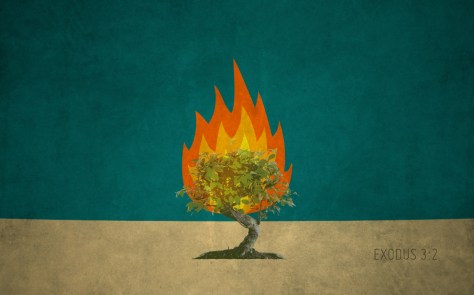
Moses was keeping the flock for his father-in-law when he came upon a burning bush. Moses saw the strange and wonderful sight and chose to turn toward it. And that’s when the Lord declared, “Moses, Moses!”

What follows is perhaps one of the most well known stories from the Bible. God speaks to Moses through the burning bush and calls him to help deliver God’s people out of Egypt. But Moses, like almost everyone encountered by God in scripture, feels unsure of the call. “Well, when the Hebrew people ask about you, who should I tell them you are?” And God said, “I AM WHO I AM.”

            The Tetragrammaton: I AM WHO I AM. YHWH. Yahweh.

For many Jews, the name of God revealed to Moses is so holy, so precious, that it cannot be uttered by the lips of mere mortals. Instead, there are other names for God like Adonai and Lord. In the Christian tradition, we will call God Yahweh, but the name of God revealed by God is unlike anything else and demands a respect and holiness that is rarely seen.

The passage about Moses in the wilderness with the burning bush is usually interpreted in such a way that it is all about Moses. Moses is walking, Moses is given a command, Moses responds. But there’s more to the story than Moses; it is the revealing of God’s holiness.

We could not have found this name, this Yahweh, by ourselves. Even if we entered into a long and passionate search through prayer or any other spiritual discipline we are not capable of finding out whom God is on our own. God’s name had to be revealed. God alone can tell us who God is.

And what does God say, “I AM WHO I AM.”

The divine name is a non-name in the best sense. Can you imagine Moses returning to the land of Egypt, mixing and mingling with the Hebrew slaves and saying, “Don’t worry, I AM WHO I AM sent me to set us free.”

What’s the purpose of a name? Do we name individuals to distinguish them from others? Do we give names to children in order to stroke our egos in attempts to live forever? Do we give names to people in order to build them up or break them down? What’s in a name?

I’ve been in enough hospitals to hear doctors refer to their patients not by Mrs. Smith or Mr. Jones, but by a room number (or worse: by their disease).

There are plenty of people who are judged simply because of the color of their skin, or their political persuasion, or their sexual orientation without their names ever being mentioned.

Names are important.

They are important in our everyday lives whether it’s learning the names of our neighbors, or our classmates, or our coworkers, or even the people in the pews next to us right now. Learning the name of the other, and actually using it, breaks down the walls and barriers that often lead us to judge rather than listen. Learning the name of the other prevents them from remaining a stranger. Learning the name of the other builds a bridge into something new instead of moving in the opposite direction.

God reveals God’s name to Moses in such a way that it bridges the divide but it also keeps the mystery. And I mean mystery in the most beautiful and theological way possible. We finite creatures cannot understand the infinite wonder that is I AM WHO I AM. There is a mystery to who God is simply because God is completely unlike us, but knowing how God reveals God’s name is important.

holyground_web (1)

If God is not given a proper name, God becomes a faceless unknown god with no story or history. But our God is a God of the story; our God has a name and is known by connections with other names.

God said to Moses, “I AM WHO I AM” and God also said so much more. God said, “I am the God of Abraham, of Isaac, and of Jacob.” Over and over again we are reminded in scripture that our God knows God’s people by their right names; God calls them and us by such: Abraham, Isaac, Jacob, Joseph, Hannah, Samuel, Saul, David, Mary, Martha, Peter.

God knows our names, and we should know God’s name as well.

If you’ve turned on your television or opened a newspaper this week you’ve seen some of the horrific and awful images coming out of Houston in the wake of hurricane Harvey. While some have taken to the internet to chastise and ridicule those in leadership about their lack of preparation or their delay in response, normal (and not-so-normal) people have done some heroic things so bring safety, life, and hope to the people who feel no hope.

And as I watched videos from Houston this week, as I saw boat after boat traveling up and down streets in attempts to bring people to safety, I was struck by one thing. In every instance of rescue, the rescuer began with the same question, “What’s your name?”

Think about that for a moment. While surrounded by signs of terror and fear, instead of commanding a person to leave their belongings or throw them over the shoulder, every rescuer looked in the eyes of the fearful other and asked the one question that would remove their otherness.

“What’s your name?”

From the burning bush God called Moses by name. Through words and flames Moses was changed through learning the name of God. I AM WHO I AM shows up in our lives at all kinds of strange moments, we could be shepherding, or sitting in a sanctuary, or waiting for rescue in a flooded house when the Lord calls out to us.

And we can trust I AM WHO I AM for the very same reason that Moses could. Because I AM WHO I AM is the God of Abraham, of Isaac, and of Jacob. Yahweh is the God who made a covenant with out ancestors, who delivered God’s people out of captivity in Egypt, who delivered us out of our captivity to sin and death. I AM WHO I AM is the God who was revealed to us in the person of Jesus Christ. I AM WHO I AM is the Spirit that lives and moves among us.

I AM WHO I AM is as mysterious as it is intimate. I AM WHO I AM comes to us in the intimacy of a piece of bread, and through the mystery of is being the flesh of Christ. I AM WHO I AM is as close as the person next to us and is as mysterious as the person sitting next to us. I AM WHO I AM is the name of our God who calls us by name. Amen.

Discerning the Devil

strangely-warmed-spreaker-header

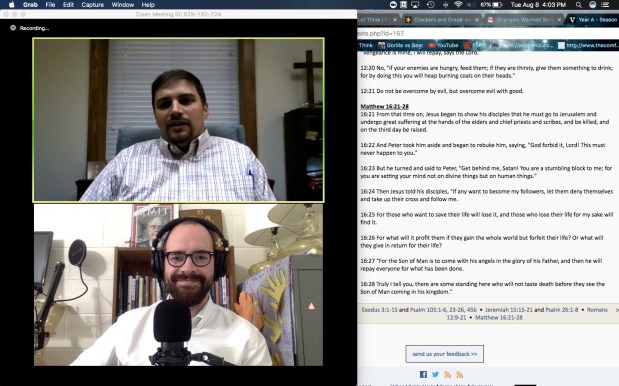
This week on the Strangely Warmed podcast I speak with Rev. Drew Colby about the readings for the 13th Sunday after Pentecost (Exodus 3.1-15, Jeremiah 15.15-21, Romans 12.9-21, Matthew 16.21-28). Drew is an ordained elder in the Virginia Annual Conference of the United Methodist Church and currently serves as an associate pastor at St. Stephen’s UMC in Burke, VA. The conversation covers a range of topics including beef tubes, identifying with biblical characters, nudity, kinship analogies, sleep, and knowing the devil. If you would like to listen to the episode or subscribe to the podcast you can do so here: Discerning the Devil 

Drew


Out Of The Water

strangely-warmed-spreaker-header

This week on the Strangely Warmed podcast I speak with Rev. Drew Colby about the readings for the 12th Sunday after Pentecost (Exodus 1.8-2.10, Isaiah 51.1-6, Romans 12.1-8, Matthew 16.13-20). Drew is an ordained elder in the Virginia Annual Conference of the United Methodist Church and currently serves as an associate pastor at St. Stephen’s UMC in Burke, VA. The conversation covers a range of topics including the kiss cams, the importance of names, how to remember the past, and what makes a holy kiss holy. If you would like to listen to the episode or subscribe to the podcast you can do so here: Out Of The Water

217387_578604105493543_912821730_n

Sinners In The Hands Of A Loving God

Isaiah 56.6-8

And the foreigners who join themselves to the Lord, to minister to him, to love the name of the Lord, and to be his servants, all who keep the Sabbath, and do not profane it, and hold fast my covenant – these I will bring to my holy mountain, and make them joyful in my house of prayer; their burnt offerings and their sacrifices will be accepted on my altar; for my house shall be called a house of prayer for all peoples. Thus says the Lord God, who gathers the outcasts of Israel, I will gather others to them besides those already gathered.


“Jews will not replace us! Jews will not replace us! Jews will not replace us!”

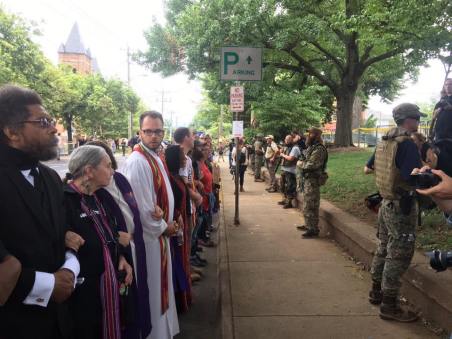
So shouted the throngs of white people in Charlottesville last weekend. They carried tiki torches burning in the night, they marched in formation, and they shouted for all to hear what they really felt.

Their anti-Semitic slogan could have gone any number of ways. While carrying around Nazi flags and weapons of violence, while defending white superiority and aggression, they could’ve shouted “Blacks will not replace us!” or “Homosexuals will not replace us” or “The Handicapped will not replace us!”

All of those groups were targeted by the Nazi regime more than half-a-century ago for being “inferior” or a threat to their dominance. The angry and assailing white people in Charlottesville could have picked any number people to shout about, but they picked the Jews. They were there to protest the removal of a Confederate Civil War General’s statue, many of them claimed to be there to protect their white Christianity, and yet they announced for everyone to hear, “Jews will not replace us!”

White Supremacists March with Torches in Charlottesville

People reject other people for all sorts of reasons. White supremacists reject those who represent everything antithetical to their values. Hardline Democrats often reject neo-Conservative values (and vice-versa). Some even reject people for the sport team they root for.

But in the realm of the church, in Christianity, to reject Jews, or any other marginalized group, is simply unchristian. For in God’s vision of the holy mountain, Christians are the gentiles who are gathered to join the Jews. We are the outcasts, the foreigners, the outsiders grafted into God’s great communion. To reject the outcast is to reject ourselves.

There are a great number of Christian churches in the world today with a wide array of views and theologies. In the US, the number of Christian denominations increases every year while the number of actual Christians is falling. And though the church is so varied and different, there is one thing that might unite all churches: the desire to appear as welcoming and inclusive as possible.

All you need to do is check a church website or a bulletin and you can find descriptions of the church that all say something like: we are an open, friendly, inclusive, and welcoming congregation.

In our denomination, we say we have open hearts, open minds, open doors.

Inclusivity is quite the buzzword in the church these days. Rather than appearing at all judgmental, we want people to know that we accept all people. Rather than seeming prejudiced, we want everyone to know they are welcome. Rather than looking at people based on their outward appearance, we want the world to know that we care more about the content of one’s character.

But the truth is there are a great number of people who have been ignored, if not rejected, by congregations claiming to be inclusive. Including our own.

Much like the droves of people protesting in Charlottesville last weekend, we reject others for all sorts of reasons. Non-Christians often assume, thanks to the way the church is talked about in the greater world, that Christians are homophobic, or racist, or elitist, and now anti-Semitic. And you know what, some Christians are. And we should be ashamed for the horrible rhetoric of our past, we should repent for what we have done even if we weren’t there, because whenever the church has rejected “the other” we are forgetting the truth that we were once the rejected outsiders welcomed by God.

art-03

There’s an old story that preachers love to tell about being inclusive and it goes like this: A church was in the middle of a worship service one Sunday morning, the preacher was up in the pulpit, and from where he stood everyone in the pews looked perfect. They were all wearing their Sunday best, the children were all quiet and well-behaved, and no one had fallen asleep. But while the preacher was preaching, a young man entered the back of the church as if he had just come off the street. He smelled up to high heaven, and the congregation quickly moved from focusing on God’s Word to wondering if one of the ushers was going to usher him out.

But the young homeless man walked down the center aisle and took a seat on the floor right in front of the pulpit. The congregation sat stunned while the oldest usher made his way down to the front and instead of berating the young man, he slowly made his way to the floor and sat next to him.

The preacher, witnessing all of this, said to the church, “You all can forget everything I say today, but don’t ever forget what you just saw happen here at the front.”

It’s a nice story right? We can all imagine ourselves in a church setting like that. It even makes us all warm and fuzzy to think about witnessing a holy moment in front of a pulpit.

But the problem with a story like that one is the fact that it makes the church out to be the kind of people who do all the accepting, instead of giving thanks to God for being the One who accepts us in the first place.

It results in us worshipping ourselves instead of worshiping God.

The prophet Isaiah had a tall order. The Israelites were returning from captivity in Babylon to a confused place they’d never even seen. The Word from God came to those who were returning, to those who were too poor to have been exiled in the first place, and to the foreigners who found themselves in a politically unstable part of the world. All of them were unsure of their future when Isaiah offered them a vision of a place where all of them have a place.

It is radical and unnerving Word to those of us with modern sensibilities, whether we’d like to admit it or not, but in God’s kingdom… everyone has a place, including us.

Prior to the return from the exile, membership in God’s community was largely based on being born into the right family, but the vision of who God invites to the holy mountain has nothing to do with genetics, or cultural customs, or skin-pigmentation, or even sexual orientation, but rather on behavior – keep the Sabbath, obey the covenant.

Who we are as Christians is not about what we look like or whom we spend our time with. It’s about loving God and loving our neighbors. God doesn’t even care what church we go to, though Cokesbury is the best one around, God simply hopes for us to live our lives in such a way that we honor and protect every person created by God.

This text, this proclamation from the prophet is good news to the outcasts – to those on the margins of life. It is good news to those who are belittled for their identity, for the people who are not welcomed in many churches on a Sunday morning, and for those who are shamed by the media.

But it is also good news for us, because we are outcasts as well. We are gentiles who have been graciously grafted into God’s vision of a mountain where all are invited to a house of prayer for all people. The good news of this text is that we, not just the people who aren’t here yet, but we are invited to this place even though we don’t deserve it.

And there’s the challenge with being an inclusive church; being inclusive puts all of the power in our hands. But God is the one who invites people to the mountain; God is the one gathering them, not us… because if it were left up to us, we would fail.

Thus says the Lord God, who gathers the outcasts of Israel, I will gather others to them besides those already gathered. Being inclusive of all peoples means the people on the margins, the ones who suffer at the hands of those in power. But it also means the people in power, the people who thirst for power, the people who are violent for the sake of power.

What happened in Charlottesville last week was terrible, and what makes it even more terrible is the fact that what happened there also happens here in small ways every day.

The practice of racism and bigotry is incompatible with Christian teaching.

To gather together with torches and chants of “The Jews will not replace us!” is incompatible with Christian teaching.

Using tactics of violence and oppression to assert white superiority is incompatible with Christian teaching.

If you turned on the news at all this week and saw what happened in Charlottesville you caught a glimpse of evil. White men and women shooting pepper spray into the faces of black men and women is sinful and shameful. A white man driving a car into a crowd to indiscriminately hurt and main and kill is contrary to the gospel of Jesus Christ. An armed militia marching to intimidate and threaten others does not make sense in the kingdom of God.

And it’s much more than what happened in that sleepy little down. The high rate of incarceration that is so heavily skewed toward black bodies is antithetical to the gospel. The muttering of racial slurs and religious discrimination that happens here in our community is offensive and wrong. The assumption that white is right and black is bad, in whatever way, shape, and form it manifests itself, is incompatible with Christian teaching.

From the riots in Charlottesville, to the backyard barbeque racism of Woodbridge, we are a fallen people in need of grace.

And this is why the vision of God’s holy mountain is so important today in particular. Because it is far too easy to talk about loving and including others, it is way too easy to condemn a group of people for the way they treat others, when the very people we are meant to love and include are not just the people on the margins, but also the people responsible for the riots and the racism.

If the vision of the holy mountain and the house of prayer were left to us to achieve, it would never happen. Our judgments and our fear of the other would prevent us from ever bringing that vision to fruition. We, like the Israelites coming home from captivity, or the ones who were left behind, or the foreigners witnessing it all from the outside, can scarcely imagine what it would look like to have everyone gathered together by God.

Only God could make that vision a reality. Only the Lord has the power and the freedom to gather all to the holy mountain. For our God is in the business of making the impossible possible. Our God makes a way where there is no way. Our God sees us not for the sins of our past but for the potential of our future. God sees the people responsible for the riots as sinners who are not outside the realm of mercy. God sees the racist tendencies of our culture and begins transforming perspectives through little seeds of faith that germinate in ways we can scarcely imagine. And God sees us as the sinners we are; God knows how judgmental we can be in our heart of hearts and beckons us to turn back.

God’s vision of the holy mountain, of the house of prayer, is for all: the oppressed and the oppressor, the powerful and the powerless, the rioters and the peacemakers. Only a God who would give his only Son to change the world could prepare a place where all are welcomed. Only a God of impossible possibility could invite people like us into the fold. Only a God of mercy could open the house of prayer for all people. Amen.

On Disobedience and Mercy

strangely-warmed-spreaker-header

This week on the Strangely Warmed podcast I speak with Molly Williamson about the readings for the 11th Sunday after Pentecost (Genesis 45.1-15; Isaiah 56.1, 6-8; Romans 11.1-2a, 29-32; Matthew 15.21-28). Molly is a PhD student in Hebrew Bible and Old Testament at Duke University and loves talking about God’s Word. The conversation covers a range of topics including the virtue of YouTube videos, what it means to find reconciliation, the inclusivity of God’s invitation, and what it means to be a Gentile. If you would like to listen to the episode or subscribe to the podcast you can do so here: Disobedience and Mercy 

423470_673718231530_1950253648_n

What Are You Doing Here?

1 Kings 19.9-18

At that place he came to a cave, and spent the night there. Then the word of the Lord came to him, saying, “What are you doing here, Elijah?” He answered, “I have been very zealous for the Lord, the God of hosts; for the Israelites have forsaken your covenant, thrown down your altars, and killed your prophets with the sword. I alone am left, and they are seeking my life, to take it away.” He said, “Go out and stand on the mountain before the Lord, for the Lord is about to pass by.” Now there was a great wind, so strong that it was splitting mountains and breaking rocks in pieces before the Lord, but the Lord was not in the wind; and after the wind an earthquake, but the Lord was not in the earthquake; and after the earthquake a fire, but the Lord was not in the fire; and after the fire a sound of sheer silence. When Elijah heard it, he wrapped his face in his mantle and went out and stood at the entrance of the cave. Then there came a voice to him that said, “What are you doing here, Elijah?” He answered, “I have been very zealous for the Lord, the God of hosts; for the Israelites have forsaken your covenant, thrown down your altars, and killed your prophets with the sword. I alone am left, and they are seeking my life, to take it away.” Then the Lord said to him, “Go, return on your way to the wilderness of Damascus; when you arrive, you shall anoint Hazael as king over Aram. Also you shall anoint Jehu son of Nimshi as king over Israel; and you shall anoint Elisha son of Shaphat of Abel-meholah as prophet in your place. Whoever escapes from the sword of Hazael, Jehu shall kill; and whoever escapes from the sword of Jehu, Elisha shall kill. Yet I will leave seven thousand in Israel, all the knees that have not bowed to Baal, and every mouth that has not kissed him.

I wrote a B- sermon this week on the palpable silence of 1 Kings 19. In praying over the text I felt God nudging me to write about the need for the absence of sound in our lives in order to really hear what God has to say. I had stories picked out about times in my life where I was particularly silent and how transformative they were for me.

The whole worship service, in fact, was planned around the topic of silence, about the need to listen more than speak. And last night, after returning home from the wonderful Ice Cream Social that we had, I turned on the news and realized that my sermon had to go; that I need to start over, because the Lord was speaking and it was time for me to listen.

A few months ago, the overwhelming majority of the City Council in Charlottesville, VA voted to remove a confederate statue of General Robert E. Lee. Lee is somewhat of a beloved figure here in the state of Virginia; people love him without really knowing much about him. And so when the city decided to remove a statue in his honor, people went ballistic. On one side there were people who were thrilled that the city was finally willing to be bold enough to take steps in a new direction, willing to ask themselves hard questions, and willing to publically declare where they were. And on the other side, there were people who were outraged that a man of great respect and honor in history was going to be torn down as if he never really mattered.

And then people stopped talking about it. Weeks and months passed until this weekend when the fever pitch of outrage began to resonate in new and frightening ways.

20727828_10154975586932428_1252324539265343927_n

Groups from all over the country met in Charlottesville this weekend to protest the removal of the statue, to stand in affirmation of the City Council’s decision, and some with hope to hold the peace.

When I turned the news on last night I saw what I thought was the National Guard entering Charlottesville to keep the peace, but in fact what I saw was armed militia’s from across the country, bearing arms and other weapons in order to name and claim there side.

I saw what I thought were clergy standing tall in protest but then I saw them pushed and spit on and berated by the throbbing crowds. I saw what I thought was a group of young people marching to protect the lives of the protestors, but in fact it was a group of neo-Nazis carrying torches and chanting anti-Semitic rhetoric.

The news then broke to a reporter meeting with different individuals, and she asked them all the same question: “What are you doing here?”

The first man was about my age wearing an army helmet with a rifle hung lazily over his shoulder. He was staring directly into the camera while the reporter asked her question and he responded without hesitation: “I am here to stand up for my freedom. People keep trying to destroy my white heritage and my white church. I am here to stand for free market economics. I am here to destroy the Jews.”

“What are you doing here?”

The next man was older with a long scraggly beard hanging below his neckline. Every thing he said came out as a shout and because it was on the radio they had to bleep out every time he shouted the N-word. He was clearly angry, but his anger was unintelligible.

“What are you doing here?”

The next man was young and was wearing a Black Lives Matter shirt, but before he was able to answer the reporter’s question, angry protestors were pushing forward to him in order to prevent him from speaking.

“What are you doing here?”

Yesterday afternoon a young white man got into his car and drove it into a car of protestors in favor of removing the statue; one of the bystanders was murdered and dozens were injured.

“What are you doing here?”

170515110556-charlottesville-lee-monument-spencer-protests-0513-exlarge-169

Before Elijah’s encounter with the Lord, Queen Jezebel sent a messenger to the prophet telling him that she intended to kill him that very day. Elijah ran for his life and he journeyed into the wilderness. Prior to the cave, Elijah collapsed under a shrub and prayed for God to take his life because he felt worthless, but God sent an angelic messenger who cared for him until sending him on his way. And that’s where our story begins.

Elijah came to a cave and spent the night. In the morning the voice of the Lord spoke to him and said, “What are you doing here Elijah?” The prophet responded with, “Lord, I’ve been a good prophet. I’ve told the people what they were supposed to do, I even struck down the false prophets, but now I’m all alone and people are trying to kill me.”

God, evidently disappointed with Elijah’s answer, commanded the prophet to stand on the mountain. First, there was a great wind, but the Lord was not in the wind. Next there was an earthquake, but the Lord was not in the earthquake. Then there was a fire, but the Lord was not in the fire. And after the fire, there was the sound of sheer silence.

When Elijah heard the silence, he went to the mouth of the cave and the Lord asked him again, “What are you doing here Elijah?”

Elijah was a prophet, but he was also a revolutionary. Sometimes the two go hand in hand. He was a defender of the Lord and an enemy of corrupt leaders within his own community. He even killed false prophets. His revolutionary credentials are what make him so important in the New Testament where people were constantly wondering if Jesus was the new Elijah.

What made Elijah revolutionary was his commitment to a world where widows, orphans, and strangers were protected against terrible economic situations and a world out of control. Elijah was like the person more concerned with whether or not the people at Rising Hope have something to eat than what President Trump recently tweeted. Elijah was like the man at the hospital arguing with the intake nurse that someone had waited too long before being treated. Elijah was like couple that did not hesitate to become a foster family for those in need.

And yet Elijah fled. Most of us would’ve done the same. When we feel overwhelmed by the world, by the responsibilities, by the commitments, we run. We flee from helping those who cannot help themselves. We run from the hectic nature of this world to vacation destinations and terrible reality shows. We flee from breaking news reports about the possibility of nuclear geopolitical tensions in a stiff drink or the bottom of a bottle.

It is there, in the caves of our own making, we wait for a word from the Lord. Like Elijah, we wait for God to tell us exactly what to do, or we wait for God to fix all of those external problems, or we wait and hide because we’re not sure if God’s even out there any more.

And that’s when God shows up not with an answer, not with a solution, but with a question, “What are you doing here?”

Being in the presence of God, whether mundane or majestic, is all about being inspired and transformed. Who we were fades into something new and wonderful because God is the one changing, morphing, and moving us.

But Elijah was the same after the experience of silence as he was in the cave; his response to the divine question was the same. He was not changed. The earthquake, wind, fire, all of them were distractions. God was not in any of them. They are a reminder that when we are desperate we are tempted to look for God in all the wrong places, when God is the one looking for us!

We look for God in the big bombastic language of a preacher promising prosperity, or in the raise at work that we think will finally make us financially comfortable, or we look for God in the broken relationships that will never be what they once were.

God’s question to the prophet is important because Elijah’s answer was wrong. “What are you doing here, Elijah?” “O God, I’ve done everything that I can and now I’m the only one left.” Elijah was not alone. There were still thousands of individuals who remained faithful to the covenant. And then God commanded Elijah to “go” because there was still work to do.

And this my friends is grace: Despite Elijah’s fears and failures, his inability to remember the God who called him to be a prophet in the first place, God did not give up on him. God still had work for him to do.

But Elijah could not hear the call to go, until he experienced the sheer silence. For it was in the sheer silence he remembered who he was, and whose he was.

I like to think that we live in a better world than the one we inherited. I like to look at the history books of the past to see how far we’ve come. I am grateful that our church has people in in who do not look like, I am grateful that there are no longer water fountains that say “Colored” and “White.” I am grateful that our children sit in classrooms full of people from all over the world with every shade of skin pigmentation.

But when I turned on the news last night, I realized that maybe we haven’t really come that far at all. Maybe we’ve congratulated ourselves too much for being progressive, because friends there is still work for us to do.

God in scripture is a God for the margins. God, again and again, stands with those who are persecuted and martyred and belittled. And throughout the bible, God implores all of the prophets to be mindful of those who are without, those who are suffering, and those who are forced to the margins of life.

We can distract ourselves from the suffering of the people around us, we can go to the right grocery store and the right shopping center in order to avoid the differences of our community, but we worship a God who was born into the suffering of the world, who was born to parents who do not look like anyone in this room.

There are and will be times in our lives that are so overwhelming that we can lose perspective. Like the powerful prophet, we can be pushed too far from our identity and we can retreat into caves of denial.

We can tell ourselves that what happened in Charlottesville will never happen here, but it does every day in some small way, shape, or form.

            We can tell ourselves that the angry white folk in Charlottesville are fringe racists, but they are here in this community too, they are our parents and brothers and sisters and neighbors. They are mumbling in their cars whenever they pass a black man on the street, and they spit words of hate at black women in parking lots.

            We can tell ourselves that we’re in a better world than the one we inherited, but Charlottesville is but one sign that we’ve still got work to do.

We’ve got work to do because our God is not done with us yet. God is working through people like you and me to make the Kingdom come on earth. God is interrupting our lives whenever we gather in this place for worship, with moments of silence to really confront who we are and whose we are.

God is asking us the same question that the reporter asked the protestors, the same question that Elijah heard in the cave, and how we answer the question defines who we are and whose we are.

“What are you doing here?” Amen.

On The Power of Sheer Silence

strangely-warmed-spreaker-header

This week on the Strangely Warmed podcast I speak with Molly Williamson about the readings for the 10th Sunday after Pentecost (Genesis 37.1-4, 12-28, 1 Kings 19.9-18, Romans 10.5-15, Matthew 14.22-33). Molly is a PhD student in Hebrew Bible and Old Testament at Duke University and loves talking about God’s Word. The conversation covers a range of topics including the perils of skipping scriptures, how God can speak through silence, and why you can’t ignore the Old Testament. If you would like to listen to the episode or subscribe to the podcast you can do so here: The Power of Sheer Silence

Molls

(I Can’t Get No) Satisfaction

Isaiah 55.1-5

Ho, everyone who thirsts, come to the waters; and you that have no money, come, buy and eat! Come, buy wine and milk without money and without price. Why do you spend your money for that which is not bread, and your labor for that which does not satisfy? Listen carefully to me, and eat what is good, and delight yourselves in rich food. Incline your ear, and come to me; listen, so that you may live. I will make with you an everlasting covenant, my steadfast, sure love for David. See, I made him a witness to the peoples, a leader and commander for the peoples. See, you shall call nations that you do not know, and nations that do not know you shall run to you, because of the Lord your God, the Holy One of Israel, for he has glorified you.

I’ve been here in Woodbridge for about a month and I feel like I’m finally getting my bearings. I know where all of the essential stores are; I know what roads to avoid during rush hour; and I’m even starting to learn most of your names!

To preach properly you need to know your people.” I heard that over and over again in seminary and it’s so true. You’ve got to know the people before you can just stand up and tell them what God is saying. And so, over the last month, I’ve tried to learn a lot about a lot of you. And not just your names… I know who makes the best food and where it’s kept in the church kitchen. I know that a lot of the real meetings happen in the parking lot and not the conference room. And for a good number of you, I’ve learned what drew you here in the first place. But for as much as I want to learn about you, I also want to learn about the people who are not here yet.

This means I want to know about our community, what makes it tick, and how it transforms the people who call it home.

For instance: I’ve gone to a few local businesses just to ask questions without expectations. I’ve started conversations with total strangers in restaurants just to ask questions without expectations. And a few weeks ago, my wife, son, and I went to the most culturally relevant location in the area: Potomac Mills.

For those of you who are unfamiliar, Potomac Mills is one of the largest outlet malls in the country and it is what smaller malls aspire to be. It’s huge. It’s overwhelming. It’s capitalism at it’s finest.

Anyway, we got in the car and drove over to the mall with our stroller. When we parked and strapped Elijah in, we headed for the nearest door and entered the great arena of commerce. Now, some of you are probably wondering what we were looking for at the mall, you’re pondering the specific item we were searching for. But here’s the thing: we weren’t looking for anything. We just wanted to see what the mall was like.

And now some of you are thinking that we’re crazy.

It took a long time to do the whole loop at the mall, particularly with all of the random people and families moving about like fish against the current. And the thing that surprised me most wasn’t how many stores there were, or even how many people there were, but how quiet it was.

It was a strange and eerie experience to be in a place with so many people and have it be so subdued. At first I was worried that my ears were stopped up, but then I realized that it was so quiet because so many people were on their cell phones.

And that’s honestly what made it so hard to navigate, not the number of people, but the fact that most of the people had their heads down in their hands and were completely oblivious to everything else going on. Even the venders in their middle kiosks could have cared less about us as we milled about Potomac Mills.

And I can’t help but wonder if that’s what Isaiah felt like trying to reach God’s people. The prophet of the Lord attempts to interrupt the sensibilities of the crowd with a declaration, but the people were in Babylon, far removed from home, and they had other things to worry about. Like a crowd of people at the mall focused on their phones, perhaps Isaiah struggled to captivate the attention of the passing people with his enthusiasm and excitement. Picture, if you can, a person doing everything he or she can to convey the truth to a group of people who are far happier with a lie.

That’s Isaiah in our scripture today.

Attention! If you’re thirsty, come to the water. And those of you without money, come, buy, and eat! Why do you keep spending your money on things that cannot bring you satisfaction? Listen to the Lord so that you may live. God is making a covenant, a promise, to love us even when we cannot love ourselves. God is blessing us daily, God is glorifying us, and most of the time we completely miss it.

Today many, if not most, of us are so caught up in our gadgets and spider-webs of false connections that we really feel empty inside. Or we are spending our money and our savings on products and commodities that offer no real satisfaction. Or we believe that so long as we ascertain the right car, or the right job, or the right spouse, we will finally find that one missing thing to give meaning to our lives.

But in the kingdom of God, the normal rules of commerce and capitalism do not apply. In fact, they have been completely overturned.

Unlike just about everything else in the world, at God’s celebration we need not bring goods or money in order to procure a place at the table. Instead, water, bread, wine, and food will be provided without cost. Whereas we think that who we are, and what we’ve earned, and what we’ve saved defines us, God only requires that we bring two things: our thirst and our hunger.

Unlike the world, where many of us prefer to fellowship and worship and commune and eat with those whose income and status and skin tone are similar to our own, God’s vision of life in the kingdom is completely different.

banner-en

On Monday morning we opened our doors to children and youth from the community for Vacation Bible School. I, like a fool, stood by the entrance in my adult size Batman costume and welcomed everyone for a week of experiencing the love of God through Hero Central. Each day the kids learned about what it takes to be a hero in God’s kingdom: heroes have heart, courage, wisdom, hope, and strength. They did crafts and science experiments, they danced and sang, and they feasted around a common table. They learned bible stories about King David, Abigail, Jesus, the Beatitudes, and Pentecost.

On our last day I was sitting at the table with all of the kids, when one of them approached me with a huge smile on her face and all she said was, “I wish church was like this every day.”

I imagine that she wished church could be like that every day because Vacation Bible School was fun and exciting, but I think there was more to her wish than that alone. This week, the distractions of phones and the siren call of social media disappeared. Instead of a mall filled with adults staring into screens, the children experienced a church full of adults who got down on their level to share with them the love of God.

Instead of an experience where everyone looked the same, earned the same, and sounded the same, the children experienced a church full of disciples who could not have been more different from one another.

This week, our children and youth caught a glimpse of the kingdom of God made manifest on earth in a way that so few of us ever get to experience. Because in God’s kingdom, the place that Isaiah beckons the crowds to experience, invitations are made to all people: the rich and the poor, the old and the young, the perfect and the broken. The beautiful wonder and glory of this scripture is the fact that God welcomes ALL to the table. Always.

IMG_2824

During the time of Isaiah, and today, so much time is wasted on sustaining existence. We hear about the next new thing and we become obsessed even though we know that when it finally arrives we will be distracted by the next new thing coming down the pike. We ask ourselves questions that are predicated on maintaining the status quo. We go to things like the mall hoping for consumerism to fill a hole that no amount of money, or goods, or experiences ever can.

But God offers us something different. God looks at the shallow nature of our lives, God examines the mistakes and sins of our past, God evaluates what our minds stay focused on, and instead of leaving us to our own devices, God shares with us a new covenant. God makes a promise to be with us in spite of us.

God shows us a life that is based not on blessing the wealthy, but on protecting the poor.

God offers a covenant in which greed is shunned, and humility is glorified.

God presents a promise in which divisions are destroyed and community is congratulated.

Isaiah pleaded with the people of the Lord to open their eyes to the truth that no product could ever offer. Isaiah interrupted the distracted crowds with a vision of the kingdom on earth where those who are different are brought together in unity around a table where God is the host.

Opening up the doors of this church for a week of Vacation Bible School is a radical thing. We gave the children food, and education, and time for no other reason than the fact that God loves them. Compared to the priorities of the world, this place was strange this week.

Gathering together in a space like this for worship is a radical thing. While the world is consumed by the next new thing and a false community you can keep in your pocket, the church stands as a witness to the truth of God’s dominion. We lift up our prayers and we bend our knees because we know that what we believe shapes how we behave.

Coming to the table to feast on the Lord’s Supper is a radical thing. We search daily for products and goods to fill the holes we feel, we spend our time with people who look like us and sound like us. And yet at this simple meal, we are invited to a table with people who are completely unlike us. At this meal we get to taste a little bit of heaven on earth and we receive the only thing that can bring real satisfaction.

Today we live in a world where we are forever asking “Who gets in?” What does it take to earn a spot at the table? What kind of grades do I need to make to get into college? How long will I have to wait before it’s my turn?

But in the kingdom of God, at this table, all are welcome. Always. Amen.

tcaa-come-to-the-table-sermon-series-header

On Limping With God

strangely-warmed-spreaker-header

This week on the Strangely Warmed podcast I speak with Teer Hardy about the readings for the 9th Sunday after Pentecost (Genesis 32.22-31, Isaiah 55.1-5, Romans 9.1-5, and Matthew 14.13-21). The conversation covers a range of topics including what its like to wrestle with God, saying “ho” in church, and how the loaves and fishes bring more than an end to hunger. If you would like to listen to the episode or subscribe to the podcast you can do so here: Limping With God

4128890529_c7f52dbfb5_b

The Cost of Heaven

Matthew 13.45-46

Again, the kingdom of heaven is like a merchant in search of fine pearls; on finding one pearl of great value, he went and sold all that he had and bought it.

In my experience sermons are often very one sided. Someone like me, will stand in a place like this, and tell people like you, what God is saying. But sermons are meant to be more than a monologue, they need to be more than a lecture, they must be more than what I come up with in isolation.

So, I would like some of you to describe heaven for me. What do you think it will look like? Who will be there? What’s on the daily agenda?


There was once a man who lived a devout life and toward the end of his days God spoke to him and said, “I am so proud of the way you’ve lived that I’m going to do something I don’t usually do: I’m going to allow you to bring something with you to heaven. You may fill a briefcase with whatever you like and it shall be with you for eternity. Now remember I don’t often make this deal, so make sure you give it some thought.”

So the man did. For weeks and months he wrestled with what he would bring with him to heaven. He made pros and cons lists, he consulted his pastor (who was utterly bewildered by his question) and finally he decided on what to put in the briefcase.

Eventually the time came for the man to die and upon arriving at the Pearly Gates, St. Peter was patiently waiting to greet the man. St. Peter looked him up and down and said, “Hey man, look I’ve gotta ask: what’s in the briefcase? God never lets people bring something inside and he made an exception for you. So, can I see it?”

The man proudly opened his case and showed off 6 gold bars.

St. Peter stood there for a moment and then beckoned for the nearby angels, “Hey everybody, you’ll never believe it. God told this guy he could bring anything he wanted into heaven and he brought asphalt!”

In heaven the streets are paved with gold… Have you ever heard this before? Or maybe the image of heaven inside your mind is a cloud-like place filled with little fat cherubs floating around the air. Or maybe you think heaven is like a never-ending buffet with all of your favorite food.

the-pearl-of-great-price-daniel-bonnell

I get asked a lot of questions as a pastor. “How am I supposed to pray?” “Where is God in all of this?” “Should I tell my husband what happened?” But the question I’m asked the most, by far, is “What is heaven like?”

Today, when most of us think about heaven, the images conjured in our minds have far more to do with Hallmark than with scripture. Our hopes and dreams about our heavenly reward often reflect what movies and books describe than what the Lord describes.

I wonder if the crowds around Jesus were disappointed when he started talking about the kingdom of heaven. His parables, his long list of comparisons, contain nothing about pearly gates, or endless buffets, or even reuniting with long lost relatives.

The stories Jesus tells about the kingdom of heaven are down to earth, literally. At times he talks about the kingdom of heaven like a mustard seed. People disregard it and toss it away, but when it takes root it grows greater than any plant and won’t stop growing.

At other times he talks about the kingdom of heaven like yeast being mixed in with three measures of flour. When mixed and baked properly it would’ve been enough bread to feed hundreds of people.

At other times Jesus talks about the kingdom of heaven as a never-ending worship service. Which, to some people, sounds less like heaven and more like hell.

And more often than not, when Jesus talks about the kingdom of heaven he compares it to a wedding feast. I like the wedding feast connection because weddings are fun and full of joy and celebration. And, perhaps most importantly, there are always a couple people at the wedding who we never would’ve invited if it was our own, but God’s invitation is not like our invitation.

In today’s short passage, Jesus tells the crowds (and us) that the kingdom of heaven is like a merchant in search of fine pearls; on finding one pearl of great value, he went and sold all that he had and bought it.

Pearl of Great Price

More than a year ago I was down in Roanoke for the start of Annual Conference. Annual Conference is the once a year opportunity for United Methodist from all over Virginia to get together for prayer, worship, renewal, and church business. I arrived early last year to meet with some of my friends for breakfast, and half of us were about to be ordained in full connection. Though we had all served as pastors for a number of years, we had finally made it through the journey to kneel before the Annual Conference and would now serve the Lord as ordained elders.

And though the time at breakfast was filled with great joy and anticipation, there was also a dark cloud hovering over the gathering. The church is not what it once was and it’s hard to ignore how much it has changed. Gone are the days when one could assume that a church would grow simply by being in a neighborhood. Gone are the days when young couples and families show up on Sunday morning without an invitation. Gone are the days when the church is regarded with high esteem by the surrounding culture.

Last year, as it is now, the church is in a place where just having the doors open is not enough. The church is disproportionately skewing to an older age demographic. And the church is forever suffering under the weight of controversies like the Book of Discipline’s language about homosexuality.

So there we were at breakfast, sharing our excitement about joining the ship of Methodism in full connection, while the ship appears to flooding and without direction. We lamented the church’s current state of affairs, we offered opinions about how we might fix certain items, or how to change certain opinions, and then my friend Morgan interrupted everything.

He said, “I’ve been thinking a lot about Jesus’ parables recently, and one in particular. He tells the disciples that the kingdom is like a merchant in search of fine pearls; on finding one pearl of great value, he went and sold all that he had and bought it.” He had been looking down at the table up to this point, but then he raised his head and looked us in the eyes and said, “Do we still feel that way about the kingdom? I mean, are we willing to risk it all, to throw ourselves completely in? Or, at the very least, have we found a pearl in our churches?”

Today the church feels afraid. Few are willing to takes risks, we hold up frightening statistics as a way to guilt people into doing more, and we ask so many questions about the viability of the church going forward. But Jesus doesn’t transform life by scaring the hell out of people. No, Jesus transforms life by helping people like us see how heaven is close at hand.

Morgan’s question has haunted me for more than a year. With all the talk of negativity in the church, with all the fear and frustrations, Morgan turned it all upside down. Where is the pearl of great price in this place? What would I give up everything to possess in the kingdom?

When my son was one month old we brought him to church for the first time. I had taken 4 Sundays off to be at home with Lindsey as we adjusted to life with a newborn, but the time had come to return to the pulpit. I can’t tell you much about the service because I was so sleep deprived that most of it is a blur. But I will never forget the moment Lindsey brought him up to the front to receive communion. Without talking about it ahead of time I took the tiniest piece of bread, dipped it in the cup, and placed it in his mouth.

He has no idea what communion means or even what it is. But for the majority of his little life he has been in church every single week, learning the habits of God in worship, and receiving the body and blood of the one we call Lord. My son knows of no life outside the church. His life has been one defined by the movements not of the world, but by the liturgy.

And seeing him in church, watching him receive communion, hearing him say “amen” without even knowing what it means… I think I would sell everything to keep that.

On Thursday morning I got to church early after working on the sermon a little bit and I discovered a great crowd of people in our parking lot. There were volunteers from Cokesbury, Old Bridge UMC, and from the Salvation Army, and they were all working together to distribute food to those in need. There was no cash box at the front for community members to pay for the food, there was no expectation that they would ever repay us, and (perhaps most importantly) there was no judgment about the fact that they needed food.

I stayed toward the sides of our lot and took it all in for the first time, though I introduced myself to a handful of families patiently waiting for the food. There was one woman who kept her eyes on me while I was moving about and I eventually went up to introduce myself. As I got close she took my hand all she said was, “Thank you. This has saved my life.”

20369172_10209226181322580_3977426946611839100_o

Experiencing her salvation in our parking lot, seeing the wonder and joy in her eyes, feeling her hope… I think I would sell everything to keep that.

Tomorrow morning we are going to open our doors to all sorts of kids from the community for Vacation Bible School. Some will come from privileged families and will have been here before. Some will come from situations they won’t talk about though it will be clear that the food we offer them will be the first food they taste that day. And a few will come from somewhere in between.

Our volunteers will fill the halls with joy and hope and laughter as we do arts and crafts, as we sing and dance, and as we all learn more about the bible.

Seeing the children and volunteers working together, hearing children excited to learn more about God, seeing individuals interact with one another in a place like this… I think I would sell everything to keep that.

And all of them, from my son in worship, to the woman in the parking lot, to the children in our building will experience the grace of God and they will leave transformed without cost.

In the parable the man sells everything he has for the pearl of great value – the pearl of God’s kingdom is of such importance that merchant gives away his very livelihood to hold on to a little slice of heaven. More important than the money he uses to purchase the pearl is his willingness to trust that the gift of God’s kingdom is more important than any earthly thing.

Friends, the kingdom of heaven is at hand. It is not just some place waiting for us in the by and by, it is also something that we can experience here and now. Because the kingdom is something that God is doing, and it is to be received as a gift; a gift like the bread and the cup, a gift like food in a parking lot, a gift like vacation bible school.

The kingdom of heaven is not something that can be acquired, or earn, or purchased; it is a way of being into which we can enter.

This beautiful and brief parable from the lips of Jesus is not about the cost of heaven. It is, instead, a testament to the fact that our response to the kingdom is total, it is everything we have. To be joined up in to this kingdom of heaven on earth, the kingdom that is both here and not yet, means committing our whole beings, without reserve, and with totality.

The kingdom of heaven is a gift that transforms every bit of our lives here and now.

There is no amount of money on earth that can purchase salvation. As the old hymn goes, “Jesus paid it all.” But the parable begs us to ask ourselves the same questions that Morgan asked me, “Do we feel like the merchant? Are we willing to risk it all, and throw ourselves completely in? Or, at the very least, have we found a pearl in this place?” Amen.