Too Busy To Welcome – Advent Homily on Romans 15.7

Romans 15.7

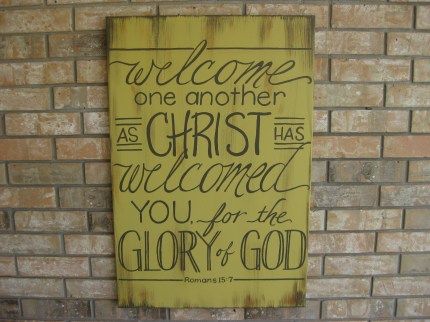
Welcome one another, therefore, just as Christ has welcomed you, for the glory of God.

too-busy-for-christmas-1

When Bob Sharp was sent to Marquis Memorial, I know that he was welcomed because it didn’t take long for the church to paint his office burgundy and gold in honor of his dedicated devotion to the Washington Redskins.

When Courtney Joyner started at St. Paul’s, I know she was welcomed because she is a triple-threat: She can sing, she can jam, and she can preach.

When John Benson first preached at Augusta Street, I know he was welcomed because his people haven’t stopped shouting “Amen!” since his first sermon.

When Won Un showed up at Central, I know he was welcomed because their entire church community has developed an affinity for Kimchi and they know that if they can’t find Won on a nice day, it’s because he’s out riding his bike.

When Janet Knott arrived at Jollivue, I know she was welcomed because she preaches with gifts, and who doesn’t love presents?

When Clayton Payne began at Cherryvale, I know he was welcomed because people keep showing up week after week even though he keeps preaching the same sermon over and over again.

When Bryson Smith was appointed to St. Paul’s, I know he was welcomed because they know if the sermon falls flat, he can always sing a solo and get the people to shout “Praise the Lord!” and “Mercy!”

When Sarah Locke was sent to Christ, I know she was welcomed because people started showing up in her kitchen while she was still unpacking boxes. I know that because I was there!

I know the United Methodist churches of Staunton are a welcoming bunch because you have so warmly welcomed your pastors. But I wonder, do we welcome everyone to our churches in the same way we welcome the pastor when he or she first arrives? Do you really welcome one another just as Christ welcomed us?

When I arrived in Staunton, Won and I got together and thought it seemed about time to resurrect the Lenten and Advent luncheons. We were not here when they used to happen and so we were able to tweak the schedule and the organization a little bit. Important for us was the shifting of host churches and guest speakers so that everyone got a chance to welcome, and every preacher got a chance to preach.

Fun fact: As of Christmas day, I will have preached in every single United Methodist Church in Staunton. And it only took me three and a half years!

Anyway, we got the Lenten luncheons started again, and the first time I was invited to preach we were gathering at Central UMC. At the time, I was young and naive, and I thought it would be a good idea to wear my Carharrt Overalls when I preached from the pulpit in order to really drive home the message. Maybe you were there. Maybe you even remember some of the things I said.

I poured out my heart and soul from the pulpit at Central UMC and I did my best to make the people of St. John’s as proud as possible. Afterwards, during lunch, after the tenth or so person made a comment about my attire, an older woman came up to me and asked if we could talk (I won’t say which church she was from).

So we moved to the corner of the social hall, and she gingerly placed her hand on my shoulder and said, “I understand that you’re new to town you might be looking for a church home, so we’d love to have you join us for worship on Sunday.”

I remember just standing there stunned. I mean, it was a kind gesture for her to invite me to church (particular when the average person in a United Methodist Church invites someone to worship once every 33 years). But going to another church on Sunday is impossible.

She welcomed me, but she didn’t listen to me. I suspect that she was more concerned with having people in the pews, than with knowing who the people are in the pews.

Welcome one another, therefore, just as Christ welcomed you, for the glory of God.

How did Jesus welcome? Well, he certainly didn’t wait for people to just show up because he was having a service on a Wednesday afternoon, or a Sunday morning, or even on Christmas Eve. Jesus welcomed others by showing up in their lives, he met them where they were and ministered to them in terms and in ways they could understand. He told stories that connected with their daily living, stories about the soil and the birds of the air. He welcomed them in the midst of their suffering and isolation. He welcomed the very people who would abandon him to a table without cost.

At St. John’s we have a Preschool and I spend time every week leading the kids in what we call chapel time. I’ll take a lesson from scripture and try to rework it in ways that can understand and apply to their life.

Last week, after practicing the Christmas pageant for what felt like the thousandth time, I set up a small table near the altar and I invited the kids to come sit and listen. The thirty minutes prior to chapel time were filled with pushing and tripping and laughter and debauchery, but when they sat down around the table I started speaking in a soft voice, and they all started to listen.

I said, “My friends, I have something I want to share with you. This is bread and grape juice, but it is about to me much more than that. For this is a gift that Jesus gives to us. Some of you might do this in your church on Sundays, and whenever we sit at the table we are remembering Christ’s love for us. At this table, all of us are welcome no matter what. So let’s pray… God thank you for loving us so much that you welcome us no matter what we’ve done and no matter who we are. I pray that you would pour out your Spirit on us and make us more like Jesus so we can love others. Amen.”

And then one by one I called them by name, I gave each of them a piece of the bread, they dipped it into the cup, and the received communion.

Unlike us, the preschoolers have the benefit of not rushing around through this season of Advent endlessly crossing items off our to-do lists. Unlike us, the preschoolers don’t feel burdened by the tyranny of things and can sit quietly for a moment to receive a gift better than anything under the tree.

It often happens around this time of year that we feel too busy to welcome. We become more concerned with the wrapping paper and the ornaments and appearance of things than with the welcoming love of the Lord who was born into an unwelcoming town. When our sanctuaries fill up with more people than usual on Christmas Eve we are more often burdened by making sure everything is in the right place, than we are by making sure we are in the right place to welcome and be welcomed by the Lord.

And it is at the meal, the Lord’s Supper, the thing that most of us do on the first Sunday of the month, where we learn what it really means to welcome like Jesus. For Jesus is the one inviting you to the table, not merely hoping that you will show up to fill an empty place in a pew, but earnestly and truly yearning for your presence. You are invited because you are unique, you are wonderful, and you are a child of God. There is a place for you at the table no matter what.

Can you imagine what our churches would really look like if we welcomed others as Christ welcomed us?

Amen.

Devotional – Romans 15.7

Devotional:

Romans 15.7

Welcome one another, therefore, just as Christ has welcomed you, for the glory of God.

Weekly Devotional Image

It is hard to welcome one another, until we ourselves know what it means to be welcomed. We can imagine what we need to do and how we need to behave, we can get out the best silverware and the matching dinner sets, we can fill everyone’s cups to the brims, but until we have experienced being welcomed, we will struggle to welcome others.

I spent the last week in Orlando, Florida with my in-laws for the Thanksgiving holiday. They were forced to practice a new type of welcoming and hospitality because they hosted their 7-month old grandson for the first time. In addition to the normal preparations for people visiting, they had to procure a stroller, pack-n-play, diapers, wipes, and an assortment of other necessary items. Moreover, they had to adjust their schedules to the sleeping habits of our son and reorient all of their plans around his general disposition and mood.

And while we sat around the dinner table on Thanksgiving I was struck by how welcomed I felt throughout the week. They could have made assumptions about what we needed and then acted on it, but instead they approached us and asked what they could do to help. They could have become quickly frustrated with Elijah changing their plans but they adapted and made us feel comfortable. They could have expected us to change to fit into their way of life, but instead they changed to fit into ours.

img_9511

One of the most brilliant aspects of the Advent season is our anticipation of the way God fit into our way of life by taking on flesh and being born as a baby in a manger. Rather than giving up on humanity’s inability to repent and turn back to God, God comes down and meets us where we are. God, in Christ, welcomes us into the kingdom of God by connecting with us in ways that we can perceive and understand.

The same holds true for the life of the church, and for us as individual Christians. We welcome one another just as Christ welcomed us, for the glory of God. When we encounter those for whom the church is a strange new world, we don’t just wait for them to “catch up,” instead we adapt our ways to meet them where they are. When we welcome people into our homes for food and fellowship, we don’t dominate the conversation with whatever we want, instead we seek to invite all present to shape what we talk about. When we discover new people sitting in the pews near us, we don’t make quick judgments about who they are based on their appearance, instead we remember how the Lord welcomed us and we do the same toward others.

Not My President


Colossians 1.11-20

May you be made strong with all the strength that comes from his glorious power, and may you be prepared to endure everything with patience while joyfully giving thanks to the Father, who has enabled you to share in the inheritance of the saints in the light. He has rescued us from the power of darkness and transferred us into the kingdom of his beloved Son, in whom we have redemption, the forgiveness of sins. He is the image of the invisible God, the firstborn of all creation; for in him all things in heaven and on earth were created, things visible and invisible, whether thrones or dominions or rulers or powers – all things have been created through him and for him. He himself is before all things, and in him all things hold together. He is the head of the body, the church; he is the beginning, the firstborn from the dead, so that he might come to have first place in everything. For in him all the fullness of God was pleased to dwell, and through him God was pleased to reconcile to himself all things, whether on earth or in heaven, by making peace through the blood of the cross.

not-my-president-anti-trump-protesters-900


A year ago today I stood in this pulpit and preached about how God’s kingdom is not of this world. I used Pilate’s interrogation of Jesus (“Are you the King of the Jews?” “You say that I am…”) to juxtapose the world’s expectations against God’s expectations. The sermon ended with a staccato’d refrain that emphasized the kingship of Jesus and our allegiance to his kingdom.

I said:

The world tells us to gain all we can.

            Jesus tells us to give all we can.

            The world tells us to seek vengeance.

            Jesus tells us to seek forgiveness.

            The world tells us to destroy our enemies.

            Jesus tells us to love our enemies.

            The world tells us we are the center of the universe.

            Jesus tells us that God is the center of all things.

            The world tells us to ignore the weak.

            Jesus tells us that the meek shall inherit the earth.

            The world tells us that death is the end.

            Jesus tells us that death is the beginning.

I didn’t think it at the time, but it was a pretty political sermon. After all, making the claim that Christ is our King is a political statement. But what I didn’t anticipate was how the words from that sermon would play out over the next 365 days.

We’re told not to mix politics with religion. Political opinions and religious beliefs are supposed to be kept in the private sphere, they are things we can think about on our own time but the world has no right to interfere with either.

Except the world interferes with both all the time. We hear about things like the Christian Coalition, and the need for Christians to take back the Supreme Court, and I even get emails asking about what the church is going to do regarding local school board decisions.

We hear that the church is not supposed to be political. We shouldn’t endorse particular candidates or platforms. We shouldn’t tell people how to vote, or even to vote at all. The church can’t be political in the sense that it can’t be Republican or Democrat, but the church itself is a politic. To be part of the church, to be part of the body of Christ, implies that our worldview is changed and therefore everything else changes as well.

Like many Sundays throughout the liturgical year, this one has a special focus and significance. However, Christ the King Sunday is a more recent addition to the Christian calendar. Whereas Christians have celebrated the likes of Maundy Thursday and Pentecost for a long time, Christ the King was only established as official day in the church in 1925. It took the church 1900 years to need this day the same way that we need it now.

In 1925, Mussolini had been head of Italy for 3 years, a loud insurrectionist in Germany named Hitler had been out of jail for a year and his Nazi party was rapidly growing in power, and the entire world was suffering under the weight of a Great Depression.

Yet, despite the rise of autocratic dictators, despite the lack of economic opportunities, despite the strange and uncomfortable silence between two World Wars, Christ the King asserted, and still does, that Jesus Christ is Lord and he shall reign forever and ever.

Throughout the last Christian year from Christ the King to Christ the King, we’ve read from Genesis to Revelation, we’ve encountered the living God in the stories from Creation to Redemption, we’ve been transformed by the Word of the God becoming incarnate in the way we live our lives…. And all of this, all of the Sundays, all of the sermons, all of the scriptures, have pointed to one thing: Jesus Christ is Lord.

That’s the thing about Christians, for us everything starts and ends with Jesus. In his letters Paul addresses this strange and beautiful quality of Jesus over and over again. And rather than trying to accommodate Jesus to the ways of the world, Paul calls for all Christians to put Christ first. Yet, Christ is the King of a Kingdom that is so different, and so far from what we’re comfortable with, that putting Jesus first is difficult.

In Jesus’ kingdom the rules and the ruler are different. All assumptions about what is important, and who we are to be, and what we are to care about, have been changed.

It’s like being deported to a strange new land where everyone else is speaking a strange language. It takes time to learn the lingo, and adapt to the habits of the people around us. It’s not a simple matter of fitting Jesus into our present way of thinking, nor is it just giving an hour of our week to worship in a church. We don’t fit Jesus into our lives; Jesus fits us into his.

We are the ones transferred, moved, and deported from one kingdom to another. We move from the kingdom of consumption to the kingdom of communion; from the kingdom of popularity to the kingdom of poverty; from the kingdom of destruction to the kingdom of deliverance; from the kingdom of competition to the kingdom of cooperation.

Everything about what we think we know and understand changes in the kingdom of God, because Christ is King.

USA ELECTION AFTERMATH

The last two weeks have been particularly tumultuous in our country: Economically disenfranchised people are fearful about the potential of losing their health care coverage, while some devastated Democrats are calling for the murder of Donald Trump. Muslims are being threatened with a registration much like the Jews were forced to register in Germany prior to World War II, while Trump voters are being physically assaulted across the national landscape. Immigrants are cowering in fear over whether or not they’re going to be deported, while countless protestors are flooding the streets of cities and the pages of social media with the declaration: Not My President.

Some are berating and demeaning the crowds for their rejection of Donald Trump as their president as if this is the first time people have rejected the president-elect in the United States. It was only sixteen years ago that tee-shirts and bumper stickers were mass produced with pictures of George W. Bush accompanied by the words: Not My President. It was only 8 years ago that Confederate flags were waved during protests after Barack Obama won the election and people were chanting: Not My President.

Thank God Jesus is not our president.

For if Jesus were our president we would have had to pick him to lead us, and we never would have picked him to lead us. We would never willingly elect someone who told us that the first will be last and the last will be first. We would never willingly elect someone who told us to sell all of our possessions and give the proceeds to the poor. We would never willingly elect someone who told us to open up all the borders and let all the refugees in. We would never willingly elect someone who spent so much time with the riff-raff of society.

If Jesus were our president he would be a product of the world rather than a product of God’s incarnation. He would have to make promises to the rich in order to maintain economic stability. He would have to compromise with other world leaders who treat their citizens like dirt. He would have to second-guess the stories he told out of fear that he would not be re-elected in the future.

If Jesus were our president he would have to make us promises that he could never keep, instead of being the glue that keeps all of us together. He would have to take sides in political debates and ostracize entire communities. He would have to brag about the stability of the union rather than name the brokenness that is keeping us from becoming who God is actually calling us to be. He would have to order the extermination of particular individuals and communities in order to keep our country safe.

Thank God Jesus is not our president. Jesus is our King. And instead of electing him, he elected us.

The kingdom Jesus rules is not of this world and it forces us to confront how broken our world really is. Jesus, as our king, subverts the powers and principalities and shows us a new way.

In this broken and flawed world, we see and know God because we see and know Jesus. Jesus is the image of the invisible, the very beginning of everything in creation. Jesus is before all things, and in him all things hold together.

When we encounter things that appear diametrically opposed, things like Republicans and Democrats, Christ is the glue that holds it all together. Through the blood of his death, the blood that was poured out for the world, we encounter the “other” as brother and the “stranger” as “sister.” All the worldly things that seek to divide us are broken down by the glory of the cross that seeks to bring peace and reconciliation rather than division and destruction.

807586_1

It is not an easy thing to be a Christian, to worship Christ as King. We need the strength of God to endure everything with patience while giving thanks to the Father, because we cannot do discipleship on our own. But when Christ becomes first in our lives, when every Sunday is like Christ the King Sunday, when we realize that we a part of a strange new kingdom, everything else starts to change.

Our King does not build walls to keep people out, nor does our king require the registration of different communities under the auspices of “safety.” Our King invites all to the table to discover the power and love of his grace.

Our King does not call for his followers to take up the sword to wipe out political opposition. Our King forgave the people who delivered him to the cross.

Our King does not pander to us with empty promises in order to procure our allegiance. Our King meets us where we are with a simple invitation saying, “follow me.”

Nearly 100 years ago, Christians all across the world needed the first Christ the King Sunday. They needed a Sunday set apart to reflect on how the Lordship of Christ outshines even the most powerful of dictators and the most devastating of depressions.

Today, we need it just as much. We need Christ the King Sunday because it helps to remind us that Jesus’ kingdom is not of this world. It forces us to confront the strange reality of our King being nailed to a cross for the people of his kingdom. It reminds us that peace comes through his sacrifice, a sacrifice that we remember at this table.

Do not be conformed to the ways of this world, but be transformed by the bread and the cup at the Lord’s Table. Instead of consuming the politics and priorities of the world, be consumed by the grace of God made manifest is Jesus Christ. Reject the powers and principalities that seek to undo God’s creation, and kneel before the true King: Jesus Christ. Amen.

Not To Boast, But…

2 Thessalonians 1.1-4, 11-12

Paul, Silvanus, and Timothy, To the church of the Thessalonians in God our Father and the Lord Jesus Christ: Grace to you and peace from God our Father and the Lord Jesus Christ. We must always give thanks to God for you, brothers and sisters, as is right, because your faith is growing abundantly, and the love of everyone of you for one another is increasing. Therefore we ourselves boast of you among the churches of God for your steadfastness and faith during all your persecutions and the afflictions that you are enduring. To this end we always pray for you, asking that our God will make you worthy of this call and will fulfill by his power every good resolve and work of faith, so that the name of our Lord Jesus may be glorified in you, and you in him, according to the grace of our God and the Lord Jesus Christ.

love_god_love_people_1x

“I’d like to come by and shoot a story about St. John’s.”

The producer from WHSV had called the church and when I heard his request through the phone I was both nervous and excited. A story. About St. John’s. On Television. But then I realized I needed to ask a question.

“About what exactly?”

We do a fair amount for our local community, but I had a feeling this request was for something else. And in the pit of my stomach I was worried that he wanted to do a story about the controversy series we recently finished. After two months of standing up in the pulpit and belaboring different points of friction, I was looking forward to leaving the controversies aside for a little while, and did not want to speak on behalf of a church where we are clearly divided over a number of issues.

But then he said, “I saw on your website that your church is hosting a communion service on Election Day, and I thought that was something more people should know about.”

He arrived about 30 minutes later with a bag full of camera equipment and a spiral bound notebook full of questions. He set everything up in the office and ran a microphone cable under the desk and into my lap to pick up on all of the dialogue. We tested for light and volume levels for a couple minutes, made sure I was in the frame, went over the specifics about looking at him and not directly into the camera, and then he pressed the record button.

“Tell me a little about the church…”

“Well,” I began, “Not to boast, but, this is the best church in the entire Shenandoah Valley. We’ve got a Preschool that has been in existence for about 30 years and has the greatest reputation for its education. The children are nurtured by our beloved teachers, they receive the necessarily information to excel when they leave for Kindergarten, and we strive to teach them about the virtues of love, grace, and mercy.

We have a solid youth group that meets on Wednesday evenings from 7-8pm for communion, discipleship formation, and bible study. The group contains the best and brightest kids from Staunton and they regularly out disciple me, their pastor. They have a hunger for the Word and are willing to vulnerably encounter one another in questions about their faith. To be honest, they give me hope for the future of the church because they believe in what we are doing almost more than most of the adults.

We have a lectionary bible study of which more than half of the attendees are not members of our church. Every week they gather in the room next door to read four scripture texts and prayerfully discern what God is saying to them through the text. They bring their experience and love of the bible to that group and all of us have grown in our faith because of that bible study.

On Sunday mornings we have some of the best worship that any church in Staunton has to offer. Our order of worship is streamlined for maximum impact, our hymns directly relate to the greater theme and narrative of worship, most of the time the sermons aren’t half bad, and we’ve got an organist who can really make our organ move and groove. The kind of hospitality that our church members extend to strangers and longtime members is worthy of imitation by all churches and they are truly the reason people come back week after week.

On any given week our building is used by a number of local civic organizations including girl scouts, cub scouts, and boy scouts. We have a quilt-for-a-cause team that regularly works on quilts that are then given away to local children in need. We’ve got a group of volunteers called the Cheer Team who take time to visit with those who are lonely or afraid in the community. We’ve got others who go to the Trinity Soup kitchen to cook and serve food to the homeless. We send a mission team of youth every summer to help different communities in need. We’ve got…”

“Just a little bit” he said. “Now,” he went on, “tell me about this Election Day communion service.”

“Are you sure you don’t want to know more about St. John’s? I really could go on, I was only really getting started.”

“No, let’s try to stay on task.”

So for the next 45 minutes he recorded as we went back and forth about the current state of politics in our country, we waxed lyrical about pamphlets and fliers we’ve received here at the church about who we should vote for as Christians, we explored the theological implications of a communion service in the midst of such political division, and we even discussed the practical matters of how much bread to purchase and how many people we should expect to attend.

All in all, we examined just about every aspect of the Election Day Communion service and when we had gone through all his questions, we shook hands and he left to get some exterior shots of the building. The last thing he said was, “It should be on the evening news in the next day or two.”

We don’t have cable at the parsonage, but you better believe I kept checking the WHSV website for the story about our church. With every click to reload the page I dreamt about how many people would see the wonderful descriptions of the church, I imagined how many people would hear all the things I boasted about, and I began picturing our pews filled to the brim on Sunday morning.

Two days later, the story finally appeared on in the news cycle. The opening shot was an image of our altar, the one right behind me, and as the news anchor began introducing the story my teeth chattered with excitement.

The anchor said, “St. John’s Pastor Taylor Mertins has this to say….”

Then the shot cuts to me in the office, with Star Wars figurines and works of theology on my shelves. Here was the big moment. And then I watched myself say, “We are going to pray for our political leaders whether it’s the person we voted for or not. That would be the most Christian thing we could do.”

And then it ended. 10 seconds. The vast majority of our conversation was left on the cutting room floor, and 45 minutes of bragging was reduced to a 10 second sound bite.

Now, don’t get me wrong. I am grateful that WHSV came to do a story about our Election Communion Service, it will be a profound moment of unity in the midst of chaos and division, I only wish that everyone watching got to hear and experience all the things that make our church what it is.

And then I reread our scripture text for this morning.

2 Thessalonians is one of the earliest Christian documents that the church has. It is the second letter written by Paul to the church in Thessalonica. And apparently, the Thessalonians have their act together. Not only does Paul mention the fact that he gives thanks and prays for their little community, but also Paul boasts about their church to all the other churches. They are the city on the hill to which all the others churches should aspire to, they are the standard by which other churches should measure themselves, and they are worth bragging about.

But why did Paul choose to brag about them?

Was it the number of people they had in the pews on Sunday morning? Perhaps they had a remarkable preschool that was helping to shape the future? Maybe they had a youth group that met once a week for communion, fellowship, and bible study? Or perhaps they had streamlined their worship services to connect all of the hymns with the scripture, and the sermon, and the offering, and the prayers?

No.

Paul boasted about the Thessalonians because they remained steadfast in their faith in the midst of persecutions and afflictions. Paul boasted about their church because they grasped and lived into the mission of the church: to grow in love of God and love of neighbor.

We, the church, are a different people. We, the church, are an alternative form of community. Rather than being labeled and defined by the marks of culture that surround us – consumption, power, greed, political parties, nationalities, sexual identities, economics – we are like strangers living in a strange land.

What we value and desire is not what the world values and desires.

            What we proclaim and believe is not what the world proclaims and believes.

            What we worship and affirm is not what the world worships and affirms.

            We are a different people, we Christians.

Though the world may change, though new presidents may reside in the oval office, though new pastors can be sent to different churches, we grow in love of God and love of neighbor. That is our mission, and if anyone can say we love God and others, if that’s what they boast about, well that’s good enough.

love-god-love-others-720-e1340940523238

So perhaps, the ten-second sound bite about the Election Day Communion service is precisely what the community should know about our church. They don’t need to know about our different activities and ministerial programs, they don’t need to know the specifics of our Sunday liturgy, they don’t need to hear a forty-five minute speech about all the best things we’ve got going on at St. John’s.

All they need to know is that we are growing in love of God and neighbor by putting aside things like all of our political differences and joining together to feast at God’s table. Instead of being captivated by the world as the results pour in on Novembers 8th, we will be here loving one another and remembering that we worship the living God.

Therefore, maybe it is our sense of challenge, our willingness to return to this place Sunday after Sunday that connects us with the church in Thessalonica from so long ago. They suffered under persecution and affliction and were able to keep the faith. We wrestle with the competing narratives that vie for our allegiance and we keep the faith. Rather than falling prey to the whims of the world, instead of being consumed by the popularity of politics, we remember that we are God’s people. This land is going through a time of great division and schism, but because of God’s grace, we have not lost sight of who we are and whose we are.

To this end we pray, asking that God will continue to make us worthy of the call and that God will fulfill by His power every good resolve and work of faith so that the name of our Lord Jesus may be glorified in us, and us in him, according to the grace and mercy of God.

The mission of the church, and the mission of all Christians, is to love God and love others. That’s it. Amen.


On Homosexuality

Leviticus 20.13

If a man lies with a male as with a woman, both of them have committed an abomination; they shall be put to death; their blood is upon them.

Colossians 3.12-15

As God’s chosen ones, holy and beloved, clothe yourselves with compassion, kindness, humility, meekness, and patience. Bear with one another and, forgive each other; just as the Lord has forgiven you, so you also must forgive. Above all, clothe yourselves with love, which binds everything together in perfect harmony. And let the peace of Christ rule in your hearts, to which indeed you were called in the one body. And be thankful.

000

Preachers can fall into the rut of preaching on whatever keeps the congregation pleased; keep them happy and they’ll keep coming back, or something like that. This sermon series has been different. Instead of falling back to the familiar narratives that keep us smiling on our way out of the sanctuary, we have confronted some of the greatest controversies facing the church. There is a better than good chance that I have said something from this pulpit during the series that you don’t agree with, and I am thankful for the vulnerability and honesty that has been present in our conversations following worship. We can only grow as Christians in community, and that requires some honesty and humility and dialogue. Today we conclude the series with the topic of Homosexuality.


When someone rings the doorbell at St. John’s, you can hear it throughout the entire building. More often than not our wonderful church secretary will answer the door with a smile on her face and direct the person to their particular destination. We regularly have people down on their luck knock on our door looking for a little bit of financial help, sometimes we have people in the midst of a crisis who want to speak with a pastor, and every once in a while we have someone who is just interested in learning more about the church.

A couple months ago I was sitting in my office working diligently when the doorbell rang. I listened for the echoes down the hallway to discern what kind of interaction I was about to have when the secretary called my office and said, “Someone needs to talk to you.”

The visitor was an older woman, recently to Staunton, dressed to the nines with a gold cross hanging across her neck. When she offered her hand in order to introduce herself she had a subtle grandmotherly smell about her that immediately elicited visions of old books with tattered dust covers, prescription pill dispensers, and Vicks VapoRub.

She said, “I’m a United Methodist.”

            I said, “How wonderful, so am I.”

            She said, “I’m new to town, and I was just driving by and saw the sign out front and I thought I’d like to know more about the church.”

For the next thirty minutes we sat in the front pews of the sanctuary and I gave her the elongated elevator speech about St. John’s UMC. I pointed to the particularly pertinent aspects of our Christian architecture here in the sanctuary. I shared with her about the hilarity and joy of our Preschool that meets in the basement. I offered her reflective stories about the intellect of our Circle group of youth who are regularly more faithful than their pastor. I talked about our lectionary bible study that meets on Thursdays and how they contribute more to the sermon on Sunday mornings than they get credit for. And then I started to tell her about how we worship, how we let the Lord speak to us through scripture, hymns, prayers, and even sometimes the sermon.

When she asked about our attendance and giving, I proudly proclaimed our Sunday average and told her that we are about to pay our apportionments in full for the third year in a row. When she asked about the kind of people who participate in the life of the church, I told her the truth: that on Sunday mornings this placed is filled with the most beautiful and brilliant people Staunton has to offer.

For thirty minutes we discussed the ins and outs of the church, and for thirty minutes I watched her fall in love with the descriptions I shared. With every anecdote and short story I could see her seeing herself becoming a vital part of our worshipping community. Honestly, it was one of the best conversations I’ve had in a while and when it ended she said that she was eager and excited to join us in worship on Sunday morning.

We shook hands and said goodbye, but right before she made it to the door she turned around and said, “Just one more question… What do you think we should do about the gays?”

            Without hesitation I said, “I think we should love them.”

            “Well then,” she said with a sigh, “I won’t be coming back.”

Human sexuality, and in particular homosexuality, is one of the most polarizing issues in the United Methodist Church today. Like all of the controversies we have confronted over the last month and a half, it requires a tremendous amount of vulnerability and patience whenever it is discussed.

The controversy regarding homosexuality and the church is made manifest in a number of ways. For many, like the woman I met in the sanctuary, it is the defining question that determines whether someone joins a church or not. That specific conversation is not the only time I have been asked about the church’s stance on homosexuality in the middle of a conversation about joining or participating in the life of the church. In fact, during my second week at St. John’s, I received a phone call from the Newsleader inquiring whether or not I, as the pastor, offer sessions to counsel individuals out of their gayness. Which is to say, our local newspaper wanted to know if I could turn a homosexual into a heterosexual.

            But beyond church participation and local media questions, the controversy is one at the heart of what it means to wrestle with being a Christian today.

The United Methodist Church has a governing document called The Book of Discipline that is edited and republished every four years. In it we receive our organizational structure, the means by which individuals can become ordained clergy, and a host of other relevant church matters. In that book you can find the following statement regarding homosexuality: “The United Methodist Church does not condone the practice of homosexuality and considers the practice incompatible with Christian teaching.”

The language in the Book of Discipline about the incompatibility of homosexuality has led the church to also assert that any bishop, clergy member, or local pastor may be tried (as in a church trial) when charged with the following offenses: being a self-avowed practicing homosexual; or conducting ceremonies which celebrate homosexual unions or performing same sex wedding ceremonies.

So, to summarize, according to the United Methodist Church to be gay is to be incompatible with Christian teaching; you cannot be a clergy person if you are in a gay relationship, and clergy can be punished for marrying a gay couple.

When it comes to the bible, the witness of scripture is explicit regarding homosexuality. In Leviticus, God proclaims that anyone engaged in homosexual behavior is an abomination and should be put to death. In Paul’s letters, the sin of homosexuality is listed along the likes of envy, murder, deceit, gossip, slander, and faithlessness.

It is no wonder, therefore, that the United Methodist Church has taken the stance it has, and that many a preacher proclaim the incapability of homosexuality from the pulpits in the churches they serve.

At this point, I could point out that the few texts that do speak about homosexuality in scripture have been overly emphasized again and again whereas other biblically prohibited behaviors are tolerated. For instance, some of us like to eat shellfish, some of us have tattoos on our bodies, and some us have let our hair become unkempt (all worth punishment in scripture).

Or I could talk about how our country guarantees the rights of its citizens to not be discriminated against because of their sexuality, and how it has affirmed the constitutional right of its gay citizens to be married.

Or I could mention how many scientists and geneticists believe that one’s sexual identity is not a choice and is instead fundamentally wired into who they are through a particular gene.

Or I could bring up the fact that God, rather than condemning the marginalized and calling them incompatible, commands us to go to those on the fringes of society to be present with and for them.

Or I could make mention of the fact that Jesus [remember him?] says absolutely nothing about homosexuality in any of the four gospels.

But I won’t talk about that.

            Instead, I want to talk about repentance. Not the repentance the church thinks someone from the LGBTQ community should confess because of their identity. But the repentance the church desperately needs for singling out a particular community and denigrating them for decades.

175 years ago, many pastors across the United States preached sermons from their pulpits about how the bible reveals a divine sanction of slavery. There are plenty of verses in the Old and New Testaments that seem to affirm the subjugation of one people by another. We, as a church, were wrong.

60 years ago, many churches across the United States believed that scripture makes it clear that white churches should remain white. There are scriptures in the Old and New Testaments that can be interpreted to proclaim that society needs to be segregated and that birds of a different feather are not supposed to flock together. We, as a church, were wrong.

50 years ago, and still today, many Christians throughout the country believe that a literal reading of the bible makes plain God’s design for women to be submissive toward men. There are verses from the Old and New Testaments that can be understood to advocate for women to not have the same rights as men. We, as a church, were wrong.

And for all the wrongs we have committed, we confess and repent. We look back on the days long gone and shake our heads about how foolish we once were. We dig up old dusty sermons and can’t believe that a pastor would be so filled with hatred to single out a particular group of people and label them as property, or unworthy, or subordinate, or incompatible. We see the scars that are still very present in our society because of what the church once believed and for that we pray for God’s forgiveness.

            And we need to do it again today.

For too long, the church has abused its power to dominate and condemn particular people out of fear and bigotry. Pastors all across this land use pulpits like this one to isolate the LGBTQ community and tell them they are incompatible, they have no worth, and they have no value.

            Can you imagine what it would feel like to bravely take a step in faith to attend a Sunday worship service at a church only to hear that you are incompatible with Christian teaching?

Can you picture the pain and agony that would come if you felt God calling you to ordained ministry and the church said you’re wrong because of who you are?

Can you imagine the anger that would percolate inside you if you found someone you wanted to spend the rest of your life with and the church told you it would not be a part of your wedding?

If we’re honest, our answer is probably “no, we can’t imagine.” We can’t imagine what it would be like because we sit comfortably in our ivory towers of heteronormativity, assuming that the world would be a better place if other people looked like us, thought like us, and acted like us. But the beautiful and wonderful diversity of humanity is part of God’s divinely created order, and it is one that we foolishly try to fix on a regular basis.

Months ago, a woman wandered into this sanctuary to ask about the church, but what she really wanted to know was what we should do about the LGBTQ community. In her question, and response, I experienced the fear and loathing that is fundamentally disconnected from the love and grace and mercy of the living God. And I wish could go back and change my answer. Not because the answer I gave her was wrong, but there’s a better one.

“What do you think we should do about the gays?”

As God’s chosen ones, holy and beloved, we are to clothe ourselves with compassion, kindness, humility, meekness, and patience. We are supposed to bear with one another and forgive each other just as the Lord has forgiven us. Above all, we are called to clothe ourselves with love, which binds everything together in perfect harmony.

If can’t agree that the least we can do is love them, then we have no business calling ourselves Christians.

Devotional – Philemon 1.3

Philemon 1.3

Grace to you and peace from God our Father and the Lord Jesus Christ.
Weekly Devotional Image

The beginning of Paul’s letter to Philemon contains an address that I use in nearly every communication I have with the church I serve. “Grace to you and peace from God our Father and the Lord Jesus Christ” are the words I use to begin worship on Sundays and the words I use to address all of my devotionals and epistle articles. There is something familiar and comforting about using the same words over and over regardless of how the community and the world has changed from week to week; no matter what we have going on in our lives, we are still greeted by the peace and grace of God when we communicate as a church.

The habit of using Paul’s words has shaped the way I interact with the people of St. John’s and the larger community. By beginning with these words I am transported back to almost all of Paul’s letter to individuals and communities, I am connected with the great tradition of the church, and I am reminded that I am called to point to Christ’s witness (and not my own).

The words are good and right and true, but it has been the habit of using them that has had a profound effect on the way I understand what it means to be a disciple.

Every Sunday at St. John’s we have a habit of standing together to affirm our faith using The Apostles’ Creed. The familiar words are printed in the bulletin and we all face the altar to proclaim what we truly believe. And yesterday, as individuals were lining up to leave the sanctuary, one of our youth pulled me aside to ask a question: “Why do we say we believe in the holy catholic church if we are the United Methodist Church?” In the moment I explained that the word “catholic” in the context of the Apostles’ Creed does not refer to the Catholic Church as a denomination but the “universal” church. And even though I answered him, his question stuck with me the rest of the afternoon.

How many times have we used the Apostles’ Creed in church without really thinking about what we say? Has the habit of using those words become so familiar that they no longer bear fruit in our lives? What other things do we take for granted in our worship and in our discipleship?

Habits are a good thing in their ability to shape our behavior. However, we have to be cautious against letting our habits become rote. The words we use in church and in our daily living have the power to transform us because what we believe shapes how we behave. So, we join together with the countless disciples of the past to say, “I believe in God the Father Almighty, maker of heaven and earth; and in Jesus Christ his only Son our Lord: who was conceived by the Holy Spirit, born of the Virgin Mary, suffered under Pontius Pilate, was crucified, dead, and buried; the third day he rose from the dead; he ascended into heaven, and sitteth at the right hand of God the Father Almighty; from thence he shall come to judge the quick and the dead. I believe in the Holy Spirit, the holy catholic church, the communion of saints, the forgiveness of sins, the resurrection of the body, and the life everlasting. Amen.”

0e4453898_1440084142_sermons-series-desktop-the-apostles-creed-3

Devotional – Galatians 1.13

Devotional:

Galatians 1.13

You have heard, no doubt, of my earlier life in Jerusalem. I was violently persecuting the church of God and was trying to destroy it.
Weekly Devotional Image

“Would you ever prevent someone from receiving communion?” The probing question was asked during a clergy-training event I attended a few years ago. The discussion leader pushed the question back to each of our tables for debate before offering his answer. At my table an older woman made it clear to all of us that children should not be able to receive communion because “they can’t understand it.” A middle-aged man declared that he would not give communion to anyone living in sin, particularly if they were gay. And a younger man shyly offered that he didn’t think it was his responsibility to allow, or prevent, anyone from coming to God’s table.

Each of the tables debated who should be able to receive communion, and the longer we discussed… the louder the room became. Theological and scriptural references were flung back and forth regarding the power clergy hold over God’s table; stories were shared about the merits of refusing to serve communion and the power of offering it to everyone; relational bridges were broken and walls were erected.

The leader let us duke it out amongst ourselves for some time before patiently raising his hand for silence. After waiting for a moment for our attention to move from our argumentative vantage points he said, “Remember this: Even Peter perjured and Paul murdered. God’s love knows no bounds.”

Do we get so caught up with Paul’s letters and his travels that we forget how horrible he was before he encountered Christ on the road? Do we respect his theology so much that it blinds us to the vital narrative of his life?

In his letter to the church in Galatia, Paul specifically addresses his sordid past in order to demonstrate the power of God’s revelation. Only in the transformative and redemptive power of God’s divine love could a man like Paul be moved from murdering Christians to baptizing Christians.

lord__s_supper_by_bclary-d37hhzp

All of us are broken by the powers of sin and selfishness; no one is free from the temptations to take the easy path and neglect to follow the road that Jesus prepared for us. Therefore, it is vital for all of us to remember that church is meant to a hospital for sinners. No matter who we are, and no matter what we’ve done, there will always be a space for us at God’s table. The challenge is to remember that beautiful and graceful truth when we encounter people we deem less than worthy.

Devotional – 1 Thessalonians 3.12

Devotional:

1 Thessalonians 3.12

And may the Lord make you increase and abound in love for one another and for all, just as we abound in love for you.

Weekly Devotional Image

God loves to surprise us. We will be worried about a particular event in our lives when God will use a friend or family member to speak a word of hope that we need to hear. We will have anxiety over a relationship when God will speak through the words of scripture to remind us about what we are called to do. We will be afraid about a current event when God will use a pastor to proclaim bold words about the power of God’s grace and mercy. God loves to surprise us.

As I was preparing for worship last week I knew that I needed to make an announcement about the importance of inviting someone to discover God’s love at St. John’s. We have embraced this as a congregational goal for the year and I put little inserts in the bulletin that anyone could use to invite someone to church. But on Saturday afternoon, I did not know how I would share this endeavor with the church, short of holding up the insert and asking people to invite others. And then when I was walking the dog on Saturday night, she got out of her harness and bolted into the darkness.

I went home to grab the flashlight, hiking boots, and a fleece cap and went searching. I looked and looked all over the neighborhood, I got in the car and combed the surrounding blocks, and I called out her name with as much love as I could muster. When I finally found her behind a neighbor’s house I quickly grabbed her and (because I forgot the leash) I carried her all the way home.

God loves to surprise us. As I carried the dog in my arms I was struck by how God loves me the same way. God will never stop searching for me when I am lost, God will use others to redirect me to the right path, and God will always be ready to carry me home. When I finally got home and the dog nuzzled up next to me on the couch I realized that I had my illustration for inviting others to discover God’s love.

IMG_0432

Paul wrote to the church in Thessalonica and prayed for the Lord to “make [them] increase and abound in love for one another and for all.” It is a good and right thing to grow the church because it allows us to bear fruit in the world and seek out the lost. If we believe the church has done some remarkable and transformative things in our lives then we should naturally want to share that gift with everyone around us.

This week, let us pray for God to give us the strength and courage to invite someone to discover the love of God in church. Let us seek out the lost and offer to bring them home. And let us increase and abound in love for one another and for all.


Devotional – Ephesians 4.29

Devotional:

Ephesians 4.29

Let no evil talk come out of your mouths, but only what is useful for building up, as there is need, so that your words may give grace to those who hear.

Weekly Devotional Image

A few weeks ago Gwen Hammer, a wonderful member of St. John’s, came into my office with a gift. She and her family had been on vacation and she said they found something I “just had to have.” So with eager anticipation and excitement I opened up the package to discover one of the funniest signs I’ve ever read, a sign that is now hanging in my office for everyone to see: “Live your life so that the preacher won’t have to lie at your funeral.”

Whenever I meet with families and friends to prepare for a funeral, I hear wonderful stories about the person who has died. Without having to ask questions, I quickly learn about what it was like to grow up with the person, how they met their spouse, what it meant to them to be a parent, and a slew of other details. I hear the funny stories that have been told and retold countless times at family gatherings. I start to see how God’s grace developed in the person’s life and led them to live the way they did.

IMG_0264

But at some point, stories pop up that I would not want to share from the pulpit; disappointments regarding a grudge that was never settled, failures to communicate what was really happening, and frustrations over choices with larger implications. I always do my best to sit and listen patiently, knowing that it is important for the friends and family to experience their grief in different ways. But when it comes time to craft the words that will be shared at the funeral, I do my best to include the truth about the person’s life, while emphasizing the details that help to build up the community of faith.

Paul wrote to the church in Ephesus about what it means to live in community: “Let no evil come out of your mouths, but only what is useful for building up, as there is need, so that your words may give grace to those who hear.” As human beings we tend to emphasize and remember our problems, but as Christians we are called to speak in a way that benefits the people around us. In our everyday lives we have opportunities to share kind words toward others such as complimenting their work or affirming their character. Whatever we can do to live in such a way that we build others up, rather than breaking them down, will allow us to fully live into God’s kingdom.

This week, let us speak in such a way that our words may give grace to those who hear, and live in such a way so that the preacher won’t have to lie at our funeral.

Devotional – 1 Corinthians 15.3-4

Devotional:

1 Corinthians 15.3-4

For I handed on to you as of first importance what I in turn had received: that Christ died for our sins in accordance with the scriptures, and that he was buried, and that he was raised on the third day in accordance with the scriptures. 

Weekly Devotional Image

Worship had come to a conclusion and people were lining up on their way out of the sanctuary. While I shake hands with those who have come to worship the living God, I attempt to  really connect with them as they leave but I also listen to the conversations going on in the line a few people away. Yesterday I overheard a man saying to the person behind him, “I just don’t understand why we need to have services in the middle of holy week. Can’t we just show up for Easter?” With every fiber of my being I resisted the temptation to explain, in detail, the importance of Maundy Thursday and Good Friday when he came to shake my hand; without them, the resurrection loses it’s meaning.

A similar episode occurred last week when I was teaching our Preschoolers about Palm Sunday. I told the story about Jesus entering Jerusalem on the back of the donkey because he was preparing himself for the beauty and wonder of Easter. I was in the middle of a sentence when one of our 4 year olds shouted out, “I love Easter Pastor Taylor!” I said, “I do too, it’s my favorite day in the entire year.” She replied, “I love Easter because the bunny is going to bring me lots of candy and toys!”

400px_JesusBunny_xlarge

Chocolate, games, and Easter eggs are all important for the celebration of Easter in the way they fill us with joy and excitement, but they are not fundamental to the story. Paul wrote to the church in Corinth about what he handed on to them. As a new and budding Christian community they were tasked with hearing, remembering, and retelling the fundamental aspects of Christ’s incredible gift: Jesus died for our sins, he was buried, and then he was raised on the third day.

If Easter is just another Sunday that we come to church to hear a message, if Easter is just about searching the yard for plastic eggs and having a meal with our families, then we are not properly handing on what we have received.

God came in the form of Jesus to dwell among us, fully God and fully human. Jesus ministered to those in need throughout Galilee and proclaimed the year of the Lord’s favor. He went to the places where people needed to feel loved and he gave everything he had to serve others rather than himself. When the time came he made his way to Jerusalem and spent a final night with his friends feasting on bread and wine and washing their feet. That night he was betrayed, arrested, and sent to his death. He carried his cross with a crown of thorns adorned on his head and was hung in the air next to two thieves. Jesus died. But three days later he rose again and the the world was changed forever.

The story of Easter is one that was handed to us, and now we have the privilege to hand it to others. This week, this final week of lent, let us all remember to tell the whole story, to live through Jesus’ final days, so that we might live with him forever in the resurrection.

6a00d8341bf67c53ef016764ba8953970b-800wi