Last Things (Part 1)

2 Corinthians 13.11-13

Finally, brothers and sisters, farewell. Put things in order, listen to my appeal, agree with one another, live in peace, and the God of love and peace will be with you. Greet one another with a holy kiss. All the saints greet you. The grace of the Lord Jesus Christ, the love of God, and the communion of the Holy Spirit be with all of you.

Today is Trinity Sunday. It falls on the first day of a new liturgical season we call ordinary time (terrible name) and it is always the first Sunday after Pentecost. Trinity Sunday is often used as an opportunity for preachers to explain away the complicated math of a three-in-one God with metaphors that often leave congregations more confused than when they arrived. On Trinity Sunday we usually read a passage contains examples of the three parts of the Godhead working together in such a way that it can help the preacher out. However, sermons on Trinity Sunday run the risk of sounding more like a lecture, or a dogmatic defense, than sounding like the proclamation of God’s living Word.

And for us today, the scripture for Trinity Sunday has taken on another ironic twist. This bit from Paul’s second letter to the church in Corinth contains some interesting language for what will be my second to last sermon in this church: Finally, farewell. Put things in order, listen to what I’ve said, agree with one another, live in peace, and the God of love and peace will be with you.

After serving God in this place for four years, this would not be a bad scripture to end with (Though I still have one Sunday left). It contains all the things I would want to leave you with much like what Paul wanted to leave with the Corinthians. If you live in peace with one another the God of love will be with you.

But Paul goes on to implore the gathered community to greet one another with a holy kiss, which sounds like doing a lot more than just living in peace with one another.

Holy kisses require an intimacy that many of us might find uncomfortable. To be clear: it doesn’t mean the pews turn into the back seats of parked cars at “make out point”, but it does imply a willingness to know and encounter the stranger as sister and the other as brother.

holy_trinity

I spent last week on the Easter Shore of Virginia with 40 United Methodists from the Staunton-Waynesboro Area for a mission trip. We represented a handful of churches and our youth were tasked with a number of work projects from reorganizing a Thrift Store to painting a dining hall to building a Habitat for Humanity House.

On our first night it was clear that this mission trip was going to be like a lot of others in that when we finally arrived and unpacked the vans, the youth broke off into their comfortable cliques from their respective churches. So we did what we always do: ice breakers and group activities. We quickly learned the names of everyone on the trip and random factoids that gave us glimpses of one another’s personalities and preferences.

But unlike other mission trips, by the first morning the home church groups started to fade and dissolve which left new friendships to determine the gatherings of our youth. I don’t know to what I can attribute the quick change and adaptation short of the fact that the youth greeted one another with “holy kisses” that first evening through questions and jokes and laughter such that they were in a new communion with one another by the next day.

IMG_2646

This was made abundantly evident through a number of situations, such as when we went kayaking and canoeing and the pairs did not know each other prior to arriving at camp, but it also showed up in more intimate and beautiful ways…

One of our youth, Grace, was the only girl from our church on the trip. The boys from St. John’s all love the same things: video games, Star Wars, and the internet, (they’re like younger versions of me) but Grace is not of the same persuasion. And it could have been easy for Grace to sulk in a corner and remain isolated, she could have retreated to the false sense of communion on her phone with friends back home, but instead Grace actively sought out new friends in this new place. She quickly bonded with a girl from another church and they discovered that they shared more in common than their similar sense of humor and quick wit: both of their mothers had breast cancer at the same time and were being treated at the same facility and had the same surgery.

Their bond over a shared experience was the holy kiss that filled them with the same type communion that connects the Father, Son, and Holy Spirit as Trinity.

There was a boy on the trip from a different church who, years ago, had an accident that resulted in severe burns over 40% of his body. I knew him before hand well enough to know that he is remarkably self-conscious about what his skin looks like and was afraid to get ready for bed in front of the other boys in my cabin. And on that first night, after all the games designed to bring us closer together, he tentatively lifted off his shirt to which one of the boys pointed and shouted for the rest of the cabin to hear. I immediately winced and prepared myself to intervene in order to protect the boy’s dignity but then I heard what the other boy had shouted: “Dude, that’s so cool!” The majority of the cabin immediately gathered around the young boy and he beamed with pride about his scars.

And the thing that had so often brought him shame and ridicule became a beautiful example of how the holy kiss of friendship filled our cabin with the same type of communion between the Trinity.

I don’t like to make comparisons like this, but our trip to the Eastern Shore was one of the best mission trips I’ve ever been on precisely because we connected with one another in a faithful and intimate way. Rather than scattered pockets of groups and cliques we got to know each other and therefore our work became that much more faithful and fruitful.

IMG_2655

When we are bold and brave enough to reach out in intimacy toward the church around us we connect with all the saints and we enter into the same friendship within the Trinity.

There is bravery and boldness and confidence in Paul’s willingness to say farewell to the church in Corinth. After doing the work to unite a community and sharing with them the Good News he could have held control over what they were doing from afar, he could have micromanaged every situation, but instead he knew that God’s church is far bigger than anything he could ever do. He was able to look at that collection of Christians and know that he could say farewell because they would thrive with or without him; after all the church didn’t belong to Paul, nor was it successful because of Paul. The church in Corinth thrived and was fruitful because it belonged to the Lord.

In addition to it being Trinity Sunday, we’ve also used part of our worship service today to thank the staff of St. John’s. They have all done tremendous work for and in this place whether it’s playing music on Sunday mornings, educating the preschoolers during the week, keeping everything safe and clean, or (in the case of our secretary) being the real boss around here. But their work has been productive and faithful because they are intimately connected with one another. They do not see their jobs as jobs. Instead they see what they do here as an extension of their community such that all of them will arrive early not just to get their tasks completed but to check in on one another and do whatever they can to help each other whether it connects to their work here or not.

But even beyond this church, beyond the wonderful people sitting in the pews this morning, God is the one who makes their work, and the work of the church possible. God has blessed them with unique gifts suited for making the kingdom come here on earth through their work at St. John’s. God is the one who has filled them with grace, love, and a sense of communion that makes possible the fruitfulness this church has embodied.

And that is what rests at the heart of Trinity Sunday. Not metaphors and dogmatic dissertations, but the communion and fellowship between the Godhead – Father, Son, and Holy Spirit. That very communion, the friendship of the Trinity, is made manifest here every week, and whenever we gather together, as the church. It was there with us on the mission trip last week. It’s here between the staff members and all of their work. It rests in between us in these pews and is most certainly present at this table and in this meal.

We become God’s people, a people of holy kisses, when the pews of the sanctuary become avenues of connection instead of walls of division. We could easily remain isolated in our own comfortable boxes of experience, or we can do the good and bold and challenging work of Trinitarian communion – like the youth on our mission trip and the staff of this church, we can open our eyes to the fundamental reality of what God is calling our lives to look like, we can believe that we have been made one in Christ Jesus, and we can know that God is the one working in our lives binding us together for the work of the kingdom.

And so, may the grace of the Lord Jesus Christ, the love of God, and the communion of the Holy Spirit be with all of us. Amen.

Devotional – Matthew 28.16-17

Matthew 28.16-17

Now the eleven disciples went to Galilee, to the mountain to which Jesus had directed them. When they saw him, they worshipped him; but some doubted.

Weekly Devotional Image

Doubt has been with the church since the very beginning. Even after the resurrection while the disciples were worshipping Jesus on the mountain in Galilee there was doubt. This is a particularly interesting note in scripture considering the fact that doubt is so ridiculed and berated in parts of the church today.

In some so-called “prosperity gospel” churches if someone gets sick or loses a job the rest of the church blames the occurrence on the doubt of the individual. In other churches you might hear a sermon that makes it plainly obvious that doubting the Lord is a sign of weakness and it needs to be dismissed from the mind (or the heart). And still yet in some churches the “d” word is never mentioned because of it’s supposed negativity.

But doubt was with the disciples from the beginning! How else could a group of finite human beings respond to the infinite wonder and grace and mercy of God made manifest in the flesh?

doubt1

Doubt is not the opposite of faith. In fact, doubt is often the prerequisite and part of the cyclical nature of faith.

Two summers ago I took a group of people from the church on a mission trip to War, West Virginia and while we were there serving the needs of the community one of our members expressed doubt in God’s love and compassion when confronting the destitute poverty of the people in the community. One afternoon, while working on the floor of a house, he said, “It’s hard to believe in a God who could let something like this happen.” At that precise moment the homeowner walked around the corner laughing and said, “Honey, you are the proof that God is not done with us yet!”

Oftentimes when we are in the midst of doubt, whether a particular event has led us to begin questioning the Lord or it comes out of nowhere, it usually takes another person to show us back to The Way. In West Virginia is took a poverty-stricken homeowner to show my friend what the grace of God really looks like. When I begin questioning aspects of the kingdom or scripture or any number of things it usually takes a word or phrase from our hymnal to knock me back into the reality of God’s reign. For some people they need a friend or relative to reach out and ask to pray together. For others it takes something close to a miracle to show how God still rules this world and is the author of our salvation.

Regardless of what we doubt, or even if we doubt, the Good News is that God is not done with us yet!

The Uninvited Guest

Acts 2.1-4

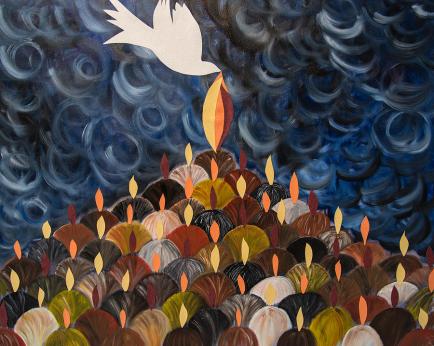
When the day of Pentecost had come, they were all together in one place. And suddenly from heaven there came a sound like the rush of a violent wind, and it filled the entire house where they were sitting. Divided tongues, as of fire, appeared among them, and a tongue rested on each of them. All of them were filled with the Holy Spirit and began to speak in other languages, as the Spirit gave them ability.

i-will-pour-out-my-spirit-on-all-my-people-marianne-gonzales-sims

I only have three opportunities left to proclaim God’s Word in this place. After preaching for 4 years from the Old and New Testaments, after listening for the Spirit’s movement for more than 250 sermons, I only have 3 left.

It’s hard not to think about what my final thoughts should be. I’ve been the pastor of St. John’s for some incredible mountaintop moments, and some frighteningly deep valleys. I’ve gone on a bunch of mission trips, taught lots of bible studies, and implored us to do some pretty strange things in this sanctuary all under the auspices of “worship.”

What do I want to leave with all of you? Should I try to whittle the entirety of the gospel down to an easily digestible sentence like “do unto others as you would have them do unto you”? Should I use my last three sermons to build you up with stories of love and grace and generosity? Should I use these final sermons to break you down with talk of sin, evil, and repentance?

I’ve got to admit that over the last few weeks I’ve found myself far more concerned with what I want to say than with what God wants to say.


Here we are my friends, today is Pentecost, the so-called birthday of the church. I know some pastors who will spend part of this morning in worship gathering their congregations around a giant birthday cake and will encourage an off-key rendition of “Happy Birthday.” Others will spend the service talking about how it is our responsibility to offer gifts to the church for her birthday and will then not-so-subtly move to the time of tithes and offerings. And others will use the church’s birthday as an opportunity to talk about inviting others to celebrate and make the whole thing into a guilt trip about evangelism and church growth.

All of which don’t have much to do with what God is saying in the text.

But, of course, Pentecost seems like a party. There are people gathered together in one place, the house is filled with something that propels the guests to do something, and everyone leaves with a gift.

But if Pentecost is a party, how long had God planned it? Who was on the guest list? Is it the kind of party we would hope to be invited to?

Pentecost may be the birthday of the church, the beginning of the gathering of disciples to worship the living God, but it is NOT the birthday of the Spirit.

In the beginning, when God created the heavens and the earth… sound familiar? When nothing existed but chaos the Spirit of God swept across the waters and brought forth order. The Spirit is not new, it was there in the creation of all things, it rested on the likes of Abraham, Isaac, Jacob, Moses, David, Solomon, and the prophets. By the day of Pentecost in the upper room the Spirit had already overshadowed Mary’s womb, and called Jesus forth from the tomb. It was there at Jesus’ baptism, it compelled him to preach his first sermon, it fed the 5,000, it healed the sick, Jesus even breathed it on the disciples in the upper room shortly after his resurrection.

The story of Pentecost is not about the arrival of some previously unknown force that we call the Spirit; the entire bible is the story of the Spirit of God made manifest in and among God’s people.

What happened on Pentecost began long before that day, and will continue long after we’re gone.

Near the beginning, the people of God had grown restless. They wanted something more than life was offering, they wanted answers to their questions, and they began work on a giant tower. With brick and mortar, sweat and tears, they cut through the horizon in an attempt to reach God, and become like God. And God saw what we humans were doing and decided to confuse our language and scatter us across the earth. The unity and connection at the heart of our species was ripped apart and never again would we so brazenly attempt to reach and control our Lord.

Or so we thought.

Later, while Moses was on top of the mountain with God, at a place called Sinai, the people down in the valley grew restless. They wanted something more than life was offering, they wanted answers to their questions, and they began forming a golden calf to worship. With a gathering of precious gems, with kneeling and praising, they chose a new god to put their hope in. And God saw what we humans were doing and decided to wipe us from the face of the earth. But Moses pleaded with the Lord and instead only 3,000 were killed for worshipping the golden calf.

The Tower of Babel in Genesis and the Golden Calf in Exodus are stories we’d like to explain away. Not just for their strange and supernatural elements, but also because they don’t match with our anachronistic and modern sensibilities. We’d rather talk about what we think the text means than what it is actually saying.

But the stories of Babel and the Golden Calf do not end with a division of language or in a slaughter.

Pentecost is the undoing of Babel with God’s magnificent power reuniting God’s people under a common tongue: the Gospel.

            Pentecost is the undoing of the episode with the Golden Calf where, instead of 3,000 being killed, 3,000 were added to the budding church in order to redeem what happened in the valley long ago.

            The Spirit at Pentecost is the one who brings forth life out of death, hope out of despair, and a beginning out of an ending.

perfectchurch

We here in church like everything nice and orderly, or at least I do. I want to have a bulletin that is clear and organized, I want a theme that stretches throughout the entirety of the service, I want people like you to get exactly what you want and what you need.

But the Spirit is not one for white linens, and perfect bulletins, and calm consciences. On Pentecost the Spirit did not come with manners and a polite disposition. No, the Spirit comes with power that could knock someone to the ground, fill a room as if with fire, and even turn the world upside down.

The Spirit shows up at Pentecost like an uninvited guest.

During the height of segregation, there was a well-known church in the heart of Durham that was filled with proper looking white families every Sunday. They all made sure their children were quiet in worship, knew when to bow their heads, and stood to sing the hymns. Their clothes were always clean and coordinated, they always had plans for lunch after worship, and to them the church was perfect.

On one particular communion Sunday however, a young black man showed up at the main door and attempted to walk in. The ushers promptly blocked his path and used a few choice words to explain what they thought about his presence.

The next month he showed up with a few of his friends and there were even more ushers blocking the entrance.

Finally, in the deep heat of the summer, the young black community members decided to wait until the service started before walking in. They waited for the ushers to head inside and stand in the back and then they made their way through the doors precisely when the preacher stepped forward with the bread and with the cup and invited everyone forward.

At that cue the group pushed through the back pews and made their way down to the altar to receive the body and blood of Jesus.

I wish I could tell you in that holy moment the white people of the church were filled by the grace of God to receive their black brothers and sisters in love.

I wish I could tell you that the whole congregation stood to sing Amazing Grace and gather with their new friends at the altar.

I wish I could tell you that the whole white community of Durham came to their senses in that profound moment and began working to end segregation.

            But that’s not what happened.

The nice people sitting in the pews with their perfect families and their perfect worship service saw the young black men and women as uninvited guests, and they did what some people do when the unwanted show up, they kicked them out.

A fight broke out that Sunday in the aisles and in the pews, clothes were torn, blood was spilt, and windows were broken.

The police were called to break up the fight, which made matters even worse, and the church was evacuated before anyone even got communion.

The Spirit does not always arrive as a still small voice or a faint stirring of the heart. Sometimes the Spirit is electric, atomic, volcanic, and even violent.

img_mouseover3

The human community divided by God at Babel, and punished at Sinai, was brought back together in the upper room on Pentecost. Instead of overwhelming confusion there was a new cooperation. At Babel and at Sinai the people of God wanted to move vertically to become like God. At Pentecost, God connected the people of God horizontally through the kingdom.

God, on Pentecost, offered us a new way, but sometimes we fall back to the Babels and the Golden Calves of the past. At that church in Durham, they believed that one’s skin pigmentation meant more than just about anything. And it took a fight between the pews to show them how far they had fallen.

For some of us we care more about what political party we’re affiliated with than anything else. We therefore ignore or even attack those who disagree with us.

For others we divide ourselves over ethnicity, race, sexual preference, age, socio-economic status, and a great slew of other factors.

But at Pentecost God did what God had to do to unite humanity back together. Like an uninvited guest God arrived as a violent wind rushing throughout the room and filled the entire house. Divided tongues like fire appeared among the disciples and a new tongue rested on each of them. All of them were filled with the Holy Spirit, the same Spirit that was there at the creation of existence, there in the virgin’s womb, and there in the empty tomb.

God interrupted the sensibilities and the gathering of the first disciples to offer a new way, a way filled with a frightening and powerful Spirit. God united the people under a common tongue of the gospel of His Son through the power of His Spirit and it forever altered the way we understand the world.

For at Pentecost we discover that WE are the church, and that “we” often includes people we can’t imagine; people who do not look like us, think like us, speak like us, or even worship like us.

Don’t get me wrong; I love the way we worship. I love our hymns and our prayers and even the way our sanctuary looks. I love the way we greet each other as we enter the building, I love the way we share signs of Christ’s peace, I even love how many of us are wearing red this morning in honor of Pentecost.

But the church should be a disruptive thing because that’s precisely what God’s Spirit did at Babel, at Sinai, at Pentecost, and it’s precisely what the Spirit did at that church in Durham, and frankly it’s what the Spirit is going to do to the youth of this church on our mission trip this week. The Spirit will upend our expectations and our hopes and our dreams. The Spirit is the one who will show us that WE are the church, all of us, and all of the people that we can’t imagine, they and we are the church, whether we like it or not. Amen.

Devotional – Acts 2.1

Devotional:

Acts 2.1

When the day of Pentecost had come, they were all together in one place.

 Weekly Devotional Image

When was the last time your entire family was together in one place? For some it probably occurred around a holiday like Christmas or Easter, for others it might have occurred at a funeral service or a wedding celebration, and for others the possibility of having everyone together might simply be an impossibility.

When an entire family is together in one place, magnificent things can take place. All the sudden you might overhear a distant cousin telling a story when you realize he or she sounds exactly like you, or you’ll notice that that you have the same color hair as an aunt, or you begin to see how really connected you are even without seeing the whole family very often.

However, being together with an entire family in one place can also bring about conflict. Old disagreements from the distant past can percolate to the surface, political differences can ruin an otherwise wonderful afternoon, or the swift judgments of family members about their family members can show the true colors of brokenness even within a group of people who share the same genes.

When was the last time the entire church was in one place? Across the country, at least in mainline Protestantism, most churches see the majority of their members only once a month. That is why there is such an abundance of churches with upwards of 400 members, but they see less than 100 on Sunday mornings. And, even if everyone showed up to be together in one place, you would get the good and the bad just like when an entire family gets together.

MIDEAST-JERUSALEM-RELIGION-CHRISTIAN-ORTHODOX-EASTER

But can you imagine what our churches would look like if we were all together in one place? And, if you can, think beyond the local church, what if The Church came together in one place? That, among many other wonderful blessings, is the miracle of Pentecost. When the Holy Spirit was poured out on the disciples in a new and transformative way, they were all together in one place even though they were not of one mind. The whole of Acts reads like a bad family reunion in that whenever they gathered together they were forever disagreeing about some tenet of theology, and it is why Paul’s letters were necessary and instructional for the Church to figure out what it meant to be the Church.

Pentecost, though we celebrate it once a year, is actually still taking place in all of our churches whenever we gather together (whether we have all our people or not). The journey and mystery of the church is a group of people striving to be together without agreeing together, it is a miracle made possible by the grace of the Spirit that binds us together particularly when we don’t want it, and it is nothing short of a miracle.

When was the last time you were together with everyone in church? This Sunday might be a great chance to encounter the story of Pentecost that is still being written whenever we gather together.

The Oval Office Of The Universe

Acts 1.6-14

So when they had come together, they asked him, “Lord, is this the time when you will restore the kingdom to Israel?” He replied, “It is not for you to know the times or periods that the Father has set by his own authority. But you will receive power when the Holy Spirit has come upon you; and you will be my witnesses in Jerusalem, in all Judea and Samaria, and to the ends of the earth.” When he had said this, as they were watching, he was lifted up, and a cloud took him out of their sight. While he was going and they were gazing up toward heaven, suddenly two men in white robes stood by them. They said, “Men of Galilee, why do you stand looking up toward heaven? This Jesus, who has been taken up from you into heaven, will come in the same way as you saw him go into heaven.” Then they returned to Jerusalem from the mount called Olivet, which is near Jerusalem, a sabbath day’s journey away. When they had entered the city, they went to the room upstairs where they were staying, Peter, and John, and James, and Andrew, Philip and Thomas, Bartholomew and Matthew, James son of Alphaeus, and Simon the Zealot, and Judas son of James. All these were constantly devoting themselves to prayer, together with certain women, including Mary the mother of Jesus, as well as his brothers.


On Tuesday afternoon I went into the Preschool and sat on the floor of the yellow room with our Preschoolers. In mere minutes I would be walking with them into the sanctuary for their end of year performance and graduation, but for the moment we were sitting crisscross applesauce on the alphabet carpet.

Some of the kids were visibly nervous, rocking back and forth on the floor knees tucked into their chests, others were focused and practicing the words to the songs under their breath, and others were completely oblivious to what we were about to do and instead were making faces at one another and then cackling from the depth of their hilarity.

When I got the signal from our director that the time had come to stand, line up, and make our way into the sanctuary I bounced off the floor and called for attention. I said, “My friends, whose ready to have some fun?!” To which they responded with a conflated and cacophonous scream.

“Well,” I continued, “Before we go upstairs I want everyone to take a deep breath. Good, hold it, now blow it our slowly and listen carefully. I want you all to know that no matter what, this is going to be great, because your families love you, I love you, and Jesus loves you.

One by one they lined up in the hallway in their specific order and just before we started to move one of our boys grabbed me by the pant leg. “But Pastor Taylor, I have a question.” Figuring he needed to use the bathroom or some such thing, I got down on my knees and said, “What is it Keller?” He said, “I know my parents love me because they’re here, and I know you love me because you’re right here, but where’s Jesus?”

I said, “C’mon Keller! We’re seconds away from the program beginning and you want to know where Jesus is?! I don’t have time for this theological nonsense!”

Just kidding. But in the moment I thought about how to answer the question, what would satisfy his longing and curiosity. Where is Jesus?

I thought about placing my one hand on his shoulder and using my other hand to point toward his chest and saying, “Keller, Jesus is in our hearts!”

I thought about grabbing a nearby children’s bible to show him a picture of the Ascension, but of course, children’s bibles only contain stories like Noah’s Ark, Jonah and the Big Fish, and an Easter Sunday that has more to do with budding flowers than a dead man being raised back into life.

So I settled for this: “I’ll tell you where Jesus is after we finish the program.”

jesus-christ-is-lord-by-thomas-hawk

When the disciples came together they asked Jesus, “Are you now going to restore the kingdom to Israel?” After years of listening to parables, watching miracles, and being fed out of nowhere, after encountering their resurrected friend, they still didn’t get it. Jesus replied, “There are some things you are not meant to know. But you will be my witnesses in Jerusalem, in all Judea and Samaria, and even to the ends of the earth.”

When he said this, the disciples watched as he ascended into the sky and a cloud took him out of their sight. And two men in white came by and said, “Men of Galilee, why do you stand with your eyes in the sky?” The disciples returned to Jerusalem and they devoted themselves to prayer while they waited.

The Ascension is important. Sadly, however, it is one of the Sundays that gets lost in the liturgical year and is overshadowed by the likes of Pentecost and Christ the King. This story of what took place 40 days after the first Easter answers our little preschooler’s question about where Jesus is, but it also does so much more.

The Ascension is not about where Jesus is, but where Jesus rules. In the Ascension, Jesus takes his place at the right hand of the Father and becomes the King who rules our lives here and now. In this spectacular moment, a vision that would keep our eyes in the sky, God brings full circle the incarnation that took place in Mary’s womb. God became what we are, and as Jesus returned to the Father the humanity of our existence was brought into the divine.

Far too often we use the Ascension story to explain Christ’s absence from our lives, we use it as the means by which we calm the questions of preschoolers, and comfort those who are in the midst of suffering. But the Ascension loses it’s beauty, majesty, and power when we limit it to the physical location of the Son of God.

When Jesus ascended to the right hand of the Father he received the authority to rule here and now through a particular people called church; people like us.

Today, we throw the word “heaven” around like we throw around the word “love.” We use it as a filler or a descriptor to such a degree that it no longer means anything. And therefore when we say that Jesus ascended into heaven and sitteth at the right hand of God the Father Almighty, we no longer know what we are saying.

In the Ascension, Christ is exalted to the Oval Office of the universe to rule forever and ever.

I use the Oval Office specifically because the Oval Office means something to us, it embodies power and gravitas and even a little bit of fear. It is the place where things get done, where decisions are made that have an effect on our lives, it is where our leader rules.

But of course, our real Leader doesn’t reside in a White House, nor does our Leader work in an Oval Office made by the hands of morals.

Our Lord is Jesus Christ who rules from the Oval Office of the Universe.

qp13YsS

Just as we throw around the term “heaven” today without knowing what we are saying, the same thing happens with “the mission of the church.” Ask any good United Methodist about the mission of the church and they will tell you that we are here to make disciples of Jesus Christ for the transformation of the world. However, the church is already the better place that God has made in the world.

It would seem then, that perhaps the real mission of the church, particularly in the world we live in today, is to reclaim the understanding and belief that Jesus is Lord.

            Because we either live under that reality or we don’t.

After my brief theological conundrum in the basement, I walked up the stairs with the kids and we entered the sanctuary for the program. The kids stood attentively as I welcomed the families and friends, they belted out the songs with such volume that they drowned out the sound system with the backing music, and then we came to the final song.

It’s really simple and it goes like this: “I like to jump every day, I like to jump every day, I like to jump every day because I know He loves me, Jesus loves me, Jesus loves me yeah, yeah, yeah, Jesus loves me, Jesus loves me yeah, yeah, yeah!” And of course, I popped out into the chancel area and jumped with the kids while we were singing. The second time through its all about clapping, so we did that. And then the third time through we sing about dancing, and we did that as well.

While performing with the kids I could hear the parents laughing and clapping along as I made a fool of myself with a bunch of 3, 4, and 5 year olds, but the thing is, they really meant it. The kids threw every bit of themselves into the three verses of that song and they jumped, clapped, and danced with reckless abandon.

After the last song I announced the graduates of the Preschool, those who are going to kindergarten in the fall, and then I dismissed everyone from the sanctuary for a meal in the fellowship hall.

While the families and children were milling about I went to go find Keller to finish our conversation about the location of the Lord. I scanned through all the people and thought about what I might say, what story I could tell, how I could make it intelligible to a 4 year old when I felt another tug at my leg.

Keller was standing there with a huge smile on his face. I said, “Keller, you did a great job and I have my answer for you about where Jesus is.” And he just stood there grinning from ear to ear and said, “I know now Pastor Taylor, I felt him up there when we were dancing!”

2016-05-05-niles-c

Our Christ is a cosmic King who rules and reigns over us. In the ascension Jesus broke forth from the chains of being one of us, among us, into a freedom to rule with authority and power at the right hand of God. We are now his witnesses in Staunton, Augusta County, and to the ends of the earth. As Christians we believe that Christ is with us in the midst of being this strange, wonderful, and beautiful thing called church. Jesus makes himself manifest with us when we break bread, when we pass the peace, when we encounter the stranger, and even when we’re dancing in the sanctuary.

The story of the ascension is transformative for us Christians because in it we recognize our inability to go it alone. The first disciples met together, traveled together, worked together, prayed together, wept together, and rejoiced together, and even danced together all in Christ’s name. Just like them, we need each other’s witness and support, challenge and care, love and grace, to live into the reality that the church is the witness to Jesus Christ.

Jesus reigns from the Oval Office of the Universe at the right hand of God the Father Almighty. But for as much as Jesus sits at the right hand of the Father, Jesus is also with us, the resurrected Christ is the one who makes possible our resurrection, who brings forth reconciliation in our lives, who offers us a story when we have no story, who dances with us, who weeps with us, who is our Lord. Amen.

On The Lordship Of Jesus or: How To Preach For Memorial Day Weekend

strangely-warmed-spreaker-header

The team from Crackers & Grape Juice recently spent an afternoon interviewing Brian Zahnd (founder and lead pastor of Word of Life Church, a nondenominational congregation in St. Joseph, Missouri) for our lectionary podcast Strangely Warmed. During our time together we talked about the readings for the season of Easter during year A from the Revised Common Lectionary. For the seventh Sunday of Easter (Ascension Sunday), Brian challenged us to make it all about joy (again) while the world struggles under the weight of the current political climate. If you want to hear the conversation and learn more about preaching Memorial Day weekend, how Jesus is Lord and everything else is B@#$%^&*, identity, clapping in worship, Lee Greenwood, and why Ascension Sunday might be the most important Sunday of the year (even more than Easter???) you can check out the podcast here: Ascension Sunday – Year A

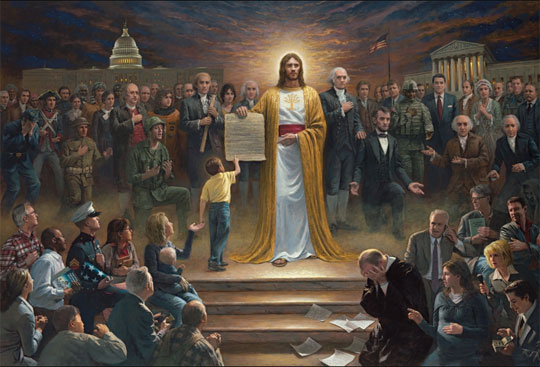
jesus_constitution

Devotional – 1 Peter 4.13

Devotional:

1 Peter 4.13

But rejoice insofar as you are sharing Christ’s sufferings, so that you may also be glad and shout for joy when his glory is revealed.

Weekly Devotional Image

“Who are you?” That is without a doubt one of my favorite questions to ask, because the way someone responds to that simple question says a lot about how the individual understands who he/she is. If I asked you the question right now, how would you respond? Recently, I’ve discovered that when I ask the question, the first response is almost always “I’m an American.”

This is, of course, true for many people in the context I serve, and it speaks volumes about priorities and identities. If someone’s immediate response was “I’m a mother” or “I’m a father” we could assume that they understand their parental role as their most important and therefore the identity they identify with most. Similarly, if someone’s response was “I’m a Republican” or “I’m a Democrat” we could assume their political identity is their most important identity.

And answering with “I’m an American” can be a good and right thing, but if that is our first thought or response, it often shapes our understanding of Christianity rather than the other way around.

bible-american-flag

Over the last few months I’ve heard a lot of people talk about their fears regarding change in the cultural ethos and most of it has to do with feeling safe. For instance, “We need to have that wall on the southern border to keep us safe” or, “We should’ve elected Clinton because she would’ve kept us safe.” But as Christians, being consumed by a desire to remain safe is strange and almost unintelligible; we worship a crucified God!

Peter calls the church to “rejoice insofar as you are sharing in Christ’s sufferings.” In America, as Americans, we fell so safe in our Christian identities that we assume being a Christian and being an American are synonymous. Therefore we are more captivated by a national narrative (Freedom, Capitalism, Democracy) than by the Christian narrative (Suffering, Patience, Penitence). But to call ourselves disciples implies an acknowledgement that, if we want to take up our crosses and follow Jesus, we might find ourselves on top of a hill with a criminal on our left and on our right.

Taking our faith seriously is a difficult thing to do when it appears normative in the surrounding culture. Instead we fall captive to the other narratives that we believe dictate our lives. But the truth is that God is the author of our salvation, that the Holy Spirit determines our lives far more than any country, and that Jesus is our Lord.

So-who-are-you


Devotional – John 14.18

Devotional:

John 14.18

I will not leave you orphaned; I am coming to you.

Weekly Devotional Image

I stood by the bell tower in my robe and I casually greeted everyone as they walked into the building for worship. Just inside the doors were greeters, ushers, and handful of other church members eagerly waiting to address those entering with greetings and salutations. I talked with individuals and families under the bell tower and when one particular woman stepped forward she was greeted by the small crowd with, “Happy Mother’s Day!” and she immediately grimaced; she is not a mother, and will never be one.

On Monday I spoke with a member of the church about a number of matters pertaining to the local community and right before we said goodbye she apologized for not being in church the day before. I asked if everything was okay, or if there was a specific reason she avoided church to which she responded, “I never come to church on Mother’s Day. It just hits too close to home.” She is not a mother, and will never be one.

mothers-day-church

Mother’s Day is a strange Sunday in the liturgical life of the church. There is nothing in scripture about the need to have a specific day focused on the glorification of those who are mothers, but in many churches that is exactly what it becomes. And it happens to such a degree that while trying to be grateful for mothers, we often ostracize a sizable community within our churches who can’t be, don’t want to be, or never will be, mothers.

To so emphasize and value the roles of the presumed normative domestic situation does a disservice to the truth of what the church is called to be: the new family.

Jesus, near the end of his earthly life, promised to not leave his friends orphaned. In a sense Jesus’ promise is a prediction of his own death and resurrection, but it also speaks to the future existence of the community of faith. Just as Jesus’ friends were not abandoned after the cross, so too have we not been abandoned in our communities of faith.

Through the sacraments of baptism and communion we are grafted into a community whereby the common identifiers and labels of mother and father are no longer limited by their biological connections. Instead we become brother and sister and mother and father to the entire community that gathers together to encounter the living God.

Being a mother is a remarkable responsibility and should be lauded on a regular basis, but it is not the most important identity that one can have. Following Jesus Christ as a disciple implies a willingness to be maternal toward all people regardless of whether or not we are biological mothers.

In the community of faith we are called to open our eyes to the realities of those around us so that, rather than discomforting someone on their way in or ostracizing someone to the point that they don’t even come, we remember that God will not leave us orphaned, not even in church.

On Stealing Sermons (and the similarities between Jesus and NT Wright)

strangely-warmed-spreaker-header

The team from Crackers & Grape Juice recently spent an afternoon interviewing Brian Zahnd (founder and lead pastor of Word of Life Church, a nondenominational congregation in St. Joseph, Missouri) for our lectionary podcast Strangely Warmed. During our time together we talked about the readings for the season of Easter during year A from the Revised Common Lectionary. For the sixth Sunday of Easter, Brian challenged us to make it all about joy (again) while the world struggles under the weight of the current political climate. If you want to hear the conversation and learn more about stealing sermons, the difference between making disciples and church members, golden calf ministries, and how Jesus (in the gospel of John) is like NT Wright you can check out the podcast here: Easter 6A – Brian Zahnd

Concept: Copy paste buttons on the keyboard. 3D rendering.

Best Day Ever

John 14.1-7

“Do not let your hearts be troubled. Believe in God, believe also in me. In my Father’s house there are many dwelling places. If it were not so, would I have told you that I go to prepare a place for you? And if I go and prepare a place for you, I will come again and will take you to myself, so that where I am, there you may be also. And you know the way to the place where I am going.” Thomas said to him, “Lord, we do not know where you are going. How can we know the way?” Jesus said to him, “I am the way, and the truth, and the life. No one comes to the Father except through me. If you know me, you will know my Father also. From now on you do know him and have seen him.

18449317_10208649403543496_1358279190100268299_o


Dear Teagan Leigh…

We are the stories we tell. Stories make up the very fabric of our existence here on earth. As you grow older your parents and grandparents and teachers will tell you tales and fables in order to teach you lessons about the world around you. When you mature enough you will be told stories about the past in order to avoid the mistakes of those who came before you. And when you get old like me, you’ll start telling stories in order to comprehend the events of life and in attempts to derive meaning out of the mundane.

We are taught by stories, we are convicted by stories, and we are entertained by stories.

Teagan, when your parents got married, I stood in front of them and their friends and their families and I told them about the importance of stories. After listening to them describe their love and commitment to and for one another in the months leading up to that moment, I knew that their stories were coming together in that holy space as I pronounced them husband and wife.

I told the story of how when your Dad, Tucker, was 4 years old he went shopping with your great grandmother. The whole trip was planned around your Dad finding something for his mom for Mother’s Day. He was given complete and total freedom to pick out whatever he wanted from the store, and sure enough he found the perfect Mother’s Day gift. They went home and wrapped it and then you’re grandmother, Lisa, opened her gift to discover that your 4 year old father, out of all the items he could’ve pick in that store, chose for her a broom and a dust pan… Your grandmother mustered up all the strength she could to accept her gift with pride, though she couldn’t help herself from asking, “Tucker, why the broom and the dust pan?” To which your father replied, “Momma, they’re green, just like your eyes!”

Teagan, I also told a story about your mother, Jess. When your Mom was about 5 years old, she started playing tee ball. She practiced and practiced and then the first real game finally arrived. When your mother got up to the plate for that first at-bat, she swung as hard as she could and she started running. By the time she rounded second base she was beaming with pride thinking about how she was about to score her very first run, and when she was closing in on third base, her coach yelled, “Home Jess! Go home!” but instead of rounding third, your mother ran straight into the dugout and, if her friends and parents hadn’t been there, she would have literally kept running all the way back to her house.

I told those stories at your parents’ wedding because we are the stories we tell. You’re mother is a remarkably loving friend who takes people at their word. Her trust for others is such that she would go to great lengths for the people in her life, even if it meant running all the way home. And your Dad is easily one of the most genuine people I’ve ever met in my life; he will tell you exactly how he feels rather than waste anyone’s time and he knows how to make the best out of any situation, even if he bought your grandmother a broom.

At your parents wedding, I stood before them, their friends, and the rest of your amazing family and told stories. I told those stories to show how your mother and father were about to have their stories join together and you, sweet precious Teagan Leigh, are one of the wonderful results of that union.

And frankly, I would like to take a little credit for your existence. Had I not been there to marry your parents together, had I not joined them in holy matrimony, you wouldn’t be here this morning for your baptism. So, you’re welcome.

I’m just kidding, but there is someone else we need to talk about, someone else whose story makes possible your story. And you might think that I’m going to start talking about Jesus… nope (or at least not yet). We need to talk about your grandfather Marshall.

At your parents’ wedding, your grandfather stood up at the reception and gave one of the best speeches I’ve ever heard. To be honest, I was a little disappointed when I was listening to it because I realized that no one would remember what I said during the ceremony, but everyone would remember what your grandfather said. And, if I may be so bold, I can condense his 45-minute speech into one phrase: Best Day Ever.

Your grandfather Marshall went on and on about all the memories he had of your Dad and your Mom and how every day was the best day ever, all the way up to the wedding day, and that throughout their marriage they would continue to experience the best day ever.

It was perfect.

What made it perfect was how faithful it was. Because marriage, the joining together of two people is based on an assurance of commitment, what we like to call a covenant. Your parents covenanted to love and cherish and remain with one another recognizing that life will change, that circumstances would move them into strange and unknown places, and yet they believed in the power of God to hold them together in spite of the great mystery we call marriage.

Which brings me to Jesus…

Teagan, your parents are crazy. In their marriage they looked into the abyss of the unknown and jumped right in, and they’re doing it again today in your baptism. Bringing you forth to be baptized is one of the craziest and most faithful things that you parents will ever do, because in doing so they are recognizing that you don’t belong to them.

            You belong to God.

Teagan, there is this profoundly awesome moment in the gospel of John when Jesus was talking to his disciples about what it would mean to follow him. Jesus went on and on in attempts to strengthen his friends and provide for them a glimpse of the kingdom of God on earth and Thomas responded by saying, “Lord how will we know the way?”

i-am-the-way

Thomas’ question is all of our questions. Throughout your life Teagan you will encounter this question in its many forms: Who should I sit next to at lunch? What should I get my mom for Mother’s Day? What school should I attend? Who should I marry? What kind of family should I raise? What kind of job should I pursue? What kind of church should I attend? How will I know when it’s the right time to retire? All of these questions are predicated on the assumption that we do not know where we’re going and we need all the help we can get.

Thomas wanted to know how to get where Jesus was going, he wanted an answer to his question, he wanted to know the way. And Jesus responded like this, “I am the way, and the truth, and the life.”

Teagan, there are many ways that you can live your life, you can find a great number of answers to your many questions. But Jesus is THE way, and THE truth, and THE life. And unlike many of the means by which the world will try to entice you with a great number of choices, attempts at making you the author of your own story, Jesus is the one who acts upon your behalf.

There might come a day when you’ll look back and regret the choice that your parents made for you. You might wonder if you would’ve made the same choice for yourself had they waited until you were old enough to make it. Your experience of the baptized life might be such that you’ll even be mad at me for being the one who doused you in water. But this thing we call baptism doesn’t really have anything to do with you, or your parents, or even me. Instead it has everything to do with God revealing THE way through THE Son.

In your baptism, something you won’t remember outside of stories and photographs, God is the one acting on your behalf. It is the Spirit that moves through the water and calls you forth into a new life, it is God who has worked in and through the waters of so many who have been grafted into the church, it is Jesus who makes possible the kind of radical transformation that takes place in the water.

When your parents got married, they stood before the altar of the Lord and asked for God’s help to navigate the difficult and challenging covenant of marriage. And in your baptism they will do much the same, and we will all join them in their covenant. The people of God’s church, and not just the people of St. John’s but all Christians everywhere, are making the promise to raise you in the faith, to support you when you falter, to congratulate you when you succeed, and to call you out when you wander from THE way.

In a sense, we are making the public proclamation that you are a gift to us from God.

For many of us Teagan, this is the best day ever. When we look up to see you at the font surrounded by such love it will give those of us who have followed THE way a great deal of hope. In the water that will cover your head we will be reminded of THE truth of what Jesus came to do for the world through THE life of God offered on the cross and resurrected from the grave. And Teagan, I hope that one day you will look back at this day, the day of your baptism, as the best day ever.

But even that would be a disservice to the living God who breathed the breath of life into you, the living God who called your mother and father to live in holy matrimony all of their days, and the living God who revealed THE way and THE truth and THE life in his Son. For to follow Jesus on THE way as THE way is to know that every day is the best day ever. Because every day is another opportunity to encounter the incredible grace of God in the laughter of a friend, in the tear of a spous e, in the smile of a stranger. Every day offers us a chance to live into THE truth that God is the author of our stories. Every day presents an occasion to give thanks for THE life that reorients all of our lives.

Teagan Leigh, you are a gift. You are a gift to your mother and father and to your family. You are a gift to the church. You are a reminder of what God’s grace actually looks like. So today we give thanks to God for you, for making this the best day ever, and for THE truth that even greater days are yet to come. Amen.