Infinite Mercy

Psalm 51

Have mercy on me, O God, according to your steadfast love; according to your abundant mercy blot out my transgressions. Wash me thoroughly from my iniquity, and cleanse me from my sin. For I know my transgressions, and my sin is ever before me. Against you, you alone, have I sinned, and done what is evil in your sight, so that you are justified in your sentence and blameless when you pass judgment. Indeed, I was born guilty, a sinner when my mother conceived me. You desire truth in the inward being; therefore teach me wisdom in my secret heart. Purge me with hyssop, and I shall be clean; wash me, and I shall be whiter than snow. Let me hear joy and gladness; let the bones that you have crushed rejoice. Hide your face from my sins, and blot out all my iniquities. Create in me a clean heart, O God, and put a new and right spirit within me. Do not cast me away from your presence, and do not take your holy spirit from me. Restore to me the joy of your salvation, and sustain in me a willing spirit. Then I will teach transgressors your ways, and sinners will return to you. Deliver me from bloodshed, O God, O God of my salvation, and my tongue will sing aloud of your deliverance. O Lord, open my lips, and my mouth will declare your praise. For you have no delight in sacrifice; if I were to give a burnt offering, you would not be pleased. The sacrifice acceptable to God is a broken spirit; a broken and contrite heart, O God, you will not despise. Do good to Zion in your good pleasure; rebuild the walls of Jerusalem, then you will delight in right sacrifices, in burnt offerings and whole burnt offerings; then bulls will be offered on your altar.

The hospital was eerily quiet as I made my late-night rounds.

The sound of my shoes echoed throughout the hallways as I peeked in on different patients, asking if anyone of them wanted “pastoral care.”

Most of them were asleep.

Those who were awake waved me away with their televisions remotes as they sifted through the early morning informercial marathons.

It felt, in that moment, like a rare opportunity to crash on the bed in the dim lit pastoral office and enjoy some blessed rest. But before I turned to head that direction, a message popped up on my beeper beckoning me to another part of the hospital.

She sat up when I entered the room, old enough to be my great-grandmother, and she gestured for me to come closer. I reached for a nearby chair but she patted on the bed. She explained that eyesight and hearing were such that she needed me to be as close as possible, so I obliged. 

She took my hand in hers and said, “Father, I need to confess my sins.”

“Well,” I began, “I’m not actually a priest, and neither am I ordained, I’m basically a glorified pastoral intern.”

She said, “God loves to work through people like you. Will you hear my confession?”

“I guess so.”

“I lied to the nursing staff this afternoon. They asked if I was comfortable and I said ‘Yes’ even though I feel terrible. They asked if I like the food here and I said ‘Yes’ even though I wouldn’t feed it to my dogs. And they asked if I needed anything and I said ‘No’ even though, honestly, I need a miracle.”

We sat in silence for a moment and then she said, “Aren’t you supposed to say something.”

“Yes,” I muttered, “In the name of Jesus Christ, you are forgiven.”

“Thank you,” she replied as I saw the worry drift away from her face, “I know God already forgives me, but sometimes it’s just nice to hear someone else say it.”

I then prepared to get up from sitting next to her on her bed when she tightened her grip around my hand and said, “Now its your turn.”

“My turn to do what?” I asked.

“To confess your sins to me.”

So I did.

Psalm 51 is read by the people of God to mark the beginning of the Lenten season. It is, as we call it in the church, one of the penitential psalms – a psalm that expresses sorrow for sin.

And yet, Psalm 51 does not begin, as we might suspect, with a confession of sin. Rather, it begins with a request for forgiveness. “Have mercy on me, O God, according to your steadfast love; according to your abundant mercy blot out my transgressions.”

That might not seem like a big deal – but it implies that the psalmist knows they have something worthy confessing, that if the psalmist is to be helped (at all) then the sins must be taken away completely, that the psalmist cannot do this on their own, and that the psalmist can ask for forgiveness because the psalmist worships a merciful God.

And that is astonishing.

Let me put it this way. In so much of our lives it go like this: We do something wrong or we avoid doing something we know we should do. And then, for awhile, we stew over what happened, or didn’t happen. We know we should probably admit what we did but it’s terrifying. What if we wronged someone and when we tell them the truth they cut us out of their lives forever? Or we wrestle with it because we don’t want to admit that we’re the kind of person who could do such a thing. And then we either bite the bullet and confess, or we keep in in our heart of hearts as it seeps throughout our being and does far more damage and the initial indiscretion.

But the psalmist sees it different. 

The psalmist knows that forgiveness has come even before the sin occurred. 

The psalmist worships a God who mercy knows no bounds.  

The psalmist understands that God can redeem even the worst mistake.

For us, people entering the season of Lent, this is something to keep at the forefront of our minds – we are justified not after we confess our sins, but right smack dab in the middle of them. At the right time Christ died for the ungodly, while we were yet sinners God proved God’s love toward us, there is therefore now no condemnation for those who are in Christ Jesus (who, by the way, happen to be everyone since Jesus has taken all upon himself in and on the cross).

The challenge then, for us, isn’t about whether or not God will forgive us. 

The challenge is whether or not we have the constitution to confess the condition of our condition.

Because even if we can summon the words, Lord have mercy upon me, most of us go around convincing ourselves that we’re, all things considered, pretty decent people.

After all, we’re tuning in to a midweek first day of lent service online!

Sure, we know we’re not perfect but at least we’re not like those other people (whoever they may be). We’re happy to get on Facebook and Twitter to call out the specks in other’s eyes all while ignoring the log in our own. 

That’s why Lent is both so important and so difficult. It is a time set apart to turn back to the Lord who came to dwell among us – it is a remarkable opportunity to reflect on what we’re doing with our lives and how those lives resonate with the One who breathed life into us.

But Lent is also a time for honesty.

Honesty about who we are, how we have fallen short, and how in need of grace we really are.

Judgment comes first to the household of God, the disciple Peter writes in an epistle to the early church. We, the church, then don’t exist to show the world how wrong it is in its trespasses but to confess first that we are sinners in need of a Savior who can do more with us and for us than we could ever do on our own. 

Confession, what we’re doing tonight, is not just an apology, it’s not just a feeling bad about what we’ve done. It’s about agreeing with God about who we really are. 

We are dead in our sins. 

And we have no hope in the world of being anything else, except for the fact that God has come not to fix the fixable or teach the teachable, but to raise the dead.

We can’t fix ourselves. But that’s actually Good News. It’s good news because nobody, not the devil, not the world, not even ourselves can take us away from the Love that refuses to let us go. Even the worst stinker in the world is someone for whom Christ died. 

The Kingdom is heaven is populated entirely and only by forgiven sinners. Hell is thinking we need no part of forgiveness. Amen. 

We Are What We Pretend To Be

What does it take, what does it mean, to be a Christian?

This is a worthy question for those of us who claim to follow Jesus, particularly during the time we call Lent. Lent, after all, is a season of repentance, or turning back to the Lord who came to dwell among us. Lent is that wondrous opportunity to reflect on what it is we are doing with our lives and how those lives resonate with the one who breathed life into us.

And yet, most of us believe, even though we confess ourselves to be sinners, that we are actually good enough. We know we are not perfect but at least we’re not like those other people (whoever they may be). It is therefore not at all clear to us that we are sinful creatures in need of a Savior who can make something of our nothing.

As Christians, thankfully, we believe that we must be taught what it means to be sinners. That training comes by being confronted by Jesus Christ who, as Karl Barth puts it: “has accused us by turning and taking to Himself the accusation which is laid properly against us, against all people. He pronounced sentence on us by taking our place, by unreservedly allowing that God is in the right against Himself – Himself the bearer of our guilt. This is the humility of the act of God which has taken our place for us in Jesus Christ.”

Just as we must be taught what it means to be sinners, we must be taught what it means to be disciples – and this is a teaching that takes a lifetime.

So we need not worry about whether or not we are really Christians. During Lent (or any other liturgical time) we may think we are only pretending to be Christian, going through the motions of faith. 

But, by God’s grace, God makes us what we pretend to be.

Here are some tunes to get in a Lenten mood…

Kevin Morby’s “Wander” has been on repeat in my house over the last few months if only because my four year old loves to pound his chest when the kick-drum shakes our bookshelves as it mirrors a heart beat midway through the song. The lyrics, though, feel perfectly Lenten as it conveys a journey into the stormy weather of the wilderness. 

The Strokes’ “Under Control” is one of my all time favorite songs and Rostam’s cover pays homage to the teen angst of the original while putting it inside of a more reflective and ethereal feel. As one of the founding members of Vampire Weekend, Rostam excels in creating atmospheric melodies and what he does with “Under Control” keeps the song stuck in my head for hours. Lent, to me, is a season where we wrestle back and forth between being in, and out of, control which is what this song is all about.

Wilco’s “On and on and On” is remarkably apt this lenten season as it feels like we never really left Lent last year because of the pandemic. Jeff Tweedy has this uncanny ability to craft songs that speak these tremendous truths, and the lyrics in this song are both hopeful and frightening (in the best way) at the same time: “On and on and on we’ll be together, yeah / please don’t cry, we’re designed to die.” 

The Scratchy Sweater of Lent

This week on the Strangely Warmed podcast I speak with Carsten Bryant about the readings for the 1st Sunday of Lent [B] (Genesis 9.8-17, Psalm 25.1-10, 1 Peter 3.18-22, Mark 1.9-15). Carsten serves as the Director of the Youth Collective of the Orange Cooperative Parish in Hillsboro, NC. Our conversation covers a range of topics including Bob Dylan and youth ministry, Karl Barth, the liturgy of Lent, double rainbows, The Brick Testament, Ellen Davis, mercy, and the immediacy of the Gospel. If you would like to listen to the episode or subscribe to the podcast you can do so here: The Scratchy Sweater of Lent

This Is The Day…

Psalm 118.24

This is the day that the Lord has made; let us rejoice and be glad in it.

Weekly Devotional Image

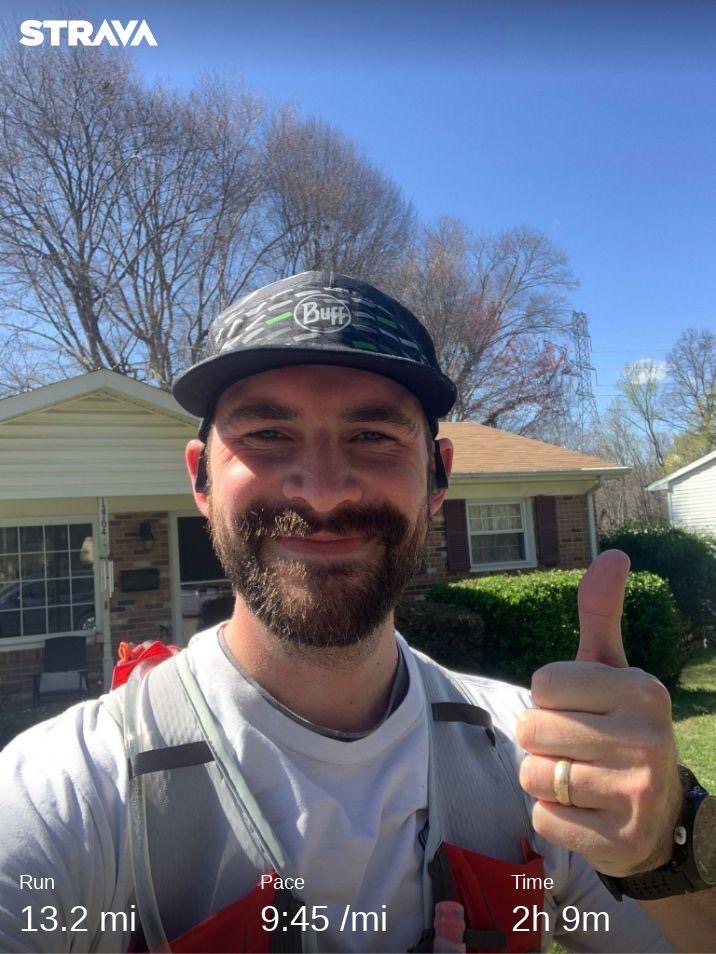
I ran a half-marathon yesterday afternoon. 13.1 miles in roughly two hours all over the Woodbridge area. I was supposed to the run the Rock ’n’ Roll Half Marathon in DC last Saturday but it was canceled in light of the Coronavirus. However I had been training for long enough that I figured, “Why not just go out and see if I can do it?”

The weather yesterday was perfect, giving extra meaning to the “this is the day that the Lord has made” and I decided to rejoice and be glad in it by putting one foot in front of the other until I put in the requisite miles.

Now, a day later, I can tell you there wasn’t much to rejoice about.

Or to put it a different way, my legs are sore!

During the months of training I was looking forward to being surrounded by scores of people all running toward the same goal. I was excited about the prospect of passing the finish line to be embraced by my family in celebration. I even anticipated the proud feeling of wearing around the medal for the rest of the day.

Yesterday was different.

IMG_2333

I ran all alone for two hours. I didn’t even tell my family that I was going to do it. And the only prize for completing it was knowing that I did it.

A lot of us have been experiencing profound feelings of isolation as the Coronavirus has forced us to remain physically separated from one another and forced us to limit our interactions outside of our homes. For some of us we’ve retreated into new or familiar books, we’ve binged terrible and incredible television shows, or we’ve picked up the phone to call people we’ve needed to reconnect with for a long time.

But for others of us, we’ve retreated further into our minds and our worries and our anxieties. We keep checking out bank accounts and wonder how we’re going to make it through all of this. We see updates from others on social media that make it seem like they are having a vacation while social distancing while our time have felt nerve wracking. 

And yet, as Christians, we believe that each new day is a gift from the Lord. That doesn’t mean that we have to force ourselves into optimism, but it does call us to rejoice knowing we’ve been given another day. The season of Lent, the season we’re in right now, is an ever-present reminder that tomorrow is never promised and that the bell will toll for us all. We didn’t need the Coronavirus to remind us of this but it certainly has helped to focus our attention on that which we cannot take for granted. 

I for one am grateful that I was able to get outside yesterday and run, even if my body feels miserable today. I am grateful I have another day to spend time with my family. But most of all I am grateful to know that God has not abandoned us to our own devices. 

The season of Lent always ends with Easter – a reminder that death is not the end.

If nothing else, that is certainly worth rejoicing. 

Subverting Expectations

Palm_frond

This week on the Strangely Warmed podcast I speak with Todd Littleton about the readings for Palm Sunday [A] (Psalm 118.1-2, 19-29, Matthew 21.1-11). Todd is a Baptist pastor serving Snow Hill Church in Tuttle, Oklahoma. Our conversation covers a range of topics including age differences, The Jesus I Never Knew, perfect subversion, the reject stone, The Princess Bride, paid participation, parades, unpacking Hosanna, and keeping the cross in Easter. If you would like to listen to the episode or subscribe to the podcast you can do so here: Subverting Expectations


Mortal

Ezekiel 37.1-14

The hand of the Lord came upon me, and he brought me out by the spirit of the Lord and set me down in the middle of a valley; it was full of bones. He led me all around them; there were very many lying in the valley, and they were very dry. He said to me, “Mortal, can these bones live?” I answered, “O Lord God, you know.” Then he said to me, “Prophesy to these bones, and say to them: O dry bones, hear the word of the Lord. Thus says the Lord God to these bones: I will cause breath to enter you, and you shall live. I will lay sinews on you, and will cause flesh to come upon you, and cover you with skin, and put breath in you, and you shall live; and you shall know that I am the Lord.” So I prophesied as I had been commanded; and as I prophesied, suddenly there was a noise, a rattling, and the bones came together, bone to its bone. I looked, and there were sinews on them, and flesh had come upon them, and skin had covered them; but there was no breath in them. Then he said to me, “Prophesy to the breath, prophesy, mortal, and say to the breath: Thus says the Lord God: Come from the four winds, O breath, and breathe upon these slain, that they may live.” I prophesied as he commanded me, and the breath came into them, and they lived, and stood on their feet, a vast multitude. Then he said to me, “Mortal, these bones are the whole house of Israel. They say, ‘Our bones are dried up, and our hope is lost; we are cut off completely.’ Therefore prophesy, and say to them, Thus says the Lord God: I am going to open your graves, and bring you up from your graves, O my people; and I will bring you back to the land of Israel. And you shall know that I am the Lord, when I open your graves, and bring you up from your graves, O my people. I will put my spirit within you, and you shall live, and I will place you on your own soil; then you shall know that I, the Lord, have spoken and will act,” says the Lord. 

In this strange new time I keep referring to as Coronatide, we have been physically separated by orders of law and state, but we are still bound to one another through the Lord. And yet, it has become apparent with every Facebook post calling on people to answer questions in order to learn more about one another that we really don’t know much about each other at all. 

Well, knowing that we don’t know what we don’t know, I’m going to share something that you do know about me, no matter who you are, and something I know about you, no matter who you are.

We’re all going to die.

What a way to start a sermon!

Or, as it is written in one of my favorite books, “In the world according to Garp, we’re all terminal cases.”

Back-to-the-Start_LowRes-WebSlide

That’s what we were affirming on Ash Wednesday, which now feels like an eternity ago, and it’s what Lent reminds us at every turn: In the midst of life we are in death. And, frankly, we didn’t need the Coronavirus to remind us. We didn’t need the empty supermarkets, and the abandoned jungle gyms, and the vacant school parking lots to remind us that no one makes it out of this life alive.

Though plenty of us love believing the contrary. We are suckers for the advertisements of products that promise youthful glows, and smoothed wrinkles, and tighter waistlines. We use tomorrow’s money to finance today’s void. We even check the updates on how fast the virus is spreading in certain places and think, “Well surely, it won’t happen like that to me.”

But then it does.

Or, to put it another way, a few weeks ago, before everything really ramped up, I took my 3 year old son out for lunch at a local Chic-fil-a. We ate our waffle fries in beatific silence, smiling as the ketchup smudged our cheeks, and then my boy gave me a look that said, “Dad. Bathroom time.” We quickly cleaned off our messy hands and faces, and bee-lined for the restrooms. After business was taken care of, a man walked in, used the stall next to us, and walked out. To which my son shouted, “Uh, Dad, that guy didn’t wash his hands.”

And I, being the great parent I am, said, “Elijah, say it louder next time.”

In ways both simple and profound, we like to pretend like the one universal truth is actually a lie.

But it’s not.

Ezekiel, contrary to our dispositions, knew the truth of our finitude. Should you have any extra time on your hands while social distancing, go read through the book of Ezekiel, there’s some wild stuff inside. But for today, we get to see, through Zeke’s eyes, the valley of the dry bones. 

It must’ve been a particularly striking and relevant image for the bizarre prophet considering his own life situation. Prior to this text, we learn that Ezekiel has been on somewhat of a rampage against God’s people, indicting them for all the had done and left undone. The people God chose to change the world, the people with whom God had covenanted, the people God loved with reckless abandon had abandoned the Lord – they had given themselves over to idolatry.

Idolatry, for the people in the back, is believing and acting as if anything or anyone can give us what only God can give.

Idolatry is believing wealth says more about who a person is than the fact they were made in the image of God.

Idolatry is looking out for our own interests at the expense of the marginalized.

Idolatry is assuming that we can save ourselves.

The people of God worshiped whatever they wanted whenever they wanted, the ignored the plight of the needy, and they believed they were entirely in control of their destines.

And the Lord spoke into their midst and said, “You want idolatry? I’ll give you idolatry!”

They were dragged off as captives to become strangers in a strange land: Babylon. A foreign place where the land was dominated by colossal statues and overwhelming debauchery. In short: a place totally at odds with what the worship and love of God is supposed to look like.

And it’s from this place of exile, maybe something a few of us can identify with right now, that Ezekiel speaks of his vision.

maxresdefault (1)

The Lord drags Ezekiel out to a graveyard, that stretches as far as the eye can see, and all his eyes can see are bones piled upon bones, and they’re all dry. And the Lord says, “Can these bones live?” Ezekiel replies, “Lord, only you know.” And the Lord says, “Tell this to the bones: O dry bones the Lord will give you life! The Lord will breathe upon you and the sinews and the flesh will string together and you will live because God is God!”

Ezekiel does what the Lord commanded, and the earth trembles beneath his feet, and like a scene befitting a horror film, Ezekiel watches as bones come together, and tendons and muscles are stretched and skin forms until a vast multitude stands on their feet and they are alive.

“Look” says the Lord, “these bones are the whole of Israel. They say, ‘Our bones are dried up and our hope is lost; we are cut off completely.’ But look what I did for them! I will bring you back and you shall know that I am the Lord!”

This is strange stuff, even for the Bible. 

The Lord promises to reconstitute the very people who had given up on the Lord.

God breathes life into the bones of those who destroyed life time and time again.

God makes a way where there was no way.

And the bones live.

Contrary to how so many of us speak about church or hear about church, this confounding moment in the valley of the dry bones has not one thing to do with us and whatever it is we think we bring to the table. 

Notice: The people of God have done less than nothing to restore God’s faith in them. They died and were buried in their sins and in the trespasses and God says, “Ok, time to make something new.” 

They didn’t deserve it and they certainly didn’t earn it. 

Notice: God doesn’t tell Ezekiel to go out and give the bones a ten-step process on how to get their lives sorted out. God doesn’t tell the people to pray three times a day in order to earn their salvation. God doesn’t wait for the people to memorize their favorite book of the Bible before the bones starting coming back together.

God raises the bones to life because that’s what God does!

I hope you hear that as a hopeful word. Because even at our best, we’re not very good.

When we hear about the valley of the dry bones, if we hear about it at all, we are often so caught up with the striking physical details that we don’t take a moment to really think about it. We have the benefit, if you want to think about it that way, of knowing whose bones we’re walking on whenever we go through a cemetery. But Ezekiel could only see bones upon bones.

But who did they belong to?

Scripture answer the question for us, of course. The Lord says to Ezekiel, “These bones are the whole house of Israel?” But even a statement like that warrants further reflection. Because if the bones are the whole house of Israel, that means that some of those bones belong to Cain and Abel, Jacob and Esau, Saul and David, the elect and the reject. It means that buried among that pile of bones are the good and the bad, the sinners and the saints, the first and the last.

63682-lent-thinkstockphotos-902294032-azerberber.1200w.tn

I don’t know what you all have been up to these last few weeks, but I’ve seen and heard countless stories about people going above and beyond to help people in need. Distilleries shutting down production of their whiskey in order to reformat their facilities to produce hand sanitizer. Businesses donating medical masks to hospitals in need. Neighbors picking up groceries for the most vulnerable. Basically, stories of saints.

But for every positive story there’s plenty of stories that demonstrate the opposite.

Individuals hoarding up precious supplies and equipment only to price gouge individuals and business who really need them. Corporations calling on furloughed workers to start GoFundMe campaigns for medical expenses rather than offering financial assistance. And countless politicians using our present crisis as an opportunity to shore up votes for the next election cycle.

And that’s not to mention the great number of pastors who have, foolishly, assured their respective congregations that they can keep worshipping together or going out in public because the Lord will protect them in all of their comings and goings.

Basically, stories of sinners.

In the end, we’re all just a bunch of dry bones sitting in the bottom of a valley. Even the best of us cannot prevent the bell that tolls for us with our perfect spirituality or magnificent morality. Even the worst of us cannot so take advantage of others to stop the inevitability of our own demise.  

Remember, in the time of Jesus, it was all of the so-called “good” institutions, both the religious and the secular, following all of the proper protocols, and calling for a vote, people like you and me joined together to crucify Jesus of Nazareth. In all of our goodness and our badness we nailed that man to a cross and hung him up for the world to see. 

Stories end in graveyards. I’ve been in enough of them with the dirt in my hands laying it over the bodies of the dead to know it is true. I’ve seen enough tears spilt upon the tombstones of the familiar and the stranger to know that the one thing we all truly share is our death. I’ve listened to enough conversations and met with enough people to know that is our deaths that frighten us the most even if we do everything in our power to convince ourselves otherwise.

The disciples knew it too. That’s why they abandoned the Lord the closer he got to death, it’s why they avoided him on the cross, and it’s why they only trudged up to his grave three days later.

And yet, one of the greatest messages of scripture, a message as plain as day in the story of Ezekiel and the dry bones, is that in the end it’s not up to us to save ourselves. We will be buried among saints and sinners, our bones will dry and scatter, and only God, Father of the Incarnate Word, is the one who raises the dead. 

If you find yourself thinking, “My life is all dried up, I’m stuck in the confines of my home unsure of what tomorrow will bring, I have nothing to hope for, I feel completely cut off” then you are in good company. God can work with that. Amen. 

Feeling Your Feelings

Screen Shot 2020-03-23 at 10.51.41 AM

This week on the Strangely Warmed podcast I speak with Todd Littleton about the readings for the 5th Sunday of Lent [A] (Ezekiel 37.1-14, Psalm 130, Romans 8.6-11, John 11.1-45). Todd is a Baptist pastor serving Snow Hill Church in Tuttle, Oklahoma. Our conversation covers a range of topics including Baptist autonomy, cross denominational friendships, dry bones, speaking creation, holding dirt, edgy professors, the songs of Frozen 2, the agency of God, the Gospel in the West Wing, fleshiness, and rejected for election. If you would like to listen to the episode or subscribe to the podcast you can do so here: Feeling Your Feelings

Thirst Trap

Screen Shot 2020-03-09 at 9.53.50 AM

This week on the Strangely Warmed podcast I speak with Alan Combs about the readings for the 3rd Sunday of Lent [A] (Exodus 17.1-7, Psalm 95, Romans 5.1-11, John 4.5-42). Alan is a United Methodist pastor serving First UMC in Salem, VA. Our conversation covers a range of topics including scriptural introductions, Christian Twitter, Old Testament preaching, the wilderness of Sin, the “back in Egypt” committee, MewithoutYou, the best parts of the communion liturgy, faith vs. faithfulness, the living water on the cross, and secret snacks. If you would like to listen to the episode or subscribe to the podcast you can do so here: Thirst Trap

https://www.spreaker.com/user/crackersandgrapejuice/lent-3a

The Grammar of Faith

Genesis 12.1-4a

Now the Lord said to Abram, “Go from your country and your kindred and your father’s house to the land that I will show you. I will make of you a great nation, and I will bless you, and make your name great, so that you will be a blessing. I will bless those who bless you, and the one who curses you I will curse, and in you all the families of the earth shall be blessed.” So Abram went, as the Lord had told him; and Lot went with him.

The people who seem to have it all just drive me crazy. 

Now, you’re good and faithful and kind people so you don’t know what’s its like to feel the way I do, but when people go about parading all of their successes and all of their perfections I just get all sorts of frustrated.

It’s even worse when the people in question are Christians.

These people are the type who get on social media and brag about all the blessings God has showered down on top of them, all the while giving you a tour of their 3.5 million dollar house. 

They are the type of people who, after experiencing some apparently divine miracle, start raking in the dough from the righteous investments and then brag about their vacation home on the other side of the world. 

They are the type of people who make it seem as if being a Christian simply means there are no problems, no fights with spouses, no disagreements with kids, no bills to be paid, no medicine to take, so long as you invite Jesus into your heart.

But what about the other Christians? 

What about the disciple who’s coping with poverty and hunger? What about the family that shows up in church only to get in the car and continue the fight they paused when they pulled into the parking lot? What about the person sitting in the pews week after week feeling less and less sure about this thing called faith?

To be clear: Miracles happen, and the less fortunate can become the most fortunate. After all, Jesus did say that the first will be last and the last will be first. It just seems like sometimes those who go from last to first want to remind everyone that they got there on their own.

Which, of course, is absurd. 

But that doesn’t stop us from consuming it with reckless abandon.

We are suckers for the supposedly self-made fortunes, and the get rich quick schemes, and the take this pill to lose all your fat babble. 

And, frankly, if we want to pour ourselves into those narratives, we are more than welcome to do so, they just don’t have much to do with the Lord.

Back-to-the-Start_LowRes-WebSlide

Every verse in the Bible is important.

That’s why, every week, we read the Word aloud in this space and we affirm the importance of that Word by responding with: The Word of God for the People of God… Thanks be to God. There are, of course, verses in the scripture for which it becomes a little harder to affirm our gratitude for something that appears confounding. But, as Christians, we believe that this book continues to speak new and fresh and good words into our lives, even today.

Every verse is important but (dare I say it?) there are some which are more important than others. What we’ve read today, the call of Abram, though short and to the point, it contains some of the most important words of all: Now the Lord said to Abram…

That might not seem like much, but it is not too strong of a statement to say that the entire structure of our faith hangs upon this foundation that we, at other times, call revelation. Now the Lord said to Abram… If this is something we believe to be true, then everything else falls into place accordingly.

Like most books, we learn to read the Bible in particular ways. Some of us learned this explicitly from a pastor or a Sunday school teacher, and others among us just picked it up along the way. There are a great many ways to read the Word and how we do it can make all the difference.

The two primary ways of coming to the text, of reading it and hearing it, are to do so anthropologically or theologically.

Now, before I lose all of you to the midmorning nap session that can come from using words like the ones I just did, bear with me. All they mean is that we can encounter the Bible as if its all about humanity (and largely only about humanity) or as if its all about God (and largely only about God).

How we read the Bible, and in particular this story near the beginning, is a big deal.

And it comes down to grammar. 

Again, I recognize that I am tempting fate by dragging out such ideas this early on a Sunday morning, on Daylight Savings no less, but the grammar we use in the life of faith communicates more about who we are and whose we are than we recognize

God is the subject of the verb right here at the beginning of Genesis 12. That means we’re not the main characters of the story – God is.

The story of the Bible is, of course, the great tale of God with God’s people’s, but (more often than not) we read it as the story of who we are, and what we’re supposed to do, or not to, and the more we focus on ourselves the less we realize that God is the subject of the verb.

But we don’t like this. 

Not one bit. 

So time and time again we change the grammar. We do it whether we’re lay or clergy, we do it in the pulpit and in the classroom, and the results can be devastating.

hands

I can vividly remember attending a college campus meeting of Christians shortly after moving away from home in which all of the faithful freshman were encouraged to gather together for a worship service in an auditorium. There was a band that played familiar songs, and we said familiar prayers, and this scripture from Genesis 12 was used by the speaker that night. 

She went on and on about how Abram was faithful in traveling to where God sent him. She talked about how Abram is an example to all of us whenever we encounter something new and strange and different. She kept returning to this singular idea that no matter how difficult college life might feel like, all of us had to keep the faith, to stay the course, and to be like Abram as strangers in a strange land.

I know she meant well, and I know that she truly believed in what she was saying, the only problem is most of us were already nervous as it was, and now it felt ten times worse. She left us with this idea that our faith was being put to the test, and that only if we held fast to our moral convictions would we remain, as she put it, sheep of His flock.

It was all about us, and it had almost nothing to do with God.

We, whether we’re college freshman or not, are all functioning narcissists. We think the world revolves around us and we want to know how everything will affect us and we act as if the entirety of the cosmos is resting on our shoulders.

And that is exhausting.

For some reason, bad theology mostly, we think this whole story from Genesis 12 is going to be about Abram as if Abram has special powers or holy characteristics that make him worthy of God’s affections. There had to be something special about Abram that led to God choosing to bless the world through him. 

But, the truth is, we don’t know anything about Abram at this point in the story. At least Noah was a good man when God told him to build the ark, but Abram’s got nothing. All we know from Genesis is that he is the son of Terrah, and his wife Sarai is barren. 

That’s it.

And yet, those skim details are everything! They are everything because these two people carry nothing significant about them or within them. What happens from this point forward is about what God does in the lives of two people who had no potential for anything on their own.

God chooses nobodies to bless the world.

god-god-is-love-lord-love-the-greatest-love-of-all-favim

I don’t know how that makes you feel, but it brings me great comfort. For, if God could bless the world through two people who had no hope in the world, then maybe God can do something even through someone like me.

Or someone like you. 

And, again, notice the grammar. God is the one who blesses the world through Abram and Sarai, not the other way around. God is the one who makes a way out of no way which, incidentally, is the entire story of the Bible.

God promises to do what is impossible for humankind, God calls into existence things that do not exist, God is the subject of the verb.

If it were all on us, if it were all up to us, we would fail. We can’t bless the world because we are far too concerned with blessing ourselves. We can’t fix the world because we are so fixated on our own problems. We can’t redeem the world because we are the ones who need redemption.

We can’t even keep our promises.

But God does. 

Always.

That’s a pretty crazy thing to think about when you hear it for the first time or the thousandth time, it just also happens to be true.

Lenny Duncan is a pastor in Brooklyn, NY at a church that has rapidly grown under his leadership. He is a gifted speaker and is sought after across the country as someone who can speak the truth of the role of church in the 21st century. He wrote a book that I’m reading right now called Dear Church.

But the fact that Lenny became a pastor is a miracle.

It’s a miracle because he had a far greater chance of ending up in prison than behind a pulpit.

He’s a former drug dealer, sex worker, homeless queer teen, and a felon.

He tried church again and again and again when he was younger, and every time he did he left feeling worse than when he arrived. He was told, explicitly and implicitly that he was not enough, that he needed to correct his ways before coming to the Lord, and that he needed to take a good hard look in the mirror to find out if he was really worthy of Jesus’ love.

That only led to more of the same in his life.

Until one day, miraculously, he entered a church just like any other church, sitting in the first pew with a backward cap on, listening to people whisper about him under their breath, but this time he heard something different. Not a different sermon or a different prayer or a different hymn, but a different invitation.

An invitation that felt like an invasion. 

“This is Jesus’ table; he made no restrictions, so come.”

There was no membership meeting, no checking of theology, no “friendly” talk with the pastor before he was invited to the table of grace. He was welcomed simply as he was, and that was revolutionary. 

He describes the moment that he heard those words and walked up the center aisle like this: 

Tears welled up in my eyes as I walked forward… this welcome to the table was something I had never experienced before. I didn’t even know what it was. It awakened the shadow side of my relationship with God that I hadn’t had the courage to look under. It was like a knife that cut instantly through years of shame and brokenness and released me from those bonds. Grace is like a knife sometimes.

That invasion of an invitation changed him forever. It changed him because instead of being invited to change or transform or get his life together, he was invited by a mighty God who works the changes that we couldn’t on our own. 

Right then and there God called him to a new and strange and different life. Not because he had any of the prerequisites or the right schooling or the right amount of faith, but simply because God loves to make something of our nothing. Amen.

Knocking The World To Pieces

4d46bf1bb0394b294fab8d3ea3c7ea0b-1024x1024

This week on the Strangely Warmed podcast I speak with Sara Keeling about the readings for the 2nd Sunday of Lent [A] (Genesis 12.1-4a, Psalm 121, Romans 4.1-5, 13-17, John 3.1-17). Sara is a United Methodist pastor serving Good Shepherd UMC in Dale City, VA. Our conversation covers a range of topics including the H-word, the importance of space, blessing to bless, mountain ministry, the law gospel distinction, Easter moments, Nicodemus as a middle schooler, being born-again, the challenge of John 3.16, and God as Mother. If you would like to listen to the episode or subscribe to the podcast you can do so here: Knocking The World To Pieces

god-is-our-mother