What’s Wrong With The World?

John 13.34

I give you a new commandment, that you love one another. Just as I have loved you, you also should love one another.

In 1905 the Daily News in London published a piece titled, “What’s Wrong With The World?” and they asked for answers to their query. Hundreds of individuals responded with hundreds of examples. GK Chesterton, writer and theologian, simply responded with two words: “I am.”

There are many versions of Christianity in the world. And not just the different denominations you can find throughout your neighborhood like Presbyterians, Episcopalians, Baptists, Catholics, etc. Even within “one” church like the United Methodist Church there is a great diversity of opinion about what it means to be a United Methodist. 

But the one thing that might unite all churches, even more than our commitment to baptism or communion, is a desire to appear as welcoming and as inclusive as possible.

All you need to do is check a church website, or a front lawn marquee, and you can find a self-imposed description that says something like: we are an open, friendly, inclusive, and welcoming church. 

In the UMC we like to say that we have open hearts, open minds, open doors.

What a righteous slogan.

The only problem is the fact that we regularly close off our affections toward certain people, we are clearly cemented in “the ways things were” rather than the way things can be, and more often than not the doors to the church are locked.

Inclusivity is the buzzword among most, if not all, churches these days. Though, we are not altogether clear about what it really means to be inclusive. True inclusivity, after all, is not just a matter of having different kinds of people sitting in the pews on Sunday morning; true inclusivity means a total and unwavering commitment to something that is frankly impossible for us: love.

I know that might sound strange: the impossibility of love in the church. But it is, in fact, against our nature. We can’t, or at the very least don’t, love everyone.

It’s like those churches with signs on the front lawn proudly claiming: “Hate Has No Place Here.”

That’s a worthy hope, but it isn’t true.

All of us have hate in us whether we like to admit it or not. And, to make matters worse, saying that hate has no place in church affirms that the church hates people who hate!

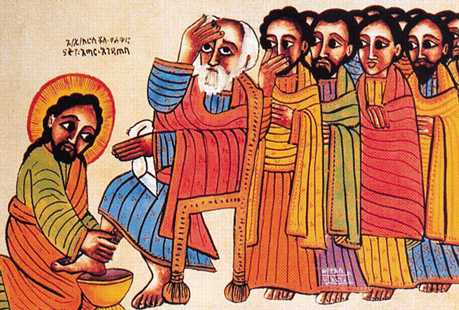
It is true that we are commanded, by God, to love one another just as Christ loved us. And yet, sometimes, I fear we confuse the two. That is: we assume that we have to love one another in order to get God to love us. When, in fact, the opposite is true: God loves us, and when we come to grips with how strange it is to be loved by God, we are then freed to love one another with the same reckless abandon that God loves us.

Notably, Jesus commands the disciples to love one another (as Jesus loves them) right after the foot washing. It’s this remarkable moment that encapsulates the humility (read: humanity) of God). And then, shortly thereafter, the disciples betray, deny, and abandon God to the cross. 

If the story ended with the cross, none of us would have ever heard about Jesus. But the cross is just the beginning because three days later Jesus is raised from the dead. And not only is Jesus raised from the dead, but he returns to the same disciples who failed to respond to the commandment of love!

We worship an odd God. Jesus chooses the unworthy and undeserving ragtag group of unloving disciples to be the people through whom the world is turned upside down. In short: there is nothing that can ever stop God from loving us.

Therefore, if there is anything truly inclusive about the church it is not our love for one another, but God’s love for us. It is the triune God who opens up the floodgates of grace to wash away our sins. It is the triune God who opens up our eyes to view others in ways we never have before. It is God who opens up the doors of the church to be a new community where strangers now are friends.

The proclamation of the Gospel is that God loves us even though we are what’s wrong with the world. But, at the same time, the Gospel is an adventure in which God’s love actually changes us so that we might begin to love one another. 

Years ago I was asked to preside over the funeral for a man who drove me crazy. He was older than dirt and he treated people like dirt and just about once a week someone from the church would wander into my office in tears because of what the man had said to them.

And then he died.

In the days leading up to his service of death and resurrection I lamented the fact that hardly anyone would be coming. Even though he pushed all my buttons, no one should be laid to rest without a church to worship in the midst of it all.

And so it came to pass that I stood at the doors of the church in my robe ready to begin the service for a small scattering of people when, all the sudden, cars started streaming into the parking lot. One by one church members who had been so wronged by the man during his life paraded into the sanctuary for worship. 

The last person to cross the threshold was a fiery old woman who was a regular target of the now-dead man’s insults and I grabbed her by the arm and said, “What are you doing here? I thought you hated him.”

To which she replied, “Preacher, don’t we worship the God who commands us to love our enemies? Didn’t you say, just last week, that even the worst stinker in the world is someone for whom Christ died? Don’t the scriptures remind us there is nothing that can get between us and the love of God in Christ Jesus? Then so be it!”

And with that she marched right into the sanctuary for worship.

Love one another just as I have loved you – easier said than done. But without love, we have nothing. 

The New Newness

This week on the Strangely Warmed podcast I speak with Teer Hardy about the readings for the Fifth Sunday of Easter [C] (Acts 11.1-18, Psalm 148, Revelation 21.1-6, John 13.31-35). Teer is one of the pastors of Mt. Olivet UMC in Arlington, VA. Our conversation covers a range of topics including love, books, ordination, dietary restrictions, the rule of threes, kingdom expansion, the praise of creation, funeral texts, tangible promises, commandments, Makoto Fujimura, and newness. If you would like to listen to the episode or subscribe to the podcast you can do so here: The New Newness

Grace Like Rain

This week on the Strangely Warmed podcast I speak with Bryant Manning about the readings for the Fourth Sunday of Easter [C] (Acts 9.1-6, Psalm 30, Revelation 5.11-14, John 21.1-19). Bryant is the director of the Wesley Foundation at FSU. Our conversation covers a range of topics including the Greek exegesis of Mark, chapel shadows, resurrection reminders, a hopeful ecclesiology, little deaths, goodness and mercy, church camp, resolution, the great ordeal, unbelief, and prayerful discernment. If you would like to listen to the episode or subscribe to the podcast you can do so here: Grace Like Rain

Who’s In Charge Here?

Revelation 1.4-8

John to the seven churches that are in Asia: Grace to you and peace from him who is and who was and who is to come, and from the seven spirits who are before his throne, and from Jesus Christ, the faithful witness, the firstborn of the dead, the ruler of the kings of the earth. To him who loves us and freed us from our sins by his blood, and made us to be a kingdom, priests serving his God and Father, to him be glory and dominion forever and ever. Amen. Look! He is coming with the clouds; every eye will see him, even those who pierced him; and on his account all the tribes of the earth will wail. So it is to be. Amen. “I am the Alpha and the Omega,” says the Lord God, who is and who was and who is to come, the Almighty.

There’s a moment that happens every single Sunday without fail. It doesn’t matter what the context is, or what music is offered, or even what scripture is read. 

It happens right before I stand right here.

There’s a silence.

An eerie silence.

Perhaps it sounds different to me than it does to all of you. Your experience of the strange silence might be born out of discomfort or awkwardness.

But as far as I can tell that moment happens every week and its special; there is true attention and silence. And in that silence there is hope.

People like you and me hope, even for but a moment, that this time we will hear an answer to the question: Is it true?

Sadly, more often than not, that hoped for question isn’t even addressed. And if it is, it is only done so indirectly. There’s an assumption that, just by being here, we all assume all of it to be true.

But that’s not right. I think we’re all here, the tall and the small, the first and the last, the believer, half-believers, and unbelievers, because we want to have our question answered.

Is it true?

Today is the second Sunday of the season we call Eastertide. It stretches all the way from Easter Sunday up to Pentecost Sunday, its the great 50 days. Every Sunday in this season is a little Easter in which we re-celebrate the most amazing thing ever to take place in the cosmos.

And let me tell you: you all are a special bunch. There is something remarkable about those in worship for the second Sunday of Easter. You’re here because you know that following the Lord is more than just being present for the big moments. You’re clued in to what takes place behind the curtain of the cosmos. You’ve experienced the Lord in such a way that you can’t imagine being anywhere else doing anything else.

But, we must confess, we of the second Sunday of Easter crowd, that the promises of Easter are not yet fully realized.

We need only turn on the television, or scroll through Twitter, to be reminded that not all is as it should be.

I, myself, riding the incredible wave of Palm Sunday worship was deeply grieved to receive a phonemail the Monday of Holy Week that my oldest friend in the world took his own life the night before.

We sang some good old gospel hymns down in Memorial Hall on Maundy Thursday, we shared the body and the blood of our Lord, and my family and I had to jump in the car to drive up to Alexandria so that I could speak at my friend’s service of death and resurrection the next day.

Not all is as it should be.

Easter Sunday, exactly one week ago, it was remarkable! First sunrise service in 100 years, the First Light Band had the whole sanctuary clapping, even our children shouted out the Good News in song and shakers. 

All told we had more than 300 people in worship last Sunday! Truly remarkable.

And, I’m no mathematician, but I don’t see 300 today.

Why is that? Why are there those who only darken the doors of the church twice a year? 

Much has been made of the so-called Chreasters, the C and E crowd. They come because of familial obligation, or guilt, or tradition. There’s a hope, even if people like me refuse to admit it, that one year they will actually all return the next Sunday. 

But the longer I do this, the more I understand that the church swells at Christmas and Easter because those who don’t normally attend know they have a better than good chance of hearing nothing but Good News: “The hopes and fears of all the years are met in thee tonight,” and “Christ the Lord is risen today!”

Part of the challenge is that we always proclaim the joy of the resurrection, in song, sacrament, and sermon, to people who, admittedly, feel like those two on the road to Emmaus. We know something has happened, but life beckons us elsewhere. 

It is true?

John the Revelator certainly seems to think so.

I don’t know what you know of John of Patmos and his epistle of Revelation. It is, perhaps, the most misunderstood book in the Bible and yet, at the same time, the most important. It, like the concluding chapter of any good book, ties everything together. But to drop in at the very end, without knowing the beginning or the middle is a recipe for disaster.

There are some wild bits to this book, some that we will encounter over the next few weeks, but, as GK Chesterton noted, “John saw many strange monsters in his vision, but he never saw a creature so wild as those who try to explain it all.”

John, whoever John was, wrote for a people living in a time in-between. They were stuck squarely between the already but the not yet, planted in the time before the end time.

You know, people just like us.

Easter people, while all is not as it should be.

Oddly enough, even with its bizarre images and confounding cassations, Revelation is an odyssey of encouragement. It tells us who we are, who God is, and what is the world is going on in the world.

To put it simply, it tells us the truth.

John begins, rather abruptly, with the decisive declaration that Jesus is Lord and King of the cosmos. He was, he is, and he will be. 

Jesus Christ is the faithful witness, the one who remains steadfast even when we don’t, he points to the real things that matter in this life, and he is committed to doing so no matter what.

Jesus Christ is the firstborn of the dead, he is the one who, by death and resurrection, makes possible an impossibility, that in our deaths we are raised to new life. 

Jesus Christ is the ruler of the kings of the earth, he is the one in charge.

I wonder though, if we actually believe that, or if we trust that to be true. I think, all things considered, it’s not difficult to affirm that Jesus is faithful, and that Jesus is risen. If it looks like Good News and it sounds like Good News. But Jesus being the ruler of the kings of the earth?

Its like a church meeting I remember attending long ago, certainly not something that would ever happen here, where we gathered for an important conversation, debate, decision making, and as we gathered voices were raised, accusations were made, and when finally came to the end of our appointed time, fists clenched, no wiser than we were when we stared, someone present had the audacity to ask if we might end our time in prayer.

I thought, “What for? We certainly didn’t behave like God was in the room, why invite the Lord in now?”

You see, when Jesus is in charge everything changes. And that doesn’t necessarily mean that it gets better. Have you read about the stuff he got up to the in the backwater towns of Galilee?

Are we sure we want Jesus to be in charge?

From the very beginning he predicted that those in power would reject him, and they did. I would say that’s strike one. Jesus has the gall to call all kinds of people who have no business being in the kingdom business. I mean, fishermen for disciples? Tax collectors for apostles? What’s next, bankers for Sunday school teachers? Lawyers on the mission committee?

Jesus is risky and foolish, spending all of his time among the last, least, lost, little, and dead. If we ever want to make the world a better place, we need a leader who’s going to spend time with the first, the best, the found, the big, and the lively.

What kind of leader forgives betrayers? What kind of ruler leaves ninety-nine behind to find the one who is lost? What kind of king hosts a banquet and invites everybody to attend?

Jesus.

John reminds us, across the centuries, through the power of words that Jesus is the one in charge, and in his infinite and confounding wisdom, he loves us, he has freed us from our very worst mistakes, and he has made us into a new people who will always feel like strangers in a stranger land. 

And, to be clear, being in charge doesn’t mean being in control. If God in Christ is the author of every war, cancer diagnosis, and car crash then God isn’t worthy of our worship. But as the one in charge it means that God in Christ is the one we follow. He leads the way.

It is to Jesus, John says, that we owe our allegiance because he does for us what we cannot do for ourselves – he makes a way where there is no way. He, himself, is Easter for us.

The key according to the Revelator, the important truth that will be brought up again and again, is that it’s all up to Jesus. We can absolutely respond to what Jesus has done, we can even take up our crosses to follow, but he’s the one in charge, he gets all the good verbs. He, to put it plainly, is the Alpha and the Omega, the A and the Z.

Jesus came to raise the dead. He did not come to reward the rewardable, or improve the improvable, or correct the correctable; he came simply to be the resurrection and the life for people like you and me, the good and the bad and the ugly. 

The message of Revelation, of the one who is, and was, and is to come, is that it isn’t over yet. Easter is still happening. Until we all feast at the Supper of the Lamb, we will live in the in-between – the place where we vacillate between mourning and dancing, crying and laughing. 

Every Easter we make the same declaration – Christ is risen! But that’s a little deceptive. It is true, but we have more to say: Christ is risen, and he’s in charge. Amen. 

Trading My Sorrows

This week on the Strangely Warmed podcast I speak with Bryant Manning about the readings for the Third Sunday of Easter [C] (Acts 9.1-6, Psalm 30, Revelation 5.11-14, John 21.1-19). Bryant is the director of the Wesley Foundation at FSU. Our conversation covers a range of topics including seminary salutations, campus ministries, silent retreats, the call of Saul, humbling humility, praying the psalms, divine anger, hand motions, nooma, the eschaton, choral singing, good worship, and texts for tweenagers. If you would like to listen to the episode or subscribe to the podcast you can do so here: Trading My Sorrows

It’s Better Than You Think It Is

This week on the Strangely Warmed podcast I speak with Drew Colby about the readings for the Second Sunday of Easter [C] (Acts 5.27-32, Psalm 118.14-29, Revelation 1.4-9, John 20.19-31). Drew is the lead pastor of Grace UMC in Manassas, VA. Our conversation covers a range of topics including strange intros, short sermons, eating in Eastertide, Raymond Brown, good trouble, Stanley Hauerwas, codas, timelessness, the firstborn of the dead, real peace, and the gift of faith. If you would like to listen to the episode or subscribe to the podcast you can do so here: It’s Better Than You Think It Is

The Divine Ellipsis

This week on the Strangely Warmed podcast I speak with Drew Colby about the readings for the Resurrection of the Lord [C] (Isaiah 65.17-25, Psalm 118.1-2, 14-24, 1 Corinthians 15.19-26, John 20.1-18). Drew is the lead pastor of Grace UMC in Manassas, VA. Our conversation covers a range of topics including McDonalds, Easter songs, champagne, ecclesial delight, the super psalm, good verbs, lectionary podcasts, Adam’s helpless race, commandment keeping, the destruction of death, All Things Beautiful, skepticism, and brevity. If you would like to listen to the episode or subscribe to the podcast you can do so here: The Divine Ellipsis

Beauty Will Not Save The World

John 12.1-8

Six days before the Passover Jesus came to Bethany, the home of Lazarus, whom he had raised from the dead. There they gave a dinner for him. Martha served, and Lazarus was one of those at the table with him. Mary took a pound of costly perfume made of pure nard, anointed Jesus’ feet, and wiped them with her hair. The house was filled with the fragrance of the perfume. But Judas Iscariot, one of his disciples (the one who was about to betray him), said, “Why was this perfume not sold for three hundred denarii and the money given to the poor?” (He said this not because he cared about the poor, but because he was a thief; he kept the common purse and used to steal what was put into it.) Jesus said, “Leave her alone. She bought it so that she might keep it for the day of my burial. You always have the poor with you, but you do not always have me.”

Lent is such a strange time in the life of the church. 

Yes, during Advent we re-await the baby born King in Bethlehem, which is bizarre in its own right. The author of the cosmos condescends to dwell among us through the least likely of people in the least likely of places.

But Lent? During Lent we hear about sin and shame – the need to lament and repent. We sing songs about death and crucifixion, we gaze inwardly at our wanton disregard for the good, the true, and the beautiful. 

But Lent, contrary to how we might convey it or even embody it, isn’t really about sin and it definitely isn’t about punishment. It is a time set a part to behold God, so that we might see ourselves and all in things in light of God’s devotion to us. 

In other words, Lent is a strange time of good news because in confronting the truth we are able to do away with falsehoods and trivialities. Looking at the cross, and our complicity in it, gives us the space to admit that nothing is as it should be. 

Just here in our local community we’ve seen, over the last week, an entire apartment complex being forced to vacate into a market where there are no available rentals, a student fired a gun inside a middle school bathroom, and a campsite for homeless people caught fire.

Each of these incidents, sadly, can be attributed to our own sinfulness and selfishness. When we care more about our wealth, our freedom, and our clean streets, than the wellbeing of others, we only further prove that we have behaved badly.

And it’s not even just the headlines that we can read in the paper. Lent, oddly, forces us to come to grips with the fact that even Beauty is not as it should be. 

Beauty cannot save the world, at least not in the ways we want it to be saved. 

Our cultural achievements, our aesthetic sophistications, our programs of spectacular morality cannot deliver us from the evil at work without or within us. 

It’s notable how often the strange new world of the Bible and the tradition of the church warns us about the dangers of beauty; beauty tricks us into believing that all is well when, in fact, all is hell.

Beauty is fleeting and finite, and no matter how hard we try and how much effort we put into things, they cannot save the world.

On Tuesday there was a benefit concert that featured the music of Ed Sheehan, Camila Cabello, and other artists that raised over 21 million dollars for Ukrainian refugees. It was a two-hour live streamed collection of performances during which the myriad array of musicians pleaded for an end to the war in Ukraine waged by Russia. 

21 million dollars is no small feat.

But you know what happened in Ukraine? Nothing.

The bombs kept falling. Cities continued to crumble. And families fled out of fear for their lives.

In Jesus’ prelude to his Passion, on the eve of Palm Sunday, he arrives in Bethany and goes to the home of Lazarus. Mary and Martha decide to throw a little dinner party for the Lord and while their kicking back over appetizers, Mary bends down to the floor with a pound of Chanel No.5, pours it out on Jesus feet, and then she wipes them with her hair.

Judas, of course, jumps up from his seat and puts her in her place, “Woman, what’s wrong with you? That perfume is worth $50,000, why didn’t you see it and give the proceeds to the poor?”

Jesus, ever calm, responds to his soon-to-be-betrayer, “Leave her alone. She bought it for my burial. There will always be poor people, but I won’t be here forever.”

Its Lent which means, hopefully, we’re all in a space to admit that we agree with Judas. We know we’re not supposed to identify with him, he is after all the one who gives up his Lord, but he has a point. It’s such a waste to pour out the perfume on Jesus feet when it could’ve been used to make the world a better place.

And Jesus’ words are downright offensive, “You will always have the poor with you, but you will not always have me.”

C’mon Jesus! Don’t you know being a Christian is about transforming the world? What a waste! Think about what we could’ve done with all that cash!

It’s embarrassing to hear the Lord speak in such a way.

And perhaps embarrassing isn’t the right word. It’s threatening to hear Jesus talk in such a way. His proclamation here to Judas threatens to upend everything we think we know. 

Our world is built on the assumption that whatever ails us can be fixed by us. And that’s not necessarily a bad thing. It is good and right for us to dig deep into our wallets and purses to help those in need. We do have an obligation to love our neighbors and our enemies as ourselves. We need to believe in a better world. We need hope.

But we aren’t the hope of the world. If we were then we would not longer need newspapers to tell us what’s wrong in the world because there wouldn’t be anything wrong in the world. 

Remember: some of the most horrific events in human history were done in the name of progress.

Transcendent hope, real hope for things not yet seen, can’t come from us, it has to be done to us. And that kind of hope has a name: Jesus.

The extravagant gift of the perfume poured out by Mary reveals to us that, unlike Judas, she knows that Jesus in the only hope in the world that we’ve got. She, therefore, can do something wild and reckless because she’s recognizes the wonder of the cosmos sitting at her table. She knows that true gifts, like the perfume and the incarnate One, cannot be controlled.

And, though we can’t help ourselves but agree with Judas, we also know (in some way, shape, or form) that Mary is right. We all encounter extravagant gifts that can disappear just as soon as they arrive.

A choir works for hours and hours only to stand up, sing for 4 minutes, and then it’s gone never to be heard again, at least not in that way.

A teacher does the same thing with every lesson just as a preacher does with every sermon.

Flowers are given in honor, love, memory, and respect only to die and wither shortly thereafter.

People like you and me put our money into offering plates week after week.

Even Jesus raises Lazarus from the dead, only for Lazarus to die again in the future.

Why?

Well, love is a strange thing. As is hope. But without them, we are nothing.

Judas rebukes Mary for her waste because she could’ve help the poor. And yet, Judas lacks the vision to see that Mary is helping the poor. She pours out the extravagant perfume on the poorest of all: God in the flesh who condescends to dwell among us. She gives value and worth to the very people that Judas is advocating for.

But Judas has his mind stuck on earthly things – he believes that the only real and important changes can come out of his own goodness and charity. 

Mary, however, has her mind on the divine, she perceives, somehow, that the One sitting at the table is the only One who can ever really make something of our nothing.

Does this mean that we are no bear responsibility for the last, least, lost, little, and dead? On the contrary, this dinner party disagreement is a profound declaration about the role of the church in the world. The world is an absolute mess and yet the church is a constant witness to the value and the worth of those the world throws away like trash. 

Lazarus was dead, wrapped up in a tomb. And Jesus brings him back.

The 5,000 have nothing to show for their faithfulness except the hunger in their bellies and Jesus feeds them.

The 12 disciples abandon, deny, and betray Jesus and he still breaks bread with them and returns to them on Easter.

Wherever the world sees failure and brokenness, Jesus sees value and beauty.

And beauty is a fickle thing. It is often fleeting and wasted. And it will not save the world. But it might make the world a little more bearable. 

Only the world that cannot save itself will be saved by God. And only the beauty that cannot save the world is worth saving at all.

Do you see? In God’s weird and wondrous way, Jesus himself is the nard purchased at a great price, to lavish upon the dying world. As Christ’s body in the world we are called to be symbols of broken beauty for a world that cannot and will not save itself.

We have hope because we know Jesus Christ and him crucified. Hope measures the distance between the now and the not yet. Hope is only intelligible amidst hopelessness. Were it up to us alone the world would never ever change. But it’s not up to us – Jesus is the hope of the world.

The anointing of Jesus’ feet is a reminder that, by the end of the week, those feet will be nailed to the cross. Jesus comes into a world that does not request him, nor even want him, because when push comes to shove we’d rather take matters into our own hands.

Or, put another way, when Jesus arrives with proclamations of grace and mercy and forgiveness, with announcements about a new age called the kingdom of God, we nail him to the cross. 

Things are not as they should be. 

No matter how hard we try there will always be more to do. But here’s the Good News: the one thing that needs to be done is already finished in the life, death, and resurrection of our Lord. Though we are unworthy, Christ makes us worthy. Though we have sinned, Christ offers pardon. Though we feel empty, Christ proclaims that we are enough.

We are freed from the burden of being God. We, like Mary, can do wild and reckless things because Christ is the hope of the world, not us. 

There is nothing beautiful about the cross. It is a sign of torture and death. And yet, for God, it is our salvation. Beauty will not save the world, but God does. Amen.

To The End

John 13.1

Now before the festival of the Passover, Jesus knew that his hour had come to depart from this world and go to the Father. Having loved his own who were in the world, he loved them to the end.

The synoptics (Matthew, Mark, and Luke) treat us to the scene of Jesus’ final evening with his friends as they sit around a table sharing bread and wine.

John, however, takes the scene a little bit further.

While eating at the table, Jesus gets up, takes off his outer robe, and ties a towel around himself. He begins washing all of the disciples’ feet and wipes them off with the towel around his waist.

Peter, of course, objects to the humble (read: humiliating) act of his Lord, but Jesus hits him hard with, “You do not know what I am doing, but later you will understand.”

Only after every disciple’s feet are washed does Jesus arise, and begins to teach:

“Listen, you call me Teacher and Lord which is good and fine because that is who I am. But check this out: If I, your Lord and Teacher, am willing to get down on the floor to wash your feet, you also ought to wash one another’s feet. This is what the Kingdom of God is all about – the first being last and the last being first. Things are getting flipped upside down right here and right now. And I do and say all of this knowing that one of you will betray me, it is to fulfill the scripture, ‘The one who ate my bread, has lifted his heel against me.’” Shortly thereafter, Judas leaves and sets in motion the world turned upside down. In mere hours the guards will arrive in the garden, Jesus will be arrested, put on trial, sentenced, beaten, and left to die on the cross.

The foot washing has always been a little strange and a little weird to the people called church. For one, as mentioned, the other Gospels don’t include it, and for another, it reveals the heart of God in a way that feels uncomfortable.

Not only does Jesus, God in the flesh, get down on his knees to wash the dirty feet of the disciples, one of whom will shortly betray him, another will deny him, and the rest will leave him hanging to die on a cross, but then Jesus has the gall to command us to do the same for one another.

And yet, in a way, more than being told what we are supposed to do, the whole message of this final moment is, again, about what Jesus does for us.

In the foot washing, Jesus repeats in himself the great lengths to which God was willing to go for a people undeserving – how far God was willing to go to wash us clean from our transgressions.

This moment, one that might make us cringe or, at the very least, furrow our brows, it reveals to the disciples and to us that the Lord, the Alpha and Omega, the Beginning and the End, is about to suffer and die just to rid us of the stench and dirt of sin and death that latches onto us.

And, notably, this is the final act of Jesus toward his disciples before Easter and, as John so wonderfully notes, Jesus loved his disciples to the end. Including Judas.

Do you see what this means? Even the worst stinker in the world, even the one who betrays his Lord to death, is someone for whom Christ died. While we were yet sinners, Christ died for us.

Jesus, bewilderingly, loves us to the end, loves us so much that he was willing to take our sin upon himself, mount the hard wood of the cross, and leave them there forever. Thanks be to God.

Narding Out

This week on the Strangely Warmed podcast I speak with Alan Combs about the readings for the Fifth Sunday of Lent [C] (Isaiah 43.16-21, Psalm 126, Philippians 3.4b-14, John 12.1-8). Alan is the lead pastor of First UMC in Salem, VA. Our conversation covers a range of topics including record breakers, timelessness, keeping Easter in Lent, Makoto Fujimura, laughing in church, terrible testimonies, tremendous transformation, clarity (or the lack thereof), authorial soliloquies, and John Daker. If you would like to listen to the episode or subscribe to the podcast you can do so here: Narding Out