Sinners, Outcasts, and the Poor

John 4.3-10

But he had to go back through Samaria. So he came to a Samaritan city called Sychar, near the plot of ground that Jacob had given to his son Joseph. Jacob’s well was there, and Jesus, tired out by his journey, was sitting by the well. It was about noon. A Samaritan woman came to draw water, and Jesus said to her, “Give me a drink.” (His disciples had gone to the city to buy food.) The Samaritan woman said to him, “How is it that you, a Jew, ask a drink of me, a woman of Samaria?” (Jews do not share things in common with Samaritan.) Jesus answered her, “If you knew the gift of God, and who it is that is saying to you, ‘Give me a drink,’ you would have asked him, and he would have given you the living water.”

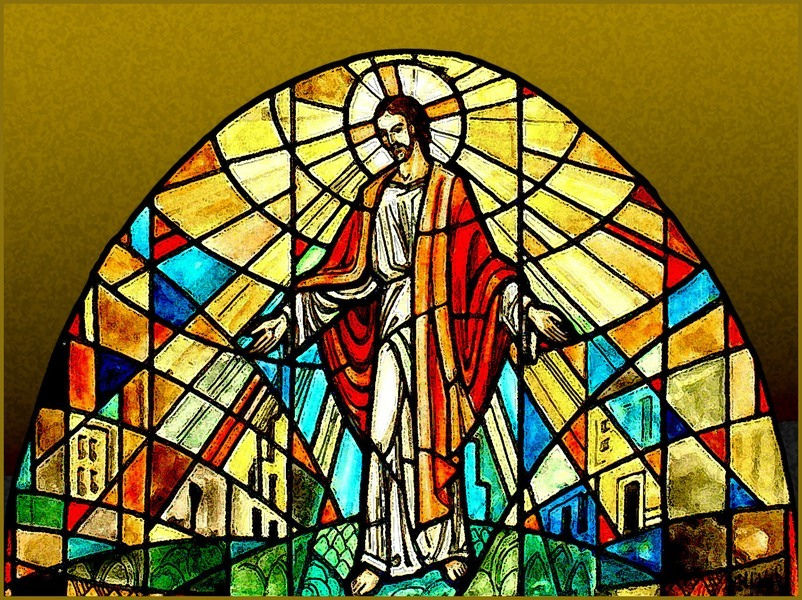
kathleen-mcguffin-rivers-of-living-water-at-arts-alive


If you want to know about Jesus, this is the story to read. We can read about his remarkable birth in a manger in Bethlehem, we can read about him feeding the multitudes by the sea, we can even read about him turning water into wine, but this little episode by the well is quintessential Jesus.

At the time, Jews avoided Samaritans. If they had to travel from the northern area of Galilee to the southern area of Jerusalem, most Jews would go hours or days out of their way to avoid passing through the region of Samaria that separated the two. Like Apartheid in South Africa or segregation in the United States, the people were separated in all things. This kind of negative and polarized relationship between the groups of people had gone on for centuries to the point where, even though they had many things in common, they believed the divide was irreparable.

And yet Jesus shows up in this Samaritan city, and under the heat of the sun at noon, he goes to the well to rest. While resting, a Samaritan woman came to draw water, and Jesus said, “Give me a drink.”

In this simple moment, a lot is going on. To begin, the unnamed woman coming to the well at the hottest part of the day is strange. Most women would have gone to the well early in the morning when it was still cool outside. The well was the area for local gossip and fellowship; it was a site for the community. And she came to the well all alone. We learn later in the scripture that she had gone from one man to another, and was now living with a man who was not her husband. It doesn’t take a lot of imagination to picture why she was separated from the other Samaritan woman, it doesn’t take a lot of imagination to picture how lonely she must have felt, and it doesn’t take a lot of imagination to picture what the people in the village would have called her: “sinner.”

The woman could not believe that this Jewish man was speaking to her, a Samaritan woman. And Jesus responds by saying, “If you knew the gift of God, and who it is that is saying to you, ‘Give me a drink,’ you would have asked him, and he would have given you the living water.

Jesus loves sinners. Here in this little story by the well we confront Jesus’ love for the marginalized, and his belief in the inherent worth of all people. When we imagine the depth of her thirst for acceptance, and the relief of the living water offered to her without cost, it compels us to ask: Do we see all people as children of God? Or do we see them as society sees them – sinners, outcasts, and poor?

Water bucket being raised from a well

There is a church in Virginia that is located right across the street from a major university. For years they have explored numerous ways to get “the young people to come to church” but they have continued to decline. They thought that by offering lectures on the importance of abstinence, or the effects of excessive drinking, or how to be political and faithful, droves of the coming generations would fill the pews on Sunday mornings.

Next to the church is a row of college housing that becomes loud and filled with debauchery on the weekends. Even though the church parking lot has numerous signs saying: “Church Parking Only” certain members were known for driving by on Saturday evenings with the explicit purpose of calling the tow company to have the party goers’ cars removed.

On one particular Friday evening, while one of the committees was meeting in the social hall, a loud and sinful party was happening right across the parking lot. The members, though tasked with discussing something like the new color for the parlor, focused their time and effort on how to fix the problem next door. They finally decided to march across the parking lot and demand that the college students stop their partying and remove their cars from the parking lot.

As they knocked and knocked on the doors the sound of their knuckles disappeared into the thundering boom of the bass and they decided they had had enough and they called the police.

With satisfied smiles across their faces, the committee stood proudly in the parking lot while tow trucks removed the vehicles, and while the police escorted those who were too young to be legally drinking in handcuffs to their cruisers.

And they still wonder why no young people attend church.

Notice: in the episode with Jesus by the well he does not say to the woman, “I know you’re a sinner, and you need to be punished for your sins.” He does not call the religious authorities for her transgressions against the law. And he does not stand by with a smug look on his face when he confronts her sinful past. Instead he says, “I can offer you living water.”

There is another church in Virginia that is located right across the street from another major university. Like the first church they struggled to get the college age population to attend their church, they struggled with the sinful behavior that was happening so close, and they wondered how they could be Jesus for these young people. One night, after a steady stream of weeks when empty beers cans were found every Sunday morning on the lawn, the pastor and a group of leaders gathered in the church to pray for the community and prayerfully discern how to move forward. They contemplated calling the police, they weighed the outcome of going over to the house and knocking on the door, but an older woman suggested that they go to the Greek life council and ask how they could help.

When the president of one of the fraternities heard their question, he laughed in response and said jokingly, “If you want to help us… we could use some food and a place to hang out in the middle of the night after a party.” Without missing a beat the same older woman from the church said, “Okay. What time?”

The following weekend, a group of faithful volunteers arrived at the church at midnight and fired up their grills. They cooked hot dogs and hamburgers, set up bean bags in the social hall, and placed signs on the lawn welcoming any college student in, regardless of inebriation, for free food. The first night only a handful of students bravely entered with puzzled looks on their faces in regard to a church that was not condemning them for their behavior, but was just trying to offer food and fellowship. But over the following weeks, more and more people arrived in the social hall every weekend thankful for the love they were experiencing.

And the strangest thing started to happen. On Sundays, when church members arrived for worship, the lawn was free of empty beers can, and though some members came in with bags under their eyes, they were thrilled to discover that many of the students who had sat on the bean bags with hamburgers in their hands the night before were sitting in the pews next to them on Sunday morning.

Who are the Samaritans to us? Our church is not located next to a large university where partying behavior can be experienced through empty beer cans on our front lawn, but there are plenty of people that we want to avoid or ignore. Many of us find that the longer we’re Christian, the more likely it is that all our friends are Christians too. Following Jesus however, means building relationships with people outside the church. We, like Jesus, are called to encounter the Samaritans and show them the love of Christ, whether they ever come to church or not.

Samaritans, therefore, are the people we ignore or avoid. That neighbor who insists on letting his dog use our lawn as a toilet; that coworker who incessantly complains about everything wrong with the business without doing anything about it; that in-law who tells us how to raise our family; that homeless man who sits on the corner of the street asking for money; that college student who plays the music in his car way too loud; that woman who has gone from man to man without finding love.

Where can we find them? We don’t have a well on the front lawn of our church, and frankly it is nearly impossible to discover our Samaritans at church. They, like the college students with churches right across the street, will not come to us; we have to go to them. We can find them in the communal spaces of life: our workplaces, our neighbors, our families. Remember that Jesus did not wait in Galilee for the Samaritans to come to him; he left the comfort and convention of the day and went to meet them where they were.

How can we give them living water? We don’t have to bring a bottle of water to everyone that exists outside of the church to share with them the love of Jesus, but’s that’s not necessarily a bad place to start. That one church found that by offering food and fellowship to their local community of college students they were offering the living water that is the love of Jesus. When we host our community cook-outs on our front lawn we are offering living water to the community through bouncy houses and free food. But finding the Samaritans in our lives, and offering them living water should be a regular occurrence and not just a once a year activity.

We give Samaritans living water by loving them no matter what. Instead of wagging our fingers in judgment against their sins or strange ways, we open our ears and listen to their struggles. Instead of looking down on others and trying to fix their problems, we share with them the crazy truth that we are broken just like them. Instead of ignoring people and leaving them to their own devices, we find them where they are and offer them the living water.

This great and powerful story is a reminder, now and always, that people who are nobodies to us are usually somebodies in the eyes of Jesus. The people we ignore are often the ones Jesus would seek out. The people we would deem sinners are the ones Jesus would spend time with.

We often think of God and Church in these big and sweeping images. We read about God’s overpowering magnificence and we experience God’s presence in majestic churches like this one. So we ask: Can a little thing like a cup of cool water, like a cheeseburger in the middle of the night, like an invitation to worship, offered in love, be the beginning of a salvation journey? The answer is yes; and we will never know what the living water can transform until we meet the Samaritan where they are and offer it in the first place. Amen.

What Is Truth?

John 18.33-38

Then Pilate entered the headquarters again, summoned Jesus, and asked him, “Are you the King of the Jews?” Jesus answered, “Do you ask this on your own, or did others tell you about me?” Pilate replied, “I am not a Jew, am I? Your own nation and the chief priests have handed you over to me. What have you done?” Jesus answered, “My kingdom is not from this world. If my kingdom were from this world, my followers would be fighting to keep me from being handed over to the Jews. But as it is, my kingdom is not from here.” Pilate asked him, “So you are a king?” Jesus answered, “You say that I am a king. For this I was born, and for this I came into the world, to testify to the truth. Everyone who belongs to the truth listens to my voice.” Pilate asked him, “What is truth?”

During the celebration of holy mass in the chapel of the Carmelite Monastery 6 members of the OCDS community made promises to the Order.  Dr. Jason Bourgeois and Judy Hawkins professed their temporary vows for 2 years and David Travers, Suzie Megown, Kathryn Theobald and Wendy Corbella professed their Difinitive Promise to the Secular Order.  Fr. Lawrence Herzog, OCD celebrated the mass which was attended by the Carmelite Nuns and families of the OCDS community.


Christ the King Sunday is the New Year’s Eve of the Christian calendar. Many of us might celebrate the New Year beginning on January 1st, but in the church the season of Advent is the beginning of our year as we wait for the coming of the Lord on Christmas. For centuries the church has celebrated this rhythm where we start a new year in anticipation of Jesus’s birth, we proclaim Jesus’ life and teachings, and we mark his death and resurrection with Holy Week. Then we look forward to the celebration of Pentecost when God’s Spirit was poured out on the first disciples, and we have a long season of what we call ordinary time to learn more about the stories from scripture.

The Christian year is built the way it is so that we retell the greatest story ever told, every year.

But just like with the celebration of New Years Eve we need a big party to mark the end of our year, we need to pull out all the stops and look back over where we’ve been, and get excited about where we’re going. We need our New Years Eve, but for us we call it Christ the King Sunday.

Since the foundation of the early church, disciples have worshipped Christ in his three offices: Prophet, Priest, and King.

Throughout the Christian year we learn about Jesus as Prophet whenever he shared a lesson with the disciples, whenever he told a parable, and whenever he spoke out against the injustices of the world. Like a true Prophet Jesus spoke the truth in love. He went out to the last, least, and lost and helped to speak words that gave them value. Jesus confronted the hypocrisy of society and challenged the world to behave according to the way God would have us to behave.

Throughout the Christian year we learn about Jesus as Priest whenever he healed the sick, fed the hungry, and clothed the naked. Like a true and holy Priest Jesus shared his final meal with his friends and told them he was offering his body and blood for their sake and for others.

Jesus atoned for the sins of the world by sacrificing himself and dying a terrible death on a cross.

Throughout the Christian year we learn about Jesus as King whenever we hear about the kingdom of God, whenever we discuss what it means to take up our cross to follow him, and whenever we confess Jesus as Lord. Like a true King Jesus watched out for the people of his community, fed the multitudes and offered a new way of life. But perhaps one of the greatest insights into what it means to worship Christ as King comes from Jesus’ interaction with Pontius Pilate.

It was early in the morning when the Jewish elders brought Jesus to Pilate with death on their minds. Of course, according to the Law, they could not kill him but they knew that the Roman leader could. So Pilate entered the headquarters and asked Jesus, “Are you the King of the Jews?” Jesus answered, “Are you asking because you want to know, or did other people tell you about who I am?” Pilate replied, “I’m not Jewish! Your people, your chief priests, your nation handed you over to me. So, what have you done?”

Jesus answered, “My kingdom is not from this world. If it were from this world, my followers would be fighting to the death to keep me from being handed over. But as it is, my kingdom is not from here.” Pilate asked, “So you are a king?” Jesus answered, “You say that I am a king. For this purpose I was born, and for this I came into the world, to testify to the truth. Everyone who belongs to the truth listens to my voice.” Pilate asked him, “What is truth?

truthianm

What is truth?

Pilate wanted to know. Christians have wanted to know. And if we’re honest with ourselves, we want to know as well. What is truth?

Seeing as how today is our New Year’s Eve, I thought we would do well to look back over the last year and examine what we have learned to be true…

In Advent we learned about how everyone is given a new beginning in Jesus Christ. That when God came into the world it changed everything, and when you discover Jesus in your heart it changes everything. It changes the way you think, the way you speak, and the way you act.

During the winter we asked tough questions about are faith like “Is it better to be cremated or buried?” and “Is it appropriate to have an American Flag in our sanctuary?” We talked about how being a Christian means sacrifice, how food will not bring us closer to God, and how God strengthens the weak.

During Lent we spent the season praying for God to cleanse us of our sins, and heal our brokenness. We got back to the basics of our faith by looking at the Ten Commandments, admitting that we cannot save ourselves, and that God is God (and we are not).

During Holy Week we went from the joy of the last supper with a foot washing on Maundy Thursday, to the shadow of the cross on Good Friday, to the glory of the resurrection on Easter Sunday.

Before Pentecost we looked to the stained glass windows in our sanctuary to learn about the faith attested in the Good Shepherd, the Methodists, and the Johns. On Pentecost we listened to two of our youth proclaim that the church is not a building but a people.

Throughout the summer we retold some of the greatest and strangest stories from the Old Testament, we even had a donkey preach one of the sermons, and we spent time praying for one another.

And this fall we addressed why we do what we do. Why we worship, why we give, why we serve, and why we pray. (All of them bring us closer to God)

What is truth? Every Sunday that we gather in this sanctuary is an attempt to answer that very question. Every sermon, every prayer, every hymn is all geared toward discovering the truth in our lives.

As we look forward to a new year in the Christian calendar we anticipate more services attempting to answer Pontius Pilate’s question and the question that rests in our hearts. We will have sermon series and bible studies, we will have prayer vigils and fellowship events, we will have baptisms, and we will have funerals, all striving to answer “What is truth?

For us today, sitting here in this worship service, Jesus has a simple and profound answer: My kingdom is not of this world.

In the wake of the tragic terrorist attacks in Paris, the French community continues to mourn and grieve over the fragility of life. For days, Parisians have gathered from across the city to place flowers and light candles in memory of all the innocent people who lost their lives.

A French interviewer recently caught sight of a father and son who were kneeling by the flowers and the interviewer asked the boy if he understood what had happened. The four year old said, “bad guys who were very mean did something very bad. We need to be very careful and my family has to move out of France.” The father quickly interrupted and said that they did not need to leave because France was their home but the son, with a quiver in his lip reminded his father about the bad guys who have guns and can shoot us because they’re really mean.

The father took a moment to think about what his son said, and then he replied, “Yes. They have guns. But we have flowers.”

The son was incredulous, “But flowers don’t do anything!”

“Of course they do,” said the father, “look, everyone is putting flowers here. It’s to fight against guns.”

“It’s to protect us?” “Exactly”

Then the son asked, “And the candles too?” “Yes. The candles are to remember all the people who are gone.”

The boy, who had clearly been distraught the whole time, finally began to smile as he took in the abundance of flowers and candles in the square and looked right at the interviewer to say, “The flowers and the candles are here to protect us.”

We live in a remarkably tumultuous world that feels like it’s on the brink of something terrible. Just turn on the television or open a newspaper and you are immediately bombarded by tragedy after tragedy. But when a young boy discovers the power of a flower, something dismissed by so much of the world, we are reminded that Jesus’ kingdom is not of this world.

It is not easy thing to be a Christian, to live our lives in such a way that Jesus is our king. Because our king asks us to do some strange things like: pray for our enemies, turn the other cheek, and give away our clothing and possessions to help those in need. But Jesus’s kingdom is not of this world, it does not harmonize with the expectations of the world.

The world tells us to gain all we can.

            Jesus tells us to give all we can.

            The world tells us to seek vengeance.

            Jesus tells us to seek forgiveness

            The world tells us to destroy our enemies.

            Jesus tells us to love our enemies as ourselves.

            The world tells us that we are the center of the universe.

            Jesus tells us that God is the center of all things.

            The world tells us ignore the weak.

            Jesus tells us that the meek shall inherit the earth.

            The world tells us that death is the end.

            Jesus tells us that death is the beginning.

What is truth? The answer to the question is our collective effort to know who we are and whose we are, to remember the stories of scripture so that they shape our lives, to live out the incarnation so that the world can be transformed.

The whole Christian year is the attempt to answer: “What is truth?

But today Jesus gives us one response: “My kingdom is not of this world.

Thanks be to God. Amen.

christ-the-king 2

Devotional – John 11.35


Devotional:

John 11.35

Jesus began to weep.

Weekly Devotional Image

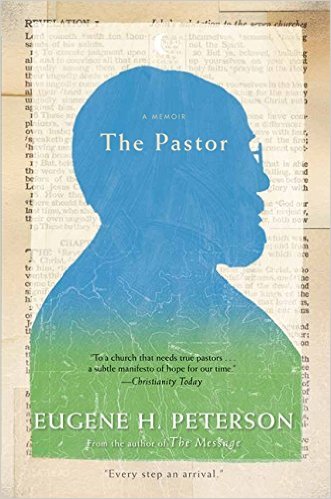
In Eugene Peterson’s memoir The Pastor he recounts the death and funeral of his mother after having buried countless church members throughout his life. As he stood before the gathered people his emotions came to a precipice and he could no longer contain himself. He writes:

“While I was reading the scriptures, tears erupted. I tried to hold them back, then gave in. I remember thinking, ‘All these people get to grieve, now it’s my turn,’ and let it come, sobbing uncontrollably. After thirty seconds or so, I recovered my composure and finished what I was doing. After the benediction, I didn’t want to see anyone and slipped into a room just off the chancel. My daughter, Karen, came in and sat beside me, without words, putting her hand on my thigh. And then a man I didn’t know came in, put his arm across my shoulder, spoke for three of four minutes in preacher clichés, and prayed. After he left I said, ‘Oh Karen, I hope I have never done that to anyone.’” (Peterson, Eugene. The Pastor: A Memoir. New York: HarperCollins, 2011. 294)

8T655xLGc

Across the great scope of Christianity, many churches will celebrate All Saints Day this Sunday. In the United Methodist Church we will use this particular opportunity in worship to remember the Saints of the church as well as all Christians both past and present. It is a time set apart to reflect on the many people who have shaped our lives, the grief we still feel regarding their deaths, and the hope of the promised resurrection.

All Saints is not a time for “preacher clichés.” It is not a time for churches to claim that God “just wanted another angel in heaven.” It is not a time for us to seek out those who are grieving and tell them how they are supposed to grieve (or worse: telling them they are supposed to be done grieving).

All Saints is a time for tears. Just like when Eugene Peterson’s wept over the death of his mother, and just like when Jesus wept over the death of Lazarus, it is good for us to grieve those who have died. This Sunday is a moment in the life of the church where we do well to let our emotions get the best of us and offer up our losses and sadness. Because it is in our grief that we really begin to appreciate those who have died and the ways they continue to shape our lives.

This week, as we prepare for All Saints Day, let us take time to reflect and pray for the people who have died in our lives. Let us thank God for their witness to God’s grace. And let us strive to sit alongside those who are grieving and bless them with our presence more than our words.

51ltEQZuJVL._SX329_BO1,204,203,200_

Devotional – John 6.60

Devotional:

John 6.60

When many of his disciples heard it, they said, “This teaching is difficult; who can accept it?”

Weekly Devotional Image

We have a great lectionary bible study at St. John’s. Every Thursday at 10:30am a dedicated group gathers to pray for one another and then read and discuss the four lectionary readings for the week. The group was started with a simple suggestion, and has grown to become one of the most life-giving teaching ministries of St. John’s.

The group is made up of both members from church, and from other churches throughout the community. With such a diverse background in church experiences, we have come to grow in faith by learning from other traditions, as well as our own.

A few weeks ago, after reading through the week’s Gospel section, one of our most faithful attendees threw up her hands and declared, “How can anyone do all this stuff?” I think that after weeks of hearing Jesus’ commands to the disciples, she was overwhelmed by how much is expected of discipleship and how consuming it can really be.

Her question is one that Christians have been asking themselves since the very first disciples. After a particularly long discussion on being the bread of life (John 6), the disciples throw up their collective hands and say, “This teaching is difficult; who can accept it?”

Fotolia_54007866_XS

In our contemporary culture, many of us want grace without expectation, we want to leave church on Sundays feeling good about ourselves, and we are ready to commit so long as the commitment is limited. We, like the first disciples, are confused by Jesus’ words when we are asked to start living accordingly. We feel good about sacrificing our time at the Food Pantry, but we refuse to forgive that person in our pew who started a hurtful rumor. We feel good about seeing children in Sunday School, but are easily annoyed by the cries from babies during worship. We feel good about the scriptures that affirm our lifestyles, and use other passages to persecute and oppress those who are different according to our world view.

Jesus’ teachings are difficult, and ask us to sacrifice nothing short of our very lives. But Jesus also offers us something greater than any political promise, social status, or monetary moment; Jesus offers us eternal life.

What teachings do you struggle with? Where do you need support in following the call to discipleship? We can grow in faith by joining bible studies that allow us to wrestle with difficult teachings in community. We can grow in faith by reaching out to the seasoned Christians in our lives and seeking their advice. And we can grow in faith by bringing our struggles to the Lord, and praying for wisdom.

The Problem With Kids Today – Sermon on John 10.11-18

John 10.11-18

“I am the good shepherd. The good shepherd lays down his life for the sheep. The hired hand, who is not the shepherd and does not own the sheep, sees the wolf coming and leaves the sheep and runs away – and the wolf snatches them and scatters them. The hired hand runs away because a hired hand does not care for the sheep. I am the good shepherd. I know my own and my own know me, just as the Father knows me and I know the Father. And I lay down my life for the sheep. I have other sheep that do not belong to this fold. I must bring them also, and they will listen to my voice. So there will be one flock, one shepherd. For this reason the Father loves me, because I lay down my life in order to take it up again. No one takes it from me, but I lay it down of my own accord. I have power to lay it down, and I have power to take it up again. I have received this command from my Father.”

IMG_0088

Happy Preschool Sunday! This morning we conclude our sermon series on our stained glass. These sermons were born out of a desire to recapture the importance of our windows and how the continue to speak into our lives. We began with The Methodists to my right: Susanna Wesley, John Wesley, and Francis Asbury. Last week we looked at The Johns: John the Evangelist, John the Presbyter, and John on Patmos. We now finish with the window behind me above the altar: Jesus as the Good Shepherd.

pg-iamshepherd-570x194

Why St. John’s?” I asked. We were sitting in the living room and going over our respective histories when I finally turned to one of my favorite questions: “Why St. John’s?” With the overwhelming abundance of churches in our community what made you choose this one?

Her answer was familiar and sounded similar to the other responses I had heard: It was where all our friends were going; it was the closest church to our neighborhood; it just made sense; it was a place our kids felt welcome. But then her answer took on a life of it’s own in a way I didn’t expect.

“But we haven’t always been here,” she said. “There was a time that we no longer wanted to come to St. John’s.” Of course my curiosity was caught and I wanted to know all the details behind their departure, but as if she was reading my mind she continued, “The ‘why’ is not important. What is important is how we came back.

“We were invited back for a particular Sunday, and though it hurt me to enter the doors of the sanctuary, I reluctantly sat down in one of the back pews. Before I knew it my mind was  flooded with all of the friendships that we cultivated in the sanctuary, all the children I had vowed to raise in the faith during their baptisms, all of the good sermons and all of the bad. But at the same time my mind was flooded with all the old arguments, the disagreements, and the frustrations.”

“But then something happened. I looked up and I saw the Good Shepherd window and everything felt right. It was like all of my worry started to slowly dissipate, and I knew that I had to come back. This was my home, because this is where I discover how the Good Shepherd watches over me.”

People and situations had driven her away. The old arguments were enough for her to leave the church behind. But miraculously enough it wasn’t people that brought her back, there were no justifications or rationalizations that would have changed her opinion. It was this window. It was Jesus as the Good Shepherd that brought her back, and it is the Good Shepherd who watches over all of us.

More often than not, the Good Shepherd stained glass window is the first thing that people notice when they enter our sanctuary. Its colors and vibrancy draw our attention and captivate us even when the sermons make us want to sleep.

It shows Jesus at his finest: leading, nurturing, and loving. The sheep are at peace knowing their shepherd is there to guide them through life. Even the abundance of blue helps to convey the deep sense of calm that comes with Jesus’s presence.

Whenever our eyes fall upon this window we are called to remember how much the Good Shepherd loves us. It shows how comforting it is to know that the Lord will hold us, and protect us, when necessary. The window exemplifies the power of the one who gave all that he had for his friends and for strangers.

Yet, even for as much as this window conveys the faith, it also muddies the waters. During the time of Jesus’ life the role of a shepherd was anything but picturesque. Shepherds were often the outcasts of society and were ignored by the masses. Jesus saying, “I am the good shepherd” would have bewildered the religious elite and the powerful. It had a certain edge to it.

This week I gathered all of our preschoolers into the choir loft to teach them about Jesus as the Good Shepherd. Like we all do, they noticed how beautiful Jesus looks in the image and how he cares for the sheep. “The sheep is like a baby” one of the kids yelled out. I remember thinking: “Yes yes, thats all good and true, but there is so much more to what it means to shepherd.”

I-am-Series_Shepherd

When describing himself as the good shepherd Jesus uses the hired hand as a comparison. The hired hand is someone who is only concerned with monetary gains, expends the minimum amount of work necessary, and will not risk life or limb for the sake of others. The hired hand is like the person who is so selfish that they ignore the needs of others.

Jesus, however, lays down his life for the sheep and promises to never let them, us, go. His voice will always draw us back because we belong to him. 

I love our preschoolers and this time of the year is always bittersweet for me. We are preparing for the end of year program, and our eldest class will be heading off to kindergarten in the fall. I spend enough time with them in the basement that I know the ins and outs of their little personalities, I know who to separate during chapel time for optimal focus, I know what jokes they will laugh at, and I know what to do and what to say to stop them from crying. I love them and I believe that I would be willing to lay my life down for them. I would do whatever it takes to protect them because each of them is a child of God.

But then I wonder if I would do the same thing for the adults in my life… I mean I love all of you too, but there’s just something about the desire to protect children that makes us stronger and braver than we normally are. For some reasons we value them as being more important than those who are older, and we prioritize their needs over others. We would do things for children that we would never do for others.

The problem with kids today, is that they are better than us.

After we looked at the window this week, I brought the preschoolers outside to demonstrate what it means to be a shepherd. I gathered a group in the middle of the yard, and I pulled four kids out to be the shepherds. I explained that I would be a wolf trying to get at the sheep in the middle, and the shepherds had to do whatever they could to protect the sheep.

It worked brilliantly. Every time I rushed forward the shepherds converged on me and pushed me back, and when I tried to run around and juke them they rearranged and protected their friends; no matter what I did, the little shepherds were going to do whatever they could to protect the sheep.

But that’s when I noticed something remarkable: The group of sheep in the middle had been holding hands the entire time. Now let me be clear, I did not instruct them to hold hands or to watch out for each other, but they did it on their own. Even more remarkable is the fact that the older kids placed the younger ones in the middle to protect them even more while they held hands. It was easily one of the most beautiful things I have ever seen.

The problem with kids today, is that they are better than us.

In our little preschool rooms, and in our community, kids are the ones who are acting more like Jesus than the adults. While we complain and groan about those who are different than us, people who do not look, think, and talk like us, kids are going out to meet them where they are. Jesus sought out the lost, the ones who needed to be rescued, the ones who are forgotten in our society. In our preschool rooms the children do whatever they can to involve everyone and show them they are loved.

11209625_10203918612636680_1355383082406316117_n

If you want to know what Jesus was really like, spend just 5 minutes with one of our preschoolers. During snack time they are willing to give up their food for the person who mentions they are still hungry. When they are playing with different objects in different stations they will include everyone in the activity no matter what. When they work on art projects they pay one another the nicest compliments regardless of how well the finger painting actually turns out. And when we were outside this week, the shepherds took care of the sheep while the sheep took care of one another.

The problem with kids today, is that they are better than us. 

We should start looking to them more often about what it means to be faithful, than expecting them to learn everything from us.

We all hunger to know and be known. Many of us (adults) create virtual communities on the internet because forming real and authentic connections is hard work. It requires face to face intimacy, a willingness to listen, and vulnerability all at the same time in a way that a phone and computer screen can never allow. Kids don’t have the benefit of social networking to create friendships, they have to do it the old fashioned way, and they’re better at it than we are.

God’s community is open and inclusive. Jesus not only cares for the sheep but gathers them into the flock. Those who are curious about what it means to be a disciple are invited into Jesus’ community no matter what: the door is always wide open to the outcasts: You know, the people whose lives are messy, whose families are not the perfect “husband-wife-2.5-children” scenario, who live in fear between paychecks, and who wonder if anyone knows how they really feel.

Today Jesus is still welcoming and inviting people who are often excluded based on the standards of our time. Kids don’t have the benefit of immediately recognizing someone’s socio-economic status, they aren’t concerned with where their parents went to college or even if they didn’t, they aren’t worried about the color of their skin or the shape of their bodies: they just want to love and be loved. 

So how can we create an authentic and life-giving community? We begin by following the example of our kids…

Imagine, if you can, what it would look like if we stopped excluding people based on our warped standards: wealth, status, race, sexual orientation, and physical condition. What if we started treating people with respects regardless of who they were and what they had done? What do you think would happen if we really started to take care of one another without judgment or expectation of reciprocation?

It wouldn’t be easy, but it would be more like the kingdom than the way we are living right now. Amen.

The Johns – Sermon on John 15.9-11, 1 John 2.15-17, and Revelation 21.1-5

John 15.9-11

As the Father has loved me, so I have loved you; abide in my love. If you keep my commandments, you will abide in my love, just as I have kept my Father’s commandments and abide in his love. I have said these things to you so that my joy may be in you, and that your joy may be complete.

1 John 2.15-17

Do not love the world or the things in the world. The love of the Father is not in those who love the world; for all that is in the world – the desire of the flesh, the desire of the eyes, the pride in riches – comes not from the Father but from the world. And the world and its desire are passing away, but those who do the will of God live forever.

Revelation 21.1-5

Then I saw a new heaven and a new earth; for the first heaven and the first earth had passed away, and the sea was no more. And I saw the holy city, the new Jerusalem, coming down out of heaven from God, prepared as a bride adorned for her husband. And I heard a loud voice from the throne saying, “See, the home of God is among mortals. He will dwell with them; they will be his peoples, and God himself will be with them; he will wipe away every tear from their eyes. Death will be no more; mourning and crying and pain will be no more, for the first things have passed away.” And the one who was seated on the throne said, “See, I am making all things new.” Also he said, “Write this, for these words are trustworthy and true.”

IMG_0058

“Taylor, the bishop is appointing you to St. John’s United Methodist Church in Staunton, Virginia. We believe the church fits with your gifts and graces and we are excited to see what the Holy Spirit can do through you there.” Those were the words used to let me know where I would be spending the next few years of my life. I remember how I felt with the phone next to my ear and Lindsey by my side when I found out that I would be coming here to serve this church.

Obviously, for the next few days all I could think about was the church and the community. What would you all be like? Would we enjoy living here? What would we do for fun? How would you respond to me as your pastor?

Of course I Googled the church, searched the church name in the local newspaper databases, and even looked up the address of the parsonage. And for as many things as I could discover, more questions began to develop to the point where I had to just stop and accept that this is where I was going.

However, one question remained in the back of my mind during the months leading up to my first Sunday. I was fine letting everything else go, I was content with the unknown, except for one thing: Why St. John’s?

Now I don’t mean why this church out of all the churches in the Virginia conference, though I have wondered about that at times. What I mean is this: Why is the church named St. John’s?

Do any of you know? Church naming often carries an interesting history. Like when a group of people from a Baptist church grow frustrated with another group and decide to leave and start a new church with the ironic name of Harmony Baptist.

Or like what we have here in town with 1st Presbyterian, 2nd Presbyterian, 3rd Presbyterian, etc. I would love to know the story behind that.

Anyway, why are we called St. John’s?

The story goes that a long time ago there was a particularly advantageous District Superintendent who dreamed of 4 new churches in the Staunton District. The population was booming in the valley and he believed it was time for the Methodist Church to start breaking ground and forming church homes for new people. He wanted 4 new churches and he wanted them to be named after the gospels: Matthew, Mark, Luke, and John. Though only two of them ever came to fruition: Mark and John.

Now, is that really how we got our name? I have no idea, but thats the story everyone seems to tell.

I want to know if thats the story we want to tell. That the name of this blessed house of the Lord got its name from some guy in the past who wanted to leave his mark in Staunton. Or do we want to take ownership of our name, and live into the reality of what it means to be St. John’s?

Our name is part of who we are, it is a part of our very identity, for better or worse. If we were First UMC I would expect that we were the first to break ground in Staunton, that we would be leading the community in what it means to love one another. If we were Harmony UMC I would expect a church full of people who agreed on everything all the time, no matter what. If we were Wesley UMC I would expect that John Wesley would be fundamental to our mission and work in the kingdom.

But if we call ourselves St. John’s, then who are we?

IMG_0063

On the right side of our sanctuary we have three stained glass windows that I call The Johns. We have John the Evangelist, John of Patmos, and John the Presbyter. Do they represent three different and distinct men? Are they in fact all the same person, just being shown throughout the different decades?

Early Christian tradition held that John was one of the original 12 disciples who actually lived a long life and was not killed for his faith like the others. It is believed that he was responsible for writing the gospel according to John, the letters 1-3 John, and the final book of the New Testament Revelation. Of course modern scholars debate as to the particular authorship and whether or not one man was responsible for all of these different writings.

What is important for us is the fact that we affirm all of the writing as canon and life-giving, that Christians for centuries have come to discover the living God in the words attributed to John, and that we will continue to live into our discipleship through them.

Our first window displays the young John as the Evangelist. Today when we hear the word evangelism we tend to picture people converting others to follow Christ, but in its most simple meaning, an evangelist is someone who shares the Good News, and in this case, it came through a written account of Jesus life and ministry.

We see a young John holding a chalice and the image of an eagle. The chalice serves to emphasize the importance of the sacrament, and the pouring out of Jesus blood for us. Throughout the gospel of John, Jesus’ atoning sacrifice is a particular focus and theme. Reflecting on Jesus life later, John could remember everything through the lens of the resurrection, and we see the importance of Jesus’ life here in the chalice.

The other detail, the eagle, is very interesting. In Revelation, a book we will talk about shortly, there is a brief section where John describes four winged creatures from his dream. Each of them have come to represent a specific gospel and it’s respective author: Matthew is a man with wings, or an angel; Mark is a lion; Luke is an ox; and John is the eagle.

Whenever our eyes fall to this window we are called to remember the Father’s love in Christ Jesus. Like the winged eagle flying high in the sky we look up to the kind of love that Jesus exemplified and strive to live accordingly. The great sacrifice was made so that our joy could be complete in and with one another as we look on eternity without flinching as we journey toward the goal of communing with the Lord.

John the Evangelist wrote what he did to remember for us what his master taught him: As the Father has loved me, so I have loved you; abide in my love.

Our second window, the one to the right, contains John as the Presbyter. Presbyter comes from the greek word presbuteros which means “elder.” As John grew older and continued to play an integral role in the formation of the early church, it became necessary for him to write letters concerning the faith.

In the window we see a mature John with a quill and parchment. Like we still do today, whenever we encounter the struggles of fellow disciples, we strive to help them through their trials and tribulations. For John, having lived with Christ and experienced the true power of the resurrection, he devoted himself to the early Christians and helped them to understand the importance of love.

He wrote things like: “Do not love the world or the things in the world.” Only a man speaking from a life of wisdom could make such a statement. The desires of flesh and the prides in riches only serve to destroy us because they wither away. All of the false things that we put our faith and hope in are passing away, but the love of God endures forever and ever.

Whenever we glance to this window of John as the Presbyter, we are called to remember the value of wisdom and what it means to grow together. Being Christian is not something that can be done in isolation, but instead can only be fruitful and life-giving if we disciple as a community. John wrote letters to encourage and remind the faithful what it means to be faithful. As disciples we have the responsibility to build one another up for kingdom work.

John the Presbyter wrote to Christian communities about what faithful living was all about: those who do the will of God live forever.

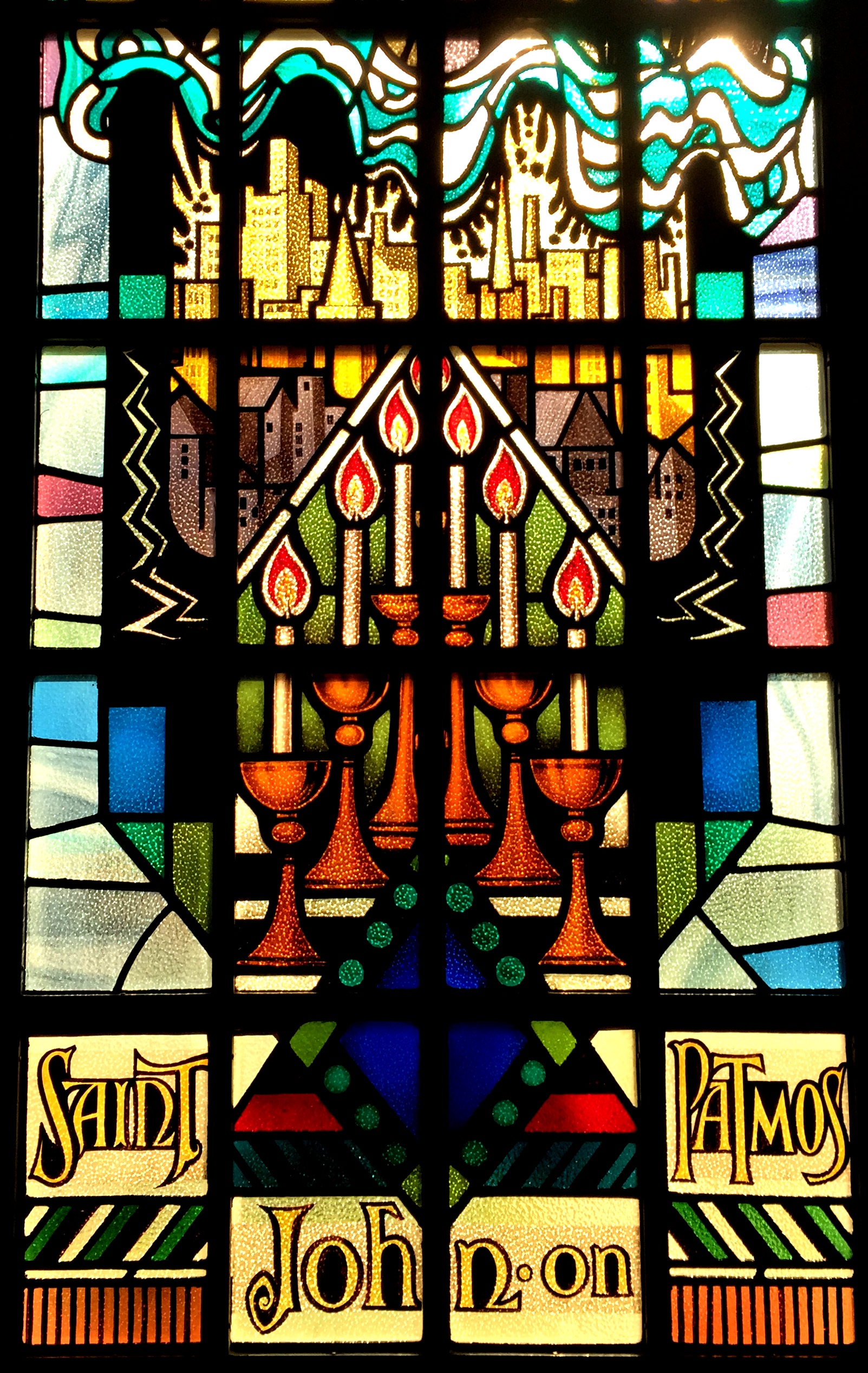
The third window, in the middle, contains John on Patmos. After a life of faith, John was exiled away to Patmos, a small Greek island in the Aegean Sea where he wrote about his visions. The book of Revelation contains fantastic imagery of the way God has, is, and will move  in the world. Our final John is older with a fiery city at his feet, and the new Jerusalem above his head with the lamb.

The Lord gave John certain visions and told him to write them down because they were trustworthy and true. Our window displays the height of the revelation when God will make all things new. A holy city, the new Jerusalem, will come down from heaven. This is where God will dwell with the people, God will wipe away all of our tears. Death will be no more; mourning and crying and pain will be no more. The first things will pass away because God will make all things new.

In our window we see the former things, the earthly passions of the world at the bottom passing away. But God has not, and will not, abandon us to our own devices. The new city at the top will reign and the kingdom will be forever. 

Whenever our eyes fall upon this window we remember that the Lord is with us now and forever. That even in our death we will come closer to the new heaven and the new earth that the Lord has promised. In the midst of our grief and suffering now we can still give thanks to the Lord for that day when he will make all things new. This window calls us to trust the Lord just like John did throughout his life.

John on Patmos wrote down the visions the Lord had provided so that others would come to know what the future holds: The Lord will dwell with us and make all things new. 

St Johns logo

Who are we? A group of Christians who get together week after week to rediscover what it means to follow Christ? A ragtag collection of disciples who need to find a little more light in our lives?

If we want to live into our name, then we need a better story than being named by a District Superintendent. If we want to be the St. John’s that God is calling us to be, then we need to reclaim what that name means for us.

We are St. John’s. That very name carries with it the history of what our church has done for this community. Wherever I go in Staunton I love to tell people that I serve as the pastor here at St. John’s because our name is immediately met with recognition; “My children went to Preschool there!” “My wife and I were married in that sanctuary.” “We buy our Christmas tree from your church every year.”

But we are also more than what we do. Our identity is firmly rooted in the name of John and we should be proud of it. We were named after a man who was called to follow Jesus, remembered the Messiah’s life for other communities, wrote to churches about faithful wisdom, and caught glimpses of future glory. 

Likewise, we are a community of faith that believes in following the Lord, in sharing God’s story with other people, in teaching those younger in the faith about what it means to love, in celebrating the coming day when God will make all things new.

St. John’s; what a perfect name. Amen.

Devotional – John 15.1-2

Devotional:

John 15.1-2

“I am the true vine, and my Father is the vinegrower. He removes every branch in me that bears no fruit. Every branch that bears fruit he prunes to make it bear more fruit. 

Weekly Devotional Image

Sometimes I speak before thinking. The Bishop had come into town to address a gathering of clergy about upcoming initiatives and events in the life of our Annual Conference. We spent a significant amount of time addressing the metrics that all United Methodist Churches are required to measure and report on a weekly basis including: Worship Attendance, Weekly Offering, Professions of Faith, Christian Formation Groups, Mission Giving/Persons in Mission. When the presentation came to a conclusion, the Bishop opened the floor for questions. A few timid hands rose from the pews with standard questions about particular theological issues that the church is still wrestling with, and before I knew it I had my hand sticking straight up in the air and the bishop asked for my question.

I thanked the bishop for taking time to speak with us and then I launched right into my question. It went something like this: “I can appreciate the need to log our metric data every week as we seek to be better stewards of our churches and continue to make disciples of Jesus Christ for the transformation of the world. However, what are we doing about the churches that are no longer fruitful? Are we addressing their negative data? Because I seem to remember a time when Jesus said ‘I am the vine, and my Father in the vinegrower, and he removes the branches that no longer bear fruit.’” At that moment a number of the clergy in the room began to laugh nervously and I continued on, “I’m not kidding around. If we’re serious about living into God’s kingdom here and now, then are we willing to cut off the branches that are no longer bearing fruit?”

The silence that followed was palpable.

The Bishop took his time to address my question and explained that we need to mourn the loss of any church, but the coming reality is that some churches are no longer bearing fruit and we will have to do something about it eventually. I recognize now that I could’ve articulated my question in a gentler fashion, but I still stand by Christ’s words.

28db47277dd96e9320e317029a5112db

In our faith journeys, and in our churches, we tend to desire change by addition while Christ articulated an alternative. If something is not bearing fruit in our churches or in our lives, what would it look like for us to cut them away? The future of our faith and church is largely dependent on our willingness to sacrifice the branches that have continued to wither away while other branches are bearing fruit in other places.

This week, let us take a good look at our lives to see whether or not we are bearing fruit. Let us pray to the Lord for guidance about how we can be better stewards of our churches and bear fruit for God’s kingdom.

Devotional – John 10.16

Devotional:

John 10.16

I have other sheep that do not belong to this fold. I must bring them also, and they will listen to my voice. So there will be one flock, one shepherd.  

Weekly Devotional Image

“What is the greatest challenge ahead for you?” This question is asked on a regular basis between myself and a number of clergy colleagues who live in the same community. Whether we are meeting for a cup of coffee, bumping into one another at a grocery store, or during an assigned clergy gathering, this question has helped us to grow as pastoral leaders and offer advice to our friends.

When I arrived at my current appointment, I assumed that other pastors would reach out and welcome me to the community. For the first few months I waited and waited and heard nothing. So one afternoon I pulled out a map and decided to visit all of the nearby churches and introduce myself as the new United Methodist pastor at St. John’s. I will never forget the look of shock on a number of pastors faces when I showed up at the door with my hand outstretched; for some of them I was the first pastor they met in our community even though many of them had been here for a number of years.

At the foundation of the United Methodist Church is our connectional system. By way of polity, and theology, we are (supposed to be) intimately connected with our brother and sister churches. We rely on one another for kingdom work and sharing resources to better live out God’s will on earth. However we also have a responsibility to connect with other churches outside of our denomination. After all, there is one true shepherd and we are all part of his one flock.

Over the last two years I have formed strong bonds with other clergy in Staunton and I believe that our willingness to grow in faith with one another has been a blessing to the greater community. Every church is different and faces unique challenges. Yet, when we spend time working with other leaders it allows us to learn and glean from one another, rather than trying to do it all on our own.

Fired-loveoneanother

Jesus told the disciples there were other sheep that did not belong to that particular fold, but there would be one flock and one shepherd. Today, many communities are peppered with varying churches and denominations representing a number of traditions. If we cannot learn to work with, and appreciate, one another then we are preventing the Church from being led by the Good Shepherd. If churches continue to view others as competition, rather than brothers and sisters, then the Church will continue to decline and no longer bear fruit in the world.

We are in this great and cosmic thing called discipleship together. We can learn from other traditions and denominations because we are all part of God’s flock and Jesus, as the shepherd, will always be here for the sheep. This week, let us challenge ourselves to really see fellow Christians as Christians, instead of seeing them as Presbyterians, Baptists, Catholics, Methodists, Anglicans, Episcopalians, etc. Let us learn to ask good and important questions so that we might all grow in faithfulness together.


Devotional – John 20.30

Devotional:

John 20.30

Now Jesus did many other signs in the presence of his disciples, which are not written in this book.

Weekly Devotional Image

My favorite piece of scripture is Mark 10.45: For the Son of man came not to be served but to serve, and to give his life a ransom for many.” I love the idea that, like Jesus, we are called to serve the needs of others rather than focusing on ourselves all the time. One of the verses that has made the most impact in my life is from Matthew 27.46: “And about three o’clock Jesus cried with a loud voice, “Eli, Eli, lema sabachthani?” that is, ‘My God, my God, why have you forsaken me?’” Through it I began to realize the depth of Jesus’ humanity and what he went through on our behalf.

There are plenty of verses that make me laugh, like Acts 20.9: “A young man named Eutychus, who was sitting in the window, began to sink off into a deep sleep while Paul talked still longer. Overcome by sleep, he fell to the ground three floors below and was picked up dead.” And there are some passages that leave me scratching my head in confusion, like Mark 9.50: “Salt is good; but if salt has lost its saltiness, how can you season it?”

th

Last Easter my friend Jason Micheli preached his sermon on what he called “the biblical verse that really ticks [him] off, the scripture verse that irritates the you-know-what out of [him] is John 20.30: Now Jesus did many other signs in the presence of his disciples, which are not written in this book.”

And I have to agree with him.

Why in the world would John omit other stories about Jesus’ life? If there were other miracles, other teachings, other divine moments, why wouldn’t he include them in the gospel? Most of the time I read from the bible I feel very fulfilled, but when I read John 20.30 I feel like I got short-changed.

Yet, on some level, I feel like it’s quite appropriate. If Easter tells us anything it’s that the living Lord is still on the move meeting us on the roads of life. John’s gospel could never contain all of Jesus’ miracles because he is still making them happen here and now. Sometimes we believe that we can only find and discover the Lord in the sacred texts of scripture, but that’s when we need to open our eyes to the wonders around us and see how God is still moving in the world.

When was the last time you felt the presence of God? Hopefully you experienced the Spirit of the Lord during your recent Easter service, or maybe you discovered God in the breaking of bread during communion. This week, let us all take heart knowing that we can find God in the words of scripture and in our experiences in the world.

Washing With Tears – Maundy Thursday Homily on John 13.12-20

John 13.12-20

After he had washed their feet, had put on his robe, and had returned to the table, he said to them, “Do you know what I have done to you? You call me Teacher and Lord – and you are right, for that is what I am. So if I, your Lord and Teacher, have washed your feet, you also ought to wash one another’s feet. For I have set you an example, that you also should do as I have done to you. Very truly, I tell you, servants are not greater than their master, nor are messengers greater than the one who sent them. If you know these things, you are blessed if you do them. I am not speaking of all of you; I know whom I have chosen. But it is to fulfill the scripture, ‘The one who are my bread has lifted his heel against me.’ I tell you this now, before it occurs, so that when it does occur, you may believe that I am he. Very truly, I tell you, whoever receives one whom I send receives me; and whoever receives me receives him who sent me.”

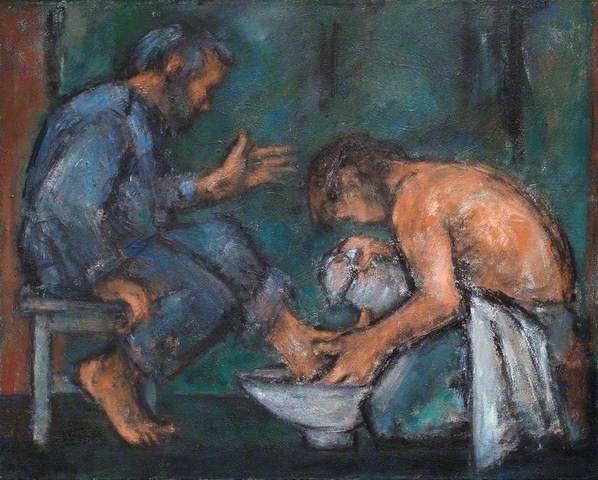
bbo_ob_mcmca_40_slide

The disciples had already finished their food, they had passed around the bread and the cup, and Jesus had told them it was his body and blood. For many of them these words might’ve gone in one ear and out the other; after all Jesus was known for saying all sorts of the things that didn’t make sense right away. Perhaps some of them were picking up the crumbs from the bread when Jesus got up from the table. Others might have been refilling their cups with wine when Jesus tied a towel around his waist. But by the time he started to wash their feet the room must have been silent. 

Imagine how profound it would have been to see Jesus kneeling on the floor and using water to wash away the grime of Jerusalem. Even more amazing is the fact that Jesus doesn’t waste time explaining what he’s about to do, he just gets down on the ground and goes to work.

However, Peter, the ever vocal disciple interrupts the serene mood with a question: “Lord, are you going to wash my feet?

“Right now it won’t make sense my friend, but soon it will all come together. If you want to be in this with me, you must let me wash your feet.”

Jesus went from one disciple to the next taking as much time as necessary, holding their feet in his hands, letting the water drip upon them, until he finished.

I took a group of middle-schoolers on a mission trip a number of years ago to Winchester, Virginia. We worked in trailer parks building wooden steps up to the doors, we worked on a wheel chair ramp that took up an entire yard, and we worked on clearing out areas that had been long forgotten. All week we did everything we could to serve the needs of the people from the nearby community, and every night we gathered to sing songs and praise our Lord.

At the end of the week we were invited into the fellowship hall for a foot-washing ceremony. I don’t know if any of you have had the chance to spend a week working outside with middle-schoolers, but it begins to smell pretty bad pretty fast; the prospect of washing one another’s feet was not high on my list of priorities. The leader explained that long ago Jesus washed his disciples feet and we would be doing the same thing. Everyone was invited to participate, but if you were uncomfortable you could simply ask for a prayer instead.

A few chairs and basins were set in the middle of the space, and when the music began we were on our own.

In my work group there was a precious young girl who had worked so incredibly hard all week and there was a young boy that annoyed her every chance he had. He would begin by playfully flicking paint onto her clothes, but when she asked him to stop he became relentless. He called her names behind her back, and schemed to turn the other kids against her. Even after I pulled him aside to set him straight he continued to prey on her at every opportunity. 

As we sat in the room waiting for the first people to go forward for the foot washing, I watched the young girl stand up, and bee-line across the room for the annoying boy. For a fleeting moment I was afraid that she had finally had too much and she was about to sock him in the face, but instead she leaned over and asked if she could wash his feet.

While other people started to do the same, my gaze was transfixed on the boy and girl from my group. The boy had gone over the line time and time again yet there she was holding his foot in her hand and washing it. When I looked closer I saw that she was crying and her tears were falling on his feet. And when I looked even closer I saw that he was crying and his tears were falling in her hair.

Foot washing is a service among equals in a company where no one’s status stands out. When Jesus finished with his friends, he called them to do the same to one another. We wash and are washed by our Lord through our brothers and sisters in Christ. When we kneel before a fellow Christian and hold their feet in our hands we make our way back to the upper room so long ago. We aren’t just called to wash the feet of those whom we love, but even the ones who drive us crazy and fill us with anger. Remember: Jesus washed Judas’ feet knowing full and well what he was about to do. 

Sometimes the people we need to reconcile with most are the ones in the pews next to us. We tend to sweep under the rug all of the proverbial problems we have with our friends and family and are far more inclined to complain about strangers. If we are filled with stress regarding the closest people in our lives than this might be the best place to embark on a new beginning. Perhaps the water can bring new life for us and for the ones we love and hate.

Jesus took time after breaking bread with his friends to wash their feet. He humbled himself to the floor and showed them what faithful love looks like. With each foot he equipped them for bringing the peace of God into the world. He washed away their insufficiencies and doubts. He rid them of labels and assumptions. He showed them how important they were for the kingdom of God.

If you want to know what faithful love looks like, look no further than this time when we follow the example of Jesus and wash one another. Amen.

IMG_2100