Making The Familiar Strange

Matthew 22.34-46

When the Pharisees heard that he had silenced the Sadducees, they gathered together, and one of them, a lawyer, asked him a question to test him. “Teacher, which commandment in the law is the greatest?” He said to him, “‘You shall love the Lord your God with all your heart, and with all your soul, and with all your mind.’ This is the greatest and first commandment. And a second is like it: ‘You shall love your neighbor as yourself.’ On these two commandments hang all the law and the prophets.” Now while the Pharisees were gathered together, Jesus asked them this question: “What do you think of the Messiah? Whose son is he?” They said to him, “The son of David.” He said to them, “How is it then that David by the Spirit calls him Lord, saying, ‘The Lord said to my Lord, “Sit at my right hand, until I put your enemies under your feet”’? If David thus calls him Lord, how can he be his son?” No one was able to give him an answer, nor from that day did anyone dare to ask him any more questions.

He liked to mow his lawn early in the morning while it was still cool. It was a welcome reprieve from his busy life to just drive back and forth with his riding lawn mower week after week. And, one morning, after finishing the lawn, the man maneuvered the mower back toward the garage when out of nowhere BAM he was tackled off of the mower and onto the ground. 

The man and his assailant rolled down the driveway and grappled until they came to a stop, and that’s when the fighting really began.

Hours later the formerly mowing man was resting in the hospital with five broken ribs wondering what in the world had led to all of this.

The man, as it turns out, was Rand Paul, the junior Republican Senator from the state of Kentucky. And for months the media speculated as to why the scuffle took place. In our heightened political atmosphere, with tensions running rampant, there was immense suspicion that the attacker was an avid opponent of Ran Paul’s political proclivities who felt the only the only recourse for their disagreements was violence. 

It was a frightening moment for lawmakers across the country as they each wondered if it could happen to them too.

Months later, when the assailant was finally brought before a judge, the truth came out: The attacker was Rand Paul’s neighbor, and he was tied of Rand Paul’s lawn clippings getting blown into his yard.

While a great sum of people assumed that Rand Paul’s political leanings were to blame for the attack, while the media continued to postulate theories about a “national political scandal,” it was all about a neighbor squabble.

Love your neighbor as yourself. 

Every week the Christian church is compelled and downright forced to rediscover the strange new world of the Bible. 

Whether it’s a church in Northern Virginia streaming its worship to the likes of Facebook and YouTube, or a house church meeting in a dingy basement, or the greatest of cathedrals with giant stained glass windows, we are all invited into the scriptures to learn more about who we are and whose we are.

And it is, indeed, a strange new world that Matthew describes for us today. Therefore, our task, the church’s task, is not the make the Gospel intelligible in the light of the world we live in – we don’t start with the world and then do what we can to accommodate God’s Word to it. Rather, we allow the strange new world of the Bible to reveal how the world we live in has already been transformed through the new creation wrought in Jesus Christ.

This is no easy task.

For, many of us are too familiar with certain scriptures such that we no longer consider them strange. After all, what could be strange about a church preaching love? 

And yet, when we read about this little moment containing Jesus pronouncement of love, we do not see how it is meant to turn the world, our world, upside down.

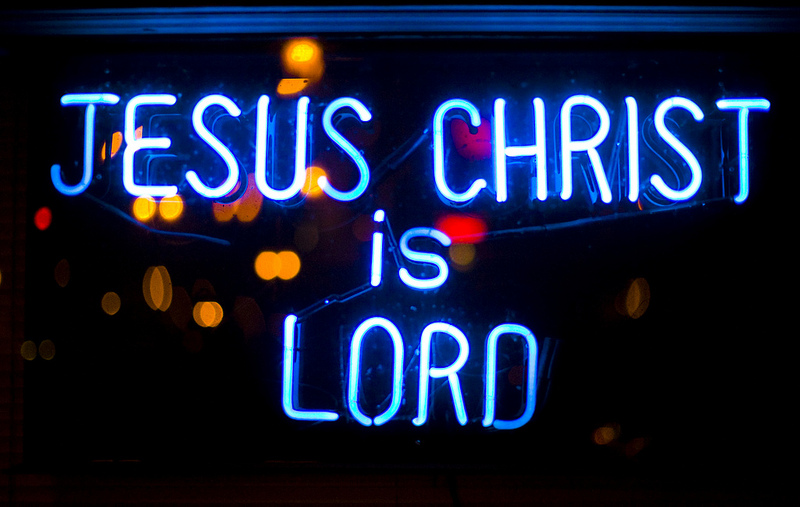
Throughout most of the church’s history, it has been all too easy to remake and reimagine Jesus in our own image. It’s why, today, any of us can drive through our neighborhoods and see what appears to be a presidential election sign in someone’s front yard but then upon closer inspection we discover it says “Jesus 2020,” and its not altogether clear whether a Republican or a Democrat lives in the house.

That this happens is indicative of the fact that all of us, at times, are guilty of picking and choosing our own verses from the strange new world of the Bible in order to project a version of Jesus that makes him into our image rather than the other way around.

And, most of the time, ideological divides notwithstanding, the Jesus we tend to choose is a harmless, gently suggestive, long-haired hippy; a Jesus we can imagine playing Kumbaya around the fire; a Jesus who just wants us to all get along. 

That Jesus is the same kind of “quivering mass of availability” (as Stanley Hauerwas puts it) that many of my fellows pastors and I have become. We’ve leaned so far into our inherent people pleasing sensibilities that we try so hard to be all things to all people and we neglect to offer the Words of Jesus to the people we serve.

But Matthew’s Gospel, particularly here in these string of passages leading up to the crucifixion, presents the Lord who knows that, sometimes, there are things worth getting worked up about, things worth arguing over, things that call for a louder voice and a deeper conviction.

Listen – Having silenced the scribes and the Sadducees, the Pharisees picked a lawyer to trap Jesus in his words, again. “Teacher, which of the commandments is the greatest?”

“Um” Jesus says, “Have you all not been reading the scriptures and going to synagogue? You know the answer: You shall love the Lord your God with all your heart, soul, mind, and strength. It’s in Deuteronomy. Go look it up.” 

The lawyer nods his head in approval but Jesus keeps going, “But there’s another one just like it. This one’s from Leviticus: You shall love you neighbor as yourself. On these two commandments hang all the law and the prophets.”

And after hearing that, no one dared to ask him another question.

“Love God and love neighbor – that’s it,” Jesus seems to say. And that line of thinking and proclamation easily leads to a Hallmark version of the church where all we ever do is meekly suggest that a little kindness every once in a while wouldn’t hurt anybody.

It’s why pastors, including myself, have used the story of Rand Paul and his driveway throw-down as a way to convince congregations to be nicer to their neighbors.

And yet, according to Matthew’s Gospel, all of the things leading up to this exchange, the flipping of the tables in the temple, and the belittling of the biblical literacy of the scribes and the Pharisees, and the mic-dropping at the end of a brief discourse on tax avoidance, are all part of how Jesus loves.

Jesus, our Lord, chooses this moment, after all the conflict and controversy, to patiently explain that the most important thing of all, the great of all the laws and commandments, is to love God and neighbor. 

Which begs the question, “Do we really know what that kind of love looks like?”

More often than not, the love we preach about in church is used as an excuse to do whatever is necessary to keep as many people happy as possible – the path of least resistance has become our way of loving God and neighbor.

When truth-telling would be far too uncomfortable, we practice silence and call it love.

When showing up to call into question the powers and principalities of this life requires too much of us, we remain content to stay home and we call it love.

When confronting our neighbors in their sinfulness feels too difficult, we build up higher fences and call it love.

Love, then, becomes the codeword for letting people get away with just about anything and everything. 

However, the earliest Christians, those who truly put their lives on the line for their faith, were not persecuted for what they believed (Jesus is Lord) but for what they refused to believe (Caesar is Lord). The church, today and always, is distinguished not only by what we stand for, but also by what we condemn. 

We can stand and call for love until we’re blue in the face, but what good is love if nothing ever changes?

A pastor named Carlyle Marney used to reject his fellow pastors for degenerating into a preaching style that came off as self-help therapy. He would say, “You preachers are always saying, ‘Bless, bless, bless’ when you ought to be saying, ‘Damn! Damn! Damn!’”

Consider: “God loves you just the way you are,” is an all too common refrain in the church these days and I am guilty of it as well. There are people who need to be told those words for a great number of reasons. But there are also an equal number of people who need to be reminded, myself included, that remaining as we are only makes a mockery of what God in Christ did for us.

Here’s an example: A beloved hymn of the church is Just As I Am (the hymn we used earlier in the service)

Just as I am without one plea” sounds an awful lot like God loves us just the way we are. Except, the very next words are, “But that thy blood was shed for me.”

Christ’s blood was shed for us precisely because of who we are! The rest of the hymn goes on to talk about the poor, the wretched, the blind and fighting and fears within and without. Those words aren’t describing other people – they’re describing us! The ones for whom Christ died!

The cross and resurrection rectify us, the make right what was wrong, they change us. That means we cannot remain as we were or as we are. We, all of us, the good and the bad, are being worked on by God in ways both seen and unseen. 

But that doesn’t sound like the kind of love we so often talk about in church. We’re content to hear the call to do a nice thing every once in a while, or the need to spread a little kindness, or a host of other lovely opportunities. 

And yet love, at least according to the strange new world of the Bible, doesn’t look like what happens on Valentine’s Day, or even suggestions from a local civic organization. 

Instead, love looks like the cross.

And that kind of love is dangerous.

The Jesus we encounter in the strange new world of the Bible understands that to love God with heart, soul, mind, and strength, and to love your neighbor as yourself is demanding and risky.  

Following the path of love, at least for Jesus, means jumping into debates, it means calling into question the powers and principalities, it means not letting the world continue on in its backwards and broken ways.

And that kind of love got Jesus killed.

Of course, we are not the Lord, thanks be to God. In the end God does what we wouldn’t and couldn’t. And that’s the whole point. 

We are called to a love that we regularly fail to do.

To know what it means to love God and neighbor, as Jesus defines it, requires us to take seriously the way Jesus loved. His love is seen in his willingness to eat with the outcast, to reach out to the untouchable, to embrace the powerless, to confront the demonic, to outmaneuver the manipulative, and to correct the clueless.

And we can only know what it means to love God because of God’s love for us. This Godly love can be, at times, harsh and dreadful, because to be loved by God is to know ourselves truthfully.

It is to know that we don’t deserve God’s love.

In this remarkably delicate situation we find ourselves in, days away from a presidential election in the midst of a pandemic that has wrought horrific economic and cultural unrest, we hear these enduring words from scripture about loving God and neighbor and it should give us pause. Not just a pause to consider whether or not we actually love God and neighbor, but also to consider how bewildering it is to be loved by God and neighbor when we don’t deserve it. 

Because when we begin to witness the condition of our condition, that we are loved in spite of all evidence to the contrary, that’s when things begin to change. 

And, God is love. 

Contrary to all of its complications, love is the heart of the life of the church and every single disciple of Jesus. And yet, the presumption that love is just something we do, or that its easy or natural, does a disservice to the One who died in the name of love. To love rightly, that is faithfully, is to recognize the hard demands of love made manifest in Christ who, from the hard wood of the cross, still pronounced a word of love and forgiveness over a world hellbent on hatred and retribution.

Love, the kind of love that God has for us and that we are called to have for God and neighbor is way more strange than we often make it out to be. But without it, we would be lost. Amen. 

Jesus Lunchables

This week on the Strangely Warmed podcast I speak with Brian Johnson about the readings for the 21st Sunday After Pentecost [A] (Deuteronomy 34.1-12, Psalm 90.1-6, 13-17, 1 Thessalonians 2.1-8, Matthew 22.34-46). Brian serves at Haymarket Church in Haymarket, VA. Our conversation covers a range of topics including radio voices, the theology of Hamilton, seeing the Promised Land, Drive-In Worship, habits, poetic prose, modeling lament, Pauline distillation, combined commandments, and transfigured wholeness. If you would like to listen to the episode or subscribe to the podcast you can do so here: Jesus Lunchables

Political Animals

Psalm 99.1

The Lord is king; let the peoples tremble! He sits enthroned upon the cherubim; let the earth quake!

What’s the most American thing about America? Is it eating a hot dog on the 4th of July? Is it being able to the watch the NBA Finals even in the midst of a pandemic? Is it the fact that you can’t really go anywhere in the country without encountering the flag reminding you exactly what country you’re in?

I would make a case that one of the most American things about the US of A is freedom. 

Freedom to speak, freedom to worship, freedom to vote, and freedom from anyone trying to infringe upon freedom. 

At the end of the day, nothing is more important to (most) Americans on the political left AND the political right than maintaining the freedom of the individual.

As such, we’ve created and cultivated a culture in which privacy is sought more than community, we believe no one should be asked to suffer for anyone else, and we can say pretty much whatever we want and others can say whatever they want so long as the two speaking don’t call into question their ability to speak freely.

And, because freedom is the end all be all of our cultural consciousness we’ve, in a weird way, become slaves to our freedom.

Today, our culture is largely divided into two categories: Donkeys and Elephants. Just about every part of our lives can be whittled down to the two predominant political ideologies such that we can’t watch tv, or scroll through Twitter, or even drive down the road without being bombarded by the two representative animals.

Animals, by the way, that we are completely free to choose in terms of our own political proclivities.

The height (and tension) of our current political realities has result in an atmosphere where we are compelled, whether we want to be or not, to identify our own respective camps on a regular basis. And, because we worship our freedom, we can surround ourselves with people who look like us, and think like us, and even vote like us.

Our freedom allows us to choose our politicians, much like we choose our communities, but, as Christians, we don’t get to choose our King…

King Jesus, and his Kingdom, run counter to our prevailing obsession with freedom because Jesus binds us to one another rather than allowing us to run off to our own devices. We are compelled to break bread with people we would otherwise ignore. And when we pray those terrifyingly powerful words every week (let thy will be done) it is a confession that we are allegiant to God more than to our own freedom.

Even in these strange times the church, thanks be to God, is one of the last remaining places where we willingly gather with people who don’t think, look, act, or vote like us. This is true even when we cannot gather in-person because of the pandemic – our online and digital faith community is made of of people we wouldn’t choose to be with on our own!

Church, thanks be to God, is the place where we believe our baptismal identities are more important AND more determinative than the political sign in our yard, on our bumper, or the one we keep incessantly posting about on Facebook.

Church, thanks be to God, is where we are reminded over and over and over again that we worship a crucified God who died for the sins of the world. We worship a King whose kingdom is built not on law and order but on grace and mercy. We worship a Messiah who saves us from ourselves.

Salvation belongs to God alone.

Even though Revelation affirms that all nations, races, creeds, and languages will be present in the eschaton, salvation does not belong to any of them – each of them in some way, shape, or form are and forever will be guilty of promising something to a particular while while damning another.

The Donkey and the Elephant can’t and won’t save us. They exist to instill a sense of fear (and freedom) that isolates us from one another rather than binding us to each other. They attempt to rid us of our baptismal identities by telling us our political identities are more important. They promise a salvation that actually brings division.

But the Lamb of God is different. Jesus reigns for us and in spite of us. The Lord is king; let the peoples tremble! He sits enthroned upon the cherubim; let the earth quake!

The Great And Terrible Mystery

This week on the Strangely Warmed podcast I speak with Brian Johnson about the readings for the 20th Sunday After Pentecost [A] (Exodus 33.12-23, Psalm 99, 1 Thessalonians 1.1-10, Matthew 22.15-22). Brian serves at Haymarket Church in Haymarket, VA. Our conversation covers a range of topics including TNG, immutability, puppy dogs Jesus, James Cone, defined justice, discipleship as imitation, taxes, the drug of political affiliation, and space communism. If you would like to listen to the episode or subscribe to the podcast you can do so here: The Great And Terrible Mystery

Gentle As A Lamb

Philippians 4.1-9

Therefore, my brothers and sisters, whom I love and long for, my joy and crown, stand firm in the Lord in this way, my beloved. I urge Euodia and I urge Syntyche to be of the same mind in the Lord. Yes, and I ask you also, my loyal companion, help these women, for they have struggled beside me in the work of the gospel, together with Clement and the rest of my co-workers, whose names are in the book of life. Rejoice in the Lord always; again I will say, Rejoice. Let your gentleness be known to everyone. The Lord is near. Do not worry about anything, but in everything by prayer and supplication with thanksgiving let your requests be made known to God. And the peace of God, which surpasses all understanding, will guard your hearts and your mind in Christ Jesus. Finally, beloved, whatever is true, whatever is honorable, whatever is just, whatever is pure, whatever is pleasing, whatever is commendable, if there is any excellence and if there is anything worthy of praise, think about these things. Keep on doing the things that you have learned and received and heard and seen in me, and the God of peace will be with you. 

Stand firm,” Paul writes to the church in Philippi. “Don’t give in to the pressures that surround you. Don’t be like other people with their judgments and their hostilities. Remember: You’re Christians. So act like it. Try being gentle. Don’t sweat the small stuff. God is close by. God listens to your prayers. And, in the end, if you find anything, true, honorable, just, pure, pleasing, and excellent, think about those things. Do what you learned and received from me and the God of peace will be with you.

Let your gentleness be known to everyone. Do not worry about anything.

Thanks for the advice Paul.

But, have you seen the world recently?

It feels like the ground is crumbling under our feet, from police brutality, to a never-ending Presidential Election season, to the fact the the Coronavirus has infected some of the most powerful people in the country who work in the White House.

So, Paul, we appreciate your not-so-subtle nudges here at the end of your letter. But gentleness, and a spirit of non-anxiety, just doesn’t quite cut it right now.

And yet, we can’t help ourselves from loving these suggestive lines from the apostle. Perhaps some of us even have them on perfectly crafted Etsy prints adorning our living room walls.

They all sound like pretty good ideas. After all, who wouldn’t want Christians to be more gentle and less anxious?

Particularly in the moment we find ourselves in! 

Just take a gander at the evening news sometime and note how those who call themselves Christians often comport themselves. Generally, they’re either the ones pointing out the signs of the times as God’s wrathful judgments falling down upon all of us, or they’re spending their time calling into question the behavior, words, and actions of other Christians for not being faithful enough.

So, if you’re like me, living in moderate comfort, usually surrounded by like-minded people, gentleness sounds not only like a nice idea, but a needed one.

Maybe, then, Paul was on to something. That, considering the condition of our current conditions, the best thing Christians can and should do is be gentle toward others.

Thanks Pauly! We’ll get to work on it right away.

Furthermore, we hear Paul’s recommendations of gentleness as a confirmation that whatever it means to be Christian is pretty much the same thing as being a good person.

Wouldn’t the world be a better place if we were all more gentle, regardless of whether or not we confess Jesus as our Lord?

And this line of thought makes sense considering that among the many Christianities that exist, the majority of them don’t like to highlight any differences between those who are, and those who are not, Christian.

Its why, on more occasions that I can count, when I’ve asked parents about why they’re choosing to have their respective children baptized they almost always respond with, “We want to raise them in the church so they know what it means to be a good person.”

Which is fine. Except, there’s a teeny tiny little problem with assuming that, in the end, Christianity is just about being nice.

And the problem is this: Paul wrote this letter from behind bars!

If we want to assume that what Paul writes about gentleness is generally recognized as a good thing, something that would make all of us and the world a better place, then how the hell did Paul get himself arrested?

The same question can be asked of Martin Luther King Jr. For, if what Dr. King really wanted was a world where we all just got a long, where we shared a little more love and cared more about the content of character than the color of skin, then why did somebody murder him?

The same question can also be asked of Jesus: For, if Jesus just wanted us to merely love our neighbors as ourselves, and spread a little more kindness in the world, then why did we nail him to the cross?

That Paul writes these words, these admonitions, from jail challenges our manifold presumptions about gentleness being as innocent as we might assume it is.

Many years ago in a small Southern town a meeting was held among the white folk in the community about the fears of integration. The small auditorium was packed to the brim with all of the well-regarded types, the business owners and country club members, and they focused their entire conversation on how to save our schools, how do we keep them out of our schools? One by one angry speakers rose to call for a boycott, or resistance, or even a show of force against the changing times in order to protect ours from theirs.

In the back of the audition stood an old, half-broken Baptist preacher who had baptized, married, or buried just about every one in the town at one time or another. He came late to the meeting that night and listened intently to the unrest among the present community.

After a hour or so of the crowd’s racist tirades, he raised his hand and asked for the microphone. The crowd made way for their beloved pastor as he, with dignity, made his way to the podium. He stood before the microphone and let his eyes slowly sweep across the room before saying, rather boldly, “You all ought to be ashamed of yourselves.”

The crowd sat in nervous silence until a man in the first row shouted, “Well, that’s not very Christian of you, Reverend.”

To which the preacher lowered his head an said, “There is neither male nor female, Jew nor Greek, slave nor free, white or black, rich or poor, educated or uneducated, for there is one Lord, one faith, one baptism. Go home and read your damn Bibles!”

Again, there was silence. 

He continued, “Looking over this assembly, looking at your faces, I this night have realized that I am the worst preacher in the world.”

A muffled gasp came forth from the gathering.

“If you think that anything in our faith justifies your presences here, that the sentiments expressed tonight are in any way exemplary of the way of Jesus, then I have failed miserably in my work as a preacher. I have poured out my life for nothing.”

Then, with the auditorium reduced to stunned and uncomfortable silence, the preacher walked to the back of the room and slammed the door as he left. 

The presider over the meeting made a rather awkward attempt to resume, but for all intents and purposes the evening was over. Slowly, people drifted out.

A few months later the school integrated without incident. 

Let your gentleness be known to everyone.

Paul, writing across the centuries to us today, continues on after his apparent call to kindness with this: Keep on doing the things that you have learn and received and heard and seen in me.

To be honest, gentleness is not the first characteristic that comes to mind when thinking about Paul. Paul was a frenetic ball of Spirit-filled energy who never backed away from a theological fight that he thought needed to be fought. 

And neither is gentleness the first thing that comes to mind when considering Jesus. 

Of course we have these images of a gentle Jesus in our mind, going after the one lost sheep, and of gathering the children close, and sharing one last meal with his friends. 

But in order to save the one lost sheep Jesus leaves ninety-nine to fend for themselves, before gathering the children close he had overturned all of the tables at the temple, and after eating bread and drinking wine with his friends he was betrayed, abandoned, beaten, and left to die.

To be fair – Christians are those called to gentleness, but our gentleness must be true. And truth often requires conflict and confrontation.

Notice: Paul doesn’t recommend that the Philippians should try to be gentle. Rather, he says, “Let your gentleness be known to everyone.” Those who follow the Lord do not become gentle, but rather are formed into gentleness by being made citizens of heaven, baptized into the death and resurrection of Christ. 

That citizenship, the truest any of us will ever have, means that Christians are a people bound and consisted by the Lord and not by the powers and principalities of this life.

Christian gentleness is not letting your crazy uncle get away with his racist rambling without calling into question his behavior and the institutions that formed him in that way.

Christian gentleness is taking the time and making the effort to make sure that all voices are being lifted rather than just those that already hold all the power even if it means calling into question those who hold the power, how they got it, and why they’re unwilling to let it go.

Christian gentleness is showing up the the first and the last, the poor and the rich, the weak and the strong, that all might come to know there is a better way not in us, but in Jesus.

Paul calls the readers of his letter to imitate him and the Paul we are called to imitate was baptized by the fire of the Holy Spirit. That baptism means that death, and the fear of it, no longer ruled Paul’s life. What mattered to Paul, more than anything else, was knowing Jesus Christ.

And knowing Jesus makes all the difference.

Knowing Jesus is knowing that all the stuff of this world crumbles away when compared with the glory of God.

Knowing Jesus is knowing a willingness to be combative about the things that really matter.

Knowing Jesus is knowing a truth about ourselves and the world that other would rather ignore.

In the end, there is no good in us. In spite of our attempts to be gentle, we mostly rest contented to do nothing or we take it too far and use our faith as a bludgeon against others. But the gentleness Paul writes of does not begin or come from us alone – It’s from Jesus.

As the Christ Hymn at the beginning of the letter goes: God emptied himself, taking the form of a slave, humbling himself, and becoming obedient to the point of death, even death on a cross. 

That is exactly the gentleness Paul believes has re-formed the Christian community in Philippi and across the world. Gentleness first comes from God.

Consider, Paul ends this section with another laundry list not of things to do, but things to consider. For, it is Jesus who determines our understandings of truth, honor, justice, and purity. 

Jesus’ truth is known in the silence that refuses to accept the empire’s power in the person of Pontius Pilate.

Jesus’ honor is made known in the humiliation of his cross.

Jesus’ justice is found in the refusal to abandon the least of these to their own devices.

Jesus’ purity is discovered in the joy of the resurrection of the dead.

Paul commended these things to the Philippians, so that they (and we today) might live in peace, rejoicing always, and resting in the Good News even in a world that knows no peace, joy, or rest.

We are formed not by being or trying to be better people, but instead we are formed by the life, death, and resurrection of Jesus Christ. 

Jesus might’ve been as gentle as a lamb, but he was also the Lamb of God who takes away the sins of the world. And what could be gentle about that? Amen.

Christmas Before Halloween?

Psalm 106.1

Praise the Lord! O give thanks to the Lord, for he is good; for his steadfast love endures forever. 

I’m a creature of habit.

Which is probably why I love the church so much.

The church, at her best, is a series of habits that habituate us into knowing more about who we are and whose we are.

For instance, we use a lectionary cycle with particular scripture readings that work in such a way to continually remind us about the nature of God, the work of Christ, and the power of the Holy Spirit. We sing the same songs and say the same prayers because those things shape us in ways both seen and unseen. We follow a liturgical calendar to remind us that God’s time is not the same thing as our time. 

And because I’m a creature of habit, the last six months have been quite unnerving. 

I’ve lost the regular rhythms of Sunday morning worship with my community of faith, I no longer drive my kid to his preschool and politely wave at the other parents, and I haven’t been able to host friends and family members for regular meals in the backyard. 

I’ve created new habits of online worship, and ZOOM hangouts with friends and family, and even Facebook Live Bible Studies, but none of it feels the same. 

And yet, there are some habits from before that I’ve kept.

I like to run. Well, “like” might be too strong of a word, but I am a runner. It helps to keep me both physically and mentally healthy in spite of whatever else might be going on in the wider world. And so, regardless of the pandemic and the changes it brought to all of our lives, I’ve kept running.

But, as a creature of habit, I run the same routes over and over and over again.

That is, until this morning.

At 6:30am, under the light of the moon, I set out from my house for a quick little 5k around the neighboring neighborhoods. I made it about 1/3 through the route when I discovered the road in front of me was blocked off due to construction and I would either need to turn around and cut my run short, or turn down an unfamiliar street and hope that I would be able to find my way back out again.

And, for some strange reason (read: Holy Spirit), I took the path untraveled.

It looked just like all of the other streets I run on in the mornings, with all of the houses blanketed in darkness while people are still sleeping, except when I made my way around the first bend in the road I saw a house in the distance that was lit up like you couldn’t believe. And, within a few strides, I found out why…

The house was already (or still?) decorated for Christmas.

I could see a full Christmas tree in the living room window adorned with lights and ornaments, there was a scattering of pre-lit plastic reindeer robotically frolicking across the yard, and there was even an inflatable Santa Claus waving manically back and forth right next to the chimney.

Let the reader understand: Today is the 7th of October, a full 79 days before Christmas!

The creature of habit in me scoffed at the scene this morning. I thought, “Do these people not know the importance of keeping seasons in their season? It was one thing to see Halloween candy in the stores around the 4th of July, but Christmas decorations before Halloween???”

So I kept running, turning my thoughts over and over in my head until I realized that having Christmas decorations up already (or still?) is actually perfect for the time we find ourselves in.

The psalmist reminds us that “God’s steadfast love endures forever.” Which is just another way of saying, there’s no season in which God’s love is not steadfast. 

The incarnation of God in Christ is a forever and always event, not something to be simply relegated to a particular month or a particular set of decorations. Christmas is now and forever and that’s Good News! It’s really Good News in a culture in which we live according to Presidential Election cycles more than the Gospel of Jesus, when we withhold love from one another because of particular political signage adorning front yards or bumper stickers, and when our habits have all been turned upside-down by a virus.

By the time I got back to the house, and had my theology straightened out, I had to think long and hard about whether or not I should get out my own Christmas decorations. After all, now is the perfect time to remember that Jesus is the light of the world, born to us and for us, and he is the reason for every season. 

Preaching Like God Is Speaking

This week on the Strangely Warmed podcast I speak with Teer Hardy about the readings for the 18th Sunday After Pentecost [A] (Exodus 20.1-4, 7-9, 12-20, Psalm 19, Philippians 3.4b-14, Matthew 21.33-46). Teer serves as one of the pastors at Mt. Olivet UMC in Arlington, VA. Our conversation covers a range of topics including robust theology, circuity, abundant coffee, God’s Top 10, sinful clergy, Karl Barth’s Gottingen Dogmatics, sabbath observance, Pauline swagger, parabolic utterances, and enjoying the fruit of the vine. If you would like to listen to the episode or subscribe to the podcast you can do so here: Preaching Like God Is Speaking

Grace Is For Losers

Matthew 21.28-32

What do you think? A man had two sons; he went to the first and said, ‘Son, go and work in the vineyard today.’ He answered, ‘I will not’; but later he changed his mind and went. The father went to the second son and said the same; and he answered, ‘I go, sir’; but he did not go. Which of the two did the will of his father?” They said, “The first.” Jesus said to them, “Truly I tell you, the tax collectors and the prostitutes are going into the kingdom of God ahead of you. For John came to you in the way of righteousness and you did not believe him, but the tax collectors and the prostitutes believed him; and even after you saw it, you did not change your minds and believe him. 

What do you all think?

There’s this guy with two kids and there’s yard work to be done. So he wrangles them out of bed and says to the first, “Hey, grab a rake and start working on the leaves.” The kid pulls the covers over his head and says, “No way Dad.” But later he changes his mind, and goes outside to rake up the leaves.

The father also tells his second kid to get out on the lawn and the kid responded with a, “Yessir” but as soon as he got outside, he got on his bike and spent the day riding through the neighborhood.

So, which of the kids did what the father wanted?

The first who, though the call of the bed seemed so strong, actually went and raked leaves?

Or the second who, though he said he would do it, actually spent the day doing whatever he wanted?

Truly I tell you, the people begging on street corners, the economy stealing stockbrokers, the pregnant teenagers, and the squanderers of inheritance are all going into the kingdom God ahead of you.

Ahead of us.

What must we do to be saved?

It’s an interesting question, particularly for those of us habituated in a world of meritocracy. 

Do we have to be baptized? 

Is there a certain percentage of Sundays that we have to be engaged in worship? 

What amount of money demonstrates a salvific commitment to Kingdom of God? 

How many wrongs do we have to right to wind up in the right place, in the end?

That question, for some, lingers above most of what we do whether its a truly theological reflection, or we’re merely thinking about how good we have to be in any given moment.

And, in some places/churches, the question is answered with a list of things to do and a list of things to avoid.

Preachers may or may not speak about it explicitly, but it definitely shows up in preaching and teaching and also on our individual Facebook statuses and our trite little tweets – we implicitly affirm a whole host of expectations.

I’ve said it before, but the church has become a version of the next best self-help program where people like me say to people like you, “Hey, the mystery of the Kingdom isn’t nearly as mysterious as we make it out to be, and if you want to be part of it, there’s some things you all need to start working on.

“Now, you might want to write all this down, because it’s important: You need to work on your racism, sexism, classism, ageism, ethnocentrism, STOP USING STYROFOAM, go vegan, gluten free, eat locally, think globally, fight against gentrification, DON’T DRINK SO MUCH, practice civility, mindfulness, inclusiveness, take precautions on dates, keep sabbath, live simply, practice diversity, do a good deed daily, love your neighbors, give more, complain less, make the world a better place, and STOP DRINKING SO MUCH.”

And, at first glance, this brief little parable about who actually does the work of the father seems to support a view in which we have work to do.

God in Christ has given us commandments and, well, we better follow them accordingly.

Doing, then, is the end all and be all of a life lived in Christ.

But, what if that’s actually wrong?

And by wrong, I mean dead wrong.

Notice – Jesus tells his story, dangling it out for the scribes and Pharisees and us, and then he ends with a reference to the salvation of tax collectors and prostitutes. And, by doing so, Jesus seems to be saying that salvation comes not because these disreputable characters suddenly become respectable and law-abiding and even good, but simply because they believe.

Salvation, according to Jesus here in his little aside, comes only by belief, by faith, by trusting in someone else to do for us what we couldn’t do on our own.

But, that’s exactly the problem because it all sounds too easy – it sounds too simple.

Is Jesus telling us that anyone can just stroll through the pearly gates just for having a little faith, even faith the size of a mustard seed? They don’t have to do anything else? They don’t have to right all the wrongs and only make good choices and be perfect all the time?

That sounds a little unfair doesn’t it? I mean, what about all of us who have worked so hard, and done all the right things, and followed all of the important rules?

Everybody getting in gratis feels so wrong – it runs counter to everything the world runs on.

Which, in the end, is exactly what makes it right.

No matter how much we talk about grace in the church, and no matter how much we sing about it in our hymns, we don’t really like it. It’s too… free. It lets squandering sons and delinquent daughters get into the Kingdom for nothing, all while disregarding the good people. 

You know, people like us. People who drove to a church parking lot on a Sunday afternoon.

So, we continue to offer words of encouragement about how much God loves everyone and forgives everyone, but then, for some reason, we make it good and clear that the aforementioned everyone have to clean up their act before God will do all the loving and forgiving.

We do this because we want to make it abundantly clear that church is for good people, and the world is for bad people.

Which only goes to show that we, sadly, have more in common with the Scribes and the Pharisees and than we do with those who are getting into the kingdom first. 

We’ve confused the Good News of Jesus Christ for the bad news of works-righteousness.

We’ve failed to see the how offensive the Gospel is, because we’ve tricked ourselves into believing in ourselves rather than believing in Jesus.

The problem with grace is that it doesn’t sell – it doesn’t give us a list of things to do to fix all of the disappointments we feel here and now. It’s not a Peloton that promises to slim our waistline, it’s not a mindfulness technique that guarantees to lower our anxiety, it’s not a book that insures we will feel happier on the other side. 

Grace works for losers and only losers, and no one wants to hang out with losers.

No one, that is, except for Jesus.

The world of winners, people like us, will invest in myriads of moral absolutes, and truck loads of self-improvement seminars, and heaping baskets of do-goodery. 

But the world of winners, people like us, refuses to opt-in for free forgiveness because that threatens to bring in all of the disreputable types.

Thankfully, however, the Holy Spirit has a knack of reminding us, all of us, that we’re all unworthy, that we’re all up the creek without a paddle, that we’re all in need of some saving.

And we can’t save ourselves.

God’s plan of salvation is that we trust Jesus. That’s it. God has already forgiven us, God has already reconciled us, God has already raised us up with Jesus. And, to make it even better, God has thrown away the ledger against us forever.

Our sins were nailed to the cross and God left them there.

If we want to keep believing the kingdom works on works, that there’s something we have to do to get what God is offering, we can absolutely believe that. But that’s not the Kingdom Jesus inaugurated in his life, death, and resurrection. 

In the end, we are saved by grace for free. We do nothing and we deserve nothing. It is all one huge and hilarious gift. Thanks be to God.

Something To Say

Philippians 1.21-30

For to me, living is Christ and dying is gain. If I am to live in the flesh, that means fruitful labor for me; and I do not know which I prefer. I am hard pressed between the two: my desire is to depart and be with Christ, for that is far better; but to remain in the flesh is more necessary for you. Since I am convinced of this, I know that I will remain and continue with all of you for your progress and joy in faith, so that I may share abundantly in your boasting in Christ Jesus when I come to you again. Only, live you life in a manner worthy of the gospel of Christ, so that, whether I come and see you or am absent and hear about you, I will know that you are standing firm in one spirit, striving side by side with one mind for the faith of the gospel, and are in no way intimidated by your opponents. For them this is evidence of their destruction, but of your salvation. And this is God’s doing. For he has graciously granted you the privilege not only of believing in Christ, but of suffering for him as well — since you are having the same struggle that you saw I had and now hear that I still have. 

It was a beautiful Sunday morning in early fall. Families made their way from the parking lot to the church, children wore matching outfits, and the sanctuary windows were open to let in the cool air.

The preacher paced in his office, looking over his notes for the sermon entitled, “A Love That Forgives.” He was momentarily grateful that the children’s choir would be singing that morning and, no matter how his preaching landed, most people would be pleased to hear the little ones’ voices. 

The Sunday school hour arrived and the adults went to their side of the building while the children went to their own. All in attendance that morning examined their Bibles, gleaned from God’s Holy Word, all while also sharing the local community gossip.

Shortly before the worship service was scheduled to start, a group of girls were giggling in the basement restroom as they changed into their choir robes. 

And that’s when the bomb exploded.

It shook the entire building and it propelled the little girls’ bodies through the air like rag dolls. A passing motorist was blown out of his car, and every single stained glass window in the building was destroyed save for one which displayed Jesus leading a group of young children.

It was Sunday September 15th, 1963. 57 years ago this week. 

4 little girls from were declared dead on the scene. Another 20 people were injured by the explosion. The 16th Street Baptist Church would never be the same.

Martin Luther King Jr. would later describe the event as one of the most vicious and tragic crimes ever perpetrated against humanity.

For to me to live is Christ and to die is gain. So wrote Paul to the Philippians from his jail cell. This is one of the greatest declarations in all of Paul’s letters, and perhaps in the entirety of scripture. It cuts right to the heart of this thing we call faith – life and death are both centered wholly in Christ.

Whether we live or die we are with Christ. 

In baptism we are deadened like Christ that we might be raised with Christ. 

This, for Paul, is the treasure hidden in the field, the pearl of great price, and he has laid it all on the line in order to obtain it. He writes with such conviction, while a convict, because he knows Christ and him crucified. His life was turned upside down by the Lord on the road to Damascus, and he now knows, deep in his bones while resting behind bars, that it is no longer he who lives, but Christ who lives in him. 

Paul, to put a finer point on it, has been assaulted by grace of God. A violent and merciful grace that knows no bounds.

When Paul writes of joy to the Philippian church, a community struggling under the weight of the world and opposition from the wider community, he does so because he has been confronted with a hope he didn’t deserve. He persecuted the early church, derided those who believed in a risen Messiah, and then was offered a position in the evangelism department!

He went from town to town and city to city sharing the Good News with people who had nothing but bad news. Which is why Paul writes of being comfortable with his fate whatever it may be. He knows he belongs to God whether he lives or dies. 

And, knowing he doesn’t know what will happen next, he encourages the Philippians to rest in the knowledge that he cares for them deeply, just as God does. That regardless of outcome, God has already overcome the world.

Which is what leads him to the line that, if we’re heard this part of Philippians before, we might know the best: Live your lives in a manner worthy of the gospel.

This solitary sentence, taken out of context, has been used on a great number of occasions to malign Christians for not being good enough. Pastors like me have stood in places like this telling people like you that you’re not living in a manner worthy of the gospel so its about time you started turning things around. 

Stop sinning.

Start repenting.

Pray harder.

Do more.

All that stuff.

And yet, Paul’s proclamation about living in a manner worthy of the Gospel is so much more subtle than all of that. 

What we read in English as “manner of life” comes from the Greek word POLITEUESTHE (from which we get polis and politics) and it carries political overtones. While, on the surface, it might seem like Paul just wants the Christians in Philippi to behave themselves, he’s actually contrasting one form of citizenship with another. 

Throughout the rest of the letter he will continue to hold these two different identities against one another and remind the church that the citizenship of the Christian community is of a higher order than that of Roman citizenship. 

Faith and politics have never been easy to sort out and there’s always been disagreement about how they relate to one another. 

For the Philippians, it was of crucial importance because everywhere they turned they were bombarded by the power of Rome whether it was through festivals, statues, calendars, coins, temples, and all sorts of other cultural phenomena. 

Its as if Paul is saying, “Look, I know the empire seems powerful and that there’s no way you can get away from it. And, perhaps there’s some truth to that. But as disciples of Jesus, if there is a conflict between your politics and your faith, your loyalty is to Christ and your heavenly citizenship its what’s most important.”

The faithful in Philippi, though they live on earth, are citizens of heaven. As inhabitants of a Roman military colony on the outskirts of the empire, they would inevitably come to find themselves at odds with the powers and principalities of the surrounding politics. 

For us today, any talk of politics from the pulpit is enough to make us squirm with discomfort. We have been told, even from infancy, that the US was founded upon a separation of church and state which means, on a practical level, that some of us don’t want to hear about politics from the pulpit.

Some of us get enough politics Monday thru Saturday that we want a little reprieve here on Sunday morning.

And yet, Paul implores the community of faith in Philippi, and therefore us today, to live in a manner worthy of the gospel. To, as the Greek hints, live as if we believe our truest citizenship is with God and not country.

Do this, Paul says, so that whether I’m able to join you or not, I will hear that you remain firm in one spirit striving side by side for the sake of the Good News.

While the members of 16th Street Baptist church were preparing for worship 57 years ago, four white men drove over to the church and planted sticks of dynamite under the steps of the church in order to rain down murder and destruction. 

All four of the men were members of the United Klans of America, an offshoot of the KKK, an organization that swears to uphold Christian morality!

It was according to their Christian convictions that they felt compelled to bomb and murder other Christians because of the color of their skin.

3 days after the bombing, Martin Luther King Jr. preached at the funeral for the 4 girls who were murdered. In it he said their deaths have something to say to all of us. “They have something to say to every minister of the gospel who has remained silent behind the safe security of stained-glass windows. They have something to say to every politicians who has fed his constituents with the stale bread of hatred and the spoiled meat of racism… They say to each of us, black and white alike, that we must substitute courage for caution. They say to us that we must be concerned not merely about who murdered them, but about the system, the way of life, the philosophy which produced the murderers.”

Paul says, “Live you life in a manner worthy of the gospel.”

Hearing about the bombing of a church nearly 60 years ago can feel like the distant past. It can feel like we’ve moved on from that stained part of our history. 

But things have largely stayed the same.

The last few months of protests have been a ringing reminder that things haven’t changed. And its not just the matters that dominate the news cycle, the unjust murders of black individuals at the hands of the police. 

It’s so much more.

It’s in every fabric of our lives from the way pregnant black women die in childbirth at a far higher rate than white women, to black students being punished with higher severity than white students for making the same mistakes, to the disproportionate number of black men in prison.

And yet, even with all of that, a study was published this week by the Barna Group which found that 30% of Christians, that is people who have attended some form of worship in the last month and claim to strongly prioritize their faith, say they are NOT motivated to engage in matters of racial injustice.

Someone, that’s an increase from 2019 when 17% said they were unmotivated.

One might imagine that the last few months of racially motivated moments in this country might change Christians’ perspectives on racial injustice, but when you look at white Christians, the old patterns hold true.  

And all of that is further problematized by the fact that more than a third of practicing Christians in the study cited religious leaders, clergy, as the most influential among a list of the type of leaders they are listening to about racial justice.

Contrary to how we, that is those of us who are white, might want things to go, the black church has never had the luxury of keeping politics out of the pulpit. Martin Luther King Jr. spoke politically and faithfully when he implored those in attendance at the funeral for the four young girls to see that there would be work to do.

There is still work to do.

Live you life in a manner worthy of the Gospel. For God has graciously granted you the privilege not only of believing in Christ, but of suffering for him as well. 

Suffering for Christ will always raise questions about where our ultimate allegiances reside. As the Lord says, we cannot serve two masters. We cannot serve Jesus and racism at the same time. We cannot serve God and white supremacy at the same time. 

The life of faith is complicated. 

It’s not just about receiving a list of to-do items and then heading out into the world – It’s about catching glimpses of how God has already overcome the world and living accordingly.

It’s not about feeling guilty for all the things we could’ve done – it’s about seeing that living in the light of grace means we cannot remain as we were.

It’s not about keeping our politics and our beliefs separate – it’s about recognizing how what we believe shapes how we behave.

Part of the complication is that we can’t live in a manner worthy of the Gospel – we will always do things we know we shouldn’t and we will all avoid doing things we know we should do. 

But we can at least begin by admitting the sin we’re stuck in, and then asking God to help us out. Amen. 

The Only Thing That Matters

Philippians 1.12-20

I want you to know, beloved, that what has happened to me has actually helped to spread the gospel, so that it has become known throughout the whole imperial guard and to everyone else that my imprisonment is for Christ; and most of the brothers and sisters, having been made confident in the Lord by my imprisonment, dare to speak the word with greater boldness and without fear. Some proclaim Christ from envy and rivalry, but others from goodwill. These proclaim Christ out of love, knowing that I have been put here for the defense of the gospel; the others proclaim Christ out of selfish ambition, not sincerely but intending to increase my suffering in my imprisonment. What does it matter? Just this, that Christ is proclaimed in every way, whether out of false motives or true; and in that I rejoice. Yes, and I will continue to rejoice, for I know that through your prayers and the help of the Spirit of Jesus Christ this will turn out for my deliverance. It is my eager expectation and hope that I will not be put to shame in any way, but that by my speaking with boldness, Christ will be exalted now as always in my body, whether by life or by death.

Hey, look, I’ll be the first to admit – the conditions… they’re not great. 

At first I thought, maybe they were sending me to one of those white-collar crime prisons. Do you know the ones I’m talking about? They’re the prisoners where they send rich people who stole money from other rich people, where you get to go outside and play tennis a few times a week, have cable television in your cell, and see your family on the weekend.

But, yeah, that’s not the type of prison I’m in.

I thought they’d send me to a nicer joint than this one because I didn’t really do much to get sent here in the first place.

It’s true enough that I was warned in plenty of towns to keep the chatter below the radar. And, to some degree, I understood the concerns. But it’s not like I was setting up insurrections, or inciting violence, or destroying public property.

I was merely story-telling. It’s just that some people didn’t like the stories I was telling.

At the right time, God came in flesh to dwell among us in Jesus Christ. Living, breathing, eating, sleeping, teaching, healing, all the good stuff. 

And we hated it.

We hated the Good News because it ran counter to everything we’d been spoon-fed from birth. We thought we knew exactly what we would need to do, and then he shows up to tell us that he was doing it all for us, in spite of us.

Some of us responded by leaving it all behind to follow. Others, such as myself, became all the more zealous to stamp it out as quickly as possible.

But Jesus doesn’t quit.

He moved from town to town, giving people glimpses of a world they couldn’t even believe, and finally, when we’d grown tired of all his goodness, we decided to do something about it.

The whole, ‘the first will be last and the last will be first’ got under our skin and we couldn’t let him remain –  he threatened to disrupt all that we had grown so accustom to. So, we hung him up in a tree for all the world to see, and we killed him.

But, of course, this was to happen according to God’s strange workings in the world.

Because even though we killed God, God came back three days later, an empty tomb signified the flipping of the cosmos. And now we’re no longer in the world of our own design, but instead we’re living in the light and grace and mercy of God who destroyed death and canceled the power of sin. 

God, believe it or not, set us free.

Anyway, they eventually caught me and locked me up for being a “threat to society.”

And, as I previously mentioned, though I was hoping for some nicer digs, I’m currently being held in a horrifying dismal cell. And, to make matters worse, they decided to chain me up to a new guard each and every day so I don’t “get any wild ideas.”

Maybe they heard about what happened to me when I got locked up before and the earthquake allowed me to escape…

Nevertheless, here I am. And, believe it or not, what has happened has actually served to advance the Gospel. 

Now, I want to be clear: The fact that God brings good out of evil does not make evil good. The Lord works in mysterious ways, making evil to serve God’s purposes despite itself. In ways both small and large, in ways known and unknown, God has power over sin, evil, and death and is able to achieve God’s own purposes of grace and peace.

Think about it like the great reversal from Good Friday to Easter. That’s at the root of the whole Gospel story.

Jesus, hanging on a cross for the world to see, belittled and beaten and betrayed. There’s nothing good about crucifixion. And yet, God chose to use the sign of death to defeat death forever and ever. 

Because that cross now stands empty to the sky, reminding those of us who follow the Lord that the tomb could not contain him, that he is still contending against the powers and principalities of this life, and that, in the end, love wins.

This is the way God works, contrary to how we might do it were we in charge of the whole operation

The Lord dabbles in unexpected deliverances, in surprising turns of events, in providential happenstances. All of them are echoes of the great reversal that began that first Easter morning. They are foretaste of the world yet to come. They are the bread and the wine at the table, the undeserved invitation, the unmerited forgiveness.

They don’t always fit and fall when we want them to, but when God’s up to something, the best thing we can do is get out of the way and say “thanks.”

Consider my situation: Locked up for a minor offense, derided by some from the local community, and yet I still proclaim God’s grace and peace. Some might believe that my mission has stopped, or that no good can come from all this.

But whoever believes that has forgotten that God works in impossible possibilities – God makes a way where there is no way.

I want you to know that being here has actually helped spread the Good News, so much so that it has become known throughout the whole of the prison staff. And not only that, but my evangelism, that is sharing the Good News, in a place such as this has given others the boldness and the confidence to speak the Word wherever they may be.

Despite my chains, despite my present circumstances, the Gospel is spreading and I remain free as a slave to the Lord. My shackles have become yet another occasion for me to tell anyone with ears to hear about the differences between what the world does to us and what God has done for us.

I might be trapped in this place, but there is a joy in my heart – a joy that only comes from belonging to Jesus

Thanks be to God.

Now, as to how the Gospel has become known… Well, again, its partly a mystery.

I didn’t, contrary to what I’ve heard others do, frighten them with fire and brimstone. I didn’t tell them to shape up or ship out. I didn’t tell them that God will torture them forever and ever unless they confess Jesus as Lord.

There will always be those who proclaim Christ from different, and even wrong places. Some do so out of envy and rivalry while still yet other do so with the best intentions. There will come so-called evangelists who are only in it for themselves or their wallets and purses. And, finally, there will come some in the name of the Lord who want to make other believers suffer for their beliefs.

And in the end, what does it matter?

So long as Jesus is proclaimed in every way, whether out of false motives or true, it makes little difference. In fact, if Jesus is proclaimed I will rejoice and I will continue to rejoice, because that’s the only thing that matters.

For what it’s worth: I happen to believe that the Good News should sound like Good News. 

So, the other day, when a guard was complaining next to me about his own circumstances (not enough food for his family, fears about not measuring up to his family’s hopes and dreams, worry he will be punished by the gods for his infidelity), I told him the truth. No matter the condition of his condition, One has already come to take away the burdens of this life. 

That, if his family is hungry, they might consider finding a local Ekklesia, that is, a gathering of those who follow Jesus, for they will give them food for nothing. 

Or, if he is worried about his worth, the Lord sees him as he really is, the good and the bad together, and already decided he was worth the cost of the cross.

Or, if the thought of torment for lapses in morality are keeping him awake at night, he need only consider the fact that Jesus, God in the flesh, already took and nailed the sins of the world to the cross and left them there forever. 

But, I know other people in this line of work have other ideas about how to proclaim Jesus, and frankly some of them don’t like the way I do it at all. 

If I may be so candid – There are tensions that exist within our community of faith, whether its in your city or in any of the others. Perhaps you already know how hard it is for a group of people called disciples to get along. If someone ever sets out to put a collection of the Scriptures together one day (What if they put these letters in? That would be kind of cool…) you’ll see how quickly people disagree about what it all really means. 

I don’t want to make it seem as if everything is perfect all the time. And, if we don’t find a way to work together, some people in the future might get the bright idea to break up the church into denominations.

And even if all of that happens, if the church splinters, and arguments arise over the Word of God, all of that will still pale in comparison to what God has already done for you, me, and the world in the person of Jesus.

Nobody, not the devil, not the world, not the flesh, not even ourselves, can take us away from the Love that refuses to let us go. We can, of course, do everything in our power to squirm and complain and set up stumbling blocks for ourselves and others, and we can make a hell of a mess in the process. But God is the one who both makes us and reconciles us. That means there is no way, literally, on earth or in hell, that we will ever be outside God’s graceful work in reconstituting the cosmos.

Or, to put it another way, if Jesus is truly proclaimed, what difference do our differences make?

There’s enough hardship and suffering in this world to argue over petty disagreements. 

The Lord came to save the world, not beat it down into submission for perfect obedience.

The Lord died and rose again that we might have life, and life abundant, not anxiety about who’s the best teacher and best apostle.

The Lord turned the world upside down, the only thing we need to do is live in it. 

So I rejoice, even behind these bars, and I will continue to rejoice! If I am delivered from this bondage, wonderful. But if not, I’ve already been freed from the greatest bondage of all – sin and death.

I thank you then for all your prayers and it is my eager hope and expectation that even through this Christ will be exalted now as always, whether I live or die. 

Sincerely, Paul.

Amen.