Micah 6.1-8
Hear what the Lord says: Rise, plead your case before the mountains, and let the hills hear your voice. Hear, you mountains, the controversy of the Lord, and you enduring foundations of the earth; for the Lord has a controversy with his people, and he will contend with Israel. “O my people, what have I done to you? In what have I wearied you? Answer me! For I brought you up from the land of Egypt, and redeemed you from the house of slavery; and I sent you Moses, Aaron, and Miriam. O my people, remember now what King Balak of Moab devised, what Balaam son of Beor answered him, and what happened from Shittim to Gilgal, that you may know the saving acts of the Lord.” “With what shall I come before the Lord, and bow myself before God on high? Shall I come before him with burnt offerings, with calves a year old? Will the Lord be pleased with thousands of rams, with ten thousands of rivers of oil? Shall I give my firstborn for my transgression, the fruit of my body for the sin of my soul?” He has told you, O mortal, what is good; and what does the Lord require of you but to do justice, and to love kindness, and to walk humbly with your God?
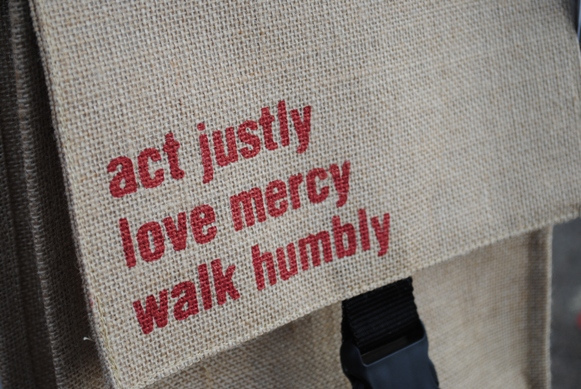
What does the Lord require of you but to do justice, and to love kindness, and to walk humbly with your God?
Pastor, preacher, reverend; titles that I’m still not used to. After only having served this church for seven months, it never ceases to amaze me how many people in the community already identify me through my vocation. I will be sitting at the Bistro downtown ready to order dinner with Lindsey when the waitress begins by asking, “What can I get for you reverend?” Or when I’m sitting behind my computer at Coffee On The Corner my coffee is accompanied with a “here you go preacher.”
Its my own fault really. I love to tell people what I do. Whenever I meet someone new in town, I’m always eager to share with them my excitement at having been appointed to St. John’s.
This past week, I was visiting one of my favorite shops downtown (that will remain nameless) when I was greeted with the familiar title: Pastor. The owner and I have a fairly decent relationship and our conversation flows smoothly whenever we’re together. As he was ringing me up, we exchanged the regular pleasantries, talking about the cold weather and other such things, until he asked me about the church. I told him about how remarkably forgiving many of the congregants are regarding my sermons, and how thankful I am for their willingness to join me in this adventure we call “church.” Thats when the conversation got serious.
“Well, I’m happy you’re enjoying it,” He said, “But church is just not the thing for me.”
Aside: I almost never ask anyone about church, and yet, people always bring up their attendance, or lack their of, in conversations.
By his tone and inflection, it was clear that he wanted to say more about the subject, so I inquired as to why church is not the thing for him.
“I used to go all the time,” he began. “I’ve popped around between different denominations, I was even an elder for a little while, but about ten years ago I lost faith in the church. We were doing all the right things, we had hundreds of people in worship every Sunday but we never did anything for the community. Everything the church did was so inwardly focused. Debates about the wallpaper, the type of bread for communion, and timing for Sunday services dominated all of our conversations. Whenever I tried to raise a need within the community that the church could meet it was brushed aside as being insignificant. Finally, at a council meeting, I could no longer contain myself. After years of watching this “perfect church” ignore the desperate needs of the people outside the building, I stood up in the front of the leadership and declared, “I think when Jesus said, ‘Feed my sheep,’ he really meant to feed his sheep.” I have not been to a church since.”
In the sixth chapter of Micah, the prophet relays God’s controversy with his people. “O my people, what have I done to you? In what way have I wearied you? Answer me! For I brought you up from the land of Egypt, and redeemed you from the house of slavery, and I sent you Moses, Aaron, and Miriam. O my people, remember now what King Balak of Moab devised, what Balaam son of Beor answered him, and what happened from Shittim to Gilgal, that you may know the saving acts of the Lord.”
At that time in Israel’s history, the people had grown weary and bored with their God. They were just going through the motions when it came to worshipping the good God who had been at the center of their very lives for so long.
How could they have become bored with God? He had delivered the people from their oppressors, raised up mighty leaders, sent truthful prophets, and brought all the people to a full awareness of his righteousness. Yet, they had forsaken him. They lived immersed in the love of God, yet were blind to much, if not most, of it.
Micah then describes “real religion” as opposed to the ways to Israelites were behaving: “With what shall I come before the Lord, and bow myself before God on high? Shall I come before him with burnt offerings, with calves a year old? Will the Lord be pleased with thousands of rams, with ten thousands of rivers of oil? Shall I give my firstborn for my transgression, the fruit of my body for the sin of my soul? He has told you, O mortal, what is good. and what does the Lord require of you but to do justice, and to love kindness, and to walk humbly with your God?”
Micah presents the simple essentials of real religion in a verse that has taken its place among the most favored of scripture. What does the Lord require of you but to do justice, love kindness, and to walk humbly with your God? Real religion is predicated on the lived reality of discipleship that changes everything.
God made it known to the Israelites the proper and good response to their Lord. The people are required to practice justice, to seek equality between themselves and others; to love kindness, to maintain a loyal commitment to God and others; and to walk humbly with their God, to live transformed lives conformed to the image of God. Real religion is a journey of faith working by love leading to holiness of heart and life.
So, where are we with God? Have we grown tired and weary of the God we have come to worship? Are we attending church, practicing our faith, and loving others out of obligation or excitement? What do we think the Lord requires of us?
Is our relationship with God determined by our attendance at church, coming to worship at 11am every Sunday, singing a couple hymns, hearing scripture read aloud, and listening to a 15 minute sermon? Are we simply going through the motions of faith, or does our faith shape the way we act outside of this building?
During the time of Micah, God no longer wanted the sacrifice of animals, burnt offerings, and rivers of oil. Instead he wanted what he already showed to be good: justice, kindness, and humility.
And when we read that list of what God does not want, it makes the threefold expectation seem easy. The real demands of God however, are both moral and spiritual, and the proper worship of God is a life obedient to them. Without justice, kindness, and humility, any of our practices in church can wound our faith. Instead of creating worthy habits for life, we appear to be bargaining with God to take something less than he actually wants of us. If our faith can be compartmentalized into one hour a week, if our faith is limited to church worship alone, than we desperately need to hear Micah’s word.
Like the ancient Israelites, we live and die immersed in the love of God. Yet, how often are we blind to much, if not most, of it?
Micah begged the people to exhibit true faith, true worship, and true morality that will come to completion in true behavior. What we believe shapes how we behave.
However, proper morality is not a substitute for religion. Its not just about “being a good person.” Outward conduct is essential for the life of faith, but it always depends on the inward character that is shaped by the gathering community of faith.
Justice, kindness, and humility might sound easy and comfortable to those who have never tried them, but the overwhelming truth is that these three practices are far more costly than thousands of rams, ten thousands of rivers of oil, or a more contemporary allusion might be that truly practicing justice, kindness, and humility will always be harder than giving numerous possessions away in order to somehow appease God.
If this church takes seriously our commitment to forming disciples of Jesus Christ for the transformation of the world, then we need learn to translate mercy into our regular daily deeds through a close, nurturing, and personal journey of faith with God. The Lord demands our lives, our love, our trust, and our loyalty.
When driving around Staunton, it is nearly impossible to miss the cacophony of churches scratched across the landscape. In my life, I have never lived in a place with so many steeples. In fact, during one of my first weeks here someone told me that Staunton has more churches per capita than anywhere in the United States. I have no idea how to confirm whether or not this is true, but I wouldn’t be surprised if it is.
In my short time here I have created relationships with some of the other clergy in town; I’ve gone out to lunch, initiated a lectionary based breakfast group, and shared numerous cups of coffee. Do you know what the first question is almost every time I meet a different pastor? “How many people do you have in worship?”
This week, while reading over Micah, I realized that getting asked about worship attendance is close to what the Israelites must have felt when someone asked, “how many rams did you sacrifice this week, how many river of oil did you present to God?”
Really? Of all the things that we could possibly talk about, the first question is always about church attendance. I wonder why we aren’t talking about ways that we can practice justice, love kindness, and walk humbly with God.
Why are we all so consumed with the numbers instead of planning ways to serve our community? And I’ll admit that I am certainly guilty of this practice. When I am asked about worship, I proudly respond about the growth of our church and the warm and inviting atmosphere that one encounters when walking through the door. But I have to be reminded too, I have to ask myself, ‘What does the Lord require?’ Does God want us to grow this church and fill it to the brim to the point where we no longer know who we are worshipping with? Or is God calling us to do justice, to love kindness, and walk humbly? Not that they are mutually exclusive, but until our focus is more on living our faith, rather than filling our building, our building will never be filled.
So, how can we practice justice as individuals and as a church? We can open our eyes to the needs of our community. We can seek out the last, least, and lost, to give them the one true gift worth sharing: love. We can stand up against the small and large injustices that occur everyday, whether its an unfair judgement in the work place, or racist comments, or belittling words between spouses. We can practice justice by living out our faith in the world.
How can we love kindness as individuals and as a church? We can initiate relationships with strangers knowing that God has done the same for us. We can show our love to our families and friends by making the extra phone call to just say “Hi.” We can truly greet one another when we gather in worship, not just the same people we talk with every week, but particularly those who are still strangers to us. We can show our loving kindness but living out our faith in the world.
How can we walk humbly with our God? We can recognize that God is not only concerned with our religious rituals, but calls for us to live out faith beyond these walls. We can admit that we have, and will continue to, fall short of God’s glory. We can find salvation and redemption through our faith in God, and God’s faith in us. We can come forward to the table and receive the bread and wine humbly, knowing that we have done nothing to deserve it. We can walk humbly with our God by living out our faith in the world.
What does the Lord require of us? To do justice, to love kindness, and to walk humbly with God.
Amen.




 think and let think