Devotional – Psalm 107.1

Devotional:

Psalm 107.1

O give thanks to the Lord, for he is good; his steadfast love endures forever. 

Weekly Devotional Image

“I’m post-racial” he said. “I am color blind to racial differences and I have no prejudices.” At the time we were discussing racial inequality in Durham, North Carolina (a still very pertinent topic) and the man claimed that if more people could see the world the way he did, everything would be fixed. He proudly claimed his lack of prejudice for anyone with ears to hear but I had a hard time taking him seriously. I did not know him well enough to begin arguing against his so called “prejudice free lifestyle” so I decided to let him him wax lyrical about himself. However, while he continued to go on and on, a friend muttered next to me under his breath, “Show me someone without prejudice, and I’ll show you a liar.”

One of the hardest tasks of following Jesus Christ is to try to live without prejudices precisely because many of us aren’t aware of how deeply rooted our prejudices are. We may think that we are “color blind” or that we relate to people who are different from us in religion, sexual orientation, or political persuasions, but in many circumstances our involuntary thoughts, uncensored words, and knee-jerk reactions often demonstrate that our prejudices are still there.

If we’re driving in our cars and we see two women holding hands walking down the side-walk, what are our first thoughts? If we are at a restaurant and we witness a black woman and a white man kissing one another across the table, how do we immediately respond? If we’re flipping through news channels and come across a political campaign of a different perspective, how do we initially react?

diversity-hands1-400x266-copy

Strangers, anyone who is unlike us, stir up fear and discomfort. They break down our sense of security and well being by simply being “different.” We can puff ourselves up all we want with claims of living with a post-whatever lifestyle, but most of us, if we’re honest, are prejudice in ways big and small, seen and unseen.

As Christians, we give thanks to the Lord for he is good. Only when we learn to fully believe that God loves each of us unconditionally and see others as equally loved can we begin to behave according to God’s goodness. The great variety in the world is a sign of God’s immense wonder and beauty. Living with a non-judgmental frame of mind is exceptionally difficult, but it is worth working toward.

This week, while we continue to journey through the season of Lent, let us admit our own prejudices. When we have those knee-jerk reactions toward those who are different from us, let us immediately go to the Lord in prayer and ask for Him to create in us clean hearts so that we might become people of love rather than prejudice.

Believing > Understanding – Sermon on Isaiah 40.21-31

Isaiah 40.21-31

Have you not known? Have you not heard? Has it not been told you from the beginning? Have you not understood from the foundations of the earth? It is he who sits above the circle of the earth, and its inhabitants are like grasshoppers; who stretches out the heavens like a curtain, and spreads them like a tent to live in; who brings princes to naught, and makes the rulers of the earth as nothing. Scarcely are they planted, scarcely sown, scarcely has their stem take root in the earth, when he blows upon them, and they wither, and the tempest carries them off like stubble. To whom then will you compare me, or who is my equal? says the Holy One. Lift up your eyes on high and see: Who created these? He who brings out their host and numbers them, calling them all by name; because he is great in strength, mighty in power, not one is missing. Why do you say, O Jacob, and speak, O Israel, “My way is hidden from the Lord, and my right is disregarded by my God”? Have you not known? Have you not heard? The Lord is the everlasting God, the Creator of the ends of the earth. He does not faint or grow weary; his understanding is unsearchable. He gives power to the faint, and strengthens the powerless. Even youths will faint and be weary, and the young will fall exhausted; but those who wait for the Lord shall renew their strength, they shall mount up with wings like eagles, they shall run and not be weary, they shall walk and not faint.

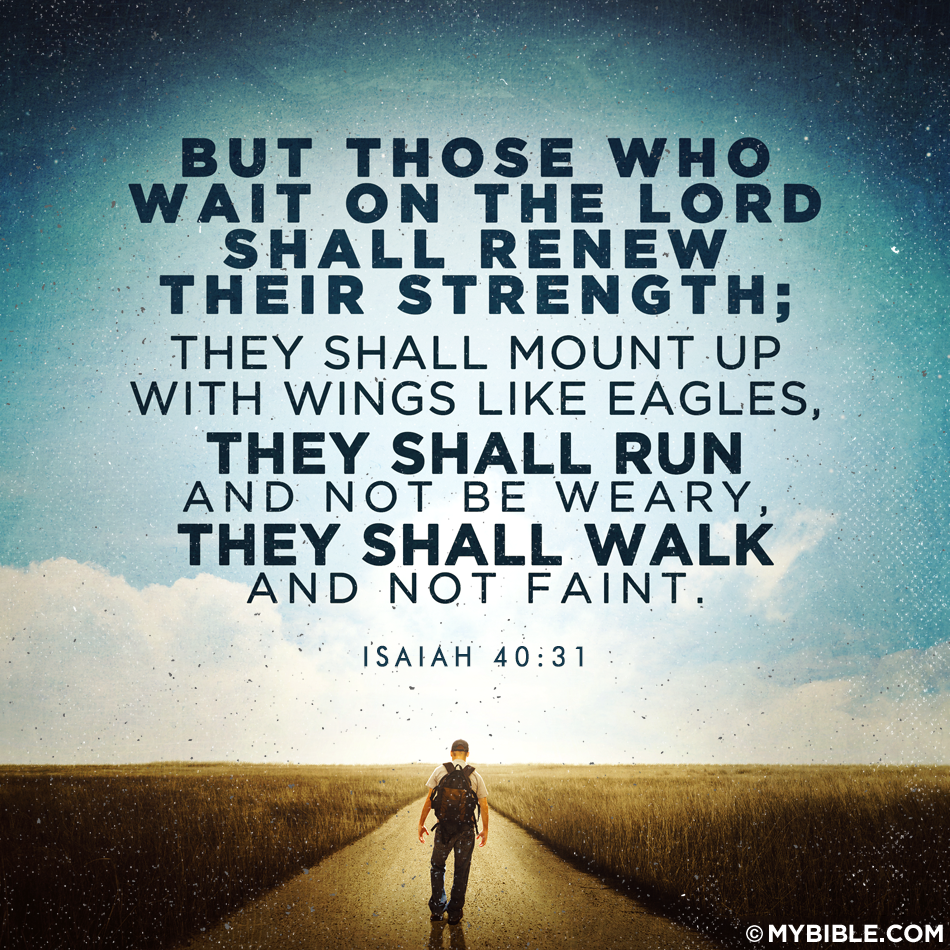
Isaiah-40-31

I have witnessed, read, and heard lots of sermons. From as far back as I can remember I was in church on a regular basis listening to people like me stand at the front of church and talk all about the bible. During seminary, I learned about the importance of attending different churches to hear from a variety of preachers. Listening to different pastors helped to cultivate my own sermonic style, and show me what not to do.

I once heard someone preaching about the wonderful story of David and Goliath. He read the corresponding scripture, prayed for God to be with him in his preaching, and then began the sermon with these words: “The stench of war hung in the air like a pungent fart…

There was a time where I heard a young woman preach on the sacrifice of Isaac from Genesis. As a sweet and endearing theologian, she frightened everyone in the room by continuing to beat on the pulpit in rhythm; first the rhythm of Abraham’s heart as he pondered the fact that God called him to sacrifice his son, second the rhythm of Abraham’s axe falling on the wood to prepare for the fire, and then latter the frightening sound of the blade falling in Abraham’s imagination. It shook everyone to their cores.

Right before I was appointed here at St. John’s I heard a pastor from the Eastern Shore preach a sermon on one of the psalms. He stood up before the gathered body and explained that he had felt convicted by the Spirit that week to rewrite the psalm as if he was one of those slam poets, and then proceeded to perform his new rendition for all of us. I can’t remember precisely what he said, but it sounded like this: “My heart beats beats beats, O God my heart beats beats beats. I will sing along to the beat, and make the beat my melody. Awake to the rhythm of my heart beat beat beat. Give thanks for the beating heating sleeting of my heart. For his steadfast love, is like a perfect dove, in the heavens so high, up in the air where the birds fly. Listen to the beat beat beat…” He went on like that for twenty minutes.

Sermons, at their best, make the Word incarnate again so that we can live it out in the world. There are as many styles as there are preachers, but hopefully we all ground what we say in God’s Holy Word. A common rule of thumb for preaching is that the text from scripture should determine the style of sermon. For instance: If the scripture lesson is a letter from Paul to one of the early churches, the sermons should function in a similar way to the church that is listening. If the scripture is a narrative, then a story should be used to help reveal the Good News from the text. If the passage is a parable, then the sermon should leave the people scratching their heads in the same way that the first Christians probably did when Jesus said something like the kingdom of God is like a mustard seed.

Is40.28-31

Our scripture today, though from a prophet, is a poem.  The Babylonians had scattered the Israelites throughout the region and they feared for their existence. They continued to grumble about their situations and constantly blamed God for their misfortunes. Like Jesus praying before his crucifixion, the exile was their Garden of Gethsemane, in which they would pray for the cup to pass from them.

Instead of telling a harrowing tale from Israel’s past, instead of offering a parable about their situation, Isaiah speaks into their situation as a poet. It is now my challenge to do the same.

—————————

Have you not known? Have you not heard? Have you not read about this in your bibles? Have you not experienced it in worship and in your daily prayers? Has it not been told to you week after week since the very beginning of your faithful journeys?

God is the one who sits above all things, He is the one who reigns over us. All of us, the people and inhabitants of the earth, we are like insects who come and go.

God is the author of salvation, he has opened up creation for us, dwells besides us, and hopes with us. God is the one who tears governments down, and makes the rulers of the earth fall away like leaves in autumn.

Like flowers in a field they are rarely planted, their roots descend but to not take hold, and when God blows upon them they float away. Crops come and go like the seasons, new plants reach up to the heavens only to disappear, flowers bloom only to wither, but God remains everlasting.

To what, then, shall we compare the Holy One? What kind of associations, experimentations, delineations shall we use to understand the one on high? What kind of metaphor will bring God to light? What kind of story points to his glory?

Lift up your eyes and see!

Look around you at the people in your life, at the blessings of food, function, and faith, at the wonders of God’s creation. God is the author of salvation, the teller of your tale, the sower of your seeds. He brings about life for all creatures then and now. It is only because of God’s great strength and glory that not one thing is missing from your story. 

So, people of God, why do we say and believe that “God does not care about my life!” How can we even utter such an abominable accusation about the author of salvation?

Have you not known? Have you not heard? Have you not read about this in your bibles? Have you not experienced it in worship and in your daily prayers? Has it not been told to you week after week since the very beginning of your faithful journeys?

The Lord is the everlasting God, the creator of the ends of the earth. Strength will rise as we wait upon the Lord as we wait upon the Lord as we wait upon the Lord. Our God reigns forever, our hope, our strong deliverer. He will not faint. He will not grow weary. His understanding is unknowable.

The Lord is the everlasting God. He gives strength to those who are weak, he empowers the powerless, and loves the unlovable. When we look out and see destruction, God sees incarnation. When we experience death, God sees life. When we believe God is missing, He is the one carrying us through our shadow of darkness.

Even the young people, with their strength and vision for the future, they will fall and be weary. The people in church and society that we so admire will crumble. They believe that life is a sprint instead of a marathon. But those who wait for the Lord, those who believe in the power of patience, shall have their strength renewed. They shall mount up with wings like eagles, they shall soar from the highest of heights, they shall run and not be weary, they shall walk and not faint.

If you can’t fly, then run. If you can’t run, then walk. If you can’t walk, then crawl. If you can’t crawl then pray and pray and pray. But whatever you do you have to keep moving forward.

The Lord is the everlasting God.

—————————

Believing is greater than understanding. I’m not talking about the simple belief that God exists, I’m not talking about believing in God. I’m talking about believing God. Believing that He is everlasting, that he creates and commands that stars in the sky, and hopes for us when all things feel hopeless.

The captives were afraid that what they held so dear would disappear to the sands of time. Many of us fear the same thing about what we believe is precious: values, morality, ethics, the church, society, love, hope, patience. But why should we be frightened? God the everlasting remains when all others things are swept away. Kings will reign, politicians will run for office, we will live, grow, and die, but God is the one who remains.

tumblr_nfmkc6gBLv1s91yx0o1_500

We are so tempted to get caught up in the here and now that we are unable to see things from God’s perspective. Our humanity prevents us from seeing God’s divinity. We look around and see all the failures of life around us and we fling our “why?” at God; but we should first challenge ourselves. What can I do to make this world better? How can I serve the needs of my brothers and sisters? What can I do to help show people a little glimpse of heaven on earth?

To wait for the Lord requires patience. We will all spend so much of our lives in vain trying to understand all that God has done when all we are called to do is believe.

“What is the text saying?” My professor asked of our class. We had our bibles open to the corresponding verses and began to argue about what it meant.

Some people, who desperately liked hearing the sound of their own voices, waxed lyrical about the historicity of the text and mentioned elements like fragments of papyrus and the corresponding dates of discovery.

Some people, who were more evangelical than others, went on and on about the infallibility of God’s Word and declared that we must take every single word literally and live them out.

Some people, who clearly were not paying attention, skirted around the issues in the text and talked about broad subjects so as to make it appear as if they had done their reading, when in fact everyone could tell they had not.

My professor practiced his patience and let us all argue it out for a while before he raised his hand to indicate silence. “You’re all wrong,” he began, “because you are operating from a false assumption. All of you believe the bible is about you.” He then said something that I will never forget: “The bible is always primarily about God, and only secondarily about us.

This poem from Isaiah is a humbling reminder that we are not nearly as important as we think we are. We are not the center of the universe. We can strive to work as hard as we can for our church and our community, but ultimately God is the one who brings about true transformation here on earth. What we pray for and work toward is worthy of our time, we just have to learn to trust that God will bring it about according to his will. Only an everlasting God could have the patience necessary to see the world turned upside down.

We are people of faith. We are people of belief. Let us not give in to the temptations of the world’s expectations of immediate gratification, and instead believe that God is the everlasting perfecter of patience, now and forever. Amen.

Devotional – Mark 1.28

Devotional:

Mark 1.28

At once his fame began to spread throughout the surrounding region of Galilee.

Weekly Devotional Image

In a place the size of Staunton, you quickly begin to recognize people all over town. It only took six months for trips to the grocery store to extend in length because there was a good chance I would run into someone that I knew and a conversation would naturally develop. Moreover, when your vocation includes serving the general public, people begin to talk about you with friends and family outside the context of church.

For instance: There was the time I was playing drums in a band concert at Gypsy Hill park when a stranger introduced himself and asked if I was “the strange pastor who carried a giant cross around Staunton.” Or there was the time that I was helping out at another United Methodist Church when a stranger introduced herself and asked if I was “the young pastor who made the youth do all sorts of strange things during worship” (and promptly walked away as soon as I confirmed her suspicions!). Or there are the numerous times when I am somewhere in town and a random person will say: “Oh, I’ve heard all about you and the things you’re doing at St. John’s” and I can never tell whether or not that is a good thing.

Gossip

Frankly, you don’t have to be in a place like Staunton for words and gossip to spread around like wild-fire; people thrive on receiving and sharing information that excites and dramatizes individuals in the local community. Many of us are guilty of perpetuating this cycle whenever we begin a conversation with: “Did you hear about ______?” or “Can you believe what ________ did?” Sometimes we sadly choose to focus on the dramatic successes and misfortunes of others so that we don’t have to confront the reality of what is actually happening to us in our lives.

Before the end of Mark’s first chapter, words and stories about Jesus have begun to spread all over Galilee; He called the first disciples, He cleansed a man with an unclean spirit, He healed Peter’s mother from her fever, and He cured many who were sick with various diseases and cast out many demons. Jesus recognized that he would have to be publicly active in his willingness to proclaim God’s Good News through his words and actions.  He went out to find people in order to bring about God’s will on earth. Important for us to remember is the fact that Jesus did not let all the rumors prevent him for doing his ministry on earth.

Wherever you live and whatever you have done, there is a good chance that people are probably talking about you in a way that is spreading your “fame” (for better or worse) in the community. Remember this: In God’s eyes you are defined by what you do for the kingdom and not by what people say about you. Therefore, let us be people of courage who do not let the words of the World break us down, but instead firmly root our hope in faith in the one whose fame continues to spread throughout the world: Jesus Christ.

Devotional – Jonah 3.2

Devotional:

Jonah 3.2

“Get up, go to Nineveh, that great city, and proclaim to it the message that I tell you.”

Weekly Devotional Image

The phone buzzed while I was still asleep. I fumbled with it as I attempted to read the number in the dimly lit room when I discovered that it was from an unfamiliar zip code. On any other morning I might’ve just ignored the call and let it go to voicemail, but for some reason I answered it and began with a sleep-ish “Good Morning.”

“Good morning to you!” the too bright voice on the other end began, “Taylor, I am the District Superintendent from the Staunton District in Virginia. I know you were thinking about pursuing an appointment as an associate pastor, but the bishop and cabinet have prayed over you and we believe that you gifts and graces fit best with a church in Staunton. You are being appointed as the pastor of St. John’s UMC. Have you ever heard of it?”

In a matter of seconds I had gone from resting soundly in a bed, to learning where I would be serving for the next few years. I remember rapidly thinking: “Staunton? Have I ever been there? I know it’s south of Harrisonburg, but that’s about it. Did they just tell me that I’m going to be pastoring by myself? What are the people like? What if they don’t like me? etc.”

preach-word

After finishing the conversation, and making sure that I wasn’t dreaming, I looked up the church online. I used google maps to see what it looked like from the sky and from the road. I used the church website to learn about all the pastors who had served in the past and what the church was currently focused on. I used local newspaper archives to see if the church had been in the news. A few weeks later I got in the car and drove to Staunton just to see what the church looked like from the outside and what the surrounding community was like so that I could see if I  could picture myself there.

God said to Jonah, “Get up, go to Nineveh, that great city, and proclaim to it the message that I tell you.” Staunton is definitely not my Nineveh, but I can relate to the feeling of unease that Jonah had regarding his divine message; Going to a strange city with the task of proclaiming God’s Word is a frightening thing. How will the people respond? Will they hear what God is saying and believe? I still feel that uncomfortable feeling each week as I take the steps up into the pulpit and pray before the sermon begins.

Jonah was tasked with sharing a message with the people in a way that is similar to pastors preaching from pulpits. Similarly, all of us are given opportunities to share God’s message with the people around us: You might see someone alone at work and feel God pushing you to check on them. Perhaps you’ve been putting off a phone call to your son or daughter about how you want your relationship to change. Maybe you’ve been praying for a friend to start coming to church and now is the time to put your prayers into action by inviting them to come with you.

We all have difficult things to share with others around us. We can run away from the Ninevehs in our life like Jonah did or we can be brave and walk into the situations that God has given us a message to proclaim. The choice is ours.

Yes, No, Maybe So – Sermon on Romans 13.1-2, John 18.36, and 1 Timothy 2.1-3

(Instead of a typical ~15 minute sermon from the pulpit, I broke the following sermon up into 3 homilies. I preached the first from the pulpit, the second from the lectern, and the third from the middle)

This morning concludes our Sermon Series on Questions. After polling the gathered body regarding your questions about God, Faith, and the Church this series was created. Last week we talked about the ever sensitive topic of forgiveness and whether or not to bury or cremate the dead. This week we finish by looking at the complicated relationship between politics and church. Before we begin I wanted to share with you some the actual questions that led to this sermon: How do we reconcile the divide between what we believe and particular political positions? The Old Testament seems to celebrate violence in God’s name. Jesus seems to permit only peaceful ways; So why do we live ready to go to war with whomever our government says we should? Is it right to have an American Flag in the sanctuary?

should-the-church-be-involved-in-politics

Let every person be subject to the governing authorities; for there is no authority except from God, and those authorities that exist have been instituted by God. Therefore whoever resists authority resists what God has appointed, and those who resist will incur judgment. 

Is the church political: YES

My office is far away from the main entrance to church. I can sit comfortably in the back hallway room, weeding through emails, making phone-calls, and preparing sermons while unaware of anyone entering the church and walking into the main office. If people arrive and desire to speak with me our secretary, Ashley, will either walk with them down toward my room, or call ahead to let me know that someone is on their way. I appreciate this system because I am rarely blindsided by a visit and can usually prepare myself for whatever enters the room. Usually.

Ashley had already gone home for the day when I heard the doorbell ringing. I have learned that I have to run from my office to the entrance if I want to catch people before they give up and assume no one is at the church. So it was with a bible and hymnal tucked under my arm that I found myself sprinting to the door to welcome whoever was waiting.

She was older, painfully shy, and carrying an absurd amount of political paperwork. She stuttered after I flung the door open and it took a lot of interpretation for me to gather that she wanted to talk about an upcoming election. On most days I would politely smile and decline her invitation, but I was in the mood to debate and argue, so I welcomed her in.

In my office we went through the expected pleasantries about how long I have been here, what the church is like, and other regular questions when the stuttering disappeared, and my shy visitor became extremely passionate about the subject of conversation. “Did you know” she began, “that Christians are voting less than they ever have in the past? While the world crumbles around us under the sinful temptations of the devil, people are neglecting their Christian duty to vote for politicians that can help turn the world right-side up… (of course, all I could think about is the fact that Jesus came to turn the world upside-down) … We need your help pastor. We need you, as the leader of this church, to use the pulpit as a tool to get good Christians back to the voting booths so we can bring our country back to the good old days.” I tried to stifle the sigh that was brewing within me, but before I had a chance to rebuke some of her statements, she dropped a bomb from scripture right on top of me, “remember what Paul wrote: ‘let every person be subject to the governing authorities; for there is no authority except from God.’ We greatly appreciate your helping our cause.

For as much as I was frustrated with some of her language, and her desire for our pulpit to become a political microphone, she was absolutely right. Throughout history Christians have wrestled with the relationship between church and state, and Paul had to address these growing concerns as a major problem in the first century. Christians, since the beginning, have either granted rulers too much power and latitude, or else have refused to give up what is fully entitled to the rulers (remember give to Caesar what belongs to Caesar?). This has resulted in Christians being too subservient in some periods, while in others they have neglected their duty to the area they found themselves in.

Paul wrote these profound words to the church in Rome because he thought that if we can be good citizens, we can be good disciples. We rely on governments, including our own, to bring order to the chaos of our world. As long as people persist in making our future unpredictable, Paul’s words will remain relevant. Wars will develop, evil will manifest itself in crime and violence, and the state will be here to protect the innocent.

Is the church political? YES. We are political because we are subject to authorities over us that were instituted by God. So, in honor of the woman who begged me in my office to do something I never wanted to do, I say this: “Remember to vote.” Amen.

——————————

Church and State

Jesus answered, “My kingdom is not from this world. If my kingdom were from this world, my followers would be fighting to keep me from being handed over to the Jews. But as it is, my kingdom is not from here.”

Is the church political? NO

I loved my AP Government class in high school. First of all, it was taught by the coach of our football team which meant that he spent more time working on the Xs and Os in his notebook than he did about the legislative branch and he was quick to reward us with stellar grades regardless of our effort. But mostly, I loved the class because it embodied, for me, all of the wonderful and incredible things I was about to experience. As a 17 year old, AP Government displayed the strange new world of our American System that I would soon be able to participate in through the right to vote. I eagerly absorbed our reading material because it was enlightening and it was relevant.

Midway through our year together a serviceman showed up in our classroom, and my excitement quickly dwindled and was replaced with disappointment and fear. The marine stood at the front of our class in his uniform while most of us were still rubbing our eyes to wake up, and began to explain the Selective Service. In mere moments I quickly learned that by no choice of mine I would be registered for the Selective Service along with every other male between the ages of 18-25. The marine attempted to calm the nerves that were developing in the room by claiming that it will probably never amount to anything, but that the government needed to have us on record just in case we were ever needed for war.

I was stupefied. How could our Government expect me to go to war when I believe in the one who calls me to love and pray for my enemies? How could our political system set aside young males, just in case, when it contradicts my understanding of God’s love and grace in the world?

God’s kingdom is not of this world, our allegiances are somewhere else. Doing things liking pledging allegiance to the flag and printing “In God We Trust” on our money draws us away from the one in whom we live and forces us to choose between God and country. Those two things are not the same. Having an American flag in our sanctuary is very dangerous because it, on some level, implies that what the cross represents is equal to what the flag represents. When we let the flag, and therefore the country it represents, come too far into our discipled lives, we run the risk of blurring the lines between God’s kingdom and America. It was not that long ago that a man named Hitler was able to bring one of the most advanced and progressive nations in the world into a war through the use of religious fanaticism that started with a nationalist church structure. That kind of thing still happens in the world today.

Is the church political? NO. God’s kingdom is not of this world, we believe in something greater than our country can represent, and we are held to a higher standard than what our country fights for. When our beliefs and faith go against what America proclaims as normative, we are reminded of the fact that God’s kingdom is not of this world. Our hope is built not on political parities but on Jesus Christ and his righteousness. Amen.

——————————

Blog Header World Compassion

First of all, then, I urge that supplications, prayer, intercessions, and thanksgivings be made for everyone, for kings and all who are in high positions, so that we may lead a quiet and peaceable life in all godliness and dignity. This is right and is acceptable in the sight of God our Savior.

Is the church political? MAYBE SO

I was hunched over the computer with my notes spread out across the desk when the text messages and phone calls started coming through. I quickly hid my phone in a drawer and continued to focus on my studies, my Old Testament Final Exam was in the morning and I felt woefully unprepared. But try as I might to remove the distraction of my phone, it continued to buzz and ring in the drawer when I began to realize that something big must’ve happened. All I needed to do was see the first message for the final to disappear from my thoughts: “We killed Osama bin Laden.

I spent the rest of the evening in front of the television witnessing the reports of our nation’s triumph in killing its greatest enemy, I saw crowds of people gathering in public and in front of political buildings celebrating a great victory while waving American flags back and worth. I even received a phone call from one of my childhood friends who was drunkenly celebrating in front of the White House who wished that I could be there to throw a cold one back with him.

In the days that followed, people continued to celebrate across the American landscape and I felt confused. On some level I kept recalling what it felt like to grow up in Alexandria and really remember the fear I felt when the Pentagon was hit, I remember the devastation that weighed on military families in my neighborhood, I remember the world changing forever on 9/11 and being angry at whoever was responsible. But while I witnessed people celebrating the death of Osama bin Laden, I couldn’t help but wonder if we had accomplished anything.

For weeks I struggled with how to feel and what it meant for our country to celebrate the death of a man who celebrated death. I was lost and unsure of my faith and what it meant to follow the one who died for us. The muslims I was used to seeing on Duke’s campus quickly disappeared from the public areas and were replaced with affluent kids dressed in red, white, and blue. Overwhelmed by everything that had taken place, I confided in a friend from seminary about my struggles and asked, “What are we supposed to do?

His response was quick and deliberate: “We pray.

The problematic relationship between church and politics is complicated by the fact that the Christian always belongs to two communities and has loyalties to both. Our identities are divided between God and Country and both are constantly striving for our allegiance. Sadly, there will never be a time that both of them stand for and represent the same things, and we will always live in this paradoxical struggle.

What are we to do when politicians fight for programs that go against our faith?

What are we to do when our country goes to war with our enemies while Jesus is the one who calls us to love them?

What are we to do with a sanctuary and worship service that displays an American flag while proclaiming the empty cross of Christ’s resurrection?

What are we to do when our country no longer stands for the Christian values everyone believes it was founded upon?

First of all then, I urge that supplications, prayers, intercessions, and thanksgivings be made for everyone, for kings and all who are in high positions, so that we may lead a quiet and peaceable life in all godliness and dignity.

We pray when confronted with the troubles of our world, when we are met with the political persuasions of our nation, and when we can no longer understand the balance between God and country. Karl Barth once said that “to clasp our hands in prayer is the beginning of an uprising against the disorder of the world.

Is the church political? MAYBE SO

We are political in the sense that we recognize that we are in the world, but we are not of the world. That God has called us to be brave and radical people who see the world turned upside down and live into a new reality. That when we clasp our hands together to pray for everyone, our leaders and enemies, our nations and others, we spark the beginning of an uprising against disorder.

The challenge of the relationship between faith and politics will always remain. Since the beginning of the church it has been a concern of Christians everywhere and it will continue to be.  But if we want to truly wrestle with this problem, is we want to take steps of faith into our political culture, we begin by asking: What Would Jesus Do about government?

He would pray for the government, he would listen to all people everywhere treating them with worth, and he would love them with all that he had.

Let it be so with us. Amen.

——————————

The Advent of Samuel – Sermon on 1 Samuel 3.1-10

1 Samuel 3.1-10

Now the boy Samuel was ministering to the Lord under Eli. The word of the Lord was rare in those days; visions were not widespread. At that time Eli, whose eyesight had begun to grow dim so that he could not see, was lying down in his room; the lamp of God had not yet gone out, and Samuel was lying down in the temple of the Lord, where the ark of God was. Then the Lord called, “Samuel! Samuel!” and he said, “Here I am!” and ran to Eli, and said, “Here I am, for you called me.” But he said, “I did not call; lie down again.” So he went and lay down. The Lord called again, “Samuel!” Samuel got up and went to Eli and said, “Here I am, for you called me.” But he said, “I did not call, my son; lie down again.” Now Samuel did not yet know the Lord, and the word of the Lord had not yet been revealed to him. The Lord called Samuel again, a third time. And he got up and went to Eli, and said, “Here I am, for you called me.” Then Eli perceived that the Lord was calling the boy. Therefore Eli said to Samuel, “Go, lie down; and if he calls you, you shall say, ‘Speak, Lord, for your servant is listening.’” So Samuel went and lay down in his place. Now the Lord came and stood there, calling as before, “Samuel! Samuel!” And Samuel said, “Speak, for your servant is listening.”

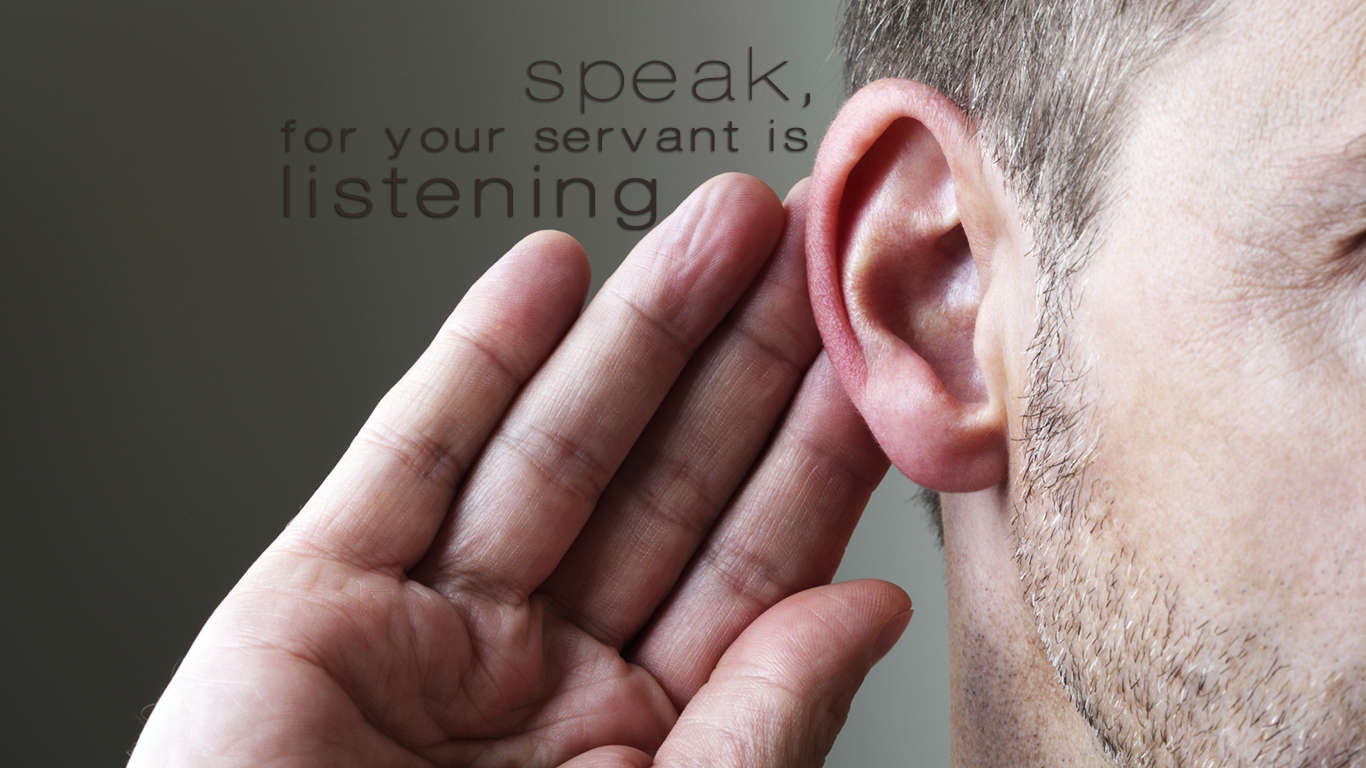
speak-for-your-servant-is-listening-christian-wallpaper-hd_1366x768

Today we continue with our Advent Sermon Series on “New Beginnings.” These few weeks of Advent are integral to the life of our church in the sense that we are preparing our hearts, minds, and souls, for the coming of God in Christ on Christmas day. Last week we looked at Abram and his call to go to a new and strange land, a call for a new beginning. Today we continue by looking at the Advent of Samuel.

Chapel time is the best. Every week our little preschoolers gather here in the sanctuary to a hear a story from the bible and how it can relate to their lives right now.

The first week I had them gather in the choir loft with the lights turned off. We talked about the beginning of creation and how God spoke the world into existence. I then encouraged the kids to scream, “Let there be light!” as loud as possible, and only when the volume was sufficiently over the top, I cut the lights on in the whole room. Another week we made chicken noodle soup together and talked about Esau selling his birthright to Jacob for a cup of stew. Another week, I had the kids do push-ups and sit-ups in the center aisle to build up their strength for a wrestling match. One by one they came forward and wrestled with me, just like Jacob wrestled with God on the banks of the Jabbok river.

10382573_702829629793354_3200154595278601519_o

On the Tuesday before Thanksgiving, I gathered with the children in the basement in preparation for their Thanksgiving feast. Chapel time that week was going to be all about communion. The kids made their way into the yellow room, and I sat down with them on the floor next to a table with the bread and the cup.

“Good morning my friends! Over the last few weeks you have been learning about the first Thanksgiving with the pilgrims and the Native Americans, about how they shared their food and ate with one another. We remember that great meal this week as many of us will sit around a table with our families and friends to share what we were thankful for. But a long time ago, way before the pilgrims landed at Plymouth Rock, there was another very special meal.”

“Jesus had been with his friends for a few years and this was going to be his last night with them. I’m pretty sure that they spent time that night talking about what they were thankful for, especially for Jesus. And when they were done talking, Jesus took a loaf of bread and gave to his friends to eat, and then he took a cup and shared it with his friends to drink. He said that he was giving himself for them, so that they would always know how loved they were.

1896866_732324416843875_2384499606542351705_n

At the moment I couldn’t believe how well the kids were paying attention. Usually someone gets distracted, and therefore distracts the rest of the kids, but that morning they were all listening and hanging on every word.

I then asked the children to pray with me over the bread and the cup and I shared communion with them. I tried very carefully to limit the amount of times I called the cup Jesus’ blood, but of course I let it slip and one of the kids shouted: “Are we really drinking blood!?” “Well, yeah, but its also grape juice” “Oh man I love grape juice!” One by one they came forward with their hands outstretched to take a piece of the bread and then dip it in the cup and then received it. For every child that came forward I looked at them in their eyes and whispered, “God loves you.”

10402584_732324513510532_5495924664254756371_n

After we finished the kids made their way to the red room to begin their feast when I discovered that Debbie, our Preschool Director, was crying. Worried that I had done something wrong I went forward to comfort her and was shocked when she shared why she was so upset: “Taylor, that was beautiful. You have no idea how precious it was so see those children line up for communion. This might be as close as some of them will ever get to understanding that God loves them.

This might be as close as some of them will ever get to understanding that God loves them.

Years from now I can imagine one of our Preschool students entering college. Though fully endowed with the knowledge of scripture and the willingness of this church to be there for him, he never enters our doors after he leaves the Preschool. High School is tough for him as wrestles with understanding his identity. Try as he might his grades are never good enough, his friends are never close enough, and no matter what he does he feels empty. Without having a true sense of direction, he applies to college and leaves home without looking back with the hope that this new beginning will be better than high school.

Sadly, it is not. College life is filled with even more people, and he feels less and less important. He falls through the cracks of campus life and spends most of his time alone in his dorm room. He still has the bible that we gave him so long ago, but it remains unopened on his shelf. One night, however, one of his roommates invites him to a campus ministry service. Reluctantly he attends, and is underwhelmed by the service.

The music is okay, and the message is all about spreading the Word of the Lord, whatever that means. He sits and listens attentively but he knows that he will never come back. But before the service ends, the pastor brings out the bread and wine and starts talking about communion. Immediately the boy is brought back to that morning sitting on the floor of the yellow room listening to a young bearded pastor talking about communion. While his mind is flooded with memories from the past he makes his way up to the make-shift altar and stretches out his hands to receive the body and blood of Christ while the pastor whispers, “God loves you.

I can imagine that even after that incredible service the knowledge of God’s love didn’t stick. The boy meets his wife in college, gets married, graduates, and moves to a new city for work. Yet, even after his family grows through the arrival of a few children, even while he is secure in his work, he still feels like something is missing.

He tries different things to find fulfillment in his life: he joins a civic organization, he volunteers at a local soup kitchen, he even helps a boy scout troop. But nothing seems to fill the void he feels in his life.

One day, however, a neighbor invites him to the community Methodist church. He laughs while responding about how he went to Preschool at a United Methodist Church but the neighbor insists that he comes to worship.

The man sits with his family in church, stands when he’s supposed to, sings when he supposed to, he even prays when he’s supposed to. He listens attentively to the announcements and the sermon, but most of it feels lifeless and repetitive. The pastor then moves to the table and invites the congregation to partake in this beautiful and precious meal that Christ has offered us without price. She says: “This table is the one true place where we can find fulfillment because in the bread and wine we see what Jesus gave for us on the cross, we see his truest and deepest act of grace. We are living in a time when the word of the Lord is rare, but at this table you can find what you’re missing, because here you discover the glory of God.

With tears in his eyes, the man walks forward. He remembers that day so long ago sitting on the cold floor in the basement of our preschool, he remembers that night in college when he walked up toward the altar. The emotional wave is almost overwhelming and as he stretches out his hands the pastor whispers, “God loves you” and for the first time, he believes it.

god-loves-you

People have heard the call of God in many different ways. Samuel heard it while he was sleeping in the temple and it took him three times to recognize that God was the one calling his name.

The word of the Lord was rare in those days, and it took an incredible act of faith to recognize that God was planning to do something incredible. Samuel did not identify his call when he first heard it, it had to be repeated and it had to be interpreted for him by the old priest Eli. 

Only when Samuel was able to respond with: “Speak, for your servant is listening” would he embark on a new beginning to be a prophet of the Lord. Part of the incredible beauty in this nighttime calling is the fact that God does not give up on Samuel. Though he clearly misses the location of his communication, God continues to call to him in an intimate and loving way.

One of the hardest things in the world to accept is that God loves us. In our heart of hearts we know, more than anyone around us, what we have done wrong and how we have fallen short of God’s glory. We see the mirrored reflection of our brokenness and we see someone unworthy of God’s love. Sometimes it takes more than a simple affirmation, it takes more than just a preacher babbling from a pulpit, it takes more than a bumper sticker or a billboard to remind us that God loves us. We need to hear it over and over and over again because it is true and remarkable.

I believe we are living in a time, just like Samuel, when the word of God is rare. We attempt to fill the emptiness in our lives with superficial commodities, we assume that money, power, and importance can make us feel whole. We foolishly hope that we can root our identity in a culture that ignores the outcast, in a country that neglects to embrace the democracy that we so worship, in a socioeconomic system that punishes the poor while rewarding the wealthy.

Now, more than ever, do we need to recapture that spirit of wonder and joy that a young man felt in the fuzzy hours of the morning when he heard his name being called in the temple. We need to discover the truest new beginning that comes when we remember that our identity is rooted in God. We need to let our discipleship be a living witness to others so that they can feel God’s love through people like us.

It was during another time when the word of God was rare, a time when governments oppressed the people they claimed to fight for, when a poverty stricken couple was forced to travel to a strange town for a census decreed by the emperor. In Bethlehem, when visions of God’s glory were not widespread, Mary and Joseph huddled together for warmth, believing the world had abandoned them to an awful fate. In the depth of their loneliness and fear, God came in the flesh to remind them that they were loved.

This table, where we gather, might be the closest you ever come to knowing that God loves you. When you feast on the great gift that was first given on Christmas, you are just like that child from our preschool, just like that questioning college student, just like that empty parent, and just like Mary and Joseph in the manger. This is where God makes all things new.

So if you remembering anything from today let it be this: God loves you. God loves you. God loves you.

Amen.

Think of the Children! – Sermon on Psalm 78.1-8

Psalm 78.1-8

Give ear, O my people, to my teaching; incline your ears to the words of my mouth. I will open in my mouth a parable; I will utter dark sayings from of old, things that we have heard and known, that our ancestors have told us. We will not hide them from their children; we will tell to the coming generation the glorious deeds of the Lord, and his might, and the wonders that he has done. He established a decree in Jacob, and appointed a law in Israel, which he commanded our ancestors to teach their children; that the next generation might know them, the children yet unborn, and rise up and tell them to their children, so that they should se this hope in God and not forget the works of God, but keep his commandments; and that they should not be like their ancestors, a stubborn and rebellious generation, a generation whose heart was not steadfast, whose spirit was not faithful to God.

kids-in-church

I love when scripture is straight-forward. With the amount of passages in both the Old and New Testaments that remain ambiguous, it is remarkably refreshing to encounter a text that is so simple with its claims and expectations.

Listen up! Open your ears to what I’m about to say regarding the mighty acts of God. I will remember for us the forgotten sayings from the past, we will not hide them from the children, we will share with them all the wonders of God. The Lord commanded our ancestors to teach our children, so that they would indeed teach their children, so that none of us would forget what God has done. Above all, let us not fall back into the rhythms of our distant ancestors, a stubborn and rebellious generation, a generation whose heart was not steadfast, nor was their spirit faithful to God.

What follows our reading from this morning is a record of history in song. The psalmist sets up his challenge: to remember the mighty acts of God for the future generations; and then declares the history of God with God’s creation. The tradition, the narrative, is so strong that the psalmist will not depart from it, since his purpose is to instruct rather than to entertain. That old old story has become so important to him, that he will tell it to the best of his ability for the sake of God’s people.

As I read the words to Psalm 78 this week, I couldn’t help but wonder about what we are teaching our children. If our desire to instruct the future generations regarding the mighty deeds of God is as strong as this Psalm claims, then how are we living that out today in our faith and in our church?

3rnvk6

On Tuesday morning, with the words from scripture percolating in my heart and soul, I made my way down to the Preschool to welcome our children into the building. I’ll admit that opening the door for our students is one of the things that I look forward to most during the week. The children are always so excited about entering the classrooms for the activities and learning that will enrich them. Whereas many parents have to drag their high-school students out of bed, banging pots and pans, even dumping water on them to wake them up, the Preschool students see school as something worth celebrating and waking up for!

It brings me so much joy to see their smiling faces every morning, to hear them shout “Pastor Taylor!” and run over to give me a hug as if they thought that they had lost me forever, to see them walking with their parents or guardians hand in hand hopeful for the day ahead. When I look at them in the morning I can’t help but think about the future generations of the church, and our community. In the basement of our building, we have the privilege of shaping, molding, and nurturing those who will one day take care of us.

Anyway, when the children arrived on Tuesday morning they came in with their normal excitement and made their way to their respective classes. I usually try to sneak back down around snack time for the selfish purpose of receiving some carrots with ranch dressing, or pretzel sticks, and I often ask each of the children what they had been learning about that morning.

“Pastor Taylor, I learned about the letter “G.” Goofy, Girl, Grass, and Grapes!”

“Pastor Taylor, I learned that spiders have eight legs and make a web to catch their food!”

“Pastor Taylor, I learned that we stole the land away from the Indians and forced them to move across the country!”

On Tuesday morning, every one of those children looked at me when I walked in, and shouted, “Pastor Taylor, we learned how to vote!” The teachers had set up a voting booth in the yellow room, and each child had the opportunity to vote on their snack for the day: Pringles Chips, or Oreo Cookies (obviously Oreos were victorious). Every child had the opportunity to go behind the curtain, place their vote in secrecy, and then received an “I Voted!” sticker.

10629408_721542274588756_4548535686040301173_o

Downstairs in the basement we work on educating the future generation on the important things: Letters, Shapes, and Numbers; Animals, Plants, and Weather; Hygiene, Responsibility, and even Civic Duty. However, sometimes we get so caught up in the education of our youth, that we lose sight of what God has called us to do. Because right now I know that every child from our Preschool can tell you why we vote, and how we vote, but I know that only a few of them can tell you who Jesus is, and what he came to do. What does it say about our culture when more people now recognize the McDonald’s Golden Arches than they recognize the cross of Jesus Christ? What does it say that we train our children regarding voting procedures, but we do not teach them how to pray?

I have very fond memories of growing up in church. I loved the change in the liturgical seasons, and the different colors around the altar. I loved getting invited up to the front of the church once a month to receive communion. I loved getting to hear the choir sing with passion on a regular basis. I loved church because it was fun.

Yet, I can’t really remember what I learned. I know that when I was much younger, we, the kids, were only allowed to stay in the sanctuary until the “children’s sermon” and then we were escorted out of the sanctuary to the classrooms to work on arts and crafts as if whatever was happening in worship was for adult audiences only; Aldersgate UMC Rated PG-13

I remember learning about the big stories, the ones that everyone knows: Noah and the Ark, David and Goliath, Jesus and his disciples. But there are so many things about church that I never learned. 

My grandmother remembers her mother placing a coin in her hand every Sunday so that she would place it in the offering plate. From a young age she was habituated into the practice of giving back to God out of the abundance that she had. But by the time my mother came around this was not something that was instilled in her, and therefore it was not instilled in me. I have no idea whether or not my parents ever gave money to the church because it was not something we ever talked about.

What I do remember is a story that one of my pastors told about receiving a letter from a young boy in the congregation. The boy had been mowing lawns in the community and his parents had talked to him about the importance of tithing so that boy collected 10% of his lawn-mowing earnings, and placed them in the offering plate inside of a ziplock bag. The way my pastor told the story was so powerful that it got many of the adults crying. Look at the faith of this young boy and his willingness to give back to God!

Photo of a Collection Plate

But when I think about that now, I don’t see it as something special, in fact I see it as something rather ordinary. The fact that it was something so deeply celebrated as a rarity is another testament to the fact that we have neglected to tell the story of God’s mighty acts to the coming generation. They recently did a study at my home church and they discovered that only 25% of the people who attend worship give money to the church. That means that 3/4 people in the pews let the offering plate pass right over them. What are we instilling in the future generations that allows them to witness the incredible acts of God in the world today? How are we sharing the story with others so that we remember who we are and whose we are?

Instead, we hope and expect that others will just figure it out on their own and that they will know to give 10%, that they will know how and when to pray for their enemies, that they will place their hope in the resurrection in the midst of death. We so desperately want to privatize everything in our lives that we don’t want to talk about our prayers, we don’t want to talk about how much we give to church, and we don’t walk to talk about when and how we doubt.

When I was in seminary we were required to take a class on preaching. For weeks we gathered in the basement of the Divinity School listening to our professor lecture on the importance of proclaiming the Word, and then we were asked to preach in front of our peers on assigned texts so that they could critique our style and form. One day however, our preaching class went on a field trip to one of the local funeral homes in Durham, NC. The point of the visit was to help prepare us for the sermons that we would be preaching at funerals, offer advice on how to interact with funeral home directors, and talk about the theology behind death.

We walked through the facility from the basement where they did the embalming to the chapel where they held smaller services. And when we passed through one of the rooms, I noticed that a coffin had been prepared and opened for a viewing that would happen that afternoon. I stopped to pay my respect and offer up a brief prayer when I saw one of my friends frozen in place with her gaze locked on the casket. At 27 years old, she had never seen a dead body. Even with all the training and reading, the practice and focus, she was completely shocked by the sight, and I had to physically help her out of the room to continue the tour. I can remember her muttering under her breath as if she was unaware that she was actually speaking “death is so real.” I learned later that she had never been to a funeral and seeing that embodiment of death for the first time came as a frightening and almost overwhelming dose of reality.

What does it say when we keep our young people from experiencing death through funerals? Are we so afraid of death that it blinds us from the hope of the resurrection? Are we so concerned about how it might affect the coming generation that we neglect to instill in them the story about how God conquered death through Christ on the cross?

Of course, this isn’t just about teaching children the stories. It’s about all of us, whether we’re nine or ninety. We gather here in this space to remember, over and over, the great acts of God in the world. We move from creation, to redemption, back and forth, to remind one another what God did for us, and what God continues to do through us.

The psalmist, so long ago, believed in retelling the story to help shape the people of God. The psalmist believed that in going back to their origins, by remembering who they are and whose they are, they would always find the living God. When we retell the story we become a people of habit and pattern, we become shaped by the Word to be Christ’s body in the world today. 

We tell the story to open our eyes to how God has provided us with so many blessings that we respond by giving back to God our tithes and offerings. We tell the story so that we can open our hearts to the ways that we can love God and love our neighbors as ourselves. We tell the story so that we can open our souls to the great cosmic victory over death and remember that we have the hope of the resurrection.

If we want the coming generations to be steeped in the Word of the Lord, if we want them to remember the glorious deeds of God, and his might, and the wonders that he has done, if we want them to be a people of hope, then its up to us to share the story with them.

Amen.

Devotional – Amos 5.23-24

Devotional:

Amos 5.23-24

Take away from me the noise of your songs; I will not listen to the melody of your harps. But let justice roll down like waters, and righteousness like an ever-flowing stream.  

Weekly Devotional Image

For me, music makes the worship service. I can listen to a mediocre sermon, but if the organist has been hitting all the notes perfectly I can walk away feeling filled with the Spirit. I can be ignored as a first time visitor, but if the gathered body sings with full vigor I can leave the service feeling that I have encountered the living God. I can witness borderline heretical theology in a bulletin, but if the musicians are truly glorifying the Lord through their instruments, I can believe that the service has been redeemed.

I started playing drums for contemporary worship services when I was in 9th grade. I played all through high school, college, and seminary for a variety of churches in a variety of places. It is difficult to describe the doxological feeling that I experience when playing drums during a service, but suffice it to say that I feel closer to God in those moments than many others. Contemporary services are not for everyone, even I will admit that I enjoy playing for those services rather than experiencing them in the pews, but they help connect a large portion of Christians to the living God in a way that shapes, molds, and grows their faith.

2885_1103206311354_8091672_n

When I was in college I began playing for the Crave service that was a part of the Wesley Foundation at James Madison University. Every Sunday afternoon the band would get together at Asbury UMC to practice for a few hours before the service began in the evening. We would play songs that got people placing their hands in the air and praising God. We would play songs that got people dancing in the pews. We would play songs that were so familiar and catchy that I could actually hear people singing the words over the volume of the drum-kit.

However, even when we were playing at our best, our music paled in comparison with the one night that we left the church and wandered around downtown Harrisonburg. Instead of gathering for the typical service (3-4 songs, prayer, sermon, communion, 1 song, benediction) we met on the steps of the church and walked downtown to pray for our city. We stopped at specific locations and joined hands to prayerfully lift up our community, and in particular we prayed over the local courthouse so that “justice might roll down like waters, and righteousness like an ever-flowing stream.”

You can have the best music in the world at your church, but when the music becomes the only life-giving part of your discipleship formation, when acts of justice and righteousness have gone missing, we limit the depth and beauty that we can experience. Music is most powerful when it points away from ourselves to God, and when it inspires us to be righteous outside of worship.

This week, let us look for the moments when we can let justice roll down like waters for others around us. Let us truly listen to the words of our Christian songs and live them out so that our righteousness can be like an ever-flowing stream.

What’s Love Got To Do With It? – Sermon on Matthew 22.34-40

Matthew 22.34-40

When the Pharisees heard that he had silenced the Sadducees, they gathered together, and one of them, a lawyer, asked him a question to test him. “Teacher, which commandment in the law is the greatest?” He said to him, “You shall love the Lord your God with all your heart, and with all your soul, and with all your mind. This is the greatest and first commandment. And a second is like it: You shall love your neighbor as yourself. On these two commandments hang all the law and the prophets.”

1304770_orig

Teacher, which commandment in the law is the greatest?

What a great question. The bible is full of teachings, so many in fact that a number of passages contradict. It details the history of God with God’s people from the beginning of creation, through the patriarchs, politicians, and prophets. The law is complex and detailed at times with provisions for how to treat one another, and behave faithfully. Are we to live by all of the commandments equally or is there one that stands alone? “Teacher, which commandment in the law is the greatest?

Jesus is asked about the greatest commandment, the one that stands alone as a beacon under which all the other laws pale in comparison. The lawyer is looking for a solitary answer, yet Jesus refuses to name only one; for Christ the love of God and neighbor are inseparable.

Jesus said to the lawyer, “You shall love the Lord your God with all your heart, and with all your soul, and with all your mind. This is the greatest and first commandment. And a second is like it: You shall love your neighbor as yourself. On these two commandments hang all the law and the prophets.”

What I want to know is this: What does it actually mean to love God and neighbor?

A number of years ago I was flying back from Guatemala after a week-long mission trip when I had one of the strangest encounters with love. In order to save money the church had purchased tickets from all over the aircraft and none of us were sitting together. Frankly, after a week of building stoves in the remote highlands of Guatemala I was perfectly fine sitting away from everyone; we smelled, we were irritable, and we were tired. When I boarded the plane all I could think about was the thrill of falling asleep and waking up back at home. My seat was located toward the front of the coach section on the left side, the middle of three seats. I arrived before my seat-mates, and when it was clear that they were a married couple, with me in the middle, I offered to move to the aisle so that they could sit next to one another. Big mistake.

Don’t get me wrong, they were remarkably kind and in good spirits. They had been vacationing together in Guatemala at a resort and were full of joy and happiness. I think they were in their early sixties, and though they had been probably married for a few decades, they looked like the trip had helped them to fall in love all over again.

From what I remember our conversation was pleasant, they told me about their resort, I told them about the stoves we built, they talked about the exquisite food, I told them about my Peanut-Butter and Jelly sandwiches. They asked me about my calling to ministry, and I asked them about their family. Without a doubt the funniest moment occurred when the steward came by and asked what we would like to drink; I was prepared to ask for a ginger ale but they insisted on purchasing me a glass of wine. When I told them that I was not yet old enough to drink alcoholic beverages they giggled and and exclaimed, “well sweetie, we won’t tell anyone,” right in front of the steward. Needless to say: I did not have a glass of wine.

Anyway, when the inflight movie started up on the headsets in front of us, I was dismayed to discover that the entire plane would be watching the romantic comedy “P.S. I Love You.” Now even if you’ve never heard of the movie, thats fine, suffice it to say that it is a romantic comedy with apathetic acting and a very limited narrative; within the first five minutes you know exactly how the movie will end. I decided to rest my eyes and catch some Zs but the couple next to me were hooked. With their headphones plunged deep into their ear canals they kept asking each other questions out loud, “Wait was he her husband?!” “Oh poor thing, what will she do now?!” “Do you think he’s right for her?!” Try as I might, I was unable to fall asleep. When the movie finally ended I muttered a quick prayer to God, thanking him for delivering me from the captivity of the couple sitting next to me, but that’s when the kissing began.

I’m not talking about your simple peck on the lips of affection, but full-on “sitting in the back seat of a car at a drive in movie” kind of kissing. All I can remember is forcing myself as far away as possible in my seat in order to clear myself from being hit by a wayward arm or leg. It was awful. I tried listening to music, I tried reading from a book, but there was nothing that could distract me from the love fest happening to my left. Suddenly however the husband stopped kissing his wife, pulled her away from his face and said with completely sincerity, “PS I Love You honey” and they commenced kissing to an even higher degree.

How are we supposed to love God and neighbor? Are we called to be filled with the Romantic-Comedy-kiss-your-spouse-on-an-airplane kind of love?

Love, in my opinion, is one of the most over-used and underwhelming words that we use on a regular basis. We teach our children to be careful with their hearts and affection unless they are in love. We wait to value a romantic relationship as something with a future only when we love and feel loved by the other. Even in our preschool I witness our children hugging one another and talking about love as if it is a prerequisite for friendship.

DO-YOU-LOVE-YOUR-NEIGHBORS

In the church, sadly, the call to love God and neighbor has become so routined in Christianity that we have become numb to it, or only view it superficially. When we hear that we are called to love our neighbor as ourselves, we don’t ask what it means to love, we just want to know who are neighbors are supposed to be!

In a time when the word “love” is greatly abused, it is important to remember that the fundamental component of biblical love is not affection, but commitment. Warm feelings of love and gratitude may fill our souls as we consider all that God has done for us, but it is not a warm and fuzzy feeling that Christ demands of us. Instead, love for God and neighbor is a stubborn and unwavering commitment. We do not have to feel affection for our neighbor, nor for God; to love our neighbors is to imitate God by taking their needs seriously.

It is true that God loves us in an affectionate and sweet way. He has called us by name and breathed life into us. But most of God’s love for us can be summarized as putting up with us in spite of all our faults and shortcomings. God has stayed with us when we no longer deserved his presence.

Pre-marital counseling is a privilege in my profession. I must admit that in the beginning I was afraid of pre-martial counseling sessions, but now I really enjoy them. I used sit with couples without having been married myself, but now with 6 months of married life experience, I am an expert! There is something indescribably precious about getting to meet with a couple before their wedding to talk about the deep realities of life-long commitment. When we gather together, it is a time of holiness and vulnerability that, I hope, will help them in the days, weeks, months, and years to come.

I also greatly enjoy those counseling sessions because I get to ask questions that would otherwise be completely inappropriate in any other circumstance. If I’m feeling particularly gung-ho I begin with the zinger: “tell me about your last fight.” Couples upon stare back at me in disbelief, or claim that they have never fought. Or I begin with a standard question turned upside down: “Why in the world do you want to get married in the church?” I inform them that we could get in the car and drive down to the courthouse and they could be married that afternoon; it would be easier and cheaper. So what is it that makes you want to get married in a church?

All of the questions I ask are aimed at trying to get them to start thinking about life beyond love. Because when I ask why they want to get married, I almost always hear “because I love her” or “because I love him.”

Love is nice, but love is not enough.

At least not the kind of love that we have been habituated into through Hallmark, Romantic-Comedies, and Trashy Novels. Love, to us, often has more to do with lust and affection than it does with commitment and patience.

Love is not enough because she is not going to look that good in ten years, and nor will he. Whatever physical love you feel for each other, it will change. You think you know each other? You think that love is enough? Just wait till you wake up next to them every morning for an entire year, or he starts snoring every night, or she forgets what you asked her to do week after week.

Are we supposed to love God and neighbor the way we are called to love our spouse? Yes, but it is a type of love that we often lose sight of. It is not the way the world tells us to love, but a love that we learn from God.

For centuries Israel disobeyed the God who brought them out of Egypt, the God of their ancestors, yet God’s love remained steadfast. For centuries the church has disobeyed the Word of the Lord and let sinfulness run rampant. When we act on behalf of the Lord for our own selfish purposes, when we make a mockery of this beautiful thing called the church, when we refuse to go to God in our prayers, we neglect to love the God who loves us in spite of what we do. God has put up with people like you and me for centuries, he has be stubbornly present with us, and thats what love is all about.

LoveNeighbor

Christ calls us to be stubbornly loving with our neighbor, who, by the way, is everyone, with unwavering commitment. Christians, Jews, Muslims, Atheists, Agnostics, Catholics, and even Baptists. Blacks, Whites, Heterosexuals, Homosexuals, the rich, the poor, the strong, the weak, the elderly, and the youthful. Loving the neighbor must teach us how to love God. Jesus has radically pushed us into a way of being where we are told to love all our neighbors, even our enemies, and we can only do so when we imitate the kind of love that God has for us.

Someone this week put it this way: It is often easier to love someone than to like them.

Truly to love God is to love the neighbor; truly to love the neighbor is to love God.

You might not like what God is doing in your life right now, you might want to cry out with clenched fists in anger about God’s presence, you might feel that God has abandoned you. You don’t have to like God to love God.

You might feel like the people closest to you have ignored your needs and have stopped listening to you, you might feel like the outcasts in our community don’t deserve any of your time or energy, you might feel like your neighbor has done something to you that is beyond forgiveness. You don’t have to like your neighbor, to love your neighbor.

It sure is a strange thing to follow Christ. How bizarre is it that he has turned the world upside down and called to the first to be last and the last to be first? How weird is it that he has shattered the world’s vision to be replaced with God’s imagination?

My friends, let us be stubborn with our patience, unwavering with our commitment, and radical with our love toward God and neighbor. 

Amen.

Why Do We Pray? – Sermon on Psalm 19.7-14

Psalm 19.7-14

The law of the Lord is perfect, reviving the soul; the decrees of the Lord are sure, making wise the simple; the precepts of the Lord are right, rejoicing the heart; the commandment of the Lord is clear, enlightening the eyes; the fear of the Lord is pure, enduring forever; the ordinances of the Lord are true and righteous altogether. More to be desired are they than gold, even much fine gold; sweeter also than honey, and drippings of the honeycomb. Moreover by them is your servant warned; in keeping them there is great reward. But who can detect their errors? Clear me from hidden faults. Keep back your servant also from the insolent; do not let them have dominion over me. Then I shall be blameless, and innocent of great transgressions. Let the words of my mouth and the meditation of my heart be acceptable to you, O Lord, my rock and my redeemer.

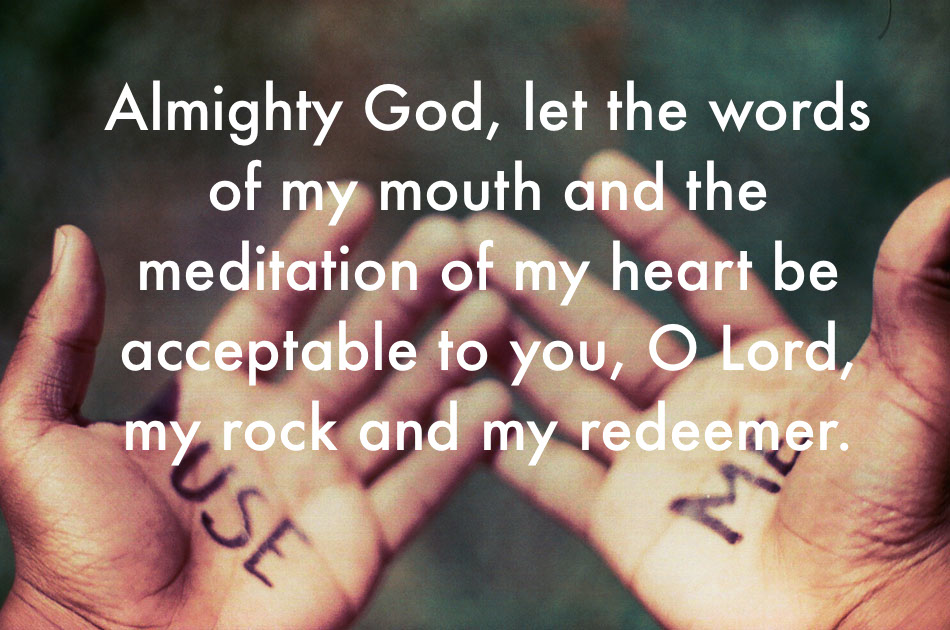
use-me

There were two men. The first lived his life perfectly and blamelessly; everything was coordinated and examined. He never wasted a moment and did his utmost to plan for every contingency and minor catastrophe. If he could live his life in consistent repetition, he believed he could achieve perfection. Every morning he awoke to eat the same breakfast and spend precisely 15 minutes reading from his bible, offering up the same lifeless prayer. He wasn’t sure that he actually believed in God, but he wanted to be safe. He took the same roads to work, ordered the same lunch, used the same pencil brand. Everything was accounted for. He made his money, invested in the right companies, provided for his family. On the surface he had everything you could want. Except he did not have life.

The second man lived a life of apparent chaos as he tried desperately to cling to something solid as the world continued to spin around him. Every morning was a new and exciting, though sometimes terrifying, adventure. He would often oversleep leading him to rush off to work without his breakfast or morning coffee. He was a faithful Christian, he somehow was able to make it to church every week, his bible was often found in different places throughout his house with ear marks and underlined passages in the Old and New Testament. He believed deeply that God was a living and loving presence in his life and looked forward to his moments of silence during the day when he felt he could best commune with the divine. Speaking with God was not about rhythm or repetition, but a life-giving and humbling experience. He made his money, tried to invest, but believed that spending time with his family would be more rewarding than a large portfolio. On the surface he was missing some of the things that make up the American dream. But he had life.

It has taken me a long time to learn how to pray; and I’m still not satisfied with my prayer life. I go through waves of devoting time everyday to sitting in silence and talking with God, and then there are days when I have realized that I felt too busy to pray. I have spent weeks praying prayers that have been written in books, and I have spent months praying extemporaneous prayers from my heart and soul. I have experimented with numerous spiritual disciplines, and I’m not sure that I have found the one that is just for me, perhaps I never will.

Prayer is one of those things in the life of Christian discipleship that we expect, but rarely talk about. Whenever we get together as a church, before an activity begins, all eyes fall on me to lead us in prayer so that we can start. Sometimes those prayers feel life-giving, but oftentimes they feel like an expectation. When I am asked to pray before a meal, there are times that I feel truly genuine in expressing my thankfulness to the Lord, but there are also times when I feel that I am just going through the motions.

prayer

There was a long period in my life where I felt like the first man. I would wake up early and ride my bike to Duke Divinity School just so that I could be there for Morning Prayer with the Anglicans and Episcopalians. I even started to lead the daily worship service. But there was a time when in meant very little to me. It became so routine that I stopped listening to the words, and felt that it was more important for me to be there in body, than it was for me to be there in heart and soul.

Last week I asked us to examine a simple, yet profound, question: What is the point of Church? Why do we spend time each week gathering in this place? I attempted to proclaim God’s Word in such a way that we could begin to move away from a maintenance model of Church, to a missional model where we live as Christ’s body for the world.

Today I would like to ask an equally simple, yet profound, question: Why do we pray and read scripture? Why do we take the time to halt the busyness of our lives to read God’s Word and commune with him?

The psalmist writes that the law of the Lord is perfect, it revives the soul, it makes us wise, it allows us to rejoice in our hearts. The commandments are clear, they open our eyes. The fear of the Lord is pure and endures forever. The ordinances of the Almighty are true and righteous. The psalmist even goes on to claim that the Word of the Lord is to be desired more than gold and sweeter than honey.

You could give me a biscuit with honey on it right now, and I would tell you that is the sweetest thing in the world. Yet, as I have grown older, as I have spent more time deep in God’s Word, its sweetness has been revealed to me. In a conversation with someone during bible study, or deep in prayer about someone’s life and suffering, a new vision and understanding is presented to me out of God’s Word. It truly is a sweet gift, one that speaks to us, even today, from God.

The difference between the two men, is that the first saw his responsibility to prayer and scripture as simply that – a responsibility. He sets aside the time to read and pray, but the words on paper and the words on his lips are lifeless. He believes the first part of the psalm but expects that so long as he maintains his regular practice it will be enough. The second man, however, recognizes that he can do more, that speaking with God can be different and casual and faithful.

Psalm 19 begins to answer our question: Why do we pray and read scripture? It refreshes our souls.

When we spend time reflecting on God’s Word and going to him with our thoughts, desires, hopes, and fears we honor the living Lord who refreshes our souls for a new day. It simplifies the way we envision the world, and reminds us who we are following and why. It humbles us and rewards us.

However, even with the benefits and warnings in scripture, we cannot completely avoid hidden sins and mistakes nor can we control others around us and prevent them from doing the same.

God’s Word operates as a warning about the transgressions of life. It has not only the green light of “allowed”, and the red light of “forbidden,” but also the yellow light of “caution.” Ordinary and humble people do not normally go plowing through the red lights of life. Deliberate and precise sins come with practice and committed degeneracy. But we are all constantly taking chances with the yellow lights of behavior.

That is why the end of the psalm is so important: Who can detect all of their own errors? Who can look at their life and faithfully say I was wrong? Great God, cleanse me from my hidden faults, keep me from those who would do harm to my soul.

The greatest test of our faith is found in our willingness to seek forgiveness from our sins, particularly those no one knows about except us. When we have committed a wrong against someone, and everyone else knows about it, I believe we are more inclined to seek forgiveness. But when we do something wrong in secret, when we sin while no one is watching, I believe we are less inclined to ask for forgiveness, because it is entirely on us. God’s word and a life of prayer are therefore the ways by which we might have the strength to admit our faults, as we read about so many who have sinned before us, and seek forgiveness as we commune with the Lord in prayer. Reading and praying are as essential for us as are eating and breathing – they all give us life.

If you want to become a United Methodist Pastor, there are a number of requirements you have to meet. One of the most stressful is planning a full worship service, leading it, preaching, and having the entire thing videotaped. I was still in seminary when I asked my home church if I could “take over” for one Sunday in order to film the service and send it off to the people who would determine whether I should become a pastor or not.

I fretted about the service, overanalyzed the bulletin, worried about the hymns I selected, stressed about the scripture, and never felt the sermon was good enough. After all the weeks of planning and communication I showed up at my home church Sunday morning, and prepared to put it all on the line. I remember standing in the back, and giving my father the “thumbs up” to start recording when Jason, my friend and pastor, walked ahead of me to address the congregation.

“For those of you that don’t know,” he began “we have one of our very own here this morning to lead us through worship. Taylor is applying to be considered for an appointment in the United Methodist Church and everything we do this morning is being filmed. You and I all know that he is not really that funny, but if you could try to laugh at his jokes, I’m sure that it will help him out with the Board of Ordained Ministry.

The service was oriented around a reading from the end of James about sharing our sufferings with one another. The role of disciples in the church is to rejoice with one another at times of happiness, and weep together during times of sorrow. We are called to love one another through the good times and the bad, but we can only begin to find healing and reconciliation if we share our struggles.

When I was finally able to offer the benediction at the end of the service I breathed out a huge sigh of relief, a sigh that was so loud that you can hear it in the recording! I had made it through the whole thing without tripping and embarrassing myself, without stuttering through the scripture reading, and I even got a few laughs during the sermon though I could never tell whether they were genuine or not…

I made my way out of the sanctuary proud of the service and hopeful that it was good enough for the Board that would be viewing it. But while my mind was caught up in my own selfish reflections about the service, I saw a member of the church, someone I knew very well, crying in her pew.

She shared with me that her daughter had been suffering with bulimia through the last six months and she had refused to share it with anyone. She was embarrassed that she had failed as a mother and she felt as if she was carrying the whole world on her shoulders. She said that after hearing the scripture read, and the words of the sermon, she prayed in her pew, and she realized (for the first time) that the church was the place that she could share her burden. And while others were preparing to leave she reached out to the stranger in her pew and asked if she could share with him her struggles and pray together. With tears flowing down her face she said that this was the best she had felt in months.

prayer-bible

The Word of the Lord is greater than gold and sweeter than honey. In the moments of our reading and praying we are opened up to the strange new world of the bible and of faithful living that can change everything.

We pray and read to cleanse our souls and to give us life. It is not something that has to be strictly observed with militaristic expression, but instead something that we believe can change our lives.

The final line of the Psalm 19 is a beloved and permanent aspect of worship; they are the words I pray before preaching every single Sunday. If our words and thoughts are acceptable in the Lord’s sight we are on the path toward renewed spirits and discipled living. When those words become our truest prayer and hope then we are speaking and thinking as if Jesus was at our elbow which, after all, is the whole point of prayer.

Amen.