Devotional – Psalm 146.1

Psalm 146.1

Praise the Lord! Praise the Lord, O my soul!

Weekly Devotional Image

On Thursday afternoon I made my way over to the parking lot at Gypsy Hill Park to prepare for the UMC Trunk or Treat. The pastors and lay leaders from the Staunton area United Methodist churches had been planning the event for a number of months and it was my responsibility to set up the parking lot and organize the first wave of volunteers. For months we had collected candy and advertised in the local community and I was anxious to see how it would turn out.

In our earliest conversations we thought we would be lucky to receive a few hundred children and their parents for our Trunk or Treat. We continued to organize, plan, and pray for the event and when it was time to start trunk or treating a long line had already started to form; All of our hard work was about to come to fruition.

Over the next two hours the line of people never dwindled. Volunteers were running around in order to maintain the safety of the young children while also replenishing the candy supplies that had run low in some of the trunks. Children were dressed in some of the wittiest and most delightful costumes as they came forward with grateful hands to receive a peace of candy. And every trunk was attended by a faithful Christian eager and willing to share God’s love through the tiniest of gifts.

At about 7pm I left Lindsey with the candy at our trunk and made my way to the top of a hill for a better vantage point; I wanted to see how well the line was moving and if people were still enjoying themselves. I resisted the temptation to turn and look until I got to the very top and when I did I was stunned. From where I stood I could see no end to the numbers of children and families that had gathered in the park. I tried taking a picture and I could not even come close to capturing everyone in it. By the time the Trunk or Treat came to a conclusion over 3,500 people had come through.

12182395_10204873871677559_710633466728393275_o

When I stood on top of the hill and looked out at what the United Methodist Church could do in connection I wanted to praise God. Only an almighty and powerful God could call us to work in community with one another instead of in competition. Only a faithful and loving God could stir our hearts to give generously to this wonderful community. Only a redemptive and sustaining God could accomplish something in us as powerful as our Trunk or Treat.

We truly serve an almighty God who is worthy of our praise!


Who Are You? – Sermon on James 1.17-27

James 1.17-27

Every generous act of giving, with every perfect gift, is from above, coming down from the Father of lights, with whom there is no variation or shadow due to change. In fulfillment of his own purpose he gave us birth by the word of truth, so that we would become a kind of first fruits of his creatures. You must understand this, my beloved: let everyone be quick to listen, slow to speak, slow to anger; for your anger does not produce God’s righteousness. Therefore rid yourselves of all sordidness and rank growth of wickedness, and welcome with meekness the implanted word that has the power to save your souls. But be doers of the word, and not merely hearers who deceive themselves. For if any are hearers of the word and not doers, they are like those who look at themselves in a mirror; for they look at themselves and, on going away, immediately forget what they were like. But those who look into the perfect law, the law of liberty, and persevere, being not hearers who forget but doers who act — they will be blessed in their doing. If any think they are religious, and do not bridle their tongues but deceive their hearts, their religion is worthless. Religion that is pure and undefiled before God, the Father, is this: to care for orphans and widows in their distress, and to keep oneself unstained by the world.

who-am-i


The small town sheriff was frustrated when he received a phone-call from the station that interrupted his Sunday supper. A report had come in that a group of young boys were throwing water balloons at strangers walking along Main Street. Reluctantly, the sheriff changed out of his Sunday best into his uniform and went to find the hooligans.

Just as the report noted, a group of young boys were standing on a street corner with a bucket of water balloons and were striking anyone within distance. As he approached in his patrol car, he expected to hear the boys laughing and hollering, but they were rather silent as he inched his way forward. He recognized all the boys from his local church, and dreaded the phone calls he would be making to all of their parents, but he knew their behavior had to stop.

The boys were smart enough not to throw a balloon at the police car, but the sheriff was still nervous to roll down his window in case a wayward throw made it inside. “What do you think you’re doing?” he yelled to the boys. In unison they all solemnly replied, “we’re working for the Lord.” He was mystified by their response, after all how could throwing water balloons at strangers be equated with the almighty? So the sheriff sat in his car with one eyebrow raised and motioned for them to explain.

The ringleader then stepped forward and said, “Didn’t you hear the preacher this morning sheriff? He told us to go out baptizing in the name of the Father, Son, and Holy Spirit. We’ve got Holy Water Balloons and we’ve done already made 45 Christians.”

Every good thing in our lives, every generous act of giving, every perfect gift, every blessing, every compliment, is from above.

Throughout our days, the Lord nurtures, guides, and provides all that we need. More often than not, God uses the people around us to do so, but nevertheless God supplies the goodness in our lives.

The letter of James is beautiful, and it begins with a quick assessment of the discipled life and what it means to live into this identity.

James knew how to notice the small things, because the small acts of life are the nuts and bolts of existence. It is the little things, the small actions and the tiny compliments, that hold together the fabric of our lives and give us the power to build and shape community. What we say and how we act are more important than we can possibly imagine.

The Lord has given us new life by the Word of truth and the power of scripture so that we would become a kind of first fruits. We have been given the great blessings of God’s presence, scripture, and Jesus Christ and now we have the responsibility to let those blessings bear fruit in our lives, and in the lives around us.

We must understand this, children of God, we should be quick to listen, slow to speak, and slow to anger, because our anger does not produce God’s righteousness. How many times have we jumped to a conclusion, or said something without thinking it through and immediately regretted it? How valuable is James’ advice: be quick to listen, slow to speak, and slow to anger?

Our contemporary conversations are filled with “uhhs” “buts” “likes” and other verbal bridges because we are afraid of silence. Rather than actually listening to others, or at least giving them the chance to speak, we fill up every ditch between our words out of fear that someone else will jump in with something else to say. Imagine how much our relationships would change if we only heeded James’ words in our conversations? Can you picture how different our identities would be if we were quick to listen, slow to speak, and slow to anger?

If we have the strength to change the way we converse, then we will begin to welcome with meekness the implanted word that has the power to change the world. Instead of relying on our own words at all times and places, with patience we can remember the great Word of God in Jesus Christ and put all our trust in him. Instead of believing that we are alone in the world and in our situations, we will come to see that God is with us, and has carried God’s people through this before and will again.

But it’s not just about the words we use and speak, as Christians we are invited to be doers of the Word and not merely hearers who deceive themselves.

Have you ever departed from church on a Sunday morning, after hearing a particularly convicting message, only to believe that it had nothing to do with you? Have you ever picked up the bible and started reading only to think about the other people the scripture should apply to instead of you?

For if we are hearers of the word and not doers, then we are like those who look at a mirror and as soon as we walk away immediately forget who we are. Our identities are rooted in the scriptures we read, and in the water of our baptism. But too often, we leave from church, or we put down the bible, or the water dries from our hair, and we immediately forget who we are and whose we are.

If church is supposed to accomplish anything on a regular basis, it is to act like a giant mirror so that we catch a glimpse of who God is calling us to be, and then never forget what we have seen.

who-am-i-1024x575

It was New Year’s Eve 1999 and Javier was afraid. For months news pundits and writers speculated about the “end of the world” coming with the year 2000. In addition to some strange and warped biblical prophecies, technologically proficient workers warned about the change that might come with the digits 99 changing to 00 and the blackouts that could ensue. For weeks people throughout the world prepared for the worst, and the rhetoric about the end times increased.

So Javier found himself getting ready to attend a worship service with his family and friends in El Salvador on the eve of the new millennium and he was afraid. The service itself was fine; it proclaimed the word of God’s faithfulness in spite the warnings about the new millennium, yet Javier could not rid himself of the fear that was shaking him to his core. Before the service came to a close, Javier stood up, walked to the front and asked to be baptized. He did not know what the New Year would bring, he did not know what would happen to the world, but he figured that a little water on his head couldn’t hurt.

Except, that simple affirmation that God was bigger than himself, that simple humbled moment of reverence to God’s power to save was enough to change Javier’s life forever. Of course, the year 2000 did not bring about the end of the world, but it did bring about Javier’s new identity in Jesus Christ. From that night forward he saw himself as a disciple and has lived into that ever sense.

My own baptism took place when I was 19 days old. Other than some strange blurry photographs of my mother and father standing at the front of the church, I have no idea what it was like or what happened. But it came to shape my very identity. The people who were present in worship that day 27 year ago took seriously the commitment to raise me in faith, and helped me hold on to my identity in Jesus.

The Sunday before I became the pastor at St. John’s I stood before my home congregation and thanked them for nurturing me in the faith all these years and said goodbye. But while I stood in the narthex shaking hands after the service, a much older woman came up with a very worn bible in her hands. Without saying much she turned to the back inside cover and showed me my name and the date of my baptism. For decades she had written down the name and date of every person baptized in her presence and made a point to pray for every single one of them, every single day. Her prayers shaped me into who I am.

Those of us to look in the mirror and remember who we are when we walk away, those of us who are doers of the word will be blessed in our actions. Our religion is pure when we, like the disciples from long ago, actually live into the Word of God and start caring about the people in our midst. Our religion is pure when we clasp our hands together and pray for the world. Our religion is pure when we remember our baptisms and are thankful.

tumblr_m8lkq3H8zQ1rqn80jo1_500

Who are you?

What defines your identity?

Perhaps we’ve forgotten who we are and whose we are. Instead of seeing disciples of Jesus Christ in the mirror, we only see fathers, mothers, brothers, sisters. Instead of holding on the image of God in our hearts, we turn away from the mirror of church and we immediately forget what God is speaking into our lives.

Do you remember your baptism? Can you recall the details of what eventually led you to yearn for the water of a new identity? Were you, like Javier, led to baptism out of fear? Were you, like me, led to baptism before you even had a chance to know what was happening?

Baptism is not about quantity; we’re not interested in throwing Holy Water Balloons at everyone within distance. Baptism is instead about discovering our fullest identity in Christ through a covenant by water and the Spirit.

Today, we are all invited to remember our baptisms and be thankful. In a few moments I will pray over our baptismal font, and everyone may come forward to remember and give thanks. The mirror behind the water is there for us to take a good look, so that when we turn around we will not forget who we are.

Disciples of Jesus Christ: Remember that every good thing is from above, that God has given us the word of truth so that we may bear fruit in our lives. Remember to be quick to listen, slow to speak, and slow to anger. Remember that we are called to be doers of the Word. Remember your baptism and be thankful. Remember who you are. Amen.

Strange Stories From Scripture: A Week In The Word – Sermon on Judges 3.12-23

Judges 3.12-23

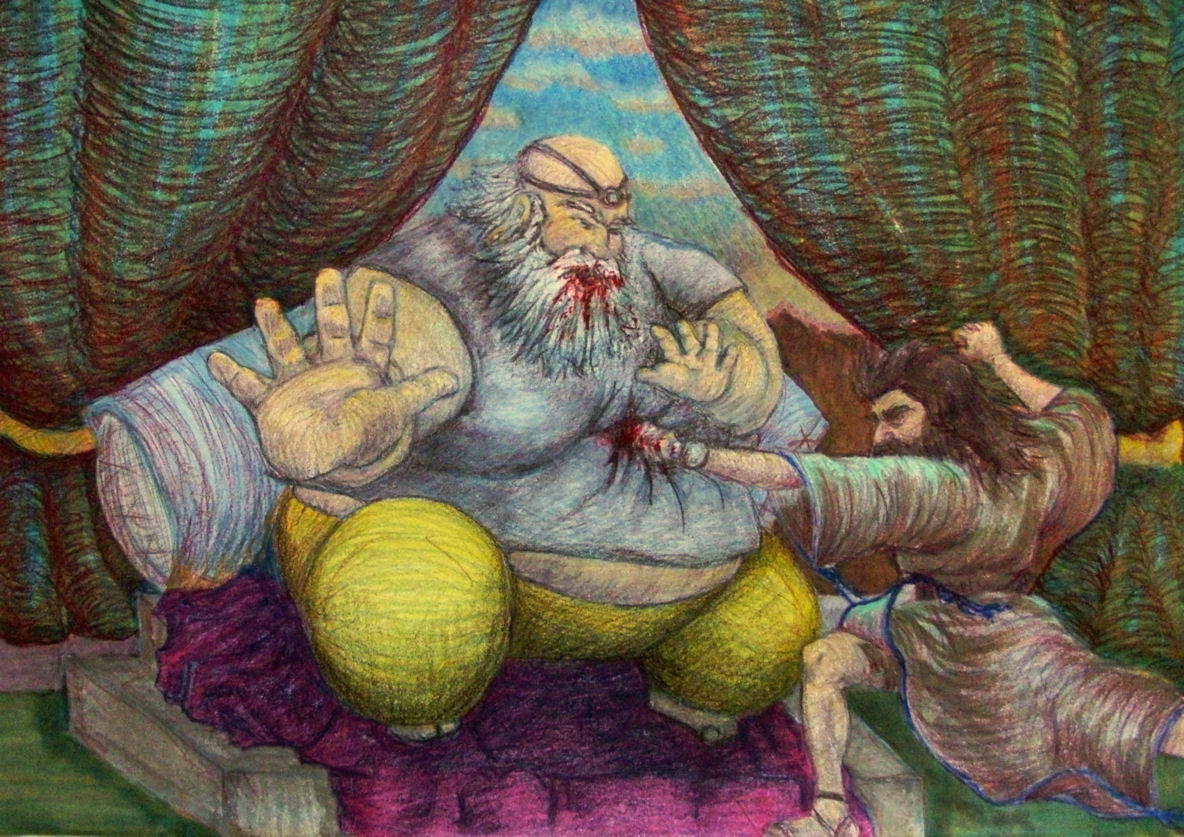
The Israelites again did what was evil in the sight of the Lord; and the Lord strengthened King Eglon of Moab against Israel, because they had done what was evil in the sight of the Lord. In alliance with the Ammonites and the Amalekites, he went and defeated Israel; and they took possession of the city of palms. So the Israelites served King Eglon of Moab eighteen years. But when the Israelites cried out to the Lord, the Lord raised up for them a deliverer, Ehud son of Gera, the Benjaminite, a left-handed man. The Israelites sent tribute by him to King Eglon of Moab. Ehud made for himself a sword with two edges, a cubit in length; and he fastened it on his right thigh under his clothes. Then he presented the tribute to King Eglon of Moab. Now Eglon was a very fat man. When Ehud had finished presenting the tribute, he sent the people who carried the tribute on their way. But he himself turned back at the sculptured stones near Gilgal, and said, “I have a secret message for you, O king.” So the king said, “Silence!” and all his attendants went out from his presence. Ehud came to him, while he was sitting alone in his cool roof chamber, and said, “I have a message from God for you.” So he rose from his seat. Then Ehud reached with his left hand, took the sword from his right thigh, and thrust it into Eglon’s belly; the hilt also went in after the blade, and the fat closed over the blade, for he did not draw the sword out of his belly; and the dirt came out. Then Ehud went out into the vestibule, and closed the doors of the roof chamber on him, and locked them.

Today marks the second part of our series on Strange Stories from Scripture. As a church we are taking time to look at those wonderful moments from the bible that they never talked about during Sunday school. These are the stories that make us blush, raise our eyebrows, and leave us scratching our heads.

Many of us are familiar with the well-known stories of Moses leading the Israelites through the wilderness, we know all about King David and his kingdom, we can even recall the miracles of Jesus, but the bible is also full of tales that are just begging to be used in worship and our daily lives.

Our first story was from the book of Numbers regarding the foolish prophet Balaam and his talking donkey. We explored how the donkey attempted to steer Balaam in the right direction, and pondered about the donkeys in our lives.

Today we are talking about Ehud and King Eglon from the book of Judges.

Ehud-and-Eglon (1)

Monday.

I’m sitting in my office, going over the emails from the weekend when I pull out the list of all the scriptures from now until Christmas Eve. I reread the plan for the sermon series on Strange Stories from Scripture, I wonder if people felt convicted by the sermon on Balaam and his donkey yesterday. I check the email once again to see if anyone took the time to send me a complaint about the sermon. The only one I receive makes a comment about seeing such a “smart… donkey” in the pulpit, but I file it away for later.

The A.C. is pumping out cold air, and I open up my bible to Judges 3 to read the scripture for Sunday. The story of Ehud and Eglon. As the words flow past my eyes, I can’t help myself from giggling in the office: Ehud stabs him in the belly, and Eglon was so fat that the blade disappeared and the dirt came out. I quickly scan through a number of other translations to see what they do with the vague “dirt” description. Some call it dirt, most call it dung, but at least one calls it poop.

When I see the word poop in the bible, it just makes me laugh.

I wonder if people will let me get away with saying poop from the pulpit on Sunday morning. I quickly make a note to pray about it during the week, before deciding whether or not to put “poop” in the sermon.

This has got to be one of the funniest and strangest stories in the bible, but before I dive into sermon writing, I decide to leave the word document open on my computer, and get to some of my other daily tasks before returning.

Tuesday.

The screen stares back at me empty. So I decide to get the mental juices flowing and rewrite the story in my own words:

The Israelites messed up again. Whether they were grumbling for more food, or worshipping false idols, they messed up, and the Lord decided to raise up King Eglon of Moab against God’s people, because they were continually messing up. King Eglon, with the help of God, went and defeated Israel and ruled over God’s people for 18 years.

But then, of course, the Israelites started to cry out to the Lord for delivery, perhaps they had seen the error of their ways, so God decided to provide their savior, Ehud, a left-handed man.

The Israelites, at the time, were in the habit of sending their taxes to King Eglon, and Ehud used this delivery to make his attack. He fashioned himself a double-edged sword, and attached it to his thigh under his clothes.

King Eglon was a very fat man.

ehud2

When Ehud finished delivering the money, he sent his compatriots away, and teased the King with the promise of a secret message from God. Eglon sent away all of the people from his inner court and invited Ehud to share this secret. But as Ehud leaned in to deliver the precious secret, he removed the hidden dagger and thrust it into Eglon’s belly.

Strangely enough, the further Ehud pushed, more of Eglon fat rolled over the blade until it disappeared from view, and Eglon’s poop came out. Then Ehud snuck out of the chamber and locked the doors behind him.

I rewrite the story, looking for sermonic inspiration that would drop down from heaven like manna in the wilderness, but I just sit in my office wondering what in the world God is trying to say through the text. Throughout the day the phone and doorbell continue to ring at church, and I welcome the distractions.

Wednesday.

I pull out some commentaries on the text, and decide to see what other people think God was saying. A few of them go into remarkable detail about the significance of Ehud being left-handed, while others address how detailed the descriptions were, and a few even propose a sexually metaphorical interpretation.

The more I read, the less the story makes me laugh. Instead of looking at the story like a cartoon with poop on the floor, I see human beings driven by enough anger and fear to conquer a nation, and murder a king.

Reluctantly, I start searching online for other sermons about Ehud and Eglon. Do people preach about this? What in the world do they say?

One of the sermons is titled, “Lefty vs. Hefty” and it is all about the differences between the two central characters. The writer emphasizes Ehud’s cunning against Eglon’s girth.

One of the sermons is titled, “Salvation” and it goes into profound detail regarding how, supposedly, God ordains the killing of people even today who get what they deserve. The preacher calls for the people to commit themselves to a radical system of justice, where they take matters into their own hands, just like Ehud did.

One of the sermons is titled, “The Power of Praise” and it focuses on how Ehud was able to trick Eglon into giving him the opportunity to strike. It ends with a reminder for the listeners to be careful about the promises they hear and the compliments offered their way, because a dagger might be lurking in the corner.

The more I read from God’s Word and from other sermons the more I regret picking the scripture for the series:

Eglon, the fat king, is now less a caricature, and more like the punishment God ordained for the people for messing up.

Ehud, the people’s deliverer, is now less a righteous judge, and more like a murderer.

Months ago I thought it would be perfect and hilarious to use this text during a series on Strange Stories, but now I worry about what I will actually say about it when the time comes.

Thursday.

Sitting in a coffee shop in attempts to begin crafting a sermon, I continue to stare at a blank screen. I have started at least three different sermons but before I am able to start really crafting a deep response to the Word, I highlight the text and pressed “delete.” Nothing feels good enough, all of the attempts feel flat.

How is this story speaking anything into our world today? What does the death of Eglon at the hand of Ehud have anything to do with the life of St. John’s and the community of disciples?

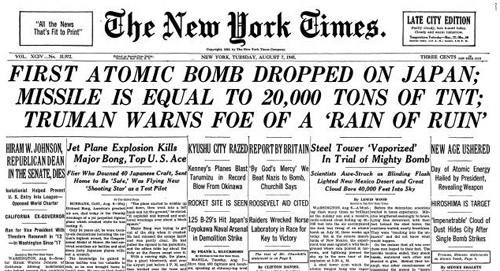
I close the computer and grab a nearby newspaper in hopes to distract myself from the seemingly endless flicker of the cursor on my computer. The top article says “US drops Atomic Bomb on Japan 70 years ago today.

1945-08-07-New-York-Times-headline

Before I realize it, I am sucked into the article, and the sermon floats away from the forefront of my mind. The writer has reproduced the original texts used the Associated Press the day the Atomic Bomb was first reported:

“An atomic bomb, hailed as the most terrible destructive force in history and as the greatest achievement of organized science, has been loosed upon Japan… The atomic bomb destroyed more than 60 percent – 4.1 square miles – of Hiroshima, city of 343,000 and radio Tokyo reported “practically every living thing” there was annihilated… Secretary of War Henry Stimson said, “If they do not now accept our terms, they may expect a rain of ruin from the air the like of which has never been seen on this earth.” (From the original AP article http://bigstory.ap.org/urn:publicid:ap.org:3fd267ba7b3c40479382189c99172d61)

I read the article and tears begin to form and fall down my face. Normally I would hide my face from the other patrons, but I am so struck by the words that I forget where I am and what I’m doing. 70 years ago we dropped the most powerful weapon we had ever created on a nation and virtually wiped out an entire city in a matter of seconds.

I start to remember where I am, and the sermon that needs to be written. The connections between the article and the scripture start to form:

Did Ehud leave the sword in Eglon because he wanted the effects to be devastating? Did he want to leave his mark in such a way that death was not the only consequence? Was the Atomic Bomb our sword that we had hidden under our clothes? Did we attack Japan in such a way that death was only the beginning of what we wanted to accomplish?

I wonder what people will think if I try to draw a connection between the anniversary of the Atomic Bomb with the death of Eglon at the hand of Ehud. Did Ehud do the right thing? Did we do the right thing? I have no idea where the sermon is heading.

Friday

I sigh deeply in front of my computer. Picking the Ehud and Eglon story was a bad idea. I explore an idea about dressing up like Ehud with a sword in church but it feels trite, impractical, and vaguely irreligious. I start writing a poem about how the Lord calls people to do extraordinary things during extraordinary times, but then it feels like I’m telling people its okay to murder and steal.

I sit in silence with my hands outstretched praying for the Lord’s will to be done, and for the sermon to be written. And I wait.

Saturday

The Community Cook-Out is going well; children are running around, adults are being fed, and conversations are flowing all over the place. I am thankful for the distraction the cook-out has provided, though I’m also worried about tomorrow morning. What will I say when the time comes? What is God’s Word speaking into our lives right now?

I watch the community in action. Not just the church, but all the people who make Staunton what it is and I think about Jesus. I remember the call to live radically transformed lives based on love and forgiveness, not on fear and retribution. I see people breaking bread for the first time, and I see Jesus in the midst of the people providing hope, the Holy Spirit giving life to our words and relationships, and God making new and lasting connections.

I think about Jesus and the new life he invites his disciples to experience. I think about the lengths God was willing to go to to respond to the cries of God’s people, raising up prophets and judges. I think about God finally offering the most precious gift he ever could, his Son, to die for all the people out on the front lawn of the church, and for the world.

I wonder if the story of Ehud and Eglon isn’t so much about how we react when the world pushes us into a corner, but about the trajectory of God’s gifts to the world. That at one time God would raise up a judge to save Israel, but that now God raised up his Son to save us from ourselves and from death.

Sunday

I stand in the sanctuary before disciples hungry for the Word of God and I say: I offer this to you in the name of the Father, and the Son, and the Holy Spirit. Amen.

How The Dishwasher Taught Me To Pray – Sermon on Ephesians 3.14-21

Ephesians 3.14-21

For this reason I bow my knees before the Father, from whom every family in heaven and on earth takes its name. I pray that, according to the riches of his glory, he may grant that you may be strengthened in your inner being with power through his Spirit, and that Christ may dwell in your hearts through faith, as you are being rooted and grounded in love. I pray that you may have the power to comprehend, with all the saints, what is the breadth and length and height and depth, and to know the love of Christ that surpasses knowledge, so that you may be filled with all the fullness of God. Now to him who by the power at work within us is able to accomplish abundantly more than all we can ask or imagine, to him be glory in the church and in Christ Jesus to all generations, forever and ever. Amen.

pray

I loved my college roommates. Some of us knew each other from high school, and others were grafted in along the way, but nevertheless, when we lived together it felt like a little family. We tried our best to communicate needs within the domicile, we kept it quiet when someone had a midterm the next morning, and we quickly learned to share common appliances for the betterment of the entire living situation.

Between us we would come to earn Bachelor degrees in Philosophy, Religion, Biology, Communications, and History. I always kind of imagined that we would be a awesome group Jeopardy team with the wealth of knowledge spread between us. Living together in college was great, but it wasn’t always easy.

There was the time we discovered mice in the house. We did our best to keep the kitchen clean, and spread mouse traps throughout the house, but during the cold winter months they came back like clockwork.

There was the time a huge snow storm came through, trapping all of our cars, and we ran out of heating oil to keep the house warm.

There was the time that we all contracted swine flu at different intervals. As one person became sicker and sicker, those of us who were well shared the responsibility of caretaker, until we started displaying our own symptoms.

Part of the beauty of living with other people was the sharing of life experiences. We celebrated each others successes, and grew to really rely on one another. Part of the challenge of living with other people was learning how to change our habits and needs based upon the habits and needs of other people.

Ephesians 3.14-21 is a prayer. Paul is writing to this new faith community in the hopes that his prayers will be answered by the Lord of hosts. He prays for the congregation because he knows that he cannot give them what they need in order to grow, but through prayer the church will learn to fully rely upon God.

The beginning of the prayer establishes the main focus: Paul prays for the church to be strengthened in its inner being, from the inside out, by the power of God. He hopes that the individuals that make of the community will see the vital importance of letting Christ into their lives and then change accordingly.

If Christ dwells in the hearts of the people, if they are rooted and grounded in love, then they may have the power to comprehend what is the breadth and length and height and depth of Christ’s love that surpasses all knowledge.

During college, I was the only person from the house that went to church. While my roommates enjoyed the comfort of their beds on Sunday mornings, I was making my way out the door to worship the Lord. I learned to accept their priorities, and on some level they learned to accept mine.

For instance: I made them pray with me whenever we ate dinner that I had prepared. I felt that if I was willing to go through all of the steps necessary to make a dinner for all of us, then they could bow their heads with me in prayer. So once a week, we would sit in our living room, eating on paper plates with plastic silverware, and they would listen to me pray.

prayer (1)

It is difficult for many of us to hear about God’s unending love, particularly a group of college-age men who just wanted to eat. It may seem so obvious to us that it no longer strikes at the core of our being. We hear “God is love,” and “love is patient, love is kind,” and “Love you neighbor as yourself,” and “God’s love knows no bounds” and instead of that love becoming clearer, it just floats around in the air.

Faithful love is even harder to grasp for those of us who do come to church because we hear about all these beautiful and wonderful things, we look around at a church filled with people who appear to have their lives figured out, when in reality we are all struggling with a myriad of secrets, private disappointments, lost hopes, and frustrations.

It’s hard to hear about love, when we don’t feel love in our lives.

Paul’s prayer for the church in Ephesus is all about letting Christ in to change lives: I pray that, according to the riches of his glory, he may grant that you may be strengthened in your inner being with power through his Spirit, and that Christ may dwell in your hearts through faith, as you are being rooted and grounded in love.

Letting Christ into our hearts is like moving in with a new roommate. At first, we spend a lot of joyful time getting to know one another, discovering common likes and interests. We do a great job putting all the dishes away and keeping the house clean, but then we have to start making compromises, whether we want to or not.

I learned about this type of faithful living the right way through my wife Lindsey. When we were dating, and I was getting ready to ask her to marry me, I dreamed about what it would be like to live together. I imagined the way we would set up our living room, where we would put the record player, and even where we would dance to all of our old jazz 33s.

After the wedding, while we were still giddy from the honeymoon, we decided to tackle the challenge of combining all of our possessions in the kitchen. We debated the value of keeping our plates in one cabinet versus putting the coffee cups near the coffee pot. We worried about the safety of keeping our knives in a drawer or right on the counter top. And we experimented with the location of the microwave in relation to the toaster and whether or not we would blow the fuse if they were both on at the same time.

praying_hands_clean_dirty_dishwasher_magnet-rcfdd698c86904ddaa1e6594a1d17e547_x7qgu_1024

The real challenge came to the precipice over the dishwasher. I was of the opinion that it did not matter where dishes and cups were placed in the dishwasher, so long as we could fit as many things as possible. Lindsey was not of the same opinion. For the first few weeks, whenever I put a plate away, she would come behind me and rearrange the dishwasher. It got to a point that I started purposely putting items wherever I wanted because I didn’t think it mattered, but sweet Lindsey would watch me live out my frustration, and then when I left the room, she would bring order to the dishwasher.

I don’t know how long this continued, but I do know when it stopped. Lindsey was working late one night, and the dishwasher was almost full. I saw my opportunity to prove that the dishwasher works fine no matter where the dishes are placed. So with a mischievous grin on my face I rearranged the order into chaos, I started the dishwasher. I couldn’t wait to see her face when she got home, I imagined the apology she would offer me regarding her wrong interpretation of dishwasher etiquette, it was going to be something beautiful.

But when the dishwasher cycle finished, I knew I was in trouble.

How could this have happened? Whenever Lindsey ran the dishwasher, everything came out all nice and clean and ready to use. But this time, there was still food on a few of the dishes, and some of the utensils looked worse than when I put them in!

I was wrong, and I learned to change. Now I will freely admit that sometimes I still place something in the wrong place, but after my passive-aggressive experiment, I have learned to alter my focus because Lindsey was right.

prayer_2014_02_07-13

The incident with the dishwasher taught me that prayer is about change. When I forced my roommates to pray in college, was I doing it because I was concerned about them, or was I doing it because I thought I was better than them? Did I earnestly pray to the Lord during that time, or did I just want them to hear the sound of my voice?

The beauty of prayer comes to fruition when we let Christ in to change us, and when we are willing to give up some of our space for the Lord. The dishwasher taught me that if prayer is only about myself, that if I am only concerned with my thoughts and actions, then I am neglecting to let God in to make some important changes.

Faithful living is about giving up those habits and behaviors that are no longer fruitful, reprioritizing and reorganizing our lives, so that God can make us clean.

In a few moments we are going to end our service not here in the sanctuary, but outside on the front lawn. We are going to gather in a group and we are going to pray.

First we will pray for God to give us the strength to give up some room, and let Christ in. That instead of focusing on just our needs and wants that we will begin to comprehend the love of Christ and the fullness of God.

Then we will face the sanctuary and we are going to pray for our church. So many of us, myself included, get caught up in such a tunnel-visioned view of prayer that we neglect to pray, like Paul did, for the community of faith.

And finally we will turn to face the community around us and pray once more. Prayer is not just about you and me, and it is not just about the church, prayer is about communing with the Lord about the very fabric of life.

If we want our lives to change, if we want our church to change, if we want to let God’s love reign, then we have to be willing to give up some space. We have to learn to rearrange the dishwashers of our lives so that everything can be made clean.

Amen.

God Is God And We Are Not – Sermon on Psalm 24

Psalm 24

The earth is the Lord’s and all that is in it, the world, and those who live in it; for he has founded it on the seas, and established it on the rivers. Who shall ascend the hill of the Lord? And who shall stand in his holy place? Those who have clean hands and pure hearts, who do not lift up their souls to what is false, and do not swear deceitfully. They will receive blessing from the Lord, and vindication from the God of their salvation. Such is the company of those who seek him, who seek the face of the God of Jacob. Lift up your heads, O gates! and be lifted up, O ancient doors! that the King of glory may come in. Who is the King of glory? The Lord, strong and mighty, the Lord, mighty in battle. Lift up your heads, O gates! and be lifted up, O ancient doors! that the King of glory may come in. Who is this King of glory? The Lord of hosts, he is the King of glory.

P-019-w_I_Am_Not_God.37205641_std

Be careful.” That’s what they kept saying when they found out I was invited to preach at a church in the heart of Detroit. I had been living in Birmingham, Michigan (a rather wealthy suburb north of Detroit) helping serve a church for the summer when I received the opportunity to fill in at another church one Sunday. And as soon as I was asked, all the warnings started coming in: “Be careful” “Park as close as possible to the church” “Keep your wallet in your front pocket.

I remember thinking these people were crippled by fear, how bad could it really be? We were talking about driving into Detroit on a Sunday morning to preach at a church…

When the morning arrived I was filled with excitement. I picked out the perfect bow tie to go with my blazer, hoping to assert my authority regardless of my young age, I had a prepared a theologically profound manuscript sermon, hoping that it would get people to shout “amen!” from the pews, and I spent the long drive down Woodward Avenue in silence, hoping to boost my holiness before the service began.

The closer I got to the church, the stranger I began to feel. I hadn’t noticed it at first, but the longer I drove, the less people I saw on the streets. The buildings went from inviting homes and businesses to abandoned shells of carpentry. The streets went from well maintained to pot holes that required a car to drive up on the sidewalk in order to avoid.

In a matter of minutes I had gone from “Pleasantville” to a post-apocalyptic movie set, and my excitement was quickly replaced by fear.

By the time I pulled in the parking lot, I realized that I hadn’t seen another human being for at least ten minutes. The streets had been largely deserted leading up to Cass UMC, and it was strangely silent when I stepped out of my car.

So here I was, standing in the heart of Detroit, in a bowtie and blazer, with a bible and sermon tucked under my arm, completely alone on a Sunday morning.

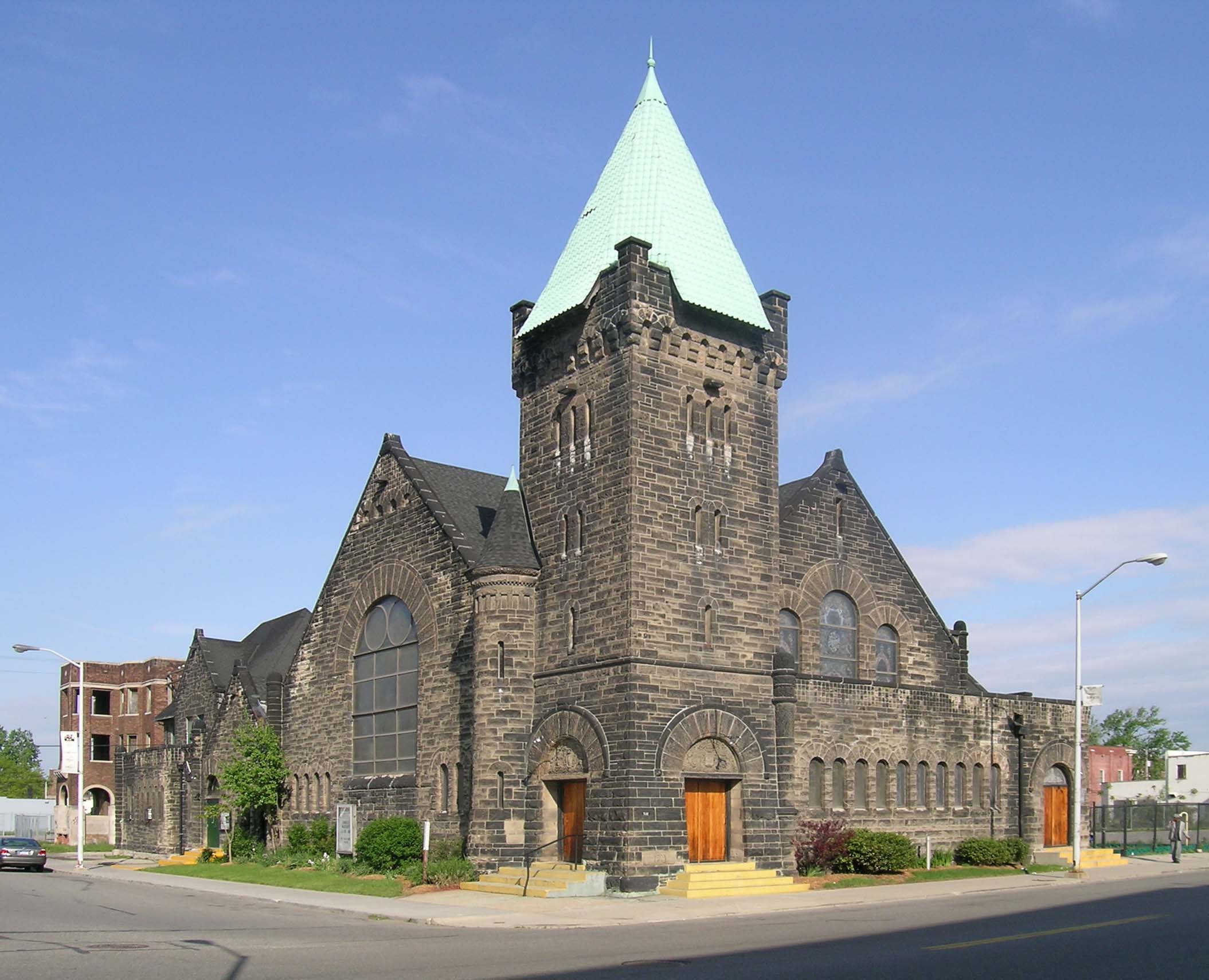
My footsteps across the concrete reverberated in echoes through the abandoned buildings flanking the church and even though it was a bright sunny day, I felt like I was walking down a dark alley in the middle of the night. The building itself was an architectural masterpiece having been built in 1883 with Tiffany’s stained glass windows, though I could tell from the street that bullet holes had cut through the once remarkable windows.

When I reached out my hand to open the doors, the height of my new fears were realized: It was locked.

Cass_Avenue_Methodist_Episcopal_Church_-_Detroit_Michigan

I knew no one from the church, I had no way to contact anyone, and all of the warnings started to really flow through my mind. But I did what any good pastor would do, I sat down on the front steps and waited for someone to open the door.

30 minutes later, a disheveled looking old man, the first person I had seen in a long time, peeked from around the corner, walked up the steps, and unlocked the front door without saying a word. I wandered around the building until I found the sanctuary, searched in vain for a worship bulletin, and resigned myself to sit down in a chair by the altar.

During the next hour, the most random assortment of people started flowing in through the sanctuary doors. The church, once renown in the heart of Detroit, was being filled with people who slept outside the night before, people who had no money to put in the offering plate, and people who were having conversations with themselves at a volume loud enough for everyone else to experience.

A group of 7 older black women arranged themselves on folding chairs near the front, and without really discussing it they all flipped their hymnals to the same page and started to sing. A man with wrinkled fingers was hunched over a piano in the corner struggling to keep up with the singing, and a young man had seated himself behind a drum-set hidden in the corner, and was wailing away to a song that only he could hear.

When the first hymn ended, the women huddled together to pick another hymn and began singing. At some point in the middle of their fourth hymn, with the pianist still planking away, and the drummer smashing the cymbals, a gentleman stood up in the middle of the sanctuary with his eyes trained on me. He walked down the main aisle slowly and deliberately until he was towering over me and then declared, “Son, if you don’t start talking, they ain’t liable to quit singing.

The earth is the Lord’s and all that is in it, from the sea to the mountains, from the rivers to the deserts, from the people to the animals; for the Lord has founded life upon the earth. Who then shall worship the Lord in holiness? And who shall stand with the Lord in the holiest of places? Only those who have clean hands, and pure hearts, those who do not lift up their souls to what is false, who do not break their promises. They will receive a blessing from the Lord, and vindication from the God of their salvation. Such is the company of those who seek the Lord.

I stood up after the end of the next hymn, and grabbed the hand held microphone to start participating in worship. I felt like a fool standing in my khakis and blazer, with my bowtie tilted just slightly to the side. I felt ridiculous with my over examined sermon under my arm, and bible in my hand. I felt like I didn’t deserve to stand before the congregation, but all of their eyes were on me. (just like all of yours are right now)

I took off the jacket and tie, rolled up my sleeves, ditched the sermon on my chair, and let the Holy Spirit go to work.

Let us pray” I began, and before I could start praying for our service, the people started shouting out their own prayers. “O Lord, help this boy to preach.” “Yes Lord, show us your mercy.”My God show me your glory!” “Remove our sins, give us your Spirit, clean our hearts!” “Your will be done!” “Have thine own way Lord!” “Help this boy preach, preach preach.

It was only after a few moments of silence that I finally said “amen” without having added any of my own prayers.

I preached on the apostle Paul’s second letter to the church in Corinth, about the new creation that comes in knowing Christ. I talked about moments that transform our lives. I said things like “there is a new life in Christ, but just because we find Christ it doesn’t mean our life will get better, but that we are called to make other lives better.” And instead of the typical, and silent, congregation I was used to, the people kept shouting at me while I preached. “Ain’t that the truth!” “Yes Lord!” “We know it, we know it” “Lord, give him strength to preach.” “Speak through him God.

When I got around to the close of the service, when I offered a benediction to the congregation, when the final amen was uttered, I heard them say in return, “Thank you Jesus.”

be-still-and-know-that-i-am-god-960x250

Lift up your heads, O gates! Open up you ancient doors! the King of glory is coming. Who is the King of glory? The Lord, strong and mighty, merciful and majestic, the Lord. Jesus Christ the author of salvation, the Good News, the Messiah. The Holy Spirit full of wisdom and truth, giver of life, and partner to our prayers. Lift up your heads, O gates! Open up you ancient doors! The King of glory is coming! Who is the King of glory? The Lord of hosts, he is the King of glory.

We can dress the part, we can read all the right books, we can memorize all the hymns and prayers, but unless we are looking for holiness in our lives, unless we are ready to bow down to the King of glory, then we are forgetting the truth: God is God and we are not.

Many of us are good Christians, we pray for our friends and family, we come to church, we put money in the plate, but there is a profound difference between believing we are holy, and wanting to be holy.

When I arrived at that church in Detroit years ago, I foolishly thought I was bringing something to them. With my well prepared outfit and sermon, I made the assumption that I was bringing God with me, nice and shiny, like a school project. I became my own main character in the story of worship, and it prevented me from seeing the King of glory.

When I stood up in the pulpit to proclaim the words, the people did not see a young man with a seminary education, they did not see some white fool trying his best to not pass out, they saw a vessel for the Lord. Their prayers were not to me, but for the Lord to work through me. The recognized the great division between God and me, and knew that Jesus was the bridge between the two.

They knew that God is God and we are not.

In our contemporary American culture, we tend to view ourselves as the center of the universe.

We assume that everything revolves around us, and that so long as our needs are being me, then everything else should be fine.

We believe that if we wear the right clothes, and get the right education, that holiness will follow accordingly.

We feel holy for giving up an hour every week to sit in a place like this and sing hymns, offer prayers, and listen to a sermon.

That church in Detroit had something that I never knew I needed: They believed that God was the center of the story, that God had the power to transform their lives, and that God really was the King of glory.

Too many of my friends have left the church because they “didn’t get anything out of it.” They might try different styles of worship and different denominations, but if they don’t get anything out of it, they will rarely return. However, church isn’t about what we get out of it, its about what God gets out of us.

Believing we are already holy limits God’s power to make us holy.

It is in the recognition of the great divide between humanity and the Lord that we can let Jesus get to work on our hearts and souls. It is in the great admission of Jesus as the King of glory we start to see ourselves, not as the center of the universe, but instruments for God’s love to be heard in the world. It is in the words of our worship that we recognize the Holy Spirit’s movement in our midst and our lives start to change.

If we remain in the assumption of our holiness, then our lives will stay the same.

But if we truly desire for the Lord to make us holy, then our lives will be transformed. Amen.

We Are The Church – Pentecost Sermon on Acts 2.43-47

This Pentecost we celebrated the outpouring of the Holy Spirit by handing over our worship service to the youth. The following sermon was proclaimed by Clinton Fitzgerald & Danielle Hammer.

Acts 2.43-47

Awe came upon everyone, because many wonders and signs were being done by the apostles. All who believed were together and had all things in common; they would sell their possessions and goods and distribute the proceeds to all, as any had need. Day by day, as they spent much time together in the temple, they broke bread at home and ate their food with glad and generous hearts, praising God and having the goodwill of all the people. And day by day the Lord added to their number those who were being saved.

Pentecost-2015

Clinton: Would you please pray with us?

Danielle: May the words of our mouths, and the meditations of our hearts, be acceptable in thy sight, O Lord, our Rock and our Redeemer. Amen.

Clinton: Honestly, preaching a sermon on Youth Sunday, on Pentecost, is really intimidating. For years, I have sat in this sanctuary and listened to countless people describe what it means to be faithful in the world, and now I am one of those people. What does it even mean to preach in the first place? Why do we gather in a place such as this week after week? We spend so much time talking about what the church should be doing, that we rarely talk about what the church is in the first place.

Danielle: Yet here we are. For one reason or another God has called us to be here in this place on this day. We have faith that regardless of what we say, the Lord will use our words in spite of ourselves to share something life-giving with everyone in worship. Which makes preaching all the more strange: Clinton and I are here to tell you what God is saying to us this day. We are both far more used to being the ones sitting in the pews, than being the ones standing in the pulpit, but we’re going to preach anyway.

Clinton: When Taylor asked us to preach, we suspected that he had something up his sleeve, but if you want to know the truth… he’s just lazy and wanted to spend this Sunday listening from the pews.

Danielle: We’re not even really sure if he’s cut-out for this whole “being a pastor thing.” We’ve heard him preach a lot of sermons and offer a lot of prayers… we keep praying for him to get better, but he kinda just does the same thing every week. The poor guy always looks so nervous while he rocks back and forth from one foot to the other while he’s preaching.

Clinton: And have you noticed that he never really knows what to do with his hands? They kind of wander all over the pulpit, and sometimes it looks like the pulpit is the only thing holding him up at all. But hopefully, with enough prayer, we can make him into a good pastor one day.

Danielle: Emphasis on “hopefully”

Clinton: Anyway, we’re not here to bash Taylor. Even if it is fun to make fun of him.

Danielle: We are here to proclaim what it means to be the church, what it means to celebrate Pentecost, and explore how we can be better disciples in the world. In preparation for this sermon, Taylor began polling certain people within the church about why they come to church.

Clinton: Many of the adults had wonderful responses to his question. They described how much they love coming to a sanctuary on Sunday mornings that has such beautiful stained glass windows. Others said that the minute they saw the exposed wood in the sanctuary they knew they would worship here for the rest of their lives.

Danielle: Some of the adults went on and on about how much they loved knowing that we sing traditional hymns in a traditional service. They described how the words of the old hymns reconnect them with the Lord and so long as the church used the hymnal, it would be the church for them. Others shared reflections about how St. John’s has always put an emphasis on prayer in worship. They attend and support this church because they believe in the importance of communing with the Lord.

Descent-of-the-Holy-Spirit-at-Pentecost

Clinton: Pretty good responses. But did you notice something missing? Taylor didn’t even notice until he started asking the youth what we love about St. John’s. The adults all described physical and worshipful aspects of our church whereas the youth focused primarily on the people. Now, don’t get us wrong, we like the way this church looks, and we like the things we do in worship. But we love this church because of you.

Danielle: In Sunday School last week, this is how some of us described our love for St. John’s: I love coming to this place because it is God’s house. Sometimes we don’t take the time to pray in our own lives, but the people here encourage me to be a better Christian during the week when we’re apart. I love the fellowship with others. When we read the bible on our own we often have questions that we can’t answer on our own, but here, in this community, I know I have people that can help me.

Clinton: I love this church because the people give me strength. I have a hard time standing up for what is right, but when I’m here I learn that God gives me all the strength I need to be faithful. All of the people here are so nice, how could I not love it? They notice me, they care about me, they ask me questions about what’s going on in my life, they make me feel important and significant. I love the people and how they care about me.

Danielle: What is the church? The church is the body of Christ for the world, which means we are the church! We could have the most beautiful building in the world, we could have the best music in the world every Sunday, but without people, this church would be nothing. Shepherds are nothing without their sheep, and churches are nothing without their people.

Clinton: Personally speaking, St. John’s has played a pivotal role in my life, from the moment I was baptized till right now. I have seen how we support each other through trials and tribulations. Our church is one that, rather than raising our voices or becoming defensive, sits back and listens in the midst of questions and challenges. We leave room for God’s light to shine through us so that we may be more compassionate Christians.

Danielle: While the world continues to spin with competing narratives and organizations vying for our attention, this church with it’s love, support, and community continues to amaze us. In Acts chapter 2, when we learn about the birth of the church, there are no descriptions about the size of sanctuaries, they don’t talk about the order of worship for Sunday mornings, they don’t list out what hymns should be used at what time. It’s all about the people, God’s people, spending time together.

be-the-church-650

Clinton: Awe came upon everyone, because many wonders and signs were being done by the apostles. Every Sunday we confront the same kind of wonders and signs the first apostles’ witnessed. We see friends and family who have carried us through the hard moments. We see people who have left their failures of the past to discover new lives in Christ.

Danielle: All who believed were together and had all things in common. We share our life experiences at St. John’s. Whether talking in the narthex or on the front lawn or during the passing of the peace, we share what we can with one another. They would sell their possessions and goods and distribute the proceeds to all, as any had need. When we pass the plates for the offering, we are redistributing our goods so that those who are in need will receive.

Clinton: Day by day, as they spent time together in the temple, they broke bread at home and ate their food with glad and generous hearts. Throughout our lives we have seen this church change with new people coming, and old friends going on to be with the Lord. When we spend our time together, when we break bread and feast during communion, we are living into the reality of what it means to be the church today.

Danielle: And day by day, the Lord added to their number those who were being saved. You might not know it, or even believe it, but each of you have contributed to our mission to be God’s church. Whether this is the first time you’ve entered our doors, or you’ve been coming here your whole life, when we are together, we are the church. Through our relationships with the people in the pews next to us, we become Christ’s body for the world.

Clinton: Danielle and I are who we are because of the tremendous witness this church has been to Christ’s love. We love this building and we love Sunday mornings, but what we really love are the people. We give God thanks for putting you in our lives, and putting us in yours.

Danielle: It is truly a blessing to be standing here before all of you proclaiming God’s Word this day. But it is an even greater privilege to know that we are the church together. We offer this to you in the name of the Father, the Son, and the Holy Spirit, One God now and forever. Amen.

Devotional – Acts 10.44

Devotional

Acts 10.44

While Peter was still speaking, the Holy Spirit fell upon all who heard the word. 

Weekly Devotional Image

It happens all the time. I’ll be preaching from the pulpit, or leading a bible study, or praying for a family when someone responds later by quoting back something I said, only I never said it. The sermon will be about the importance of loving our neighbors, and someone will bring  up our “obviously similar” political persuasions while we shake hands after the service. The bible study will move through the book of James and the challenge of being wealthy and Christian, and someone will later thank me for my comments about “sinful multi-national corporations.” I’ll be in a hospital room praying with a family for God’s will to be done, when someone will later attribute the cure to my wishing for a miracle.

In ministry, and in life, something happens between our lips and another person’s ears that we can never prepare for or predict. For as much time as pastors put into their sermons/bible studies/prayers it is a remarkable thing that we often lose control over what we say. The exact moment the words leave our lips they wrench themselves free from our dominion and take on a life of their own. The consequences of this lack of control can be both destructive and life-giving.

Occasionally someone will hear something in the sermon/lesson/prayer (that was never said) and it leads to a divisive and frightening argument. The narthex conversations following worship can be nerve-racking because you never know what to expect. But, more often than not, people hear something in the sermon/lesson/prayer (that was never said) and it gives greater glory to God than I could ever do with my own words. People will open up and confess they believed the words were meant for them alone and they experienced God’s abundant presence speaking into their lives.

let-go-let-god-blog

Preaching is meant to be a conversation. The pastor stands at the front speaking words about the reality of God and they pick up subtle clues regarding responses: the occasional head nod and the rare audible “amen.” But they also deeply rely on the comments made after the service regarding the proclamation. Just as the Spirit fell upon all who heard the word from Peter, the Spirit shows up in worship, in bible studies, and in hospital rooms reigniting words, rearranging them, and helping them to sink deeply into people’s lives.

It is hard to relinquish control over something as precious as a sermon, but then again the sermon never belongs to me in the first place; it belongs to God.

This week let us take time to really listen to the people in our lives and engage in conversation with them. Let us give thanks to God for providing the power of the Holy Spirit to actually make something out of our words in spite of us. And let us have the courage to be honest with all the pastors in our lives about what they say and what it means to us.

What Is Love? (Jesus Don’t Hurt Me) – Sermon on 1 John 3.16-24

1 John 3.16-24

We know love by this, that he laid down his life for us – and we ought to lay down our lives for one another. How does God’s love abide in anyone who has the world’s goods and sees a brother or sister in need and yet refuses help? Little children, let us love, not in word or speech, but in truth and action. And by this we will know that we are from the truth and will reassure our hearts before him whenever our hearts condemn us; for God is greater that our hearts, and he knows everything. Beloved, if our hearts do not condemn us, we have boldness before God; and we receive from him whatever we ask, because we obey his commandments and do what pleases him. And this is his commandment, that we should believe in the name of his Son Jesus Christ and love one another, just as he has commanded us. All who obey his commandments abide in him, and he abides in them. And by this we know that he abides in us, by the Spirit that he has given us.

tumblr_lcd0x7hrio1qectnco1_500_large1

1 John is a letter written by a wise, old, veteran Christian leader who continues to help those who are new and young to the faith by addressing the challenges of discipleship. What we have read this morning encompasses John’s understanding of love, Christ’s love, and the need for Christians to find this same love in their lives. Now, to be clear, I am not like John. I am not a mature Christian leader, with years of experience to rely upon. I cannot pull from the wisdom of leading churches throughout the decades to help those who are struggling. I am not like John. In fact, I’m the kind of person that John wrote this letter to in the first place.

Yet, knowing I am not qualified, I decided to write my own letter this week as if I were John to our contemporary church…

tumblr_nlfp9qcFN51u06rnxo1_500

Dear St. John’s,

What is love? Do you ever find yourself asking that very question? Love seems to be one of those things, those words, that we tend to just throw around without really thinking about what it means. I love your outfit! I love what you’ve done with the place! I love eating frozen Kit Kats! I love you!

Love, as a word, has the power to mean everything and nothing. For instance: when we start dating and we grow closer and closer to someone else and they say for the first time: “I love you” it can mean everything in the world. Time can slow down and we can remember the way we felt when we heard it for the first time. However, years later, “love” can become routine, that word we use to end conversations rather than to declare how we feel in our heart of hearts. Love becomes a filler rather than a feeling.

What is love? Is it something that we can only experience in a romantic way? Can we love our friends and family? Can we love our church? Can we love the Lord?

This is how we know what love is: that Jesus laid down his life for us – and we ought to do the same for one another. Now, stay with me if you can, I know that as you read this letter you might already start to grow weary of this thing called love. How willing are we to really lay down our lives for other people? Frankly, most of us will never have to come that far, we will never be martyred for our faith. For as much as we talk about lifting up our cross to follow Christ, it is unlikely that we will ever find ourselves hanging on that cross for what we believe.

Yet, as Christians, this is how we know what love looks like. That a man, fully God and fully human, delivered himself to die for us even when we did not deserve it.

St. John’s, how can the Lord’s love abide in us when we are filled with the world’s goods, but we refuse to help our brothers and sisters in need? Is it possible to love without sacrifice?

Most of us want to love and be loved so long as it doesn’t hurt. We want to know all about love, and we are ready to follow the Lord’s commands so long as it won’t cost us anything.

Love is never really love unless it has the power to harm us.

Discipleship is never holy unless we are willing to sacrifice and be deeply honest with ourselves and others. Trust is never fully possible until we know what’s its like to have our trust broken. Love is what it is because it can both build us up and tear us down.

We might never have to die for somebody else like Jesus did for us, but to love others implies a willingness to lay down our needs and desires for someone else’s needs and desires. What is love if not a willingness to be vulnerable with another?

So, if we want to love, let us do so not with words or speeches, but in truth and action. Anybody can say “I love you”; it is far harder for our lives to match our words. Do we practice what we preach? Are our feet and tongues in alignment? Do our actions match our professions?

Love is hard. It requires dedication and commitment, vulnerability and sacrifice, honesty and attention. We would rather love with our words because we do not have the strength to love with our actions. This is why we pray; We pray for the Lord to give us the strength to love the unlovable because we cannot do it on our own.

Have you ever noticed the covenants made at a wedding? The couple consents and promises to love one another in the sight of God and witnesses, but then the entire congregation makes a promise to nurture that couple in love. Romantic love and a promise between two people is not enough to sustain a life-long marriage. We need others to hold us accountable to the promises of love, and in particular to the love between partners.

Have you ever noticed that sometimes, in fact many times, the Lord does not answer our prayers? Or at least not the way we would want to the Lord to answer them? We know that the Lord is greater than our fickle hearts and that he answers our prayers, but sometimes we ask for the wrong things.

How often do we pray for the Lord to fix this or that, to make our children better, to rid us of our sickness when we could be praying for the Lord to give us the strength to address our own problems, the courage to be honest with our kids, and the endurance to bear the pain?

The Lord is greater than all of our selfish desires and trite fixations. The Lord’s love knows no bounds and continues to seek us out even when we turn away. This is the truth of the Good News, that God’s love remains steadfast even as ours falters. We will never be able to love others in the exact same way that God does, but our challenges is to strive for it nonetheless.

tumblr_m9ho7dWZYb1rcmqo9o1_500

St. John’s, our church needs some encouragement so despair will not take root. We need to love and feel loved. We need to lift one another up with this sacrificial love so that we might know and experience God’s love right now through each other.

If we fail in our own eyes, if we feel that we have been a disappointment, be assured that God knows our hearts better than we do. We might look in the mirror every morning and see regrets, failures, and short-comings, but the Lord sees hope, beauty, and wonder. We might replay in our minds the hateful words that have been shouted at us by our bosses, friends, and spouses, but the Lord wants us to hear only one thing: you are loved.

Do we know that we are loved? Do we feel it in our lives on a regular basis? Do we experience a feeling of worth from the Lord through others?

The Lord has given us a worthy commandment: we should believe in the power of his Son Jesus Christ, and we should love one another. 

I asked the children of our preschool about love and they were able to describe it in a way that many of us forget by the time we grow up. They want to love because it makes them happy, they feel love through hugs and snuggles and time well spent. Yet, when I asked one particular boy if he feels loved, this is what he said: “I feel loved by my mommy and daddy whenever they hug me and sit with me. But I don’t know why they love me.

It is so sad that we believe love can only exist when it is deserved or warranted. We live in such a commodified society, that we expect that love only accompanies good behavior.

God’s love is unconditional, and ours should be to.

You might not know it, or even believe it, but I have seen this love made real and tangible through the people in our pews.

When we learned about the needs of a community in West Virginia, men from our church volunteered to shave their faces just so we could raise money for the mission trip. They literally put their faces on the line for God’s kingdom. At the same time, everyone that contributed financially sacrificed from their lives so that we might bless and love on others in need. We responded in love not because of what people deserve, but simply as a reaction to need.

When we learn about someone’s recent diagnosis or loss of a loved one, we gather together to nurture them and surround them with care. We write cards and offer prayers, we drive to homes and cemeteries, we sit and we listen. We respond in love not because they once did the same for us and we believe that we owe it to them, but we do so because living by loving is the only way that makes sense as Christians.

If love is real, there is no “why?”

What is love? God is. We love others because God loves us. God was willing to humble himself to the form of flesh, to know what we know and feel. God was willing to walk among the people and listen to their needs and hopes, to lift them up and offer them worth. God was willing to carry death on his back and hang there for all to see. God was willing to die for you and the world. God was willing to love us, and continues to through every moment of our lives.

Do you know that you are loved? Whenever you look at a cross, remember that Jesus died on one for you. Whenever you look at a loaf of bread, remember that Christ’s body was given so that you could live. Whenever you look at another person, remember that Christ died for them just as much as he died for you. 

When we love we abide in the Lord and he abides in us. Loving others is the closest we can ever get to really being Christ’s body for the world. When we love with our actions we allow the Holy Spirit to live and move through us. Whether we love with a hug or a letter, a smile or a sacrifice, a commitment or a vow, we are abiding in the Lord.

St. John’s, loving is the greatest thing in the world, but it can also be the hardest. Love can build us up and break us down. Love can inspire majesty and travesty. Love can bring us closer to God and drive us away.

Love is hard, but if it wasn’t, it wouldn’t be worth it. Amen.

Devotional – John 20.30

Devotional:

John 20.30

Now Jesus did many other signs in the presence of his disciples, which are not written in this book.

Weekly Devotional Image

My favorite piece of scripture is Mark 10.45: For the Son of man came not to be served but to serve, and to give his life a ransom for many.” I love the idea that, like Jesus, we are called to serve the needs of others rather than focusing on ourselves all the time. One of the verses that has made the most impact in my life is from Matthew 27.46: “And about three o’clock Jesus cried with a loud voice, “Eli, Eli, lema sabachthani?” that is, ‘My God, my God, why have you forsaken me?’” Through it I began to realize the depth of Jesus’ humanity and what he went through on our behalf.

There are plenty of verses that make me laugh, like Acts 20.9: “A young man named Eutychus, who was sitting in the window, began to sink off into a deep sleep while Paul talked still longer. Overcome by sleep, he fell to the ground three floors below and was picked up dead.” And there are some passages that leave me scratching my head in confusion, like Mark 9.50: “Salt is good; but if salt has lost its saltiness, how can you season it?”

th

Last Easter my friend Jason Micheli preached his sermon on what he called “the biblical verse that really ticks [him] off, the scripture verse that irritates the you-know-what out of [him] is John 20.30: Now Jesus did many other signs in the presence of his disciples, which are not written in this book.”

And I have to agree with him.

Why in the world would John omit other stories about Jesus’ life? If there were other miracles, other teachings, other divine moments, why wouldn’t he include them in the gospel? Most of the time I read from the bible I feel very fulfilled, but when I read John 20.30 I feel like I got short-changed.

Yet, on some level, I feel like it’s quite appropriate. If Easter tells us anything it’s that the living Lord is still on the move meeting us on the roads of life. John’s gospel could never contain all of Jesus’ miracles because he is still making them happen here and now. Sometimes we believe that we can only find and discover the Lord in the sacred texts of scripture, but that’s when we need to open our eyes to the wonders around us and see how God is still moving in the world.

When was the last time you felt the presence of God? Hopefully you experienced the Spirit of the Lord during your recent Easter service, or maybe you discovered God in the breaking of bread during communion. This week, let us all take heart knowing that we can find God in the words of scripture and in our experiences in the world.

The Shadow of the Cross – Good Friday Homily on Luke 23.32-46

Luke 23.32-46

Two others also, who were criminals, were led away to be put to death with him. When they came to the place that is called The Skull, they crucified Jesus there with the criminals, one of his right and one on his left. Then Jesus said, “Father, forgive them; for they do not know what they are doing.” And they cast lots to divide his clothing. And the people stood by, watching; but the leaders scoffed at him, saying, “He saved others; let him save himself if he is the Messiah of God, his chosen one!” The soldiers also mocked him, coming up and offering him sour wine, and saying, “If you are the King of the Jews, save yourself!” There was also an inscription over him, “This is the King of the Jews.” One of the criminals who were hanged there kept deriding him and saying, “Are you not the Messiah? Save yourself and us!” But the other rebuked him, saying, “Do you not fear God, since you are under the same sentence of condemnation? And we indeed have been condemned justly, for we are getting what we deserve for our deeds, but this man has done nothing wrong.” Then he said, “Jesus, remember me when you come into your kingdom.” He replied, “Truly I tell you, today you will be with me in Paradise.” It was now about noon, and darkness came over the whole land until three in the afternoon, while the sun’s light failed; and the curtain of the temple was torn in two. Then Jesus, crying with a loud voice, said, “Father, into your hands I commend my spirit.” Having said this, he breathed his last.

8812217-good-friday

Religious people aren’t supposed to fail, or suffer, or get arrested. They’re not supposed to hang out with vagrants, and criminals, and failures. Religious people are supposed to live good lives, surrounded by good people, doing good things. They’re supposed to have life all figured out, to be content, and to be filled with joy.

Jesus was beaten, dirtied, and was marched to his death with two criminals. While they walked along the way, the few disciples who had yet to abandon him must’ve lost all their hope; their Messiah was carrying a cross to the place called The Skull where he was to be crucified. Yet while the crowds screamed and threw their complaints into the air, Jesus calmly forged ahead with his eyes on the ground and the cross digging into his shoulder.

When they arrived on the hill, the guards nailed Jesus and the two thieves to their crosses and hung them in the air. The crowds must have grown larger the closer they came to the place and they hurled insults at the man in the air, ridiculing him for all that he had said and done. With the chaos erupting around him, Jesus bowed his head to speak with his Father: “Forgive them, for they don’t know what they’re doing.” 

In the entirety of the Christian year, Ash Wednesday and Good Friday are the least attended services. Christmas Eve and Easter are big days in the life of the church because we celebrate the incarnation and Jesus’ resurrection from the dead. But Ash Wednesday and Good Friday are all about death; “You are dust and to dust you shall return,” “Father, into your hands I commend my spirit.”

We don’t want to talk about death, we don’t want to talk about our own suffering, we don’t want to “bring other people down.

One of the things that surprises me most about funerals is our inability to confront death. When I preside over services of death and resurrection I am tasked with talking about, and affirming, the one thing that most people are afraid of: death being real. The juxtaposition between a funeral and the reception afterwards is sometimes nauseating.

Here in the sanctuary we speak the truth about death, we begin the process of grieving, we talk about what the person did with their lives and we acknowledge the void we now feel. But then I go to a reception and everyone wants to talk about everything else: March Madness brackets, the latest movies, new restaurants, and children’s activities. I’m not saying that we need to wallow in the sadness of death, but it is clear that we want to avoid death because it stinks.

goodfriday

By the time Jesus made it to the cross, the disciples had all cleared out. They had abandoned him for the same reasons that we avoid death today, it is too frightening, too heavy, and too sad.

The people began to mock the messiah in the tree: “he saved others; let him save himself if he really is the Messiah!” The soldiers taunted him with sour wine and scream out: “If you are the King of the Jews, save yourself.” And above his head they hung a sign containing his conviction: “This is the King of the Jews.”

Verbal attacks kept pouring in from the ground, but the scene now moves to the air. One of the criminals rebuked Jesus: “If you are the Messiah, save yourself and us!” But the other criminal spoke up, “we are getting what we deserve, but this man has done nothing wrong. Jesus please remember me when you come into your kingdom.

Jesus replied, “Truly I tell you, today you will be with me in paradise.

For the next three hours darkness came over the whole land and the temple curtain was town in two. Then Jesus, crying out with a loud voice, said, “Father, into your hands I commend my spirit.And he died.

For a long time I always inserted myself into the story as the forgiven criminal. I believed that even at the end I would’ve understood what Jesus was doing. As I grew older I started seeing myself as one of the disciples who abandoned the Lord and was nowhere to be found. I recognized that my faith isn’t as strong as I would like it to be, and that I would’ve been more concerned with my safety than with Jesus on the cross. But now, now I see myself as one of the bystanders who was there on Palm Sunday screaming “Hosanna” and then quickly began to scream “crucify!” a few days laters.

We sinners are lousy and fall short of God’s glory. We avoid people who are not like us, we want to shy away from common criminals, we want our lives to be perfect, and organized, and clean, and comfortable. And more often than not we enjoy witnessing the suffering of others.

But there is no shade in the shadow of the cross.

It is vitally important for us to remember that Jesus Christ was executed as a criminal among criminals! His death was made real on a cross because it warned the people about crimes agains the state and it added shame, pain, and public ridicule.

From the cross Jesus had no anger, only peace. He did not save himself, instead he saved a criminal. He did not thrash about with frustration, instead he was filled with serenity. He did not doubt God’s presence, he only trusted and kept faith.

Death is messy and ugly. I have been in enough hospitals, and stood over enough caskets to know how frightening death can be. Jesus’ death was likewise ugly. It was filled with shame and embarrassment. How did this prophetic Messiah go from the crowds cheering his name to being killed on a cross? How did he go from having faithful disciples to spending his finals moments with two criminals?

Jesus’ crucifixion was dirty and shameful. Yet, the hardest thing to comprehend is his willingness to forgive. More than the physical suffering and his literal death, his forgiving spirit is what stops us in our tracks when we read these words from so long ago.

From the cross Jesus announces forgiveness – this is the heart of the Gospel, it is the crux of the story, and it is what we are called to do if we are to follow him.

Last year I asked us to look at the cross and live. I implored us to give thanks to God for dying in Christ on our behalf to save us. I handed out crosses so that we might ponder the kind of divine love that was made real for us. I asked us to look at the cross and live.

This year I want to ask us to look at the cross and forgive. If Jesus was willing to use some of his final breaths to forgive the crowds for betraying him and bringing him to the cross, why are we so unwilling to forgive? If Jesus was so filled with love, shouldn’t we do the same?

Being a Christian is messy, ugly, and frightening if we are willing to follow Jesus. If we really want to be like him, then we have to start by forgiving others, and forgiving ourselves.

Amen.

unnamed